


Abstract
Coari Lake is a critical area in the Amazon due to the oil exploration that began in the 1980s. The present study evaluates the impact on Coari Lake and the Solimões River in order to identify the origin of the sedimentary organic matter. This research is of great importance as it constitutes a crucial follow-up assessment, conducted 13 years after the initial survey by the same research group. Aliphatic hydrocarbons found in the new collected samples ranged from n-C14 to n-C34, with Cmax at C29–C31 and CPI values between 2.5 and 5.1, suggesting predominantly terrestrial biogenic inputs. Although the total n-alkane concentrations increased from 2012 to 2025, values remained within natural background ranges and as well as those ones associated with contaminated sediments. Aromatic hydrocarbons were strongly dominated by perylene, further supporting a biogenic origin. Monoaromatic and polyaromatic triterpenoids derived from α-amyrin, β-amyrin and lupeol were consistently detected, reflecting contributions from higher-plant material. No petrogenic indicators such as hopanes, steranes or unresolved complex mixtures were identified in any sample. Principal Component Analysis confirmed a temporal increase in hydrocarbon abundance while maintaining stable source signatures. Overall, the results demonstrate that Coari Lake sediments are still dominated by natural organic matter.
1. Introduction
The Amazon region represents an ecological unit of global importance. The vast river systems and floodplain lakes, such as Coari Lake, behave in a certain way as sedimentary environmental archives, preserving signals of natural processes and anthropogenic impacts. Sediment samples collected from these lacustrine systems provides geochronological records of sedimentation dynamics and historical anthropogenic contributions, underscoring their geochemical relevance [1]. In this context, establishing a geochemical baseline is imperative to accurately distinguish element concentrations associated with natural background levels from those resulting from human activities, that is to differentiate background from contamination in baseline studies [2,3,4].
The Central Amazon region, particularly the area surrounding Coari Lake, has been exposed to significant environmental pressures due to petroleum exploration and production activities initiated in the 1980s [5,6,7]. Coari Lake is a floodplain lake hydraulically connected to the Solimões River, characterized by seasonal water-level fluctuations and predominantly fine-grained sedimentation, which favors the preservation of geochemical signals in its sedimentary record [8,9]. These operations introduce a substantial risk of hydrocarbon contamination, specifically from aliphatic and aromatic hydrocarbons, which are known to be persistent and potentially toxic to aquatic life [10,11,12,13].
In this framework, aliphatic and aromatic hydrocarbons, particularly n-alkanes, isoprenoids and polycyclic aromatic hydrocarbons (PAHs), provide a powerful molecular toolbox for reconstructing contamination histories in aquatic systems. Their concentration profiles, carbon-number distributions and diagnostic ratios are widely used as tracers of petroleum inputs, organic matter sources and combustion-related emissions in lacustrine and riverine sediments [14]. Analyzed in dated sediment, these compounds enable the reconstruction of temporal trends in inputs and the identification of shifts in dominant sources. Therefore, such molecular markers allow for not only differentiation between natural and anthropogenic contributions but also the distinction between petrogenic (oil-related) and pyrogenic (combustion-related) sources [15,16].
Although the environmental risks associated with decades of industrial activity are known, there remains a critical knowledge gap regarding the long-term, direct impact of this oil exploitation on the hydrocarbon profile of Coari Lake sediments. Furthermore, earlier studies in the wider Amazonian region have highlighted contamination issues related to mercury, other metals and additional pollutants [17,18]. Previous efforts to establish a geochemical baseline in the Coari Lake region were conducted by [19], focusing on surface sediments collected in 2012. By combining gas chromatography and compound-specific stable isotope analysis (δ13), that study identified a predominance of odd-chain n-alkanes (C27 to C33) and biological hopane isomers, confirming a major input of terrigenous organic matter and the absence of petrogenic contamination at that time. Despite the continuous operation of the Urucu oil and gas province and the strategic importance of the Solimões Terminal over the last decade, there is a lack of follow-up studies evaluating the temporal stability of this baseline. It remains unclear whether the intensification of regional activities or environmental changes in land use have altered the organic geochemical signature of this sensitive ecosystem.
The present study revisits the Coari Lake area 13 years after the initial baseline assessment. New surface sediment samples were collected in 2025 at the same strategic locations monitored in 2012 to evaluate the temporal evolution of aliphatic and polycyclic aromatic hydrocarbons (PAHs). The primary objective is to compare current geochemical data with the previous baseline to (i) assess quantitative changes in organic matter input; (ii) verify the persistence of the natural biogenic signature versus potential anthropogenic contamination; and (iii) determine if recent environmental dynamics have shifted the hydrocarbon background of the region.
2. Geological Setting
The study area is located in the Solimões Basin, which covers an area of 440,000 km2 (solely within the State of Amazonas) and hosts a thick Paleozoic succession. This stratigraphic setting is subdivided into the Jandiatuba Sub-basin to the west and the Juruá Sub-basin to the east, both separated by the Carauari Arch [20]. Its geological boundaries include the Purus Arch (to the east), the Iquitos Arch (to the west), the Guiana Shield (to the north), and the Brazilian Shield (to the south). It is characterized as a basin devoid of outcrops of the Paleozoic section, which is covered by Meso-Cenozoic rocks. According to Caputo [21], the name Solimões Basin replaced the former used term Alto Amazonas Basin, as it experienced a distinct geological evolution from that of the sedimentary basins of the Middle and Lower Amazon.
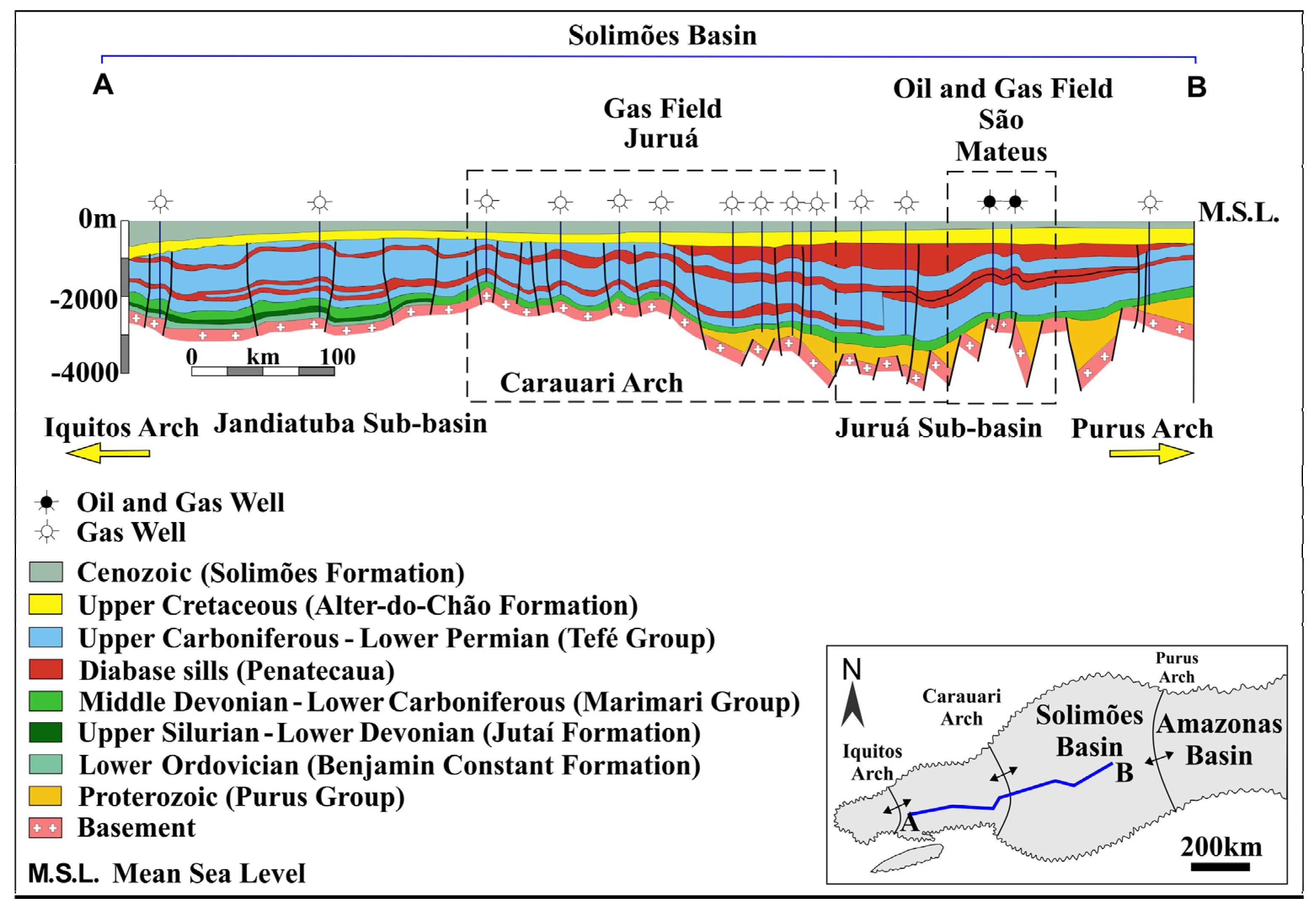
According to Wanderley Filho et al. [20], the stratigraphic framework of the Solimões Basin is primarily based on the research elaborated by Silva [22] and is divided into five depositional sequences limited by regional unconformities. The ages of these sequences are as follows: Ordovician (Benjamim Constant Formation), Upper Silurian–Lower Devonian (Jutaí Formation), Middle Devonian–Lower Carboniferous (Marimari Group), Upper Carboniferous–Permian (Tefé Group), and Upper Cretaceous–Quaternary (Javari Group). The Penatecaua Magmatism of the Triassic is also included in this package. A transpressive tectonic event deformed the diabase sills but did not affect the Alter do Chão Formation (Upper Cretaceous) and Solimões Formation at the base and the top of the Javari Group. This event resulted in the formation of folds and anticlines which, in the Urucu and Juruá petroleum provinces, amplified the paleo-highs that would eventually constitute the traps for oil and gas accumulations (Figure 1).
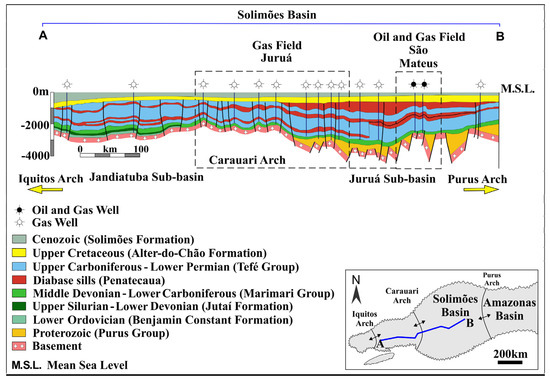
Figure 1.
Schematic Cross-Section of the Solimões Basin—five main stratigraphic sequences (Benjamim Constant, Jutaí, Marimari, Tefé, and Javari (Alter do Chão e Solimões formations))—groups and the Triassic Penatecaua Magmatism. Folding and anticlinal structures, resulting from a transpressive tectonic event, created traps for valuable oil and gas accumulations (e.g., Urucu and Juruá provinces). Modified from Eiras [23] and Caputo [24].
This is the major hydrocarbon intracratonic province in Brazil, and despite the relatively limited drilling activity (only 251 wells, of which 155 wildcats), the basin ranks highly among domestic oil producers, yielding significant volumes of light oil (42° to 52° API) and natural gas [25]. The Jandiatuba-Juruá system is recognized as the dominant petroleum system driving commercial accumulations [25,26]. The principal reservoir facies consist of the fluvial-aeolian Juruá Formation sandstones, which are sealed by the evaporitic succession of the Carauari Formation. Classical trapping mechanisms involve Jurassic–Cretaceous reverse faults associated with anticlinal structural closures. Hydrocarbon generation was fundamentally governed by source rock burial to a maximum of 3800 m (present-day depth), supplemented by the thermal effects of a significant eroded overburden. The Paleozoic stratigraphy was subsequently affected by widespread, thick intrusive igneous bodies, which induced accumulations that were secondary and extensively cracked due to intense heat from igneous activity in existing oil and contributed additional thermal energy for hydrocarbon generation [27]. The primary source rock is attributed to the Devonian black shales of the Jandiatuba Formation (TOC approximately 5.5%) [25].
As discussed by Speight [28], light crude oil is generally associated with lower environmental impacts when compared to heavier oils. Its lower viscosity facilitates easier extraction and flow, often requiring less energy, reduced heating, and fewer chemical additives during production. In terms of refining, light crude oils are less processing-intensive due to their higher proportion of short-chain hydrocarbons, requiring less upgrading, hydrogen input, and thermal cracking than heavy crudes. Consequently, this results in lower greenhouse gas emissions per refined barrel. Additionally, the lower concentrations of problematic components such as sulfur, metals (Ni and V), and asphaltenes lead to reduced generation of toxic byproducts and smaller volumes of solid waste during refining.
3. Materials and Methods
3.1. Sampling
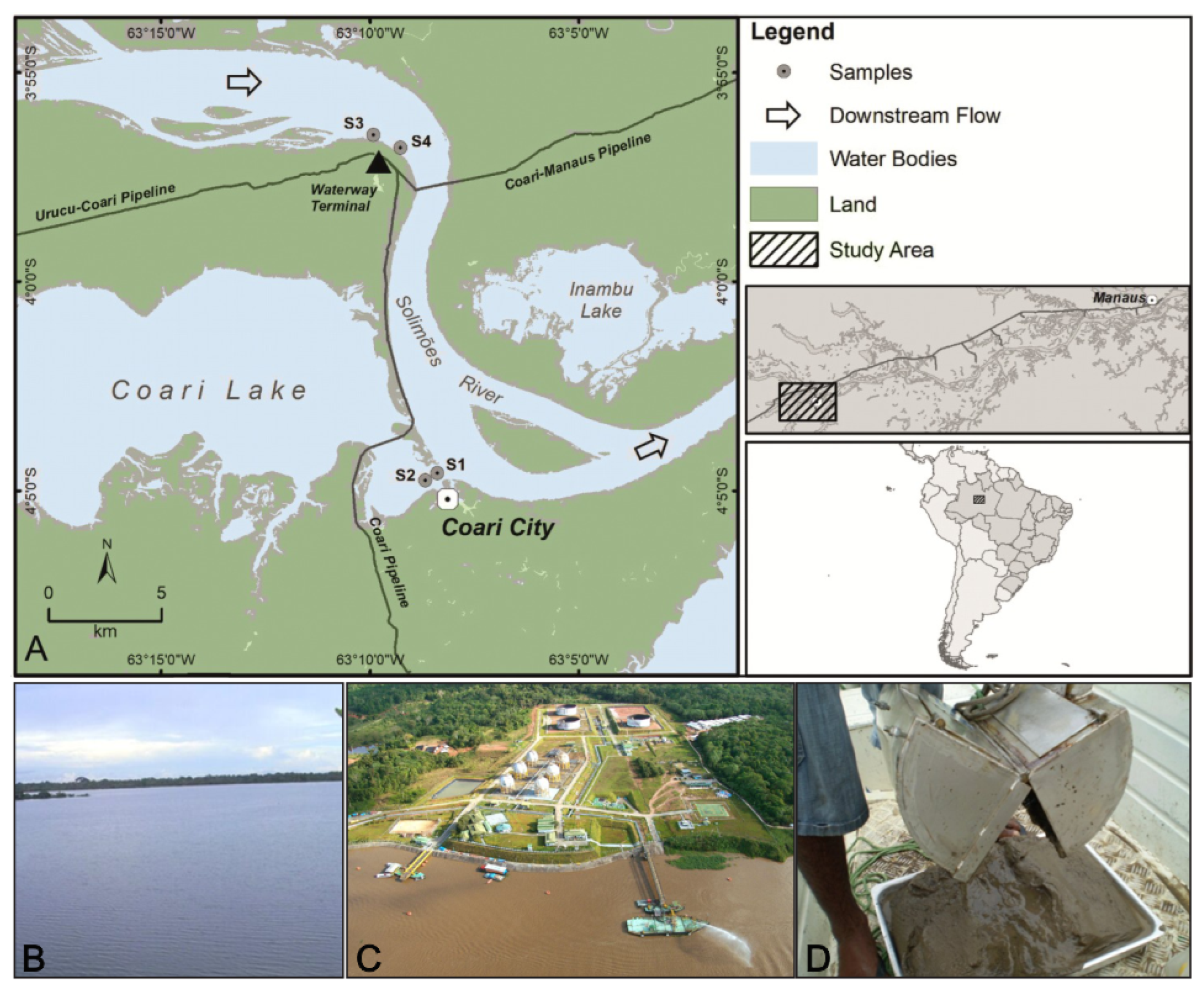
Sediment sampling was performed using a stainless-steel van-Veen grab. Four samples were collected, one at each sampling point, as shown in Figure 2. Two samples were collected from Lake Coari (S1 and S2), and two others were collected along the river (S3 and S4). All samples were stored in aluminum containers and subsequently frozen at −20 °C.
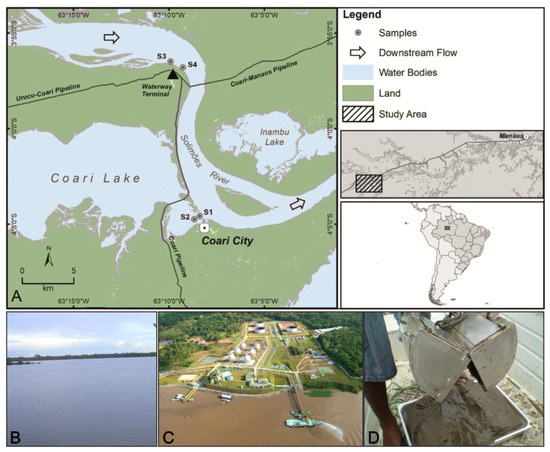
Figure 2.
(A) Study area in Coari Lake, showing the sampling sites in Coari Lake (S1 and S2) and along the Solimões River (S3 and S4). (B) Photograph of Coari Lake (S1 and S2—sampling sites). (C) TESOL terminal on the Solimões River (S3 and S4—sampling sites). (D) Surface sediment collection in Coari Lake (S1 and S2—sampling sites).
3.2. Cleaning of Materials
All glassware used was initially washed with water and common detergent and then submerged in a 10% Detertec-13 (Vetec) solution for 24 h to eliminate any organic residue. Subsequently, the material was exhaustively rinsed with running water and finally with distilled water. The material was dried in an oven at approximately 105 °C, with the exception of volumetric glass ware, which was dried at room temperature, and properly stored.
3.3. Reagent Treatment
The analysis of organic compounds in sediments requires certain precautions, as it is a trace analysis, such as the use of high-purity solvents. Thus, all solvents used (dichloromethane, methanol, hexane) were pesticide-grade. Furthermore, the material used during the compound fractionation in the column (cotton and silica) was purified. The cotton was previously treated by Soxhlet extraction with dichloromethane for 72 h. Before use, the silica (silica gel 60; 0.063–0.200 mm; Merck) was activated in an oven at 120 °C for 12 h. After cooling, the silica was stored in a desiccator.
3.4. Sample Preparation
3.4.1. Ultrasonic Extraction
The extraction was performed by accurately weighing approximately 30 g of each air-dried sediment sample (dried at 30 °C in a forced-air circulation oven), which was then extracted with 50 mL of a dichloromethane:methanol solution (9:1 v/v) in an ultrasonic bath for 20 min at room temperature. This procedure was repeated three more times. The resulting extracts were concentrated using a rotary evaporator under reduced pressure. The extraction conditions were evaluated in a previous study [29].
3.4.2. Liquid Chromatography Fractionation (Column Chromatography)
The extracts obtained in the previous step were fractionated by liquid chromatography. A slurry of silica (previously activated for 24 h at 120 °C) in 10 mL of n-hexane was added to the glass column. Three fractions were collected: saturated hydrocarbons, aromatic hydrocarbons, and polar compounds. The saturated hydrocarbon fraction was eluted with 10 mL of n-hexane; the aromatic fraction was eluted with 10 mL of n-hexane:dichloromethane (8:2, v/v); and the polar compounds were eluted with 10 mL of dichloromethane:methanol (9:1, v/v). The fractions were concentrated using a rotary evaporator under reduced pressure. The fractions were analyzed by GC-FID and GC-MS.
3.4.3. Gas Chromatography with Flame Ionization Detection (GC-FID)
The fractions obtained from column chromatography, containing the aliphatic compounds and aromatic hydrocarbons, were analyzed by gas chromatography with a hydrogen flame ionization detector (GC-FID) using an Agilent Technologies model 7890A gas chromatograph. Analyses were performed using a fused silica capillary column with an HP-5MS stationary phase (Agilent Technologies, USA; J & W, 60 m, 0.25 mm i.d., df = 0.25 µm). The analytical conditions used were 40 °C to 150 °C at 15 °C/min, followed by 150 °C to 325 °C at 3.0 °C/min. The injector temperature was set to 320 °C and the detector temperature was 340 °C. Hydrogen was used as the carrier gas, and 1 µL of sample was injected in splitless mode.
3.4.4. Gas Chromatography Coupled with Mass Spectrometry (GC-MS)
The fractions obtained from column chromatography were also analyzed by gas chromatography coupled with mass spectrometry (GC-MS) using an Agilent Technologies model 6890 gas chromatograph. Analyses were performed using a fused silica capillary column with an HP-5MS stationary phase (Varian, USA; J & W, 30 m, 0.25 mm i.d., df = 0.25 µm). The analytical conditions used were 40 °C to 150 °C at 15 °C/min, followed by 150 °C to 325 °C at 3.0 °C/min. The injector temperature was set to 320 °C. Helium was used as a carrier gas, and 1 µL of sample was injected in splitless mode. Samples were analyzed in full scan (SCAN) mode and by selected ion monitoring (SIM) using electron impact (EI) ionization at 70 eV.
3.4.5. Quality Control and Quality Assurance
The analytical performance of the sediment method was systematically assessed to ensure the reliability and robustness of the generated data prior to its application to environmental samples. Procedural blanks consisting of sediment matrices previously subjected to multiple extraction steps were analyzed to confirm the absence of target compounds. These blank sediments were subsequently fortified with n-tetracosane-d50 and a mixture of polycyclic aromatic hydrocarbons (PAHs), including phenanthrene, fluoranthene, pyrene, chrysene, benzo[a]anthracene, benzo[b]fluoranthene, benzo[k]fluoranthene, benzo[a]pyrene, indeno[1,2,3-cd]pyrene, dibenz[a,h]anthracene, benzo[g,h,i]perylene, and perylene, at five concentration levels covering the working range of the method.
The results acquired from the fortified blank samples were used to estimate the method detection limits (MDLs). The MDLs were calculated for each compound as the mean concentration measured in the blanks plus three times the corresponding standard deviation. For analytes not detected in blank samples, MDLs were derived from their instrumental detection limits. The main statistical performance parameters of the method are summarized in Table 1.

Table 1.
Analytical performance parameters of the method for n-alkane and polycyclic aromatic hydrocarbons (PAHs) in sediment samples.
Instrumental suitability was verified prior to each analytical batch through the injection of standard solutions of n-tetracosane-d50 for GC-FID and PAH standards for GC-MS, allowing for the evaluation of chromatographic performance, peak resolution, and detector response. During routine analysis, solvent blanks, calibration standards, and fortified quality control samples were analyzed to monitor potential contamination, analytical stability, and method accuracy.
Limits of detection (LOD) and limits of quantification (LOQ) were established following international guidelines [30,31]. LODs were determined using a signal-to-noise ratio of 3 under selected ion monitoring (SIM) conditions, whereas LOQs were calculated based on a signal-to-noise ratio of 10, both considering the lowest fortification level evaluated.
Calibration curves generated from fortified sediment samples containing PAHs showed satisfactory linearity over the investigated concentration ranges. In the aliphatic fraction, n-tetracosane-d50 was used as the internal standard, whereas in the aromatic fraction, deuterated pyrene was used as the internal standard. The method exhibited adequate accuracy, with recoveries ranging from 64 to 104%, and acceptable precision, with relative standard deviations generally below 31%. Under these conditions, the quantification limits ranged from 0.02 to 0.55 ng g−1 for PAHs and from 6.0 ng g−1 for n-tetracosane-d50, as detailed in Table 1.
3.4.6. Statistical Analysis
ANOVA was used to assess differences between sampling years (2012 and 2025) for each compound, using year as a fixed factor and points S1–S4 as samples. Tukey’s test was used to compare means when ANOVA indicated a significant effect (p < 0.05), with differences represented by distinct letters in the figures. The normality of residuals was verified by the Shapiro–Wilk test and the homogeneity of variances by Levene’s test. To explore multivariate patterns not evident in the univariate analyses, a Principal Component Analysis (PCA) was applied to all n-alkanes and aromatic hydrocarbons, using autoscaled data (centering on the mean and dividing by the standard deviation).
4. Results
4.1. Aliphatic Hydrocarbons
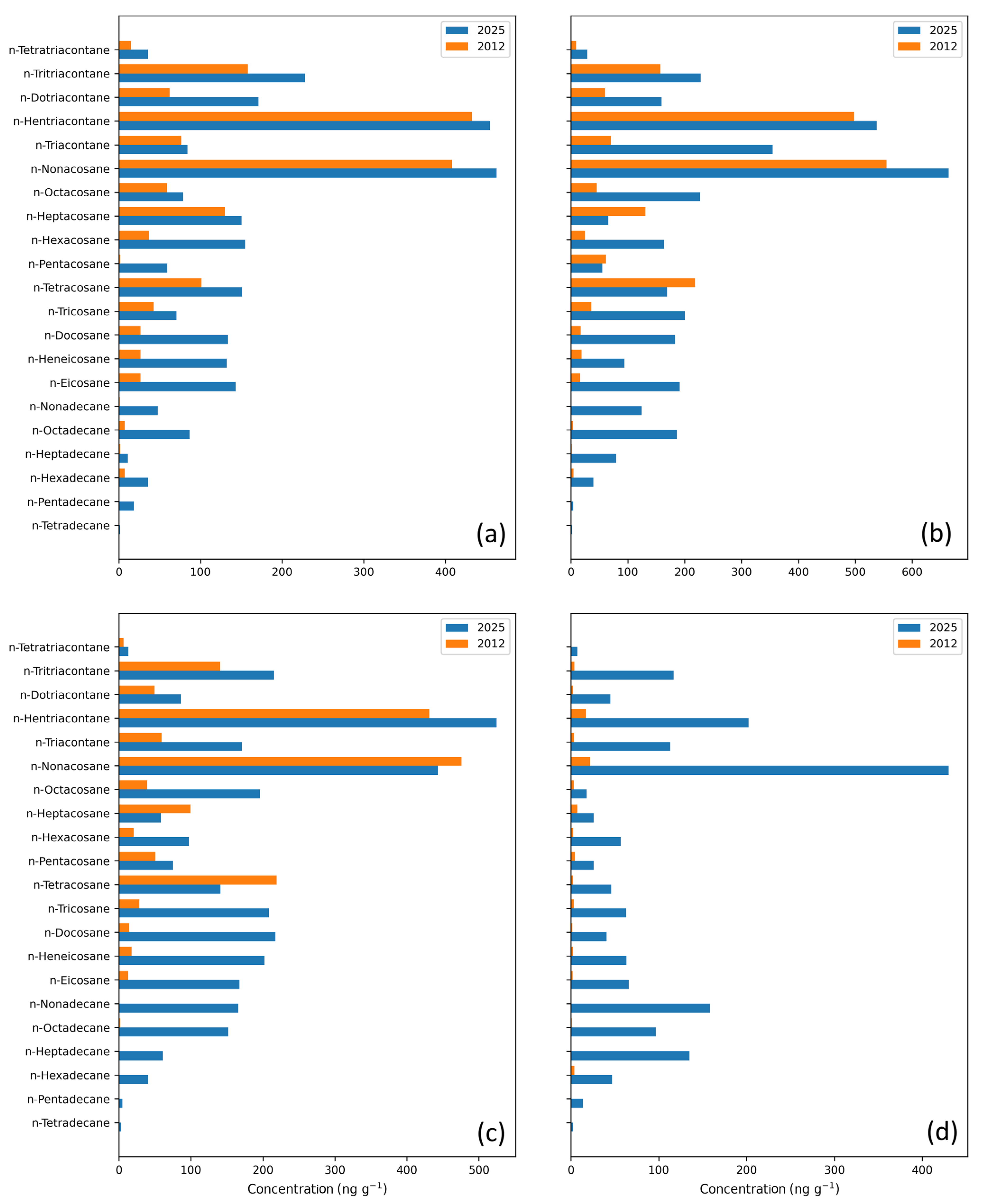
Homologous series of n-alkanes were identified in the new samples, allowing for the determination of the Carbon Preference Index (CPI) and the carbon number of maximum abundance (Cmax) (Figure 3; Table S1). The n-alkanes in the samples ranged from n-C14 to n-C34, with pronounced maxima in the long-chain odd homologues, particularly n-Nonacosane (C29) and n-Hentriacontane (C31). CPI values ranged between 2.5 and 5.1. Total n-alkane concentrations varied from 1771.1 to 3758.0 ng g−1, corresponding to moderate–high natural hydrocarbon contents.
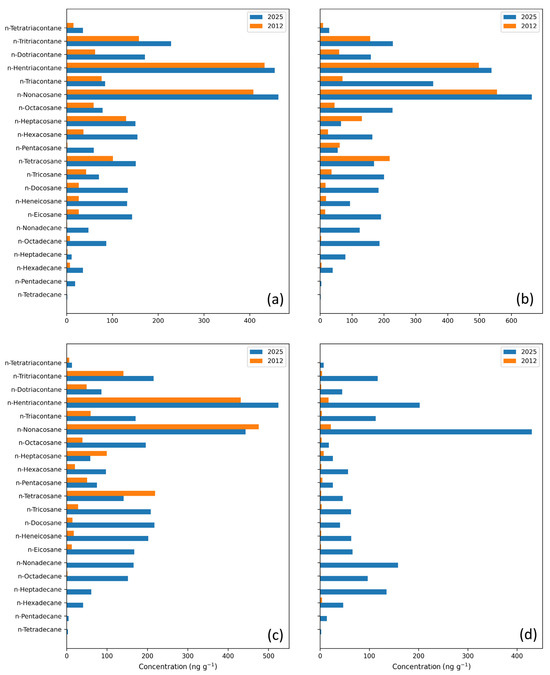
Figure 3.
Concentrations of individual n-alkanes (ng g−1) in surface sediments from Coari Lake and the Solimões River in 2012 (orange), as shown in Berg et al. [19] (blue) for the different collection regions: (a) S1, (b) S2, (c) S3, and (d) S4.
Comparison between the two sampling periods across the four sampling sites (S1–S4) showed that the n-alkane distributions in 2025 broadly mirror the patterns observed in 2012 (Figure 3). It is noteworthy that S4 exhibited the largest variations between periods, which may be related to its closer proximity to the refinery, as shown in Figure 2. Differences between campaigns are mainly expressed as changes in concentration magnitude rather than alterations in the overall compositional pattern. Several mid- to long-chain n-alkanes (approximately C19–C24 and C27–C31) exhibited higher concentrations at some sites in 2025, whereas short-chain compounds (≤C16–C18) remained consistently low across the transect.
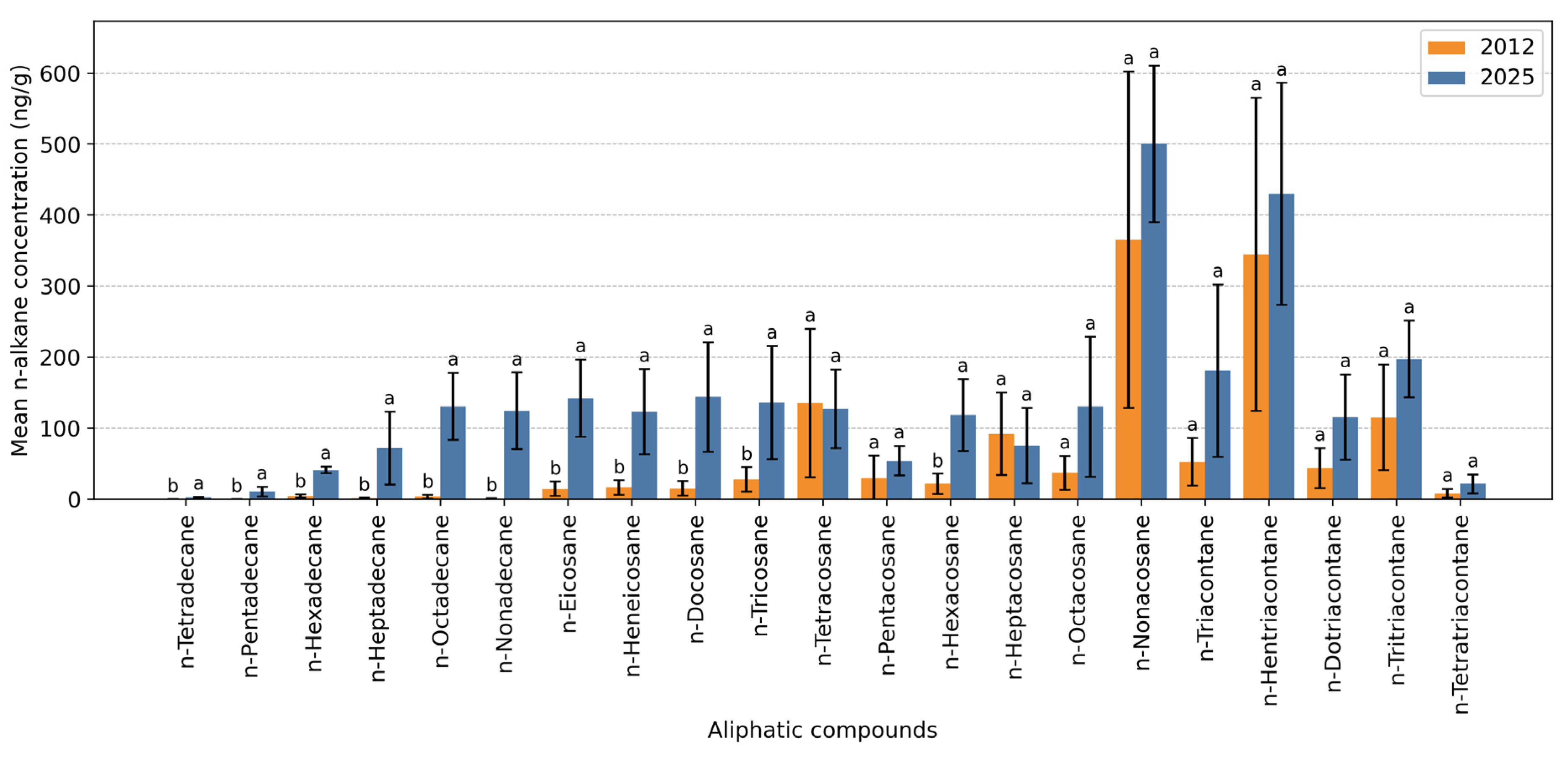
Samples were grouped according to sampling year and compared using one-way ANOVA to assess decadal variability across all sites. The results (Figure 4) indicate that most compounds did not differ significantly between years, except for n-alkanes in the C14–C23 range, which presented significantly higher concentrations in 2025. This pattern was also observed when sites were evaluated individually, as illustrated in Figure 3.
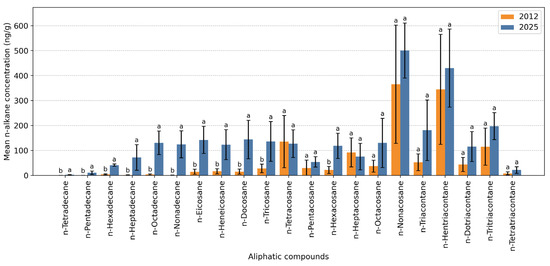
Figure 4.
Mean concentrations of individual n-alkanes (ng g−1) in surface sediments from Coari Lake and the Solimões River in 2012 (orange), as shown in Berg et al. [19] (blue). Values represent the average of four sites (S1–S4), and error bars indicate standard deviation (n = 4) amongst the different samples. Different letters above bars denote significant differences between sampling years for each compound (one-way ANOVA followed by Tukey’s test, p < 0.05).
4.2. Aromatic Hydrocarbons
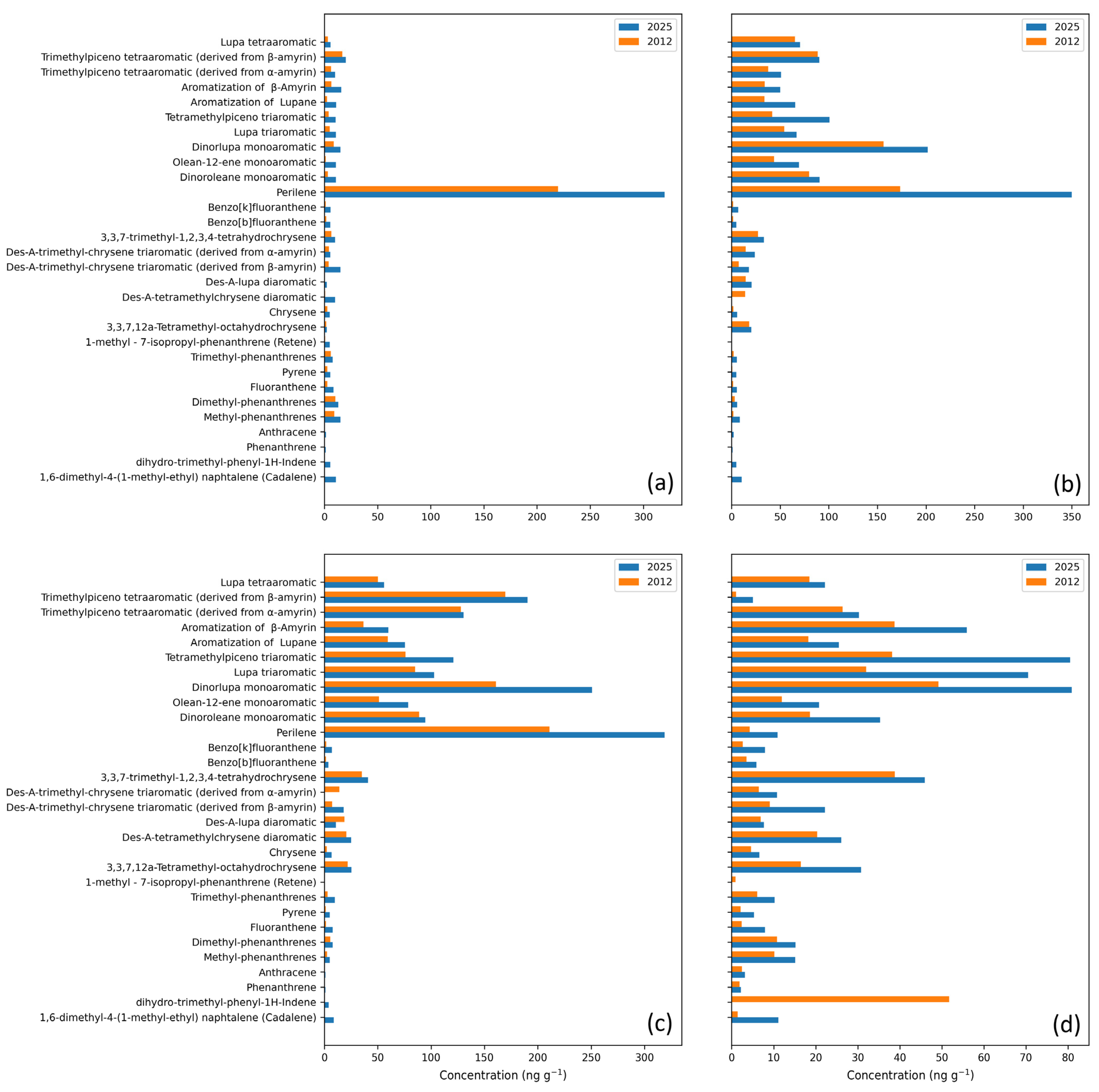
Among the aromatic hydrocarbons, perylene was the most abundant compound in all samples (Figure 5; Table S2). The ratio of perylene relative to the sum of PAHs monitored at m/z 252 exceeded 70% for all samples.
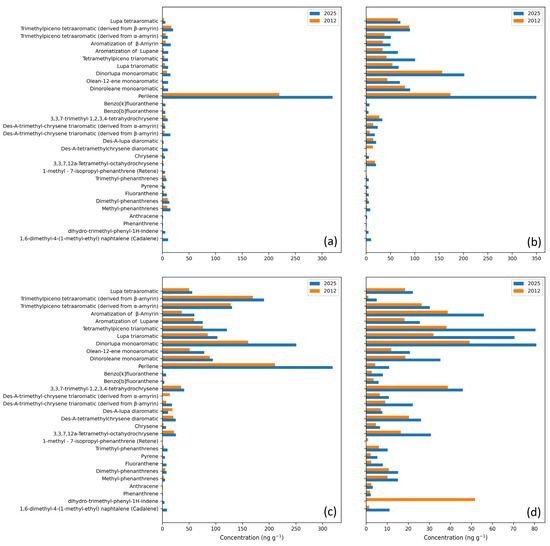
Figure 5.
Concentrations of individual aromatic hydrocarbons (ng g−1) in surface sediments from Coari Lake and the Solimões River in 2012 (orange), as shown in Berg et al. [19] (blue) for the different collection regions: (a) S1, (b) S2, (c) S3, and (d) S4.
Other biogenic-related aromatic compounds were also detected in the majority of samples, including monoaromatic lupane (A-ring), 3,3,7-trimethyl-1,2,3,4-tetrahydrochrysene, and 3,4,7,12a-tetramethyl-1,2,3,4,4a,11,12,12a-octahydrochrysene.
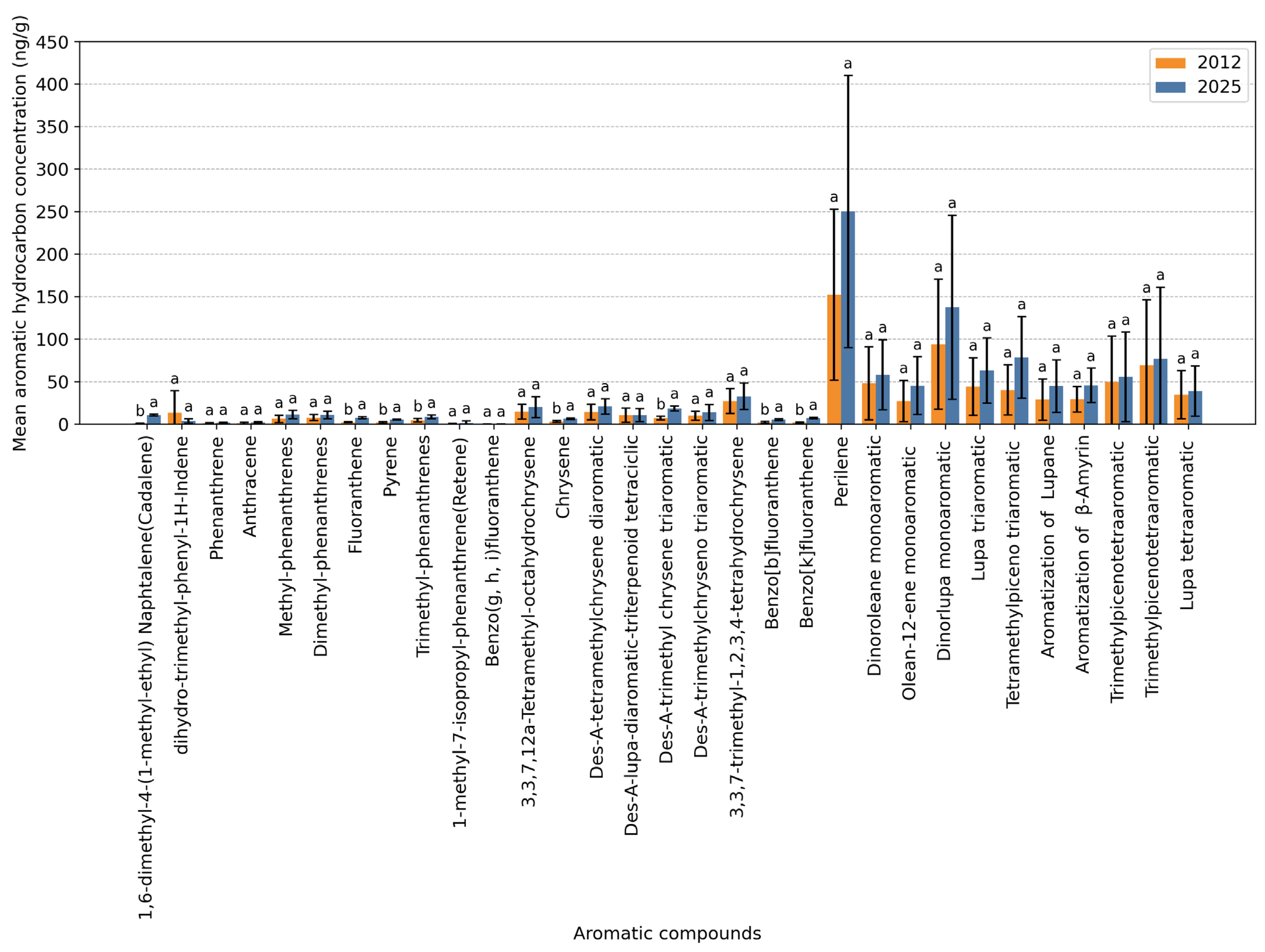
Monoaromatic dinoroleane, monoaromatic olean-12-ene (A-ring), and monoaromatic lupene (A-ring) were detected at all sites (S1–S4). Methyl- and dimethyl-phenanthrenes were also observed at trace levels. In general, the sediment samples from Coari Lake therefore showed an intense contribution of aromatic compounds derived from natural pentacyclic triterpene precursors (α-amyrin, β-amyrin, and lupeol). The aromatic fraction of the surface sediments was composed of low- to moderate-abundance PAHs, with most compounds occurring at concentrations below 100 ng g−1 and only a few species exceeding this level (Figure 4). Parent 3–4-ring PAHs such as phenanthrene, anthracene, fluoranthene, and pyrene displayed relatively low mean concentrations in both sampling periods. Several aromatic biomarkers, such as cadalene, retene-type compounds, des-A triterpenoids, and aromatic hopanoid-like compounds, were detected in most samples. Perylene was the most abundant individual compound in both 2012 and 2025, although its large standard deviations indicated substantial spatial variability among sites.
When the two sampling periods are compared as groups, statistically significant differences are restricted to a subset of compounds (Figure 6). Cadalene, fluoranthene, pyrene, chrysene, 3,3′,7,12a-tetramethyloctahydrochrysene, some trimethylphenanthrenes, and the high-molecular-weight PAHs benzo[b]fluoranthene and benzo[k]fluoranthene show higher mean concentrations in 2025 than in 2012, as indicated by distinct Tukey letters (a vs. b). In contrast, dihydro-trimethyl-phenyl-1H-indene presented higher levels in 2012.
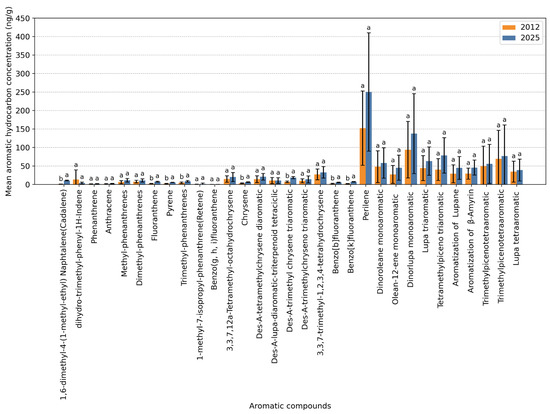
Figure 6.
Mean concentrations of individual aromatic hydrocarbons (ng g−1) in surface sediments from Coari Lake and the Solimões River in 2012 (orange), as shown in Berg et al. [19] (blue). Values represent the average of four sites (S1–S4), and error bars indicate standard deviation (n = 4) amongst the different samples. Different letters above bars denote significant differences between sampling years for each compound (one-way ANOVA followed by Tukey’s test, p < 0.05).
For perylene and most aromatic triterpenoids, the mean concentrations tended to be higher in 2025, but the differences were not statistically significant because of the large variability.
4.3. Multivariate Assessment
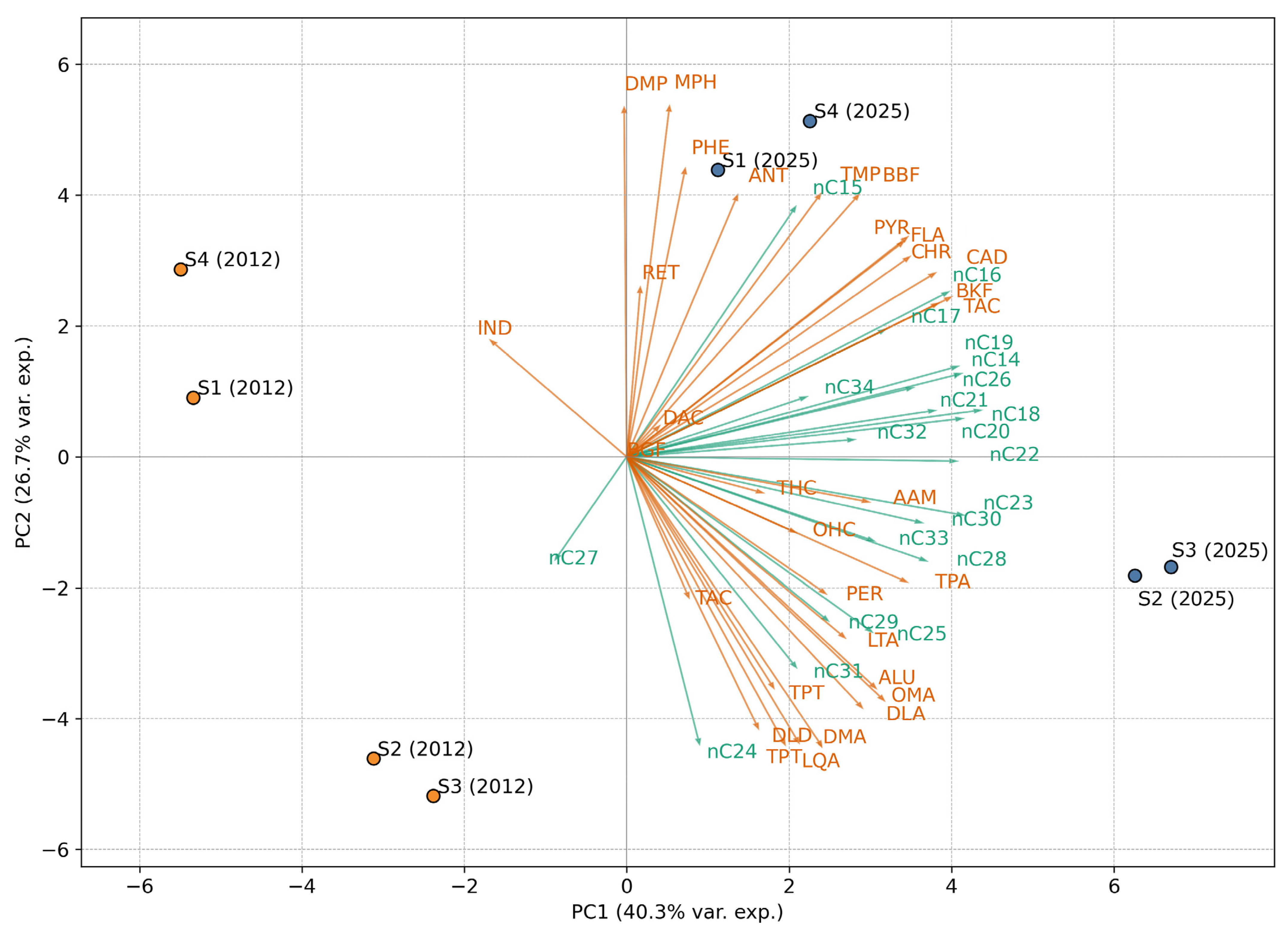
In order to explore multivariate patterns that were not evident from the univariate results, a principal component analysis (PCA) combining all n-alkanes and aromatic hydrocarbons was applied, and the results are shown in Figure 7. In the biplot, loading vectors represent individual compounds, with aliphatic compounds in green and aromatic compounds in orange. The first component (PC1, 40.3% of the variance) clearly separated the two sampling periods: all 2012 samples were plotted on the negative side of PC1, whereas all 2025 samples fell on the positive side. Most variables with the strongest contributions to PC1 showed loadings oriented toward the positive PC1 direction, indicating that the 2025 samples were associated with a broader co-variation (and, overall, higher multicomponent signal) across both aliphatic and aromatic fractions relative to 2012. Accordingly, PC1 was interpreted as a temporal gradient that captured the decadal shift between the two campaigns, rather than a site-specific effect.
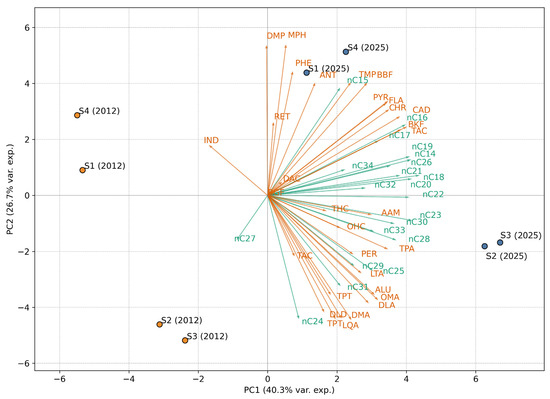
Figure 7.
PCA biplot of n-alkanes and aromatic hydrocarbons in surface sediments from Coari Lake and the Solimões River. Scores are shown for samples collected in 2012 (orange circles), as shown in Berg et al. [19] (blue circles), while arrows represent compound loadings (green = aliphatic hydrocarbons; orange = aromatic hydrocarbons). Abbreviations: nCx indicates linear n-alkanes, where x corresponds to the number of carbon atoms in the chain (e.g., nC14 = n-tetradecane; nC15 = n-pentadecane). CAD (1,6-dimethyl-4-(1-methyl-ethyl) naphthalene, cadalene); IND (dihydro-trimethyl-phenyl-1H-indene); PHE (phenanthrene); ANT (anthracene); MPH (methyl-phenanthrenes); DMP (dimethyl-phenanthrenes); TMP (trimethyl-phenanthrenes); FLA (fluoranthene); PYR (pyrene); RET (1-methyl-7-isopropyl-phenanthrene, retene); BGF (benzo[g,h,i]fluoranthene); BBF (benzo[b]fluoranthene); BKF (benzo[k]fluoranthene); PER (perilene); CHR (chrysene); OHC (3,3,7,12a-tetramethyl-octahydrochrysene); THC (3,3,7-trimethyl-1,2,3,4-tetrahydrochrysene); DAC (des-A-tetramethylchrysene diaromatic); TAC (des-A-trimethyl chrysene/chrysenotri-aromatic); DMA (dinoroleane monoaromatic); OMA (olean-12-ene monoaromatic); DLA (dinorlupa monoaromatic); LTA (lupa triaromatic); LQA (lupa tetraaromatic); TPA (tetramethylpicene triaromatic); TPT (trimethylpicene tetraaromatic); ALU (aromatization of lupane); AAM (aromatization of β-amyrin).
The second component (PC2, 26.8% of the variance) revealed a spatial structure that was consistent across years. Samples from S1 and S4 (both 2012 and 2025) were plotted in the positive PC2 quadrant, whereas S2 and S3 (both 2012 and 2025) were plotted in the negative PC2 quadrant. This axis was associated with two partially contrasting groups of compounds: on the positive side of PC2, several parent PAHs and related aromatics (including phenanthrene/anthracene-type signals, methylated phenanthrenes, and higher-molecular-weight PAHs such as benzo[b]fluoranthene and benzo[k]fluoranthene), together with some lower- to mid-chain n-alkanes, showed positive loadings; on the negative side, aromatic triterpenoids (e.g., lupane/oleanane-derived mono-, tri- and tetra-aromatic structures and aromatization products) and multiple mid- to long-chain n-alkanes displayed negative loadings. Thus, S1 and S4 were characterized by a relatively stronger PAH-related contribution, whereas S2 and S3 were comparatively more influenced by higher-plant biomarker-type aromatics and long-chain aliphatic homologues.
5. Discussion
5.1. Aliphatic Hydrocarbons
In this study, Carbon Preference Index (CPI) values ranging from 2.5 to 5.1, together with a maximum abundance (Cmax) at C29 and C31, are consistent with values reported for sediments from the Amazon region [32].These results indicate a predominant biogenic origin for the n-alkanes, as n-alkanes derived from biomass burning are often indistinguishable from those originating from vascular plants [33]. Compounds with carbon numbers higher than C23 are typically associated with inputs from higher plants, whereas those below C22 generally reflect microbial contributions [34,35].
Samples from Coari Lake exhibited a unimodal n-alkane distribution pattern. The absence of pristane and phytane, as well as the lack of petroleum biomarkers such as hopanes and steranes, indicates no evidence of fossil fuel contamination throughout the analyzed period (2012–2025).
Assuming that the study area lies within the broader influence zone of the Urucu oil and gas province and associated production/transport infrastructure, evaluating whether increased hydrocarbon levels could reflect petrogenic imprinting is essential. However, despite this operational context, the total n-alkane concentrations remain characteristic of natural organic matter inputs, and the concentrations are well below levels commonly associated with contaminated sediments (e.g., <50,000 ng g−1 dry sediment as typical of unpolluted environments [36]). This interpretation is consistent with baseline evidence reported for the region by Berg et al. [19], who likewise found a predominantly biogenic hydrocarbon signature and no indication of petrogenic contribution.
Although absolute n-alkane concentrations increased between 2012 and 2025, the compositional pattern remained largely unchanged. Statistically significant increases were observed mainly for short- to mid-chain n-alkanes (C14–C23), which are known to be more sensitive to environmental conditions such as hydrology, redox state, and early diagenesis. In lacustrine and floodplain systems, short-chain n-alkanes are often associated with algal and microbial production, whereas mid-chain compounds may reflect inputs from aquatic macrophytes [37,38].
The overall increase in long-chain n-alkanes, particularly C29 and C31, suggests enhanced transport of terrestrial plant debris into Coari Lake over the last decade. This trend is consistent with documented land-use changes in the Coari region, including deforestation, expansion of urban areas, and increased soil exposure [39]. Infrastructure development associated with oil and natural gas activities, such as the Urucu–Coari–Manaus gas pipeline and the Solimões Oil Terminal, has contributed to landscape modification and vegetation removal, thereby enhancing surface runoff and erosion. These processes facilitate the transport of terrigenous organic matter into the lake, explaining the observed increase in n-alkane concentrations without invoking petrogenic contamination.
5.2. Aromatic Hydrocarbons
The aromatic hydrocarbon composition of Coari Lake sediments is characterized by a strong predominance of perylene in all analyzed samples. Perylene accounted for more than 70% of the total PAHs in all samples. Although the origin of perylene remains debated—being attributed to either biogenic or pyrogenic sources [40,41,42]—its consistent occurrence and high relative abundance strongly support a biogenic origin in this setting. Similar conclusions were reported for northern Amazon sediments, where perylene was linked to continental vegetation and the preservation of its precursors in decomposing plant material [43].
Importantly, perylene is well known to have strong diagenetic controls and may be enhanced under reducing conditions and/or linked to specific terrigenous organic matter pathways, so its temporal variability is not as straightforward to interpret as “pollution change” alone [44,45]. Overall, the aromatic dataset therefore suggested moderate temporal changes in specific PAHs and biomarkers, superimposed on a broadly similar compound distribution between 2012 and 2025, with the dominant imprint remaining consistent with mixed natural/diagenetic sources and only a limited strengthening of selected pyrogenic PAHs.
The detection of monoaromatic triterpenes and related diagenetic products further reinforces the dominance of natural organic inputs. These compounds are formed through early diagenetic processes involving oxidation, microbial transformation, and partial aromatization of pentacyclic triterpenoids such as α-amyrin, β-amyrin, and lupeol [46,47]. Their presence reflects the strong influence of forest-derived organic matter in the sediments of Coari Lake.
Although some aromatic markers may also originate from biomass burning, as reported for aerosols in the Amazon region [33], the overall aromatic assemblage does not exhibit diagnostic features of petroleum-derived inputs. Instead, the observed increases in selected PAHs between 2012 and 2025 involve mainly parent (non-alkylated) 4–5-ring compounds (e.g., chrysene and benzo-fluoranthenes), which are widely used as indicators of pyrogenic inputs (combustion, biomass burning, and engine emissions) in sediments. In contrast, petrogenic inputs typically display a stronger contribution of alkylated homologues and distinct diagnostic patterns [48]. In this context, the observed increases likely reflect a greater contribution of regionally transported combustion-derived material and/or enhanced local deposition and resuspension processes over the last decade, rather than a shift toward a petroleum signature—an interpretation that is particularly relevant given the long-standing oil production activities in the region [48].
Generally, the aromatic hydrocarbon record indicates moderate temporal changes superimposed on a broadly stable compositional pattern dominated by biogenic and diagenetic sources. The sedimentary archive therefore reflects environmental changes in the watershed, including deforestation, erosion, and biomass-related processes, rather than impacts directly attributable to petroleum exploration and production activities.
6. Conclusions
The results obtained in this study clearly indicate a predominance of biogenic inputs to the surface sediments of Coari Lake. All samples exhibited a clear odd-over-even predominance of n-alkanes, with maximum abundance at C29 and C31, reflecting a dominant contribution from higher-plant waxes. Total n-alkane concentrations ranged from 1771.1 to 3758.0 ng g−1, remaining well below values typically reported for contaminated environments. The absence of an unresolved complex mixture (UCM) and the non-detection of petrogenic hopanes further confirm the lack of petroleum-derived hydrocarbon inputs to the system.
Furthermore, among the aromatic hydrocarbons, perylene was consistently the most abundant polycyclic aromatic hydrocarbon (PAH), with concentrations between 10.9 and 350.1 ng g−1, indicating a substantial contribution of terrestrial organic matter. In addition, the occurrence of aromatic biomarkers derived from pentacyclic triterpenoids (e.g., α-amyrin, β-amyrin, and lupeol) highlights the strong influence of higher-plant precursors in the sedimentary organic matter pool.
It is noteworthy that despite the proximity of the Solimões Oil Terminal (TESOL) and long-standing oil and gas activities in the municipality of Coari (Amazonas State), no geochemical evidence of oil pollution was identified in the sediments of Coari Lake. Instead, the hydrocarbon signatures reflect natural biogenic and diagenetic processes, modulated by terrestrial organic matter inputs and regional environmental dynamics. In general, the sedimentary record indicates environmental changes driven by land-use and watershed processes rather than direct impacts from petroleum exploration or transport activities.
Supplementary Materials
The following supporting information can be downloaded at https://www.mdpi.com/article/10.3390/geosciences16020078/s1, Table S1: Concentration (ng/g) of Aliphatic compounds in the sediment of Coari Lake (2025) and Berg et al. [19]; Table S2: Aromatic hydrocarbons identified and quantified (ng/g) in the sediment of Coari Lake (2025) and Berg et al. [19].
Author Contributions
J.C.d.A.: Conceptualization, investigation, data curation, writing—original draft, visualization, writing—review and editing. V.K.: Writing—original draft, data curation, visualization, writing—review and editing. M.M.M.: Conceptualization, investigation, visualization, writing—review and editing. P.M.C.: Conceptualization, investigation, visualization, writing—review and editing. D.E.S.d.R.: Data curation, writing—original draft, visualization, writing—review and editing. T.C.S.d.O.: Sample collection, data curation, methodology, writing—review and editing. C.Y.d.S.S.: Project supervision, conceptualization, data curation, methodology, writing—original draft and review. All authors have read and agreed to the published version of the manuscript.
Funding
This research received no external funding.
Data Availability Statement
All data and materials during this study are included in this manuscript and the Supplementary Materials.
Acknowledgments
The authors thank two anonymous reviewers for their valuable comments on the manuscript. We are grateful to Petrobras/CENPES for financial support in the field work, IQ/UFRJ for chemical analysis and COPPE/UFRJ for providing access to the laboratory facilities. Mário Miguel Mendes and Pedro Miguel Callapez gratefully acknowledge financial support from the CITEUC—Centre for Earth and Space Research of the University of Coimbra, Portugal (UID/Multi/00611/2020 research project of FCT).
Conflicts of Interest
The authors declare no conflicts of interest.
Abbreviations
The following abbreviations are used in this manuscript:
| GC-FID | Gas Chromatography with Flame Ionization Detector |
| GC-MS | Gas Chromatography–Mass Spectrometry |
| HRGC-MS | High-Resolution Gas Chromatography coupled with Mass Spectrometry |
| TAH | Total Aliphatic Hydrocarbon |
| PAH | Polycyclic Aromatic Hydrocarbon |
| SCAN | Full Scan |
| EI | Electron Impact Ionization |
| SIM | Selected Ion Monitoring |
| CPI | Carbon Preference Index |
| Cmax | Maximum Abundance Compound |
| TIC | Total Ion Chromatogram |
| UCM | Unresolved Complex Mixture |
References
- Rosengard, S.Z.; Moura, M.S.; Spencer, R.G.M.; Johnson, C.; McNichol, A.; Boehman, B.; Galy, V. The thermal reactivity and molecular diversity of particulate organic carbon in the Amazon River mainstem. J. Geophys. Res. Biogeosci. 2025, 130, e2024JG008660. [Google Scholar] [CrossRef]
- Selvaggi, R.; Damianić, B.; Goretti, E.; Pallottini, M.; Petroselli, C.; Moroni, B.; La Porta, G.; Cappelletti, D. Evaluation of geochemical baselines and metal enrichment factor values through high ecological quality reference points: A novel methodological approach. Environ. Sci. Pollut. Res. 2020, 27, 930–940. [Google Scholar] [CrossRef] [PubMed]
- Silva-Filho, E.V.; Marques, E.D.; Vilaça, M.; Gomes, O.V.; Sanders, C.J.; Kutter, V.T. Distribution of trace metals in stream sediments along the Trans-Amazonian Federal Highway, Pará State, Brazil. J. S. Am. Earth Sci. 2014, 54, 182–195. [Google Scholar] [CrossRef]
- Gong, Q.; Shi, Z. New advances, challenges, and illustrations in applied geochemistry. Appl. Sci. 2025, 15, 3407. [Google Scholar] [CrossRef]
- Callede, J.; Dupre, B.; RieIux, J.; Lartiges, B. Hydrogeochemistry of the Amazon Basin. In The Amazon: Geochemistry, Geophysics, and Environmental Perspectives; Meadows, M.E., Meadows, D.L., Eds.; Elsevier: Amsterdam, The Netherlands, 2000. [Google Scholar]
- Gudowicz, S.; Kessels, D.; Klose, T.; Schonholzer, V.; Kopelowitz, S.; Schulz, B.H.; Siegel, K. The geochemical record of human impact in Amazonian floodplains. In Proceedings of the International Symposium on Contaminants in the Hydrologic Cycle; Murdoch, L.Q., Ebert, S.J., O’Dell, B.A., Eds.; Springer: Berlin/Heidelberg, Germany, 2010. [Google Scholar]
- Wittmann, H.; Schneider, P.E.; Mendes, S.A.; Weber, K.D.; Silva, T.L.A.P.E.O.; Souza-Filho, E.V.; Reis, A.B.M. Sediment archives in Amazonian várzea lakes: Tools for paleoenvironmental and paleoclimatic reconstruction. J. S. Am. Earth Sci. 2016, 72, 1–13. [Google Scholar]
- Piedade, M.T.F.; Junk, W.J.; D’Ângelo, S.A.; Wittmann, F.; Schöngart, J.; Barbosa, K.M.N.; Lopes, A. Aquatic herbaceous plants of the Amazon floodplains: State of the art and research needed. Acta Limnol. Bras. 2010, 22, 165–178. [Google Scholar] [CrossRef]
- Horbe, A.M.C.; Behling, H.; Nogueira, A.C.R.; Mapes, R. Environmental changes in the western Amazônia: Morphological framework, geochemistry, palynology and radiocarbon dating data. An. Acad. Bras. Ciênc. 2011, 83, 863–874. [Google Scholar] [CrossRef]
- Almeida, W.S.; Souza, N.M. Coari: Petróleo e Sustentabilidade–Um Exemplo Amazônico; Desenvolvimento e Meio Ambiente: Curitiba, Brazil, 2008; pp. 69–92. [Google Scholar]
- Chaves, R.A.; Oliveira, T.K. Source apportionment and risk assessment of PAHs and aliphatic hydrocarbons in riverine sediments affected by oil industry activities. Sci. Total Environ. 2023, 900, 165800. [Google Scholar]
- Silva, R.A.; Rodrigues, P.L.; Farias, M.J.; Santos, H.K.; Lima, E.G.; Oliveira, C.F. Heavy metal contamination in surface sediments of the Madeira River Basin: Ecological risk assessment and source identification. Environ. Sci. Technol. 2024, 58, 4801–4815. [Google Scholar]
- Almeida, L.F.; Costa, S.M.; Freitas, E.K. Chronic toxicity of crude oil components on Amazonian fish species and macroinvertebrates: Insights into long-term environmental consequences. Aquat. Toxicol. 2025, 268, 106750. [Google Scholar]
- Ludwik, L.; Szymczak-Żyła, M. Application of various molecular markers for investigating petrogenic inputs in coastal systems strongly impacted by anthropogenic stressors. Mar. Pollut. Bull. 2024, 201, 116224. [Google Scholar] [CrossRef]
- Cecinato, A.; Bacaloni, A.; Romagnoli, P.; Perilli, M.; Balducci, C. Molecular signatures of organic particulates as tracers of emission sources. Environ. Sci. Pollut. Res. 2022, 29, 65904–65923. [Google Scholar] [CrossRef]
- Yunker, M.B.; Macdonald, R.W.; Snowdon, L.R.; Fowler, B.R. Alkane and PAH biomarkers as tracers of terrigenous organic carbon in Arctic Ocean sediments. Org. Geochem. 2011, 42, 1109–1146. [Google Scholar] [CrossRef]
- Souza, P.C.; Mello, S.P. Mercury pollution in Amazonian aquatic systems: A continuing environmental and public health crisis. Ecotoxicol. Environ. Saf. 2023, 265, 115500. [Google Scholar]
- Abreu, E.C.; Reis, A.B.M.; Wittmann, H. What do paleoecological data tell us about the Amazon Anthropocene? Estud. Avançados 2023, 37, e20230040. [Google Scholar]
- Berg, M.M.; dos Santos Siqueira, C.Y.; Landau, L.; de Miranda, F.P.; Mello, T.S.; Neto, F.R.D.A. Evaluation of the organic matter sources and δ13C composition of individual alkanes for the baseline assessment of hydrocarbons in a pristine area from Amazon region, Brazil. Environ. Earth Sci. 2016, 75, 1034. [Google Scholar] [CrossRef]
- Wanderley Filho, J.R.; Travassos, W.A.S.; Alves, D.B. O Diabásico nas Bacias Paleozóicas Amazônicas—Herói ou Vilão? Bol. Geociênc. PETROBRAS 2006, 14, 117–184. [Google Scholar]
- Caputo, M.V.; Silva, O.B. Sedimentação tectônica da Bacia do Solimões. In Origem e Evolução de Bacias Sedimentares; CENPES: Rio de Janeiro, Brazil, 1990; pp. 169–192. [Google Scholar]
- Silva, O.B. Revisão Litoestratigráfica da Bacia do Solimões. In Proceedings of the XXXV Congresso Brasileiro de Geologia; Sociedade Brasileira de Geologia: Belém, Brazil, 1988; Volume 6, pp. 2428–2433. [Google Scholar]
- Eiras, J.F. A evolução tectono-sedimentar da Bacia do Solimões e implicações para o sistema petrolífero. Rev. Bras. Geociênc. 1999, 29, 419–432. [Google Scholar]
- Caputo, M.V. Estratigrafia, sedimentação e evolução tectônica da Bacia do Solimões. Bol. Geociênc. Petrobras 2007, 15, 123–150. [Google Scholar]
- Bender, M.; Sowers, T.; Labeyrie, L. The Dole effect and its variations during the last 130,000 years as measured in the Vostok ice core. Glob. Biogeochem. Cycles 2010, 24, GB4010. [Google Scholar] [CrossRef]
- Zhang, Y.; Li, X.; Wang, J.; Chen, Z.; Liu, H. Recent advances in organic geochemical tracers for source apportionment of hydrocarbons in aquatic sediments. Org. Geochem. 2025, 186, 104746. [Google Scholar]
- Dahl, J.; Moldowan, J.M.; Sundararaman, P.; Horsfield, B. Diamondoid hydrocarbons as indicators of natural cracking of oil to gas. Nature 1999, 399, 54–57. [Google Scholar] [CrossRef]
- Speight, J.G. The Chemistry and Technology of Petroleum, 5th ed.; CRC Press: Boca Raton, FL, USA, 2014; pp. 1–953. [Google Scholar]
- Da Silva, L.S.V. Aplicação do uso de Biomarcadores em Estudo Paleoambiental do Lago Mar Chiquita, Argentina. Ph.D. Thesis, Universidade Federal do Rio de Janeiro, Rio de Janeiro, Brazil, 2007. [Google Scholar]
- ICH–International Conference on Harmonisation. Validation of Analytical Procedures: Text and Methodology Q2(R1); ICH: Geneva, Switzerland, 1995. [Google Scholar]
- INMETRO–Instituto Nacional de Metrologia, Qualidade e Tecnologia. Orientação Sobre Validação de Métodos Analíticos (DOQ-CGCRE-008); INMETRO: Rio de Janeiro, Brazil, 2003. [Google Scholar]
- Abas, M.R.B.; Simoneit, B.R.T.; Elias, V.; Cabral, J.A.; Cardoso, J.N. Composition of organic compounds in Amazonian aerosols. Chemosphere 1995, 30, 995–1015. [Google Scholar]
- Simoneit, B.R.T. The Organic Chemistry of Marine Sediments. In Chemical Oceanography, 2nd ed.; Riley, J.P., Chester, R., Eds.; Academic Press: New York, NY, USA, 1978; Volume 7, pp. 233–311. [Google Scholar]
- Simoneit, B.R.T.; Cardoso, J.N.; Robinson, N. An assessment of the origin and composition of higher molecular weight organic matter in aerosols over Amazonia. Chemosphere 1990, 21, 1285–1301. [Google Scholar] [CrossRef]
- Baumard, P.; Budzinski, H.; Garrigues, P. Polycyclic aromatic hydrocarbons in sediments and mussels of the western Mediterranean sea. Environ. Toxicol. Chem. 1998, 17, 765–776. [Google Scholar] [CrossRef]
- Meyers, P.A. Applications of organic geochemistry to paleolimnological reconstructions: A summary of examples from the Laurentian Great Lakes. Org. Geochem. 2003, 34, 261–289. [Google Scholar]
- Ficken, K.J.; Li, B.; Swain, D.L.; Eglinton, G. An n-alkane proxy for the sedimentary input of submerged/floating freshwater aquatic macrophytes. Org. Geochem. 2000, 31, 745–749. [Google Scholar]
- Guilherme, A.P.; Mota, A.B.S.; Mota, D.S.; Machado, N.G.; Niudes, R. Use of vegetation index to characterize land use change in Coari, Amazonas, Brazil. Soc. Nat. 2016, 28, 301–310. [Google Scholar]
- Silliman, J.E.; Meyers, P.A.; Eadie, B.J. Perylene: An indicator of alteration processes or precursor materials? Org. Geochem. 1998, 5, 1737–1744. [Google Scholar] [CrossRef]
- Jiang, C.; Alexander, R.; Kagi, R.I.; Murray, A.P. Origin of perylene in ancient sediments and its geological significance. Org. Geochem. 2000, 31, 1545–1559. [Google Scholar] [CrossRef]
- Silliman, J.E.; Meyers, P.A.; Eadie, B.J.; Klump, J.V. A hypothesis for the origin of perylene based on its low abundance in sediments of Green Bay, Wisconsin. Org. Geochem. 2001, 17, 309–322. [Google Scholar]
- Budzinski, H.; Jones, I.; Bellocq, J.; Piérard, C.; Garrigues, P. Evaluation of sediment contamination by polycyclic aromatic hydrocarbons in the Gironde Estuary. Mar. Chem. 1997, 58, 85–97. [Google Scholar] [CrossRef]
- Suzuki, N.; Yessalina, S.; Kikuchi, T. Probable fungal origin of perylene in Late Cretaceous to Paleogene terrestrial sedimentary rocks of northeastern Japan as indicated from stable carbon isotopes. Org. Geochem. 2010, 41, 234–241. [Google Scholar] [CrossRef][Green Version]
- Hanke, U.M.; Lima-Braun, A.L.; Eglinton, T.I.; Donnelly, J.P.; Galy, V.; Poussart, P.; Reddy, C.M. Significance of perylene for source allocation of terrigenous organic matter in aquatic sediments. Environ. Sci. Technol. 2019, 53, 8244–8251. [Google Scholar] [CrossRef]
- Bouloubassi, I. Aspects de la Biogéochimie des Hydrocarbures non Aromatiques et Aromatiques dans la Colonne d’eau et les Sédiments du Milieu Marin Côtier: Cas du Delta du Rhône. Ph.D. Thesis, Université Pierre et Marie Curie, Paris, France, 1990. [Google Scholar]
- Simoneit, B.R.T.; Rushdi, A.I. Abiotic synthesis of organic compounds and biomarkers under hydrothermal conditions. Astrobiology 2005, 5, 749–769. [Google Scholar]
- Tobiszewski, M.; Namieśnik, J. PAH diagnostic ratios for the identification of pollution emission sources. Environ. Pollut. 2012, 162, 110–119. [Google Scholar] [CrossRef] [PubMed]
- Soclo, H.H.; Garrigues, P.H.; Ewald, M. Origin of polycyclic aromatic hydrocarbons (PAHs) in coastal marine sediments: Case studies in Cotonou (Benin) and Aquitaine (France) areas. Mar. Pollut. Bull. 2000, 40, 387–396. [Google Scholar] [CrossRef]
Disclaimer/Publisher’s Note: The statements, opinions and data contained in all publications are solely those of the individual author(s) and contributor(s) and not of MDPI and/or the editor(s). MDPI and/or the editor(s) disclaim responsibility for any injury to people or property resulting from any ideas, methods, instructions or products referred to in the content. |
© 2026 by the authors. Licensee MDPI, Basel, Switzerland. This article is an open access article distributed under the terms and conditions of the Creative Commons Attribution (CC BY) license.