



Learning Debris Flow Dynamics with a Deep Learning Fourier Neural Operator: Application to the Rendinara–Morino Area


Abstract
1. Introduction
2. Physical Model: One-Dimensional Governing Equations for Debris-Flow Modelling
3. Numerical Solver: Finite-Volume Godunov Scheme
3.1. HLLC Numerical Flux
3.2. Rusanov Numerical Flux
3.3. Well-Balanced Hydrostatic Reconstruction
3.4. Treatment of Wet–Dry Transitions
3.5. Diagnostic Bulk Density
3.6. Voellmy–Salm Basal Friction
3.7. Temporal and Spatial Accuracy
3.8. CFL Condition
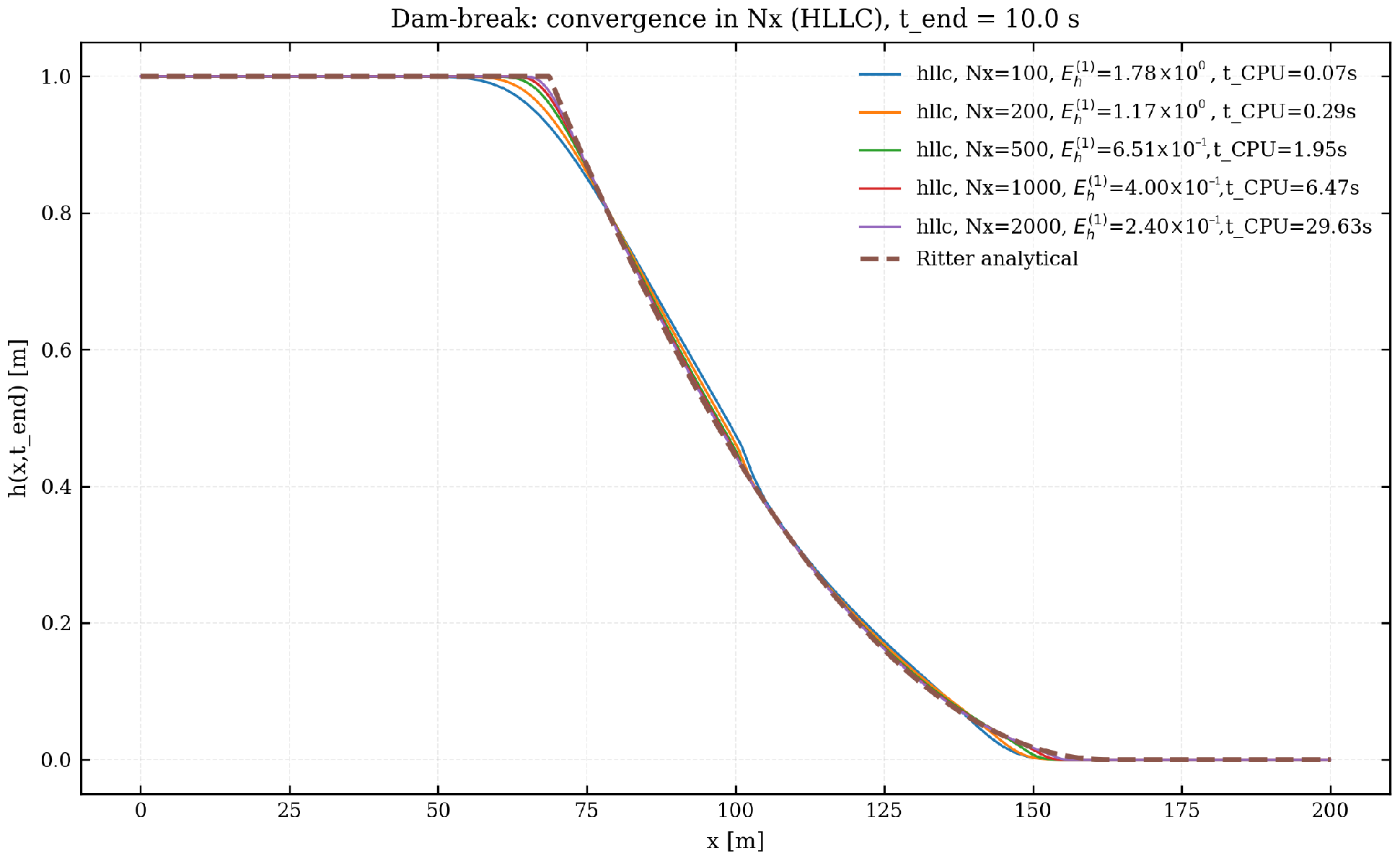
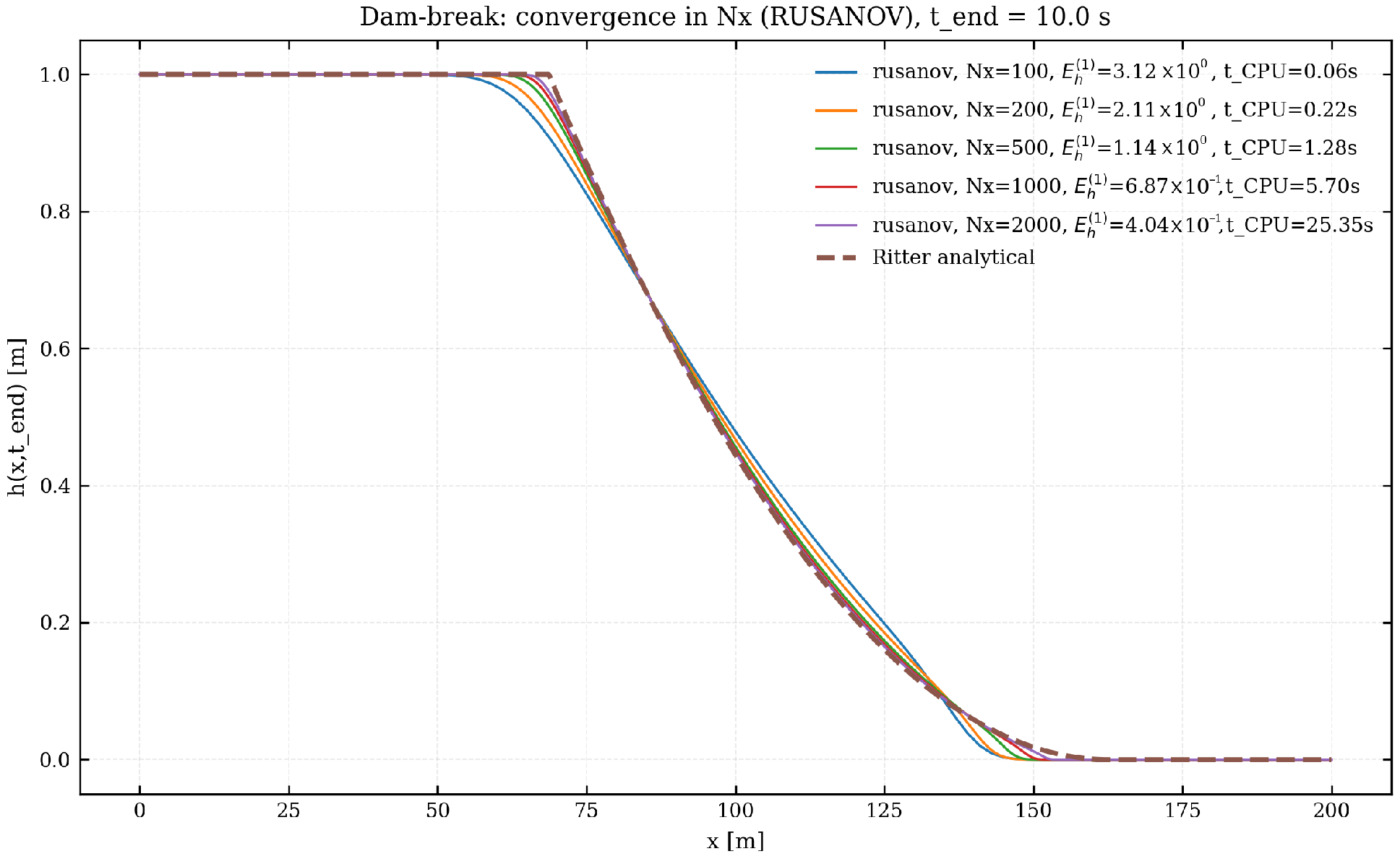
3.9. Validation of the Numerical Solver: Dam-Break Test Against Ritter’s Analytical Solution
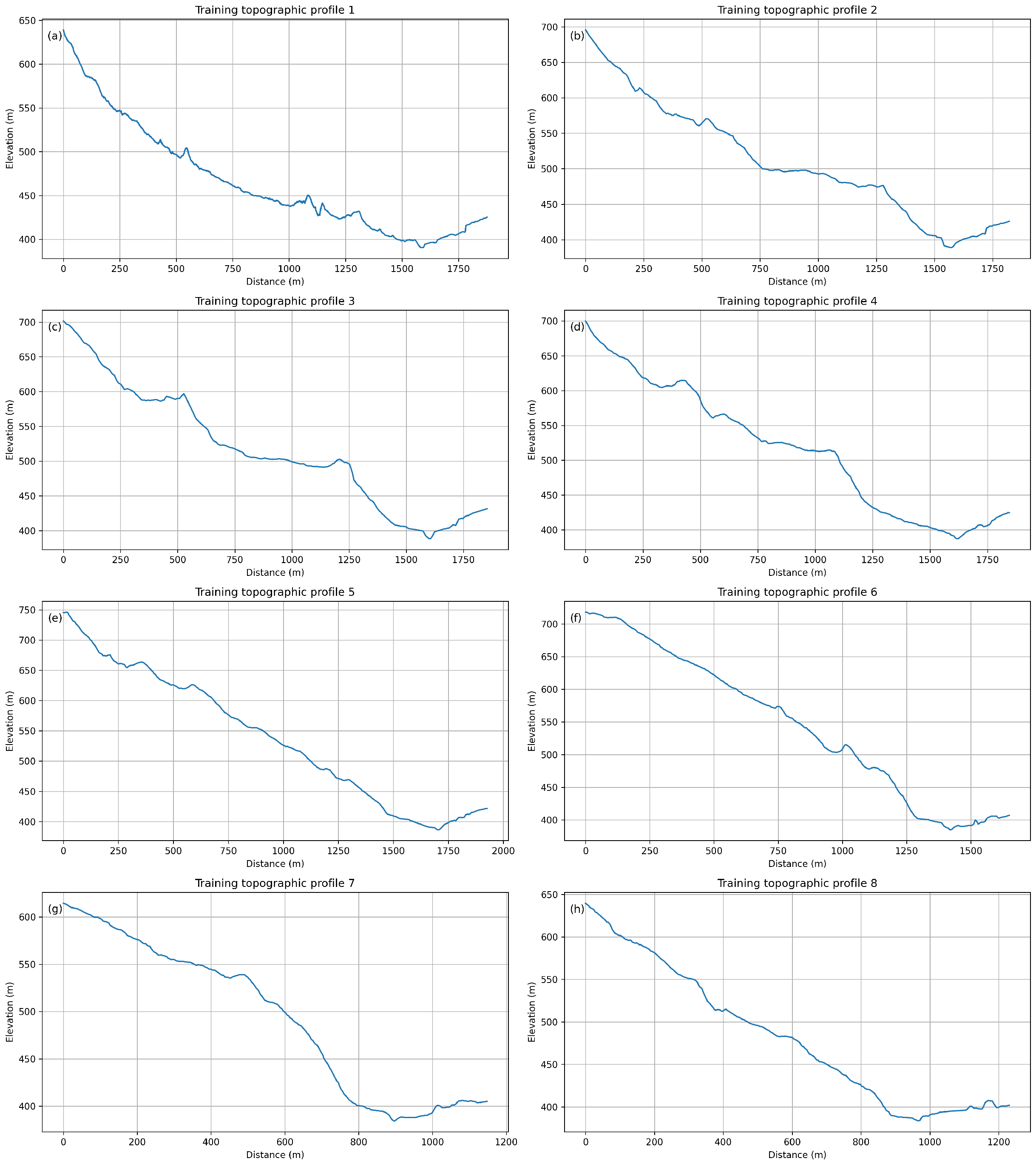
4. Study Area and Synthetic Dataset
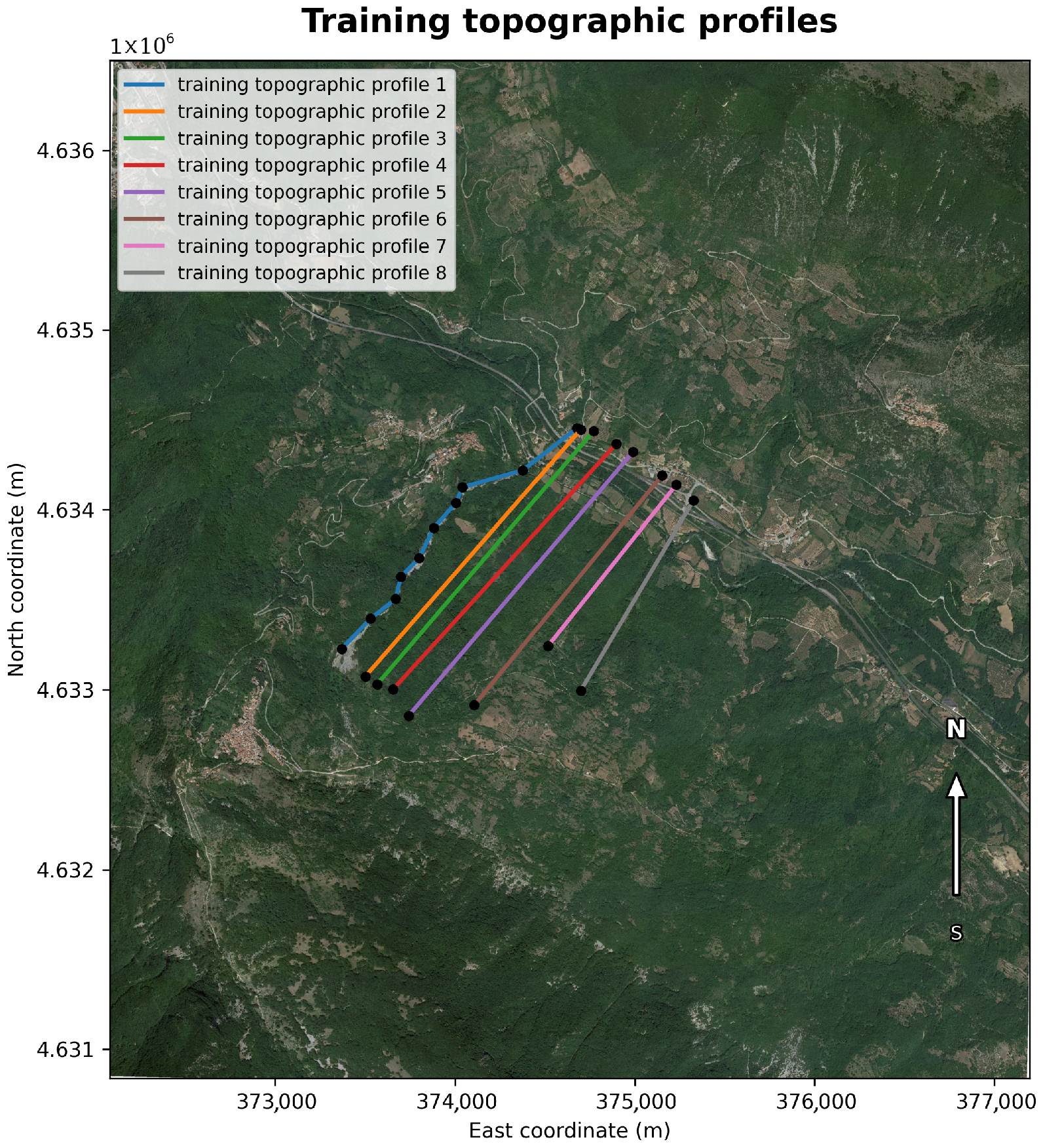
4.1. Geographic Zone: The Morino–Rendinara Debris–Flow System
4.2. Dataset Parameter Space and Numerical Setup
- Bulk density of the mixture: , is sampled uniformly in the interval , in accordance with the two density levels (1200 and 1300 kg/m3) tested in their simulations [4].
- Released volume/initial thickness: Pasculli et al. consider released volumes of 100 and 200 m3 [4]. In the 1D solver, the parameter spans values uniformly distributed in m, and is thus tuned to produce 1D volumes that are consistent, in order of magnitude, with the 2D released masses reported in Pasculli et al. [4]. While denotes the global initial thickness parameter controlling the total released volume in each simulation, represents the spatially distributed initial thickness field provided by the numerical solver.
- Voellmy friction parameters: The dry (Coulomb-type) friction coefficient and the viscous–turbulent coefficient are varied coherently with the ranges suggested for simulations of granular (solid-like) and earth-flow (fluid-like) behaviour [4]. Specifically, is sampled in , while is drawn from the interval m/s2 for granular flows and m/s2 for earth-flow-type behaviour, as reported in Pasculli et al. [4].
- constant parameter fields: x, t, , , , and all spatially and temporally uniform over the entire computational domain for each profile).
- dynamic fields: bed elevation and .
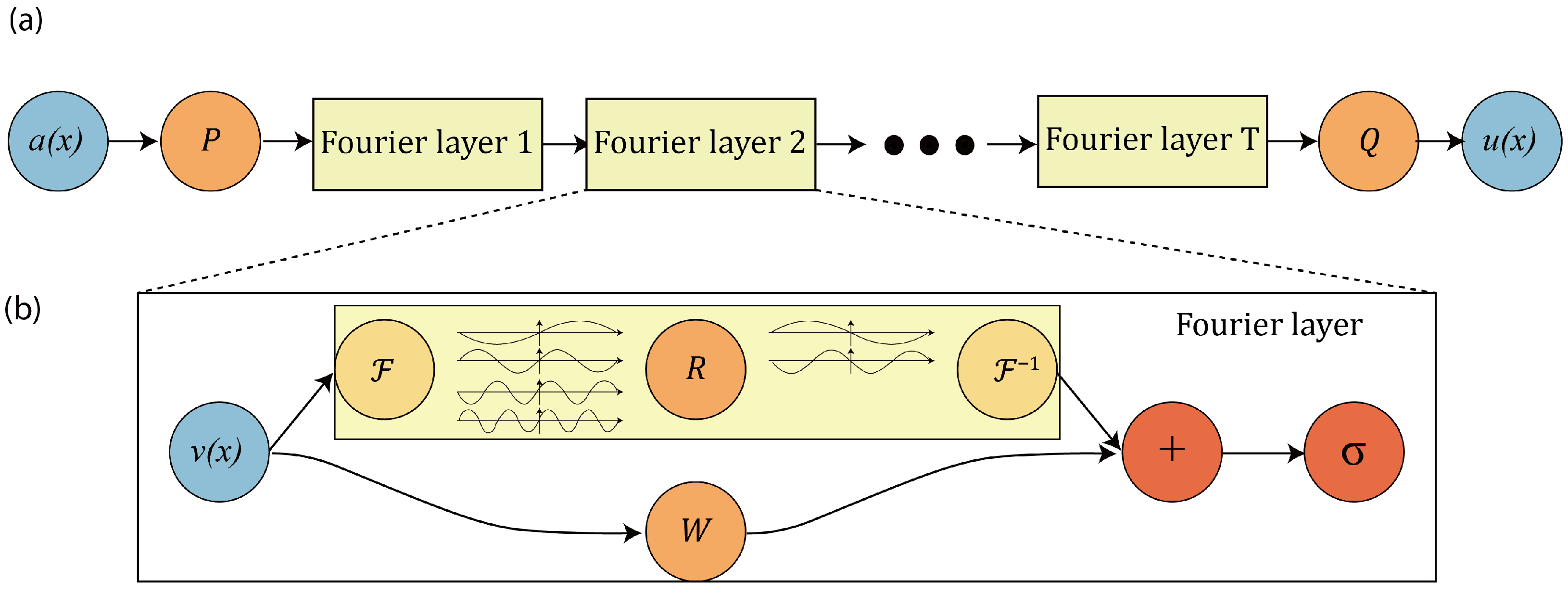
5. Fourier Neural Operator
5.1. Mathematical Formulation of the Fourier Neural Operator
5.2. Training Procedure and Model Optimization
6. Results
6.1. Baseline Case: ,
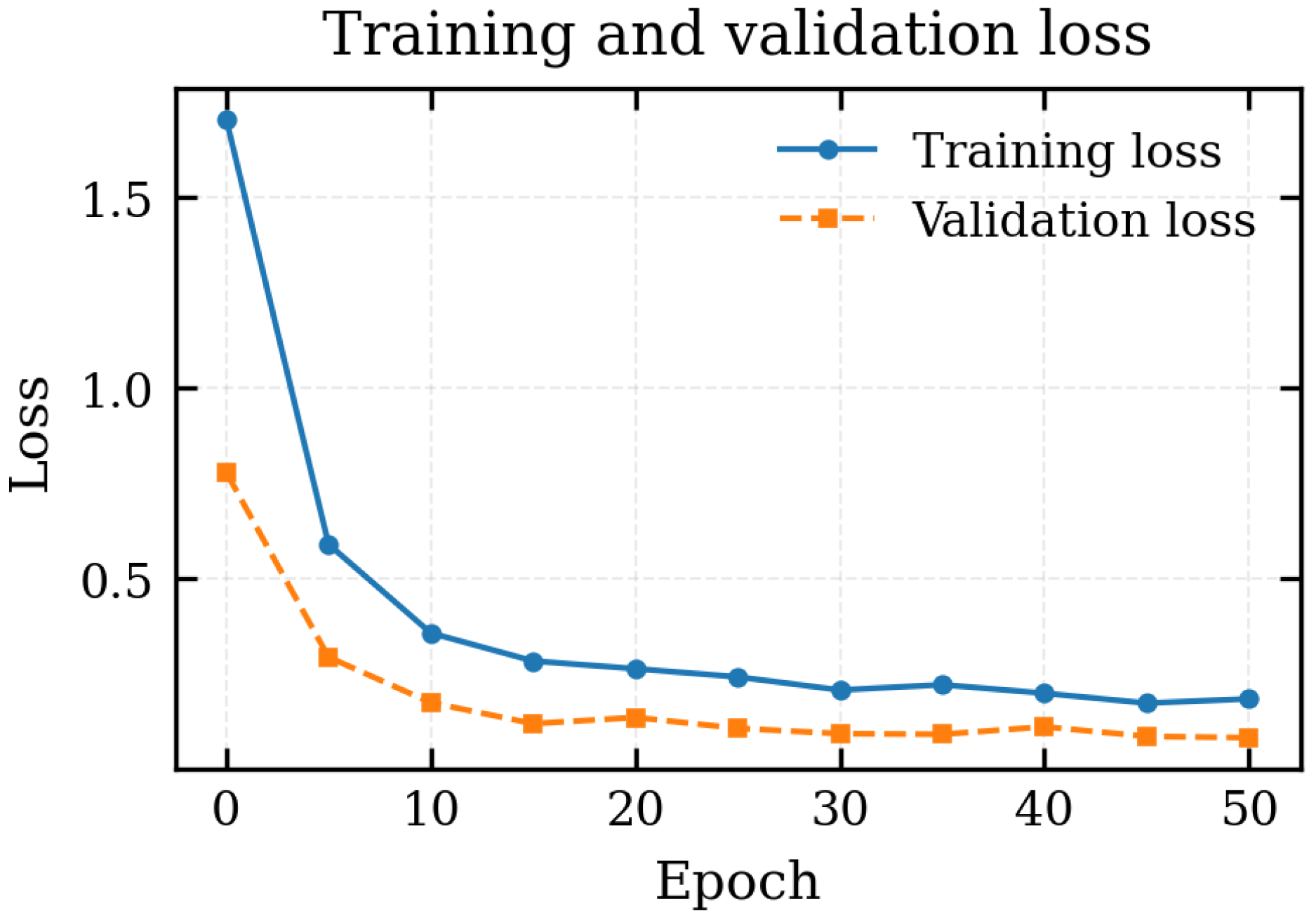
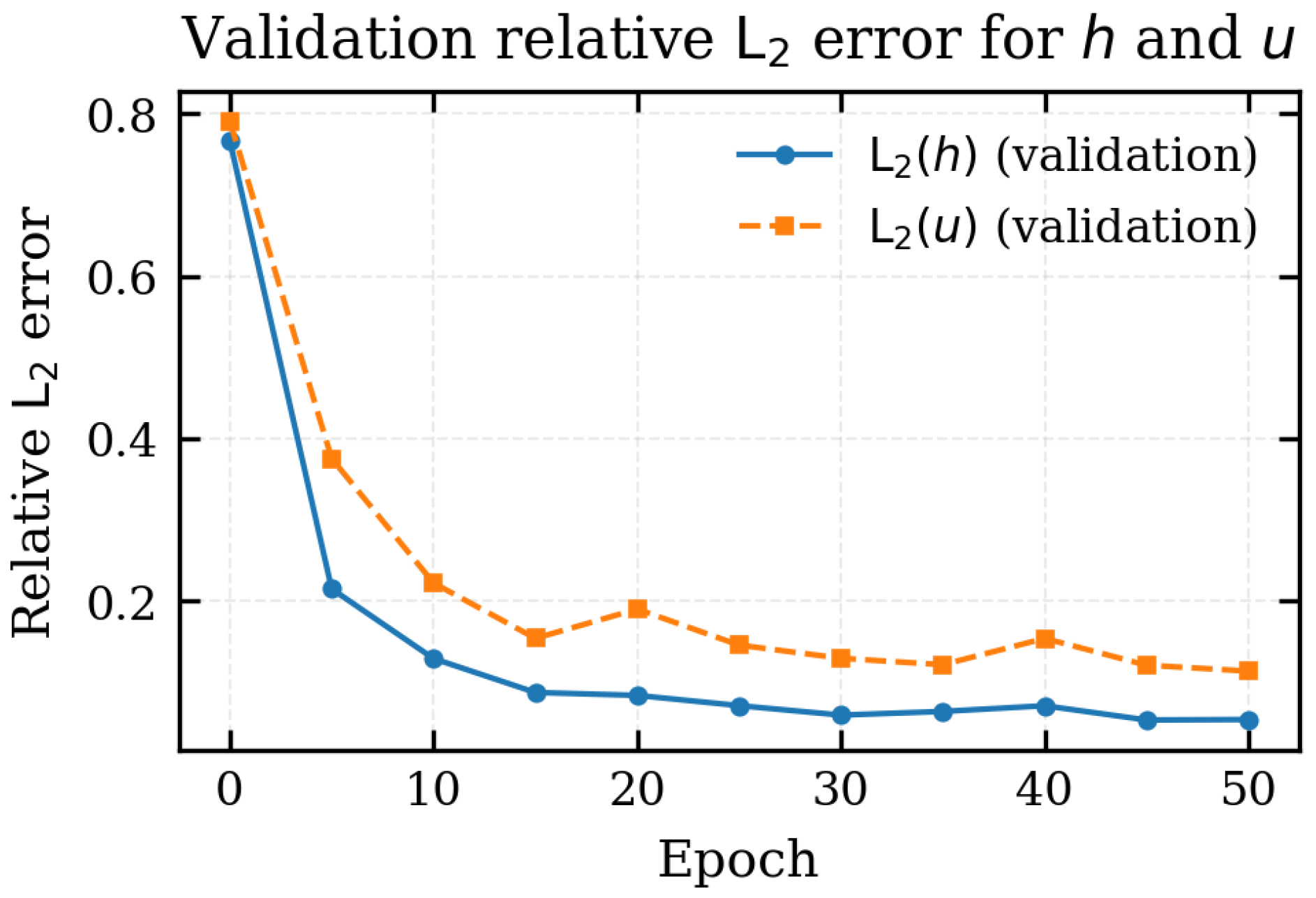
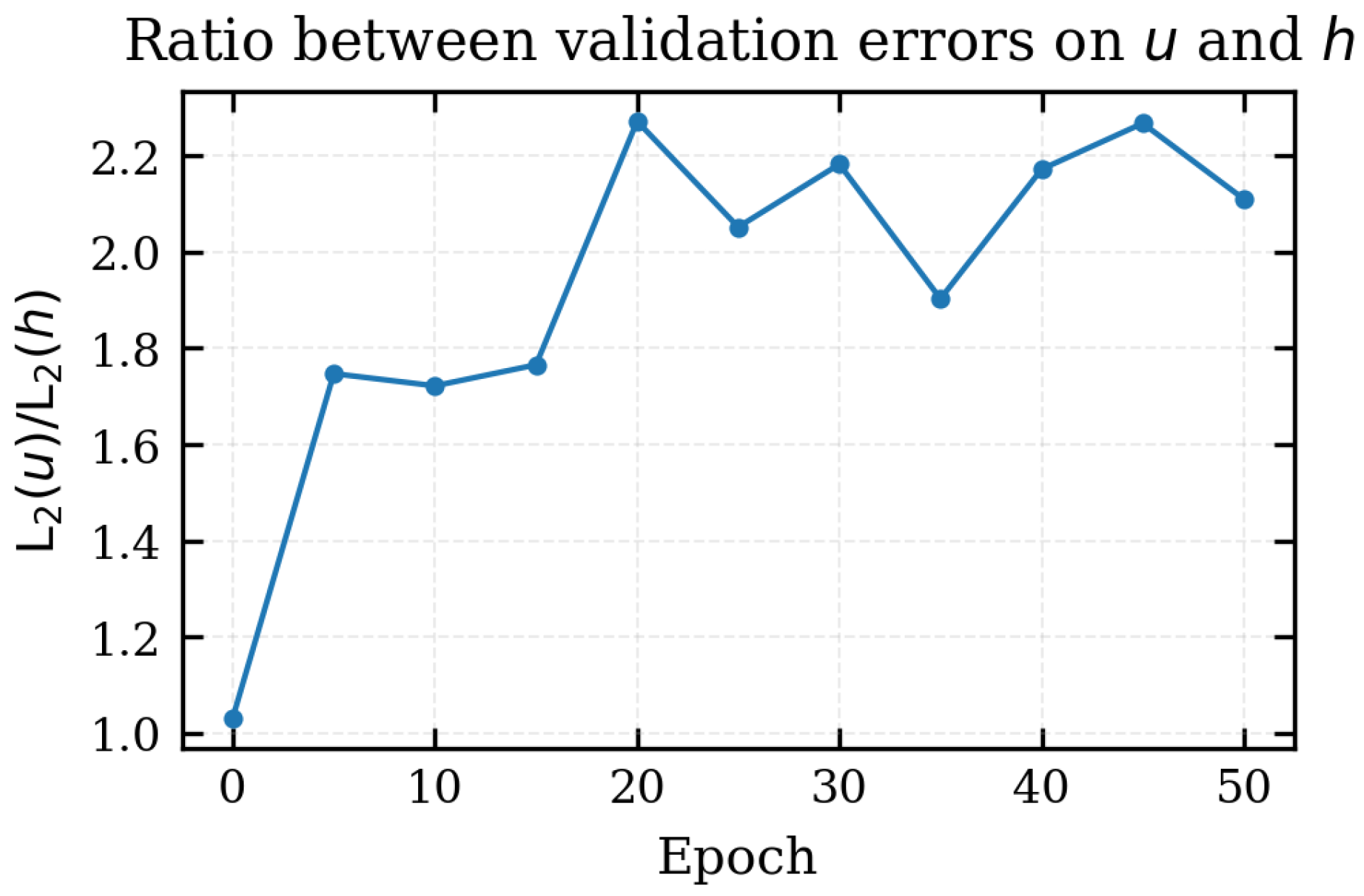
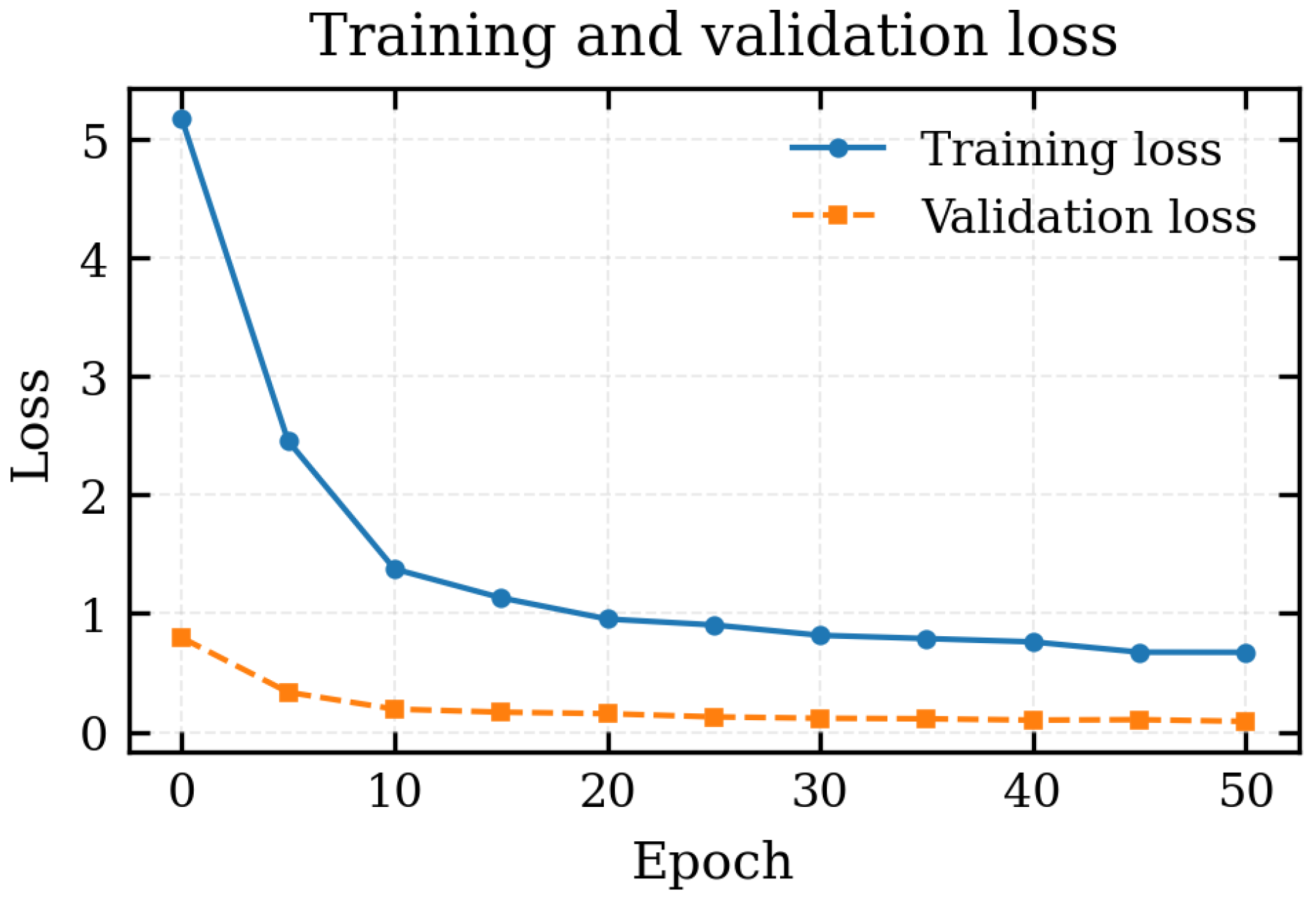
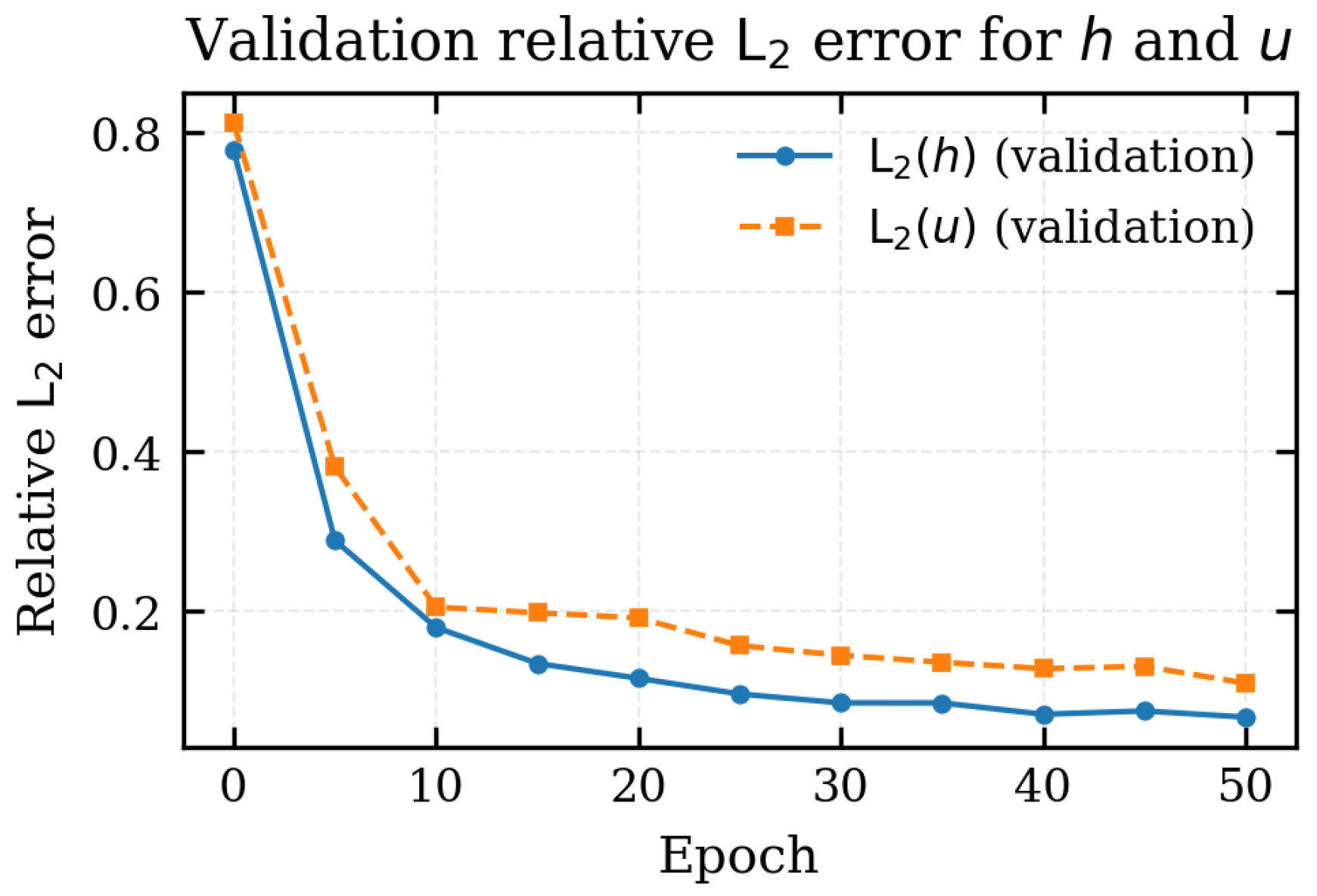
6.1.1. Training Dynamics and Validation Errors
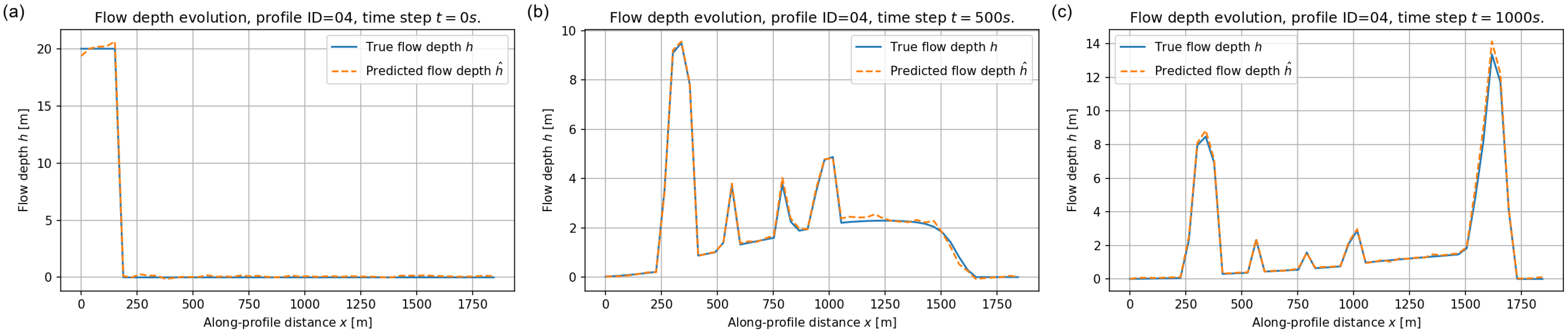
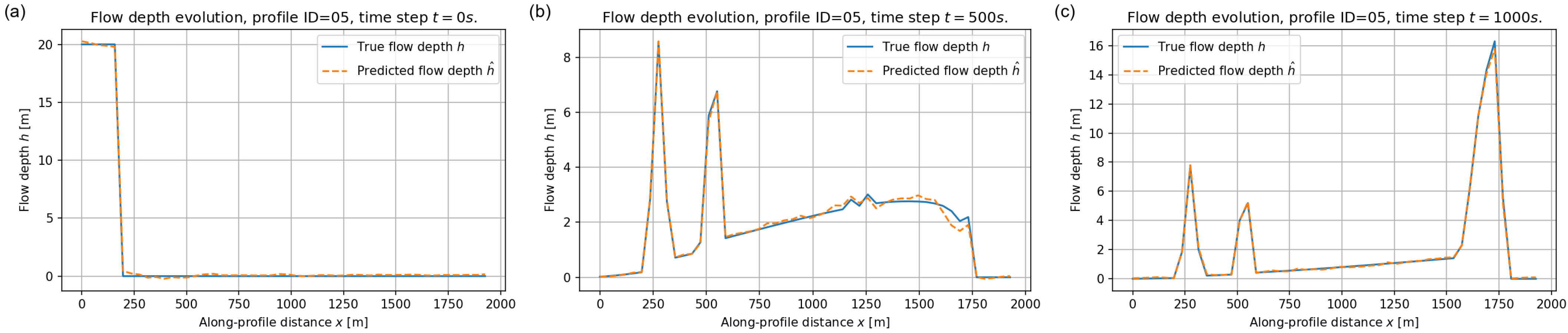
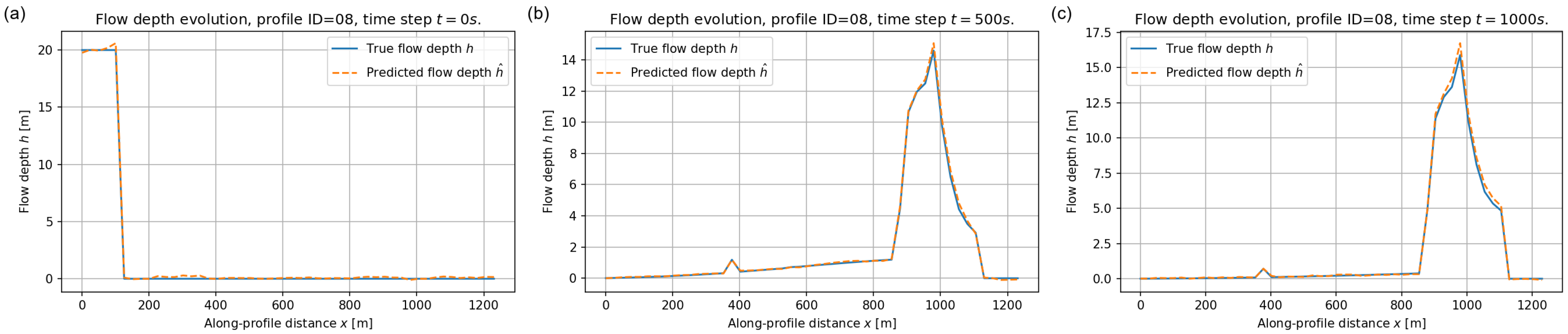
6.1.2. Flow–Depth Evolution Along Training Profiles
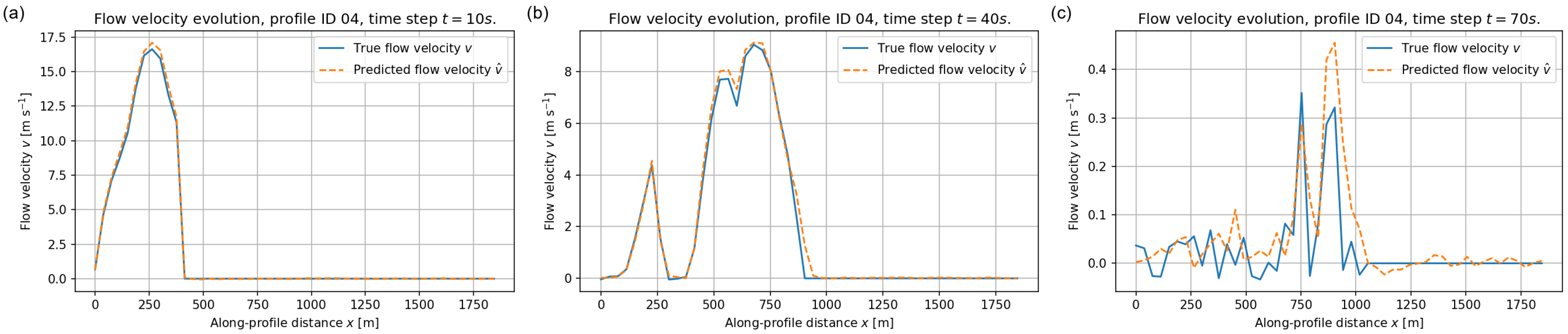
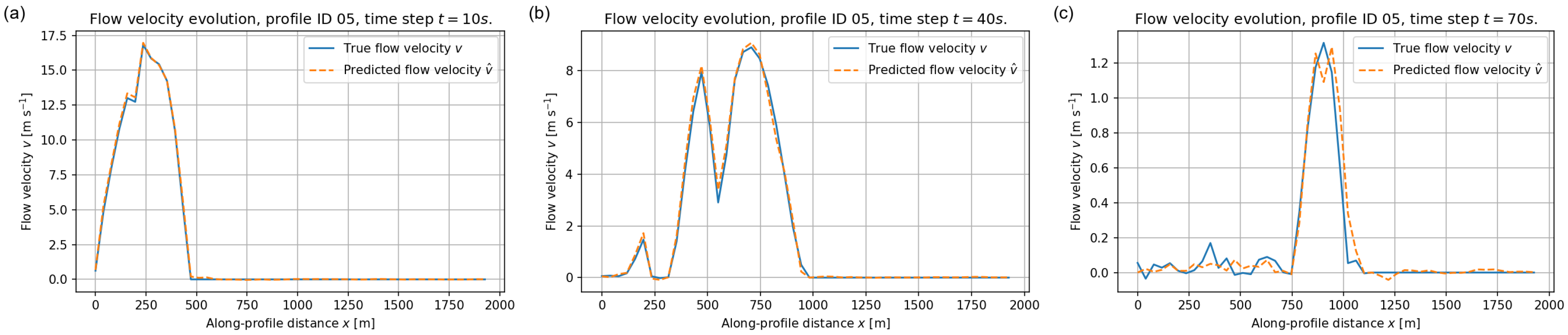
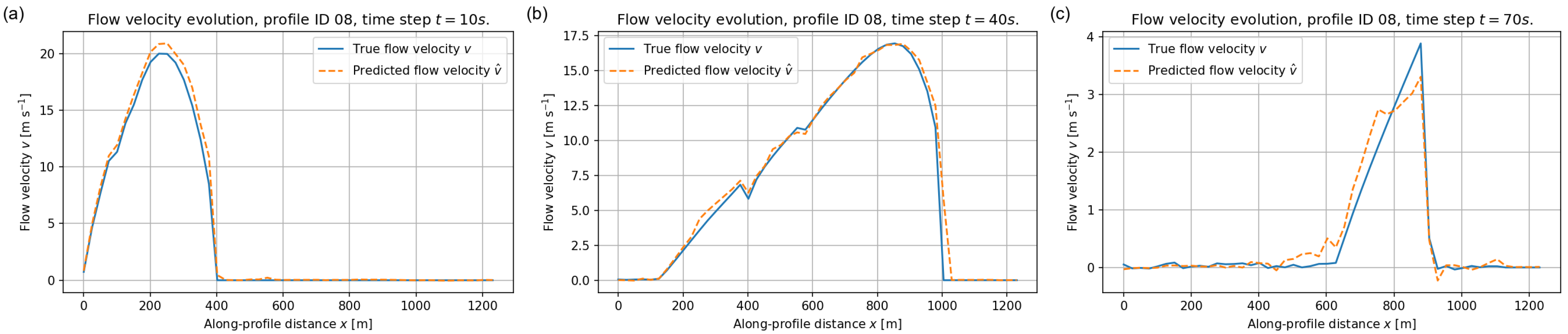
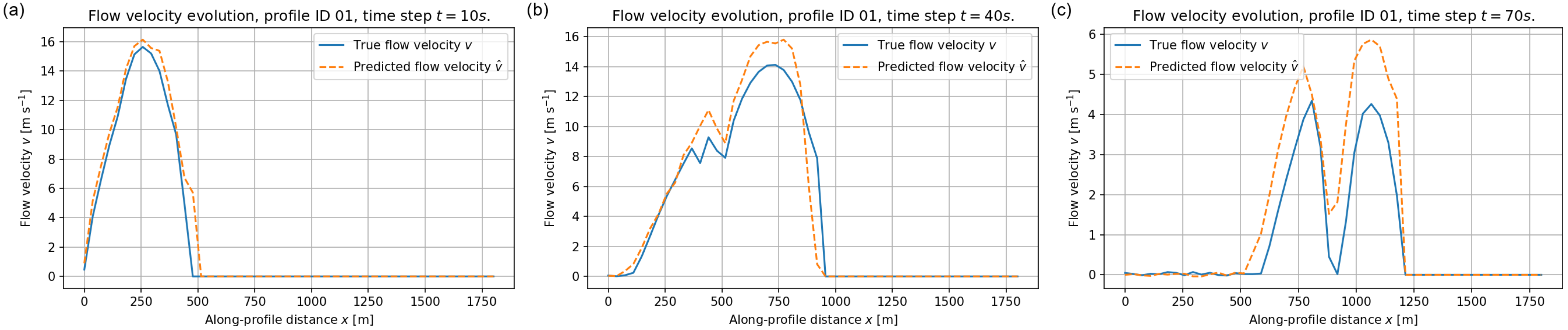
6.1.3. Flow–Velocity Evolution Along Training Profiles
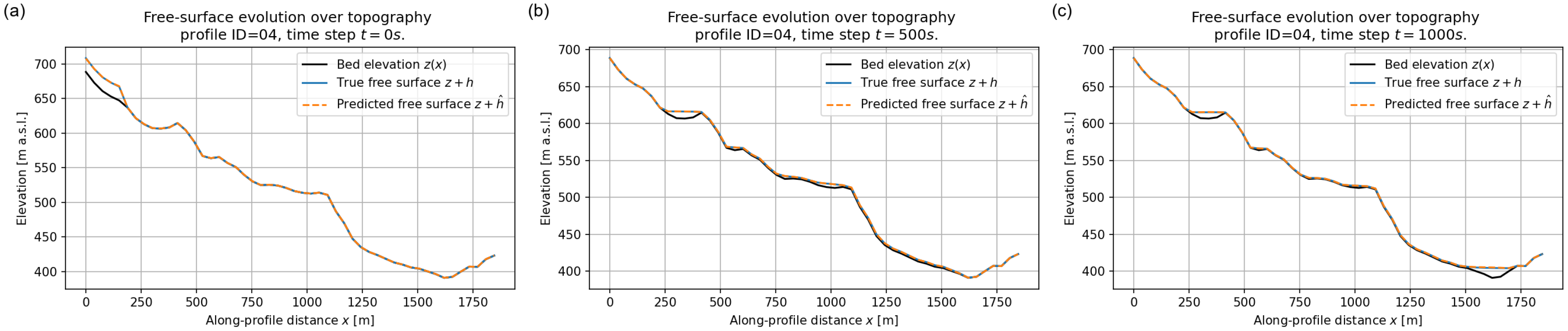
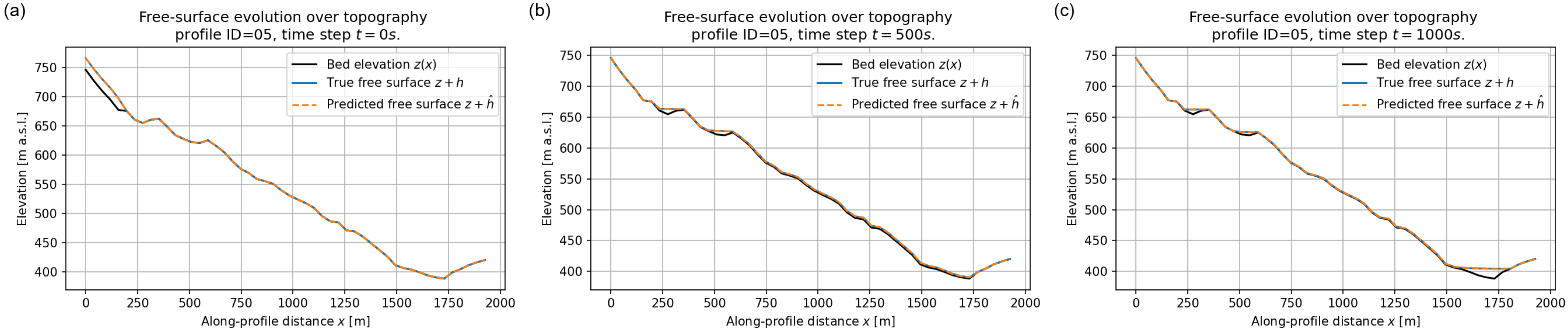
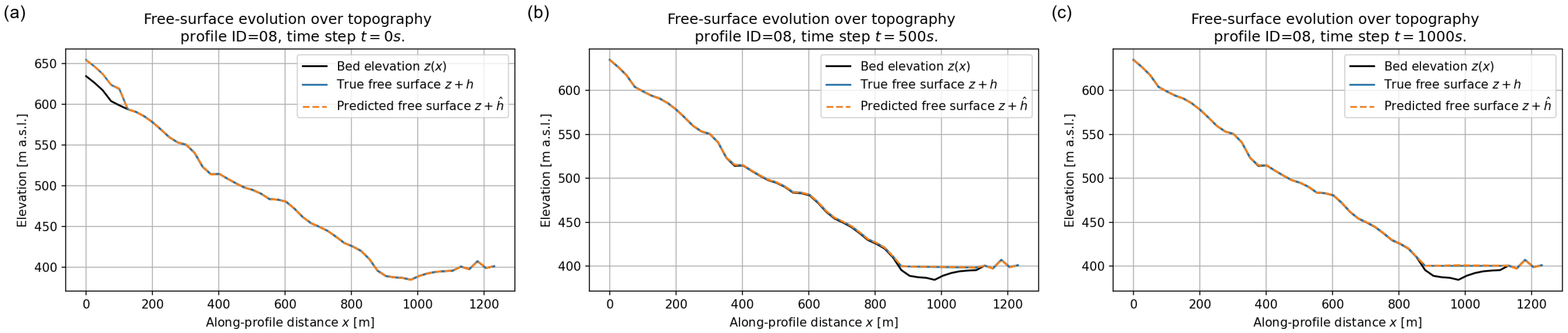
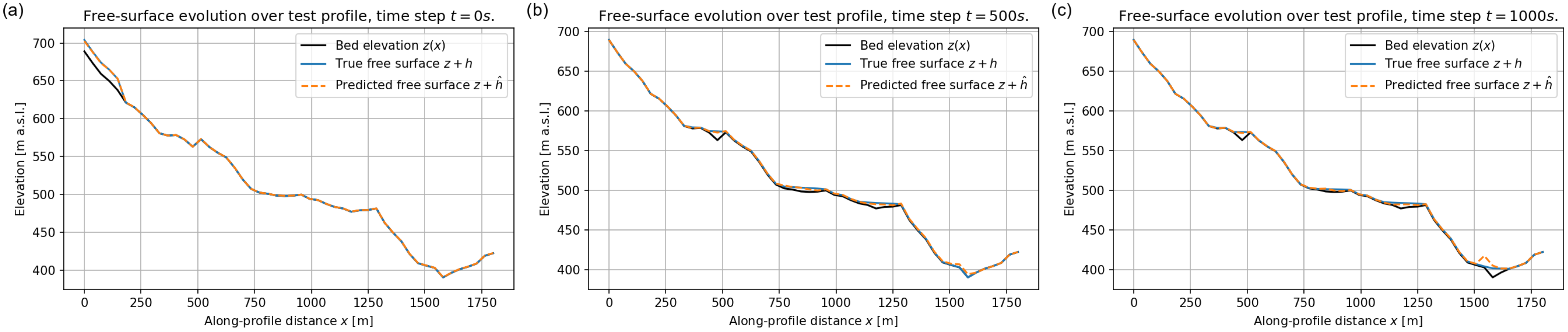
6.1.4. Free–Surface Evolution over Fixed Topography
6.2. Reweighted Case: ,
6.2.1. Training Dynamics and Validation Errors
6.2.2. Flow–Velocity Evolution Along Training Profiles
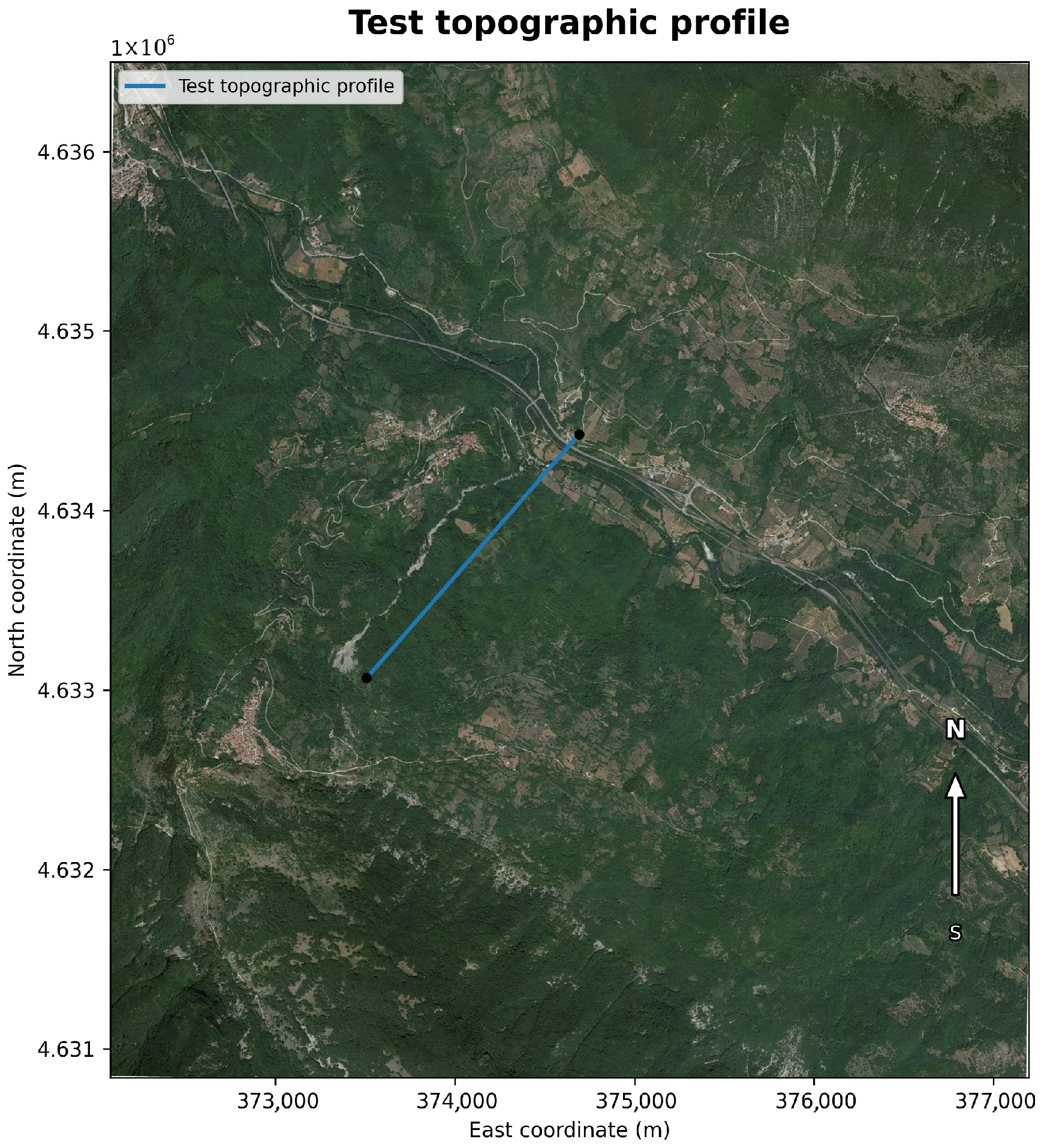
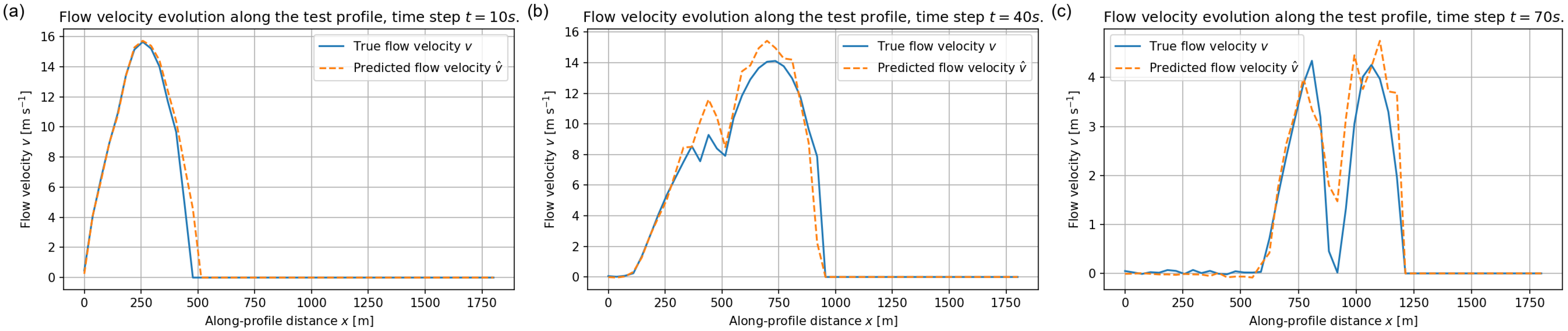
6.3. Generalisation to an Unseen Test Profile
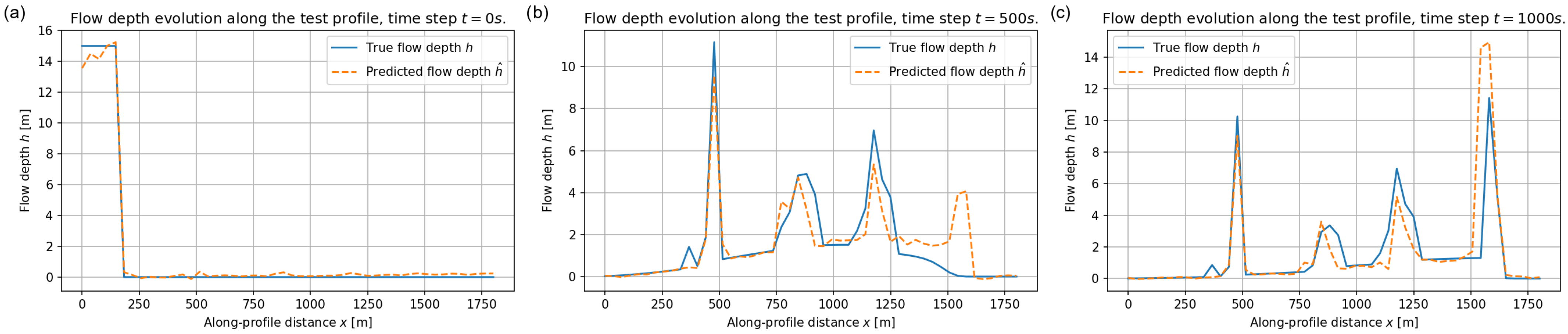
6.3.1. Baseline Case: ,
6.3.2. Reweighted Case: ,
6.4. Inference Performance Comparison
7. Discussion
7.1. Surrogate Performance and Physical Consistency
7.2. Methodological Contribution: Objective-Function Design and Velocity Reweighting
7.3. Inference Efficiency and Performance Relative to the Numerical Solver
7.4. Implications for Large-Scale and Probabilistic Debris-Flow Hazard Analysis
7.5. Site-Specific Surrogates and Integration with Probabilistic Modelling
7.6. Limitations and Perspectives for Future Work
7.6.1. Extensions of the Physical Model and Numerical Solver
7.6.2. Dataset Expansion, Calibration, and Territorial Scalability
7.6.3. Neural-Architecture Choices and Benchmarking Perspectives
8. Conclusions
Author Contributions
Funding
Data Availability Statement
Conflicts of Interest
References
- Iverson, R.M. The Physics of Debris Flows. Rev. Geophys. 1997, 35, 245–296. [Google Scholar] [CrossRef]
- Arattano, M.; Franzi, L. Influence of Rheology on Debris-Flow Dynamics. Nat. Hazards Earth Syst. Sci. 2006. [Google Scholar] [CrossRef]
- Pasculli, A.; Cinosi, J.; Turconi, P.; Sciarra, N. Learning Case Study of a Shallow-Water Model to Assess an Early-Warning System for Fast Alpine Muddy-Debris-Flow. Water 2021, 13, 750. [Google Scholar] [CrossRef]
- Pasculli, A.; Zito, C.; Sciarra, N.; Mangifesta, M. Back Analysis of a Real Debris Flow, the Morino–Rendinara Test Case (Italy), Using RAMMS Software. Land 2024, 13, 2078. [Google Scholar] [CrossRef]
- Chung, T.J. Computational Fluid Dynamics, 4th ed.; Cambridge University Press: Cambridge, UK, 2006; p. 1012. [Google Scholar]
- Pasculli, A. Viscosity variability impact on 2D laminar and turbulent Poiseuille velocity profiles; characteristic-based split (CBS) stabilization. In Proceedings of the 2018 5th International Conference on Mathematics and Computers in Sciences and Industry (MCSI), Corfu, Greece, 25–27 August 2018; pp. 770–771. [Google Scholar]
- Audusse, E.; Bouchut, F.; Bristeau, M.-O.; Klein, R.; Perthame, B. A fast and stable well-balanced scheme with hydrostatic reconstruction for shallow water flows. SIAM J. Sci. Comput. 2004, 25, 2050–2065. [Google Scholar] [CrossRef]
- Gallouët, T.; Hérard, J.-M.; Seguin, N. Some approximate Godunov schemes to compute shallow-water equations with source terms. Comput. Fluids 2003, 32, 479–513. [Google Scholar] [CrossRef]
- Murillo, C.J.J.; Garcia-Navarro, P. 2D simulation of granular flow over irregular steep slopes using global and local coordinates. J. Comput. Phys. 2013, 255, 166–204. [Google Scholar] [CrossRef]
- Zienkiewicz, O.C.; Taylor, R.L. The Finite Element Method for Solid and Structural Mechanics, 6th ed.; Elsevier: London, UK, 2006; p. 631. [Google Scholar]
- Paik, J. A high resolution finite volume model for 1D debris flow. J. Hydro-Environ. Res. 2015, 9, 145–155. [Google Scholar] [CrossRef]
- Pasculli, A.; Minatti, L.; Sciarra, N.; Paris, E. SPH modeling of fast muddy debris flow: Numerical and experimental comparison of certain commonly utilized approaches. Ital. J. Geosci. 2013, 132, 350–365. [Google Scholar] [CrossRef]
- Pastor, M.; Haddad, B.; Sorbino, G.; Cuomo, S.; Drempetic, V. A depth integrated coupled SPH model for flow-like landslides and related phenomena. Int. J. Numer. Anal. Methods Geomech. 2009, 33, 143–172. [Google Scholar] [CrossRef]
- Del Pin, F.; Aubry, R. The particle finite element method: An overview. Int. J. Comput. Methods 2004, 1, 267–307. [Google Scholar] [CrossRef]
- Idelsohn, S.R.; Oñate, E.; Del Pin, F. The particle finite element method: A powerful tool to solve incompressible flows with free-surfaces and breaking waves. Int. J. Numer. Meth. Eng. 2004, 61, 964–989. [Google Scholar] [CrossRef]
- Bouchut, F. Nonlinear Stability of Finite Volume Methods for Hyperbolic Conservation Laws; Springer: Berlin, Germany, 2004. [Google Scholar]
- Toro, E.F. Riemann Solvers and Numerical Methods for Fluid Dynamics, 3rd ed.; Springer: Berlin, Germany, 2009. [Google Scholar]
- Cesca, M.; D’Agostino, V. Comparison Between FLO-2D and RAMMS in Debris-Flow Modelling: A Case Study in the Dolomites. WIT Trans. Eng. Sci. 2008, 60, 197–206. [Google Scholar]
- Schraml, K.; Thomschitz, B.; McArdell, B.W.; Graf, C.; Kaitna, R. Modeling Debris-Flow Runout Patterns on Two Alpine Fans with Different Dynamic Simulation Models. Nat. Hazards Earth Syst. Sci. 2015, 15, 1483–1492. [Google Scholar] [CrossRef]
- Mikoš, M.; Bezak, N. Debris Flow Modelling Using RAMMS Model in the Alpine Environment with Focus on the Model Parameters and Main Characteristics. Front. Earth Sci. 2021, 8, 605061. [Google Scholar] [CrossRef]
- FLO-2D Europe. Condizioni di Vendita e Politica di Rinnovo della Licenza Software FLO-2D PRO. Available online: https://www.flo-2deurope.com (accessed on 30 November 2025).
- WSL Institute for Snow and Avalanche Research SLF. RAMMS::Debrisflow Licensing and Shop Information. Available online: https://ramms.ch (accessed on 30 November 2025).
- Hungr Geotechnical Inc. DAN3D Order and License Types. Available online: https://hungr-geotech.com (accessed on 30 November 2025).
- Lu, L.; Jin, P.; Karniadakis, G.E. Learning Nonlinear Operators via DeepONet. Nat. Mach. Intell. 2021, 3, 218–229. [Google Scholar] [CrossRef]
- Bihlo, A.; Popovych, R.O. Physics-informed neural networks for the shallow-water equations on the sphere. J. Comput. Phys. 2022, 456, 111024. [Google Scholar] [CrossRef]
- Nag, P.; Zammit-Mangion, A.; Singh, S.; Cressie, N. Spatio-temporal modeling and forecasting with Fourier neural operators. arXiv 2026, arXiv:2601.01813. [Google Scholar] [CrossRef]
- Yang, Q.; Hernandez-Garcia, A.; Harder, P.; Ramesh, V.; Sattigeri, P.; Szwarcman, D.; Watson, C.D.; Rolnick, D. Fourier neural operators for arbitrary resolution climate data downscaling. J. Mach. Learn. Res. 2024, 25, 1–30. [Google Scholar]
- Pasculli, A.; Secchi, M.; Mangifesta, M.; Cencetti, C.; Sciarra, N. A Novel Probabilistic Approach for Debris Flow Accumulation Volume Prediction Using Bayesian Neural Networks with Synthetic and Real-World Data. Geosciences 2025, 15, 362. [Google Scholar] [CrossRef]
- Li, Z.; Kovachki, N.; Azizzadenesheli, K.; Liu, B.; Bhattacharya, K.; Stuart, A.; An kumar, A. Fourier Neural Operator for Parametric PDEs. In Proceedings of the International Conference on Learning Representations (ICLR), Vienna, Austria, 4 May 2021. [Google Scholar]
- Tran, A.; Mathews, A.; Xie, L.; Ong, C.S. Fourier Neural Operator: A Generalist Neural Operator. arXiv 2022, arXiv:2202.09417. [Google Scholar]
- Kovachki, N.; Li, Z.; Liu, B.; Azizzadenesheli, K.; Bhattacharya, K.; Stuart, A.; An kumar, A. Neural Operator: Learning Maps Between Function Spaces. J. Mach. Learn. Res. 2023, 24, 1–97. [Google Scholar]
- Voellmy, A. Über die Zerstörungskraft von Lawinen. Schweiz. Bauztg. 1955, 73, 159–165. [Google Scholar]
- Rusanov, V.V. Calculation of Interaction of Non-Steady Shock Waves with Obstacles. USSR Comput. Math. Math. Phys. 1961, 1, 304–320. [Google Scholar] [CrossRef]
- Toro, E.F.; Spruce, M.; Speares, W. Restoration of the Contact Surface in the HLL Riemann Solver. Shock Waves 1994, 4, 25–34. [Google Scholar] [CrossRef]
- Minatti, L.; Pasculli, A. Dam break Smoothed Particle Hydrodynamic modeling based on Riemann solvers. In Advances in Fluid Mechanics VIII; WIT Transactions on Engineering Sciences; WIT Press: Southampton, UK, 2010; Volume 69, pp. 145–156. [Google Scholar]
- Ritter, A. Die Fortpflanzung der Wasserwellen. Z. Des Vereins Dtsch. Ingenieure 1892, 36, 947–954. [Google Scholar]
- Willmott, C.J.; Matsuura, K. Advantages of the Mean Absolute Error (MAE) over the Root Mean Square Error (RMSE) in Assessing Average Model Performance. Clim. Res. 2005, 30, 79–82. [Google Scholar] [CrossRef]
- Li, Z.; Zheng, H.; Kovachki, N.; Jin, D.; Chen, H.; Liu, B.; Azizzadenesheli, K.; An kumar, A. Physics-Informed Neural Operator for Learning Partial Differential Equations. arXiv 2021, arXiv:2111.03794. [Google Scholar] [CrossRef]
- Khodakarami, S.; Oommen, V.; Bora, A.; Karniadakis, G.E. Mitigating Spectral Bias in Neural Operators via High-Frequency Scaling for Physical Systems. arXiv 2025, arXiv:2503.13695. [Google Scholar] [CrossRef]
- Sanchez-Gonzalez, A.; Godwin, J.; Pfaff, T.; Ying, R.; Leskovec, J.; Battaglia, P. Learning to Simulate Complex Physics with Graph Networks. In Proceedings of the 37th International Conference on Machine Learning (ICML), Virtual Event, 13–18 July 2020. [Google Scholar]
- Raissi, M.; Perdikaris, P.; Karniadakis, G.E. Physics-Informed Neural Networks: A Deep Learning Framework for Solving Forward and Inverse Problems Involving Nonlinear PDEs. J. Comput. Phys. 2019, 378, 686–707. [Google Scholar] [CrossRef]
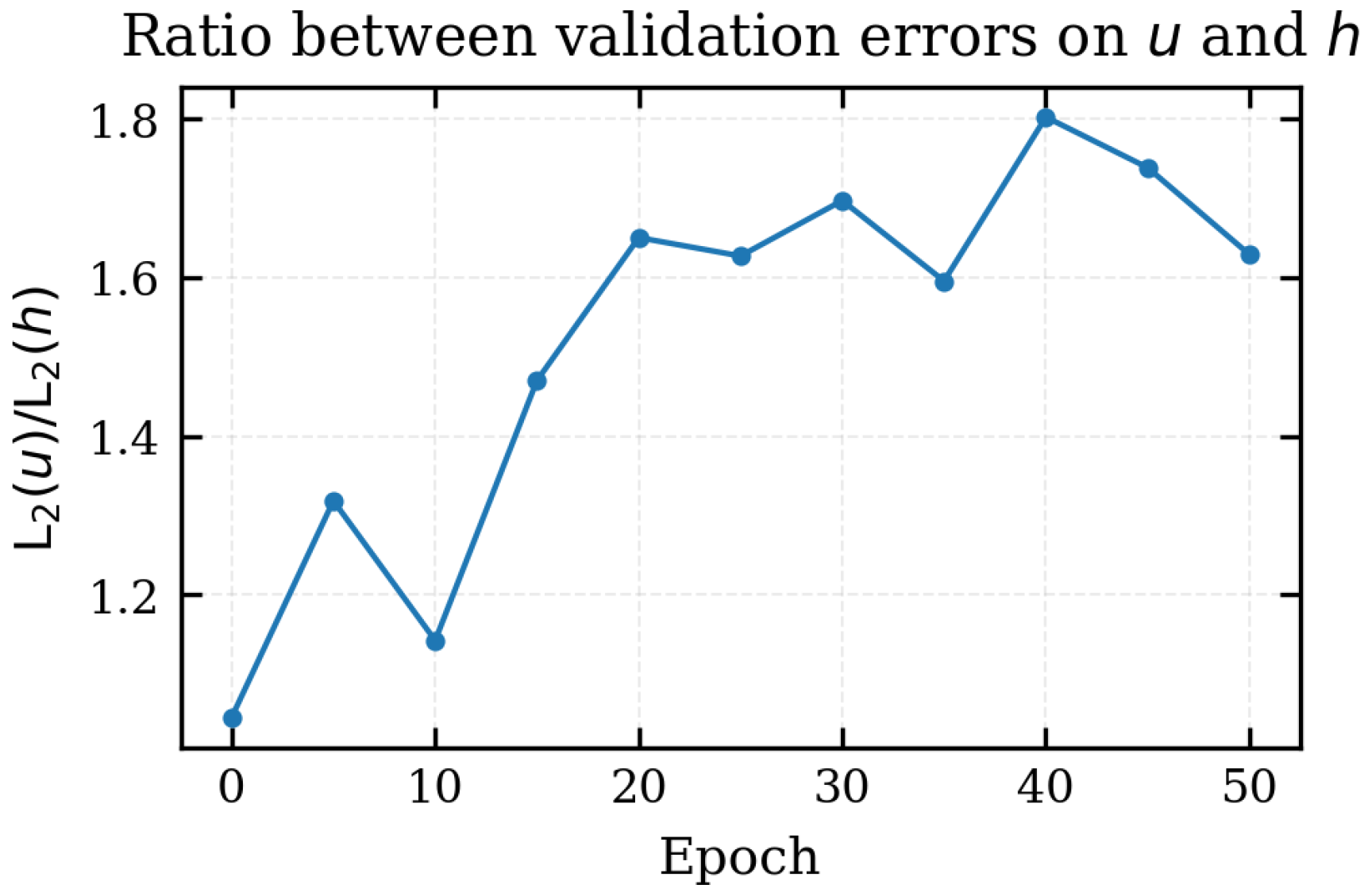
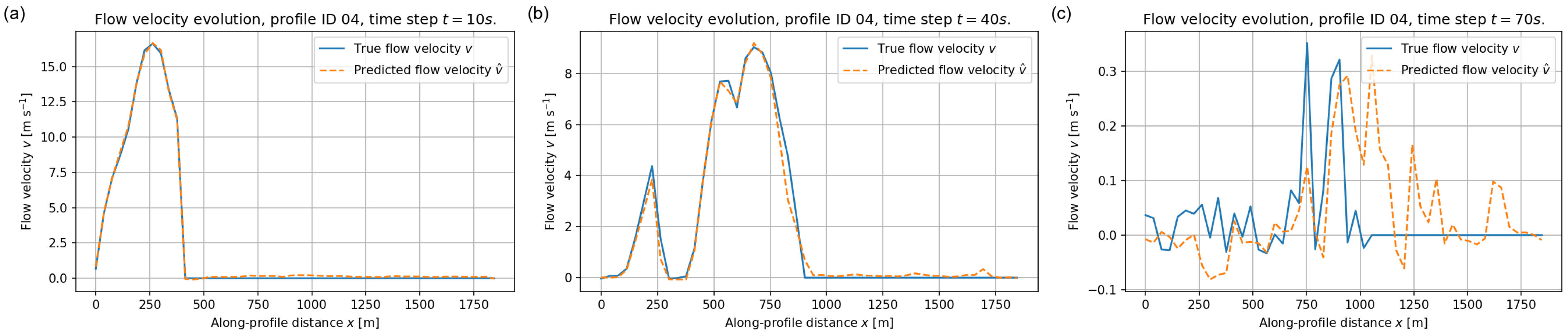
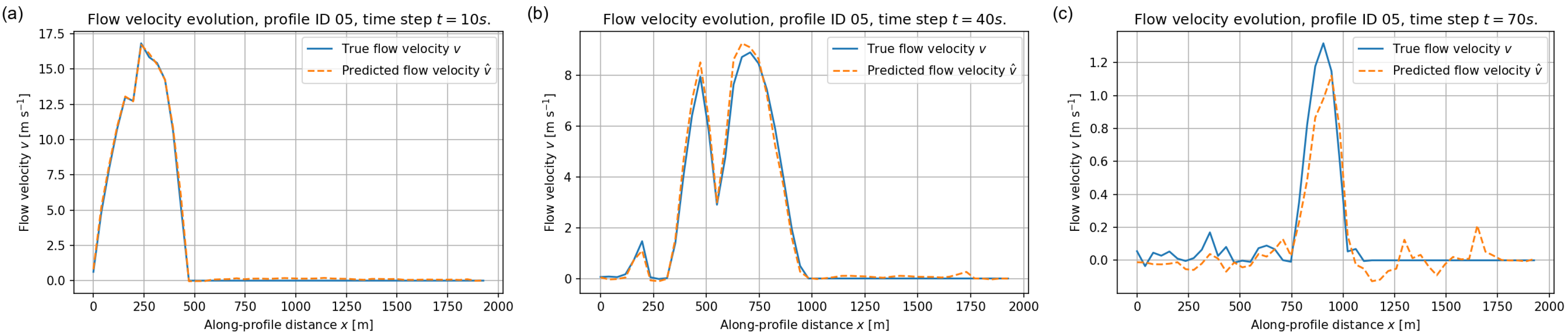
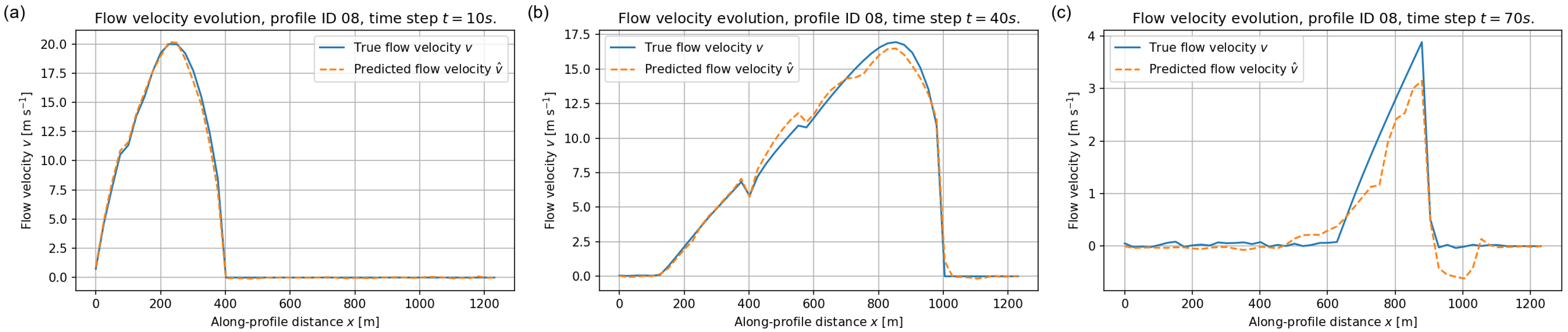

| Category | Parameter | Range/Value |
|---|---|---|
| Material properties | Bulk density | |
| Rheology (Voellmy) | Dry friction coefficient | |
| Turbulent coefficient (granular) | ||
| Turbulent coefficient (earth–flow) | ||
| Initial conditions | Initial thickness | |
| Boundary conditions | Upstream and downstream boundaries | Open (outflow-type) via ghost-cell extrapolation |
| External inflow | None prescribed () |
| Quantity | Value/Description |
|---|---|
| Number of longitudinal profiles | 8 representative transects |
| Spatial discretisation | equally spaced nodes along each profile |
| Time step of numerical solver | for each simulation |
| Temporal resampling for FNO training | (applied to reduce memory and storage requirements) |
| Stored variables (channels) | Constant fields: |
| Dynamic fields: , | |
| Tensor shape | , where is the number of channels |
| Total number of samples | 1298 simulations |
| Training/validation split | 1038/260 (80%/20%) |
| Channel | Physical Meaning | Normalisation |
|---|---|---|
| Spatial coordinate normalized | Linearly scaled to over the domain length. | |
| Time coordinate normalized | Linearly scaled to over the simulated time window. | |
| Bulk density normalized | Min–max scaling from to . | |
| Initial thickness normalized | Min–max scaling from to . | |
| Voellmy dry friction coefficient normalized | Min–max scaling from to . | |
| Voellmy turbulent coefficient normalized | Min–max scaling from to . | |
| Bed elevation normalized | Min–max scaling per profile to | |
| Initial flow thickness profile normalized | Max scaling per profile to |
| Category | Parameter | Value/Setting |
|---|---|---|
| Input/Output | Input tensor shape | |
| Output fields | , | |
| Architecture | Network type | Fourier Neural Operator (FNO) |
| Number of Fourier layers | ||
| Latent width per layer | 128 | |
| Channel width per layer | ||
| Retained Fourier modes | ||
| Nonlinearity | GELU | |
| Loss function | Data misfit | Weighted loss on |
| Depth weight | 1 | |
| Velocity weight | 1 (baseline), 5 (reweighted) | |
| Optimisation | Optimiser | Adam |
| Learning rate | ||
| Weight decay | None | |
| Batch size | 10 | |
| Number of epochs | 50 | |
| Training setup | Training/validation split | 80%/20% |
| Random seed | 42 | |
| Hardware | CPU (AMD Ryzen 5 5625U) | |
| Framework | PyTorch |
Disclaimer/Publisher’s Note: The statements, opinions and data contained in all publications are solely those of the individual author(s) and contributor(s) and not of MDPI and/or the editor(s). MDPI and/or the editor(s) disclaim responsibility for any injury to people or property resulting from any ideas, methods, instructions or products referred to in the content. |
© 2026 by the authors. Licensee MDPI, Basel, Switzerland. This article is an open access article distributed under the terms and conditions of the Creative Commons Attribution (CC BY) license.
Share and Cite
Secchi, M.; Pasculli, A.; Mangifesta, M.; Sciarra, N. Learning Debris Flow Dynamics with a Deep Learning Fourier Neural Operator: Application to the Rendinara–Morino Area. Geosciences 2026, 16, 55. https://doi.org/10.3390/geosciences16020055
Secchi M, Pasculli A, Mangifesta M, Sciarra N. Learning Debris Flow Dynamics with a Deep Learning Fourier Neural Operator: Application to the Rendinara–Morino Area. Geosciences. 2026; 16(2):55. https://doi.org/10.3390/geosciences16020055
Chicago/Turabian StyleSecchi, Mauricio, Antonio Pasculli, Massimo Mangifesta, and Nicola Sciarra. 2026. "Learning Debris Flow Dynamics with a Deep Learning Fourier Neural Operator: Application to the Rendinara–Morino Area" Geosciences 16, no. 2: 55. https://doi.org/10.3390/geosciences16020055
APA StyleSecchi, M., Pasculli, A., Mangifesta, M., & Sciarra, N. (2026). Learning Debris Flow Dynamics with a Deep Learning Fourier Neural Operator: Application to the Rendinara–Morino Area. Geosciences, 16(2), 55. https://doi.org/10.3390/geosciences16020055

