Article

Something Old, Something New: Revisiting Terranes of the Western Paleozoic and Triassic Belt, Klamath Mountains, Northern California


Department of Geological Sciences, California State University Fullerton, 800 N State College Blvd, Fullerton, CA 92831, USA
*
Author to whom correspondence should be addressed.
Geosciences 2026, 16(2), 54; https://doi.org/10.3390/geosciences16020054 (registering DOI)
Submission received: 20 November 2025 / Revised: 16 January 2026 / Accepted: 18 January 2026 / Published: 24 January 2026
(This article belongs to the Section Structural Geology and Tectonics)

Abstract

The age, provenance, and evolution of some terranes in the Klamath Mountains are poorly constrained because of low detrital zircon yields. We present petrography and 947 new detrital and igneous zircon U-Pb ages from the North Fork (NFT), Eastern Hayfork (EHT), and Western Hayfork (WHT) terranes in the central and southern Klamath Mountains. Chert and argillite are abundant in the NFT and EHT, but matrix sandstones with abundant Proterozoic-to-Archean zircon ages indicate that the EHT received more sediment from North America. Detrital zircon ages from the WHT are ~171 Ma with scattered pre-Mesozoic ages, consistent with previous ages and continental input. A younger population of three grains at 145 Ma is interpreted as Pb loss during metamorphism. In the southernmost EHT, a 143 Ma dike correlates with plutons in the northern Sierra Nevada, which were offset from the Klamath Mountains 140–130 Ma. A 158 Ma metavolcanic/metavolcaniclastic rock in the EHT is a possible extrusive equivalent of the Wooley Creek intrusive suite. The metamorphosed EHT matrix has a young population of six ages at 69 Ma, which we tentatively interpret may represent Pb loss during metamorphism. This study documents an exposure of Late Jurassic arc cover sequence and suggests there may be previously unrecognized local metamorphism/magmatism ≤69 Ma.

1. Introduction

The Klamath Mountains are situated north of the Sierra Nevada along the border of Oregon and California (Figure 1) and are composed of distinct lithotectonic terranes and subterranes separated by east-dipping thrust faults [1]. The Eastern Klamath terrane, the Central Metamorphic Belt, the Western Paleozoic and Triassic Belt, and the Western Jurassic terrane were progressively accreted to the Western Margin of North America from east to west in the mid-Paleozoic through to the Late Jurassic and crosscut by Late Devonian to Early Cretaceous intrusions [1,2,3] (Figure 1). The most extensive belt is the Western Paleozoic and Triassic belt, which contains the Permian-Middle Jurassic Stuart Fork/Fort Jones, North Fork, Eastern Hayfork, Western Hayfork, and Rattlesnake Creek terranes [1,4].
There is a long history of geologic investigation in the Klamath Mountains [3], but there are several open questions about their age, provenance, and tectonic development. Detrital zircon U-Pb geochronology studies on siliciclastic units in the Eastern Hayfork terrane (EHT) and North Fork terrane (NFT) have placed important constraints on the age and provenance of these terranes [7,8,9]. However, low yields in these zircon-poor rocks have made it challenging to determine robust maximum depositional ages and track the history of terrigenous material incorporated into the terranes. The Western Hayfork terrane (WHT) is a volcanic/volcaniclastic arc sequence with magmatic hornblende K-Ar and 40Ar/39Ar ages 177–168 Ma [10,11] which extend younger than a crosscutting intrusion at 170 Ma [10] and may represent cooling ages. Zircon would likely provide more robust depositional ages but is rare in the WHT. After the amalgamation of the Western Paleozoic and Triassic belt, the Galice Formation of the Western Klamath terrane deposited 160–150 Ma but incorporated few zircon ages from the belt, which was either low-lying or buried by volcanic cover at the time [6,12]. The voluminous 167–154 Ma Wooley Creek suite [6,13], which intrudes the central-to-northern Klamath Mountains (Figure 1), likely had an extrusive equivalent, but no outcrops of Late Jurassic volcanic or volcaniclastic sequences are documented in the Western Paleozoic and Triassic belt.
This study sampled NFT clastic strata, EHT mélange matrix, and WHT volcanic/volcaniclastic rocks, all of which have been challenging to date with detrital zircon, to better understand their age, provenance, and evolution. We also searched for potential exposures of Late Jurassic cover sequences that may have buried the Western Paleozoic and Triassic belt. Our new petrography and 947 detrital zircon U-Pb ages from one igneous and five detrital samples further support previous results, document an exposure of Late Jurassic volcanic cover sequence, and indicate that there may be additional complexities in the metamorphic history of the Klamath Mountains.

2. Geologic Background

2.1. North Fork Terrane

The North Fork terrane (NFT, sensu lato) comprises oceanic mafic and ultramafic rocks overlain by folded and foliated volcanic and sedimentary strata [14]. These have been classified into three interfingering units: the Salmon River unit, an ophiolitic basement with island arc tholeiite (IAT) basalts; the North Fork unit (sensu stricto), ocean island basalts (OIB) and breccias; and the St. Claire Creek unit, interlayered metaclastic rocks and metachert [15]. The settings of NFT components have been interpreted as forearc basin [4,7], immature volcanic arc [15,16], seamount [14], and mid-ocean ridge crust [1]. A gabbro cutting a diabase yielded a hornblende 40Ar/39Ar age of ~200 Ma for the basement [15], and metasandstones contain young detrital zircon U-Pb populations of Late Triassic–Early Jurassic ages [7]. In the central NFT, the metasandstones also include Paleozoic and Proterozoic ages consistent with Eastern Klamath sources [7]. Limestones interbedded with volcanic rocks and breccias include Permian fossils of Tethyan affinity, and radiolarian fossils in chert are Middle Permian-to-Middle Jurassic [17]. In the southern NFT, basalts have OIB and mid-ocean ridge basalt (MORB) geochemical signatures and may represent an accreted seamount [18], but mixed mafic volcanic and terrigenous geochemistry in fine sediments suggest that the southern NFT is a more distal portion of the upper plate arc system found in the central NFT [7].

2.2. Eastern Hayfork Terrane

The North Fork terrane is thrust westward along the Twin Sisters fault over the Eastern Hayfork terrane (EHT), a complexly deformed region of mélange and broken formation composed of quartzite, metamorphosed arkosic/lithic sandstone, meta-argillite, chert, and exotic blocks of mica schist, quartzofeldspathic schist, limestone, and greenstone [4,8,9]. The majority of the matrix is composed of argillite and chert [4]. Most blocks and matrix are greenschist-grade or lower, but undated blueschist and amphibolite blocks are locally exposed [4,19,20]. Fossils in matrix chert and argillite are primarily Permian-to-Upper Triassic [17], quartzarenite matrix has Late Archean-to-Early Proterozoic detrital zircon U-Pb ages [21], and meta-argillite matrix has maximum depositional ages at ∼272, ∼211, and ∼201 Ma [9]. Tethyan and North American McCloud faunal assemblages are consistent with subduction of far-traveled ocean plate stratigraphy [17]. Olistoliths of coarse-grained subarkosic metasandstones [8] have Late Archean-to-Early Proterozoic zircon U-Pb ages and are potentially sourced from the Antelope Mountain Quartzite in the Eastern Klamath terrane (Figure 1) or an along-strike source [8,21]. Two samples of chert–argillite breccia from the EHT matrix yield predominantly Archean and Proterozoic ages consistent with the olistoliths [22]. The EHT and NFT together are interpreted as part of a supra-subduction zone complex, sometimes referred to as the Sawyers Bar terrane [23].

2.3. Western Hayfork Terrane

The EHT is thrust westward along the Wilson Point thrust over the Western Hayfork terrane (WHT), a sequence of volcaniclastic deposits with argillite and minor lava flows, conglomerate, and chert. Metasandstone clasts include volcanic lithics and crystals of plagioclase, clinopyroxene, and amphibole [10,11,24]. Rocks are generally zircon-poor [22], but magmatic amphibole K-Ar and 40Ar/39Ar ages are 177–171 Ma with one K-Ar age at 168 Ma [10,11]. Minor chert and textures of volcanic rocks indicate formation in a subaqueous environment, and rare quartz- and K-feldspar-rich arenites in the upper WHT suggest formation close to a terrigenous source [10,11,24]. Geochemically, the calc-alkaline high-Mg lavas in the WHT may be the extrusive equivalent of the 174 Ma Forks of Salmon pluton, which intrudes the EHT, but it is not related to the 170 Ma Ironside Mountain batholith and related plutons, which intrude the EHT, WHT, and Wilson Point thrust [24] (Figure 1). These relationships are consistent with formation of the WHT above an east-dipping subducting slab after accretion of the composite Sawyers Bar terrane (NFT and EHT) to North America [24].

2.4. Klamath and Sierra Nevada Offset

The amalgamated Western Paleozoic and Triassic belt is intruded by plutons 174–136 Ma of the WHT, Wooley Creek, Western Klamath, tonalite–trondhjemite–granodiorite (ttg), and grandodiorite suites (Figure 1). The Klamath Mountains are considered to be a northern continuation of the Sierra Nevada Mountains due to significant structural and lithological similarities, but the Klamath Mountains salient was translated ~200 km westward [25] (Figure 1). The offset occurred after deposition of the 160–150 Ma Galice Formation in the Klamath Mountains and the 159–148 Ma Mariposa Formation in the western Sierra Nevada [6,12]. The Valanginian Great Valley Group paleoshoreline is offset by only ~100 km [26], indicating slip was underway during deposition [25]. The lack of 125–85 Ma plutons in the Klamaths, which are plentiful in the Sierra Nevadas, shows that the Klamaths must have been displaced off the magmatic arc by this time [25]. The salient formed 140–130 Ma [25] and may have been a result of shallow subduction beneath the Klamath Mountains [25,27].

3. Geology of the Study Area

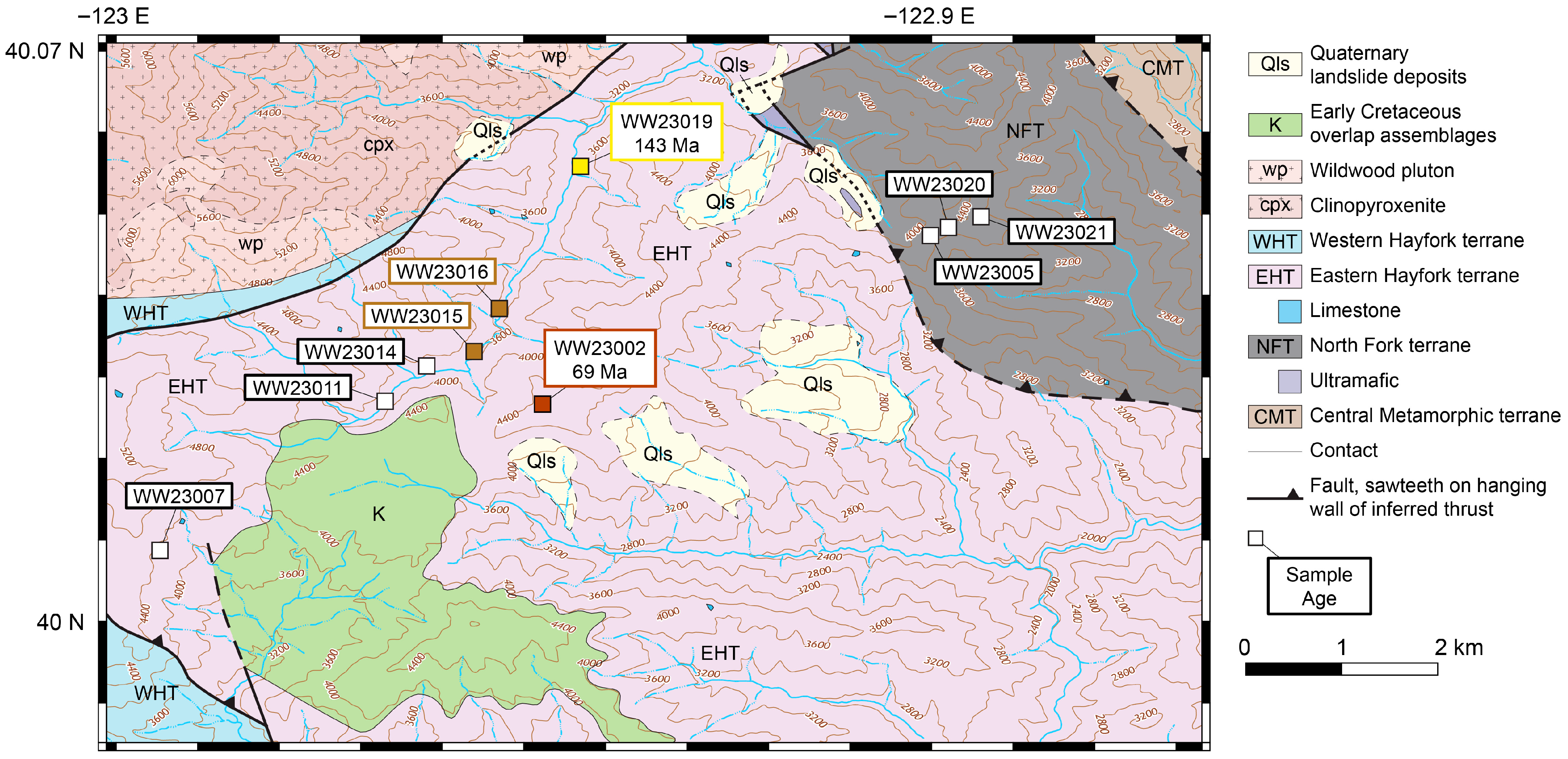
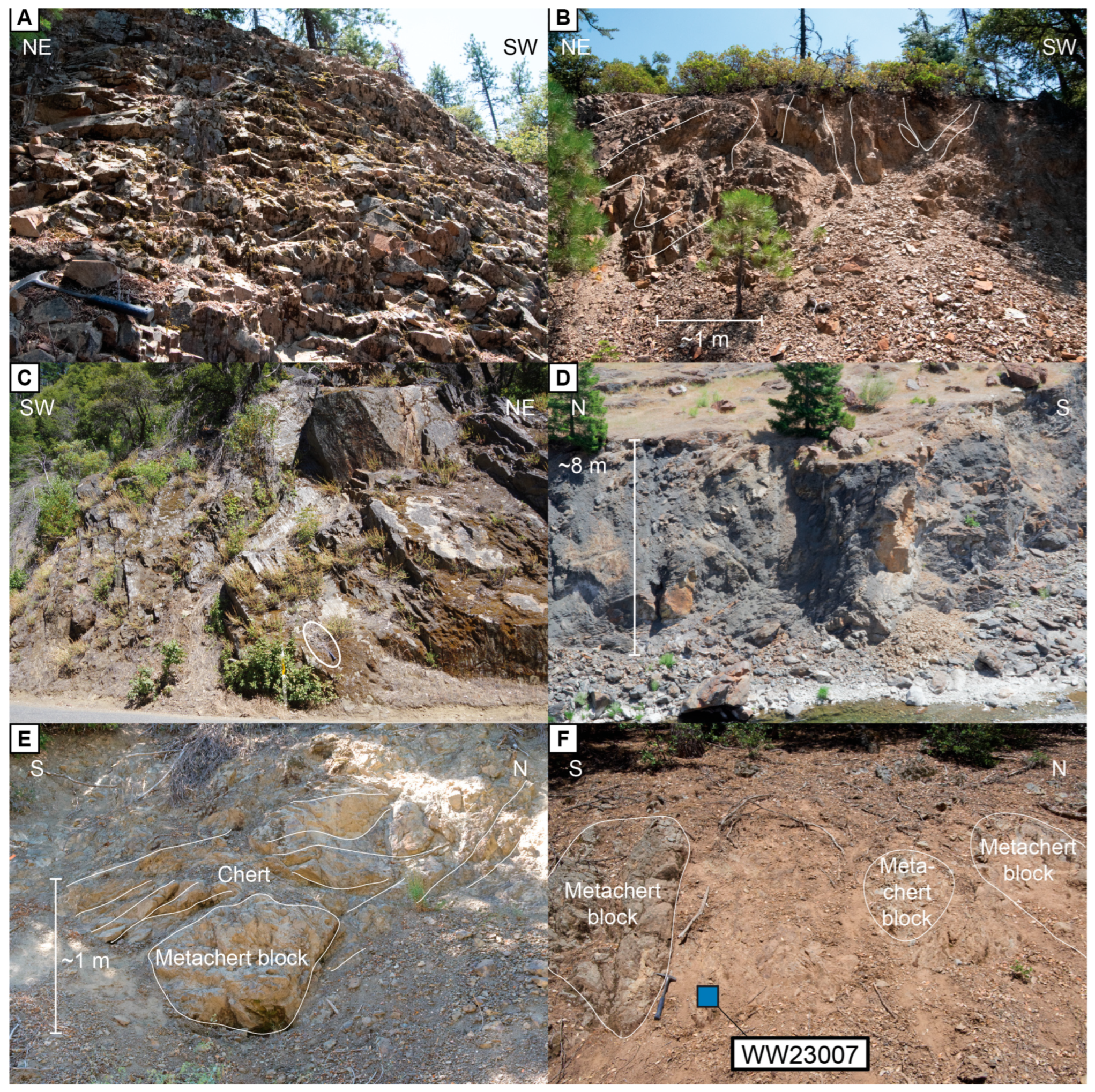
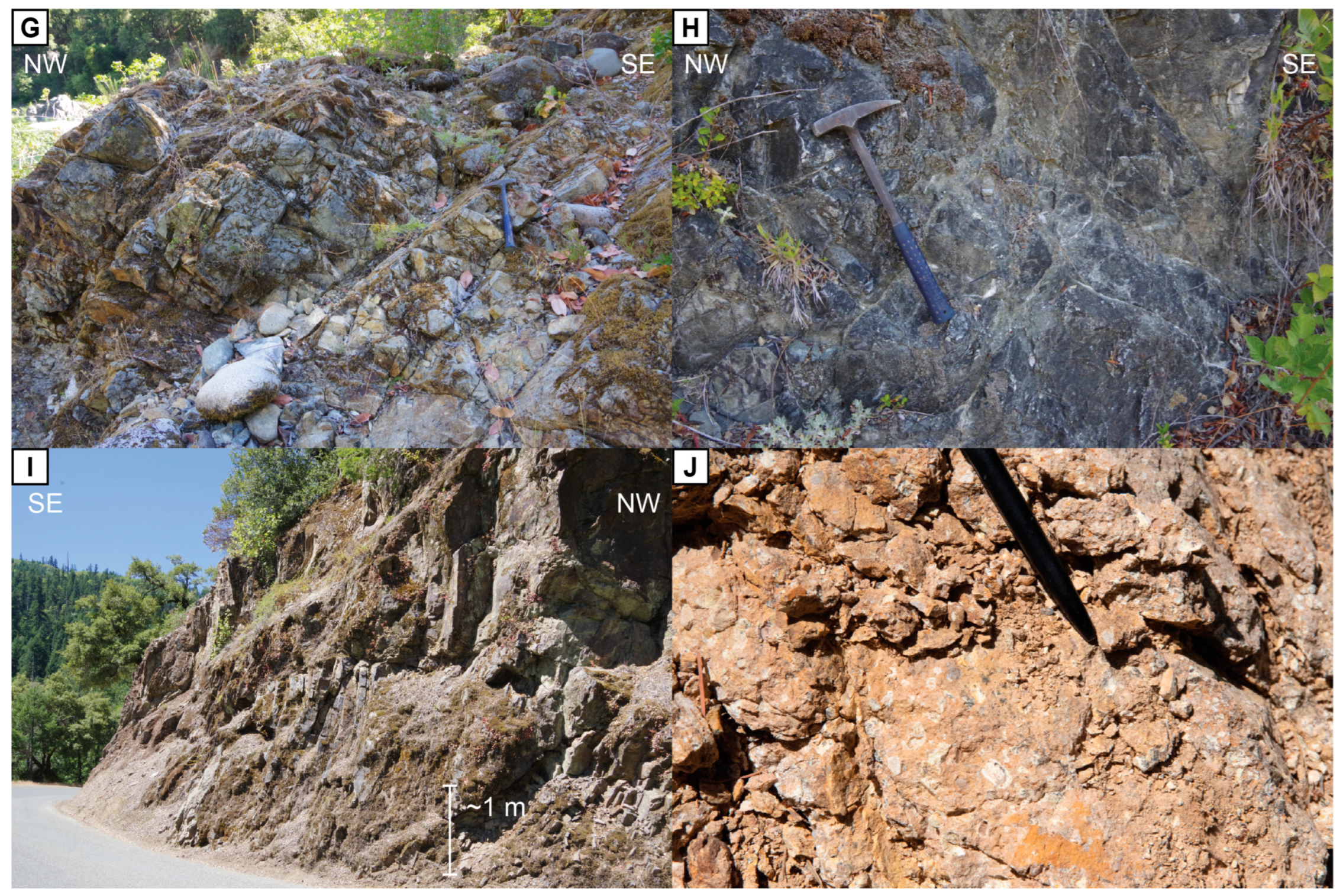
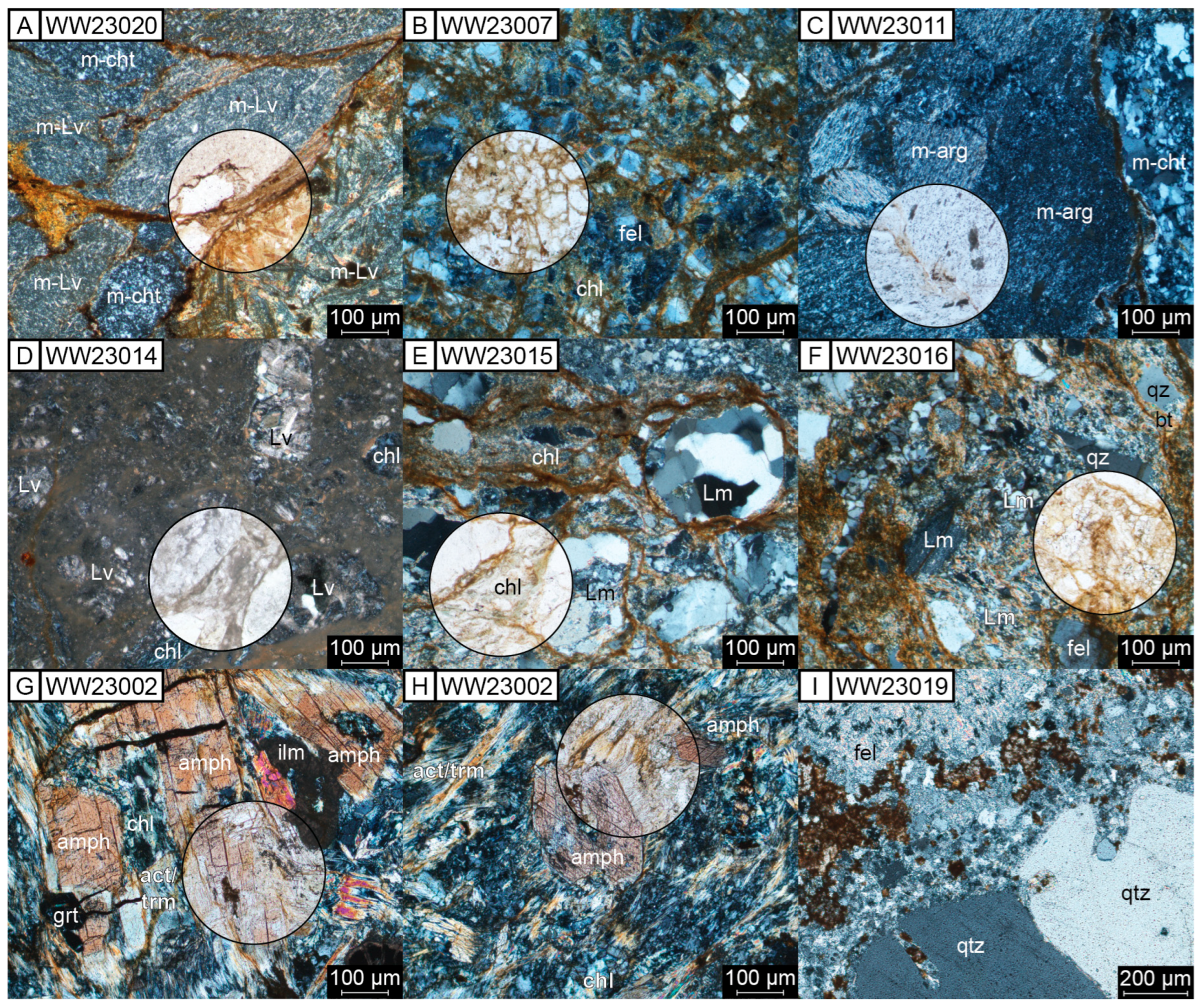
Fieldwork was conducted in the central Klamath Mountains along the Salmon River and in the southern Klamath Mountains near Wildwood (Figure 1 and Figure 2). Sample information is presented in Table 1, field photos in Figure 3, and photomicrographs in Figure 4. Full plane- and cross-polarized light photomicrographs are available in Figure S1.
Figure 2. Geologic map of the Wildwood area showing geologic contacts and sample locations, after Blake Jr. et al. [28]. Topographic contours and streams from the United States Geological Survey Chancehlulla Peak and Arkbuckle Mountain quadrangle maps. White squares denote thin sections only, and colored squares denote zircon samples. Samples with Phanerozoic zircon population(s) have a reported age.
Geosciences 16 00054 g002
Figure 3. Field photos from the Wildwood and Salmon River areas. (A) Subvertical graded sandstone and shale beds of the North Fork terrane in the Wildwood area. Fining direction is to the southwest at this outcrop, and sample WW23005 was collected nearby. (B) Just northeast of Figure 3B the graded beds traced in white are strongly folded. (C) Coherent section of gray ribbon-bedded chert in the Eastern Hayfork terrane broken formation along the Salmon River. Rock hammer is circled for scale. (D) Block-in-matrix mélange structure of the Eastern Hayfork terrane exposed on the bank of the Salmon River. (E) Wildwood Eastern Hayfork terrane metachert block with relict chert bedding in a matrix of deformed ribbon-bedded chert (traced in white). (F) Multiple metachert blocks in highly deformed matrix in the Wildwood Eastern Hayfork terrane. The location of metavolcanic matrix sample WW23007 is marked. (G) Massive metavolcaniclastic rocks of the Western Hayfork terrane along the shore of the Salmon River. (H) Metavolcaniclastic rock cut by calcite veins in the Western Hayfork terrane along the Salmon River. Sample 7.11.20.1KM was collected nearby. (I) Subvertical layered metavolcanic/metavolcaniclastic rocks within the Eastern Hayfork terrane along the Salmon River. Sample 7.9.20.3KM was collected from this outcrop. (J) Poorly exposed dike crosscutting the Eastern Hayfork terrane in the Wildwood area. Phenocrysts of feldspar and quartz are surrounded by a finer groundmass. White feldspars are euhedral but altering, quartz crystals are rounded, and the whole outcrop is weathered. Sample WW23019 was collected from this outcrop.
Geosciences 16 00054 g003aGeosciences 16 00054 g003b
Figure 4. Thin section photomicrographs of samples from the Wildwood area. Images are in cross-polarized light except in each circle which shows an area in plane-polarized light. The sample name is shown in the upper left and the scale in the lower right. Full plane- and cross-polarized light photomicrographs are included in Figure S1. (A) Typical NFT clast-supported sandstone with clasts of chert and fine-grained metavolcanics as well as a rarer metavolcanic clast with pseudomorphs after plagioclase laths. (B) EHT metavolcanic matrix of deformed plagioclase with albite twinning, undulose extinction, and pervasive chlorite. Outcrop location shown in Figure 3F. (C) EHT matrix sandstone with metamorphosed chert and argillite clasts. (D) Brecciated EHT matrix volcanic with fragments suspended in a muddy matrix. Fragments are mostly volcanic lithics composed of plag laths and chlorite displaying anomalous blue interference colors. Calcite is locally present as fragments and veins. (E) Olive-green EHT matrix sandstone. The sample is heavily fractured and contains multiple metamorphic lithics with recrystallized quartz displaying undulose extinction. (F) Similar to E. A quartz vein crosscuts the brecciation but is also deformed, indicating progressive deformation in the matrix. (G) Amphibolite matrix from the southern EHT. Large amphiboles have patchy pink-brown pleochroism. At the edges, the amphiboles are breaking down into fibrous amphiboles of the actinolite/tremolite series, which is a significant component of the groundmass along with chlorite. Minor ilmenite forms clusters, and this view shows a rare garnet. (H) Basal sections display strong amphibole cleavage, and the points of the rhombohedral crystal are altering to fibrous actinolite/tremolite. The large center amphibole grain and the smaller grain in the upper left display the range of pleochroism. Fine-grained chlorite and fibrous actinolite/tremolite are abundant in the surrounding groundmass. (I) Felsic dike crosscutting the southern EHT with mm-to-cm-scale feldspar and quartz. Note, the scale bar is different from other panels in this figure. Feldspars are altering to sericite, and rounded quartz has embayments, indicating resorption. Outcrop shown in Figure 3J. act/trm—actinolite/tremolite; amph—amphibole; chl—chlorite; fel—feldspar; grt—garnet; ilm—ilmenite; Lm—metamorphic lithic; Lv—volcanic lithic; m-arg—meta-argillite; m-cht—metachert; qtz—quartz; m-Lv—metavolcanic lithic.
Geosciences 16 00054 g004

3.1. North Fork Terrane

In the Wildwood area (Figure 2), the North Fork terrane consists of bedded sandstone, shale, and chert. Fining sequences of interbedded sandstone and shale (locally low-grade metasandstone and slate) are cm-to-m-scale (Figure 3A), and the fining direction of steeply dipping beds changes, consistent with observed folding (Figure 3B). Sandstone varies from fine-grained to poorly sorted coarse and subrounded grains of chert and metavolcanic lithics with local meta-argillite (Figure 4A). Metavolcanic clasts locally contain ~100 μm plagioclase laths with chlorite, and other very-fine-grained minerals within the lithics include chlorite, quartz, and muscovite. The sandstones are grain-supported with minor clay matrix partially altered to white mica, and grain shapes have been modified by compression (Figure 4A). The sandstone and shale sequences to the southeast overlie folded ribbon chert to the northwest.

3.2. Eastern Hayfork Terrane

The EHT is dominated by metamorphosed sandstone, argillite, and ribbon chert with minor metavolcanics. Deformation ranges from broken formation to block-in-matrix mélange with a matrix of deformed argillite, gray ribbon chert, and more minor sandstone in various proportions. The matrix, blocks, and broken formation in the study areas range from weakly metamorphosed sandstone, chert, and argillite to greenschist facies schist, quartzite, and phyllite. Matrix often wraps around large blocks, indicating deformation since incorporation of the blocks. Broken formation includes layers of argillite interbedded with sandstone or ribbon chert which may transition abruptly into mélange.
Along the Salmon River, the EHT is a mixture of broken formation (Figure 3C) and mélange (Figure 3D) with local metavolcanics. Some outcrops show clear fabric, boudinage, and folding, and other outcrops are more massive. In the Wildwood area to the south, outcrops of block-in-matrix mélange are more common than broken formation (Figure 3E,F). Abundant blocks of recrystallized quartz are gray-white, somewhat rounded, and are 1–2 m in length but locally larger. Some preserve relict ribbon bedding, indicating these blocks are metachert. Mica schists are common in the matrix but only locally contain actinolite. Foliations in the Wildwood EHT are generally northeast-dipping.
Five samples were collected from the Wildwood EHT mélange matrix (Figure 3), and all show evidence of multiple episodes of veins and brecciation. Sample WW23007 is a brecciated metavolcanic rock composed of brecciated plagioclase laths with albite twinning and undulose extinction surrounded by chlorite and clay (Figure 4B). Sample WW23011 is a sandstone with a mix of meta-argillite and metachert, and the orientations of micas are not consistent, indicating clast fabrics formed before erosion and deposition (Figure 4C). Sample WW23014 is a brecciated metavolcanic rock with a wide range of fragment sizes separated by clay (Figure 4D). Metavolcanic fragments are composed of plagioclase laths and abundant chlorite with anomalous blue interference colors. Calcite veins are also abundant in this sample. Samples WW23015 and WW23016 are sandstones with clasts of quartz, feldspar, metamorphic lithics, muscovite, and biotite in a matrix of chlorite, biotite, quartz, and feldspar (Figure 4E,F). Quartz mostly has undulose extinction, and most feldspar is plagioclase with albite twinning, although minor K-feldspar with tartan plaid twinning is also present.
Mélange matrix sample WW23002 contains chlorite, amphibole, minor apatite, plagioclase, muscovite, and ilmenite, and local garnet < 100 μm (Figure 4G,H). Large (100s μm) amphibole crystals display anomalous pleochroic pink-brown zones in plane- and cross-polarized light and inclined extinction, and basal sections show two cleavages not at 90°. The edges of the large amphiboles are altering to fibrous amphibole consistent with the tremolite/actinolite series, which is also a significant part of the matrix. Chlorite is generally fine-grained and pervasive in the matrix. This composition is consistent with high-grade amphibolite with a mafic protolith that has experienced retrograde greenschist metamorphism.

3.3. Western Hayfork Terrane

The WHT is exposed just east of the confluence of the Klamath and Salmon Rivers. Most outcrops are fine-grained massive metavolcaniclastic rocks, often with quartz or calcite veins (Figure 3G). Common euhedral crystals indicate abundant volcanic material. Sample 7.11.20.1KM was collected from dark-gray mostly fine-grained rock with crystals of plagioclase and amphibole along with chlorite. The outcrop is heavily fractured and cut by calcite veins (Figure 3H).

3.4. Igneous and Metaigneous Units

An outcrop of layered metavolcanic/metavolcanicastic rocks was identified in the central EHT (Figure 1). The layers are cm-to-dm-scale, subvertical, and gently folded (Figure 3I). In the hand sample, the rock is dark-gray and has ~1 mm crystals of weakly foliated and elongate hornblende and plagioclase in subequal amounts, consistent with an intermediate composition. Diorite dikes are not uncommon in the EHT, but they are coarser and less regular in shape. In the southern EHT (Figure 2), a dike crosscutting the mélange is poorly exposed. The rock is weathered orange and contains cm-scale quartz and feldspar in a finer matrix (Figure 3J). Feldspar grains are euhedral and altering to sericite, and quartz is rounded with embayments, indicating resorption (Figure 4I).

4. Methods

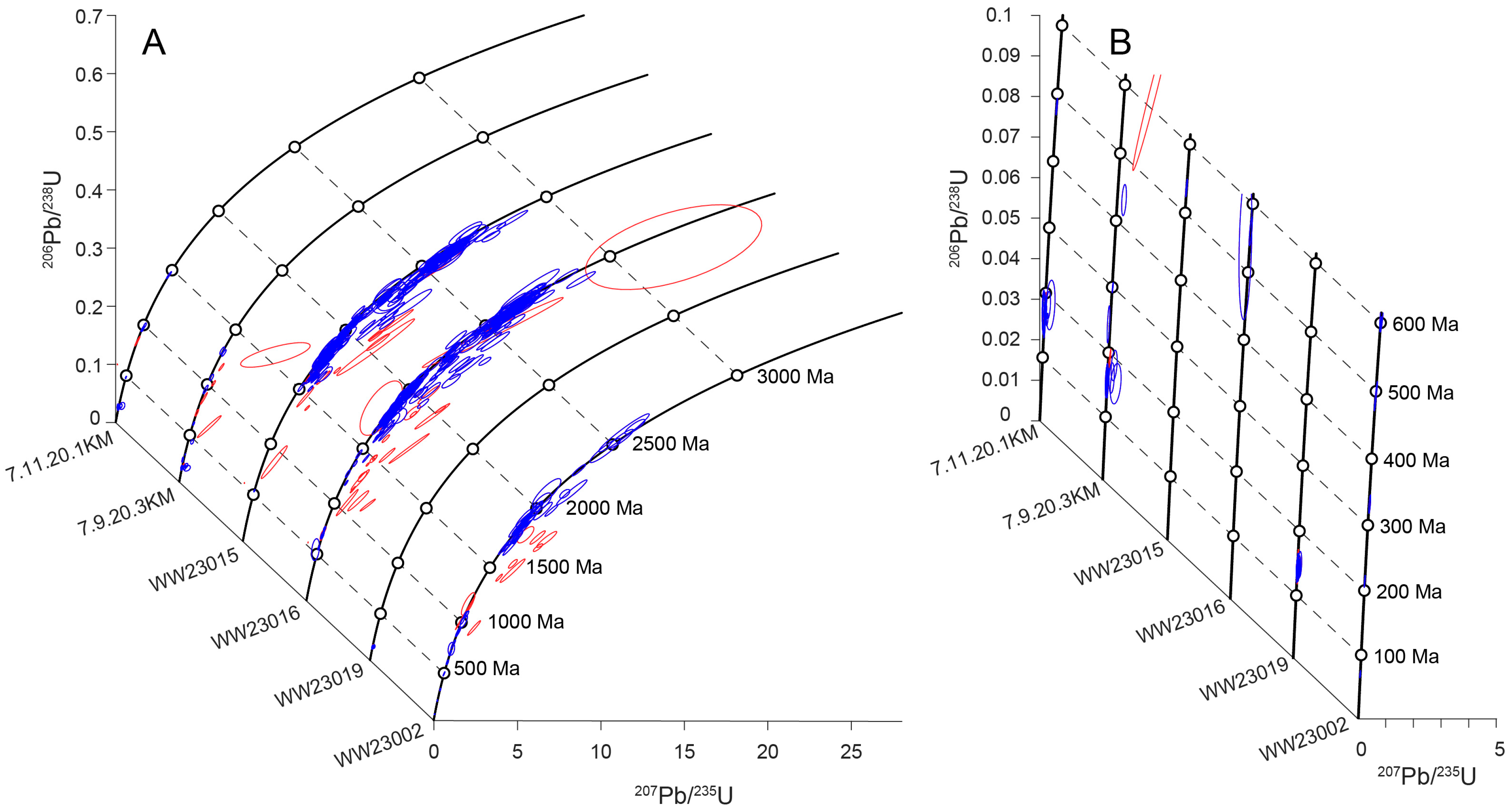
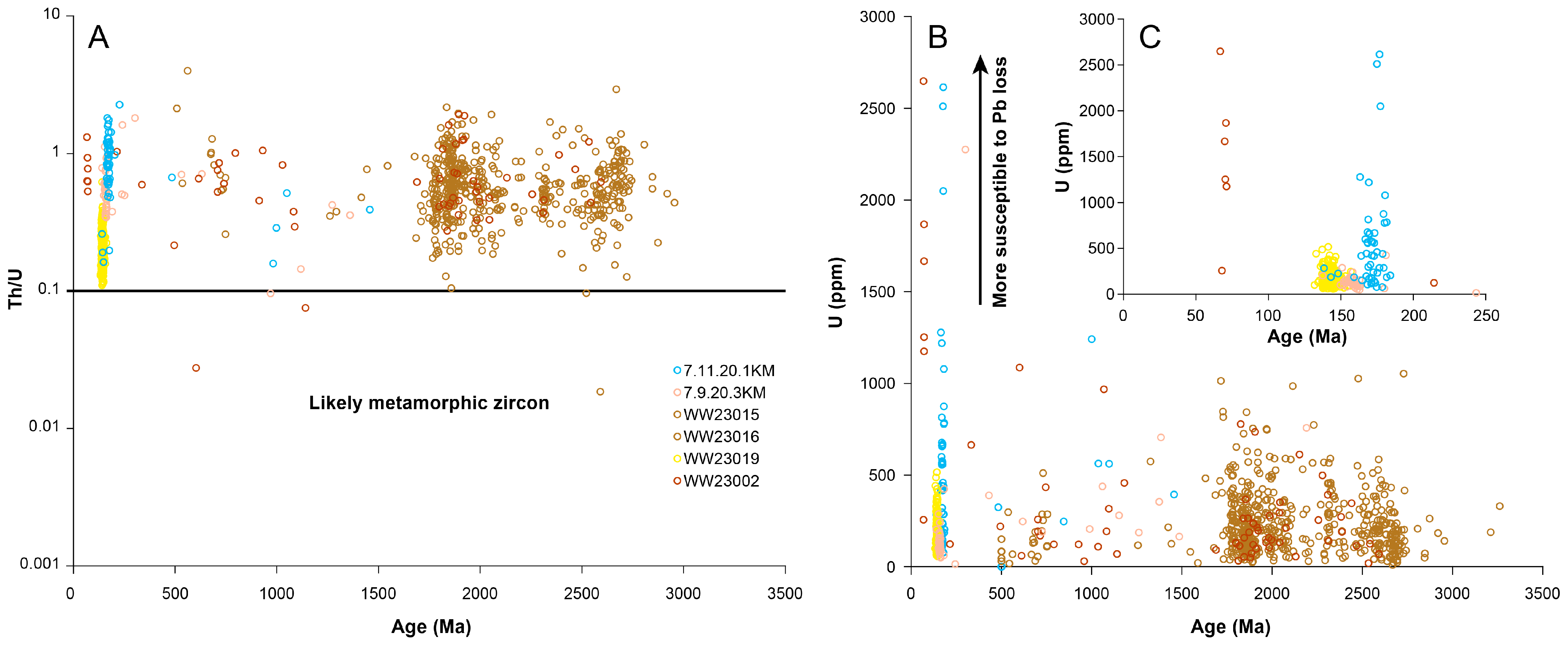
Samples were crushed and zircon grains separated by standard methods at the University of Arizona Laserchron Center (ALC). Backscattered electron (BSE) imaging was used to avoid inclusions in the zircons. Laser ablation inductively coupled plasma mass spectrometry (LA-ICP-MS) was conducted with a 20 μm laser spot and reduced using the Matlab tool AgeCalc [29]. Systematic uncertainties for 206Pb/238U and 206Pb/207Pb are 1.39–0.65%. All errors are reported at 2σ including both internal and external uncertainty, and discordance is reported as the mismatch between the 238U/206Pb and 206Pb/207Pb age. Analyses were rejected for >10% error in 206Pb/238U or 206Pb/207Pb, variable intensity, <3000 counts per second (cps) 235U, and >500 cps 204Pb. For 206Pb/238U ages > 600 Ma, analyses were rejected for >20% discordance or >5% reverse discordance. Discordance filtering was not applied to ages < 600 Ma because of the high uncertainty for young 206Pb/207Pb ages. The 206Pb/238U age is reported as the best age for ages < 900 Ma and the 206Pb/207Pb age for older ages. Wetherill concordia diagrams for the full age range and ages < 600 Ma show rejected analyses in red and accepted analyses in blue, and no ages <600 Ma plot far from concordia (Figure 5). Plots of Th/U and U ppm against age are shown in Figure 6. Zircon grains with Th/U < 0.1 are likely metamorphic [30], although metamorphic zircons can have Th/U > 0.1 depending on the availability of U and Th during metamorphism [31]. Zircon grains with high U concentration may be more susceptible to Pb loss during metamorphism.
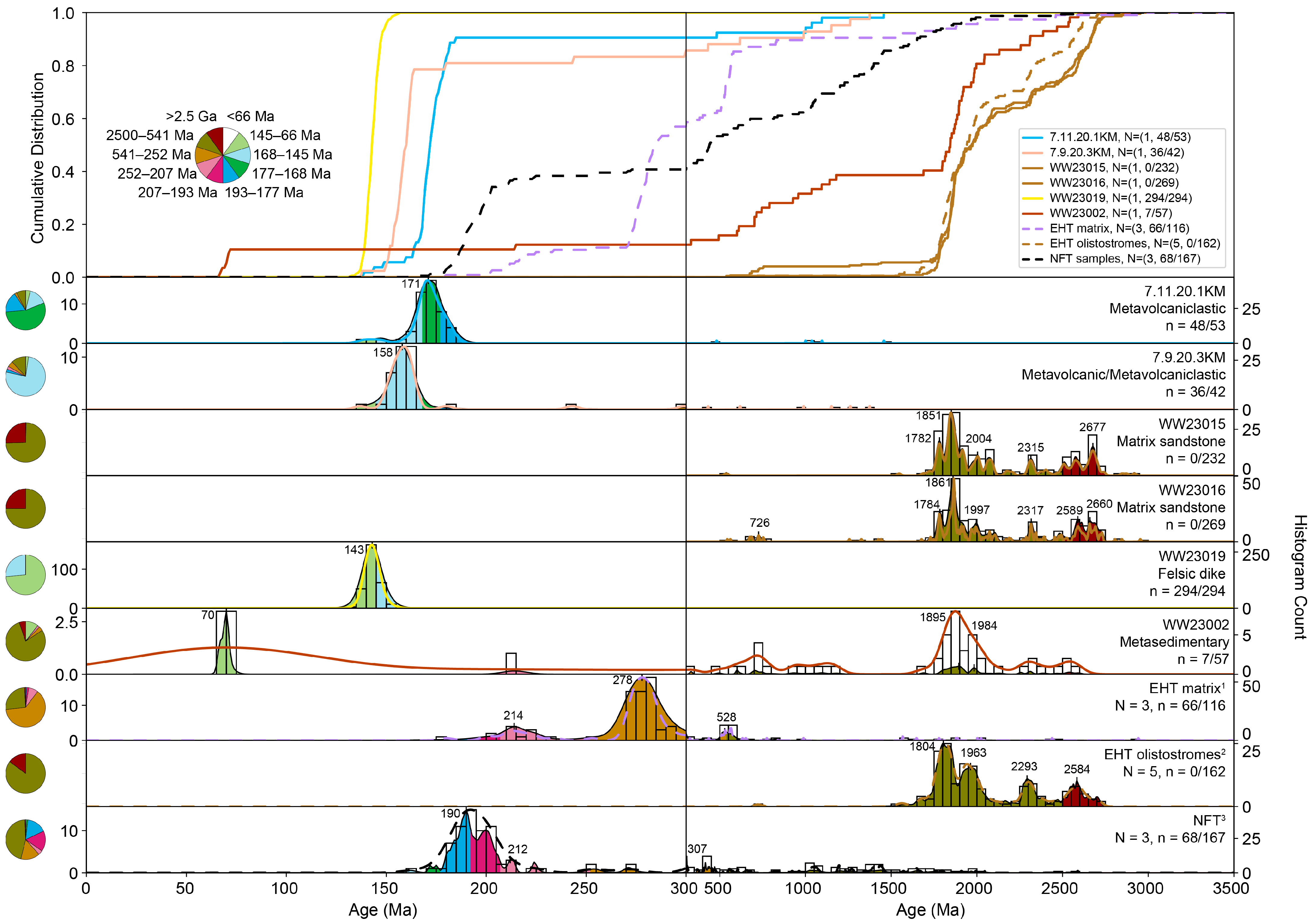
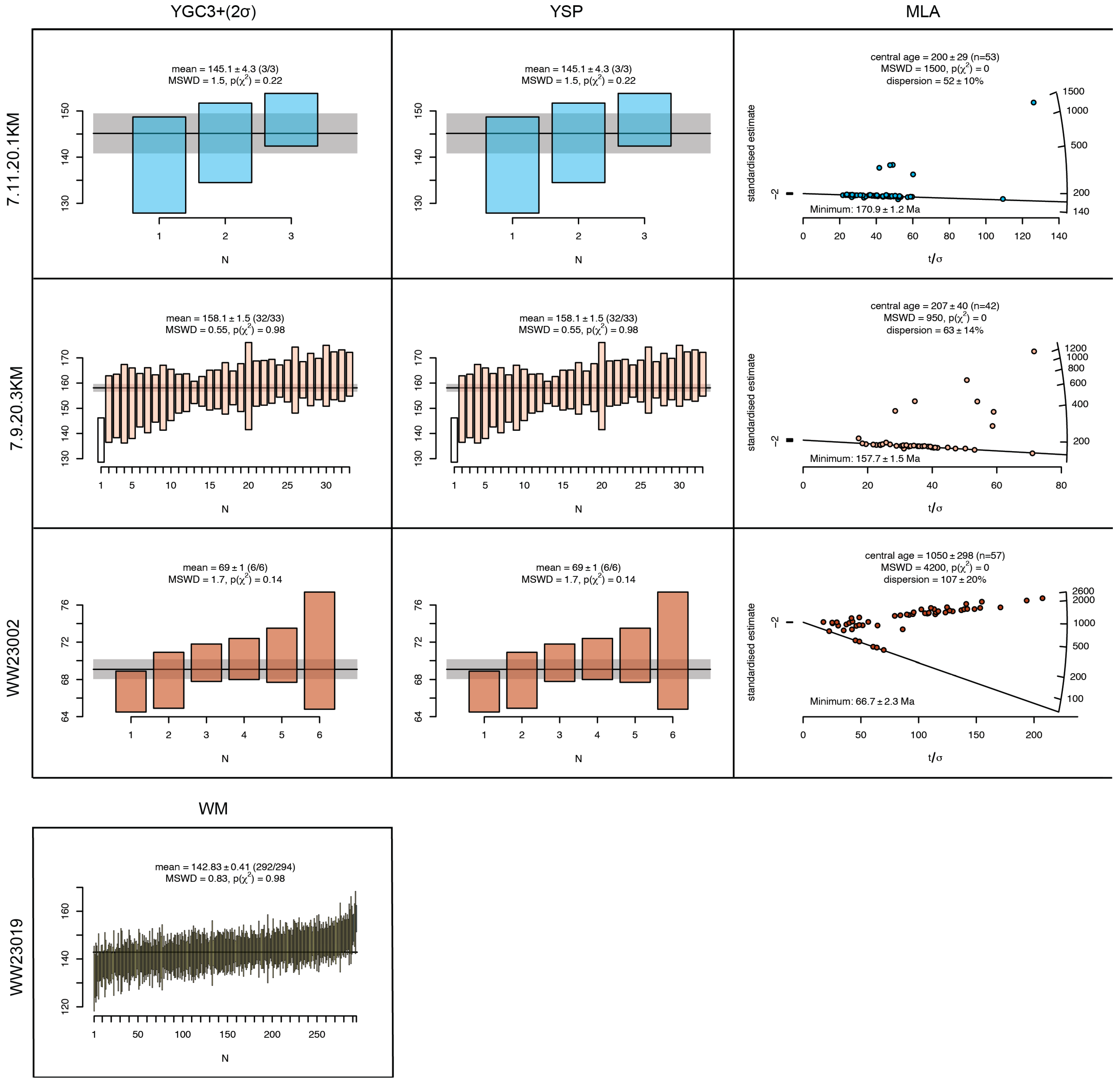
Samples were visually examined using cumulative distribution plots (CDPs), probability density plots (PDPs), kernel density estimates (KDEs), and histograms made in detritalPy [32] (Figure 7). Maximum depositional age (MDA) can be determined several ways [33,34] and is only calculated here for detrital samples with Paleozoic or younger ages. Other rocks are considered exotic and not representative of formation in the studied terranes. In Table 2 and Figure 8, we present the youngest single grain (YSG), the youngest grain cluster of three or more grains at 2σ (YCG3 + (2σ)), the youngest statistical population (YSP) [33], and the maximum likelihood age (MLA) [34]. For YCG3 + (2σ) and YSP weighted means, outliers are determined using the modified Chauvenet’s criterion in IsoplotR [35]. A weighted mean (WM) age was calculated for igneous sample WW23019 (Table 2, Figure 8). All sample ages were calculated using IsoplotR [35].

5. Results

Three NFT and seven EHT samples were analyzed in thin sections (Figure 2 and Figure 4). Six samples within the EHT and WHT and none in the NFT yielded sufficient zircon for analysis.

5.1. Salmon River Area

WHT sample 7.11.20.1KM yielded 53 ages with a single peak at 171 Ma (Figure 7). Three young ages define a YCG3 + (2σ) and YSP age 145.1 ± 4.3 Ma, but the MLA is 170.9 ± 1.2 Ma (Figure 8). Five older ages are scattered 204–1457 Ma, and 9% of ages are pre-Mesozoic. Intermediate metavolcanic/metavolcanicastic sample 7.9.20.3KM yielded 42 ages with a single peak age (Figure 7) and MDA at 158 Ma (YSP: 158.1 ± 1.5 Ma; MLA: 157.7 ± 1.5 Ma) (Figure 8), and 11 ages 191–1360 Ma (17% pre-Mesozoic) (Table 2).

5.2. Wildwood Area

EHT matrix metasandstone samples WW23015 and WW23016 yielded 232 and 269 ages, respectively, with major age peaks at ~1780, ~1855, ~2000, ~2315, ~2590, and ~2670 Ma (Figure 7). Sample WW2015 has only two zircons with ages 537 Ma and 1546 Ma, but sample WW23016 has two ages 543 Ma and 561 Ma, nine ages 673–755 Ma, and four ages 1256–1441 Ma. All ages are pre-Mesozoic, ~75% Proterozoic, and ~25% Archean (Table 2). Amphibolite matrix sample WW23002 yielded 57 ages with an MDA at 69 Ma (n = 6, YSP: 69 ± 1 Ma, MLA: 66.7 ± 2.3 Ma) and scattered ages 214–2593 Ma (87.7% pre-Mesozoic) with major age peaks at ~700, 1895, 1984, ~2300, and ~2550 Ma (Figure 7 and Figure 8). The other three matrix samples (WW23007, WW23011, and WW23014) did not yield zircon, consistent with their more mafic composition and/or fine-grained texture (Figure 4A–C). No NFT samples yielded sufficient zircon for analysis. Felsic dike sample WW23019 yielded 294 ages with a distinct single peak age at 143 Ma (WM: 142.83 ± 0.41 Ma, MSWD = 0.83; Figure 7 and Figure 8).

6. Discussion

6.1. Petrography and Geochronology

Low detrital zircon content remains an issue for the NFT and EHT. Although two EHT matrix metasandstones had good yields with 232 and 269 accepted analyses, other samples yielded from 42 to 57 accepted analyses, and the NFT samples did not yield zircon. For detrital samples with ~50 analyses, there is a 95% confidence that no age populations comprising >6% of the sample are missed [36].
Coarse NFT sandstones are composed of zircon-poor and fine-grained clasts (Figure 4F). While this makes it more difficult to constrain the ages of the strata, the petrography is consistent with limited terrigenous sediment [7,16]. Much of the EHT matrix is chert and argillite with some metavolcanic and sandstone components (Figure 4A–E). Matrix sandstone samples WW23015 and WW23016 match well with previous zircon ages from exotic blocks [8], matrix quartzite [21], and matrix chert–argillite breccia [22], although the higher zircon yields in this study improve the resolution of significant age peaks (Figure 7). While some argillaceous matrix samples contain significant Mesozoic zircon ages [9], our sandy matrix samples are likely derived from exotic olistostromal deposits as they were tectonically incorporated into the mélange matrix.
In the WHT, sample 7.11.20.1KM has MLA and YCG3 + (2σ) ages ~171 Ma, consistent with the 177–168 Ma K-Ar and 40Ar/39Ar magmatic hornblende ages for the WHT [10,11]. The YSP age is ~145 Ma using the youngest three ages (MSWD = 1.5) (Figure 8), younger than 170 Ma Ironside Mountain batholith, which intrudes the WHT [10]. Although all Th/U ratios are >0.1, the three youngest ages have Th/U 0.16–0.26, among the lowest values in the sample but well within the range for dike sample WW23019 (Figure 6). The concordia diagram does not show any significant chord trajectories (Figure 5), and all young grains have U concentration <500 ppm (Figure 6), but these young ages may still be affected by Pb loss, so the MDA would be ~171 Ma. Otherwise, the young ages are consistent with 150–143 Ma magmatism in the Western Klamath terrane [37,38] (Figure 1), suggesting this sample represents a Late Jurassic cover sequence. The outcrop shows metamorphism and fluid flow forming veins (Figure 3H), so we prefer the interpretation that sample 7.11.20.1KM is a metamorphosed part of the WHT with an MDA ~171 Ma.
The ages of two samples from the EHT are consistent with crosscutting intrusive suites. Sample 7.9.20.3KM from the layered metavolcanic/metavolcanicastic sequence in the central Klamath Mountains (Figure 1) has an MDA of 158 Ma and likely represents an extrusive equivalent to the Wooley Creek suite. The rotation of the layering to subvertical (Figure 3I) indicates significant deformation since 158 Ma. Felsic dike sample WW23019 intruded the EHT at ~143 Ma, younger than the ~169 Ma Wildwood/Chanchelulla Peak pluton [10] just to the northwest (Figure 2) and older than the ~136 Ma Shasta Bally pluton [39] farther to the east (Figure 1). The ttg suite includes plutons 145–141 Ma, but they are significantly farther north (Figure 1). Before the Sierra Nevada and Klamath Mountains offset 140–130 Ma [25], the 142–140 Ma plutons in the northernmost Sierra Nevada Mountains would have been more proximal (Figure 1). Although these intrusions are slightly younger, they restore closer to the dike, which may represent minor preceding magmatism.
Matrix sample WW23002 is an amphibolite that has undergone greenschist facies retrograde metamorphism. However, it also contains detrital zircon ages consistent with those in EHT olistostromal blocks [8] and matrix samples from this study and others [21,22]. This apparent contradiction could indicate that the matrix is a mix of mafic and sedimentary protoliths with some heterogeneous zones like the amphibolite in the portion of the sample retained for thin section analysis. The youngest six zircon grains define an MDA ~69 Ma (Figure 8). Although it is possible that these young grains represent contamination during mineral separation, they represent 12% of analyses. Additionally, an EHT matrix sample near the Wooley Creek batholith [22] and an olistostromal block in the southern Rattlesnake Creek terrane [40] both contain similar pre-Mesozoic detrital zircon ages and a few young grains of 71–78 Ma, which the authors interpret as likely contamination [22,40]. It is unlikely that two samples with similar pre-Mesozoic ages separated and analyzed at different lab facilities would include the same Late Cretaceous contamination ages, so we explore alternate explanations in Section 6.3 below.

6.2. Comparing the North Fork and Eastern Hayfork Terranes

Near Wildwood, although chert and argillite are abundant in both the NFT and EHT, there are significant differences in the texture and composition of their clastic rocks. EHT metachert blocks are abundant, and matrix sample WW23011 has clasts similar to the NFT sandstones, but the EHT also contains blocks and matrix that are significantly coarser and more felsic than any clasts identified in the siliciclastic NFT. Such a felsic composition in the EHT is inconsistent with a high contribution of sediment from the previously accreted Klamath terranes, which are largely oceanic. The Antelope Mountain quartzite in the Eastern Klamaths is a potential zircon source [8]. However, the abundance of coarse siliciclastic material and olistostromal blocks with significant Proterozoic zircons in the EHT and their lack in the NFT suggests that the accreted continental sediment was not transported across the NFT on the upper plate to the trench, but rather was deposited on the subducting plate from a source along strike [21].
Although Permian and Triassic paleomagnetic data are only available for the Redding subterrane, they indicate that the Klamath Mountains have rotated >90° clockwise relative to North America [41]. Paleomagnetism on the 170 Ma Ironside Mountain Batholith, which intrudes into the WHT, indicates 73.5 ± 11.8° clockwise rotation and no significant difference in latitude compared with North America [42], consistent with a more E-W orientation of the Klamath Mountains in the early Mesozoic. The Permian–Triassic left-lateral California–Coahuila transform translated part of the North American margin south [43], but it is unclear how far north the transform extended and how it might have impacted tectonic motions in northern California [44]. In the NFT, Permian metachert paleomagnetism suggests significant northward transport relative to North America [45], but this is difficult to reconcile with the largely sinistral margin at the time. Based on the Permo-Triassic orientation of the orogen, we tentatively suggest the major continental source for the EHT blocks was located south of the Klamath Mountains rather than the more proximal Antelope Mountain quartzite (Figure 1).

6.3. Magmatism and Metamorphism

This study documents a Late Jurassic volcanic cover sequence as 158 Ma layered intermediate metavolcanic/metavolcanicastic rocks on the central EHT. Deformation since then has rotated the layers to subvertical. If the Late Jurassic cover sequence was extensive and buried significant portions of the Klamath Mountains, it could explain the low proportion of zircon ages from older Klamath terranes in the 160–150 Ma Galice Formation [12]. A young population of zircon ages ~145 Ma in the Western Hayfork terrane sample is younger than crosscutting intrusions and interpreted as an indication of Pb loss during metamorphism. This age is consistent with the 150–143 Ma Western Klamath suite of magmatism [37,38]. In the southernmost EHT, a 143 Ma crosscutting dike is significantly younger than the nearby 169 Ma Wildwood pluton. Instead, it is likely more closely related to 140–142 Ma plutons in the northern Sierra Nevada (Figure 1), which were proximal before the translation of the Klamath Mountains to the west 140–130 Ma [25].
Matrix sample WW23002 in the EHT is most likely metamorphosed olistostromal material mixed with amphibolite and is significantly more metamorphosed than matrix samples WW23015 and WW23016 with similar pre-Mesozoic ages, consistent with a subduction complex mélange. The amphibolite in thin section exhibits a high-grade phase overprinted by greenschist retrograde metamorphism. Although the youngest six ages 71–67 Ma could be explained by contamination during mineral separation, similar ages have been found in an EHT matrix sample farther north [22] and a Rattlesnake Creek terrane block farther west [40], as discussed in 6.1 above.
Another possible source of the young grains is in situ contamination, where younger grains from regolith may have become deeply embedded and not removed by standard washing/scrubbing procedures [46]. The Late Cretaceous Hornbrook [47,48,49], Early Eocene Umpqua [50,51], and Early-to-Middle Eocene Tyee Formations [51,52] are exposed on the margins of the Klamath Mountains; the Miocene Weaverville Formation [53,54] is present in fault-bounded basins in the southern Klamath Mountains [53,55,56]; and the Pliocene Wimer Formation is locally preserved overlying the Klamath peneplain [57,58]. However, detrital zircon grains from these Late Cretaceous and younger deposits are mostly >80 Ma [47,48,51,52,53,59,60]. While the Tyee Formation contains detrital zircon ages derived from Idaho that can explain the young zircons in sample WW23002, the zircon ages extend to as young as 44 Ma with a sharp peak at 49 Ma [51,52,59,60], and it is possible, but unlikely, that the Tyee Formation extended to the southern Klamath Mountains. No detrital zircon data exist for the Wimer Formation, and conglomerate clasts are mostly locally derived, but white mica 40Ar/39Ar ages and the abundance of K-feldspar in synchronous deposits farther west also indicate sediment from Idaho [57,58]. Still, given the age range of zircons sourced from Idaho in the Tyee Formation, we find it unlikely that three different samples in the Klamath Mountains would be contaminated with less abundant 78–67-Ma-age zircons.
Based on the metamorphic grade of sample WW23002, the youngest ages could be metamorphic zircon, which grew in olistostromal material in the EHT mélange. However, the Th/U ratios for the six youngest grains are 0.5–1.3, consistent with ratios for the majority of analyses in other samples from this study (Figure 6). U concentrations of 256–2649 ppm are within the range of grains we interpret as representing a robust MDA for sample 7.11.20.1KM (Figure 6), but chords of analyses below concordia also indicate Pb loss in the sample (Figure 5). Localized contact or hydrothermal metamorphism could explain why Late Cretaceous detrital zircon ages are not more widespread in the Klamath Mountains. However, the 136 Ma Shasta Bally pluton is the youngest magmatism documented in the Klamath Mountains [13], and the Sierra Nevada shut off by 80 Ma [61]. Modest Cretaceous extension [62,63] is the only deformation of similar age, and there is no documented associated magmatism.
More evidence is needed to confirm that Late Cretaceous zircons are more prevalent in the basement terranes of the Klamath Mountains. If so, these ages are difficult to explain by in situ contamination, and more sampling of Late Cretaceous and younger remnants is needed to characterize their detrital zircon ages. Although the sample shows Pb loss trends in concordia, the young ages are also not consistent with any documented metamorphism or magmatism in the Klamath Mountains. Yet, we find it difficult to explain the presence of Late Cretaceous zircons in three separate basement samples from multiple laboratories and studies [22,40] and this study as laboratory contamination. Zircon geochemistry could provide more constraints on provenance and/or metamorphism. For now, we tentatively propose that these Late Cretaceous grains may have experienced Pb loss during previously unrecognized local metamorphism/magmatism ≤69 Ma, potentially related to local dikes and/or hydrothermal fluids.

7. Conclusions

This study presents some petrographic and zircon U-Pb geochronology results that are consistent with previous studies.
  • In the Wildwood area of the southern Klamath Mountains, the petrography of the EHT matrix and NFT siliciclastic strata is consistent with previous studies and with the poor zircon yields from many of these rocks.
  • Detrital zircon ages in the southern EHT matrix are consistent with exotic olistostromal material.
  • Detrital zircon U-Pb ages from the WHT yield an MDA of ~171 Ma and minor pre-Mesozoic ages, consistent with detrital hornblende K-Ar and 40Ar/39Ar ages, crosscutting intrusions at 170 Ma, and terrigenous input from older accreted terranes.
  • A 143 Ma dike crosscutting the southern EHT is consistent with offset of the Klamath Mountains and Sierra Nevada after 140 Ma.
This study also presents intriguing new results.
5.
Within the central EHT, a sequence of layered metavolcanic/metavolcaniclastic rocks is 158 Ma and may represent a volcanic component of the Wooley Creek intrusive suite, which may have covered much of the Western Paleozoic and Triassic belt. Significant deformation occurred since deposition to rotate it into its current subvertical orientation.
6.
A young ~145 Ma population of detrital zircon ages in the central WHT is younger than crosscutting intrusions and suggests Pb loss during an episode of metamorphism, possibly related to the intrusion of the Western Klamath suite.
7.
The southern EHT matrix includes mafic volcanic rocks and olistostromal sandstone, which are locally mixed. One matrix sample has detrital zircon ages similar to olistostromal blocks and matrix in the EHT, but it is significantly more metamorphosed, and the youngest zircon age population is 69 Ma, consistent with minor Late Cretaceous detrital zircons in the Klamath Mountains from previous studies, which is difficult to explain by contamination. The young grains may have experienced lead loss during metamorphism, but this does not match any known episode of magmatism or metamorphism. We tentatively suggest that the young grains record previously unrecognized local metamorphism and/or magmatism ≤69 Ma, potentially related to local dikes and/or hydrothermal fluids.
More detailed field mapping, geochemistry, geochronology, and thermochronology are necessary to determine the extent and significance of these new findings, but they indicate that there is still much to discover in the Klamath Mountains.

Supplementary Materials

The following supporting information can be downloaded at: https://www.mdpi.com/article/10.3390/geosciences16020054/s1, Table S1: Sample locations and geochronology; Figure S1: Full thin section photomicrographs.

Author Contributions

Conceptualization, Kathryn Metcalf; Data curation, K.M., J.G., and J.C.R.; Formal analysis, K.M., J.G., and J.C.R.; Funding acquisition, K.M.; Investigation, K.M., J.G., and J.C.R.; Methodology, K.M., J.G., and J.C.R.; Project administration, K.M.; Resources, K.M.; Supervision, K.M.; Validation, K.M., J.G., and J.C.R.; Visualization, K.M.; Writing—original draft, J.G. and J.C.R.; Writing—review and editing, K.M. All authors have read and agreed to the published version of the manuscript.

Funding

This research was funded by California State University Fullerton funding awarded to K.M. Analyses were conducted at the Arizona LaserChron Center, which is supported by NSF EAR-1338583.

Data Availability Statement

The original data presented in the study are openly available in the Supplementary Materials.

Acknowledgments

We thank Calvin Barnes and Derek Beal for their helpful discussions on Klamath geology and Jennifer Diaz for their assistance in the field. We also thank Klamath and Shasta-Trinity National Forests for their field support and the Arizona LaserChron Center staff for their assistance in geochronology data collection and reduction. Constructive reviews by four anonymous reviewers improved the manuscript.

Conflicts of Interest

The authors declare no conflicts of interest. The funders had no role in the design of the study; in the collection, analyses, or interpretation of data; in the writing of the manuscript; or in the decision to publish the results.

Abbreviations

The following abbreviations are used in this manuscript:
AArchean
act/trmActinolite/tremolite
amphAmphibole
BSEBackscattered electron
CDPCumulative distribution plot
chlChlorite
CMZCondrey Mountain shear zone
EHTEastern Hayfork terrane
felFeldspar
grtGarnet
IATIsland arc tholeiite
KDEKernel density estimation
LA-MC-ICPMSLaser ablation multi-collector inductively coupled plasma mass spectrometry
LkLake
MDAMaximum depositional age
MDSMulti-dimensional scaling
MLAMaximum likelihood age
MORBMid-ocean ridge basalt
MSWDMean square of weighted deviates
MtnMountain
MzMesozoic
NNumber of samples in a compilation
nNumber of analyses
NFTNorth Fork terrane
OFOrleans fault
OIBOcean island basalt
PDPProbability distribution plot
PkPeak
PtPoint
PtzProterozoic
PzPaleozoic
qtzquartz
SCRT/SRTSoap Creek Ridge thrust/Salmon River thrust
SCTSalt Creek thrust
SEMScanning electron microscope
STSiskiyou thrust
TiOTitanium oxide
TSTTwin Sisters thrust
TTTrinity thrust
ttgtonalite–trondhjemite–granodiorite
WHTWestern Hayfork terrane
WPTWilson Point thrust
YGC3+ (2σ)Youngest grain cluster of three or more grains overlapping in 2σ error
YSGYoungest single grain
YSPYoungest statistical population

References

  1. Irwin, W.P. Terranes of the Western Paleozoic and Triassic Belt in the Southern Klamath Mountains, California. In Geological Survey Research 1972; U.S. Geological Survey: Reston, VA, USA, 1972; pp. C103–C111. [Google Scholar]
  2. Saleeby, J.B. Accretionary Tectonics of the North American Cordillera. Annu. Rev. Earth Planet. Sci. 1983, 11, 45–73. [Google Scholar] [CrossRef]
  3. Snoke, A.W.; Barnes, C.G. The Development of Tectonic Concepts for the Klamath Mountains Province, California and Oregon. In Geological Studies in the Klamath Mountains Province, California and Oregon: A Volume in Honor of William P. Irwin; Geological Society of America: Boulder, CO, USA, 2006; ISBN 978-0-8137-2410-2. [Google Scholar]
  4. Wright, J.E. Permo-Triassic Accretionary Subduction Complex, Southwestern Klamath Mountains, Northern California. J. Geophys. Res. Solid Earth 1982, 87, 3805–3818. [Google Scholar] [CrossRef]
  5. Irwin, W.P. Correlation of the Klamath Mountains and Sierra Nevada; Open-File Report; U.S. Geological Survey: Reston, VA, USA, 2003; Volume 2002–490. [Google Scholar]
  6. Surpless, K.D.; Alford, R.W.; Barnes, C.; Yoshinobu, A.; Weis, N.E. Late Jurassic Paleogeography of the U.S. Cordillera from Detrital Zircon Age and Hafnium Analysis of the Galice Formation, Klamath Mountains, Oregon and California, USA. GSA Bull. 2024, 136, 1488–1510. [Google Scholar] [CrossRef]
  7. Scherer, H.H.; Ernst, W.G. North Fork Terrane, Klamath Mountains, California: Geologic, Geochemical, and Geochronologic Evidence for an Early Mesozoic Forearc. In Special Paper 438: Ophiolites, Arcs, and Batholiths: A Tribute to Cliff Hopson; Geological Society of America: Boulder, CO, USA, 2008; Volume 438, pp. 289–309. ISBN 978-0-8137-2438-6. [Google Scholar]
  8. Scherer, H.H.; Ernst, W.G.; Wooden, J.L. Regional Detrital Zircon Provenance of Exotic Metasandstone Blocks, Eastern Hayfork Terrane, Western Paleozoic and Triassic Belt, Klamath Mountains, California. J. Geol. 2010, 118, 641–653. [Google Scholar] [CrossRef]
  9. Ernst, W.G.; Wu, C.; Lai, M.; Zhang, X. U-Pb Ages and Sedimentary Provenance of Detrital Zircons from Eastern Hayfork Meta-Argillites, Sawyers Bar Area, Northwestern California. J. Geol. 2017, 125, 33–44. [Google Scholar] [CrossRef]
  10. Wright, J.E.; Fahan, M.R. An Expanded View of Jurassic Orogenesis in the Western United States Cordillera: Middle Jurassic (Pre-Nevadan) Regional Metamorphism and Thrust Faulting within an Active Arc Environment, Klamath Mountains, California. GSA Bull. 1988, 100, 859–876. [Google Scholar] [CrossRef]
  11. Donato, M.M.; Barnes, C.G.; Tomlinson, S.L. The Enigmatic Applegate Group of Southwestern Oregon: Age, Correlation, and Tectonic Affinity. Or. Geol. 1996, 58, 14. [Google Scholar]
  12. Surpless, K.D.; Barnes, C.; Yoshinobu, A. Record of the Late Jurassic Cordilleran Margin from Detrital Zircon Analysis of the Galice and Mariposa Formations, California and Oregon. In Jurassic–Paleogene Tectonic Evolution of the North American Cordillera; Gordon, S.M., Miller, R.B., Rusmore, M.E., Tikoff, B., Eds.; Geological Society of America: Boulder, CO, USA, 2025; pp. 1–40. ISBN 978-0-8137-2565-9. [Google Scholar]
  13. Richardson, A.E. Space/Time Evolution of Magmatism in the Klamath Mountains Province, CA/OR: Implications for Cordilleran Arc Magma Periodicity. Master’s Thesis, Texas Tech University, Lubbock, TX, USA, 2021. [Google Scholar]
  14. Hacker, B.R.; Ernst, W.G.; McWilliams, M.O. Genesis and Evolution of a Permian-Jurassic Magmatic Arc/Accretionary Wedge, and Reevaluation of Terranes in the Central Klamath Mountains. Tectonics 1993, 12, 387–409. [Google Scholar] [CrossRef]
  15. Ernst, W.G. Mesozoic Petrotectonic Development of the Sawyers Bar Suprasubduction-Zone Arc, Central Klamath Mountains, Northern California. GSA Bull. 1999, 111, 1217–1232. [Google Scholar] [CrossRef]
  16. Ando, C.J.; Irwin, W.P.; Jones, D.L.; Saleeby, J.B. The Ophiolitic North Fork Terrane in the Salmon River Region, Central Klamath Mountains, California. GSA Bull. 1983, 94, 236–252. [Google Scholar] [CrossRef]
  17. Irwin, W.P.; Blome, C.D. Fossil Localities of the Rattlesnake Creek, Western and Eastern Hayfork, and North Fork Terranes of the Klamath Mountains; U.S. Geological Survey: Reston, VA, USA, 2004; p. 50. [Google Scholar]
  18. Scherer, H.H.; Snow, C.A.; Ernst, W.G. Geologic-Petrochemical Comparison of Early Mesozoic Mafic Arc Terranes: Western Paleozoic and Triassic Belt, Klamath Mountains, and Jura–Triassic Arc Belt, Sierran Foothills. In Geological Studies in the Klamath Mountains Province, California and Oregon: A Volume in Honor of William P. Irwin; Geological Society of America: Boulder, CO, USA, 2006; ISBN 978-0-8137-2410-2. [Google Scholar]
  19. Goodge, J.W. Pre-Middle Jurassic Accretionary Metamorphism in the Southern Klamath Mountains of Northern California, USA. J. Metamorph. Geol. 1995, 13, 93–110. [Google Scholar] [CrossRef]
  20. Goodge, J.W.; Renne, P.R. Mid-Paleozoic Olistoliths in Eastern Hayfork Terrane Mélange, Klamath Mountains: Implications for Late Paleozoic-Early Mesozoic Cordilleran Forearc Development. Tectonics 1993, 12, 279–289. [Google Scholar] [CrossRef]
  21. Miller, M.M.; Saleeby, J.B. Permian and Triassic Paleogeography of the Eastern Klamath Arc and Eastern Hayfork Subduction Complex, Klamath Mountains, California: Evidence from Lithotectonic Associations and Detrital Zircon; Pacific Section SEPM: Fullerton, CA, USA, 1991; pp. 643–652. [Google Scholar]
  22. Barnes, C.G.; Coint, N.; Barnes, M.A.; Chamberlain, K.R.; Cottle, J.M.; Rämö, O.T.; Strickland, A.; Valley, J.W. Open-System Evolution of a Crustal-Scale Magma Column, Klamath Mountains, California. J. Petrol. 2021, 62, egab065. [Google Scholar] [CrossRef]
  23. Ernst, W.G. Accretionary Terrane in the Sawyers Bar Area of the Western Triassic and Paleozoic Belt, Central Klamath Mountains, Northern California. In Paleozoic and Early Mesozoic Paleogeographic Relations; Sierra Nevada, Klamath Mountains, and Related Terranes; Harwood, D.S., Miller, M.M., Eds.; Geological Society of America: Boulder, CO, USA, 1990; Volume 255, ISBN 978-0-8137-2255-9. [Google Scholar]
  24. Barnes, C.G.; Barnes, M.A. The Western Hayfork Terrane: Remnants of the Middle Jurassic Arc in the Klamath Mountain Province, California and Oregon. Geosphere 2020, 16, 1769–1792. [Google Scholar] [CrossRef]
  25. Ernst, W.G. Earliest Cretaceous Pacificward Offset of the Klamath Mountains Salient, NW California–SW Oregon. Lithosphere 2013, 5, 151–159. [Google Scholar] [CrossRef]
  26. Jones, D.L.; Irwin, W.P. Structural Implications of an Offset Early Cretaceous Shoreline in Northern California. GSA Bull. 1971, 82, 815–822. [Google Scholar] [CrossRef]
  27. Chapman, A.D.; Grischuk, J.; Klapper, M.; Schmidt, W.; LaMaskin, T. Middle Jurassic to Early Cretaceous Orogenesis in the Klamath Mountains Province (Northern California–Southern Oregon, USA) Occurred by Tectonic Switching: Insights from Detrital Zircon U-Pb Geochronology of the Condrey Mountain Schist. Geosphere 2024, 20, 749–777. [Google Scholar] [CrossRef]
  28. Blake, M.C., Jr.; Harwood, D.S.; Helley, E.J.; Irwin, W.P.; Jayko, A.S.; Jones, D.L. Geologic Map of the Red Bluff 30’ × 60’ Quadrangle, California 1999. Available online: https://pubs.usgs.gov/imap/2542/ (accessed on 17 January 2026).
  29. Sundell, K.E.; Gehrels, G.E.; Pecha, M.E. Rapid U-Pb Geochronology by Laser Ablation Multi-Collector ICP-MS. Geostand. Geoanalytical Res. 2021, 45, 37–57. [Google Scholar] [CrossRef]
  30. Rubatto, D. Zircon: The Metamorphic Mineral. Rev. Mineral. Geochem. 2017, 83, 261–295. [Google Scholar] [CrossRef]
  31. Yakymchuk, C.; Kirkland, C.L.; Clark, C. Th/U Ratios in Metamorphic Zircon. J. Metamorph. Geol. 2018, 36, 715–737. [Google Scholar] [CrossRef]
  32. Sharman, G.R.; Sharman, J.P.; Sylvester, Z. detritalPy: A Python-Based Toolset for Visualizing and Analysing Detrital Geo-Thermochronologic Data. Depos. Rec. 2018, 4, 202–215. [Google Scholar] [CrossRef]
  33. Coutts, D.S.; Matthews, W.A.; Hubbard, S.M. Assessment of Widely Used Methods to Derive Depositional Ages from Detrital Zircon Populations. Geosci. Front. 2019, 10, 1421–1435. [Google Scholar] [CrossRef]
  34. Vermeesch, P. Maximum Depositional Age Estimation Revisited. Geosci. Front. 2021, 12, 843–850. [Google Scholar] [CrossRef]
  35. Vermeesch, P. IsoplotR: A Free and Open Toolbox for Geochronology. Geosci. Front. 2018, 9, 1479–1493. [Google Scholar] [CrossRef]
  36. Andersen, T. Detrital Zircons as Tracers of Sedimentary Provenance: Limiting Conditions from Statistics and Numerical Simulation. Chem. Geol. 2005, 216, 249–270. [Google Scholar] [CrossRef]
  37. Saleeby, J.B.; Harper, G.D. Tectonic Relations Between the Galice Formation and the Condrey Mountain Schist, Klamath Mountains, Northern California. In Mesozoic Paleogeography of the Western United States—II; Dunne, G.C., McDougall, K.A., Eds.; SEPM (Society for Sedimentary Geology): Claremore, OK, USA, 1993; pp. 61–80. [Google Scholar]
  38. Harper, G.D. Structure of Syn-Nevadan Dikes and Their Relationship to Deformation of the Galice Formation, Western Klamath Terrane, Northwestern California. In Geological Studies in the Klamath Mountains Province, California and Oregon: A Volume in Honor of William P. Irwin; Geological Society of America: Boulder, CO, USA, 2006; ISBN 978-0-8137-2410-2. [Google Scholar]
  39. Lanphere, M.A.; Jones, D.L. Cretaceous Time Scale from North America. In Contributions to the Geologic Time Scale; Cohee, G.V., Glaessner, M.F., Hedberg, H.D., Eds.; American Association of Petroleum Geologists: Tulsa, OK, USA, 1978; Volume 6, ISBN 978-1-62981-200-7. [Google Scholar]
  40. Urda, D.; Metcalf, K.; Diaz, J. Development and Evolution of the Rattlesnake Creek Terrane, Klamath Mountains, Northern California. Geosciences 2026, 16, 30. [Google Scholar] [CrossRef]
  41. Mankinen, E.A.; Irwin, W.P. Review of Paleomagnetic Data from the Klamath Mountains, Blue Mountains, and Sierra Nevada; Implications for Paleogeographic Reconstructions. In Paleozoic and Early Mesozoic Paleogeographic Relations; Sierra Nevada, Klamath Mountains, and Related Terranes; Harwood, D.S., Miller, M.M., Eds.; Geological Society of America: Boulder, CO, USA, 1990; Volume 255, ISBN 978-0-8137-2255-9. [Google Scholar]
  42. Mankinen, E.A.; Grommé, C.S.; Irwin, W.P. Paleomagnetic Contributions to the Klamath Mountains Terrane Puzzle—A New Piece from the Ironside Mountain Batholith, Northern California. Tectonophysics 2013, 608, 401–407. [Google Scholar] [CrossRef]
  43. Dickinson, W.R. Geodynamic Interpretation of Paleozoic Tectonic Trends Oriented Oblique to the Mesozoic Klamath-Sierran Continental Margin in California. In Paleozoic and Triassic Paleogeography and Tectonics of Western Nevada and Northern California; Geological Society of America: Boulder, CO, USA, 2000; ISBN 978-0-8137-2347-1. [Google Scholar]
  44. Schweickert, R.A. Jurassic Evolution of the Western Sierra Nevada Metamorphic Province. In Late Jurassic Margin of Laurasia—A Record of Faulting Accommodating Plate Rotation; Anderson, T.H., Didenko, A.N., Johnson, Khanchuk, A.I., MacDonald, J.H., Jr., Eds.; Geological Society of America: Boulder, CO, USA, 2015; Volume 513, pp. 299–358. ISBN 978-0-8137-2513-0. [Google Scholar]
  45. Mankinen, E.A.; Irwin, W.P.; Blome, C.D. Far-Travelled Permian Chert of the North Fork Terrane, Klamath Mountains, California. Tectonics 1996, 15, 314–328. [Google Scholar] [CrossRef]
  46. Kinny, P.D.; Clark, C.; Kirkland, C.L.; Hartnady, M.; Gillespie, J.; Johnson, T.E.; McDonald, B. How Old Are the Jack Hills Metasediments Really?: The Case for Contamination of Bedrock by Zircon Grains in Transported Regolith. Geology 2022, 50, 721–725. [Google Scholar] [CrossRef]
  47. Surpless, K.D. Hornbrook Formation, Oregon and California: A Sedimentary Record of the Late Cretaceous Sierran Magmatic Flare-up Event. Geosphere 2015, 11, 1770–1789. [Google Scholar] [CrossRef]
  48. Surpless, K.D.; Beverly, E.J. Understanding a Critical Basinal Link in Cretaceous Cordilleran Paleogeography: Detailed Provenance of the Hornbrook Formation, Oregon and California. GSA Bull. 2013, 125, 709–727. [Google Scholar] [CrossRef]
  49. Nilsen, T.H. Stratigraphy of the Cretaceous Hornbrook Formation, Southern Oregon and Northern California; U.S. Geological Survey Professional Paper; U.S. Geological Survey: Reston, VA, USA, 1993. [Google Scholar] [CrossRef]
  50. Ryu, I.-C.; Niem, A.R.; Niem, W.A. Schematic Fence Diagram of the Southern Tyee Basin, Oregon Coast Range, Showing Stratigraphic Relationships of Exploration Wells to Surface Measured Sections; Department of Geology and Mineral Industries: Portland, OR, USA, 1992. [Google Scholar]
  51. Stern, R.J.; Dumitru, T.A. Eocene Initiation of the Cascadia Subduction Zone: A Second Example of Plume-Induced Subduction Initiation? Geosphere 2019, 15, 659–681. [Google Scholar] [CrossRef]
  52. Wells, R.; Bukry, D.; Friedman, R.; Pyle, D.; Duncan, R.; Haeussler, P.; Wooden, J. Geologic History of Siletzia, a Large Igneous Province in the Oregon and Washington Coast Range: Correlation to the Geomagnetic Polarity Time Scale and Implications for a Long-Lived Yellowstone Hotspot. Geosphere 2014, 10, 692–719. [Google Scholar] [CrossRef]
  53. Michalak, M.J.; Cashman, S.M.; Langenheim, V.E.; Team, T.C.; Christensen, D.J. Neogene Faulting, Basin Development, and Relief Generation in the Southern Klamath Mountains (USA). Geosphere 2023, 20, 137–266. [Google Scholar] [CrossRef]
  54. Barnett, J. Palynology and Paleoecology of the Tertiary Weaverville Formation, Northwestern California, USA. Palynology 1989, 13, 195–246. [Google Scholar] [CrossRef]
  55. Irwin, W.P. Geologic Map of the Weaverville 15’ Quadrangle, Trinity County, California; U.S. Geological Survey: Reston, VA, USA, 2009. [Google Scholar]
  56. Irwin, W.P. Reconnaissance Geologic Map of the Hayfork 15’ Quadrangle, Trinity County, California; U.S. Geological Survey: Reston, VA, USA, 2010. [Google Scholar]
  57. Aalto, K.R. The Klamath Peneplain: A Review of J.S. Diller’s Classic Erosion Surface. In Geological Studies in the Klamath Mountains Province, California and Oregon: A Volume in Honor of William P. Irwin; Geological Society of America: Boulder, CO, USA, 2006; ISBN 978-0-8137-2410-2. [Google Scholar]
  58. Stone, L. Depositional/Tectonic History of the Plio-Pleistocene Crescent City/Smith River, Del Norte County, California. In Field Guide to the Late Cenozoic Subduction Tectonics & Sedimentation of Northern Coastal California; Carver, G.A., Aalto, K.R., Eds.; The Pacific Section American Association of Petroleum Geologist: Bakersfield CA, USA, 1992; Volume GB 71, ISBN 978-1-7320148-2-4. [Google Scholar]
  59. Dumitru, T.A.; Ernst, W.G.; Wright, J.E.; Wooden, J.L.; Wells, R.E.; Farmer, L.P.; Kent, A.J.R.; Graham, S.A. Eocene Extension in Idaho Generated Massive Sediment Floods into the Franciscan Trench and into the Tyee, Great Valley, and Green River Basins. Geology 2013, 41, 187–190. [Google Scholar] [CrossRef]
  60. Dumitru, T.A.; Elder, W.P.; Hourigan, J.K.; Chapman, A.D.; Graham, S.A.; Wakabayashi, J. Four Cordilleran Paleorivers That Connected Sevier Thrust Zones in Idaho to Depocenters in California, Washington, Wyoming, and, Indirectly, Alaska. Geology 2016, 44, 75–78. [Google Scholar] [CrossRef]
  61. Saleeby, J.; Ducea, M.; Clemens-Knott, D. Production and Loss of High-Density Batholithic Root, Southern Sierra Nevada, California. Tectonics 2003, 22, 1–24. [Google Scholar] [CrossRef]
  62. Batt, G.E.; Cashman, S.M.; Garver, J.I.; Bigelow, J.J. Thermotectonic Evidence for Two-Stage Extension on the Trinity Detachment Surface, Eastern Klamath Mountains, California. Am. J. Sci. 2010, 310, 261–281. [Google Scholar] [CrossRef]
  63. Batt, G.E.; Harper, G.D.; Heizler, M.; Roden-Tice, M. Cretaceous Sedimentary Blanketing and Tectonic Rejuvenation in the Western Klamath Moutains: Insights from Thermochronology. Cent. Eur. J. Geosci. 2010, 2, 138–151. [Google Scholar] [CrossRef]
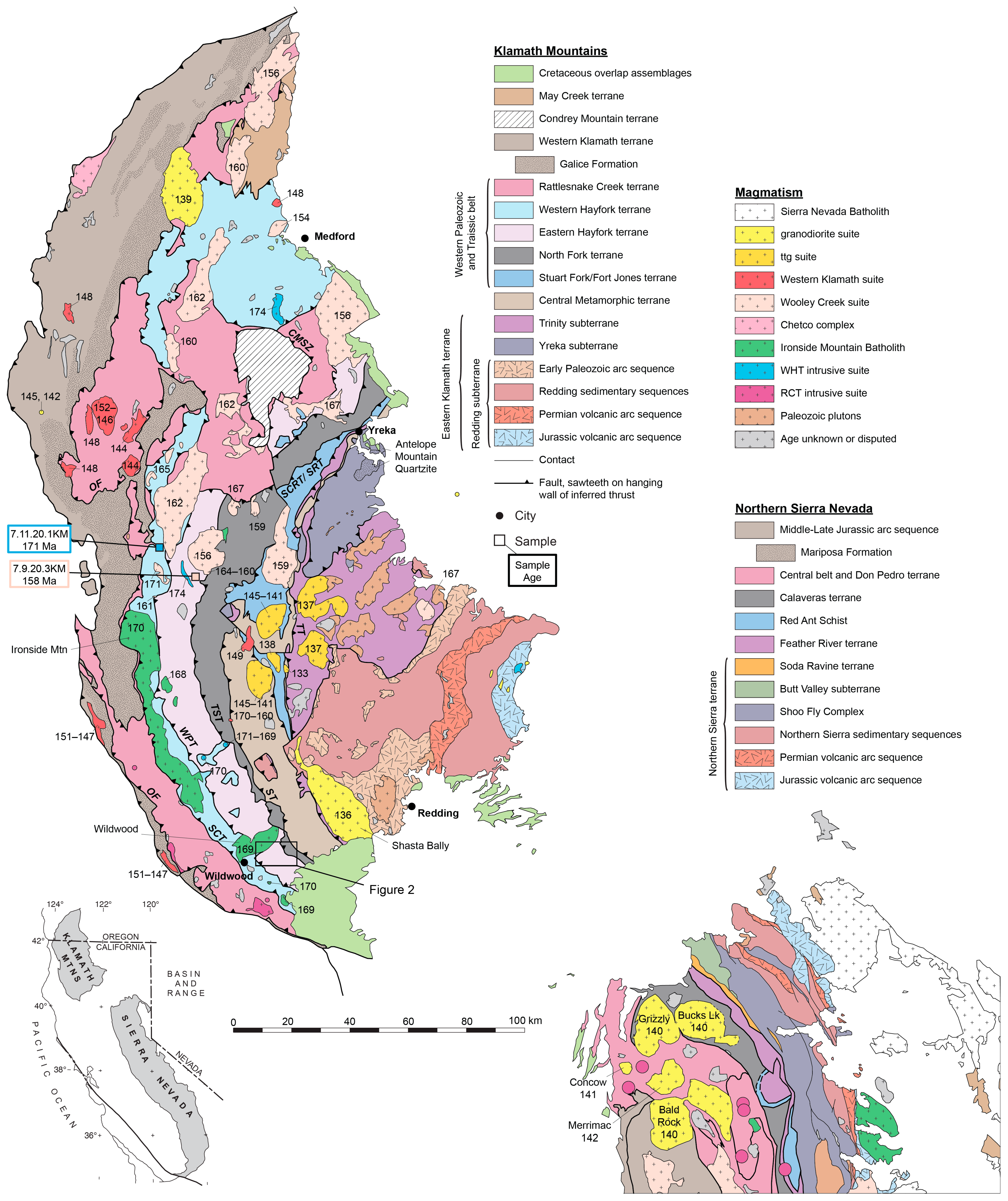
Figure 1. Geologic map of the Klamath Mountains and northern Sierra Nevada showing tectonostratigraphic terranes, plutons (selected ones with ages), and major faults. Modified after Irwin et al. [5] and Snoke and Barnes [3] with additional pluton ages from Surpless et al. [6]. Locations of zircon samples in the Salmon River area and, in Figure 2, in the Wildwood area are marked. CMSZ—Condrey Mountain shear zone; Lk—lake; Mtn—mountain; OF—Orleans fault; SCRT/SRT—Soap Creek Ridge thrust/Salmon River thrust; SCT—Salt Creek thrust; ST—Siskiyou thrust; TST—Twin Sisters thrust; TT—Trinity thrust; ttg—tonalite–trondhjemite–granodiorite; WHT—Western Hayfork terrane; WPT—Wilson Point thrust.
Geosciences 16 00054 g001
Figure 5. Stacked Wetherill concordia diagrams with 2σ ellipses for zircon samples from the Western Hayfork terrane, Eastern Hayfork terrane, and associated igneous units. Red ellipses were rejected by the filtering described in the Methods section and blue ellipses are the remaining accepted analyses. (A) Full age range for samples. (B) Analyses younger than 600 Ma for which discordance filtering was not applied, although some analyses were rejected by other filter criteria. Plots were made with AgeCalcML [29].
Geosciences 16 00054 g005
Figure 6. Th/U and U concentration versus age for all accepted U-Pb zircon analyses. (A) Th/U vs. age: note, logarithmic scale for the vertical axis. Analyses with Th/U < 0.1 are commonly from metamorphic zircons [30], and few analyses fall below this line. (B) U ppm vs. age. Analyses with higher U concentration are more susceptible to Pb loss during metamorphism. Few analyses have >1000 ppm U, but most that do are <200 Ma. (C) Inset plot shows the U concentration for grains <250 Ma.
Geosciences 16 00054 g006
Figure 7. Zircon data for all samples in this study and the literature data from the EHT matrix and blocks as well as the NFT. Note the change in the horizontal axis scale at 300 Ma. Solid lines are from this study, and dashed lines are from the literature. Cumulative distribution functions (CDFs), kernel density estimates (KDEs), probability density plots (PDPs), histograms, and pie charts of age populations. KDEs with an optimized variable bandwidth are shown in colored lines, and PDPs are shown as filled curves. Pie charts and PDPs are colored by age. Counts for histograms are on the left side of the plot for ages <300 Ma and on the right side for ages >300 Ma. Plots were made in detritalPy [32]. 1 Ernst et al. [9], 2 Scherer et al. [8], 3 Scherer and Ernst [7], N—number of samples in compilation, n—number of analyses <300 Ma/total number of analyses.
Geosciences 16 00054 g007
Figure 8. Plots of maximum depositional ages (MDAs) for detrital samples with Phanerozoic ages and weighted mean age for igneous sample WW23019. Errors are all reported at 2σ, and colors are as in Figure 1, Figure 2, Figure 6 and Figure 8. Each row is a different sample, and each column is a different method to calculate age. Unfilled boxes in YGC3+ (2σ) and YSP plots represent grains that are classified as outliers using a modified version of Chauvenet’s criterion [35]. All plots were generated in IsoplotR [35]. MLA: maximum likelihood age [34]; MSWD—mean square of weighted deviates; WM—weighted mean; YGC3+ (2σ)—youngest grain cluster of three or more ages overlapping within 2σ; YSP—youngest statistical population [33].
Geosciences 16 00054 g008
Table 1. Sample locations, contexts, and ages.
Sample NameLocationUnitRock typeAge (Ma)Age Interpretation
LatitudeLongitudeStudy Area
7.11.20.1KM41.37426°−123.45321°Salmon RiverWHTMetavolcaniclastic171
(145)
Deposition
(Pb loss)
7.9.20.3KM41.27406°−123.28116°Salmon RiverWooley Creek suiteIntermediate volcanic158Deposition
WW2300540.44735°−122.90014°WildwoodNFTSandstone--
WW2302040.44835°−122.89793°WildwoodNFTSandstone--
WW2302140.44966°−122.89394°WildwoodNFTSandstone--
WW2300240.42667°−122.94772°WildwoodEHTAmphibolite matrix69Pb loss
WW2300740.40872°−122.99464°WildwoodEHTMafic volcanic matrix--
WW2301140.42701°−122.96702°WildwoodEHTSandstone matrix--
WW2301440.43134°−122.96192°WildwoodEHTMafic volcanic matrix--
WW2301540.43312°−122.95611°WildwoodEHTSandstone matrix--
WW2301640.43840°−122.95302°WildwoodEHTSandstone matrix--
WW2301940.45584°−122.94307°WildwoodGranodiorite suiteFelsic dike143Intrusion
Ages are reported for samples which yielded Phanerozoic zircon age populations. EHT—Eastern Hayfork terrane; NFT—North Fork terrane; WHT—Western Hayfork terrane.
Table 2. Maximum depositional ages, weighted mean ages, and zircon age abundances.
Sample NameYSG (2σ)YGC3+ (2σ)YSPMLAn%
Age ± 2σ (Ma)Age ± 2σ (Ma)MSWDnAge ± 2σ (Ma)MSWDnAge ± 2σ (Ma) MzPzPtzApre-Mz
7.11.20.1KM138.3 ± 10.4145.1 ± 4.31.53145.1 ± 4.31.53170.9 ± 1.253912709
7.9.20.3KM137.4 ± 8.8158.1 ± 1.50.5532158.1 ± 1.50.5532157.7 ± 1.54283512017
WW23015 2320<17425100
WW23016 269007525100
WW2300266.7 ± 2.269 ± 11.7669 ± 11.7666.7 ± 2.35712479588
Sample Name Weighted mean n%
Age ± 2σ (Ma)MSWDn MzPzPtZApre-Mz
WW23019 142.83 ± 0.410.83292 2941000000
A—Archean; MLA: maximum likelihood age [34]; MSWD—mean square of weighted deviates; Mz—Mesozoic; n—number of analyses; Ptz—Proterozoic; Pz—Paleozoic; YGC3+ (2σ)—youngest grain cluster of three or more ages overlapping within 2σ; YSG—youngest single grain; YSP—youngest statistical population [33].
Disclaimer/Publisher’s Note: The statements, opinions and data contained in all publications are solely those of the individual author(s) and contributor(s) and not of MDPI and/or the editor(s). MDPI and/or the editor(s) disclaim responsibility for any injury to people or property resulting from any ideas, methods, instructions or products referred to in the content.