1. Introduction
The occurrence of tailings storage facility (TSF) failures has drawn significant attention in recent years. Over the past 15 years, there have been a number of serious failures of Tailings Storage Facilities (TSFs) with devastating environmental, social and economic consequences [
1,
2]. The most tragic recent ones include the disasters in Mount Polley—Canada, 2014 [
3]; Fundão/Samarco—Brazil, 2015 [
4] and Brumadinho—Brazil, 2019 [
5] which resulted in significant infrastructure damage, environmental pollution and numerous fatalities. The common factor contributed to many of these events was poor management practices, underestimation of geotechnical risks and lack of effective monitoring and assessment of embankment stability in dynamic conditions, including seismic events or heavy rainfall [
6]; Databases and statistics developed by international organizations such as ICOLD [
7] and GRID-Arendal [
8] indicate that the frequency of TSF failures is not decreasing despite technological progress, which highlights the need to implement more advanced monitoring and risk analysis methods. Particular concern should be paid to the implications of seismic activities. Studies have reported that seismic events are a direct catalyst for approximately 17% of global TSF failures, with additional contributing factors including heavy rainfall and construction defects [
9]. The catastrophic failures at notable sites such as Brumadinho and Mount Polley have served as crucial learning points for geotechnical engineering practices. These incidents underscored the inadequacies of traditional stability assessments, particularly the pseudostatic methods employed, which often disregard the complex dynamic interactions between seismic forces and material behavior [
10].
Currently most of geotechnical stability calculations are conducted in pseudostatic approach. The pseudostatic calculation method has been widely adopted due to its simplicity and applicability in seismic stability evaluation. Initially introduced by Terzaghi, the pseudostatic approach simplifies the seismic loading conditions by replacing dynamic earthquake effects with equivalent static forces Lu et al. [
11]. This method may incorporate two key forces: the vertical and horizontal inertial forces, representing the effects of seismic acceleration on slope stability [
12]. Although this method allows for straightforward calculations and has been integrated into several engineering guidelines, it has notable limitations, particularly in its inability to account for dynamic characteristics such as frequency and wave propagation effects [
13]. Research indicates that relying solely on this method can lead to an inaccurate assessment of safety factors, especially in complex geological settings [
14,
15]. Recent advancements highlight an essential contrast between traditional pseudostatic analysis and more sophisticated approaches, like probabilistic methods and finite element analysis, which consider the stochastic nature of seismic events more comprehensively [
16]. Moreover, studies demonstrate a critical need for integrating dynamic response considerations into slope stability evaluations, as seismic waves can induce failures that are not captured by the static equivalents used in pseudostatic analysis [
17]. Additional investigations underscore the significance of incorporating site-specific conditions, such as soil behavior during seismic loading, which can inform the limitations of the pseudostatic method when dealing with heterogeneous soil profiles [
18]. Another research indicates that incorporating frequency-dependent analyses can significantly enhance prediction accuracy concerning TSF response during seismic events, as dynamic interactions can amplify the strength loss observed in water-saturated tailings [
19]. Consequently, while the pseudostatic method remains a foundational tool in slope stability assessment, its limitations necessitate a transition towards dynamic analyses that can more accurately reflect the complex interactions between seismic forces and slope materials [
20,
21].
It must be highlighted that the challenge of accurately assessing slope stability is particularly critical in the context of TSFs, which are often situated—due to economic and logistical constraints—within zones affected by dynamic loading, such as those impacted by mining-induced seismicity. One of the most prominent examples of such a structure is the Żelazny Most TSF, located in southwestern Poland (
Figure 1). It is not only the largest tailings impoundment in Europe, but also ranks among the largest facilities of its kind worldwide.
Despite numerous studies focused on the stability of TFS facilities [
20,
22,
23,
24,
25,
26], none of the publicly available research accounts for the influence of the dominant frequency of ground motion on the dynamic Factor of Safety (FS) distribution. In practice, most facilities, such as Żelazny, are subjected to a wide range of advanced dynamic analyses using numerical methods, which enable an adequate and robust evaluation of the facility’s safety by continuously assessing hazards such as liquefaction potential, the influence of seismic activity on deformation levels, and other time-dependent response indicators. Nevertheless, it should be noted that even though such analyses can be highly sophisticated, commonly used continuum-based numerical approaches (e.g., FDM or FEM) have inherent limitations; most notably, they do not provide a direct means to quantify the temporal variability of the FS within a single dynamic simulation, and frequency-dependent amplification effects may therefore remain insufficiently captured. This gap highlights the need for more advanced, frequency-sensitive modeling frameworks—particularly for TSF facilities, where the interaction between anthropogenic seismicity and embankment behavior represents a major safety concern.
This article presents a comprehensive analysis of the influence of the dominant frequency of seismic vibrations on the stability of slopes and large geotechnical structures. The research used a hybrid computational approach combining the finite element method (FEM) with the limit equilibrium method (LEM), which allowed for the dynamic determination of the stability factor
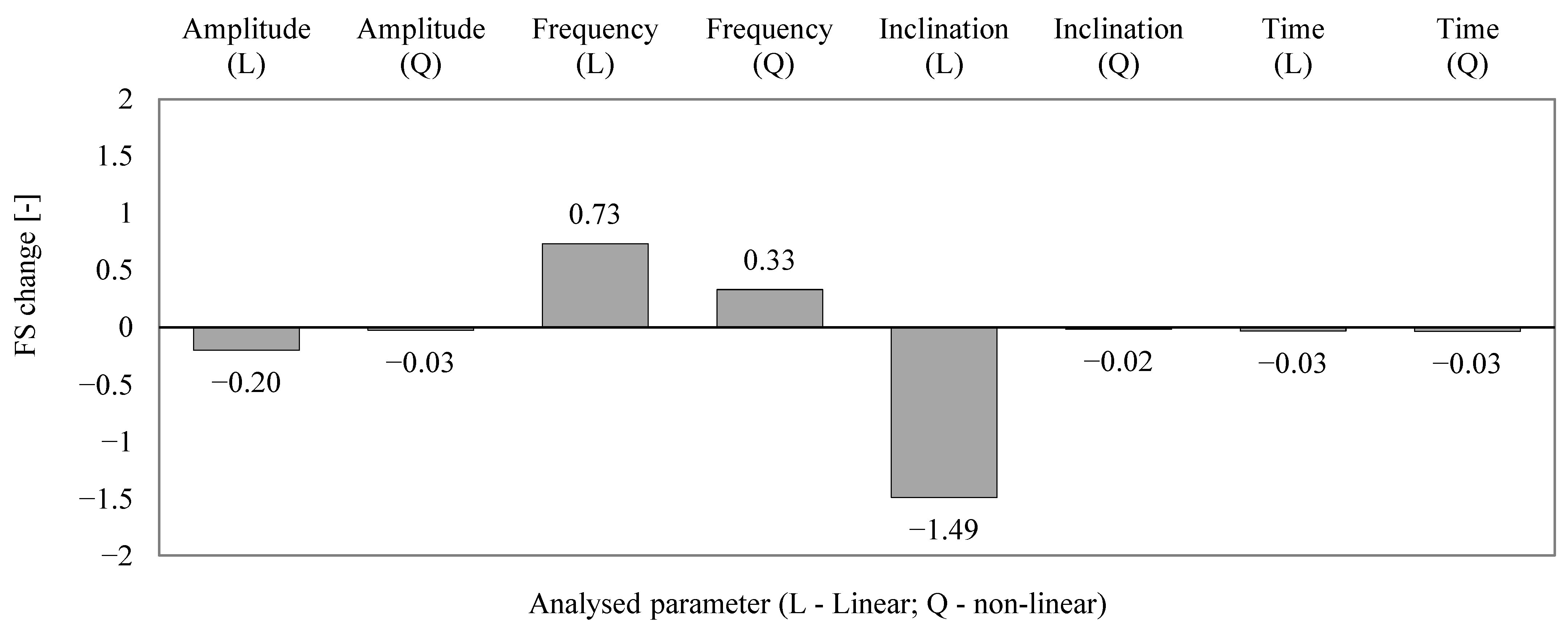
FS under variable seismic load conditions. A series of numerical simulations were carried out using synthetic vibration courses with different dominant frequency, amplitude, duration and slope inclination. Based on the experimental plan and variance analysis, the influence of individual parameters on the
FS value was determined. The obtained results were compared with the results of the classic pseudo-static analysis. The geometry of the slope considered in the analysis corresponds to the geometry of the TSF Żelazny Most, while the seismic wave characteristics (range of amplitudes, frequencies and durations) describing the interaction in the near wave field were prepared for the conditions prevailing in the Lower Silesian Copper Basin (LSCB) in accordance with the analysis presented in the article [
2].
2. Material and Methods
In order to determine the influence of individual dynamic parameters of seismic waves on slope stability, a hybrid approach was employed by combining numerical analysis using the finite element method (FEM) with an analytical approach based on the limit equilibrium method (LEM). The results obtained from the hybrid calculations were subsequently used to conduct a statistical analysis of the impact of selected parameters on the FS value. The loading scenarios required to ensure the reliability of the results were determined using the Design-of-Experiment (DOE) method.
2.1. Numerical Model Preparation
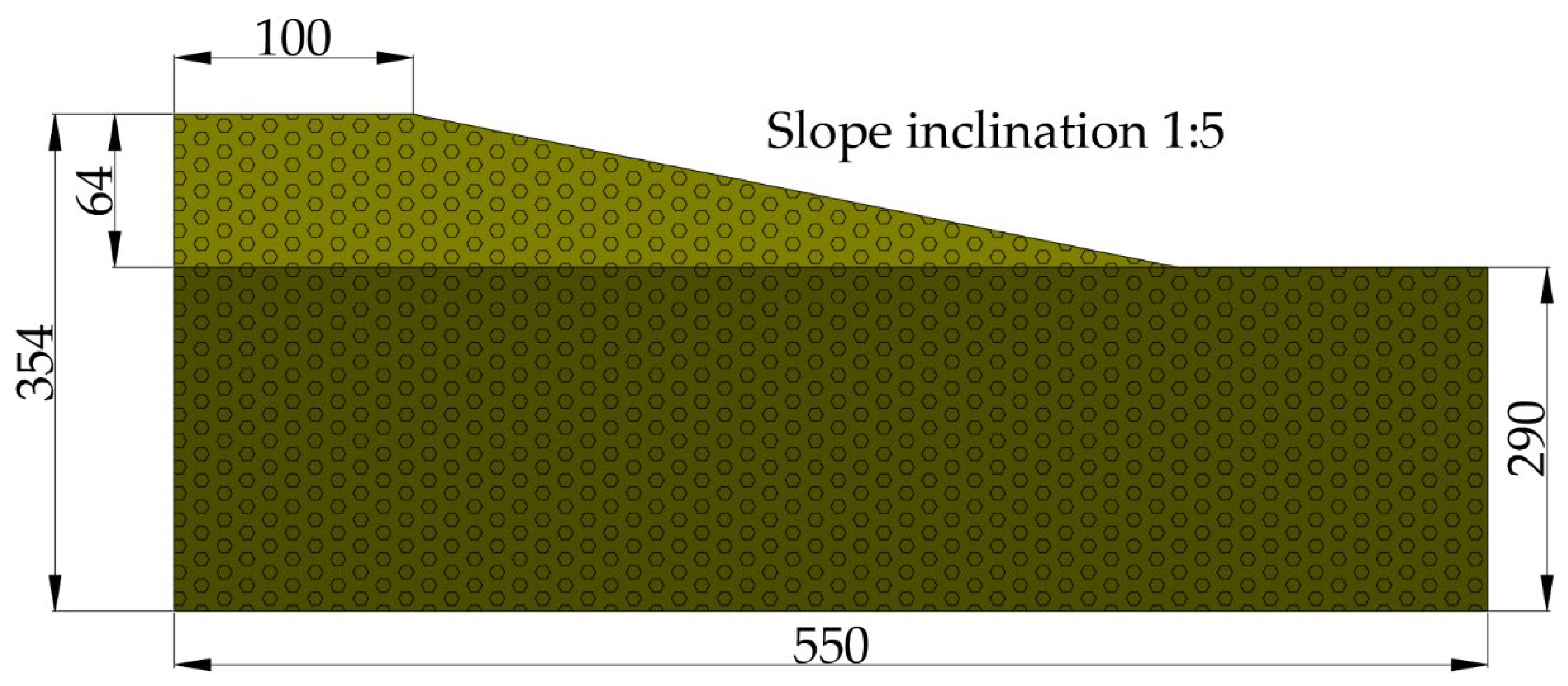
For the purpose of the analysis, a simplified geotechnical model of a slope was prepared, featuring a slope inclination of 1:5 and a total height of 64 m (
Figure 2). It was assumed that both the subsoil and the embankment were composed of the same type of material-consolidated cohesive glacial till intermixed with coarse- and fine-grained sands. The geotechnical properties of the material were defined as follows: bulk unit weight
γ = 20 kN/m
3, Young’s modulus
E0 = 100 MPa, Poisson’s ratio
ν = 0.33, internal friction angle
φ = 30°, and cohesion
c = 5 kPa. These parameters were selected to reflect typical conditions observed in postglacial terrains and to ensure numerical stability of the model under dynamic loading conditions.
The above material definition corresponds to a homogeneous Mohr–Coulomb model applied both to the embankment and the foundation. This choice was a deliberate simplification rather than a limitation of the software. The primary objective of the present work is not to reproduce a specific case history in full constitutive detail, but to clearly isolate and quantify the influence of the dominant frequency of ground motion on the FS. Introducing advanced, strongly nonlinear constitutive models with strain-dependent stiffness, cyclic degradation or liquefaction mechanisms would inevitably couple the response to a large number of additional parameters, making it difficult to attribute changes in FS solely to the frequency content of the excitation.
In other words, the numerical set-up was intentionally kept simple and transparent: a single material forming both the dam and the subsoil, a fixed geometry representative of large earth structures such as the Żelazny Most TSF, and a Mohr–Coulomb envelope with constant small-strain stiffness E0. Within this framework, all variations in FSdyn can be traced back directly to changes in the seismic input (frequency, amplitude and duration) rather than to constitutive details. This is consistent with the methodological goal of the paper, which is to demonstrate that the dominant frequency of ground motion cannot be neglected in stability assessments, especially in contrast to widely used pseudostatic approaches that ignore it by construction.
It should also be emphasized that, at present, commonly available dynamic analysis tools do not natively provide a time-dependent factor of safety for fully nonlinear constitutive models. The hybrid FEM–LEM workflow adopted here derives
FSdyn indirectly from stress histories computed in QUAKE/W [
27] and mapped to SLOPE/W [
28]. Keeping the constitutive description as a homogeneous soil with constant elastic stiffness and Mohr–Coulomb strength parameters, i.e., without any modulus-reduction or cyclic degradation model ensures that this coupling remains numerically stable and that the obtained
FSdyn(t) curves are not affected by additional numerical artifacts related to complex nonlinear soil models.
The algorithms used for the stability calculations using the limit equilibrium method are based on the determination of stress and force values that:
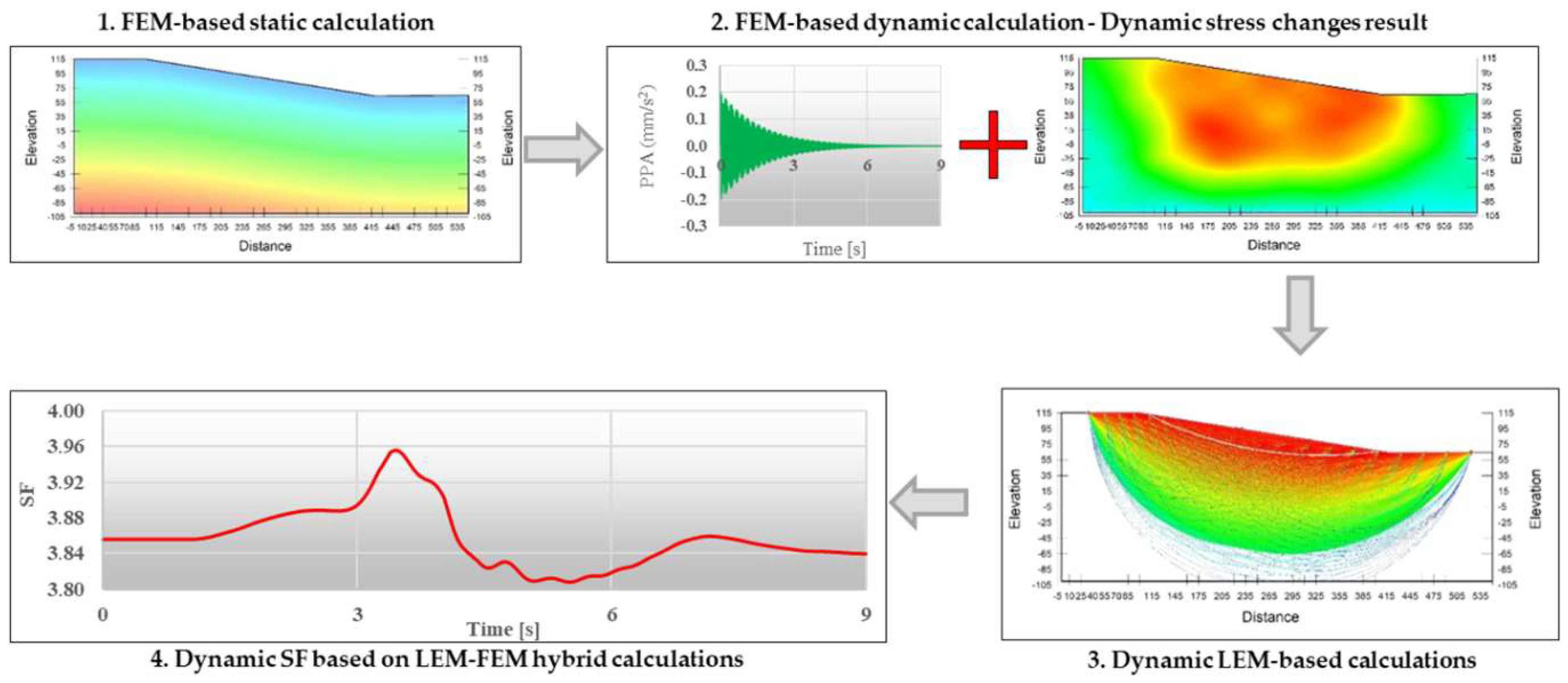
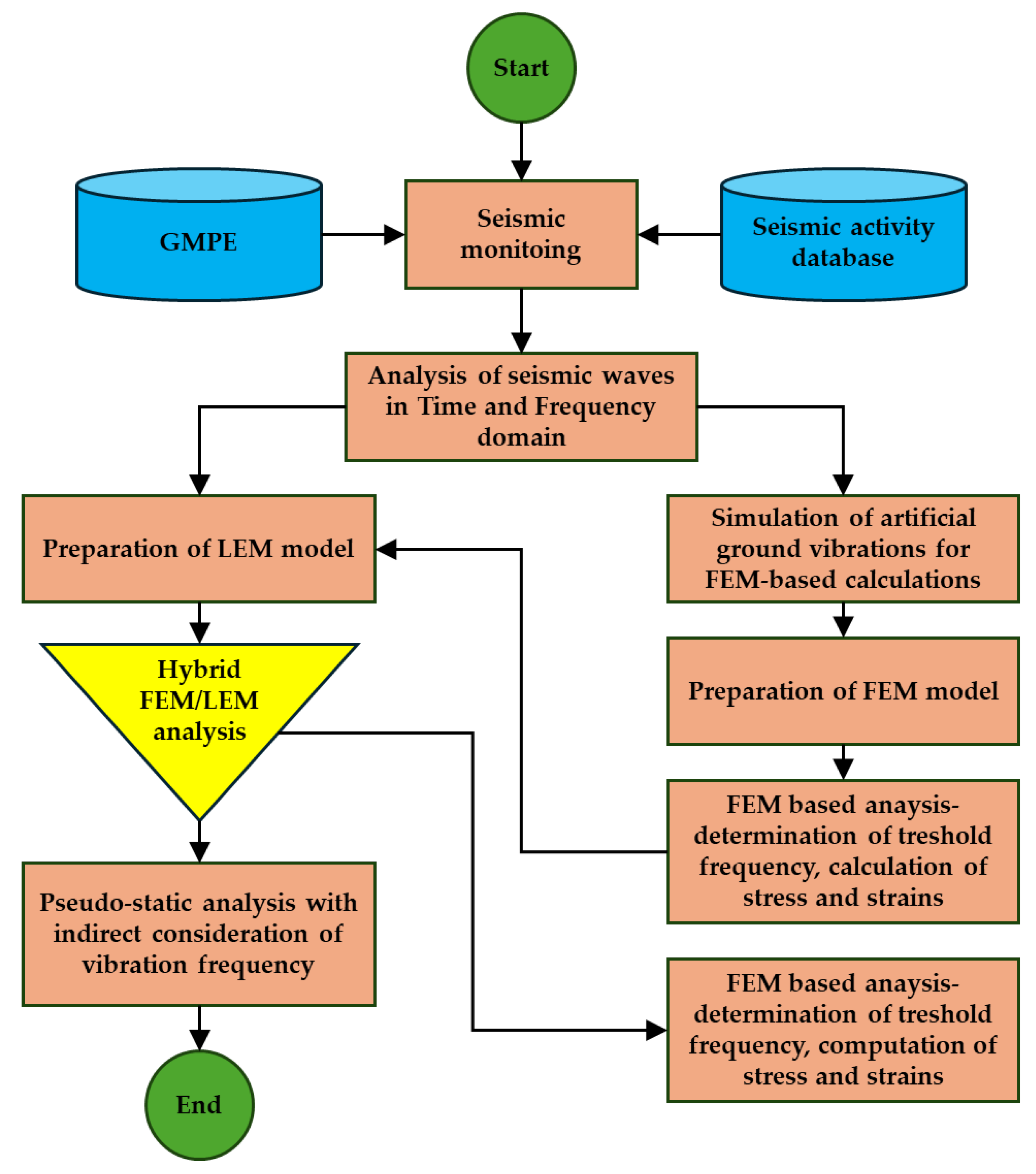
These simplifications and assumptions of the limit equilibrium method mean that it is not always possible to obtain a reliable stress distribution along the slip surface. Such an up-simplification can be bypassed in the case of implementing a relationship describing the stress–strain characteristics of the soil under the analyzed geometric, loading and material conditions. Considering such a relationship means ensuring the consistency of displacements in neighboring slices, which in turn leads to much more realistic stress distributions. One way to take into account the stress–strain relationship in the stability analysis is to first determine the stress distribution in the soil using the FEM analysis and then use these stresses in the stability analysis using the LEM, which, on the one hand, will allow for determining the permanent displacements within the calculation model, and on the other hand will be the basis for determining the dynamic change in the safety factor FS. A simplified procedure for calculating the dynamic change in the stability coefficient is shown schematically in
Figure 3.
The total stresses calculated in
QUAKE/W represent the combined effect of both static and dynamic components. The static stresses are known from the predefined in situ stress conditions. Therefore, by subtracting the initial static stresses from the total stresses obtained in
QUAKE/W, one can isolate the dynamic stress component:
These dynamic stresses can be computed at the base of each slice in the slope model. By integrating the shear stresses along the entire slip surface, it is possible to determine the total mobilized dynamic shear, which reflects the additional shear force induced by seismic shaking. Dividing this total dynamic shear by the mass of the potential sliding block yields the average acceleration of the sliding mass at each time step during the ground motion. Plotting this average acceleration against the corresponding factor of safety (FS) over time produces a dynamic response curve.
2.2. Simulation of Artificial Waveforms
In this study, synthetic seismic waveforms were employed to ensure a controlled and consistent basis for assessing the influence of dominant frequency on slope stability. The primary rationale behind this decision was the need to isolate and analyze the individual effect of frequency from other seismic signal parameters. In real-world seismic records, characteristics such as amplitude, duration, damping, and frequency content are highly variable and interdependent, making it difficult to determine the singular influence of one parameter on the FS.
To overcome this limitation, the synthetic waveforms were designed with fixed amplitudes, damping characteristics, and durations across all scenarios. Only the dominant frequency of the vibration was systematically modified. This approach allowed for the creation of a reproducible experimental framework in which the impact of frequency could be clearly identified, quantified, and interpreted without interference from confounding variables.
where
a(
t) is the amplitude of seismic wave acceleration in each time step (m/s
2);
amax is the maximum amplitude of seismic wave acceleration before attenuation (m/s
2);
β is the attenuation factor (1/s);
t is time (s);
ω is the natural frequency (rad/s); and
φ is the initial phase (rad).
2.3. Safety Factor and Dynamic Safety Factor Calculations
The dynamic safety factor was calculated by coupling FEM-based QUAKE/W with LEM-based SLOPE/W software. Both software are part of GeoStudio package. In the first stage, the ground response to the input acceleration record was computed in QUAKE/W by solving the equation of motion:
where
,
, and
are the mass, damping, and stiffness matrices,
is the nodal displacement vector, and
represents the seismic excitation applied at the model boundary. During calculation linear Rayleigh damping was used:
with
and
selected to match target modal damping over the frequency range of interest. From the transient solution element stress histories
and a static reference state
were extracted. Dynamic increments were defined as:
Then the acceleration-based (pseudo-dynamic) approach was implemented. Therefore, instantaneous inertial forces were applied to each slice of weight:
where
and
are the horizontal and vertical accelerations obtained from QUAKE/W and
is gravity. Then
from (5) was mapped to the candidate slip surface and converted internally by SLOPE/W into equivalent shear and normal loads acting along slice bases.
For each time step t, the limit equilibrium method (Morgenstern–Price) was solved. The available shear resistance on slice i followed the Mohr–Coulomb envelope:
with
and
are the effective strength parameters,
is the slice-base length,
is the effective normal force, and
the method-dependent geometric factor. The instantaneous factor of safety was then:
where
collects the driving components (static plus dynamic). The dynamic safety factor reported herein is the minimum over the excitation:
This workflow provides a full-time history FS(t) and the associated critical slip surface at the time t.
In practical terms, the coupling between QUAKE/W and SLOPE/W follows the standard workflow implemented in GeoStudio. Dynamic stresses are transferred using the built-in option in SLOPE/W. The procedure is as follows:
In QUAKE/W, element stress histories are stored for the finite elements located along the potential sliding region;
In SLOPE/W, the same mesh and candidate slip surfaces are defined and the import of stress values from the QUAKE/W results file is activated;
For each time step t, SLOPE/W interpolates the imported stresses to the base of each slice and resolves them into normal and shear components acting on the slice base, which are then combined with the instantaneous inertial forces from Equations (6) and (7) in the Morgenstern–Price formulation.
This sequence of operations follows the step-by-step procedure described in the official QUAKE/W and SLOPE/W user manuals, so that any user with access to GeoStudio can reproduce the hybrid analysis by following the same series of commands. At each time step t, SLOPE/W performs a full search over a dense set of candidate slip surfaces. Consequently, the critical slip surface associated with FSdyn(t) is not fixed a priori, but may change its position and shape during the seismic excitation as the stress field evolves. All FSdyn values reported in this paper therefore correspond to the minimum factor of safety identified over all candidate slip surfaces.
To quantify the difference between the dynamic factor of safety—accounting for the ground-motion frequency content—and the frequency-independent pseudostatic factor of safety, a series of supplementary slope-stability analyses using the Morgenstern–Price method were performed. In this approach, constant seismic coefficients were defined based on peak acceleration values:
where
and
are horizontal and vertical seismic coefficients, while
and
are, respectively, horizontal and vertical peak ground accelerations.
Then, internal loads in subsequent slices of the model are calculated with:
Inter-slice shear
was related to inter-slice normal
by the MP (GLE) assumption:
where
is unknown scale solved with FS, while
is user-selected function evaluated at slice
i.
Subsequently mobilized base shear on slice
i was tied to available strength through:
where
and
φ′ denote the effective cohesion and friction angle,
li denotes the slice-base length, and
Ni′ =
Ni −
Ui denotes the effective base normal force (total normal
Ni minus pore-pressure resultant
Ui).
Ultimately
FS is defined as the ratio of the available shear capacity summed along the slip surface to the shear demand required by slice equilibrium. For a given interslice closure scale λ from Equation (15), let
denote the required base shear on slice i obtained after resolving all loads (slice weight, external actions, pore-pressure resultant):
2.4. Design of Experiment (DOE)
The experiment was planned using the DOE procedure. For the purposes of this study, a fractional three-value plan 3(
k-
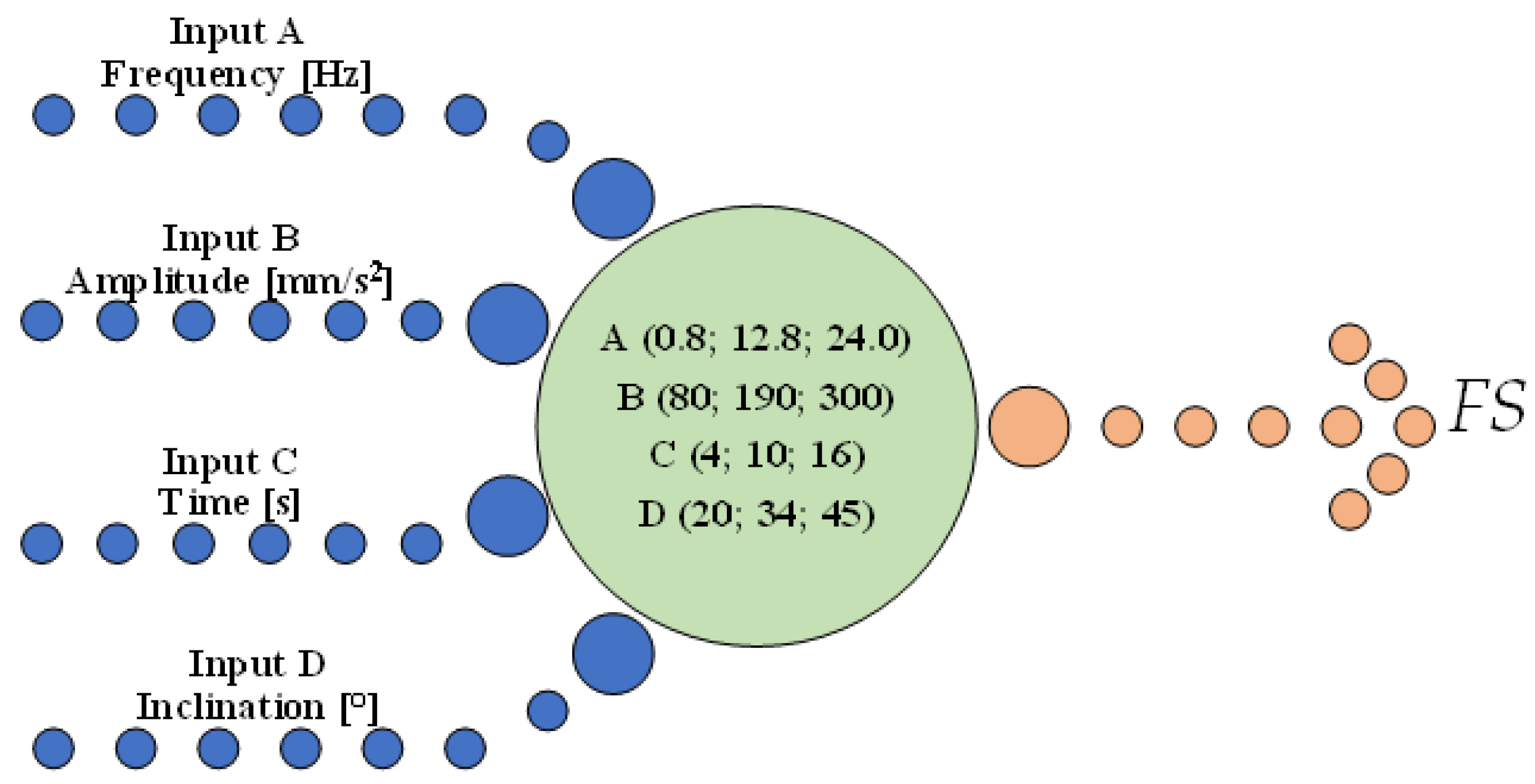
p) was used. To simplify the calculations, it was assumed that the factors influencing the slope stability take only three values—minimum, middle and maximum. Finally, a plan was selected that included 4 input parameters, i.e., frequency, amplitude, time and slope (
Figure 4).
The use of synthetic waveforms aligns with best practices in parametric numerical studies, where the Design-of-Experiment (DOE) methodology demands strict control of input variables to derive statistically meaningful conclusions. By applying a tri-level full factorial experimental plan, the analysis covered a broad spectrum of frequency values representative of seismic activity observed in the LSCB over the past two decades [
2]. Since the analysis is based on numerical techniques, increasing the number of simulation scenarios does not generate significant additional costs. As a result, a full factorial design was adopted, comprising one block and a total of 27 computational configurations. The distribution of input parameters for each configuration is presented in
Table 1.
4. Discussion
The application of both logarithmic and saturation approaches provided a complementary view of the dependence of the safety factor on the dominant vibration frequency. The logarithmic model, while simple and highly accurate within the tested range, remains a purely empirical formulation, lacking the ability to determine the limiting value of FS or to establish explicit links with PGA. In contrast, the saturation model offers comparable fitting accuracy, but additionally defines the asymptotic limit F∞, accounts for the influence of PGA on the curve shape, and enables a physically consistent interpretation as well as extrapolation to high frequencies. Consequently, it represents a more universal and mechanistically grounded solution for modeling dynamic processes in geomechanics.
From a physical point of view, the fitted relationships should therefore be regarded as empirical descriptors of the frequency-dependent amplification of the slope–foundation system rather than as direct estimates of the mass, stiffness or damping of an equivalent single-degree-of-freedom (SDOF) oscillator. The asymptotic limit F∞ approximates the stability level reached when the excitation frequency is well above the fundamental modes of the system and dynamic amplification becomes small, while the coefficients C(PGA) and k(PGA) describe, respectively, the initial deficit in FS at low frequencies and the rate at which the system transitions toward this high-frequency regime. These trends are qualitatively consistent with the behavior of an equivalent SDOF system, but a rigorous identification of SDOF parameters for the present slope configuration would require a separate, more theoretical study and is beyond the scope of this paper.
Still, it must be pointed out that despite the high quality of fit within the studied range, the saturation model relies on the assumption of a common asymptote F∞ and an exponential approach towards it, which is a simplification of real dynamic processes. The parameters C(A) and k(A) were derived solely from five PGA values and five dominant frequency bands, which restricts the ability to generalize the model to other loading conditions.
At this stage it has to be kept in mind that extrapolation beyond the range A ∈ [200, 3000] mm/s2 and f ∈ [0.8, 24] Hz may lead to significant errors. Furthermore, the method does not account for nonlinear material effects or the full dynamics of the phenomenon, since is based on simulated waveforms, and should therefore be regarded as a supplementary tool for describing trends and comparisons rather than as a standalone method for dynamic stability assessment. Moreover, both the developed saturation model and the logarithmic fits are applicable only to the specific slope geometry and the geotechnical parameters of the analyzed soil layers; their applicability beyond this configuration requires recalibration. Extending the study to real vibration records (not based on harmonic decomposition) may lead to different, and likely less conservative, quantitative results. Nevertheless, the methodology remains valid: the fitting procedure (logarithmic and saturation), the derivation of F∞, C(A), and k(A), as well as the analysis of sensitivity and saturation thresholds, can be directly applied to new datasets once they are recalibrated.
An important aspect that reinforces the practical applicability of the hybrid FEM–LEM dynamic approach is its comparison with the traditionally adopted pseudostatic method, particularly using the rigorous Morgenstern–Price limit equilibrium formulation. This comparison enables an objective evaluation of the benefits and limitations of each method under identical loading scenarios. To this end, the minimum
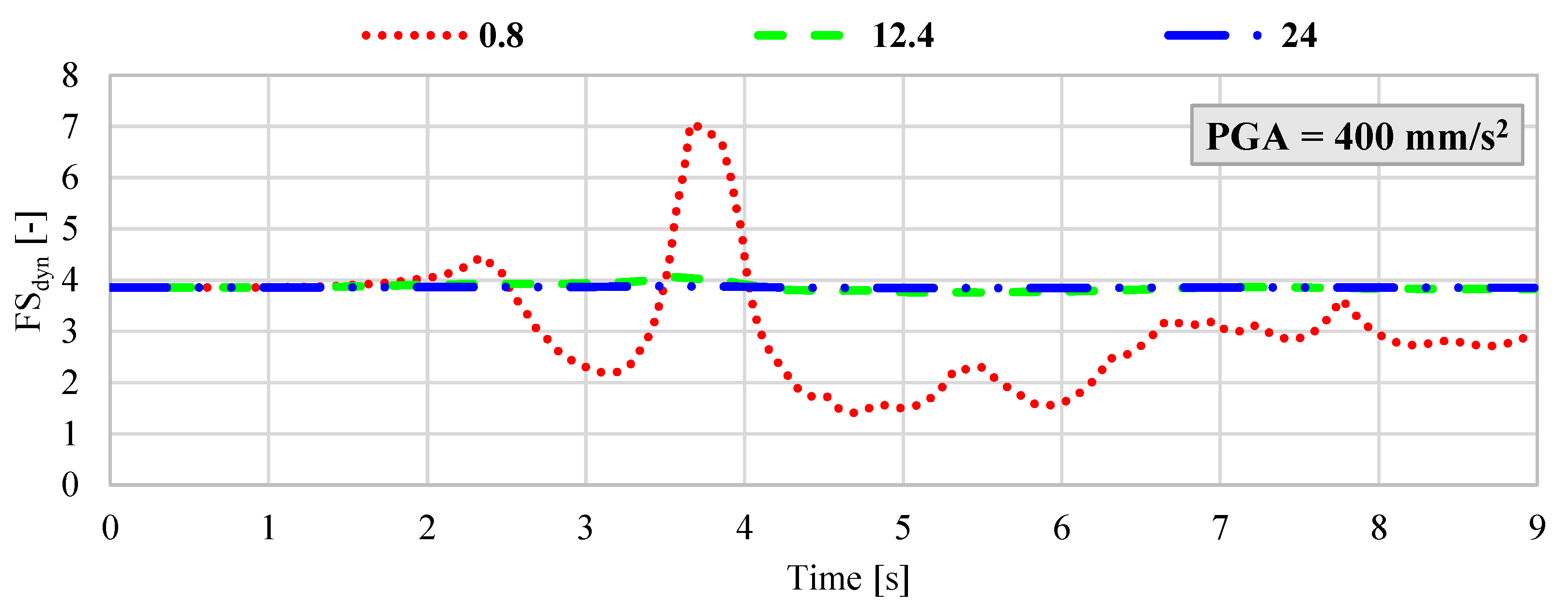
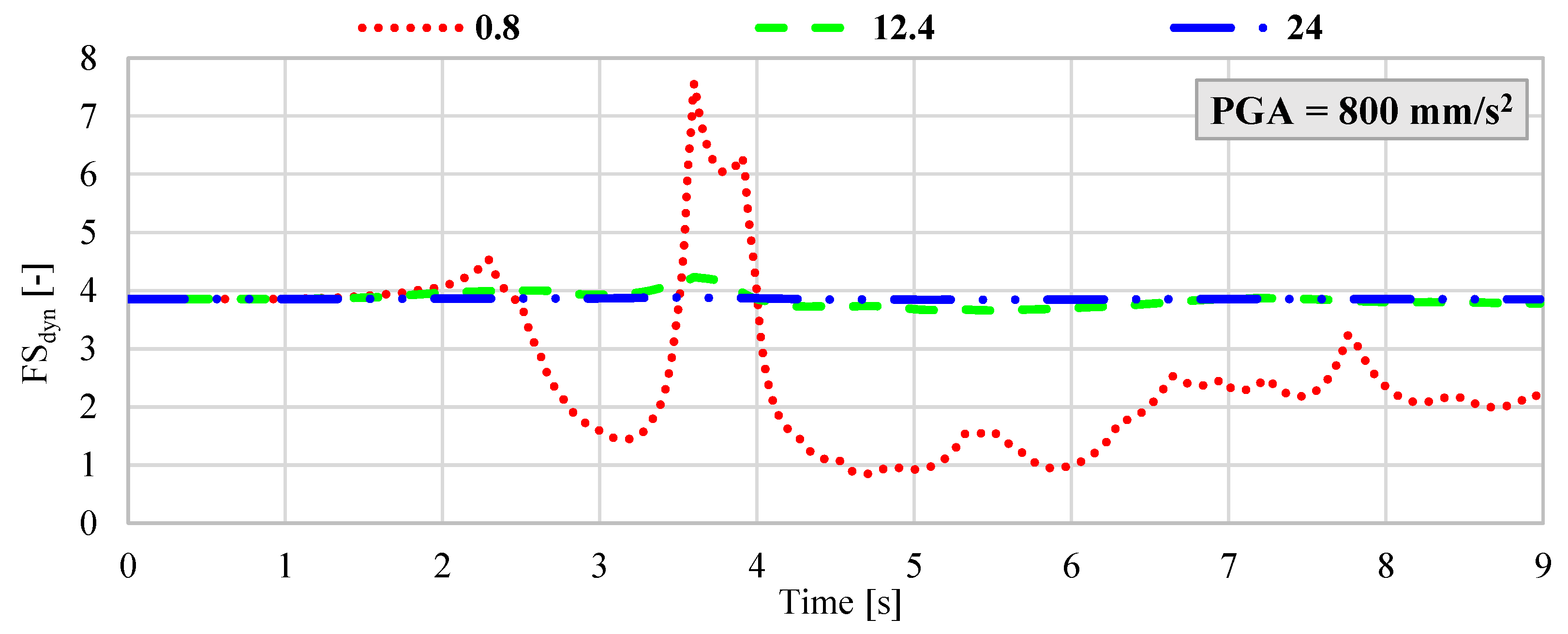
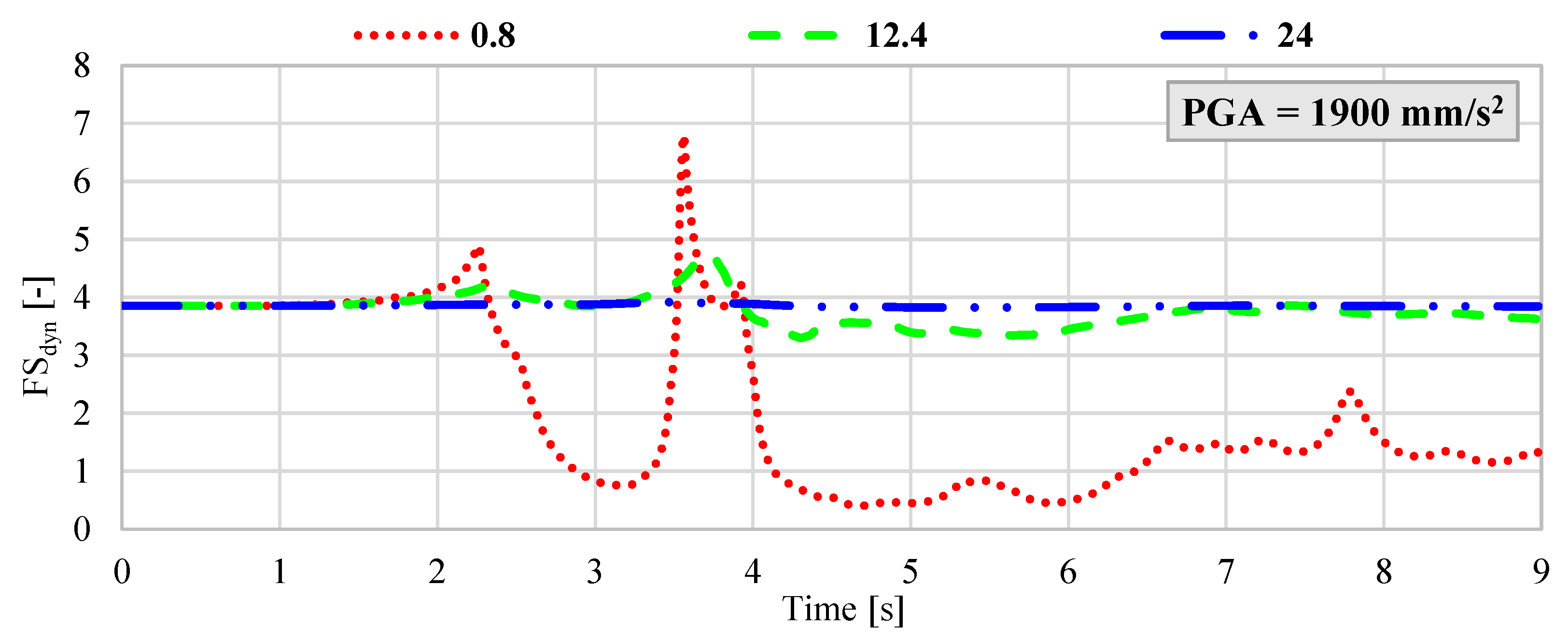
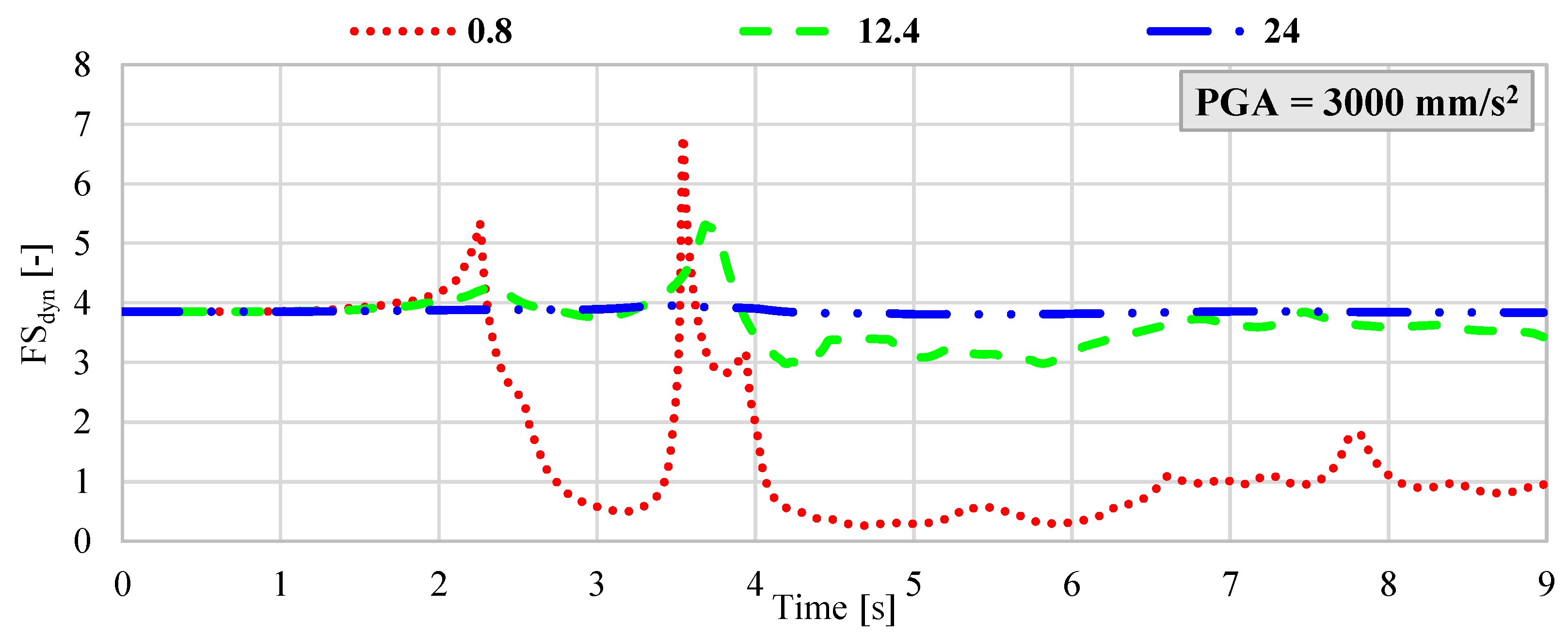
FSdyn values obtained for each dynamic case (illustrated in
Figure 6,
Figure 7,
Figure 8,
Figure 9 and
Figure 10) were compared against the
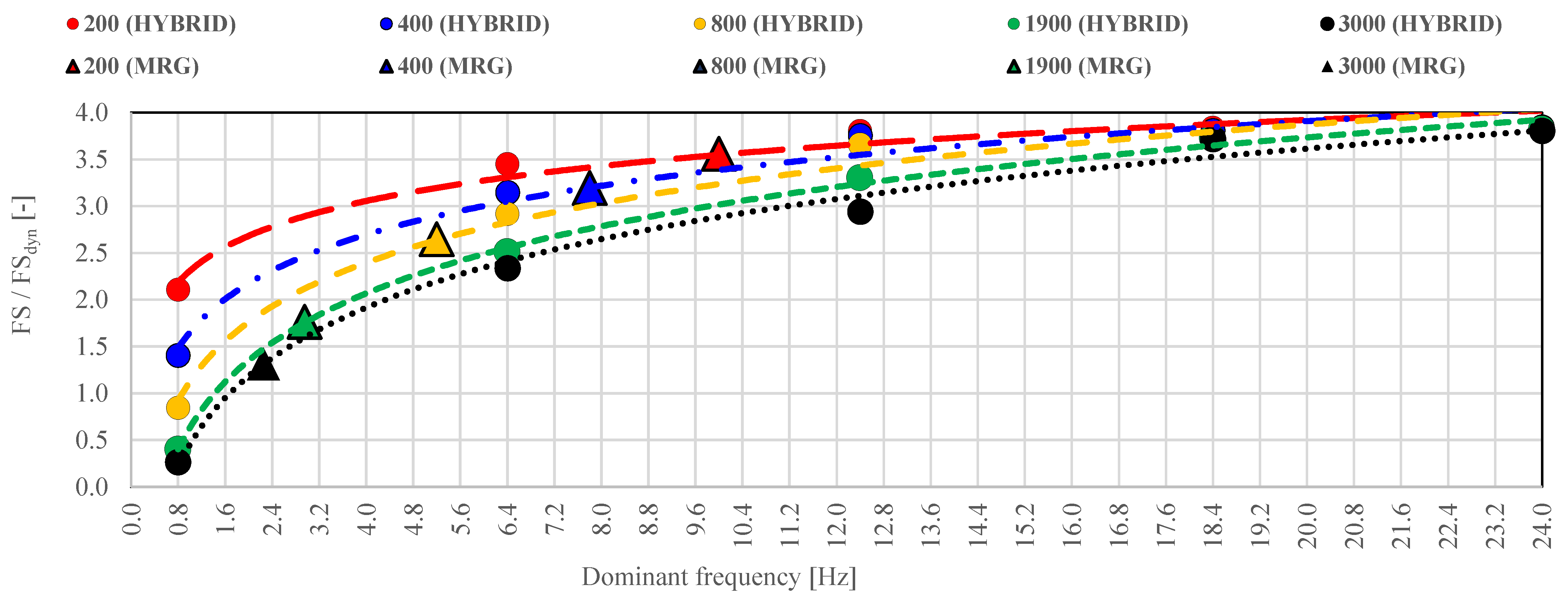
FS values derived from the corresponding pseudostatic analyses. This side-by-side comparison provides insight into the extent to which the pseudostatic method may overestimate or underestimate slope stability under seismic excitation. The results of this comparison are summarized in
Figure 11, which highlights the frequency-dependent discrepancies between the two approaches.
This analysis confirms that the hybrid method captures important dynamic effects neglected in the pseudostatic framework and should therefore be considered in risk assessments for large geotechnical structures subjected to complex seismic loading.
Figure 11 clearly demonstrates that while the pseudostatic method may be sufficient in high-frequency, low-amplitude conditions, it significantly diverges from the dynamic response in the presence of low-frequency, high-energy seismic loading-conditions under which the hybrid analysis predicts critical reductions in FS. As shown in Figure 13, for each analyzed vibration amplitude, it is possible to identify a threshold dominant frequency below which the hybrid method becomes necessary for a realistic evaluation of stability. Conversely, for dominant frequencies above this threshold, the conventional pseudostatic approach may still provide reliable results-and in some cases, even overly conservative ones compared to the actual dynamic response. The data reveal a clear trend: as the PGA increases, the frequency threshold for which the hybrid method is required decreases. In other words, higher energy seismic events render even moderate frequencies dynamically significant, requiring a more advanced modeling approach. The threshold frequencies below which a hybrid FEM–LEM analysis is recommended for the examined PGA values are as follows:
200 mm/s2 → hybrid analysis should be applied for dominant frequencies ≤ 10 Hz;
400 mm/s2 → hybrid analysis should be applied for dominant frequencies ≤ 7.8 Hz;
800 mm/s2 → hybrid analysis should be applied for dominant frequencies ≤ 5.2 Hz;
1900 mm/s2 → hybrid analysis should be applied for dominant frequencies ≤ 2.9 Hz;
3000 mm/s2 → hybrid analysis should be applied for dominant frequencies ≤ 2.2 Hz.
These results underscore the limitations of the pseudostatic method in capturing the destabilizing influence of low-frequency, high-intensity ground motions and provide a clear guideline for selecting appropriate modeling strategies based on site-specific seismic loading characteristics.
Figure 12 shows the procedure for determining the dynamic stability index taking into account the effect of frequency on the structural stability of the object.
From an engineering perspective, it is important to indicate how the linear-elastic assumption may bias the results. For high-frequency motions and moderate PGA, shear strains remain small, so the difference between a constant-stiffness Mohr–Coulomb model and a nonlinear, strain-dependent model should be limited and the FSdyn values obtained here can be treated as a reasonable approximation of the actual stability. For low-frequency, large-amplitude motions (f ≈ 0.8 Hz and high PGA), real tailings and foundation soils would exhibit pronounced stiffness degradation and cyclic strain accumulation, so our simplified model is likely to overestimate stability; a more realistic nonlinear model would yield lower FSdyn values, which reinforces the conclusion that low-frequency excitation is most critical for large earth structures.
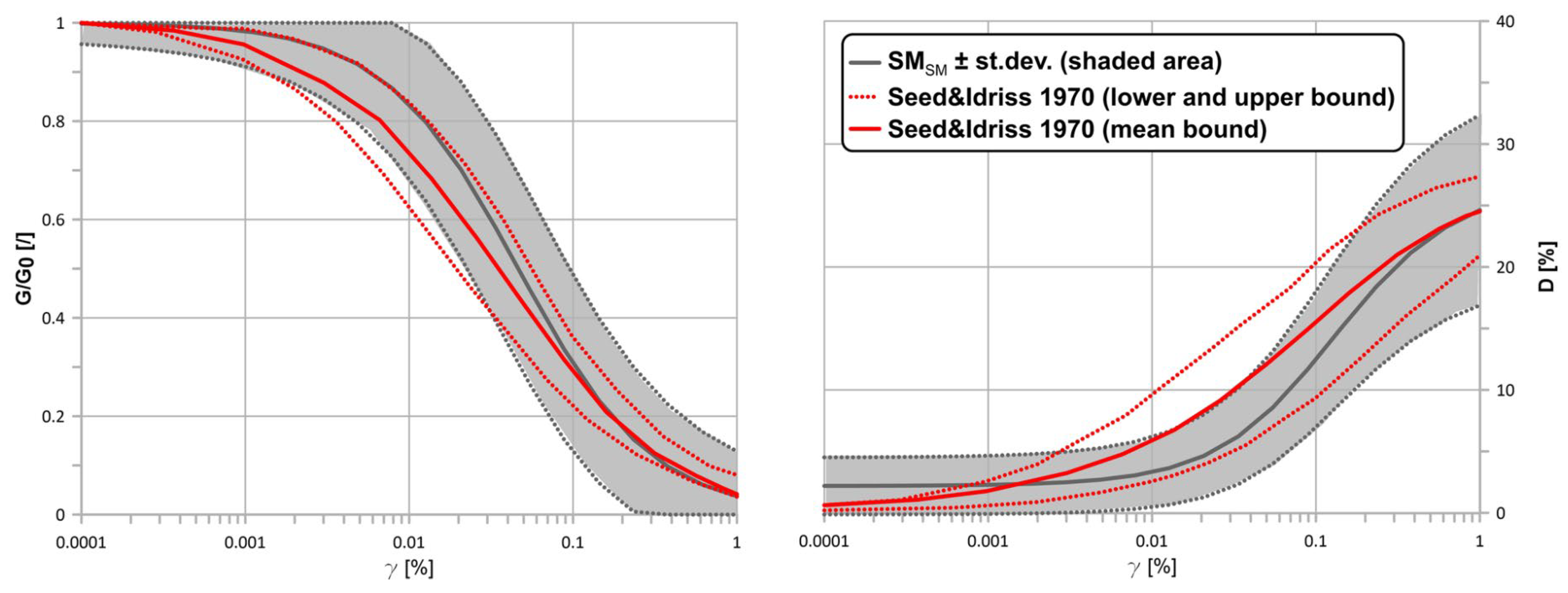
This interpretation is consistent with
Figure 13. The left panel shows the normalized shear modulus reduction curve G/G
0 from Gaudiosi et al. [
29], together with the classic Seed and Idriss bounds [
30]. The mean shear modulus (black) indicates that G/G
0 ≈ 1 at very small strains (γ ≲ 0.001%), but typically decreases to about 0.4–0.7 for intermediate strains (γ ≈ 0.01–0.1%), i.e., in the range relevant for strong, low-frequency shaking. The right panel shows the accompanying increase in damping ratio
D. Thus, when seismic loading drives the soil into this strain range, a nonlinear model with modulus reduction and increased damping would predict lower
FSdyn than reported here, while the overall trend of increasing
FSdyn with frequency would remain.
In addition, the present analysis neglects the dynamic generation and dissipation of pore water pressure and therefore effectively represents dry or well-drained conditions. As a consequence, the results are not intended for direct application to collapsible loess, highly saturated tailings deposits or fully saturated silty foundations without further model development. In such materials, pore pressure build-up and partial loss of effective stress would further reduce both FS and FSdyn, especially under low-frequency, high-amplitude motions. The factors of safety reported here should therefore be interpreted as optimistic stability estimates for drained conditions, while the qualitative conclusions regarding the influence of dominant frequency are expected to remain valid when realistic pore pressure evolution is introduced in future, fully coupled hydro-mechanical analyses.
At the same time, the frequency-dependent
FSdyn framework proposed here could be integrated into modern probabilistic slope stability and failure probability assessment methods, which have recently been applied to seismic and rainfall-induced landslides [
31,
32,
33].
5. Conclusions
The correct evaluation of slope stability under additional dynamic loads remains one of the major challenges in contemporary geotechnics. Despite significant advances in monitoring techniques and the development of increasingly sophisticated numerical methods, catastrophic slope failures continue to be recorded worldwide. The present study addressed this issue by investigating the dynamic variation in the safety factor (FS) for an example slope using a hybrid FEM–LEM computational framework. The calculations were based on synthetic seismic waveforms characterized by different dominant frequencies and amplitudes, within the range of ground motion parameters observed in the Lower Silesian Copper Basin (Poland) between 2002 and 2025. Two complementary modeling approaches were applied to describe the relationship between FSdyn and dominant frequency. The logarithmic model, although purely empirical, provided excellent fitting accuracy across all PGA levels and confirmed the strong dependence of stability on frequency content. The saturation-type model achieved comparable accuracy, but additionally introduced a physically interpretable asymptotic limit F∞ and allowed the explicit characterization of PGA-dependent parameters. Both approaches consistently indicated that the stabilizing effect of seismic vibrations is most pronounced in the low-frequency band (1–10 Hz), while at higher frequencies the rate of FS increase diminishes and the curves converge toward a common asymptote.
The findings underline that reliance solely on pseudostatic methods—based only on peak ground acceleration—may overlook the crucial influence of frequency content on slope performance. The proposed methodology, combining numerical simulation with mathematical modeling, provides a more complete framework for analyzing the seismic response of large-scale geotechnical structures.
The present conclusions are directly applicable to large, predominantly homogeneous, drained slopes subjected to narrow-band excitation in the range of ground motion parameters typical for the Lower Silesian Copper Basin. For heterogeneous stratigraphy, partially saturated or highly compressible materials, or broad-band earthquake records, additional caution is required and the quantitative values of FSdyn may change. Nevertheless, the demonstrated sensitivity to dominant frequency remains an important warning that design checks based solely on peak ground acceleration can be non-conservative for critical earth structures exposed to low-frequency seismic loading.
In future work, the approach will be extended to real seismic waveforms generated by mining-induced events with magnitudes from ML = 2.5 up to ML = 4.5, recorded within 5 km of the site. Accurate reproduction of time histories and comparative analyses across different slope geometries and material configurations will enable a detailed sensitivity assessment. This represents an essential step toward enhancing the accuracy and reliability of geotechnical stability analyses, particularly in regions affected by induced seismicity.
Finally, it should be emphasized that the present study adopts a deterministic FS framework. In parallel with such deterministic approaches, there is a growing body of work on probabilistic slope stability and failure probability assessment, which aims to quantify the likelihood of failure rather than only providing a single safety margin. Integrating the frequency-dependent FSdyn response obtained here into probabilistic or reliability-based frameworks represents a natural direction for future research, in line with recent developments in probabilistic geotechnical analysis.