1. Introduction
The body condition of female rabbits has been consistently associated with their reproductive performance [
1,
2] and longevity [
3,
4]. Recent evidence indicates that obesity represents one of the major risk factors for culling and mortality in rabbit does, particularly in nulliparous and multiparous females, as it predisposes them to metabolic disorders such as hepatic lipidosis and requires specific management in breeding stock [
5]. Traditionally, comparative slaughter has been regarded as the reference method for determining whole-body chemical composition in rabbits [
6,
7,
8,
9]. However, this approach is restricted to experimental settings and does not allow for longitudinal monitoring of body composition across multiple reproductive cycles.
Researchers have attempted to develop
in vivo approaches to predict body composition using indirect methods such as near-infrared spectroscopy (NIRS) [
10,
11], deuterium oxide (D
2O) dilution [
12], magnetic resonance imaging (MRI) [
13,
14], and X-ray computerized tomography (CT) [
15,
16]. Although these techniques are of considerable interest, they are expensive, particularly for this domestic species, and technically demanding, which limits their feasibility as practical alternatives to comparative slaughter.
For this reason, considerable research efforts in recent years have focused on developing
in vivo methodologies that allow for an affordable assessment of body composition in rabbit does. Among these techniques, the following can be highlighted: total body electrical conductivity (TOBEC; [
17]), ultrasonographic assessment of perirenal fat thickness [
18], and body condition scoring (BCS; [
1]). Nevertheless, the accuracy of TOBEC in rabbit does has been questioned, as it tends to yield unreliable estimates of protein and ash content [
17]. Although they are not exactly refining methods, their use reduces the number of slaughtered animals, so they would be considered in line with the use of alternative methods that pursue any of the 3Rs [
19].
Bioelectrical impedance analysis (BIA) has emerged as a promising alternative. The principles of BIA are based on the body’s opposition to the passage of an alternating electric current, which comprises two components: reactance (
Xc), originating from cell membranes, and resistance (
Rs), associated with intra and extracellular fluids [
20]. The total impedance (
Z) combines both components and is calculated as
. Assuming constant body geometry and applying a standardized alternating current, animals with a greater proportion of adipose tissue exhibit higher impedance values, due to the low electrical conductivity of fat [
21].
BIA has been extensively applied to estimate body composition in humans [
22,
23], pigs [
21,
24,
25,
26], lambs [
27,
28], beef cattle [
29,
30], steers [
31], fish [
32], and goats [
33]. More recently, BIA has been validated in growing rabbits to predict carcass composition and nutrient retention [
34,
35], as well as in broiler chickens [
36]. These studies highlight its main advantages, namely high accuracy, repeatability, and non-invasiveness.
In addition, BIA has been employed extensively in studies on the reproductive and nutritional physiology of rabbit does carried out by our research group. For instance, in previous work, we have applied our BIA-based prediction equations to assess metabolic status, monitoring indices such as blood leptin and non-esterified fatty acid (NEFA) levels as indicators of body reserve mobilization [
37], and to explore how body reserves relate to fertility performance, finding that higher body protein and fat contents were associated with improved conception rates and litter outcomes [
3,
38,
39]. We also employed these equations to evaluate the effects of dietary regimens [
40,
41,
42,
43,
44] and weaning and reproductive management strategies [
45] on the rabbit does’ body composition. In all these cases, BIA-derived composition estimates provided a minimally invasive approach to monitor changes in fat and energy reserves, thereby linking the nutritional and metabolic status of the rabbit does to key outcomes such as endocrine profiles, reproductive performance, and long-term body condition stability. However, although the prediction equations used in those studies had been previously developed and validated by our group as part of a doctoral dissertation in 2010 [
46], to date, neither the equations nor the validation procedures had been published in peer-reviewed scientific journals for this category of animals. Consequently, the scientific community still lacks access to reliable BIA models for estimating the body composition of reproductive does
in vivo.
Therefore, the objective of the present work is to fill this gap, showing these BIA-based prediction equations and their validation procedures to estimate the in vivo body composition of rabbit does at different physiological stages throughout the reproductive cycle. By making these equations accessible to the scientific community, this work provides researchers and practitioners with a new tool to assess body composition in reproductive does, analogous to the models already established for young growing rabbits and broiler chickens. This will allow others to utilize BIA in reproductive does, something that has not been possible until now due to the absence of published equations.
2. Materials and Methods
This work was carried out in 2008–2009, in the context of agricultural research, and according to the regulations in force [
47], non-experimental agricultural practices and veterinary clinics are excluded from the scope of this directive. Therefore, animals had to be kept under conditions similar to those of animals in commercial farms, and their housing complied with the standards laid out in the Spanish legislation [
48], which incorporates the European Directive on the protection of animals kept for farming purposes into Spanish law. In addition, animals were handled according to the principles for the care of animals in experimentation [
47,
49,
50] and favorably assessed retrospectively by the Ethics Committee of the Polytechnic University of Madrid (code: CE251212).
2.1. Animals and Housing
A total of 87 New Zealand × Californian rabbit does, weighing between 3002 and 5736 g, were used as the calibration group (CG) to develop regression equations for the in vivo estimation of body composition. All rabbit does were artificially inseminated 11 days after parturition, and their litters were weaned at 35 days of age.
Animals were allocated to five groups according to their physiological status: nulliparous (16–19 weeks old; NUL; n = 15), pregnant (21 days of gestation) and lactating (32 days of lactation; PL; n = 18), pregnant (23–28 days of gestation) and non-lactating (PNL; n = 18), non-pregnant and lactating (11 days of lactation, at insemination; NPL; n = 18), and non-pregnant and non-lactating (NPNL; n = 18). An additional set of 25 females (5 per physiological category), weighing between 2837 and 5014 g, was used as the validation group (VG) to assess the predictive accuracy of the equations generated from the CG. Parity order within each reproductive category ranged from 0 to 10 kindlings. All animals had ad libitum access to water until slaughter.
A commercial diet (Cunimax-A, Cargill SA, Spain; 18.5 MJ GE/kg DM, 188 g CP/kg DM, and 388 g NDF/kg DM) was provided ad libitum during late pregnancy (from day 28 onwards) and throughout lactation, whereas feed intake was restricted to 150 g/day from weaning until day 28 of gestation. Diet contained a vitamin and mineral premix (provided per kg of diet: vitamin A, 10,000 I.U.; vitamin D3, 900 I.U.; riboflavin, 3 mg; calcium d-pantothenate, 10 mg; nicotinic acid, 25 mg; menadione, 1 mg; alpha-tocopherol, 35 mg; thiamine, 1; pyridoxine, 1.5 mg; biotin, 0.05 mg; folic acid, 1.5 mg; cianocobalamin, 0.012 mg; manganese, 15 mg; zinc, 50 mg; iodine, 0.8; iron, 40 mg; copper, 8 mg; cobalt, 0.30 mg; selenium, 0.05 mg; robenidine, 50 mg) and 100 mg zinc-bacitracin/kg (APSA, Reus, Spain).
Rabbit does were individually housed at the facilities of the Universidad Politécnica de Madrid in flat-deck cages measuring 700 × 500 × 320 mm (length, width and height, respectively), under controlled environmental conditions (ambient temperature between 16 and 24 °C, forced ventilation, and a light/dark photoperiod of 16:8 h). Light was switched on at 07:30 h a.m.
2.2. Bioelectrical Impedance Analysis Measurements
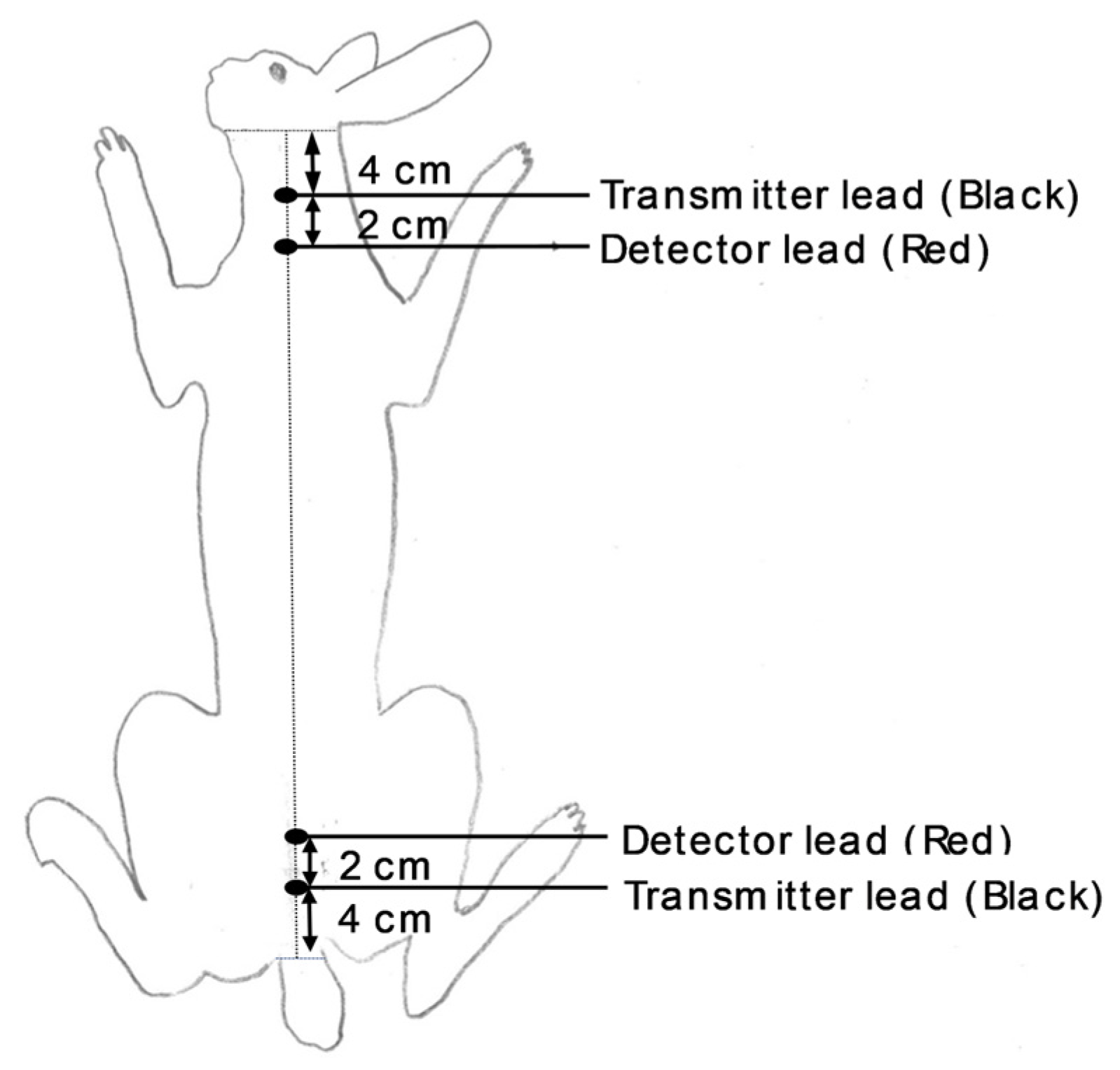
Bioelectrical impedance was measured using a four-terminal body composition analyzer (Quantum II, Model BIA-101, RJL Systems, Detroit, MI, USA). Prior to each measurement session, the device was calibrated using a standard 500 Ω resistor to verify the accuracy of the system. A constant alternating current of 800 µA at 50 kHz was delivered through the black transmitter leads (two distal electrodes), while resistance (Rs, Ω) and reactance (Xc, Ω) were recorded via the red detector leads (two proximal electrodes).
Rabbit does were neither anesthetized nor shaved during the procedure. Animals were positioned on a flat, non-conductive, non-slip board that provided a secure surface. Standard stainless-steel hypodermic needles (21 G × 1½″, 0.8 × 40 mm) were used as electrodes and inserted subcutaneously through the skin, which did not cause any pain, allowing the rabbit does to stay calm throughout the measurements. Bleeding rarely occurred with the insertion of the needles, but if any superficial capillaries were ever reached, the skin was disinfected with an antiseptic solution. Electrodes were positioned along the dorsal midline: for the distal transmitter pair, one electrode was inserted 4 cm caudal to the base of the ears (scapular region) and the other 4 cm cranial to the base of the tail (rump region). The proximal detector pair was placed 2 cm caudal (scapular region) and 2 cm cranial (rump region) to the respective transmitter electrodes (
Figure 1).
The distance between detector electrodes (D, cm) and the dorsal length (L, cm) from the base of the ears to the base of the tail were measured using a flexible steel tape. Live weight (LW, g) and parity order (PO) were also recorded for each female. Bioelectrical impedance measurements were taken twice per animal in calibration and validation groups (at 30 min- intervals) between 09:00 and 11:00 h to assess measurement repeatability. Because feed and water intake in rabbits at this time is minimal [
51], nutritional and hydration status were not standardized before taking BIA measurements. Furthermore, the measurements were taken under conditions similar to those we might find on commercial farms. The approximate time required to measure one animal (including the weighing of the animal and electrode insertion and removal) was around two minutes.
2.3. Slaughtering and Processing of the Samples
Following BIA measurements, the staff with required accreditations euthanized animals using an intravenous administration of sodium pentobarbital (Dolethal®, Vetoquinol, Madrid, Spain) at a dose of 120 mg/kg body weight, injected into the marginal ear vein (2–2.5 mL per doe, depending on body weight). Barbiturates were administered at low doses for sedation, and once adequate sedation was achieved, the euthanasia dose was subsequently administered. After euthanasia, carcasses were stored at −20 °C until processing.
Before grinding, each carcass was thawed slowly for 24 h at 4 °C and subsequently chopped into small pieces. Entire animals, including skin, hair, and major organ systems, were then homogenized using an industrial meat grinder (Cruells, C-15 EN 60742). A representative portion of the homogenate was collected from each rabbit. One aliquot was immediately analyzed for water content, while the remaining sample was refrozen at −20 °C. Samples were later freeze-dried for 72 h and milled through a 1 mm screen prior to chemical analyses.
2.4. Analytical Methods
Dry matter (DM) content of the ground material was determined by mixing 5 g of sample with 20 g of sea sand and 5 mL of ethanol, followed by drying at 103 °C for 24 h, according to the ISO 1442 method [
52]. Chemical analyses were performed according to AOAC procedures [
53]: DM (oven-drying method, 934.01), ash (muffle furnace incineration, 923.03), ether extract (Soxhlet extraction following 3 N HCl acid hydrolysis, 920.39), and crude protein (CP), using the Dumas combustion method (968.06) with an FP-528 analyzer (LECO, St. Joseph, MI, USA). Gross energy (GE) was determined by isoperibol bomb calorimetry (Model 1356, Parr Instrument Company, Moline, IL, USA).
2.5. Statistical Analysis
The effects of physiological state on body composition of rabbit does were analyzed using a completely randomized design, with parity order (PO) included as a linear covariate and physiological state as the main fixed effect. Data were analyzed using the GLM procedure of SAS [
54]. Results are presented as least-squares means (LSMeans), and pairwise comparisons among physiological states were performed using the
t-test.
Repeatability (SR), representing the intra-series variability of BIA measurements within individual rabbit does, was estimated using the VARCOMP procedure of SAS. It was calculated as SR = √(Se2), where Se denotes the expected variance of error. The coefficient of variation in repeatability (CVR) was expressed as the ratio between SR and the mean BIA value, multiplied by 100.
Pearson correlation coefficients between BIA variables and carcass chemical composition were computed using the CORR procedure.
To identify the regression models that best explained the variation in the dependent variables, the RSQUARE option of the REG procedure was applied using data from the calibration group (CG). Dependent variables included water (expressed as % and g), crude protein (CP), ash, fat (expressed as % DM and g), and gross energy (kJ/100 g DM and MJ). Independent variables considered as potential predictors were physiological state (NUL, PL, PNL, NPL, NPNL), PO, PO2, live weight (LW, LW2), distance between detector electrodes (D, D2), dorsal length (L, L2), resistance (Rs, Rs2), reactance (Xc, Xc2), impedance (Z, Z2), and derived volume indices vol1 (D2/Rs) and vol2 (D2/Z).
Model selection was based on Mallows’
Cp statistic [
55], ensuring values ≤
p + 1 (where
p is the number of independent variables) to avoid bias due to omission of relevant predictors. Among models meeting this criterion, the optimal model was selected according to the minimum values of the following criteria: SP Statistic [
56], Final Prediction Error (JP) [
56,
57], Amemiya’s Prediction Criterion (PC) [
57,
58], and Akaike’s Information Criterion (AIC) [
59].
Once the most appropriate predictors were identified, parameter estimation for the multiple linear regression (MLR) models was performed using the REG procedure. Validation of the regression equations was conducted using independent data from the validation group (VG).
Prediction accuracy was evaluated using the Mean Prediction Error (MPE), calculated as the square root of the mean squared difference between the observed (chemically determined) and predicted values of each body composition parameter. The Relative Mean Prediction Error (RMPE, %) was expressed as the ratio between MPE and the mean observed value of the corresponding parameter. Differences between observed and predicted values derived from MLR equations in the validation group were assessed using paired t-tests.




 ,
,