


Simple Summary
Interest in the use of music therapy as a behavioral enrichment tool in veterinary medicine is growing. Indeed, an industry has formed around the development of ‘dog music’, which has been purposely designed to relax dogs. Despite enthusiastic uptake of the idea, there is little empirical evidence supporting the design of such tools. This article summarizes the scientific literature in this emerging domain. It notes that, as a general observation, animals appear less stressed or anxious when exposed to classical music than to control conditions. It also acknowledges that this field is relatively under-researched, and more rigorous studies must be conducted before species-specific recommendations can be made. Such studies must reflect individuals’ and species’ preferences for different genres and songs, taking care to avoid habituation.
Abstract
Music therapy yields many positive health outcomes in humans, but the effects of music on the health and welfare of nonhuman animals vary greatly with the type of music played, the ethology of the species, and the personality and learning history of individual animals. One context in which music therapy may be used to enhance animal welfare is to alleviate stress in domestic environments. Here, we review studies of the effects of music exposure on dogs as a case study for the implementation of music therapy in veterinary medicine. Nine reports of experimental testing for the therapeutic effects of music on dogs were found, with most of these studies focusing on changes in behavior. Overall, exposure to classical music appears to have a calming influence on dogs in stressful environments, with no additional benefit observed from any music purposely designed for dogs (specifically “Through a dog’s ear”). Given the cost effectiveness and ease of implementation, music therapy holds promise in veterinary medicine and animal welfare. However, to address precise research questions, further studies must use clearly defined characteristics of stimulus music in the experimental design, and consider the variability of each individual animal’s physical characteristics and past experience in the selection of candidates.
1. Introduction
Music as a therapy for humans has been shown to yield many positive outcomes, such as pain relief, reduced blood pressure, heart rate and anxiety levels [1,2,3]. Due to the low cost and the ease of administration of music to domestic animals, there is growing interest in adapting music therapy techniques from the human domain to improve the health and welfare of companion, performance and production animals [4]. However, when assessing the effect of music upon nonhuman animals, it is important to consider how each species has evolved to encounter auditory stimuli, the type of music administered, the desired outcome, and the individual differences among animals. Studies of comparative acoustics have shown that the anatomy of the head, the distance between the ears and the shape and mobility of the pinnae influence the effective acoustic radius [5]. Even among a single species, such as Canis lupus familiaris, individuals’ size, head shape, the shape and mobility of the pinnae [6] and learning history [7] can create variation that would affect perception and outcomes. Hence, music therapy cannot be simply translated from the human context into veterinary medicine; carefully designed experiments are required to implement evidence-based practice.
There are several potential benefits of implementing music therapy for domestic animals. For example, music therapy may have a positive effect upon the health and behavior of an individual or group of animals in a stressful context (e.g., veterinary hospital, abattoir, milking parlor, boarding kennel, zoological park) (reviewed in [4]). Music may also be used to increase production in agriculture systems. For example, it has been effectively used to encourage dairy cows to approach the stalls in an automatic milking parlor [8]. Furthermore, cows exposed to classical music in the milking parlor showed fewer behavioral indicators of stress, and produced more milk than cows exposed to only the noises of the automated system. So, for the period of this study at least, music used in this context reaped a dual benefit of increased profit and animal welfare [8]. Importantly, auditory enrichment is relatively cheap and easy to employ. In contrast to many other forms of environmental enrichment that can often require additional materials, food, and labor to construct, music can be easily administered via a speaker system.
Important considerations in the implementation of music therapy are the characteristics of the species and individuals being targeted. The effect of music on animal health and welfare may also depend on the music’s genre, tempo, or instrumentation of the music played. While many animals have been shown to benefit from music exposure, others have shown adverse reactions or no changes in behavior when exposed to music. For example, behavioral observations in captive cotton-topped tamarins (Saguinus oedipus, n = 5) and common marmosets (Callithrix jacchus, n = 4) indicated that they preferred silence to both fast and slow music [9]. In a study of captive Moloch gibbons (Hylobates moloch, n = 8), the use of auditory enrichment in an animal park induced no significant differences in activity, brachiation and affiliative behaviors, such as grooming [10]. In another example, ‘fast music’ (rock music) was shown to decrease daily growth rates in pigs, while ‘slow music’ (light music) had no effect upon growth rate [11]. Finally, animals may become habituated to music, and therefore any effects may decrease over time [12]. Hence, properly controlled experiments, designed with the target population and outcome response clearly defined, are required to achieve the best outcome when implementing music therapy in veterinary medicine.
The use of music therapy in nonhuman animals has been examined most thoroughly in companion animal species, especially dogs. Hence, here we systematically review experimental studies of music exposure in dogs as a case study to inform future directions for the implementation of music therapy in more general attempts to boost animal health and welfare. The current data suggest that using music as an instrument to improve welfare requires a multifactorial approach, with consideration of species, individual differences, genre and composition of music, background noise, and long-term experimental data collection to guide these choices.
2. Materials and Methods
A literature search with the strings “music AND dog OR canine” was completed on 31 October 2019 in the ISI Web of Science and PubMed databases. These databases were selected because of their high volumes of peer-reviewed scientific literature on animal health, science and behavior. This search yielded 111 unique articles, whose titles and abstracts were screened for relevance by two independent reviewers (see Figure 1). Only studies that experimentally manipulated the auditory environment and assessed at least one measure of canine health or behavior were included for further review, leaving 14 articles for full-text screening.
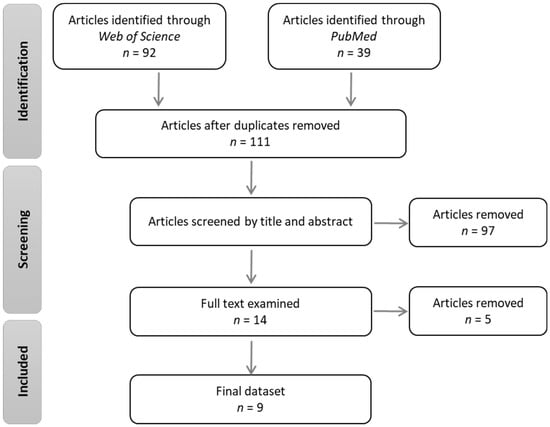
Figure 1.
Preferred Reporting Items for Systematic Reviews and Meta-Analyses (PRISMA) flow diagram of study selection.
Five of these articles (all by the same team of authors and published between 1987–1989) were then excluded, because music was used to induce stress rather than enrichment. This process left nine articles in the final dataset (Table 1).

Table 1.
Studies examining effects of auditory enrichment on canine health and behavior.
Follow-up searches of music therapy studies in other species were conducted by combining general and more specific key words relating to music therapy, auditory enrichment, and its behavioral and physiological effects on animals. Search terms included combinations of ‘auditory’, ‘enrichment’, ‘stress’, ‘animal’, ‘music’, ‘immun*’, ‘husbandry’, ‘health’, ‘behav*’ and ‘welfare’. Only publications in English were included. A sample of the range of studies examining the effects of music on animals is shown in Table 2. This sample is not comprehensive, nor part of the systematic review. Rather, we highlight these studies to provide new ideas for future research in the effects of music on canine health and welfare.
Table 2.
Sample of studies examining effects of auditory enrichment on health and behavior of non-canine species.
3. Results
Nine studies experimentally testing the therapeutic effects of music on dogs were examined (Table 1). Most of these studies are recent (7/9 studies having been published in the past five years, with the remaining two having been published in 2002 and 2012), demonstrating an escalating interest in this emerging area of research. The studies cover a range of breeds, across all ages from puppies to adults, and generally examine both sexes. Settings include animal shelters, veterinary hospitals and police-dog training facilities. All but one study examined behavioral measures as a response variable, with most including an assessment of time spent resting and barking (among other variables) as indicators of stress. Six of these eight studies reported that exposure to music affected one or more behavioral measures, with most revealing that classical music had a calming effect compared to controls and other forms of music (Table 1). Fewer studies examined health and/or physiological measures. Three studies examined heart rate variability, with all three finding significant changes with exposure to music [12,17,20]. Two studies examined circulating cortisol concentrations, with one finding no difference in salivary cortisol concentrations as a result of exposure to classical music [12], and the other finding increased urinary cortisol concentrations with exposure to soft rock music [17].
4. Discussion
There is growing interest in using music therapy as a behavioral management and enrichment tool in veterinary medicine [4]. In particular, an industry has formed around the development of ‘dog music’, which has been purposely designed to relax dogs. Despite an enthusiastic uptake of the idea, there is little empirical evidence supporting the design of such tools. A broad search of the terms ‘music’ and ‘dog’ only yielded nine studies that experimentally tested the effects of music exposure upon dogs (Table 1). Overall, these studies provide strong evidence that exposure to music alters the behavioral traits of dogs, with classical music generally being reported to have a calming influence in potentially stressful environments such as boarding kennels, rescue shelters and veterinary clinics. Overall, classical music was associated with dogs spending more time sitting or lying down, resting and sleeping, and less time vocalizing and standing (Table 1). However, music marketed as being specifically designed for dogs (the five studies examining dog music all used “Through a dog’s ear”) did not appear to have many beneficial effects over and above those gained by exposing dogs to a random selection of classical music [14,15,16,18,20]. This is likely due to the heterogeneity of the populations studied, and/or a lack of sensitivity in the response variables measured. To develop evidence-based guidelines for the implementation of music therapy in veterinary medicine, further experiments using carefully controlled target populations, interventions and response measures are required.
Of the nine studies identified in our systematic review, all but one study assessed behavior as the main response variable. Only four of the nine studies tested for the physiological effects of music exposure in dogs, providing some supporting evidence of the interpretation from behavioral data of a reduction in stress levels during exposure to classical music [12,17]. Yet, the beneficial effects of music therapy in canine shelters is likely to extend far beyond the limited responses reported to date. Alternative study designs and response measures examined in other animal species may be adapted to inform future directions (Table 2). For example, additional benefits of music therapy in animal shelters may include beneficial effects on immune function and metabolism [21,25]. Exposure to classical music has been shown to enhance immune function and anti-tumor responses in laboratory rodents (both mice and rats) [21], and immunity and developmental stability in layer chicks [23]. Investigations into the effects of the exposure of veterinary patients to music in clinics have begun [16,18,20], but such studies have thus far been limited by small sample sizes. Another potential use of music in animal shelters is to influence animal movement patterns [8,24] by drawing towards certain areas and repelling them from others. Theoretically, this has the potential to facilitate the provision of larger, relatively free-range enclosures. In addition, music in animal shelters and veterinary hospitals may have flow-on benefits to staff and visitors [18], and may improve adoption rates [13,17]. Hence, in addition to improving the immediate and short-term physiological and mental health of dogs, music therapy may improve long-term welfare, potentially countering the effects of overcrowding and protracted stays in shelters. We encourage future studies to broaden the scope of response variables examined to gain insight into the full range of health and welfare benefits gained through music therapy.
While the addition of classical music to kennel and veterinary hospital environments seems to yield positive benefits overall, several considerations arise when using auditory enrichment as a welfare measure. Four of the studies compared the effects of various broad categories of music including Heavy Metal [13,14], Pop [13,15,17] and Soft Rock, Motown and Reggae [17]. Rock and heavy metal music were found to induce undesirable behavioral and physiological changes in dogs, such as increased barking/vocalizing and standing [13,14,17]. However, it is still not clear what specific traits of each type of music stimulus are responsible for the altered outcomes. Some generalizations can be inferred, and traits such as pitch, tempo and volume have been considered. Yet, the category of music classified under the umbrella term ‘classical’ is wide and varied. Future studies should consider traits such as instrumentation, as the timbre of the music may affect outcomes. For example, a study that examined piglets’ reactions to different types of classical music revealed differences between the effects of fast and slow tempos, as well as between string and wind instruments [24]. Slow string and wind music were both associated with more exploratory behaviors, although slow string music also resulted in more time spent lying down [24]. Fast wind music significantly increased the time piglets spent walking, lying, standing and exploring [24]. Responses to music instrumentation is likely to vary among species, and therefore further research is required to determine if similar affects are found in dogs. In addition to instrumentation, a final consideration of variation within the category of classical music is the inclusion of a human voice. Praising words combined with a praising intonation activate primary reward regions in dog brains [26]. Furthermore, Brayley and Montrose [15] found that playing an audiobook induced calmer behavior than both classical and dog music. Hence, it would be interesting to investigate the effects of instrumental versus vocal classical music, particularly when the text includes praising words.
Another important consideration is that of the physical differences among breeds, as head shape and anatomy can alter the perception and responses to music treatments [6]. Similarly, previous experiences of each individual animal may have conditioned positive or negative associations with a particular type of music that will influence the response of that particular animal [7]. The nine studies examined covered a range of dog breeds and ages, and generally included both males and females, so it is interesting that over this wide range of animals, general patterns of changes in behavior were observed. However, Bowman et al. (2015) reported that heart rate variability measurements were not consistent throughout the trial, suggesting that dogs may have individual preferences for certain songs [12]. It is important to recognize that humans also have auditory physiological and anatomical differences from other species, and so music that is generally calming to humans may not have the same influence on nonhuman animals [4,27,28,29]. Moreover, some individuals may prefer silence to music. For example, stress behaviors (e.g., pacing) and plasma cortisol concentrations were found to decrease in captive primates that were granted the facility to choose when the music was on or off [4]. Similarly, in humans, autonomy and personal preference are crucial factors in music’s ability to alleviate stress [25]. Therefore, it is important to give individual animals autonomy over their musical environment (e.g., by providing music in one part of the kennel and relative quiet in another area). In addition, consideration should be given to variability in the playlist used. Bowman et al. (2015) found that dogs exposed to the same playlist repeatedly over 7 days became refractory to the psychological and physiological effects of the music [12]. This rapid habituation can be moderated by increasing variety and changing the sequence in which the tracks are presented [17].
5. Conclusions
The use of music in domestic animal contexts shows great potential as an effective and easy-to-implement therapeutic measure with many flow-on benefits to animal health and welfare. When considering auditory enrichment for the improved welfare of animals in stressful environments, it is important to consider a few key factors. Firstly, this field is relatively under-researched, and more empirical studies must be conducted before specific recommendations can be made. The elimination of ultrasound and infrasound that may distress nonhuman listeners is a basic first step. As a general observation, animals appear less stressed or anxious when exposed to classical music than to control conditions e.g., [8,17,23,24]. However, it is important to consider and adapt to individuals’ and species’ preferences for different genres and songs, taking care to avoid habituation [17]. Overall, the addition of classical music as an enrichment of environments in which animals are confined or potentially under stress is a relatively inexpensive and easily implemented enrichment that appears to withstand cost-benefit analysis. It offers potentially considerable benefits in terms of animal behavior, health and welfare [8,14]. Owners, trainers, keepers and managers should therefore consider and assess the potential benefits of using auditory enrichment for animals in their care.
Author Contributions
Conceptualization, A.M.L. and A.J.C.; methodology, A.M.L. and A.J.C.; validation, A.M.L., P.D.M. and A.J.C.; data curation, A.M.L. and A.J.C.; writing—original draft preparation, A.M.L. and A.J.C.; writing—review and editing, A.M.L., P.D.M. and A.J.C. All authors have read and agreed to the published version of the manuscript.
Funding
The APC was funded in part by a bequest to the Sydney School of Veterinary Science, The University of Sydney.
Acknowledgments
A.J.C. was supported by a bequest from the Mabs Melville foundation to the Sydney School of Veterinary Science.
Conflicts of Interest
The authors declare no conflict of interest.
References
- De Witte, M.; Spruit, A.; van Hooren, S.; Moonen, X.; Stams, G.J. Effects of music interventions on stress-related outcomes: A systematic review and two meta-analyses. Health Psychol. Rev. 2019. [Google Scholar] [CrossRef] [PubMed]
- Fu, V.X.; Oomens, P.; Sneiders, D.; van den Berg, S.A.A.; Feelders, R.A.; Wijnhoven, B.P.L.; Jeekel, J. The effect of perioperative music on the stress response to surgery: A meta-analysis. J. Surg. Res. 2019, 244, 444–455. [Google Scholar] [CrossRef] [PubMed]
- Umbrello, M.; Sorrenti, T.; Mistraletti, G.; Formenti, P.; Chiumello, D.; Terzoni, S. Music therapy reduces stress and anxiety in critically ill patients: A systematic review of randomized clinical trials. Minerva Anestesiol. 2019, 85, 886–898. [Google Scholar] [CrossRef] [PubMed]
- Alworth, L.C.; Buerkle, S.C. The effects of music on animal physiology, behavior and welfare. Lab Anim. 2013, 42, 54–61. [Google Scholar] [CrossRef] [PubMed]
- Klump, G.M.; Dooling, R.J.; Fay, R.R.; Stebbins, W. Methods in Comparative Psychoacoustics; Birkhäuser Verlag: Basel, Switzerland, 1995. [Google Scholar]
- McGreevy, P.D.; Georgevsky, D.; Carrasco, J.; Valenzuela, M.; Duffy, D.L.; Serpell, J.A. Dog behavior co-varies with height, bodyweight and skull shape. PLoS ONE 2013, 8, e80529. [Google Scholar] [CrossRef]
- McGreevy, P.D.; Boakes, R.A. Carrots and Sticks—Principles of Animal Training; Cambridge University Press: Cambridge, UK, 2007. [Google Scholar]
- Uetake, K.; Hurnik, J.F.; Johnson, L. Effect of music on voluntary approach of dairy cows to an automatic milking system. Appl. Anim. Behav. Sci. 1997, 53, 175–182. [Google Scholar] [CrossRef]
- McDermott, J.; Hauser, M.D. Nonhuman primates prefer slow tempos but dislike music overall. Cognition 2007, 104, 654–668. [Google Scholar] [CrossRef]
- Wallace, E.K.; Kingston-Jones, M.; Ford, M.; Semple, S. An investigation into the use of music as potential auditory enrichment for moloch gibbons (Hylobates moloch). Zoo Biol. 2013, 32, 423–426. [Google Scholar] [CrossRef]
- Ekachat, K.; Vajrabukka, C. Effect of music rhythm on growth performance of growing pigs. Kasetsart J. Nat. Sci. 1994, 28, 640–643. [Google Scholar]
- Bowman, A.; Dowell, F.J.; Evans, N.P.; Scottish, S. Four Seasons in an animal rescue centre; classical music reduces environmental stress in kennelled dogs. Physiol. Behav. 2015, 143, 70–82. [Google Scholar] [CrossRef]
- Wells, D.L.; Graham, L.; Hepper, P.G. The influence of auditory stimulation on the behaviour of dogs housed in a rescue shelter. Anim. Welf. 2002, 11, 385–393. [Google Scholar]
- Kogan, L.R.; Schoenfeld-Tacher, R.; Simon, A.A. Behavioral effects of auditory stimulation on kenneled dogs. J. Vet. Behav. 2012, 7, 268–275. [Google Scholar] [CrossRef]
- Brayley, C.; Montrose, V.T. The effects of audiobooks on the behaviour of dogs at a rehoming kennels. Appl. Anim. Behav. Sci. 2016, 174, 111–115. [Google Scholar] [CrossRef]
- Albright, J.D.; Seddighi, R.M.; Ng, Z.; Sun, X.; Rezac, D.J. Effect of environmental noise and music on dexmedetomidine-induced sedation in dogs. PeerJ 2017, 5, e3659. [Google Scholar] [CrossRef] [PubMed]
- Bowman, A.; Dowell, F.J.; Evans, N.P.; Scottish, S. The effect of different genres of music on the stress levels of kennelled dogs. Physiol. Behav. 2017, 171, 207–215. [Google Scholar] [CrossRef] [PubMed]
- Engler, W.J.; Bain, M. Effect of different types of classical music played at a veterinary hospital on dog behavior and owner satisfaction. J. Am. Vet. Med. Assoc. 2017, 251, 195–200. [Google Scholar] [CrossRef]
- Alves, J.C.; Santos, A.; Lopes, B.; Jorge, P. Effect of auditory stimulation during early development in puppy testing of future police working dogs. Top. Companion Anim. Med. 2018, 33, 100–104. [Google Scholar] [CrossRef]
- Koster, L.S.; Sithole, F.; Gilbert, G.E.; Artemiou, E. The potential beneficial effect of classical music on heart rate variability in dogs used in veterinary training. J. Vet. Behav. 2019, 30, 103–109. [Google Scholar] [CrossRef]
- Nunez, M.J.; Mana, P.; Linares, D.; Riveiro, M.P.; Balboa, J.; Suarez-Quintanilla, J.; Maracchi, M.; Mendez, M.R.; Lopez, J.M.; Freire-Garabal, M. Music, immunity and cancer. Life Sci. 2002, 71, 1047–1057. [Google Scholar] [CrossRef]
- Lemmer, B. Effects of music composed by Mozart and Ligeti on blood pressure and heart rate circadian rhythms in normotensive and hypertensive rats. Chronobiol. Int. 2008, 25, 971–986. [Google Scholar] [CrossRef]
- Davila, S.G.; Campo, J.L.; Gil, M.G.; Prieto, M.T.; Torres, O. Effects of auditory and physical enrichment on 3 measurements of fear and stress (tonic immobility duration, heterophil to lymphocyte ratio, and fluctuating asymmetry) in several breeds of layer chicks. Poult. Sci. 2011, 90, 2459–2466. [Google Scholar] [CrossRef] [PubMed]
- Li, X.; Zhao, J.N.; Zhao, P.; Zhang, X.; Bi, Y.J.; Li, J.H.; Liu, H.G.; Wang, C.; Bao, J. Behavioural responses of piglets to different types of music. Animal 2019, 13, 2319–2326. [Google Scholar] [CrossRef] [PubMed]
- Yamasaki, A.; Booker, A.; Kapur, V.; Tilt, A.; Niess, H.; Lillemoe, K.D.; Warshaw, A.L.; Conrad, C. The impact of music on metabolism. Nutrition 2012, 28, 1075–1080. [Google Scholar] [CrossRef] [PubMed]
- Andics, A.; Gabor, A.; Gacsi, M.; Farago, T.; Szabo, D.; Miklosi, A. Neural mechanisms for lexical processing in dogs. Science 2016, 353, 1030–1032. [Google Scholar] [CrossRef] [PubMed]
- Lefman, S.H.; Prittie, J.E. Psychogenic stress in hospitalized veterinary patients: Causation, implications, and therapies. J. Vet. Emerg. Crit. Car. 2019, 29, 107–120. [Google Scholar] [CrossRef] [PubMed]
- Heffner, H.E. Auditory awareness. Appl. Anim. Behav. Sci. 1998, 57, 259–268. [Google Scholar] [CrossRef]
- Heffner, H.E.; Heffner, R.S. Hearing ranges of laboratory animals. J. Am. Assoc. Lab. Anim. 2007, 46, 20–22. [Google Scholar]
© 2020 by the authors. Licensee MDPI, Basel, Switzerland. This article is an open access article distributed under the terms and conditions of the Creative Commons Attribution (CC BY) license (http://creativecommons.org/licenses/by/4.0/).