Skip to Content
MicroorganismsMicroorganisms
  • Article
  • Open Access

13 February 2026

Differential Responses to Heat Stress Between Freshly Isolated and Long-Term Cultured Symbiodinium


,
,
,
,
,
,
,
,
1
Biological and Environmental Science and Engineering Division (BESE), King Abdullah University of Science and Technology (KAUST), Thuwal 23955-6900, Saudi Arabia
2
National Center for Wildlife (NCW), P.O. Box 61681, Riyadh 11575-4508, Saudi Arabia
3
Institut Fresnel, CNRS, Centrale Med, Aix-Marseille University, 13284 Marseille, France
4
Computer, Electrical and Mathematical Sciences and Engineering (CEMSE), King Abdullah University of Science and Technology (KAUST), Thuwal 23955-6900, Saudi Arabia

Abstract

Symbiotic dinoflagellates from the family Symbiodiniaceae play a central role in coral reef ecosystems by forming mutualistic relationships with reef invertebrates, particularly stony corals. These relationships underpin reef productivity in nutrient-poor waters but are vulnerable to disruption from marine heatwaves and climate change. While laboratory culturing of symbionts has enabled controlled studies of thermal stress, prolonged culturing may lead to physiological changes that do not reflect in hospite conditions. Here, we examined the thermal stress responses of two axenic cultures of Symbiodinium A1, freshly isolated and long-term cultured (2.5 years), originally from the jellyfish Cassiopea andromeda in the Red Sea. Both cultures were exposed to a daily temperature increase of 1 °C, up to 37 °C. Freshly isolated symbionts consistently showed higher photochemical efficiency (0.515 ± 0.007) and growth rates (1.68 ± 0.60 µ day−1) compared to long-term cultured cells (0.401 ± 0.007; −2.25 ± 0.38 µ day−1), which collapsed at 37 °C. Heat stress also led to decreases in O2 and increases in pCO2 across treatments. Long-term cultured symbionts exhibited greater lipid body accumulation, suggesting a shift to anaerobic metabolism. These findings demonstrate that extended batch culturing alters symbiont physiology and stress responses, highlighting the need to consider culture history in experimental designs to avoid bias in interpreting holobiont resilience.

1. Introduction

Symbiotic dinoflagellates belonging to the family Symbiodiniaceae [1] have undergone extensive investigation primarily due to their importance as mutualistic symbionts in various reef invertebrates, particularly reef-building stony corals. This highly efficient symbiosis drives the remarkable primary productivity of coral reefs in nutrient-poor waters, supporting their complexity, rich biodiversity, and associated fisheries [2,3]. This partnership involves a reciprocal nutrient exchange, with corals providing shelter and nutrients to Symbiodiniaceae in return for photosynthates [2,3,4]. A recent discovery has revealed that nitrogen recycling might be the central mechanism of symbiont control and nutrient efficiency in this symbiosis [5].
The rapid degradation of coral reefs observed in recent years underscores their vulnerability to human-induced global changes, particularly rising sea surface temperatures [6] and intensified marine heatwaves [7,8], which are among the most important current drivers of coral reef degradation [9,10,11]. Ocean warming can disrupt the symbiotic relationship between coral hosts and Symbiodiniaceae, ultimately resulting in coral bleaching. This process is characterized by the loss of Symbiodiniaceae and photosynthetic pigments, which often leads to coral mortality [12]. Nevertheless, historical records demonstrate that certain reef-forming corals and their obligate symbiotic associations have exhibited resilience to substantial changes [13,14] persisting for more than 200 million years [1,15,16]. Particularly, it is well understood that symbionts play a key role in driving their thermal resilience [17,18,19,20].
Symbiodiniaceae genera show different thermal resistance in hospite [21,22] and in culture [23]. For instance, Symbiodinium (formerly clade A [1]) from Cassiopea xamachana displayed a reduced photosynthetic activity at 30 °C and complete disruption at 36–37 °C [24]. In contrast, other genera exhibited variable responses, rapidly adapting to thermal stress [25]. This suggested that the holobiont’s resilience to thermal stress might be primarily, but not uniquely [26,27], driven by different symbiont assemblages associated with the host [2,17,18,28,29,30], leading to varied thermal tolerances among distinct colonies and host species [19,20,31,32]. Thus, a thorough understanding of the physiological responses of these endosymbionts becomes imperative for predicting the potential reactions of algal-cnidarian partnerships to rising ocean temperatures.
While the coral-Symbiodiniaceae relationship is naturally intricate, the symbionts can also exist in free-living states [33,34,35] and have been cultivated under controlled conditions since the 1950s [36]. This offers the opportunity to simplify the system, enabling detailed investigations of the symbiosis itself. Culturing isolated symbionts has provided insights into their metabolic interactions and responses [37], offering further understanding of the physiological responses of Symbiodiniaceae spp. [37] and their role in symbioses [38] and in mitigating climate change [24]. However, culturing these algae in isolation imposes conditions possibly deviating from those in hospite, and may induce physiological changes [38,39,40,41,42]. Cultured Symbiodiniaceae adapt to non-optimal conditions, altering their sensitivities to major environmental factors like pH, oxygen (O2), carbon dioxide (CO2), temperature, and salinity [43]. During extended artificial cultivation, Symbiodiniaceae’s rapid asexual reproduction rate [44] might cause spontaneous mutations [25], potentially influencing experimental outcomes. As a consequence, many experimental studies relying on long-term cultured Symbiodiniaceae implicitly assume that these cultures represent reasonable physiological proxies for in hospite symbionts. However, if prolonged culturing substantially alters stress responses, this assumption may bias interpretations of symbiont performance and holobiont resilience to climate change. Despite its widespread relevance, the influence of culture history on thermal stress responses remains poorly quantified.
Therefore, we hypothesize that freshly isolated Symbiodiniaceae cells may perform differently under thermal stress than those maintained in culture for multiple generations, and may, therefore, provide responses to experimental conditions better reflecting symbiont populations within hosts. To test this hypothesis, we used Symbiodinium A1 cells extracted from the oral arms of wild Cassiopea andromeda, the upside-down jellyfish, collected from the Red Sea. We first characterized growth and environmental conditions in standard culture settings (pre-experimental phase). We tested the hypothesis that “freshly isolated” and “long-term cultured” symbionts differ in responses by comparing the performance of two Symbiodinium A1 axenic cultures, one isolated in 2018 (“long-term cultured”) and one “freshly isolated” 5 months prior to the start of the assessment of responses to a ramping temperature design experiment (conducted in March 2022). Responses to increasing temperatures were assessed by measuring: (1) productivity-related factors (i.e., Symbiodinium cells density, maximum photochemical efficiency [Fv/Fm], chlorophyll-a concentration, photosynthesis rates, and thylakoid lipids unsaturation state), (2) metabolic responses potentially driving acidification of the culturing medium (i.e., respiration rates and lactate production), and (3) energy storage processes (i.e., neutral lipids accumulation).

2. Materials and Methods

2.1. Isolation of Symbiodiniaceae

Details about the host species employed in this study can be found in the Supplementary Materials. This study utilized two distinct axenic cultures of Symbiodiniaceae derived from the oral arms of the jellyfish C. andromeda collected during separate years. The first culture, denoted as “long-term cultured”, comprised Symbiodinium A1 cells [1] isolated from Cassiopea sp. specimens gathered from the KAEC lagoon (Latitude: 22.38979° N, Longitude: 39.135547° E) in November 2017 [27]. The axenic culture was isolated in November 2018 and was thereafter maintained under specific environmental conditions, namely, a temperature of 29 °C (coinciding with the minimum summer temperature in the Red Sea; [45]), light intensity ~100 µmol photons m−2 s−1, and a consistent 12 h/12 h light cycle, over 2.5 years. The culturing medium was refreshed monthly [23]. Conversely, the second culture, designated as the “freshly isolated”, contained Symbiodinium cells isolated from Cassiopea sp. specimens at the KAEC lagoon in March 2021 (Figures S1 and S2). The axenic “freshly isolated” culture was obtained in September 2021. These “freshly isolated” cells were subjected to identical conditions as the “long-term cultured” throughout the expansion period. At the time of the experiment conducted here, the axenic “freshly isolated culture” had been grown in laboratory conditions for 5 months, compared to 2.5 years for the “long-term cultured” strain.
For the isolation of Symbiodinium (Clade A1), selected oral arms of four C. andromeda individuals were ground using a Dounce homogenizer (Wheaton Science Products, Millville, NJ, USA) until no tissue chunks were visible. The homogenates were subsequently centrifuged (300 rpm × 5 min), rinsed with ultrapure water, and resuspended three times. The pellet was concentrated by centrifugation and resuspended in 600 µL of F/2 medium (20 mL in 1 L of 0.45-µm-filtered and autoclaved seawater; Sigma-Aldrich, St. Louis, MA, USA). Two aliquots (300 µL) of this suspension were used for (1) growth in 1.5 mL Eppendorf tubes in F/2 medium, and (2) growth in 75 cm2 culture flasks equipped with vented caps (Corning®, Corning, NY, USA) with 100 mL of F/2 medium and germanium (12.5 mg in 5 mL of ultrapure water; Sigma-Aldrich, 483702-5G) for approximately a month. Part of the first aliquot was used for clade characterization via ITS2 sequencing. The cell concentration of the culture obtained from the second aliquot was measured and adjusted to approximately 100 cells per plate. The resulting suspension was grown for 1 month in a Petri dish on a solid culture medium, prepared by combining seawater (1 L), F/2 medium (25 mL), agarose (10 g; Sigma-Aldrich, A9539-250G), and germanium (2 mL). Five single colonies grown on plates (Figure S3) were gently scraped with a sterile micropipette tip for each plate: half of the scraped material was used for clade characterization, while the other half was grown in a 1.5 mL Eppendorf tube containing 500 µL of F/2 medium. Every single colony was considered to have originated from a single cell. After a month of growth in the Eppendorf tubes, the symbionts were transferred into culture flasks for expansion.

2.2. DNA Extraction, PCR, and ITS2 Sequencing

The Symbiodiniaceae clades initially isolated from the medusae were characterized using Illumina sequencing of the Internal Transcribed Spacer 2 (ITS2) region, following a modified protocol outlined by Herrera and colleagues [46]. Details can be found in the Supplementary Materials. The resulting sequences were analyzed and resolved using the online database SymPortal (SymPortal, version 0.0.3; [47]).
Confirmation of isolation of Symbiodinium A1 from colony picking was performed by DNA extraction using DNeasy® Plant Mini Kit (Qiagen, Venlo, The Netherlands). Verification and quantification of DNA extraction were conducted using the Nanodrop. PCR amplification of the 28S rRNA was performed as described above, employing the primers SYMA28S-R (5′CTCTGAGAGCAAGTACCGTGC3′) and SYMA28S-F (5′GATTGTGGCCTTTAGACATACTA3′; [48]). Each PCR reaction was performed as described in the Supplementary Materials. See Figures S1–S4 for a summary of the protocols.

2.3. Experimental Design

Symbiont cells were cultured in 126 flasks per culture type, with a working volume of 100 mL and a cell density of 1–2 × 10⁴ cells mL−1. The flasks were placed in incubators (Percival Scientific Inc., Perry, IA, USA) and maintained at 29 °C, with a 12 h/12 h dark/light cycle and a light intensity of ~100 µmol photons m−2 s−1. Prior to the main experiment, 24 flasks were utilized for preliminary monitoring to estimate when cells were in the exponential phase and to assess whether in vitro conditions mimic in vivo conditions (details in Figures S5 and S6 and Table S1). Throughout this phase, weekly assessments of environmental conditions (O2, pH, and temperature) and growth (cell density) were conducted at 05:00 (night) and 17:00 (day) hours local time. The selected timepoints were strategically chosen to capture the most extreme conditions, such as before the lights turned on in the morning at 07:00 and just before 19:00 after 12 h of light exposure. At each timepoint for each symbiont type, three flasks were utilized. Dissolved O2 levels were measured using a FiveGOTM DO (Mettler Toledo, Columbus, OH, USA) meter, with a one-point calibration for 100% air saturation. pH measurements were performed using a Mettler Toledo portable meter (Mettler Toledo, SevenGOTM Duo, Columbus, OH, USA) calibrated for the National Institute of Standards and Technology (NIST) scale using commercial standard solutions (pH 4.0, 7.0, and 10.0). Symbiont suspension samples (1 mL) were collected and stored at −20 °C until further analysis. Symbiont density was measured using a hemocytometer in a 10 μL volume (n = 3) under a fluorescent microscope (Leica DM6000 B, Leica, Wetzlar, Germany). Following the measurements, the flasks were discarded to maintain sterility and prevent any potential bacterial contamination.
The main experiment comprised six treatments (Figure S7): (1) “long-term cultured” symbionts maintained at 29 °C, (2) “freshly isolated” symbionts maintained at 29 °C, (3) “long-term cultured” symbionts subjected to heat stress, (4) “freshly isolated” symbionts subjected to heat stress, (5) “Blank” with F/2 medium only maintained at 29 °C, and (6) “Blank” with F/2 medium only subjected to heat stress. The experiment commenced when the cells were at the beginning of the exponential phase (i.e., symbionts exhibited consistent growth rates, optimal physiological state, and uniform populations) and lasted for 9 days. The “long-term cultured” symbionts, “freshly isolated” symbionts, and “Blanks” were randomly distributed among four incubators. Two of these incubators were used as temperature controls, set at 29 °C with a 12 h/12 h photoperiod and a light intensity of ~100 µmol photons m−2 s−1. The remaining two incubators served as heat-stress treatments, with a 12 h/12 h photoperiod and a light intensity of ~100 µmol photons m−2 s−1, with the temperature increased at a rate of +1 °C per day. The temperature increase (+8 °C) aligns with the Red Sea’s inherent variability [49], and the rate (+1 °C per day) aligns with the rate for the mitigation of severe bleaching in the models by Safaie et al. [50] and prior research [51]. “Blank” flasks containing only 100 mL of F/2 medium were utilized as controls for both temperature ramping and control conditions to account for potential background respiration/production.
Each day, three flasks per type were utilized at 05:00 and 17:00 h local time for monitoring environmental conditions (O2, pH, and temperature) and biological responses. The contents of each “long-term cultured” and “freshly isolated” replicate flask were allocated as follows: (a) 500 µL of symbiont suspension was stored at −20 °C and used for cell count, (b) 3 mL were utilized to measure the maximum Fv/Fm of photosystem II (PSII), (c) 500 µL were stored at −20 °C and used for estimating the chlorophyll content, (d) 1 mL was stored at −80 °C and used for measuring lactate production, (e) 15 mL were immediately utilized for dark respiration/photosynthesis rates, and (f) 1 mL was snap-frozen in liquid nitrogen and stored at −80 °C for lipid analysis. Symbiont density, maximum Fv/Fm, chlorophyll, and lactate analyses were conducted daily, while samples for lipids and respiration/production analyses were collected on days 1, 3, 5, 7, and 9, corresponding to temperatures 29 °C, 31 °C, 33 °C, 35 °C, and 37 °C. Samples for analysis of lipid unsaturation in the thylakoid membrane were collected at 29 °C and 37 °C. The “Blank” flasks were employed for measuring environmental conditions and were then used as blanks during the oxygen fluxes. The collection of samples and measurement of environmental conditions were randomized each day. Additionally, the flasks were rotated every three days to avoid potential bias due to their position within the incubator. Environmental values were also calculated as deviations from blank values (displayed in the Supplementary Materials).

2.4. Symbiont Density, Maximum Photochemical Efficiency (Fv/Fm), Chlorophyll, and Lactate

Symbiont density was assessed using a hemocytometer in a 10 μL volume (n = 3) under a fluorescent microscope (Leica DM6000 B, Leica, Wetzlar, Germany). Growth rates (µ day−1) in the pre-experimental phase were calculated with the following equation:
G r o w t h   r a t e µ   d a y 1 = 1 t × ln N e N s
where Ns indicates the symbiont density at the start, Ne indicates the density at the end, and t is the duration (i.e., one day; [52]).
To determine the dark-adapted maximum Fv/Fm, symbionts were subjected to a 15-min dark-acclimation (except for those sampled at night), and then samples were analyzed using a Phyto-PAM II (PAM, Compact version, Walz GmbH, Effeltrich, Germany). For measurements of chlorophyll-a (chl-a) content, aliquots of the samples were centrifuged at 3000× g at 4 °C for 10 min, and the supernatant was discarded. The pelleted symbionts were then resuspended in 1 mL of 100% ethanol, and chl-a was extracted overnight in darkness at 4 °C. Subsequently, the samples were centrifuged at 13,000× g for 5 min, and the supernatant was transferred to a 96-well plate for spectrophotometric measurement at 629 and 665 nm using a microplate reader spectrophotometer (SpectraMax® Paradigm®, Molecular Devices, San Jose, CA, USA). Blanks (100% ethanol) were included as controls, and the total chlorophyll concentration was determined using the coefficients from the spectrophotometric equation for chlorophyll-a (μg mL−1) (−2.6094 × A629 + 12.4380 × A665) for dinoflagellates in ethanol [53]. The chlorophyll-a content was then standardized to the symbiont density (cells × 104 mL−1), providing measurements of chlorophyll-a per cell.
Lactate production was assessed following the manufacturer’s instructions using the Lactate Assay Kit (Sigma-Aldrich, MAK064). The samples were homogenized in four volumes of lactate assay buffer, and after centrifugation at 13,000× g for 10 min, insoluble materials were removed. The samples were then filtered through a 10 KDa MWCO spin filter. Subsequently, 50 µL of the filtered samples were added to a 96-well clear plate, and 50 µL of master reaction mix was added to each well. A blank was used to account for any potential autofluorescence of the medium. After thorough mixing, the plate was incubated in the dark at room temperature. Finally, the fluorescence intensity at λexcitation = 535/λemission = 587 nm was determined using a microplate reader spectrophotometer (SpectraMax® Paradigm®, Molecular Devices, San Jose, CA, USA). The final values were calculated using standard curve readings. Lactate production was standardized to the cell count (ng cell−1).

2.5. Respiration and Photosynthesis Rates

Rates of photosynthesis and dark respiration were measured each day at 05:00 and 17:00 h local time through O2 flux incubations. The measurements were conducted using a four-channel FireSting-O2 system (PyroScience, Aachen, Germany) connected to fiber-optic sensors, with O2 readings taken at 15-s intervals. The sensors were calibrated for each treatment temperature using a two-point calibration method, which involved calibrating at 0% and 100% air saturation. On Days 1, 3, 5, 7, and 9, corresponding to temperatures 29 °C, 31 °C, 33 °C, 35 °C, and 37 °C, O2 flux incubations were performed in two rounds within a spare incubator set at the respective treatment temperature. To avoid potential biases associated with their position in the incubators, the samples were randomized for each round. The sample groups consisted of “long-term cultured” symbionts, “freshly isolated” symbionts, and seawater blanks (n = 3). The O2 flux incubations were conducted in 12 mL incubation chambers fitted with an Oxygen Sensor Spot SP-PSt6-YAU (PreSens, Regensburg, Germany) and stir bars. Before the incubations, the samples were exposed to the same light conditions they experienced before the measurements, with day samples exposed to light followed by darkness, and vice versa for night samples. To ensure proper mixing inside the chambers, an IKA RT 15 magnetic stir plate (IKA-Werke GmbH & Co. KG, Staufen, Germany) was used. The incubation process lasted approximately 45 min. Subsequently, rates of photosynthesis and dark respiration were calculated by subtracting the blank values from the corresponding sample rates and normalized using the symbiont density in the sample (µmol O2 cell−1 h−1).

2.6. Total Alkalinity

Total Alkalinity (TA) of the F/2 medium was measured at low (1.76 ± 1.41 × 10⁴ cells mL−1) and high (9.97 ± 2.15 × 10⁴ cells mL−1) density of Symbiodinium in the culture to account for eventual variability. pCO2 values based on levels throughout the experiment using the mean TA levels, pH, dissolved O2, temperature, and salinity using the CO2SYS software (Lewis et al., 1998, version 2.1).

2.7. Thylakoid Lipids Unsaturation and Lipid Bodies Quantification and Analyses

Thylakoid membrane lipid unsaturation was evaluated at 29 °C and 37 °C in “long-term cultured” and “freshly isolated” cultures. Samples were prepared following a modified protocol from [54]. Briefly, 1 mL samples were snap frozen in liquid nitrogen, stored at −80 °C, thawed on ice, and Symbiodinum were collected via centrifugation (300× g, 4 °C, 10 min). Fixation involved 10% trichloroacetic acid (TCA) at 4 °C for 30 min. Subsequently, samples were centrifuged (300× g, 5 min), washed with MilliQ water, and adjusted to a concentration of 2.5 × 10⁶ cells mL−1. Samples (100 µL) were prepared for Raman analyses via cytospin (5 min at 250 rpm). Unsaturation was assessed at the single-cell level using stimulated Raman scattering (SRS) microspectroscopy, as outlined in [54]. The system is based on a dual-beam femtosecond pulsed laser (Chameleon Discovery, Coherent Inc., Santa Clara, CA, USA). The first beam (Stokes) has a fixed wavelength of 1040 nm, is spectrally filtered to a 0.9 nm bandwidth using a 4-f spectral shaper, and its intensity is modulated at high frequency using an acousto-optic modulator. The second beam (pump) is tunable and filtered by an acousto-optic-tunable filter (AOTF) to a 0.5 nm bandwidth. This configuration provides a spectral resolution of 8 cm-1, enabling the resolution of the Raman bands of most biomolecules. The two beams are guided to an inverted microscope (Nikon Eclipse Ti-E, Nikon Corporation, Tokyo, Japan) and focused into the sample by a high numerical aperture objective (Nikon CFI Plan Apo IR SR 60XWI, Nikon Corporation, Tokyo, Japan, NA = 1.27). A water dipping microscope objective lens (Olympus LUMPLFLN 60XW, Olympus Corporation, Tokyo, Japan, NA = 1) collects the beams in the forward direction, where a photodiode measures the pump beam to retrieve the SRS signal. This system allows simultaneous SRS and two-photon excited fluorescence (TPEF) acquisitions. In fact, a dichroic mirror placed before the high-NA objective allows the detection of the TPEF signal in epi-detection mode with a hybrid photodetector (R11322U-40-01, Hamamatsu Photonics K.K., Hamamatsu, Japan).
Label-free mapping of the lipid-rich organelles—mainly thylakoid membranes and lipid droplets—inside the algae was obtained by collecting SRS images at 2855 cm−1, a vibrational frequency assigned to the CH2 stretching vibration. The TPEF signal from the chlorophyll in the thylakoid membranes was used to distinguish the chloroplasts from the lipid droplets contained inside the cell bodies. This distinction was possible because the chloroplasts contain chlorophyll and produce a detectable TPEF signal, while the lipid droplets lack chlorophyll and do not appear in the TPEF image. The unsaturation level of the thylakoid membranes was obtained following the protocol described in [54]: the SRS spectrum was normalized using the CH2 bending signal at 1445 cm−1, and the C=C stretch signal at 1660 cm−1 was used to evaluate the unsaturation level of the thylakoid membranes. For each cell, we computed the mean of the unsaturation levels of all the measured chloroplasts.
Besides this label-free imaging approach, neutral lipids (Triolein equivalents mg cell−1) were quantified using a modified version of the method by [55] at temperatures ranging from 29 °C to 37 °C every other day (days 1, 3, 5, 7, and 9, corresponding to temperatures 29 °C, 31 °C, 33 °C, 35 °C, and 37 °C). Samples underwent centrifugation at 3000× g for 10 min at 4 °C, followed by staining with 50 µL of 10 µg mL−1 Nile Red solution for 30 min at 40 °C. The efficacy of the staining procedure was verified under a fluorescent inverted confocal microscope (Leica SP8, Leica, Wetzlar, Germany). Post-staining, 1950 µL of 25% dimethyl sulfoxide (DMSO) solution was introduced to achieve a final volume of 2 mL. A two-point standard curve was established with 30 mg mL−1 triolein solution [56] and 0 mg mL−1. Triolein was selected as a calibration standard because it is a representative neutral triacylglycerol commonly used in Nile Red–based assays to quantify total neutral lipid pools; neutral lipid content is therefore expressed as triolein equivalents and does not imply measurement or synthesis of triolein as a specific lipid species. Fluorescence emissions were measured using a Varian spectrophotometer (λexcitation = 530 nm, scan rate = 120 nm minute−1, high PMT at 80 Volts). Emissions from 580 to 635 nm [57] were averaged and employed for neutral lipid quantification, accounting for dilution factor and symbiont density in final calculations.

2.8. Statistical Analysis

Linear mixed-effects models (LMMs) were used to analyze each dependent variable separately, including multiple fixed predictors and random effects, using IBM® SPSS® Statistics software (Version 27.0.1.0; see details in the Supplementary Materials). This approach was selected because the experimental design included both fixed effects of interest and random effects associated with repeated measurements and experimental units. Prior to analysis, all datasets were assessed for normality and homoscedasticity by inspecting standardized residual plots, Q–Q plots, and performing Shapiro–Wilk tests (p > 0.05; [58,59]). When model assumptions were not met, appropriate transformations were applied (see Supplementary Materials for details on the transformations used for each variable). Statistical inferences were conducted on the transformed scale when required, while figures display untransformed data to facilitate biological interpretation. Differences in total alkalinity (TA; dependent variable) were assessed using a paired t-test conducted in Excel, which revealed no significant differences (p = 0.23, df = 4, t = 1.39). Similarly, initial cell density was tested for potential differences between treatments (p = 0.003, df = 4, t = −6.27). When appropriate, post hoc analyses with multiple pairwise comparisons were performed using IBM® SPSS® Statistics software. All graphical outputs were generated using non-transformed data. Results were evaluated and presented based on the highest-order significant terms identified in the LMMs. When no significant effects were detected, response variables are reported as mean ± 1 standard error (SE) across all replicates. The Supplementary Materials provide full statistical details supporting the main results, including figures illustrating significant terms and interactions not directly related to the primary objective of this study (i.e., comparing the performance of “freshly isolated” versus “long-term cultured” symbionts under thermal stress).

3. Results

3.1. Microenvironmental Dynamics

During the experiment, we assessed environmental conditions daily at 05:00 and 17:00 h local time (Figure 1 and Table S2). As described in the Methods, results are reported as mean ± 1 standard error (SE) unless otherwise indicated. All considered factors sig-nificantly impacted dissolved O2 values, resulting in multiple significant interactions (LMMs; AR(1) heterogeneous, non-transformed Timepoint: p < 0.001, df = 1, Denominator df = 19.140, F = 642.538; Temperature: p < 0.001, df = 7, Denominator df = 26.162, F = 111.441; Culture type: p = 0.005, df = 1, Denominator df = 19.140, F = 10.083; Temperature regime: p = 0.005, df = 1, Denominator df = 19.140, F = 9.998). In particular, at 37 °C, daytime O2 levels under heat stress decreased relative to 36 °C (−3.52% and −1.75% from 36 °C values in “freshly isolated” and “long-term cultured”, respectively; Figure 1A), while differences between culture types at this temperature were not statistically sig-nificant (pairwise, p = 0.782, df = 62.348). Across temperatures, the pattern of dissolved O2 depended on culture type (LMMs; AR(1) heterogeneous, p < 0.001, df = 7, Denominator df = 26.126, F = 5.360).
Figure 1. Variations in metabolic and energy storage responses of Symbiodinium during a thermal stress experiment (non-transformed data). (A) Respiration rates (µmol O2 cell−1 h−1) plotted by temperature and culture type (“freshly isolated” in white and “long-term cultured” in black; see Tables S35–S38 for statistical details). (B) Respiration rates (µmol O2 cell−1 h−1) plotted by temperature and condition (“freshly isolated” Day in light blue, “freshly isolated” Night in dark blue, “long-term cultured” Day in dark red, and “long-term cultured” Night in red; see Tables S35–S38 for statistical details). (C) Neutral lipid content (triolein equivalents cell−1) plotted by temperature and culture type (“freshly isolated” in white and “long-term cultured” in black; see Tables S41 and S42 for statistical details). In all panels, whiskers indicate the full range (minimum to maximum), boxes represent the interquartile range, and the horizontal line indicates the median. Significant differences detected on transformed data are indicated by asterisks (*, p < 0.05). In all graphs, “long-term cultured” is abbreviated as “LT cultured” to shorten labels. In panels where responses are plotted against temperature, control cultures were maintained at a constant temperature of 29 °C throughout the experiment, and temperatures shown on the x-axis represent the conditions experienced by ramping samples on specific days; thus, control cultures remained at 29 °C despite the temperature values shown for ramping treatments.
An overall increase in pCO2 values was observed, with patterns dependent on both temperature and culture type (LMMs; AR(1) heterogeneous, non-transformed, Temperature: p < 0.001, df = 7, Denominator df = 21.161, F = 21.578; Culture type: p < 0.001, df = 1, Denominator df = 46.817, F = 25.914). From 36 °C onwards, cultures under heat stress exhibited increasing pCO2, peaking at 37 °C (pairwise Control vs. Heat-stress at 36 °C: p = 0.002, df = 80.487; at 37 °C: p < 0.001, df = 80.487). At 37 °C, “freshly isolated” cultures showed the highest pCO2 values at night and during the day (1752.80 ± 441.77 µatm and 928.30 ± 373.93 µatm, respectively) compared to “long-term cultured” ones (1011.80 ± 778.43 µatm and 560.90 ± 44.35 µatm, respectively), although differences between culture types at this temperature were not statistically significant (pairwise Freshly Isolated vs. Long-term Cultured: p = 0.080, df = 47.666).
This increase in pCO2 under heat stress was reflected by the trends in pH. Overall, pH was significantly affected by timepoint, temperature, culture type, and temperature regime (LMMs; AR(1), non transformed, Timepoint: p < 0.001, df = 1, Denominator df = 61.659, F = 149.387; Temperature: p < 0.001, df = 7, Denominator df = 76.546, F = 9.234; Culture type: p < 0.001, df = 1, Denominator df = 50.602, F = 71.703; Temperature regime: p < 0.001, df = 1, Denominator df = 36.082, F = 106.802), and pH responses depended on both culture type and temperature regime (LMMs, Culture type × Temperature regime: p < 0.001, df = 1, Denominator df = 36.082, F = 31.028). Overall, pH levels diverged between “freshly isolated” and “long-term cultured” at 37 °C, with both cultures under the heat-stress regime showing significant medium acidification (−1.05% and −1.02% from 36 °C values, respectively; Figure 1C). These variations in O2 and CO2 levels during heat stress suggest differential productivity and metabolic responses of “freshly isolated” and “long-term cultured” Symbiodinium A1.

3.2. Cellular Productivity-Related Responses

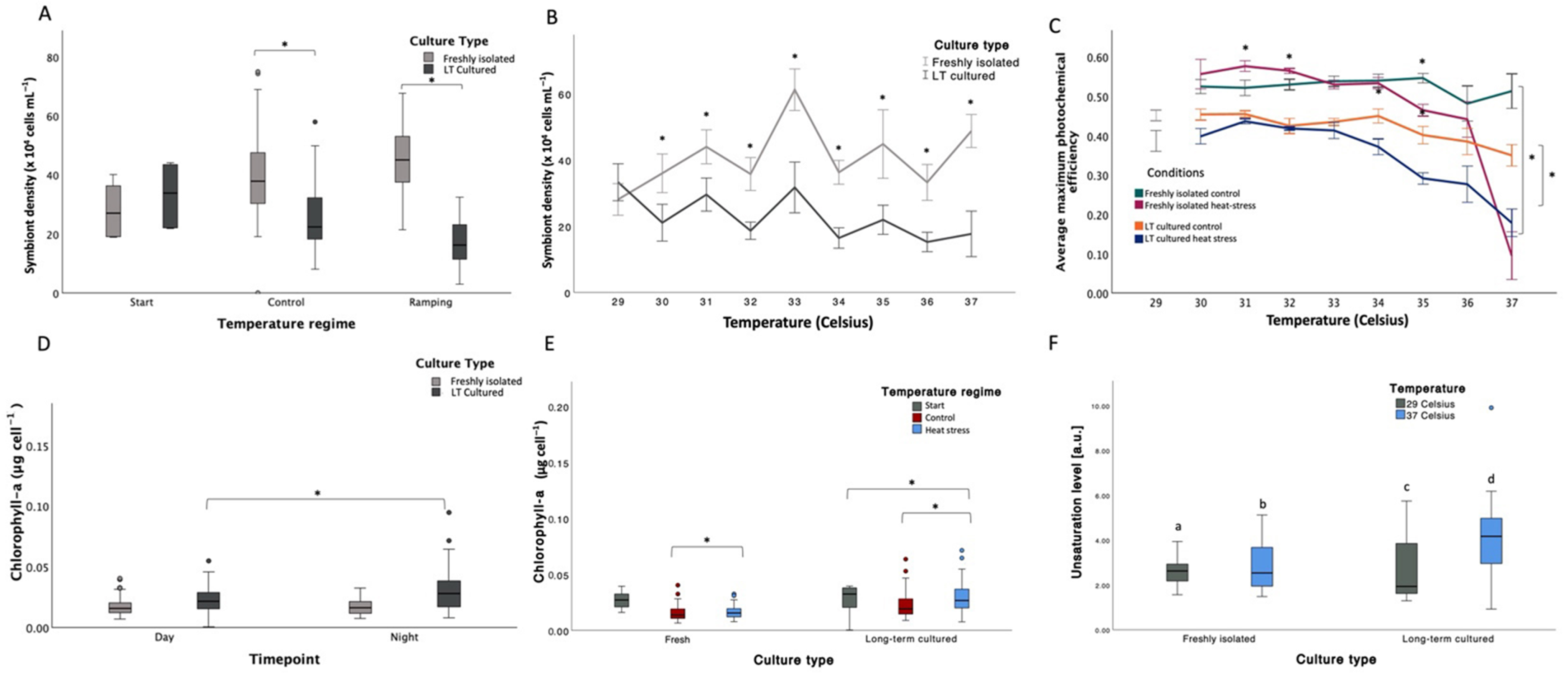
Symbiodinium A1 density significantly varied with temperature, temperature regime, and culture type (LMMs; AR(1), Sqrt, Temperature: p < 0.001, df = 7, Denominator df = 28.030, F = 19.665; Temperature regime: p < 0.001; Culture type: p < 0.001, df = 1, Denominator df = 54.388, F = 138.814; Tables S22–S25). “Freshly isolated” cultures generally exhibited higher symbiont density compared to “long-term cultured” ones under both temperature regimes (41.60 ± 0.93 × 10⁴ cells mL−1 and 22.19 ± 0.89 × 10⁴ cells mL−1, respectively; Figure 2A,B), with pairwise comparisons indicating significant differences between culture types from 30 to 37 °C (p < 0.05; Table S24), but not at the start of the experiment (29 °C; Table S24). This was likely due to the different growth rates in the two cultures, as “freshly isolated” cultures exhibited two-fold higher growth rates (0.055 ± 0.039 µ day−1) than “long-term cultured” (0.029 ± 0.030 µ day−1) Symbiodinium A1 in the pre-experimental phase. Similarly, during the thermal stress experiment, growth rates were negative in “long-term cultured” symbionts (−2.25 ± 0.38 and −0.99 ± 0.57 µ day−1 under thermal stress and control conditions, respectively) and positive in “freshly isolated” cultures (0.87 ± 0.78 and 1.68 ± 0.60 µ day−1 under thermal stress and control conditions, respectively).
Figure 2. Variations in productivity-related responses of Symbiodinium during a thermal stress experiment (non-transformed data). (A) Symbiont density (cells × 104 mL−1) plotted by temperature regime and culture type (“freshly isolated” in gray and “long-term cultured” in dark gray; see Table S23 for statistical details). (B) Symbiont density (cells × 104 mL−1) plotted by temperature and culture type (“freshly isolated” in white and “long-term cultured” in black; see Table S24 for statistical details). (C) Maximum photochemical efficiency (Fv/Fm) plotted by temperature and condition (dark green: “freshly isolated” control; purple: “freshly isolated” under heat stress; brown: “long-term cultured” control; dark blue: “long-term cultured” under heat stress). (D) Chlorophyll (µg cell−1) plotted by timepoint and culture type (“freshly isolated” in gray and “long-term cultured” in dark gray). (E) Chlorophyll (µg cell−1) plotted by culture type (“freshly isolated” and “long-term cultured”) and temperature regime (start in green, control in red, heat stress in dark blue). (F) Unsaturation levels (a.u.) of thylakoid membrane lipids plotted by culture type (“freshly isolated” and “long-term cultured”) and temperature (29 °C in gray and 37 °C in blue). Different letters indicate significant pairwise differences (post hoc tests, p < 0.05). In all panels, whiskers indicate the full range (minimum to maximum), boxes represent the interquartile range, and the horizontal line indicates the median. In all graphs, “long-term cultured” is abbreviated as “LT cultured” to shorten labels. Significant differences identified on transformed data are indicated by asterisks (*, p < 0.05); asterisks represent pairwise comparisons between culture types within temperature regimes (panel (A); Table S23) or at individual temperatures (panel (B); Table S24). In panels where responses are plotted against temperature, control cultures were maintained at a constant temperature of 29 °C throughout the experiment, and temperatures shown on the x-axis represent the conditions experienced by ramping samples on specific days; thus, control cultures remained at 29 °C despite the temperature values shown for ramping treatments.
Maximum photochemical efficiency (Fv/Fm) significantly differed among temperatures, temperature regimes, and culture types (LMMs; CS, non-transformed, Temperature: p < 0.001; Temperature regime: p < 0.001; Culture type: p < 0.001; Tables S22 and S26–S28; Figure S10). Maximum Fv/Fm levels were initially consistent across “freshly isolated” and “long-term cultured” cultures under control and heat stress conditions, with differences emerging as temperature increased (Figure 2C,D). “Freshly isolated” symbionts maintained higher maximum Fv/Fm under heat stress than “long-term cultured” (0.515 ± 0.007 and 0.401 ± 0.007, respectively), although pairwise differences between culture types were temperature-dependent (Table S28). However, at the highest temperature tested (37 °C), maximum Fv/Fm was entirely disrupted in both culture types under the heat stress regime (0.28 ± 0.04; Figure 2C), reflecting a strong negative effect of thermal stress (pairwise control vs. heat stress at 37 °C: p < 0.001; Table S28). Temperature effects on maximum Fv/Fm varied with the temperature regime, with control samples exhibiting higher maximum Fv/Fm compared to those under heat stress conditions (Figure S10B).
Chlorophyll-a concentration was significantly affected by temperature, temperature regime, and their interaction, while no main effect of culture type was detected (LMMs; AR(1) heterogeneous, Ln, Temperature: p < 0.001; Temperature regime: p < 0.001; Temperature × Temperature regime: p < 0.001; Culture type: p > 0.05; Tables S29–S32; Figure S11, Figure 2D). “Freshly isolated” cultures exhibited higher chlorophyll-a concentrations under control conditions than under heat stress (0.0200 ± 0.0017 and 0.0200 ± 0.0014 µg cell−1, respectively). In contrast, “long-term cultured” symbionts showed higher chlorophyll-a concentrations under heat stress compared to control conditions (0.0284 ± 0.0032 and 0.0185 ± 0.0012 µg cell−1, respectively; Figure 2E). Despite these contrasting trends, no significant differences between culture types were detected.
Production rates (µmol O2 cell−1 h−1) were significantly influenced by temperature in a timepoint-dependent manner, with a significant timepoint × temperature interaction detected only at the start of the experiment (LMMs; AR(1), non-transformed, Timepoint: p < 0.001; Temperature × Timepoint: p < 0.001; Tables S29 and S33). No significant temperature effects were observed at later timepoints. These responses were consistent across culture types, with no significant culture-type-specific effects detected (p > 0.05). Lipid thylakoid membrane unsaturation increased significantly with temperature and differed between culture types (Table S34). “Long-term cultured” symbionts exhibited a more pronounced increase under heat stress (from 2.77 ± 0.38 at 29 °C to 3.77 ± 0.46 a.u. at 37 °C) compared to “freshly isolated” cultures (from 2.67 ± 0.06 at 29 °C to 2.77 ± 0.29 a.u. at 37 °C; Figure 2F).

3.3. Metabolic Responses

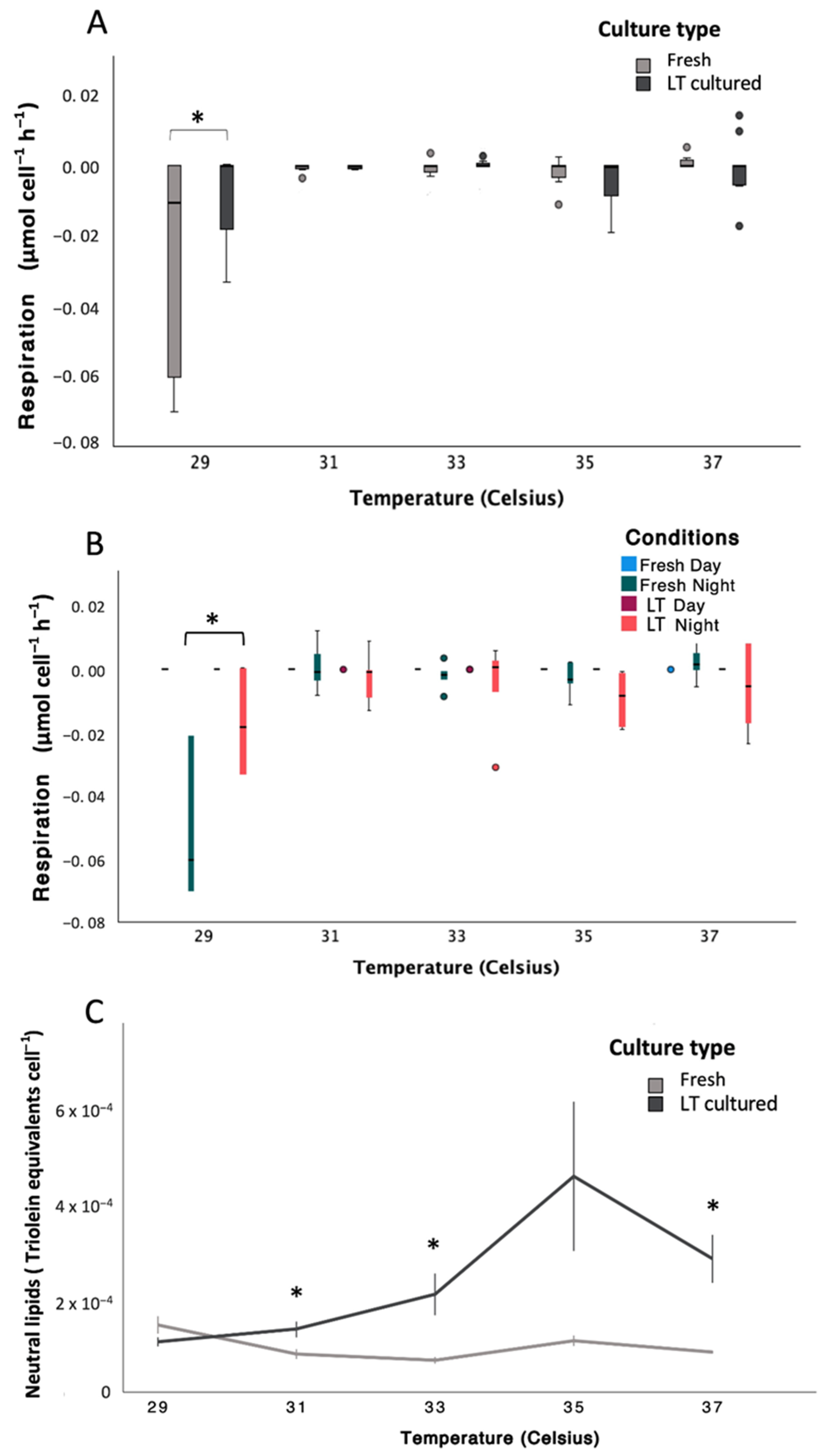
Respiration rates were significantly affected by timepoint and temperature, with addi-tional temperature-dependent differences between culture types (LMMs; AR(1), non-transformed Timepoint: p < 0.001, df = 1, Denominator df = 32.91, F = 24.04; Tem-perature: p < 0.001, df = 4, Denominator df = 49.64, F = 13.03; Timepoint × Temperature: p < 0.001, df = 4, Denominator df = 59.13, F = 13.01; Temperature × Culture type: p < 0.001, df = 4, Denominator df = 69.23, F = 5.56; Tables S35–S38). Respiration rates differed between “freshly isolated” and “long-term cultured” cultures at 29 °C (−0.0084 ± 0.0135 and −0.0253 ± 0.0307 µmol O2 cell−1 h−1, respectively), while values converged at higher temperatures (−0.0016 ± 0.0064 µmol O2 cell−1 h−1; Figure 3A). Pairwise comparisons confirmed a significant difference between culture types at 29 °C (p < 0.001), whereas no significant differences were detected at subsequent temperatures. Night respiration rates followed a similar pattern (Figure 3B), with significant day–night differences at 29 °C (p < 0.001), but not at higher temperatures. Accordingly, differences in respiration rates between “freshly isolated” and “long-term cultured” symbionts were restricted to pre-stress conditions and disappeared once thermal stress progressed (Figure S12).
Figure 3. Variations in metabolic and energy storage responses of Symbiodinium during a thermal stress experiment (non-transformed data). (A) Respiration (µmol cell−1 h−1) plotted by temperature and culture type (“freshly isolated” in white and “long-term cultured” in black; see Tables S35 and S36 for statistical details). (B) Respiration (µmol cell−1 h−1) plotted by temperature and conditions (“freshly isolated” Day in light blue, “freshly isolated” Night in dark blue, “long-term cultured” Day in dark red, and “long-term cultured” Night in red; see Tables S35 and S38 for statistical details). (C) Neutral lipid content (triolein equivalents cell−1) plotted by temperature and culture type (“freshly isolated” in white and “long-term cultured” in black; see Tables S41 and S42 for statistical details). In all panels, whiskers indicate the full range (minimum to maximum), boxes represent the inter-quartile range, and the horizontal line indicates the median. In all graphs, “long-term cultured” is abbreviated as “LT cultured” to shorten labels. Significant differences identified on transformed data are indicated by asterisks (*, p < 0.05). In panels where responses are plotted against temperature, control cultures were maintained at a constant temperature of 29 °C throughout the experiment, and temperatures shown on the x-axis represent the conditions experienced by ramping samples on specific days; thus, control cultures remained at 29 °C despite the temperature values shown for ramping treatments.
Lactate production varied significantly with timepoint, culture type, and temperature regime (LMMs; AR(1), Ln, Timepoint: p = 0.011, df = 1, Denominator df = 73.66, F = 6.88; Culture type: p = 0.001, df = 1, Denominator df = 61.35, F = 11.36; Temperature regime: p = 0.033, df = 1, Denominator df = 54.45, F = 4.78; Table S35), with temperature-related patterns primarily driven by interactions involving timepoint (Timepoint × Temperature: p < 0.001, df = 7, Denominator df = 93.28, F = 4.48; Timepoint × Culture type: p = 0.044, df = 1, Denominator df = 75.35, F = 4.19; Timepoint × Temperature × Temperature regime: p = 0.007, df = 7, Denominator df = 92.79, F = 2.99). Under heat stress, significant day–night differences in lactate production were observed at 30 °C and 32 °C, while at 36 °C, day–night differences were detected under both control and heat-stress regimes (Tables S39 and S40; Figure S13).

3.4. Energy Storage Responses

Changes in neutral lipid content (triolein equivalents cell−1) were significantly influenced by temperature and culture type, with a significant temperature × culture type interaction (LMMs; AR(1) heterogeneous, Ln, Temperature: p = 0.003, df = 4, Denominator df = 17.189, F = 6.373; Culture type: p < 0.001, df = 1, Denominator df = 14.150, F = 57.610; Temperature × Culture type: p < 0.001, df = 4, Denominator df = 16.685, F = 13.167; Tables S41 and S42). Temperature regime did not significantly affect neutral lipid content (p = 0.091, df = 1, Denominator df = 12.494, F = 3.360; Table S41). Neutral lipid content in “freshly isolated” cultures remained relatively constant across temperatures (0.96 × 10⁻⁴ ± 0.067 × 10⁻⁴ triolein equivalents cell−1), whereas “long-term cultured” symbionts exhibited a pronounced temperature-dependent increase, rising from 1.0 × 10⁻⁴ ± 0.015 × 10⁻⁴ at 29 °C to 2.8 × 10⁻⁴ ± 0.05 × 10⁻⁴ triolein equivalents cell−1 at 37 °C (Figure 3C).

4. Discussion

Our study highlights the differential thermal performance of “freshly isolated” and “long-term cultured” Symbiodnium A1. This is consistent with previous results on a different stressor type (i.e., oxidative stress), which showed that “freshly isolated” and “long-term cultured” Symbiodinium have differential responses, with the “freshly isolated” ones being more stress-tolerant [60]. In our study, “freshly isolated” symbionts showed higher photochemical efficiency and symbiont density within the tested temperature range, whereas “long-term cultured” symbionts exhibited increased neutral lipid accumulation with rising temperatures, consistent with stress-induced metabolic reallocation and altered carbon partitioning. This confirms that “freshly isolated” Symbiodinium tend to be more stress-tolerant than “long-term cultured”. By using isogenic Symbiodinium A1 derived from the same host species and location, and by integrating photophysiological, metabolic, biochemical, and energy storage metrics, our experimental design isolates the effects of culture history and provides a holistic framework for interpreting symbiont stress responses within the broader context of coral bleaching physiology.
Furthermore, in this study, we also observed significant deviations in pH, dO2, and dCO2 in the culture environment from in hospite conditions (see data in [61]), confirming the hypothesis that in vitro (i.e., cultured in artificial settings) conditions are not representative of in hospite conditions [38,43,62]. Hence, Symbidinium cells maintained in culture for multiple generations, as the long-term cultured ones in our experiment, may adapt to these conditions and progressively depart from the performance of freshly isolated cells. These findings are consistent with previous investigations about circadian rhythm in Stylophora pistillata, which measured O2 in hospite and in vitro [63,64]. Hence, controlling symbiont culture environments is essential to closely mimic in hospite conditions and to consider this factor when planning experiments.
Limited research has investigated the differentiating attributes of “freshly isolated” and “long-term cultured” Symbiodiniaceae, encompassing properties such as theca [40], protein profiles [41,65], metabolic modulation [42], energy storage [39] (Wang et al., 2015), morphology [65], and genetic traits [66]. However, even scarcer attention has been dedicated to comprehending their differences in responses to environmental stressors (e.g., thylakoid thermostability; [67] or thermal tolerance; [60]). In our study, differences in the responses of “freshly isolated” and “long-term cultured” symbionts to heat stress manifested in their divergent O2, pH, and pCO2 trends, besides other physiological effects. Notably, when temperatures reached 36–37 °C, both cultures witnessed marked declines in O2 and pH levels, albeit more pronounced in “freshly isolated” samples. Below this thermal threshold, “freshly isolated” symbionts exhibited slightly, but not significantly, higher oxygen production. Conversely, pCO2 levels exhibited an increase within the same temperature range, with “freshly isolated” Symbiodinium showing higher pCO2 at 37 °C than “long-term cultured”. These trends in O2 levels were mirrored by Fv/Fm patterns. In fact, “freshly isolated” Symbiodinium exhibited a higher Fv/Fm under heat stress than their “long-term cultured” counterparts. When the temperature reached the highest level tested (37 °C), Fv/Fm halved in both culture types. A comparative analysis involving “cultured” and freshly isolated Symbiodinium from sea anemones indicated that Fv/Fm remained unaltered by thermal stress in freshly isolated symbionts, contrary to a significant reduction observed in “cultured” counterparts [60], consistent with our results. In the pre-experimental phase, we also noted higher symbiont growth rates in “freshly isolated” cells than in “long-term cultured” counterparts, a finding contrary to previous studies [68,69], and an overall higher symbiont density was observed during the ramping experiment, regardless of the temperature regime. This stems from “freshly isolated” Symbiodinium exhibiting positive growth rates, whereas their “long-term cultured” counterparts showed negative growth rates. This difference might partially explain the above-described patterns.
Both “freshly isolated” and “long-term cultured” Symbiodinium exhibited consistent chlorophyll-a concentration and production rates under the applied thermal stress. Thylakoid unsaturation state, assessed only in symbionts subjected to heat stress at 29 and 37 °C, exhibited different patterns in the two cultures, showing a striking increase, particularly in “long-term cultured” Symbiodinium. The thylakoid membrane lipid composition has been suggested as a diagnostic factor for coral bleaching, with a focus on unsaturation regulation [70]. Previous studies showed that elevated temperatures induce shifts in membrane saturation, reducing lipid unsaturation for greater rigidity [71]. Such changes have been shown to enhance PSII activity under thermal stress in specific species (e.g., Chlamydomonas reinhardtii and Arabidopsis thaliana; [72,73]). However, our investigation revealed an overall increase in thylakoid membrane unsaturation state under heat stress, more pronounced in “long-term cultured” Symbiodinium. This result aligns with prior research demonstrating high variability in thylakoid lipid responses to thermal stress, including increases in unsaturation under short-term heat exposure [74]. Importantly, changes in lipid unsaturation may reflect both regulated membrane remodeling and stress-related processes, such as oxidative damage and lipid peroxidation, rather than a purely adaptive response. This dual interpretation further emphasizes the limited reliability of thylakoid lipid unsaturation as a standalone indicator of photosystem efficiency in Symbiodiniaceae exposed to heat stress [74].
Thermal stress affected the metabolism of the symbionts, resulting in differences in respiration rates between “freshly isolated” and “long-term cultured” symbionts only at 29 °C. This outcome aligns with the observations by [75] who documented distinct oxygen fluxes between in hospite (Aiptasia pulchella) and freshly isolated symbionts. Consequently, the “freshly isolated” symbionts may maintain different physiological statuses in comparison to “long-term cultured” counterparts. As thermal stress commences, these differences attenuate.
As a result of a combination of a decrease in Fv/Fm and disruption of oxygen production, a shift in metabolism was expected and confirmed lipid bodies accumulation in “long-term” cultured symbionts. Such accumulation of neutral lipids (e.g., triacylglycerols stored in lipid droplets) has been widely reported as a cellular response to environmental stress in Symbiodiniaceae and other microalgae, reflecting stress-induced metabolic reallocation and energy storage strategies rather than direct evidence of classic anaerobic energy metabolism [76]. This finding indicates a shift from aerobic to anaerobic energy production under thermal stress [76]. Variations in symbiont nutrient uptake under diverse temperatures have been documented [77] and might be explained by the fact that nutrient acquisition and storage capacity are compromised under thermal stress, leading to lipid droplet (LD) accumulation. This was observed in Nannochloropsis oculata [78] and Symbiodnium [79]. In the latter case, all high-temperature treatments induced neutral lipid (triacylglycerols [TAG]) accumulation in LDs after 5 days of thermal stress (low and high; [79]). Our study confirmed that LDs accumulation in Symbiodinium was similar in the two culture types at control temperature 29 °C, whereas when exposed to thermal stress, LDs accumulation was particularly pronounced in “long-term cultured” symbionts compared to “freshly isolated”.
In the pre-experimental phase, we monitored abiotic conditions in the culture medium to assess how closely in vitro conditions approximate those experienced by symbionts in hospite (Supplementary Materials). Although the “freshly isolated” symbionts used in this study had a substantially shorter culture history than the long-term cultures, they still represent an axenic in vitro system and therefore cannot be considered a true in hospite control. Notably, our comparison shows that in hospite conditions generally exhibit slightly greater environmental extremes than in vitro conditions (Table 1), consistent with previous findings that artificial culturing does not fully replicate host-associated micro-environments [38]. This insight is derived from our use of Symbiodinium A1 isolated from Cassiopea andromeda, the same species and collection area as studied in [61]. Their investigation of the internal microenvironment of Cassiopea sp. oral arms (the symbiont hosting site) provides a basis for comparison with in vitro values (i.e., collected in the pre-experimental phase) in Table 1. This table offers a comprehensive overview of in hospite versus in vitro condition comparisons for symbionts isolated from cnidarian species obtained from the available peer-reviewed literature. Although numerous studies have investigated the modifications that freshly isolated and cultured endosymbionts undergo in artificial conditions, there is limited understanding of the drivers underlying these changes. Variations in ionic conditions and adaptation to a non-intracellular life [43], lack of host-symbiont interactions [62], and differences between in hospite and in vitro conditions might partially drive these changes. Considering the differences shown in Table 1, we postulate that Symbiodiniaceae can rapidly adapt to artificial settings and changes in environmental conditions [21]. The observed changes in sensitivity, as identified in our study and corroborated by [43], can stem from their cultivation in artificial settings that fail to mimic in hospite conditions. Notably, culture in artificial conditions has also been demonstrated to alter gene and protein expression [41]. This phenomenon is likely exacerbated by prolonged artificial cultivation that can facilitate the appearance of spontaneous mutations over a short period of time [25], due to the rapid asexual reproduction in Symbiodiniaceae [44].
Table 1. Comparison of oxygen (mg L−1) and pH levels in hospite and in vitro (i.e., grown in artificial conditions) in several species of Cnidarians.
Although this study focused on a single Symbiodinium clade (A1) isolated from a single host species, this reductionist approach allowed us to isolate the effects of prolonged in vitro culture from host- and clade-specific variability. Our findings, therefore, provide a mechanistic case study illustrating how artificial culturing alone can substantially alter symbiont physiology and stress responses. Extending these comparisons across additional Symbiodiniaceae clades and host taxa will be essential to determine how general these patterns are across coral–symbiont associations. The direction and magnitude of culture-driven physiological drift may differ among thermally tolerant or ubiquitous lineages, and symbionts originating from hosts with different degrees of environmental tolerance and symbiosis regulation, such as Cassiopea, compared to reef-building corals, may respond differently to prolonged in vitro culture, underscoring the need for comparative studies across clades and host types.
An important question arising from our results is whether prolonged in vitro culturing may act as a form of unintentional “domestication”, selecting for traits optimized for stable laboratory conditions while potentially reducing stress resilience relevant in hospite, thereby influencing estimates of symbiont thermal tolerance. Although our experimental design was not intended to test artificial selection, the contrasting responses observed between “freshly isolated” and “long-term cultured” symbionts indicate that prolonged maintenance under in vitro conditions can substantially alter physiological performance and stress responses. Importantly, these changes do not necessarily reflect enhanced thermal tolerance, but rather acclimation or adaptation to artificial culture environments that differ markedly from in hospite conditions. Whether targeted selection under controlled thermal regimes could yield symbiont strains with stable and ecologically relevant heat tolerance remains an open question and warrants dedicated experimental investigation.

5. Conclusions

In conclusion, prudent consideration is advised when using cultured symbionts for experimental studies. Although various factors could contribute to the differences observed between “freshly isolated” and “long-term cultured” symbionts, their distinct responses in this study are primarily attributed to being cultured under artificial conditions and the pre-experiment conditions. Post the inherently stressful isolation process, numerous environmental factors change, encompassing light intensity, temperature regime, O2, pH, and pCO2, potentially underpinning these physiological shifts. Additionally, the ‘long-term cultured’ symbionts were maintained under stable conditions for 2.5 years, which coincides with the threshold for stable phenotypic changes observed in vitro (see [25]). In contrast, ‘freshly isolated’ symbionts, having recently experienced environmental variability prior to artificial culturing, displayed greater resilience in terms of photochemical efficiency and symbiont density stability during thermal stress. Exposure to environmental variability has previously been linked to enhanced organismal performance under thermal stress [80]. Hence, these findings underscore the importance of incorporating environmental variability into laboratory experiments [81]. Consequently, all these factors warrant careful consideration when devising experiments to gauge the impact of climate change on cnidarian holobionts.

Supplementary Materials

The following supporting information can be downloaded at https://www.mdpi.com/article/10.3390/microorganisms14020455/s1. Refs [82,83] are included in Supplementary Materials.

Author Contributions

Conceptualization, C.M.D., S.A. and S.G.K.; methodology, S.A., S.G.K., L.G. and S.P.L.; software, S.A.; validation, S.A., S.G.K. and J.V.A.G.; formal analysis, S.A., S.G.K. and J.V.A.G.; investigation, S.A., S.-H.H., O.R.S., A.S., L.G., S.P.L., J.V.A.G. and N.P.; resources, C.M.D. and S.G.K.; data curation, S.A.; writing—original draft preparation, S.A.; writing—review and editing, all authors; visualization, S.A.; supervision, C.M.D., S.G.K., M.A. and C.L.; project administration, C.M.D. and S.G.K.; funding acquisition, C.M.D., M.A. and C.L. All authors have read and agreed to the published version of the manuscript.

Funding

Financial support for this research was provided by the King Abdullah University of Science and Technology and the Tarek Ahmed Juffali Research Chair on Red Sea Ecology, including the baseline research funds of CD, MA, and CL.

Institutional Review Board Statement

Not applicable.

Data Availability Statement

The original contributions presented in this study are included in the article/Supplementary Material. Further inquiries can be directed to the corresponding author.

Acknowledgments

The authors express their gratitude to the KAUST Coral Labs team for their valuable support and assistance. We also thank Aranda’s lab for donating the Symbiodinium A1 culture isolated in 2018.

Conflicts of Interest

The authors declare no conflicts of interest.

References

  1. LaJeunesse, T.C.; Parkinson, J.E.; Gabrielson, P.W.; Jeong, H.J.; Reimer, J.D.; Voolstra, C.R.; Santos, S.R. Systematic revision of Symbiodiniaceae highlights the antiquity and diversity of coral endosymbionts. Curr. Biol. 2018, 28, 2570–2580. [Google Scholar] [CrossRef]
  2. Muscatine, L.; Porter, J.W. Reef Corals: Mutualistic Symbioses Adapted to Nutrient-Poor Environments. Bioscience 1977, 27, 454–460. [Google Scholar] [CrossRef]
  3. Muscatine, L.; McCloskey, L.R.; Marian, R.E. Estimating the daily contribution of carbon from zooxanthellae to coral animal respiration 1. Limnol. Oceanogr. 1981, 26, 601–611. [Google Scholar] [CrossRef]
  4. Hofmann, D.K.; Kremer, B.P. Carbon metabolism and strobilation in Cassiopea andromedea (Cnidaria: Scyphozoa): Significance of endosymbiotic dinoflagellates. Mar. Biol. 1981, 65, 25–33. [Google Scholar] [CrossRef]
  5. Cui, G.; Konciute, M.K.; Ling, L.; Esau, L.; Raina, J.B.; Han, B.; Salazar, O.R.; Presnell, J.S.; Rädecker, N.; Zhong, H.; et al. Molecular insights into the Darwin paradox of coral reefs from the sea anemone Aiptasia. Sci. Adv. 2023, 9, eadf7108. [Google Scholar] [CrossRef]
  6. Oliver, E.C.; Donat, M.G.; Burrows, M.T.; Moore, P.J.; Smale, D.A.; Alexander, L.V.; Benthuysen, J.A.; Feng, M.; Sen Gupta, A.; Hobday, A.J.; et al. Longer and more frequent marine heatwaves over the past century. Nat. Commun. 2018, 9, 1324. [Google Scholar] [CrossRef]
  7. Frölicher, T.L.; Fischer, E.M.; Gruber, N. Marine heatwaves under global warming. Nature 2018, 560, 360–364. [Google Scholar] [CrossRef] [PubMed]
  8. Collins, M.S.; Bouwer, L.; Cheong, S.-M.; Frölicher, T.; Jacot Des Combes, H.; Koll Roxy, M.; Losada, I.; McInnes, K.; Ratter, B.; Rivera-Arriaga, E.; et al. Extremes, abrupt changes and managing risk. In IPCC Special Report on the Ocean and Cryosphere in a Changing Climate; Cambridge University Press: Cambridge, UK, 2019; pp. 606–611. [Google Scholar]
  9. Warner, M.E.; Fitt, W.K.; Schmidt, G.W. Damage to photosystem II in symbiotic dinoflagellates: A determinant of coral bleaching. Proc. Natl. Acad. Sci. USA 1999, 96, 8007–8012. [Google Scholar] [CrossRef] [PubMed]
  10. Negri, A.P.; Marshall, P.A.; Heyward, A.J. Differing effects of thermal stress on coral fertilization and early embryogenesis in four Indo Pacific species. Coral Reefs 2007, 26, 759–763. [Google Scholar] [CrossRef]
  11. Grottoli, A.G.; Warner, M.E.; Levas, S.J.; Aschaffenburg, M.D.; Schoepf, V.; McGinley, M.; Baumann, J.; Matsui, Y. The cumulative impact of annual coral bleaching can turn some coral species winners into losers. Glob. Change Biol. 2014, 20, 3823–3833. [Google Scholar] [CrossRef] [PubMed]
  12. Hoegh-Guldberg, O.; Mumby, P.J.; Hooten, A.J.; Steneck, R.S.; Greenfield, P.; Gomez, E.; Harvell, C.D.; Sale, P.F.; Edwards, A.J.; Caldeira, K.; et al. Coral reefs under rapid climate change and ocean acidification. Science 2007, 318, 1737–1742. [Google Scholar] [CrossRef]
  13. Wood, R. The ecological evolution of reefs. Annu. Rev. Ecol. Syst. 1998, 29, 179–206. [Google Scholar] [CrossRef]
  14. Kiessling, W. Geologic and biologic controls on the evolution of reefs. Annu. Rev. Ecol. Evol. Syst. 2009, 40, 173–192. [Google Scholar] [CrossRef]
  15. Veron, J.E.N. Corals in Space and Time: The Biogeography and Evolution of the Scleractinia; Cornell University Press: Ithaca, NY, USA, 1995. [Google Scholar]
  16. Simpson, C.; Kiessling, W.; Mewis, H.; Baron-Szabo, R.C.; Müller, J. Evolutionary diversification of reef corals: A comparison of the molecular and fossil records. Evolution 2011, 65, 3274–3284. [Google Scholar] [CrossRef] [PubMed]
  17. Baker, A.C. Flexibility and specificity in coral-algal symbiosis: Diversity, ecology, and biogeography of Symbiodinium. Annu. Rev. Ecol. Evol. Syst. 2003, 34, 661–689. [Google Scholar] [CrossRef]
  18. Rowan, R.; Knowlton, N. Intraspecific diversity and ecological zonation in coral-algal symbiosis. Proc. Natl. Acad. Sci. USA 1995, 92, 2850–2853. [Google Scholar] [CrossRef]
  19. Berkelmans, R.; Van Oppen, M.J. The role of zooxanthellae in the thermal tolerance of corals: A ‘nugget of hope’ for coral reefs in an era of climate change. Proc. R. Soc. B Biol. Sci. 2006, 273, 2305–2312. [Google Scholar] [CrossRef] [PubMed]
  20. LaJeunesse, T.C.; Smith, R.; Walther, M.; Pinzón, J.; Pettay, D.T.; McGinley, M.; Aschaffenburg, M.; Medina-Rosas, P.; Cupul-Magaña, A.L.; Pérez, A.L.; et al. Host–symbiont recombination versus natural selection in the response of coral–dinoflagellate symbioses to environmental disturbance. Proc. R. Soc. B Biol. Sci. 2010, 277, 2925–2934. [Google Scholar] [CrossRef]
  21. Howells, E.J.; Beltran, V.H.; Larsen, N.W.; Bay, L.K.; Willis, B.L.; Van Oppen, M.J.H. Coral thermal tolerance shaped by local adaptation of photosymbionts. Nat. Clim. Change 2011, 2, 116–120. [Google Scholar] [CrossRef]
  22. Ladner, J.T.; Barshis, D.J.; Palumbi, S.R. Protein evolution in two co-occurring types of Symbiodinium: An exploration into the genetic basis of thermal tolerance in Symbiodinium clade D. BMC Evol. Biol. 2012, 12, 217. [Google Scholar] [CrossRef]
  23. Grégoire, V.; Schmacka, F.; Coffroth, M.A.; Karsten, U. Photophysiological and thermal tolerance of various genotypes of the coral endosymbiont Symbiodinium sp. (Dinophyceae). J. Appl. Phycol. 2017, 29, 1893–1905. [Google Scholar] [CrossRef]
  24. Iglesias-Prieto, R.; Matta, J.L.; Robins, W.A.; Trench, R.K. Photosynthetic response to elevated temperature in the symbiotic dinoflagellate Symbiodinium microadriaticum in culture. Proc. Natl. Acad. Sci. USA 1992, 89, 10302–10305. [Google Scholar] [CrossRef]
  25. Chakravarti, L.J.; Beltran, V.H.; van Oppen, M.J. Rapid thermal adaptation in photosymbionts of reef-building corals. Glob. Change Biol. 2017, 23, 4675–4688. [Google Scholar] [CrossRef] [PubMed]
  26. Barshis, D.J.; Ladner, J.T.; Oliver, T.A.; Seneca, F.O.; Traylor-Knowles, N.; Palumbi, S.R. Genomic basis for coral resilience to climate change. Proc. Natl. Acad. Sci. USA 2013, 110, 1387–1392. [Google Scholar] [CrossRef]
  27. Klein, S.G.; Pitt, K.A.; Lucas, C.H.; Hung, S.H.; Schmidt-Roach, S.; Aranda, M.; Duarte, C.M. Night-time temperature reprieves enhance the thermal tolerance of a symbiotic cnidarian. Front. Mar. Sci. 2019, 6, 453, Correction in Front. Mar. Sci. 2019, 6, 705. https://doi.org/10.3389/fmars.2019.00705. [Google Scholar] [CrossRef]
  28. LaJeunesse, T.C. Investigating the biodiversity, ecology, and phylogeny of endosymbiotic dinoflagellates in the genus Symbiodinium using the ITS region: In search of a “species” level marker. J. Phycol. 2001, 37, 866–880. [Google Scholar] [CrossRef]
  29. van Oppen, M.J.; Palstra, F.P.; Piquet, A.M.T.; Miller, D.J. Patterns of coral–dinoflagellate associations in Acropora: Significance of local availability and physiology of Symbiodinium strains and host–symbiont selectivity. Proc. R. Soc. Lond. Ser. B Biol. Sci. 2001, 268, 1759–1767. [Google Scholar] [CrossRef]
  30. Brener-Raffalli, K.; Clerissi, C.; Vidal-Dupiol, J.; Adjeroud, M.; Bonhomme, F.; Pratlong, M.; Aurelle, D.; Mitta, G.; Toulza, E. Thermal regime and host clade, rather than geography, drive Symbiodinium and bacterial assemblages in the scleractinian coral Pocillopora damicornis sensu lato. Microbiome 2018, 6, 39. [Google Scholar] [CrossRef] [PubMed]
  31. Sampayo, E.M.; Ridgway, T.; Bongaerts, P.; Hoegh-Guldberg, O. Bleaching susceptibility and mortality of corals are determined by fine-scale differences in symbiont type. Proc. Natl. Acad. Sci. USA 2008, 105, 10444–10449. [Google Scholar] [CrossRef]
  32. Hawkins, T.; Hagemeyer, J.; Warner, M. Temperature moderates the infectiousness of two conspecific Symbiodinium strains isolated from the same host population. Environ. Microbiol. 2016, 18, 5204–5217. [Google Scholar] [CrossRef]
  33. Manning, M.M.; Gates, R.D. Diversity in populations of free-living Symbiodinium from a Caribbean and Pacific reef. Limnol. Oceanogr. 2008, 53, 1853–1861. [Google Scholar] [CrossRef]
  34. Coffroth, M.A.; Lewis, C.F.; Santos, S.R.; Weaver, J.L. Environmental populations of symbiotic dinoflagellates in the genus Symbiodinium can initiate symbioses with reef cnidarians. Curr. Biol. 2006, 16, R985–R987. [Google Scholar] [CrossRef]
  35. Thornhill, D.J.; Howells, E.J.; Wham, D.C.; Steury, T.D.; Santos, S.R. Population genetics of reef coral endosymbionts (Symbiodinium, Dinophyceae). Mol. Ecol. 2017, 26, 2640–2659. [Google Scholar] [CrossRef]
  36. McLaughlin, J.J.; Zahl, P.A. Axenic Zooxanthellae from Various Invertebrate Hosts. Ann. N. Y. Acad. Sci. 1959, 77, 55–72. [Google Scholar] [CrossRef]
  37. Xiang, T.; Hambleton, E.A.; DeNofrio, J.C.; Pringle, J.R.; Grossman, A.R. Isolation of clonal axenic strains of the symbiotic dinoflagellate Symbiodinium and their growth and host specificity. J. Phycol. 2013, 49, 447–458. [Google Scholar] [CrossRef]
  38. Wang, J.T.; Meng, P.J.; Sampayo, E.; Tang, S.L.; Chen, C.A. Photosystem II breakdown induced by reactive oxygen species in freshly-isolated Symbiodinium from Montipora (Scleractinia; Acroporidae). Mar. Ecol. Prog. Ser. 2011, 422, 51–62. [Google Scholar] [CrossRef]
  39. Wang, L.H.; Chen, H.K.; Jhu, C.S.; Cheng, J.O.; Fang, L.S.; Chen, C.S. Different strategies of energy storage in cultured and freshly isolated Symbiodinium sp. J. Phycol. 2015, 51, 1127–1136. [Google Scholar] [CrossRef]
  40. Loeblich, A.R.; Sherley, J.L. Observations on the theca of the motile phase of free-living and symbiotic isolates of Zooxanthella microadriatica (Freudenthal) comb. nov. J. Mar. Biol. Assoc. U. K. 1979, 59, 195–205. [Google Scholar] [CrossRef]
  41. Stochaj, W.R.; Grossman, A.R. Differences in the protein profiles of cultured and endosymbiotic Symbiodinium sp. (pyrrophyta) from the anemone Aiptasia pallida (anthozoa). J. Phycol. 1997, 33, 44–53. [Google Scholar] [CrossRef]
  42. Peng, S.E.; Chen, C.S.; Song, Y.F.; Huang, H.T.; Jiang, P.L.; Chen, W.N.U.; Fang, L.S.; Lee, Y.C. Assessment of metabolic modulation in free-living versus endosymbiotic Symbiodinium using synchrotron radiation-based infrared microspectroscopy. Biol. Lett. 2012, 8, 434–437. [Google Scholar] [CrossRef]
  43. Goiran, C.; Allemand, D.; Galgani, I. Transient Na+ stress in symbiotic dinoflagellates after isolation from coral-host cells and subsequent immersion in seawater. Mar. Biol. 1997, 129, 581–589. [Google Scholar] [CrossRef]
  44. Wilkerson, F.P.; Kobayashi, D.; Muscatine, L. Mitotic index and size of symbiotic algae in Caribbean reef corals. Coral Reefs 1988, 7, 29–36. [Google Scholar] [CrossRef]
  45. Giomi , F.; Barausse, A.; Duarte, C.M.; Booth, J.; Agusti, S.; Saderne, V.; Anton, A.; Daffonchio, D.; Fusi, M. Superoxygenation protects coastal marine fauna from ocean warming. Sci. Adv. 2019, 5, eaax1814. [Google Scholar] [CrossRef]
  46. Herrera, M.; Klein, S.G.; Schmidt-Roach, S.; Campana, S.; Cziesielski, M.J.; Chen, J.E.; Duarte, C.M.; Aranda, M. Unfamiliar partnerships limit cnidarian holobiont acclimation to warming. Glob. Change Biol. 2020, 26, 5539–5553. [Google Scholar] [CrossRef]
  47. Hume, B.C.; Smith, E.G.; Ziegler, M.; Warrington, H.J.; Burt, J.A.; LaJeunesse, T.C.; Wiedenmann, J.; Voolstra, C.R. SymPortal: A novel analytical framework and platform for coral algal symbiont next-generation sequencing ITS2 profiling. Mol. Ecol. Resour. 2019, 19, 1063–1080. [Google Scholar] [CrossRef]
  48. Yamashita, H.; Suzuki, G.; Hayashibara, T.; Koike, K. Do corals select zooxanthellae by alternative discharge? Mar. Biol. 2011, 158, 87–100. [Google Scholar] [CrossRef]
  49. Saderne, V.; Baldry, K.; Anton, A.; Agusti, S.; Duarte, C.M. Characterization of the CO2 system in a coral reef, a seagrass meadow, and a mangrove forest in the central Red Sea. J. Geophys. Res. Ocean. 2019, 124, 7513–7528. [Google Scholar] [CrossRef]
  50. Safaie, A.; Silbiger, N.J.; McClanahan, T.R.; Pawlak, G.; Barshis, D.J.; Hench, J.L.; Rogers, J.S.; Williams, G.J.; Davis, K.A. High frequency temperature variability reduces the risk of coral bleaching. Nat. Commun. 2018, 9, 1671, Correction in Nat. Commun. 2018, 9, 2244. https://doi.org/10.1038/s41467-018-04741-4. [Google Scholar] [CrossRef]
  51. Voolstra, C.R.; Buitrago-López, C.; Perna, G.; Cárdenas, A.; Hume, B.C.; Rädecker, N.; Barshis, D.J. Standardized short-term acute heat stress assays resolve historical differences in coral thermotolerance across microhabitat reef sites. Glob. Change Biol. 2020, 26, 4328–4343. [Google Scholar] [CrossRef] [PubMed]
  52. Weiler, C.S.; Eppley, R.W. Temporal pattern of division in the dinoflagellate genus Ceratium and its application to the determination of growth rate. J. Exp. Mar. Biol. Ecol. 1979, 39, 1–24. [Google Scholar] [CrossRef]
  53. Ritchie, R.J. Consistent sets of spectrophotometric chlorophyll equations for acetone, methanol and ethanol solvents. Photosynth. Res. 2006, 89, 27–41. [Google Scholar] [CrossRef] [PubMed]
  54. Laptenok, S.P.; Rajamanickam, V.P.; Genchi, L.; Monfort, T.; Lee, Y.; Patel, I.I.; Bertoncini, A.; Liberale, C. Fingerprint-to-CH stretch continuously tunable high spectral resolution stimulated Raman scattering microscope. J. Biophotonics 2019, 12, e201900028. [Google Scholar] [CrossRef]
  55. Chen, W.; Zhang, C.; Song, L.; Sommerfeld, M.; Hu, Q. A high throughput Nile red method for quantitative measurement of neutral lipids in microalgae. J. Microbiol. Methods 2009, 77, 41–47. [Google Scholar] [CrossRef]
  56. Bertozzini, E.; Galluzzi, L.; Penna, A.; Magnani, M. Application of the standard addition method for the absolute quantification of neutral lipids in microalgae using Nile red. J. Microbiol. Methods 2011, 87, 17–23. [Google Scholar] [CrossRef]
  57. Luo, Y.J.; Wang, L.H.; Chen, W.N.U.; Peng, S.E.; Tzen, J.T.C.; Hsiao, Y.Y.; Huang, H.J.; Fang, L.S.; Chen, C.S. Ratiometric imaging of gastrodermal lipid bodies in coral–dinoflagellate endosymbiosis. Coral Reefs 2009, 28, 289–301. [Google Scholar] [CrossRef]
  58. Shapiro, S.S.; Wilk, M.B. An analysis of variance test for normality (complete samples). Biometrika 1965, 52, 591–611. [Google Scholar] [CrossRef]
  59. Razali, N.M.; Wah, Y.B. Power comparisons of Shapiro-Wilk, Kolmogorov-Smirnov, Lilliefors and Anderson-Darling tests. J. Stat. Model. Anal. 2011, 2, 21–33. [Google Scholar]
  60. Wietheger, A.; Fisher, P.L.; Gould, K.S.; Davy, S.K. Sensitivity to oxidative stress is not a definite predictor of thermal sensitivity in symbiotic dinoflagellates. Mar. Biol. 2015, 162, 2067–2077. [Google Scholar] [CrossRef]
  61. Arossa, S.; Barozzi, A.; Callegari, M.; Klein, S.G.; Parry, A.J.; Hung, S.H.; Steckbauer, A.; Aranda, M.; Daffonchio, D.; Duarte, C.M. The internal microenvironment of the symbiotic jellyfish Cassiopea sp. from the Red Sea. Front. Mar. Sci. 2021, 8, 705915. [Google Scholar] [CrossRef]
  62. Sutton, D.C.; Hoegh-Guldberg, O. Host-zooxanthella interactions in four temperate marine invertebrate symbioses: Assessment of effect of host extracts on symbionts. Biol. Bull. 1990, 178, 175–186. [Google Scholar] [CrossRef]
  63. Sorek, M.; Levy, O. The effect of temperature compensation on the circadian rhythmicity of photosynthesis in Symbiodinium, coral-symbiotic alga. Sci. Rep. 2012, 2, 536. [Google Scholar] [CrossRef]
  64. Sorek, M.; Yacobi, Y.Z.; Roopin, M.; Berman-Frank, I.; Levy, O. Photosynthetic circadian rhythmicity patterns of Symbiodinium, the coral endosymbiotic algae. Proc. R. Soc. B Biol. Sci. 2013, 280, 20122942, Correction in Proc. Biol. Sci. 2013, 280, 20131012. https://doi.org/10.1098/rspb.2013.1012. [Google Scholar] [CrossRef]
  65. Pasaribu, B.; Weng, L.C.; Lin, I.P.; Camargo, E.; Tzen, J.T.; Tsai, C.H.; Ho, S.L.; Lin, M.R.; Wang, L.H.; Chen, C.S.; et al. Morphological variability and distinct protein profiles of cultured and endosymbiotic Symbiodinium cells isolated from Exaiptasia pulchella. Sci. Rep. 2015, 5, 15353. [Google Scholar] [CrossRef]
  66. Santos, S.R.; Taylor, D.J.; Coffroth, M.A. Genetic comparisons of freshly isolated versus cultured symbiotic dinoflagellates: Implications for extrapolating to the intact symbiosis. J. Phycol. 2001, 37, 900–912. [Google Scholar] [CrossRef]
  67. Hill, R.; Ulstrup, K.E.; Ralph, P.J. Temperature-induced changes in thylakoid membrane thermostability of cultured, freshly isolated, and expelled zooxanthellae from scleractinian corals. Bull. Mar. Sci. 2009, 85, 223–244. [Google Scholar]
  68. Taylor, F.J. Symbionticism revisited: A discussion of the evolutionary impact of intracellular symbioses. Proc. R. Soc. Lond. Ser. B Biol. Sci. 1979, 204, 267–286. [Google Scholar] [CrossRef]
  69. Falkowski, P.G.; Dubinsky, Z.; Muscatine, L.; Porter, J.W. Light and the bioenergetics of a symbiotic coral [Symbiodinium microadriaticum, zooxanthellae, dinoflagellates]. BioScience 1984, 34, 661–689. [Google Scholar] [CrossRef]
  70. Tchernov, D.; Gorbunov, M.Y.; de Vargas, C.; Narayan Yadav, S.; Milligan, A.J.; Häggblom, M.; Falkowski, P.G. Membrane lipids of symbiotic algae are diagnostic of sensitivity to thermal bleaching in corals. Proc. Natl. Acad. Sci. USA 2004, 101, 13531–13535. [Google Scholar] [CrossRef]
  71. Raison, J.K.; Roberts, J.K.; Berry, J.A. Correlations between the thermal stability of chloroplast (thylakoid) membranes and the composition and fluidity of their polar lipids upon acclimation of the higher plant, Nerium oleander, to growth temperature. Biochim. Biophys. Acta (BBA)-Biomembr. 1982, 688, 218–228. [Google Scholar] [CrossRef]
  72. Sato, N.; Sonoike, K.; Kawaguchi, A.; Tsuzuki, M. Contribution of lowered unsaturation levels of chloroplast lipids to high temperature tolerance of photosynthesis in Chlamydomonas reinhardtii. J. Photochem. Photobiol. B Biol. 1996, 36, 333–337. [Google Scholar] [CrossRef]
  73. Hugly, S.; Kunst, L.; Browse, J.; Somerville, C. Enhanced thermal tolerance of photosynthesis and altered chloroplast ultrastructure in a mutant of Arabidopsis deficient in lipid desaturation. Plant Physiol. 1989, 90, 1134–1142. [Google Scholar] [CrossRef]
  74. Oakley, C.A.; Pontasch, S.; Fisher, P.L.; Wilkinson, S.P.; Keyzers, R.A.; Krueger, T.; Dove, S.; Hoegh-Guldberg, O.; Leggat, W.; Davy, S.K. Thylakoid fatty acid composition and response to short-term cold and heat stress in high-latitude Symbiodiniaceae. Coral Reefs 2022, 41, 343–353. [Google Scholar] [CrossRef]
  75. Muller-Parker, G. Photosynthesis-irradiance responses and photosynthetic periodicity in the sea anemone Aiptasia pulchella and its zooxanthellae. Mar. Biol. 1984, 82, 225–232. [Google Scholar] [CrossRef]
  76. La Motta, L.M.; Padula, M.P.; Sommer, B.; Camp, E.F.; Matthews, J.L. Diversity of lipid profiles of Symbiodiniaceae under temperature and nutrient stress. Front. Protistol. 2024, 2, 1320353. [Google Scholar] [CrossRef]
  77. Baker, D.M.; Andras, J.P.; Jordán-Garza, A.G.; Fogel, M.L. Nitrate competition in a coral symbiosis varies with temperature among Symbiodinium clades. ISME J. 2013, 7, 1248–1251. [Google Scholar] [CrossRef]
  78. Converti, A.; Casazza, A.A.; Ortiz, E.Y.; Perego, P.; Del Borghi, M. Effect of temperature and nitrogen concentration on the growth and lipid content of Nannochloropsis oculata and Chlorella vulgaris for biodiesel production. Chem. Eng. Process. Process Intensif. 2009, 48, 1146–1151. [Google Scholar] [CrossRef]
  79. Pasaribu, B.; Li, Y.S.; Kuo, P.C.; Lin, I.P.; Tew, K.S.; Tzen, J.T.; Liao, Y.K.; Chen, C.S.; Jiang, P.L. The effect of temperature and nitrogen deprivation on cell morphology and physiology of Symbiodinium. Oceanologia 2016, 58, 272–278. [Google Scholar] [CrossRef]
  80. Oliver, T.A.; Palumbi, S.R. Do fluctuating temperature environments elevate coral thermal tolerance? Coral Reefs 2011, 30, 429–440. [Google Scholar] [CrossRef]
  81. Ziegler, M.; Anton, A.; Klein, S.G.; Rädecker, N.; Geraldi, N.R.; Schmidt-Roach, S.; Saderne, V.; Mumby, P.J.; Cziesielski, M.J.; Martin, C.; et al. Integrating environmental variability to broaden the research on coral responses to future ocean conditions. Glob. Change Biol. 2021, 27, 5532–5546. [Google Scholar] [CrossRef]
  82. Arossa, S.; Klein, S.G.; Garuglieri, E.; Steckbauer, A.; Parry, A.J.; Alva Garcia, J.V.; Alamoudi, T.; Yang, X.; Hung, S.H.; Salazar, O.R.; et al. Oxygen supersaturation adds resistance to a cnidarian: Symbiodiniaceae holobiont under moderate warming in experimental settings. Front. Mar. Sci. 2024, 11, 1305674. [Google Scholar] [CrossRef]
  83. Roik, A.; Röthig, T.; Roder, C.; Ziegler, M.; Kremb, S.G.; Voolstra, C.R. Year-long monitoring of physico-chemical and biological variables provide a comparative baseline of coral reef functioning in the central Red Sea. PLoS ONE 2016, 11, e0163939. [Google Scholar] [CrossRef]
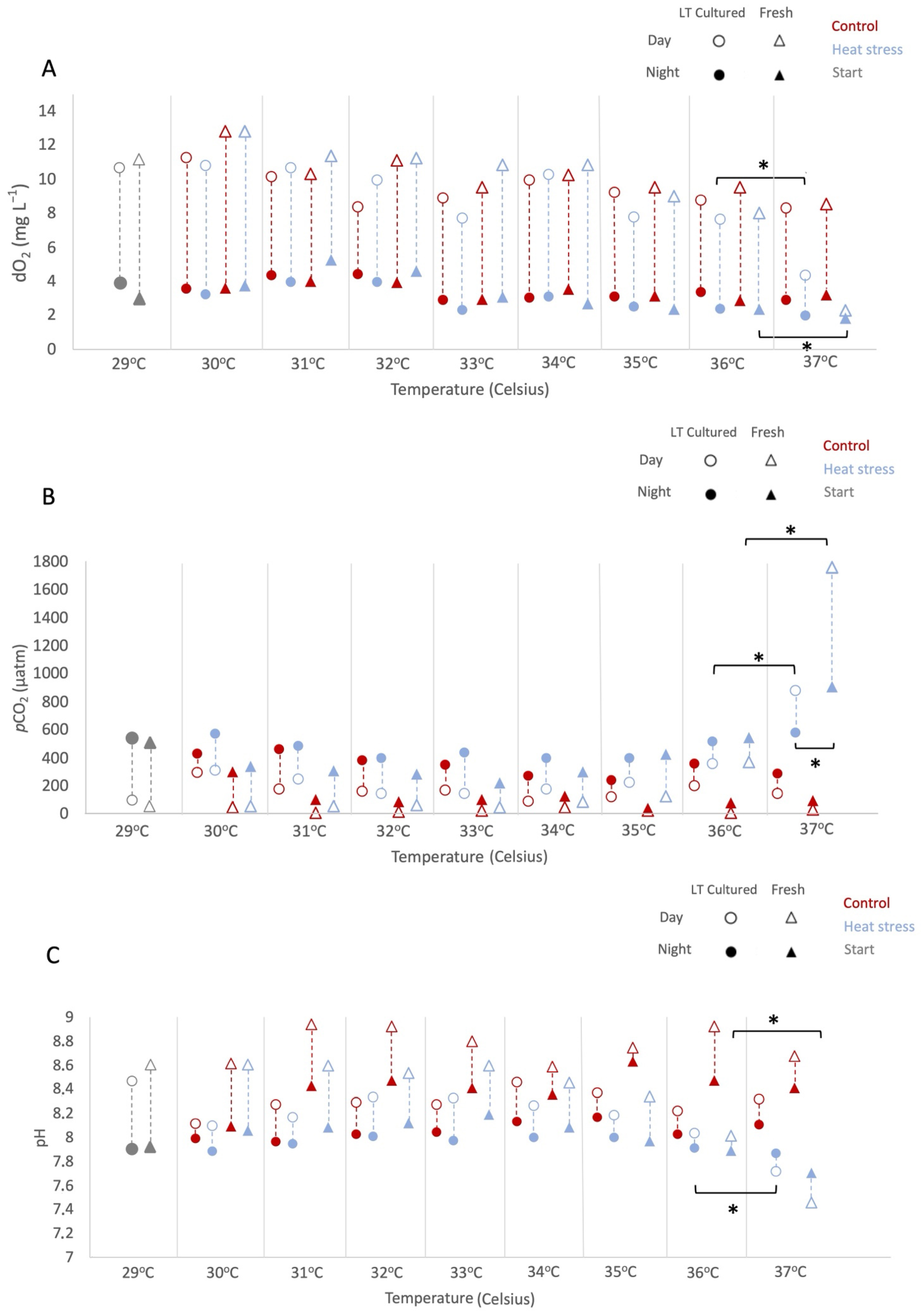
Disclaimer/Publisher’s Note: The statements, opinions and data contained in all publications are solely those of the individual author(s) and contributor(s) and not of MDPI and/or the editor(s). MDPI and/or the editor(s) disclaim responsibility for any injury to people or property resulting from any ideas, methods, instructions or products referred to in the content.

Article Metrics

Citations

Article Access Statistics

Multiple requests from the same IP address are counted as one view.