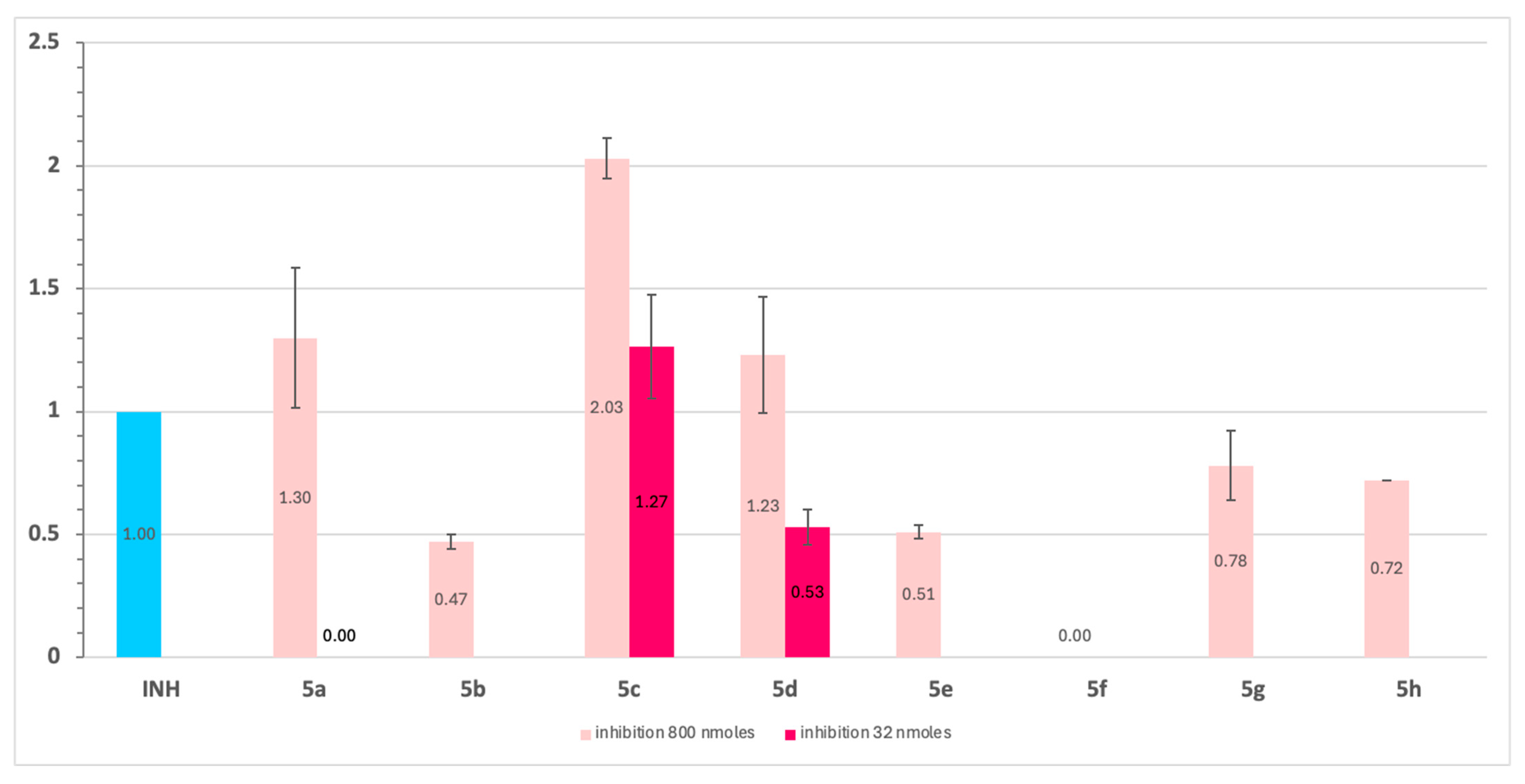
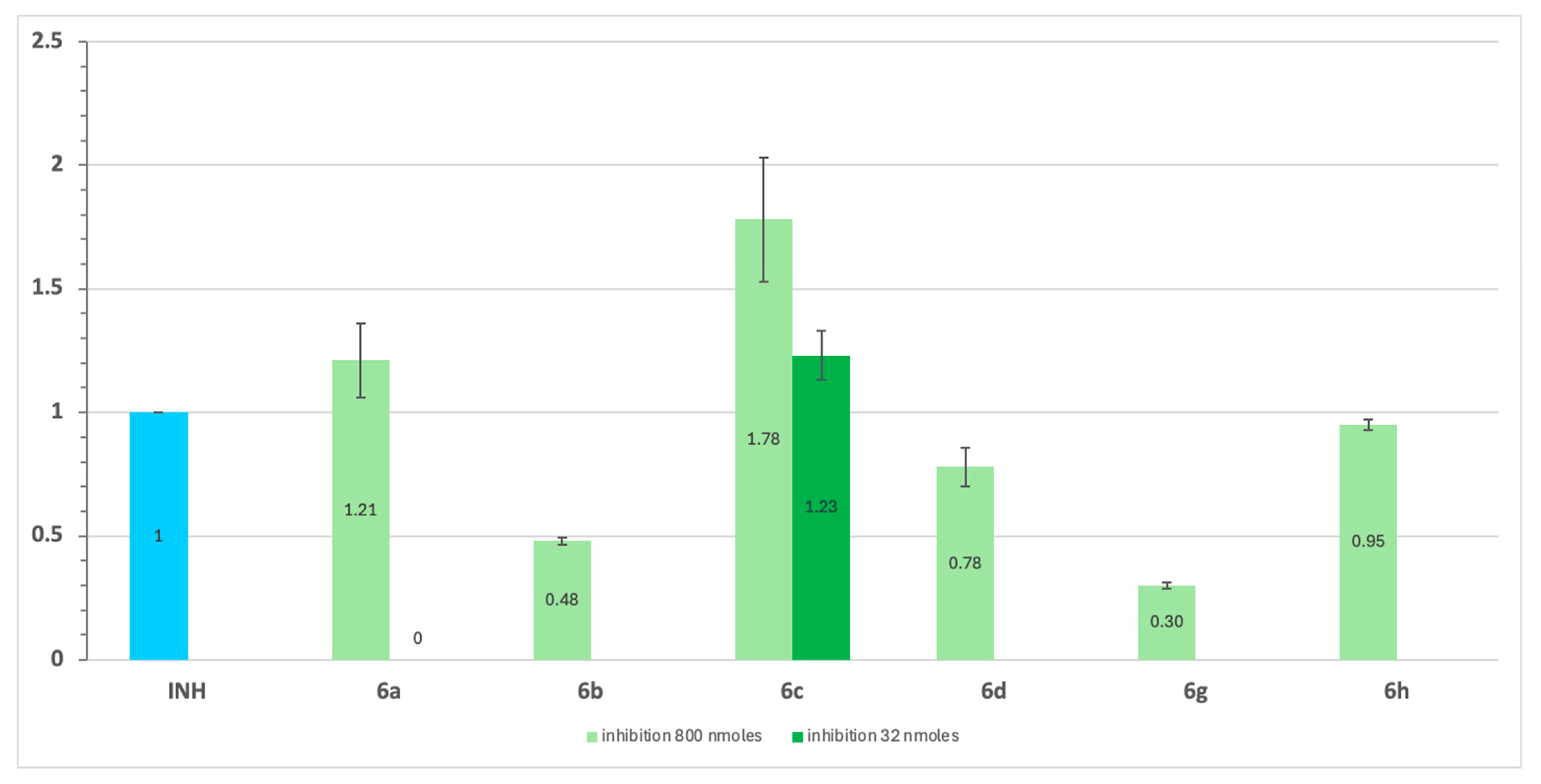
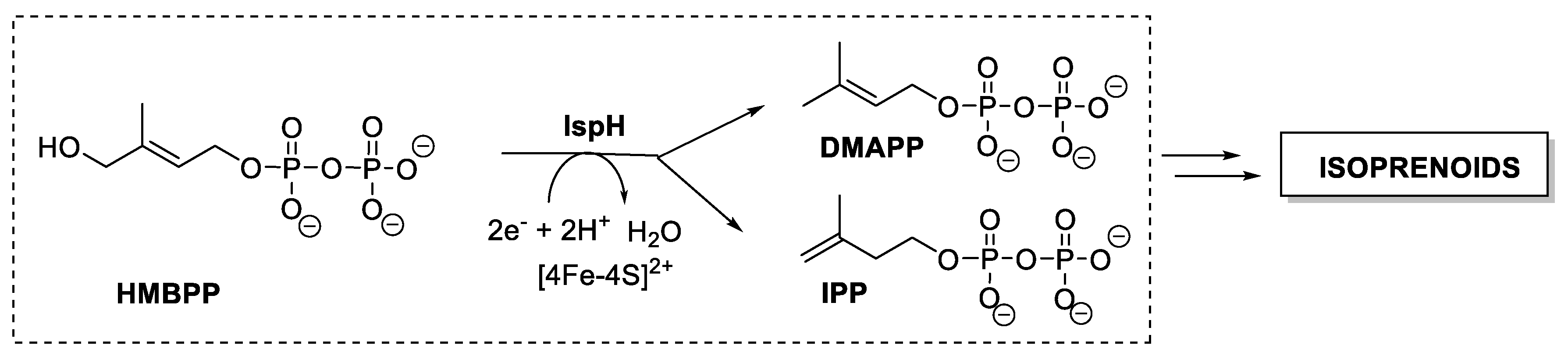
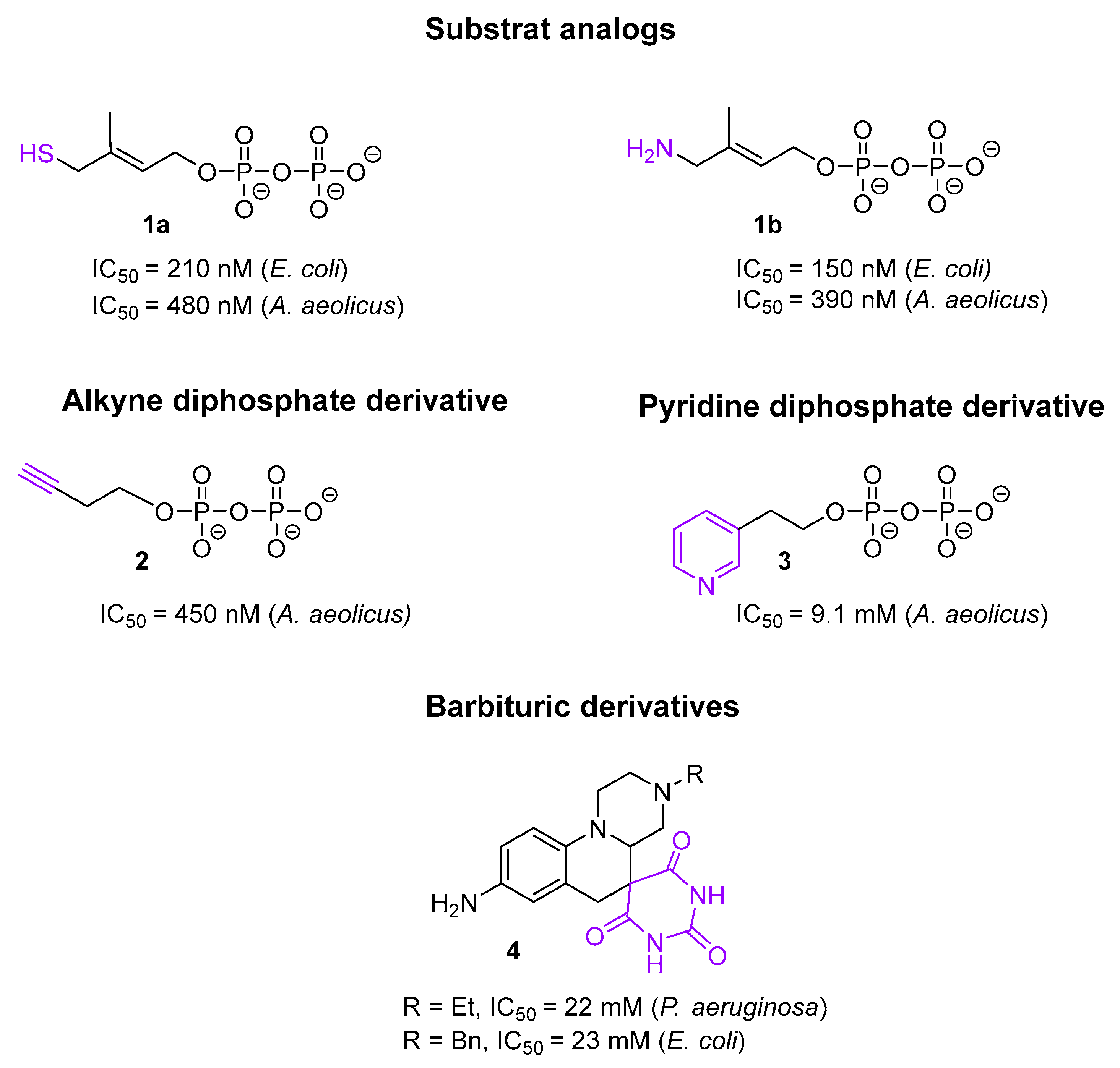
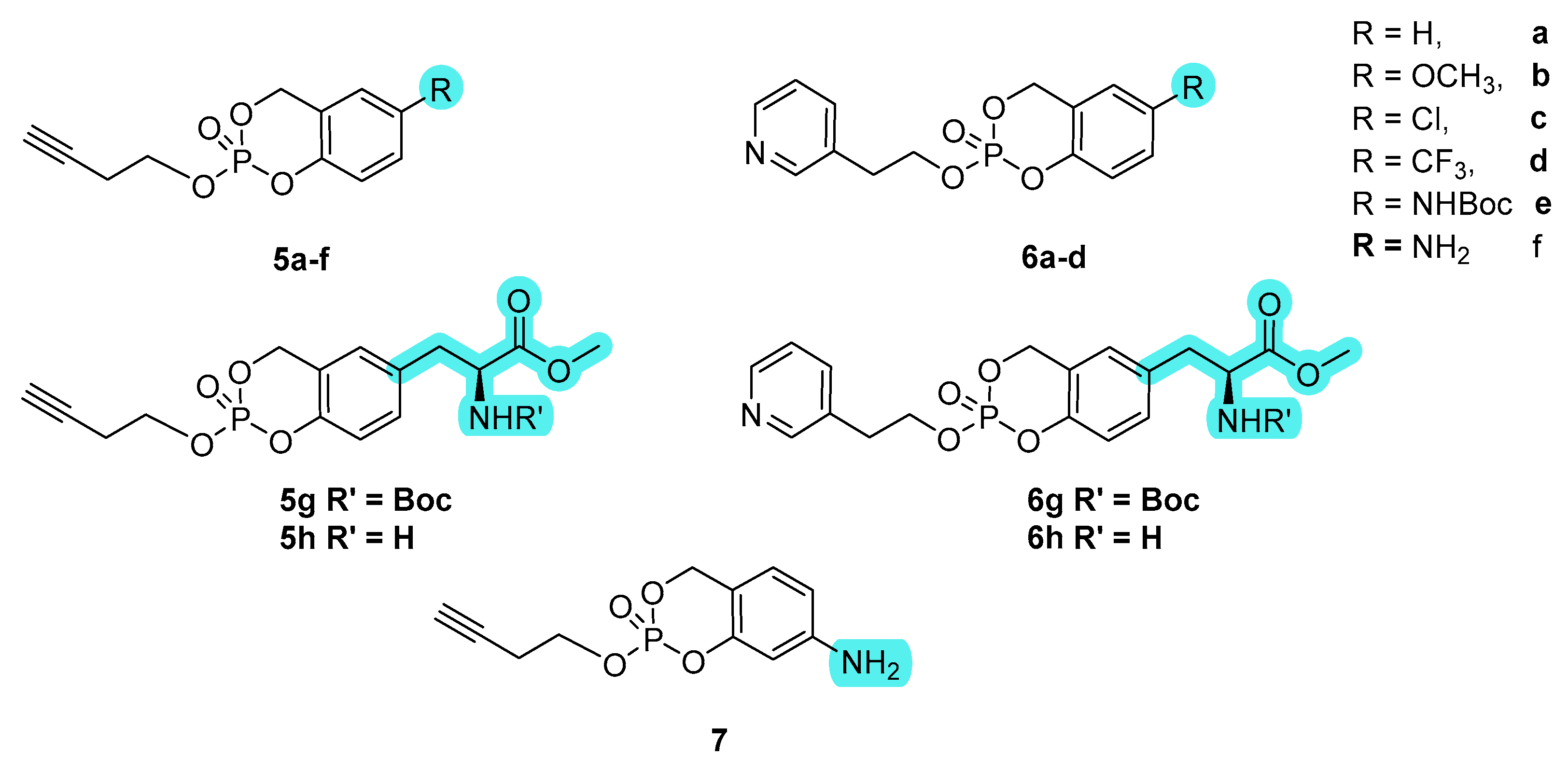
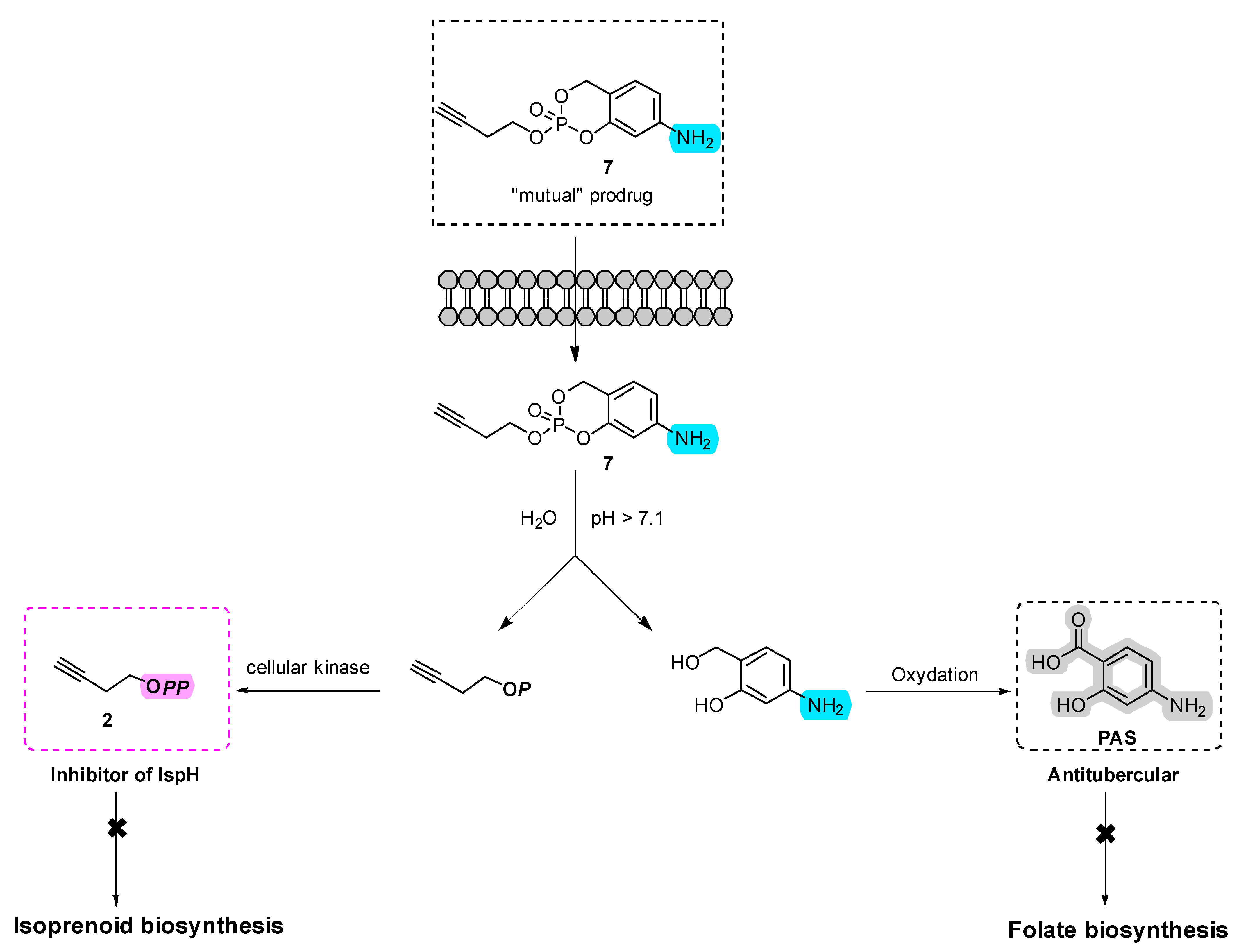
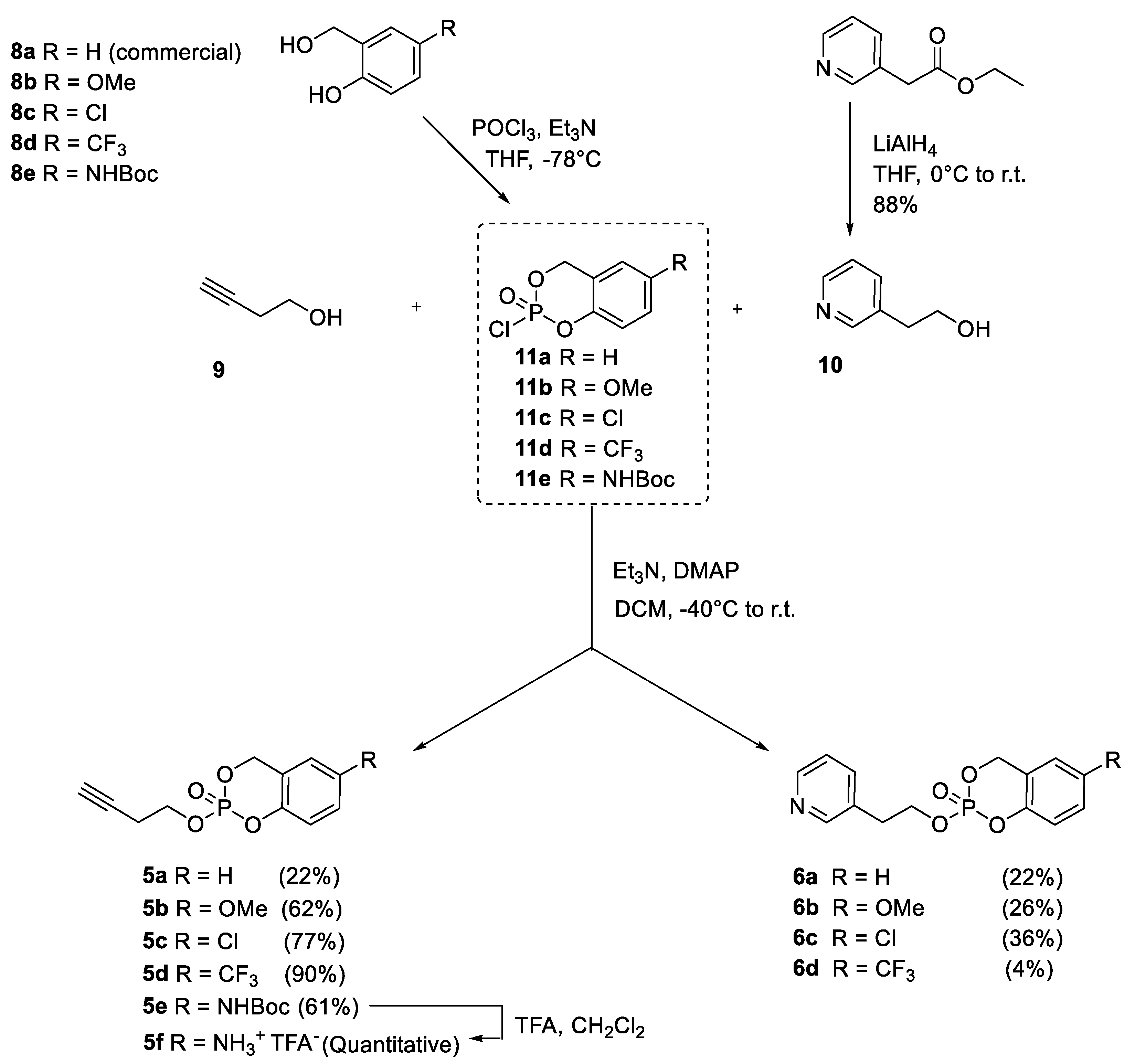
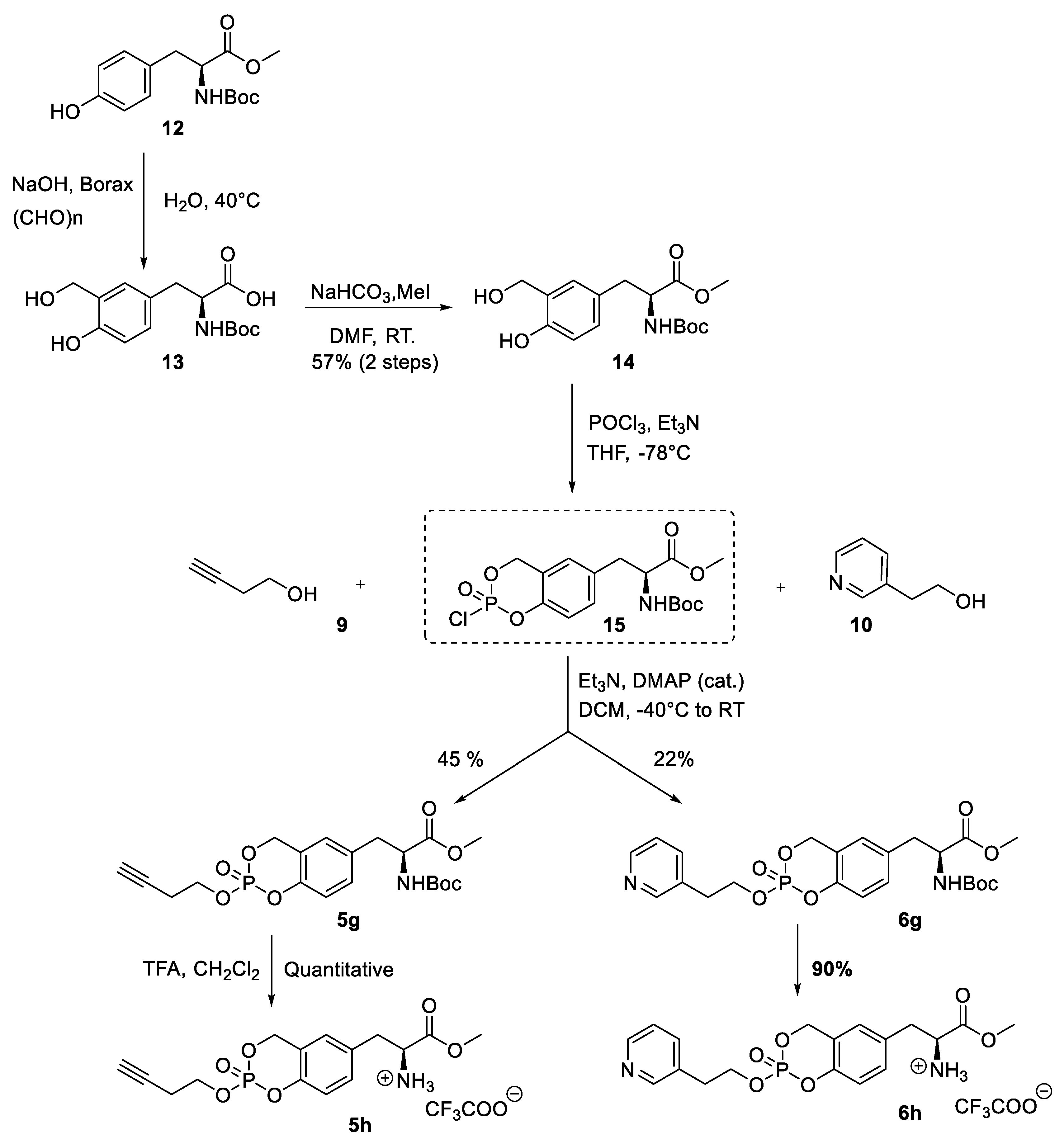
2.2. General Procedures
A/General procedure for the synthesis of cycloSal phosphochloridate
A solution of phosphorous oxichloride (1.1 eq) in THF (1.3 mL/mmol) was cooled down to −78 °C. A solution of saligenol (1 eq) and triethylamine (2.1 eq) in THF (2 mL/mmol) was added dropwise and the mixture was allowed to slowly warm up to reach approximately 10 °C overnight. After completion, the colorless solid was filtered under argon and the solvent evaporated under reduced pressure. The crude was directly engaged in the next step.
B/General procedure for the synthesis of cycloSal phosphotriester
A solution of DMAP (0.5 eq), alcohol (1 eq) and triethylamine (1.1 eq) in DCM (3 mL/mmol) was cooled down to −40 °C, and a solution of cycloSal phosphochloridate (3 eq) in DCM (0.8 mL/mmol) was added dropwise. The reaction mixture was allowed to warm up to room temperature and stirred overnight.
Workup 1:
A saturated solution of NH4Cl was added, and the aqueous layer was extracted with DCM. The combined organic layers were dried over anhydrous sodium sulfate (Na2SO4), and the solvent was evaporated under reduced pressure.
Workup 2:
A saturated solution of NaCl was added. Then, the aqueous layer was extracted with DCM, basified with a saturated NaHCO3 solution to a pH around 6 and extracted again with DCM. These last combined organic layers were dried over Na2SO4, and the solvent was evaporated under reduced pressure.
tert-Butyl (4-hydroxy-3-(hydroxymethyl)phenyl)carbamate (8e)
To a solution of methyl 2-hydroxy-5-nitrobenzoate (5.0 g, 25.3 mmol) in a mixture of ethyl acetate (150 mL) and methanol (15 mL), a Pd/C catalyst (0.5 g, 10 wt%) was added under argon. The reaction mixture was carefully evacuated from argon, filled with hydrogen and then stirred overnight at room temperature. After completion, the reaction mixture was filtered on a pad of Celite, and the solvent was evaporated under reduced pressure to afford methyl 5-amino-2-hydroxybenzoate (cas: 42753-75-3) as brownish solid (3.86 g, 91%). The
1H NMR spectrum is in agreement with previously reported data [
19].
1H NMR (300 MHz, chloroform-d): δ 3.37 (bs, 2H, NH2), 3.93 (s, 3H, OCH3), 6.83 (dd, J = 8.8, 0.6 Hz, 1H, CHAr), 6.88 (dd, J = 8.8, 2.8 Hz, 1H, CHAr), 7.16 (dd, J = 2.8, 0.6 Hz, 1H, CHAr), 10.19 (s, 1H, OH).
To the crude methyl 5-amino-2-hydroxybenzoate (1 eq, 3.86 g, 23.1 mmol), neat Boc2O (1.2 eq, 6.37 mL, 27.7 mmol) was added, and the reaction mixture was stirred at rt for 1 h leading to a brown solid which was dissolved in DCM. The organic layer was washed with water and a saturated solution of NaHCO3 prior to being dried over Na2SO4 and evaporated to give methyl 5-((tert-butoxycarbonyl)amino)-2-hydroxybenzoate (cas: 942404-97-9) (6.74 g, quant. yield).
1H NMR (300 MHz, chloroform-d): δ 1.51 (s, 9H, C(CH3)3), 3.94 (s, 3H, OCH3), 6.35 (br. s, 1H, NH), 6.92 (d, J = 8.9 Hz, 1H, CHAr), 7.36 (dd, J = 8.9, 2.8 Hz, 1H, CHAr), 7.92 (d, J = 2.5 Hz, 1H, CHAr), 10.53 (s, 1H, OH).
To a solution of methyl 5-((
tert-butoxycarbonyl)amino)-2-hydroxybenzoate (1 eq, 1.4 g, 5.2 mmol) in dry THF (50 mL) cooled at −80 °C, LiAlH
4 was added dropwise (2.4 eq, 12 mL; 1 M solution in THF, 12 mmol). The mixture was stirred and allowed to warm to room temperature overnight. The reaction mixture was quenched by a careful addition of
ca. 100 mL of seignette salt’s saturated solution. The aqueous phase was acidified to pH = 6 by addition of 2 M HCl and then extracted three times with Et
2O. Organic phases were combined, dried over Na
2SO
4, filtered and evaporated under reduced pressure. The crude was purified by automated flash chromatography (from 95:5 PE/EtOAc to 70:30 PE/EtOAc) to afford compound
8e (858 mg, 70%) as a beige solid. The
1H NMR spectrum is in agreement with previously reported data [
20].
1H NMR (300 MHz, chloroform-d): δ 1.50 (s, 9H, C(CH3)3), 4.82 (s, 2H, OCH2), 6.30 (s, 1H, NH), 6.81 (d, J = 8.6 Hz, 1H, CHAr), 7.01 (dd, J = 8.6, 2.7 Hz, 1H, CHAr), 7.14–7.23 (m, 1 H, CHAr).
tert-Butyl (2-chloro-2-oxido-4H-benzo[d][1,3,2]dioxaphosphinin-6-yl)carbamate (11e)
The general procedure A was applied to synthetize compound 11e from saligenol 8e (1 eq, 858 mg, 3.6 mmol). A 31P-NMR confirmed the presence of the product obtained as a yellow oil (proportion: 81%).
31P NMR (161.9 MHz, chloroform-d): δ −6.4.
The general procedure with workup 1 was applied to synthetize compound 5a from 3-butyn-1-ol 9 (1 eq, 0.5 mL, 6.4 mmol). The crude was purified by automated flash chromatography (from 70:30 PE/EtOAc to 50:50 PE/EtOAc). The desired product was afforded as a colorless solid (0.337 g, 22%).
Rf = 0.31 (60:40 PE/EtOAc).
1H NMR (500 MHz, chloroform-d): δ 1.96 (t, 4J = 2.7 Hz, 1H, CH), 2.61 (td, 3J = 6.8 Hz, 4J = 2.6 Hz, 2H, CCH2), 4.22–4.36 (m, 2H, CCH2CH2), 5.29–5.46 (m, 2H, CH2OP), 7.04–7.10 (m, 2H, CHAr), 7.13 (td, J = 7.6 Hz, J = 1.9 Hz, 1H, CHAr), 7.29–7.34 (m, 1H, CHAr).
13C NMR (125.8 MHz, chloroform-d): δc 20.7 (d, 3JC-P = 6.7 Hz, CH2CH2OP), 66.0 (d, 2JC-P = 5.6 Hz, CH2CH2OP), 68.7 (d, 2JC-P = 6.9 Hz, CH2OP), 70.6 (CH), 79.0 (CCH), 118.8 (d, JC-P = 9.1 Hz, CHAr), 120.6 (d, 3JC-P = 9.9 Hz, CAr), 124.3 (CHAr), 125.3 (d, JC-P = 1.1 Hz, CHAr), 129.8 (d, JC-P = 1.7 Hz, CHAr), 150.2 (d, 2JC-P = 7.0 Hz, OCAr).
31P NMR (121.5 MHz, chloroform-d): δ −9.9.
HRMS (EI)+: m/z calculated for C11H12O4P [M+H]+ 239.0468, found 239.0486.
The general procedure B with workup 1 was applied to synthetize compound 5b from 3-butyn-1-ol 9 (1 eq, 0.1 mL, 1.34 mmol). The crude was purified by automated flash chromatography (from 60:40 PE/EtOAc to 50:50 PE/EtOAc). The desired product was afforded as a colorless oil (0.225 g, 62%). Rf = 0.41 (50:50 PE/EtOAc).
1H NMR (300 MHz, chloroform-d): δ 1.97 (t, 4J = 2.7 Hz, 1H, CH), 2.60 (td, 3J = 6.8 Hz, 4J = 2.7 Hz, 2H, CCH2), 3.77 (s, 3H, OCH3), 4.19–4.34 (m, 2H, CCH2CH2), 5.24–5.41 (m, 2H, CH2OP), 6.57 (d, J = 3.0 Hz, 1H, CHAr), 6.79–6.87 (m, 1H, CHAr), 6.99 (d, J = 8.9 Hz, 1H, CHAr).
13C NMR (125.8 MHz, chloroform-d): δc 20.7 (d, 3JC-P = 6.7 Hz, CH2CH2OP), 55.7 (OCH3), 65.9 (d, 2JC-P = 5.6 Hz, CH2CH2OP), 68.7 (d, 2JC-P = 7.0 Hz, CH2OP), 70.5 (CH), 79.0 (CCH), 110.1 (bs, CHAr), 115.0 (d, JC-P = 1.6 Hz, CHAr), 119.6 (d, JC-P = 9.1 Hz, CHAr), 121.2 (d, 3JC-P = 10.0 Hz, CAr), 143.8 (d, 2JC-P = 6.9 Hz, OCAr), 156.0 (CArOCH3).
31P NMR (121.5 MHz, chloroform-d): δ −9.6.
HRMS (EI)+: m/z calculated for C12H14O5P [M+H]+ 269.0573, found 269.0593.
The general procedure B with workup 1 was applied to synthetize compound 5c from 3-butyn-1-ol 9 (1 eq, 0.17 mL, 2.18 mmol). The crude was purified by automated flash chromatography (from 70:30 PE/EtOAc to 60:40 PE/EtOAc). The desired product was afforded as a colorless solid (0.439 g, 77%).
Rf = 0.24 (60:40 PE/EtOAc).
1H NMR (300 MHz, chloroform-d): δ 1.97 (t, 4J = 2.7 Hz, 1H, CH), 2.61 (td, 3J = 6.7 Hz, 4J = 2.7 Hz, 2H, CCH2), 4.20–4.37 (m, 2H, CCH2CH2), 5.22–5.45 (m, 2H, CH2OP), 7.00 (d, J = 8.9 Hz, 1H, CHAr), 7.06–7.10 (m, 1H, CHAr), 7.25–7.30 (m, 1H, CHAr).
13C NMR (125.8 MHz, chloroform-d): δc 20.7 (d, 3JC-P = 6.8 Hz, CH2CH2OP), 66.3 (d, 2JC-P = 5.6 Hz, CH2CH2OP), 68.1 (d, 2JC-P = 7.1 Hz, CH2OP), 70.6 (CH), 78.9 (CCH), 120.2 (d, JC-P = 9.4 Hz, CHAr), 119.6 (d, 3JC-P = 9.9 Hz, CAr), 125.2 (d, JC-P = 1.1 Hz, CHAr), 129.5 (CAr), 129.8 (d, JC-P = 1.5 Hz, CHAr), 148.7 (d, 2JC-P = 6.9 Hz, OCAr).
31P NMR (121.5 MHz, chloroform-d): δ −10.3.
HRMS (EI)+: m/z calculated for C11H10ClKO4P [M+K]+ 310.9637, found 310.9647.
The general procedure B with workup 1 was applied to synthetize compound 5d from 3-butyn-1-ol 9 (1 eq, 0.013 mL, 0.17 mmol). The crude was purified by automated flash chromatography (from 70:30 PE/EtOAc to 60:40 PE/EtOAc). The desired product was afforded as a colorless oil (0.047 g, 90%).
Rf = 0.38 (70:30 PE/EtOAc).
1H NMR (300 MHz, chloroform-d): δ 1.96 (t, 4J = 2.6 Hz, 1H, CH), 2.62 (td, 3J = 6.7 Hz, 4J = 2.6 Hz, 2H, CCH2), 4.42–4.19 (m, 2H, CCH2CH2), 5.54–5.29 (m, 2H, CH2OP), 7.16 (d, J = 8.6 Hz, 1H, CHAr), 7.41–7.34 (m, 1H, CHAr), 7.59 (d, J = 8.5 Hz, 1H, CHAr).
13C NMR (125.8 MHz, chloroform-d): δc 20.7 (d, 3JC-P = 6.7 Hz, CH2CH2OP), 66.5 (d, 2JC-P = 5.7 Hz, CH2CH2OP), 68.2 (d, 2JC-P = 7.1 Hz, CH2OP), 70.7 (CH), 78.8 (CCH), 119.4 (d, JC-P = 9.3 Hz, CHAr), 121.1 (d, 3JC-P = 10.1 Hz, CAr), 122.9 (q, 3JC-F = 3.7 Hz, CHAr), 123.5 (q, 1JC-F = 271.9 Hz, CF3), 126.8 (q, 2JC-F = 33.7 Hz, CArCF3), 127.0–127.2 (m, CHAr), 152.6 (bdd, 2JC-P = 6.7, 5JC-F = 1.5 Hz, OCAr).
31P NMR (121.5 MHz, chloroform-d): δ −10.7.
19F NMR (282.4 MHz, chloroform-d): δF −62.2.
HRMS (EI)+: m/z calculated for C12H11F3O4P [M+H]+ 307.0342, found 307.0368.
The general procedure B with workup 1 was applied to synthetize compound 5e from 3-butyn-1-ol 9 (1 eq, 75 µL, 0.98 mmol). The crude was purified by automated flash chromatography (from 80:20 PE/EtOAc to 50:50 PE/EtOAc). The desired product was afforded as a colorless oil (213 mg, 61%).
1H NMR (500 MHz, chloroform-d): δ = 1.51 (s, 9H, C(CH3)3), 1.97 (t, J = 2.7 Hz, 1H, CH), 2.60 (td, J = 6.8, 2.7 Hz, 2H, CCH2), 4.19–4.34 (m, 2H CCH2CH2), 5.25–5.42 (m, 2H, CH2OP), 6.50 (s, 1H, NH), 6.97 (d, J = 8.8 Hz, 1H, CHAr), 7.02–7.07 (m, 1H, CHAr), 7.41 (s, 1H, CHAr).
13C NMR (125.8 MHz, chloroform-d): δ = 20.8 (d, J = 6.8 Hz, CH2CH2OP), 28.4 (C(CH3)3), 66.1 (d, J = 5.6 Hz, CH2CH2OP), 68.9 (d, J = 7.0 Hz, CH2OP), 70.7 (CCH), 79.1 (CCH), 81.2 (C(CH3)3), 115.2 (CHAr), 119.2 (d, J = 9.2 Hz, CHAr), 119.8 (CHAr), 121.1 (d, J = 9.9 Hz, CH2-CAr), 134.9 (N-CAr), 145.6 (d, J = 6.9 Hz, O-CAr), 152.9 (CO).
31P NMR (202 MHz, chloroform-d): δ −9.7.
HRMS (EI)+: m/z calculated for C16H20NaNO6P [M+Na]+ 376.0920, found 376.0917.
To a solution of compound 5e (86 mg, 0.24 mmol) in dry DCM (2.5 mL) at 0 °C was added trifluoroacetic acid (0.5 mL). The resulting reaction mixture was stirred at the same temperature for 1.5h. After reaction completion, volatiles were removed under vacuo to give the desired compound as a brownish oil (88 mg, quant. yield).
1H NMR (500 MHz, methanol-d4): δ = 2.31 (t, J = 2.7 Hz, 1H, CH), 2.61 (dddd, J = 6.6, 6.2, 2.7, 0.9 Hz, 2H, CCH2), 4.20–4.33 (m, 2H, CCH2CH2), 5.42–5.56 (m, 2H, CH2OP), 7.12–7.16 (m, 1H, CHAr), 7.18–7.22 (m, 1H, CHAr), 7.24–7.28 (m, 1H, CHAr).
13C NMR (125.8 MHz, methanol-d4): δ 21.2 (d, J = 6.9 Hz, CH2CH2OP), 68.1 (d, J = 5.9 Hz, CH2CH2OP), 69.8 (d, J = 7.0 Hz, CH2OP), 71.7 (CCH), 80.1 (CCH), 117.6 (q, J = 290.1 Hz, CF3COO−), 119.9 (CHAr), 121.1 (d, J = 9.2 Hz, CHAr), 123.9 (d, J = 9.9 Hz CH2-CAr), 124.0 (CHAr), 132.3 (N-CAr), 149.5 (d, J = 6.5 Hz, O-CAr), 162.0 (q, J = 35.2 Hz, CF3COO−).
31P NMR (202 MHz, methanol-d4): δ −9.7.
19F NMR (470 MHz, methanol-d4): δ −77.2.
HRMS (EI)+: m/z calculated for C11H13NO4P [M+H]+ 254.0577, found 254.0578.
2-(Pyridin-3-yl)ethan-1-ol (10)
To a solution of ethyl 2-(pyridin-3-yl)acetate (1 eq, 0.46 mL, 3.0 mmol) in THF (6 mL/mmol, 18 mL) cooled down to 0 °C, a 1 M solution of LiAlH4 in THF (1.1 eq, 3.3 mL) was added dropwise and the reaction mixture was then stirred at room temperature for 3h. After completion, the reaction mixture was cooled down to 0 °C, quenched with a saturated solution of Seignette’s salt and allowed to warm to room temperature for 30 min. Then, Et2O (10 mL) was added, and after separation of the layers, the aqueous one was extracted with EtOAc (3 × 10 mL). The combined organic layers were dried over Na2SO4 and evaporated. The crude was purified by automated flash chromatography (from 100% EtOAc to 90:10 EtOAc/MeOH). The desired product was afforded as a yellowish oil (0.327 g, 88%).
Rf = 0.24 (90:10 EtOAc/MeOH).
1H NMR (300 MHz, chloroform-d): δ 2.67 (bs, 1H, OH), 2.85 (t, 3J = 6.5 Hz, 2H, CH2CH2OH), 3.87 (t, 3J = 6.5 Hz, 2H, CH2OH), 7.21 (dd, 3J = 7.7 Hz, 3J = 5.0 Hz, 1H, CHAr), 7.56 (d-pseudo-t, 3J = 7.8 Hz, 4J = 1.9 Hz, 1H, CHAr), 8.32–8.47 (m, 2H, CHAr).
13C NMR (125.8 MHz, chloroform-d): δc 36.4 (CH2CH2OH), 62.9 (CH2OH), 123.4 (CHAr), 134.7 (CAr), 136.8 (CHAr), 147.5 (CHAr), 150.1 (CHAr).
The general procedure B with workup 2 was applied to synthetize compound 6a from 2-(pyridin-3-yl)ethan-1-ol 10 (1 eq, 0.205 g, 1.66 mmol). The crude was purified by automated flash chromatography (from 98:2 EtOAc/MeOH to 95:5 EtOAc/MeOH). The desired product was afforded as a colorless oil (0.107 g, 22%).
Rf = 0.29 (95:5 EtOAc/MeOH).
1H NMR (300 MHz, chloroform-d): δ 3.02 (t, 3J = 6.5 Hz, 2H, CH2pyr), 4.32–4.49 (m, 2H, CH2CH2pyr), 5.12–5.38 (m, 2H, CH2OP), 6.96–7.06 (m, 2H, CHAr-cycloSal), 7.11 (pseudo-td, 3J = 7.4 Hz, 4J = 1.1 Hz, 1H, CHAr-cycloSal), 7.17 (ddd, J = 7.8, 4.8, 0.8 Hz, 1H, CHAr-pyr), 7.26–7.34 (m, 1H, CHAr-cycloSal), 7.46–7.54 (m, 1H, CHAr-pyr), 8.42 (d, J = 2.2 Hz, 1H, CHAr-pyr), 8.46 (dd, J = 4.8 Hz, J = 2.2 Hz, 1H, CHAr-pyr).
13C NMR (125.8 MHz, chloroform-d): δc 33.9 (d, 3JC-P = 6.5 Hz, CH2pyr), 68.2 (d, 2JC-P = 5.9 Hz, CH2OP), 68.6 (d, 2JC-P = 7.1 Hz, CH2CH2pyr), 118.7 (d, JC-P = 8.9 Hz, CHAr-cycloSal), 120.5 (d, 3JC-P = 10.0 Hz, CAr-cycloSal), 123.4 (CHAr-pyr), 124.3 (CHAr-pyr), 125.3 (d, JC-P = 1.0 Hz, CHAr-cycloSal), 129.8 (d, JC-P = 1.8 Hz, CHAr-cycloSal), 132.4 (CAr-pyr), 136.4 (CHAr-pyr), 148.4 (CHAr-pyr), 150.0 (d, 2JC-P = 6.9 Hz, OCAr-cycloSal), 153.3 (CHAr-cycloSal).
31P NMR (121.5 MHz, chloroform-d): δ −9.8.
HRMS (EI)+: m/z calculated for C14H15NO4P [M+H]+ 292.0733, found 292.0735.
The general procedure B with workup 2 was applied to synthetize compound 6b from 2-(pyridin-3-yl)ethan-1-ol 10 (1 eq, 0.084 g, 0.68 mmol). The crude was purified by automated flash chromatography (from 100% EtOAc to 95:5 EtOAc/MeOH). The desired product was afforded as a colorless oil (0.057 g, 23%).
Rf = 0.25 (95:5 EtOAc/MeOH).
1H NMR (500 MHz, chloroform-d): δ 2.99 (t, 3J = 6.5 Hz, 2H, CH2pyr), 3.75 (s, 3H, OCH3), 4.28–4.46 (m, 2H, CH2CH2pyr), 5.06–5.30 (m, 2H, CH2OP), 6.51 (d, J = 2.9 Hz, 1H, CHAr-cycloSal), 6.76–6.82 (m, 1H, CHAr-cycloSal), 6.87–6.93 (m, 1H, CHAr-pyr), 7.13–7.20 (m, 2H, CHAr-cycloSal), 7.48 (dt, 3J = 7.8 Hz, 4J = 1.9 Hz, 1H, CHAr-pyr), 8.41 (d, J = 2.1 Hz, 1H, CHAr-pyr), 8.45 (dd, J = 4.9 Hz, J = 1.5 Hz, 1H, CHAr-pyr).
13C NMR (125.8 MHz, chloroform-d): δc 33.9 (d, 3JC-P = 6.4 Hz, CH2pyr), 55.6 (OCH3), 68.1 (d, 2JC-P = 6.9 Hz, CH2OP), 68.6 (d, 2JC-P = 7.1 Hz, CH2CH2pyr), 110.1 (bs, CHAr-cycloSal), 115.0 (d, JC-P = 1.6 Hz, CHAr-cycloSal), 119.5 (d, JC-P = 9.1 Hz, CHAr-cycloSal), 121.1 (d, 3JC-P = 10.0 Hz, CAr-cycloSal), 123.4 (CHAr-pyr), 132.4 (CAr-pyr), 136.4 (CHAr-pyr), 143.6 (d, 2JC-P = 7.0 Hz, OCAr-cycloSal), 148.3 (CHAr-pyr), 150.3 (CHAr-pyr), 156.0 (CAr-cycloSalOCH3).
31P NMR (121.5 MHz, chloroform-d): δ −9.6.
HRMS (EI)+: m/z calculated for C15H17NO5P [M+H]+ 322.0838, found 322.0845.
The general procedure B with workup 2 was applied to synthetize compound 6c from 2-(pyridin-3-yl)ethan-1-ol 10 (1 eq, 0.170 g, 1.38 mmol). The crude was purified by automated flash chromatography (from 100% EtOAc to 95:5 EtOAc/MeOH). The desired product was afforded as a colorless oil (0.162 g, 36%).
Rf = 0.59 (95:5 EtOAc/MeOH).
1H NMR (300 MHz, chloroform-d): δ 3.01 (t, 3J = 6.5 Hz, 2H, CH2pyr), 4.31–4.49 (m, 2H, CH2CH2pyr), 5.10–5.30 (m, 2H, CH2OP), 6.91 (d, 3J = 8.8 Hz, 1H, CHAr-cycloSal), 7.00 (d, 4J = 2.5 Hz, 1H, CHAr-pyr), 7.14–7.26 (m, 2H, CHAr-cycloSal), 7.49 (dt, 3J = 7.8 Hz, 4J = 1.9 Hz, 1H, CHAr-pyr), 8.42 (d, J = 2.2 Hz, 1H, CHAr-pyr), 8.46 (dd, J = 4.9 Hz, J = 1.6 Hz, 1H, CHAr-pyr).
13C NMR (125.8 MHz, chloroform-d): δc 33.8 (d, 3JC-P = 6.6 Hz, CH2pyr), 68.0 (d, 2JC-P = 7.0 Hz, CH2OP), 68.4 (d, 2JC-P = 5.9 Hz, CH2CH2pyr), 120.1 (d, JC-P = 9.2 Hz, CHAr-cycloSal), 121.9 (d, 3JC-P = 10.1 Hz, CAr-cycloSal), 123.5 (CHAr-pyr), 125.3 (d, JC-P = 1.0 Hz, CHAr-cycloSal), 129.6 (CAr-cycloSal), 129.8 (d, JC-P = 1.5 Hz, CHAr-cycloSal), 132.3 (CAr-pyr), 136.4 (CHAr-pyr), 148.3 (CHAr-pyr), 148.5 (d, 2JC-P = 6.9 Hz, OCAr-cycloSal), 150.2 (CHAr-pyr).
31P NMR (121.5 MHz, chloroform-d): δ −10.4.
HRMS (EI)+: m/z calculated for C14H14ClNO4P [M+H]+ 326.0343, found 326.0348.
The general procedure B with workup 2 was applied to synthetize compound 6d from 2-(pyridin-3-yl)ethan-1-ol 10 (1 eq, 90 mg, 0.73 mmol). The crude was purified by automated flash chromatography (from 100% EtOAc to 95:5 EtOAc/MeOH). The desired product was afforded as a colorless oil (10.9 mg, 4%).
1H NMR (400 MHz, chloroform-d): δ 3.04 (t, J = 6.5 Hz, 2H, CH2-Cpyr), 4.36–4.56 (m, 2H, CH2CH2-Cpyr), 5.18–5.38 (m, 2H, CH2OP), 7.09 (d, J = 8.6 Hz, 1H, CHAr-cycloSal), 7.18 (dd, J = 7.8, 4.8 Hz, 1H, CHAr-pyr), 7.32 (s, 1H, CHAr-cycloSal), 7.48–7.54 (m, 1H), 7.57 (d, J = 8.7 Hz, 1H, CHAr-cycloSal), 8.42–8.49 (m, 2H, CHAr-pyr).
13C NMR (125.8 MHz, chloroform-d): δ 34.0 (d, J = 6.5 Hz, CH2-Cpyr), 68.2 (d, J = 7.1 Hz, CH2OP), 68.7 (d, J = 5.8 Hz, CH2CH2-Cpyr), 119.5 (d, J = 9.2 Hz, CHAr-cycloSal), 121.1 (d, J = 10.1 Hz, CAr-cycloSal), 123.0 (qd, J = 3.7, 1.0 Hz, CHAr-cycloSal), 123.55 (q, J = 272.0 Hz, CF3), 123.59 (CHAr-pyr), 127.0 (q, J = 33.6 Hz, CAr-cycloSal-CF3), 127.2–127.4 (m, CHAr-cycloSal), 132.3 (CAr-pyr), 136.5 (CHAr-pyr), 148.5 (CHAr-pyr), 150.3 (CHAr-pyr), 152.5 (dq, J = 6.9, 1.2 Hz, OCAr-cycloSal).
31P NMR (162 MHz, chloroform-d): δ −10.65.
19F NMR (376 MHz, chloroform-d): δ −62.2.
HRMS (EI)+: m/z calculated for C15H14F3NO4P [M+H]+ 360.0607, found 360.0606.
The general procedure B with workup 2 was applied to synthetize compound 6d from 2-(pyridin-3-yl)ethan-1-ol 10 (1 eq, 92 mg, 0.75 mmol). The crude was purified by flash chromatography (95:5 EtOAc/MeOH). The desired product was afforded as a colorless oil (83.2 mg, 22%). Two diastereoisomers were detected by NMR spectroscopy with a diastereomeric ratio of 66:33. Unambiguous assignment of the signals to each individual diastereomer has not been achieved.
1H NMR (500 MHz, chloroform-d): δ = 1.41 (s, 2.96H, C(CH3)3, minor diastereoisomer), 1.42 (s, 6.02H, C(CH3)3, major diastereoisomer), 2.94–3.14 (m, 4H, CH2-Cpyr and CH2CH), 3.718 (s, 1.9H, OCH3, minor diastereoisomer), 3.722 (s, 1.1H, OCH3, major diastereoisomer), 4.34–4.46 (m, 2H, CH2CH2-Cpyr), 4.51–4.63 (m, 1H, NCH), 4.99–5.30 (m, 2H, CH2OP), 5.36 (d, J = 8.3 Hz, 0.36H, NH, minor diastereoisomer), 5.57 (d, J = 8.3 Hz, 0,69H, NH, major diastereoisomer), 6.77–6.83 (m, 1H, CHAr-cycloSal), 6.87 (d, J = 8.4 Hz, 0.35H, CHAr-cycloSal), 6.91 (d, J = 8.4 Hz, 0.68H, CHAr-cycloSal), 7.00–7.07 (m, 1H, CHAr-cycloSal), 7.20 (dd, J = 7.8, 4.8 Hz, 1H, CHAr-pyr), 7.48–7.54 (m, 1H, CHAr-pyr), 8.26 (d, J = 2.3 Hz, 0.66H, CHAr-pyr), 8.33 (d, J = 2.3 Hz, 0.33H, CHAr-pyr), 8.45–8.51 (m, 1H, CHAr-pyr).
13C NMR (125.8 MHz, chloroform-d): 28.4 (C(CH3)3, minor diastereoisomer), 28.5 (C(CH3)3, major diastereoisomer), 33.96 (d, J = 6.4 Hz, CH2-Cpyr, major diastereoisomer), 33.98 (d, J = 6.4 Hz, CH2-Cpyr, minor diastereoisomer), 37.66 (CH2CHN, minor diastereoisomer), 37.70 (CH2CHN, major diastereoisomer), 52.47 (OCH3, major diastereoisomer), 52.50 (OCH3, minor diastereoisomer), 54.48 (CHN, minor diastereoisomer), 54.53 (CHN, major diastereoisomer), 68.2 (d, J = 5.8 Hz, CH2OP, minor diastereoisomer), 68.4 (d, J = 5.8 Hz, CH2OP, major diastereoisomer), 68.7 (d, J = 7.0 Hz, CH2CH2-Cpyr, minor diastereoisomer), 68.71 (d, J = 7.0 Hz, CH2CH2-Cpyr, major diastereoisomer), 80.17 (C(CH3)3, major diastereoisomer), 80.21 (C(CH3)3, minor diastereoisomer), 118.82 (d, J = 8.8 Hz, CHAr-cycloSal, minor diastereomer), 118.85 (d, J = 9.0 Hz, CHAr-cycloSal, major diastereoisomer), 120.49 (d, J = 10.1 Hz CAr-cycloSal, major diastereomer), 120.55 (d, J = 10.0 Hz, CAr-cycloSal, minor diastereomer), 123.5 (CHAr-pyr, major diastereomer), 123.6 (CHAr-pyr, minor diastereomer), 126.0 (CHAr-cycloSal, minor diastereomer), 126.2 (CHAr-cycloSal, major diastereomer), 130.7 (d, J = 1.7 Hz, CHAr-cycloSal, major diastereomer), 130.9 (d, J = 1.6 Hz, CHAr-cycloSal, minor diastereomer), 132.56 (CAr-pyr, major diastereomer), 132.57 (CAr-pyr, minor diastereomer), 132.7 (CAr-cycloSal, minor diastereomer), 132.8 (CAr-cycloSal, major diastereomer), 136.49 (CHAr-pyr, major diastereomer), 136.50 (CHAr-pyr, minor diastereomer), 148.4 (CHAr-pyr), 149.1 (d, J = 6.9 Hz, O-CAr, major diastereomer), 149.1 (d, J = 7.0 Hz, O-CAr, minor diastereomer), 150.26 (CHAr-pyr, major diastereomer), 150.27 (CHAr-pyr, minor diastereomer), 155.26 (NCO, minor diastereomer), 155.33 (NCO, major diastereomer), 172.12 (CO, major diastereomer), 172.14 (CO, minor diastereomer).
31P NMR (162 MHz, chloroform-d): δ −9.9 (minor diastereoisomer), −10.1 (major diastereoisomer).
HRMS (ESI, positive mode) m/z calculated for C23H30O8N2P [M+H]+ 493.1734, found 493.1738.
To a solution of compound 6g (41.8 mg, 0.085 mmol) in dry DCM (1 mL) at 0 °C, trifluoroacetic acid (0.5 mL) was added. The resulting reaction mixture was stirred at the same temperature for 1h. After reaction completion, volatiles were removed under vacuo to give the desired compound as a light-brown paste (46.9 mg, 90%). Two diastereoisomers were detected by NMR spectroscopy with a diastereomeric ratio of 66:33. Unambiguous assignment of the signals to each individual diastereoisomer has not been achieved.
1H NMR (400 MHz, methanol-d4): δ 3.10–3.31 (m, 4H, CH2-Cpyr and CH2CH), 3.82 (s, 3H, OCH3), 4.29–4.37 (m, 1H, NCH), 4.45–4.62 (m, 2H, CH2CH2-Cpyr), 5.37–5.44 (m, 2H, CH2OP), 6.99–7.08 (m, 1H, CHAr-cycloSal), 7.08–7.15 (m, 1H, CHAr-cycloSal), 7.21–7.30 (m, 1H, CHAr-cycloSal), 7.99 (dd, J = 8.2, 5.8 Hz, 1H, CHAr-pyr), 8.48–8.55 (m, 1H, CHAr-pyr), 8.73 (d, J = 5.7 Hz, 1H, CHAr-pyr), 8.78 (d, J = 2.2 Hz, 1H, CHAr-pyr).
13C NMR (125.8 MHz, methanol-d4): δ 34.3 (d, J = 6.6 Hz, CH2-Cpyr), 36.51 (CH2CHN, minor diastereoisomer), 36.53 (CH2CHN, major diastereoisomer), 53.8 (OCH3), 55.0 (CHN), 69.1 (d, J = 5.8 Hz, CH2CH2-Cpyr), 70.1 (d, J = 6.9 Hz, CH2OP), 120.1 (d, J = 9.0 Hz, CHAr-cycloSal, minor diastereoisomer), 120.2 (d, J = 9.0 Hz, CHAr-cycloSal, major diastereoisomer), 122.7 (d, J = 10.0 Hz, CAr-cycloSal, major diastereomer), 122.8 (d, J = 10.0 Hz, CAr-cycloSal, minor diastereomer), 127.97 (CHAr-pyr), 128.01 (d, J = 1.1 Hz, CHAr-cycloSal, minor diastereomer), 128.1 (d, J = 1.1 Hz, CHAr-cycloSal, major diastereomer), 132.16 (d, J = 1.7 Hz, CHAr-cycloSal, major diastereomer), 132.22 (d, J = 1.7 Hz, CHAr-cycloSal, minor diastereomer), 132.3 (CAr-cycloSal, minor diastereomer), 132.4 (CAr-cycloSal, minor diastereomer), 139.3 (CAr-pyr), 142.4 (CHAr-pyr), 144.3 (CHAr-pyr), 147.3 (CHAr-pyr), 150.7 (d, J = 6.7 Hz, O-CAr), 170.29 (CO, minor diastereomer), 170.31 (CO, major diastereomer).
31P NMR (161.9 MHz, methanol-d4): δ −9.49 (major diastereoisomer), −9.52 (minor diastereoisomer).
HRMS (ESI, positive mode) m/z calculated for C18H22O6N2P [M+H]+ 393.1210, found 393.1203.
2-((tert-Butoxycarbonyl)amino)-3-(4-hydroxy-3-(hydroxymethyl)phenyl)propanoic acid (13)
To a solution of N-(tert-butoxycarbonyl)-L-tyrosine methyl ester (1 eq, 2.200 g, 7.45 mmol) and sodium tetraborate decahydrate (borax) (2 eq, 5.721 g, 14.9 mmol) in water (2.4 mL/mmol, 18 mL) was added a 1M solution of sodium hydroxide (2.3 mL/mmol, 17 mL). The reaction mixture was stirred at room temperature for 30 min, then aqueous formaldehyde (4 eq, 2.23 mL of a 37% solution, 29.8 mmol) was added and the reaction was stirred at 40 °C for 5 days. After completion, the reaction mixture was allowed to cool down to room temperature and acidified with a 10% HCl solution to pH 2. The suspension was extracted with EtOAc (3 × 20 mL), and the combined organic layers were washed with water (20 mL), brine (20 mL), dried over Na2SO4 and evaporated. The desired product (1.942 g) was used in the next step without further purification.
1H NMR (300 MHz, DMSO-d6): δ 1.33 (s, 9H, C(CH3)3), 2.70 (dd, 3J = 13.7 Hz, 10.2 Hz, 1H, CH2CH), 2.88 (dd, 3J = 13.9 Hz, 4.5 Hz, 1H, CH2CH), 3.96–4.05 (m, 1H, CH), 4.44 (s, 2H, CH2OH), 4.94 (bt, 3J = 5.3 Hz, 1H, NH), 6.64 (d, 3J = 8.1 Hz, 1H, CHAr), 6.90 (d, 3J = 8.2 Hz, 2.2 Hz, 1H, CHAr), 6.97 (d, 3J = 8.2 Hz, 1H, CHAr), 7.15 (s, 1H, PhOH).
Methyl 2-((tert-butoxycarbonyl)amino)-3-(4-hydroxy-3-(hydroxymethyl)phenyl) propanoate (14)
A solution of NaHCO3 (2 eq, 1.017 g, 12 mmol) and carboxylic acid 13 (1 eq, 1.879 g, 6.0 mmol) in DMF (3 mL/mmol, 18 mL) was stirred at room temperature for 30 min prior to dropwise addition of methyl iodide (2 eq, 0.75 mL, 12 mmol), and the reaction mixture was stirred overnight at room temperature. After completion, water (30 mL) was added, and the reaction mixture was extracted with EtOAc (3 × 15 mL). The combined organic layers were washed with water (2 × 15 mL), brine (2 × 15 mL), dried over Na2SO4 and evaporated. The crude was purified by automated flash chromatography (from 60:40 PE/EtOAc to 50:50 PE/EtOAc). The desired product was afforded as a colorless solid (1.413 g, 69%).
Rf = 0.22 (60:40 PE/EtOAc).
1H NMR (300 MHz, chloroform-d): δ 1.41 (s, 9H, C(CH3)3), 2.77–3.06 (m, 3H, CH and CH2CH), 3.71 (s, 3H, OCH3), 3.96–4.05 (m, 1H, CH), 4.49 (pseudo-q, 3J = 7.4 Hz, 1H, CH2OH), 4.75 (bs, 2H, CH2OH), 5.01 (d, 3J = 8.2 Hz, NH), 6.72–6.83 (m, 2H, CHAr), 6.87–6.95 (m, 1H, CHAr), 7.54 (bs, 1H, PhOH).
13C NMR (125.8 MHz, chloroform-d): δc 28.3 (C(CH3)3), 37.5 (CH2CHN), 52.3 (OCH3), 54.7 (CH), 64.1 (CH2OH), 80.2 (C(CH3)3), 116.5 (CHAr), 125.2 (CAr), 127.3 (CAr), 128.7 (CHAr), 130.0 (CHAr), 155.1 (CAr), 155.3 (NCO), 172.6 (CO).
Methyl 2-((tert-butoxycarbonyl)amino)-3-(2-chloro-2-oxido-4H-benzo[d][1,3,2]dioxaphosphinin-6-yl)propanoate (15)
The general procedure A was applied to synthetize compound 15 from saligenol 14 (1 eq, 0.939 g, 2.9 mmol). A 31P-NMR confirmed the presence of the product obtained as a colorless solid (proportion: 71%).
Rf = 0.72 (30:70 PE/EtOAc).
31P NMR (161.9 MHz, chloroform-d): δ −6.0.
The general procedure with workup 1 was applied to synthetize compound 5g from 3-butyn-1-ol 9 (1 eq, 0.1 mL, 1.34 mmol). The crude was purified by automated flash chromatography (from 60:40 PE/EtOAc to 40:60 PE/EtOAc). The desired product was afforded as a colorless oil (0.265 g, 45%).
Rf = 0.34 (50:50 PE/EtOAc).
1H NMR (300 MHz, chloroform-d): δ 1.41 (s, 9H, C(CH3)3), 1.97 (t, 4J = 2.7 Hz, 1H, CCH), 2.62 (td, 3J = 6.8 Hz, 4J = 2.7 Hz, 1H, CCH2), 2.97 (dd, 3J = 14.0 Hz, 3J = 6.5 Hz, 1H, CH2CH), 3.10 (dd, 3J = 13.9 Hz, 3J = 5.7 Hz, 1H, CH2CH), 3.72 (s, 3H, OCH3), 4.19–4.38 (m, 2H, CCH2CH2), 4.49 (pseudo-q, 3J = 6.8 Hz, 1H, NCH), 4.98 (d, 3J = 8.3 Hz, 1H, NH), 5.22–5.45 (m, 2H, CH2OP), 6.81–6.88 (m, 1H, CHAr), 6.98 (dd, 3J = 8.3 Hz, 4J = 0.9 Hz, 1H, CHAr), 7.02–7.10 (m, 1H, CHAr).
13C NMR (125.8 MHz, chloroform-d): δc 20.7 (d, 3JC-P = 6.7 Hz, CH2CH2OP), 28.3 (C(CH3)3), 37.7 (CH2CHN), 52.4 (OCH3), 54.3 (CHN), 66.0 (d, 2JC-P = 5.8 Hz, CH2CH2OP), 68.6 (d, 2JC-P = 7.1 Hz, CH2OP), 70.6 (CCH), 79.0 (CCH), 118.8 (d, JC-P = 8.7 Hz, CHAr), 120.5 (d, 3JC-P = 10.4 Hz, CAr), 125.9 (d, JC-P = 5.6 Hz, CHAr), 130.6 (d, JC-P = 5.7 Hz, CHAr), 132.5 (CAr), 149.2 (d, 2JC-P = 7.3 Hz, POCAr), 155.0 (NCO), 172.0 (CO).
31P NMR (121.5 MHz, chloroform-d): δ −9.9.
HRMS (EI)+: m/z calculated for C20H26KNO8P [M+K]+ 478.1028, found 478.1039.
To a solution of compound 5g (31.7 mg, 0.072 mmol) in dry DCM (1 mL) at 0 °C, trifluoroacetic acid (1 mL) was added. The resulting reaction mixture was stirred at the same temperature for 1h. After reaction completion, volatiles were removed under vacuo to give the desired compound as a colorless oil (32.8 mg, quant. yield). Two diastereoisomers were detected by NMR spectroscopy with a diastereomeric ratio of 60:40. Unambiguous assignment of the signals to each individual diastereoisomer has not been achieved.
1H NMR (500 MHz, methanol-d4): δ = 2.329 (t, J = 2.70 Hz 0.6 H, CCH, major diastereoisomer), 2.331 t, J = 2.70 Hz 0.4H, CCH, minor diastereoisomer), 2.57–2.64 (m, 2H, CCH2), 3.12–3.20 (m, 1H, CH2CH), 3.22–3.29 (m, 1H, CH2CH), 3.82 (s, 3H, OCH3), 4.20–4.30 (m, 2H, CCH2CH2), 4.31–4.35 (m, 1H, NCH), 5.33–5.63 (m, 2H, CH2OP), 7.09–7.16 (m, 2H, CHAr), 7.23–7.31 (m, 1H, CHAr).
13C NMR (125.8 MHz, methanol-d4): δ 21.2 (d, J = 7.0 Hz, CH2CH2OP), 36.49 (CH2CHN, major diastereoisomer), 36.50 (CH2CHN, minor diastereoisomer), 53.7 (OCH3), 54.97 (CHN, major diastereoisomer), 54.98 (CHN, minor diastereoisomer), 67.98 (d, J = 5.8 Hz, CH2CH2OP, major diastereoisomer), 68.00 (d, J = 5.8 Hz, CH2CH2OP, minor diastereoisomer), 70.0 (d, J = 6.9 Hz, CH2OP), 71.7 (CCH), 80.12 (CCH, major diastereoisomer), 80.13 (CCH, minor diastereoisomer), 118.1 (q, J = 292.2 Hz, CF3COO−), 120.18 (d, J = 9.1 Hz, CHAr, major diastereoisomer), 120.21 (d, J = 9.1 Hz, CHAr, minor diastereoisomer), 122.81 (d, J = 9.8 Hz, CAr, minor diastereoisomer), 122.85 (d, J = 9.8 Hz, CAr, major diastereoisomer), 127.88 (d, J = 1.0 Hz, CHAr, major diastereoisomer), 127.91 (d, J = 1.0 Hz, CHAr, minor diastereoisomer), 132.02 (d, J = 1.7 Hz, CHAr, major diastereoisomer), 132.06 (d, J = 1.7 Hz, CHAr, minor diastereoisomer), 132.07 (CAr, major diastereoisomer), 132.09 (CAr, minor diastereoisomer), 150.9 (d, J = 6.7 Hz, O-CAr), 162.7 (q, J = 35.2 Hz, CF3COO−), 170.256 (CO, major diastereoisomer), 170.262 (CO, minor diastereoisomer).
31P NMR (121.5 MHz, methanol-d4): δ −9.58 (minor diastereoisomer), −9.59 (major diastereoisomer).
19F NMR (282.4 MHz, methanol-d4): δ −77.0.
HRMS (ESI, positive mode) calculated (m/z) for C15H19O6NP [M+H]+ 340.0945, found 340.0945.
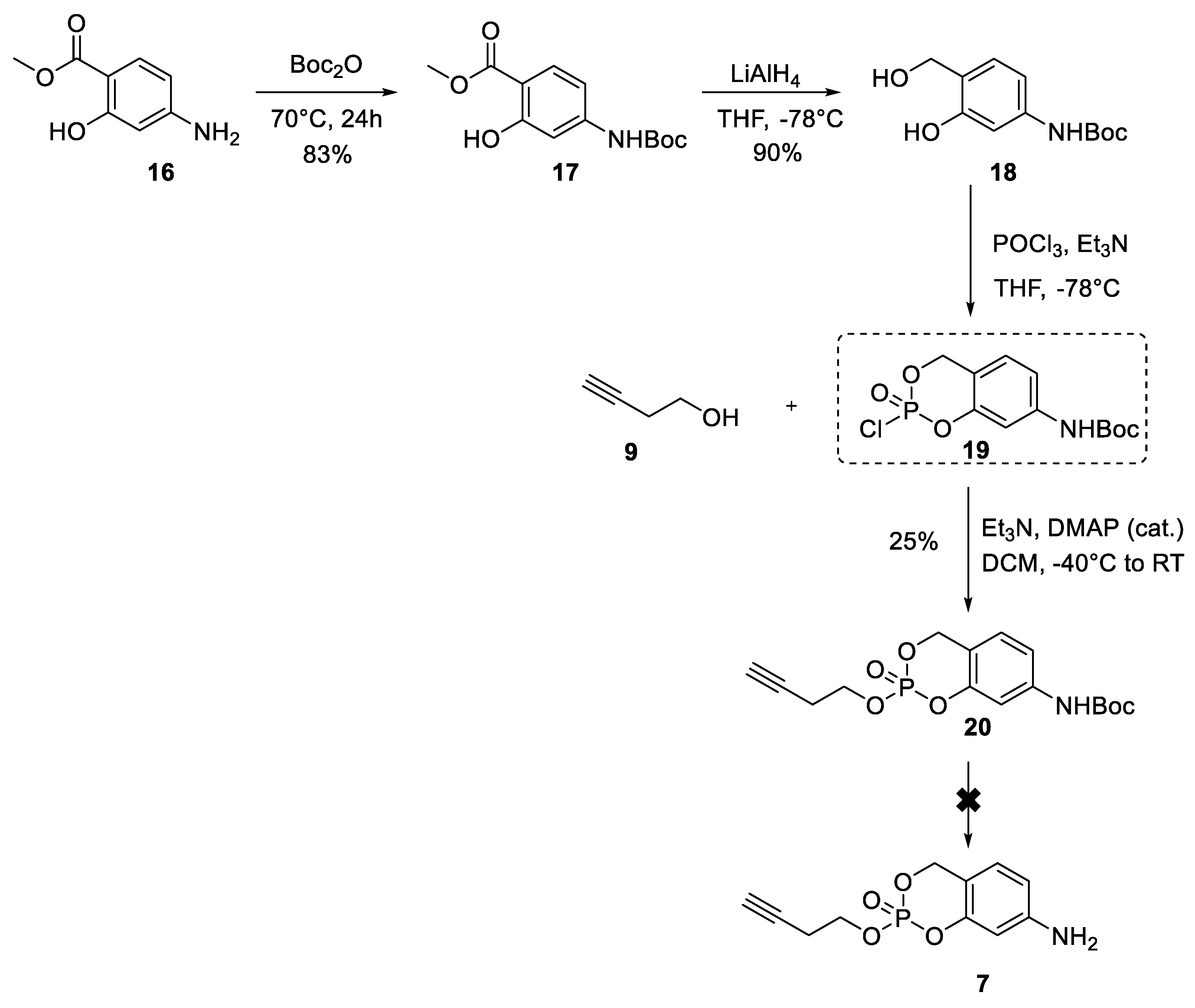
Methyl 4-((tert-butoxycarbonyl)amino)-2-hydroxybenzoate (17)
Methyl 4-Amino-2-hydroxybenzoate
16 (2.5 g, 15 mmol) and Boc
2O (3.75 mL, 16.3 mmol, 1.1 eq.) were heated at 70 °C for 3 days. The volatiles were removed under reduced pressure. Then, ethyl acetate and distilled water were added to the resulting residue, and the two layers were separated. The organic layer was washed with 2 M HCl (3 × 25 mL), brine (3 × 25 mL), dried over Na
2SO
4 and filtered. After removal of the volatiles under reduced pressure, the crude product was purified by flash chromatography (SiO
2, 1:9 EtOAc/Petroleum ether) to afford an off-white solid (3.85g, 96%). The characterization data were in agreements to those previously reported in the literature [
21].
1H NMR (500 MHz, chloroform-d): δ = 1.52 (s, 9H, C(CH3)3), 3.91 (s, 3H, O-CH3), 6.60 (s, 1H, NH), 6.93 (dd, J = 8.7, 2.2 Hz, 1H, CHAr), 6.98 (d, J = 2.2 Hz, 1H, CHAr), 7.73 (d, J = 8.7 Hz, 1H, CHAr), 10.83 (s, 1H, OH).
To a solution of compound 17 (2.12 g, 7.9 mmol) in distilled THF (70 mL) at −78 °C was added dropwise LiAlH4 (1.6 eq., 1 M solution in THF, 13 mL, 13 mmol). The reaction mixture was left overnight in the acetone/dry ice bath and allowed to warm to room temperature. The reaction mixture was quenched by dropwise addition of water. Thereafter, saturated Rochelle salt solution was added. M HCl was added dropwise until the resulting solution reached a pH of 5. The resulting mixture was extracted three times with ethyl acetate. Organic layers were combined, washed with brine, dried over Na2SO4, filtered and concentrated under reduced pressure to give the crude product as an orange residue. After purification by automated flash chromatography (from 80:20 PE/EtOAc to 50:60 PE/EtOAc), the desired product was obtained as yellow solid (1.71 g, 90%).
1H NMR (500 MHz, chloroform-d): δ = 1.50 (s, 9H, C(CH3)3), 4.72 (s, 2H, CH2), 6.53 (s, 1H, NH), 6.78 (dd, J = 8.1, 2.1 Hz, 1H, CHAr), 6.90 (s, 1H, CHAr), 6.93 (d, J = 8.2 Hz, 1H, CHAr).
13C NMR (125.8 MHz, chloroform-d): δ = 28.5 (C(CH3)3), 63.7 (CH2), 81.0 (C(CH3)3), 107.0 (CHAr), 110.4 (CHAr), 120.5 (CAr), 128.7 (CHAr), 139.3 (CAr), 153.1 (CO), 156.4 (CAr).
HRMS (ESI, positive mode) calculated (m/z) for C12H17NNaO2 [M+Na]+ 262.1050, found 262.1049.
tert-Butyl (2-chloro-2-oxido-4H-benzo[d][1,3,2]dioxaphosphinin-7-yl)carbamate (19)
The general procedure A was applied to synthetize compound 19 from saligenol 18 (1 eq, 990 mg, 4.2 mmol). A 31P-NMR confirmed the presence of the product obtained as a yellow solid (proportion: 50%).
31P NMR (161.9 MHz, chloroform-d): δ = −6.2.
The general procedure B with workup 1 was applied to synthetize compound 20 from 3-butyn-1-ol 9 (1 eq, 50 µL, 0.66 mmol). The crude was purified by automated flash chromatography (from 70:30 PE/EtOAc to 60:40 PE/EtOAc). The desired product was afforded as a light-yellow oil (59.1 mg, 25%).
1H NMR (500 MHz, chloroform-d): δ = 1.52 (s, 9H, C(CH3)3), 1.98 (t, J = 2.7 Hz, 1H, CH), 2.61 (tdt, J = 6.8, 2.7, 0.6 Hz, 2H, CH2CH2OP), 4.19–4.35 (m, 2H, CH2CH2OP), 5.24–5.39 (m, 2H, CH2OP), 6.56 (bs, 1H, NH), 6.95–6.98 (m, 1H, CHAr), 7.10 (dd, J = 8.3, 2.1 Hz, 1H, CHAr), 7.19 (d, J = 2.1 Hz, 1H, CHAr).
13C{1H} NMR (125.8 MHz, chloroform-d): δ = 20.8 (d, 2JC-P = 6.8 Hz, CH2CH2OP), 28.4 (C(CH3)3), 66.2 (d, J = 5.7 Hz, CH2CH2OP), 68.7 (d, J = 6.8 Hz, CH2OP), 70.7 (CH), 79.1 (CCH), 81.4 (C(CH3)3), 108.7 (d, J = 9.9 Hz, CHAr), 114.2 (CHAr), 114.8 (d, J = 10.0 Hz, CAr), 125.7 (d, J = 1.1 Hz, CHAr), 140.1 (d, J = 2.5 Hz, CAr), 150.7 (d, J = 6.5 Hz, CAr), 152.4 (CO).
31P{1H} NMR (161.9 MHz, chloroform-d): δ = −9.9.
HRMS (ESI, positive mode) calculated (m/z) for C16H20NNaO6P [M+Na]+ 376.0920, found 376.0923.




 ,
,