


Abstract
Restoring soil microbial functioning in reclaimed coal gangue soils is critical for ecosystem recovery, yet how different organic amendments, particularly industrial by-products, regulate bacterial communities remains unclear. Here, we tested three organic inputs—the residue after evaporation (RAE) from vitamin C production, Trichoderma inoculation, and cattle manure—applied alone and in combination in a photovoltaic agroforestry system on coal gangue spoil. Our results indicate that the treatment based on manure increased bacterial α-diversity and favored taxa associated with organic matter transformation, including Actinobacteria and Acidobacteriota, suggesting expanded niche partitioning in response to heterogeneous substrates and nutrients. RAE alone supported communities closer to non-manure controls but, when co-applied with manure, further enhanced network connectivity and the prevalence of positive associations, indicating strengthened cooperative interactions and functional redundancy. In contrast, RAE combined with Trichoderma in the absence of manure reduced diversity, and simplified the co-occurrence network, suggesting resource monopolization and antagonism. Overall, RAE acted as a key driver of microbial cooperation and potential ecosystem resilience, and RAE-based amendments, particularly when integrated with manure, appear to be effective strategies for improving soil microbial functionality in degraded coal gangue soils.
1. Introduction
Mining operations have significantly disturbed terrestrial ecosystems, especially in arid and semi-arid areas, by compromising soil structure, diminishing nutrient availability, and hindering the recovery of vegetation [1,2]. Central to mitigating the impacts of mining is the rehabilitation of mined landscapes, with the ultimate goal of establishing aboveground flora and fauna that exhibit adequate composition and diversity [3,4]. In recent years, agrivoltaic systems—which integrate photovoltaic (PV) energy generation with the cultivation of vegetation—have surfaced as a novel means for land reclamation [5]. This strategy of dual land use enhances efficiency while also aiding in soil stabilization, regulation of microclimates, and carbon sequestration within degraded regions [6]. Nonetheless, the primary barriers to establishing vegetation beneath PV installations are poor soil fertility and restricted microbial activity [7].
To address these limitations, biological soil improvement strategies that integrate organic amendments with functional microorganisms have gained increasing attention [8]. Organic substrates, such as livestock manure, enhance soil fertility by providing diverse carbon and nutrient sources that stimulate microbial metabolism and enzyme activities, thereby promoting nutrient cycling and soil aggregation [9,10]. Meanwhile, industrial byproducts, such as the residue after evaporation (RAE) from vitamin C production, represent a promising source of organic matter for ecological restoration [11]. RAE is rich in low-molecular-weight organic acids and soluble carbohydrates, which can serve as labile carbon sources to activate soil microbial processes, increase enzymatic hydrolysis rates, and improve nutrient bioavailability [12]. Recent studies have shown that the controlled application of RAE improves soil physicochemical properties and promotes plant growth in degraded soils [11]. In parallel, Trichoderma species are well-known rhizosphere fungi that enhance plant growth, suppress pathogens, and promote nutrient transformation through the secretion of enzymes and bioactive metabolites [13,14]. When applied to nutrient-poor soils, Trichoderma can accelerate organic matter decomposition and increase microbial turnover, thereby enhancing soil biochemical functions and resilience [15,16]. Nevertheless, the combined effects of RAE and Trichoderma under agrivoltaic conditions remain largely unexplored [11,12]. Understanding how substrate quality and microbial inoculants interact to shape soil microbial communities is therefore critical for optimizing reclamation strategies in mining ecosystems [17].
Beyond improving soil nutrient status, organic amendments profoundly influence soil bacterial communities, which play pivotal roles in regulating nutrient cycling, organic matter decomposition, and ecosystem resilience [18,19]. Bacteria are the primary drivers of carbon and nitrogen transformations in soil, mediating enzymatic hydrolysis, mineralization, and the synthesis of humic substances [20]. Changes in substrate composition—such as the input of labile organic acids and carbohydrates from residues like RAE—can alter bacterial metabolic pathways and shift the balance between copiotrophic and oligotrophic taxa, thereby influencing soil biochemical stability [9]. Moreover, enhanced bacterial diversity and connectivity strengthen functional redundancy, enabling soils to better buffer against environmental disturbances [12,18]. Consequently, elucidating how organic amendments restructure bacterial community assembly and interaction networks is critical for understanding the mechanisms of soil fertility restoration in degraded ecosystems.
In this study, we established an agrivoltaic intercropping system in a mining region of western Liaoning, China, to investigate how RAE, Trichoderma, and their combination affect soil bacterial diversity, community composition, and co-occurrence network structure. Specifically, we aimed to (i) assess the effects of single and combined organic and microbial amendments on soil physicochemical and biochemical properties; (ii) elucidate how these treatments reshape bacterial community diversity and assembly patterns; and (iii) explore the mechanisms by which resource quality and microbial interactions jointly influence soil ecosystem functioning. We hypothesized that manure-derived substrate heterogeneity and the addition of RAE would expand microbial niche space and promote cooperative interactions within bacterial communities. The results provide new insights into the resource–microbe–network coupling mechanisms that underpin soil microbial reorganization and ecosystem recovery under agrivoltaic conditions in mining regions.
2. Materials and Methods
2.1. Study Site Description
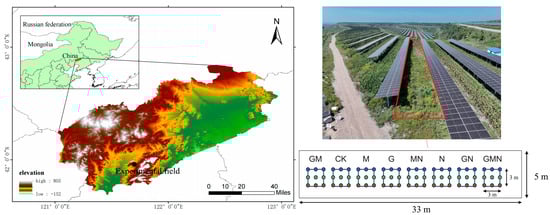
The research area is located at 121°42′21′′ E and 41°57′42′′ N, situated in the ecological restoration zone of coal gangue piles in the western part of Liaoning Province (Figure 1). The terrain in this region is generally undulating, with an elevation of approximately 200 to 250 m. The predominant landform types are eroded residual hills and gentle slopes. The area experiences a typical temperate continental monsoon climate, with an average annual temperature ranging from 7 to 9 °C and annual precipitation of approximately 450 to 550 mm, mainly concentrated between July and September. The potential evaporation exceeds 1500 mm, indicating a significant moisture deficit.
Figure 1.
Information on the experimental site. The experimental plot was located within a photovoltaic agricultural system. The total plot length was 75 m, with photovoltaic panel columns spaced at 13 m intervals. A 33 m section at the center of the plot was selected, within which a 5 m wide open area free from photovoltaic shading was designated as the experimental plot. The nine points indicate nine planted sea buckthorn individuals, and soil samples collected according to color were pooled into one composite sample. CK, control; G, RAE; M, Trichoderma; N, cattle manure; MN, Trichoderma and cattle manure; GM, RAE and Trichoderma; GN, RAE and cattle manure; GMN, RAE and Trichoderma and cattle manure.
2.2. Experimental Design
The experiment adopted a randomized complete block design to evaluate the individual and interactive effects of the residue after evaporation (RAE) from vitamin C production, Trichoderma and well-decomposed cattle manure on the growth of sea buckthorn (Hippophae rhamnoides L.) and soil microbial regulation. Eight treatments were established: CK (control), G (RAE alone), M (Trichoderma alone), N (cattle manure alone), GM (RAE and Trichoderma), GN (RAE and cattle manure), MN (Trichoderma and cattle manure), and GMN (RAE and Trichoderma and cattle manure). The cattle manure used in this study was well-composted manure derived from Simmental cattle, whose diet consisted primarily of maize and wheat bran. In each treatment plot, nine uniformly growing sea buckthorn seedlings were planted and used as replicates, with the individual tree considered as the experimental unit. One-year-old sea buckthorn seedlings were pruned to 40 cm before planting, and transplanted on 4 May. Each treatment was assigned to a 3 m × 3 m plot, with seedlings planted at 1 m × 1 m spacing and 1 m buffer rows maintained between adjacent plots.
RAE was supplied by Northeast Pharmaceutical Group Co., Ltd. (Shenyang, China). The initial pH of RAE was approximately 1, making it unsuitable for direct use in plant cultivation. To minimize soil pH fluctuations, RAE was diluted 200-fold and adjusted to pH 6.3 using NH3·H2O under water-bath conditions prior to application, ensuring that the molecular structure of low-molecular-weight organic acids (LMWOAs) was preserved. After the seedlings had recovered from transplanting, RAE was applied regularly during the growing season from May to August at a rate of 40 mL per plant per application, with an interval of 10 days between applications, for a total of approximately 10 applications. The diluted RAE was applied as a basal drench around each plant to ensure infiltration into the root absorption zone. Trichoderma spp. was obtained from Guangzhou Weiyuan Biotechnology Co., Ltd. (Guangzhou, China). The product was a water-soluble powder containing 2 × 10⁹ viable cells g−1, which is readily activated upon hydration and applied to improve soil health. For the Trichoderma treatment, a commercial Trichoderma spp. formulation was applied at 4 g per plant directly to the root zone in the planting hole on the day of transplanting, followed by backfilling and thorough watering. For the cattle manure treatment, 1000 g per plant of fully decomposed cattle manure was applied in a ring around each plant on the day of transplanting. No additional chemical fertilizers were applied during the sea buckthorn growing period.
2.3. Soil Sampling
Soil sampling was conducted in October 2024. Before collecting soil cores from the 0–20 cm layer, surface litter and debris were removed from each experimental plot. For each treatment, three soil cores were taken from each row of sea buckthorn and thoroughly homogenized to obtain one composite soil sample per row. With three rows per treatment, a total of 24 soil samples were collected. After sampling, visible roots and stones were removed, and the soils were air-dried and passed through a 2 mm sieve. The processed samples were then kept refrigerated during transport to the laboratory and stored at −20 °C until analysis. One subsample was used for determining soil physicochemical properties, and another subsample was used for the assessment of microbial and biological indicators.
2.4. Soil Environment Factor
Soil pH was measured in a 1:2.5 (soil/water) suspension using a glass-electrode pH meter (PHS-3C, INESA, Shanghai, China). Soil organic carbon (SOC) was quantified using the K2Cr2O7–H2SO4 dichromate oxidation method. Soil available nitrogen (AN), phosphorus (AP), and potassium (AK) were determined using the alkaline hydrolysis diffusion method, Bray’s No. 1 method, and ammonium acetate extraction method, respectively [21]. Soil enzyme activities were assessed through established colorimetric techniques [22]. The measurement of urease activity (UE) in the soil was conducted using the sodium hypochlorite colorimetric approach [23]. Sucrase activity (SUC) in soil was evaluated via the 3,5-dinitrosalicylic acid colorimetric technique. Phosphatase activity (PME) in soil was analyzed with the p-nitrophenyl phosphate method. The titration method was employed to determine catalase activity (CAT) in the soil [24].
2.5. DNA Extraction, PCR Amplification, and Sequencing
Total genomic DNA was extracted from 0.5 g of soil using the FastDNA® SPIN Kit for Soil (MP Biomedicals, Santa Ana, CA, USA), following the manufacturer’s instructions. The integrity of the DNA was assessed using 1% agarose gels, while purity and quantity were evaluated with a NanoDrop™ 2000 and a Qubit fluorometer. Qualified DNA was stored at −20 °C. Bacterial communities were profiled by amplifying the V3–V4 region of the 16S rRNA gene using primers 341F (5′-CCTACGGGNGGCWGCAG-3′) and 806R (5′-GGACTACHVGGGTATCTAAT-3′). Libraries were quantified using Qubit and qPCR, and subsequently sequenced by Novogene (Beijing, China) on an Illumina MiSeq platform. Fungal communities were not profiled by ITS sequencing in the present dataset; therefore, fungal community responses and bacteria–fungi interactions are beyond the scope of this work and are suggested for future studies.
2.6. Statistical Analyses
All statistical analyses were conducted using R (version 4.5.1). To mitigate bias arising from variations in sequencing depth, the ASV table was initially rarefied to a uniform depth with the “phyloseq” package. Alpha diversity was computed from the ASV table using the “vegan” package, and intergroup differences were analyzed via one-way ANOVA. When the assumptions of normality (Shapiro–Wilk test) and homogeneity of variance (Levene’s test) were satisfied, Fisher’s LSD post hoc test was employed (two-tailed, α = 0.05). In cases where these assumptions were not met, variables were either log-transformed or analyzed using nonparametric methods. Community composition was aggregated at the phylum and class levels, with the top 10 taxa selected based on average relative abundance, while the remaining taxa were grouped as “Other” for visualization in stacked bar charts. β-diversity was assessed using Bray–Curtis distance, followed by constrained principal coordinate analysis, with significance evaluated through 999 permutation tests and visualized using ggplot2. For community-environment correlation analysis, Pearson correlations were initially calculated for environmental factors, and significance was annotated on the heatmap. Subsequently, Mantel tests were performed to assess the relationship between microbial community distance (Bray–Curtis) and environmental distance (Euclidean) using the “linkET” package. The co-occurrence network retained ASVs that met the specified occurrence frequency threshold. Spearman correlations were computed, and edges were recorded only if they simultaneously met the Bonferroni correction criteria with |R| ≥ 0.85 and p < 0.001. To ensure robust treatment-level networks, subnetworks were generated separately for each replicate sample, and edges consistently present across all replicates were selected as the final edge set for that treatment. Network topology comparisons were conducted by calculating and reporting the number of nodes, number of edges, average degree, and counts of positive and negative edges. Networks were exported in GEXF format and optimized using Gephi (version 0.10.1).
3. Results
3.1. Correlations Between Bacterial Community and Environmental Factors
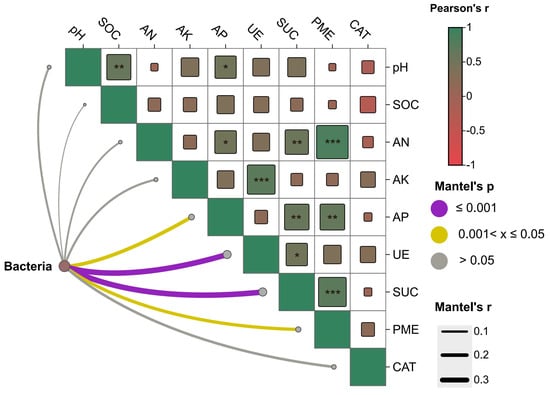
Across all samples, hydrolytic enzyme activities (UE, SUC, PME) were the dominant environmental correlates of bacterial community variation (Mantel, p ≤ 0.001) (Figure 2). Available phosphorus (AP) showed a moderate association (0.01 < p ≤ 0.05), whereas pH, SOC, AN, AK, and catalase (CAT) were not significant (p > 0.05). Pairwise Pearson correlations among edaphic variables were largely positive, with enzyme activities co-varying with nutrient pools (AK/AN/AP) and with each other, while correlations involving SOC or pH were weak or absent (Figure 2). Collectively, these patterns indicate that the proximate gradient structuring bacterial communities aligns with a nutrient-turnover axis defined by C–N–P hydrolysis rather than by single bulk properties.
Figure 2.
Correlation analysis by Mantel’s test. Note, SOC, organic carbon; AN, available nitrogen; AK, available potassium; AP: available phosphorus; UE, urease activity; SUC, sucrase activity; PME, phosphatase activity; CAT, catalase activity. Correlation analysis and Mantel’s test were performed by Spearman’s method. ***, p < 0.001; **, p < 0.01; *, p < 0.05.
3.2. Soil Bacterial Alpha and Beta Diversities
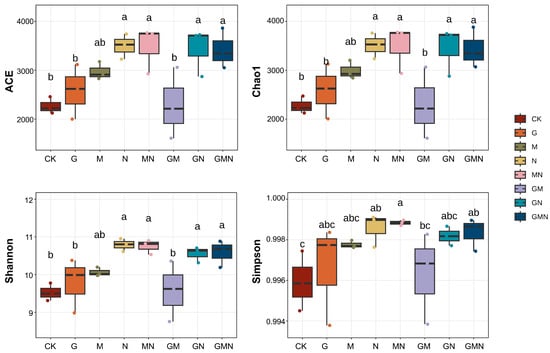
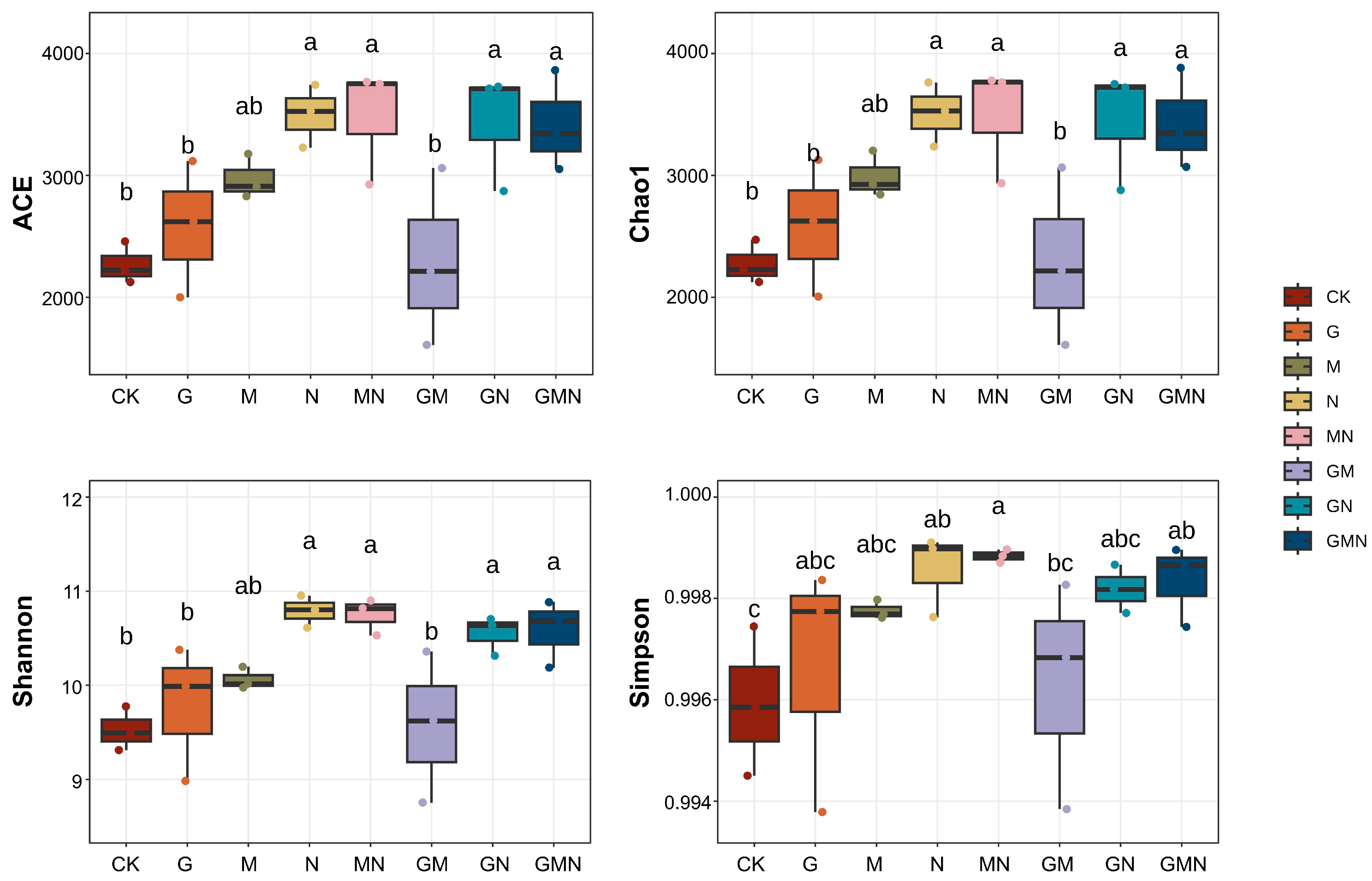
The figure shows the effects of different treatments on soil bacterial α-diversity indices (ACE, Chao1, Shannon, and Simpson) (Figure 3). Compared with CK and G, manure-containing treatments (N, MN, GN, GMN) exhibited significantly higher richness (ACE, Chao1) and diversity (Shannon) (p < 0.05). Among fertilized treatments, GM (RAE and Trichoderma) showed the lowest richness, approaching control levels. Overall, manure application, either alone or in combination with other amendments, markedly enhanced bacterial richness and diversity, while RAE in combination with Trichoderma provided minimal benefits.
Figure 3.
ACE, Chao1, Shannon, and Simpson values of the bacterial communities under different treatments. CK, control; G, RAE; M, Trichoderma; N, cattle manure; MN, Trichoderma and cattle manure; GM, RAE and Trichoderma; GN, RAE and cattle manure; GMN, RAE and Trichoderma and cattle manure. Treatments not sharing any lowercase letters are significantly difference (p < 0.05, LSD test).
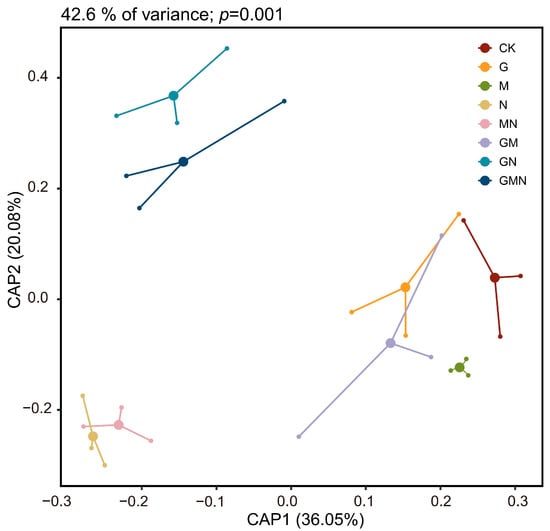
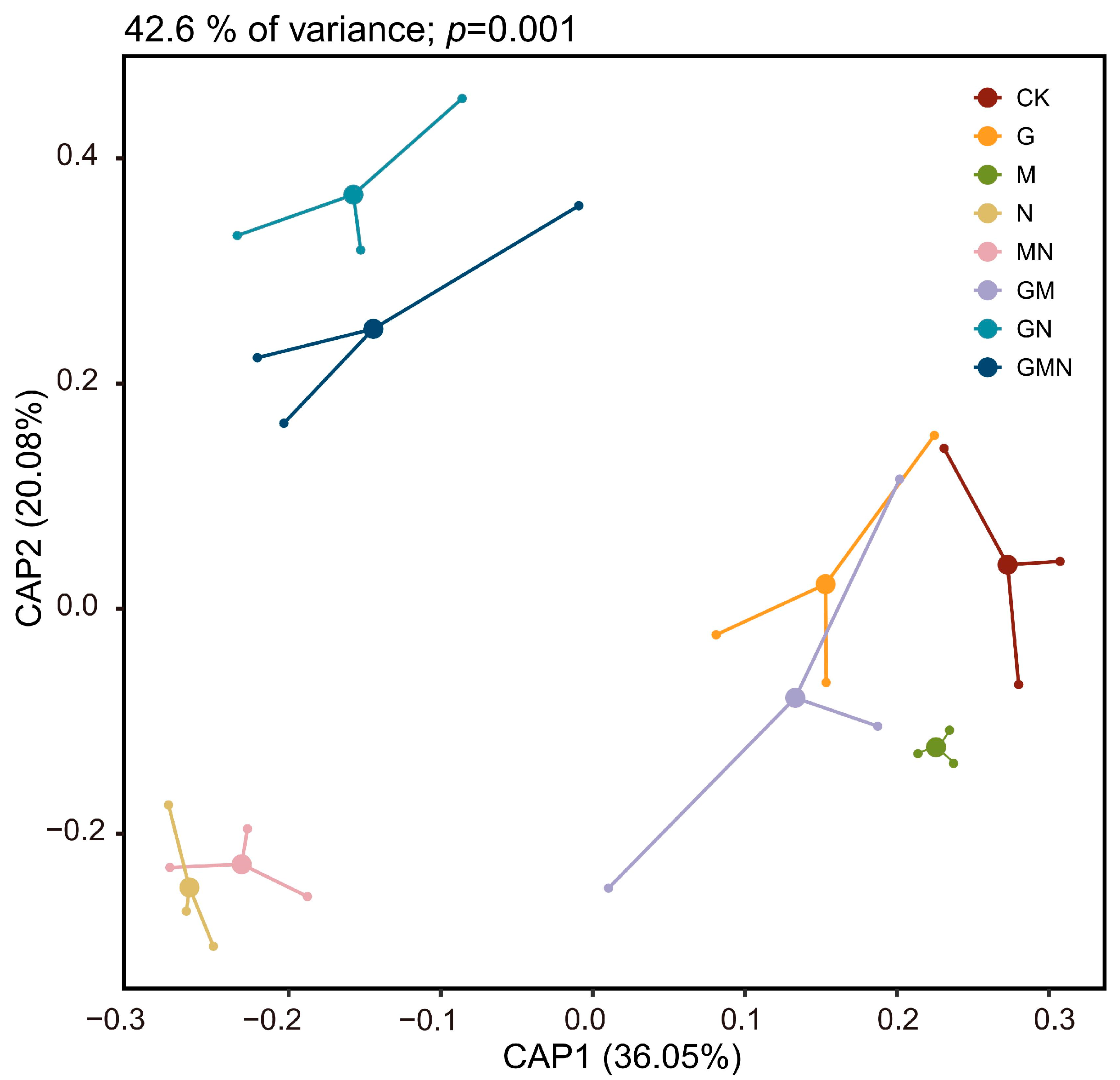
Constrained analysis of principal coordinates (CAP) (Figure 4) revealed clear treatment-wise separations in community composition (CAP1 = 36.05%, CAP2 = 20.06%; p = 0.001). Treatments containing cattle manure (GN, GMN) clustered distinctly from all other groups along CAP2, indicating substantial shifts in bacterial assemblages relative to non-manure treatments. In contrast, RAE–Trichoderma (GM) and manure-free treatments (CK, G, M) were positioned closer together, suggesting greater compositional similarity. The manure-only (N) and manure–Trichoderma (MN) treatments formed a separate cluster along negative CAP1 values, further highlighting the strong influence of manure application on community structure. Combined with α-diversity results, these findings indicate that cattle manure not only enhanced bacterial richness and diversity but also drove pronounced compositional differentiation, whereas RAE in the absence of manure had minimal effects on community structure.
Figure 4.
CAP biplots display the differences in bacterial consortia associated with various treatments. CK, control; G, RAE; M, Trichoderma; N, cattle manure; MN, Trichoderma and cattle manure; GM, RAE and Trichoderma; GN, RAE and cattle manure; GMN, RAE and Trichoderma and cattle manure.
3.3. Bacterial Community Composition at the Phylum and Class Levels
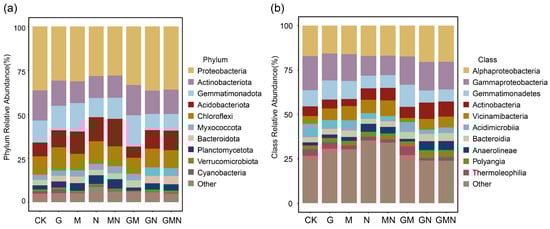
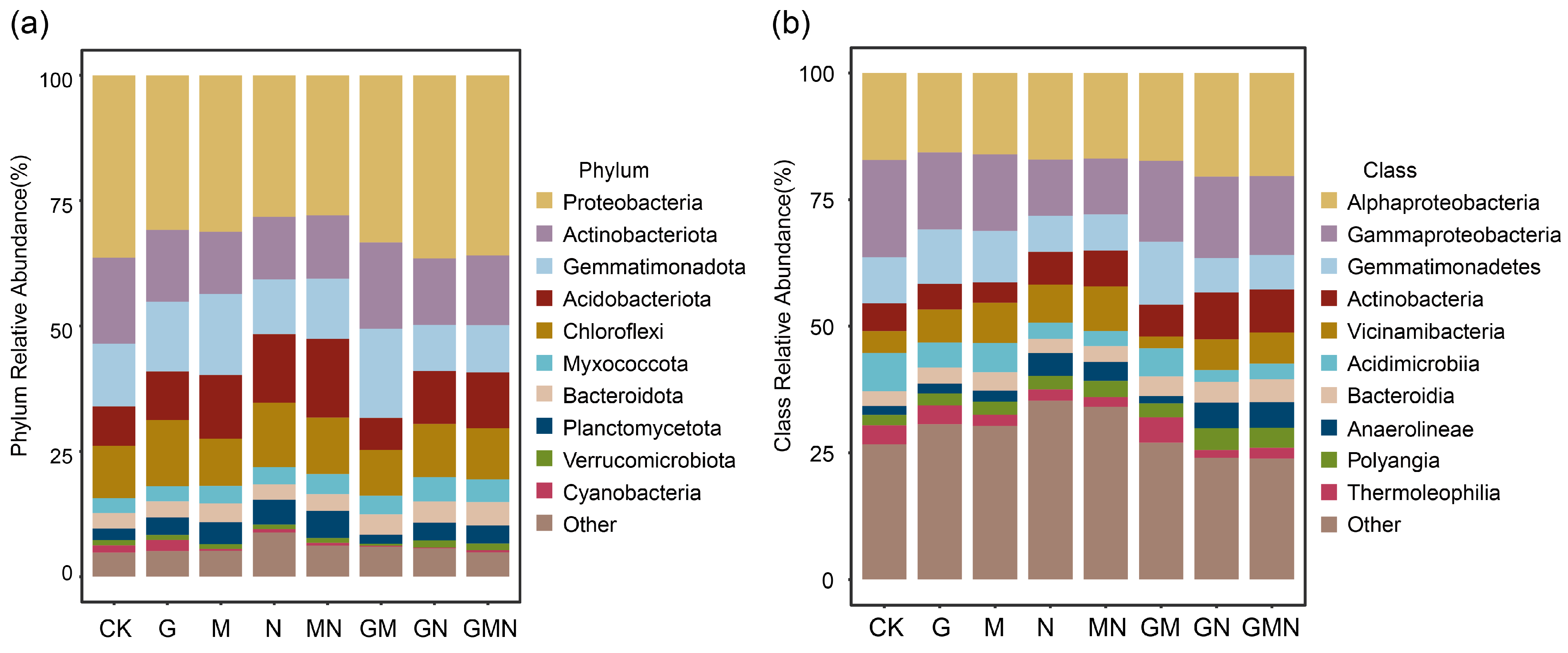
At the phylum level (Figure 5a), the dominant bacterial groups across all treatments were Proteobacteria, Actinobacteriota, Gemmatimonadota, Acidobacteriota, and Chloroflexi, together accounting for the majority of the community composition. Compared with CK, Treatments containing cattle manure (N, MN, GN, GMN), generally exhibited a higher relative abundance of Acidobacteriota accompanied by a lower proportion of Gemmatimonadota. In contrast, GM treatment showed a reduced contribution of Acidobacteriota but relatively higher proportions of Gemmatimonadota than the manure-combined treatments.
Figure 5.
Relative abundance of soil bacterial communities at the phylum (a) and class (b) ranksunder different treatments. CK, control; G, RAE; M, Trichoderma; N, cattle manure; MN, Trichoderma and cattle manure; GM, RAE and Trichoderma; GN, RAE and cattle manure; GMN, RAE and Trichoderma and cattle manure.
At the class level (Figure 5b), Alphaproteobacteria, Gammaproteobacteria, Gemmatimonadetes, Actinobacteria, and Vicinamibacteria were predominant. Treatments containing cattle manure (N, MN, GN, GMN) were characterized by enrichment of Actinobacteria and Vicinamibacteria. The GM treatment contained a relatively lower proportion of Vicinamibacteria and a higher proportion of Gemmatimonadetes. In all treatment groups, Alphaproteobacteria and Gammaproteobacteria consistently occupied significant positions, but their relative proportions varied depending on the different combinations of amendments.
3.4. Modulation of Microbial Network Structure Under Different Treatments
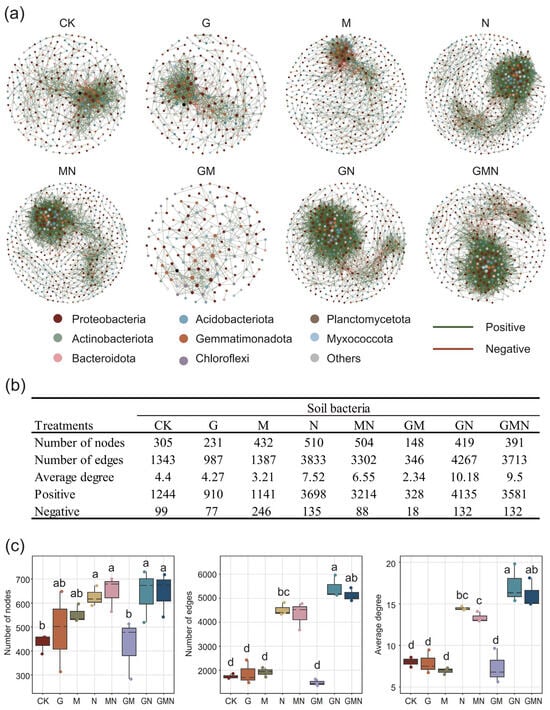
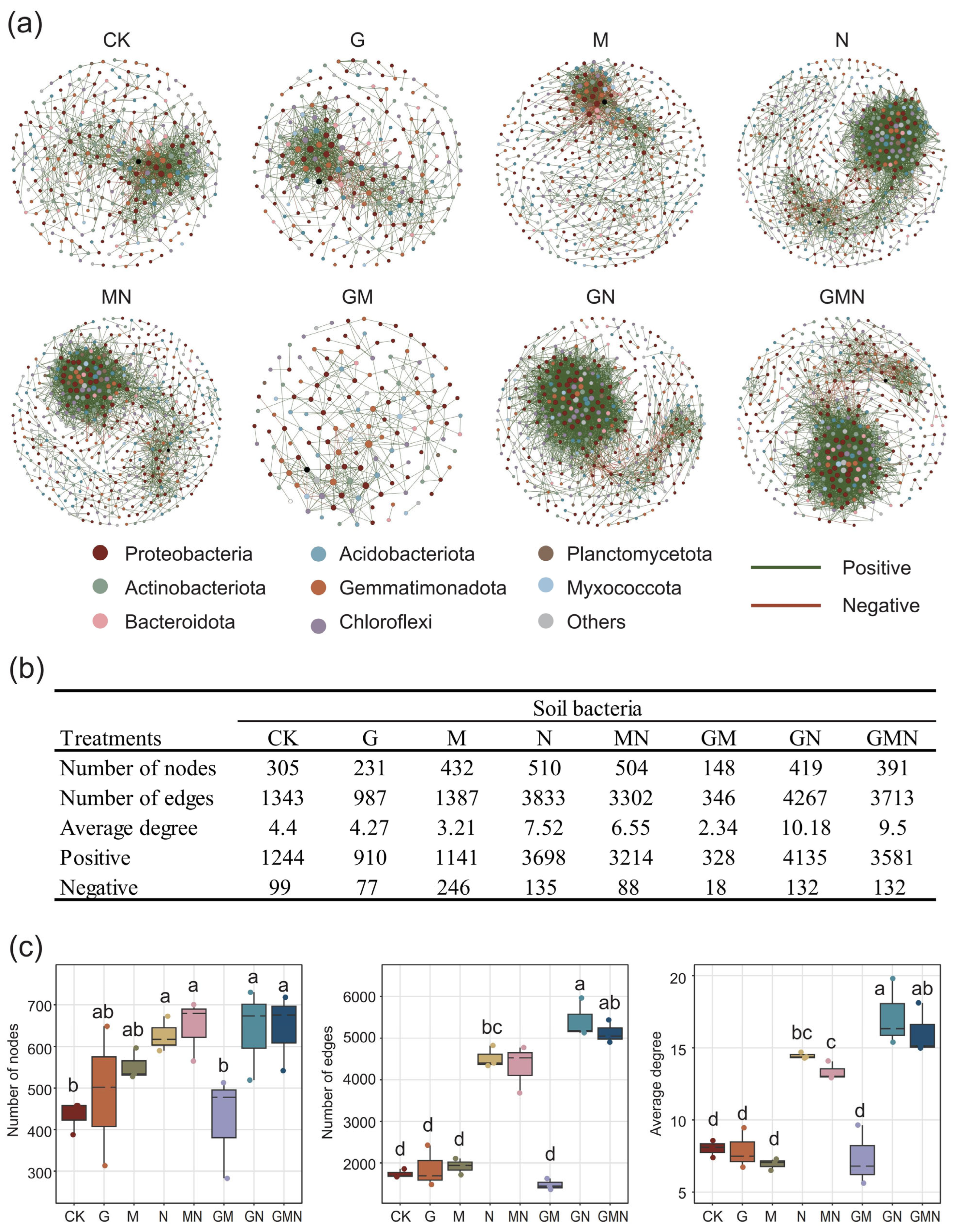
The co-occurrence network analysis demonstrated that treatments involving RAE markedly influenced the structural complexity of soil bacterial communities (Figure 6a). Compared with the control (CK) (231 nodes), the RAE-alone treatment (G) increased the number of nodes to 305 (Figure 6b) and maintained a relatively balanced proportion of positive to negative associations, suggesting that RAE contributed to stabilizing microbial interactions. More strikingly, when RAE was combined with cattle manure and Trichoderma (GN and GMN), the networks exhibited the highest complexity, characterized by dense connections and large numbers of edges (4267 and 3713, respectively) (Figure 6b). These treatments also showed the greatest average degrees (10.18 in GN) (Figure 6b), indicating stronger microbial connectivity and potential cooperative interactions within the soil community. By contrast, the GM treatment yielded a simplified network, suggesting that the beneficial effects of RAE were best realized in the presence of manure.
Figure 6.
Co-occurrence network analysis of soil bacterial communities under different treatments. (a) Network structures at the phylum level, where nodes represent bacterial taxa and edges indicate significant correlations (green: positive; red: negative). (b) Topological properties of bacterial networks, including the number of nodes, edges, and average degree. (c) Boxplots showing statistical comparisons of network metrics across treatments. RAE treatments (G, GN, GMN) notably enhanced network complexity, with GN and GMN exhibiting the highest numbers of edges and average degrees, indicating stronger microbial connectivity and cooperative interactions. Different letters above boxplots denote significant differences among treatments (p < 0.05).
Taken together, these results indicate that manure-derived substrate heterogeneity, especially when combined with RAE (GN and GMN), reinforces cooperative linkages within bacterial communities, whereas pairing RAE with Trichoderma in the absence of manure (GM) likely intensifies resource competition or antagonism, leading to network simplification.
4. Discussion
4.1. Organic Amendments Regulate Microbial α-Diversity Through Resource Availability and Niche Differentiation
The observed increases in α-diversity (Figure 3) under manure-based treatments (N, MN, GN, GMN) suggest that the addition of organic substrates enriched the soil environment with heterogeneous carbon and nutrient pools [25], thereby broadening ecological niches and supporting the coexistence of diverse microbial taxa [26]. Manure is particularly rich in both labile and recalcitrant organic compounds [27], which can be differentially utilized by fast- and slow-growing microorganisms, promoting niche complementarity and enhancing community richness [28]. In contrast, the GM treatment, combining RAE with Trichoderma, showed reduced diversity, which may be attributed to selective resource competition [14]. RAE is rich in soluble carbohydrates and organic acids, which could be preferentially consumed by Trichoderma, leading to the suppression of bacterial groups that rely on similar carbon sources [29]. Moreover, certain metabolites secreted by Trichoderma (e.g., secondary metabolites with antimicrobial activity) might further inhibit sensitive bacterial taxa [30]. RAE alone produced bacterial communities broadly comparable to the control, indicating that its primary value lies in modulating manure-driven responses rather than independently restructuring communities. These findings highlight that the effects of organic amendments on microbial diversity is also influenced by interactions between substrate quality and microbial functional traits [31,32,33].
4.2. Resource Quality and Microbial Functional Guilds Drive Shifts in Community Composition
CAP ordination (Figure 4) indicated that community composition segregated primarily along a manure-driven resource-quality axis, consistent with selective enrichment by organic amendments [8]. In manure-containing treatments, Acidobacteriota increased whereas Gemmatimonadota decreased at the phylum level, while Actinobacteria [34] and Vicinamibacteria were enriched at the class level (Figure 5). This pattern suggests that manure input did not simply promote copiotrophic taxa through nutrient enrichment. Instead, it likely increased humified organic matter, enhanced spatial heterogeneity, and strengthened environmental filtering [35]. This enrichment indicates a selective stimulation of functional groups involved in organic matter transformation and efficient resource use, driven by the complex substrates and nutrients supplied by manure.
In contrast, the GM treatment showed lower Acidobacteriota but higher Gemmatimonadota, together with a decline in Vicinamibacteria. This pattern implies that fungal involvement reshaped bacterial assembly. Trichoderma may pre-process the inputs, release metabolites, and alter competitive interactions. As a result, the community may shift toward taxa better adapted to fungus-driven carbon flow and changes in substrate spectra, indicating a fungus-channeled carbon flow that disfavors bacterial decomposers [36]. The presence of Gemmatimonadota remained comparatively stable across treatments, suggesting tolerance to edaphic stress and limited sensitivity to short-term changes in carbon quality [37]. These guild transitions align with CAP separations (Figure 4), where GN/GMN clustered away from non-manure treatments, reinforcing the interpretation that substrate heterogeneity—not bulk soil properties—drives community reassembly [28].
With respect to the persistence of the exogenous Trichoderma, our bacterial community patterns indicate a strong dependence on resource context. The Trichoderma-only treatment (M) clustered close to CK and G in CAP ordination (Figure 4), suggesting a limited long-term imprint on bacterial community structure in this low-fertility reclaimed soil when applied without additional complex substrates. By contrast, co-application with RAE (GM) reduced bacterial richness (Figure 3) and simplified the co-occurrence network (Figure 6a), which is consistent with stronger ecological activity and/or competitive effects of Trichoderma when labile carbon is available.
Mechanistically, manure provides a broad spectrum of substrates, ranging from soluble monomers to structural polymers, thereby expanding metabolic niche space and enabling niche complementarity between fast- and slow-growing strategists [38,39]. This observation aligns with the enzyme-defined turnover axis (UE, SUC, PME) (Figure 2), which best explains community variation [22]. In contrast, GM likely combines the resource monopolization of RAE’s labile acids and carbohydrates by Trichoderma with potential antagonism from fungal secondary metabolites, thereby restricting bacterial access to labile carbon and compressing decomposer guilds [40,41].
4.3. Microbial Interactions Underpin Changes in Network Complexity and Ecosystem Functioning
Co-occurrence analyses (Figure 6a) showed that manure—particularly when combined with RAE (GN, GMN)—substantially increased network connectivity, evidenced by higher node numbers, more edges, and greater average degree, which is consistent with previous studies [42,43]. The predominance of positive associations (>85%) (Figure 6b) indicates that diverse organic substrates promoted metabolic cross-feeding and cooperation [44], thereby increasing functional redundancy and the potential buffering capacity of the community [45]. In contrast, the GM treatment produced a simplified co-occurrence network. Interaction breadth declined and ecological buffering weakened [46]. Mechanistically, limited substrate diversity and the preferential uptake of labile carbon by Trichoderma curtailed complementary bacterial metabolism [39,45]. After explicitly incorporating resource interactions, the structure of resource supply constrains co-feeding and network stability [47].
Linking network patterns to community assembly, manure-derived substrate heterogeneity expanded niche space [48,49] and selected copiotrophic decomposer guilds (e.g., Actinobacteria, Gammaproteobacteria) [50]. This, in turn, reinforced cooperative linkages and enhanced connectivity under GN/GMN. The counter pattern in GM aligns with resource monopolization and/or antagonism by Trichoderma [51], suppressing decomposers and restricting metabolic handoffs among bacteria, thereby simplifying the network. Under the manure and RAE treatment, α-diversity is higher, decomposers are enriched, and positive links are denser. These signals point to a resource-mediated mechanism. Amendment quality drives communities toward cooperative, redundancy-rich networks that sustain nutrient turnover and ecosystem functioning [52].
5. Conclusions
Manure-derived substrate heterogeneity was the main factor shaping soil bacterial communities by expanding niche space, enhancing α-diversity, and shifting key guilds such as Actinobacteria and Acidobacteriota. Co-application of manure and RAE (GN, GMN) promoted cooperative microbial networks with higher connectivity and functional redundancy, whereas RAE combined with Trichoderma without manure (GM) simplified networks through resource competition. Overall, RAE functioned as a key co-driver of microbial cooperation when integrated with manure, rather than as a standalone driver. RAE-based amendments, particularly when integrated with manure, are effective strategies for improving soil microbial functionality in degraded ecosystems.
A limitation of the present work is that microbial community profiling was restricted to bacteria, and therefore we did not characterize fungal community responses or bacteria–fungi interaction networks under the different organic amendment and Trichoderma treatments. Given the functional importance of fungi in litter turnover and soil aggregation, future studies should incorporate ITS-based fungal profiling to evaluate how fungal taxa, including Trichoderma, interact with bacteria to shape microbiome assembly in reclaimed coal gangue soils.
In addition, direct tracking of the exogenous Trichoderma across time would allow estimation of survival dynamics and colonization success, and help link inoculant persistence to the observed shifts in bacterial community structure, enzyme activities, and network properties.
Author Contributions
Z.Z.: Formal analysis, writing—original draft, and visualization. T.K.: Conceptualization, methodology, and writing—review and editing. H.C.: Software, investigation, and data curation. G.L. and S.B.: resources, validation, and data curation. L.X.: Conceptualization, methodology, and supervision. All authors have read and agreed to the published version of the manuscript.
Funding
This research was funded by Applied Basic Research Program of Liaoning Province (2025JH2/101300071).
Institutional Review Board Statement
Not applicable.
Informed Consent Statement
Not applicable.
Data Availability Statement
The original contributions presented in this study are included in the article. Further inquiries can be directed to the corresponding author.
Acknowledgments
We thank the reviewers and editors for their helpful comments regarding the manuscript.
Conflicts of Interest
The authors declare no conflicts of interest.
References
- Ren, Q.; Qiang, F.; Liu, G.; Liu, C.; Ai, N. Response of Soil Quality to Ecosystems after Revegetation in a Coal Mine Reclamation Area. CATENA 2025, 257, 109038. [Google Scholar] [CrossRef] [Scilit]
- Chen, Z.; Yang, Y.; Zhou, L.; Hou, H.; Zhang, Y.; Liang, J.; Zhang, S. Ecological Restoration in Mining Areas in the Context of the Belt and Road Initiative: Capability and Challenges. Environ. Impact Assess. Rev. 2022, 95, 106767. [Google Scholar] [CrossRef] [Scilit]
- Brooker, R.W. Plant–Plant Interactions and Environmental Change. New Phytol. 2006, 171, 271–284. [Google Scholar] [CrossRef] [Scilit] [PubMed]
- Moreira-Grez, B.; Muñoz-Rojas, M.; Kariman, K.; Storer, P.; O’Donnell, A.G.; Kumaresan, D.; Whiteley, A.S. Reconditioning Degraded Mine Site Soils with Exogenous Soil Microbes: Plant Fitness and Soil Microbiome Outcomes. Front. Microbiol. 2019, 10, 1617. [Google Scholar] [CrossRef] [Scilit]
- Gnayem, N.; Magadley, E.; Haj-Yahya, A.; Masalha, S.; Kabha, R.; Abasi, A.; Barhom, H.; Matar, M.; Attrash, M.; Yehia, I. Examining the Effect of Different Photovoltaic Modules on Cucumber Crops in a Greenhouse Agrivoltaic System: A Case Study. Biosyst. Eng. 2024, 241, 83–94. [Google Scholar] [CrossRef] [Scilit]
- Tan, Y.; Liu, J.; Li, W.; Yin, J.; Chen, H.; Peng, Y.; Tan, J.; Wei, M. Agrivoltaics Development Progresses: From the Perspective of Photovoltaic Impact on Crops, Soil Ecology and Climate. Environ. Res. 2025, 266, 120540. [Google Scholar] [CrossRef] [Scilit]
- Meng, R.; Meng, Z.; Jia, R.; Li, H.; Cai, J.; Gao, Y. Positive Soil Responses to Different Vegetation Restoration Measures in Desert Photovoltaic Power Stations. Front. Plant Sci. 2025, 16, 1607404. [Google Scholar] [CrossRef] [Scilit]
- Francioli, D.; Schulz, E.; Lentendu, G.; Wubet, T.; Buscot, F.; Reitz, T. Mineral vs. Organic Amendments: Microbial Community Structure, Activity and Abundance of Agriculturally Relevant Microbes Are Driven by Long-Term Fertilization Strategies. Front. Microbiol. 2016, 7, 1446. [Google Scholar] [CrossRef] [Scilit]
- Jiao, S.; Lu, Y.; Wei, G. Soil Multitrophic Network Complexity Enhances the Link between Biodiversity and Multifunctionality in Agricultural Systems. Global Change Biol. 2022, 28, 140–153. [Google Scholar] [CrossRef] [Scilit]
- Ma, T.; He, X.; Chen, S.; Li, Y.; Huang, Q.; Xue, C.; Shen, Q. Long-Term Organic–Inorganic Fertilization Regimes Alter Bacterial and Fungal Communities and Rice Yields in Paddy Soil. Front. Microbiol. 2022, 13, 890712. [Google Scholar] [CrossRef] [Scilit]
- Cheng, H.; Sun, H.; Yang, W.; Gao, M.; Zhao, X.; Xu, H. Harnessing Vitamin C Industrial Byproducts for Sustainable Agriculture: Improved Soil Quality and Maize Production in Degraded Semi-Arid Farmlands. Agronomy 2025, 15, 897. [Google Scholar] [CrossRef] [Scilit]
- Wang, B.; Sun, H.; Yang, W.; Gao, M.; Zhong, X.; Zhang, L.; Chen, Z.; Xu, H. Potential Utilization of Vitamin C Industrial Effluents in Agriculture: Soil Fertility and Bacterial Community Composition. Sci. Total Environ. 2022, 851, 158253. [Google Scholar] [CrossRef] [Scilit] [PubMed]
- Gao, P.; Qi, K.; Han, Y.; Ma, L.; Zhang, B.; Zhang, Y.; Guan, X.; Qi, J. Effect of Trichoderma Viride on Rhizosphere Microbial Communities and Biocontrol of Soybean Root Rot. Front. Microbiol. 2023, 14, 1204688. [Google Scholar] [CrossRef] [Scilit] [PubMed]
- Chen, X.; Lu, Y.; Liu, X.; Gu, Y.; Li, F. Trichoderma: Dual Roles in Biocontrol and Plant Growth Promotion. Microorganisms 2025, 13, 1840. [Google Scholar] [CrossRef] [Scilit]
- Cheng, H.; Gao, M.; Yang, W.; Sun, H.; Kong, T.; Xu, H. Combined Application of Organic Wastes and Trichoderma Longibraciatum to Promote Vegetation Restoration and Soil Quality on Mining Waste Dump Sites. Plant Soil 2025, 508, 567–588. [Google Scholar] [CrossRef] [Scilit]
- Vinale, F.; Sivasithamparam, K.; Ghisalberti, E.L.; Marra, R.; Woo, S.L.; Lorito, M. Trichoderma–Plant–Pathogen Interactions. Soil Biol. Biochem. 2008, 40, 1–10. [Google Scholar] [CrossRef] [Scilit]
- Elias, D.M.O.; Mason, K.E.; Goodall, T.; Taylor, A.; Zhao, P.; Otero-Fariña, A.; Chen, H.; Peacock, C.L.; Ostle, N.J.; Griffiths, R.; et al. Microbial and Mineral Interactions Decouple Litter Quality from Soil Organic Matter Formation. Nat. Commun. 2024, 15, 10063. [Google Scholar] [CrossRef] [Scilit]
- Delgado-Baquerizo, M.; Maestre, F.T.; Reich, P.B.; Jeffries, T.C.; Gaitan, J.J.; Encinar, D.; Berdugo, M.; Campbell, C.D.; Singh, B.K. Microbial Diversity Drives Multifunctionality in Terrestrial Ecosystems. Nat. Commun. 2016, 7, 10541. [Google Scholar] [CrossRef] [Scilit]
- Fierer, N. Embracing the Unknown: Disentangling the Complexities of the Soil Microbiome. Nat. Rev. Microbiol. 2017, 15, 579–590. [Google Scholar] [CrossRef] [Scilit]
- Trivedi, P.; Delgado-Baquerizo, M.; Trivedi, C.; Hu, H.; Anderson, I.C.; Jeffries, T.C.; Zhou, J.; Singh, B.K. Microbial Regulation of the Soil Carbon Cycle: Evidence from Gene–Enzyme Relationships. ISME J. 2016, 10, 2593–2604. [Google Scholar] [CrossRef] [Scilit]
- Li, J.; Wei, Z.; Tao, L.; Zhong, J.; Liu, X.; Ji, J.; Lan, X.; Hou, H.; Feng, Z.; Xiao, J.; et al. Impact of Organic Fertilization Strategies on Soil Bacterial Community and Honey Pomelo (Citrus Maxima) Properties. Agronomy 2024, 14, 2244. [Google Scholar] [CrossRef] [Scilit]
- Sinsabaugh, R.L.; Lauber, C.L.; Weintraub, M.N.; Ahmed, B.; Allison, S.D.; Crenshaw, C.; Contosta, A.R.; Cusack, D.; Frey, S.; Gallo, M.E.; et al. Stoichiometry of Soil Enzyme Activity at Global Scale. Ecol. Lett. 2008, 11, 1252–1264. [Google Scholar] [CrossRef] [Scilit] [PubMed]
- Sun, L.; Zhang, J.; Zhao, J.; Lu, X.; Xiao, C.; Xiao, Z.; Zhang, T.; Gu, Y.; Sun, H.; Liu, H.; et al. Effects of Cinnamomum Camphora Coppice Planting on Soil Fertility, Microbial Community Structure and Enzyme Activity in Subtropical China. Front. Microbiol. 2023, 14, 1104077. [Google Scholar] [CrossRef] [Scilit] [PubMed]
- Guan, S.Y.; Zhang, D.; Zhang, Z. Soil Enzyme and Its Research Methods; Chinese Agricultural Press: Beijing, China, 1986; pp. 274–297. [Google Scholar]
- Cui, J.; Yang, B.; Zhang, M.; Song, D.; Xu, X.; Ai, C.; Liang, G.; Zhou, W. Investigating the Effects of Organic Amendments on Soil Microbial Composition and Its Linkage to Soil Organic Carbon: A Global Meta-Analysis. Sci. Total Environ. 2023, 894, 164899. [Google Scholar] [CrossRef] [Scilit]
- Guo, Z.; Lv, L.; Liu, D.; He, X.; Wang, W.; Feng, Y.; Islam, M.d.S.; Wang, Q.; Chen, W.; Liu, Z.; et al. A Global Meta-Analysis of Animal Manure Application and Soil Microbial Ecology Based on Random Control Treatments. PLoS ONE 2022, 17, e0262139. [Google Scholar] [CrossRef] [Scilit]
- Yang, X.; Zhang, S.; Wu, D.; Huang, Y.; Zhang, L.; Liu, K.; Wu, H.; Guo, S.; Zhang, W. Recalcitrant Components Accumulation in Dissolved Organic Matter Decreases Microbial Metabolic Quotient of Red Soil under Long-Term Manuring. Sci. Total Environ. 2024, 934, 173287. [Google Scholar] [CrossRef] [Scilit]
- Prosser, J.I.; Martiny, J.B.H. Conceptual Challenges in Microbial Community Ecology. Philos. Trans. R. Soc. B Biol. Sci. 2020, 375, 20190241. [Google Scholar] [CrossRef] [Scilit]
- Sood, M.; Kapoor, D.; Kumar, V.; Sheteiwy, M.S.; Ramakrishnan, M.; Landi, M.; Araniti, F.; Sharma, A. Trichoderma: The “Secrets” of a Multitalented Biocontrol Agent. Plants 2020, 9, 762. [Google Scholar] [CrossRef] [Scilit]
- Zhang, Y.-Q.; Zhang, S.; Sun, M.-L.; Su, H.-N.; Li, H.-Y.; Liu, K.; Zhang, Y.-Z.; Chen, X.-L.; Cao, H.-Y.; Song, X.-Y. Antibacterial Activity of Peptaibols from Trichoderma Longibrachiatum SMF2 against Gram-Negative Xanthomonas Oryzae Pv. Oryzae, the Causal Agent of Bacterial Leaf Blight on Rice. Front. Microbiol. 2022, 13, 1034779. [Google Scholar] [CrossRef] [Scilit]
- Shu, X.; Liu, W.; Huang, H.; Ye, Q.; Zhu, S.; Peng, Z.; Li, Y.; Deng, L.; Yang, Z.; Chen, H.; et al. Meta-Analysis of Organic Fertilization Effects on Soil Bacterial Diversity and Community Composition in Agroecosystems. Plants 2023, 12, 3801. [Google Scholar] [CrossRef] [Scilit]
- Whalen, E.D.; Grandy, A.S.; Geyer, K.M.; Morrison, E.W.; Frey, S.D. Microbial Trait Multifunctionality Drives Soil Organic Matter Formation Potential. Nat. Commun. 2024, 15, 10209. [Google Scholar] [CrossRef] [Scilit] [PubMed]
- Jiao, S.; Peng, Z.; Qi, J.; Gao, J.; Wei, G. Linking Bacterial-Fungal Relationships to Microbial Diversity and Soil Nutrient Cycling. mSystems 2021, 6, e01052-20. [Google Scholar] [CrossRef] [Scilit] [PubMed]
- Li, F.; Chen, L.; Zhang, J.; Yin, J.; Huang, S. Bacterial Community Structure after Long-Term Organic and Inorganic Fertilization Reveals Important Associations between Soil Nutrients and Specific Taxa Involved in Nutrient Transformations. Front. Microbiol. 2017, 8, 187. [Google Scholar] [CrossRef] [Scilit] [PubMed]
- Salam, L.B. Metagenomic Insights into the Microbial Community Structure and Resistomes of a Tropical Agricultural Soil Persistently Inundated with Pesticide and Animal Manure Use. Folia Microbiol. 2022, 67, 707–719. [Google Scholar] [CrossRef] [Scilit]
- Zhang, F.; Xu, X.; Huo, Y.; Xiao, Y. Trichoderma-Inoculation and Mowing Synergistically Altered Soil Available Nutrients, Rhizosphere Chemical Compounds and Soil Microbial Community, Potentially Driving Alfalfa Growth. Front. Microbiol. 2019, 9, 3241. [Google Scholar] [CrossRef] [Scilit]
- DeBruyn, J.M.; Nixon, L.T.; Fawaz, M.N.; Johnson, A.M.; Radosevich, M. Global Biogeography and Quantitative Seasonal Dynamics of Gemmatimonadetes in Soil. Appl. Environ. Microbiol. 2011, 77, 6295–6300. [Google Scholar] [CrossRef] [Scilit]
- Nielsen, K.; Roß, C.-L.; Hoffmann, M.; Muskolus, A.; Ellmer, F.; Kautz, T. The Chemical Composition of Biogas Digestates Determines Their Effect on Soil Microbial Activity. Agriculture 2020, 10, 244. [Google Scholar] [CrossRef] [Scilit]
- Park, J.; Cho, K.H.; Ligaray, M.; Choi, M.-J. Organic Matter Composition of Manure and Its Potential Impact on Plant Growth. Sustainability 2019, 11, 2346. [Google Scholar] [CrossRef] [Scilit]
- Guzmán-Guzmán, P.; Etesami, H.; Santoyo, G. Trichoderma: A Multifunctional Agent in Plant Health and Microbiome Interactions. BMC Microbiol. 2025, 25, 434. [Google Scholar] [CrossRef] [Scilit]
- Khan, R.A.A.; Najeeb, S.; Hussain, S.; Xie, B.; Li, Y. Bioactive Secondary Metabolites from Trichoderma Spp. against Phytopathogenic Fungi. Microorganisms 2020, 8, 817. [Google Scholar] [CrossRef] [Scilit]
- Wu, X.; Hu, H.; Li, S.; Zhao, J.; Li, J.; Zhang, G.; Li, G.; Xiu, W. Chemical Fertilizer Reduction with Organic Material Amendments Alters Co-Occurrence Network Patterns of Bacterium-Fungus-Nematode Communities under the Wheat–Maize Rotation Regime. Plant Soil 2022, 473, 605–623. [Google Scholar] [CrossRef] [Scilit]
- Ren, L.; Lv, J.; Zhang, F.; Dou, B.; Li, L.; Wang, Y.; Zhang, Y. Integrated Fertilization with Organic Manure and Trichoderma Enhances Wheat Productivity and Soil Nutrient Availability. Front. Plant Sci. 2025, 16, 1687216. [Google Scholar] [CrossRef] [Scilit]
- Gong, X.; Jarvie, S.; Wen, J.; Su, N.; Yan, Y.; Liu, Q.; Zhang, Q. Compared with Soil Fungal Diversity and Microbial Network Complexity, Soil Bacterial Diversity Drives Soil Multifunctionality during the Restoration Process. J. Environ. Manag. 2024, 354, 120379. [Google Scholar] [CrossRef] [Scilit] [PubMed]
- Chen, X.; Zhang, J.; Xia, W.; Shao, Y.; Liu, Z.; Guo, J.; Qin, W.; Wan, L.; Liu, J.; Liu, Y.; et al. Influence of Cover Crop Root Functional Traits on Sweet Potato Yield and Soil Microbial Communities. Microorganisms 2025, 13, 471. [Google Scholar] [CrossRef] [Scilit] [PubMed]
- Wagg, C.; Schlaeppi, K.; Banerjee, S.; Kuramae, E.E.; Van Der Heijden, M.G.A. Fungal-Bacterial Diversity and Microbiome Complexity Predict Ecosystem Functioning. Nat. Commun. 2019, 10, 4841. [Google Scholar] [CrossRef] [Scilit]
- Butler, S.; O’Dwyer, J.P. Stability Criteria for Complex Microbial Communities. Nat. Commun. 2018, 9, 2970. [Google Scholar] [CrossRef] [Scilit]
- Hoek, T.A.; Axelrod, K.; Biancalani, T.; Yurtsev, E.A.; Liu, J.; Gore, J. Resource Availability Modulates the Cooperative and Competitive Nature of a Microbial Cross-Feeding Mutualism. PLoS Biol. 2016, 14, e1002540, Erratum in PLoS Biol. 2017, 15, e1002606. [Google Scholar] [CrossRef] [Scilit]
- Heikkinen, J.; Ketoja, E.; Seppänen, L.; Luostarinen, S.; Fritze, H.; Pennanen, T.; Peltoniemi, K.; Velmala, S.; Hanajik, P.; Regina, K. Chemical Composition Controls the Decomposition of Organic Amendments and Influences the Microbial Community Structure in Agricultural Soils. Carbon Manag. 2021, 12, 359–376. [Google Scholar] [CrossRef] [Scilit]
- Fierer, N.; Bradford, M.A.; Jackson, R.B. Toward an Ecological Classification of Soil Bacteria. Ecology 2007, 88, 1354–1364. [Google Scholar] [CrossRef] [Scilit]
- Harman, G.E.; Howell, C.R.; Viterbo, A.; Chet, I.; Lorito, M. Trichoderma Species—Opportunistic, Avirulent Plant Symbionts. Nat. Rev. Microbiol. 2004, 2, 43–56. [Google Scholar] [CrossRef] [Scilit]
- Wagg, C.; Bender, S.F.; Widmer, F.; Van Der Heijden, M.G.A. Soil Biodiversity and Soil Community Composition Determine Ecosystem Multifunctionality. Proc. Natl. Acad. Sci. USA 2014, 111, 5266–5270. [Google Scholar] [CrossRef] [Scilit]
Disclaimer/Publisher’s Note: The statements, opinions and data contained in all publications are solely those of the individual author(s) and contributor(s) and not of MDPI and/or the editor(s). MDPI and/or the editor(s) disclaim responsibility for any injury to people or property resulting from any ideas, methods, instructions or products referred to in the content. |
© 2025 by the authors. Licensee MDPI, Basel, Switzerland. This article is an open access article distributed under the terms and conditions of the Creative Commons Attribution (CC BY) license.