

Design, Modeling, and Experimental Study of a Constant-Force Floating Compensator for a Grinding Robot

 ,
,  ,
, 

Abstract
1. Introduction
- (1)
- Eccentric load-aware compensation. The tool’s eccentric loading encountered during grinding is explicitly incorporated into the controller’s design, enabling stable constant force control even under torque disturbances of at least 27 N·m.
- (2)
- Utilization of nonlinear sealing stiffness. The nonlinear spring effect of the compensator’s sealing cover is introduced into the compensation mechanism, allowing for the effective use of displacement sensor feedback and improving force accuracy during passive floating on complex and highly varying surfaces.
- (3)
- High integration and enhanced engineering practicality. The proposed design achieves a nominal force density of 105.2 N/kg and a ±25 mm floating stroke and integrates an STM32-based control box with redundant communication and simplified connection, eliminating the need for an end force sensor and supporting rapid deployment.
2. Design of the CFFC
2.1. Driving Principle of the CFFC
2.2. Mechanical Structure Integration Design of the CFFC
- (1)
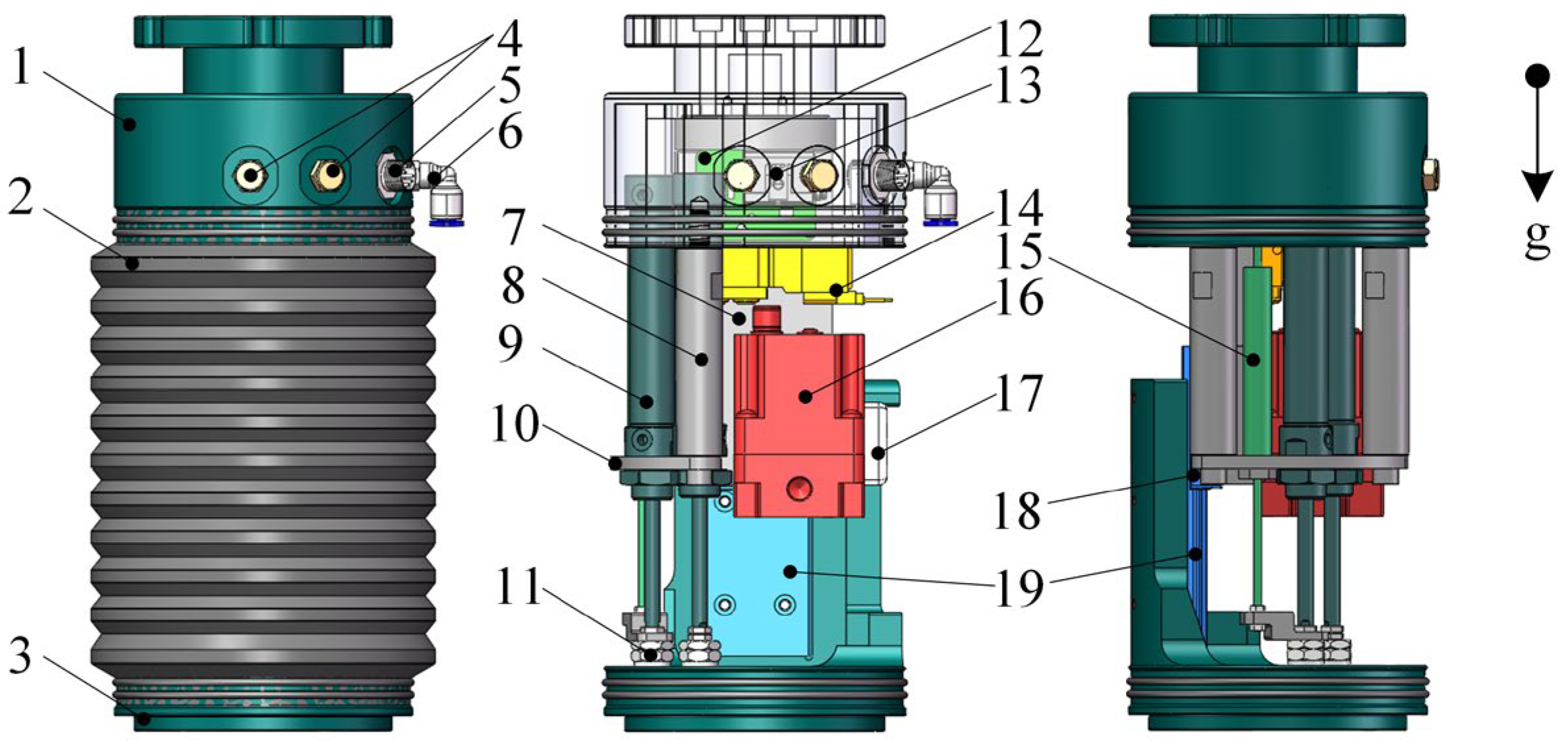
- The structural components include a robot connection flange (1), which is used to install the CFFC to the end of a robot (tool moving and grinding-deployment scheme) or fix it on a workbench (workpiece moving and grinding-deployment scheme). One end of the rail mounting plate (7) is fixedly connected to the interior of the one-robot connection flange (1), used for fixing the slider and internal components of the linear rail. The linear guide rail (19) is installed on the tool connection flange (3), and the two become the main moving parts. Its axial movement range is limited by the limit block (17) installed on the side of the guide rail installation (7) plate and the slot length on the side of the tool connection flange (3), to avoid cylinder damage caused by overtravel movement. The end of the flange (3) connected to the tool can be equipped with various grinding tools. One end of the two columns (8) is installed on the robot connection flange (1), and the other end is equipped with a cylinder mounting plate (10).
- (2)
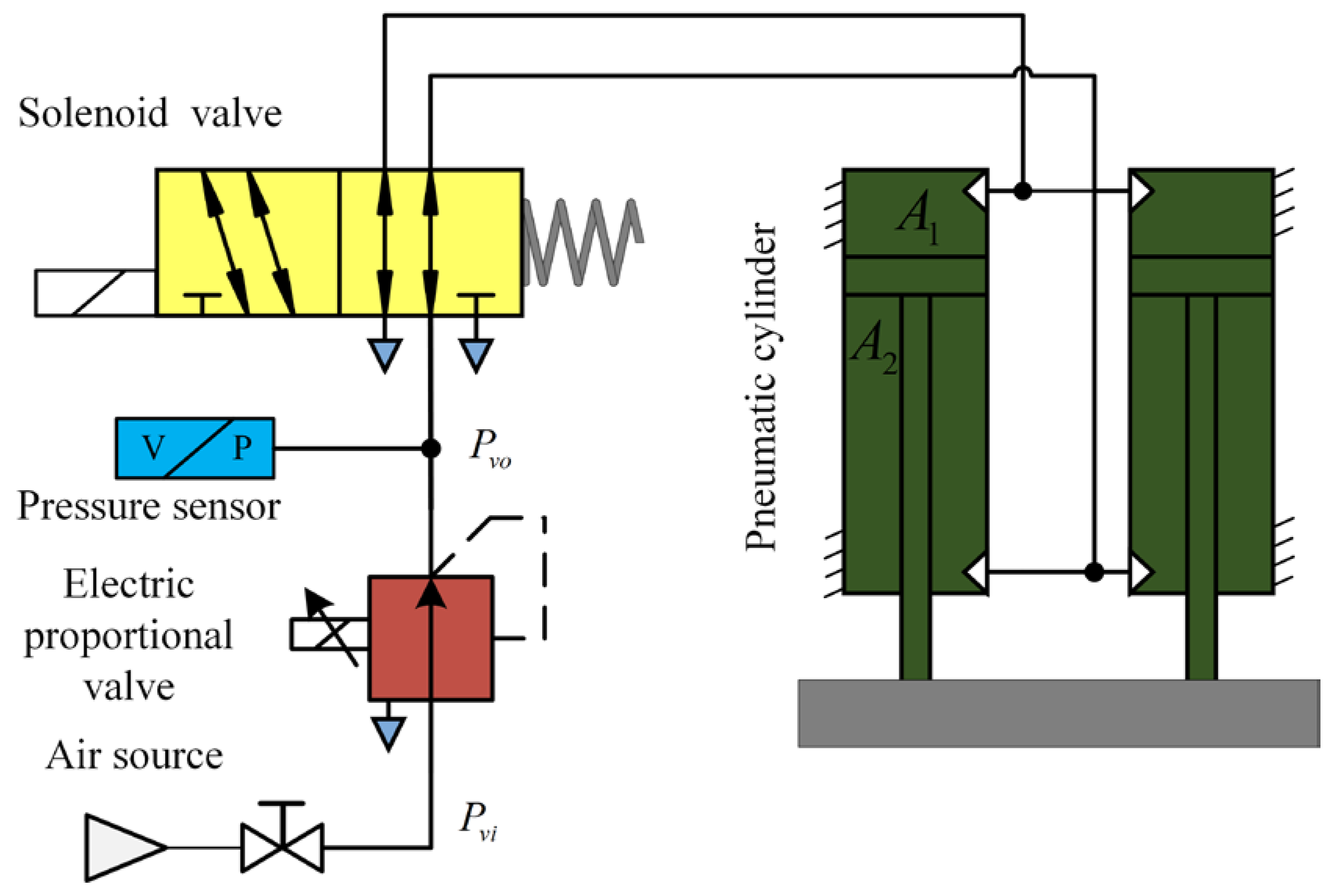
- The pneumatic components mainly include two cylinders (9; one end fixed with threads) installed on the cylinder mounting plate (10), and their piston rod ends are connected to a tool connection flange (3) through a floating hinge (11). The floating hinge (11) can move radially and swing axially to a certain extent, thereby compensating for the installation error between the cylinder and the guide rail and avoiding jamming. The solenoid valve (14) and electrical proportional valve (16) are both fixed on the rail mounting plate (7), achieving full utilization of the internal space of the CFFC.
- (3)
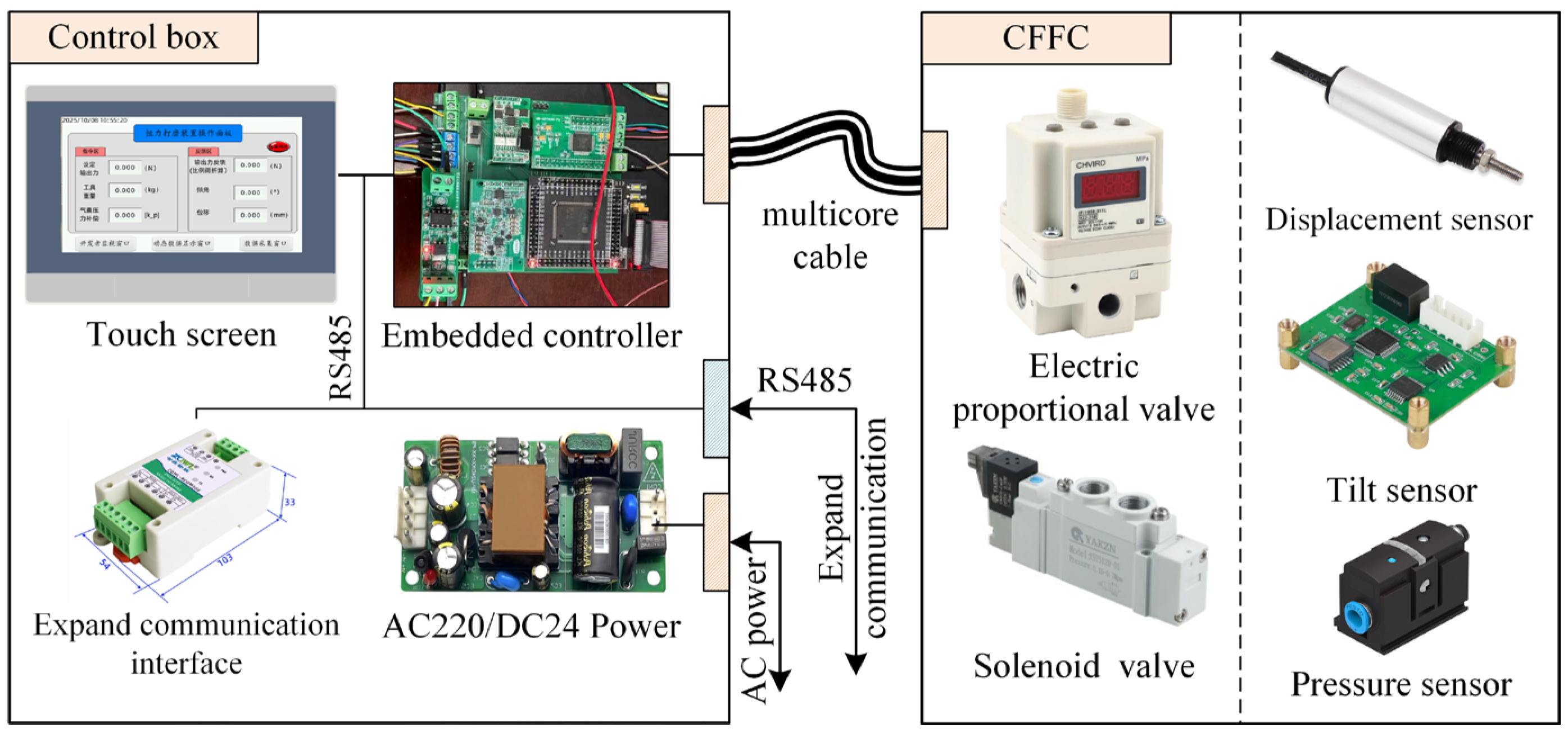
- The sensors include a tilt sensor (12), which is installed at the fixed end of the rail mounting plate (7) to measure the tilt angle of the CFFC relative to its vertical axis. The pressure sensor (13) is also fixed on the rail mounting plate (7) and connected in parallel to the pipeline between the outlet of the electrical proportional valve and the inlet of the solenoid valve by a pneumatic hose, indirectly measuring the interaction force acting on the CFFC. The housing of the displacement sensor (15) is fixed to the cylinder mounting plate (10) with its end threaded, and the end of the motion rod is connected to the piston rod of the cylinder (9) to measure the expansion and contraction displacement of the CFFC.
- (4)
- The accessories include a sealing cover (2), customized from rubber material, fixed at both ends on the robot connection flange (1) and the tool connection flange (3) to prevent dust pollution of the moving parts of the CFFC during grinding. Its natural length is designed to be within the effective stroke of the CFFC. The muffler (4) is installed on the robot connection flange (1) and used to balance the internal air pressure changes during the expansion and contraction process of the sealing cover (2). A bus connector (5) is designed on the robot connection flange (1), which aggregates the circuits of electronic components inside the CFFC to achieve bus interaction with the control box. The air source connector (6) is also installed on the robot connection flange (1) and connected internally to the inlet of the electrical proportional valve through a hose. The connector can rotate around the circumference to avoid pipeline damage or bending, which may cause blockage of the air path.
2.3. Electrical Control System Design for CFFC
3. Mathematic Model of the CFFC
3.1. Pneumatic Model of Electrical Proportional Valve
3.2. Dynamic Model of Cylinder Pressure
3.3. Macro Dynamic Model of the CFFC
3.4. Transfer Function and System Characteristics of the CFFC
4. Controller Design for CFFC
4.1. Analysis of Adverse Factors for Force Control
4.2. Dual-Loop Force Controller Based on ADRC
4.2.1. Design of Tracking Differentiator (TD)
4.2.2. Design of Extended State Observer (ESO)
4.2.3. Design of Dual-Loop PI Controller
| Algorithm 1. ADRC-based Dual-Loop (DL-ADRC) Force Control. |
| Inputs: F_set[k], P_vo[k], x_p[k], theta[k], Ts |
| Outputs: u_v[k] |
| 1. Initialization: TD states (r1, r2), ESO states (x1, x2, x3), and PI integrals (e_F, e_P). |
| 2. For k = 0, 1, 2, … do |
| 3.//Tracking Differentiator (TD) |
| Update r1[k+1], r2[k+1] from r1[k], r2[k], F_set[k] for reference generation. |
| 4.//Force estimation and gravity compensation |
| F_hat[k] ← x1[k] − G(theta[k]). |
| 5.//Outer-loop force error |
| e_F[k] ← r1[k] − F_hat[k]. |
| 6.//Outer-loop PI |
| P_ref[k] ← Kpf × e_F[k] + Kif × (e_F accumulated). |
| 7.//Inner-loop pressure error |
| e_P[k] ← P_ref[k] − P_vo[k]. |
| 8.//Pressure PI |
| u_PI[k] ← Kpp × e_P[k] + Kip × (e_P accumulated). |
| 9.//ESO (inner-loop disturbance observer) |
| Update x1[k], x2[k], x3[k] using x_p[k] and u_PI[k]. |
| 10.//Disturbance compensation |
| u_v[k] ← u_PI[k] − x3[k]/b0. |
| 11.//Saturation |
| u_v[k] ← clamp(u_v[k], u_min, u_max). |
| 12. Update all states and integrals. |
| 13. END For |
| 14. Return u_v[k]. |
4.3. Simulation Analysis for the CFFC
5. Prototype and Experiments
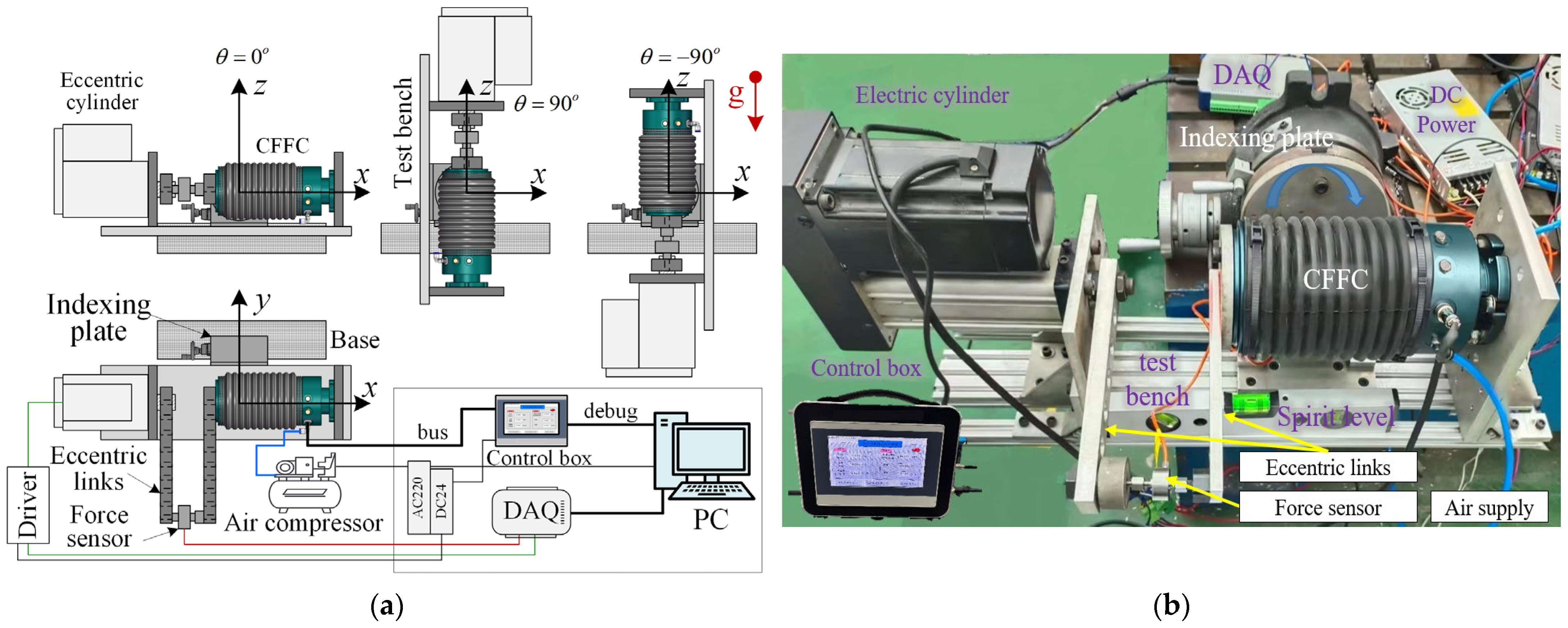
5.1. Experimental Condition Configuration
5.2. Controller Parameters Tuning
- (1)
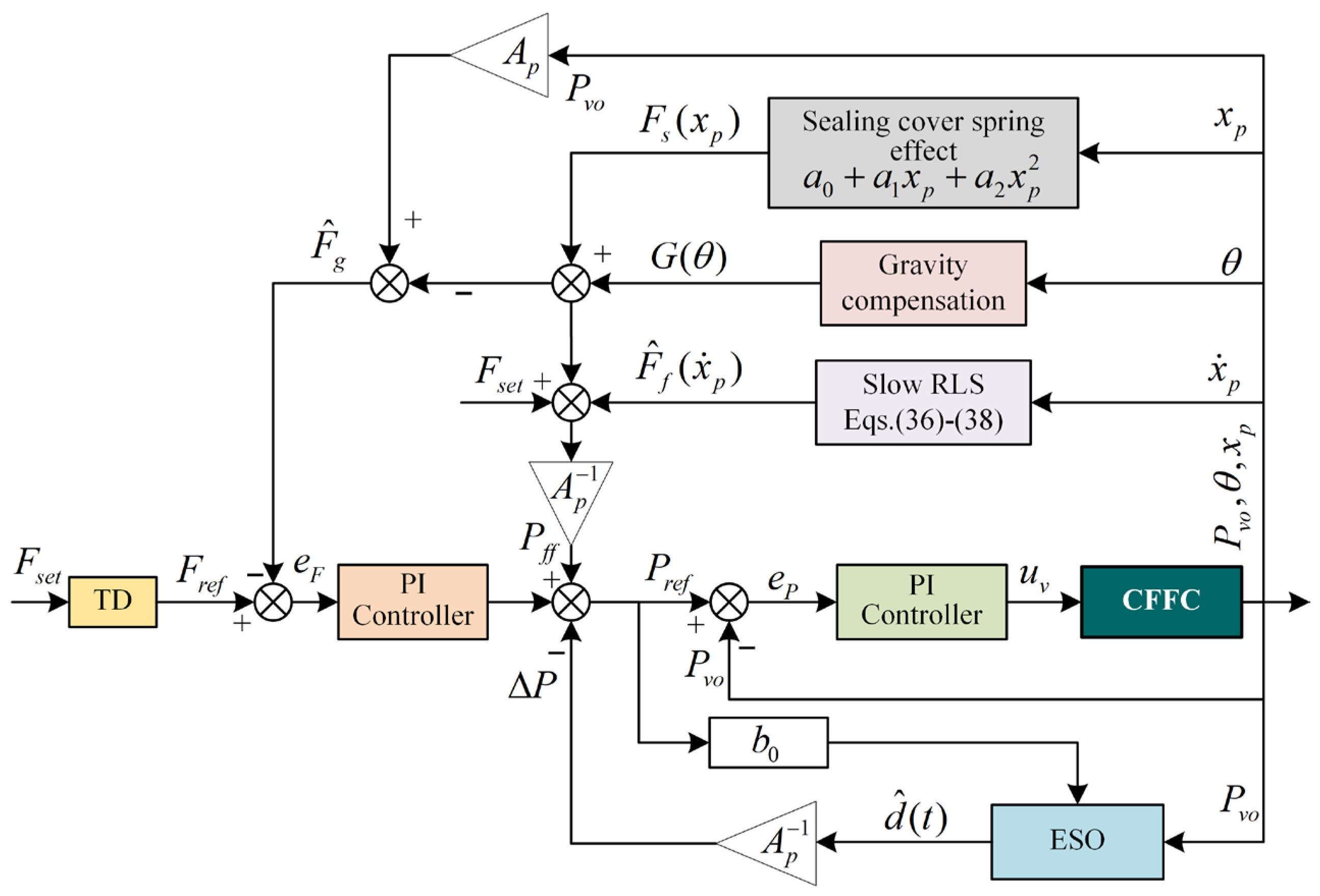
- To ensure high speed and stable pressure tracking in the inner loop, the bandwidth of the controller can be set to . The inner-loop bandwidth is set to . The PI controller of the pressure loop shown in Figure 8 is initialized to , . We performed a step response to avoid excessive noise until the response time reaches the expected value (about ), overshoot < 10%, and steady-state error < 0.1 bar. The inner loop PI parameters are finally tuned to , . Meanwhile, apply a small step current command , record the pressure increment , and preliminarily determine the initial parameter of the ESO as .
- (2)
- The parameters of the force loop PI controller shown in Figure 8 are initialized to , . Note that at this point, the estimation of total disturbance by the ESO should be turned off, that is, temporarily set to . Due to differences in design, installation, and other factors, if there is significant overshoot or oscillation in the response, a certain differential needs to be introduced, and the differential gain can refer to . The tuning goal is still to make the output force response time close to , with minimal overshoot and no low-frequency oscillations.
- (3)
- Enable the ESO and set . Apply a small step signal to observe whether the transition of is reasonable. If the response of is slow, increase appropriately. If contains a large amount of high-frequency noise or jitter, reduce or even introduce a filter. In the end, the gain of ESO follows , , . Furthermore, the input gain can be refined, following the principle of reducing if the pressure response overshoot is too large and, finally, set .
- (4)
- Introducing the feedforward compensation, the key parameters of RLSs are initialized to , . Then, in several floating runs of the CFFC, the convergence behavior of parameter is observed. If the convergence is slow, the forgetting factors of or can be reduced. If oscillation occurs, a low-pass filter can be introduced, and the final tuning result of this experiment is , .
5.3. Basic Performance Testing
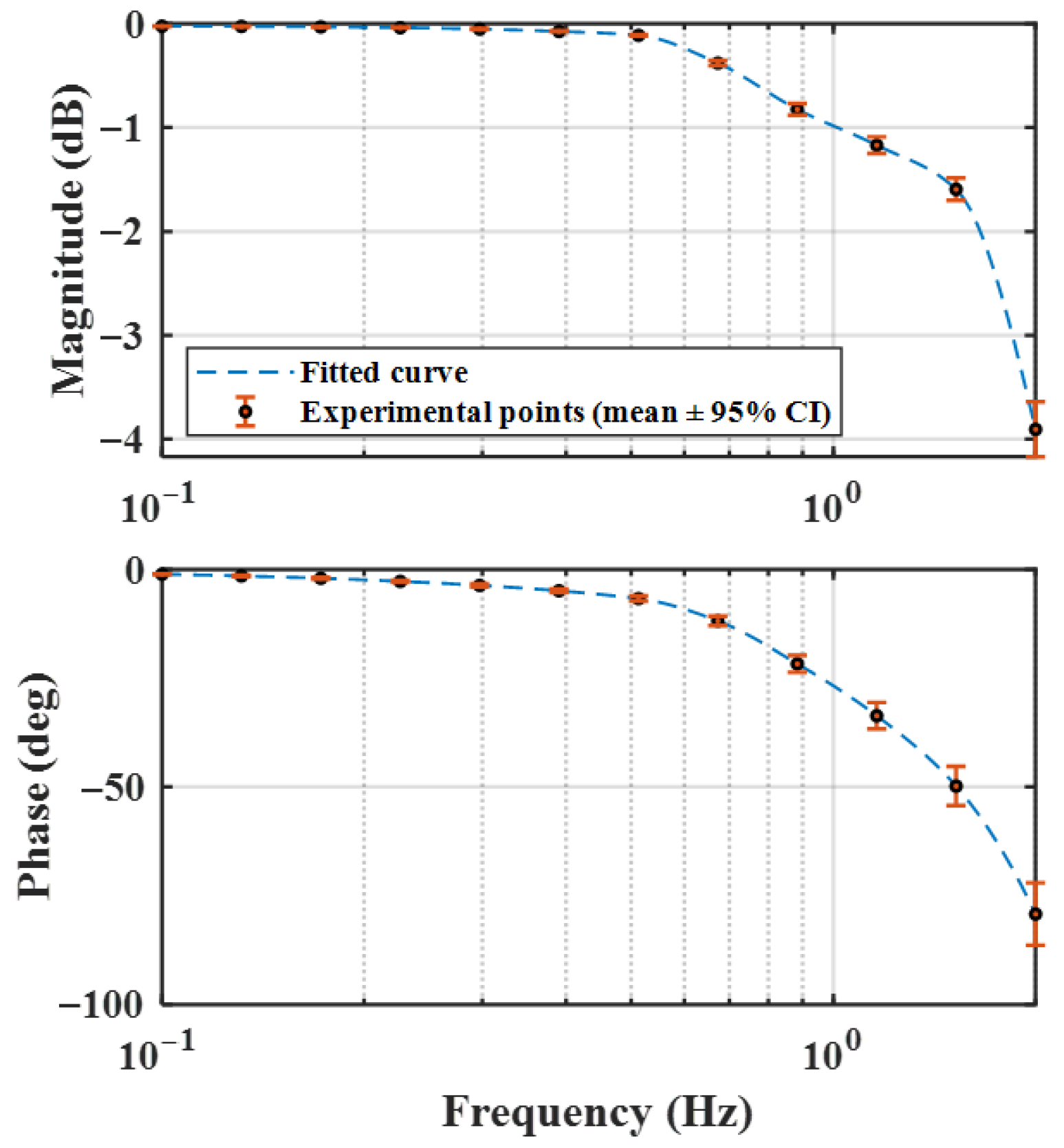
5.3.1. Frequency Response Test
5.3.2. Step Response and Force-Tracking Tests
5.4. Constant Force Control Testing
5.4.1. Constant Force Control Under Passive Floating Condition
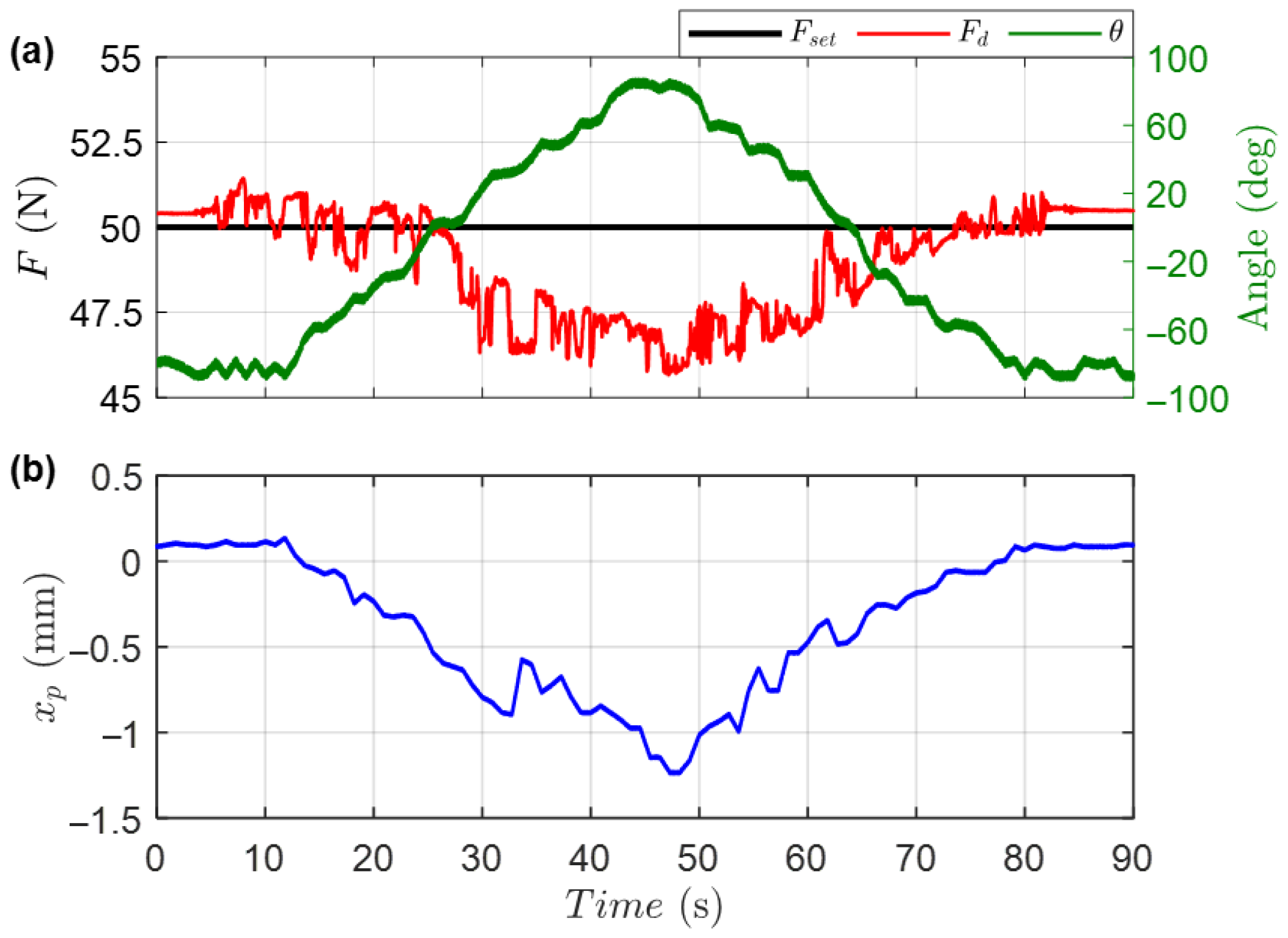
5.4.2. Constant Force Control Under Attitude Change Condition
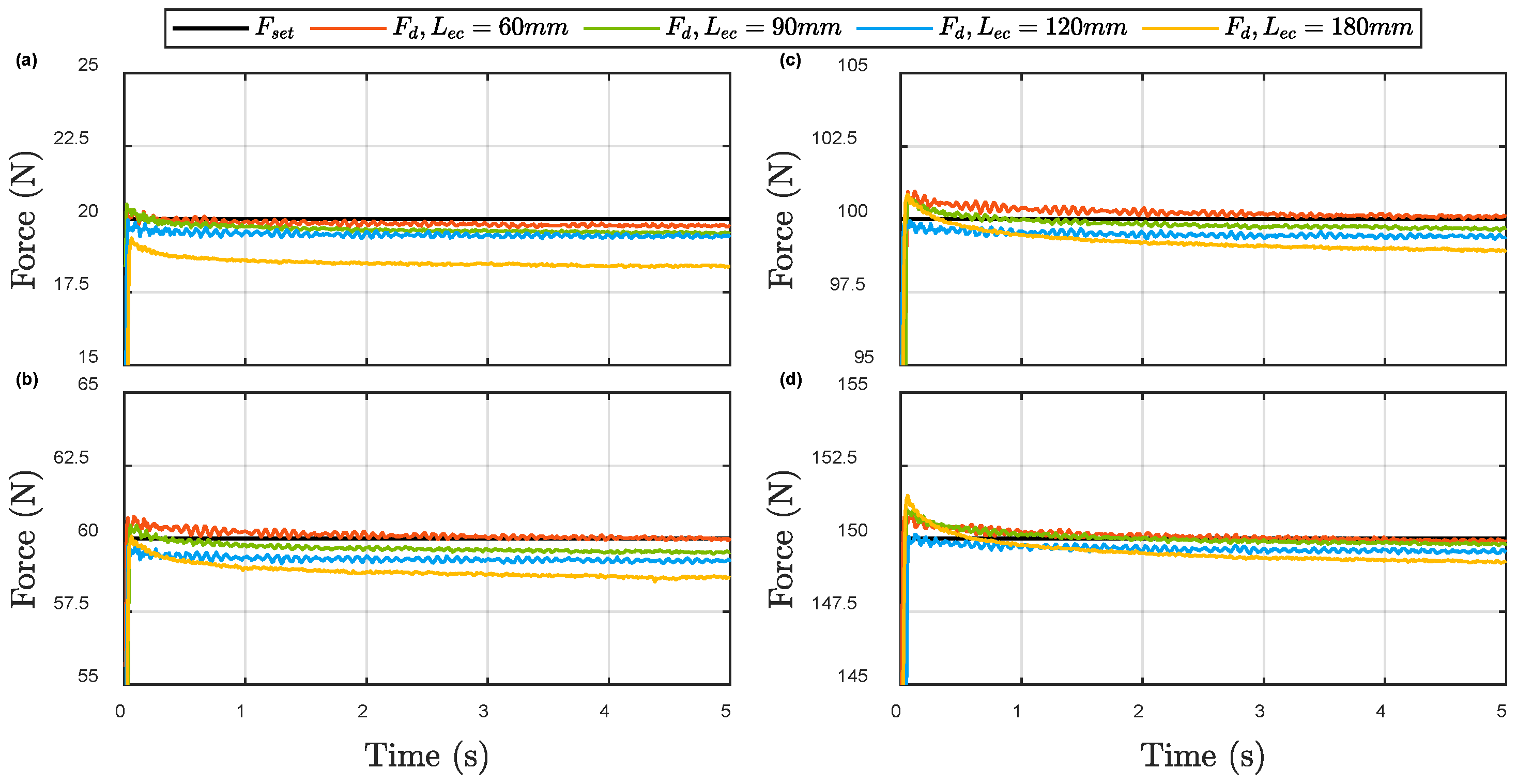
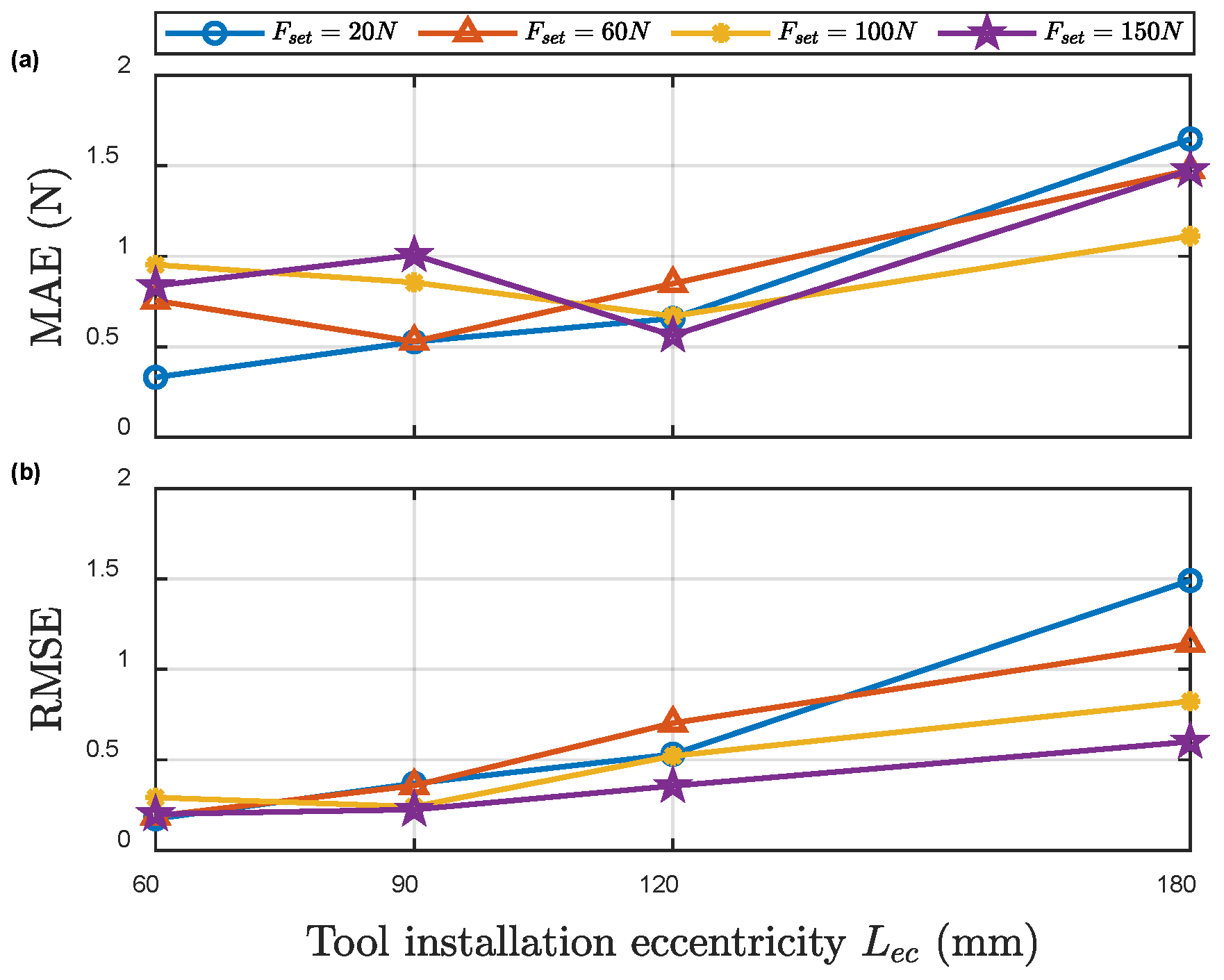
5.4.3. Constant Force Control Under Biased Load Installation Condition
6. Discussion
6.1. Grinding System Errors with the CFFC from Robot and Calibration Methods
- (1)
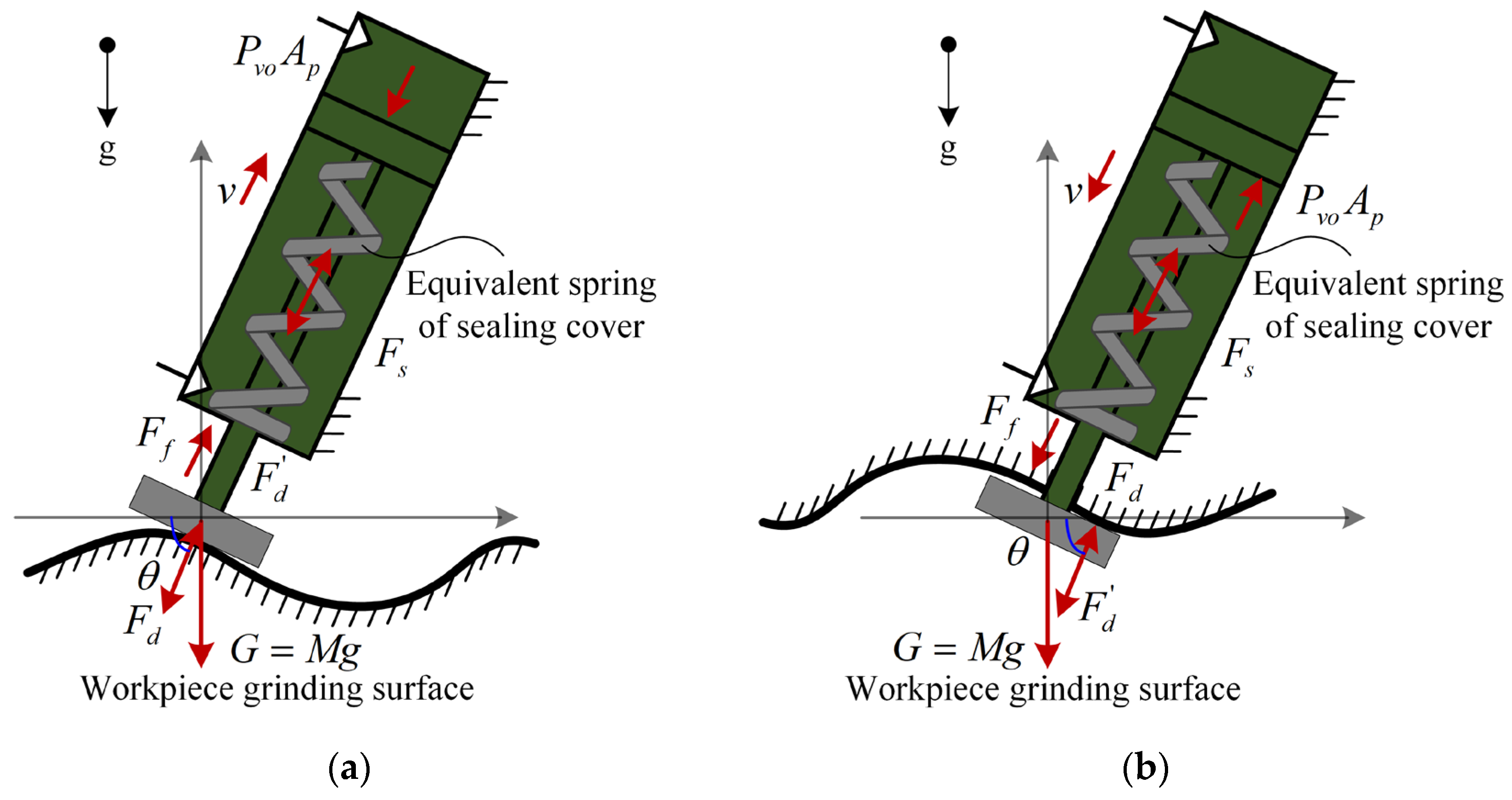
- After installation of the CFFC and grinding tool, the robot requires a standard tool-center-point (TCP) calibration so that the end-effector geometry and compliance are correctly reflected in the robot’s kinematic chain. As shown in Figure 4a, if the CFFC is operating in extended mode, it is recommended to adjust its output force to the maximum to fully extend it to the stroke limit and maintain stability and then perform TCP calibration. On the contrary, as shown in Figure 4b, if the CFFC is operating in retraction mode, it is recommended to open the solenoid valve and adjust its output force to the maximum to fully retract it to the stroke limit and maintain stability, and then perform TCP calibration. If necessary, it is recommended to use a reference force sensor to finely calibrate the bias force in its system installation state.
- (2)
- Using inertial recognition programs from robot manufacturers or external weighing sensors can help eliminate joint torque deviations caused by gravity and improve the accuracy of the robot’s internal dynamic model.
- (3)
- Since the CFFC does not use direct force sensors, the pneumatic pressure is mapped to the end effector force through a calibration model. If necessary, it is recommended to perform a force calibration step for the end effector to further improve the accuracy of force control. This can be achieved offline by using a reference six-axis F/T sensor to improve pressure force mapping, or online by utilizing joint torque feedback and small probing motion to compensate for force deviations during grinding.
- (4)
- Robot path-planning errors may cause deviations from the desired surface normal, leading to force direction errors. These effects can be reduced by geometric calibration of the workpiece and robot pose with high-precision measurement methods and path-correction methods. If necessary, multiple CFFCs can be configured along the compensation direction to achieve constant-force floating compensation for multiple degrees of freedom.
6.2. Tuning Strategy and Sensitivity Analysis of the Proposed Controller
6.3. Limitations of the Proposed System
7. Conclusions
Author Contributions
Funding
Institutional Review Board Statement
Informed Consent Statement
Data Availability Statement
Conflicts of Interest
Abbreviations
| CFFC | Constant-Force Floating Compensator |
| CFC | Constant Force Control |
| PID | Proportion-Integral-Derivate |
| RLS | Recursive Least Square |
| ADRC | Active Disturbance Rejection Control |
| ESO | Extended State Observer |
| TD | Tracking Differentiator |
| HMI | Human Machine Interaction |
| The flow rate of the proportional valve | |
| The inlet and outlet air pressures of the electrical proportional valve | |
| The driving side air pressure of the cylinder | |
| The gain controlled by the proportional valve amplifier | |
| The gain of outlet air pressure and flow rate | |
| The control analog voltage for the electrical proportional valve | |
| The internal leakage flow rate of the cylinder | |
| The air density | |
| The effective working area of the piston on the cylinder drive side | |
| The piston displacement | |
| V, V0 | The volume and initial volume of the cylinder drive chamber |
| M | The equivalent floating motion mass |
| The viscous damping coefficient | |
| The tilt angle of the CFFC | |
| The mass of the internal leakage in the cylinder | |
| The ideal and specific air constant | |
| T | The air temperature |
| The atmospheric pressure and the absolute pressure | |
| The equivalent stiffness of the compensator | |
| The grinding force or grinding contact reaction force | |
| The equivalent elastic force of the sealing cover | |
| The equivalent frictional force | |
| The instantaneous steady-state constant | |
| The desired set force | |
| The gravity along the axis of the cylinder |
References
- Li, J.; Guan, Y.; Chen, H.; Wang, B.; Zhang, T. Robotic Polishing of Unknown-Model Workpieces with Constant Normal Contact Force Control. IEEE/ASME Trans. Mechatron. 2023, 28, 1093–1103. [Google Scholar] [CrossRef]
- Ming, W.; Xu, Y.; Chang, H.; Zhang, G.; Wang, Y.; Zhang, Z. Bio-inspired designing and fabricating hydrophobic functional surface for advanced fuel cell applications: A review. Renew. Sustain. Energ. Rev. 2025, 223, 116066. [Google Scholar] [CrossRef]
- Yu, C.; Qiao, J.; Liu, N.; Hu, X.; Yang, Z.; Zhou, S.; Shi, Y.; Li, Z.; Yu, S.; Yuan, H.; et al. Robotic grinding technology of multi-scale complex components based on 3D point clouds: A review. Measurement 2025, 257, 118663. [Google Scholar] [CrossRef]
- Torres-Izu, R.; Iriarte, X.; Mata, S.; Aginaga, J.; Barrenetxea, D. Compensation strategy to minimize over-cut effects in robotic belt grinding with passive-compliant tools. J. Manuf. Process. 2025, 141, 1433–1443. [Google Scholar] [CrossRef]
- Li, M.; Wang, W.; Zou, L.; Lv, C.; Zhang, J.; Huang, Y. Robotic grinding of complex surfaces with an internal structured compliant tool: Multi-performance optimization in confined spaces. Robot. Comput. Integr. Manuf. 2025, 94, 102974. [Google Scholar] [CrossRef]
- Guo, W.; Qi, B.; Ren, X.; Chen, H.; Chen, X. Vision-based closed-loop robotic fine grinding of aeroengine turbine seals utilizing Gabor Wavelet Transform. Mech. Syst. Signal Process. 2024, 220, 111632. [Google Scholar] [CrossRef]
- Tao, Z.; Hou, Z.; Wang, Y.; Sun, Y.; Qi, J.; Zhang, D. On-machine measurement and quantitative evaluation of belt wear in robotic grinding using line structured light scanning. J. Manuf. Process. 2025, 150, 555–569. [Google Scholar] [CrossRef]
- Li, B.; Li, Z.; Ge, C.; Liu, C.; Qin, S.; He, Z. Dimensionality reduction calibration of a robotic grinding head’s 3D coordinate system using a 1D laser sensor. Opt. Laser Technol. 2025, 187, 112831. [Google Scholar] [CrossRef]
- Qi, Q.; Yang, J.; Ding, H. A Feedrate-Force Planning Algorithm Considering the Hybrid Dynamic Constraints of the Robotic Compliant Grinding System With Active Force Control. IEEE/ASME Trans. Mechatron. 2025. Early Access. [Google Scholar] [CrossRef]
- Ke, X.; Yu, Y.; Li, K.; Wang, T.; Zhong, B.; Wang, Z.; Kong, L.; Guo, J.; Huang, L.; Idir, M.; et al. Review on robot-assisted polishing: Status and future trends. Robot. Comput. Integr. Manuf. 2023, 80, 102482. [Google Scholar] [CrossRef]
- Wu, C.; Guo, K.; Sun, J.; Liu, Y.; Zheng, D. Active vibration control in robotic grinding using six-axis acceleration feedback. Mech. Syst. Signal Process. 2024, 214, 111379. [Google Scholar] [CrossRef]
- Wang, Y.; Chen, C.; Hong, Y.; Zheng, Z.; Guo, Z.; Peng, F. PI2-BDMPs in Combination With Contact Force Model: A Robotic Polishing Skill Learning and Generalization Approach. IEEE/ASME Trans. Mechatron. 2025, 30, 978–988. [Google Scholar] [CrossRef]
- Huang, R.; Li, B.; He, X.; Zhang, B. Modeling and real-time compliance control of robotic automatic polishing for turbine blades. Int. J. Adv. Manuf. Technol. 2025, 137, 151–166. [Google Scholar] [CrossRef]
- Li, L.; Wang, Z.; Zhu, G.; Zhao, J. Position-based force tracking adaptive impedance control strategy for robot grinding complex surfaces system. J. Field Robot. 2023, 40, 1097–1114. [Google Scholar] [CrossRef]
- Zhang, T.; Xiao, M.; Zou, Y.; Xiao, J. Robotic constant-force grinding control with a press-and-release model and model-based reinforcement learning. Int. J. Adv. Manuf. Technol. 2020, 106, 589–602. [Google Scholar] [CrossRef]
- Samadikhoshkho, Z.; Saive, E.; Lipsett, M.G. A review of compliant mechanisms for contact robotics applications. Robot. Auton. Syst. 2025, 186, 104902. [Google Scholar] [CrossRef]
- Liu, D.; Zhang, J.; Guo, H.; Yang, S.; Song, A. Optimal Trajectory Planning and Multimodal Force Control for Robotic Large Surface Rapid Grinding. IEEE Trans. Instrum. Meas. 2025, 74, 7506715. [Google Scholar] [CrossRef]
- Shao, Y.; Wang, Z.; Sun, Y.; Shi, D.; Feng, Y.; Liu, F.; Ding, X.; Zhang, W. Design of an Adjustable Constant Force Mechanism Based on Integrated Magnet-beam Structures and an Adjustable Lever Mechanism. Mech. Mach. Theory 2025, 209, 105997. [Google Scholar] [CrossRef]
- Wu, Z.; Wang, X.; Lyu, Z.; Xu, Q. Design of a Novel Passive Polishing End-Effector With Adjustable Constant Force and Wide Operating Angle. IEEE/ASME Trans. Mechatron. 2024, 29, 4330–4340. [Google Scholar] [CrossRef]
- Jiang, C.; Yang, Z.; Zheng, J.; Fu, B.; Bai, Y. Research on Active Disturbance Rejection Control of Rigid–Flexible Coupled Constant Force Actuator. Actuators 2025, 14, 325. [Google Scholar] [CrossRef]
- Tong, Z.; Zhang, X.; Wang, G. Automatic Optimization for Compliant Constant Force Mechanisms. Actuators 2023, 12, 61. [Google Scholar] [CrossRef]
- Ahmad, A.R.; Lin, C.-Y.; Shah, S.; Cheng, Y.-S. Design of a Compliant Robotic End-Effector Tool for Normal Contact Estimation. IEEE Sens. J. 2023, 23, 1515–1526. [Google Scholar] [CrossRef]
- Zhang, J.; Zhao, L.; Li, L.; Ma, F.; Chen, G. Design of Passive Constant-Force End-Effector for Robotic Polishing of Optical Reflective Mirrors. Chin. J. Mech. Eng. 2022, 35, 141. [Google Scholar] [CrossRef]
- Mu, Z.; Jin, Y.; Tong, Y.; Yang, Y.; Li, S. Adaptive control of pneumatic end-effector polishing force based on dual extended state observer. Int. J. Adv. Manuf. Technol. 2024, 132, 4087–4102. [Google Scholar] [CrossRef]
- Rei, C.; Wang, Q.; Yan, X.; Fu, L.; Zhang, P.; Wang, C. An adaptive electropneumatic end effector for constant force robot grinding with steel wire brush. Adv. Mech. Eng. 2024, 16, 16878132241244918. [Google Scholar] [CrossRef]
- Zhang, X.; Sun, Y. Development of Pneumatic Force-Controlled Actuator for Automatic Robot Polishing Complex Curved Plexiglass Parts. Machines 2023, 11, 446. [Google Scholar] [CrossRef]
- Liu, Y.; Wu, L.; Lu, E.; Ju, J. Vibration coupling characteristics and grinding force control of an elastic component grinding system. Mech. Sci. 2024, 15, 123–136. [Google Scholar] [CrossRef]
- Li, X.; Zhao, H.; Zhou, H.; Cai, Y.; Yin, Y.; Ding, H. Robotic grinding and polishing of complex aeroengine blades based on new device design and variable impedance control. Robot. Comput. Integr. Manuf. 2025, 92, 102875. [Google Scholar] [CrossRef]
- Xu, D.; Yin, L.; Wang, J. Grinding force estimation and control of grinding robot with variable impedance control strategy. Int. J. Adv. Manuf. Technol. 2025, 137, 2011–2024. [Google Scholar] [CrossRef]
- Tang, X.; Yang, J.; Ding, H. A novel electromagnetic variable stiffness actuator for robotic grinding: Design, modeling, optimization, and control. Int. J. Robot. Res. 2025, 02783649251347661. [Google Scholar] [CrossRef]
- Ouyang, L.; Yang, M.; Huang, X.; Qiu, S.; Zhang, C.; Feng, K. Design of a Pneumatic-Electric Hybrid Linear End-effector for Robot Polishing. In Proceedings of the 13th International Symposium on Linear Drives for Industry Applications (LDIA), Wuhan, China, 1–3 July 2021; IEEE: New York City, NY, USA, 2021. [Google Scholar] [CrossRef]
- Chen, F.; Bao, R.; Peng, J.; Lv, Z.; Wang, K. Recent advances in high precision grinding and polishing of robots for complex surface. Int. J. Adv. Manuf. Technol. 2025, 140, 5795–5821. [Google Scholar] [CrossRef]
- Dong, J.; Shi, J.; Ma, Z.; Yu, T. Research of the FLC + PID switching control strategy based on real-time error for the pneumatic polishing force regulating system. Eng. Sci. Technol. Int. J. 2024, 51, 101659. [Google Scholar] [CrossRef]
- Pei, G.; Yu, M.; Xu, Y.; Ma, C.; Lai, H.; Chen, F.; Lin, H. An Improved PID Controller for the Compliant Constant-Force Actuator Based on BP Neural Network and Smith Predictor. Appl. Sci. 2021, 11, 2685. [Google Scholar] [CrossRef]
- Yang, Z.; Kou, J.; Li, Z.; Zhao, W.; Ma, Y.; Wang, Y.; Shi, Y. Neural network adaptive force control for pneumatic polishing end-actuator with external disturbances and full-state constrains. Eng. Appl. Artif. Intell. 2025, 160, 111876. [Google Scholar] [CrossRef]
- Rei, C.; Wang, Q.; Chen, L.; Yan, X.; Zhang, P.; Fu, L.; Wang, C.; Liu, X. Constant force grinding controller for robots based on sac optimal parameter finding algorithm. Sci. Rep. 2024, 14, 14127. [Google Scholar] [CrossRef]
- Dai, J.; Chen, C.-Y.; Zhu, R.; Yang, G.; Wang, C.; Bai, S. Suppress Vibration on Robotic Polishing with Impedance Matching. Actuators 2021, 10, 59. [Google Scholar] [CrossRef]
- Wu, C.; Guo, K.; Sun, J. Dual PID Adaptive Variable Impedance Constant Force Control for Grinding Robot. Appl. Sci. 2023, 13, 11635. [Google Scholar] [CrossRef]
- Xue, Y.; Liu, X.; Li, H.; Fan, D. Research on the constant force control method of wind turbine blade grinding robots based on improved active disturbance rejection impedance control. J. Braz. Soc. Mech. Sci. Eng. 2025, 47, 461. [Google Scholar] [CrossRef]
- Tang, H.; Liu, Z.; Yang, T.; Sun, L.; Fang, Y.; Jing, X. Reinforcement-learning-based robust force control for compliant grinding via inverse hysteresis compensation. IEEE/ASME Trans. Mechatron. 2023, 28, 3364–3375. [Google Scholar] [CrossRef]
- Yang, J.; Tang, X.; Ding, H.; Yin, Y. A novel electromagnetic end-effector with adaptive force-stiffness coordinated control for robotic grinding with variable workpiece stiffness. CIRP Ann. 2025, 74, 541–545. [Google Scholar] [CrossRef]
- Li, Y.; Wang, Y.; Li, Z.; Lv, Y.; Chai, J.; Dong, E. Deep reinforcement learning-based variable impedance control for grinding workpieces with complex geometry. Robot. Intell. Autom. 2025, 45, 159–172. [Google Scholar] [CrossRef]
- Ke, S.; Zhao, H.; Li, X.; Wei, Z.; Yin, Y.; Ding, H. Robotic grinding skills learning based on geodesic length dynamic motion primitives. IEEE/ASME Trans. Mechatron. 2025. Early Access. [Google Scholar] [CrossRef]
- Le, X.; Gunawardane, P.D.S.H.; Mallikarachchi, S.; Chiao, M.; Godage, I.S. Hybrid control of 3D-printed multimodal soft pneumatic actuators. In Proceedings of the 2024 IEEE International Conference on Mechatronics and Automation (ICMA), Tianjin, China, 4–7 August 2024; IEEE: New York City, NY, USA, 2024; pp. 1753–1758. [Google Scholar] [CrossRef]
- Klimchik, A.; Bondarenko, D.; Pashkevich, A.; Sébastien, B.; Benoît, F. Compliance error compensation in robotic-based milling. Lect. Notes Electr. Eng. 2014, 283, 197–216. [Google Scholar] [CrossRef]





| Components | Brand or Model | Core Specifications |
|---|---|---|
| Pneumatic cylinder | SMC (Tokyo, Japan), MQMLB20H-60D | Stroke: 60 mm, low friction |
| Linear guideway | HIWIN (Kunshan, China), HGH20HA | Stroke: 60 mm, low preload |
| Floating hinge | AirTAC (Ningbo, China), F-M6 × 080F | Free floating |
| Sealing cover | Self-designed | Rubber |
| Cylinder mounting plate | Self-designed | Stainless steel |
| Actuator effective stroke | Self-designed | 50 mm |
| Actuator size | Self-designed | (L230–L280) × φ 118 mm |
| Components | Brand or Model | Core Specifications |
|---|---|---|
| Displacement sensor | WXXY, PM11-1-60 | Linear error: 0.02% |
| Tilt sensor | YC, SCT716H-90 | ±90°, absolute accuracy: 0.02° |
| Pressure sensor | FESTO (Esslingen, Germany), SDE5-D10-O-Q4E-V-K | Max. 10 bar, output: 0–10 V |
| Solenoid valve | CHELIC, SM-5101-DC24-L | 5/2 way, DC24 V |
| Electric proportional valve | SMC (Tokyo, Japan), ITV1050-311L | Max. 9 bar, input: 0–10 V, output: 1–5 V |
| Embedded controller | Self-designed,/ | Based on STM32H7 |
| Power | MW, AC220V/DC24V | PCB type, 30 W |
| Touch screen | Weinview (Shenzhen, China), TK6072IP | DC24 V |
| Expand communication interface | WX, RS485 | Two-way, 250 bps, DC24 V |
| Disturbances | Definition | Origin | Compensation |
|---|---|---|---|
| Gravity | Load orientation | ||
| Sealing spring effect | sealing cover deformation | Fitted model by experiment in feedforward | |
| Friction | Guide rail/slider | RLS-based online identification in Equations (35)–(38) | |
| Pressure coupling and leakage | Air dynamics and chamber volume change | compensated by ESO | |
| Unmodeled dynamics | Structural flexibility and residual nonlinearities |
| Parameters | Value | Unit |
|---|---|---|
| Self-weight | 6.53 | kg |
| Maximum load | 31 | kg-(under 6 bar) |
| Nominal force control range (Extend working mode) | 0–687 | N (with load) |
| Nominal force control range(Retract working mode) | 0–627 | N (with load) |
| Floating range | ±25 | mm |
| Type | Indicators | PID | Fuzzy PID | DL-ADRC |
|---|---|---|---|---|
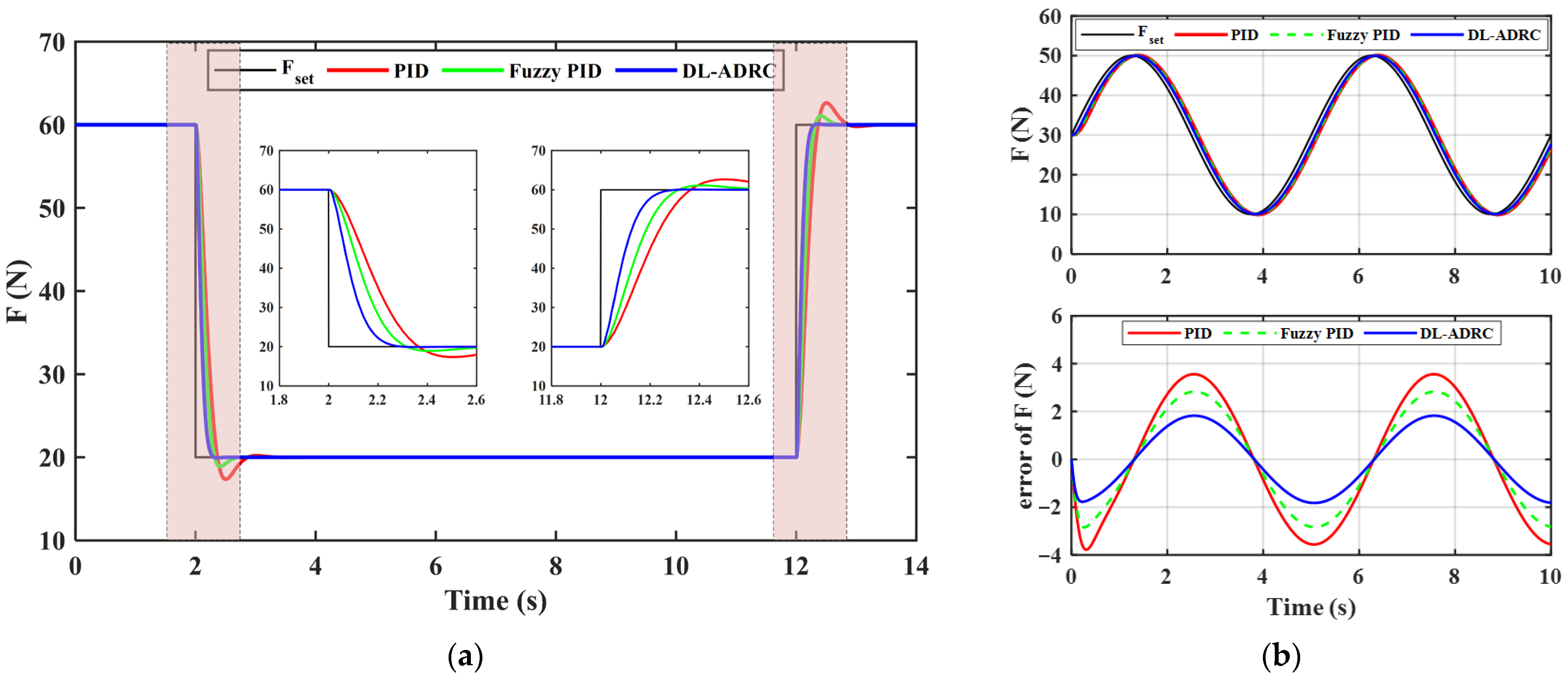
| Simulation Step response | Delay time (s) | 0.14 | 0.12 | 0.09 |
| Max. overshoot (%) | 6.61 | 2.71 | 0.21 | |
| Settling time (s) | 0.91 | 0.85 | 0.78 | |
| Steady state error (N) | 0.09 | 0.01 | 0.001 | |
| Simulation Sinusoid tracking | Max. error (N) | 3.78 | 2.84 | 1.83 |
| Average error (N) | 2.52 | 1.98 | 1.28 | |
| RMSE (N) | 2.50 | 1.97 | 1.27 | |
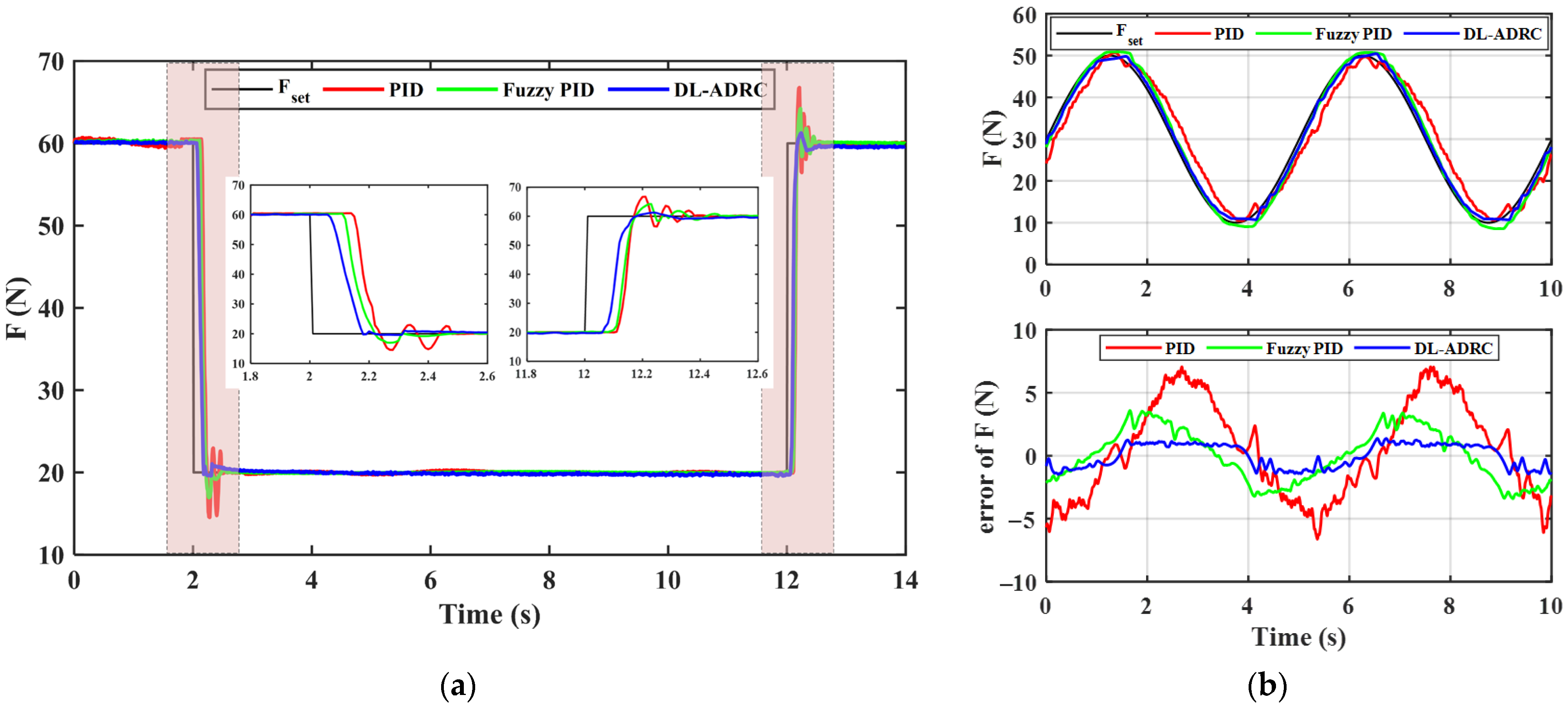
| Experimental Step response | Delay time (s) | 0.31 | 0.24 | 0.17 |
| Max. overshoot (%) | 15.36 | 9.15 | 2.21 | |
| Settling time (s) | 1.69 | 1.14 | 0.86 | |
| Steady state error (N) | 0.42 | 0.33 | 0.21 | |
| Experimental Sinusoid tracking | Max. error (N) | 7.06 | 3.59 | 2.37 |
| Average error (N) | 3.74 | 2.86 | 1.93 | |
| RMSE (N) | 3.23 | 2.38 | 1.52 |
Disclaimer/Publisher’s Note: The statements, opinions and data contained in all publications are solely those of the individual author(s) and contributor(s) and not of MDPI and/or the editor(s). MDPI and/or the editor(s) disclaim responsibility for any injury to people or property resulting from any ideas, methods, instructions or products referred to in the content. |
© 2025 by the authors. Licensee MDPI, Basel, Switzerland. This article is an open access article distributed under the terms and conditions of the Creative Commons Attribution (CC BY) license.
Share and Cite
Xu, Y.; Zhang, K.; Guo, K.; Ming, W.; Ma, J.; Wang, S.; Ye, Y. Design, Modeling, and Experimental Study of a Constant-Force Floating Compensator for a Grinding Robot. Actuators 2026, 15, 4. https://doi.org/10.3390/act15010004
Xu Y, Zhang K, Guo K, Ming W, Ma J, Wang S, Ye Y. Design, Modeling, and Experimental Study of a Constant-Force Floating Compensator for a Grinding Robot. Actuators. 2026; 15(1):4. https://doi.org/10.3390/act15010004
Chicago/Turabian StyleXu, Yapeng, Keke Zhang, Kai Guo, Wuyi Ming, Jun Ma, Shoufang Wang, and Yuanpeng Ye. 2026. "Design, Modeling, and Experimental Study of a Constant-Force Floating Compensator for a Grinding Robot" Actuators 15, no. 1: 4. https://doi.org/10.3390/act15010004
APA StyleXu, Y., Zhang, K., Guo, K., Ming, W., Ma, J., Wang, S., & Ye, Y. (2026). Design, Modeling, and Experimental Study of a Constant-Force Floating Compensator for a Grinding Robot. Actuators, 15(1), 4. https://doi.org/10.3390/act15010004