
Article

Extenics Coordinated Torque Distribution Control for Distributed Drive Electric Vehicles Considering Stability and Energy Efficiency
1
School of Mechanical Engineering and Rail Transit, Changzhou University, Changzhou 213164, China
2
Kaiyang Laboratory, Chery Automobile Co., Ltd., Wuhu 241000, China
*
Author to whom correspondence should be addressed.
Actuators 2026, 15(1), 3; https://doi.org/10.3390/act15010003 (registering DOI)
Submission received: 11 November 2025 / Revised: 10 December 2025 / Accepted: 16 December 2025 / Published: 19 December 2025

Abstract

To address the challenges of enhancing driving stability and energy efficiency in distributed-drive electric vehicles, this paper proposes an extenics coordinated torque distribution control method that integrates energy efficiency optimization and vehicle stability. The primary contribution was the development of a vehicle stability assessment method grounded in extenics control theory, which was used to obtain the vehicle’s phase plane and stability region. Subsequently, an objective function with constraints for in-wheel motor torque distribution was formulated, targeting both optimal energy efficiency and maximum tire stability margin. Furthermore, the extension distances from the actual vehicle state to the stability boundaries were computed to determine adaptive weighting coefficients for these dual objectives. Finally, a Matlab/Simulink 2018a and Carsim2019 co-simulation platform was built to implement and test the proposed method. Simulations under the NEDC urban driving cycle and double-lane-change driving conditions were conducted to evaluate the following three distribution strategies: energy-optimal, stability-oriented, and extenics coordinated control. The results demonstrated that, regarding vehicle stability performance, extenics coordinated control showed a slightly inferior performance to the stability-oriented approach but substantially outperformed the energy-optimal strategy. In terms of energy consumption, the energy-optimal strategy achieved the lowest loss and the stability-oriented strategy showed the highest, while the extenics coordinated control presented intermediate results of 5.4 × 10⁹ J and 9.7 × 10⁷ J, respectively, under two driving conditions, representing reductions of 2.17% and 11.2% compared to the stability-oriented method. The proposed torque distribution method establishes an effective balance between energy-optimal and stability-oriented objectives. This method not only ensures satisfactory driving stability, but also reduces energy loss in in-wheel motors.

1. Introduction

With the continuous advancement of vehicle intelligence and by-wire technologies, Distributed-Drive Electric Vehicles (DDEVs) integrate in-wheel motors inside the wheels, featuring independent drive, compact structure, and a high transmission efficiency. These characteristics contribute to enhanced driving stability and energy efficiency. Currently, the most widely adopted torque distribution control strategy for DDEVs is hierarchical control. The upper-level controller calculates generalized forces through direct yaw moment control, while the lower-level controller rationally allocates these generalized forces or torques to individual wheels, thereby ensuring both driving safety and energy efficiency.
Numerous scholars have conducted research on single-objective torque distribution control methods [1,2,3,4]. In the context of torque distribution control aimed at enhancing vehicle stability [5,6,7,8], Aria et al. [9] allocated upper-level control torque to four in-wheel motors based on dynamic tire load transfer and designed a slip-rate-based sliding mode controller to correct the torque. Their simulation results demonstrated a reduction in lateral acceleration, improved tracking of the reference yaw rate, a decrease in the vehicle sideslip angle, and a further enhancement of vehicle handling stability. Ren et al. [10] treated the torque outputs of four in-wheel motors as the control inputs for the MPC system. The objective function of their controller incorporated not only the tracking performance of vehicle states relative to desired references, but also constraints including the maximum torque of in-wheel motors, tire slip rates, torque variation limits, and steering requirements. Their simulation results demonstrated that rational torque allocation enabled satisfactory controller performance, effectively aligning with driver intentions. Shi et al. [11] formulated the torque distribution for individual wheels as a nonlinear constrained optimization problem, with the objective function focused on minimizing longitudinal control error. The solution was obtained using the Sequential Quadratic Programming (SQP) method. Through simulation validation combined with upper-level control, the results demonstrated that the proposed approach enhanced vehicle handling stability during typical lane-change maneuvers and reduced driver workload. Su et al. [12] proposed a torque vectoring control system to enhance the handling stability of distributed-drive electric buses under complex driving conditions. This system adopts a hierarchical control structure, where the upper-level controller consists of a direct yaw moment controller based on feedforward and feedback control and the lower-level controller functions as a torque allocation controller. Comparative real vehicle test results demonstrated that the torque vectoring control system significantly improved the bus’s handling stability. Hu et al. [13] proposed a coordinated torque distribution strategy considering wheel slip to address in-wheel motor torque loss scenarios. By developing an anti-wheel-slip torque constraint mechanism and a distribution strategy accounting for torque loss, coordinated allocation of four-wheel torque was achieved. The effectiveness of the proposed approach was validated through hardware-in-the-loop testing. Huang et al. [14] proposed a hierarchical control system for handling stability in distributed-drive electric vehicles. The upper-level controller employs robust H-infinity control, while the lower-level controller adopts a rule-based torque vectoring allocation strategy. Co-simulation results utilizing Carsim and Matlab demonstrated that the proposed rule-based torque vectoring strategy effectively enhanced both vehicle handling stability and ride comfort.
In terms of achieving optimal energy efficiency as the torque distribution control objective [15,16,17,18], Adeleke et al. [19] proposed an economy-oriented torque distribution strategy. They established a comprehensive model of a distributed-drive electric vehicle and employed the Dynamic Programming (DP) algorithm for torque distribution. Through simulations and hardware-in-the-loop testing, comparisons were made with a fuzzy logic control algorithm. The results demonstrated that the proposed method further reduced vehicle energy consumption and ensured optimal torque distribution. Hu et al. [20] established the maximization of in-wheel motor efficiency as the objective function, with constraints including the maximum torque of the in-wheel motors and the front–rear axle torque distribution ratio. They allocated the target control forces and moments accordingly. This control algorithm achieved a peak motor efficiency of 89.49%, representing a 0.42% improvement over a uniform distribution strategy. Cao et al. [21] investigated dynamic driving conditions of four-wheel-drive electric vehicles and proposed a multi-objective optimal torque distribution strategy that comprehensively considers load transfer between axles and variations in adhesion characteristics. Their simulation results demonstrated that the proposed strategy achieved a significantly better economic performance compared to both the average torque distribution strategy and an optimization strategy based on the sequential quadratic programming algorithm. Sun et al. [22] investigated the cornering scenario of distributed-drive electric vehicles by establishing a seven-degree-of-freedom vehicle dynamics model. They applied Pontryagin’s minimum principle to study torque vectoring allocation during vehicle steering and performed offline optimization of the torque distribution coefficients to reduce energy consumption in cornering conditions. Shangguan et al. [23] proposed a hierarchical control framework for electric buses driven by in-wheel motors. The upper-level controller incorporates a nonlinear observer for estimating longitudinal and lateral velocities, while the lower-level controller employs nonlinear model predictive control. This structure enabled accurate path tracking while minimizing energy consumption of the bus. Tan et al. [24] proposed an energy-saving torque distribution strategy for off-road distributed drive vehicles. By analyzing the characteristics of the motor system, the optimal inter-axle torque distribution scheme was determined to improve energy conversion efficiency. Quadratic programming was employed to optimize the inter-wheel torque allocation. Co-simulation results demonstrated that, compared with conventional methods, the proposed approach not only ensured optimal torque distribution for path tracking, but also significantly enhanced the overall energy efficiency of the distributed-drive vehicle.
A limited number of scholars have investigated torque distribution control methods that simultaneously consider stability and economy. Qiu et al. [25] proposed a fuzzy yaw moment control strategy based on the golden section search algorithm for distributed-drive electric buses. Simulations and hardware-in-the-loop experiments demonstrated that, compared with the four-wheel average distribution strategy, the proposed method improved torque distribution efficiency by approximately 4% under two steering conditions. It also comprehensively enhanced the vehicle’s energy utilization rate while effectively reducing deviations in yaw rate and sideslip angle, thereby significantly improving vehicle stability. Liu et al. [26] proposed a hierarchical torque vectoring control strategy to coordinate maneuver stability and energy consumption in distributed-drive electric vehicles. By integrating road adhesion coefficient estimation, adaptive model predictive control, and stability boundary-based torque distribution, the proposed strategy achieved a 44.88% reduction in the root mean square error of sideslip angle and a 24.45% decrease in motor power consumption during double-lane-change maneuvers compared to conventional torque distribution methods. These results demonstrated a significant improvement in overall vehicle performance. Jia et al. [27] developed a lane-changing control system utilizing pure electric driving range and remaining range, and performed simulations to analyze both the performance of this control model and the economic benefits of the integrated eco-driving strategy.
In summary, existing research predominantly focuses on motor torque distribution control for distributed-drive electric vehicles (DDEVs) with a single objective, either stability or energy efficiency. However, the actual operating environments of these vehicles are complex and variable. Consequently, torque allocation must not only ensure driving stability, but also address energy dissipation and driving range requirements. It is, therefore, imperative to develop integrated torque distribution control methodologies that simultaneously optimize both vehicle stability and energy efficiency.
In response to the above issues, this study proposes a torque distribution methodology for distributed-drive electric vehicles based on extenics coordinated control, with consideration given to both vehicle stability and energy efficiency. This study innovatively constructs a torque distribution objective function aimed at achieving optimal energy efficiency and maximum tire stability margin. By utilizing extenics control theory to adaptively coordinate the weight coefficients, a torque distribution control method based on extenics coordinated control theory is ultimately realized. Its effectiveness is validated through a Carsim/Simulink co-simulation platform.

2. Materials and Methods

2.1. Two-Degree-of-Freedom Mathematical Model of Vehicle Dynamics

2.1.1. Nonlinear Two-Degree-of-Freedom Vehicle Dynamics Model

The vehicle stability investigated in this study primarily concerns the planar motion parallel to the ground. Therefore, only the following two degrees of freedom are considered: the yaw motion and the lateral motion of the vehicle. The two-degree-of-freedom vehicle dynamics model (bicycle model) is illustrated in Figure 1. In the figure, oxy represents the vehicle coordinate system; Fxf and Fxr denote the total longitudinal forces of the front and rear wheels, respectively; Fyf and Fyr denote the total lateral forces of the front and rear wheels, respectively; αf and αr represent the tire sideslip angles of the front and rear wheels, respectively; v is the vehicle travel speed; vx is the vehicle longitudinal speed; vy is the vehicle lateral speed; β is the vehicle sideslip angle at the center of mass; γ is the vehicle yaw rate; δ is the front-wheel steering angle; and Lf and Lr are the distances from the front and rear axles to the vehicle’s center of mass, O, respectively.
The differential equations of the two-degree-of-freedom vehicle dynamics model are as follows:
m ( v ˙ y + v x γ ) = F x f sin δ + F y f cos δ + F y r I z γ ˙ = L f F x f sin δ + F y f cos δ L r F y r
During cornering maneuvers, the front-wheel steering angle is assumed to be a small angle, namely cos δ 1 , sin δ δ , so the following result is established:
m ( v ˙ y + v x γ ) = F x f δ + F y f + F y r I z γ ˙ = L f F x f δ + F y f L r F y r
Given that the vehicle sideslip angle β is assumed to be small, it follows that v y = v sin β = v β , v x = v cos β = v . Based on the kinematic geometry of the vehicle and the definition of the tire slip angle, the slip angles of the front and rear tires are derived as follows:
α f = v β + L f γ v δ α r = v β L r γ v
Based on tire cornering characteristics, when the tire slip angle becomes excessively large, the tire operates in the nonlinear region, causing the vehicle to exhibit nonlinear behavior during actual driving. Therefore, when analyzing vehicle handling and stability, selecting the magic formula, which effectively captures the dynamic characteristics of tires, is sufficient to meet the requirements.
For a given initial vertical load and camber angle, the general expression of the magic formula is as follows [28]:
y = D sin C arctan B x E B x arctan ( B x ) Y ( X ) = y ( x ) + S V x = X + S H
The physical quantities represented by each symbol in Equation (4) are explained in Table 1. The tire model parameters can be obtained through fitting.
Under combined slip conditions, the tire longitudinal force, lateral force, and aligning moment are expressed as follows:
F x = F x 0 G x α ( α , λ , γ , F z ) F y = F y 0 G y λ ( α , λ , γ , F z ) + S V y λ M z = t F y + M z r
where Fx0 and Fy0 represent the tire longitudinal force and lateral force under pure longitudinal slip and pure side slip conditions, respectively; Svyλ is the drift factor present when fitting the tire lateral force; Mzr is the residual aligning moment of the tire; F y = F y F V y λ ; and G x α ( α , λ , γ , F z ) and G y λ ( α , λ , γ , F z ) are weighting coefficients for the longitudinal force and lateral force under combined conditions, which are functions of vertical load, slip angle, slip ratio, and camber angle.

2.1.2. Two-Degree-of-Freedom Linear Vehicle Dynamics Model

In the analysis of vehicle handling and stability, under the assumptions that the vehicle operates at a constant speed and the tire cornering characteristics remain within their linear region, the lateral forces generated by the front and rear tires are given by the following:
F y f = k f α f F y r = k r α r
where kf and kr are the cornering stiffnesses of the front and rear tires, respectively.
This paper neglects longitudinal tire forces by setting Fxf = 0. By combining Equations (2), (3), and (6), we obtain the following:
β ˙ = k f + k r m v β + L f k f L r k r m v 2 1 γ k f m v δ γ ˙ = L f k f L r k r I z β + L f 2 k f + L r 2 k r I z v γ L f k f I z δ

2.1.3. Reference Model

Setting β ˙ = 0 and γ ˙ = 0 , the vehicle yaw rate under steady-state conditions is given by the following:
γ = v / L K v 2 + 1 δ
where K = m L f / k r L r / k f / L 2 is the stability factor, a key parameter for characterizing the vehicle steady-state response.
In the study of vehicle handling and stability, the reference model for the control strategy is defined as follows. To ensure path-tracking capability, the ideal sideslip angle at the vehicle’s center of gravity is set to 0 rad, reflecting the objective of tracking a desired steady-state value. Meanwhile, the yaw rate under steady-state conditions is designated as the target to preserve handling stability. Furthermore, the road adhesion coefficient must also be incorporated. The reference model for the vehicle handling stability control strategy is, thus, formulated as follows:
β d = 0 γ d = min δ v / L K v 2 + 1 , 0.85 μ g v sgn δ
where μ is the road adhesion coefficient.

2.2. Research on Vehicle Motion Control Methods

2.2.1. Longitudinal Speed Tracking Control

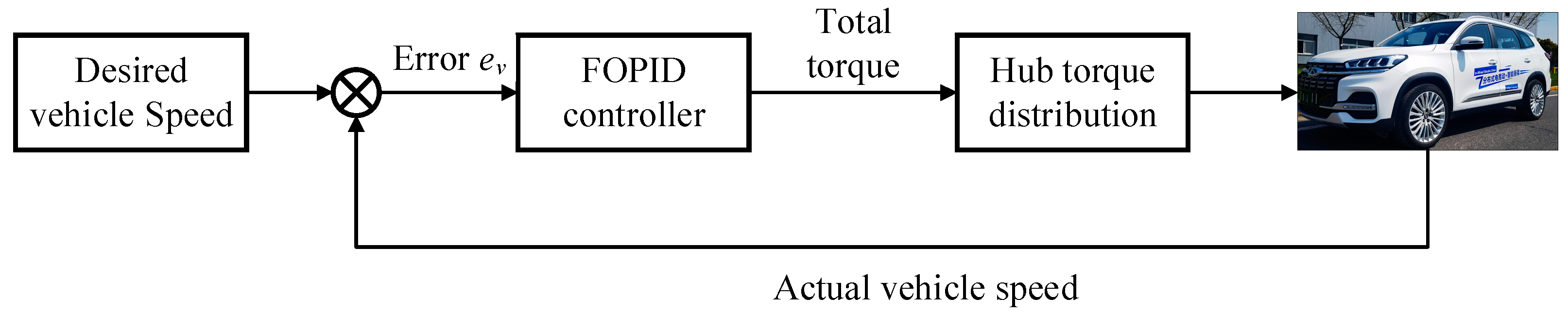
To ensure the accuracy of vehicle speed tracking, this paper introduces fractional-order operators D α t t 0 and designs a fractional-order PID controller based on fractional-order calculus theory [29,30,31]. The desired vehicle speed vobj is set as the control target for the longitudinal vehicle speed. A fractional-order PID (FOPID) controller is devised based on the error between the actual vehicle speed v and vobj. This controller yields the required total longitudinal drive torque, thereby enabling the vehicle to track the desired speed. The flowchart of this longitudinal speed control process is illustrated in Figure 2.

2.2.2. Vehicle Lateral Stability Control

To fulfill the requirement for stable vehicle handling performance, the linear two-degree-of-freedom vehicle dynamics model in this paper is augmented with the target yaw moment, ΔM, and the lateral force, Fdy. This augmented model can be transformed from Equation (7) into Equation (10), as follows:
β ˙ = k f + k r m v β + L f k f L r k r m v 2 m v 2 γ k f m v δ + F d y m v γ ˙ = L f k f L r k r I z β + L f 2 k f + L r 2 k r I z v γ L f k f I z δ + M I z
By setting e = e γ e β T , the integral sliding mode surface is defined as follows:
s I = λ I 0 t e d t + e
where s I = s γ s β T ; e γ = γ d γ ; e β = β d β ; λ I = d i a g ( λ γ , λ β ) , λγ and λβ are positive real numbers.
The exponential reaching law is selected as follows:
s ˙ I = k I s ε I sgn ( s I )
where both k I = d i a g k γ , k β and ε I = d i a g ε γ , ε β 1 2 are positive real matrices.
Differentiating Equation (11) yields the following:
s ˙ I = λ I e + e ˙
By combining Equations (10), (12), and (13), the control laws for the target yaw moment, ΔM, and the lateral force, Fdy, are derived as follows:
Δ M = I z γ ˙ d + λ γ e γ L f k f L r k r I z β L f 2 k f + L r 2 k r I z v γ + L f k f I z δ + k γ s γ + ε γ sgn ( s γ ) F d y = m v β ˙ d + λ β e β k f + k r m v β L f k f L r k r m v 2 m v 2 γ + k f m v δ + k β s β + ε β sgn ( s β )
Construct a Lyapunov function
V I = 1 2 s γ 2 + 1 2 s β 2
Differentiating Equation (15) yields the following:
V ˙ I = s ˙ γ s γ + s ˙ β s β = ( λ γ e γ + γ ˙ d γ ˙ ) s γ + ( λ β e β + β ˙ d β ˙ ) s β
Substituting Equations (10) and (14) into Equation (16) and simplifying yields the following:
V ˙ I = k γ s γ + ε γ sgn ( s γ ) s γ k β s β + ε β sgn ( s β ) s β k γ s γ 2 ε γ s γ k β s β 2 ε β s β
Since kγ, kβ, εγ, and εβ are all positive real numbers, it follows that V ˙ I 0 . According to the Lyapunov stability theorem, the control laws for the target yaw moment and lateral force ensure the asymptotic stability of the control system.

2.3. Vehicle Stability Judgment Based on Extenics Control Theory

Based on a 2-DOF nonlinear dynamic vehicle model, the characteristic parameters of vehicle handling stability are analyzed to determine the influence of factors such as vehicle speed, road adhesion coefficient, and steering wheel angle on vehicle stability.
In vehicle stability control research, it is common practice to assume a constant vehicle speed as a prerequisite for stability analysis. Neglecting the effects of longitudinal tire forces, Equation (2) can be rewritten as follows:
β ˙ = F y f + F y r m v γ γ ˙ = L f F y f L r F y r I z
Without consideration of vehicle dynamic load transfer, the vertical loads on the front and rear axles are as follows:
F z f = m g L r L F z r = m g L f L
Based on Equations (3), (18), (19), and the magic formula tire model, a 2-DOF nonlinear dynamic vehicle model is established.
By employing the phase plane method, the phase portraits of sideslip angle and its rate are obtained. The phase trajectories of the vehicle’s state points are analyzed, thereby determining the stable and unstable regions of vehicle motion.
Under various conditions of vehicle speed, road adhesion coefficient, and steering wheel angle, the vehicle’s driving state is assessed using the phase plane method. Research on vehicle control is conducted based on the β β ˙ phase plane. Depending on the vehicle state, the control domain is partitioned into the classical domain, extensible domain, and non-domain using the limit cycle method [32,33].

2.3.1. Determination of the Linear Boundary Parameters for the β β ˙ Phase Plane Stability Region

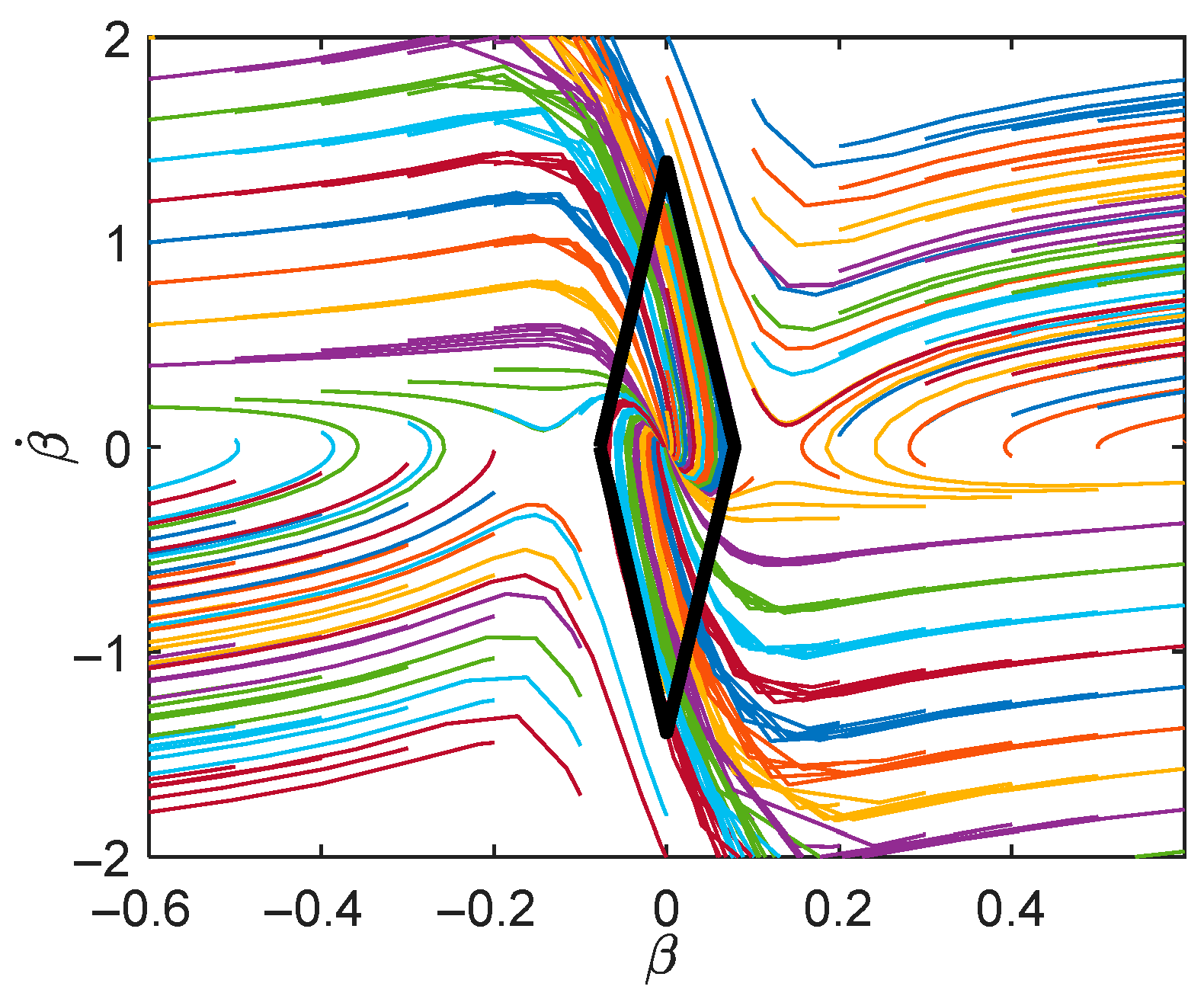
Assuming good road surface adhesion conditions and a constant vehicle speed, with a steering wheel angle of 0 rad, the phase trajectories corresponding to different initial values γ0 β0 and β β ˙ were obtained based on the 2-DOF nonlinear vehicle dynamics model, as shown in Figure 3. The diamond markers in the figure represent the stability region determined by the five-parameter diamond method, with the corresponding parameters provided in Table 2.
The approximate expressions for the vehicle sideslip angle and its rate, which satisfy the vehicle stability condition, are given by the following [34]:
c 1 β + c 2 β ˙ < 1
where c1 and c2 are constants that depend on the vehicle state parameters.
It follows that the boundary lines of the diamond-shaped stability region satisfy c 1 i β i + c 2 i β ˙ i = 1 for i = 1~4. Substituting the endpoint and vertex parameters from Table 2 into Equation (20) yields the parameters c1i and c2i for these four lines.

2.3.2. Acquisition of Stability Region Boundary Based on Extenics Control Theory

(1)
Determination of the classical domain boundary
The ellipse obtained by the limit cycle method is defined as the stability boundary for vehicle motion, where the interior of the ellipse represents the vehicle stability region, i.e., the classical domain of the extension set. By default, the four lines of the diamond boundary are tangent to the ellipse, leading to the following system of equations:
O a _ i n β R a _ i n 2 + O b _ i n β ˙ R b _ i n 2 = 1 c 1 β + c 2 β ˙ = 1
where Oa_in and Ob_in are the coordinates of the center of the inscribed ellipse, corresponding to the horizontal and vertical directions, and Ra_in, Rb_in define its semi-minor and semi-major axes, respectively.
It can be obtained from Equation (21) that the relationship between the diamond boundary and the ellipse satisfies the following:
c 1 i 2 R a _ i n 2 + c 2 i 2 R b _ i n 2 = 1 O a _ i n c 1 i O b _ i n c 2 i 2
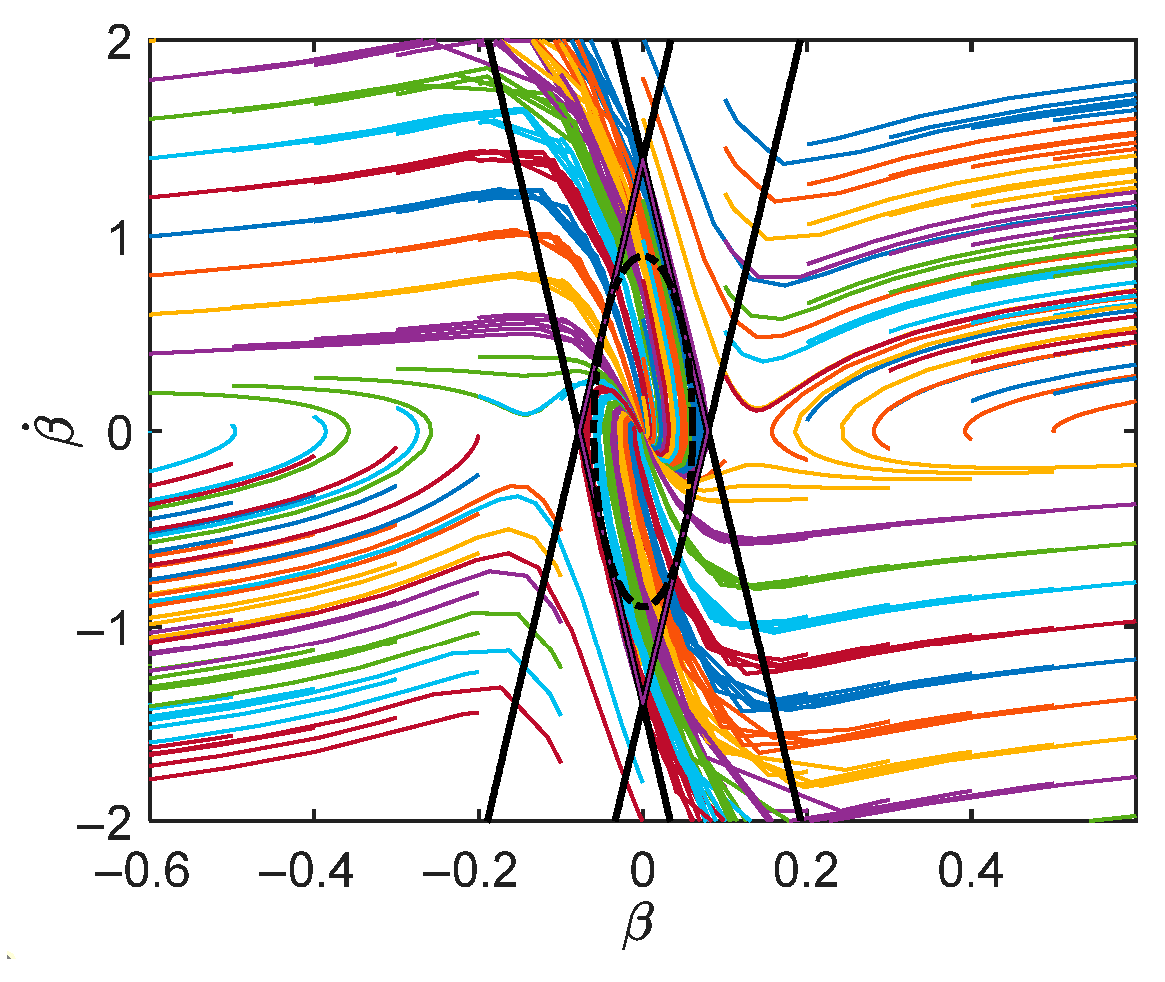
The inscribed ellipse of the diamond, as shown in Figure 4, is obtained by solving for the semi-major axis, semi-minor axis, and center coordinates using the fmincon function in Matlab. The objective function is the area of the inscribed ellipse, subject to the following equation:
J i n t e r i o r = min ( π R 1 R 2 )
Subject to the following:
c 1 i 2 R 1 2 + c 2 i 2 R 2 2 = 1 a 1 c 1 i b 1 c 2 i 2 β lim < a 1 < β lim + β ˙ lim < b 1 < β ˙ lim + 0 < R 1 < β lim + β lim / 2 0 < R 2 < β ˙ lim + β ˙ lim / 2
where I = 1~4.
(2)
Acquisition of extension domain boundaries
The circumscribed circle of the rhombus boundary is defined as the extension domain of the extension set. The equation of the circumscribed ellipse is as follows:
O a _ e x β R a _ e x 2 + O b _ e x β ˙ R b _ e x 2 = 1
where Oa_ex and Ob_ex represent the x-coordinate and y-coordinate of the circumscribed ellipse’s center, and Ra_ex and Rb_ex represent its semi-minor axis and semi-major axis, respectively.
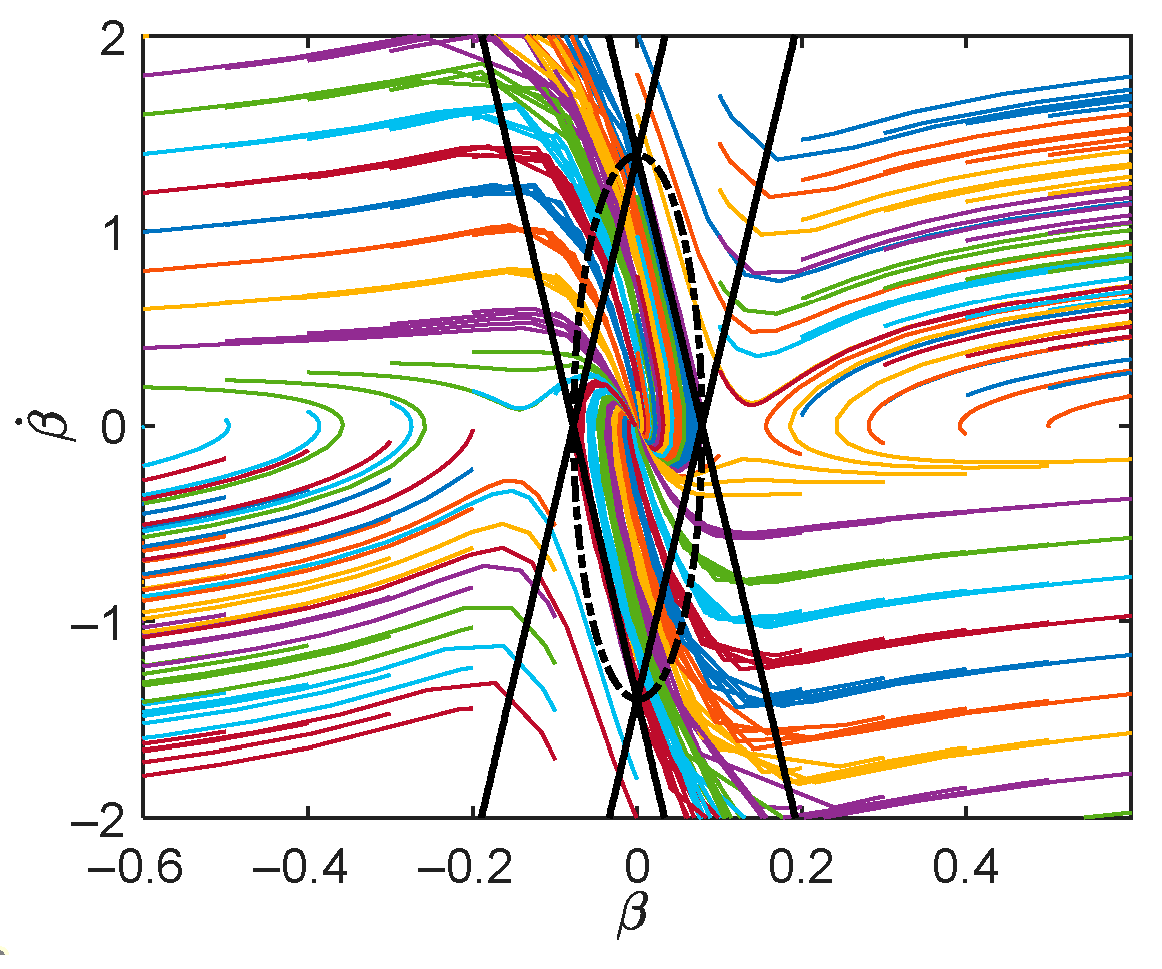
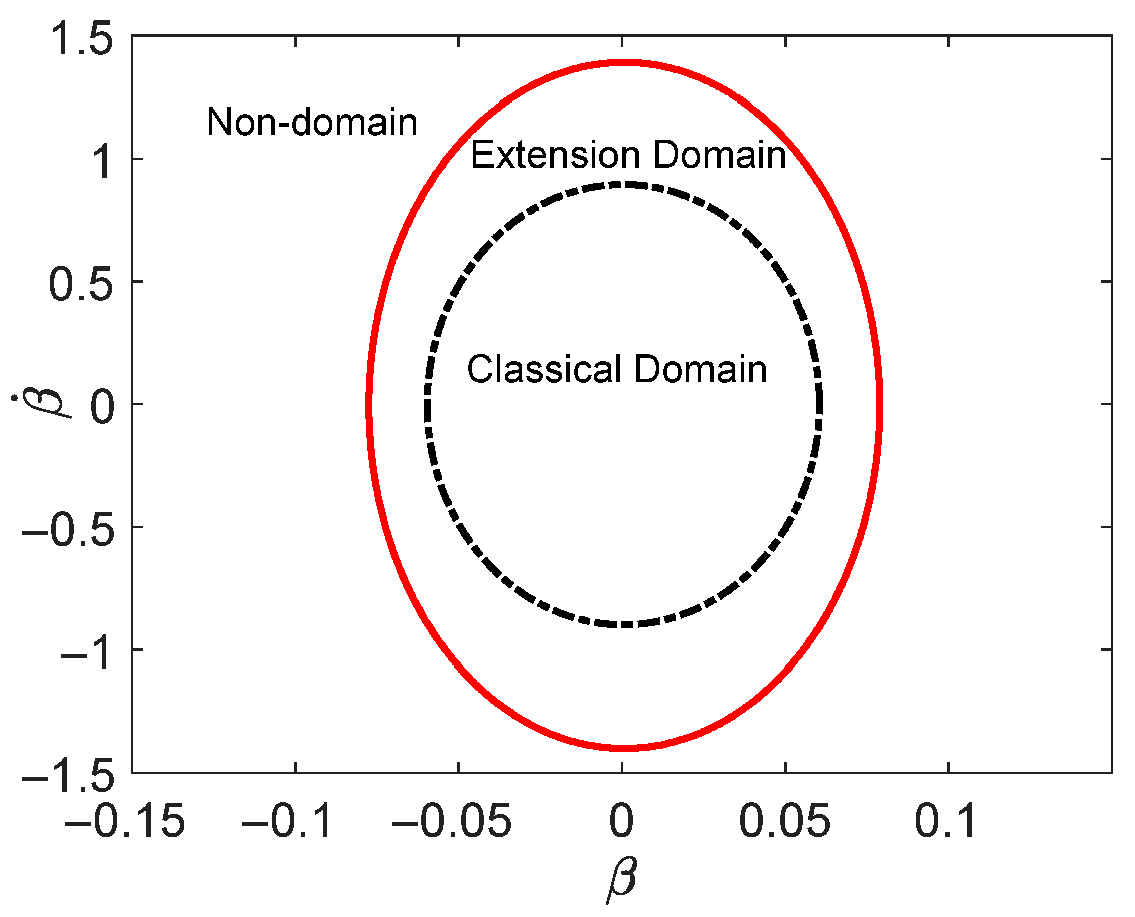
The four vertices of the rhombus, ( β lim , 0), (0, β ˙ lim + ), ( β lim + , 0), and (0, β ˙ lim ), lie on the circumscribed ellipse. Substituting these coordinates into Equation (25) yields a system of four equations. Solving this system gives the semi-major axis, semi-minor axis, and center of the ellipse, as illustrated in Figure 5.
(3)
Acquisition of extension sets
The circumscribed ellipse and inscribed ellipse of the rhombus are combined to obtain the extension set of the control domain, as shown in Figure 6. The area inside the black dashed line represents the classical domain, where the vehicle remains stable and adopts a torque distribution strategy for the in-wheel motors based on energy efficiency optimization. The region between the black dashed line and the red solid line constitutes the extension domain, where the vehicle operates between the stable and unstable zones. In this region, an extensible combined torque distribution strategy for the in-wheel motors is applied, considering both energy efficiency optimization and stability. The area outside the red solid line is the non-domain, indicating that the vehicle is in an unstable state. Here, the torque distribution strategy for the in-wheel motors is solely based on vehicle stability.

2.4. Extenics Coordinated Torque Distribution Control Method Based on Energy Efficiency Optimization and Stability

2.4.1. Objective Function and Constraints Based on Energy-Optimal Distribution

The efficiency of an individual in-wheel motor was experimentally determined by Elaphe through measurements under various torque and speed conditions, covering both traction and regeneration scenarios. Power losses in the in-wheel motor include electromagnetic and windage losses, losses in the inverter, and mechanical losses within the hub assembly.
Chatzikomis et al. established the following expression for the power loss of a single hub motor [35]:
P l o s s ( T q , n ) = T q n 1 / η ( T q , n ) 1 / 9.55 T q > 0 T q n η ( T q , n ) 1 / 9.55 T q < 0 P e m T q = 0
where Tq is the torque of a single in-wheel motor; n is the rotational speed; η(Tq,n) is the efficiency of the in-wheel motor; and Pem is the power loss of the motor at 0 N·m.
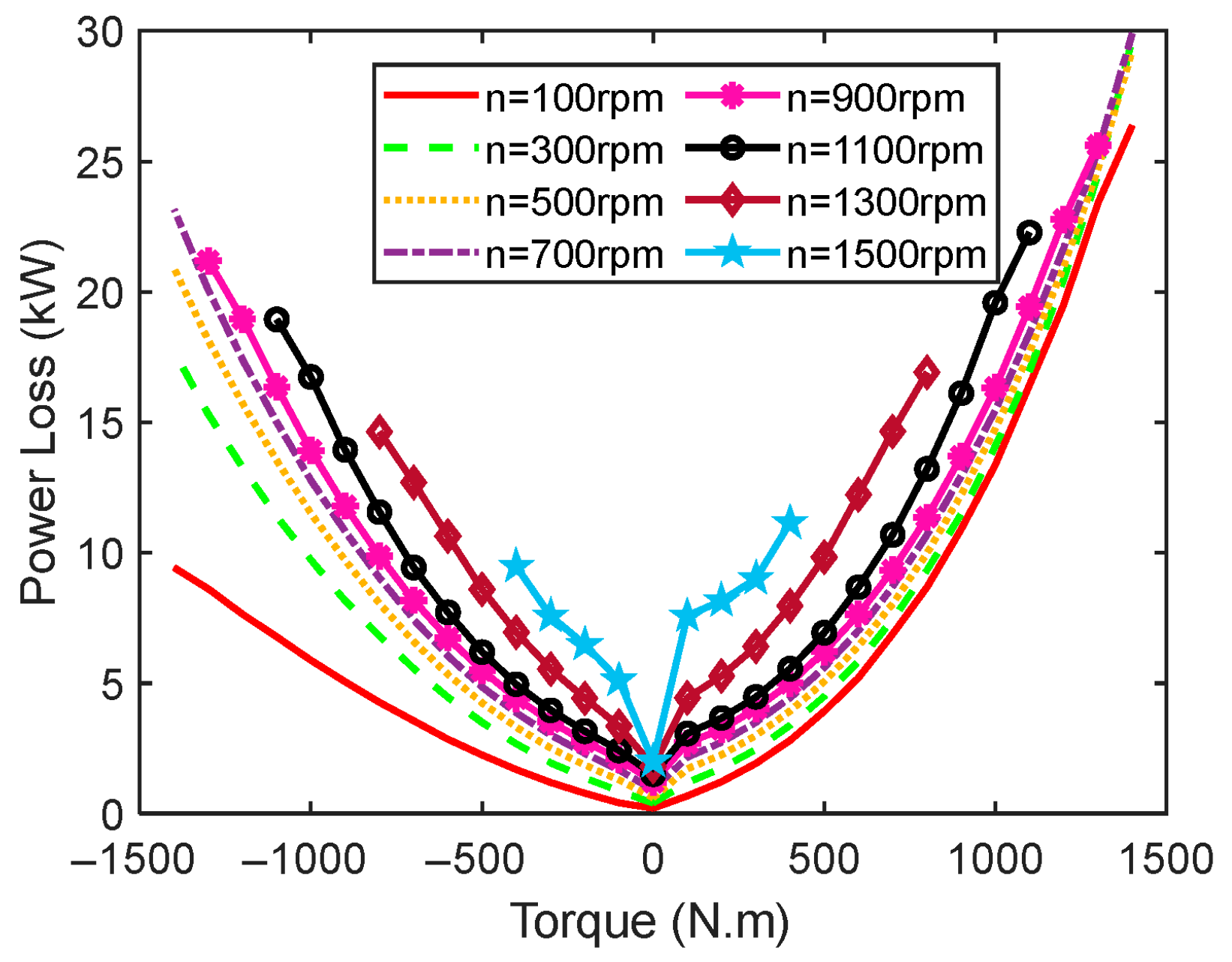
Based on the power loss of a single in-wheel motor, the power loss curves under different torque and speed conditions are obtained, as shown in Figure 7. At a constant speed, the power loss increases monotonically with the increase in torque. Under the same torque condition, the power loss increases with a higher speed, particularly at low torque levels where the power loss exhibits a more significant rise as speed increases.
Based on the power loss of a single in-wheel motor, the objective function for torque distribution control of in-wheel motors aimed at optimal energy efficiency is as follows:
J e = min P l o s s = min i = f r j = l r P l o s s , i j
where Ploss,ij is the power loss of each in-wheel motor.
Based on the relationship between the target control torque/force and the in-wheel motor torques, the following is derived:
F v = B v u v
where Fv is the target control torque and force, respectively, F v = [ T x F d y Δ M ] T ; uv is the in-wheel motor torque, u v = T x f l T x f r T x r l T x r r T ; and Bv is the coefficient matrix.
B v = cos δ cos δ 1 1 sin δ / R f l sin δ / R f r 0 0 B f cos δ + 2 L f sin δ / 2 R f l B f cos δ + 2 L f sin δ / 2 R f r B r 2 R r l B r 2 R r r
, where Rfl and Rfr are the tire radii of the front-left and front-right wheels, respectively; Bf and Br are the front and rear wheel tracks, respectively.
Due to the torque output limits of the in-wheel motors and the road adhesion coefficient limit, the constraints are formulated as follows:
T x i j < min μ i j R i j F z i j , T max
where Txij is the torque of each in-wheel motor.
The quadratic programming-based optimal control allocation algorithm is selected to solve for the in-wheel motor torques. This method distributes the target control moments and forces to the four in-wheel motors, meeting the torque distribution requirements while ensuring optimal energy efficiency of the motors.
Based on the objective function and constraints for energy-efficient torque distribution control of in-wheel motors, a standard quadratic programming problem can be formulated as follows:
J E = 1 2 B v u v F v T W v B v u v F v + 1 2 u v T W u c u v s t . A e q u v = b e q u v min u v u v max
where W v c = d i a g ( 1 , 1 , 1 ) ; A e q = B v ; b e q = F v ; u v max = u v min = min μ i j R i j F z i j , T max ; W u c = W u c f l 2 0 0 0 0 W u c f r 2 0 0 0 0 W u c r l 2 0 0 0 0 W u c r r 2 , W u c i j = n i j 1 / η ( T x i j , n i j ) 1 / 9.55 T x i j > 0 n i j η ( T x i j , n i j ) 1 / 9.55 T x i j < 0 0 T x i j = 0 .

2.4.2. Objective Function and Constraints Based on Stability-Oriented Distribution

For the torque distribution control strategy of in-wheel motors on complex road surfaces, the objective function and constraints are formulated based on maximizing the tire stability margin, road adhesion conditions, and motor operational characteristics. Furthermore, the vehicle roll angle is incorporated as an additional constraint to enhance safety and stability under extreme driving conditions.
Vehicle body roll induces a shift in the center of mass, which reduces the vehicle’s inherent ability to resist rollover through its own weight and decreases the rollover threshold. Once the roll angle exceeds the critical threshold, vehicle rollover occurs, leading to severe personal injury and property loss. The Lateral-Load Transfer Rate (LTR), a widely adopted rollover indicator, can effectively identify the transient rollover state of a vehicle. Its expression is given as follows:
L T R = F z f l + F z r l F z f r F z r r F z f l + F z r l + F z f r + F z r r
where the LTR value lies within the range of [0, 1].
Neglecting road gradient and considering vehicle load transfer, the dynamic vertical load exerted by the ground on the tires is expressed as follows:
F z f l = m g L r 2 L m a x h g 2 L m a y h g L r B f L m g h g L r sin φ B f L F z f r = m g L r 2 L m a x h g 2 L + m a y h g L r B f L + m g h g L r sin φ B f L F z r l = m g L f 2 L + m a x h g 2 L m a y h g L f B r L m g h g L f sin φ B r L F z r r = m g L f 2 L + m a y h g L f B r L + m a x h g 2 L + m g h g L f sin φ B r L
where ax represents the vehicle longitudinal acceleration, ay represents the vehicle lateral acceleration, hg represents the height of the vehicle’s center of mass, and φ represents the vehicle roll angle.
Substituting Equation (32) into Equation (31) yields the following:
L T R = 2 m h g L L r / B f + L f / B r a y + g sin φ m g
As indicated by Equation (33), the LTR is related to both lateral acceleration and vehicle roll angle. When LTR = 0, it indicates no vehicle roll has occurred. When LTR = 1, it signifies that the tires on one side of the vehicle have lifted off the road surface, and rollover is imminent. For LTR values within the interval (0, 1), the metric characterizes the extent of load transfer—the closer the value is to 1, the higher the propensity for vehicle rollover.
Substituting a y = 1 m T x f l R f l + T x f r R f r sin δ + F y f l + F y f r m cos δ + F y r l + F y r r m into Equation (33) yields the following:
L T R = 2 h g L L r B f + L f B r T x f l R f l + T x f r R f r sin δ + F y f l + F y f r cos δ + F y r l + F y r r + m g sin φ m g
The objective function for the stability-oriented torque distribution control of in-wheel motors is derived as follows:
min f s = 1 2 B v u v F v T W s v B v u v F v + 1 2 u v T W s c u v s t . A u v < b   A e q u v = b e q u v min u v u v max
where W s v = d i a g ( 1 , 1 , 1 ) ; W s c = d i a g 1 μ f l R f l F z f l 2 , 1 μ f r R f r F z f r 2 , 1 μ r l R r l F z r l 2 , 1 μ r r R r r F z r r 2 ; A = sin δ / R f l sin δ / R f l sin δ / R f r sin δ / R f r 0 0 0 0 ; b = m g L 2 h g L r / B f + L f / B r F y f l + F y f r cos δ F y r l F y r r m g sin φ m g L 2 h g L r / B f + L f / B r + F y f l + F y f r cos δ + F y r l + F y r r + m g sin φ .

2.4.3. Determination of Weighting Coefficients

The two characteristic quantities, sideslip angle and its angular velocity, are selected. The calculation methods for the extension distance and its correlation function are then determined based on the extenics theory approach.
(1)
Computation of the correlation function
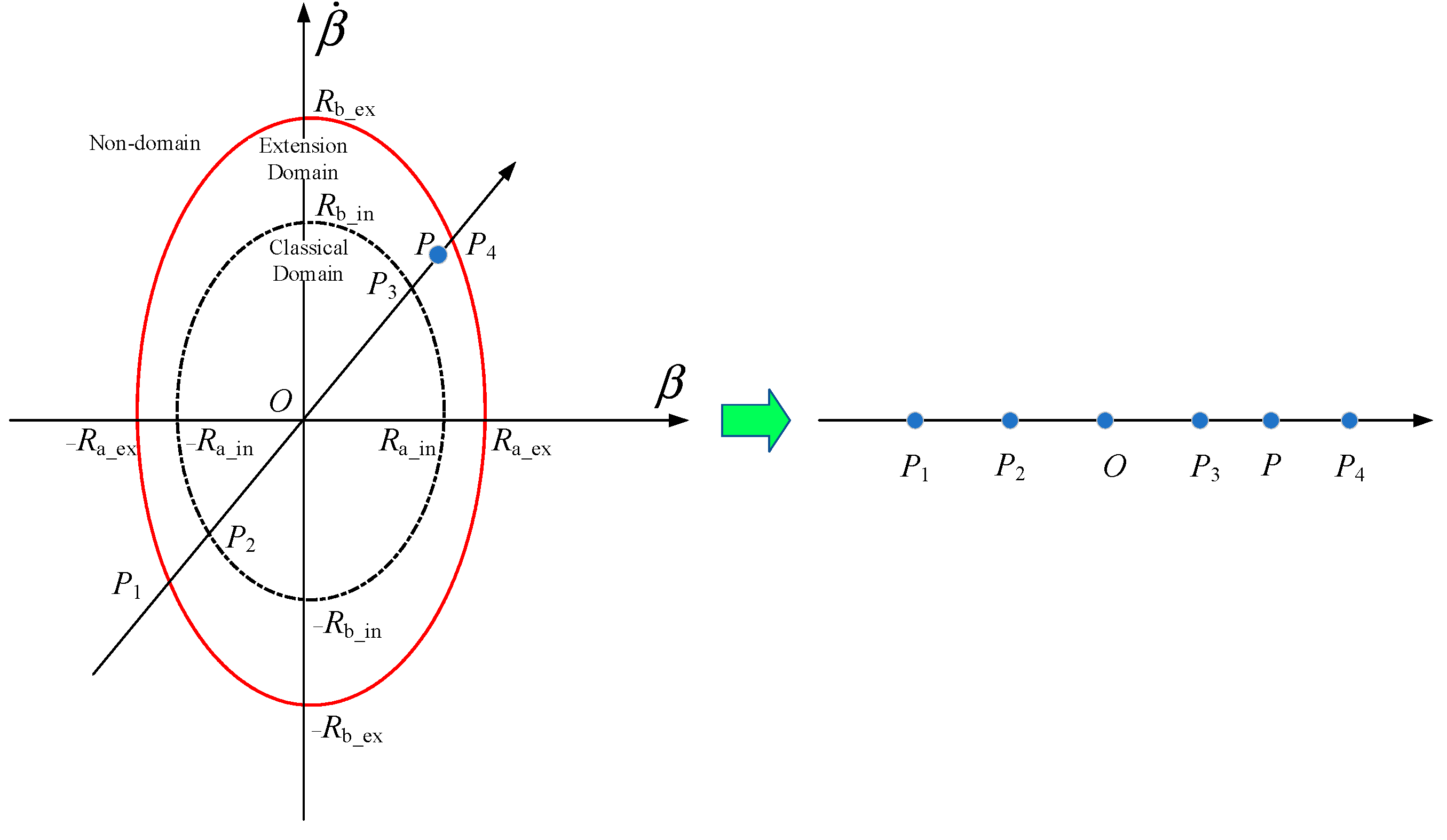
In a two-dimensional extension set, the origin O (0, 0) is the optimal point, representing the stable state point of a vehicle. Assuming the vehicle’s arbitrary driving state is denoted as point P, the straight line OP is drawn and extended. This line intersects the boundaries of the classical domain and the extension domain at points labeled sequentially from left to right as P1, P2, P3, and P4, as illustrated in Figure 8. The segment OP represents the shortest distance for point P to approach the origin O (0, 0). In extension set theory, the extension distance, which is defined within a one-dimensional coordinate system, refers to the distance from a point to a set. Consequently, it is necessary to transform the two-dimensional extension set into a one-dimensional form.
As shown in Figure 8, the extension distance from point P to the classical domain X 1 =   < P 2 , P 3 > is defined as ρ ( P , X 1 ) , as follows:
ρ P , X 1 = | P P 2 | P   < , P 2 > | P P 2 | P   < P 2 , 0 > | P P 3 | P   < 0 , P 3 > | P P 3 | P   < P 3 , + >
Similarly, the extension distance from point P to the extension domain X 2 =   < P 1 , P 2 > < P 3 , P 4 > is ρ ( P , X 2 ) ; thus, the following correlation function is obtained:
K ( s ) = ρ ( P , < P 1 , P 4 > ) D ( P , < P 1 , P 4 > , < P 2 , P 3 > )
where D ( P , < P 1 , P 4 > , < P 2 , P 3 > ) = ρ ( P , < P 1 , P 4 > ) ρ ( P , < P 2 , P 3 > ) .
(2)
Measurement mode partition and weighting coefficients
Based on the results of the correlation function in Equation (37), the corresponding torque distribution strategy is applied, as follows:
When both β and β ˙ reside within the classical domain, the measurement mode is set to M 1 = { s | K ( s ) 1 } . Consequently, the torque distribution weight for energy efficiency optimization is assigned as ηe = 1, while the weight for stability-oriented distribution is assigned as ηs = 0.
When both β and β ˙ reside within the extension domain, the measurement mode is set to M 2 = { s | 0 K ( s ) < 1 } . Consequently, the torque distribution weight for energy efficiency optimization is assigned as ηe = K(s), while the weight for stability-oriented distribution is assigned as ηs = 1 − K(s).
When both β and β ˙ reside within the classical domain, the measurement mode is set to M 3 = { s | K ( s ) < 1 } . Consequently, the torque distribution weight for energy efficiency optimization is assigned as ηe = 0, while the weight for stability-oriented distribution is assigned as ηs = 1.

2.4.4. Objective Function and Constraints for Extenics Coordinated Control

Based on the objective functions and constraints defined in Section 2.4.1 and Section 2.4.2, and incorporating the weighting coefficients obtained in Section 2.4.3, the extenics coordinated control objective function for the hub motor torque is derived as follows:
J = J E η e J E + η s J s J s β , β ˙ c l a s s i c a l     d o m a i n β , β ˙ e x t e n s i o n     d o m a i n β , β ˙ n o n d o m a i n

3. Results and Discussion

Using the proposed in-wheel motor torque distribution control method, a co-simulation experiment was conducted using Matlab/Simulink and Carsim under the NEDC driving cycle and double-lane-change maneuver conditions. Comparative results analysis was performed on the vehicle’s actual motion trajectory and power loss during operation. The main parameters of the vehicle are shown in Table 3.

3.1. NEDC Urban Driving Cycle

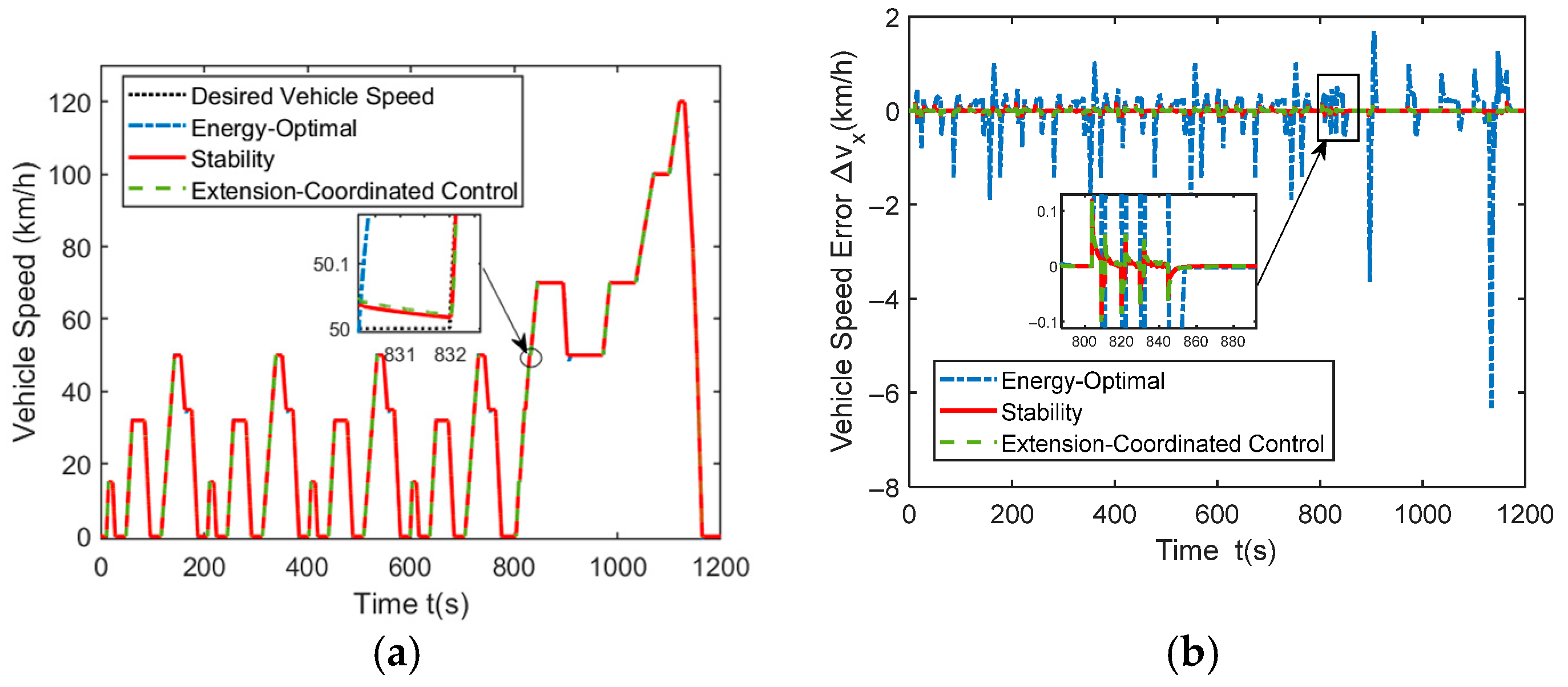
Assuming the vehicle is traveling on a horizontal road with a road adhesion coefficient of 0.85, the vehicle speed, speed error, in-wheel motor torques, weight coefficients of the objective function, and energy loss are presented in Figure 9, Figure 10, Figure 11, Figure 12 and Figure 13.
The desired vehicle speed and actual vehicle speed under three torque distribution methods are shown in Figure 9a. Throughout the driving cycle, all three torque distribution strategies—energy-optimal, stability-oriented, and extenics coordinated control—effectively track the desired speed. As shown in Figure 9b, the energy-optimal distribution exhibits a maximum relative speed error of 21.5%, while the stability-oriented and extenics coordinated control distributions show significantly smaller maximum relative errors of 0.73% and 0.89%, respectively. These results indicate that the energy-optimal distribution performs the worst in longitudinal speed control, followed by the extenics coordinated control distribution, though it only marginally underperforms the stability-oriented approach by 0.16%.
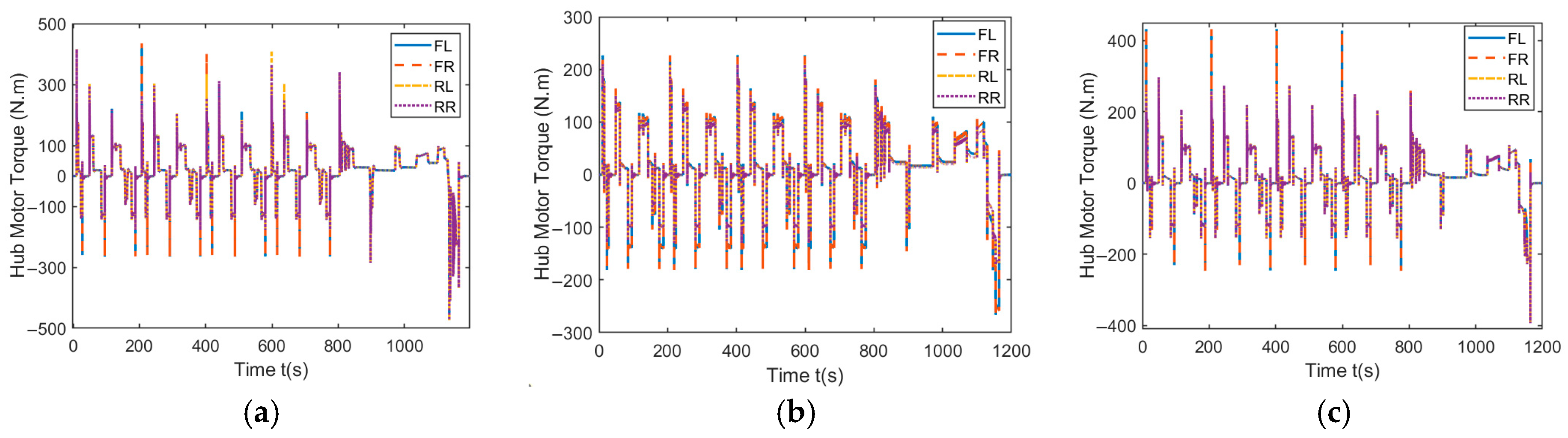
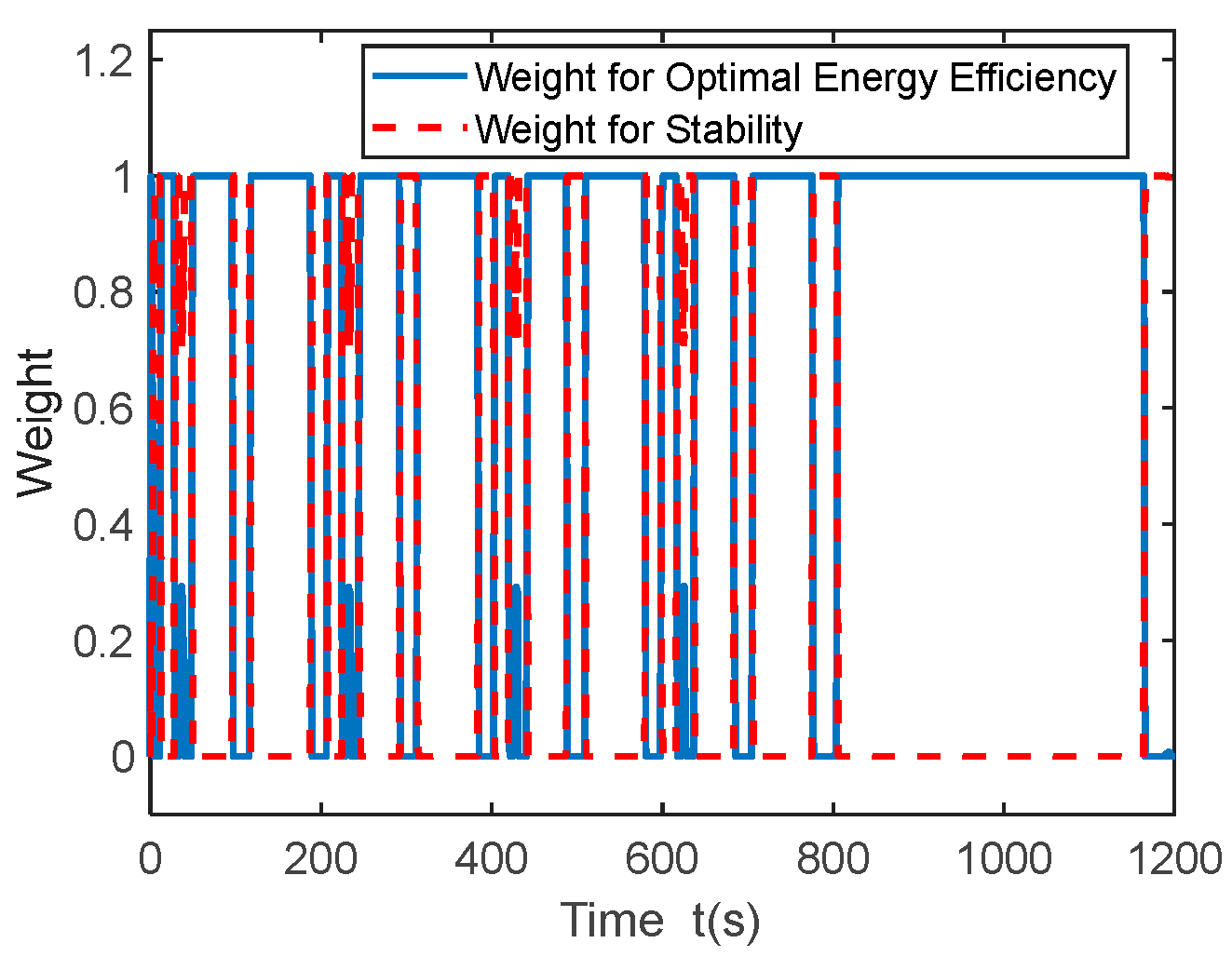
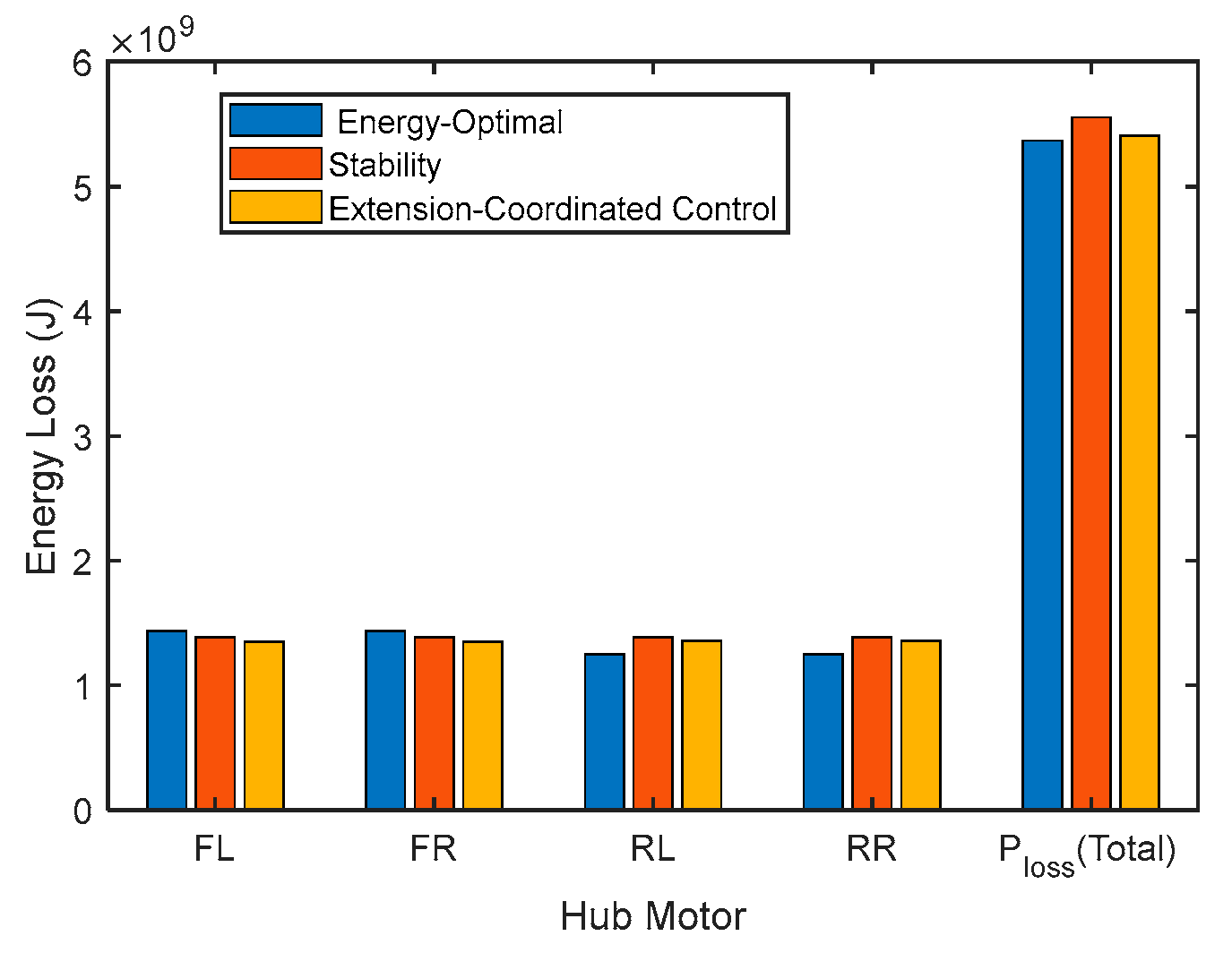
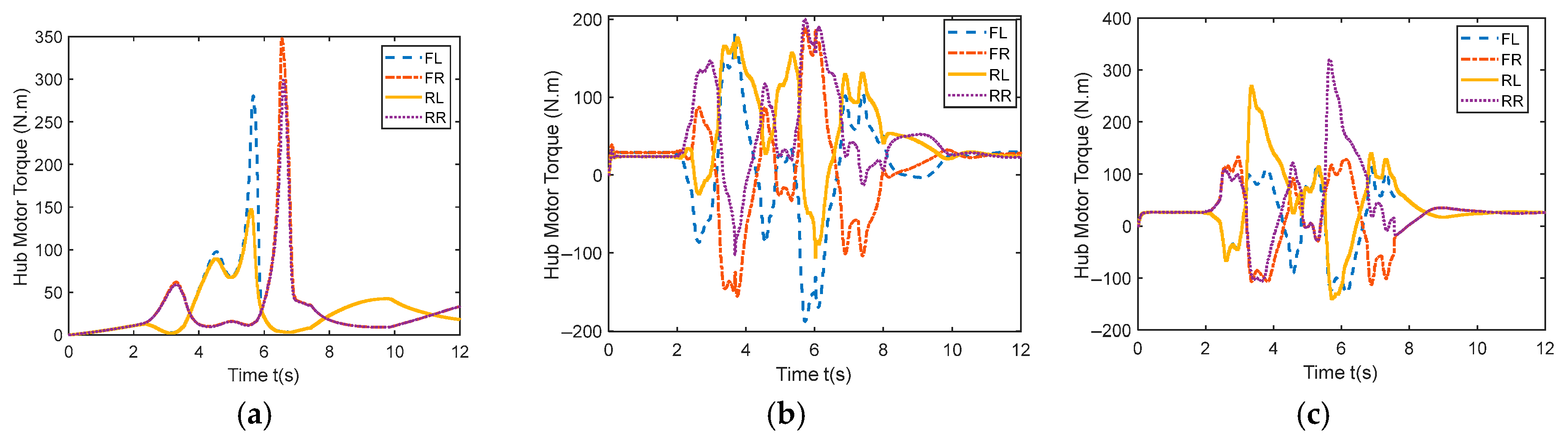
The simulation result curves of in-wheel motor torque for the three distribution control strategies are shown in Figure 10, the weight coefficients for the extenics coordinated control distribution are presented in Figure 11, and the energy losses throughout the driving cycle are illustrated in Figure 12. Under the NEDC urban driving cycle, the total energy loss across all wheels with the energy-optimal distribution is approximately 5.2 × 10⁹ J, while the stability-oriented distribution results in about 5.52 × 10⁹ J total energy loss. The extenics coordinated control distribution demonstrates a total energy loss of approximately 5.4 × 10⁹ J, representing a 3.85% increase compared to the energy-optimal distribution but a 2.17% reduction relative to the stability-oriented distribution.
Therefore, under the NEDC urban driving cycle, when comprehensively considering vehicle speed and energy loss in distributed-drive electric vehicles, the extenics coordinated control-based torque distribution method emerges as the optimal choice compared to both the stability-oriented and energy-optimal torque distribution approaches.

3.2. Double-Lane-Change Maneuver Driving Conditions

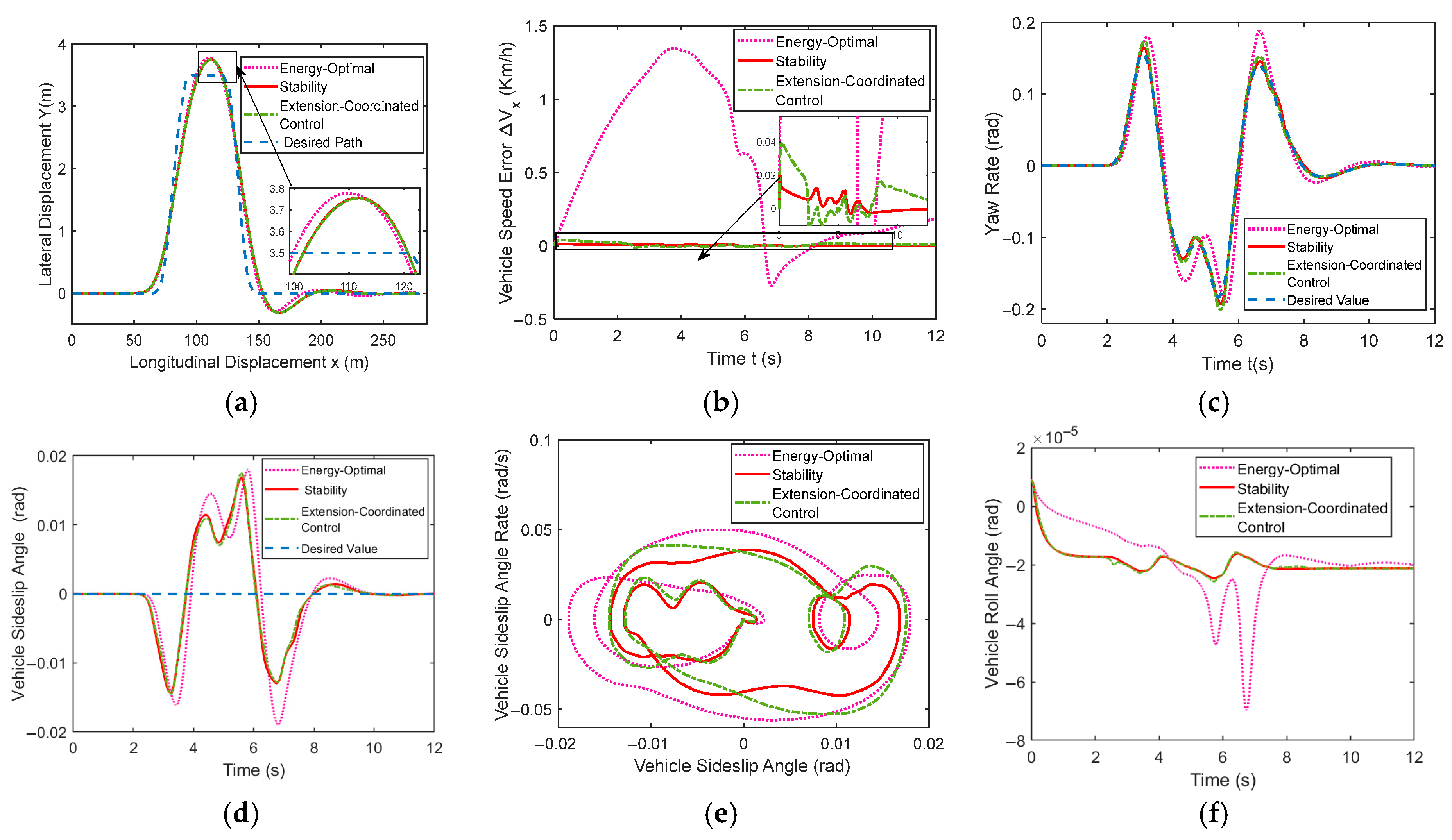
Assuming the vehicle travels on a horizontal road at a constant speed of 80 km/h with a road adhesion coefficient of 0.85, the actual vehicle state curves are shown in Figure 13. As shown in Figure 13a,b, the energy-optimal distribution demonstrates significantly larger errors in tracking desired lateral displacement and vehicle speed compared to both the extenics coordinated control and stability-oriented distributions, with the maximum speed error reaching 1.34 km/h. The yaw rate and sideslip angle curves presented in Figure 13c,d reveal that the stability-oriented distribution achieves the smallest errors, while the extenics coordinated control distribution performs slightly worse than the stability-oriented approach. The energy-optimal distribution exhibits a maximum yaw rate error of 2.9 °/s and a maximum sideslip angle error of 1.07°. In comparison, the extenics coordinated control distribution demonstrates a yaw rate maximum relative error of 1.06 °/s (relative error: 5.28%) and a maximum sideslip angle error of 1.0045°. The β β ˙ phase plane trajectory in Figure 13e indicates that the energy-optimal distribution results in the poorest vehicle stability, while Figure 13f shows that the maximum vehicle roll angle reaches 0.22°.
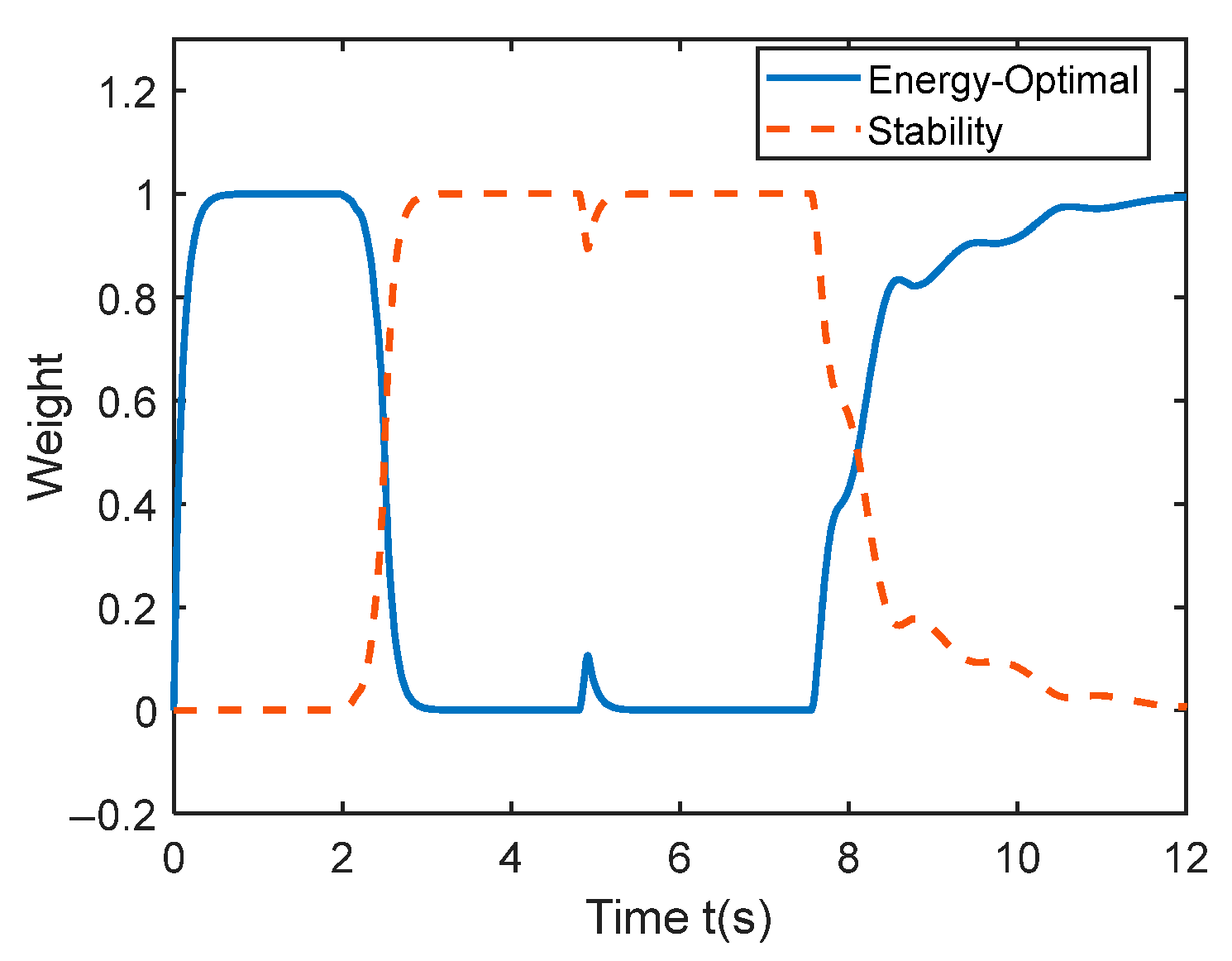
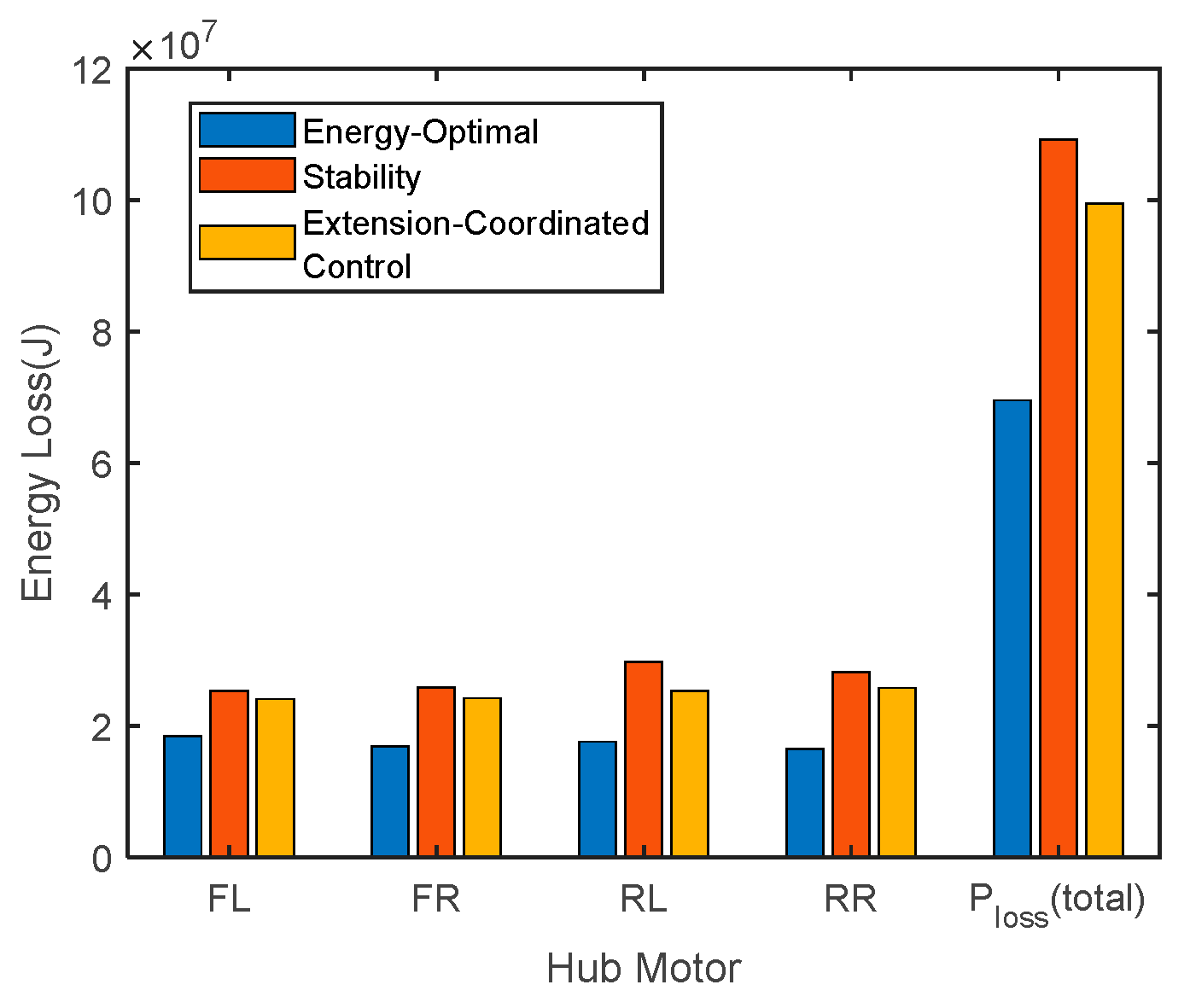
The simulation curves of the three in-wheel motor torque distribution control strategies are shown in Figure 14. The weight coefficients for the extenics coordinated control distribution are presented in Figure 15, indicating that the strategy prioritizes energy-optimal distribution during straight-line driving and shifts to stability-oriented distribution during steering maneuvers. The energy losses throughout the driving cycle are illustrated in Figure 16. Among the three distribution strategies, the stability-oriented distribution demonstrates higher energy losses at each wheel compared to the other two strategies, with the highest total energy loss of 10.92 × 10⁷ J. The energy-optimal distribution achieves the lowest total energy loss of 6.96 × 10⁷ J. The extenics coordinated control strategy shows an intermediate total energy loss of 9.7 × 10⁷ J, which is 28% higher than the energy-optimal distribution but 11.2% lower than the stability-oriented distribution.
Under double-lane-change maneuver driving conditions, analysis of vehicle state parameter response curves, motor torque, and energy loss demonstrates that the extenics coordinated control distribution achieves a significantly superior vehicle stability compared to the energy-optimal distribution, while maintaining a lower energy loss than the stability-oriented distribution. The extenics coordinated control-based torque distribution method effectively combines the advantages of both strategies.

4. Conclusions

This study focuses on distributed-drive electric vehicles and proposes an extensics coordinated torque distribution control method that simultaneously addresses both stability and energy efficiency. A two-degree-of-freedom vehicle dynamics model was established to obtain the reference model for vehicle sideslip angle and yaw rate. A fractional-order PID controller was designed for vehicle speed tracking, while a sliding mode controller was developed for lateral stability control using sideslip angle and yaw rate as control targets. The phase plane was obtained based on different initial states of yaw rate and sideslip angle, with the diamond method and limit cycle method employed to determine the boundaries of the vehicle stability region. An objective function with constraints was formulated with the dual objectives of energy efficiency and vehicle stability, where extension correlation degrees between actual vehicle states and stability region boundaries were calculated using extension control theory to determine weight coefficients for both objectives. A co-simulation platform integrating Matlab/Simulink and Carsim was constructed, and comparative experiments were conducted for three torque distribution methods.
Comparative simulation experiments were conducted under both the NEDC urban driving cycle and double-lane-change conditions, evaluating the following three torque distribution strategies: energy-optimal, stability-oriented, and extenics coordinated control. The co-simulation results demonstrated that under the NEDC urban cycle, the extenics coordinated control strategy achieved a maximum relative speed error of 0.89%, slightly higher than the stability-oriented approach but significantly lower than the energy-optimal distribution. The energy loss with extenics coordinated control measured 5.4 × 10⁹ J, representing a 3.85% increase compared to the energy-optimal distribution but a 2.17% reduction relative to the stability-oriented distribution. Under double-lane-change conditions, the vehicle stability parameters with extenics coordinated control performed slightly worse than the stability-oriented approach but substantially outperformed the energy-optimal strategy. The maximum relative error of yaw rate and the maximum error of sideslip angle for the extenics coordinated control distribution were 5.28% and 1.0045°, respectively. The total energy loss with this method reached 9.7 × 10⁷ J, reflecting a 28% increase compared to the energy-optimal distribution but an 11.2% reduction relative to the stability-oriented approach.
In conclusion, the torque distribution method for distributed-drive electric vehicles based on extenics coordinated control effectively strikes a balance between energy-optimal distribution and stability-oriented distribution. The method not only ensures satisfactory handling stability, but also reduces energy loss in the in-wheel motors, thereby extending the vehicle’s driving range.
Future work will involve automatically converting the algorithm code written in Matlab/Simulink into the required code for the vehicle domain controller via a toolchain, in order to validate the proposed torque distribution method on a real vehicle. Future research will also further consider simulation analysis using a four-wheel vehicle reference model and uneven road conditions.

Author Contributions

Conceptualization, L.W.; methodology, L.W.; software, L.W. and Y.T.; validation, L.W. and Q.S.; resources, L.W. and D.Z.; writing—original draft preparation, L.W.; writing—review and editing, L.W. and Q.S.; supervision, D.Z. and Y.T.; funding acquisition, L.W. All authors have read and agreed to the published version of the manuscript.

Funding

This research was funded by the National Natural Science Fund, grant number 32501796, the Research Start-up Fund Project of Changzhou University, grant number ZMF23020191, and the Changzhou Science and Technology Project, grant number CJ20240053.

Institutional Review Board Statement

Not applicable.

Informed Consent Statement

Not applicable.

Data Availability Statement

All research data supporting this study are included in the manuscript.

Conflicts of Interest

Authors Liang Wang and Yan Ti were employed by the company Kaiyang Laboratory, Chery Automobile Co., Ltd. The remaining authors declare that the research was conducted in the absence of any commercial or financial relationships that could be construed as a potential conflict of interest.

References

  1. Luo, Y.; Zhou, T. Vehicle stability control based on steering angle compensation and torque distribution. Mach. Des. Manuf. Eng. 2020, 49, 75–79. [Google Scholar]
  2. Guo, L.; Ge, P.; Sun, D. Torque distribution algorithm for stability control of electric vehicle driven by four in wheel motors under emergency conditions. IEEE Access 2019, 7, 104737–104748. [Google Scholar] [CrossRef]
  3. Li, J.; Yang, S.; Li, Z.; Guo, L. An energy conservation strategy based on drive mode switching for multi-axle in-wheel motor driven vehicle. Energy Proc. 2019, 158, 2580–2585. [Google Scholar] [CrossRef]
  4. Hua, M.; Chen, G.; Zhang, B.; Huang, Y. A hierarchical energy efficiency optimization control strategy for distributed drive electric vehicles. Proc. Inst. Mech. Eng. 2019, 233, 605–621. [Google Scholar] [CrossRef]
  5. Zhai, L.; Sun, T.; Wang, J. Electronic stability control based on motor driving and braking torque distribution for a four in-wheel motor drive electric vehicle. IEEE Trans. Veh. Technol. 2016, 65, 4726–4739. [Google Scholar] [CrossRef]
  6. Gao, S.; Wang, J.; Guan, C.; Zhou, Z.; Liu, Z. Wheel torque distribution control strategy for electric vehicles dynamic performance with an electric torque vectoring drive axle. IEEE Trans. Transp. Electrif. 2024, 10, 1692–1705. [Google Scholar] [CrossRef]
  7. Chen, Q.; Huang, H.; Liu, S.; Liu, R.; Liang, C. Coordinated control of stability and anti-slip torque distribution for distributed electric vehicles under extreme operating conditions. Trans. Inst. Meas. Control 2025. [Google Scholar] [CrossRef]
  8. Hu, J.; Yan, C.; Zhao, L.; Ling, X.; Xie, Y. Torque distribution in distributed drive electric vehicles under steering conditions. China J. Highw. Transp. 2020, 33, 92–101. [Google Scholar]
  9. Asiabar, A.; Kazemi, R. A direct yaw moment controller for a four in-wheel motor drive electric vehicle using adaptive sliding mode control. Proc. Inst. Mech. Eng. Part K J. Multi-Body Dyn. 2019, 233, 549–567. [Google Scholar] [CrossRef]
  10. Ren, B.; Hong, C.; Zhao, H.; Yuan, L. MPC-based yaw stability control in in-wheel-motored EV via active front steering and motor torque distribution. Mechatronics 2016, 38, 103–114. [Google Scholar] [CrossRef]
  11. Shi, Y.; Fan, Y. Hierarchical direct yaw-moment control system design for in-wheel motor driven electric vehicle. Int. J. Automot. Technol. 2018, 19, 695–703. [Google Scholar]
  12. Su, L.; Wang, Z.; Chen, C. Torque vectoring control system for distributed drive electric bus under complicated driving conditions. Assem. Autom. 2022, 42, 1–18. [Google Scholar] [CrossRef]
  13. Hu, J.; Zhang, S.; Wang, H.; Zhang, B.; Ye, X.; Li, Y.; Zhao, L. Torque distribution and stability control of distributed drive electric vehicles considering torque loss and wheel slip. Proc. Inst. Mech. Eng. Part D J. Automob. Eng. 2025. [Google Scholar]
  14. Huang, C.; Wu, X.; Wu, C.; Wang, J.; Shu, X. Rule-based torque vectoring distribution strategy combined with slip ratio control to improve the handling stability of distributed drive electric vehicles. Proc. Inst. Mech. Eng. 2025, 239, 1311–1328. [Google Scholar] [CrossRef]
  15. Lenzo, B.; Filippis, G.; Dizqah, A.; Sorniotti, A.; Gruber, P.; Fallah, S.; Nijs, W. Torque distribution strategies for energy-efficient electric vehicles with multiple drivetrains. J. Dyn. Syst. Meas. Control 2017, 139, 121004. [Google Scholar] [CrossRef]
  16. Chu, H. Torque Allocation Control of Four-Wheel Drive EVs Considering Energy Efficiency Optimization. Master’s Thesis, Jilin University, Changchun, China, 2020. [Google Scholar]
  17. Ren, B.; Deng, W.; Chen, H. An energy-efficient torque distribution strategy for in-wheel-motored EVs based on model predictive control. Int. J. Veh. Des. 2020, 82, 18–44. [Google Scholar] [CrossRef]
  18. Zhu, S.; Kuang, C.; Chen, P. Economical optimal torque distribution control for distributed four-wheel-drive electric buses. Automob. Technol. 2022, 1, 15–22. [Google Scholar]
  19. Adeleke, O.; Li, Y.; Chen, Q.; Zhou, W.; Xu, X.; Cui, X. Torque distribution based on dynamic programming algorithm for four in-wheel motor drive electric vehicle considering energy efficiency optimization. World Electr. Veh. J. 2022, 13, 181. [Google Scholar] [CrossRef]
  20. Hu, J.; Tao, J.; Xiao, F.; Niu, X.; Fu, C. An optimal torque distribution control strategy for four-wheel independent drive electric vehicles considering energy economy. IEEE Access 2019, 7, 141825–141837. [Google Scholar] [CrossRef]
  21. Cao, K.; Hu, M.; Wang, D.; Qiao, S.; Guo, C.; Fu, C.; Zhou, A. All-wheel-drive torque distribution strategy for electric vehicle optimal efficiency considering tire slip. IEEE Access 2021, 9, 25245–25257. [Google Scholar] [CrossRef]
  22. Sun, W.; Chen, Y.; Wang, J.; Wang, X.; Liu, L. Research on TVD control of cornering energy consumption for distributed drive electric vehicles based on PMP. Energies 2022, 15, 2641. [Google Scholar] [CrossRef]
  23. Shangguan, J.; Yue, M.; Qi, H.; Fang, C. Coordinated control of path tracking and energy optimization for in-wheel motor drive electric buses with velocity estimation. Eur. J. Control 2022, 65, 100641. [Google Scholar] [CrossRef]
  24. Tan, S.; Wang, Y.; Zheng, X.; Zhang, N.; Luo, T.; Pan, B.; Li, S.; Cui, X. Energy-efficient torque allocation strategy for autonomous distributed drive electric vehicle. IEEE Trans. Transp. Electrif. 2024, 10, 8275–8285. [Google Scholar] [CrossRef]
  25. Qiu, L.; Zhu, S.; Liu, D.; Xiang, Z.; Fu, H.; Chen, H. Research on the torque control strategy of a distributed 4WD electric vehicle based on economy and stability control. Electronics 2022, 11, 3546. [Google Scholar] [CrossRef]
  26. Liu, S.; Zhang, H.; Wang, S.; Zhao, X. Hierarchical torque vectoring control strategy of distributed driving electric vehicles considering stability and economy. Sensors 2025, 25, 3933. [Google Scholar] [CrossRef] [PubMed]
  27. Jia, Y.; Liu, Y.; Zhang, Y.; Chen, Z.; Lei, Z.; Zhang, Y. Lane changing enabled eco-driving control for plug-in hybrid electric vehicle under consecutive signalized intersection conditions. Green Energy Intell. Transp. 2026, 5, 100311. [Google Scholar] [CrossRef]
  28. Pacejka, H.B. Tyre and Vehicle Dynamics, 2nd ed.; Elsevier: Amsterdam, The Netherlands, 2006. [Google Scholar]
  29. Ullah, M.; Mallawi, F.; Baleanu, D.; Alshomrani, A. A new fractional study on the chaotic vibration and state-feedback control of a nonlinear suspension system. Chaos Solitons Fractals 2020, 132, 109530. [Google Scholar] [CrossRef]
  30. Watanabe, M.; Prasad, A. Fractional delayed feedback for semi-active suspension control of nonlinear jumping quarter car model. Chaos Solitons Fractals 2025, 199, 116973. [Google Scholar] [CrossRef]
  31. Sadeghian, H.; Salarieh, H.; Alasty, A.; Meghdari, A. On the control of chaos via fractional delayed feedback method. Comput. Math. Appl. 2011, 62, 1482–1491. [Google Scholar] [CrossRef]
  32. Chen, W.; Wang, X.; Tan, D.; Lin, S.; Sun, X.; Xie, Y. Study on the grey predictive extension control of yaw stability of electric vehicle based on the minimum energy consumption. J. Mech. Eng. 2019, 55, 156–167. [Google Scholar] [CrossRef]
  33. Zhao, L.; Chen, W.; Wang, J.; Cong, G.; Xie, Y. Research on steering-by-wire control strategy based on extension sliding mode control. J. Mech. Eng. 2019, 55, 126–134. [Google Scholar] [CrossRef]
  34. Yu, Z.; Xia, Q. Automobile Theory; China Machine Press: Beijing, China, 2009. [Google Scholar]
  35. Chatzikomis, C.; Zanchetta, M.; Gruber, P.; Sorniotti, A.; Modic, B.; Motaln, T.; Blagotinsek, L.; Gotovac, G. An energy-efficient torque-vectoring algorithm for electric vehicles with multiple motors. Mech. Syst. Signal Process. 2019, 128, 655–673. [Google Scholar] [CrossRef]
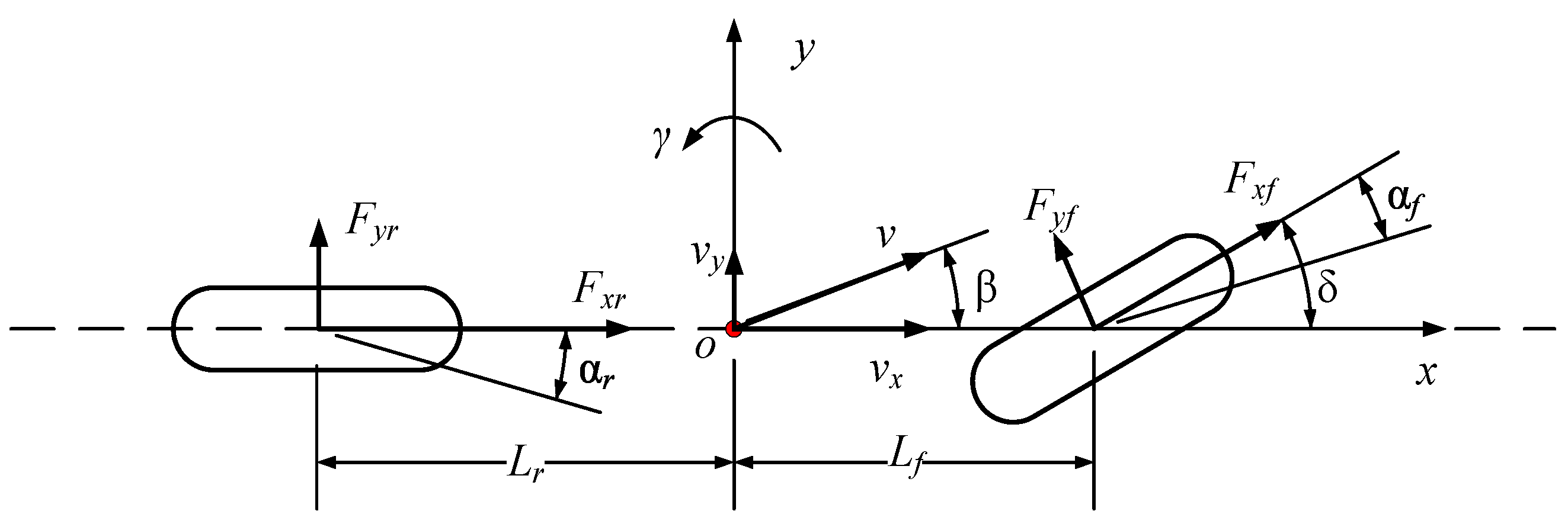
Figure 1. Nonlinear two-degree-of-freedom vehicle dynamics model.
Actuators 15 00003 g001
Figure 2. Longitudinal speed control flowchart.
Actuators 15 00003 g002
Figure 3. Boundary of the stability region.
Actuators 15 00003 g003
Figure 4. Inscribed ellipse of the diamond.
Actuators 15 00003 g004
Figure 5. Circumscribed ellipse of the diamond.
Actuators 15 00003 g005
Figure 6. Extension set.
Actuators 15 00003 g006
Figure 7. Power dissipation characteristics of hub motor.
Actuators 15 00003 g007
Figure 8. Transformation of the extension distance in a two-dimensional extension set.
Actuators 15 00003 g008
Figure 9. Vehicle speed and its error. (a) Vehicle speed. (b) Error between desired and actual vehicle speed.
Actuators 15 00003 g009
Figure 10. In-wheel motor torque for the three distribution control strategies under the NEDC driving cycle. (a) Energy-optimal. (b) Stability-oriented. (c) Extenics coordinated control.
Actuators 15 00003 g010
Figure 11. Weight coefficients during NEDC driving cycle.
Actuators 15 00003 g011
Figure 12. Energy loss during NEDC driving cycle.
Actuators 15 00003 g012
Figure 13. Vehicle state response curves during double-lane-change maneuvers. (a) Lateral displacement. (b) Vehicle speed error. (c) Yaw rate. (d) Sideslip angle. (e) β β ˙ phase plane trajectory. (f) Vehicle roll angle.
Actuators 15 00003 g013
Figure 14. In-wheel motor torque for the three distribution control strategies during double-lane-change maneuvers. (a) Energy-optimal. (b) Stability-oriented. (c) Extenics coordinated control.
Actuators 15 00003 g014
Figure 15. Weight coefficients during double-lane-change maneuvers.
Actuators 15 00003 g015
Figure 16. Energy loss during double-lane-change maneuvers.
Actuators 15 00003 g016
Table 1. Physical quantities in the magic formula tire model.
NotationPhysical Quantity
YOutput variable, representing the tire longitudinal force Fx, lateral force Fy, or aligning moment Mz
XInput variable, representing the wheel slip angle or longitudinal slip ratio
BStiffness factor, determining the slope at the origin
CShape factor, influencing the form of the curve and defining the effective range of the sine function
DPeak factor, controlling the maximum value of the curve
ECurvature factor, adjusting the curvature near the peak and influencing the horizontal position of the maximum value
SVVertical shift in the curve relative to the origin
SHHorizontal shift in the curve relative to the origin
Table 2. Parameters of the five-parameter diamond method.
ParameterAbscissa β /(Rad)Ordinate β ˙ /(Rad/s)
Left endpoint β lim 0
Right endpoint β lim + 0
Top vertex0 β ˙ lim +
Bottom vertex0 β ˙ lim
Stable point00
Table 3. The main vehicle parameters.
ParametersUnitValueParametersUnitValue
mkg1750Bfm1.55
Izkg·m22954Brm1.55
Lfm1.27Rijm0.357
Lrm1.4hgm0.54
Disclaimer/Publisher’s Note: The statements, opinions and data contained in all publications are solely those of the individual author(s) and contributor(s) and not of MDPI and/or the editor(s). MDPI and/or the editor(s) disclaim responsibility for any injury to people or property resulting from any ideas, methods, instructions or products referred to in the content.