


Abstract
Surrealism persistently resisted its own historicization, defining itself not as a literary or artistic movement but as an activity of the mind aimed at total liberation. This essay re-examines surrealism’s internal contradictions: its rejection of literature alongside its dependence on literary institutions; its commitment to psychic freedom alongside political orthodoxy; and its hostility to authorship alongside the production of canonical works. Drawing on manifestos, journals, performance practices, and postwar critical reception, the essay situates surrealism at the fault line between modernism, Dada, and later poststructuralist theory. It argues that surrealism’s most enduring legacy lies less in its aesthetic products than in its reconfiguration of cultural authority among artist, artwork, and reader, a redistribution that continues to shape contemporary literary, media, and performance studies.
Keywords:
surrealism; Dada; modernism; André Breton; Tristan Tzara; authorship; performance; reception theory 1. Introduction
“La poésie doit être faite par tous. Non par un.” [Poetry must be made by all. Not by one.]—Lautréamont
“L’habileté artistique apparait comme une mascarade qui compromet toute la dignité humaine.” [Artistic skill seems to be a masquerade compromising all human dignity.]—Aragon
Attempts to gather Surrealist material as a monument to that group of loosely associated artists are simultaneously its headstone, an admission, at least implicitly, that the revolution of mind and society, and the attempt to restructure both, was, finally, a delineable and limited artistic movement, one with a beginning and an end. Having written his major study of surrealism in 1944, during the final days of the Nazi occupation, Maurice Nadeau looked back on the movement some 13 years later and was forced to admit, “Until further notice, we must resign ourselves to considering surrealism as a literary school […]” (Nadeau [1944] 1987, p. 239). Jean-Paul Sartre, who as a nineteen-year-old student at the Ecole Normale Supérieure was imitating surrealist poetry but whose philosophy of Existentialism and whose call for a more socially conscious literature in his famous essay, “The Situation of the Writer,” a call for littérature engagée that captured the literary, intellectual, and moral high ground from surrealism after World War II, offered a similar assessment as he called surrealism “the only poetic movement as a crucial hinge between modernism and later critical paradigms” (Sartre 1950).
2. From Dada to Surrealism: Poetry as Mental Activity
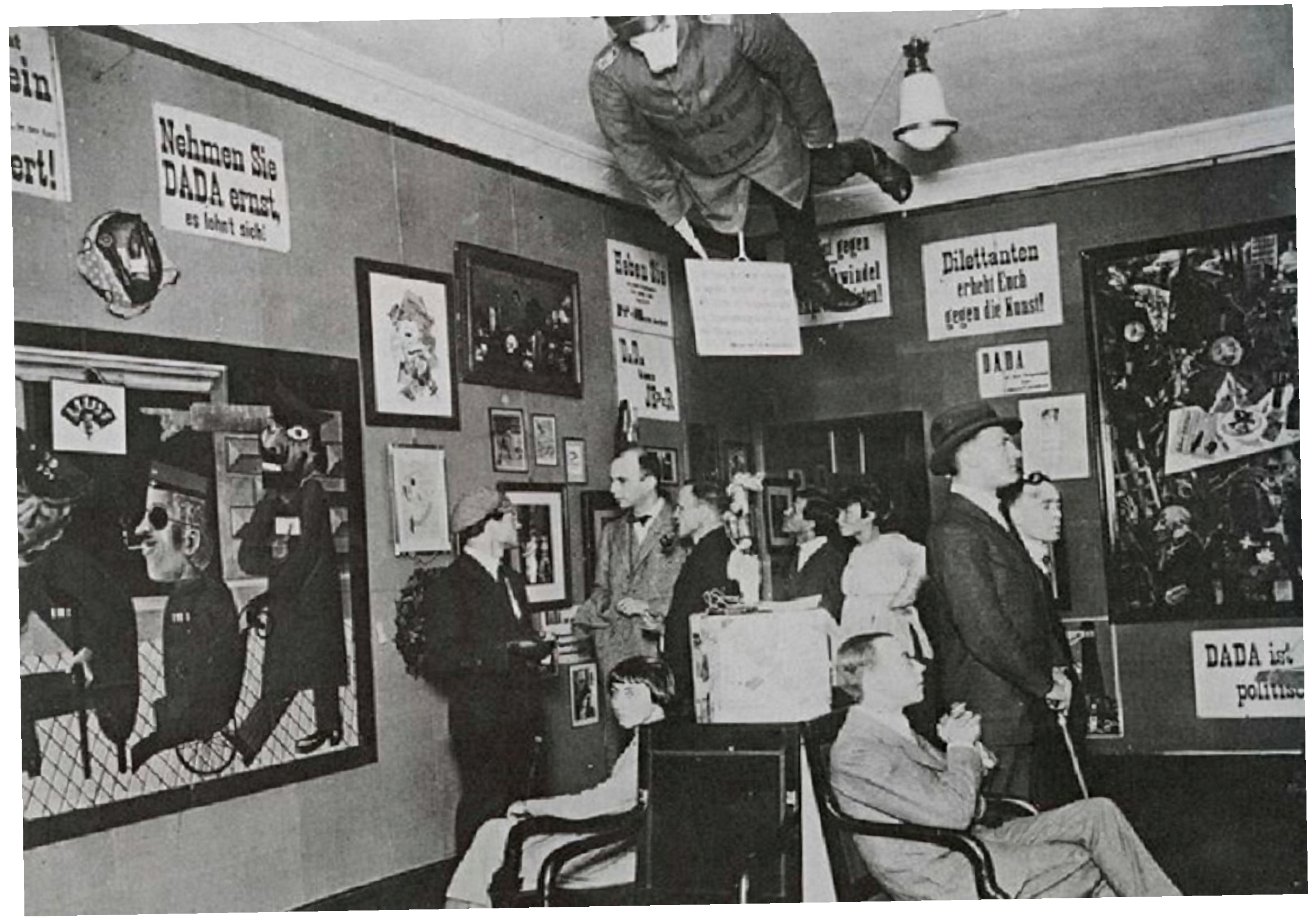
Surrealism emerges directly from the wreckage of Dada (see Figure 1), inheriting its anarchic distrust of reason while seeking to redirect that negation toward psychic exploration. Tristan Tzara’s distinction between poetry as expression and poetry as activity of the mind articulates a central Surrealist premise: that poetic activity need not result in poems at all. “The Surrealist poet is not primarily [part of] poetic movement” or “a literary school.” Their aims were more broadly revolutionary. From its Bureau de Recherches Surréaliste founded in December 1924 at 15, rue de Grenelle, the band of some 26 adherents issued its “Declaration of 27 January 1925” in which it proclaimed:
We have nothing to do with literature. Surrealism is not a new means of expression. It is a means of total liberation of the mind and of all that resembles it …. We are determined to make a revolution.
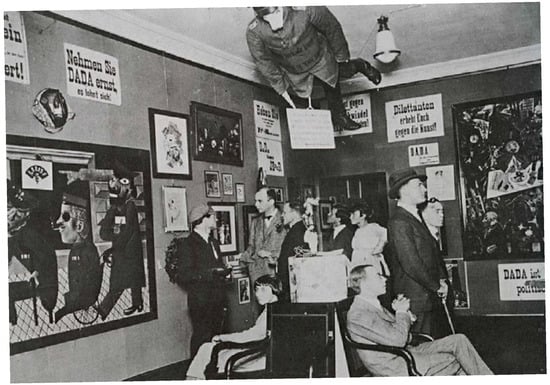
Figure 1.
Cabaret Voltaire, Zurich (1916). Early Dada performance space emphasizing chance, noise, and collective provocation.
Figure 1.
Cabaret Voltaire, Zurich (1916). Early Dada performance space emphasizing chance, noise, and collective provocation.
It is a theme the surrealists never tired of proclaiming, as much for their own reassurance as for public consumption, partly because so much of their activity looked remarkably like that of a poetic movement. In 1931, Tristan Tzara, one of the architects of Dada in Zurich in 1916 and now back in the good graces of André Breton with whom he battled physically in 1923 at a production of Tzara’s play The Gas Heart, made the point afresh in his “Essai sur la situation de la poésie”, which appeared in the third issue (nos. 3–4) of Le Surréalisme au service de la revolution (Tzara 1931). In it, Tzara distinguishes between “poésie-moyen d’expression” [poetry as a means of expression] and “poésie-activité de l’esprit” [poetry as an activity of the mind]: “The poetry which distinguishes itself from novels only by its external form, the poetry which expresses either ideas or sentiments, no longer interests anyone. To it I oppose poetry as an activity of the mind. It is perfectly evident today that one can be a poet without ever having written a line.” Tzara here comes close to recycling one of his original tenets of Dada, which Breton himself had echoed in the coda to Nadja when he called for “poetry without poems.” Like Dada, its predecessor, surrealism was “an activity of the mind,” a process and not a means of generating products, and so finally an anti-literary movement. “Absolute rebellion,” Camus called it in The Rebel (Camus 1951) “total insubordination, sabotage on principle, the humor and cult of the absurd—such is the nature of surrealism.” And yet the process, the “activity of mind”, manifests itself chiefly (but not exclusively) in works of art, and so it is a measure of the movement’s failure on at least the absolute, transcendental, or sublime level, on the plane of idealist revolution, that what remains of it today is archeological, artifacts and a style of art, and precious little activity of mind.
And yet it is precisely amid such paradoxes and contradictions that surrealism situated itself, on which it throve, without which, in fact, surrealism would be inconceivable. The surrealists themselves were, of course, literary and cultural archeologists, passionate collectors of the neglected and rejected art and artifacts of their culture, and so they hunted among the detritus of capitalism at the marché aux puces de St.-Ouen and amid the cast-offs of French letters to resurrect the likes of the Comte de Lautréamont and the Marquis de Sade. They were also passionate anthologists of their own cultural products. From the first, this anti-literary movement engaged in and relied on the literary marketplace, and offered up gatherings of its literature in journals and anthologies. The ironically titled ur-surrealist review Littérature was founded by Louis Aragon, André Breton, and Philippe Soupault in Paris in March of 1919 while the group was flirting with several avant-garde movements, was sympathetic to Dadaist provocation (in fact, they published some 23 Dada manifestos), yet was not wholly surrealist. In it, Breton and Soupault published what most critics consider the first surrealist text, Les Champs magnétiques [1919], [Magnetic Fields] (Breton and Soupault [1919] 1985). In a later essay, “Enter the Mediums,” published in Littérature in 1924, reprinted in Les Pas Perdus and the Surrealist Manifesto that same year, Breton describes this discovery of “automatic writing,” his application of the Freudian principles of “free association,” which he, trained in medicine, had occasionally practiced at the neurological center in Nantes in 1916, and his subsequent collaboration with Soupault on the first automatic text which the co-authors produced in eight days. It was Soupault, admits Breton, who argued for total spontaneity, “for always opposing—and forcibly opposing—any attempt at revision or correction of passages….”. And so, from the first, surrealism, like its predecessors Futurism and Dadaism, established itself in opposition to the tradition of lapidary modernism in Mallarmé, Proust, Flaubert, Joyce, Eliot, Pound, and Stein. In Littérature, the remnants of confrontational Paris Dada co-existed alongside the group’s growing interest in the exploration of consciousness and dreams and their direct literary expression in automatic texts. That Littérature group would shortly adopt the term that Apollinaire (1964) had used as the subtitle to his play The Breasts of Tiresias: A Surrealist Drama as early as 1903. In Les Mamelles de Tirésias; drame surréaliste en deux actes et un prologue [alt. The Mammaries of Tiresias] (Apollinaire 1918), he offered a concise, prefatory overview of the crisis of theater late in the nineteenth century and beginning of the twentieth, which generated a series of generic disruptions, ruptures we loosely call modernist theater, beginning, perhaps, with Les Mamelles and other Dada and subsequent surrealist performance provocations. Apollinaire offered a tipping point in his “protest against ‘realistic’ theater, which is the predominating theatrical art today.” Instead, he proposed new epistemologies, new realities, a rethinking of gender and other ontological fluidities, of phantasms and dreams, of a surreality as a bored, blue-faced housewife, Thérèse, who transforms her gender before an audience as her breasts float away like balloons. Transformed, Thérèse takes the name of the androgynous prophet Tiresias as s/he assaults the centers of power to become both a general and parliamentarian. Her abandoned husband, on the other hand, in an act of self-fertilization, gives birth to some 40,040 children between the acts in something of a speculative piece of performance art.
In December of 1924, with André Breton’s Manifeste du surréalisme (October 1924) behind it, the group produced its first wholly surrealist journal, edited at first by Pierre Naville and Benjamin Pêret, La Révolution surréaliste, and, from issue four on, in July of 1925, edited by Breton himself. The journal ran for some twelve issues, until 15 March 1928. When it was resuscitated, a little over a year later, in July of 1930, the surrealists’ more overtly political aims were proclaimed in the new title, Le Surréalisme au service de la révolution. This version of the publication lasted only six numbers in four issues (the last two double issues), until May of 1933, after which a succession of surrealist publications followed: Minotaure, VVV, Neon, Medium, View, Bulletin International du Surréalisme, London Bulletin (published by The Surrealist Group in England), and after the war, Le surréalisme, même (1956–1959) and Cahiers Dada Surréalisme (1966–1970). Moreover, a host of general literary publications devoted considerable space or whole issues to surrealist art, not the least of which were two Paris-based, English-language literary journals, Maria and Eugene Jolas’s transition and Edward Titus’s This Quarter, which in 1932 was guest-edited by André Breton for the first English-language collection of surrealist work (although, to Breton’s chagrin, the issue was sanitized for the British and American censors). Unlike the art of the dominant modernist tradition, surrealist art was never an end in itself. Its function was never merely to reflect or preserve its culture, even if in that reflection new and previously hidden depths were revealed, but instead to destroy it, or at least to interpose itself between the individual and all forms of authority: church, state, tradition, culture, and the individual conscience.
By 1924, Breton had defined surrealism principally in terms of automatic writing: “Surrealism, subst. [i.e., substantive]; Pure psychic automatism, by which it is intended to express, verbally, in writing, or by other means, the real process of thought. It is thought’s dictation, all exercise of reason and every aesthetic or moral preoccupation being absent. Encyclopedically, it may be said that surrealism rests on belief in the higher reality of certain forms of association hitherto neglected; in the omnipotence of dreaming, in the unbiased play of thought. It tends to the ultimate destruction of all other psychic mechanisms and to be substituted for them in the resolution of life’s chief problems.” By 1932, the achievements of surrealism consisted for Breton of “A hundred or so works of prose and verse, fifty issues of reviews, innumerable pamphlets on politics and morals, a thousand or thereabouts of paintings and ‘objects’ relating to the dream world or symbolism, several cinema films, violent controversies, public outbursts that have repeatedly furnished lively news to the daily press—there is the evidence of the varied activity surrealism has been carrying on in France during the last decade [1922–1932].”
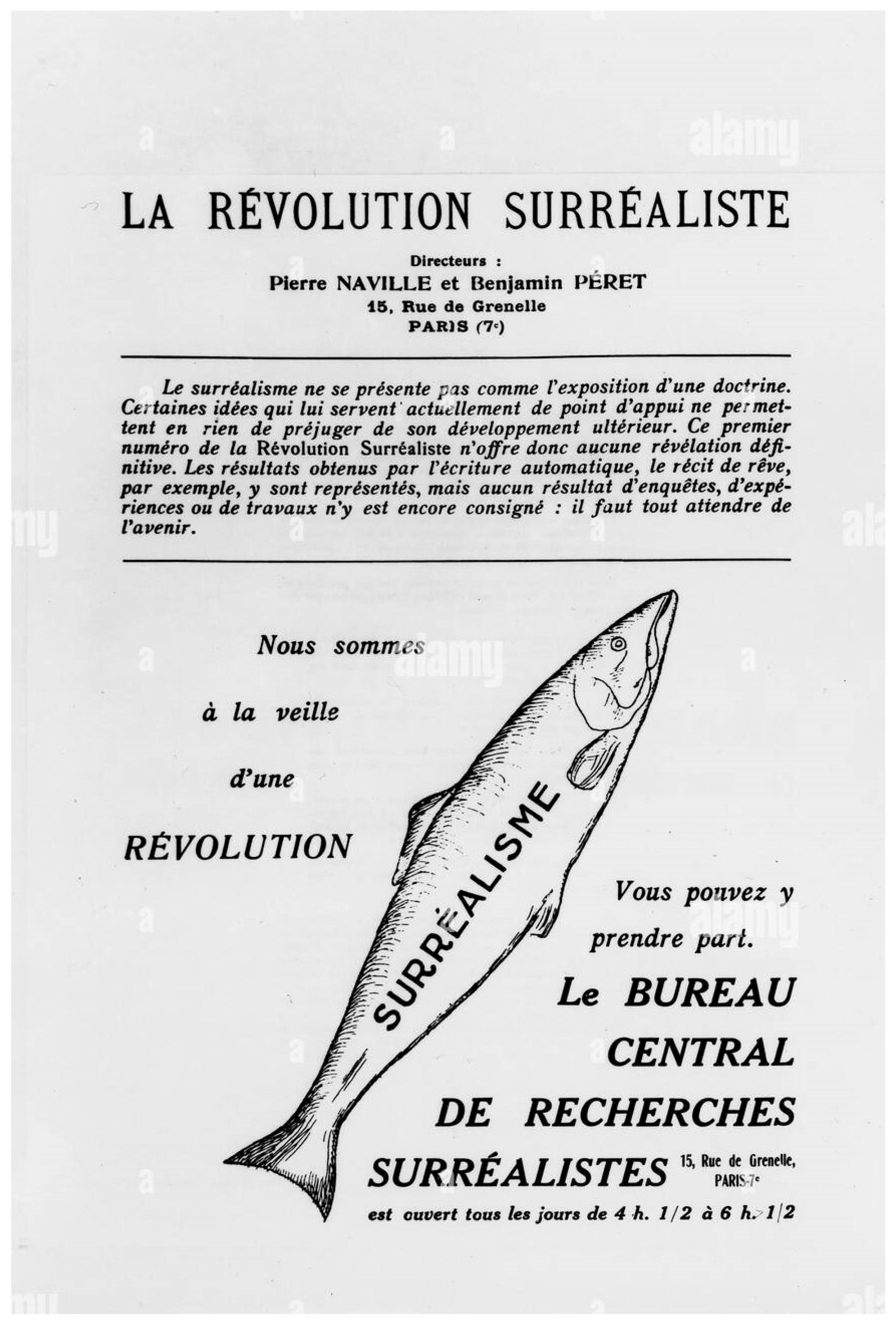
With the adoption of a revolutionary social program, direct political activity, and the acceptance of the philosophical/political paradigm of dialectical materialism (all laid out in the Second Surrealist Manifesto of 1929), surrealism moved into its second phase, away from an idealist philosophy of a revolution of the mind. The latter concept they had borrowed from the champion of many avant-garde movements at the turn of the century, Guillaume Apollinaire, who was convinced that the world could be changed through language alone. But the shift from an idealist philosophy to direct political action signaled (in 1927 when Breton and a few others officially joined, albeit briefly, the PCF, the French Communist Party) an admission that the revolution the surrealists so ardently supported could no longer be solely situated in language. The decision exacerbated a schism between the group’s individual and collective activities, between artistic and social revolutions, a Cartesian duality that the surrealists would never solve. Despite assertions to the contrary, surrealism remained a divided movement, a problem which Breton often tried to deal with by expulsions. Maurice Nadeau, for one, outlined the dialectical paths of surrealism, which always threatened to (and finally did) tear the movement apart, the first constantly bearing towards unknown forces within the human, the second towards political revolution; the former Nadeau associates most strongly with Salvador Dali, the latter with the poet and finally apostate surrealist, Louis Aragon, who finally broke with the movement or was expelled by Breton after the publication of what Breton considered “an occasional poem,” “Front Rouge.” The two roads were for André Breton (as were all dualities), however, always the one, since both developed from the central question of freedom, artistic and political, that is, individual and collective, which the surrealists treated as an absolute right and not as a gift from authority. Breton stated his position on the subject most succinctly and polemically in Nadja: “… freedom, acquired here on earth and at the price of a thousand—and the most difficult—renunciations, must be enjoyed as unrestrictedly as it is granted, without pragmatic considerations of any sort, and this because human emancipation—conceived finally in its simplest revolutionary form, which is no less than human emancipation in every respect, by which I mean, according to the means at every man’s disposal—remains the only cause worth serving.” Albert Camus, however, saw the dark side to Breton’s passion for absolute freedom; it culminated, for Camus, in the theory of the gratuitous act, summarized in Breton’s regrettable example of 1933, that the simplest surrealist act was the discharging of a pistol at random into a crowd. Breton here may have been merely echoing André Gide’s theme in Les Caves du Vatican (The Vatican Cellars [1914]) in which Gide’s protagonist, Lafcadio, commits an “unmotivated crime,” a theme that may grow out of Gide’s (mis)reading of Dostoevsky outlined in his 1923 study Dostoevsky. But the world would soon have its belly full of gratuitous violence with the rise of Chancellor Hitler. For Camus, the surrealists seemed preoccupied with violence, even against themselves. To a surrealist query, “Is Suicide a Solution?” published in the second issue of La Révolution surréaliste (see Figure 2), at least four members, René Crevel (1935), Oscar Dominguez (1957), Jacques Rigaut (1929), and earlier Jacques Vaché (1919) (Nadeau [1944] 1987, pp. 240–41), answered in the affirmative (dates of death cited, although Vaché’s death was the result of a drug overdose). In the tradition of Rimbaud’s “apocalypse of crime”, the surrealists adopted as their heroes, in their determination to liberate desire, the infamous Marquis de Sade and the accused parricide Violette Nozières, for whom the surrealists composed a volume of poems and drawings. And that infatuation with violence and crime has spawned its own tradition in the post-World War II era, with Jean Genet, the American “poéte maudit,” William Burroughs, and even the American novelist John Rechy.
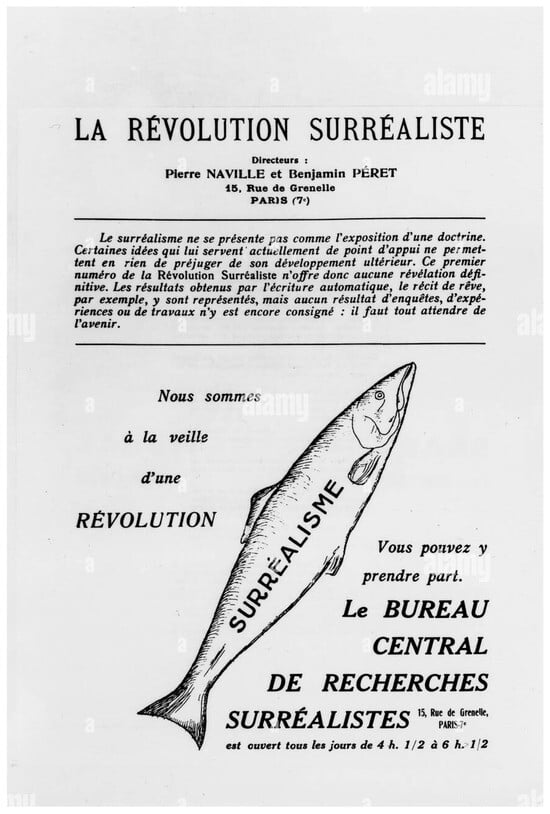
Figure 2.
First page of La Révolution surréaliste, no. 1 (1924). Visual rhetoric of scientific documentation applied to psychic revolution.
In the broadest sense, Breton saw his enterprise, and it was very much his enterprise, surrealism, of a piece with the great political and artistic upheavals of the eighteenth century: the American Revolution (1776), the French Revolution (1789, 1792), and even the Romantic revolution. Marxism, a product of the exploitive days of nineteenth-century capitalism, but based on the historical and philosophical paradigm developed by the great eighteenth-century philosopher and theorist of Romanticism, G.F. Hegel, was, for Breton and the surrealists, the inevitable next step in the development of human freedom, and for the surrealists it had already borne fruit in the October revolution of 1917. As late as 1957, after the Moscow trials of 1936–1938, after the rumors and then confirmation of Stalin’s pogroms and his archipelago of Gulags, and even the crushing of the Budapest insurrection the year before, Breton could still generate praise if not for the Soviet regime at least for the October revolution, noting that it “command[s] forever my fidelity to a cause—the most sacred of all: that of human emancipation” (Breton 1978).
But Breton refused to restrict the surrealist revolution to the political, the social, and the external. He complained that Marx “was entirely taken up with the need of transforming from top to bottom the external conditions of social life.” “I really cannot see,” he continued, “why we should abstain from taking up the problems of love, of dreaming, of madness, of art and of religion, so long as we consider these problems from the same angle as they [the Marxists], and we too, consider Revolution.” This is, of course, precisely Camus’s complaint against the surrealists: “Breton wanted both love and revolution at the same time; but they are incompatible.” The heroes for the surrealists were, then, not the political revolutionaries, Washington, Jefferson, Danton, or Robespierre, or even Lenin, but the likes of Donatien Alphonse François, Marquis de Sade, who died in the institute for the insane at Charenton in 1814. For the surrealists the battle against the repression of desire, which the Marquis represented for them, was as integral as the battle against political and economic repression, and Dali and Buñuel valorized the Marquis in the image of Christ in the final section of their second film, L’Âge d’or (1930). The Marquis de Sade highlighted for the surrealists the fact that social order (that is, civilization itself, at its root) is based on the repression of desire, a point Freud would make strikingly in Civilization and its Discontents (Freud 1930). For the Marquis de Sade and the surrealists, sex and politics were inseparable.
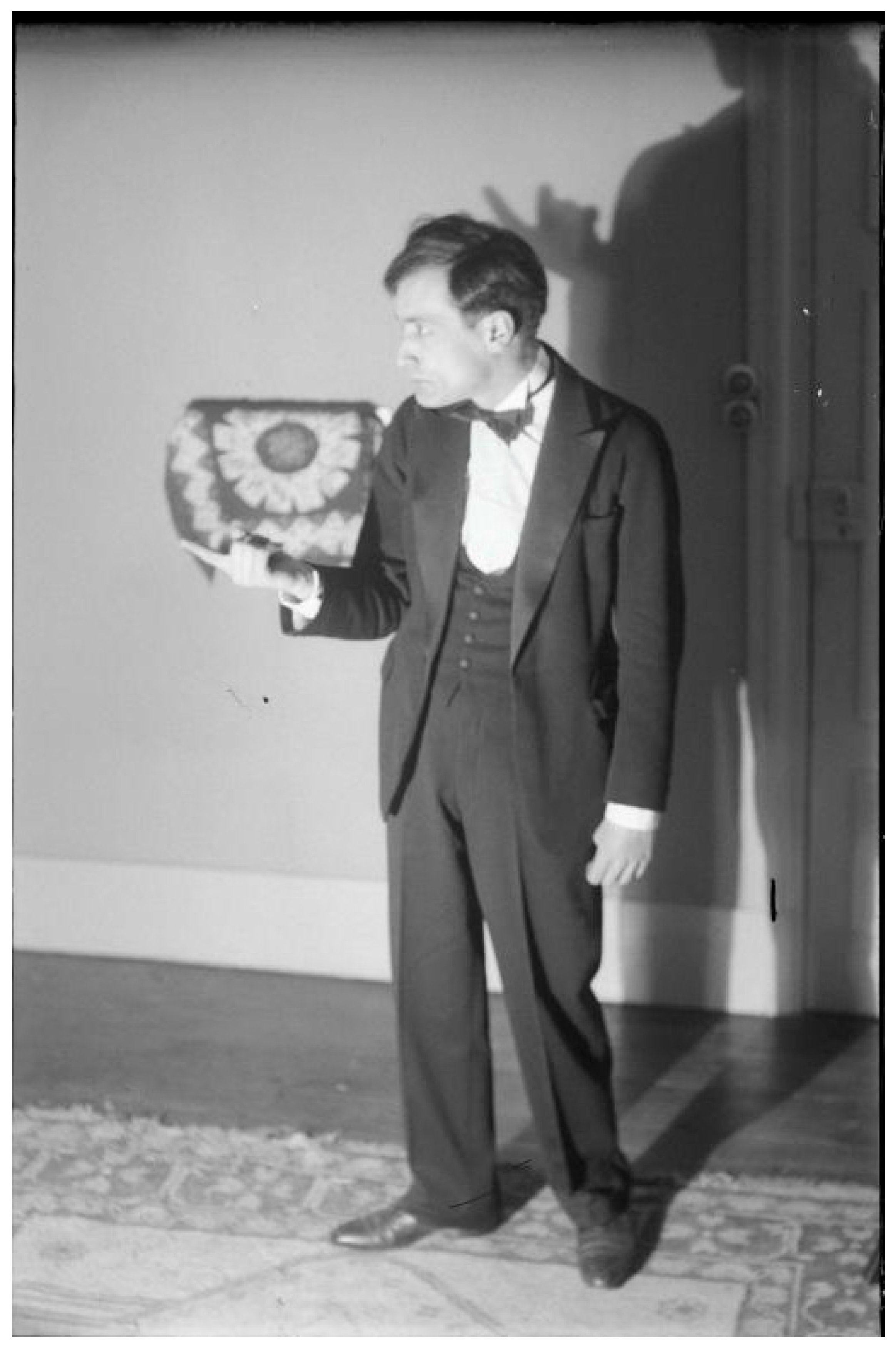
The surrealists then relished their contradictions and social provocations, and so this anti-literary movement produced some exquisite literature, especially the tender lyric poems of Paul Eluard. And even Camus, hostile in general to Breton and surrealism, had to admit, “In the general meanness of his times—and they cannot be forgotten—he is the only person who wrote profoundly about love.” Hostile to the novel as a literary form, except for the roman noir, the Gothic novel, in which the surrealists found that the very notion of “beauty” was redefined, they produced some memorable works of narrative, urban dreamscapes like Louis Aragon’s Le Paysan de Paris, [The Peasant of Paris] and André Breton’s Nadja. Suspicious of the commercialism of the performing arts, the surrealists nonetheless produced some startling works in film and drama, and if their theatre pieces are less performed today than they deserve, their impact on post-World War II theatre, especially through theoretical works like Antonin Artaud’s The Theatre and its Double is almost beyond calculation, providing much of the theoretical framework for the following generation’s theatrical renaissance, which Martin Esslin has so memorably dubbed and titled his monograph the Theatre of the Absurd (Esslin 1961). In fact, one can better understand Artaud’s call for a “theatre of cruelty” and a “theatre as plague” by seeing these ideas against the movement that nourished them and which Artaud first embraced and finally rejected in 1930, that is, surrealism. For Artaud, social turmoil (that is, cultural revolution) is best mediated through performative art, theater (see Figure 3), whose concentrated energy should strike the audience with the direct social impact of a plague; that is, the change in public sensibility should come through the “cruelty” of art. “One can admit,” says Artaud, “that the external events, political conflicts, natural cataclysms, the order of revolution and the disorder of war, by occurring in the context of theatre, discharge themselves into the sensibility of the audience with all the force of an epidemic.” (Artaud [1938] 1958, pp. 15–32). That too was the doctrine of surrealism, which was a social revolution through the mediating effects of marvelous art.
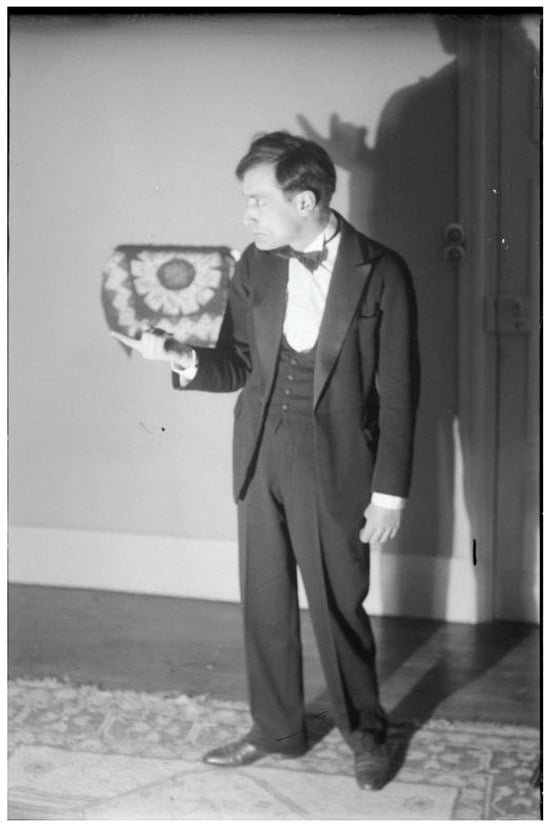
Figure 3.
Antonin Artaud performing at Théâtre Alfred Jarry (c. 1930). Portrait emphasizing embodiment and intensity central to Surrealist performance theory.
And finally, despite their dedication to the abolition of literary movements, they saw themselves in a fairly direct line with the Romantic movement, “of which we are quite ready to appear to-day [1932] as the tail,” admits Breton. Hostile to literary history, Breton is careful to detail the diverse precursors of surrealism, including (in an abbreviated list designed to highlight English influences): “Swift who is found complete in Jarry and Vaché; the chief representatives of the ‘Gothic novel,’ Walpole of The Castle of Otranto, Mrs. Radcliffe (whom Lautréamont calls the ‘crazy spectre’), Monk Lewis, looming large in Sade’s Idées sur les romans and contributing ‘the indispensable revolutionary impulses’ which had begun to agitate the Europe of that time; Maturin, who, having loomed over Borel and Baudelaire, is described by Lautréamont as ‘the devil’s crony’ (‘Le compère des ténèbres’); not to overlook in the vanguard of such masters of terror that prodigy of verbal orchestration who was Young ([1742] 1798), unquestionably the most authentic forerunner of the surrealist style, whose secret Lautréamont was the first to appropriate: “O nights of Young! you have given me many a headache!” Finally, there is Synge, with his Playboy of the Western World, which alone links us with him,—a play whose poetical and moral career is still far from being terminated” (Breton [1924–1930] 1969). Explaining surrealism to an English-speaking audience, Breton saw the need to emphasize his literary predecessors, and in 1940 he collected and introduced work by many of these same authors for his Anthology of Black Humor.
The Cartesian taxonomy of surrealism began to be sketched soon after its inception. In the First English and American Surrealist Manifesto (Roditi [1928] 1974), published at Oxford University just four years after André Breton’s First Surrealist Manifesto (1924), Edouard Roditi argued that the main line of modernism established by Proust, Joyce, Eliot, Stein, Pound, and others had run its course, its emphasis on “aestheticism” exhausted. Moving dialectically against these “latter day saints of technique,” against this line that emphasizes “complete mastery of expression and [which] knows exactly where to place each word” are those artists opening their work to chance: “This element of chance is surrealism.” Roditi’s definition may seem overly simple, surrealism as an extension of Dada (an association about which considerable critical debate remains) but it does strike at the heart of at least one of the great surrealist issues. It predicts the demise of the humanist tradition of directed and teleological art, sees its replacement by an art whose “meaning is no longer a purpose but an accident.” And so, “The writer is no longer a person but an accident.”
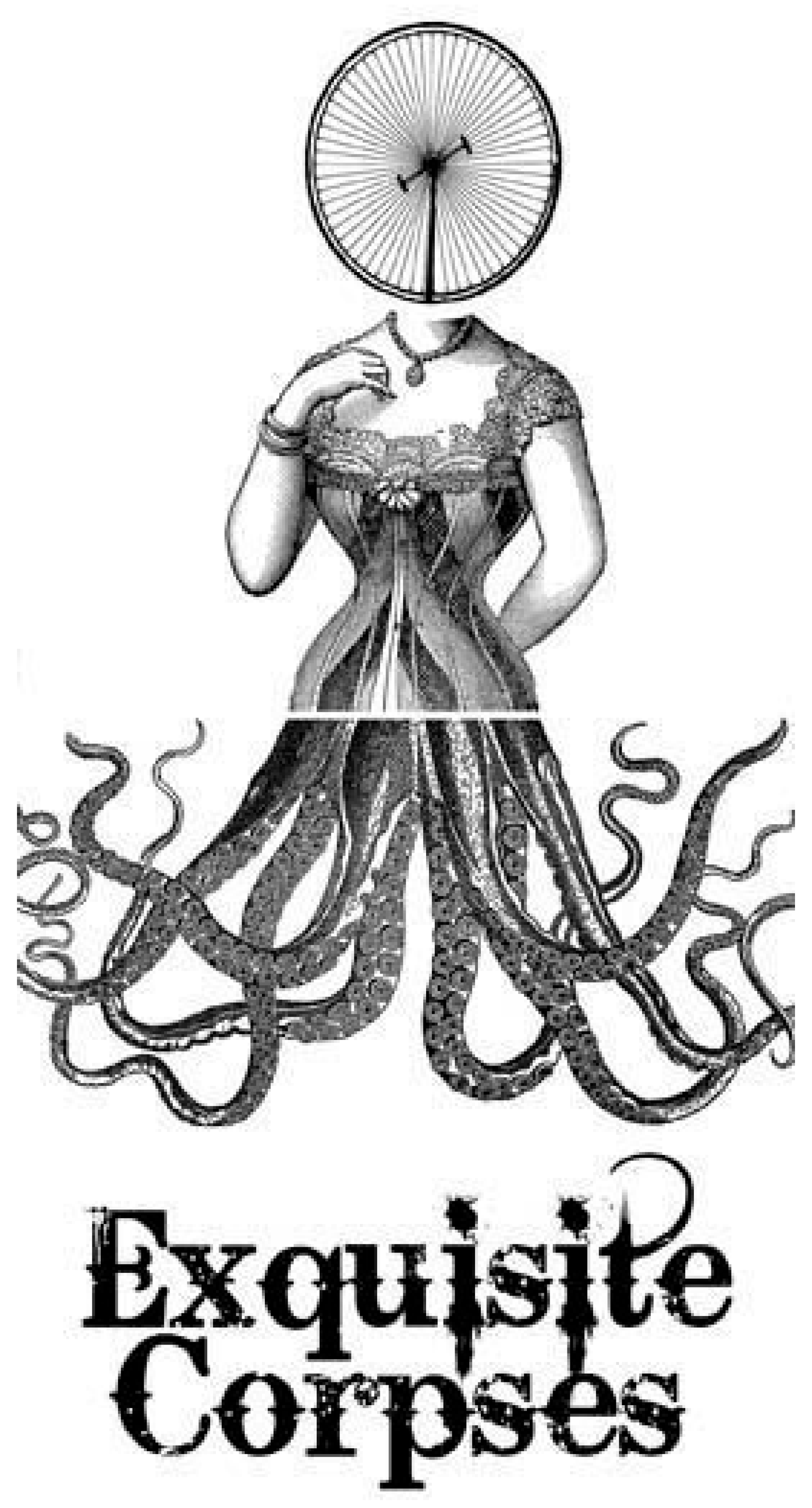
Roditi’s announcement of the demise of lapidary modernism may have been a bit premature in 1928 since only the first of the seventeen installments of what James Joyce was then calling Work in Progress had appeared in transition by 1928, and William Faulkner would not begin to publish his major, stream of consciousness novels for another year, until The Sound and the Fury in 1929, and Virginia Woolf was yet to write The Waves (1931) and The Years (1937). Samuel Beckett, who bridges both traditions, had barely begun to publish, although he would wrestle with the specter of James Joyce for another twenty years before he came to peace with and finally modified the modernist tradition beyond recognition, but the sketch of the ideological schism within modernism was a prescient observation for the 18-year-old critic/poet, fresh undergraduate at Oxford University, himself writing in the shadow of the recently departed W. H. Auden. What separates the two categories for Roditi is not so much that the surrealists had discovered a new subject matter for art. Certainly, Rimbaud, Mallarmé, Proust, and Joyce were plumbing what Freud would finally call the subconscious, as were the Romantics and the Symbolists before them. What separates the two finally is power, the relationship of the artist to his or her work, and hence the relationship of the reader to the artwork. The surrealists opposed the concentration of power in any form, whether within political units like governments or aesthetic units like artists. What the surrealists brought to the discourse of art was a sense of the diminished role of the artist, if not the abolition of talent per se. The point is made strikingly by Ernst (1948) in the opening paragraph to his essay, “Inspiration to Order”: “Since the becoming of no work which can be called absolutely surrealist is to be directed consciously by the mind (whether through reason, taste, or the will), the active share of him hitherto described as the work’s ‘author’ is suddenly abolished almost completely. This ‘author’ is disclosed as being a mere spectator of the birth of the work, for, either indifferently or in the greatest excitement, he merely watches it undergo the successive phases or [sic] its development.” Ernst saw quite clearly that such an aesthetics was revolutionary and would alter our very conception of the artist and his work of art: “Needless to say, this has been a great blow to art critics, who are terrified to see the importance of the ‘author’ being reduced to a minimum and the conception of ‘talent’ abolished.” Ernst is indeed echoing here Breton’s comment in the First Surrealist Manifesto, “We have no talent,” but the matter warrants repeating since it carries the weight of the deposition of monarchy. The consequences of such a revolution in aesthetics are finally something of a democratization: “surrealist painting is within the reach of everybody who is attracted by real revelations and is therefore ready to assist inspiration to make it work to order.” The corollary to dethroning the author then is the collaborative composition like the Magnetic Fields, Immaculate Conception, and the “exquisite corpse” experiments (see Figure 4). “They were the first to dare,” writes Maurice Nadeau, “to write collective poems, eliminating thereby the role of the poet legislating from atop some Sinai, or even simply of the littérateur who too often supposes himself the sole author of what he writes.”
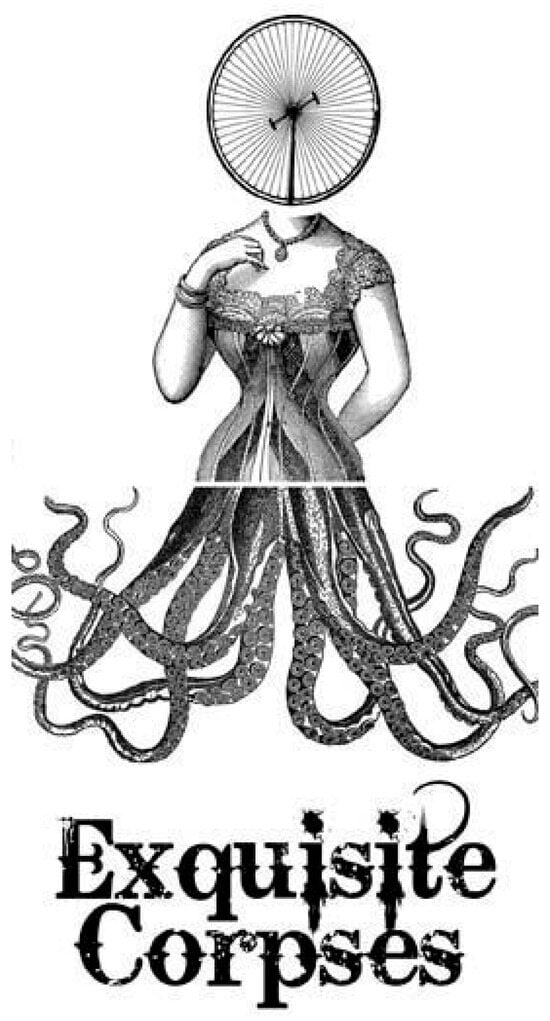
Figure 4.
Example of cadavre exquis [Exquisite Corpse] drawing, surrealist group, c. 1927. Collective authorship and chance composition.
Although surrealism is, as Breton admits, an extension of Romantic aesthetics, it takes serious issue with the Romantic image of the artist, an image more associated with high modernism than its surrealist antithesis. Against the Romantics’ and early Modernists’ exaltation of the artist, the surrealists posited his or her total demise. Against the conception of the eternal artwork, the surrealists offered its evanescence and desecration. Against the development of an art of privilege, an art designed for and restricted to a highly educated elite, James Joyce’s ideal reader with ideal insomnia who would (and could) spend his life deciphering, decoding texts like Finnegans Wake, or Mallarmé’s ideal reader (after Huysman’s hero), Des Esseintes, who was devoted to aestheticism and understood beauty as artifice, the Dadaists first and then the surrealists offered an assault against craft. Such devaluation of craft has its roots in the developing modernist interest in primitivism, the innocent, naive paintings of “Le Douanier,” Henri Rousseau, who bridges the gap between Romantic and modern painting more thoroughly than even that post-Impressionist spirit of Cubism, Paul Cezanne. And in literature, the child-like simplicity of Alfred Jarry does much the same, literalizing the Romantic’s adoration of the child, in this case his more sinister, amoral side. The Dadaists widened the breach between art and craft with an overt return to the sensibility of a child in the paper masks of Marcel Janco, in the simple wooden sculptures/puzzles/shapes/toys of Jean Arp, and in the verbal collages, the cut up and re-arranged Shakespearean sonnets of Tristan Tzara.
The Victorian fascination with primitive cultures and myth bore scholarly fruit with the publication of James Frazer’s The Golden Bough, the first volume of which appeared in 1890 and the twelfth volume during the first World War, in 1915. And in 1919, the book that was so fundamental to T. S. Eliot’s early poetry, Jessie Weston’s From Ritual to Romance, subtitled An Account of the Holy Grail from Ancient Ritual to Christian Symbol appeared. But that aspect of the primitive, which literally changed the face of modernist imagery, was Picasso’s use of African masks in the painting with which he invented Cubism in 1907, “Les Demoiselles d’Avignon.” What Picasso found in those primitive masks was not any anthropological insight into native cultures, but simply license, the justification for his rupture with mimesis. He found the freedom to distort.
For Breton, primitivism, reinforced by Freud’s analysis of the subconscious (and Freud himself was a great collector of antiquities and primitive art) included the works of the insane as well as those objects produced by third-world cultures. And when he went to Mexico in 1938, Breton found the essence of surrealism thriving in native folk imagery. Although primitive art lacked spontaneity, the element of automatism, it confirmed for Breton the global nature of the surrealist vision.
Artistically and politically, surrealism was an assault on privilege, a rejection of the attitude summarized by Flaubert, that “Art is a luxury … It needs white, calm hands.” In one of the manifestos published in what has arguably become the most influential book on theater in the twentieth century, The Theatre and its Double (1938), Antonin Artaud, who was the first director of the Central Bureau of Surrealist Research in 1925 but who had broken with the surrealists in November of 1926 when he published his manifesto for the Théâtre Alfred Jarry in Nouvelle Revue Francaise, notes that “We must have done with this idea of masterpieces reserved for a self-styled elite and not understood by the general public,” for “fixed masterpieces,” a phrase which for Artaud was redundant, are “one of the aspects of bourgeois conformism.” We are very far removed here from Mallarmé’s position outlined in a letter to Henri Cazalis, that art is for artists, and in which he grieved diluting his work for the general reader. Explaining his own “surrealist objects” (derived in great part from Marcel Duchamp’s assault on craft with his “ready-mades”), the American veteran of New York Dada, Man Ray, noted that for his “objects” he selected “something which in itself has no quality or charm. I pick something which in itself has no meaning at all. I disregard completely the aesthetic quality of the object; I am, against craftsmanship. I say the world’s full of wonderful craftsmen, but there are very few practical dreamers” (emphasis added).
The sensibility with which the surrealists might have been expected to remain compatible would then be that of the Marxists, but the Marxists finally had little sympathy for “practical dreamers,” and Marxist materialism was philosophically at odds with the surrealists’ deification of the irrational. Breton met Marcel Fournier, editor of the Marxist Clarté, in 1925 and a fragile association was begun, which culminated in the publication of La Révolution d’abord et toujours. And in turn Fournier even contributed pieces to La Revolution surréaliste. In January of 1927, Breton, Aragon, Eluard, and Péret joined the PCF, the French Communist Party, but the alliance was shaky and many of the surrealists left by the end of the year. In Legitimate Defense, September of 1926, Breton had already taken issue with the Communists’ literary attitudes, at least those expressed in the party organ, L’Humanité, but the alliance was pursued. Louis Aragon, along with Georges Sadoul, visited the Soviet Union for the Second Congress of the International of Revolutionary Literature in October of 1930, during which Aragon apparently rejected surrealism by signing a letter denouncing Freud, Trotsky, and Breton’s Second Manifesto of Surrealism. On his return to France, Aragon had second thoughts and renounced his earlier repudiation in a pamphlet, Aux Intellectuels Revolutionnaires. The following year, however, Aragon published Front Rouge, an overtly revolutionary poem for which he was then charged by the French government with “demoralization of the army and the nation.” In defense of the poem, rather in defense of the poet’s right to publish freely and without censure or punishment, Breton also attacked the attitudes toward the literature of the French Communist party. With the Aragon conflict, Breton saw threats from both the political right and left. In 1928, Breton saw the danger principally from the right, “those who wanted to be content with that minimum of common activity which could be innocuously practiced in literature and art.” But in 1932, he was alarmed because: “A drift to the left was some months ago seeking to crystalize itself around a poem by Aragon, Front Rouge ….” Breton summarizes his position on Marxism and freedom and effectively excommunicated Aragon from the surrealist group.
Although Breton remained apparently committed “entirely, without reservation, to the principle of historical materialism [i.e., dialectical materialism],” he insisted “as on a right, that whatever is most significant and most specific in what we have to give shall not be alienated on behalf of any blind orthodoxy,” i.e., Marxism. He attacked those authors who “were content to let their pens run over the paper without observing in the least what was at the time going on inside themselves.” By 1934, when Andrei Zhdanov offered the program of “social realism” at the First Congress of Soviet Writers, surrealism broke with Marxism and its aesthetics was irremediable.
Looking back on the movement some twenty-six years after his original English manifesto, Edouard Roditi still tended to divide the surrealists into two camps: those attached to the “romantic quest of the absolute or sublime,” on the one hand, and the black humorists, “the anarchist cult of the absurd,” on the other. He insists that critics like Anna Balakian and Maurice Nadeau stress the former at the expense of the latter and so reduce the complexity of the movement. Much of the controversy comes down to the relationship between surrealism and its most direct predecessor, Dada. Certainly the more one stresses the “anarchist” elements of surrealism, the more the movement sounds like its predecessor, and Balakian warns against this danger. Reviewing her 1959 study of surrealism for a third edition in 1986 (Balakian [1959] 1986), she warned of “several dangers” in the renewed interest in surrealism: “Instead of a clarification of the distinctions between Dada and surrealism I note more and more the assumption of their common identity.” Balakian insists on surrealism’s positive character, its “determined optimism,” against Dada’s negation, which was “non-creative.” Roditi, on the other hand, maintains that such a view obscures the anarchist, the pataphysical elements of surrealism, the persistence of the Dadaist spirit within surrealism. For Balakian surrealism overcame its dualities; for Roditi it did not. Breton would have loved the dispute and have agreed with both.
In many respects, the hopes of surrealism may seem naive to us today. In a world where violent juxtapositions, i.e., Lautréamont’s sense of beauty or what André Breton called “convulsive beauty” or “the marvelous,” where the umbrella and sewing machine meet on an operating table, are part of the fabric of everyday life, it seems naive to think, or to have thought, that such a technique could generate at least a new sensibility if not a new social order. In America, at any rate, even the high seriousness of the evening news is not immune from interruption by singing scrub brushed dancing merrily in a pristine toilet bowl. The imagery makes Marcel Duchamp’s Fountain seem subtle. Such a juxtaposition was the “marvelous” for the surrealists, at least the means to convulsive beauty. But we have plunged so far and so fast into the hyper-kinetic fragmentation of postmodernist culture that the surrealist experiments in juxtaposition seem tame, placid, and almost urbanely pastoral. The achievements of modern medical technology, however, on the verge of creating prosthetic technological centaurs, seems to have outstripped even the wildest surrealist imagination. Even the surrealists’ sense of a sexual revolution, much of it based on the fetishization, objectification, and even dismemberment of the female body, seems more a projection of male fears and fantasies than a universal liberation. Furthermore, what Breton could not have anticipated was the passivity of the masses, that group that Baudrillard (1983) has dubbed the “silent majority.” For Baudrillard that apathy is an active political statement by those who remain militantly passive, “and not only passive, but who, in all good faith and with glee and without even asking themselves why, frankly prefer a football match to a human and political drama.” The question is not, as Baudrillard points out, merely one of ignorance and apathy of the masses, but their “refusal to participate in the recommended ideals, however enlightened.” Nor can one easily accept the notion that a plunge into the subconscious via the myriad of surrealist techniques is, in and of itself, of interest. Or that any of the surrealist techniques for plumbing the depths of the subconscious, automatic writing or drawing, dreams, hypnotic trances, and the like would produce interesting results.
Aragon himself demolished that notion in his Traité du style: “If you write dreary idiocies following a surrealist method they will remain dreary idiocies… And especially if you belong to that lamentable category of individuals which is ignorant of the meaning of words, it is probable that the practice of surrealism will bring to light no more than this crass ignorance.” (Aragon 1991).
And yet one can continue to view with admiration the surrealists’ almost masochistic passion for self-examination, their willingness to confront the beast within and the beast without, their willingness to repudiate our “many expedients to escape the nightmare.” Others have confronted disorder, continues Nadeau, “The surrealists though lived with the beast in constant confrontation.” In a less jaded age, we might have deemed that confrontation heroic. Forced to take sides against a rising tide of fascism in Europe, the surrealists chose the anarchic left. Much of the modernist movement, however, went with the tide toward an anti-egalitarianism and toward a backward-looking aesthetics. William Butler Yeats rejected the popular Naturalism of his early drama for a more elitist, Noh-inspired theatre that brought Yeats close to a Nietzschean-inspired fascism. D. H. Lawrence recoiled from nihilism in favor of an elite, charismatic, near-fascist super leader. Ezra Pound embraced Benito Mussolini’s brand of order enough to broadcast propaganda during the second World War. T. S. Eliot finally withdrew from his struggle with the beast into Anglicanism and royalism. Salvador Dali re-embraced Catholicism and supported the Franco dictatorship in his native Spain. And while Carl Jung found a measure of appeal to the Nazi plan for the German peoples, Martin Heidegger actually joined the party, and in 1934, Heidegger, the Nazi appointed Rector of the University of Freiberg, refused to greet his 75-year-old former teacher and even removed Husserl’s name from the dedication page of the masterwork, Being and Time. The surrealists, on the other hand, much to their credit, resisted all forms of Gleichschaltung, of conformity, in politics and in aesthetics.
Repudiating the concept of eternal or even lasting beauty, surrealists have nonetheless produced works of lasting (if redefined) beauty. Artaud’s assault on the very notion of masterpieces is itself a masterpiece of theoretical and critical insight, the ravings of a “madman” with all the acute insight accessible only to the mad. And certainly, and perhaps most profoundly, surrealists have permanently altered the power structure among artist, artwork, and audience. With the death of authority and the admission of chance as co-creator, the literary focus is no longer on the author or on a static or timeless work of art, but on its reception, on the phenomenological interplay between perceiver and text. Such a critical redistribution of textual power spawned a whole school of reception aesthetics in Germany and a movement among French critics called variously la nouvelle critique, poststructuralism, or deconstruction. Roland Barthes’s assessment of the power shift is representative. “Surrealism … contributed to the desacralization of the image of the author by ceaselessly recommending the abrupt disappointment of the expectations of meaning (the famous surrealist ‘jolt’), by accepting the principle and experience of several people writing together.” The removal of the author “utterly transforms the modern text.” Once the surrealists opened up the work of art to the multiplicity of creators and creative forces, we have a new text, one “made of multiple writings, drawn from many cultures and entering into multiple relations of dialogue, parody, contestation, but there is one place where this multiplicity is focused and that place is the reader, not, as was hitherto said, the author.” And so the artwork, at least the sources of image and subject, was no more in control of the artist than were his dreams. Even the careful reworking of that original image—and one need look no further than the paintings of Salvador Dali and René Magritte (allegorists both in the tradition of Hieronymus Bosch) to realize that the surrealists had not destroyed deliberation and craft entirely but merely deposed it. And those subconscious images were themselves, to use Freud’s term, “overdetermined,” so condensed in meaning that the process of their decoding was infinite. Like the dreamwork, the subconscious image was the nexus of forces that Freud called “condensation,” that is, the existence of multiple significations within a single image, and “displacement,” whereby an image can be part of several times and spaces simultaneously. The arrangement of those images in a sequence, in a narrative or in a space, framed or unframed, is of less import than their archeology. Such order, which Freud called “secondary revision,” was merely a trick of the ego to slip over-determined images past the censor of the subconscious. In fact, Freud’s analysis of secondary revision in dreams stands as a useful primer for reading and analyzing surrealist poetry and paintings: “we should disregard the apparent coherence between a dream’s constituents as an unessential (sic) illusion and that we should trace back the origin of each of its elements on its own account” (Freud [1899] 2010).
The final irony of surrealism may be found in its current bourgeois respectability, its epitaph written in its own images replicated on designer tee shirts. This band dedicated to “total insubordination” is being absorbed not only into the fabric of western culture, but into its marketplace as well. The works of André Breton were finally collected for a Pléiade volume in the summer of 1988. At an auction the following summer at Paris’s Hôtel Drouot, a Max Ernst painting sold for USD 980,000. Twenty-six works by Tristan Tzara brought USD 7.5 million, prompting the French government to intervene by invoking its “law of preemption” to block the sale of five of those works, four others by Jean Arp and a collage by Kurt Switters (valued at USD 350,000) since these works were now considered national treasures. More than testimony to the masochistic potential of the bourgeoisie, the patriotic act by the French government may represent surrealism’s final defeat in a governmental embrace the cultural equivalent of suffocation.
3. Journals, Manifestos, and the Anti-Literary Archive
Despite its hostility to literature as an institution, surrealism depended upon journals, manifestos, and anthologies for its dissemination. The review Littérature, founded in 1919, was a literary extension of Dada performative activities centered in the Cabaret Voltaire, Zurich, in 1916. The literary journal occupies a paradoxical position as both incubator and archive. It was here that Breton and Soupault published Les Champs magnétiques, often identified as the first surrealist text and a paradigmatic experiment in automatic writing.
Breton’s retrospective accounts of automatism emphasize spontaneity and the suspension of revision. Automatic writing, drawing on Freudian free association, sought to bypass conscious control and aesthetic judgment. Yet even these experiments required material conditions: time, collaboration, publication, and readership. The surrealist archive thus emerges as an unintended residue of anti-archival impulses.
Subsequent journals such as La Révolution surréaliste and Le Surréalisme au service de la révolution mark the movement’s evolution from psychic experimentation toward political engagement. Their pages juxtapose dream reports, political tracts, questionnaires on suicide, and images of found objects, enacting surrealism’s refusal of disciplinary boundaries.
4. Politics, Marxism, and the Question of Commitment
Breton ([1924–1930] 1969)’s definition of surrealism as “pure psychic automatism” situates the movement firmly within an idealist philosophy of mental liberation. By the late 1920s, however, surrealism entered a second phase characterized by political engagement and temporary alignment with Marxism. This shift reflected a growing dissatisfaction with purely linguistic or psychic revolution.
The surrealists’ brief affiliation with the French Communist Party exposed irreconcilable differences between artistic freedom and political discipline. Nadeau identifies two dialectical paths within surrealism: one oriented toward the exploration of the unconscious, the other toward collective political action. Breton insisted that both paths converged in a single demand for freedom, yet the movement’s history is marked by expulsions, denunciations, and schisms.
Camus’s critique of surrealism’s fascination with absolute freedom and gratuitous violence underscores the ethical stakes of these debates. The surrealist valorization of figures such as the Marquis de Sade foregrounds the movement’s insistence that psychic liberation cannot be separated from social transgression.
5. Surrealism, Performance, and the Crisis of Theatre
Surrealism’s challenge of representation found especially fertile ground in performance and theatre. Guillaume Apollinaire’s Les Mamelles de Tirésias anticipates surrealist dramaturgy through its rejection of realism, its play with gender fluidity, and its embrace of theatrical absurdity. Apollinaire’s declaration of a “surrealist drama” signals an early recognition that theatre could function as a site of epistemological rupture.
Antonin Artaud’s subsequent development of a “theatre of cruelty” extends surrealist principles into a theory of performance as sensory and psychic assault. In The Theatre and Its Double, Artaud rejects the primacy of text in favor of gesture, sound, and spatial intensity. Theatre, for Artaud, becomes a plague: a force capable of reordering perception and social relations.
6. Authorship, Collectivity, and the Dethroning of Talent
Surrealism’s most radical intervention may lie in its reconfiguration of authorship. Max Ernst’s assertion that the artist becomes a spectator to the work’s emergence articulates a decisive break with Romantic and modernist notions of genius. The surrealist author does not master the work but witnesses its unfolding.
Collective practices such as automatic collaboration and the cadavre exquis literalize this dethroning of authorship. By dispersing creative agency across multiple participants, surrealism undermines the concentration of aesthetic power. Nadeau’s observation that surrealism dared to abolish the poet “legislating from atop some Sinai” underscores the movement’s democratic impulse.
These practices anticipate later theoretical developments. Roland Barthes’s proclamation of the “death of the author” echoes surrealist challenges to authority, while reception theory and poststructuralism extend surrealism’s redistribution of meaning toward the reader.
7. Afterlives: Institutionalization and Irony
The final irony of surrealism lies in its institutional success. A movement dedicated to total insubordination now circulates within museums, archives, and the cultural marketplace. Breton’s works appear in the Bibliothèque de la Pléiade; surrealist artworks command record prices at auction.
Yet this institutionalization should not be read simply as defeat. Surrealism’s deeper legacy persists in its challenge to aesthetic hierarchy, its suspicion of mastery, and its insistence on the instability of meaning. Even as its images are commodified, its theoretical provocations continue to unsettle assumptions about art, authorship, and interpretation.
8. Conclusions: Surrealism After Surrealism
Surrealism did not complete the revolution it imagined. Its faith in psychic liberation, political transformation, and collective creation now appears, in some respects, naïve. Yet its interventions permanently altered the conditions under which art and criticism operate. By dismantling the authority of the author, destabilizing the artwork, and foregrounding reception, surrealism opened a path toward later critical paradigms.
In this sense, surrealism survives less as a movement than as a method: a mode of suspicion toward authority, a willingness to confront contradiction, and an enduring commitment to the imagination as a site of resistance.
Funding
This research received no external funding.
Data Availability Statement
No new data were created or analysed in this study. This article is based exclusively on published primary and secondary sources, all of which are cited in the References section. No datasets were generated or deposited during the preparation of this manuscript.
Acknowledgments
The author wishes to thank colleagues in modernist and performance studies for ongoing conversations that informed the development of this essay.
Conflicts of Interest
The author declares no conflict of interest.
References
- Apollinaire, Guillaume. 1918. Les Mamelles de Tirésias: Drame surréaliste en deux actes et un prologue. Paris: Gallimard. [Google Scholar]
- Apollinaire, Guillaume. 1964. The Breasts of Tiresias: A Surrealist Drama. In Modern French Theatre: An Anthology of Plays. Edited by Michael Benedikt and George E. Wellwarth. Translated by Louis Simpson. New York: E. P. Dutton, pp. 3–38. [Google Scholar]
- Aragon, Louis. 1991. Treatise on Style (Traité du style). Translated by Alyson Waters. Lincoln: University of Nebraska Press. [Google Scholar]
- Artaud, Antonin. 1958. The Theatre and Its Double. Translated by Mary Caroline Richards. New York: Grove Press. First published 1938. [Google Scholar]
- Balakian, Anna. 1986. Surrealism: The Road to the Absolute, 3rd ed. Chicago: University of Chicago Press. First published 1959. [Google Scholar]
- Baudrillard, Jean. 1983. In the Shadow of the Silent Majority. Translated by Paul Foss, Paul Patton, and John Johnston. New York: Semiotext(e). [Google Scholar]
- Breton, André. 1969. Manifestoes of Surrealism. Translated by Richard Seaver, and Helen R. Lane. Ann Arbor: University of Michigan Press. First published 1924–1930. [Google Scholar]
- Breton, André. 1978. The October Revolution. In What Is Surrealism? Selected Writings. Edited and Introduced by Franklin Rosemont. New York: Monad Press, pp. 297–98. [Google Scholar]
- Breton, André, and Philippe Soupault. 1985. The Magnetic Fields. Translated by David Gascoyne. London: Atlas Press. [First published as Les Champs magnétiques in 1919]. [Google Scholar]
- Camus, Albert. 1951. The Rebel. Translated by Anthony Bower. New York: Alfred A. Knopf. [Google Scholar]
- Ernst, Max. 1948. Beyond Painting and Other Writings by the Artist and His Friends. New York: Wittenborn, Schultz. [Google Scholar]
- Esslin, Martin. 1961. The Theatre of the Absurd. London: Eyre & Spottiswoode. [Google Scholar]
- Freud, Sigmund. 1930. Civilization and Its Discontents. Translated by James Strachey. New York: W. W. Norton. [Google Scholar]
- Freud, Sigmund. 2010. The Interpretation of Dreams. Translated by James Strachey. New York: Basic Books. [First published as Die Traumdeutung, 1899]. [Google Scholar]
- Nadeau, Maurice. 1987. The History of Surrealism. Translated by Richard Howard. Cambridge: Belknap Press of Harvard University Press. First published 1944. [Google Scholar]
- Roditi, Édouard. 1974. The New Reality: First English and American Surrealist Manifesto. In Emperor of Midnight. Santa Barbara: Black Sparrow Press, pp. 49–52. First published 1928. [Google Scholar]
- Sartre, Jean-Paul. 1950. What Is Literature? Translated by Bernard Frechtman. London: Methuen. [Google Scholar]
- Tzara, Tristan. 1931. Essai sur la situation de la poésie. Le Surréalisme au Service de la Révolution 3–4: 15–20. [Google Scholar]
- Young, Edward. 1798. Night Thoughts. London: T. Heptinstall. First published 1742. [Google Scholar]
Disclaimer/Publisher’s Note: The statements, opinions and data contained in all publications are solely those of the individual author(s) and contributor(s) and not of MDPI and/or the editor(s). MDPI and/or the editor(s) disclaim responsibility for any injury to people or property resulting from any ideas, methods, instructions or products referred to in the content. |
© 2026 by the author. Licensee MDPI, Basel, Switzerland. This article is an open access article distributed under the terms and conditions of the Creative Commons Attribution (CC BY) license.