


Abstract
While concepts of remoteness have long conditioned the fabulation of alterity, remoteness is not a quality ascribable to distant places and strange peoples “out there”. No one is by nature “remote”. Building from this proposition, this article argues that a heritage of European aestheticization of the “far” north grew out of European ways of imagining the world and contributed to settler social imaginaries of remoteness. Through historical analysis of travelling accounts, colonial exhibitions, and the settler art theorical work of Francis Sparshott about the “cold and remote art” of “far” northerly Inuit peoples, the concept of an aesthetics of remoteness—modes of appreciation and taste that produce a “darkness” not inherent to the Arctic itself but projected by the settler-colonial milieu, which maintains control through the creation of distance. The study shows how Indigenous Arctic art becomes aestheticized through settler sensoria of faraway and incomprehensible forms of beauty that mask histories of colonial extraction and dispossession. The article further contextualises a close, critical reading of Sparshott into relation with the wider history of trade and colonisation, to consider how colonial markets for art objects interface with both European narration of remote peoples and European markets for art from remote parts of the world. The work ultimately argues for a reorientation that refuses this projection of an aesthetics of remoteness and proposes an ethics of recognition that confronts the colonial histories embedded in art circulation and appreciation within Canada and beyond.
Keywords:
circumpolar; aesthetics of remoteness; remote art; social imaginary; Francis Sparshott; Pia Arke; far north; Marco Polo; Johan Adrian Jacobsen; Inuit; Inuit sculpture; colonial collection; colonial history of art; Oviloo Tunnillie; Maudie Rachel Okittuq; Osuitok Ipeelee; Abraham Ulrikab; Martin Frobisher; James Archibald Houston 1. Introduction: Darkness, Non-Knowledge and Aesthetics of Remoteness
The fact is that far beyond this kingdom, still travelling northward, there is a province called the Land of Darkness on account of the perpetual darkness that reigns there. For neither sun nor moon nor star is seen there, but it is always as dark as it is with us in the early evening. The people have no ruler and live like beasts. Nor do they fall under the sway of any other rulers.Marco Polo, The Travels (Polo 2015).
In the late thirteenth century, Marco Polo1 (ca. 1254–1324) described the most northerly regions of Russia and western Siberia as devoid of daylight. Polo fabulated as he described what lay farther north than the reach of his travels, echoing the first century Naturalis Historia of Pliny the Elder (ca. 23–79), and its description of the people of Pterophorus, “a part of the world that lies under the condemnation of nature and is plunged in dense darkness, and occupied only by the work of frost and the chilly lurking-places of the north wind” (Boele 2023, p. 42; Pliny the Elder 1952, vol. 4, p. 88). If Polo was unable to shed much light upon “far” northerly places and peoples, his writing then suggests that this is only because they are already permanently shrouded in darkness. In a sense, Polo’s Land of Darkness attributes to a faraway place and an unknown people the affective quality of his own not knowing.
This contribution to ARTS is an investigation of the “far” north through the fumbling articulations of white settlers and European travellers, visitors, and curious outsiders feeling their way through the darkness of their non-knowledge and finding in it a way to see northerly peoples and places. What I call the aesthetics of remoteness takes shape in such displacements. Travelling accounts, collection and curatorial documents, and art theoretical writings are herein brought together and analysed for the ways that Europeans have mistaken their own non-knowledge about regions of the circumpolar north as instead indicative of a strangeness and obscurity inherent to and aesthetically emergent from its landscapes, peoples, and lifeways.
The book A Woman in the Polar Night (1938), written by explorer and housewife Christiane Ritter (1897–2000), provides many descriptive passages that illustrate the circumpolar aesthetics of remoteness. Here is one:
In her description of longing, Ritter also sketches a landscape typical of the aesthetics of remoteness. Ritter not only conjures the image of an ice-laden site but proposes that such a place is primaeval—completely untouched and beyond the bounds of civilized Europe.We are seized by an uncontrollable longing for remote places. We want to go further and further into the Arctic lands, the islands in the ice, the frozen earth, which is still lying there as on the day that God created it. Europe, and everything that binds us to Europe, is forgotten.(Ritter [1938] 2010, p. 212)
Indeed, the islands of which she speaks—Svalbard—were in Norwegian possession, and were a site of mining, whaling, trapping, and summer tourism in the period of her writing. The aesthetics of remoteness brushes away evidence of European presence, even when such evidence is embodied by the very person speaking. As principles of appreciation, beauty, and taste, aesthetics themselves are made political and historical in and through bodies, the senses, and commerce. The aesthetics of remoteness, as Ritter’s quote shows, engage in a politics informed by partialized witness, unseeing Europe and one’s embodiment of it within its sites of extraction and commerce.
If circumpolar regions have for centuries been described as strange, distant, uncivilized, and shrouded in darkness in European accounts, they have also been long tied into global networks of trade. Catering perhaps to European interest in foreign products available for trade from faraway lands, Polo’s medieval account emphasized the trade of people from the Land of Darkness with southerly Tartars (Boll 2024, p. 46). Polo’s depiction described how subarctic peoples
His description foreshadows hundreds of years of colonial and imperial expansion driven, in part, by European demand for furs, such as was the case with the North American fur trade (Innis [1930] 1999).have enormous quantities of costly furs. They have sables, which fetch the huge sum I mentioned before; they have ermines; they have ercolin and squirrel and black fox and many other costly furs. They are all trappers, and they collect so many of these furs that it is quite wonderful. And I can tell you that the inhabitants of the neighbouring lands, who live in the light, buy all these furs off them.(Polo 2015, p. 362)
In this contribution, I likewise deal with a history of what northern peoples trade south, turning instead to the art market. A central figure in this investigation is the Canadian philosopher and art historian Francis Sparshott (1926–2015), and his analysis of his own connoisseurship of sculptures traded to southerly settlers by twentieth-century Inuit people in the Canadian Northern Territories. Particularly, I unpack his 1982 theory of “cold and remote art” first shared as the presidential address to the American Society for Aesthetics and later published in the Journal of Aesthetics and Art Criticism. Therein, Sparshott discussed the profound remove he felt from the Inuit artists whose work he admired, studied, and collected. Kalaaleq (Greenlandic Inuk) and Danish artist Pia Arke (1958–2007) has described settler and European collection of the artworks of colonised peoples, like that conducted by Sparshott, as acts that, “cannot after all fully contain the relationship between the cultures—in particular, the enthusiasm with which members of Western culture would wish to concern themselves with the alien culture” (Arke [1995] 2017, p. 7). Arke’s notion of “alien culture” is particularly resonant in Sparshott’s case. As a settler buyer from the south of Canada, Sparshott described his experience of the “remote art” of Inuit sculpture as inflected by, “the complete strangeness of the culture from which the work stems, and its virtual inaccessibility” (Sparshott 1982, p. 134). He further argued, in his studies of Inuit carving, that “any addition to one’s information only strengthens one’s feeling that the whole inwardness of the matter escapes one” (Sparshott 1982, p. 134). Sparshott was not a traveller or explorer, nor was he European, but I argue that his deployment of contemporary Inuit carving within a theory of “remote art” showcases how histories of travel, exploration, trade, colonial extraction, and imperial domination impact regimes of taste and aesthetic theory in ways that continue to link Europe and the settler colonial (especially Anglophone) “West”. Like Polo’s late-thirteenth century description of the far north, Francis Sparshott’s twentieth century characterisation of Inuit art as remote contributes to the long-enduring vision of non-visibility applied to Indigenous and non-European circumpolar peoples, their lives, and their material cultures.
At the same time, I find it useful that Sparshott’s concept of remoteness connects the negative connotations of otherization and exotification that can inform aesthetic reception of the arts of “faraway peoples” with something else: recognition of non-understanding. In a certain way, even the medieval image Marco Polo gives of The Land of Darkness is symbolic of that non-understanding. Affectual experiences of remoteness serve to connect what is immediately experienced as not familiar or known with contemplation of what it is to not know—to live in a world which is so much more exquisite, complex, and multiplicit than any knowledge regime which might attempt to fully illuminate or describe it can entirely contain.
Within this contribution, I compose an expanded or extended history to theorise an aesthetics of remoteness. The central query driving my investigation is that of how to think historically about the aesthetics that emerge from gulfs of non-knowledge informing settler reception of Indigenous art of the American “far” north. Discussions of how important it is that awareness of non-knowledge inform settler responses to Indigenous art, ideas, and lifeways are already widely explored in Indigenous scholarship, including (for example) Dylan Robinson’s Hungry Listening: Resonant Theory for Indigenous Sound Studies (Robinson 2020), and Aileen Moreton-Robinson’s The White Possessive: Property, Power, and Indigenous Sovereignty (Moreton-Robinson 2015). It is also a discussion that is important to foundational decolonial thinkers, including Chinua Achebe (1930–2013), Boaventura de Sousa Santos (b. 1940), and Linda Tuhiwai Smith (b. 1950) (Achebe 1977; Santos 2010; L. T. Smith [1999] 2021).
Conversely, Pia Arke wrote of the remoteness that artists from colonised lands must negotiate when reaching toward European art markets: “We, the ethnics in various shapes and sizes […] have an interest in unveiling the connections leading back to Europe, in the same way as the aesthete has an interest in occupying him or herself with art” (Arke [1995] 2017, p. 7). Her observation underscores that the distance presumed to lie between “the West” and “the rest” is not simply geographic but historically constructed through uneven relations of power, circulation, and desire. Building from this insight, the present article extends the frame beyond Sparshott’s immediate focus on settler networks who value Inuit art for its perceived remoteness. Instead, it situates his theory within a longer and more entangled colonial history shaped by economies of words, bodies, and objects: travel narratives, imperial ethnography, the extraction and collection of Inuit cultural belongings, and the forced movement of Indigenous peoples. It is within this complex matrix of encounter, displacement, and representation that aesthetics of remoteness have been engendered, and it is this broader history that the article seeks to foreground.
2. The Play of Light: Aesthetic Conflation of Temporality, Geography, and Socio-Political Distance
The aesthetics of remoteness connect circumpolar winter darkness with concepts of a primaeval time plunged in the darkness of non-knowledge. Polo’s description of the far northerly Land of Darkness resonates not only with Pliny’s descriptions of Pterophorus, but with the epoch-defining musings of Petrarch (1304–1374). A few decades after Polo’s book entered circulation, Petrarch described the post-Roman early Middle Ages as particularly unenlightened when compared to classical antiquity, and thus, “surrounded by darkness and dense gloom” (Marciniak 2006, p. 103). Over the course of modernity, Petrarch’s concept would come to be popularly applied to the whole of the medieval period in arguments that cast pre-modern ages as primitive, backward, and superstitious (Elliott 2017). Polo’s work also makes an argument about civilizational advancement in which descriptions of northerly people who “live like beasts” draw from the hierarchical “great chain of being” and also foreshadow supremacist discourses of our own time.2 Thus, though Polo’s words were written so many centuries ago, they also feel (and are) familiar; They are early exemplars of otherwise long-standing tactics of conflation that connect primitivity as much with those who are far away as with those who came long before.
As anthropologist Johannes Fabian has argued, with the rise of colonisation,
Aesthetics of remoteness participate in time-worn methods by which, as Fabian suggests, geopolitics and chronopolitics are intermingled. Polo’s work demonstrates the deep historical roots of these aesthetics: Across centuries of political and economic change, they have shaped a durable narrative of visual conventions that in part define “civilization” by giving its imagined opposite a distinctive look, sound, texture, and taste. To understand how these conventions persist and how they provide lasting structures by which we structure the identifying markers of “contemporaneity”, a concept of the social imaginary is essential.The expansive, aggressive, oppressive societies which we collectively and inaccurately call the West needed Space to occupy. More profoundly and problematically, they required Time to accommodate the schemes of a one-way history: progress, development, modernity (and their negative mirror images: stagnation, underdevelopment, tradition). In short, geopolitics has its ideological foundations in chronopolitics.(Fabian [1983] 2014, p. 144)
As Charles Taylor (b. 1931) wrote in Modern Social Imaginaries (Taylor 2004),
Taylor’s concept of the social imaginary points to processes of sense-making so enduring that they disappear into modes of sensorially experiencing the world. As Anne Marie Dalton and Henry C. Simmons write, Taylor’s concept, “cannot be understood only in terms of an articulated history […] there is a large and inarticulate understanding” within the social imaginary (Dalton and Simmons 2010, p. 4). In the words of Nicholas Davey, Taylor’s social imaginary is, “a mode of being that a community shares or participates in and in so far as it ontologically precedes subjectivity […] its being is something experience ‘attests’ to rather than demonstrates” (Davey 2011, p. 345). Davey further argues that Taylor’s concept is inspired by Wilhelm Dilthey’s notion of Weltanschauung (worldview) (Davey 2011, p. 345; Dilthy [1911] 1914). Social imaginaries, then, regulate the ways that events are brought into collective understanding by conditioning experience itself.What I am calling the social imaginary […] is in fact that largely unstructured and inarticulate understanding of our whole situation, within which particular features of our world show up for us in the sense they have. It can never be adequately expressed in the form of explicit doctrines because of its unlimited and indefinite nature. That is another reason for speaking here of an imaginary and not a theory.(Taylor 2004, p. 25)
The concept of social imaginary that Taylor articulates allows for aesthetics to be brought into historical thinking. Aesthetics are formulated through durable, subliminal histories of sense-making and draw from foggy intergenerational memory. Aesthetic regimes of taste are informed by a vast milieu of de-situated images, ideas, ways of thinking, and narratives through which we situate ourselves to inform our ways of sensually engaging with the world. As such, aesthetics compose a deep substrata of intangible heritage, an experiential commons that formulates the foundations of cultural sensoria. European aesthetics of remoteness, then, draw from histories of trade, exploration, imperialism, and colonialism to formulate modes of appreciation, attention, and taste for experiences registered as strange, foreign, faraway, and implicated in the unknown. The bewildered and puzzled witness, feeling strange and out of place, draws from European social imaginaries to “attest” to the idea that a remoteness internally felt is instead visible, tangible, and audible in landscapes and peoples experienced.
European understandings of circumpolar peoples as distant and thus “remote” from the cradles of human civilization have also been shaped by the logics of cartography. During the rise of the early modern period, the Catholic archbishop Olaus Magnus (1490–1557) identified arctic communities as “remote” in his A Description of the Northern Peoples (1555) by clarifying that they were at the farthest parallel from Ptolemy’s 0 degree designation of the equator. At Ptolemy’s 39th parallel, Magnus explained, “are situated the peoples and regions which are most remote and nearest to the Pole” (Magnus [1555] 1996, p. 207). In his extensive descriptions of the north, Magnus endeavoured to describe the many ways that people from polar regions lived lives more restricted by the extremes of nature compared to those in more temperate, southerly places. Toward that end, Magnus did not continue in the tradition of Polo and Pliny but instead emphasized how polar qualities of darkness and light shaped the unique lifeways of the peoples of the far north, who endeavoured to survive years that Magnus described as divided into six months of darkness and six months of light. Thus, with Magnus, the play of light and dark enters into European social imaginaries of the “far” north as conditions that shape a differentiation between the labouring bodies of northerly peoples and southerly Europeans.
Magnus’s way of seeing circumpolar peoples as particularly occupied with surviving strange patterns of light and dark amid inhospitable cold contributed to longstanding discourses connecting civilization to agriculture. Scholar Jen Rose Smith (dAXunhyuu) articulates this as “temperate-normativity”, which she offers, “to interrogate this historical phenomenon” (J. R. Smith 2021, p. 159). Smith explains further:
Smith’s argument points to a European social imaginary that frames the Arctic as inhospitable to civilization. From this social imaginary, the aesthetics of remoteness arise: Relations between circumpolar lands and people are reduced to the strange drama of a uniquely uncivilized people.“Proper” civilizations are said to arise from settlements in temperate locales that depend largely on cultivation via agricultural practices. Sedentarism through agricultural practice becomes a universal indicator and foundation for civilization. Under this rubric, ice, in its resistance to root and hostility to settlement, is said to not only racialize due to “extreme” climate but the Arctic also becomes a space where pathological migrancy and transit takes place.(J. R. Smith 2021, p. 159)
Two quotes from Sparshott’s essay “Cold and Remote Art” provide examples of what Smith is discussing above. Describing Canadian Inuit peoples, Sparshott writes:
After valorising Inuit dexterity in their homelands, Sparshott then immediately proposed that their traditional way of life should be understood as limited. He then continued to underhandedly describe colonisation:Almost universal among them is a remarkable dexterity and quickness in the use and understanding of tools and machines of all kinds, and a distinctive sense of space and time adapted to a landscape in which temporal divisions and physical features are unlike those elsewhere. Only the Inuit can live where they do (unless one brings one’s environment with one). But even their adaptation to the land is imperfect. Their traditional life involves severe physical stress and constant risk of starvation.(Sparshott 1982, p. 131)
Sparshott leaves the colonial process uninterrogated, as if it were not done by people but passively “happened” by circumstance. He remains focussed instead on articulating the kind of history upon which his concept of “cold and remote art” might be formulated. To do so, Sparshott offered up Inuit carving as objects that do not necessarily speak to, but only emerge from, the hardship and negotiated survival of a distant people who fell into an artistic trade due to colonial incursion. The aesthetics of remoteness Sparshott pursues are shaped as much by geographic and cultural distance as by the inarticulate influence of coloniality upon the rise in a non-traditional craft. He looks to the northerly colonial frontier for the aesthetics of remoteness—as a zone of disaster, poverty, and neglect—and finds therein an aesthetic to appreciate. Shaped by gulfs of experience, geography, and privilege, distancing “settler” and “native” in twentieth-century Canada, Sparshott’s description of the remoteness of Inuit art conflates these gulfs, transforming them into the grounds for aesthetic experience.In the present century the Inuit way of life collapsed, under a variety of pressures: spreading diseases, the development of air transport, the drive to exploit mineral resources, and an assortment of bureaucratic and police pressures for the establishment of permanent settlements […] quite suddenly, in the 1940s, traditional Inuit life vanished. Within a few years the Inuit are living in fixed settlements, socially demoralized and disoriented, and economically largely pauperized. It was in these conditions that the Inuit turned to the extensive production of handicrafts for export to the south. The Inuit had not been prolific producers of artworks, no doubt because of the rigorous conditions of their existence, but had a tradition of skilled carving […](Sparshott 1982, p. 132)
3. Cold and Remote Art: Settler Art Appreciation Sustained in Ignorance
Sparshott’s concept of Inuit carving as a “cold and remote art” draws its meaning as much by referring to the “distant” northern Inuit homelands as to their social, political, and economic distance from his experience. The term also signals a “cold” distance, or feelings of remove and indifference, that Sparshott perceived as extant between Inuit carvers, their work, and their non-Inuit audiences. Thus, Sparshott understood himself as taking an interest in artworks made by Indigenous people that could nonetheless not be considered a particularly Indigenous practice. Sparshott wrote that Inuit carvers selling to the settler market
This description was key to the concept of remoteness Sparshott laid out in his argument about the remoteness in his appreciation for and collection of Indigenous Inuit carving that emerged to satisfy a mid-century settler market. However, before I launch into analysis of the above quote, I would like to problematize Sparshott’s framing of Inuit carving for the mass-market as explicitly not “practicing a tribal craft”—as this is a concept of Inuit art-making that only allows for Indigenous identity in the case that such identity fulfils settler expectations of Indigenous “traditionalism” or “tribalism”.are neither practicing a tribal craft and selling the outcome, nor seeking self expression in art or whatever else it is that artists do among us. They have invented an art for sale to a public to which they have little direct access and which has less access to them; and in so doing they have generated a various and vigorous art of sculpture for which some have a high regard.(Sparshott 1982, p. 134)
At its heart, Sparshott’s essay described artistic appreciation that arises in a knowledge vacuum. My qualms aside, Sparshott’s argument is that the “remote art” of Inuit carving is largely produced for the enjoyment of interested—if geographically distant and culturally disconnected—publics. This (at least as Sparshott implies) potentially undermines the intimate relationship between artwork, artist, and place. Into the coldness of this remove, Sparshott arrives with his sense of appreciation and finds that, although his own “fabric of appreciation sustains itself in a vacuum, [t]he point is that what is thus sustained in ignorance is itself knowledge” (Sparshott 1982, p. 134). That knowledge, emergent on the receiving end of “remote art”, turns out to be deeply intimate for Sparshott: “because what I know is how my life has taken shape in relation to a determinate set of objects” (Sparshott 1982, p. 134). His collection of Inuit carvings may be devoid of relation to any people from the culture that made them; however, Sparshott nonetheless argues that his appreciation for the Inuit carvings becomes a kind of intrinsic knowledge: “It is like the knowledge one has of one’s home town, so easily shown up as amusing ignorance by visiting gourmets or art historians whose knowledge of landmarks and restaurants one lacks” (Sparshott 1982, p. 134). To foster such a rooted sense of appreciation for an art so “remote”, Sparshott’s theory likens the remove of Inuit carvers with the bureaucratic knowledge of art historians and scholarly experts: “In every walk of life this relation holds between the structures centred on one’s own system of life and the structures impersonally established by experts for the world at large” (Sparshott 1982, p. 134). Sparshott’s appreciation has as little to do with the knowledge and experiences of expert Inuit carvers as it has to do with the “experts” who write about Inuit carving. By this means, Sparshott’s description of remoteness produces in itself the contradiction of familiarity; Works of “remote art” join the intimacy of the recognizable insofar as they are removed from (made remote to) the intimate worlds of their makers and evaluators. As Sparshott describes,
In an absence of personal relations, kinship ties, feelings of mutuality, or a sense of understanding, Sparshott describes a zone of artistic appreciation that arises through the isolated speculation of buyers, and which, by consequence, gives rise to a community of art appreciation who exchange knowledge through a kind of “shared language” that emerges between them. Sparshott, here, is thus describing the construction of disconnected space for aesthetic experience by a (settler) community gathered around an art genre produced by a different (Indigenous) community that they actively—rather than passively—hold remote from themselves. Notably, he is describing his participation in perpetuating social imaginaries of the “far” north made possible by the contextual remoteness of the art they consume.My understanding and appreciation, whatever their limits, have their own internal structure and are firmly related to other of my understandings and appreciations. And they are related in no less firmly structured a way to the understandings and appreciations of other people whose tastes and interests sufficiently intersect with mine for us to constitute a public. Within this public, understanding and incomprehension, envy and contempt, approval and dissent, are alike meaningful because we speak different dialects and idiolects of a common language. It is largely because of the density of the texture of these agreements and disagreements that I can take ever renewed delight in, for instance, a whalebone carving by Nasagetook, of whom I know that he [sic] is a typical artist of Spence Bay in the early 1970s, but nothing else, not even his [sic] sex or age or the correct transcription of his name.(Sparshott 1982, pp. 134–35)
It is important to mention that Sparshott is not necessarily advocating for this kind of art appreciation. Describing Sparshott’s concept of “remote art”, the aesthetic theorist Michel-Antoine Xhignesse writes that:
Xhignesse and Sparshott’s concepts of remoteness centre on art reception—within their ideas, it is the audience’s position of epistemic distance from the art that produces remoteness, and the audience is likewise responsible for dealing with the consequences of that remove. Following Xhignesse, then, it is important to consider how the remoteness experienced in art reception reflects the drives of art markets. Both Sparshott and Xhignesse’s articulations of the concept of “remote art” seem to describe modes of artistic (non)-relation most easily connected with commodity fetishism, a concept Marx developed by studying colonial capitalism and thinking of economics as a form of animist religion (Bracken 2007). As Marx would argue it, the social relationship between Sparshott and Inuit carvers, for example, is facilitated through the social lives of things, which is most simply represented here by (but by no means reducible to) the exchange of money for sculptures. The appreciative stance for the “remote art” of Inuit carving that Sparshott then experiences is maintained precisely by the colonial markets in which Indigenous peoples are treated as the devalued producers of spiritually and economically valued Indigenous artworks. Sparshott’s distance is instituted by a capitalist system that transforms Inuit art objects into mystical accumulations (ensoulment) of Inuit labor power. Sparshott articulates “remote art” as an art that cannot arise from direct, non-capitalist social relations, and that by consequence takes up residence in objects whose movement (unlike human bodies) between non-interacting communities produces value and is thus economically desirable. Nonetheless, he also describes how such a “remote art” does not survive in a continued absence of human relations, but instead, thrives upon the fascination of communities that gather in appreciation.Sparshott’s ‘remoteness’ is not a prescription for how we should appreciate art. On the contrary, it is a wholly descriptive term that aims to capture the epistemic gulf that separates everyday audiences from certain kinds of art, including both the art that preoccupies the New York artworld as well as the art of distant, largely unfamiliar cultures such as the Inuit carvers whose praises he sang.(Xhignesse 2024, p. 362)
To expand his point, Sparshott displays some of what he knows about the history of Inuit sculpture production for settler markets, and in that sense, he shows how the concealment of labor in commodity fetishism produces the grounds for the appreciative labour of art historicism. Indeed, while Sparshott’s appreciation for the Inuit sculptures began as a form of aesthetic delight, it expanded into speculation on the circumstances of sculpture production. Sparshott lists a series of questions he cannot answer, and these showcase how Inuit carvings, as “remote art”, are commodified, disassociated by market demand from Inuit subjectivity, Inuit narration, Inuit survivance, and the many forms this takes for each Inuit artist, precisely to give room for settler wonderment:
My ignorance is broad and deep. In what conditions, in what frame of mind, are the objects I cherish really produced? What do the artists know, what do they guess, of the market for which their carvings are destined, and how is their production affected by their opinions and hopes about that matter? What value do they place on their artistic activity? And which of their works do they value above the others? Is there agreement among them on that score and, whether there is or not, do the disagreements or the consensus relate at all to the stabilities and variations of preference among us? What attitudes have they to what we should call the mythical, the fantastic, the naturalistic, the nostalgic, the pornographic aspects of their work? What part do the cooperatives play in guiding artists and selecting works for sale? How are the artists influenced by such nontraditional sources of imagery as comic books, school books, and television?(Sparshott 1982, pp. 133–34)
What Sparshott does not know, what remains remote to him, and what then becomes enticing to his interest, is what Inuit people, as artists, value. Such questions, one might notice, gesture toward closing the gap of remoteness with renewed intimacy. Sparshott, however, does not pursue intimacy. He leaves the remoteness intact. In part, such an action is filled with respect. Against the contours of knowledge, Sparshott chooses to respect the distance between the carvers, their lives, and himself. Such an approach to Indigenous artistry pushes back against a history of colonial knowledge extraction. In the words of David Garneau (Métis),
The colonial attitude, including its academic branch, is characterized by a drive to see, to traverse, to know, to translate (to make equivalent), to own, and to exploit. It is based on the belief that everything should be accessible, is ultimately comprehensible, and a potential commodity or resource, or at least something that can be recorded or otherwise saved. Primary sites of resistance, then, are not the occasional open battles between the minoritized, oppressed, or colonized and the dominant culture, but the perpetual, active refusal of complete engagement: to speak with one’s own in one’s own way; to refuse translation and full explanations; to create trade goods that imitate core culture without violating it; to not be a Native informant.(Garneau 2012, p. 32)
To be given leave, to not be known, is a necessary part of living a life not reduced to the means of extraction. Within the market of “remote art” in which Sparshott partakes, however, artists remain unheard and devalued enough for buyer wonderment to flood the darkness of their absent voices with the light of theory, little of which turns to address the colonial entanglements of the settler collector.
The kinds of questions Sparshott cannot answer about Inuit sculptors he further wields to connect and contrast his concept of “remote art” to systems of high-culture gatekeeping. In an early section of his essay—which is where his thoughts on “remote art” begin—Sparshott’s concept of “remote art” did as much as it could to align remoteness with what I would call the institutional and parasocial spheres of art evaluation, through which art is structured into history, and partakes in the production of national and historical social imaginaries. “Like the victims or customers of history,” writes Sparshott, “its [history’s] makers drain their own doings of value in favour of the unknown stranger” (Sparshott 1982, p. 127). When Sparshott described these impersonal institutional structures that evaluate art as an “unknown stranger”—or, a remoteness—he proposes that they enforce formulations of art-historical value upon people who should instead evaluate for themselves. Art historical practice, as Sparshott would have it, is engaged in a vast attempt to overwrite the intimate knowledges both artists and publics have about what matters to them about art with “what they are told to admire by strangers” (Sparshott 1982, p. 127). Thus, argues Sparshott, history “takes us away from the works we relate to and the works we might make to an intelligible order in which they [these works] are mere nodes” (Sparshott 1982, p. 158).
After Sparshott identifies the mainstream history of art as a system by which art is categorized into an “intelligible order”, he then makes a bold claim against the influence of art history on artistic practices: “largely because of the dramatic character of art history in the last century, recent aesthetics has paid less and less attention to how art is usually carried on,” instead preferring an, “imaginary art invented without regard to plausibility to illustrate a theory of what art would be if art history were everything” (Sparshott 1982, p. 128). His interest in Inuit sculptures, he emphasized, was not dictated by the kinds of structures of value that inform typical art historical assessments, but by the aesthetic delight he took in the work, and the way that delight drove his further engagement in social forms of study on the history, practices, and artists of Inuit carving, which he saw as likewise significantly unhindered by official doctrines determining art historical importance. As remote as Sparshott knew Inuit art to be from his own life, he found its remoteness untroubling, as his way of enjoying Inuit art overstepped “the unknown stranger” of art historical evaluation; His appreciation of Inuit art remained genuine.
A convoluted concept of unknown strangers emerges from Sparshott’s analysis. In contrast with the intelligible order demanded by the remote authority figures of art history, Sparshott saw in Inuit artists and their lives an unintelligible order that could not be grasped and could thus not be incorporated into his appreciation of their works. The link he proposes casts both Indigenous and Western “high art” as remote from Sparshott’s imagined audience—an assumed population of “average North American” art appreciators like him—but deproblematizes the remoteness of one (Inuit carvers) while reproblematizing the remoteness of the other (artworks widely deemed “historically important”). In Sparshott’s view, then, Inuit carvers present a somehow natural or physical remoteness, emergent from factual geographic and cultural difference, while canonical art historicism instead presents a social or culturally constructed form of remoteness, emergent from the intellectual imposition of an elite class of people. Sparshott’s argument, then, repeats colonial civilizational politics.
Meanwhile, two concepts about the everyday practices of art appreciation run through his argument: First, that art scholarship should pay more attention to the popularity of art genres and to communities of art appreciation. The boom of the market for Inuit carvings, and its wide settler reception, provides the example. Second, Sparshott insinuated that, if art markets separate objects from people, creating a circulation of decontextualized art objects, art audiences will start to network with each other to recontextualize what they find meaningful, thus regrounding their appreciation of art in relation to people. Sparshott identifies that, in art appreciation, people need, in one way or another, to be a part of things. Thereby, Sparshott writes, a body of work identifiable as “remote art” transforms into “a body of cognized and enjoyed reality” that both “challenges one’s commitment and enters into the structure of one’s care” (Sparshott 1982, p. 135). Underlying Sparshott’s point remains the function of the colonial art market, operating among the Inuit since Canada’s oldest corporation, the Hudson Bay Company, was founded in 1670. In the commodity fetishism of the colonial art market, Indigenous artworks are freely mobilized, depersonalized from Indigenous labour so they may enter the structure of settler care. The colonial relations inherent to their production are then obscured by processes that overwrite this with settler connoisseurship and appreciation.
Articulating his affinity for zones of art production less clogged with the historical and theoretical work of experts, Sparshott shows his attraction to Inuit sculpture as a taste informed by his settler identity (and the settler colonial pursuit of literal and figurative “wide open spaces”). In shifting his own expert attention from European to Indigenous art, however, Sparshott does not alter his personal situation; much of the art he appreciates as a part of his life is composed within environments to which he relates only imaginatively. The art historian replaces the remoteness of European art history with the remoteness of current Indigenous art—swapping temporal distance for cultural, geographic, and political distance—in a way that centres the drama of settler subjectivity. Sparshott then pleads for art theory and history to include more of how art is appreciated in people’s lives, yet his method of analysis shows that he does not perceive the colonial historical contours of his own life as relevant to the remoteness through which he experiences Inuit art. Worse, Sparshott proposes that this must be the case. Appreciation of “remote art” does not happen, Sparshott argues, because distant communities come to understand or appreciate each other through art. Instead, each community comes to an understanding on its own terms, and remoteness remains between them. “Remote art” is the aesthetic material passed between them, but as such, it does not trespass on the remoteness that isolates them.
4. Remote Infrastructures of Art: Histories of Colonial Display and Art Markets
Despite how deeply structured by colonial politics and how personal the structures of coloniality have become in both settler and Indigenous lives, the history of coloniality can also feel remote. It is an inheritance, diffuse and pervasive, both a history of institutions, experts, and politics, and a history of everyday lives on a North American continent marked by hundreds of years of colonial history. Sparshott’s work does showcase some curiosity for Inuit negotiation of colonial structures as well as colonial history, even while his work likewise displays an immense lack of interest in his own settler-colonial story to emerge in turn. Thus, while Sparshott engaged with an aesthetics of remoteness and is fascinated with Indigenous work, what materialises as truly remote in his work—as distanced by non-address—is the settler art theorist’s understanding of his own participation in colonial-historical infrastructures of extraction.
Sparshott seems to devalue an historical mode of art appreciation, proposing that the historical work of experts is not necessary to art appreciation. As Sparshott argued: “That a work of art takes its meaning from its place in the history of art is not something that anyone believes all the time” (Sparshott 1982, p. 128). His theory of “cold and remote art” thus critiqued the historical mode, which would overemphasise the importance of historical legacies, influences, contexts, and long-durational processes that influence the way that art is made and experienced. However, Sparshott does not critique the idea of historicizing art appreciation. Indeed, he does initial legwork toward historically situating the conditions which allowed for his participation in the market for Inuit sculptures. And so, in these final sections, I will explore what happens to Sparshott’s concept of “remote art” if the extraordinary violence of colonial history, and the impacts of that history on settler and Indigenous communities of artistic reception and production, are taken into account to a degree that implicates Sparshott and his appreciation of Inuit sculpture within the larger contours of colonial history.
Popular colonial curiosity about Inuit people of the northern territories was first ignited by Martin Frobisher (c. 1535/1539–1594) in his well-documented 1576 journey to Baffin Island. Frobisher’s contact with Inuit people was preceded, of course, by Viking contact with the Inuit, including Erik the Red in the tenth century, and exchange between European whalers (including Basque whalers from Labourd) and Labrador Innu and Inuit peoples, that may extend into the fourteenth century. In 1577, however, Frobisher kidnapped three Inuit people (Kalicho, Arnaq, Nutaaq) and brought them as hostages to Bristol (Vaughan 2006). Their visit to England was heavily chronicled and included displays of kayaking and duck-hunting by Kalicho before rapturous publics. In this case, as in many other examples of European kidnapping and display of Indigenous Americans, all three died within a few months of their arrival (Vaughan 2006). There is evidence that their things—including a kayak—were transferred to the first museum in England, opened in the seventeenth century as the Musaeum Tradescantianum (Feest 1992, p. 65).
The Hudson Bay Company was operating within Inuit lands by 1668, facilitating the expansion of trade between Inuit people and French colonists. The Moravian Church arrived to Labrador in the eighteenth century. In the nineteenth century, increased European interest in collecting Inuit artworks coincided with further European interest in witnessing the display of Inuit bodies. In 1880, Norwegian explorer and human trafficker3 Johan Adrian Jacobsen brought two families of Labrador Inuit to Europe for human zoo displays. They included Abraham Ulrikab (1845–1881) and his family (Figure 1)—wife Ulrike, daughters Sara and Maria, and son Tobias, alongside a family of three, named Tigianniak, Paingu, and Nuggasak. All of the Inuit people brought on the trip died, due to Jacobsen’s neglect, of preventable illness. In 2014, Jacobsen’s journals from his trip to Labrador were published as Voyage with the Labrador Eskimos, 1880–1881 (Jacobsen 2014). Ulrikab had agreed to Jacobsen’s invitation to go on display in Europe because, as he wrote, he hoped, “to pay all my and my late father’s debts from kayaking” to the Moravian Mission Church (Ulrikab [1881] 2005, p. 4). Like Jacobsen, he kept a travel journal of his expedition in Europe. Therein, he wrote about his suspicion that he was ensnared by Jacobsen. He further described the stifling crowds, his homesickness, and Jacobsen’s corporeal abuse of his son. His travelling account, written in Inuit language of his journey through Europe, was translated and transcribed first to German, then to English.
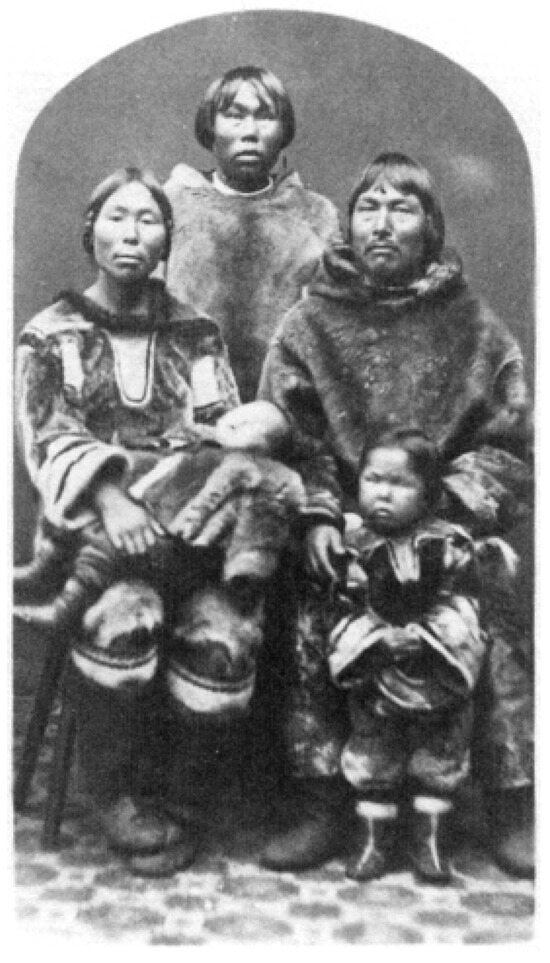
Figure 1.
Abraham Ulrikab with his family. From left to right: Ulrike with daughter Sara in her lap, son Tobias, Abraham Ulrikab with daughter Maria standing before him. Photograph taken during Hagenbeck’s Human Zoo display of the “Eskimos” 1880/81. Photo by Johann Adrian Jacobsen. Public domain, Wikimedia Commons: https://commons.wikimedia.org/wiki/File:Familie_Abraham_Ulrikab_1880.jpg, accessed on 1 March 2025.
Ulrikab’s travel journal narrates the destructive consequences of the European “appreciation” of him. He described endless days of rudely gawking people. In Berlin, missionaries from Hlawatschek visited the group. Ulrikab described the elation at being called by his name, and the warmth of being invited to visit the homes and church of the missionaries. However, Ulrikab and the others were “not able to, as there are too many people. Indeed, going out by daytime is impossible because of all the people, because we are totally surrounded by them” (Ulrikab [1881] 2005, p. 13). A deeply Christian man, Ulrikab went to Europe, in part, in search of exchange and Christian fellowship. Instead, he either waited “in vain for someone to talk about Jesus” or found it impossible to be in fellowship with other Christians (Ulrikab [1881] 2005, p. 5). Ulrikab’s travelling narrative gives a meaningful picture of an overwhelming European fascination with the remote, Indigenous, arctic people, and the profound toll their curiosity took. Ulrikab painstakingly chronicled the severe sicknesses that afflicted the group, and the endless drudgery of work through illness, followed by deaths of his children and wife from smallpox before he himself died. His travel account ends in a desperate and pleading letter, in which he wishes, against all hope, to see his relatives back home once more.
For his part, Jacobsen later lamented that, though immunizations were required at the time, he simply forgot to immunize the exhibition performers. Upon the deaths of Ulrikab and his family, Jacobsen then set off on a collection expedition funded by the Berlin Ethnological Museum (then called the Berlin Museum für Volkerkunde), between 1881 and 1883. Jacobsen travelled through British Columbia, the Yukon, and Alaska, where he collected (by use of grave robbing, coercion, force, and other means) domestic wares, artworks, sacred items, and artifacts from a wide number of northerly Indigenous communities, including western Inuit peoples. He further scouted for people to traffic for future shows to be organized with Carl Hagenbeck, failing in his attempt to take some young people, who fled from his clutches. Jacobsen’s tendency to beat Indigenous people is also evidenced in his travel journals from this period. From his experiences, Jacobsen published the travelling account titled Reise an der Nordwestküste Amerikas in 1884, documenting his trip and collection of Indigenous material culture (Jacobsen [1884] 1977). Jacobsen’s massive collection, with more than five thousand objects, remains an important and substantial collection of Arctic and circumpolar North American Indigenous art.4 After the collection arrived in Europe, Jacobsen presented series of lectures to the public, directly connecting information from his travel journals with the collections. In 1885, Jacobsen then trafficked a troupe of Nuxalk performers to Berlin, who presented dances while wearing various regalia from the collection.
When connected with displays of Indigenous objects and performances, travelling accounts like Jacobsen’s added greatly to European interest in Inuit people and their performance and art works. This fascination further contributed to wider interest in distant peoples and foreign lands and contributed to restructuring longstanding European civilizational politics and concepts of European supremacy into colonial scientistic concepts of primitivity and justifications for colonial expansion. Jacobsen’s ideas built upon models of civilizational difference and imperial desire extending back to Europe’s oldest merchant narratives. All of this structures the later social and political context in which settler art appreciation—like that of Sparshott—can be understood. Settler and European appreciation for Indigenous art and desire for Indigenous displays and performance of practices cannot be entirely separated from a history of fascinated extraction. Even the art market with which Sparshott was engaged has been shaped by systematic exploitation.
One of the most important scholars addressing the colonial history of settler markets for Inuit carvings is Inuk scholar Heather Igloliorte, who has written on the beginnings of the North American settler market for Inuit carvings. With her work on this history, Igloliorte intervened in an historical art market by analysing its colonial contours. As Igloliorte notes, the contemporary market was preceded by European whalers, who were trading European goods for Inuit carvings from the eastern Arctic since at least the eighteenth century: “Whalers not only enthusiastically collected all manner of precontact ivory carvings representing northern life, but also encouraged the production of such intercultural souvenirs as ashtrays and cribbage boards” (Igloliorte 2018, p. 65). This signals that Canadian Inuit carving, as a form of artistic production, can be understood as a long-term tactic for economic engagement with Europeans and colonists.
The market that Sparshott was engaged with was initiated by settler artist and author James Archibald Houston (1921–2005), and his work with Inuit artists in the mid-twentieth century. Sparshott certainly knew the essentials of this story. As Igloliorte describes, Houston was on a trip to do landscape painting in the Artic near the end of the 1940s when he learned that Inuit people were producing carvings. He excitedly returned south and, “presented a proposal to the guild’s Indian and Eskimo Committee” after which, “a tenuous agreement was brokered between the guild, the Northwest Territories administration, and the Hudson’s Bay Company” to facilitate the collection and selling of Inuit sculptures (Igloliorte 2018, p. 68). Igloliorte’s work discusses Houston’s attempt to influence Inuit carving, and addresses the ways that Inuit artists worked with, cast aside, built upon, and pushed against the settler painter’s suggestions for Inuit art practice.
On a series of two trips to the north, Houston moved between Inuit communities, and widely distributed drawings for suggested carvings to sell based on Houston’s own studies of historical Inuit and wider Indigenous art figures of North American circumpolar regions. He also documented carvings produced in various Inuit communities, distributing these among other communities as he travelled, thus facilitating a means of aesthetic exchange between them (Igloliorte 2018, p. 69). Artists grappled with these materials and then moved beyond them. Houston further produced a pamphlet to train local artists that drew inspiration, in part, from museum artifacts. Called Sanajaksat: Eskimo Handicrafts (1951), the pamphlet was “published in Eskimo for the people of the Canadian Arctic” and featured illustrations purposed to “suggest to them some of their objects which are useful and acceptable to the white man” (Houston 1951, p. 3). The pamphlet thus emphasized the importance of pleasing settler buyers, and further included drawings of objects more identifiable with other Indigenous communities, such as a totem pole-like figure (associated with Indigenous cultures of the Northwest Coast and Alaska), and artifacts of the colonial curio trade, including a Cribbage board carved from a tusk, proposing that Inuit carvers use these as examples. The latter of these objects particularly connects with the history of Inuit contact with European whalers, described above. Houston’s exhibitions of the resultant Inuit carvings caused an explosion of settler interest and purchase of them in the south.
Sparshott’s participation in the settler market initiated by Houston contributed to its historical importance. Among Inuit carvers, Sparshott identified a variety of named and unnamed masters who produced a wide variety of carving styles that emerged in ways typical and atypical of several centres of production. These centres then became comparable and contrastable—producing for Sparshott the means to imagine and study a complex map of styles and relations. In Inuit sculptural production, Sparshott found a zone safe from the realms of European high art and its overbearing expert culture. There, he could newly enact the work of art history. This is often how colonial relations go: European epistemologies (of art, of commerce) are imported and used to restructure the colony (Santos 2023; Mignolo 2000; Fanon 1959). Sparshott’s genuine appreciation participates in this process. Sparshott’s lived experience, like the lived experience of the Inuit carvers whose works he admires, is thus informed by historical processes. What legacies of settler engagement with Indigenous peoples does he, in his collection and assessment of Inuit sculpture, take up and work to amend and address in his own life’s work? The long-term colonial tactics in which Sparshott is engaged are those of art appreciation, curiosity, and collection. By becoming tied to extractive markets, these same seemingly innocuous foundational procedures drove the ethnological collection of Indigenous arts and continue to inform settler-centric narration of Indigenous life.
Sparshott’s curiosity and collection resonate with the earliest European colonial collection practices in “cabinets of curiosity” (Wunderkammern). As Anna Winterbottom writes, these “cabinets of collection formed the physical counterparts of written accounts and both savants and merchants often contextualized material objects using written texts and vice versa” (Winterbottom 2018, p. 234). European displays of Indigenous artworks were from the beginning connected with the published and unpublished storytelling of merchants and travellers, as well as with the display of Indigenous peoples before European audiences (Pennock 2024; Winterbottom 2018). European museums for the display of natural historical and ethnological collections began opening in the eighteenth century (Pimentel and Thurner 2021; Kuper 2023). Since the rise of colonialism, collections of Indigenous art have rarely been devoid of the ethnologising impulse. Sparshott’s collecting impulse resonates with the idiosyncratic approach developed among cabinets of curiosity: “There can be no conclusive reason for not considering and relishing a practice or artifact in terms of the practices and attitudes of one’s own culture, as opposed to the originating culture which is not one’s own,” wrote Sparshott in “Art and Anthropology” (Sparshott 1997, p. 242). That Sparshott so supported an ethnocentric approach is due, in part, to his belief in the utter inaccessible remoteness of the Inuit people—a concept that likewise drove forms of aesthetic play within cabinets of curiosity.
While articulating a way of thinking anti-colonially between the “ethnic” and the “aesthetic”, Pia Arke’s 1995 work on “ethno-aesthetics” provides a meaningful response to Sparshott’s beliefs about aesthetic appreciation and remoteness. In the essay, she defined her concept of ethno-aesthetics as one dealing with the artistic productions of “non-Europeans, all positioned, in some respect, beyond the borders of the West” (Arke [1995] 2017, p. 7). She further wrote of European, “resistance to ethno-aesthetics” as informed by “a defence of the pure product” of art against “an unbearable reminder of the ethnic, the political, the economic—in short, of everything ‘un-aesthetic’ about aesthetics” (Arke [1995] 2017, pp. 8–9). Sparshott’s work shows much evidence of precisely such a defence. Against the reduction of art to such a “pure product”, Arke argues that aesthetics are composed of “un-aesthetic” political and economic elements. Her theory fortifies the concept of aesthetics of remoteness argued herein. Ethno-aesthetics, broadcast to Europe, are at risk of being received through the aesthetics of remoteness, which arise from a perspective that views the “rest” of the world as something to gaze outward upon; as something supposedly at a remove from European culture or the so-called “West”. When Sparshott positions Inuit sculpture as “remote art”, he is seeing from just such a position.
Arke described how, “speaking of an ethnic aesthetics causes uneasiness—since the only aesthetics really worth considering is the aesthetic aesthetics” (Arke [1995] 2017, p. 8). Aesthetic aesthetics, in Arke’s argument, only emerge when art is appreciated in ways that ignore art’s participation in political power and economic markets. If ethno-aesthetics is compromised by desire for Europe, it nonetheless re-entangles aesthetics with the political contours of an “anti-colonial cultural struggle and poststructuralist critique of reason” that drives through the centre of Europe from its outskirts and beyond its borders (Arke [1995] 2017, p. 9). By contrast, the aesthetics of remoteness formulates that the “remoteness” of the outskirts might be kept intact, no matter how subjected they are to extraction.
“In any case,” wrote Arke,
If Arke discussed the attention of artists like herself directed to Europe, Sparshott instead imagined that Inuit carvings for the settler market comprise “a whole art world in miniature” conducted in isolation from European centres of art (Sparshott 1982, p. 132). Sparshott additionally argued that his interest in and collection of Inuit art derived from this isolated complexity. The aesthetic aesthetics that Sparshott sought in Inuit carving, then, emerged not only from his belief in its isolation, but in his belief that the work was neither self-expression nor traditional Indigenous craft. As he wrote in his later essay “Art and Anthropology”, he considered it an absolute “joke” to contend that “carvings and prints produced for the market by the Canadian Inuit, as a source of desperately needed cash”, could “properly be assessed as a spontaneous expression of unsullied Inuit ethnicity” (Sparshott 1997, p. 239). Sparshott here seems to propose that the basic act of engaging with a settler market corrupts any potential Indigenous work that might have to be culturally authentic. Sparshott’s work repeatedly presupposes that such undermining of authenticity is a prerequisite to the free-play of truly aesthetically grounded study. Against this kind of settler thinking, Arke argues for a concept of ethno-aesthetics in which Indigenous and non-European works instead offer a “description of the West seen from the outside, from the point of view of the ‘other’, from a point of view such as mine, the Greenlander’s” (Arke [1995] 2017, p. 7).the road to being discovered leads through Europe, and if we search for a lack of coherence there, for cracks in the surface, it is because we cling to the possibility of participating in the festivities, of making our special contribution to the ongoing celebration of European culture. What we want to do, as must be said of our case, is to ‘intensify’ the criticism of ethnocentricity.(Arke [1995] 2017, p. 9)
How might Inuit sculptural practices be understood in relationship with Arke’s argument? Canadian Inuit carvers have long interacted with Europe’s enduring fascination with virgin and child compositions, for example, and have thus presented Europe with the likeness of such compositions as fashioned within Inuit styles. Artists like Osuitok Ipeelee (1922–2005), while incorporating themes identifiable with European high art, thus created mother and child figures that participate in depicting European themes from the so-called ‘outside’ (Ayre 2022, p. 49).5
The renowned woman carver Oviloo Tunnillie (1949–2014), who also started her career with a mother and child figure at the age of 17, pushed back against the impersonal settler market by taking up a uniquely autobiographical turn in her artistic production. Her work included sculptures documenting her two-year childhood illness of tuberculosis, when she was held away from her family in a hospital in the south. Such work, I argue, implicitly portraits Indigenous experiences of colonial healthcare systems. Other works of Tunnillie depict her family’s history as artists and thus include carvings of her family members making carvings, or holding up their artworks (Wight 2019, pp. 8, 12–13). Tunnillie’s autobiographical approach speaks of Indigenous authorship through Indigenous artworks, even as it disrupts Sparshott’s claim that Inuit sculptures, as objects made for distant settler publics, were not “seeking self expression” (Sparshott 1982, p. 134). Inuit carvers like Ipeelee and Tunnillie lived the impacts of colonization in their communities while they, as artists, grappled with settler-centric notions of art, Inuit tradition, history, and primitivism that influenced the market for their works. This shows up in their work in critical ways that also respond to colonial devaluation of Indigenous lives.
From Sparshott’s own collection, the sculpture Anguished Woman (ca. 1980) likewise participates in unsettling the depersonalisation of the settler market. Carved by Maudie Rachel Okittuq (b. 1944), the piece depicts a standing woman with an agonised face, holding a smaller face in a similar expression of misery between her mittened hands. As Okittuq described in an interview with Darlene Coward Wight, this and other works may connect with “the anxious period in her childhood, after her mother died” (Wight 2000, p. 97). It is a powerful and complicated act to sell such an object into settler hands. Sparshott’s collection held the handmade evidence of Indigenous lives, stories, and the intimacy of heartbreak, even if he was not quite interested in those aspects of the work.
The works of Ipeelee, Tunnillie, and Okittuq’s are by no means overtly political works. Nonetheless, I argue that they contribute to the wider work of Indigenous artists, since colonial contact, to experiment with, overturn, and refashion how their communities are beheld within the travelling accounts, colonial documents, journalistic writings, literature, and performance works that compose the settler imaginary about them. As artists, Ipeelee, Tunnillie, and Okittuq engage with the problem of remoteness by refashioning the stories brought by distant colonizers into their works, thus enlivening or re-envisioning how history is told, and by whom it is told, in and through their practices. Art history itself draws from a history of imaginative practices of storytelling, and so artistic practices of telling stories can, in turn, inform the scholarly practice, for example, of telling art history. If art historical scholarship aims to evaluate art and contextualize its practice, it does so while artists re-evaluate history and remodel its telling in turn.
5. Conclusions
If Marco Polo’s Land of Darkness imagined the northern world as a place where light could not reach, it also revealed how easily the images and fabulations derived from non-knowledge transform into the materials from which social imaginaries are constructed. Polo’s vision, which transformed the limits of his comprehension into the qualities of other peoples and places, has endured across centuries. From medieval cosmographies to the colonial art market, the trope of remoteness persists as an aesthetic shorthand for distance, strangeness, and the unknown.
Francis Sparshott’s notion of “cold and remote art” continues this lineage. In his admiration for Inuit carving, the condition of not knowing becomes itself the basis for aesthetic pleasure. His appreciation is sustained not in relation but in distance; his unknowing becomes both a method of appreciation and a mode of taste. Within this framework, remoteness is transfigured into beauty unhindered by labour and intimate exchange, and the absence of relation is rebranded as the grounds for the aesthete’s refined sensitivity. The colonial separation that allows Inuit art to circulate as a collectible commodity equally divorced from the depths of tradition or the violence of colonial extraction is thus aestheticized as the very condition of its appeal.
It is here that Pia Arke’s concept of ethno-aesthetics intervenes. Writing from what she described as a “bastard”6 perspective blending Greenlandic Inuk and Danish identities, Arke described an ethno-aesthetics that insists on the shadows and fissures where political, economic, and colonial entanglements reside. Ethno-aesthetics, as formulated by Arke, critiques the colonial fantasy of being able to see “the other” aesthetically without confronting the political and historical relations that make such seeing possible. In this sense, aesthetics of remoteness and ethno-aesthetics are not opposites but two responses to the same underlying structure. The aesthetics of remoteness positions Indigenous art as distant—an object safely outside European cultural centers to be admired as a thing “far away”, even through direct processes of dispossession and extraction that often facilitate the rise in colonial art markets. Ethno-aesthetics, on the other hand, attempts to expose and reclaim the political, economic, and historical forces behind the distance Europe maintains in relation to its present and former colonies.
This shared epistemic foundation produces a difficulty: remoteness and ethno-aesthetics both rely on a gaze that locates Indigenous art in relation to Europe, as something “other,” whether framed by isolation or by resistance. The tension between being seen as remote and being understood as a politically charged site folds back into the same mechanism, where the “outside” is defined by its relation to the “inside.” Together, they describe Indigenous and non-European art as trapped in a web of visibility and invisibility, where the artwork is always legible through colonial frameworks—never free from the shadows cast by those frameworks. To break this cycle is to challenge the very epistemic ground on which both rest.
Arke, however, also gestures toward a radical reversal. Her work insists that those whom colonial aesthetics render “remote” are, in fact, intimately connected to Europe through histories of trade, extraction, and representation. “We, the ethnics,” she writes, “have an interest in unveiling the connections leading back to Europe.” To take Arke seriously is to turn the gaze back upon the structures of looking themselves—to see that the remoteness aestheticized by Sparshott, like the darkness imagined by Polo, is not located in the north at all, but in the epistemological posture of these viewers and their social milieu.
Thus, to dwell in the darkness differently is to refuse its projection outward. It is to recognize that what has been called “remote” is not simply “far away” but kept distant by design—sustained by the institutions, markets, and imaginaries that define what counts as knowledge, art, and civilization. Arke’s critique transforms the aesthetics of remoteness into an ethics of recognition: The understanding that aesthetic pleasure derived from the unknown is never innocent but always entangled in histories of extraction.
The Land of Darkness, then, is not the Arctic horizon of Marco Polo’s imagination, nor the protective bubble of Sparshott’s connoisseurship. It is the unexamined interior of modern aesthetics—a darkness within which Europe and its settler descendants learned to see themselves illuminated against those they rendered obscure. To emerge from that darkness is not to bring light to others, but to confront the shadows that structure ways of seeing.
Funding
This research received no external funding.
Data Availability Statement
Some of the insights of this article emerge from a multi-year project “Getting Our Stories Back”, in which the author partook, and which focussed on Indigenous-led research and exploration of Alaska Native belongings collected by Johan Adrian Jacobsen in the 1880s. Out of respect for Indigenous data sovereignty, this article does not share or link to datasets collected during that time. Therefore, these data are unavailable due to privacy or ethical restrictions, and no other new data were created during the research process for this article. See: https://www.smb.museum/en/museums-institutions/ethnologisches-museum/collection-research/research/getting-our-stories-back/ (accessed on 3 March 2025).
Conflicts of Interest
The author declares no conflict of interest.
Notes
| 1 | As is well known, because Polo’s book was widely translated in the late medieval and early modern, it inspired the travels of Christopher Columbus in the fifteenth century (Eng 2003, p. 477). By the sixteenth century, European access to the riches of the east was facilitated by shipping routes, and colonial expansion in the “New World” was undertaken at the same time when a wealth of Chinese porcelain, silks, laquerwares and visual art works poured into Europe (Greenhalgh 2020, p. 209). What ensued in the Americas, and indeed, with the expansion of European colonialism globally, is an astonishing history of wealth extraction enacted through oppression, genocide, slavery, and dispossession conducted at a massive, historically unprecedented scale by European travelers, merchants, settlers, and missionaries (Koch et al. 2019). |
| 2 | While there are many examples of contemporary tactics of dehumanization that compare humans to animals, a recent one suffices: At the beginning of Israel’s bombing of Gaza, for example, Defense Minister Yoav Gallant announced that Israel would blockade Gaza, because, “we are fighting human animals and we are acting accordingly.” Former IDF soldier and scholar of genocide Omer Bartov has compared Israeli dehumanization of the people of Gaza to his previous research on Nazi descriptions of Jews as “animals”. See: (Bartov 2024). |
| 3 | Prior to his work in the Americas, Jacobsen had organized displays of Sami people, including for Hagenbeck in Hamburg. See: Thode-Arora (2021, p. 54). |
| 4 | Jacobsen’s collections contributed to the salvage approach of the Berlin’s ethnological museum, which imagined that colonial dispossession would erase Indigenous peoples, and that thus museological preservation was necessary. Many source communities, however, are now ready to reclaim their possessions from such museums and have expressed their interest in so doing. UN human rights regulations for Indigenous peoples require, “access and/or repatriation of ceremonial objects and human remains in their possession through fair, transparent and effective mechanisms developed in conjunction with indigenous peoples concerned” (United Nations [2007] 2020, p. 12). Since 2019, however, German repatriation laws focus primarily on former German colonial territories, repatriation of remains, and an unclear concept of “wrongfully obtained items” (Schuetze 2019, p. C3). The New York Times has clarified that, “the pact is not legally binding and does not create any reliable legal framework” to facilitate largescale restitution of the Jacobsen collection to source communities (Schuetze 2019, p. C3). |
| 5 | For settler buyers, these would be identifiable as akin to Madonna and baby Jesus images popular throughout the history of Christian art. |
| 6 | From personal correspondence with a family member of Pia Arke. |
References
- Achebe, Chinua. 1977. An Image of Africa: Racism in Conrad’s Heart of Darkness. The Massachusetts Review 18: 14–27. [Google Scholar]
- Arke, Pia. 2017. Ethno-Aesthetics. Afterall: A Journal of Art, Context, and Enquiry 44: 4–11. First published 1995. [Google Scholar] [CrossRef]
- Ayre, John. 2022. James Houston and the Making of Inuit Art. Jefferson: McFarland Incorporated, Publishers. [Google Scholar]
- Bartov, Omer. 2024. As a former IDF soldier and historian of genocide, I was deeply disturbed by my recent visit to Israel. The Guardian, August 13. Available online: https://www.theguardian.com/world/article/2024/aug/13/israel-gaza-historian-omer-bartov (accessed on 3 March 2025).
- Boele, Otto. 2023. The North in Russian Romantic Literature. Leiden: Brill. [Google Scholar]
- Boll, Dirk. 2024. Art and Its Market. Berlin: Hatje Cantz. [Google Scholar]
- Bracken, Christopher. 2007. Magical Criticism: The Recourse of Savage Philosophy. Chicago: University of Chicago Press. [Google Scholar]
- Dalton, Anne Marie, and Henry C. Simmons. 2010. The Social Imaginary and the Ecological Crisis. In Ecotheology and the Practice of Hope. Albany: State University of New York Press, pp. 1–18. [Google Scholar]
- Davey, Nicholas. 2011. Hermeneutic Aesthetics and the Problem of the Imagination. In Gadamer’s Hermeneutics and the Art of Conversation. Edited by Andrzej Wierciński. Berlin: Lit Verlag, pp. 339–52. [Google Scholar]
- Dilthy, Wilhelm. 1914. Weltanschauung und Analyse des Menschen seit Renaissance und Reformation. Leipzig: B.G. Teubner. First published 1911. [Google Scholar]
- Elliott, Andrew B. R. 2017. Medievalism, Politics and Mass Media: Appropriating the Middle Ages in the Twenty-First Century. Cambridge: D.S. Brewer. [Google Scholar]
- Eng, Robert Y. 2003. Polo, Marco (1254–1324). In Colonialism: An International Social, Cultural, and Political Encyclopedia. Edited by Melvin E. Page and Penny M. Sonnenburg. London: Bloomsbury, vol. 2. [Google Scholar]
- Fabian, Johannes. 2014. Time and the Other: How Anthropology Makes Its Object. New York: Columbia University Press. First published 1983. [Google Scholar]
- Fanon, Frantz. 1959. L’An V de la Révolution Algérienne. Paris: Éditions François Maspero. [Google Scholar]
- Feest, Christian F. 1992. North America in the European Wunderkammer. Vienna: Museum für Völkerkunde. [Google Scholar]
- Garneau, David. 2012. Imaginary Spaces of Conciliation and Reconciliation. West Coast Line 46: 28–38. [Google Scholar]
- Greenhalgh, Paul. 2020. Ceramic, Art and Civilisation. London: Bloomsbury. [Google Scholar]
- Houston, James. 1951. Eskimo Handicrafts. Montreal: Canadian Handicrafts Guild. [Google Scholar]
- Igloliorte, Heather. 2018. ‘Hooked Forever on Primitive Peoples’: James Houston and the Transformation of ‘Eskimo Handicrafts’ to Inuit Art. In Mapping Modernisms: Art, Indigeneity, Colonialism. Edited by Elizabeth Harney and Ruth B. Phillips. New York: Duke University Press, pp. 62–90. [Google Scholar]
- Innis, Harold A. 1999. The Fur Trade in Canada: An Introduction to Canadian Economic History. Toronto: University of Toronto Press. First published 1930. [Google Scholar]
- Jacobsen, Johan Adrian. 1977. Alaskan Voyage, 1881–1883: An Expedition to the Northwest Coast of America. Abridged translation by Erna Gunther, from the German text by Adrian Woldt (1884). Chicago: University of Chicago Press. First published 1884. [Google Scholar]
- Jacobsen, Johan Adrian. 2014. Voyage with the Labrador Eskimos, 1880–1881, 2nd ed. Gatineau: Polar Horizons. [Google Scholar]
- Koch, Alexander, Chris Brierley, Mark M. Maslin, and Simon L. Lewis. 2019. Earth system impacts of the European arrival and Great Dying in the Americas after 1492. Quaternary Science Reviews 207: 13–36. [Google Scholar] [CrossRef]
- Kuper, Adam. 2023. The Museum of Other People: From Colonial Acquisitions to Cosmopolitan Exhibitions. London: Profile Books. [Google Scholar]
- Magnus, Olaus. 1996. A Description of the Northern Peoples. London: The Hakluyt Society. First published 1555. [Google Scholar]
- Marciniak, Vwadek P. 2006. Towards a History of Consciousness: Space, Time, and Death. New York: Peter Lang. [Google Scholar]
- Mignolo, Walter. 2000. Local Histories/Global Designs: Coloniality, Subaltern Knowledges, and Border Thinking. Princeton: Princeton University Press. [Google Scholar]
- Moreton-Robinson, Aileen. 2015. White Possessive: Property, Power, and Indigenous Sovereignty. Minneapolis: University of Minnesota Press. [Google Scholar]
- Pennock, Caroline Dodds. 2024. On Savage Shores: How Indigenous Americans Discovered Europe. New York: Random House. [Google Scholar]
- Pimentel, Juan, and Mark Thurner. 2021. New World Objects of Knowledge: A Cabinet of Curiosities. London: University of London. [Google Scholar]
- Pliny the Elder. 1952. Natural History: Volume IV. Translated by H. Rackham. Cambridge: Harvard University Press, pp. 77–79. [Google Scholar]
- Polo, Marco. 2015. The Travels. Translated by Nigel Cliff. London: Penguin Books. [Google Scholar]
- Ritter, Christiane. 2010. A Woman in the Polar Night. Translated by Jane Degras. London: Pushkin Press. First published 1938. [Google Scholar]
- Robinson, Dylan. 2020. Hungry Listening: Resonant Theory for Indigenous Sound Studies. Minneapolis: University of Minnesota Press. [Google Scholar]
- Santos, Boaventura de Sousa. 2010. Decolonizing Knowledge, Reinventing Power. Uruguay: Trilce Editorial. [Google Scholar]
- Santos, Boaventura de Sousa. 2023. Law and Epistemologies of the South. London: Cambridge University Press. [Google Scholar]
- Schuetze, Christopher F. 2019. Germany Sets Guidelines for Repatriating Colonial-Era Artifacts. New York Times, March 15, p. C3. [Google Scholar]
- Smith, Jen Rose. 2021. ‘Exceeding Beringia’: Upending universal human events and wayward transits in Arctic spaces. Environment and Planning D: Society and Space 39: 158–75. [Google Scholar] [CrossRef]
- Smith, Linda Tuhiwai. 2021. Decolonizing Methodologies: Research and Indigenous Peoples. London: Zed Books. First published 1999. [Google Scholar]
- Sparshott, Francis. 1982. Cold and Remote Art. Journal of Aesthetics and Art Criticism 41: 127–36. [Google Scholar] [CrossRef]
- Sparshott, Francis. 1997. Art and Anthropology. The Journal of Aesthetics and Art Criticism 55: 239–43. [Google Scholar] [CrossRef]
- Taylor, Charles. 2004. Modern Social Imaginaries. Durham: Duke University Press. [Google Scholar]
- Thode-Arora, Hilke. 2021. The Hagenbeck Ethnic Shows: Recruitment, Organization, and Academic and Popular Responses. In Staged Otherness: Ethnic Shows in Central and Eastern Europe, 1850–1939. Edited by Dagnosław Demski and Dominika Czarnecka. Budapest: Central European University Press, pp. 45–76. [Google Scholar]
- Ulrikab, Abraham. 2005. The Diary of Abraham Ulrikab: Text and Context. Translated by Hartmut Lutz and students from the University of Greifswald. Ottawa: University of Ottawa Press. First published 1881. [Google Scholar]
- United Nations. 2020. The United Nations Declaration on the Rights of Indigenous Peoples. Her Majesty the Queen in Right of Canada, represented by the Minister of Justice and Attorney General of Canada. Ottawa: Minister of Justice and Attorney General of Canada. First published 2007. [Google Scholar]
- Vaughan, Richard. 2006. Arctic Adventures: The Story of Martin Frobisher. London: Hambledon Continuum. [Google Scholar]
- Wight, Darlene Coward. 2000. Art & Expression of the Netsilik. Winnipeg: Winnipeg Art Gallery. [Google Scholar]
- Wight, Darlene Coward. 2019. Oviloo Tunnillie: Life & Work. Toronto: Art Canada Institute. Available online: https://www.aci-iac.ca/art-books/oviloo-tunnillie/ (accessed on 1 March 2025).
- Winterbottom, Anna. 2018. Science. In The Corporation and Protagonist in Global History, c. 1550–1750. Edited by David Veevers and William A. Pettigrew. Leiden: Brill, p. 232. [Google Scholar]
- Xhignesse, Michel-Antoine. 2024. Distant Dinosaurs and the Aesthetics of Remote Art. British Journal of Aesthetics 64: 361–80. [Google Scholar] [CrossRef]
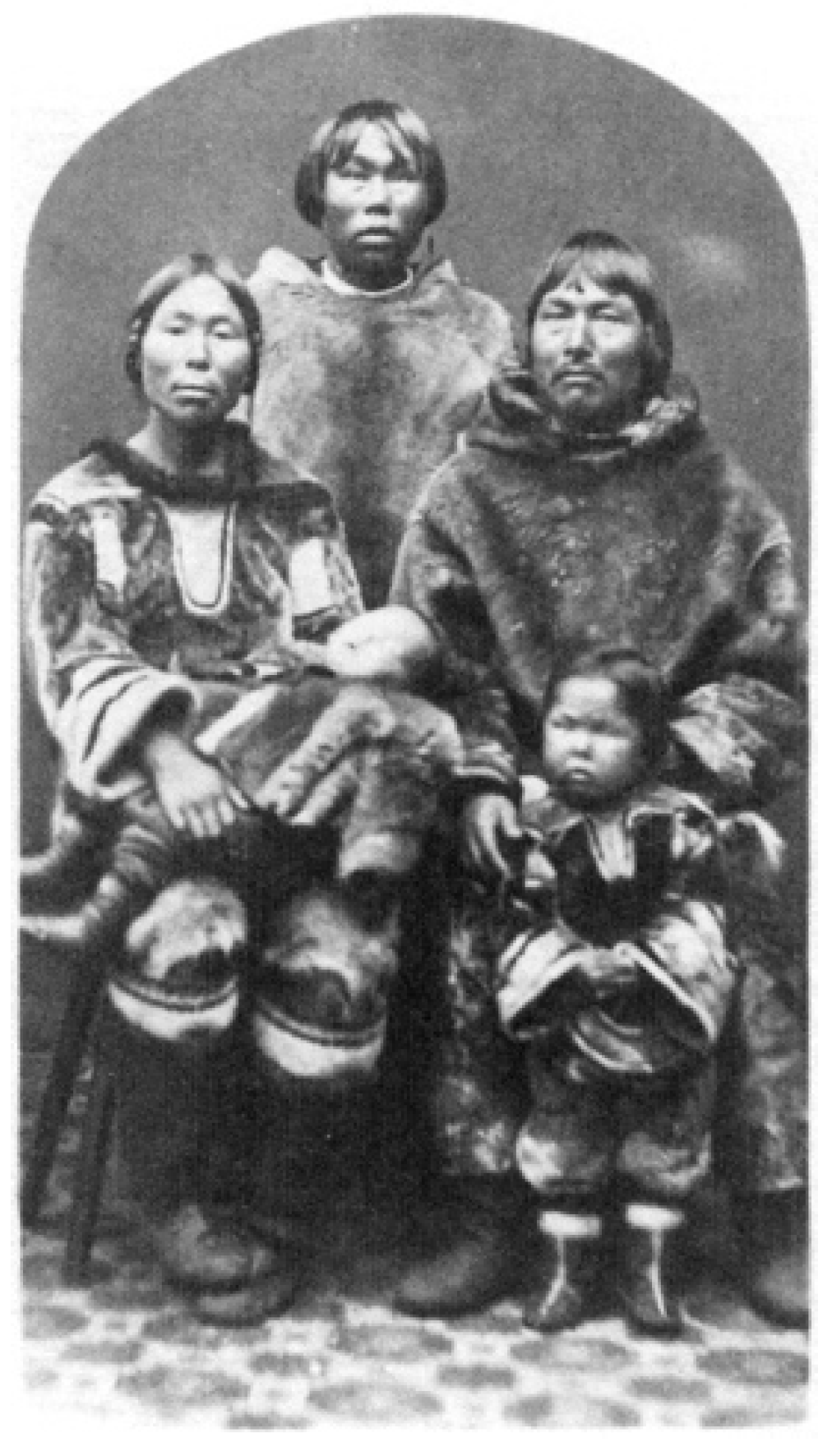
Disclaimer/Publisher’s Note: The statements, opinions and data contained in all publications are solely those of the individual author(s) and contributor(s) and not of MDPI and/or the editor(s). MDPI and/or the editor(s) disclaim responsibility for any injury to people or property resulting from any ideas, methods, instructions or products referred to in the content. |
© 2026 by the author. Licensee MDPI, Basel, Switzerland. This article is an open access article distributed under the terms and conditions of the Creative Commons Attribution (CC BY) license.