

Curating and Creating Collective Artistic Experiences: The Role of the Choral Conductor

Abstract
1. Introduction
‘The task is daunting, but the reward lies in the many magical moments—when time seems to stand still and the entire choir becomes one organism, one body, one breath, one thought’.(Dahl 2008, p. 9)
1.1. Professional Context
1.2. Methodological Approach
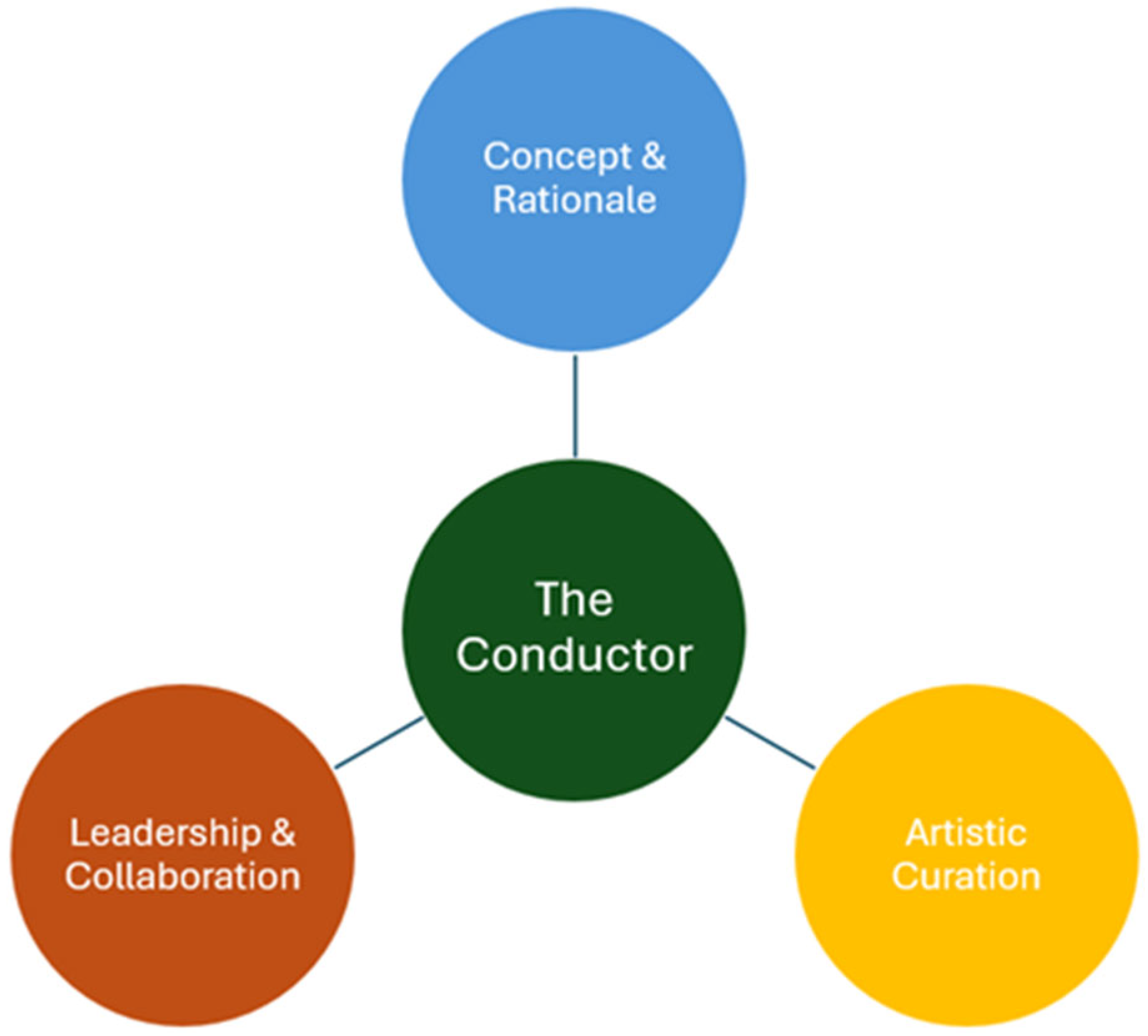
1.3. Framework for Structured Reflection
1.3.1. Concept and Rationale
1.3.2. Artistic Curation
1.3.3. Leadership and Collaboration
- -
- Artistic director: planning and shaping the choir’s artistic and technical development in the short, medium, and longer terms;
- -
- Conductor in rehearsal: leading the musical, textual, and interpretative learning of the repertoire throughout the rehearsal period;
- -
- Conductor in performance: conducting the choir in the concert/recording; presenting the concert;
- -
- Project manager: leading the project in various artistic and logistical respects, in conjunction with a committee and other contributors.
2. Artistic Programming: Principles and Priorities
2.1. Selecting and Formulating the Programme
Score study itself unfolds so many stories and treasures for us all. Often, unexpected connections are found in unexpected avenues of our study. That harmonic progression in the Brahms may lead to a find of a contemporary composer with the same bent. The text to that Italian madrigal from 1580 touches the hem of a late 20th century composer as well. The folk tune melodic structure from 17th-century Latvia is surprisingly seen in an English folk song from the 19th century. The counterpoint in an Ockeghem motet may trigger a new look at a secular cantata of J. S. Bach. All of our study, however oblique, helps us in that journey towards the best piece for the ensemble.(Bjella 2017, pp. 282–83)
2.2. Realising the Programme
People experience themselves as performing musicians through the act of musical participation, and the choral practitioner’s task is to help singers engage with the music they sing in a way that not only respects the needs of the music, but that can be accepted and embraced by the singer as true to themselves as well…[T]he ways in which people sing, and the terms in which they understand it, not only connect out into their wider social identities but also extend deep into their affective and imaginative states(Garnett 2009, p. 199).
3. Structured Reflections on Artistic Projects
3.1. Project I: Natural History
3.1.1. Concept and Rationale
To pollute a spring or a river, to exterminate a bird or beast, should be treated as moral offences and as social crimes; … Yet during the past century, which has seen those great advances in the knowledge of Nature of which we are so proud, there has been no corresponding development of a love or reverence for her works; so that never before has there been such widespread ravage of the earth’s surface by destruction of native vegetation and with it of much animal life, and such wholesale defacement of the earth by mineral workings and by pouring into our streams and rivers the refuse of manufactories and of cities; and this has been done by all the greatest nations claiming the first place for civilisation and religion!4
3.1.2. Artistic Curation
3.1.3. Leadership and Collaboration
3.2. Project II: Ghost Songs: Contemporary Music and Words from Ireland
3.2.1. Concept and Rationale
3.2.2. Artistic Curation
- I see sketches of islands
- half revealed
- like deities
- in a haze
- sun shines on sea
- like errant particles
- glittering
- in their own glory
- the presence of numinous beings
- reflect of the surface
- brown rushes turn gold
- on cliffs.
- my heart lifted
- you were in the present tense
- for a while11
- The room is tense with the threat of the dead,
- Their anger cannot be assuaged.
- There is no living person with me,
- But I feel her near me,
- Though she is buried three months.
- There is no sound that I can make
- That does not put her on edge,
- Ready to emerge, awakened, into my presence.
- Be quiet, and let not the person who is newly dead,
- Newly fallen into the stupor of death,
- Hear you.
3.2.3. Leadership and Collaboration
There ought to be more recordings like this. The art of setting words and delivering them musically is widely discussed, but the words as a starting point are often left behind. Here three contemporary Irish poets, with the earlier Lola Ridge and W.B. Yeats read by broadcaster Carl Corcoran, are given the opportunity to present their work in isolation, cadenced as written rather than as they are then sung. It makes for fascinating listening and far from generating any tension between the written and the sung form, the juxtaposition illuminates both.(Morton 2021, pp. 67, 69).
4. Conclusions
Author Contributions
Funding
Data Availability Statement
Conflicts of Interest
| 1 | |
| 2 | |
| 3 | |
| 4 | Wallace’s text is cited in the Composer’s Note in the preface to the score of O’Halloran’s Natural History. |
| 5 | For programme details for previous concerts, see ‘Mornington Singers: Archive’, https://www.morningtonsingers.org/concerts/archive (accessed on 3 January 2026) |
| 6 | |
| 7 | These events were ‘The Beauty of It’, part of the Bealtaine Age and Opportunity Festival at Poetry Ireland, Dublin, in 2017, and ‘Tairseach: Threshold’, part of the Anam Arts Festival at Dublin City University in 2018. |
| 8 | For full list of tracks and performers, see When Love Speaks. https://en.wikipedia.org/wiki/When_Love_Speaks (accessed on 3 January 2026). |
| 9 | For track list and album details, see Seamus Heaney and Liam O’Flynn, ‘The Poet and the Piper’, https://claddaghrecords.com/products/cd-seamus-heaney-and-liam-oflynn-the-poet-and-the-piper (accessed on 4 January 2026). |
| 10 | Both Ní Chinnéide and Denvir are native Irish speakers, from the West Kerry and Connemara Gaeltacht areas, respectively. While Denvir’s artistic output is almost entirely in Irish, Ní Chinnéide identifies as a bilingual poet and has published collections in both languages. For my own part, I am not a native speaker, but have a keen interest in the language and speak it regularly, as well as partaking in its musical traditions. |
| 11 | Translated by Dairena Ní Chinnéide, Ghost Songs sleeve notes (Blunnie 2021a). Original Irish version published in Tairseach (Ní Chinnéide 2021, p. 27). The poet’s reading on Ghost Songs is preceded by the phrase ‘i gcuimhne mo mháthair’ (‘in memory of my mother’). |
| 12 | For the full poem, see ‘The Last Thing’, in her collection As If By Magic (Meehan 2020, p. 248). |
| 13 | For further detail on this song, see Ghost Songs sleeve notes (Blunnie 2021a). Amhrán Mhuínse also links back musically to the island theme of Numinosity via the perfect 4th-based drone of the shruti box. |
| 14 | May eternal light shine upon them, O Lord, with your saints forever, for you are faithful. |
| 15 | For a performance of the complete poem by Paula Meehan with introduction by the poet, see ‘The Ghost Song by Paula Meehan’, https://www.youtube.com/watch?v=C4Vvf7IdkuY (accessed on 4 January 2026). |
References
- Abrahams, Frank D., and Daniel Abrahams. 2017. Choral Pedagogy and the Construction of Meaning. In The Oxford Handbook of Choral Pedagogy. Edited by Frank D. Abrahams and Paul D. Head. New York: Oxford University Press Inc., pp. 205–218. [Google Scholar]
- Apfelstadt, Hilary. 2000. First Things First: Selecting Repertoire. Music Educators Journal 87: 19–46. [Google Scholar] [CrossRef]
- Arnold, Jonathan. 2019. Music and Faith: Conversations in a Post-Secular Age. Woodbridge: Boydell. [Google Scholar]
- Arnold, Josie. 2005. The PhD In Writing Accompanied By An Exegesis. Journal of University Teaching and Learning Practice 2: 36–50. [Google Scholar] [CrossRef]
- Barrett, Estelle. 2007. Experiential Learning in Practice as Research: Context, Method, Knowledge. Journal of Visual Art Practice 6: 115–24. [Google Scholar] [CrossRef] [PubMed]
- Bartlett, Alison, and Gina Mercer. 2001. Postgraduate Research Supervision: Transforming (R)Elations. New York: Peter Lang Publishing. [Google Scholar]
- Baxter, Hannah. 2024. Intuition: The Missing Piece? In Perspectives on Conducting. Edited by Róisín Blunnie and Ciarán Crilly. New York and Abingdon: Routledge, pp. 119–32. [Google Scholar]
- Beyer, Bud. 2014. Completing the Circle: Considerations for Change in the Performance of Music. Chicago: GIA Publications. [Google Scholar]
- Bjella, Richard. 2017. The Art of Successful Programming: Study, Selection, and Synthesis. In The Oxford Handbook of Choral Pedagogy. Edited by Frank Abrahams and Paul D. Head. Oxford and New York: Oxford University Press, pp. 281–302. [Google Scholar]
- Blunnie, Róisín. 2021a. Ghost Songs: Contemporary Music and Words from Ireland. Album with Sleeve Notes. Vermont: Divine Art Records. Digital Booklet. Available online: https://divineartrecords.com/recording/ghost-songs-contemporary-music-and-words-from-ireland (accessed on 7 June 2025).
- Blunnie, Róisín. 2021b. Ghost Songs—Where Irish Literature and Choral Music Meet. Available online: https://www.rte.ie/culture/2021/1027/1253955-ghost-songs-where-irish-literature-choral-music-meet (accessed on 16 June 2025).
- Blunnie, Róisín. 2024. Together from the Start: The Collective Power of the Choral Warm-Up. In Perspectives on Conducting. Edited by Róisín Blunnie and Ciarán Crilly. New York and Abingdon: Routledge, pp. 156–68. [Google Scholar]
- Borgdorff, Henk. 2006. The Debate on Research in the Arts. Bergen: Kunsthøgskolen i Bergen, vol. 2, Available online: https://www.esmuc.cat/wp-content/uploads/2022/02/The-debate-on-research-in-the-arts.pdf (accessed on 21 June 2025).
- Brady, Tess. 2000. A Question of Genre: De-mystifying the Exegesis. Text 4: 1. Available online: https://textjournal.scholasticahq.com/article/35896-a-question-of-genre-de-mystifying-the-exegesis (accessed on 3 January 2026).
- Brunner, David L. 1994. Choral Program Design: Structure and Symmetry. Music Educators Journal 80: 46–49. [Google Scholar] [CrossRef]
- Callaghan, Lynsey. 2024. Voices for Change: Socially Responsible Programming in Youth Choral Music Education. In Perspectives on Conducting. Edited by Róisín Blunnie and Ciarán Crilly. New York and Abingdon: Routledge, pp. 252–63. [Google Scholar]
- Candy, Linda, and Ernest Edmonds. 2018. Practice-Based Research in the Creative Arts: Foundations and Futures from the Front Line. Leonardo 51: 63–69. [Google Scholar] [CrossRef]
- Carrington, Simon. 2012. Small Ensemble Rehearsal Techniques for Choirs of All Sizes. In The Cambridge Companion to Choral Music. Edited by André de Quadros. Cambridge: Cambridge University Press, pp. 281–91. [Google Scholar]
- Clarke, Colin. 2022. Ghost Songs: Contemporary Music and Words from Ireland. Fanfare, 493. [Google Scholar]
- Corbett, George. 2018. TheoArtistry, and a Contemporary Perspective on Composing Sacred Choral Music. Religions 9: 7. [Google Scholar] [CrossRef]
- Dahl, Tone Bianca. 2008. The Choir: Singing, Leading, Communicating. Translated by Andrew Smith. Stavanger: Cantando. [Google Scholar]
- Durrant, Colin. 2009. Communicating and Accentuating the Aesthetic and Expressive Dimension in Choral Conducting. International Journal of Music Education 27: 326–40. [Google Scholar] [CrossRef]
- Emmons, Shirlee, and Constance Chase. 2006. Prescriptions for Choral Excellence: Tone, Text, Dynamic Leadership. Oxford: Oxford University Press. [Google Scholar]
- Flanagan, Orla. 2024. Playing the Long Game: Strategies for Building Consistency in the Chamber Choir. In Perspectives on Conducting. Edited by Róisín Blunnie and Ciarán Crilly. New York and Abingdon: Routledge, pp. 135–45. [Google Scholar]
- Friedman, Susan Stanford. 2011. Why Not Compare? PMLA 126: 753–762. Available online: http://www.jstor.org/stable/41414149 (accessed on 3 January 2026). [CrossRef]
- Garnett, Liz. 2009. Choral Conducting and the Construction of Meaning: Gesture, Voice, Identity. Aldershot: Ashgate. [Google Scholar]
- Gelardi, Joy, and Michael Kamen. 2002. When Love Speaks. London: EMI Classics. [Google Scholar]
- Heaney, Seamus, and Liam O’Flynn. 2003. The Poet and the Piper. Dublin: Claddagh Records. Available online: https://claddaghrecords.com/products/cd-seamus-heaney-and-liam-oflynn-the-poet-and-the-piper (accessed on 22 June 2025).
- Henton, Mary Elizabeth. 2022. Choosing Repertoire for Your Orchestra. American String Teacher 72: 23–26. [Google Scholar] [CrossRef]
- Hopkins, Michael. 2013. Programming in the Zone: Repertoire Selection for the Large Ensemble. Music Educators Journal 99: 69–74. [Google Scholar] [CrossRef]
- Howard Jones, Ann. 2012. A Point of Departure for Rehearsal Preparation and Planning. In The Cambridge Companion to Choral Music. Edited by André de Quadros. Cambridge: Cambridge University Press, pp. 272–80. [Google Scholar]
- Hultberg, Cecilia K. 2013. Artistic Processes in Music Performance A Research Area Calling for Inter-Disciplinary Collaboration. Swedish Journal of Music Research/Svensk Tidskrift för Musikforskning 95: 79–94. Available online: https://publicera.kb.se/stm-sjm/article/view/33877/27004 (accessed on 28 June 2025).
- Jansson, Dag. 2018. Leading Musically. SEMPRE Studies in the Psychology of Music. New York: Routledge. [Google Scholar]
- Jordan, James. 2007. Evoking Sound: The Choral Rehearsal: Volume 1: Techniques and Procedures. Chicago: GIA Publications. [Google Scholar]
- Juliano, Kristy Lynn. 2014. Facilitating Transformative Music Experiences: A Wholehearted Approach for Choral Leaders. Unpublished Master’s dissertation, California State University, Los Angeles, CA, USA. Available online: https://www.proquest.com/docview/1626021110 (accessed on 21 June 2025).
- Kroll, Jeri. 2004. The Exegesis and the Gentle Reader/Writer. Text. Available online: https://fac.flinders.edu.au/dspace/api/core/bitstreams/d1aa1544-d20a-4c5b-b795-9e3f63f6bcb5/content (accessed on 3 January 2026).
- MacMillan, James. 2017. A New Generation of Christian Artists. Catholic Herald, 21. [Google Scholar]
- Meehan, Paula. 2020. The Last Thing. In As If By Magic. Dublin: Dedalus. [Google Scholar]
- Morton, Brian. 2021. Ghost Songs: Contemporary Music and Words from Ireland. Choir and Organ 29: 67–69. [Google Scholar]
- Nelson, Robin. 2006. Practice-as-research and the Problem of Knowledge. Performance Research 11: 105–16. [Google Scholar] [CrossRef]
- Nelson, Robin. 2013. Practice as Research in the Arts: Principles, Protocols, Pedagogies and Resistances. New York: Palgrave MacMillan. [Google Scholar]
- Ní Chinnéide, Dairena. 2019. Deleted. County Clare: Salmon Poetry. [Google Scholar]
- Ní Chinnéide, Dairena. 2021. Tairseach. Dublin: Éabhóid. [Google Scholar]
- Paul, Sharon J. 2020. Art and Science in the Choral Rehearsal. New York: Oxford University Press. [Google Scholar]
- Rosenbaum, Harold. 2018. A Practical Guide to Choral Conducting. New York: Routledge. [Google Scholar]
- Ryan, Amy. 2024. Facilitating Connections: Leading and Developing University Choirs. In Perspectives on Conducting. Edited by Róisín Blunnie and Ciarán Crilly. New York and Abingdon: Routledge, pp. 184–200. [Google Scholar]
- Schön, Donald A. 1983. The Reflective Practitioner: How Professionals Think in Action. New York: Basic Books. [Google Scholar]
- Sheils, Laura. 2024. A Choral Meditation: Fusing Past and Present in the Sacred Music of Eoghan Desmond. Religions 15: 135. [Google Scholar] [CrossRef]
- Sherlock, Bernie. 2024. The Kodály Route to Becoming a Choral Conductor. In Perspectives on Conducting. Edited by Róisín Blunnie and Ciarán Crilly. New York and Abingdon: Routledge, pp. 45–61. [Google Scholar]
- Shumack, Kaye. 2008. Learning as experience: A model for teaching the ‘reflective exegesis’ for communication design practice. Art, Design & Communication in Higher Education 7: 59–72. [Google Scholar] [CrossRef]
- Skains, R. Lyle. 2018. Creative Practice as Research: Discourse on Methodology. Media Practice and Education 19: 82–97. [Google Scholar] [CrossRef]
- Turunen, Kari. 2024. The Other Side of Programming: How to Shape a Choral Concert Programme. In Perspectives on Conducting. Edited by Róisín Blunnie and Ciarán Crilly. New York and Abingdon: Routledge, pp. 146–55. [Google Scholar]
- Yoo, Hyesoo. 2016. A Web-Based Environment for Facilitating Reflective Self Assessment of Choral Conducting Students. Contributions to Music Education 41: 113–30. Available online: http://www.jstor.org/stable/24711131 (accessed on 27 June 2025).



| Composer | Title | Key |
|---|---|---|
| Hugo Alfvén | Aftonen | F major |
| Laura Sheils | The Daffodils | F minor—E flat major |
| Frank Bridge | The Bee | E flat major |
| Roxanna Panufnik | Celestial Bird | C minor—C major |
| Ralph Vaughan Williams | The Turtle Dove | B flat minor |
| Emma O’Halloran | Natural History | B flat major—C major |
| Chris Sivak | Alouette Meets her Maker | A minor |
| Eoghan Desmond | I Am | F minor/A flat major |
| Charles Villiers Stanford | God and the Universe | D minor—D major |
| Edward Elgar | O Wild West Wind | E flat |
| No. | Title | Type | Poet/Composer/Author | Performer(s) | Duration |
|---|---|---|---|---|---|
| 1 | Numinosity | P, S, I | Dairena Ní Chinnéide & Síle Denvir | Dairena Ní Chinnéide; Síle Denvir | 1:35 |
| 2 | The Solace of Artemis | P | Paula Meehan | Paula Meehan | 1:38 |
| 3 | The Destroyer | P | Lola Ridge | Carl Corcoran | 0:42 |
| 4 | The Destroyer | C | Seán Doherty | Laetare Vocal Ensemble | 3:48 |
| 5 | Extract from Woman and Scarecrow | R | Marina Carr | Marina Carr | 1:14 |
| 6 | Do Not Stand at My Grave and Weep | P | Attrib. Mary E. Frye | Carl Corcoran | 0:55 |
| 7 | Do Not Stand at My Grave and Weep | C | Rhona Clarke | Laetare Vocal Ensemble | 3:14 |
| 8 | An Aimsir Láithreach | P | Dairena Ní Chinnéide | Dairena Ní Chinnéide | 1:06 |
| 9 | The Last Thing | P | Paula Meehan | Paula Meehan | 0:55 |
| 10 | Extract from Woman and Scarecrow | R | Marina Carr | Marina Carr | 1:54 |
| 11 | Well | P | Paula Meehan | Paula Meehan | 1:22 |
| 12 | It’s Strange About Stars | P | Lola Ridge | Carl Corcoran | 0:39 |
| 13 | It’s Strange About Stars | C | Seán Doherty | Laetare Vocal Ensemble | 4:30 |
| 14 | Extract from Phaedra Backwards | R | Marina Carr | Marina Carr | 1:00 |
| 15 | Teorainn Leasa | P | Dairena Ní Chinnéide | Dairena Ní Chinnéide | 1:26 |
| 16 | Sister Trauma | P | Paula Meehan | Paula Meehan | 1:29 |
| 17 | Extract from Indigo | R | Marina Carr | Marina Carr | 6:38 |
| 18 | Down by the Salley Gardens | P | W. B. Yeats | Carl Corcoran | 0:53 |
| 19 | Down by the Salley Gardens | C | Seán Doherty | Laetare Vocal Ensemble | 2:46 |
| 20 | Tairseach Toinne—Morning Raga | P, I | Dairena Ní Chinnéide & Síle Denvir | Dairena Ní Chinnéide; Síle Denvir | 3:55 |
| 21 | Under-Song | P | Lola Ridge | Carl Corcoran | 1:21 |
| 22 | Under-Song | C | Seán Doherty | Laetare Vocal Ensemble | 5:32 |
| 23 | Extract from Phaedra Backwards | R | Marina Carr | Marina Carr | 1:03 |
| 24 | The Old Woman | P | Traditional rhyme | Carl Corcoran | 1:11 |
| 25 | The Old Woman | C | Rhona Clarke | Laetare Vocal Ensemble | 3:43 |
| 26 | The Old Neighbourhood | P | Paula Meehan | Paula Meehan | 0:49 |
| 27 | Lios | P | Dairena Ní Chinnéide | Dairena Ní Chinnéide | 1:12 |
| 28 | At the Spring Equinox | P | Paula Meehan | Paula Meehan | 3:46 |
| 29 | The Graves at Arbour Hill | P | Paula Meehan | Paula Meehan | 0:49 |
| 30 | The Graves at Arbour Hill | C | Seán Doherty | Laetare Vocal Ensemble | 3:32 |
| 31 | Oileán—Amhrán Mhuínse | P, S | Dairena Ní Chinnéide; trad. | Dairena Ní Chinnéide; Síle Denvir | 3:40 |
| 32 | Bagairt na Marbh | P | Seán Ó Ríordáin | Dairena Ní Chinnéide | 0:49 |
| 33 | Bagairt na Marbh | C | Michael Holohan | Laetare Vocal Ensemble | 4:44 |
| 34 | The Ghost Song | P | Paula Meehan | Paula Meehan | 1:04 |
| 35 | The Ghost Song | C | Seán Doherty | Laetare Vocal Ensemble | 4:35 |
Disclaimer/Publisher’s Note: The statements, opinions and data contained in all publications are solely those of the individual author(s) and contributor(s) and not of MDPI and/or the editor(s). MDPI and/or the editor(s) disclaim responsibility for any injury to people or property resulting from any ideas, methods, instructions or products referred to in the content. |
© 2026 by the authors. Licensee MDPI, Basel, Switzerland. This article is an open access article distributed under the terms and conditions of the Creative Commons Attribution (CC BY) license.
Share and Cite
Blunnie, R.; Flanagan, O. Curating and Creating Collective Artistic Experiences: The Role of the Choral Conductor. Arts 2026, 15, 43. https://doi.org/10.3390/arts15030043
Blunnie R, Flanagan O. Curating and Creating Collective Artistic Experiences: The Role of the Choral Conductor. Arts. 2026; 15(3):43. https://doi.org/10.3390/arts15030043
Chicago/Turabian StyleBlunnie, Róisín, and Orla Flanagan. 2026. "Curating and Creating Collective Artistic Experiences: The Role of the Choral Conductor" Arts 15, no. 3: 43. https://doi.org/10.3390/arts15030043
APA StyleBlunnie, R., & Flanagan, O. (2026). Curating and Creating Collective Artistic Experiences: The Role of the Choral Conductor. Arts, 15(3), 43. https://doi.org/10.3390/arts15030043