


Next Issue
Volume 15, March
Previous Issue
Volume 15, January


Arts, Volume 15, Issue 2 (February 2026) – 17 articles
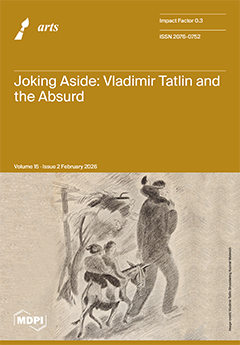
Cover Story (view full-size image): An arch-rival of Kazimir Malevich, Vladimir Tatlin, is remembered for his material experiments, including his counter-reliefs, his design for the Monument to the Third International, and his project for a one-man glider known as the Letatlin. His name is therefore closely associated with constructivism and its radical rethinking of architecture and the applied arts in the Revolutionary era. However, Tatlin was also drawn to the outlandish—a tendency that led him to collaborate with the Russian Dadaists, namely the group OBERIU, led by Daniil Kharms. Joking Aside: Vladimir Tatlin and the Absurd shifts attention to the artist’s more lyrical and playful dimension, particularly his illustrations for Kharms’s 1929 story Vo-pervykh i vo-vtorykh [Firstly, Secondly], at the conclusion of which an oversized Tatlin carries away a diminutive Malevich. View this paper
  • Issues are regarded as officially published after their release is announced to the table of contents alert mailing list.
  • You may sign up for e-mail alerts to receive table of contents of newly released issues.
  • PDF is the official format for papers published in both, html and pdf forms. To view the papers in pdf format, click on the "PDF Full-text" link, and use the free Adobe Reader to open them.
Order results
Result details
Section
Select all
Export citation of selected articles as:
64 pages, 10037 KB  
Article
The Salamander in the Furnace of the Loggia of Psyche at Villa Farnesina: Alchemy and the Hermetic Tradition in Renaissance Rome (With an Analysis of Jacopo del Sellaio’s Abegg-Stiftung Florentine Psyche Marriage Cassone Panel, as an Adaptation of Botticelli’s Primavera)
by Robert Paul Huber, Jr.
Arts 2026, 15(2), 41; https://doi.org/10.3390/arts15020041 - 14 Feb 2026
Viewed by 1522
Abstract
This article examines the unexplained image of a reptilian creature in the fire of a spandrel of Raphael’s Loggia of Psyche in Villa Farnesina, Rome, from the point of view of alchemy. The essay identifies the probable alchemical literary source upon which the [...] Read more.
This article examines the unexplained image of a reptilian creature in the fire of a spandrel of Raphael’s Loggia of Psyche in Villa Farnesina, Rome, from the point of view of alchemy. The essay identifies the probable alchemical literary source upon which the image was based and explains its reason in the overall symbolism of the artwork. Moreover, evidence is brought to bear regarding the Cupid and Psyche myth from Apuleius’ Golden Ass in the Renaissance as being understood as an allegory of the Magnum Opus of alchemy. Alchemy and related astrology, furthermore, are here considered in relation to Hermetism within the context of the period’s notion of the prisca theologia and its learned magia. Medici household interest in the Psyche myth, as demonstrated by illustrations of Apuleius’ fable on three sets of Florentine marriage cassoni, are used as evidence to explicate this. The essay also provides plausible reasons why the patron Agostino Chigi, papal banker from Siena, likely harbored interest in alchemy and the consequent effect on the symbolism in the Loggia of Psyche it implies. The methodology employed is essentially humanistic, in that I consider medieval and Renaissance literary sources regarding the Psyche myth, but also Hermetic philosophy, astrology and alchemy to rationally explain the symbolism of the Psyche tale illustrated in the Loggia of Psyche according to the Hermetic ideals of alchemy. Full article
(This article belongs to the Special Issue Myths in Art, XV–XVII Centuries)
Show Figures

Figure 1

12 pages, 980 KB  
Article
The Japanese Hornpipe: Creative Alteration and Palimpsestic Identity in the Whistling Tradition of Ireland
by Robert Harvey
Arts 2026, 15(2), 40; https://doi.org/10.3390/arts15020040 - 13 Feb 2026
Viewed by 812
Abstract
Irish traditional music is typically characterised as an ‘oral tradition’ which has been handed down from one generation to the next. Though the process of reworking has been considered central to its transmission, little consideration has thus far been given to the ways [...] Read more.
Irish traditional music is typically characterised as an ‘oral tradition’ which has been handed down from one generation to the next. Though the process of reworking has been considered central to its transmission, little consideration has thus far been given to the ways in which the music develops diachronically and what factors influence these performance decisions. Cottrell considers the act of performance as a palimpsest where traces of earlier renditions can still be identified in any given performance. Taking the example of ‘The Japanese Hornpipe’, this article will consider the ways in which individual actors and regional styles can reshape fundamental melodic characteristics through creative alteration in successive performances as the melody passed from circus performance act through the Donegal fiddle tradition and the whistling competition at Fleadh Cheoil na hÉireann. Full article
(This article belongs to the Special Issue Creating Musical Experiences)
Show Figures

Figure 1

25 pages, 5051 KB  
Article
The Eyes in Close-Up: Surveillance, Control, and Montage in Three Works by Sergei Eisenstein
by Joana Jacob Ramalho
Arts 2026, 15(2), 39; https://doi.org/10.3390/arts15020039 - 10 Feb 2026
Viewed by 933
Abstract
This article outlines the central role of the human eye as a consistent and recurring aesthetic strategy in the cinematic oeuvre of Sergei Eisenstein via an investigation of three films—Strike (1925), Potemkin (1925), and the unfinished, two-part Ivan the Terrible (1945, 1958). [...] Read more.
This article outlines the central role of the human eye as a consistent and recurring aesthetic strategy in the cinematic oeuvre of Sergei Eisenstein via an investigation of three films—Strike (1925), Potemkin (1925), and the unfinished, two-part Ivan the Terrible (1945, 1958). It analyses seeing, being seen, and shut and open eyes, in conjunction with the use of the close-up, as crucial to Eisenstein’s visual vocabulary and argues for the need to think about the persistent focus on eyes and vision in terms of panoptic mechanisms of political surveillance and control. Meaning is generated from eye to eye, through configurations of looking and spying, revealing and concealing—formal and aesthetic strategies which condition the gaze of the spectator, creating sites of affect that provide continuity between the films. It furthermore contextualises Soviet montage and Eisenstein’s work in relation to European avant-gardes, specifically French Impressionism and German Expressionism, whose influence on the director’s filmography has received little scholarly attention. Full article
(This article belongs to the Section Film and New Media)
Show Figures

Figure 1

19 pages, 4477 KB  
Article
Divergent Connections: Unique Posts from Côte d’Ivoire, Tourist Art and the Implications for Ethical Display
by Ana Echemendia
Arts 2026, 15(2), 38; https://doi.org/10.3390/arts15020038 - 9 Feb 2026
Viewed by 409
Abstract
The George Washington University holds a collection of African objects donated by a private collector in the 1970s, many of which are culturally misattributed. Among the objects are two large wooden posts cataloged as “house posts” from Côte d’Ivoire. These posts exhibit two [...] Read more.
The George Washington University holds a collection of African objects donated by a private collector in the 1970s, many of which are culturally misattributed. Among the objects are two large wooden posts cataloged as “house posts” from Côte d’Ivoire. These posts exhibit two distinct sections, each resembling material culture used in ceremonial traditions, but together have not been identified in existing museum collections or scholarly sources. This paper documents the findings of an investigation into the provenance and the cultural context of these posts through the analysis of the objects’ materiality, stylistic characteristics, and possible market production to determine a framework for their ethical handling and restitution. What do the combined objects reveal about the interconnectedness of Western market demands and the creation of African tourist art from the 1970s? And what are the implications of these unique forms of African material culture in the conversation on museum reforms and ethical display? The research points to the blurred boundaries between authentic ritual objects and the fabrication of “authenticity” for Western consumption. The goal of this paper is to reveal the possible connections between carvers producing objects for the tourist market within the social and cultural environment of the Senufo workshop system. The paper argues that the objects in the George Washington University collection were adapted for a Western market and audience. Through a comparative analysis of cultural ideographs from surrounding cultures in the area, records of workshops and economic production, the paper concludes that the objects were not produced for sacred use but more likely for commercial purposes, and that their cultural value is not diminished. Instead, they represent another form of expression developed by carvers who adapted Indigenous forms to satisfy Western market demands. Full article
Show Figures

Figure 1

22 pages, 4554 KB  
Article
The Role of Interference Patterns in Architecture: Between Perception and Illusion
by Alina Lipowicz-Budzyńska
Arts 2026, 15(2), 37; https://doi.org/10.3390/arts15020037 - 6 Feb 2026
Viewed by 674
Abstract
Interference patterns are increasingly explored in contemporary architectural façades as visual configurations generated through the superposition of repetitive and layered geometric structures. This study examines the role of interference patterns in contemporary architecture, with particular attention to the perceptual effects and illusion-related phenomena [...] Read more.
Interference patterns are increasingly explored in contemporary architectural façades as visual configurations generated through the superposition of repetitive and layered geometric structures. This study examines the role of interference patterns in contemporary architecture, with particular attention to the perceptual effects and illusion-related phenomena that may emerge during their observation. The research is based on a comparative, case-based analysis of selected architectural examples in which interference patterns are introduced through façade articulation, layered glazing systems, spatial textures, or form-related strategies. The analysed material is classified into four groups: semi-spatial façades, façade graphics applied to multi-layer glass systems, spatial textures, and interference embedded in the overall building form. The analysis focuses on identifying recurring perceptual effects associated with interference patterns, such as illusion-related phenomena, including visual aliasing, motion parallax, apparent depth, figure–ground ambiguity, flicker effects, and dynamic perspective. The comparative analysis indicates that interference patterns can significantly influence the perception of architectural space within its urban context. This influence extends beyond visual appearance and aesthetic composition, contributing to architectural communication, meaning-making processes, and the cognitive engagement of the viewer with spatial and visual structures. The study provides a structured analytical framework that may support further research on perceptual strategies in contemporary architectural design. Full article
Show Figures

Graphical abstract

12 pages, 231 KB  
Article
Nicolas Poussin’s Realm of Flora: The Botanical Renaissance and the Mysteries of the Flower, Sign, Circle and Ellipse
by Frederick A. De Armas
Arts 2026, 15(2), 36; https://doi.org/10.3390/arts15020036 - 6 Feb 2026
Viewed by 891
Abstract
In spite of the preeminence of Nicolas Poussin as one of the great classicist painters in seventeenth century France, some of his earlier work has not received the attention it deserves. This article turns to his Realm of Flora (c. 1631) in order [...] Read more.
In spite of the preeminence of Nicolas Poussin as one of the great classicist painters in seventeenth century France, some of his earlier work has not received the attention it deserves. This article turns to his Realm of Flora (c. 1631) in order to study some salient aspects that have been neglected. First, Poussin followed what I call the “Botanical Renaissance.” This study foregrounds which elements he followed and which he transformed. In conjunction with this movement, this article highlights Poussin’s uses of Platonic philosophy through the works of Marsilio Ficino. The importance of Sol in his works is replicated here in the power of the solar rays to nourish nature. Thirdly, we consider the many metamorphoses in the work and their significance. Finally, we turn to the circle in the heavens with the planets, stars and twelve constellations and contrast it with the more elongated circle of the metamorphic figures on Earth in order to highlight the relation between zodiacal signs/stars and the flowers depicted. The circular constellations contrast with an elongated, even elliptical shape of the figures on Earth, perhaps to suggest the conflict, prevalent at the time, between the Copernican heliocentric and circular system with Kepler’s elliptical view of the path of the heavenly planets. Full article
(This article belongs to the Special Issue Myths in Art, XV–XVII Centuries)
21 pages, 5579 KB  
Article
Art Hiding in Plain Sight: Soviet Conscript Demobilization Albums and Artistic Forms of Commemoration
by Alison Rowley and Dennis Stepanov
Arts 2026, 15(2), 35; https://doi.org/10.3390/arts15020035 - 6 Feb 2026
Viewed by 1282
Abstract
In 1967, the Soviet government altered its expectations and procedures for mandatory military service by reducing the overall length of service and instituting biannual call-ups. This article looks at the demobilization albums created by several generations of conscripts as their time in the [...] Read more.
In 1967, the Soviet government altered its expectations and procedures for mandatory military service by reducing the overall length of service and instituting biannual call-ups. This article looks at the demobilization albums created by several generations of conscripts as their time in the army or navy approached its end. These sources have received little attention to date, despite the wealth of information that they contain. The focus here will be on the artistic styles and different media commonly employed by the young men who made such scrapbooks and how these connect to the overall commemorative aspects of their creations. After discussing how some soldiers literally used parts of their uniforms to fashion their albums, thereby establishing an embodied memory of their time in the armed forces, the focus shifts to the ways in which picture postcard collages commemorated geographic locations and introduced a touristic aesthetic into the albums. Next the article considers the ways in which paintings and cartoons were employed to express concepts of time as experienced by the conscripts. The final section of the article is devoted to the private photographs that were included, specifically those taken to commemorate the friendships built while the young men endured a common rite of passage. Full article
(This article belongs to the Section Visual Arts)
Show Figures

Figure 1

20 pages, 3074 KB  
Article
From Craft to Code and Back: Biodegradable Polyester, Institutional Co-Design, and Garment Practice in Nishijin Weaving
by Kaori Ueda
Arts 2026, 15(2), 34; https://doi.org/10.3390/arts15020034 - 5 Feb 2026
Viewed by 384
Abstract
Nishijin weaving in Kyoto developed as a luxury textile for kimono, yet sustaining the district requires expansion toward contemporary apparel and markets. Within a silk-centred culture and quality regime, polyester has been adopted as a versatile option, and its use has increased, especially [...] Read more.
Nishijin weaving in Kyoto developed as a luxury textile for kimono, yet sustaining the district requires expansion toward contemporary apparel and markets. Within a silk-centred culture and quality regime, polyester has been adopted as a versatile option, and its use has increased, especially for kimono-related products, partly because its filament form can substitute for silk and fit existing processes. From this trajectory, we explore a craft–code–craft pathway by integrating a biodegradable polyester grade into Nishijin’s code-based Jacquard production (CGS). Through practice-based research, we trace how design intent is encoded (Houdini → CGS → Jacquard) and how shop-floor constraints reconfigure design (Jacquard → CGS → Houdini), revealing institutional constraints that shape which materials become usable. We report three case studies: (A) 3D woven structures informed by pleat parameterisation, (B) a zero-waste garment using a 25 cm repeat logic, and (C) a fashion show that makes translation processes legible to the public in an exhibition context. While biodegradable polyester can fit existing infrastructure, apparel-grade warp use remains under development due to warping and warp-joining requirements; yarn specifications and design parameters are being revised. By foregrounding translation across tools, roles, and standards, the study proposes pathways for material transition and circularity within a craft system. Full article
Show Figures

Figure 1

22 pages, 1034 KB  
Article
Commercial Generative AI as a Tool—The Control–Convenience Spectrum
by Krzysztof Cybulski
Arts 2026, 15(2), 33; https://doi.org/10.3390/arts15020033 - 4 Feb 2026
Viewed by 1077
Abstract
AI-generated content—spanning text, imagery, and music—is becoming increasingly commonplace. As the newest generation of song-producing AI systems garner attention, serious questions emerge regarding the role and place of music producers, particularly in the area of non-artistic, or “utility music”. While it might seem [...] Read more.
AI-generated content—spanning text, imagery, and music—is becoming increasingly commonplace. As the newest generation of song-producing AI systems garner attention, serious questions emerge regarding the role and place of music producers, particularly in the area of non-artistic, or “utility music”. While it might seem that human skills and creativity are unlikely to be replaced entirely by generative AI in domains such as art music or live performance, recent developments in the field suggest that human efforts in creation of advertisement or background music are already being challenged by generative AI systems. However, there is a number of alternative, more balanced forms of human–machine co-creativity. It is in this regard that I am posing a question: can commercial generative AI systems really be classified as tools in the strict sense of the term? In this paper, I am attempting to answer this question by introducing the “Control–Convenience Spectrum”—a concept I believe applies to all human creative processes that utilize tools. It bears some similarities to earlier ideas in complexity theory or flow psychology—particularly, it proposes that the extremes of this spectrum are unlikely to produce compelling aesthetical outcomes or satisfying creative practice. I argue that prompt-driven commercial generative AI systems occupy one of the far ends of the spectrum, thus failing to meet the criteria for a creative expression tool. Full article
(This article belongs to the Special Issue Sound, Space, and Creativity in Performing Arts)
Show Figures

Figure 1

14 pages, 260 KB  
Article
Jean-Luc Godard’s Europe: Digital Orientalism and Geopolitical Aesthetics
by Anne-Gaëlle Colette Saliot
Arts 2026, 15(2), 32; https://doi.org/10.3390/arts15020032 - 4 Feb 2026
Viewed by 731
Abstract
This essay contends that Jean-Luc Godard’s late digital cinema elaborates a geopolitical aesthetics in which Europe confronts the return of its repressed histories through the very instability of the digital image. While Europe has long functioned in Godard’s work as both theme and [...] Read more.
This essay contends that Jean-Luc Godard’s late digital cinema elaborates a geopolitical aesthetics in which Europe confronts the return of its repressed histories through the very instability of the digital image. While Europe has long functioned in Godard’s work as both theme and epistemic horizon—echoing the Hegelian cartographies—Film Socialisme (2010) and The Image Book (2018) transform this Eurocentrism into a site of crisis. In these films, what Fredric Jameson terms the “political unconscious” (1981) emerges through the spectral return of Palestine and the Arab world, compelling a reckoning with colonial legacies and the limits of representation. The digital turn proves decisive. Godard mobilizes pixelation, saturation, glitch, and decomposed sound to reveal what might be called the technological unconscious of the medium. I develop the concept of “Digital Orientalism” to designate how Orientalist chronotopes persist in the digital age yet are unsettled by Godard’s experimental manipulation of audiovisual fragments. Through close readings of Film Socialisme and The Image Book, which incorporates works by Arab filmmakers including Youssef Chahine, Nacer Khemir, Ossama Mohammed, and Wiam Simav Bedirxan, I show how Godard’s fractured montages produce symptomatic cartographies of the world-system where repression, memory, and accident collide. Full article
(This article belongs to the Special Issue Film and Visual Studies: The Digital Unconscious)
21 pages, 1785 KB  
Article
Living Rhythms: Investigating Networks and Relational Sensorial Island Rhythms Through Artistic Research
by Ann Burns
Arts 2026, 15(2), 31; https://doi.org/10.3390/arts15020031 - 3 Feb 2026
Viewed by 433
Abstract
Awaken, aware, arise, perform, pause, and repeat. The actions of the everyday. Without it, we fall into dysregulation. This paper seeks to examine creative research developed as an experiment during COVID-19, an audiovisualscape in virtual reality (VR). Rhythmanalysis+ is a social, ecological, and [...] Read more.
Awaken, aware, arise, perform, pause, and repeat. The actions of the everyday. Without it, we fall into dysregulation. This paper seeks to examine creative research developed as an experiment during COVID-19, an audiovisualscape in virtual reality (VR). Rhythmanalysis+ is a social, ecological, and sensorial enquiry into materiality, grounded in archipelagic thinking, through the lens of Rhythmanalysis, a form of analysis focusing on the everyday, through the lens of cyclical and linear rhythms. (Lefebvre). The research will also draw on Deleuze and Guattari’s rhizome theory, a botanical and philosophical investigation into networks. Networks form the backbone of the research. Lars Bang Larsen also argues that networks offer a distinctive view on how factual, speculative, historical, and non-human elements envelop and intertwine. Glissant’s archipelagic thought promotes transformation, multiplicity, and a sense of unpredictability. For this work, four inhabitants from Sherkin, a small island off the southwest coast of Ireland with a population of 100, became the research focus. Across four weeks, islanders gathered data from their daily sensory rhythms. Flight patterns of birds and bats were recorded, daily tasks noted, pathways cycled. Relational impacts of animal-odour on farming, weather, and tides were processed remotely, and an immersive cartographic score was created as a direct response in a three-dimensional virtual space. Rhythmanalysis+ analyses our newly altered perceptions of time and space as a material within a virtual world. VR, created as a gaming platform, is being pushed by art itself, forcing us to relook at the natural world, which is not static, but relational. Fluid but equally extractive, it is important to look at technology’s impact on all that is human and how it is perceived within the body as it is reframed digitally. Full article
(This article belongs to the Special Issue The Impact of the Visual Arts on Technology)
Show Figures

Figure 1

16 pages, 247 KB  
Article
Meyerhold’s Biomechanics and the Image of the New Man in Early Soviet Avant-Garde Theatre
by Anastasia Arefyeva
Arts 2026, 15(2), 30; https://doi.org/10.3390/arts15020030 - 3 Feb 2026
Viewed by 972
Abstract
This article explores Vsevolod Meyerhold’s biomechanics as an avant-garde theatrical and anthropotechnical method developed to forge new subjectivity and redefine roles in post-revolutionary society. It delves into early Soviet avant-garde theatre’s emphasis on movement as a core expressive tool and the transformation of [...] Read more.
This article explores Vsevolod Meyerhold’s biomechanics as an avant-garde theatrical and anthropotechnical method developed to forge new subjectivity and redefine roles in post-revolutionary society. It delves into early Soviet avant-garde theatre’s emphasis on movement as a core expressive tool and the transformation of the actor’s body into a precise instrument for calibrated gestures. Methodologically, the research is based on cultural studies examining relations between art processes and the functioning of social institutions. The article also analyzes a significant corpus of recently published archival materials related to Meyerhold’s development of biomechanical elements and details the structure of Meyerhold’s exercises and their role in enhancing motor skills and expressiveness on stage. The purpose of this article is to interpret biomechanics in the socio-cultural context of early Soviet times, while also examining it as a complex system transcending mere theatrical training. The key finding of the article is that the development of biomechanics encompassed not only theatrical, scientific, and social aspects but also proved close to the ideas of philosophy of Russian anthropocosmism. Full article
11 pages, 195 KB  
Article
Claiming Place Through Visual Sovereignty—Articulations of Khoisan Belonging in Contemporary Cape Town
by Alta Steenkamp
Arts 2026, 15(2), 29; https://doi.org/10.3390/arts15020029 - 3 Feb 2026
Viewed by 728
Abstract
This article explores the reclamation of Khoisan identities in South Africa as a multifaceted process of cultural, spatial, and political resurgence. Framed within the country’s constitutional vision of a “Nation of Nations,” the research examines how Khoisan communities—historically marginalised and classified under apartheid [...] Read more.
This article explores the reclamation of Khoisan identities in South Africa as a multifaceted process of cultural, spatial, and political resurgence. Framed within the country’s constitutional vision of a “Nation of Nations,” the research examines how Khoisan communities—historically marginalised and classified under apartheid as “Coloured”—are reasserting their Indigenous heritage through acts of cultural revival and place-based activism. Centred on Cape Town, the ancestral homeland and symbolic epicentre of both colonial encounter and Indigenous resurgence, the article theoretically investigates how creativity, heritage, and activism intersect in processes of reimagining, renaming, and retaking of place. Drawing on theories of visual sovereignty and re-placement, it analyses how visual and performative practices—ranging from protest art and language revitalisation to heritage occupations—function as decolonial acts that reclaim both the image and meaning of place. The article situates the Khoisan revival within broader global movements of Indigenous self-representation and argues that reclaiming place constitutes a living form of sovereignty, restoring relational networks between people, land, and identity. Ultimately, it demonstrates that contemporary Khoisan activism transforms visibility into agency, using culture and creativity as tools to rewrite belonging and to decolonise South Africa’s cultural landscape. Full article
22 pages, 7664 KB  
Article
Joking Aside: Vladimir Tatlin and the Absurd
by John E. Bowlt
Arts 2026, 15(2), 28; https://doi.org/10.3390/arts15020028 - 3 Feb 2026
Viewed by 844
Abstract
The article queries the conventional interpretation of Vladimir Tatlin’s oeuvre as rational and pragmatic by focusing on more “irrational” aspects such as the visionary and unfeasible Monument to the III International, Letatlin and other, parallel projects that were never constructed or, perhaps, [...] Read more.
The article queries the conventional interpretation of Vladimir Tatlin’s oeuvre as rational and pragmatic by focusing on more “irrational” aspects such as the visionary and unfeasible Monument to the III International, Letatlin and other, parallel projects that were never constructed or, perhaps, were never meant to be constructed. While acknowledging Tatlin’s debt to Cézanne and Picasso and referring to Formalist critics Punin and Tarabukin and to his proximity to Constructivism, the article also emphasizes the common contemporary reception of Tatlin as an actor, a buffoon and even a Holy Fool. The article concludes with copious references to Tatlin’s support of Daniil Kharms and the OBERIU group of Absurdist writers and to his illustrations for the former’s “fairy-tale” Vo-pervykh i vo-vtorykh. Full article
Show Figures

Figure 1

17 pages, 3683 KB  
Essay
Worldbuilding with Drawing and Words, an ‘Unproductive’ Counter to the Consumer-Driven, Extractive Models in Higher Education and the Cultural and Creative Industries
by Alexandra Antonopoulou and Eleanor Dare
Arts 2026, 15(2), 27; https://doi.org/10.3390/arts15020027 - 2 Feb 2026
Viewed by 737
Abstract
Antonopoulou and Dare’s ongoing collaborative projects (Phi Books 2008: ongoing; Digital Dreamhacker 2013: ongoing) enact an open-ended, experimental set of slow ‘Fictioning’ practices and actions that involve performing, diagramming, or assembling to create or anticipate new modes of existence. In this paper, the [...] Read more.
Antonopoulou and Dare’s ongoing collaborative projects (Phi Books 2008: ongoing; Digital Dreamhacker 2013: ongoing) enact an open-ended, experimental set of slow ‘Fictioning’ practices and actions that involve performing, diagramming, or assembling to create or anticipate new modes of existence. In this paper, the authors use the visual essay form to evidence how their daily practices of drawing, writing, and exchanging, position art and the artist. These practices unfold without, in this case, the utilitarian, economic, and epistemic priorities and systems of reductive representation which underpin the extractive models of Generative AI and other ‘innovative’ intermediaries, systems which expedite content and regulate consumption in the cultural and creative industries and in ‘arts and humanities’ education. Focusing on their creative practices, Antonopoulou and Dare reposition commodified notions of productivity, creativity, and innovation, seeking what Haraway describes as a way ‘of making, thinking and worlding’ beyond the neoliberal imperatives of extracting profit from labour. Positioned within an era of escalating precarity combined with ecological and political instability driven by extractive colonialism, the temporality of collaboration and drawing over decades is proposed as an act of material resistance to art’s subsumption into the venture capitalist hype cycles. Such cycles are associated with an accelerating array of crises, discussed here. Full article
Show Figures

Figure 1

20 pages, 15560 KB  
Article
Music, Morality, and Mayhem: Anton Möller the Elder’s Drawings from Marienburg (1587)
by Emily Peppers
Arts 2026, 15(2), 26; https://doi.org/10.3390/arts15020026 - 1 Feb 2026
Viewed by 825
Abstract
This article examines two drawings by the Prussian artist Anton Möller the Elder (1563–1611), based in Danzig [Gdańsk]. In 1587, Möller spent time in Marienburg [Malbork] near Danzig, fresh from his post-apprenticeship travels. These drawings evidence his tuition in Northern Renaissance styles, subject [...] Read more.
This article examines two drawings by the Prussian artist Anton Möller the Elder (1563–1611), based in Danzig [Gdańsk]. In 1587, Möller spent time in Marienburg [Malbork] near Danzig, fresh from his post-apprenticeship travels. These drawings evidence his tuition in Northern Renaissance styles, subject matter, and disguised symbolism—embodying contemporary Lutheran ideologies of temperance, morality, and the powerful sway of music. While scholarship on Möller’s works is well established (mainly in Polish and German sources in brief catalogue-style entries), this article represents an in-depth analysis of the symbolism in his works—primarily missing from modern scholarship, especially in the English language. Möller’s Folk Fair before Marienburg is entertaining, sensational, and serves as a graphic warning not to fall prey to alcohol’s destruction of moral character. Möller directly copies figures from Northern Renaissance artists working in the folk fair genre—I discuss these connections and symbolism. Musicians are given an incendiary role in the scene, spurring revelers on to indulge in base emotions and vices. In stark contrast, Möller’s An Elegant Reception with Christburg [Dzierzgoń] Castle in the Background, places music at the center of the scene, depicts “active listening,” and provides a visual message on how music can cultivate a pure mind and heart, if one’s moral compass is properly attuned. Full article
Show Figures

Figure 1

16 pages, 15261 KB  
Article
Winners and Losers: The Analysis of a Contemporary Tattoo in Light of Aby Warburg’s Work
by Olaya Sanfuentes
Arts 2026, 15(2), 25; https://doi.org/10.3390/arts15020025 - 1 Feb 2026
Viewed by 765
Abstract
In light of the ideas of Erwin Panofsky and Aby Warburg, this paper analyzes a contemporary tattoo by a Chilean artist. The image depicts a Spanish native on horseback destroying a Spanish conquistador. It is a reinterpretation of the classic figure of the [...] Read more.
In light of the ideas of Erwin Panofsky and Aby Warburg, this paper analyzes a contemporary tattoo by a Chilean artist. The image depicts a Spanish native on horseback destroying a Spanish conquistador. It is a reinterpretation of the classic figure of the apostle Saint James destroying his enemies of the faith. First, it was Saint James the Moor-slayer, then Saint James the Indian slayer. The formula, although inverted, is effective in showing the period’s interpretation of opposites confronting each other through violence, demonstrating that these images are visual constructions that emerge whenever there is an emotional climate that justifies them. Full article
Show Figures

Figure 1

Previous Issue
Next Issue
Back to TopTop
