
Joking Aside: Vladimir Tatlin and the Absurd

Department of Slavic Languages and Literatures, University of Southern California, University Park, Los Angeles, CA 90089-4353, USA
Arts 2026, 15(2), 28; https://doi.org/10.3390/arts15020028
Submission received: 21 November 2025
/
Revised: 5 January 2026
/
Accepted: 7 January 2026
/
Published: 3 February 2026
(This article belongs to the Special Issue The European Avant-Garde(s) and Technologies: Unfinished Modernity and the Idea of Tékhnē—the One Hundred Years’ Revolution, 1850–1950)
Abstract
The article queries the conventional interpretation of Vladimir Tatlin’s oeuvre as rational and pragmatic by focusing on more “irrational” aspects such as the visionary and unfeasible Monument to the III International, Letatlin and other, parallel projects that were never constructed or, perhaps, were never meant to be constructed. While acknowledging Tatlin’s debt to Cézanne and Picasso and referring to Formalist critics Punin and Tarabukin and to his proximity to Constructivism, the article also emphasizes the common contemporary reception of Tatlin as an actor, a buffoon and even a Holy Fool. The article concludes with copious references to Tatlin’s support of Daniil Kharms and the OBERIU group of Absurdist writers and to his illustrations for the former’s “fairy-tale” Vo-pervykh i vo-vtorykh.
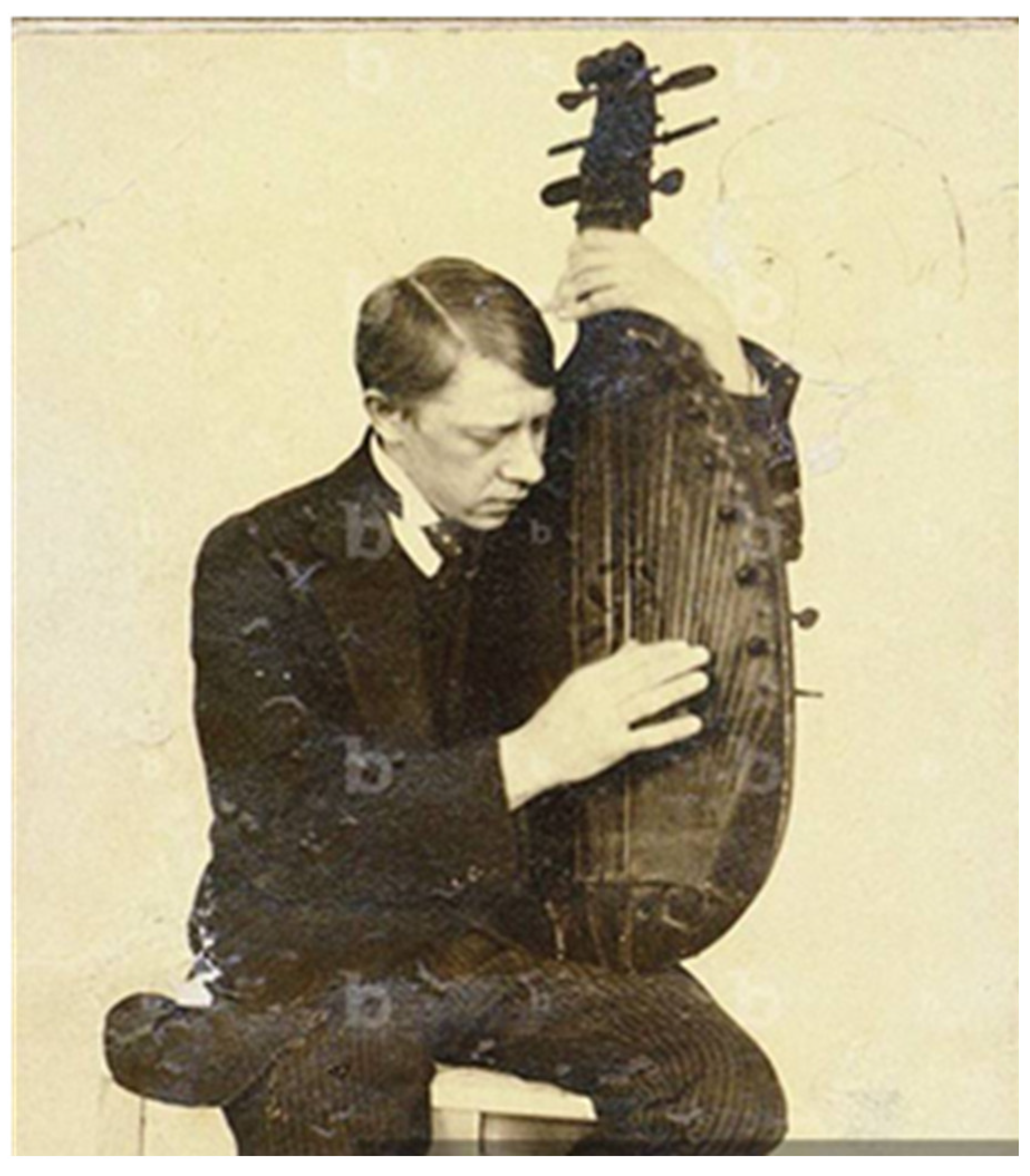
Vladimir Evgrafovich Tatlin (1885–1953) (Figure 1) is often remembered as a constructor, a designer and an engineer, and words such as rational, calculated and down-to-earth tend to be associated with his life and work. Nikolai Punin, for example, described him as a cool advocate of “materials, volume and construction”,1 while Velimir Khlebnikov cast him as a “stern singer of the propellor”.2
At first glance, therefore, Tatlin would seem to be a master of reason, whose manifest knowledge of arithmetic, structural engineering and aeronautics must, presumably, have reflected common sense, an ordered mind and a clarity of vision—an assumption often reinforced by references to his early career as a seaman and to the influence of Paul Cézanne and Pablo Picasso, as well as to a strong support of Constructivism. Punin even affirmed that, thanks to Tatlin, the “individual relationship of forms is expelled; the emotional stimuli to the hypertrophied and crippled eye are admitted to be unhealthy and are eliminated”.3 Certainly, Tatlin’s art was not hypertrophied or crippled—on the contrary, perhaps the first impression of his paintings, reliefs and three-dimensional projects is of detached logic and harmonious equilibrium. At the same time, however, much of Tatlin’s theory and practice may be regarded as unorthodox, if not iconoclastic, aberrant rather than axial and “funny” rather than “serious”, often defying the very notions of consistent deduction and pragmatic goal—which is not to reject Tatlin’s debt to the Constructivist worldview but, rather, to argue for a more synthetic, more encompassing approach to his oeuvre. In an attempt to give credence to this interpretation, let us first examine the ostensible logic of Tatlin’s art and then try to superimpose a lighter, if not absurdist reading.
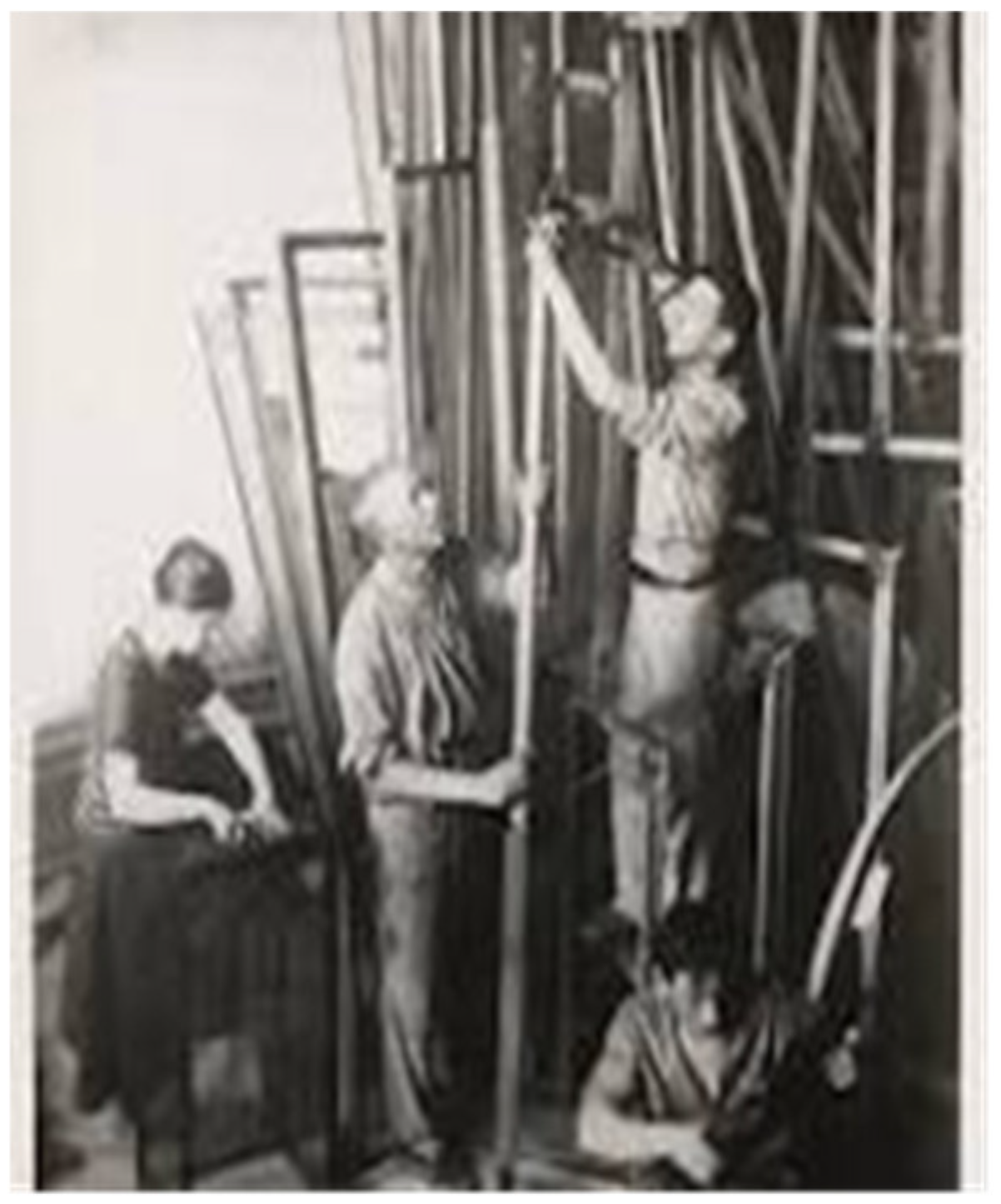
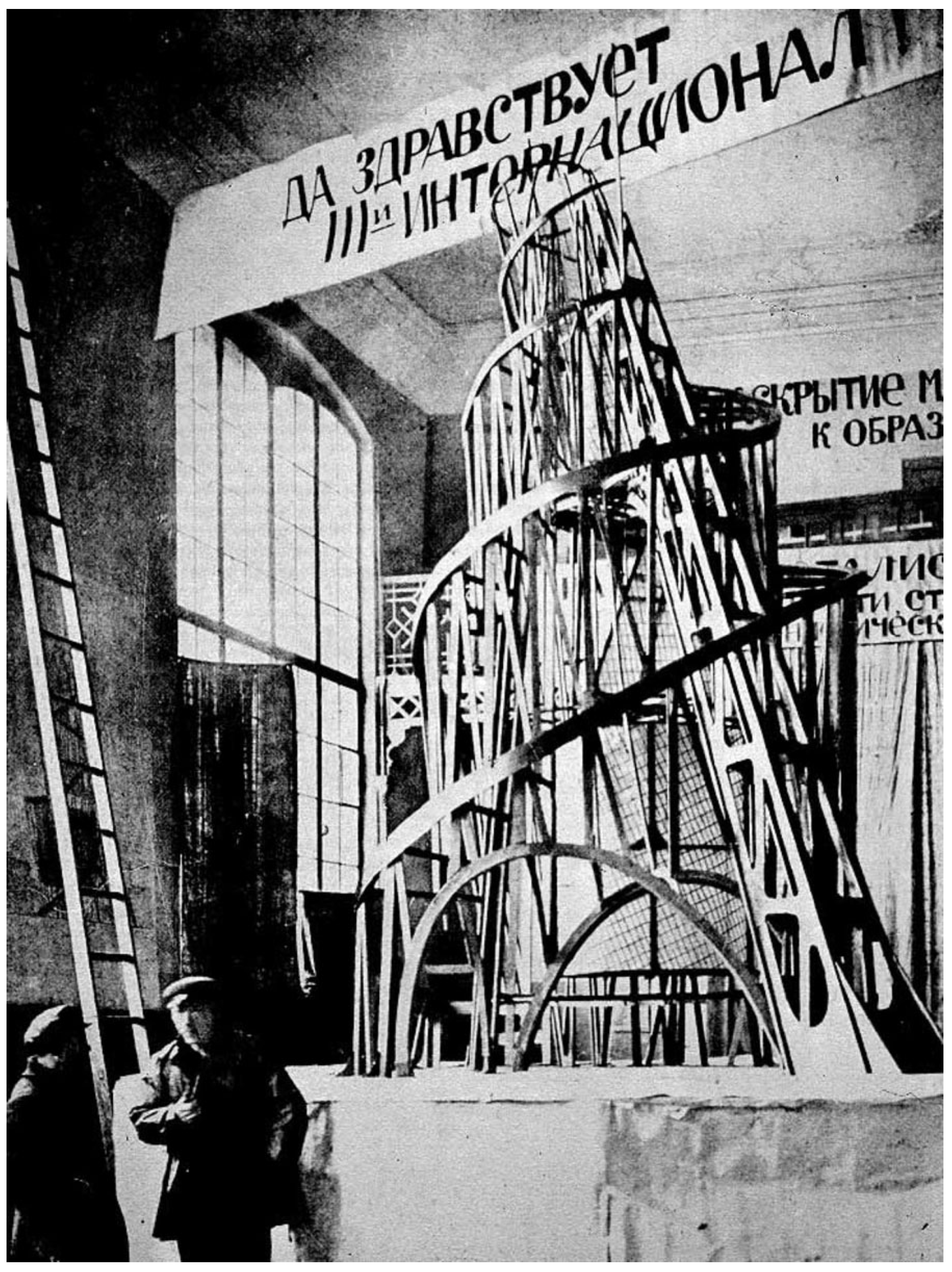
In critical writings, old and new, a marked tendency has been to praise Tatlin’s apparent efficiency and sobriety (in art rather than in life), even if the famous model for the Monument to the III International (Tatlin’s Tower) (Figure 2) could hardly be described as sensible and realistic. Unexpectedly, for example, even the rational Punin, acknowledging Tatlin’s debt to the measured methods of Cézanne, Picasso and the machine, also connected Tatlin with the alternative conventions of the Russian icon in relation to “composition (the construction of form) and to colour”, concluding that the art of the icon had introduced Tatlin to the “palpability of materials in the play of their surfaces and volumes.”4
Eccentrically, however, and bearing in mind such “palpability of materials”, Tatlin seems to have focused not on the holy images on the front of the icon but, rather, on the back of the icon with its undisguised constructive function, prompting him to incorporate the natural finish of wood as an esthetic component into his reliefs and counter-reliefs. In other words, a specific point of departure for Tatlin lay in the very texture and constructiveness of the wooden board of the icon composed of one, two or more panels and not, for example, the semantic and reverse perspectives of the actual picture, which attracted colleagues such as Natal’ia Goncharova and Kazimir Malevich. Again and again, from the early reliefs to the late-stage designs such as A Comedian of the XVII Century (1935.35), Tatlin returned to the physicality of wood. The front of the icon, i.e., the sacred depiction, seems to have been of much less immediate interest, even if it did present him with the brilliant effects of unmixed colors and varied spatial resolutions, especially in medieval icons, one such visual element being the spiral and S-form composition.
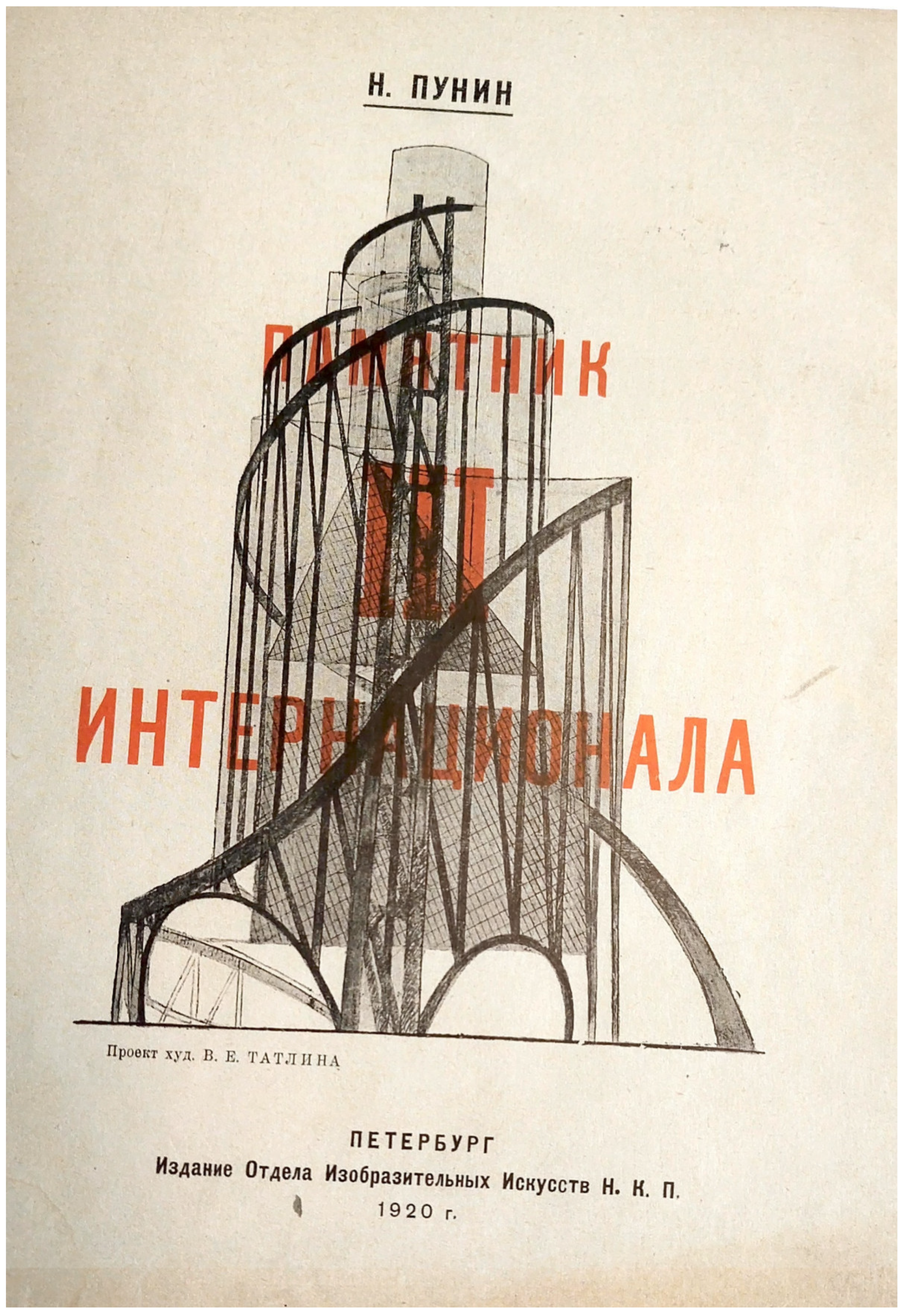
Tatlin used a spiral structure in many of his works, and, of course, it operated as the constructive principle in his model for the Monument (built of wood), even if in this immediate context the spiral impulse tends to be associated with the dynamic force of revolution and described as the “ideal expression of freedom; with its heel fixed firmly to the earth, [the Monument] escaping from the earth, becomes, as it were, a symbol of the rejection of all animal, earthly and reptilian interests”5—culminating in a project more visionary than feasible (Figure 3).
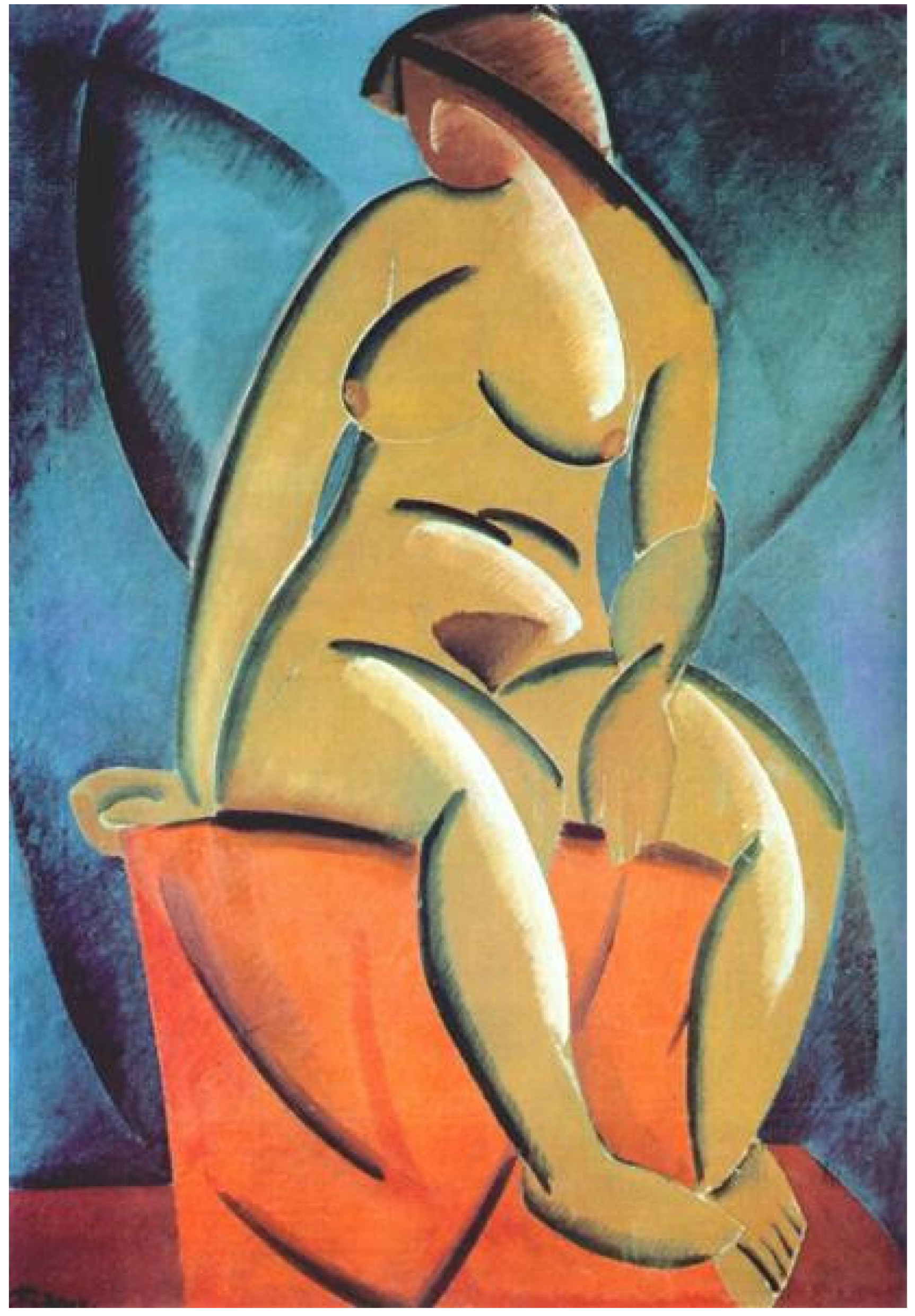
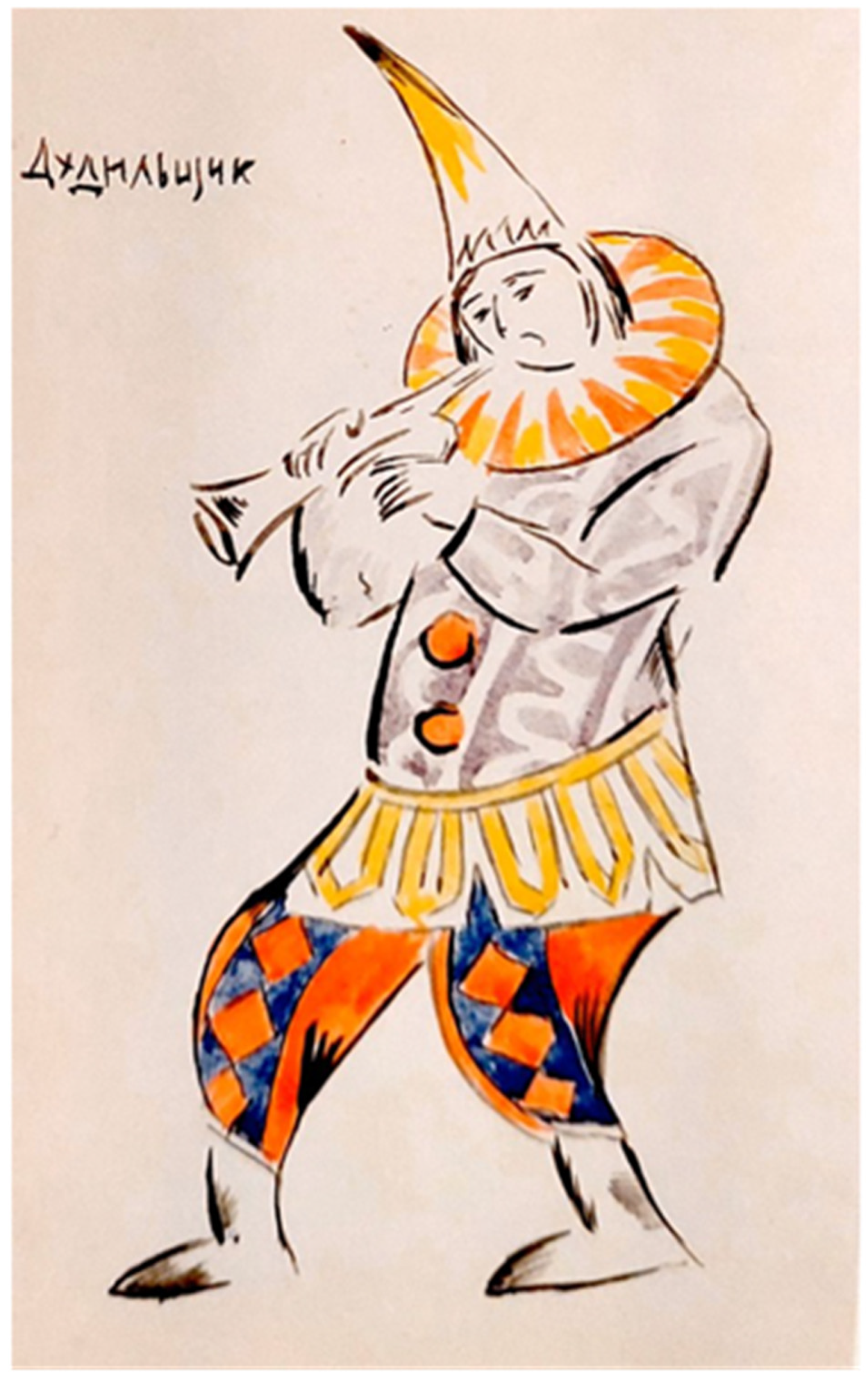
At the same time, Tatlin did compose a number of paintings and drawings based on a spiral, such as Fishvendor (1911, State Tretyakov Gallery, Moscow), Self-Portrait as a Seaman (1912, State Russian Museum, St. Petersburg), and especially Nude (1913, State Tretyakov Gallery, Moscow) (Figure 4), wherein a clear contour moves in a grand arc from feet to head, encompassing a square base, a conoid center and a spherical top, a mechanical arrangement anticipating the trajectory of the Monument. Tatlin also observed this compositional system in his costume designs for Tsar Maksimilian and His Disobedient Son, Adol’f (1911) (Figure 5) and A Life for the Tsar (1913–1915; unrealized production), wherein he intended to use a “three-dimensional, gold, cubistic Gothic form”.6
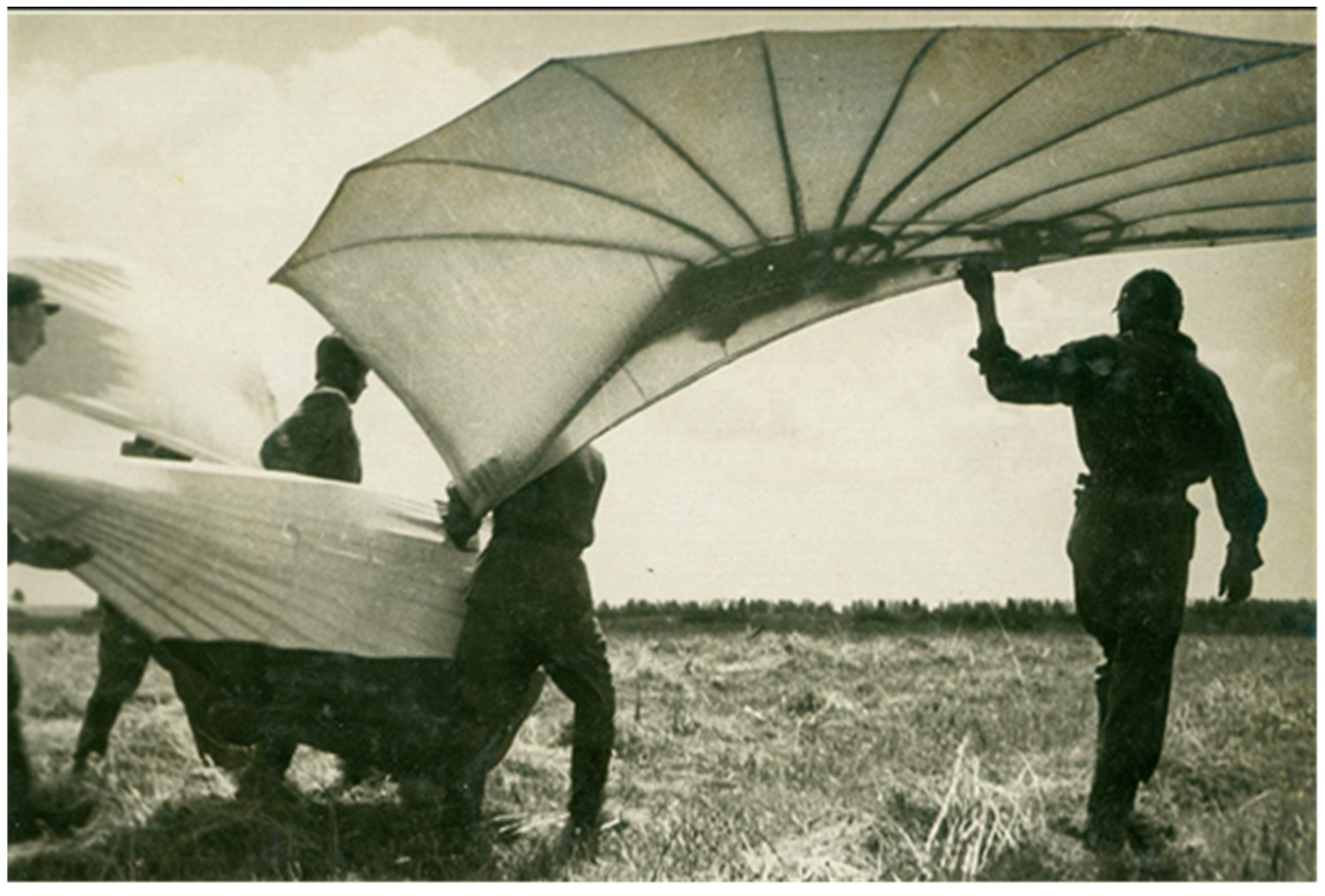
Much later, when Tatlin was working on Letatlin (his one-man glider) (Figure 6), he affirmed: “I believe … that the use of curved surfaces, and experimental work on this … are inadequately developed … A series of forms determined by complicated curvatures will demand other plastic, material. and constructive relationships—the artist can and must master these elements”7—which is to reaffirm that Tatlin paid astute attention to the efficiency and economy of construction, even if the ultimate goal of such construction was often unreasonable, if not inane.
In his memoirs, the artist and one-time student of Tatlin, Vasilii Komardenkov, recalled:
Once again, in this simple formula, Tatlin’s spontaneous and “subjective” slices of black bread, boot knife and onion defuse his traditional association with the “objectivity” of Constructivism, even if, at the same time, Komardenkov was touching upon a characteristic feature of Tatlin’s psychology, i.e., his universality and aspiration to substitute the collective response for the individual whim. In other words, and almost literally as a volte-face, Tatlin wished to remove the artifact from the long tradition of private contemplation and gratification to the level of mass consumption, to replace the “astrology” of art by its “astronomy”.9It was noisy in Tatlin’s studio and great fun, despite that time of hunger, cold and unease. Vladimir Evgrafovich knew how to create the right ambience for work. He spoke little, but persuasively. He would talk about space, texture as colorific expression and glass which provides the potential for spatial resolutions—referring to his ‘counter-reliefs’ which hung on the walls of the studio … Tatlin regarded Constructivism as an organizational principle, asserting that this was a new viewpoint for seeing the world, a plastic perception of the world … On certain days of the month, Vladimir Evgrafovich used to come into the studio holding a loaf of black bread under his arm … Vladimir Evgrafovich took a knife from his boot-top, cut us each a big slice and sometimes gave us a bit of onion too, saying: ‘You have heavy work to do, serious work, and this will help you get along’”.8
Tatlin’s main artistic activities—his stage designs, his reliefs, his Monument, his functional projects, and his glider—represent a consistent extension of an endeavor to replace the particular by the universal. Indeed, both before and after the October Revolution, Tatlin worked as the leader or member of a collective: for example, between 1912 and 1917, his Moscow studio (No. 3 at Ostozhenka, now Metrostroevskaia Street) was a center of fruitful dialog and collaboration among many important artists, including Aleksei Grishchenko, Viktor Midler, Aleksei Morgunov, Liubov’ Popova, Nadezhda Udal’tsova and Aleksandr Vesnin. Even if Vesnin concluded that it was “impossible to work with Tatlin”,10 the Ostozhenka studio was reminiscent of a medieval guild in which common ideas and materials were formulated, shared and elaborated, including the topical issues of the icon, primitive art and Cubism. Consequently, the works produced on the Ostozhenka were sometimes mutually similar in both principle and intention, Tatlin’s figure drawings, for example, often recalling Popova’s geometric nudes of the same period. The spirit of collectivity was also evident during the construction of the models of the Monument and Letatlin, and, in fact, the drawings and designs for the Monument were exhibited precisely as a collective undertaking at the “Association of New Trends in Art” in Petrograd in 1923. Tatlin even described the model as an “anonymous” enterprise when, with co-workers Sof’ia Dymshits-Tolstaia, Tevel’ Shapiro, losif Meerzon and M.P. Vinogradov, he declared that in the art of the past, “every connection between painting, sculpture and architecture had been lost: the result was individualism, i.e., the expression of purely personal habits and tastes”.11 In contrast, Tatlin now offered a new, volumetrical art on a sound basis of “materials, volume and material relationships—the artist can and must master these elements.”12 At least, that is what Tatlin would have us believe.
Obviously, the “rational” Tatlin owed part of his constructive methodology to the art of Cézanne, which he knew from the Moscow collections of Ivan Morozov and Sergei Shchukin, from the readily available reproductions circulating in Moscow and St. Petersburg, and from his discussions with colleagues, not least with Grishchenko.13 As a member of the Jack of Diamonds group in 1913 and, therefore, a colleague of the Russian “Cézannists” Robert Fal’k, Aleksandr Kuprin et al., Tatlin favored the “exposition of nature”14 and the treatment of objects not as vehicles of psychological and narrative denotation but, rather, as simple natures mortes. Tatlin admired Cézanne for his arrangement of the picture via colored planes and not via Impressionist flecks of color and for the resultant effect of tangibility rather than of instability.
For Tatlin the “materialist”, then, a painting such as La Montagne Sainte-Victoire (1896–1898, bought by Morozov in 1907; now in the State Hermitage, St. Petersburg) would have confirmed the validity of the kind of geometric organization that he recognized in icon painting, i.e., the consolidation and not the fragmentation of the visual image, its reconstruction rather than deconstruction. Although Punin, for example, concluded that Cézanne was, ultimately, an Impressionist, Tatlin did not share this view and tended to condemn the term Impressionism as he did once in the presence of the “Russian Impressionists” Igor’ Grabar’ and Konstantin Korovin.15
In any case, Tatlin’s analyses of the constructive patterns of Cézanne’s painting was stimulated further by immediate acquaintance with Cubism during his trip to Paris in the spring of 1914 and, specifically, by his examination of a “violin sawn up into pieces, hanging by threads on various planes” in Picasso’s studio.16 There is no question that at this juncture the influence was immediate and formative, the encounter with Picasso’s three-dimensional work proving to be a vital stimulus to Tatlin’s final break with surface convention. Although Tatlin was in Picasso’s studio for only a few minutes before he was “noisily removed”,17 he saw the violins and guitars of 1912–1913 constructed of cardboard and string, combinations that were as much tactile as they were visual and which, in their “ludicrousness” must have appealed to Tatlain’s sense of humor.
Composing collages of textures of wood, marble, etc., Picasso and his colleagues, especially Braque, had been exploring the tactile property of painting ever since the former’s “piano in relief” of 1909.26. As Jean Metzinger wrote later: “Avant hous, aucun peintre n’avait eu le souci de palper les objets qu’il peignait”.18 In some cases, the textural contrasts were elemental and relied on real, solid materials, as, for example, Picasso’s La Chaise cannée (1912, Musée Picasso, Paris) with its inclusion of actual cane. In any case, what impressed Tatlin in the Picasso “reliefs” was not only their three-dimensionality but also their dependence on raw materials for esthetic effect. Furthermore, as often happens at such moments of artistic revelation, Tatlin was affected not by what was of the utmost significance to Picasso but, rather, by the ancillary action of cutting a piece of material to the approximate form of a guitar or violin. At this juncture, therefore, Tatlin was attracted not so much by the parody of appearance as by the estrangement of the recognizable form of the object (a musical instrument) from the normal medium of the construction of that object (wood now replaced by cardboard or metal), a condition that inspired him to produce his first reliefs in the autumn (?) of 1914.
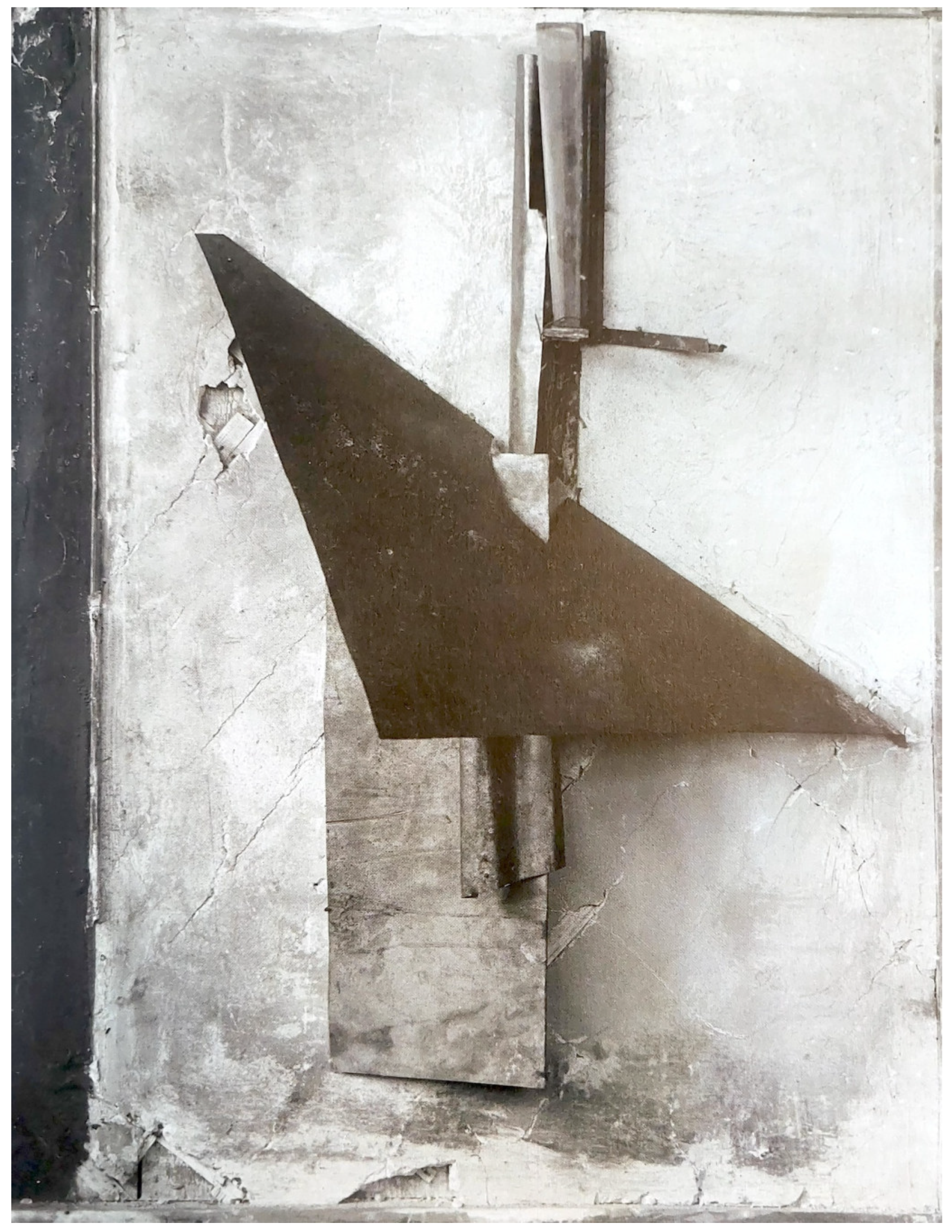
Tatlin’s organization of “industrial” materials into an artistic whole devoid, apparently, of either immediate representational or utilitarian value marks a revolutionary departure. True, the arrangement of forms in the reliefs such as Painterly Relief. Selection of Materials (Figure 7) still betrays its derivation from, and abstraction of, a Picasso violin or guitar: the top cone of glass here seems to repeat the top piece of a Picasso violin or guitar; the wooden vertical repeats the length of the instrument; the large metal triangle approximates the sounding board. In other words, the planar foundation of Tatlin’s early reliefs (the board) maintained the pictorial tradition, for, as the critic Nikolai Tarabukin asserted in 1923, the Tatlin relief still demanded a frontal and, therefore, static view.19
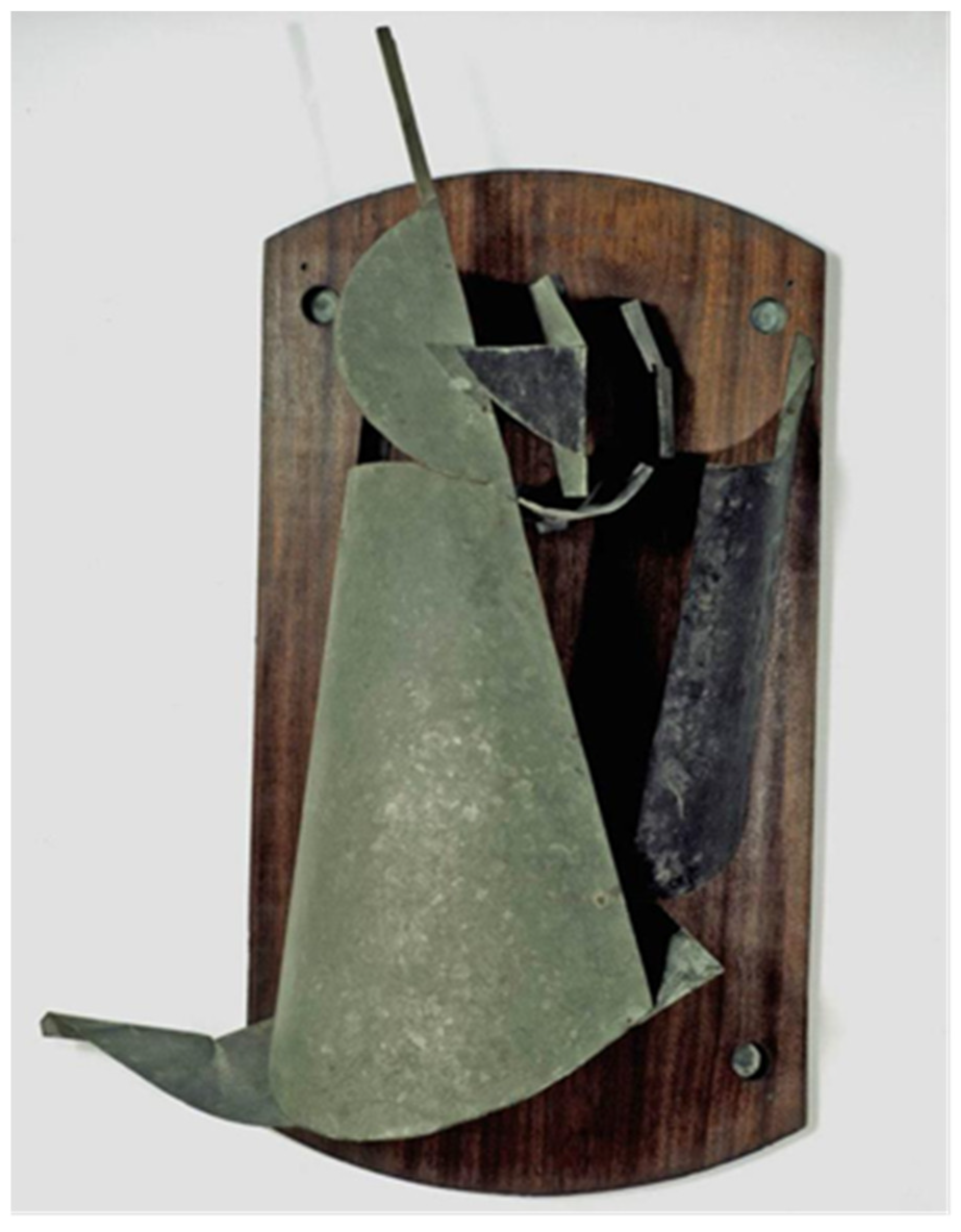
Taken in this context of the frontal perception, Tatlin’s painterly reliefs of 1914 and the Picasso/Braque reliefs of the same period, are similar in principle and function—Tatlin has, so to speak, altered the outward design of the artifact, but not the intrinsic shape. Tatlin’s development of the relief from the painterly phase to the corner and hanging relief in 1915 represents an earnest attempt to reject the frontal view and break with the terrestrial pull, the counter-relief (Figure 8) being a material analogy to the military counter-attack (the time of this episode was the First World War).20 Just as a counter-attack entails an intensified assault against the adversary, so the counter-relief attacks the external space with renewed vigor, for here “counter” does not mean penetration back into the pictorial plane (i.e., a bas relief), but, rather, an assault against the surrounding space away from the basic, two-dimensional position.
Tatlin first showed his new interpretations of material and space at two concurrent exhibitions in Moscow and Petrograd in the spring of 1915, i.e., “The Exhibition of Painting” (ex-catalog) and ‘Tramway V”. One critic remarked that “Tatlin et al., it seems, have reached the limit in their Futurist aspirations … Tatlin has glued a broken table leg, a sheet of iron and a broken glass jug on to a dirty board”.21 Tatlin, of course, had certainly not reached the limit, the next stage being the corner relief invented in 1915 and displayed at “0.10” in Petrograd in the winter of 1915–1916. In reviewing the exhibition, Sergei Isakov pleaded for the acceptance of Tatlin’s experiments:
Incidentally, the broken table leg, sheet of iron and broken glass jug might just as well be interpreted both as an affront to Futurism with its glorification of the machine and as a pointer to the unreasonable art of Marcel Duchamp, Francis Picabia and the Dada movement in general (founded in February 1916).In exposing the hidden life of the material which defines the process of our industrial life …, in fathoming the laws of the energy possessed by material and in transferring them to the plane of beauty, [Tatlin] himself, therefore, becomes the master of the material world and engenders the hope that one day mankind will discover the means and strength to cast off the yoke of the humiliating machine.22
At this moment Tatlin made a radical and transformative break with artistic tradition. When Malevich’s Suprematist paintings (also exhibited for the first time at “0.10”) are compared with Tatlin’s corner reliefs, they emerge as the conclusion to a passing order. But the hanging corner relief, with its adoption of space as a creative agent, with its multilateral accessibility and kinetic potential, signifies the beginning of a new artistic code. In an essay of 1919, Punin implied that the suspended relief did, indeed, both designate and demand a new perception. “Not only materials with their forms have gone into Tatlin’s counter relief (with cables), but also action with its form; so rupture is demonstrated in the relief; it is quite clear that, in this instance, space and time have combined in a single form”.23
In his painterly reliefs, corner reliefs and counter-reliefs, Tatlin both strove towards a universal perception and reestablished the importance of the tactile element in art, thereby, perhaps, disobeying the traditional notice in museums: “Do not touch”. In cultivating the raw surfaces of wood, metal, glass, plaster, etc., Tatlin replaced color with texture, putting the eye under the control of touch, for, as he asserted, “A piece of cut iron says much more about hard work than all your paintings”.24 Inasmuch as Tatlin was concerned with the idea of universality and the continuum, the reliefs should be regarded not as hermetic, independent artifacts, but rather as component phases in an artistic process, experiments preliminary to a subsequent, more enduring achievement. On several occasions Tatlin indicated that his investigations into the properties of materials, embodied by the reliefs, were supplying preparatory data for inventions still to be made.
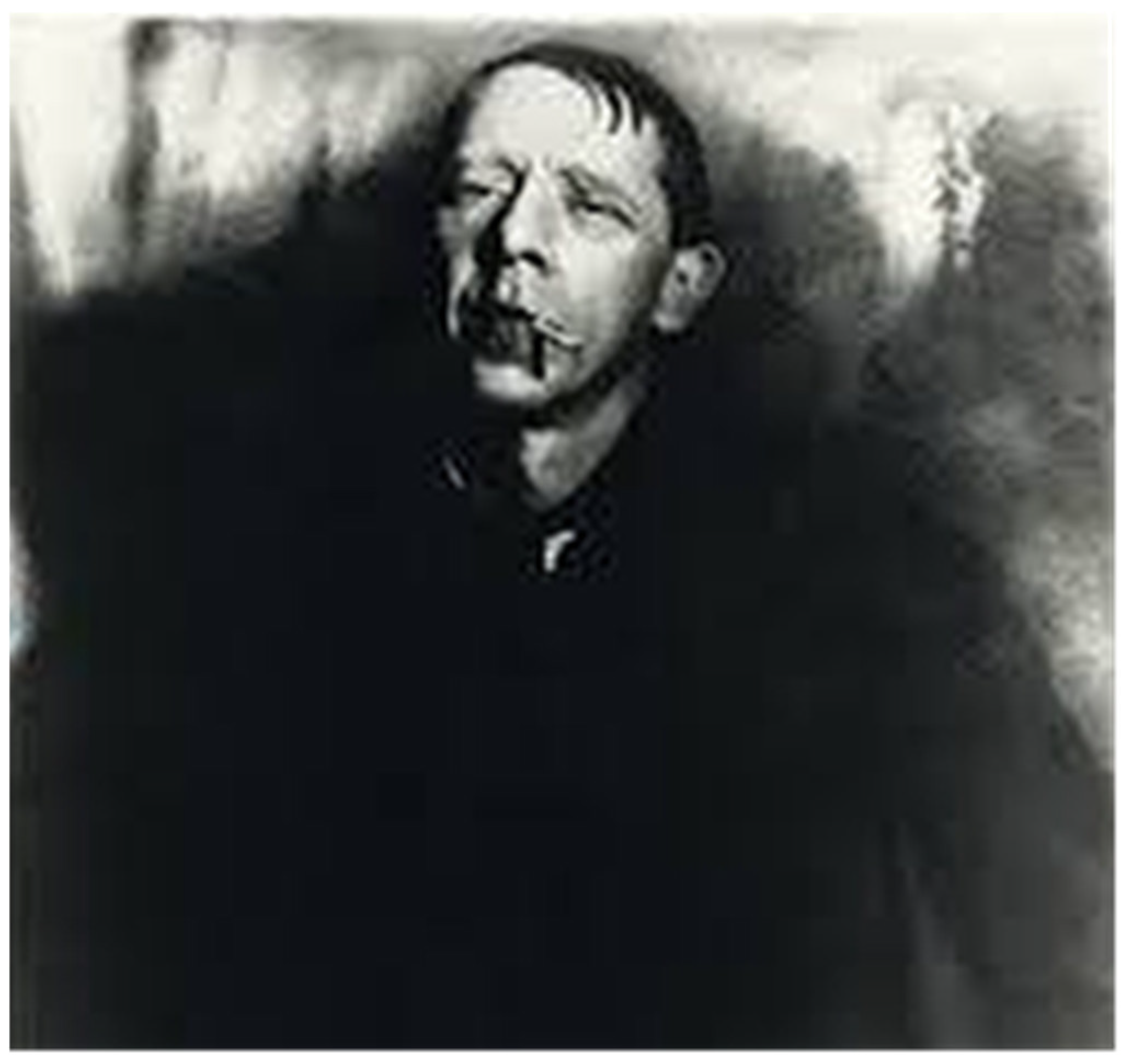
Tatlin’s attempt to pass beyond the plane, to “reach out”, was evident on many levels—in his concern with the method of display in the Tretyakov Gallery in Moscow, in his participation in societies and associations such as the Professional Union of Artists-Painters in Moscow in 1917 and the All-Russian Collegium for Museum Affairs and for the Preservation of Artistic and Antique Monuments in 1918, in his efforts to establish (with Punin) the journal Internatsional iskusstv [International of the Arts] the same year (anticipating the title of his Tower, i.e., Monument to the III International), and even in his demand for a motorcycle in 1922 so that he could visit “at least fifteen factories”.25 Tatlin also demonstrated his “personal impersonality” by his unchanging mode of dress and hairstyle—the old jacket and sagging polo-neck sweater visible in photographs of 1916 or of 1950 (Figure 9). Yet viewed against this simple physical and psychological characteristic, Tatlin’s creation of the reliefs, the Monument and the glider begs a fundamental question as to how Tatlin, the studio artist, dared to become Tatlin, the functional designer. The fact that he had no training in the applied arts, let alone engineering, raises the very question of the feasibility of Tatlin’s “industrial” designs, especially the Monument and Letatlin. All of which is to propose that, beyond the ostensible collectivity, constructiveness and objectivity of Tatlin’s artistic sensibility, there was another dimension—deeply individualistic and eccentric, if not haywire and narcissistic.
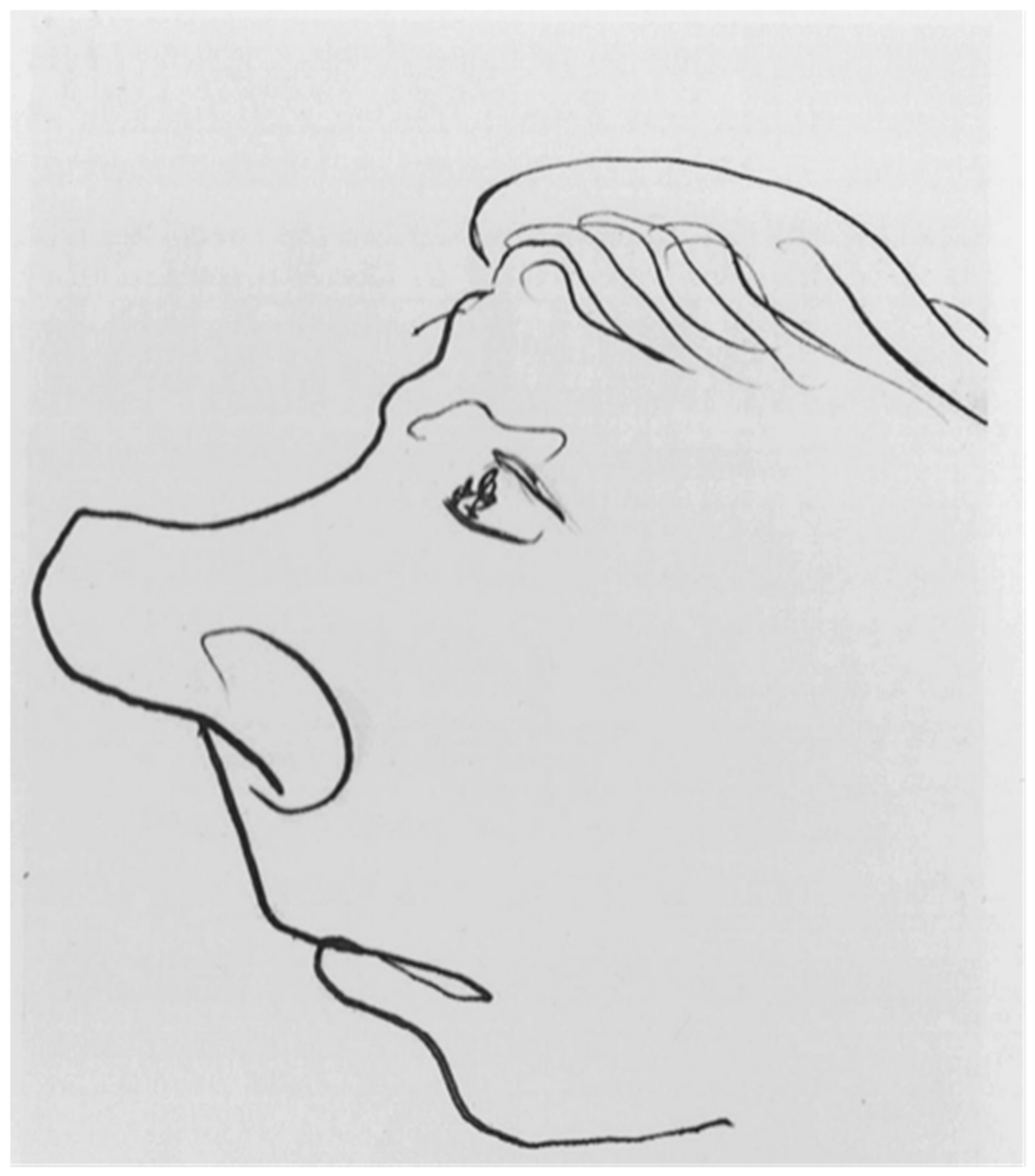
In fact, when we suspend the customary art-historical attribution of “rationality” to Tatlin’s oeuvre, we might delineate a very different creative personality—an artist who was perhaps closer to the irrationality of the Dadaists than to the linear economy of the Constructivists. There is substantial evidence to infer that in many ways Tatlin was an Absurdist and that his instinct was to create entertaining baubles and invent pure fantasies rather than design functional objects for the new, revolutionary reality. Not for nothing did George Grosz call Tatlin the “great fool”;26 and not for nothing did Abram Efros call him a “great martyr, obsessed, and slow moving”,27 descriptions which link Tatlin to the long lineage of Russia’s Holy Fools—a connection which Mikhail Larionov might have had in mind as he sketched his caricature (Figure 10). As a matter of fact, in his famous Rayist oil portrait of Tatlin (1913, Musée National d’Art Moderne, Centre Pompidou, Paris), intended, presumably, as a birthday present (hence the “28 years” in the top left corner), Larionov even writes “BALDA” (IDIOT) across the top of the picture!
Unless we invoke this lineage, how else can we explain the essential paradox in which art criticism has enveloped the history of Tatlin’s art—that he was the prime apologist of “material culture” and Constructivism? The paradox lies in the fact that Tatlin is now discussed and admired primarily for the things that have not survived (and perhaps were not meant to—such as most of the reliefs), for things that were not built (e.g., the Monument), for things that did not function (e.g., Letatlin), and for designs which were implemented not in life, but in the theater. It is this constant play with negatives, deflations and irreconcilabilities that merits Tatlin a direct association not with the Moscow Constructivists such as Aleksandr Rodchenko, but with the Leningrad Absurdists—the oberiuty. The key symbol of this orientation is Tatlin’s friendship with Daniil Kharms (pseudonym of D.I. Yuvachev), the leader of the oberiuty, and his collaboration as the illustrator of Kharms’ children’s tale for adults, Vo-pervykh i vo-vtorykh [Firstly and secondly] of 1929.28
In 1919 or 1920 the artist Vladimir Milashevsky visited the studio (Figure 11) where Tatlin and his colleagues were working on the model for the Monument. Erected upon a circular base looking like a pulpit, the model of the Monument in the form of a tower rose up on an ‘ambo’.
Red and orange rods and laths fastened with nails and screws served as the ribs of the tower. The ‘torso’ of this structure proceeded from the center of the ‘ambo’ out towards the wall, then moved nimbly along the wall, approached the window, passed the window and was about to make another turn, but … it hadn’t got that far yet. If the tower had contrived to make one more turn, it would have looked like some kind of sheep’s horn. We started to eat. To do this we all sat down around the pulpit. We sat with our backs to the tower, so that each of us looked outwards-radially—from the model, fixing our gaze on the walls of the studio. We could no longer see the next guy but one, and in order to ask someone a question, we had to stretch back and arch our backs to one side, while our interlocutor had to make the same serpentine movement in our direction. So we were forced to talk to each other along the notochord of the pulpit. One might say now that this was an anti-table, something contrary to the usual table at which people have been chatting for centuries looking at each other one on one.29
There are several elements in this encapsulation which connect Tatlin to Kharms and to the Absurdist conception of life as a complex of interrelationships whose only legitimate meaning is the so-called fifth meaning, i.e., the conventional predicates which, normally, are identified with the “useful” justification of an object are false and the only eternal, syntagmatic value is the object itself, its total independence and defiance of the gravity. As Kharms explained:
Every object … has four working meanings and a FIFTH, quintessential, meaning. The first four are: (1) the graphic meaning (the geometric meaning), (2) the meaning of the purpose (the utilitarian meaning), (3) the meaning of the emotional influence upon man, and (4) the meaning of the esthetic influence upon man. The fifth meaning is determined by the very fact of the existence of the object. This meaning lies beyond the connection between man and the object, and serves the object itself. The fifth meaning is the free will of the object … Such an object is “SOARING” … Not only objects but also gestures and actions can be soaring.30
As Milashevsky implies in his description of the studio, Tatlin ordered his world to create disorder—no-one could communicate, the work of art (the Monument) had assumed an independence which had dislocated normal spatial sequences between inventor and invented and the end result—the “anti-table”-bore an uncanny resemblance to the non-objects and “personalized” furniture in Kharms’ apartment. Furthermore, Kharms’s evocation of “soaring” applies immediately to Tatlin’s own basic artistic aspiration to fly away from the surface of things into three-dimensional space (the reliefs), the cosmos (the Monument) and the heavens (Letatlin). The very fact that Tatlin, according to Yurii Annenkov, wished to place a beating heart inside the Tower in order to create an “animated machine”31 also parallels Kharms’ conviction that objects possessed their own existential spirits. Tatlin’s “War on Chests of Drawers and Sideboards”,32 therefore, could be read not as a Constructivist plea for new, utilitarian furniture, but rather as a plea for chests of drawers which are chests of drawers in the same way that Kharms demanded that a cupboard be a cupboard.33
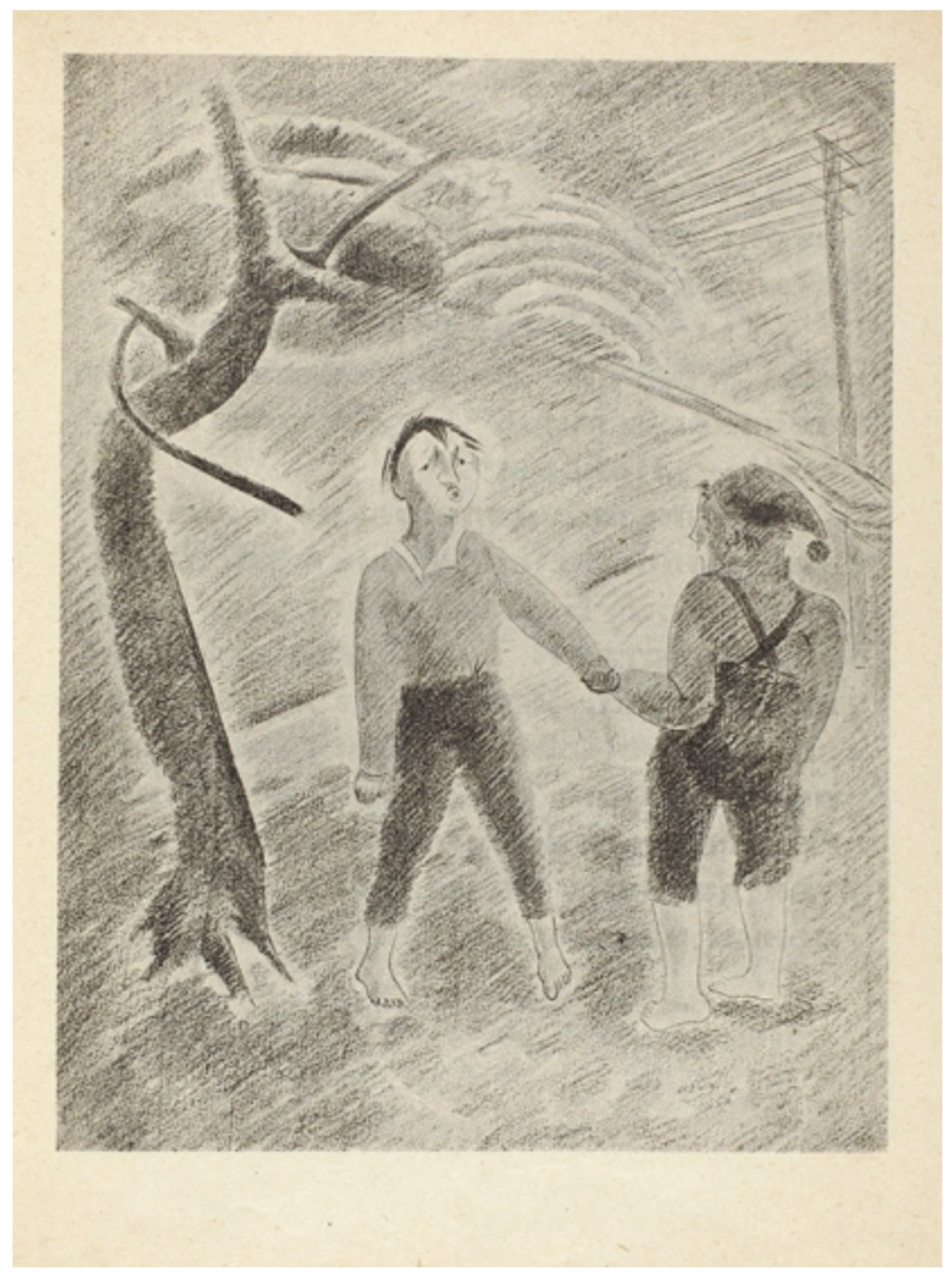
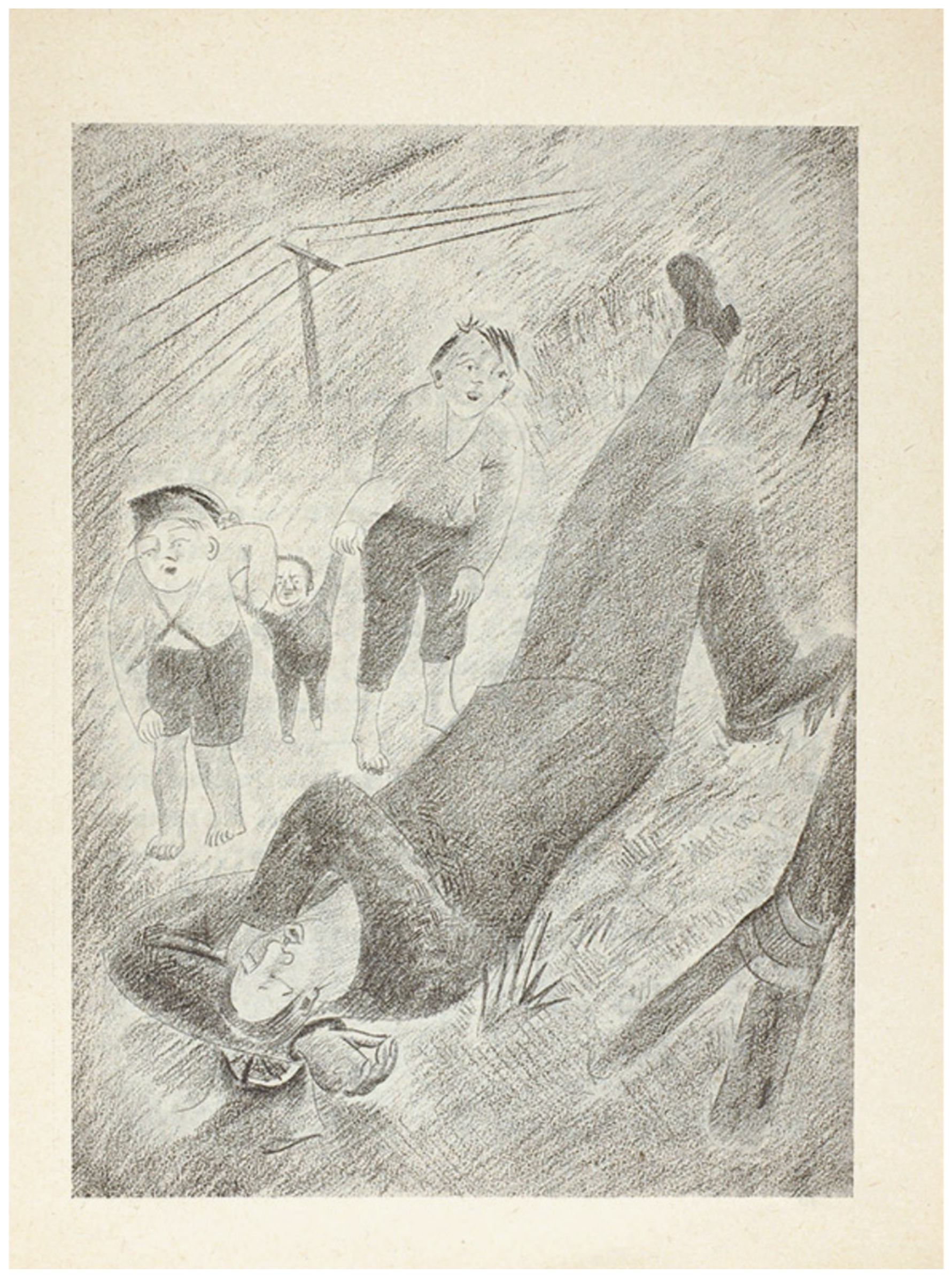
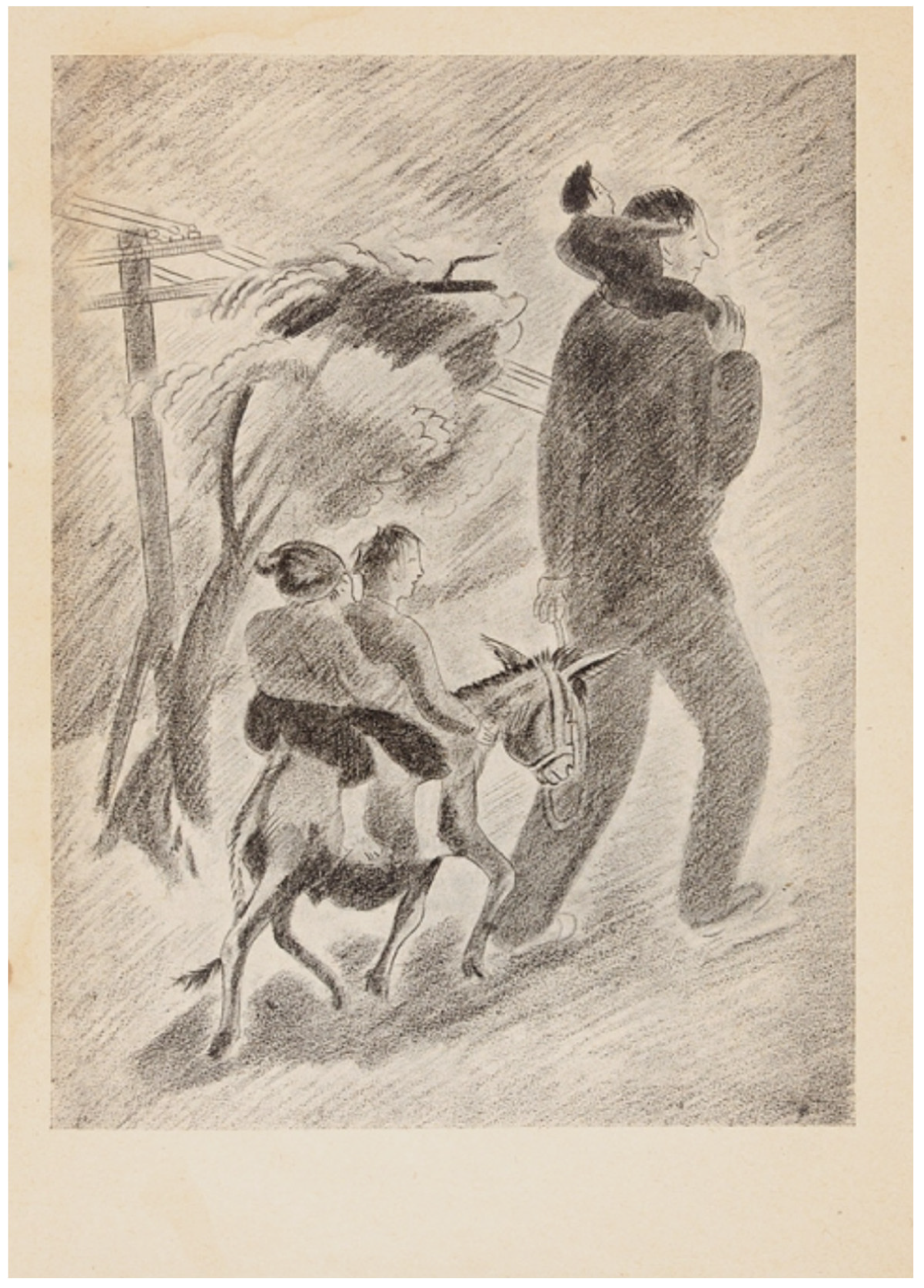
The oberiuty were deeply concerned with such conscious dyslexia and in their aspiration to “deepen the meaning of the object and the word without destroying it in any way”34 they engendered literary absurdities through Dada montage, the deliberate stretching and warping of time and the evocation of the infinite (which is the essential theme of Vo-pervykh i vo-vtorykh) (Figure 12, Figure 13, Figure 14 and Figure 15). Tatlin was not a member of the oberiuty, although his critical supporter Punin and colleagues Leonid Chupiatov and Vladimir Lebedev were close to the group, and all were involved in the various activities of Ginkhuk [State Institute of Artistic Culture] in Leningrad. It was there, for example, that Tatlin designed the production of Khlebnikov’s Zangezi in 1923, that Punin headed the Department of General Ideology between 1924 and 1926 and that oberiuty, Aleksandr Vvedensky and Igor’ Terent’ev, contributed to the phonological experiments in zaum’.
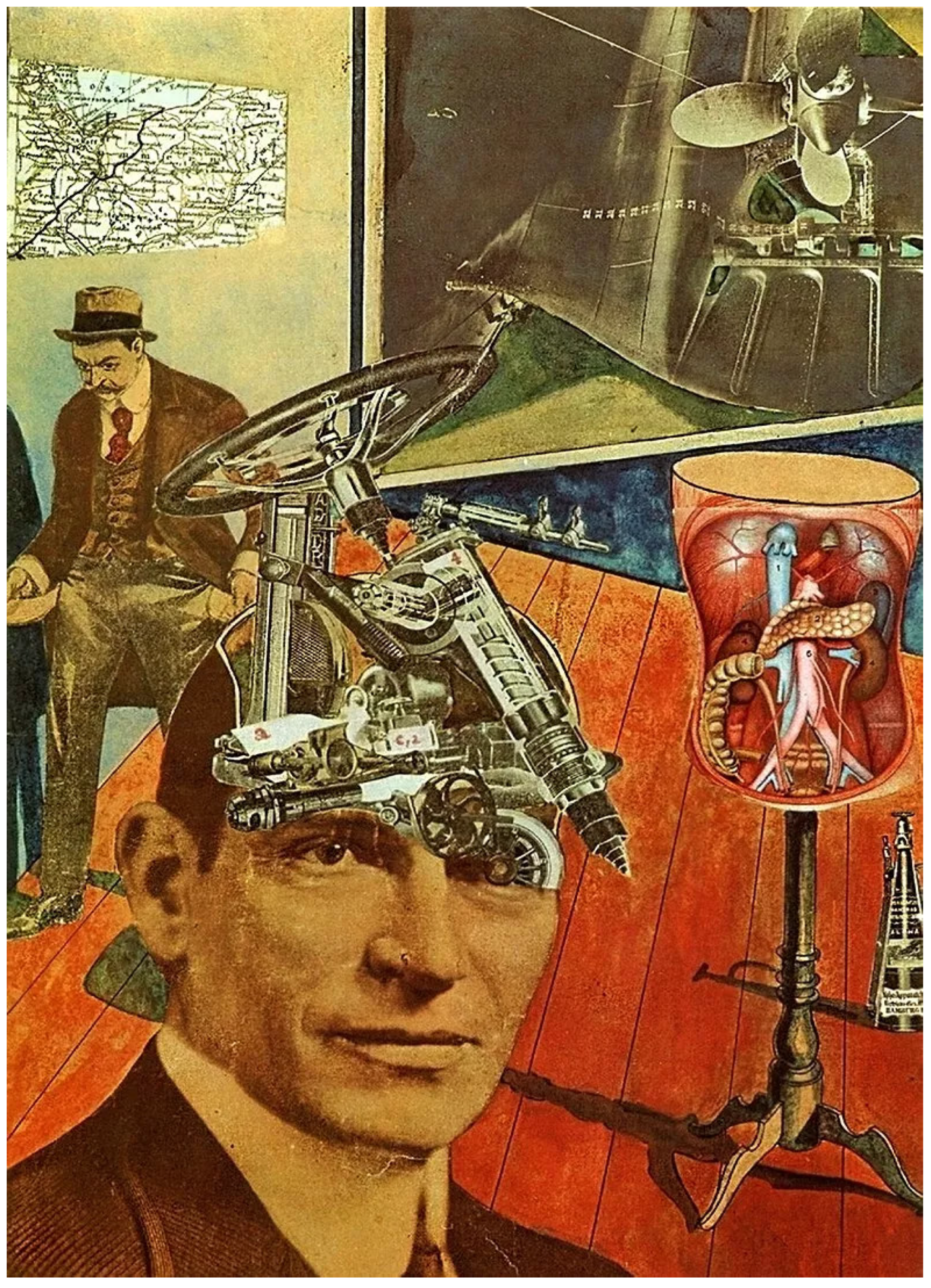
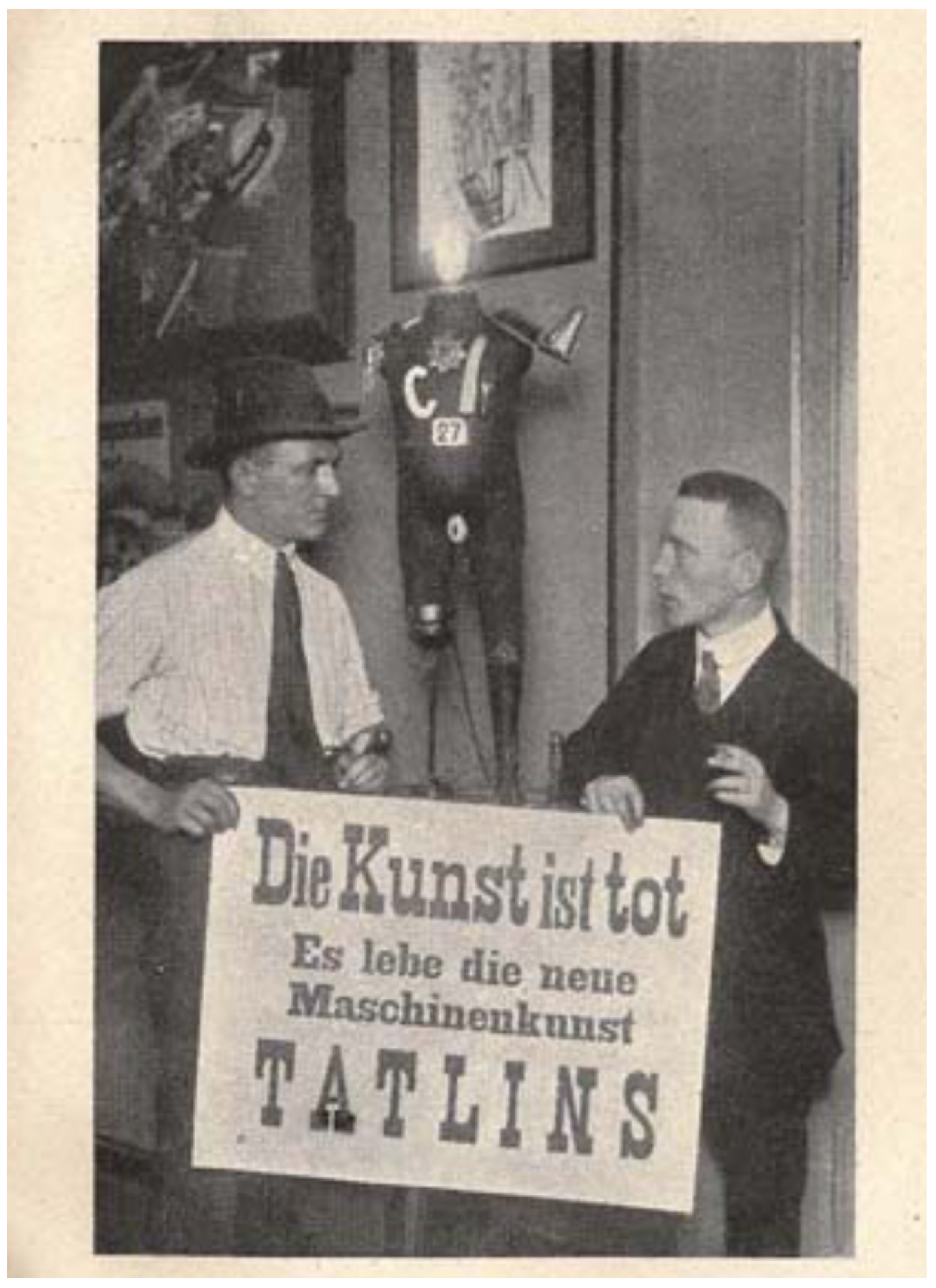
Many of the oberiu concepts are reflected in Tatlin’s work—in his untoward assemblages of materials such as a bucket or piece of drainpipe nailed on to a painting or in the infinite rotations of his unbuildable Tower. Of course, it would be tempting to propose that the German Dadaists were drawn to Tatlin for this very reason, Raoul Hausmann creating his collage Tatlin at Home (Figure 16) with its substitution of the human brain with a bizarre assemblage of machine parts and George Grosz and John Heartfield announcing that “Die Kunst ist tod. Es lebe die neue Maschinenkunst Tatlins” at the “Erste Internationale Dada-Messe” in Berlin in 192035 (Figure 17).
Of course, far from Moscow, the Dadaists were guided more by hearsay than by the reality of Tatlin’s art, interpreting it as the replacement of bourgeois “beauty” by mechanical fantasy or, rather, as a constant battle between the two, and would hardly have agreed with Punin’s assessment of Tatlin’s art as a technological combination of materials, economy and efficacy driven by the formula that function determines form:
If modern man wants to assimilate fully all the forces affecting the creation of this or that work of art, he must approach the work by studying and analyzing it by means of the scientific method.36
Unexpectedly, therefore, and unlike Punin, Grosz, Hausmann and Heartfield seem to have grasped the innate absurdity of Tatlin’s art, welcoming him to their camp and promoting his “machine art” as some outlandish dreamscape (recalling, incidentally, Yakov Chernikhov’s architectural fantasies of the same time).37 Certainly, Tatlin was interested in engineering and technology, but his esthetic gestures transcended practicality arid, ultimately, had little to do with the “scientific method”. With its ribs painted red, its shining glass and radio paraphernalia, the Monument, for example, may have been regarded by some sympathizers and by historians later as an affirmation of Constructivism and the Machine Age, but for others such as the actor Konstantin Miklashevsky, it was a ‘hothouse for growing pineapples”38 As an example of fantastic architecture, the Monument prompted parodies and witticisms; even becoming the hero of Il’ia Erenburg’s story “Vitrion” in his 6 povestei o legkikh kontsakh Tales with Easy Endings] of 1922: “A new form. Abstraction. The heavy weight of a cylinder and a sphere. The teeth of the triangles strain forth … It revolves. It walks. The monument to a new era. It cannot stand still like a scarecrow”.39
There is further testimony to Tatlin’s “absurd” worldview.
Boris Semenov, for example, recalled that Tatlin, like Kharms, believed in levitation (cf. soaring)40 and Grosz remembered the chickens and hens—and not the severe geometries—crowding Tatlin’s studio.”41 By vocation Tatlin was a performer, and many of his creative and recreative acts were linked to the professions of musician, actor, fakir, and magician. He played the bandura; his major public debut was as designer for the folk farce Emperor Maximilian and His Disobedient Son Adolf in 1911 (Figure 5); he acted in the fantasy film Nav’i chary [Ghostly Charms] in 1917 (not released); and, like a clown, he dressed up in a “brightly colored dressing-gown and dark glasses” in order to attract Picasso’s attention in Paris in 1914.42
In other words, like the oberiuty, Tatlin appreciated the culture of the buffoon and the jester and, by extension, of the circus in general. The few artifacts that have come down to us (or perhaps we should say, the many artifacts that have not come down to us), “ridiculous, but bold”, according to Arkadii Rylov,43 are nearly all “anti-objects” like his studio table. Here was a suit that was not worn, a chair that was not sat in and an airplane which was not flown, objects whose artistic success had been guaranteed by their very lightness of being. It is as if Tatlin, a master conjurer, has tricked us by sleight of hand or trompe l’oeil into believing that the Monument was to have been a real tower or that Letatlin was to have been mass-produced. Indeed, like the Monument, Letatlin was a visionary structure that, under different auspices, might have carried Tatlin from a reality ever more mundane, ever more superficial, to a magical never-never land. The critic Boris Arvatov once wrote: “Tatlin belongs entirely to the future”.44 Indeed, Tatlin’s flight of the imagination was way beyond the grasp of his fellow men, and, sad to say, it still is.
Tatlin’s objects, then, were absurd—although not nonsensical—because they appealed to the higher, fifth sense and existed or exist as entities in the same way that the old ladies and limbless men exist in Kharms’ short stories. The Monument is a case in point, its symbolic value clearly connected to the theme of elevation and levitation. Even in the initial phase of the project, then intended as a monument to the Revolution, Tatlin considered his Tower to be an extension of the earth’s axis into space, as a center of world-wide telegraphic and telephonic communication and as an international meeting place for Communists. Punin described the original proposal as follows: “ … The form of the monument corresponds to all the artistic forms discovered in our age … This project shows in what direction the artist is to work when he has grown tired of heroes and busts. Above all, the artist must forget sculpture in the more restricted sense of this term; the forms of the human body cannot today serve as an artistic form; form must be discovered anew”.45
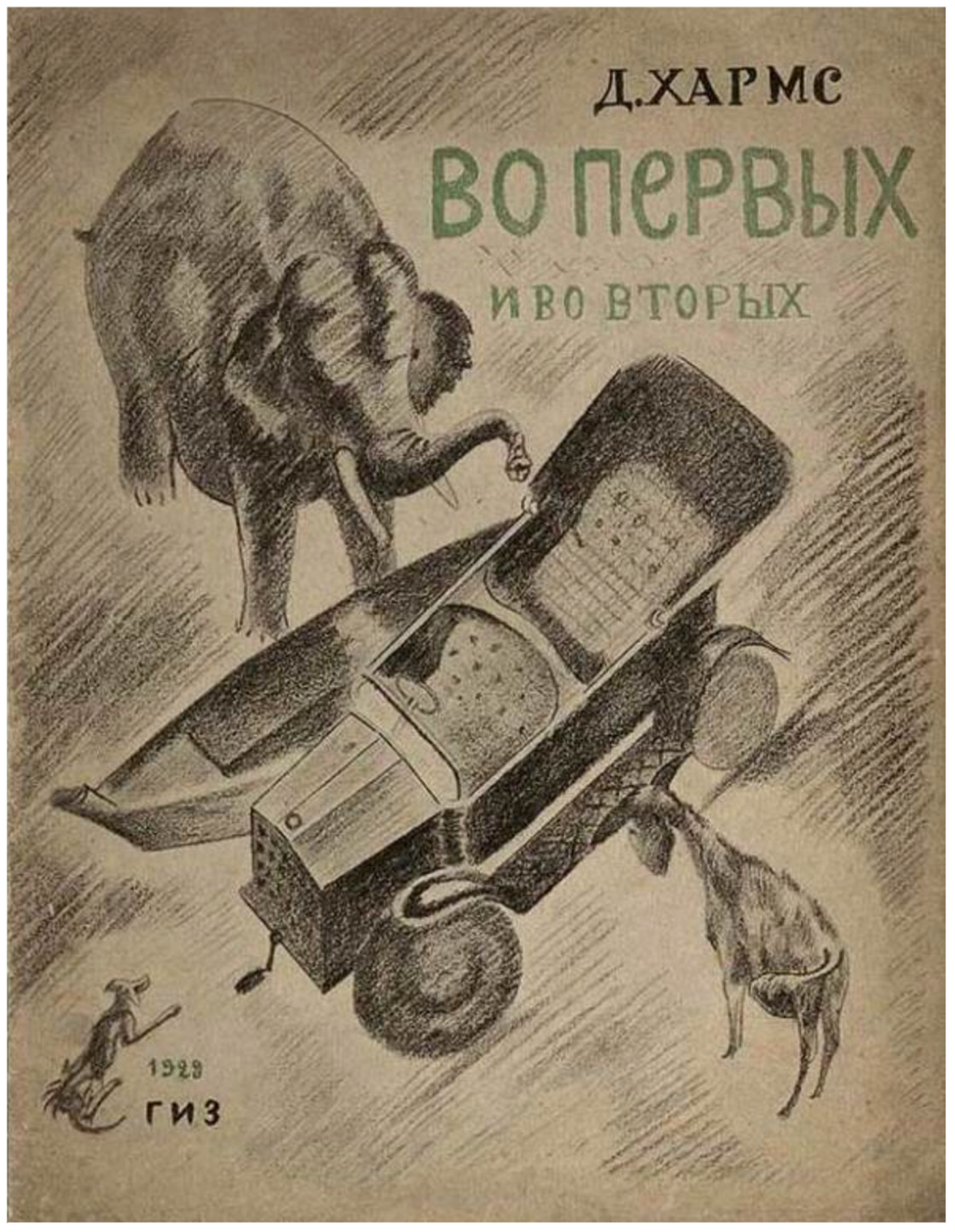
Kharms’ children’s story Vo-pervykh i vo-vtorykh was published in 1929 in an edition of 10,000 (Figure 12, Figure 13, Figure 14 and Figure 15). If Tatlin’s cover and nine illustrations to the story form an intelligible sequence, the plot, divided into ten chapters or frames, is more abstruse: the author, “I”, is joined by his friend Pet’ka (the generic hero of Russian nursery stories and a relative of Petrouchka), who then “go, singing songs”. Their point of departure and destination are never revealed, but as they advance through the phases of the story, they encounter various people, objects and places. Their first meeting is with the “samyi malen’kii chelovek v mire” [“tiniest man in the world”] who agrees to join their expedition; their second meeting is with a man who is “takoi dlinnyi, chto ne vidat’, gde nogi konchaiutsia” [“so long that you can’t see where his legs end”]. The company of four then proceeds to meet up with a donkey, a boat and an automobile, and in the penultimate chapter, the four men sleep at the hotel of a certain town. The next morning an elephant and a little dog join the humans and the donkey, and all ride off “feeling great and whistling songs”. What happens after that, the author writes, “will be narrated next time”. This Swiftian tale is about a motley crew composed of casual acquaintances that has no beginning and no end (obviously, the “firstly, secondly” can go on forever). There are no real temporal, geographical or meteorological conditions, and only one character, Pet’ka, has a name. The only other concrete identities established in the human world are those of the “tiniest man in the world” and the “long man”.
Tatlin’s drawings for Vo-pervykh i vo-vtorykh are very different from his radical contributions to, for example, the Futurist booklets Mirskontsa [Worldbackward] and Trebnik troikh [Prayer-book of three] of 1912–1913, for here he offers a literal visual transposition: opposite each passage except two (the very first and the very last), Tatlin presents a graphic interpretation of the particular episode described, although unlike the author, the artist supplements the bare, monochromatic structures with physical details—faces, a road, telegraph poles, occasional trees, etc. As Larisa Zhadova has pointed out,46 perhaps the most powerful addition is Tatlin’s evident identification of the “long man” with himself, for if we look closely at the faces of creator and created, we see a striking resemblance between the two. Vasilii Komardenkov recalled:
We might also add that Tatlin had a big nose, used to wear a dark baggy suit and wore his hair brushed carelessly across the forehead. All these characteristics can be seen in Moisei Nappel’baum’s famous photograph of him (Figure 9) and in the Larionov caricature (Figure 10)—and in Tatlin’s own depiction of the “long man” in Kharms’ story. Perhaps there is even a phonic clue in the word “long” [“dlinnyi”] with its echo of “Tatlin”, the kind of name game that he was investigating just at this moment when he was beginning to work on Letatlin. But if Tatlin is the “long man”, who is the “tiniest man in the world”? Naturally, Kazimir Malevich, not only because of the second wordplay of “malen’kii” [tiny] and Malevich, but also because Malevich was short and stocky. For some, he looked like a square, had “unpleasant, shifty eyes, and was an insincere, self-centered, and narrow-minded dimwit”,48 a description which is not too distant from Tatlin’s rendering of the tiniest man—reduced almost to an afterthought as Tatlin carries him on his shoulders towards their unknown destination (Figure 15). In any case, for Kharms, these two artistic figures represented the extreme achievements of the Russian avant-garde, and there is something both topical and poignant in the fact that the oberiuty (Pet’ka and I) would have gathered them up as they embarked upon their journey into the great unknown. Moreover, as we know so well from the mutual hostility of Malevich and Tatlin, Tatlin would have been more than ready to equate tiny in physical size with tiny in artistic stature, especially since the story allowed him to reduce the tiniest man almost to a nonentity while placing himself at the forefront.Tatlin was tall, broad-shouldered,of compact physique. His head wasset in a special way, he had a simple,but willful face …47
Even if this particular decoding of Vo-pervykh i vo-vtorykh is uncorroborated, we are still left with the story itself and the remarkable consonance of literary and artistic perceptions shared by Kharms and Tatlin. This was the only time that the two men collaborated on a single project, even though at this time Malevich’s pupils Vera Errnolaeva and Lev Yudin were busy illustrating both Kharms and Vvedensky and Tatlin was interpreting other authors such as Mikhail Semenko and Sergei Sergel’. Kharms with his “wires and springs … boxes, little devils, symbols and emblems”,49 Tatlin with his chickens, anti-table, and bandura—both writer and artist lived in a world of make-believe that had nothing to do with the “four meanings” and everything to do with “senselessness”.50 As we turn to the last illustration in Vo-pervykh i vo-vtorykh and watch the Don Quixotic Tatlin riding off into the sunset on his elephant after a decade of unfulfilled dreams and negations, we seem to hear him renarrating Kharms’ absurd story from Golubaia teatrad’ No. 10 [Blue notebook No. 10]:
There was once a red-ribbed tower which had no sides and no base. It also had no skeleton so it was called red-ribbed only in a manner of speaking.It wasn’t able to move … because it didn’t have a motor. It had no moving parts either.It didn’t have any glass or metal.It also didn’t have a frame and itdidn’t have a spine, and it didn’t haveany other insides. It didn’t have anything.So it’s hard to understand what weretalking about.So we’d better not talk about it anymore.51
Funding
This research received no external funding.
Institutional Review Board Statement
Not applicable.
Informed Consent Statement
Not applicable.
Data Availability Statement
No new data were created or analyzed in this study. Data sharing is not applicable to this article.
Conflicts of Interest
The author declares no conflict of interest.
| 1 | (Punin 1927): 8. For extensive biographical data and critical appreciations of Tatlin’s work see (Harten 1993; Strigalev 2011b; Baier et al. 2012). |
| 2 | See V. Khlebnikov: “Tatlin, tainovidets lopastei”, in (Duganov 1987), No. 10, p. 373 |
| 3 | This was Tatlin’s slogan of 1913. In 1920 he replaced it by “Via the exposure of material to a new object”. Both slogans appear on the last page (unnumbered) of N. Punin: Tatlin (Protiv kubizma), Petersburg: Gosizdat (Punin 1920a). |
| 4 | Ibid., p. 9. |
| 5 | See (Punin 1920a), unpaginated. For further commentary on Tatlin’s Monument to the III International see (Lynton 2009; Strigalev 2011a; Lapshina 2025). |
| 6 | According to Flora Syrkina in (Soviet Artist 1977). |
| 7 | See V. Tatlin: “Iskusstvo v tekhniku” (1933). From the translation (Andersen 1968, p. 75). |
| 8 | See (Komardenkov 1973). |
| 9 | Nikolai Tarabukin stressed the need to replace the “alchemy” of art by its “chemistry” and the “astrology” of art by its “astronomy” in his book Ot mol’berta k mashine, p. 42. (Tarabukin 1923). |
| 10 | From a letter by Aleksandr Vesnin to his brother Leonid of January, 1915. Quoted in p. 38. (Chiniakov 1970). |
| 11 | Tatlin in his lecture “Doloi Tatlinizm” in Petersburg, 1922. Quoted from K. Miklashevsky, p. 60. (Miklashevsky 1924). |
| 12 | V. Tatlin: “Iskusstvo v tekhniku” (1933). From the translation in Andersen, Tatlin, p. 75. (Andersen 1968). |
| 13 | Grishchenko was one of the few Russians who focused attention on Cézanne rather than on the “favorites” Monet and Renoir abd expressed some of his ideas in his book 0 sviaziakh russkoi zhivopisi s Vizantiei i Zapadom XIII-XX v., Moscow: Grishchenko, 1913. Grishchenko also did serious research on the Russian icon. See his book, Russkaia ikona kak iskusstvo zhivopisi, Moscow: Gorodskaia tipografiia, 1917. For further information on the subject of Cézanne and Russian Modenrism see Christina Lodder and Maria Kokkori, eds.: Experiment, Los Angeles and Amsterdam: Brill, fall, 2023, No. 29. (Grishchenko 1913, 1917; Lodder and Kokkori 2023). |
| 14 | This was the title of one of Tatlin’s works (i.e., Kompozitsiia obnazhennoi natury) exhibited at the “Jack of Diamonds” in Moscow and St. Petersburg in 1913. |
| 15 | See (Moleva 1963, p. 458). |
| 16 | William Rubin writes that “there is no firm evidence for the dating of the Guitar, the photograph of Picasso’s Boulevard Raspail studio of 1912–1913 shows only cardboard and string versions” (Rubin 1972, pp. 207–8). However, it does seem clear that Picasso worked on a metal guitar early in 1912. |
| 17 | As related by the artist Georgii Yakulov to Komardenkov. Dni minuvshie, op. cit., p. 56. (Komardenkov 1973). |
| 18 | Quoted in Antonina Vallentin: Pablo Picasso, p. 188. (Vallentin 1957). |
| 19 | See Tarabukin, op. cit., p. 8. (Tarabukin 1923). |
| 20 | S. Isakov: “K ‘kontr-rel’efam’ Tatlina” in Novyi zhurnal dlia vsekh, Petrograd, 1915, No. 12. Quoted in Tatlin Moscow Catalog, p. 4. |
| 21 | Ya-o: “Vystavka 1915 goda” in Mlechnyi put’, No. 4, p. 63. (Ya-o 1915). |
| 22 | Isakov, op. cit. |
| 23 | N. Punin: “Razorvannoe soznanie, 2” in lskusstvo kommuny, No. 8, p. 2. (Punin 1919b). |
| 24 | A. Fedorov-Davydov: “Skul’ptura” in Pechat’ i revoliutsiia, Book 7, p. 184. (Fedorov-Davydov 1927). |
| 25 | See V. Lobanov: Khudozhestvennyi gruppirovki za 25 let, p. 98 (Lobanov 1925). |
| 26 | See G. Grosz: Ein kleines Ja und ein grosses Nein, p. 172 (Grosz 1955). |
| 27 | See A. Efros: “Ob Aristarkhe Lentulove” (1933) in p. 249. (Efros 1979). |
| 28 | See D. Kharms: Vo-pervykh i vo-vtorykh, Moscow-Leningrad: Gosudarstvennoe izdatel’stvo. (Kharms 1929). |
| 29 | See V. Milashevsky: Vchera, pozavchera, Leningrad: Khudozhnik RSFSR, p. 202. (Milashevsky 1972). |
| 30 | See D. Kharms: “Predmety i figury, othrytye Daniilom Ivanovichem Kharmsom” (1927). Original Russian and partial translation in I. Levin: “The Fifth Meaning of the Motor-Car” in Soviet Union, Tempe, Vol. 5, Part 2, pp. 287–300. (Kharms 1978). |
| 31 | See Yu. Annenkov: Dnevnik moikh vstrech, New York: Inter-Language Literary Associates, Vol. 2, p. 243. (Annenkov 1966). |
| 32 | V. Tatlin: “Problema sootnosheniia cheloveka i veshchi. Ob”iavim voinu komodam i bufetam” in Rabis, Moscow, No. 15, p. 9. |
| 33 | A. Vvedensky et al.: “OBERIU” in R. Milner-Gulland: “’Left Art’ in Leningrad: the OBERIU Declaration” in Vol. 3, p. 70. (Milner-Gulland 1970). |
| 34 | According to Levin, op. cit., p. 288. (Levin 1978). |
| 35 | Kh. Ol’brikh: “Sovetskaia vystavka 1922 goda v Germanii” (Ol’brikh 1980). |
| 36 | See N. Punin: Pervyi tsikl lektsii, Petrograd: 17 Gosudarstvennaia tipografiia, p. 54. (Punin 1920b). |
| 37 | See Ya. Chernikov: Arkhitekturnye fantazii 101 kompozitsiia (Chernikov 1933). |
| 38 | See K. Miklashevsky: Gipertrofiia iskusstva, Petrograd: Sokolov, p. 65. (Miklashevsky 1924). |
| 39 | See I. Erenburg: 6 povestei o legkikh kontsakh, Berlin: Gelikon, p. 11. Illustrated by El Lissitzky. (Erenburg 1922). |
| 40 | See B. Semenov: Vremia moikh druzei, Leningrad: Lenizdat, p. 270. (Semenov 1982). |
| 41 | Grosz, op. cit. |
| 42 | As related by Georgii Yakulov. See Komardenkov, Dni minuvshie, p. 56. (Komardenkov 1973). |
| 43 | See A. Rylov: Vospominaniia, Leningrad: Khudozhnik RSFSR, p. 193. (Rylov 1977). |
| 44 | See B. Arvatov: Natan Al’tman, Berlin: Petropolis, p. 62. (Arvatov 1924). |
| 45 | See N. Punin: “0 pamiatnikakh” in lskusstvo kommuny, No. 14, pp. 2–3. (Punin 1919a). |
| 46 | L. Zhadova: “Tatlin. the Illustrator and Designer of Books” in L. Zhadova, ed.: Tatlin, New York: Rizzoli, p. 131. |
| 47 | Komardenkov, p. 55. |
| 48 | See A. Rodchenko: “O Tatline 1915-1917 gg.” in (Rodchenko 1982, p. 84). |
| 49 | See A. Poret: “Vospominaniia o Daniile Kharmse” in Panorama iskusstv, Moscow, 1980, No. 3, p. 352. (Poret 1980). |
| 50 | The twelfth point of Kharms’ manifesto “Predmety …” (see Note 30) is: “By transposing this sequence [objects presented in their filth meaning] into a new system, we will attain a literary sequence which is humanly SENSELESS”. |
| 51 | See: Kharms: “Golubaia tetrad’ No. 10” in G. Gibian, ed.: Daniil Kharms. Izbrannoe, Würzburg: Jal-Verlag, 1974, p. 47. (Kharms 1974). See also (Kharms 1978). |
References
- Andersen, Troels, ed. 1968. Tatlin. Catalogue of Exhibition at Moderna Museet. Stockholm: Moderna Museet. [Google Scholar]
- Annenkov, Yuri. 1966. Dnevnik Moikh Vstrech. New York: Inter-Language Literary Associates, vol. 2. [Google Scholar]
- Arvatov, Boris. 1924. Natan Al’tman. Berlin: Petropolis. [Google Scholar]
- Baier, Simon, Gian Casper Bott, Dmitrii Dimakov, Jürgen Harten, Yevgraf Kipatop, Nathalie Leleu, Maria Lipatova, Anna Szech, and David Walsh. 2012. Tatlin. New Art for a New World. Catalog of Exhibition at the Museum Tinguely. Basel: Museum Tinguely. [Google Scholar]
- Chernikov, Yakov. 1933. Arkhitekturnye Fantazii 101 Kompozitsiia. Leningrad: Mezhdunarodnaia Kniga. [Google Scholar]
- Chiniakov, Aleksei. 1970. Brat’ia Vesniny. Moscow: Literatura po stroitel’stvu. [Google Scholar]
- Duganov, Rudolf. 1987. Risunki Khlebnikova. In Panorama iskusstv. Moscow: Sovetskii Khudozhnik. [Google Scholar]
- Efros, Abram. 1979. Ob Aristarkhe Lentulove (1933). In A.M. Efros. Mastera Raznykh Epokh. Compiled by Mikhail Tomachev. Moscow: Sovetskii khudozhnik. [Google Scholar]
- Erenburg, Ilia. 1922. 6 Povestei o Legkikh Kontsakh. Illustrated by El Lissitzky. Berlin: Gelikon. [Google Scholar]
- Fedorov-Davydov, Aleksei. 1927. Skul’ptura. In Pechat’ i Revoliutsiia. Moscow: Gosizdat, vol. 7. [Google Scholar]
- Grishchenko, Aleksei. 1913. O sviaziakh russkoi zhivopisi s Vizantiei i Zapadom XIII-XX v. Moscow: Grishchenko. [Google Scholar]
- Grishchenko, Aleksei. 1917. Russkaia Ikona kak Iskusstvo Zhivopisi. Moscow: Gorodskaia tipografiia. [Google Scholar]
- Grosz, George. 1955. Ein kleines Ja und ein Grosses Nein. Reinbek: Rowohlt. [Google Scholar]
- Harten, Jürgen, ed. 1993. Tatlin: Leben, Werk, Wirkung; ein internationales Symposium. Cologne: DuMont. [Google Scholar]
- Kharms, Daniil. 1929. Vo-pervykh i vo-vtorykh. Moscow and Leningrad: Gosudarstvennoe izdatel’stvo. [Google Scholar]
- Kharms, Daniil. 1974. Golubaia tetrad’ No. 10. In Daniil Kharms. Izbrannoe. Edited by George Gibian. Würzburg: Jal-Verlag. [Google Scholar]
- Kharms, Daniil. 1978. Predmety i figury, otkrytye Daniilom Ivanovichem Kharmsom (1927). Original Russian and partial translation appears in: Levin, I. The Fifth Meaning of the Motor-Car. In Soviet Union. Tempe: Arizona State University, vol. 5, part 2. [Google Scholar]
- Komardenkov, Vassili. 1973. Dni minuvshie. Moscow: Sovetskii khudozhnik. [Google Scholar]
- Lapshina, Elena. 2025. Bashnia Tatlina: Opyt graficheskoi rekonstruktsii pamiatnika mirovoi Arkhitektury. Ekaterinburg: Tatlin. [Google Scholar]
- Levin, Ilya. 1978. The Fifth Meaning of the Motor-Car. In Soviet Union. Tempe: Arizona State University, vol. 5, part 2. [Google Scholar]
- Lobanov, Viktor. 1925. Khudozhestvennyi gruppirovki za 25 let. Moscow: AKhR. [Google Scholar]
- Lodder, Christina, and Maria Kokkori, eds. 2023. Experiment. Los Angeles and Amsterdam: Brill, Fall, vol. 29. [Google Scholar]
- Lynton, Norbert. 2009. Tatlin’s Tower. Monument to Revolution. New Haven: Yale University Press. [Google Scholar]
- Miklashevsky, Konstantin. 1924. Gipertrofiia Iskusstva. Petrograd: Sokolov. [Google Scholar]
- Milashevsky, Konstantin. 1972. Vchera, Pozavchera. Leningrad: Khudozhnik RSFSR. [Google Scholar]
- Milner-Gulland, Robin. 1970. ‘Left Art’ in Leningrad: The OBERIU Declaration. In Oxford Slavonic Papers. Oxford: Oxford University Press, vol. 3. [Google Scholar]
- Moleva, Nina, comp. 1963. Konstantin Korovin. Moscow: Akademiia khudozhestv SSSR. [Google Scholar]
- Ol’brikh, Khristian. 1980. Sovetskaia vystavka 1922 goda v Germanii. In Vzaimosviazi Russkogo i Sovetskogo Iskusstva i Nemetskoi khudozhestvennoi kul’tury. Edited by Ulrich Kukhirt. Moscow: Nauka. [Google Scholar]
- Poret, Alisa. 1980. Vospominaniia o Daniile Kharmse. In Panorama Iskusstv. Moscow: Sovetskii Khudozhnik, no. 3. [Google Scholar]
- Punin, Nikolai. 1919a. O pamiatnikakh. In Iskusstvo kommuny. Petrograd: Izo Narkomprosa, no. 14. [Google Scholar]
- Punin, Nikolai. 1919b. Razorvannoe soznanie, 2. In Iskusstvo Kommuny. Petrograd: Izo Narkomprosa, no. 8. [Google Scholar]
- Punin, Nikolai. 1920a. Pamiatnik Ill Internatsionala. Petersburg: Izo Narkomprosa. [Google Scholar]
- Punin, Nikolai. 1920b. Pervyi tsikl Lektsii. Petrograd: Gosudarstvennaia tipografiia, vol. 17. [Google Scholar]
- Punin, Nikolai. 1927. Noveishie techeniia v russkom Iskusstve. Book 1. Leningrad: Gosudarstvennyi Russkii muzei. [Google Scholar]
- Rodchenko, Alexander. 1982. O Tatline 1915–1917 gg. In A.M Rodchenko. Stat’i, Vospominaniia. Avtobiograficheskie zapiski. Pis’ma. Compiled by Varvara Rodchenko. Moscow: Sovetskii khudozhnik. [Google Scholar]
- Rubin, William. 1972. Picasso in the Collection of the Museum of Modern Art. New York: The Museum of Modern Art. [Google Scholar]
- Rylov, Arkadii. 1977. Vospominaniia. Leningrad: Khudozhnik RSFSR. [Google Scholar]
- Semenov, Boris. 1982. Vremia moikh Druzei. Leningrad: Lenizdat. [Google Scholar]
- Soviet Artist. 1977. Vladimir Tatlin. Catalogue of exhibition at the Union of Writers of the USSR. Moscow: Sovetskii khudozhnik. [Google Scholar]
- Strigalev, Anatolii. 2011a. *Bashnia 3-go Internatsional’nogo*. Moscow: Gordeev. [Google Scholar]
- Strigalev, Anatolii. 2011b. Tatlin. Moscow: Gordeev. [Google Scholar]
- Tarabukin, Nikolai. 1923. Ot mol’berta k Mashine. Moscow: Rabotnik prosveshcheniia. [Google Scholar]
- Vallentin, Antonina. 1957. Pablo Picasso. Paris: Albin Michel. [Google Scholar]
- Ya-o. 1915. Vystavka 1915 goda. In Mlechnyi put’. Moscow: I.F. Orlov, no. 4. [Google Scholar]
Figure 1.
Photographer unknown: Vladimir Tatlin playing the bandura, Moscow, 1911.

Figure 2.
Photographer unknown: Sof’ia Dymshits-Tolstaia, Vladimir Tatlin, Tevel’ Shapiro and Iosif Meerzon at work on the model of the Monument to the III International, 1920.
Figure 2.
Photographer unknown: Sof’ia Dymshits-Tolstaia, Vladimir Tatlin, Tevel’ Shapiro and Iosif Meerzon at work on the model of the Monument to the III International, 1920.

Figure 3.
Cover of Nikolai Punin’s book, Pamiatnik Ill Internatsionala, Petersburg: IZO NKP, 1920.

Figure 4.
Vladimir Tatlin: Nude (Model), 1913, oil on canvas, 143 × 108, State Tretyakov Gallery, Moscow.
Figure 4.
Vladimir Tatlin: Nude (Model), 1913, oil on canvas, 143 × 108, State Tretyakov Gallery, Moscow.

Figure 5.
Vladimir Tatlin: Costume Design for a Pipe-Player in Tsar Maksimilian and His Disobedient Son, Adol’f, 1911, watercolor and ink on paper, 32 × 19.5. Courtesy Nina and Nikita Lobanov-Rostovsky, London. In Tatlin’s second illustration to Daniil Kharms’ tale, Vo-pervykh i vo-vtorykh, Pet’ka wears a similar jester hat. See below.
Figure 5.
Vladimir Tatlin: Costume Design for a Pipe-Player in Tsar Maksimilian and His Disobedient Son, Adol’f, 1911, watercolor and ink on paper, 32 × 19.5. Courtesy Nina and Nikita Lobanov-Rostovsky, London. In Tatlin’s second illustration to Daniil Kharms’ tale, Vo-pervykh i vo-vtorykh, Pet’ka wears a similar jester hat. See below.

Figure 6.
Photographer unknown: Testing Vladimir Tatlin’s flying machine, Letatlin, early 1930s. Photographic print from the State Vladimir Maiakovsky Museum, Moscow.
Figure 6.
Photographer unknown: Testing Vladimir Tatlin’s flying machine, Letatlin, early 1930s. Photographic print from the State Vladimir Maiakovsky Museum, Moscow.

Figure 7.
Vladimir Tattlin: Painterly Relief (Selection of Materials), 1915, iron, plaster, glass, гулдрон, 1914. Lost.
Figure 7.
Vladimir Tattlin: Painterly Relief (Selection of Materials), 1915, iron, plaster, glass, гулдрон, 1914. Lost.

Figure 8.
Vladimir Tatlin: Counter-Relief 1916, varnished mahogany zinc, iron, 45 × 80 × 3, State Tretyakov Gallery.
Figure 8.
Vladimir Tatlin: Counter-Relief 1916, varnished mahogany zinc, iron, 45 × 80 × 3, State Tretyakov Gallery.

Figure 9.
Moisei Nappel’baum: Photograph of Vladimir Tatlin, 1920s.

Figure 10.
Mikhail Larionov: Portrait of Vladimir Tatlin, ca. 1912, pen and ink on paper, 15 × 12. Courtesy Nina and Nikita Lobanov-Rostovsky, London.
Figure 10.
Mikhail Larionov: Portrait of Vladimir Tatlin, ca. 1912, pen and ink on paper, 15 × 12. Courtesy Nina and Nikita Lobanov-Rostovsky, London.

Figure 11.
Photographer unknown: Vladimir Tatlin (second right) in front of his model for the Monument to the III International, Petrograd, 1920.
Figure 11.
Photographer unknown: Vladimir Tatlin (second right) in front of his model for the Monument to the III International, Petrograd, 1920.

Figure 12.
Vladimir Tatlin: Cover of Daniil Kharms: Vo-pervykh i vo-vtorykh, Moscow-Leningrad: GIZ, 1929. Zincograph.
Figure 12.
Vladimir Tatlin: Cover of Daniil Kharms: Vo-pervykh i vo-vtorykh, Moscow-Leningrad: GIZ, 1929. Zincograph.

Figure 13.
Vladimir Tatlin: Illustration for Vo-pervykh i vo-vtorykh showing Pet’ka in jester hat.

Figure 14.
Vladimir Tatlin: Illustration for Vo-pervykh i vo-vtorykh showing the long man (Tatlin).

Figure 15.
Vladimir Tatlin: Illustration for Vo-pervykh i vo-vtorykh showing the little man (Malevich) on Tatlin’s shoulders.
Figure 15.
Vladimir Tatlin: Illustration for Vo-pervykh i vo-vtorykh showing the little man (Malevich) on Tatlin’s shoulders.

Figure 16.
Raoul Hausmann: Tatlin at Home, 1920, Collage, 31 × 28, private collection.

Figure 17.
George Grosz and John Heartfield announcing that “Die Kunst ist tod. Es lebe die neue Maschinenkunst Tatlins” at the “Erste Internationale Dada-Messe”, Otto Burchard Gallery, Berlin, June–August, 1920. First reproduced in R. Hausmann, ed.: DADA Almanach, 1920, June, p. 40.
Figure 17.
George Grosz and John Heartfield announcing that “Die Kunst ist tod. Es lebe die neue Maschinenkunst Tatlins” at the “Erste Internationale Dada-Messe”, Otto Burchard Gallery, Berlin, June–August, 1920. First reproduced in R. Hausmann, ed.: DADA Almanach, 1920, June, p. 40.

Disclaimer/Publisher’s Note: The statements, opinions and data contained in all publications are solely those of the individual author(s) and contributor(s) and not of MDPI and/or the editor(s). MDPI and/or the editor(s) disclaim responsibility for any injury to people or property resulting from any ideas, methods, instructions or products referred to in the content. |
© 2026 by the author. Licensee MDPI, Basel, Switzerland. This article is an open access article distributed under the terms and conditions of the Creative Commons Attribution (CC BY) license.
Share and Cite
MDPI and ACS Style
Bowlt, J.E. Joking Aside: Vladimir Tatlin and the Absurd. Arts 2026, 15, 28. https://doi.org/10.3390/arts15020028
AMA Style
Bowlt JE. Joking Aside: Vladimir Tatlin and the Absurd. Arts. 2026; 15(2):28. https://doi.org/10.3390/arts15020028
Chicago/Turabian StyleBowlt, John E. 2026. "Joking Aside: Vladimir Tatlin and the Absurd" Arts 15, no. 2: 28. https://doi.org/10.3390/arts15020028
APA StyleBowlt, J. E. (2026). Joking Aside: Vladimir Tatlin and the Absurd. Arts, 15(2), 28. https://doi.org/10.3390/arts15020028
Note that from the first issue of 2016, this journal uses article numbers instead of page numbers. See further details here.
Article Metrics
Article metric data becomes available approximately 24 hours after publication online.