1. Introduction
- (i)
Context and Motivation
Rhythmanalysis+ is a socially engaged artistic project conceived during a time of geographic isolation and emotional fragmentation. Through immersive storytelling, the work explores how presence, perception, and embodied sensorial experience can be constructed and shared across spatial and emotional boundaries. This research was undertaken as an urgent enquiry, building upon earlier works on an undergraduate degree and within the Arts and Environment archipelagic master’s degree programme at the Technological University of Dublin. These involved elements entrenched in community and where virtual reality was introduced, experimenting with the technology as a means of education and connection. The projects were both relational and speculative, focusing on community life and primitive knowledge on Sherkin Island, West Cork; a location accessible only by a two-hour drive from my North Cork home and a fifteen-minute boat crossing. The previous work grew, building on my knowledge as a ceramicist and my innate love for the material and process of clay, of which I knew existed naturally on the island. It was also rooted in an in-depth enquiry of French educator Fernand Deligny, who worked with non-verbal autistic children outside of language. The study allowed for a unique relationship to build, not simply with islanders, who I knew would be happy to assist in this new enquiry, but with the island too. The unique language of environment itself began to fascinate me, most especially around the elements of sensory knowledge and the repetition of the everyday, which regulates us as humans. This underpinned my connection to both the environment and the islanders—a connection that continues to inform my practice, though still residing in North Cork. The island became not just a site of observation, but a collaborative and rhythmic space for gathering sensorial data, responding intuitively to collective and personal states of regulation, perception, and evolution. Circadian and habitual rhythms, as discussed by
Roenneberg (
2012) and
Lefebvre (
2004), directly informed how participants’ daily patterns were understood and mapped.
Rhythmanalysis+ is a socially engaged research-creation project, comprising of a VR installation, displaying a suite of analogue map-like drawings and an immersive soundscape. Developed with four residents of Sherkin Island, during COVID-19 restrictions, the project investigates how daily sensory rhythms can be gathered and represented through immersive media. It is guided by the research question: How can lived sensory rhythms be translated through VR to rethink rhythm, connection, and forms of perceptual contact during periods of enforced isolation?
This article offers three contributions to current debates around rhythm, contact, and digital artistic research. First, it expands Lefebvre’s conception of rhythm by demonstrating that they are not only temporal patterns but also multi-sensory, interspecies, and environmentally co-produced interactions that become clear only through drawing, sound, and immersive experience. Second, it proposes an understanding of “contact” that does not rely solely on physical proximity: the VR environment reveals how perceptual, affective, and embodied forms of connection can emerge during periods of social restriction, offering an alternative mode of relationality. Third, the project contributes to VR art and research-creation by showing how ethnographic sensory mappings can be translated into an immersive 360-degree spatial drawing, where rhythm functions as both method and material. These contributions frame Rhythmanalysis+ not simply as documentation but as an enquiry that generates new knowledge through its aesthetic and embodied processes.
- (ii)
Artistic Process and Theoretical Frameworks
Creating an enquiry into artistic research,
Rhythmanalysis+ questions what Henk Borgdorff refers to as ‘boundary work’—occupying the liminal space between academic enquiry and aesthetic practice. Here, he says that ‘knowledge doesn’t merely scaffold art but is generated through and with it’ (
Borgdorff 2009, p. 72). The paradox remains: even though artistic research may resist traditional academic formats, written articulation is often still required to validate its presence. In this archipelagic context, where island thinking is at its source, theories such as
Glissant’s (
1997) relationality and opacity,
Deleuze and Guattari’s (
1987) rhizomatic thought, and
Elo and Luoto’s (
2018) reflections on ‘touch as presence’ offer gentle framing devices within the work. They do so in a manner that is rhizomatic, switching and shifting in an almost tidal and organic manner. They do not dominate it but mirror its layered, chaotic structure, its refusal to reveal all, and its commitment to highlighting embodied engagements. In drawing on concepts such as the rhizome, archipelagic thought, and the arachnean, I refer not simply to resonant metaphors but to a set of relational frameworks that shape how this project approaches connection, dispersion, and entanglement. This is reminiscent of all frameworks that underpin the entire process. While they are introduced here as guiding orientations, each of the terms informs the analytic and methodological choices later in the paper.
Rhythmanalysis+ stands as a hybrid methodology and an experiment where the production of knowledge is not separate from aesthetic experience—but is, instead, entangled with it. Upon completing the work, the question inevitably arose: “What is it? A drawing, a sculpture, an experience?” After a year of deep immersion, I found it impossible to step back far enough to offer a definitive answer. It is socially engaged practice, and all these artistic elements, but ultimately, it
is the research. What can be seen are visual traces of a layered, arachnean-style journey: a choreographed dance of research, legible only through its enactment. This approach in creating embodied and sensorial experience—as knowledge that emerges in tandem with aesthetic engagement—naturally leads back to the foundational influence of French philosopher Fernand Deligny. He created layered, delicately traced drawings of the daily- life rhythms of 10 non-verbal children. His work, which foregrounds the invisible traces of presence and non-verbal communication, continues to shape how I think about rhythm, gesture, and the ethics of observation in
Rhythmanalysis+. Deligny asks, “Can we say that the spider’s project is to weave its web? We may as well say that the web’s project is to be woven” (
Deligny 2015, p. 34). Here, he refers to a ‘mode of being’, aligning it to the ethereal work of the spider or the arachnean. He is speaking of networks. The analogical model for Deligny’s network is the spider’s web and offers an image, familiar to all, that I have always related to the intricate dance we play in the development of our social networks. The arachnean here offers us an image of pathways, a persistence, an endurance to survive, and a vital necessity. Deligny was not an artist, but the visual mapping created research that became part of the 2012 Biennale in São Paulo on an artistic stage with themes of transformation, transnationality, and multiplicity.
Deligny was a French experimental educator and essayist whose unorthodox work with dysphasic autistic children outside the institutional model deeply influenced thinkers such as Deleuze and Guattari in the 1970s. Referring to space outside of language, where sensory exists, the mythical web of the spider or arachnean is created of “lines, holes, traces, enigmas and questions without answers that demand to see that which cannot be seen” (
Deligny 2015, pp. 9–10). This sense of wandering and non-linear connections resonates with Gilles Deleuze and Félix Guattari’s conceptualisation of a model of thought and relation that emphasises multiplicity and connection without hierarchy. Central to their work on networks is their theory of the rhizome (
Deleuze and Guattari 1987, pp. 1–27). According to this idea, they stated that a rhizome could be interconnected at any point, without any form of hierarchical structure. They developed six principles around this. These are connection, heterogeneity, multiplicity, asignifying rupture, cartography, and decalcomania. A botanical example of a rhizome might be the root system of grass or the tuberous ginger, but as a social concept, the internet, or social media, could also be considered as rhizomatic. Social media threads that tangle and re-join creating a non-linear, rhizomatic example of something we encounter every day. Some of the principles would state that they are completely interconnected, without a beginning or an end. The principle of connection, for example, would state that any point, anywhere in a rhizome, can be connected to any other point, and not in a linear way. Cartography: also strong in its relevance, as I looked at mapping people’s connections and their interactions with their environment. The principle of cartography represents ever-changing relationships within a rhizome rather than a fixed one and is one of the rhizome’s core principles, becoming central here because it offers a way to trace relations rather than represent fixed forms. For this project, cartography provided a method of mapping the shifting connections between islanders, their movements, and their environments, making visible the sensory and relational patterns that later informed the VR translation.
This is certainly true of this project, as elements were constantly changing. Asignifying rupture states that no one element in a rhizome is more important than another. If one area were to become damaged or broken, it could regrow and connect with another to begin again, also relating to the principle of multiplicity. This is an interesting consideration when looking at the varieties of networks that became part of the work. These investigations or relationships relate to both the human and the non-human who thrive on the repetition and interconnectedness of daily life as a species. Here, I am drawing on Merleau-Ponty’s account of bodily habit, where repetition is understood as the rhythmic patterning through which bodies orient themselves in the world, rather than as a universal biological law (
Merleau-Ponty 2012). It is this curiosity in repetition that Deligny researched that led me to look at his work. He describes how “connectivity is a compulsion that subtends social participation and cultural participation.” (
Bang Larsen 2014, p. 12). If this is a state of being that we cannot escape, then what kind of internal webs were being woven and unpicked during the period that became known as the COVID-19 global pandemic?
- (iii)
COVID-19 and Research Aims
This period in Ireland, from March 2020 through to September/October 2022, left a mark on the social landscape in Ireland, still being felt in 2025, with increasing evidence of social anxiety present amongst all age groups. A system of ‘cocooning’ was put in place by the Irish government at the time, where people were advised to isolate their most vulnerable loved ones with full food, health, and emotional support. Specific regulatory restrictions in Ireland at that time meant that people also had to operate their daily lives within a 2 km radius of their homes, followed by an expanded 5 km zone. Only specialised documentation from employers or medical professionals is allowed for movement outside this zone with caution. All this has left a marked impact on thought processes around social interactions and new policies around working from home, digitally away from pre-COVID-19 office-based team configurations.
On the offshore island of Sherkin, on the southwest coast of Cork, Ireland, decisions were made with families and friends creating their own cocoons in a population of 100 people at the time. People on the island were very frightened, as there were many older and vulnerable islanders, but some cocooned in bubbles of family and close friends, so that they were able to see each other and interact somewhat. Local artist and islander M remembered that “locals read the situation well, understanding the fear amongst the older community. People abided by the rules concerning contamination as food came in and out by boat with people looking out for each other. Difficulties only arose from those who began to travel more frequently on and off the island. People were very afraid.” A tight agreement and understanding amongst locals were suddenly put at risk by those who came and went more casually. The increased uncertainty added to the general anxiety in the area.
Though the island is 5 km squared, the 2 km restriction was not always a suitable rubric that could be applied to the island. The size and shape of the island were part of this. People responded differently—some isolated themselves, others grouped together based on living conditions, while the vulnerable or anxious managed on their own. Islanders think as a community. Island consciousness is a shared, intentional awareness where people support each other; on the mainland, that unity has faded into individualism. As an artist, I required support in undertaking this artistic research, but my core concern during this fragile time was to take care of the participants, who gave their time so generously. I wanted to ensure that a strong mode of exchange existed within the investigations and that they felt this in receiving some alternative insights during the investigations or new ways of thinking about their own daily rhythms.
As both artist and researcher, my motivation for creating Rhythmanalysis+ stemmed from a deep curiosity about how people experience connection and presence during periods of isolation. This became very evident when VR became our only means of connection and enquiry within the university setting. That curiosity—how perception, environment, and emotion converge—drove me to gather and represent these sensorial traces in ways that could be felt, not merely seen. As humans move deeper into AI and virtual realms, it is important to reflect on the subtle sensory experiences—both within and beyond language, as Deligny did, and with the physical world—often taken for granted.
People are creatures of habit, and without these habits, what will happen? It is the instinctive circadian rhythms that regulate our breath, our sleep, and our mental health, but how important is our physical connection to our environment? These claims are well supported by chronobiological research showing that circadian rhythms play a central role in regulating our sleep-wake cycles, cognitive function, and emotional well-being. (
Foster and Kreitzman 2014;
Roenneberg 2012) What does that give us that nothing else can? Sensory perception is the arrangement and coordination of stimuli connecting the sense organs and the brain, and this affects up to nine different senses for us, with five of the most common being hearing, sight, taste, smell, and touch. When we are within the natural environment, variations in these stimuli are activated. This is an instinctive or primal reaction. A place will trigger joyful or upsetting feelings, thoughts, or memories; it will send messages flooding through our systems without words. Deligny referred to this research as being ‘outside of’ or ‘beyond language’. There was no possibility of words for him, and so he had to make references and drawings of this from other sensorial sources. When I refer to ‘place’, I refer to the natural environment, unblemished or affected by humans, places we feel safe instinctively, perhaps, or are familiar with. Can the replication of a space, then, in a virtual world, give us the same level of regulation? Though our brain understands that it is entering into a man-made space, our eyes can fool us.
Widening our view beyond the human experience, it is essential to look towards our environments and rhythms and outside of our usual methods of observation. Similarly with artistic research, Natalie Loveless describes how we must also approach it in a new and more expanded way, ‘demanding new and expanding categories’ for this hybrid work (
Loveless 2019, p. 7). One way of performing so is by changing our perspectives to view it with an inter-species related viewpoint. According to
Haraway (
2016), both human and non-human are linked through what she calls tentacular relational practices. “The tentacular ones make attachments and detachments; they make cuts and knots; they make a difference; they weave paths and consequences but not determinisms; they are both open and knotted in some ways and not others” and “tentacularity is about life lived along lines—and such a wealth of lines—not at points, not in spheres” (
Haraway 2016, pp. 31–32). It is about being open to new realities. Artist Sarah Brady reflects on her work with Lichens and says that “Lichens require sympoiesis, or making-with, rather than autopoiesis, or self-making… We must follow patterns, where humans and non-humans are inextricably linked.” (
Brady 2018). In other terms, organisms thrive through co-creation, not isolation—a theme that is mirrored in the islanders’ communal adaptations during COVID-19. Here again, concepts introduced earlier can be seen as more methodological tools rather than figurative references. It becomes clearer that the rhizomatic guides my non-linear tracing of connections across sites; archipelagic thought supports an approach that treats separation and dispersion as forms of relation, also feeding back to Glissant. The arachnean highlights the ongoing weaving of practices, and Haraway’s tentacularity helps to attune the analysis of the uneven field of the human and non-human multispecies.
Fernand Deligny, in his work during the 1970s, thought in an alternative way, rejecting social norms. He connected his thought processes to the experiences of dysphasic children—once deemed by staff to be ‘unteachable’ in an asylum—who began to thrive when placed in a supportive, rural environment. His understanding of networks, as he saw them, was in absolute harmony and exchange with the analogy of the arachnean here. The journey of the spider, and its purpose, seems perfectly aligned to be the non-human element that weaves in and out of the process created within this research, led by the framework of Rhythmanalysis. Using this perspective allows the reader an insight, through this written word, to assess both the social engagement and its decline because of COVID-19, and the illusory sense of reality produced by work co-created by islanders for this experience in virtual reality.
2. Methods and Materials
During COVID-19, the lives of four residents of Sherkin Island in West Cork, Ireland, were cartographically and sonically mapped, creating the research. These traces of experience formed the basis of a sensorial experience in a virtual reality (VR) setting, known as Rhythmanalysis+. It was a socially engaged experiment without face-to-face realities, where all ethnographic contact was conducted online, where all data produced had ethical considerations and consent, and was directly sourced by islanders. This was brought about as a direct result of my own interest in the everyday, I wanted to make connections with the importance of sensory perception and regulation in our daily lives while exploring new and immersive technology, which came to the fore during this time.
There is specific emphasis on the effects of social disconnection and how it may be reinterpreted by deep sensorial mapping of a space to create a meaningful and measurable experience in a virtual environment. To analyse this work, I will employ the analogy of the botanical rhizome as a framework by which human networks can be aligned. The intention behind the research was to explore the daily sensorial patterns of the islanders during COVID-19 through Rhythmanalysis, which Henri Lefebvre defines as ‘a system revealing relationships relating to places or territories; how they are populated, remembered, envisioned, and how they shape the experience of everyday life through the lens of rhythm’ (
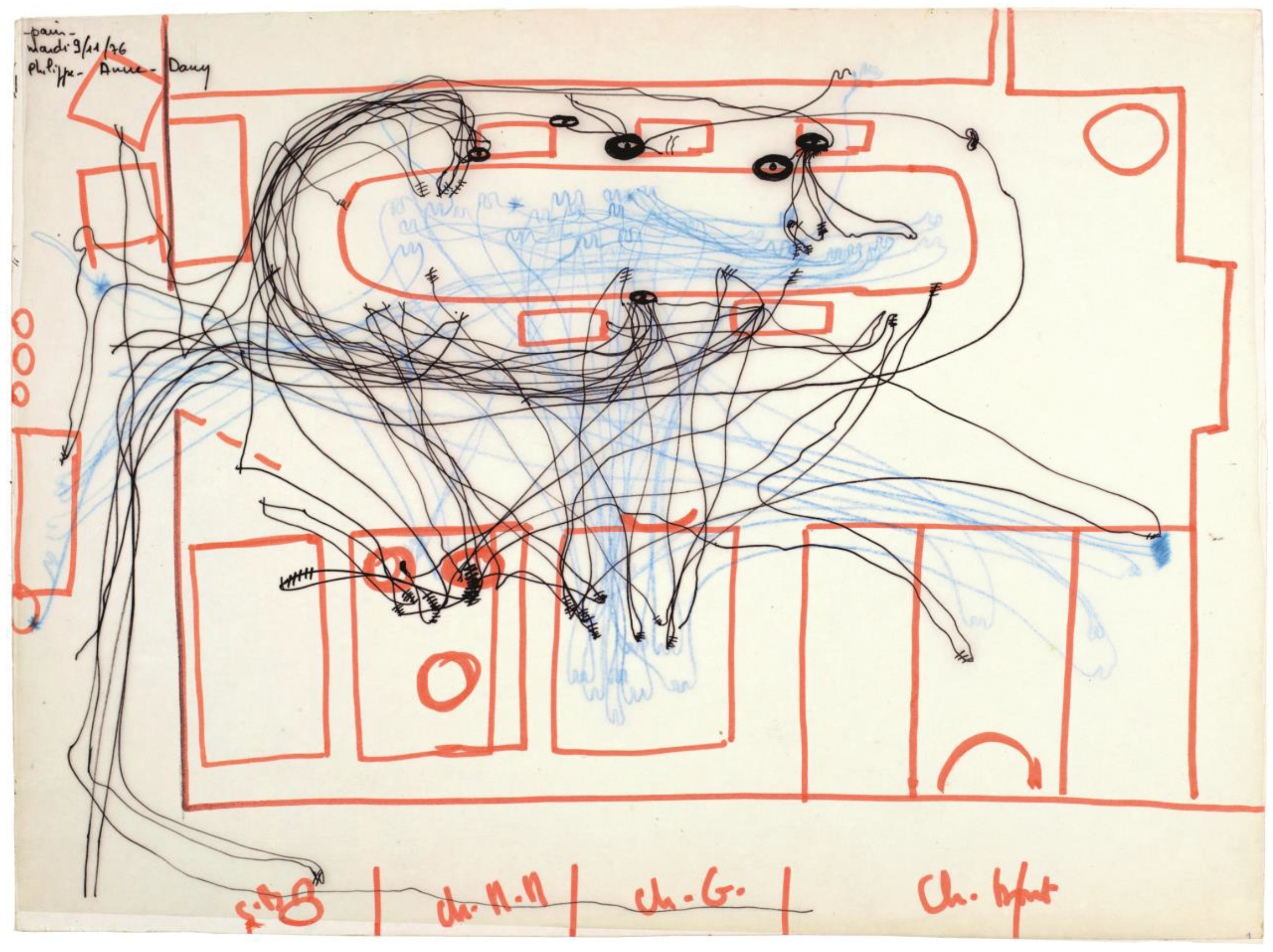
Lefebvre 2004). Drawing on Lefebvre’s Rhythmanalysis, I approached the field of enquiry by tuning into my repeated patterns and temporal movements of my everyday practices, using myself as a reference point. This helped me to really attend to how island life unfolds through sequences, pauses, tensions, and repetitions. Emphasis was placed on the cyclical/daily and linear rhythms. Routines are examined, analysed, and visualised. Deligny engaged in similar methods during the 1970s, mentioned earlier, which involved observing and documenting the lives of ten non-verbal autistic children who were given the freedom to live more independently outside of institutional settings. By closely monitoring their daily activities, such as body washing, woodland walks, and cooking, Deligny created cartographic tracings that illustrated their movements and interactions with their environment, where even their breath was recorded, as in
Monoblet,
Figure 1. His observations captured not only their rhythmic behaviours but also moments of pausing—whether to listen to birds or to respond to natural interruptions—highlighting the importance of these self-regulatory practices within their lived experience and emphasising the significance of rhythm in understanding the nuances of their existence.
A double-layered tracing. The base represents the kitchen layout at Monoblet, the rural dwelling for the children, including basic furniture: a kitchen table with place settings, a stool, cupboards, and basic units. The upper tracing superimposes the movements and repetitious interactions of the children, including muscular motions and trails of saliva depicted by wavelet symbols.
This work became the underlying inspiration for the Rhythmanalysis+. However, the climate of COVID-19 in Ireland, where public health restrictions included social distancing, meant that it was, in fact, impossible to gaze directly upon the actions of the four islanders, as no face-to-face interactions were feasible. As an artist grounded in ceramics, my love for ecology and the landscape once felt worlds apart from virtual reality; yet the evolving discourse around environment and archipelagic thinking revealed VR as a potent and ethical medium for exploring relational space and sensory rhythm without meeting face to face.
Abruptly, as we were all catapulted into isolation and restriction, the technological element allowed the research to come to life, becoming the only space in which the research could continue. Virtual reality was not chosen simply as a novel presentation tool, but because it could hold and reshape the sensorial data in ways that other formats could not. VR allows for a multi-sensory and embodied form of attention—spatial sound, 360-degree visuals, and proprioceptive awareness combine, placing the viewer inside of a rhythm environment, rather than in front of a representational one. This aligns closely with Lefebvre’s understanding that rhythm must be perceived with the body, not just observed at a distance. VR also mirrors the relational networks underpinning the project: its immersive space supports non-linear interconnected movements that echo some of the islanders’ lived rhythms as well as the rhizomatic structures of the research. In this way, it became a necessary but surprising medium, one that could translate all these non-traditional elements in a way that could be felt rather than simply described.
Virtual reality, originally developed as a gaming engine, suddenly bore so many new possibilities, but with very little knowledge or skill in the area, the work was not to become a game, but the means to transport the viewer to another space, maintaining honesty and the voices of the islanders during this difficult time. Not a utopian alternative, nor a fantasy, but a place that is carefully constructed using firsthand echoes of real lives embedded with emotion, memory, and daily rhythms.
In revisiting the Deligny investigations—and mindful of how today’s digital world is saturated with visual media through social platforms and smartphone—I wanted the work to engage with more than just images. Participants were recruited through existing community relationships that had strengthened during my studies with the university on the island. This was an essential part of the process of studying there. It was a small resource, but rich in learning, and it was fragile in that it was so important not to be all extractive in our work there. An open invitation was circulated, and four individuals volunteered to take part. These participants were very suitable due to the contrast in their daily routines and diverse sensory patterns for mapping.
Decision-making within the project was shared rather than fully centralised. While the overall structure of the research and its translation into virtual reality were shaped by me as the artist-researcher, participants retained agency over what they chose to share and how they did so. They were invited to document their daily rhythms in ways that suited them—through voice notes, photographs, drawings, recordings, or conversation—and could omit, revise, or withdraw material at any stage. There was no expectation of completeness. Reciprocity operated through ongoing dialogue: participants were kept informed about how their contributions were being translated, could raise questions or concerns, and were given access to the completed work. Care was taken throughout to ensure the process remained non-extractive, particularly given the pressures of the pandemic.
As a starting point, I sent an ethics document to the four islanders asking them if they would like to participate in a study around their everyday encounters, and how it could be developed as a socially engaged process. These were a cross-section of the island community, and good representatives of island-living people I had built a relationship of trust with. I was conscious that it was a difficult time for many, and I wanted to ensure that it was going to be a thought-provoking exchange for all parties. The brief was that they consider their daily routines for four weeks and record them in any way that was successful for them. This could be performed in a fully inclusive manner, taking into consideration people with varied learning styles. People could keep a diary, take photographs, voice notes or recordings, and video. They could do some drawings or even create maquettes. As a backup, in case participants found the task difficult, I arranged to meet them once, on a Zoom call, where I had a set of open questions prepared. These questions included topics such as “How does your day usually start?” and let them speak to that. Using ethnographic techniques through Zoom, I listened intently as they spoke, and as I did, I began to draw physical maps, developed using charcoal and pigment on brown paper, layering one upon another, highlighting both unity and isolation on the island within the pandemic. Daily patterns, sensorial experiences, and cyclical behaviours not commonly used in geography were things that I added, leaning on graphic scores I had researched, looking at Aboriginal Dreamtime, the work of Cornelius Cardew and John Cage, which I speak about later. Climbing out of bed, eating, dressing, walking to the pier to collect food, and meanderings such as walks where weather, birds, salty breezes, and bat interactions were noticed and remembered. Stories also emerged about island neighbours leaving food or messages at the end of each other’s driveways or garden gates during COVID-19, small gestures that became rhythmic acts of care and connection when physical proximity was restricted. Island thinking allows us to think relationally, and this research evolved from island perspectives and experiences to the navigation of dialogical interactions involving humans and non-humans together with their shared environment. This is because island environments make interdependence overt: ecological systems, social relations, and daily practices are tightly entangled and often more perceptible than in mainland contexts, where scale and density can obscure such connections. The sea is relational both as a barrier and a bridge, a carrier of stories and experiences, but in this case also as a carrier of sound, of transportation, of supplies, and of safety. The actors gathered stories to form an unedited archive, preserving the authenticity of the work created during this unique global experience. As technology evolves, the work may be reimagined in new formats, but its core content should remain a precise and faithful piece of documentation. With the passage of time, and since the completion of the work, I have noticed my desire to keep up with learning and development of the technology.
The heart of this work is the people, the connection with their environment, and the story that it holds. What came out of this work was not merely data or an event recorded, but a multi-layered dialogue between people’s lived experience and digital representation, where rhythms recorded became both map and reflection. As researchers, it is vital that we take the ‘opportunity to re-envision and re-craft to re-story, our practices and labour and perhaps, most importantly, our pedagogy, within university ecologies’ (
Loveless 2019, p. 27).
3. Results
This section traces the material and conceptual development of Rhythmanalysis+, moving from early visual mapping and sound gathering through virtual translation, and finally into exhibition and audience encounter.
- (i)
Developing VR Work
The development of the VR work began with an exploration of visual notation systems that could hold movement, memory, and rhythm without relying on conventional cartography. Visual mapping techniques of Dreamtime, an Aboriginal system of beliefs and existence, formed the initial exploration around how the mapping of people and their movements might appear. This initially came to me through connections I had made with traditional Irish musician Steve Cooney, whom I had met many times as a young musician playing traditional music when I had also first discovered Sherkin Island. He was researching alternative ways of visualising musical notation, referring to his own Aboriginal and Tipperary ancestry. Through researching Aboriginal maps and creative mark making, which could denote systems of stories, songs, and knowledge, he began to create new hybrid creative notations. This was reminiscent to me of graphic scores created by Cornelius Cardew, John Cage, and Pauline Oliveras and led me right back to Deligny, as he created his own notational scores of the stories, movements, and habits of the children. This gave me a clearer picture of how I could transcribe sentences or paragraphs of information, with the simplest or most complex of marks within the work to visually tell the stories of the islanders.
My knowledge of Gravity Sketch, the creative app software within the virtual reality headset, was a complete learning curve, and at 52, I was not at all sure that it was going to be successful. There were, as a result, limitations. The project was not solely one of a digital nature; there were many opportunities to create enrichment through material investigation, as well as ethnographic and immersive sound engagement. It became even more important to be able to reach beyond the obstacles and create as much of a network as I could in real-time and real space with real materials and make as many real connections as possible with Sherkin Island, under the restrictions.
- (ii)
Participant Mapping and Soundscape
Having spent many years, on and off the island, I had already developed relationships of trust with many people on Sherkin. With the visual language established, the research then shifted toward collaborative mapping and sound gathering, grounding the work in the lived, sensory rhythms of the islanders. Having spent many years on and off the island, I had already developed relationships of trust with many people, and I knew that this was a most considerable advantage as I moved into this new, critically fragile period. Successful networks develop organically over time, shaped by diverse entry points—both historical and contemporary. In my case, the initial stages of data collection and Zoom discussions laid the foundation for what I have come to call a “network contract”: an implicit, evolving agreement built on trust and mutual understanding that gradually revealed itself as the work unfolded.
As a means of experimentation prior to the finished work, I explored my own local sensorial recordings as a demonstration of a restricted 2 km area during the COVID-19 lockdown, fine-tuning and immersing myself in my own daily rhythms. During this period, Ireland stayed in lockdown longer than any other European country at that time.
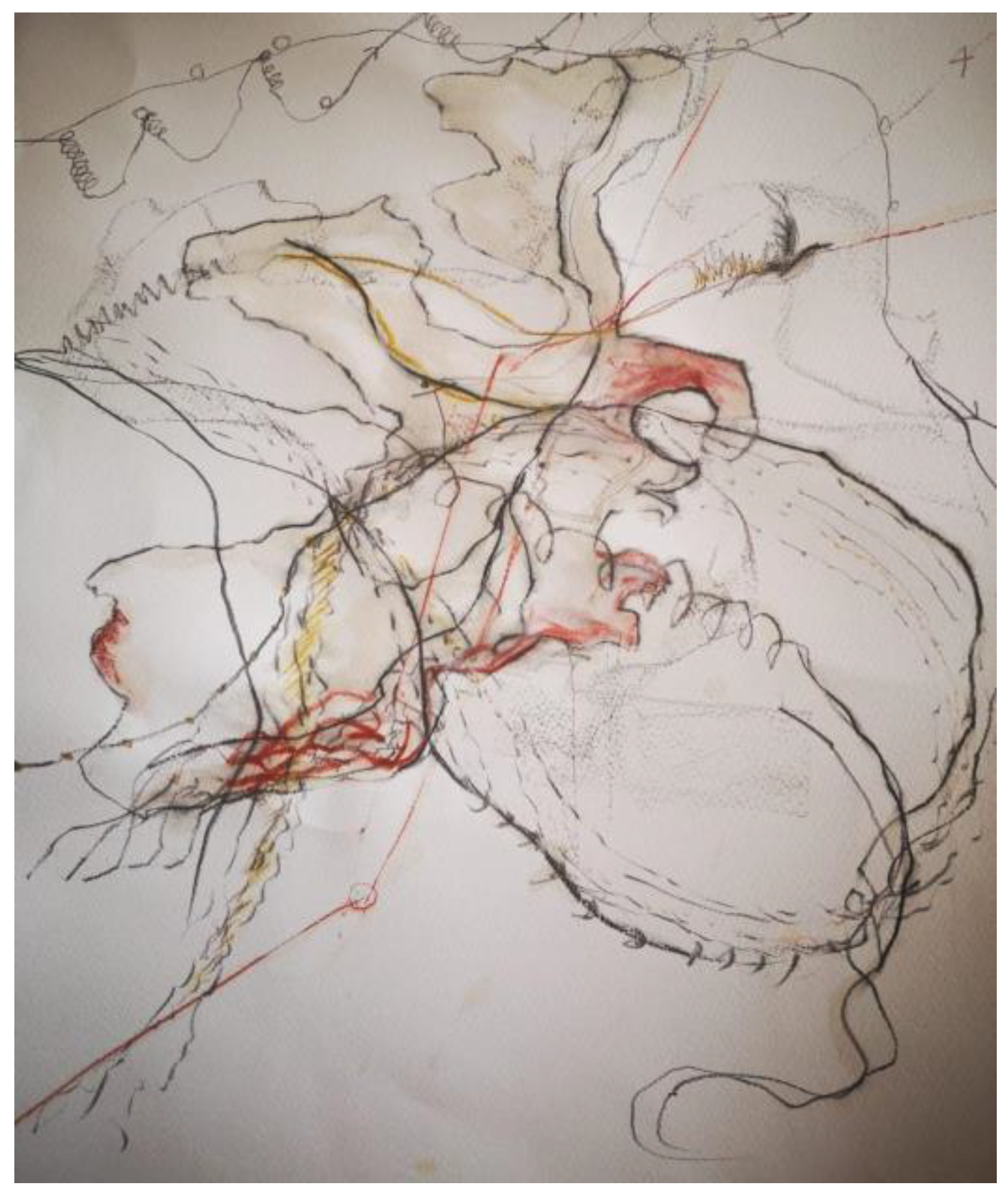
Figure 2.
Personal Geographies visualises a rural setting with outdoor activities remembered and natural notations of creatures and weather patterns. It also defines a superimposed internal home area, describing habitual cyclical movements and patterns of life. Marks are made to denote internet access, as well as daily walks and tense interactions with a teenager. The linear dissemination of my favourite radio show kept my thoughts stable during this uncertain period. With some preparatory research complete, it was time to engage with the islanders, subject to their agreements.
A charcoal and pigment illustration on paper of a personal sensory map. It denotes the physical space at a property, the zones of land, hedgerows, and fencing. It carries temporal information on passing birds and how physical spaces encroach on ecosystems. It also illustrates verbal interactions and movement between people and the linear rhythms of media as it is heard daily.
Once all participants of the project had been contacted by phone, Zoom interviews were arranged. Prior to interviews, participants were provided with explanations of the project to prepare accordingly. They already knew me, as I had already completed a successful socially engaged university project with other islanders titled Network-
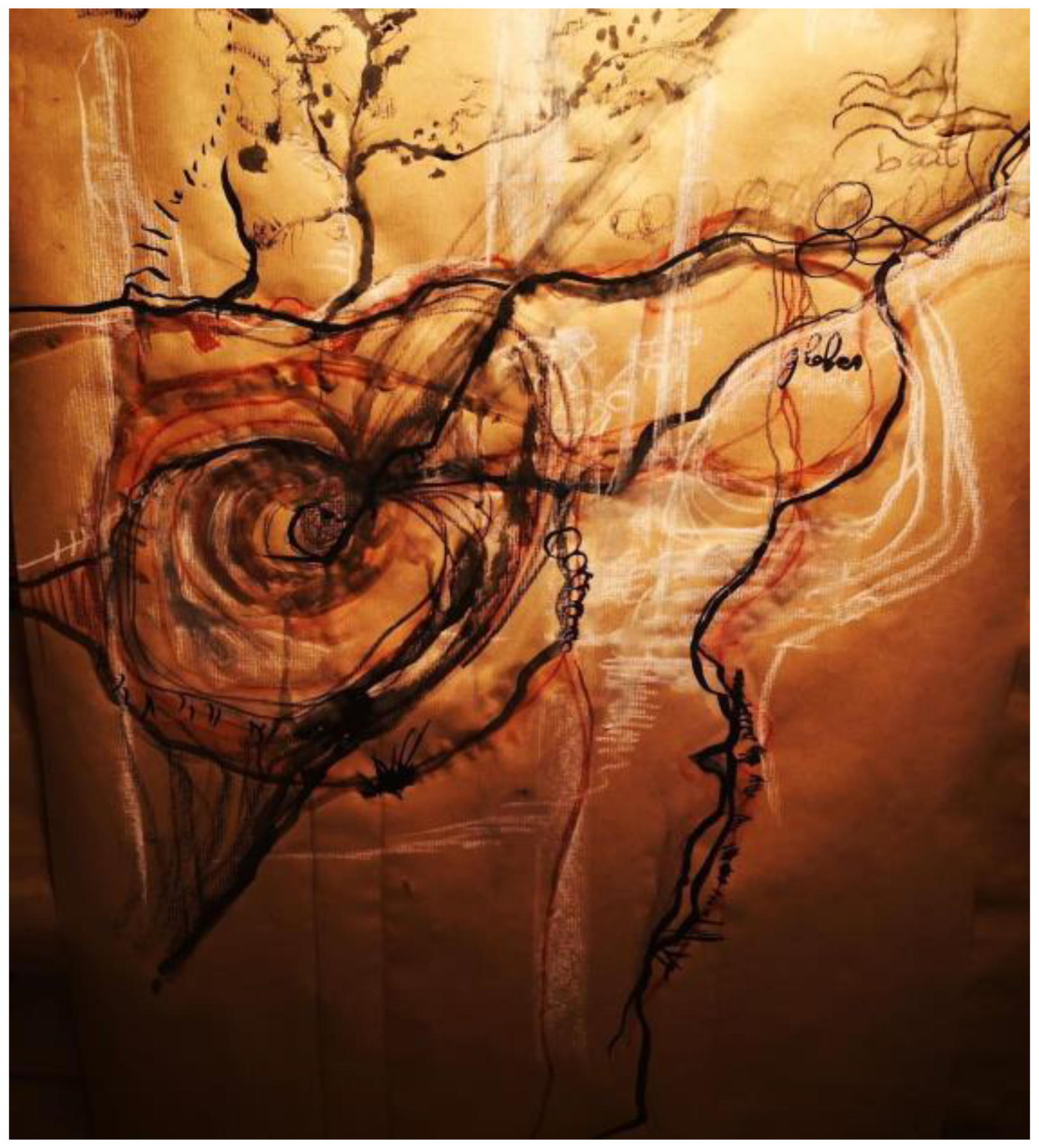
A Mode of Being. The focus at that time was around networks and intuitive knowledge. The context for this work was more detailed, though, and individualised. COVID-19 had become the overarching giant that was engulfing us all during this time, and though my research was around the everyday, it was essential to remain as non-extractive as possible with my participants, as their mental health was at stake. I did not want to colour their thoughts. I asked them to reflect on their everyday movements for four weeks; from the moment they arose until they were back in bed at night. I asked them to consider things on their journeys that may not be so obvious as they performed daily tasks, ate familiar foods, walked well-known roads and pathways. I asked them to consider all forms of nature and its habits, to consider myths and legends, weather-related tales, and stories that they might hear along the way. I began to listen and draw on large brown paper sheets (58 cm × 88 cm) using natural materials I had in my drawer. No art shops were open, no new materials were available, so I used what I had. I drew with charcoal, pencil, and water-soluble earth pigments as they spoke to me of their daily rhythms. Using one large sheet of brown paper for each person, lines and marks were created according to the information gathered. Each interview was an hour long. In
Figure 3,
The Globes, descriptions of the blackthorn bushes and their growth filled the page with gnarled trunks and branches, drawn with chunky dark blocks of pigment, while discussions of wet and windy salty walks to the pier, using watered pigments, conjured elemental sensations which became central to what I wanted to portray in the digital experience through image and sound. “The Globes” is a local nickname affectionately used for one participant (M) and her family, inspired by the nearby Globe Rocks off Sherkin Island, which are visible from their property. A well-known family, with a long history on the island, having a wealth of island knowledge, M talked of her walks from her home towards the pier. “The walk, with the sea on your left as you go, gets the gale from the salty sea air and in all weathers the salt would almost rip through your skin.” As she described the texture of the air, I tried to make responsive, fast-moving, sharp, and short marks with a sharp 8B pencil to bring out the elemental sensation of the cutting wind. As she chatted more informally between nuggets of sensorial treasures, I often added water, where it may be needed, but mostly, it was left, as the conversation would cease.
There were four drawings, one per islander. Each with a very different story, discussing how they regulated and created their own normal in this abnormal time. This varied from participant to participant; some travelled alone through their days, noting trees and animal habitats, and some mapped sea rocks and miniature islands that they wished to touch while travelling daily on a kayak. Others walked and told stories while they carried their children on their shoulders. They all took photographs that supplemented what they spoke about, as well as making recordings of any sounds they encountered along the way. These were sent directly to me.
The drawings I completed were photographed and uploaded to a web page associated with the VR application called
landing-pad, where images could be added or subtracted to the VR headset as needed. All audio recordings, such as crashing seas, rainfall, and walking through crunching sticks and stones, were gathered with the interviews, combined, and edited to create the complete soundscape of 5 min and 20 s with the expert assistance of Blackwater Studios, Cork. The three-dimensional virtual drawings came afterwards, in response to the sound. In reaction to the restricted conditions around physical connection, it was necessary to engage with both digital and physical approaches to develop the research further and to reveal the essence of the sensorial data. This was to be an integrative and immersive social engagement, although physically separated by the pandemic. All work was completed from my home. I attempted the immersive 3D drawings many times, experimenting with size, colours, and line thickness. Initially, I chose colours that I felt were relevant to the subjects being discussed, but this took away from the direct response I felt it needed; it was not reactive and too prescriptive.
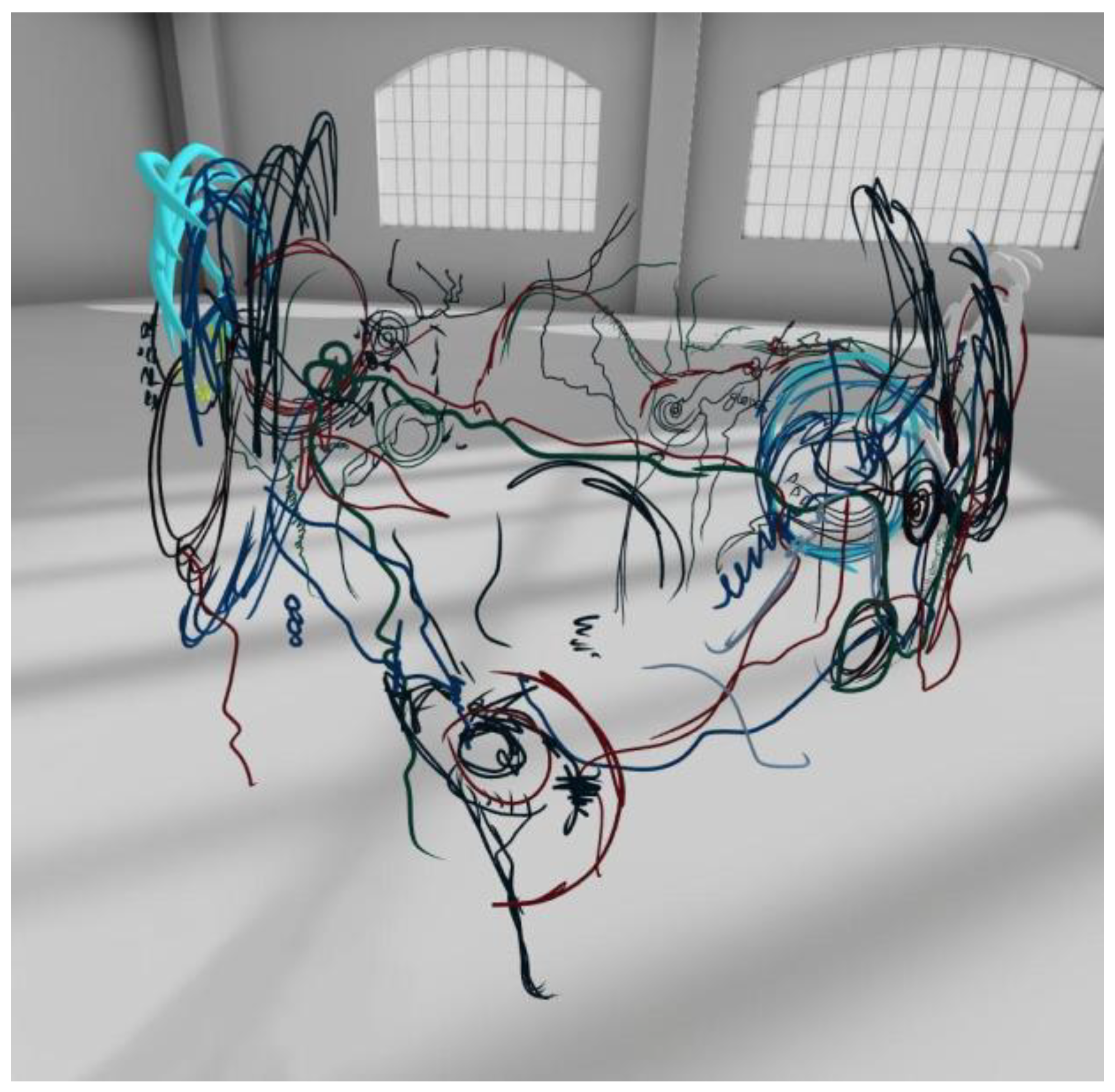
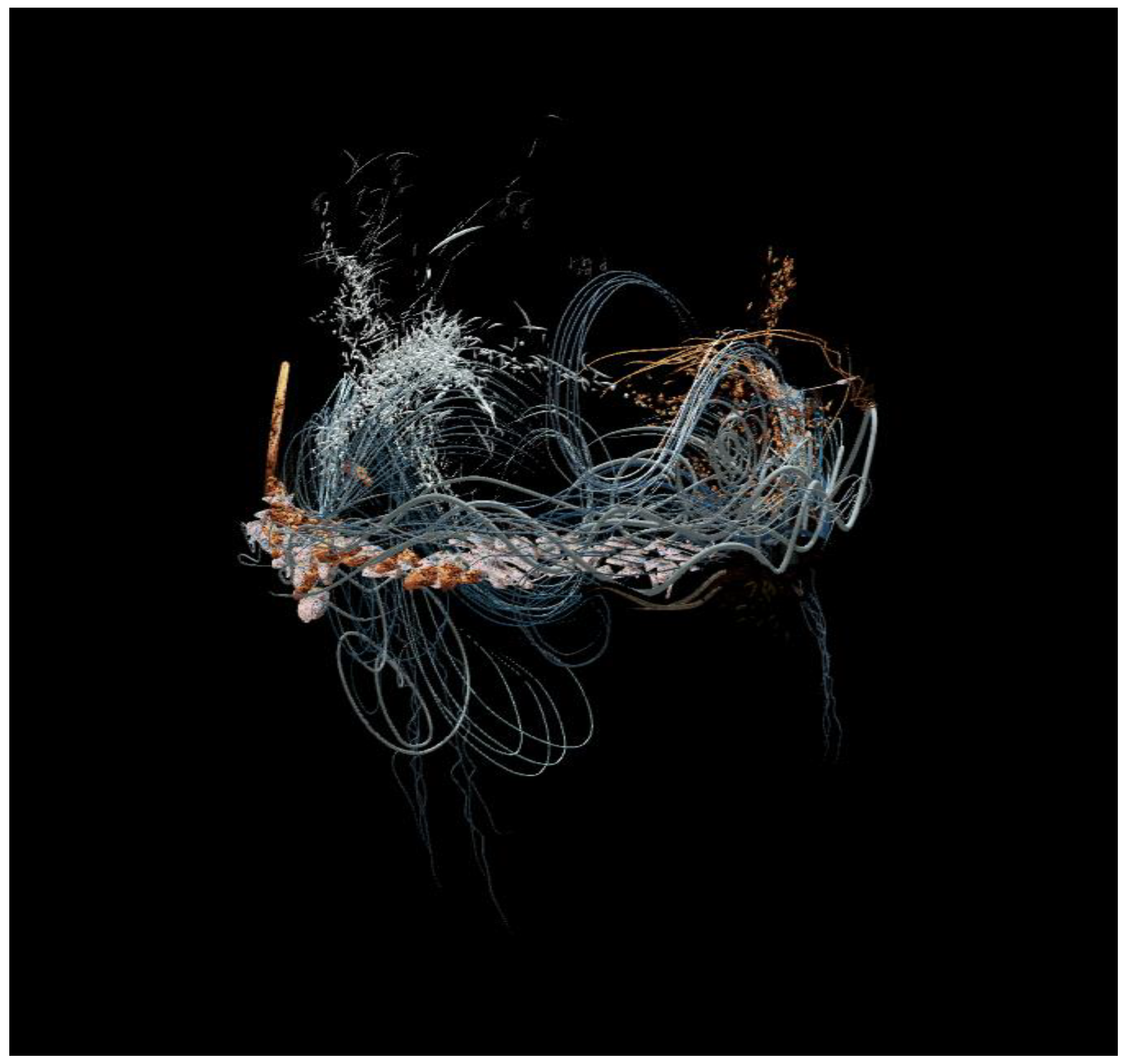
Figure 4: A 360-degree sonic graphic score was created based on sounds recorded directly from the participants, and as a representation of information gleaned through Zoom interviews.
To begin the process, I chose the largest space in my home, the kitchen, as I knew I wanted to draw this at the scale a viewer would see it, i.e., surrounding them. I used earphones, repeatedly playing the audio through my phone, isolating sounds, people, and their experiences. Using Gravity Sketch, a drawing application within the Meta Quest virtual reality headset, lines were drawn in a performative manner at arm’s length in response to the sound piece. This was achieved by holding the hand controls of the VR device and squeezing the triggers in various ways. The experiment continued within the digital realm, by using the photographs of the physical maps as representations of participant movements, which became the scaffolds for digital data lines, at this time still sitting quietly in the VR holding space (landing pad—web page). Colours became digitally visible from the palette of the original maps, now hovering in the space, but providing essential information needed.
Now, JPEGs within the space, every colour used, were directly related to the person and the rhythm in which the drawing is depicted. Marks created in the virtual space represented walks, facing into a salty breeze, meeting a bat at twilight, watching the birds as they changed their migration habits due to climate change, and perhaps knowing how the tides can influence the weather as it shifted. The image now floated in a black void, creating a tension between the reality and the image and a sense of disconnection. Software gaming and animation programmes, such as Blender for three-dimensional modelling and Unity, were necessary to rotate and light the work.
- (iii)
Exhibition/Audience Response
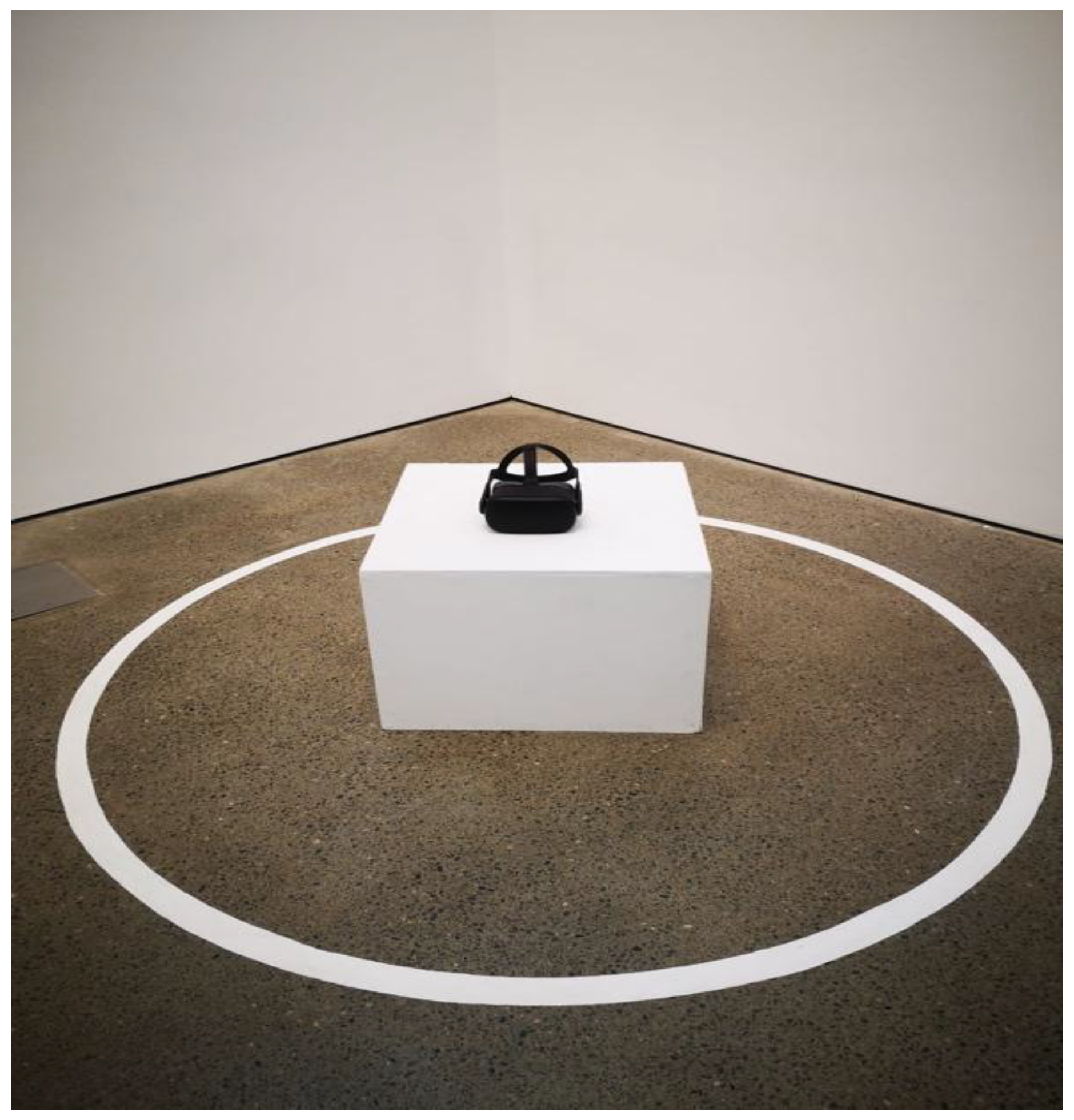
Once the virtual work was realised, its meaning and effects were further shaped through exhibition, where the research was activated through public encounter rather than explanation or instruction. On displaying the work in the gallery, no physical information or sense of onboarding was supplied to the viewer by the artist. It was a simple installation. A squared plinth 60 cm × 50 cm high, sat on the floor surrounded by a 5 cm white line painted onto the floor akin to what is known in the virtual world as a guardian. The black headset and hand controllers sat on the plinth (
Figure 5).
The artwork itself is a slow-moving piece, introducing the island to the viewer visually and sonically and referencing the cyclical and slow movement of our day, our lives, and our planet. VR was essential here because it creates a type of immersive contact that is not available through film, drawing, or audio alone. As a VR piece, the artwork is person-centred, with the experience and comfort of the viewer paramount to its design. Many audience members approached the headset cautiously, expecting a game, and instead, were surprised to encounter a quiet relational space, built from lived sensory traces. Engaging with VR technology in this way was novel at the time of presentation in 2022, contrasting more common uses for entertainment, such as single and multiple-player gaming activities for which it was originally designed. As such, there remained a fear, along with curiosity, from the audience engaging with the work, unsure as to what they were about to meet inside the device.
By incorporating auditory elements and personal narratives, the experience transcends traditional methods of observation and engagement, inviting users to understand and appreciate the living rhythms of existence, characterising the daily lives of the participants. For those with visual limitations, either central or peripheral, the visual drawing work is positioned close to the body as it revolves at a precise fraction of the Earth’s rotation speed and does not incite nausea or motion sickness. It can also be a stand-alone audio soundscape. The full suite of environmental sounds collected through phones and recording devices available on the island forms an authentic, unedited image through sound alone. With only sound and vision as a reference point, it is an illusion that is real or unreal to the viewer.
As people experienced the work, many sat and looked around in wonder, afraid to move from the seating provided. Others stood and attempted to reach for the non-real, but for what their eyes believed to be real in the moment. Some asked about the background to the work before seeing it, and as many specifically asked to see the work first, drawing their own conclusions. The idea around the artists’ intention within the remit of this work was different, I believe. As an artist, the original intention I had was to carefully handle the information bestowed upon me and represent a visual and sonic experience of the lives of the islanders using this unique tool. As I handed the work to the audience, I noticed how their reactions shifted—some froze in place, hesitant to move; others leaned forward, almost reaching through the illusion toward what their eyes momentarily accepted as real. There was wonder, disbelief, curiosity, and avoidance—and moments where individuals appeared genuinely lost in the threshold between perception and immersion. Although such gestures can occur in many VR experiences, within Rhythmanalysis+, they functioned as more than habitual reactions: they reflected viewers’ attempts to orient towards the sensorial traces of others. In this context, reaching or pausing became a form of perceptual contact, prompted by the presence of real-lived rhythms rather than fictional stimuli. Correct display of this work was important. What I mean by this is that it needed constant monitoring and interaction, as well as with those who used it. The interactions I describe were not gathered through formal interviews with those who viewed the work but came from being simply present with the work—invigilating the space, which I did over four weeks, helping people in and out of the headset, and noting how they moved, hesitated, or reached out. This was less about data collection and more in-the-moment observation and helped me to recognise how the artwork was operating on a bodily level. It also showed me that themes like connection, presence, touch, and rhythm were being addressed by audiences themselves. Perhaps a more formal recognition of this could have been put in place, but this remains entangled in the research process. These observations were informal and naturalistic, arising through invigilation and practical care of the installation, and were used to inform ergonomic, accessibility, and presentation decisions rather than analysed as formal audience data.
All these gestures revealed something important: VR encourages a form of embodied searching, where the body attempts to verify presence without physical touch. In this, I was reminded of
Elo and Luoto’s (
2018) insight: “
Touch is… a way of estimating the sense of a presence… a way of sensing the very sense of a contact.” Their words articulate what I witnessed—an audience bodily engaged and exposed, each movement a search for corporeal affirmation within the sonic and visual environment. In a time when physical touch and proximity were restricted, VR offered an alternative mode of connection. It created a bridge between the viewer and the islanders’ everyday environments, allowing the audience to momentarily share their sensory world. The cyclical movement of the live drawing lines, the swell of the water, and the sound of the wind all created a layered field of perception that bypassed the eye and invited a more embodied response. In VR, the viewer is not outside the work; they are situated within it, and their own movements and sensations become part of the encounter.
The idea of contact is essential within this context, as Rhythmanalysis+ was created in such a precarious time where contact was what we were missing. For this reason, VR also became an ethical tool of choice. It allowed the experiences of the islanders to be represented without requiring physical visits or visual exposure. The translation of their stories, into lines, sound, and immersion, respects Glissant’s idea of the ‘right to opacity’—the right not to be fully exposed or explained. VR became a way of staying connected, without breaching safety or trust. While it was impossible to physically be with the islanders during the gathering of the sensorial information, digital technology was key to building that bridge, enabling visual and verbal connection. Contact can be perceived in so many forms throughout this investigation: perceptual and embodied, emotional, relational, and in all forms. VR mediates this by offering an alternative enclosed space only visible to the viewer, allowing a feeling of safety and connection produced through attention, rather than skin-to-skin interaction. It allows for a momentary intimacy that does not rely on a physical space, and it also provides a situation where the viewer meets the islander’s experiences in a shared space, producing a unique sense of connection through perception instead of touch. It was the engagement of the audience that created a sense of a cyclical conclusion as they absorbed the voices, imagined the blackthorn, and almost inhaled the seaweed and salty air through spatial sound. In the ‘argument of the eye’, Harriet Hawkins speaks of the use of her body as a ‘research instrument’ to investigate an artwork. She speaks to the decline of the Cartesian observer and an ocular-centric perspective, moving toward a modern geography, where sensory perception enters the equation, and argues toward a more embodied methodology, engaging multiple senses beyond language, beyond sight. It becomes a co-creative process between the viewer and the artwork, referencing Merleau Ponty’s intercorporeality, referring to the reciprocity of one’s own body with that of another; in this case, being the artwork.
In previous explorations of sensory perception, as part of my master’s dissertation, I have described how ‘sensory perception assists scientific and geographical facts; it can be crucial to the aspect, the climatic or perhaps tidal uncertainties’ (
Burns 2022). Andy Clark and David Chalmers ask, “where does the mind stop and the rest of the world begin?” Some say skin and skull, but they advocate for a very different sort of externalism: an active externalism based on the active role of the environment in driving cognitive processes” (
Clark and Chalmers 1998).
Rhythmanalysis+ is a digital environment, an extension of the mind connecting a sensory domain, relating the living rhythms of the islanders, to the body of the viewer. Within this digital experience, it is worth considering Hawkins’ theory on ‘the argument of the eye’, which is:
alongside the central role of bodily presence and sensuous, tactile and experiential being that the installation draws out, it also configures our awareness of absences, of displacements within the fields of vision, absences that condition our subjectivities and lived experiences.
When considering the drawings or maps within
Rhythmanalysis+, it is worth looking at the sensory challenges Deligny encountered in trying to visually describe the actions of the children baking, also including time, movement, and some sensory situations.
Monoblet,
Figure 1, though it is a physical and geographical tracing, is also an ocular view of a daily rhythm in the bakery house or Y House, where less-than-regular movements were recorded. The tracing is made up of two layers, the first being a basic sketch of the farmhouse, with some furnishings, but the top layer includes lines and wavelets designated to the movements of breath, the movements of hands, and bodies. It is these very details that lead me to consider the kinds of lines and mark-making that can be inspired by such primitive practices as
dreamtime, as new and exciting lines are created through
Gravity Sketch, a creative drawing tool in virtual reality.
In terms of the realisation of the project, there are areas of specialisation that unfold only within the journey of expansion, for example, unknown territories, such as in uncharted environments, illusions, and reality, etc. It needed close monitoring and invigilation as well as a constant technical eye on the hardware. Having the unit fully charged, as well as having instructions on hand in case of any faults, was also a concern and a stress, as it required the artist or an extra staff member at the gallery to be on hand. A 5 mm painted white circle, on the floor, circumnavigated the plinth, which carried the headset, creating an imaginary safety space. Interestingly, people stepped over it on entering, as though they entered a contract. Most adults sat on the plinth supplied; children generally did not. The plinth provided was moved out of the circle as wheelchair users insisted on sitting within the painted white line. It is, but a psychological contract, and people agreed to the terms. Once the headset was upon the head of the viewer, they became immersed, separated from reality, a disconnected illusion. You knew you were in the gallery, but for five minutes and twenty seconds, there was a willingness to suspend disbelief. In Plato’s Allegory of the Cave, captives in a cave see shadows that they believe are indeed reality, and it is only when some of them escape, through the illumination of seeing the real world, that they realise what they had seen was merely an illusion. One enlightened individual returned to tell others of what he had seen despite the possibility of being mocked. Rhythmanalysis+ opens as a dark space, much like the darkness of Plato’s cave.
As a viewer, you sit and wait. You are still in the gallery; you lose conscious awareness of your surroundings, and the distinct possibility that others may be watching you. This element of slow time passing allows the senses to suspend disbelief. What is really happening? Is it possible to stay in the present? The description that follows is meant to show you how the VR piece guides the viewer into a slower, more reflective state. The moment is important to the study because it highlights how sensory cues sound, movement, and atmosphere—shape the way participants experience temporality and place. By paying attention to what the viewer feels and notices, we can see how the work blurs the line between the gallery environment and the recorded island landscape. This helps explain how the project uses immersion, not just for storytelling, but as a way for participants to sense time passing, to question what feels “real,” and to engage with the material gathered from the islanders. The passage below captures this shift and shows why it matters for understanding how people respond to the work.
The mind allows you to believe what you see. This can make you feel vulnerable. The sounds of gulls and seaside waves surround you in spatialised sound. The experience starts to appear, accompanied by participant K, setting the scene of the windy landscape and how it engulfs you as you go on your journey, taking in the visual, auditory, gustatory, and olfactory nature of the experience. Is it real? It was real when it was recorded… You are given time then, to digest it all, as you fill your eyes with a feast of slowly rotating lines denoting the ebb and flow of the tides, as you hear the recordings of the islanders as they let you feast on what is part of their everyday life.
The sea is a chasm, but also a bridge denoting the relational, as Glissant encounters the sea as ‘Poeisis’. In this case, Glissant’s reference to ‘Poeisis‘, is a ‘bringing into being or opening onto’ of unpredictability, or things that are unheard of… a sense, perhaps, of not knowing what might happen next, or also how the sea may alter or change things. It is true that if we consider the research in question, how existentially different it would look if the time frame of recording the information had been shifted even by one day, highlighting how time alone would have revealed a new reality. When you emerge from the work, have you really been there, or was it an illusion? An illusion is imaginary. All information is gathered from islanders, in their reality, in a determined timeframe.
This multi-access experience allows the audience to engage with the participants’ stories and sensory lives using a headset, fostering an immersive understanding of their individual perspectives. It continues with interspersing the voices of other islanders, describing the journeys, in ways that connect you instantly with your senses, bypassing all sense of the digital, but allowing it to flow through the body. The illusory images become the meshwork linking the real with the imagined, the human with the non-human, and the living with the invisible. Inter-relational in their communication, it creates an ephemeral affair where the viewer is at the mercy of the composer. It is somehow akin to a type of dance between all the elements. Some can be seen, and some are internalised. People grapple with their own questions while also accepting the encounter. It also plays with time, timeframes, and memory, pulling the audience into their own minds while still seeing what they see. Colours link directly to the original maps (
Figure 6), denoting the story of the individuals, and a window to their everyday lives, where they are prisoners on their beautiful island during this time.
Discussions of routines and journeys were combined with sounds of walking gingerly through crackling twigs, and events that were individual to the participants, to maintain good mental health at this very difficult time. The swell and consistency of the water throughout the piece keep you connected to the island. Offering stability in the instability of the technology, the swell decreases, the drawing slowly fades, leaving only the quiet of the receding tide, until there is only darkness and silence. You emerge into the gallery, or do you arrive? Have you been somewhere else, in fact? Have you travelled in your mind, though you know you have not moved from your seat? It does seem to affect people on some level. All the elements of the artwork are seemingly mundane, everyday experiences, and yet, when brought together in this multimedia, perhaps the body is feeling it in an alternative way, as though perhaps you have been to an alternative island.