
Music, Morality, and Mayhem: Anton Möller the Elder’s Drawings from Marienburg (1587)

Abstract
1. Introduction
“For whether you wish to cheer the miserable, or deter the cheerful, encourage the despairing, break the proud, calm the lovers, soothe the haters—and who shall count all those masters of the human heart, the affections and impulses or spirits that drive all virtues or vices?—what could you find more efficacious than music herself?”2
2. Early Years and Artistic Development
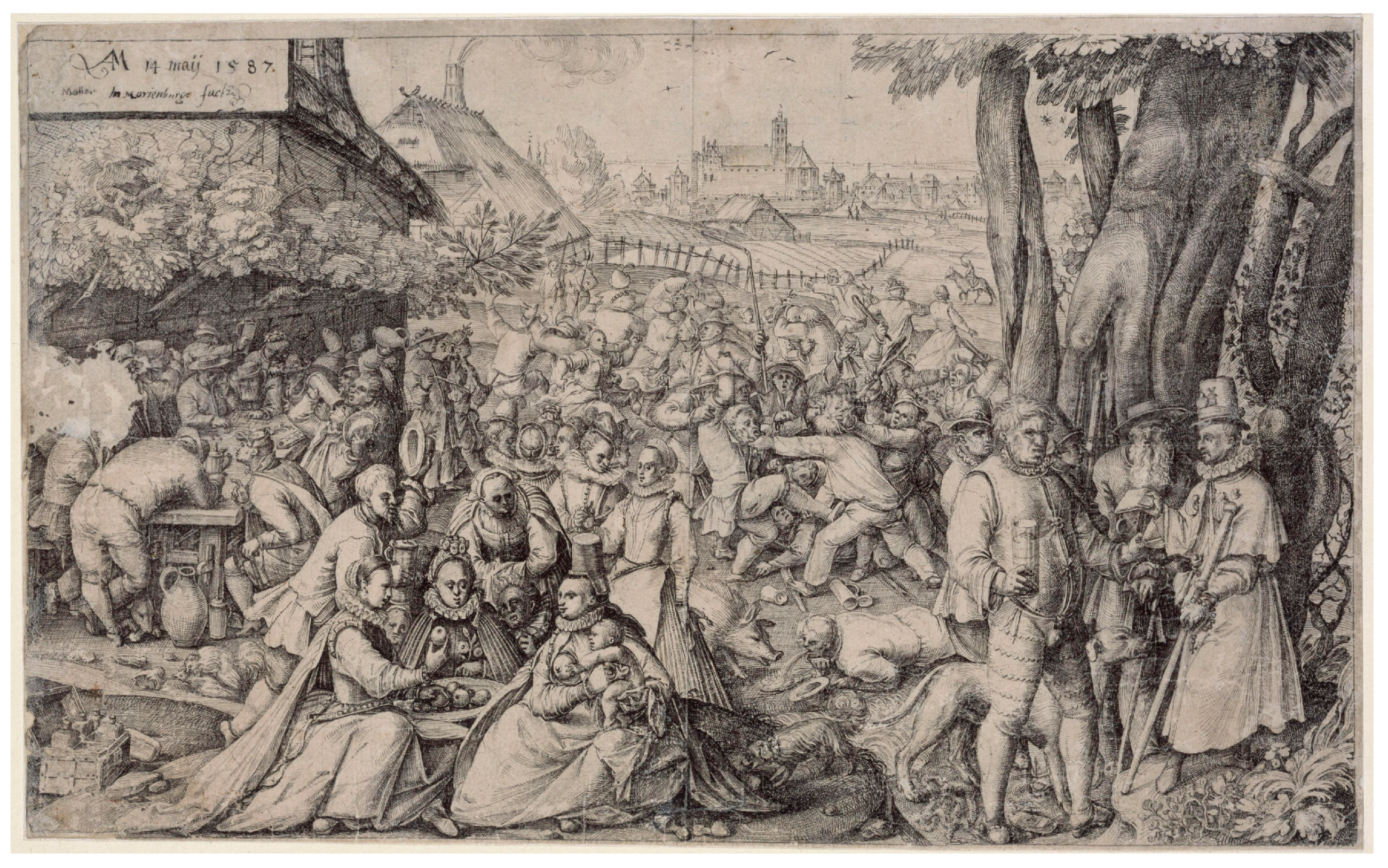
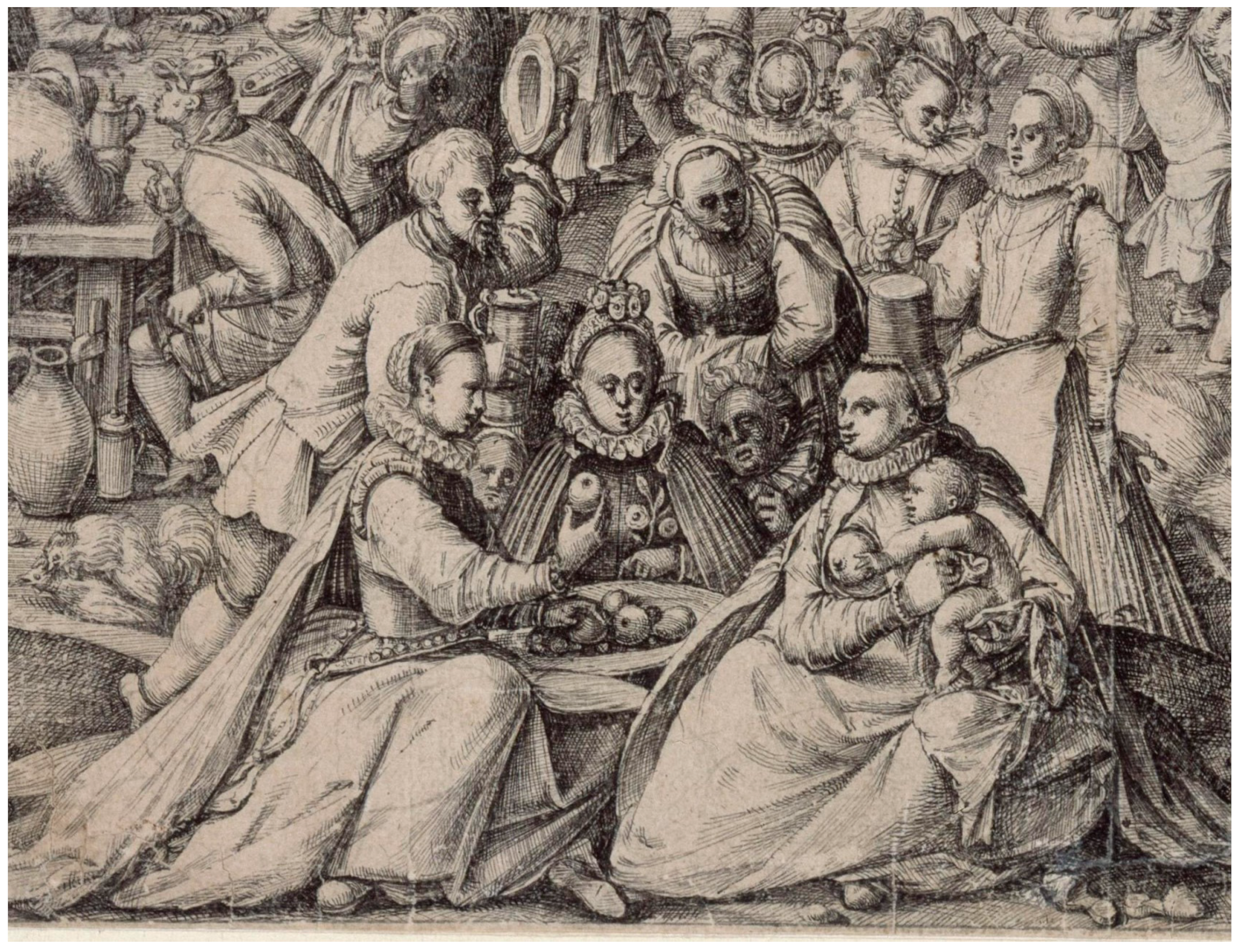
3. Moral Degradation, Religious Reformation, and the Power of Music—A Case Study
In German: “I, Antonius Müller have ( ) the honorable Johann Kretzmer/This too long difficult memory has been cast aside ( )/The 14th of May Ann. 1587, in Marienburg”
In Latin: “The painter was happy to paint things/I accepted the small task as a friend. After the death of Johann Kretzmer, the same Antonius Mollerus author/for the sake of friendship and perpetual memory, sent to M. Alexandro Glasero/November 6, 1589./Don’t let the cobbler go above the edge [of the shoe]” (“cobbler, keep to your last”).10
“…a person who…does not regard it [music] as a marvelous creation of God, must be a clodhopper indeed and does not deserve to be called a human being; he should be permitted to hear nothing but the braying of asses and the grunting of hogs.”
4. Music’s Role in Cultivating Balance, Morality, and Measured Restraint—A Counter Case-Study
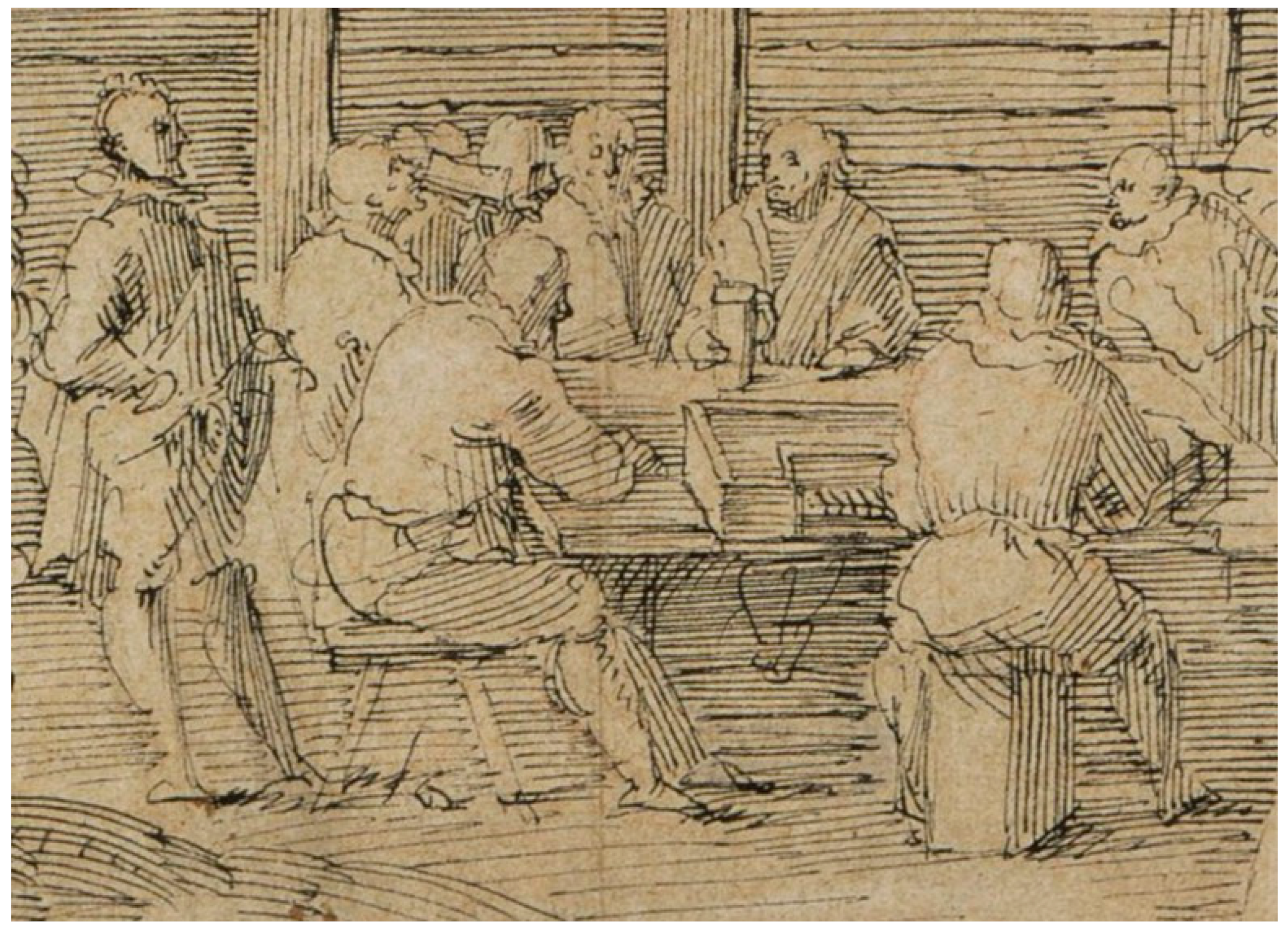
“First of all, if you examine the thing itself, you will find that music was impressed on or created with every single creature, one and all. For nothing is without sound, or sounding number, so that the very air, which on itself is invisible and impalpable, and imperceptible to all the senses, and least musical of all things, but utterly mute and of no account, yet in motion sounds and can be heard and even touched….”13
“[The] Voice is a flowing breath of air, perceptible to the hearing by contact. It moves in an endless number of circular rounds, like the innumerably increasing circular waves which appear when a stone is thrown into smooth water…. In the same manner the voice executes its movements in concentric circles; but while in the case of water the circles move horizontally on a plane surface, the voice not only proceeds horizontally, but also ascends vertically by regular stages.”
5. Conclusions
Funding
Data Availability Statement
Acknowledgments
Conflicts of Interest
| 1 | Möller’s drawings (especially the Folk Fair before Marienburg) have often been a focus of past scholars; however, the juxtaposition of these two drawings, examination of their symbolism, and the specific role of music in these works, to my knowledge, have not been explored before. For a detailed bibliography compiled by Jacek Tylicki of writing on these works, please see (Tylicki 2005). |
| 2 | “Siue enim velis tristes erigere, siue laetos terrere, desperantes animare, superbos frangere, amantes sedare, odientes mitigare, et quis omnes illos numeret dominos cordis humani, scilicet affectus et impetus seu spiritus, impulsores omnium vel virtutum vel vitiorum? Quid inuenias efficatius quam ipsam Musicam?” |
| 3 | Möller’s Last Judgement at Artus Court in Gdańsk was destroyed in World War II and recreated from pre-war photographs. |
| 4 | Möller’s work for the ceiling of Toruń city hall (1608) was destroyed by fire less than a century later. |
| 5 | A popular strategy game known at least since the Roman times. Called “gry w młynek” in Poland, an example exists on a ceramic floor tile from the seventeenth century. |
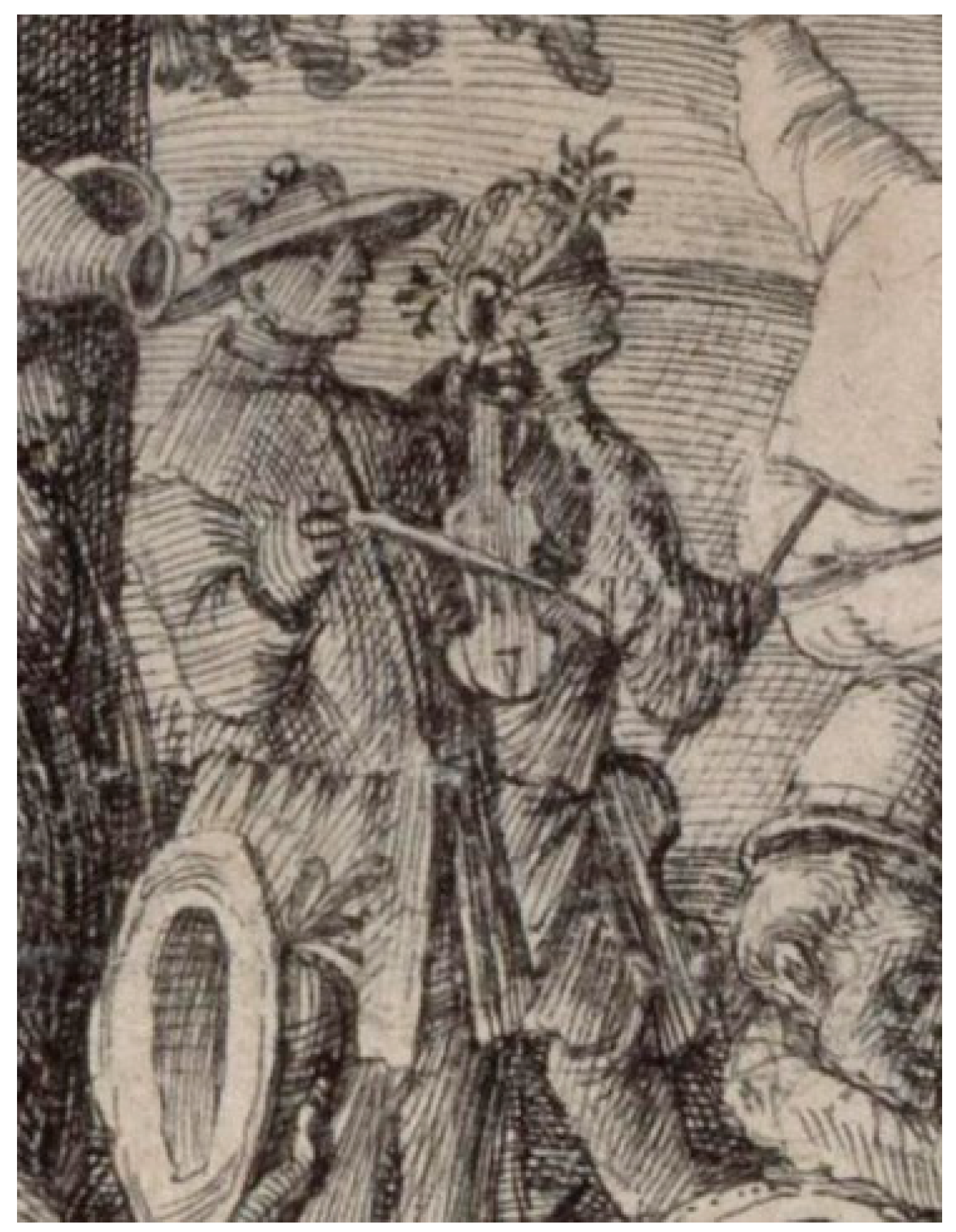
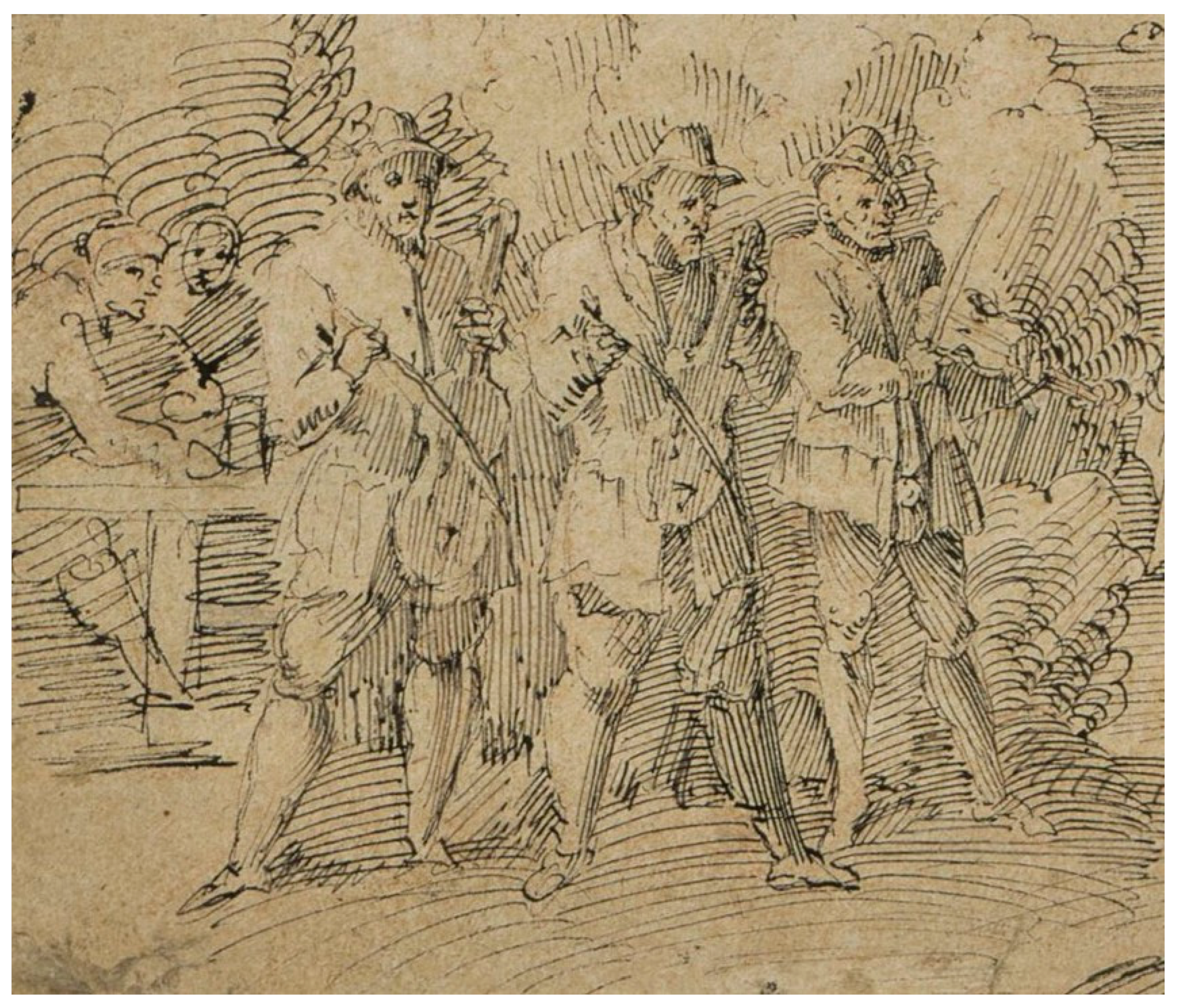
| 6 | Essentially, it would have been very hard to push the string all the way down to the neck because the distance was too great, requiring the string to be pressed from the side with the hard nail. |
| 7 | Of course, the roses could have also just been a decorative hair ornament, as other women have hair ornaments in this drawing. |
| 8 | “…o Maria, viola humilitatis, lilium castitatis, rosa charitatis.” |
| 9 | (Baldung Grien c. 1540) depicts the uselessness of chastity belts to keep a woman faithful and implies the husband’s jealousy. |
| 10 | “Dem E(h)rbaren gesellen Johanno Kretzmer hab ich Antonius Müller/Dieses Zu lang wierigen gedechtnus herum (?) gerissen/Den 14 Maij Ann. 1587, in Marienburg/De laetis libuit pictori pingere rebus/Munus id exiguum gratus amice cape. Post obitum uero Iohannis Kretzmari idem Antonius Mollerus autor/amiciciae et perpetuae memoriae causa ddbt M. Alexandro Glasero/6 Nouemb: 1589./Ne sutor ultra crepidam.” Transcription Tylicki. Translation from German by the author. For a detailed bibliography compiled by Jacek Tylicki of writing on these works, please see (Tylicki 2005). |
| 11 | I have used the term “peasant” when the institution uses this term in the object title, favoring the term “folk,” “rural,” or “agricultural community” in this article. The term peasant has been used by many generations of scholars to signify mainly uneducated, rural agricultural communities that have a penchant for dancing, drinking, fighting, and sinning. Keith Moxey’s Peasants, Warriors, and Wives (Moxey 1989) or Maximiliaan Martens’s Dancing Peasants at a St. Sebastian’s Kermis (Martens 2018) give us a much more nuanced analysis of “peasant” in the context of analyzing people depicted in Netherlandish kermis celebration scenes. A similar adjustment in this article is to use the phrase “sex worker,” instead of “prostitute” or “whore,” removing the historically female-associated immoral branding and instead describing their interpreted profession. |
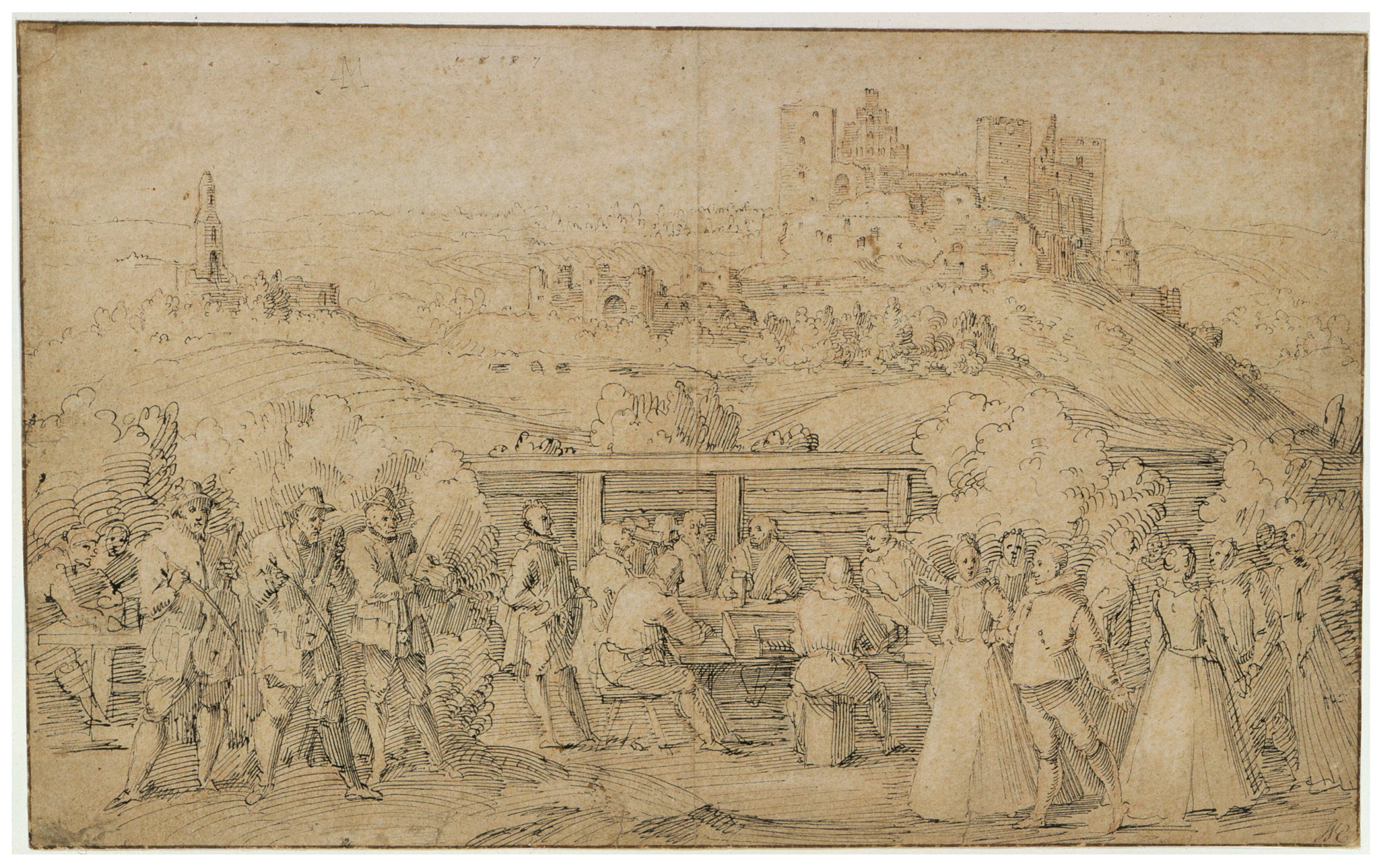
| 12 | Signed in ligature AM and dated 1587 along the top of the work. |
| 13 | “Primum, si rem ipsam spectes, inuenies Musicam esse ab initio mundi inditam seu concretam creaturis vniuersis, singulis et omnibus. Nihil enim est sine sono, seu numero sonoro, ita vt et aer ipse per sese inuisibilis et inpalpabilis, omnibusque sensibus inperceptibilis, minimeque omnium musicus, sed plane mutus et nihil reputatus, tamen motus sit sonorous et audibilis, tunc etiam palpabilis….” |
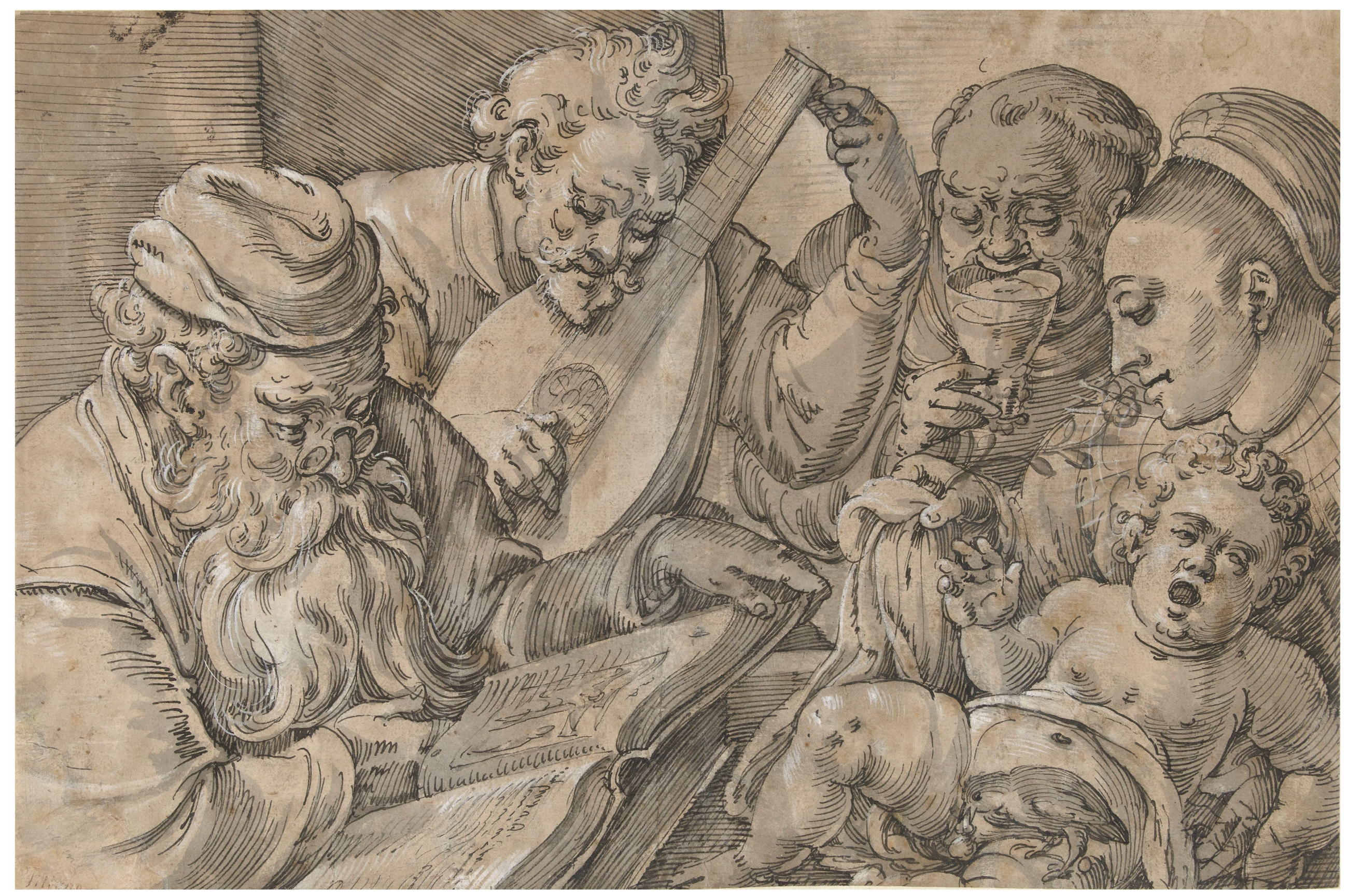
| 14 | It could also be that the lute player must listen closely over the din of the crying infant (who represents touch) as a bird bites his penis. |
| 15 | See, for instance, Giorgione, The Three Ages of Man (Giorgione 1500), in which tactus is used as an allegory of time. https://commons.wikimedia.org/wiki/File:Giorgione,_Three_Ages.jpg (accessed on 20 January 2026). Tactus is further discussed in (Hatter 2011). The title page of Opusculum Musice mensuralis by Sebastian of Felsztyn depicts members of a vocal ensemble cupping their ears while a figure in the forefront beats tactus (Felsztyn 1517). |
| 16 | “Das verwustete schlos Cristberg 3 meil. Von Marienburg sie es an Zu schawen/wan man ein halb viertel weges Davon stehet im felde geschrabbeldt/in eile bei dem pfluge in pflug,” Transcription Tylicki. Transcription by author and Quinton Binder. For a detailed bibliography compiled by Jacek Tylicki of writing on these works, please see (Tylicki 2005). |
References
- Agricola, Martin. 1529. Musica instrumentalis deudsch: Ynn welcher begriffen ist, wie man nach dem gesange auff mancherley Pfeiffen lernen sol, auch wie auff die Orgel, Harffen, Lauten, Geigen, vnd allerley instrument vnd Seytenspiel, hach der rechtgegrundten Tabelthur sey abzusetzen. Wittenberg: G. Rhau, Reprinted in 1896: Breitkopf & Härtel, 210. [Google Scholar]
- Anonymous. n.d. Ceramic floor tile with game “gry w młynek” (seventeenth century). Museum of Warsaw., inv. no. MHW/DZA/ZW/1198. Available online: https://muzeumwarszawy.pl/obiekt/plytka-podlogowa-plansza-gry-mlynek/ (accessed on 17 January 2026).
- Baldung Grien, Hans, Heinrich Vogtherr, or Peter Flötner (attributed). c. 1540. Jensen, C. E. (1908) Karikatur-album. Den evropæiske karikatur-kunst fra de ældste tider indtil vore dage. Væsenligst paa grundlag af Eduard Fuchs: Die Karikatur. Available online: http://commons.wikimedia.org/wiki/File:Alfons_luder_kunde.gif (accessed on 5 September 2025).
- Bayer, Oswald. 2008. Martin Luther’s Theology. A Contemporary Interpretation. Grand Rapids: W. B. Eerdmans Publishing Co., p. 184. [Google Scholar]
- Beham, Hans Sebald. 1535. Large Village Fair. Woodcut on Paper. Art Institute Chicago, inv. no. 1967.491. Available online: https://www.artic.edu/artworks/27884/the-large-village-fair (accessed on 17 January 2026).
- Beham, Hans Sebald. 1546. The Peasant Wedding or the Twelve Months: 7 Jacob Hewmon. Copperplate Engraving. The Cleveland Museum of Art, Mr. and Mrs. Lewis B. Williams Collection, inv. no. 1950.479.4. Available online: https://www.clevelandart.org/art/1950.479.4 (accessed on 17 January 2026).
- Beumkes, Yvonne. 2022. Peasants Dancing at the Village Fair. Available online: https://artanddance.art.blog/2022/06/05/peasants-dancing-at-the-village-fair/ (accessed on 3 October 2025).
- Bogucka, Maria. 1984. Gdańscy Ludzie Morza w XVI–XVII w. [Gdańsk People of the Sea in the Sixteenth and Seventeenth Centuries]. Gdańsk: Wydawnictwo Morskie Gdańsk, pp. 38–41. [Google Scholar]
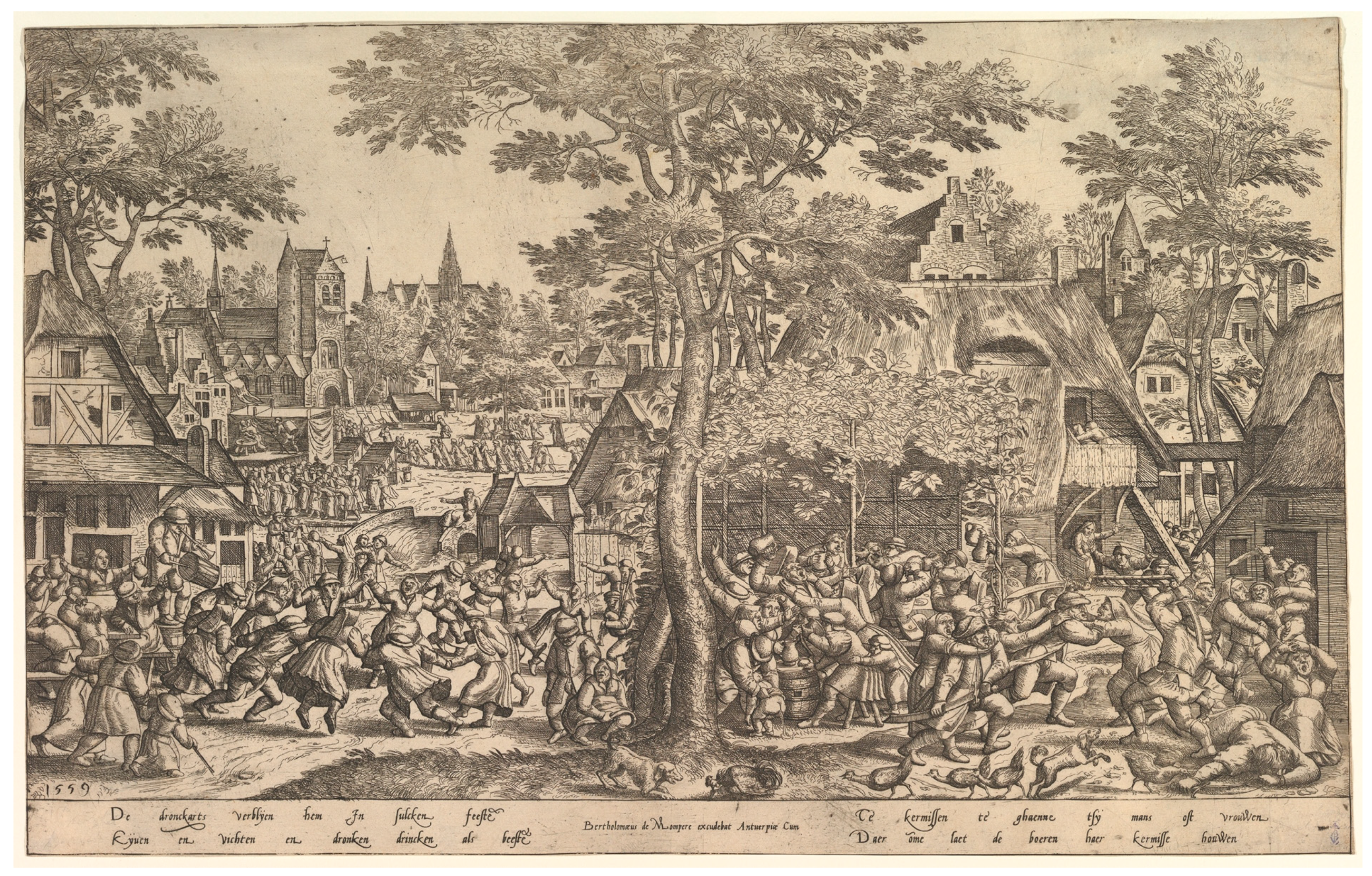
- Borcht the Elder, Pieter van der. 1559. Folk Fair [Boerenkermis]. Metropolitan Museum of Art, inv. no. 2000.437. Available online: https://www.metmuseum.org/art/collection/search/342616 (accessed on 17 January 2026).
- Dahlig, Ewa. 1994. A Sixteenth-century Polish Folk Fiddle from Płock. The Galpin Society Journal 47: 111. Available online: https://www.jstor.org/stable/i234937 (accessed on 27 August 2025). [CrossRef]
- Dahlig, Ewa. 2001. Ludowe instrumenty skrzypcowe w Polsce [Folk Forms of Fiddles in Poland]. Warsaw: Instytut Sztuki Polskiej Akademii Nauk, p. 213. [Google Scholar]
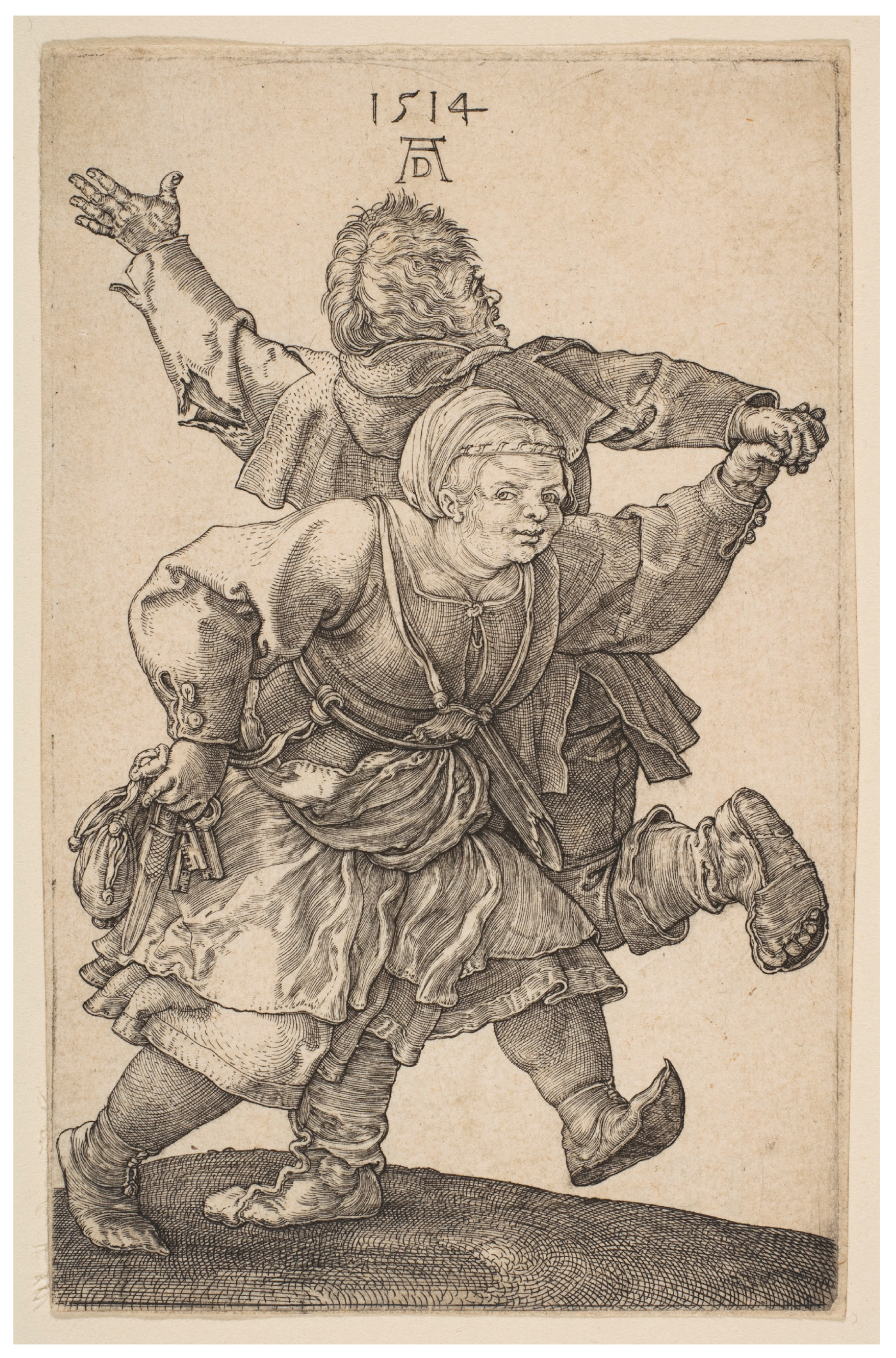
- Dürer, Albrecht. 1514. Peasant Couple Dancing. Metropolitan Museum of Art. Bequest of Ida Kammerer, in Memory of her husband, Frederic Kammerer, M.D., 1933, inv. no. 33.79.1. Available online: https://www.metmuseum.org/art/collection/search/391211 (accessed on 17 January 2026).
- Erasmus of Rotterdam. 1558. Adagiorum chiliades quatuor cum sesquicenturia, des. Erasmi Roterodami. Robertus Stephanus (Robert Estienne): Paris, 51, 196. Available online: https://archive.org/details/bub_gb_q9o5RQWC6M8C/mode/2up (accessed on 10 March 2025).
- Felsztyn, Sebastian of. 1517. Opusculum Musice mensuralis. Kraków, Haller. Available online: https://polona.pl/item-view/7dab76b6-2166-4da9-98a6-e2515abc0516?page=4 (accessed on 5 December 2025).
- Franits, Wayne. 2017. Wily women?: On sexual imagery in Dutch art of the seventeenth century. In From Revolt to Riches: Culture and History of the Low Countries, 1500–1700. Edited by Theo Hermans and Reinier Salverda. London: UCL Press, pp. 220–233, 228. Available online: https://doi.org/10.2307/j.ctt1n2tvhw.26 (accessed on 10 December 2025). [CrossRef]
- Gheeraerts the Elder, Marcus. c. 1571. Festival at Bermondsey. Private Collection. Available online: https://upload.wikimedia.org/wikipedia/commons/b/bc/Marcus_Gheeraerts_the_Elder_-_Festival_at_Bermondsey.png (accessed on 1 September 2025).
- Gibson, Gail McMurray. 1977. Ave Madeline: Ironic Annunciation in Keats’s “The Eve of St. Agnes.”. Keats-Shelley Journal 26: 44 fn. 23. Available online: http://www.jstor.org/stable/30212802 (accessed on 8 September 2025).
- Giorgione. 1500. The Three Ages of Man. Palazzo Pitti, Florence, inv. no. 110. Available online: https://commons.wikimedia.org/wiki/File:Giorgione,Three_Ages.jpg (accessed on 17 January 2026).
- Gloger, Zygmunt. 1903. Geografia historyczna ziem dawnej Polski. Warsaw: Spółka Wydawnicza Polska, p. 156. [Google Scholar]
- Hatter, Jane. 2011. Col tempo: Musical time, aging and sexuality in 16th-Century Venetian paintings. Early Music 39: 3–14. [Google Scholar] [CrossRef]
- Hebbert, Benjamin. 2020. Violin Making in Northern Europe in the Time of the Amatis: Part 2. Available online: https://violinsandviolinists.com/violin-making-in-northern-europe-in-the-time-of-the-amatis-part-2/ (accessed on 31 August 2025).
- Herbst, Klaus-Dieter. 2023. Johann Kretschmar. Biobibliographisches Handbuch der Kalendermacher von 1550 bis 1750. Available online: https://www.presseforschung.uni-bremen.de/dokuwiki/doku.php?id=kretzschmar_johann (accessed on 30 April 2025).
- Januszajtis, Andrzej. 2021. History of Science in Gdańsk. Task Quarterly 25: 50. [Google Scholar] [CrossRef]
- Jasniewicz-Downes, Aleksandra. 2005. Adolf Boy. Próba określenia “oeuvre” malarskiego [Adolf Boy. An attempt to define the painter’s “oeuvre”]. Teka Komisji Historii Sztuki 10: 246–56. [Google Scholar]
- Jongh, Eddy de. 1999. The iconological approach to seventeenth-century Dutch painting. In The Golden Age of Dutch Painting in Historical Perspective. Edited by Frans Grijzenhout and Henk van Veen. Translated by Andrew McCormick. Cambridge: Cambridge University Press, pp. 200–23. [Google Scholar]
- Kajdańska, Aleksandra. 2020. Ubiory w nowożytnym Gdańsku od połowy XVI do końca XVIII wieku. Gdańsk: Wydawnictwo Uniwersytetu Gdańskiego, pp. 48–49. [Google Scholar]
- Kartawidjaja, Yakub E. 2021. Music in Martin Luther’s Theology. Germany: Vandenhoeck & Ruprecht, p. 94. [Google Scholar]
- Klukowska, Maria. 1993. Anton Möller. In Słownik Artystów Polskich i Obcych w Polsce Działających (zmarłych przed 1966 r.) [Dictionary of Polish and Foreign Artists Active in Poland (Deceased Before 1966)]. Edited by Janusz Derwojed. Warsaw: Krąg, pp. 623–24. [Google Scholar]
- Korsch, Dietrich. 2021. The Word of God and Music in Luther: Re-Reading Luther’s 1538 Rhau Preface. In Lutheran Music Culture: Ideals and Practices. Edited by Mattias Lundberg, Maria Schildt and Jonas Lundblad. Berlin and Boston: De Gruyter, pp. 21–22, 28. [Google Scholar] [CrossRef]
- Loewe, J. Andreas. 2013. “Musica est Optimum:” Martin Luther’s theory of music. Music & Letters 94: 573–605. Available online: http://www.jstor.org/stable/24547377 (accessed on 1 September 2025).
- Loewe, J. Andreas, and Katherine Firth. 2022. Martin Luther and the Arts: Music, Images, and Drama to Promote the Reformation. Leiden: Brill, p. 218. [Google Scholar]
- Martens, Maximiliaan. 2018. Dancing Peasants at a St. Sebastian’s Kermis: A Rediscovered Painting by Pieter Bruegel the Elder. Milan: Silvana Editoriale. [Google Scholar]
- McCarthy, Vanessa Gillian. 2015. Prostitution, Community and Civic Regulation in Early Modern Bologna. Ph.D. dissertation, University of Toronto, Toronto, ON, Canada; pp. 37–38, 52. Available online: http://hdl.handle.net/1807/72884 (accessed on 24 August 2025).
- Miziołek, Jerzy. 2005. The punishment of Licinius Crassus and other “exempla iustitiae” at Arthur’s Court in Gdańsk in the context of Netherlandish, German and Italian art. Questiones Medii Aevi Novae 10: 345–74. [Google Scholar]
- Morawska, Katarzyna. 2002. The History of Music in Poland (The Renaissance 1500–1600), II. Translated by John Comber. Warsaw: Sutkowski Edition Warsaw, p. 79. [Google Scholar]
- Moxley, Keith. 1989. Peasants, Warriors and Wives: Popular Imagery in the Reformation. Chicago: The University of Chicago Press. [Google Scholar]
- Möller the Elder, Anton. 1587a. An Elegant Reception with Christburg Castle in the Background [Eleganckie Przyjecie na tle Zamku w Dzierzgoniu]. Pen and ink on paper. Berlin Staatliche Museen, Preußischer Kulturbesitz Kupferstichkabinett, inv. no. KdZ 17916. Available online: https://recherche.smb.museum/detail/1038600/bankett-im-freien-mit-musikanten (accessed on 8 September 2025).
- Möller the Elder, Anton. 1587b. Folk Fair Before Marienburg [Zabawa ludowa pod Malborkiem]. Pen and ink on paper. Berlin Staatliche Museen, Preußischer Kulturbesitz Kupferstichkabinett, inv. no. KdZ 875. Available online: https://recherche.smb.museum/detail/948034/kirmes-in-marienburg (accessed on 8 September 2025).
- Möller the Elder, Anton. 1588. Old Traveler with a Young Man with a Sword [Oude Zwerver met Jongeman met Zwaard]. Pen and ink on Paper. Rijksmuseum, inv. no. RP-T-00-691. Available online: https://id.rijksmuseum.nl/200114810 (accessed on 5 September 2025).
- Möller the Elder, Anton. 1597. Death Portrait of Bonifacio Giovanni Bernardino D’Oria. National Museum, Gdańsk [Museum Narodowe Gdańsk]. Available online: https://pl.wikipedia.org/wiki/Jan_Bernard_Bonifacio#/media/Plik:Joannes_Bernhardinus_Bonifacius.jpg (accessed on 10 June 2025).
- Möller the Elder, Anton. 1598. Patrician Woman. National Museum, Gdańsk. Available online: https://commons.wikimedia.org/wiki/File:Anton_M%C3%B6ller_Patrycjuszka.jpg (accessed on 5 September 2025).
- Möller the Elder, Anton. 1608. Portrait of Johann von der Linde. National Museum Gdańsk. Available online: https://upload.wikimedia.org/wikipedia/commons/6/65/Johann_von_der_Linde_1608.jpg (accessed on 5 September 2025).
- Möller the Elder, Anton. c. 1606–1609. Drunk Orchestra [Orkiestra pijacka] from the Stammbuch of Michael Heidenreich. Kórnik Library, Polish Academy of Sciences, inv. no. BK 1436, 53 (Later Pagination). Digitized Page No. 111. Available online: https://platforma.bk.pan.pl/pl/bib_records/212164 (accessed on 5 September 2025).
- Möller the Elder, Anton. n.d. The Five Senses (and Five ages of Man?) [De vijf zintuigen (en tevens vijf leeftijden?)]. Rijksmuseum, Pen in Black, Blush in White and Gray on Paper, inv. no. RP-T-1916-28. Available online: https://id.rijksmuseum.nl/200115280 (accessed on 4 January 2026).
- Möller the Younger, Anton. 1617. Fair [Kirchweih]. Herzog Anton Ulrich Museum, Germany, inv. no. Z 89. Available online: https://www.christies.com/en/lot/lot-5868550 (accessed on 21 August 2025).
- Nastyuk, Elena. 2017. Shoes as Symbols in Art. Available online: https://arthive.com/encyclopedia/195~Shoes_as_symbols_in_art (accessed on 20 March 2025).
- Panofsky, Erwin. 1934. Jan van Eyck’s Arnolfini Portrait. The Burlington Magazine for Connoisseurs 64: 117–27. Available online: http://www.jstor.org/stable/865802 (accessed on 2 January 2025).
- Pliny the Elder. 1906. Naturalis Historia. Edited by Karl Friedrich Theodor Mayhoff. Leipzig: B. G. Teubner, book XXXV, chapter XXXVI. Available online: http://data.perseus.org/citations/urn:cts:latinLit:phi0978.phi001.perseus-lat1:35.36 (accessed on 17 January 2026).
- Praetorius, Michael. 1619. Syntagma Musicum, vol II. De organographia. Wolfenbüttel: Elias Holwein, fol. 44. [Google Scholar]
- Smith, Mark M. 2007. Sensing the Past: Seeing, Hearing, Smelling, Tasting, and Touching in History. Berkeley: University of California Press, p. 45. [Google Scholar]
- Smith, Simon, Jackie Watson, and Amy Kenny, eds. 2015. Introduction. In The Senses in Early Modern England, 1558–1660. Manchester: Manchester University Press, p. 5. [Google Scholar]
- Stewart, Alison G. 2014. Man’s Best Friend? Dogs and Pigs in Early Modern Germany. In Animals and Early Modern Identity. Edited by Pia F. Cuneo. Abingdon-on-Thames: Routledge, p. 21. [Google Scholar]
- Szmelter-Fausek, Bożena, and Justyna Olszewska-Świetlik. 2018. Painting works by Anton Möller on the background of Gdańsk’s painting workshop of the last quarter of the 16th and the first half of the 17th century. Acta Universitatis Nicolai Copernici Zabytkoznawstwo i Konserwatorstwo 48: 133–75. [Google Scholar] [CrossRef]
- Tylicki, Jacek. 2005. Rysunek gdański ostatniej ćwierci XVI i pierwszej połowy XVII wieku [Gdańsk Drawings from the Last Quarter of the Sixteenth Century and the First Half of the Seventeenth Century]. Toruń: Wydawnictwo Uniwersytetu Mikołaja Kopernika, pp. 37–39, 177, 182–83. [Google Scholar]
- Veronese, Paolo (Caliari). 1563. Les Noces de Cana [The Wedding at Cana]. Musée du Louvre. Inv No. 142. Available online: https://collections.louvre.fr/en/ark:/53355/cl010064382# (accessed on 1 September 2025).
- Vitruvius, Pollio. 2006. The Ten Books on Architecture. Translated by Morris Hickey Morgan. Cambridge: Harvard University Press, pp. 139, 153. Available online: https://gutenberg.org/cache/epub/20239/pg20239-images.html (accessed on 1 December 2025).



Disclaimer/Publisher’s Note: The statements, opinions and data contained in all publications are solely those of the individual author(s) and contributor(s) and not of MDPI and/or the editor(s). MDPI and/or the editor(s) disclaim responsibility for any injury to people or property resulting from any ideas, methods, instructions or products referred to in the content. |
© 2026 by the author. Licensee MDPI, Basel, Switzerland. This article is an open access article distributed under the terms and conditions of the Creative Commons Attribution (CC BY) license.
Share and Cite
Peppers, E. Music, Morality, and Mayhem: Anton Möller the Elder’s Drawings from Marienburg (1587). Arts 2026, 15, 26. https://doi.org/10.3390/arts15020026
Peppers E. Music, Morality, and Mayhem: Anton Möller the Elder’s Drawings from Marienburg (1587). Arts. 2026; 15(2):26. https://doi.org/10.3390/arts15020026
Chicago/Turabian StylePeppers, Emily. 2026. "Music, Morality, and Mayhem: Anton Möller the Elder’s Drawings from Marienburg (1587)" Arts 15, no. 2: 26. https://doi.org/10.3390/arts15020026
APA StylePeppers, E. (2026). Music, Morality, and Mayhem: Anton Möller the Elder’s Drawings from Marienburg (1587). Arts, 15(2), 26. https://doi.org/10.3390/arts15020026