2. The Loggia di Psiche at Villa Farnesina and Its Strange Reptilian Creature in the Fire
In a spandrel above the arcade facing the garden of the
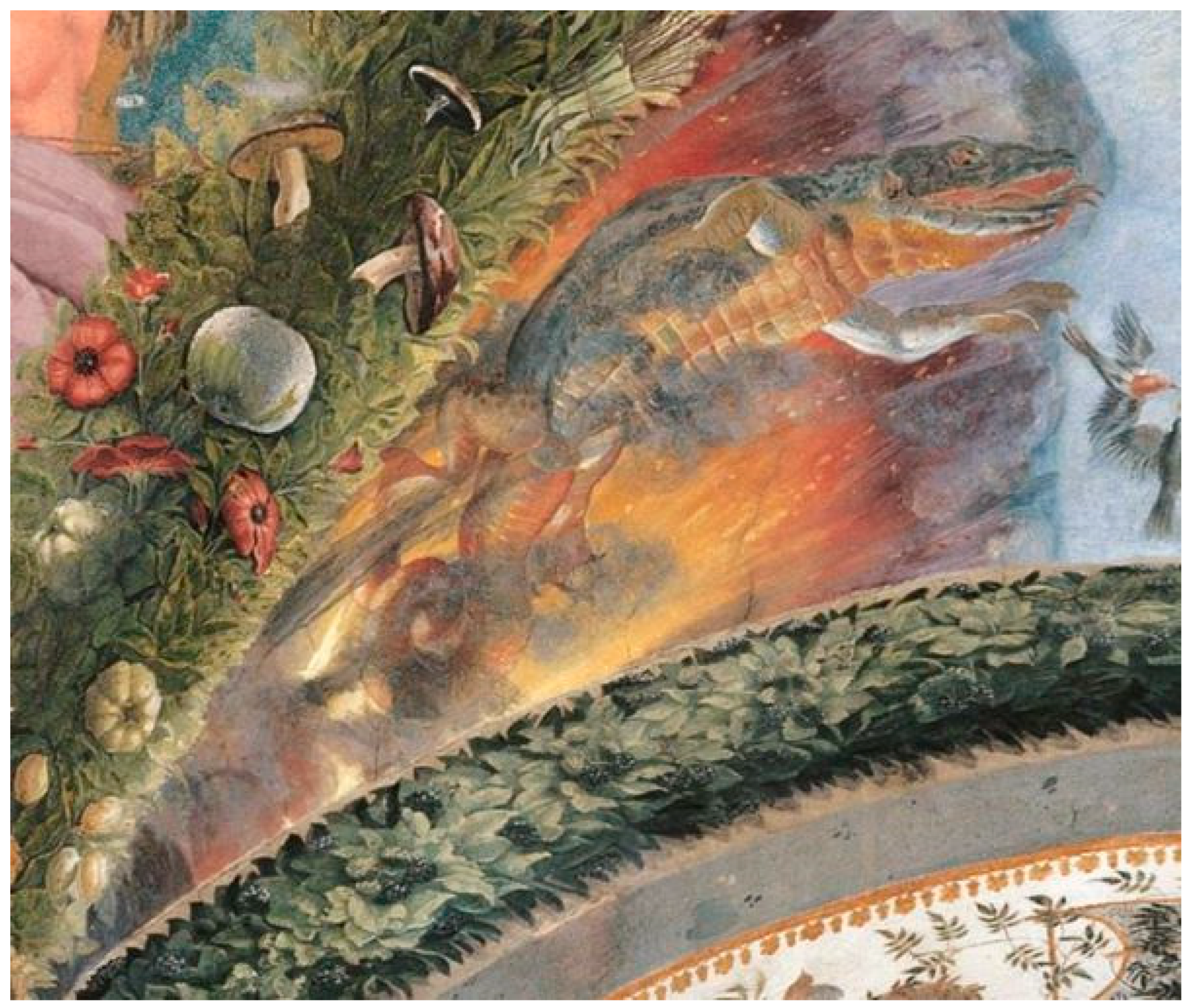
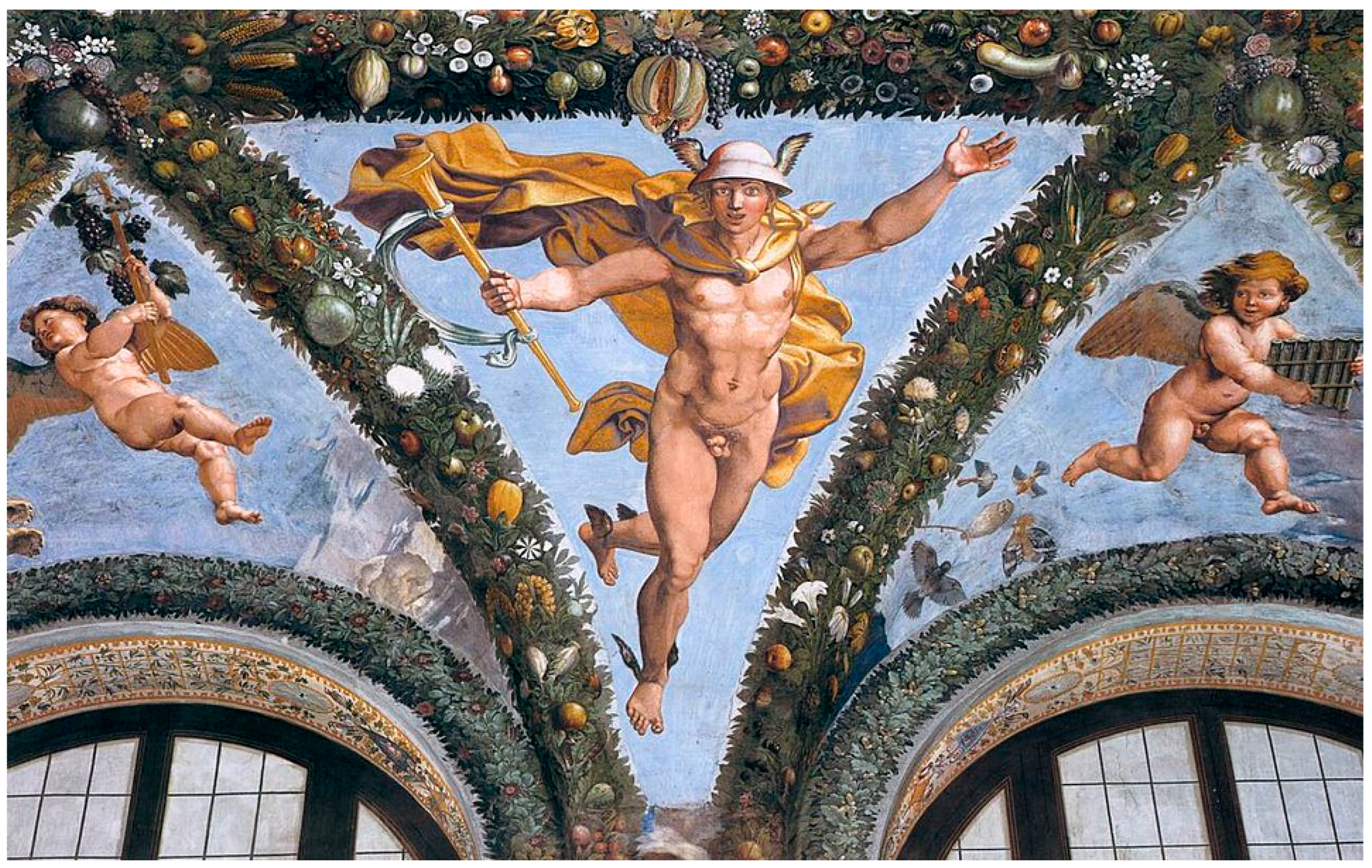
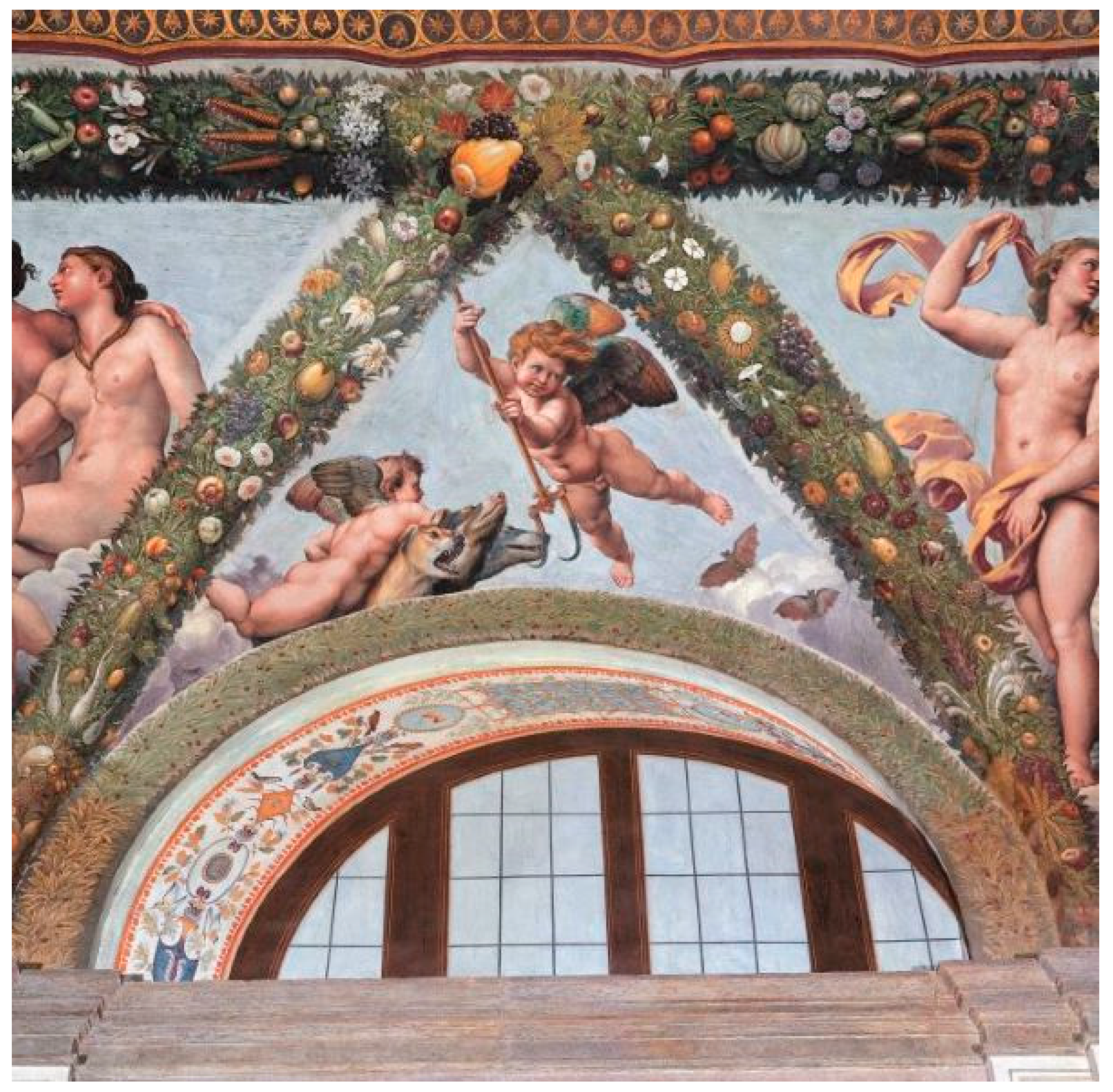
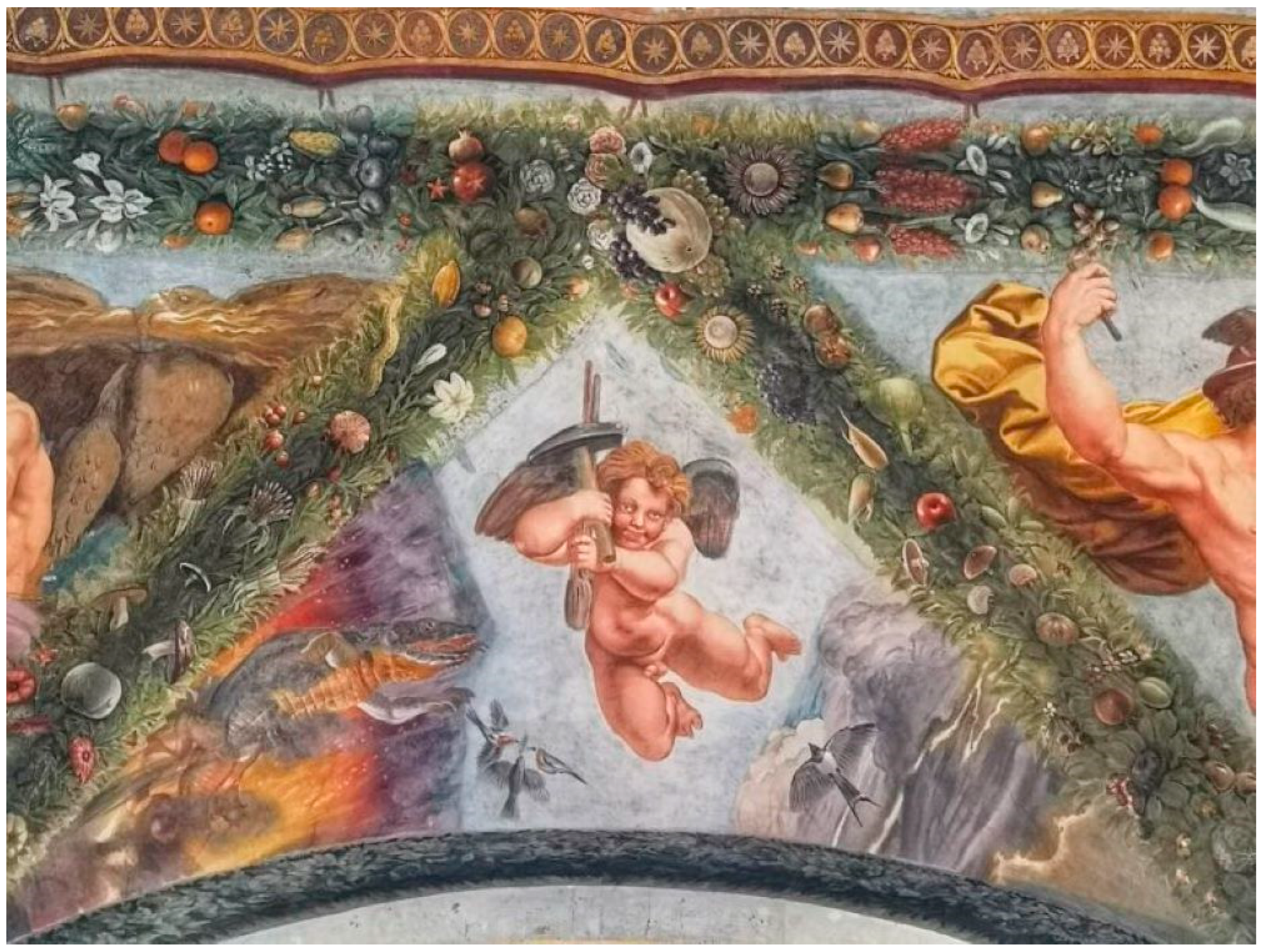
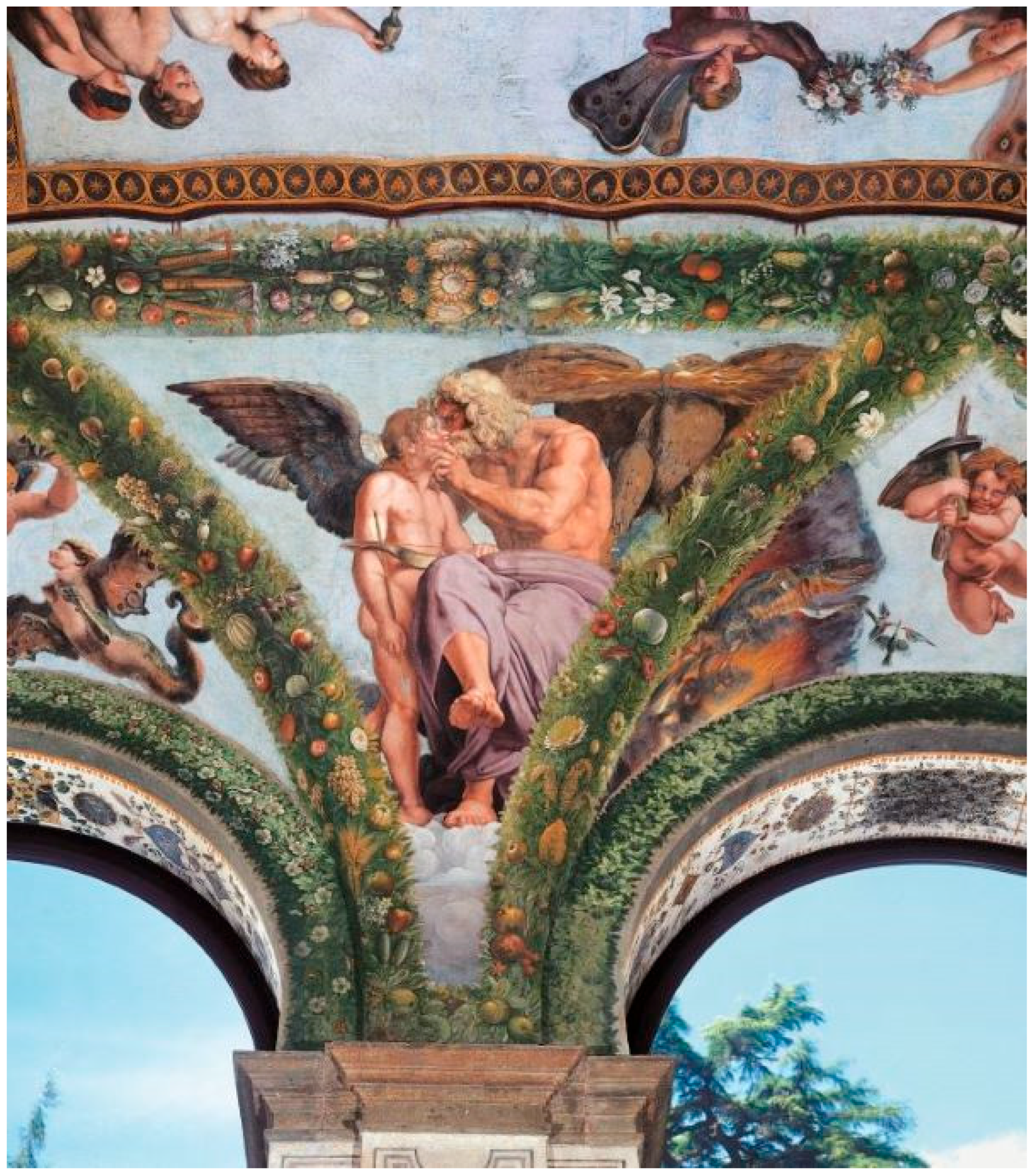
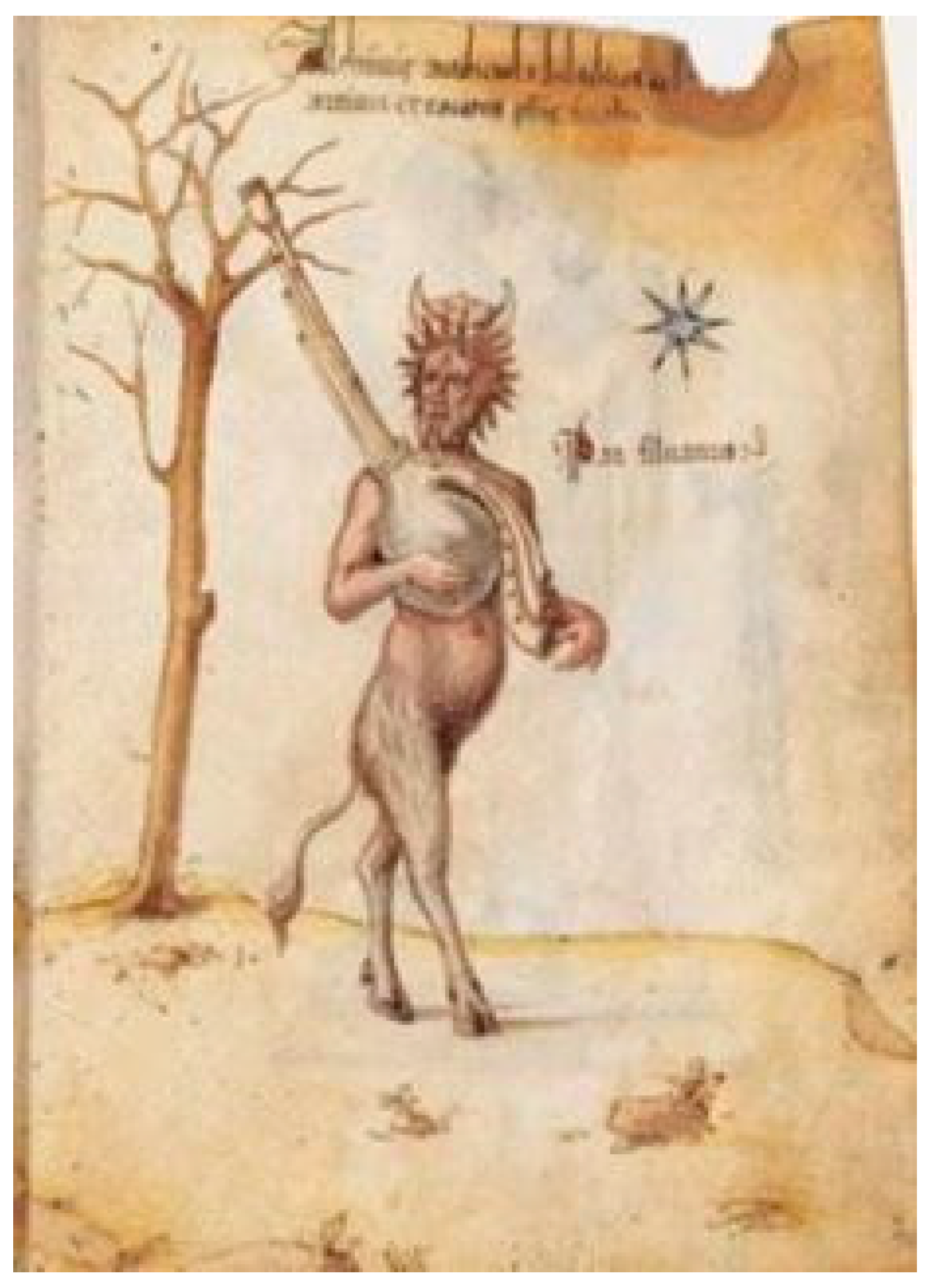
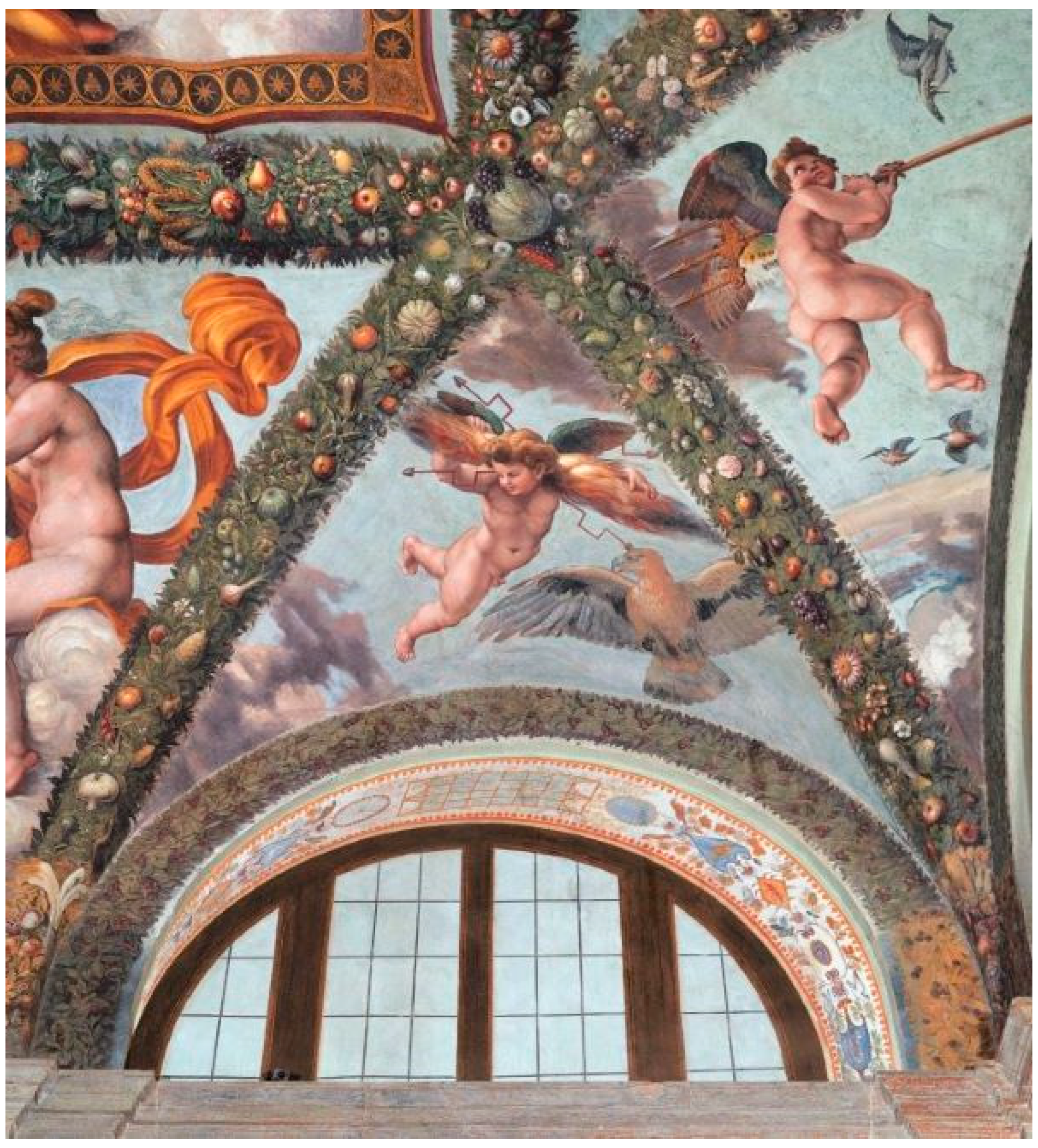
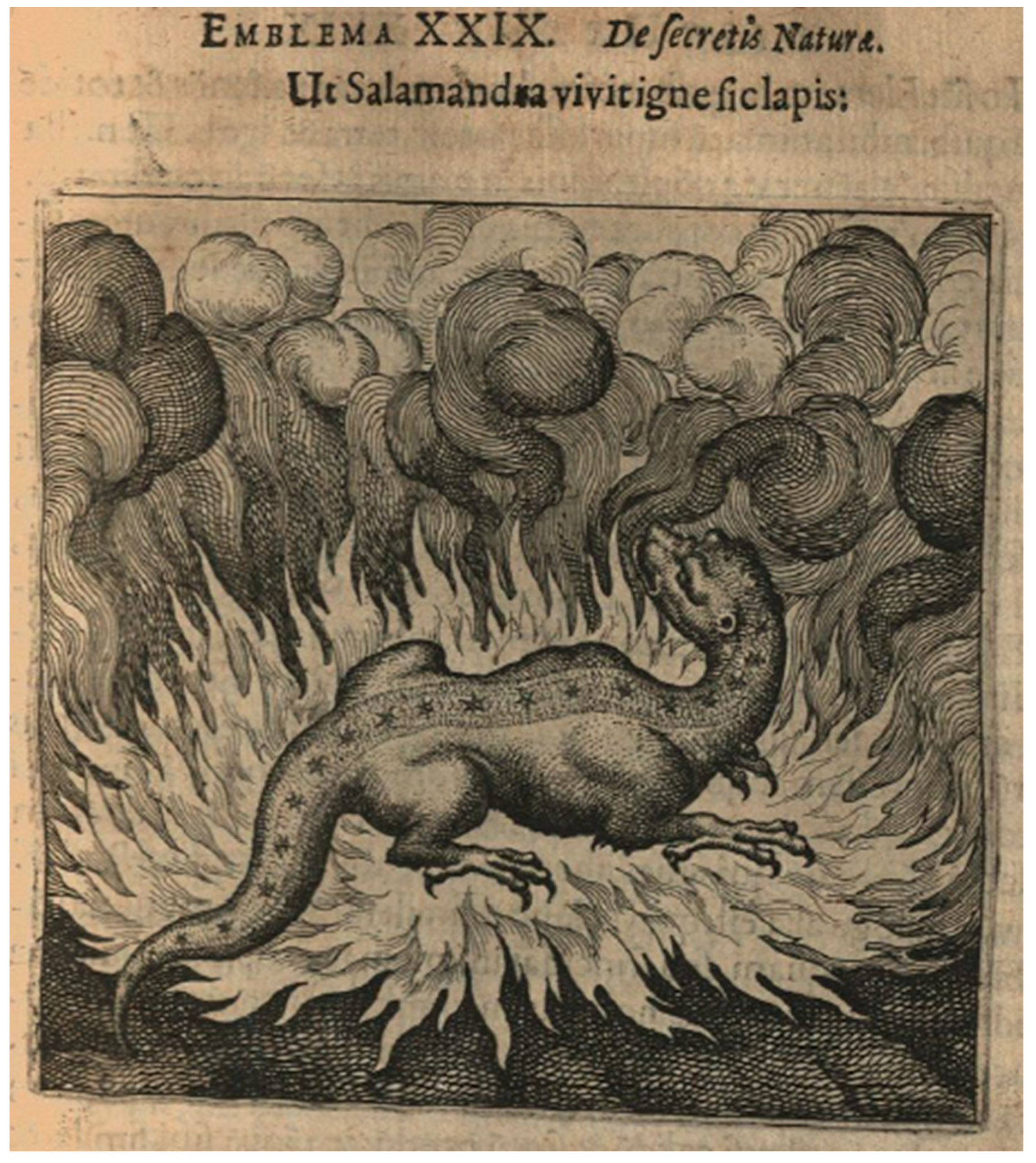
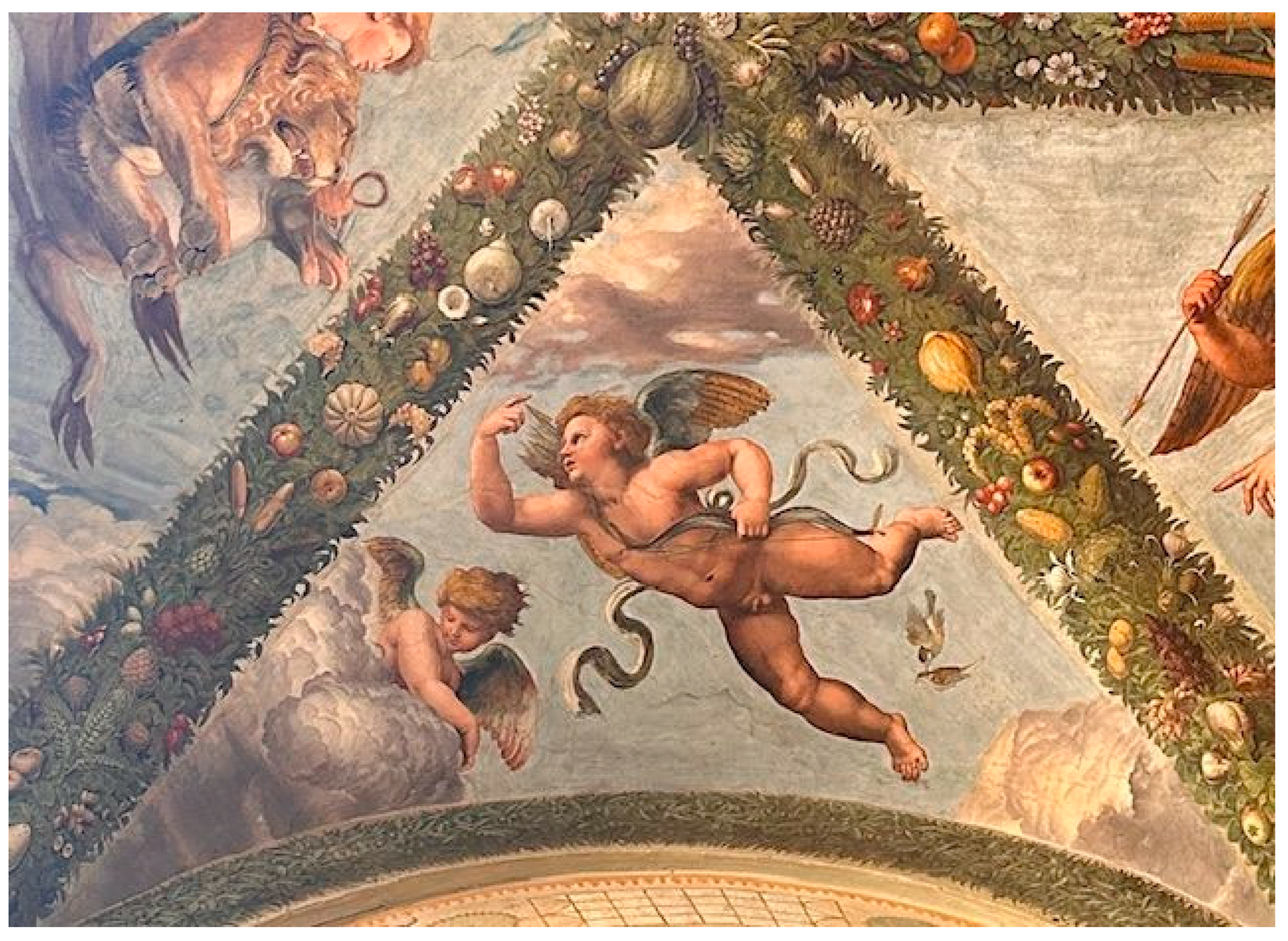
Loggia di Psiche at Villa Farnesina in Rome, is a beguiling scene full of terror and wonderment. Emerging from the infernal region at the right angle of this spandrel is a hideous reptilian creature consumed by fire, but not scorched by its flames, which arises from the combustion (
Figure 1 and
Figure 2). No scholar has analyzed this bizarre figure and its fiery domain or, to my knowledge, even mentioned its bewildering presence in the complex iconography of the hall (
Shearman 1961, pp. 59–95;
Marek 1984, pp. 257–90;
Marek 1986, pp. 189–208;
Rohlmann 2002, pp. 71–92;
Cavicchioli 1995–1998;
1999, pp. 79–95;
2002, pp. 155–71;
Varoli-Piazza 2002, pp. 57–69;
Varoli-Piazza 2005, pp. 7–36;
Frommel 2003a,
2003b;
Rijser 2012, pp. 419–24;
Huber,
2019, ch. 4;
J. G. Turner 2022, ch. 4). Why is it there and what possibly could it mean? The final purpose of this study is to clarify the iconography of the image by identifying the literary source upon which it was apparently based, while indicating an alternative symbolic reading of the loggia.
The
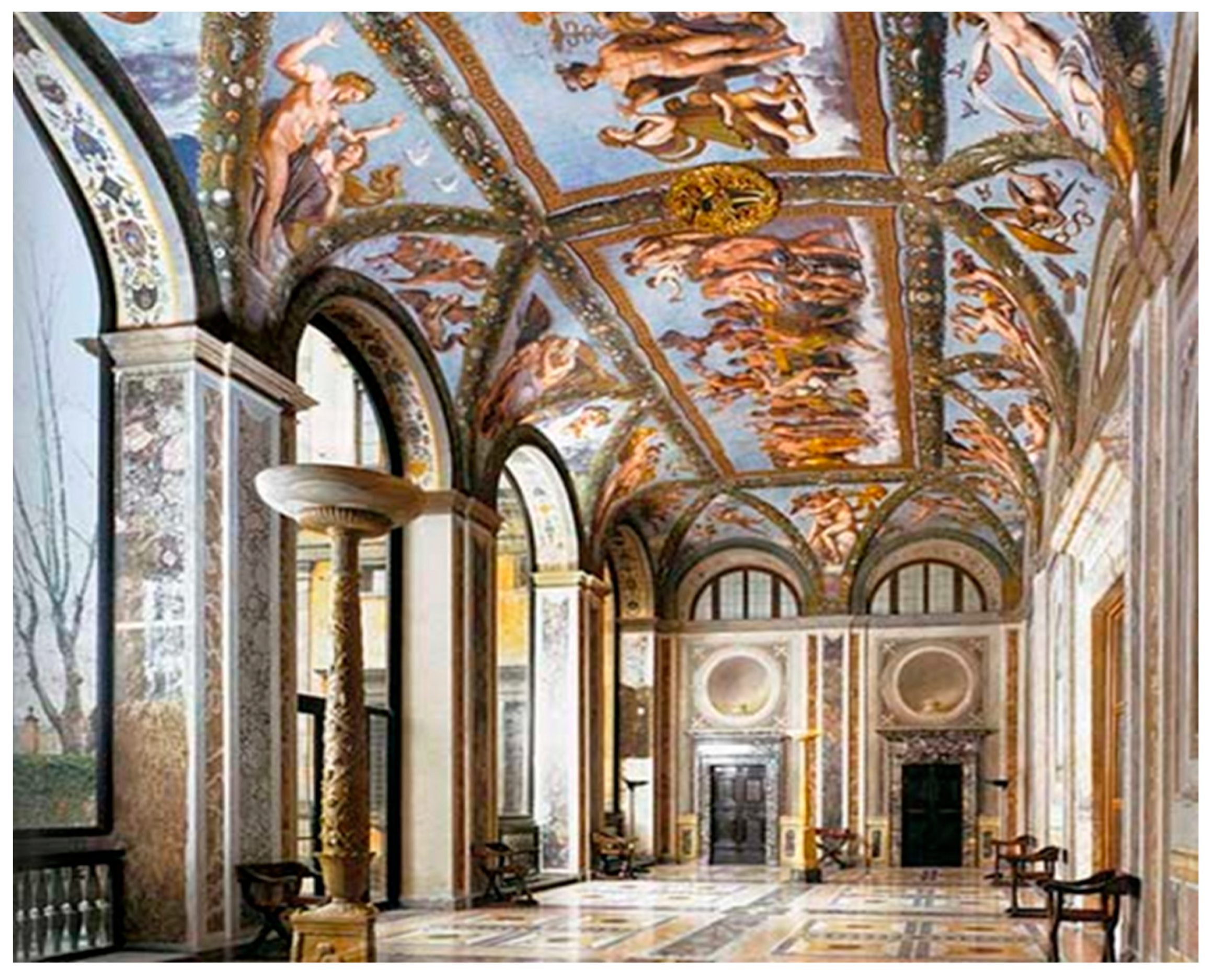
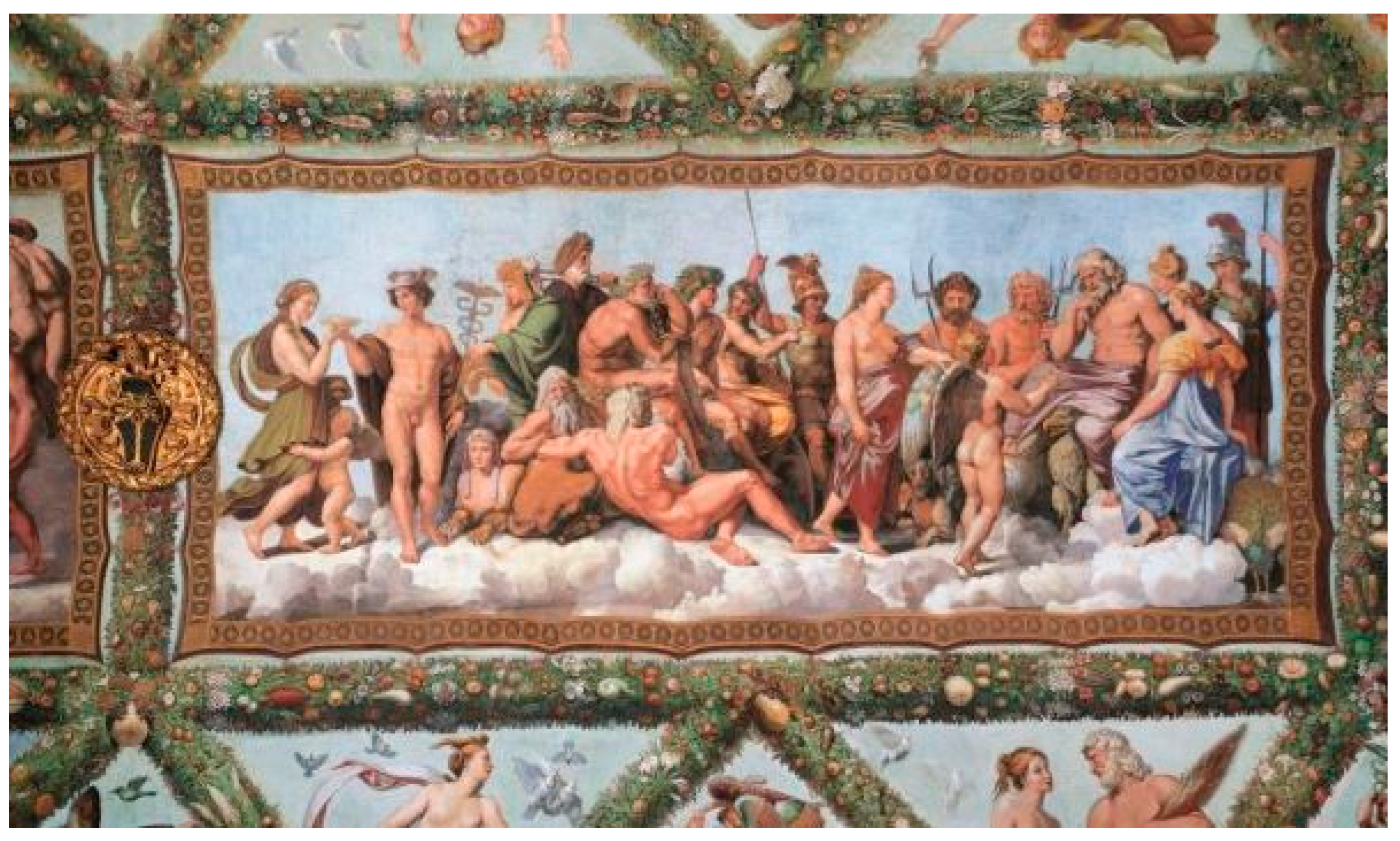
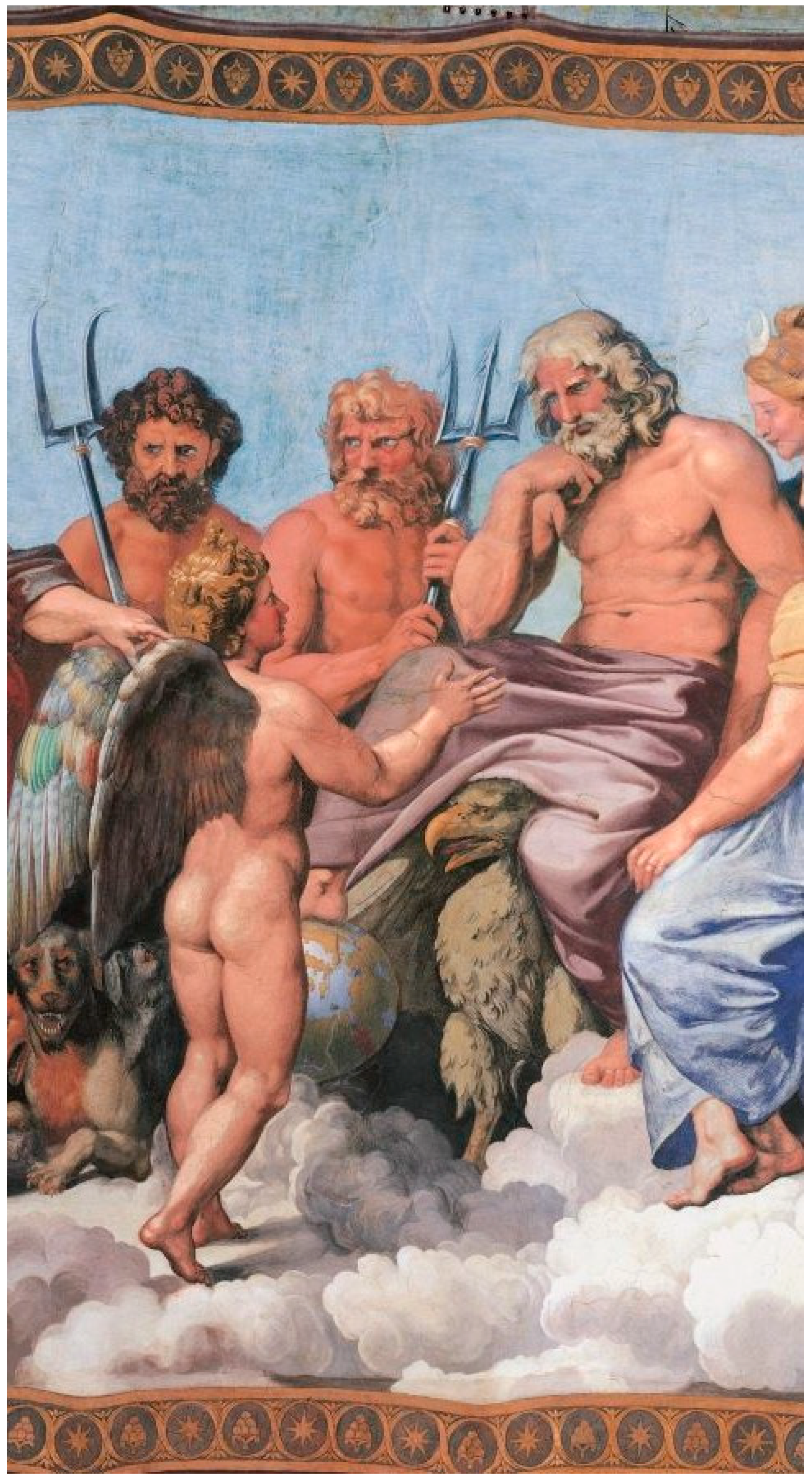
Loggia di Psiche at Villa Farnesina along the Tiber, frescoed by Raphael (1483–1520) and
bottega for the fabulously wealthy papal banker from Siena, Agostino Chigi (1466–1520), completed by 1519, is among the best-known examples of High Renaissance art in Rome
2 (
Figure 3). Baldassarre Peruzzi (1481–1536), architect and painter of Siena, designed and built the villa for Chigi in 1506–1510. The myth of Cupid and Psyche is contained in the second-century Roman novel originally entitled
Metamorphoses (IV, 28—VI, 24), but later known as the
Golden Ass (
Asinus Aureus), by the North African writer and philosopher Apuleius (Lucius Apuleius Madaurensis).
3 Apuleius’ fable is told on the lips of a drunken old hag to console the lovely maiden Charite, prisoner of a gang of bandits, as an anodyne tale to take her mind off losing her betrothed (
Zimmerman 2004).
The myth relates how Psyche, because of her extraordinary beauty, unleashes the terrible jealousy of Venus. The goddess in turn unknowingly provokes the love affair between her son Cupid and mortal Psyche. Having besmirched the name of Eros, but having successfully carried out the lethal tasks of Venus, Psyche reaches Olympus, becomes immortal and marries Cupid (
Apuleius 1996,
Met. 6.23–24;
Rijser 2012, pp. 421–22). The story anticipates the trials of the novel’s hero Lucius, who is turned into an ass, but in the end redeemed. Delivered back to his manhood through divine intervention, Lucius is initiated into the sacred guilds of Egyptian Isis to become a quasi-saint. Psyche’s ordeal thus symbolically mirrors that of Lucius. In Greek Psyche means the soul, spirit and vital breath, symbolized by the delicate wings of the butterfly and thus the story of Cupid and Psyche is also the story of the human soul that must, like Lucius, overcome terrible trials in life to be made worthy of reaching the divine sphere.
Apuleius was a Platonist whose myth in the
Golden Ass had a central place in Neoplatonism (
Hartt 1950). In the Renaissance Apuleius’ affiliation with Platonism is recognized in the first printed edition (
editio princeps) of his works, both philosophical and literary, including
Metamorphoses, which was financed by Bishop Andrea Giovanni Bussi (1417–1475) and published at Rome in 1469 by the printmakers Sweynheym and Pannartz (
Cavicchioli 2002, p. 38). The preface to Bussi’s
editio princeps, although dedicated to Pope Paul II, lets us know that the writings of the great Greek émigré, Cardinal Bessarion (1403–1472), were the impetus behind the project: namely, the publication of a corpus of works unknown to the Platonic writers, beginning with “The Platonist Lucius Apuleius, in whom a distinguished copiousness and gracefulness of speech is joined to the highest erudition” (
Cavicchioli 2002, p. 38).
4 Perhaps, therefore, the
Loggia di Psiche emphasized Neoplatonic matters that related the themes of love and marriage union in the Cupid and Psyche tale to Chigi’s wedding at the villa in 1519 to his young Venetian bride of humble birth, Francesca Ordeaschi, for which the porch was painted. The nuptial theme of the loggia almost certainly intended to be a picturesque backdrop for Agostino’s and Francesca’s matrimony gala. So considering that its vault illustration of redeemed Psyche’s celestial wedding to divine Cupid, after her terrible trials took a favorable turn, is full of decent Neoplatonic resonance, this may in part be the case.
Modern scholarship, however, has looked beyond Neoplatonic relevance to draw a parallel between the Cupid and Psyche tale and the ordeal of bringing lowly Francesca, who was likewise severely tested, into Chigi’s high social sphere. In this way the artwork allowed the betrothed to see their vicissitudes aptly enacted (
Rijser 2012, p. 420). Contemporary studies, moreover, have connected the loggia’s iconography to a narrative based on the concept of humor, wit, gaiety and entertainment that the Renaissance suburban villa presupposes, aimed at
voluptas (
Zimmerman 2004, p. 552;
Rijser 2012, p. 420). The recent analysis of Villa Farnesina by James Grantham Turner concords with this line of thinking (
J. G. Turner 2022). For Turner the villa (and its loggia) celebrates aesthetic, social and erotic pleasure (
J. G. Turner 2022, p. 37). The frescoed edifice according to the author was the “seedbed” of an early sixteenth-century erotic revolution; a locus “where artists like Raphael and Giulio Romano conversed with writers like Pietro Bembo and Pietro Aretino, a ‘Palace of Venus’ displaying an influential visual encyclopedia of erotic myth in a highly prestigious context…” (
J. G. Turner 2017, pp. 110–31;
2022, p. 37). My analysis, by contrast, considers the fresco program and its iconography beyond Neoplatonic matters and sensual gratification at a deeper level of symbolic meaning from the point of view of alchemy, for reasons to be elucidated below.
Let us, then, embark upon an excursus that will provide the essential set of clues for the direction this inquiry will take, before finally returning to the spandrel image in question. In the process, beyond explaining principles of alchemy, I need to consider the following things (at times simultaneously): 1. how the mythological imagery of Villa Farnesina was meant to be understood at the time it was made and the allegorical readings of the Psyche tale in the Renaissance; 2. the relationship between astrology and alchemy in the Renaissance and Hermetic philosophy; and a reading or the Psyche myth then as symbolizing aspects of Egyptian occult themes and thus possibly alchemy, for reasons to be explained; 3. the plausible reasons why alchemy may have concerned Agostino Chigi; 4. the adaptation of Botticelli’s Primavera on Jacopo del Sellaio’s illustration of the Psyche myth on a Florentine marriage cassone panel (now in the Abegg-Stiftung, Riggisberg, Switzerland) concerning alchemy and astrology. Having investigated these matters, I shall provide an explanation for the reptilian creature in the fire of the spandrel, by indicating the probable alchemical literary source upon which it was based, and other aspects of the iconography of the loggia in relation to alchemy (and astrology).
3. Myths and Their “Hidden Sense” at Villa Farnesina, Plus the Psyche Tale and Allegory
In the first instance, it is useful to consider what a humanist working within the inner circle of Agostino Chigi in the early sixteenth-century, Blosio Palladio (d. 1550), had to say about some mythological scenes of the villa in a eulogistic Latin poem called
Suburbanum Augustini Chisii (“The Suburban Villa of Agostino Chigi”) of 1512. Referring to Sebastiano del Piombo’s frescoed lunettes containing episodes from Ovid’s likewise entitled
Metamorphoses in the adjacent
Loggia di Galatea, now a closed hall, the viewer is invited to grasp the unrevealed meaning: “But, having admired the work, now I desire that you marvel at that which lies hidden under it, and the story which is weighted with a hidden sense” (
Quinlan-McGrath 1990, p. 119;
Barbieri 2015a, pp. 184–213)
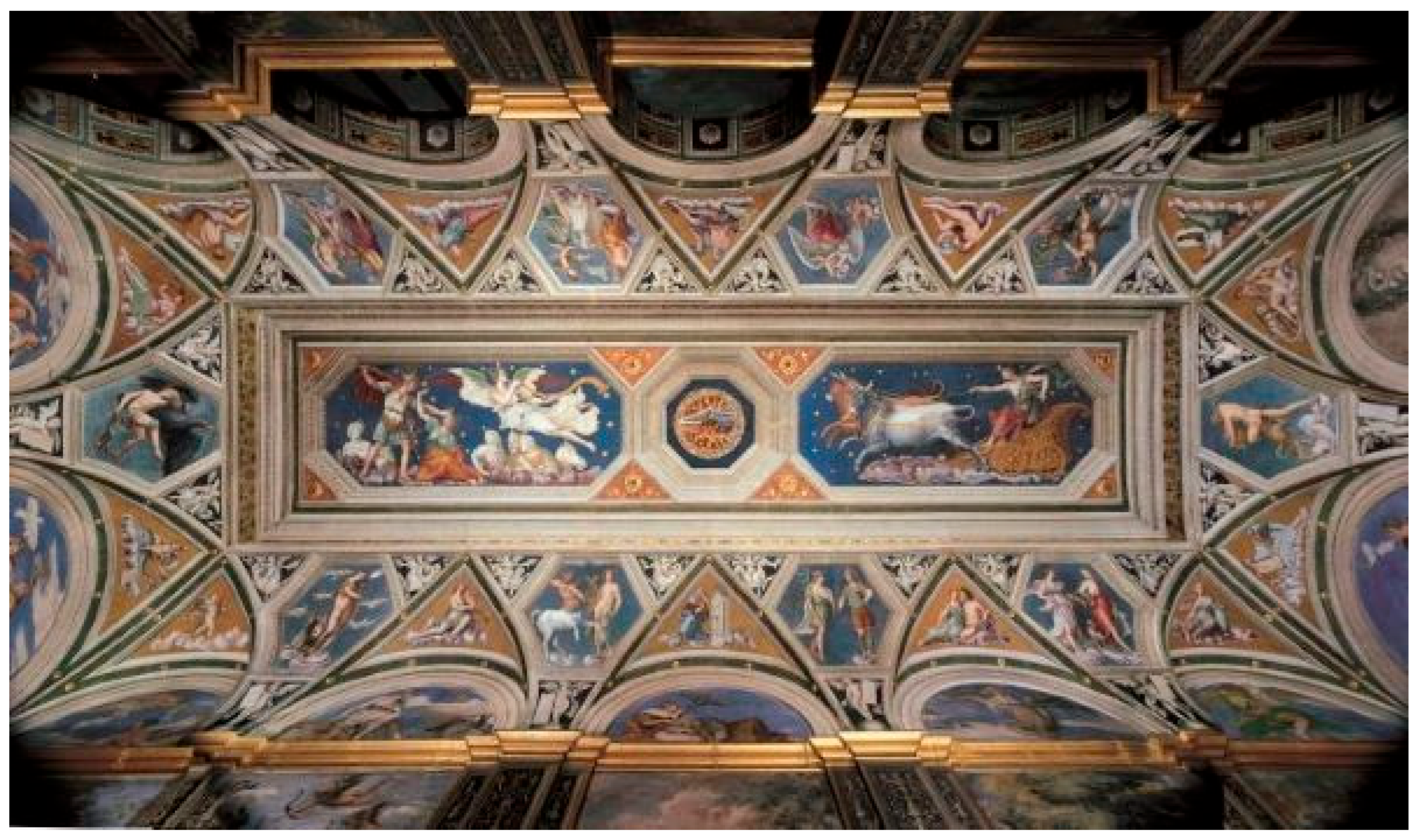
5 (
Figure 4, beneath the spandrels and hexagons). We are thus presented with a concept of layered iconographical meaning, in which the viewer starts to comprehend the artwork at the narrative surface and then penetrates into the deeper realms of more arcane profundities (or rather is challenged to do so). Blosio essentially echoes what the bishop of Orléans and poet Theodulph (ca. 760–821) had long before said about the myths contained in Ovid’s poem, namely that while much is frivolous there are very many truths hidden under false covering.
6Costanza Barbieri has excellently termed this phenomenon of viewing the mythological imagery as being encoded with layered meaning at Villa Farnesina,
meta-mythologies (“meta-mitologie”). Barbieri likens meta-mythologies to a theater within a theater of metamorphosis, in which the image first acts as the stage scene itself, to be admired for its beauty and narrative content, to then assume a symbolic function (
Barbieri 2023, X). Doubtless the idea of a “hidden sense” in the myths from Ovid’s
Metamorphoses of Sebastiano’s lunettes should be extended to all the mythological scenes of Villa Farnesina, such as the strange reptilian creature in the fire of the
Loggia di Psyche, which I will show relates its depicted Psyche tale to alchemy.
As the art of transmutation into gold, producing the elixir of longevity and the Philosopher’s Stone, alchemy at the metaphysical level accords well with the transformations of Psyche in Apuleius’ fable of
Metamorphoses/Golden Ass. For like the dissolutions and coagulations of the matter of the Stone in the alembic of alchemy, the story of Psyche is essentially one of corporeal death of imperfect matter, which passes from one nature to another; when the soul, being raised up high and united to its higher genius (in marriage to Cupid), obtains perfection (like Psyche’s apotheosis). A good starting point for understanding these alchemical processes is the notion of the “chemical wedding,” a central image of the
opus alchymicum, by which, through a repeated cycle of dissolutions and coagulations (
solve et coagula), the old metallic form is killed and reduced to the primary matter (
prima materia) of creation (
Abraham 1998, pp. 35–39). And then, by way of a conjunction (
coniunctio) of opposites, depicted in alchemical imagery as a coupling man and woman, it is reborn into a higher state of being. Through this “marriage” of opposites (
coniunctio oppositorum), which is the “chemical wedding,” the aim of the opus of rendering gold and its metaphysical correspondent, the Philosopher’s Stone, was obtained. Psyche’s trials, death, resurrection and ascent to Olympus, where she, like the “chemical wedding,” marries divine Amor (Cupid) and becomes a goddess, as an allegory squares very well with the processes of alchemy in the production of the Philosopher’s Stone. The notion will be explained further below. So we have to consider the fable allegorically, as indeed it was in the Renaissance.
The first monumental illustration of the Cupid and Psyche myth in Renaissance Italy, which was made at the ducal court of Ferrara, is instructive in this regard. Unfortunately, the artwork has not survived, but literary evidence of it remains, which confirms the spiritual and allegorical readings of Apuleius’ fable. The lost cycle of ca. 1490 was commissioned by Duke Ercole I d’Este (1431–1505), to his court artist Ercole de’ Roberti for the residence of Belriguardo.
7 Werner Gundersheimer in 1968 discovered a manuscript at the Vatican Apostolic Library (
Biblioteca Apostolica Vaticana) of Sabadino degli Arenti’s
De trumphis religionis (“On the Triumph of Religion”) of 1497 for Ercole I, which begins with a discussion of the magnificent lost Belriguardo frescoes (
Gundersheimer 1972). Sabadino degli Arienti provides us with a kind of clinical chart of the former artwork. He commences his description of the cycle by noting that: “On the walls one sees with singular morality, beneath poetic veils adorned in delightful painting, Psyche…” (
Gundersheimer 1972, pp. 62–65).
8 Hence, the moral message is contained under the poetic veils of allegory, for which the viewer must try to grasp the “hidden sense” concealed beneath the outward appearance of the tale.
This lost depiction of Apuleius’s fable in the
Golden Ass also emerges in the dedicatory letter of the so-called
Tabula Cebetis, which Niccolò Maria d’Este, Ercole’s cousin, had Gianjacopo Bortoloto da Parma translate into the
volgare in 1498 so that the duke could read it.
9 The text, at the time attributed to a disciple of Socrates, the Greek philosopher Cebes, is an
ékphrasis of an ancient painting in which a human life is represented in elaborate allegorical terms and was supposedly set up in a temple by a wise man for the instruction of the young (
Hope and McGrath 2006, p. 179). The work’s purpose was moral and didactic, thus in keeping with Ercole’s Belriguardo Psyche cycle, for which Niccolò wrote that
Tabula Cebetis would appeal to the duke’s most intimate pleasures and so recommends it to him. In the letter Niccolò writes the duke derived great pleasure from contemplating the Cupid and Psyche fresco, because the fable was thought to contain a “secret mystery” (
secreto mysterio): “…having [the duke] now taken such delight in painting…And already having had the tale of Psyche depicted, which in the veiled sense means the soul and who, in the distress that lies behind useless action, needed to find another way out of her predicament; represents with subtle and secret mystery the human life” (
Kristeller 1987, p. 265).
10 It seems fairly clear from the text that the “secret mystery” thought Neoplatonically contained in the fable was that Psyche, the human soul, must seek a higher power to be liberated from her trials, a human life, which leads to salvation and upward ascent. As we have seen, however, such an allegory also conforms to the theory and practice of alchemy in the transmutation of metals and the production of the Philosopher’s Stone, which thus presents us with a complimentary way of understanding the fable’s
secreto mysterio. I shall put forth the cogent reasons why below.
In the
Capitoli del giuoco dei tarocchi, (“Excerpts on the Tarot Game”) Matteo Maria Boiardo (1441–1494) likewise treats Psyche’s trials and celestial journey in elaborate allegorical terms: “Psyche had patience in her trials/And so was rescued in her desperation/And in the end was made a Goddess, which is an example to us all” (
Boiardo 1944, pp. 752–53).
11 A late fifteenth-century commentary on Boiardo’s “tarot” deck by the medic Pier Antonio Viti of Urbino (1470–1500), furthermore, underscores this allegorical (and Neoplatonic) significance for the Psyche tale: “This is our soul, which, rising above the ugliness of our world with greatest fatigue, takes wings conceded by grace from Jupiter [and] leaning on divine help arrives all the way to Heaven; where, for merit of her labors, taking up the happy life, becomes a Goddess” (
Boiardo 1944, p. 711;
1993, pp. 29–62).
12The notion of the soul “rising above the ugliness of the world” to “leaning on divine help” obtain the celestial sphere is, moreover, a perfect metaphor for alchemy in the production of the Philosopher’s Stone. This relates allegorically extremely well to scenes of the
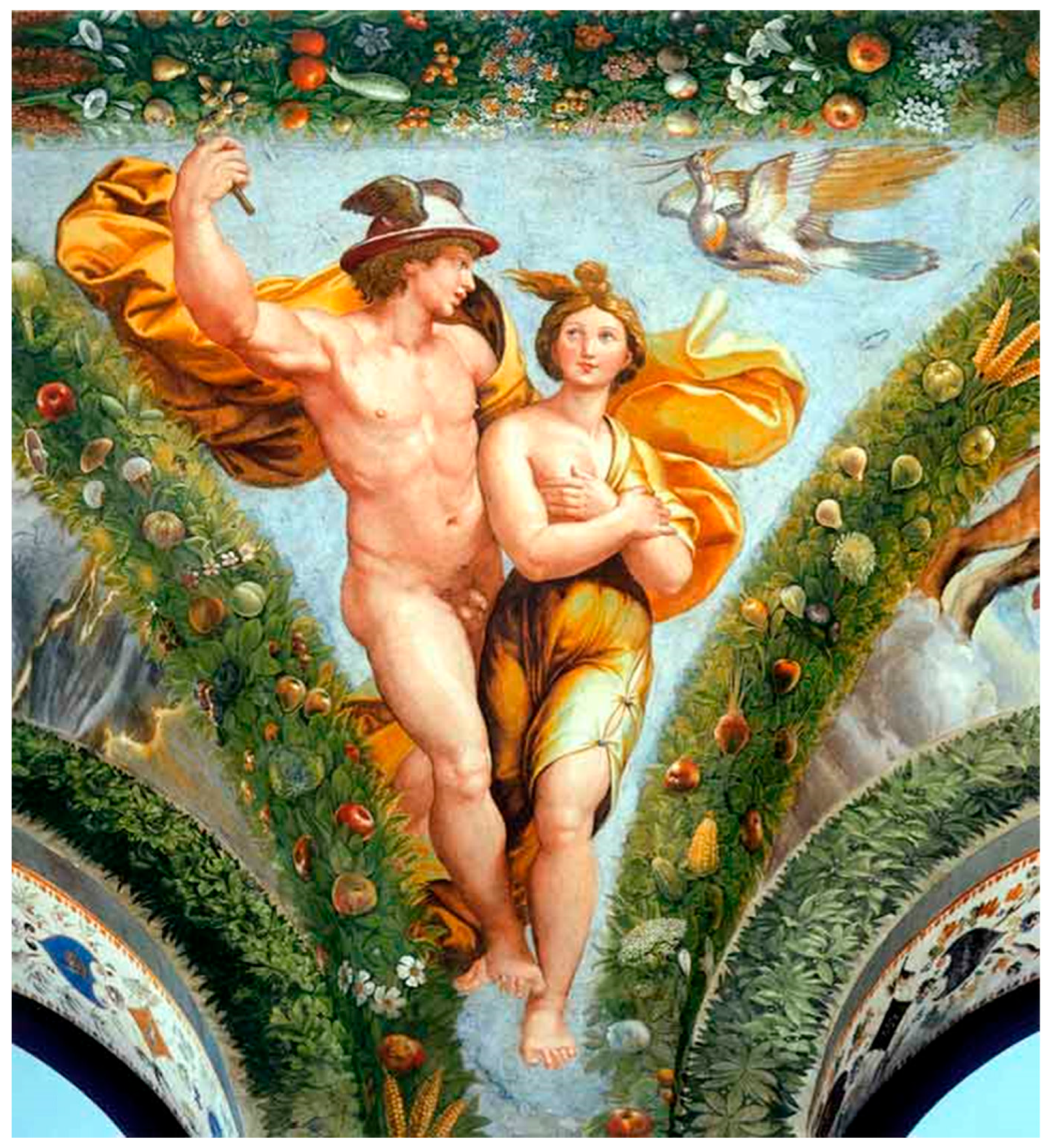
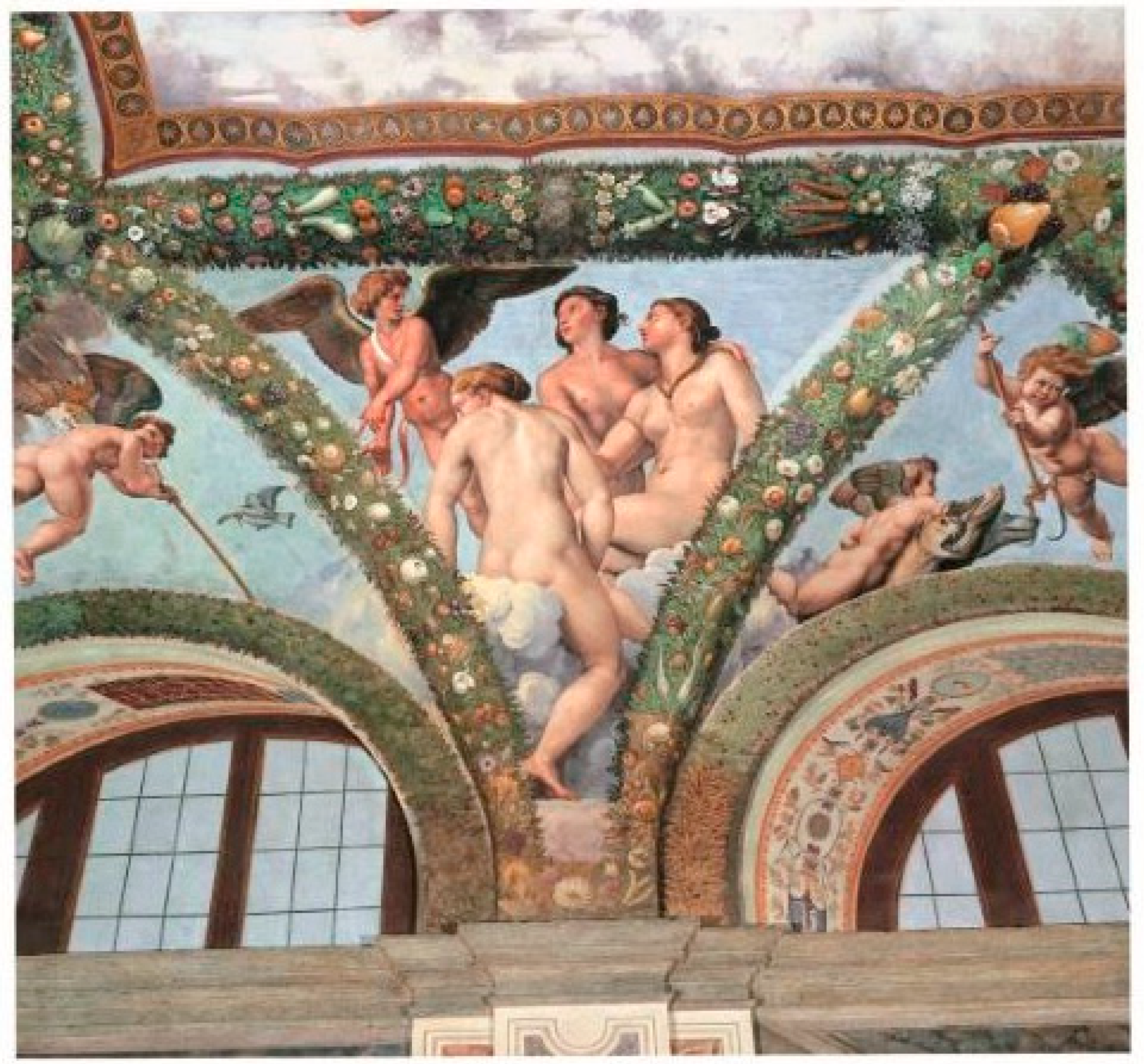
Loggia di Psiche, in particular those of the reptilian spandrel mentioned above and its two adjoining pendentives: one showing Cupid and Jupiter sealing their sacred covenant with a kiss, which grants Psyche entrance to Olympus/heaven (left), the other depicting Psyche’s flight to Olympus borne aloft by Hermes (right) (
Figure 5 and
Figure 6). At the metaphysical level, as explained by Abraham, alchemy aims to separate the metallic soul from the metallic body, to free it from the age-old attachment to the body, as a kind of “death” to the world in which the turmoil of nature is left behind (
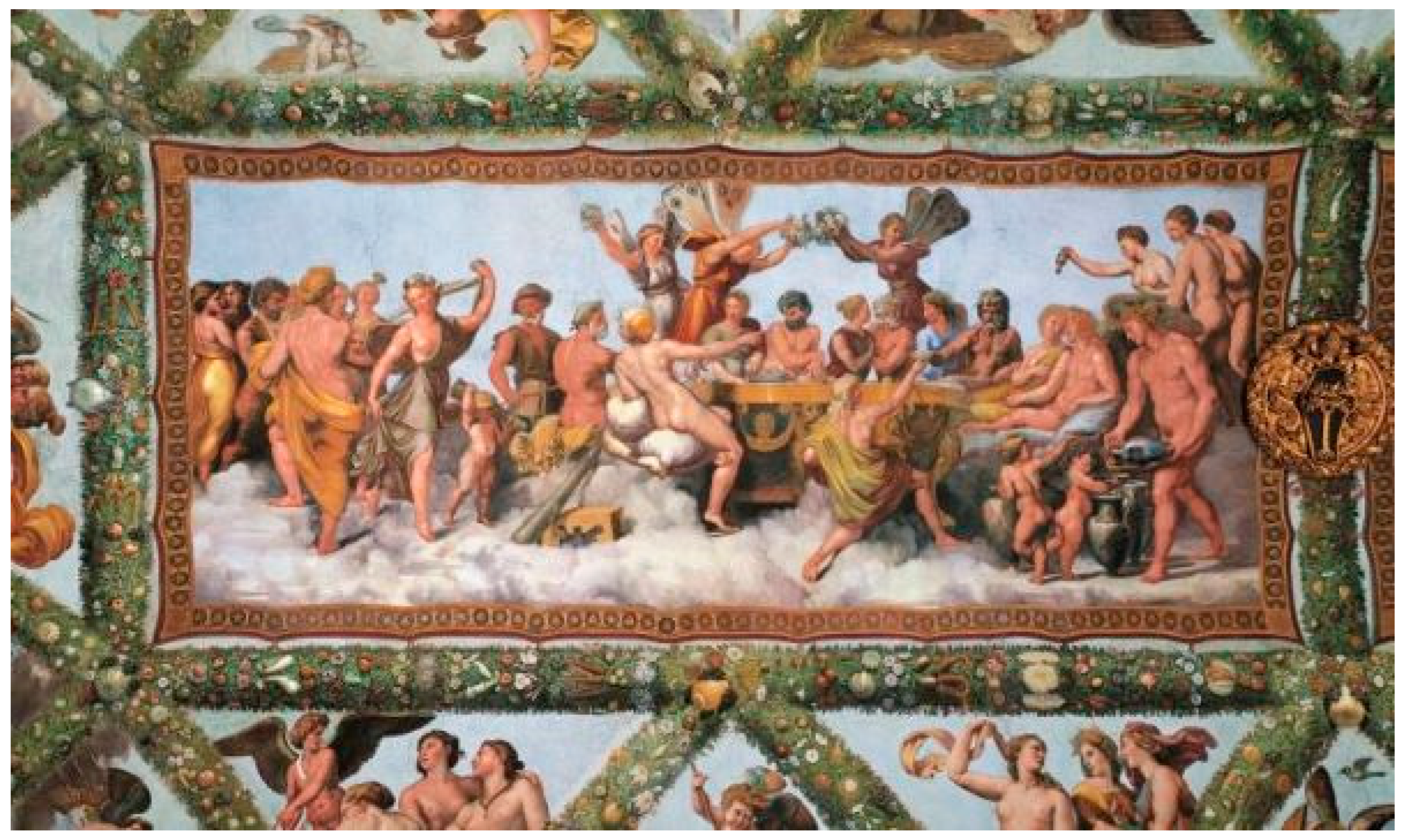
Abraham 1998, pp. 38–39). This is like redeemed Psyche’s transcendent rebirth, after death, following her terrestrial and netherworld ordeals, a miracle seemingly consented to her in the loggia’s Cupid and Jupiter pendentive (“on wings conceded by grace from Jupiter”). Then the soul takes flight to be united with the spirit above and is illuminated by it, just as Psyche ascends to Olympus in the arms of Hermes, thus “leaning on divine help,” as illustrated in the loggia’s Psyche and Hermes pendentive; to finally marry Cupid as a luminous immortal (referred to on two fictive tapestries of the vault above concluding the narrative sequence of the fresco program).
Aptly summing up the work of the alchemist regarding the separation of the metallic soul from the metallic body is a passage of the
De vita coelitus comparanda (“On Obtaining Life from the Heavens”), by the great Florentine Neoplatonist Marsilio Ficino (1433–1499). This esoteric pharmacological treatise, published in 1489 and dedicated to Lorenzo the Magnificent (1449–1492), is a commentary on a work of the Neo-Platonist Plotinus. It describes the role astrology and philosophy (here read alchemy) play in medicine. In the following passage such work is articulated clearly along alchemical and astrological lines: “In the meantime you ask: ‘If the elements and living things generate something similar to themselves through their spirit, why then don’t gems and metals generate, which are half way between the elements and living things?’ Well, clearly because the spirit in them is withheld in something denser. When this spirit is separated in the right way [so alchemy] and, once separated, is conserved, it acquires the power of a seed that generates something similar to itself, so long as it is employed to a similar material. The diligent natural philosophers [so alchemists], when they separate this type of spirit from gold by sublimation over fire [so alchemy], they employ it to some metals and obtain gold. The spirit correctly extracted form gold, or from something else, and conserved, is called Elixir by the Arabic astrologers [who are thus likewise alchemists]” (
Ficino 1561,
Opera Omnia, 565,
De vita 3.3, 15–24).
13The text vividly conveys the workings of the Renaissance magus, while forging a bond between the science of the stars, Neoplatonic thought and alchemical practice. It thus forces us to consider Neoplatonic thought in relation to alchemy and astrology, which indicates one avenue by which the Cupid and Psyche myth in Apuleius could have been read by some as an alchemical allegory, with the possible symbolic consequences for the
Loggia di Psyche it entails. As head of the Florentine academy, Ficino was a leading luminary of the Renaissance, perhaps its most influential humanist. So his writings reflect serious trends in the thought world at the time, which we should expect to be thematically and symbolically reflected in Italian Renaissance art. This was most certainly the case, for example, in Botticelli’s allegorical paintings with mythological themes like
Primavera (see below) for the Medici household, which was educated at Ficino’s feet. Yet this thought world of Ficinian matrix reached far and wide through the network of Marsilio’s disciples at the Florentine academy and their associates, permeating the Italian courts and is, I believe, symbolically reflected in the mythological imagery of Villa Farnesina and the
Loggia di Psiche for Agostino Chigi. For Chigi, a man of his times, harbored shared cultural interests with the Medici, who like them pertained to the merchant-banker class, was a patron of the arts and humanistic scholarship, fraternized with leading artists, scholars and literati, some of whom had been connected to the Medici household and Ficino’s academy, so this makes perfect sense (
Dante 1980;
Gilbert 1980).
Alchemy was the art of liberating parts of the cosmos from temporal existence (astrology thus directly pertained to it) for achieving perfection; through a circular work (
rotatio) of the four elements (
opus circulatorium) that acts upon the primary matter (
prima materia) with the aim of transmutation, in a continuous distillation process of dissolving and coagulation (“solve et coagula”) to achieve the perfected Stone, a cosmos in miniature.
14 Transferred to the material plane this means the transmutation of metals (
chymistria), but for man is the elixir of longevity (
physica), while for the human soul redemption and finally immortality (
spiritualis). The story of Psyche, being effectively one of the soul’s dissolution and reconstitution, which then gets raised up high to perfection in her marriage to Cupid on Olympus, allegorically conforms very well with all of these notions of alchemy (chemical, physical and spiritual).
4. Alchemy and Astrology
Something else to consider, with this in mind, is that the Ovidian based scenes by Sebastiano del Piombo mentioned above are illustrated right beneath Baldassarre Peruzzi’s depicted horoscope of Agostino Chigi on the vault of the hall (
Figure 3). To do this the artist “mytholgizes” the celestial bodies to map out on the vault hexagons and spandrels the patron’s natal chart, showing the planets as the gods they are named after (Venus, Mars, Mercury and so forth), accompanied by the constellations of the zodiac (Capricorn, Sagittarius, Scorpio, etc.) and extra-zodiacal constellations depicted by myths related to them (
Saxl 1934;
Lippincott 1990;
Quinlan-McGrath 1984, pp. 91–105;
Barbieri 2023, pp. 29–55).
15 Such “mythologizing” of the celestial bodies finds its origins in the Homeric poems, which was codified in the fifth-century BCE and culminated in the catalogues of Eudoxos of Knidos, the poems of Aratos and in the works of the astronomer Eratosthenes of Cyrene (
Seznec [1953] 1995, p. 38). Each constellation is thus connected with a mythological episode, thereby creating a fusion between astronomy and mythology, of which the works of the first-century poet, mythographer and astronomer Hyginus are a leading example (who became a principal source for the Middle Ages and Renaissance) (
Seznec [1953] 1995, p. 38).
16This is significant because it shows how myths were understood in relation to astrological discipline, and not simply taken at narrative face value (a phenomenon that likewise regards myths and alchemical discipline, as we shall see below). Secondly, Peruzzi’s depicted horoscope leads to a further important consideration, certainly for the man Chigi’s personal interests, but also regarding the potential symbolic intentions behind the banker’s artistic patronage, in particular the Loggia di Psiche: namely astrology and alchemy were inextricably connected disciplines in the Renaissance. Ficino’s quote above already makes this abundantly clear. Hence, if Chigi harbored faith in astrology, as Peruzzi’s depicted horoscope of the banker irrefutably attests, he likely would have been interested in alchemy. The possibility that the Loggia di Psiche was encoded with alchemical symbolism, as I believe the image in the title of this work demonstrates, would signify a sensational thematic harmony of these halls’ artistic programs as planned according to the nexus of astrology and alchemy.
Alchemy was considered “terrestrial astrology” or “inferior astronomy.” The compiler of alchemical texts Ludovico Lazzarelli (1444–1500) confirms this, stating that astrology and alchemy were considered inseparable arts in a work about his own training in the occult arts: “…in this book called
Vade Mecum [“Go with Me”],” he wrote, “we will first of all speak briefly of alchemy, which is a natural magic and is called terrestrial Astrology by Aristotle” (
Hanegraaff and Bouthoorn 2005, p. 377). An anonymous letter about alchemy composed at Venice in 1475 shares this point of view, being dedicated to those “who are interested from a theoretical, not practical, point of view in that celebrated aspect of the sublime and glorious philosophy that is hidden from the foolish, but revealed to prudent men; namely,
inferior astronomy, which is the transmutation of the elements” (
Pereira 2001, p. 17).
17 Lastly, the Elizabethan age Englishman, John Dee (1527–1608), in his
Monas Hieroglyphica stated that alchemy is “the
insignia of
astronomia inferior” (
Josten 1964, p. 86). The
astra, furthermore, regarded alchemy. In alchemical writings the seven planets were frequently used to indicate the corresponding metals they stood for, so Jupiter for tin, Mars for iron, the Moon for silver, the Sun for gold and so forth; while the alchemists stressed the importance attributed to the influences of the stars in acting upon the elements during the process of transmutation (
Pereira 2001, p. 36).
18 The correspondence between above and below was thus a fundamental doctrine of alchemy, which arises from Hermetic philosophy, something that I must now consider further (
Pereira 2000a).
5. Alchemy and Hermetic Philosophy
Bussi’s
editio princeps of Apuleius’ works is relevant here. For it also included the Hermetic text
Asclepius, a dialogue between the legendary ancient Egyptian magus Hermes Trismegistus (“Thrice-great Hermes”), the supposed author of the work, and the Greek medicine god about the nature of the soul, Nilotic religion and theurgy.
19 The reason for this is that Apuleius was thought to have been the work’s Latin translator from the original Greek (
Gentile and Gilly 1999, p. 19).
20 The inclusion of the Hermetic
Asclepius may provide us with a further clue regarding a reading of the Psyche tale and its “secret mystery” in the Renaissance in relation to alchemy. For it stands to reason that Apuleius was not only deemed an accomplished Platonist by his erudite readership, but by virtue of having been considered the Latin translator of
Asclepius de facto well-versed in Hermetic philosophy and its doctrines. As we have seen in the introduction to this work, the figure of Hermes Trismegistus was intimately associated with alchemy and astrology, even if these disciplines were not mere facets of Hermetic philosophy (
Pereira 2000a,
2000b). Nevertheless, the connection between Apuleius and Hermes Trismegistus through
Asclepius, may explain the appearance of alchemical and astrological symbolism that I find present in the iconography of the Renaissance illustrations of the Psyche myth in
Metamorphoses discussed in this work.
In the legendary history of alchemy, which took upon the name
Magnum Opus (“Great Work”), Hermes Trismegistus, the Greek equivalent of Egyptian Thot, was considered the discipline’s founder and patron (many works on alchemy were ascribed to him)—as well as on astrology and all the magical sciences (
Pereira 2000a, p. 132). The reason is well known. Seventh through eleventh century Arabic translations of a variety of late Hellenistic
Hermetica on astrology, alchemy and talismanic magic, begot Latin versions that invaded Europe done largely at the hands of Spanish friars. (
Szulakowska 2017, p. 12;
Ockenström 2013, p. 40). The short tractates likely reinforced the notion of the primordial origin of Hermes Trismegistus, which, in tandem with the Latin
Asclepius, informed the late medieval understanding of Hermetic wisdom that Ficino inherited (
Ockenström 2013, p. 40). Consequently, the alchemical phenomenon in Latin culture by the mid-Quattrocento was of very widespread nature. (
Crisciani 2002, p. 25, n. 1).
Although obviously there was no unified “Hermetic philosophy,” the notion of “technical” (magical, alchemical and astrological) versus “philosophical” (theosophic and spiritual teachings)
Hermetica is modern, categories created by Garth Fowden in 1993, following the foundational studies of the Greek Hermetic literature in antiquity by André-Jean Festugières (
Festugière [1922] 2002). Florian Ebeling made a lapidary synopsis of the primary Hermetic texts, concluding that by the Renaissance there were two distinct sub-traditions of Hermetism, one philosophical-theological and the other alchemical (
Ebeling 2007). However, like Fowden’s categorizations, the Renaissance made no such distinction.
In the Renaissance the Hermes ascribed to the “philosophical”
Corpus Hermeticum was considered the same author of the “technical”
Tabula Samragdina (“Emerald Tablet”) of alchemy. Such texts, consequently, were viewed as part of a unified tradition that pertained to a common, divinely revealed ancient Wisdom. Hence, the Renaissance itself conflated them, but this does not mean that I wish to do so. Moreover, period readers appeared to have viewed something of the philosophical in the technical and vice versa. Suggesting this are Ficino’s previously mentioned
De vita coelitus comparanda about attracting down beneficial astral forces, and Ludovico Lazzarelli’s dialogue,
Crater Hermetis (“Hermes’ Jar”), composed probably between 1492 and 1494, about how the Hermetic magus can cause the palingenesis of human souls. Both works evidence great knowledge of Hermetic sources, both philosophical and technical (as well as Neoplatonic, Kabbalistic and Biblical ones) (
Kaske and Clark 1998;
Hanegraaff 2018, p. 8;
Hanegraaff et al. 2006, p. 681).
Due to the translations of Arabic technical
Hermetica and to the passages in
Asclepius (
Asclepius 2007, pp. 23–24, 37–38) about so called “god-making” regarding animating statues, “Mercurius” was often associated with alchemical and astrological magic and demonology. Ficino, moreover, considers Hermes Trismegistus as the founder of all science and human wisdom (
Ficino 2001,
Th. Pl. 6.1.7, 12.1.4). Renaissance alchemists, therefore, referred to themselves as
filii Hermetis, the “children of Hermes” (
Pereira 2000a, pp. 26–28). So it goes that Hermes knew the secrets of metallic transmutation and the process for making the Philosopher’s Stone; and that this ancestor of alchemy had obtained his knowledge of the
Magnum Opus from the
Book of Genesis of “Moses,” since Genesis was considered the greatest page of alchemy of all (
Patai 1994, p. 158). Renaissance alchemists, consequently, thought the Egyptians, or at least a privileged class among them, had complete insight into the structure of the Universe and Creation; thus granting them access to the secret of the Philosopher’s Stone, with which transmutation of metals could be brought about (
De Jong [1969] 2014, p. 22).
To Hermes was ascribed authorship of the Ur-text of alchemy called
Emerald Tablet, a brief work that professes the unity between the elemental forces of earth and heaven (
vim inferiorum et superiorum), and explains the root of all phenomena diffused throughout the macrocosm and microcosm in the One origin (
De Jong [1969] 2014, p. 58;
Pereira 2000b). The opening precept of
Emerald Tablet summarizes the notion: “True it is, without falsehood, certain and most-true. That which is below is like that which is above. And that which is above, is like that which is below…”
21 Emerald Tablet thus alludes to the possibility of the passage of matter from above to below and vice versa, while establishing the profound spirit of Renaissance Hermetism, namely that the alchemist could transform matter in a Hermetic quest to obtain a higher consciousness of God and the divine work that unifies cosmos and world (
Garin 1954, pp. 150–91). Ficino’s already-cited
De vita coelitus comparanda tells us something about the notion: “The doctor, the natural philosopher, that knows the objects of nature and the stars [so alchemy and astrology], who we quite rightly usually call a Magus…inserts at the right time [astrological moment, that is] celestial powers into terrestrial ones [thus astrology/alchemy] …The Magus subjugates the things of nature to the things of the heavens, indeed everywhere the forces of inferior things to the superior ones [as inferred by
Emerald Tablet] …The same Hermes [Trismegistus], who Plotinus follows, affirms [all of this] (
Ficino 1561, vol. 2, p. 600
De vita, 3.26, 54–59).
22The fundamental doctrine consequently arises of a parallel between Macrocosm and Microcosm and belief in the power of stars and astral spirits (and daímones), in the zodiac and decans, which govern the descent of both the human soul and cosmic life (to be harnessed by the astrologer/alchemist in his work of purifying matter with the aim of transmutation). Through an influence of Platonic World Soul (
anima mundi) vis-à-vis the Spirit of the World (
spiritus mundi), the spirits of matter can be perfected, so goes the doctrine, but likewise the human soul is purified during the
opus alchymicum. Ficino sums up the notion when discussing the Arabic astrologers: “That the cosmos is animated just like anything else, or rather much more so, is not only demonstrated by the arguments of the Platonists, but also by the testimony of the Arabic astrologers. The very same work of the Arabic astrologers demonstrates that by applying our spirit to the spirit of the Universe through physical science [alchemists were often referred to as “physici” in the Renaissance literature] and our well-disposed soul, celestial gifts enter our soul and body. Such comes about on the one hand through our spirit that is a mediator, strengthened by World Spirit and, on the other hand, by the light of the stars that act favorably upon our spirit, which by its very nature is similar to the stellar light rays and capable of adapting itself to celestial things” (
Ficino 1561,
Opera Omnia, 564,
De Vita 3.2, 87–95).
23 The attracting of benevolent planetary influences is essential to Ficino’s concept of
magia, which he believed was practiced by the ancient mages that was inherited by and further transmitted through the Arabic astrologers.
The exceptional fortune the Hermetic doctrines enjoyed in late Quattrocento Italy and beyond was largely thanks to Ficino’s Latin translation in 1463 of the Greek Hermetic corpus, a series of texts ascribed to Hermes Trismegistus, for Cosimo il Vecchio de’ Medici (Cosimo the Elder “Pater Patriae,” 1389–1464) ruler of Florence. Ficino’s Latin
Corpus Hermeticum was published at Treviso in 1471 (
Hanegraaff et al. 2006, pp. 533–34;
Scott 1924, p. 20;
Gentile and Gilly 1999, p. 19). The title Ficino gave his translation of Books I–XIV was
Poimandres (or
Pimander), after the name of the “Mind of the Supreme Power” with whom Hermes has a hypnagogic encounter who reveals to him the sacred mysteries (
Faivre 2006, pp. 533–34).
24 Moreover, Ficino believed Hermes’ creed was established roughly in the times of Moses and thus foundational to Plato’s philosophy (in reality the Hermetic texts postdate Plato). Plato, the Florentine humanist rather asserted, inherited the sacred
disciplina of Hermes contained in the Egyptian magus’ writ, while enhancing and illuminated it in his own writings (
Ficino 2001,
Theologia Platonica, 17.2). This is why a Hermetic reading of the
Loggia di Psyche concerning alchemy would not clash with a Neoplatonic one in the Renaissance, but is complementary to it.
A series of late Quattrocento and early Cinquecento images of Hermes Trismegistus show him as the primordial alchemist and astrologer. He is represented as an alchemist and mage in the
Florentine Picture Chronicle attributed to Maso Finiguerra and Baccio Baldini of circa 1470–1475 (for the FPC see
Godwin 2002, pp. 51–59;
Colvin 1898) (
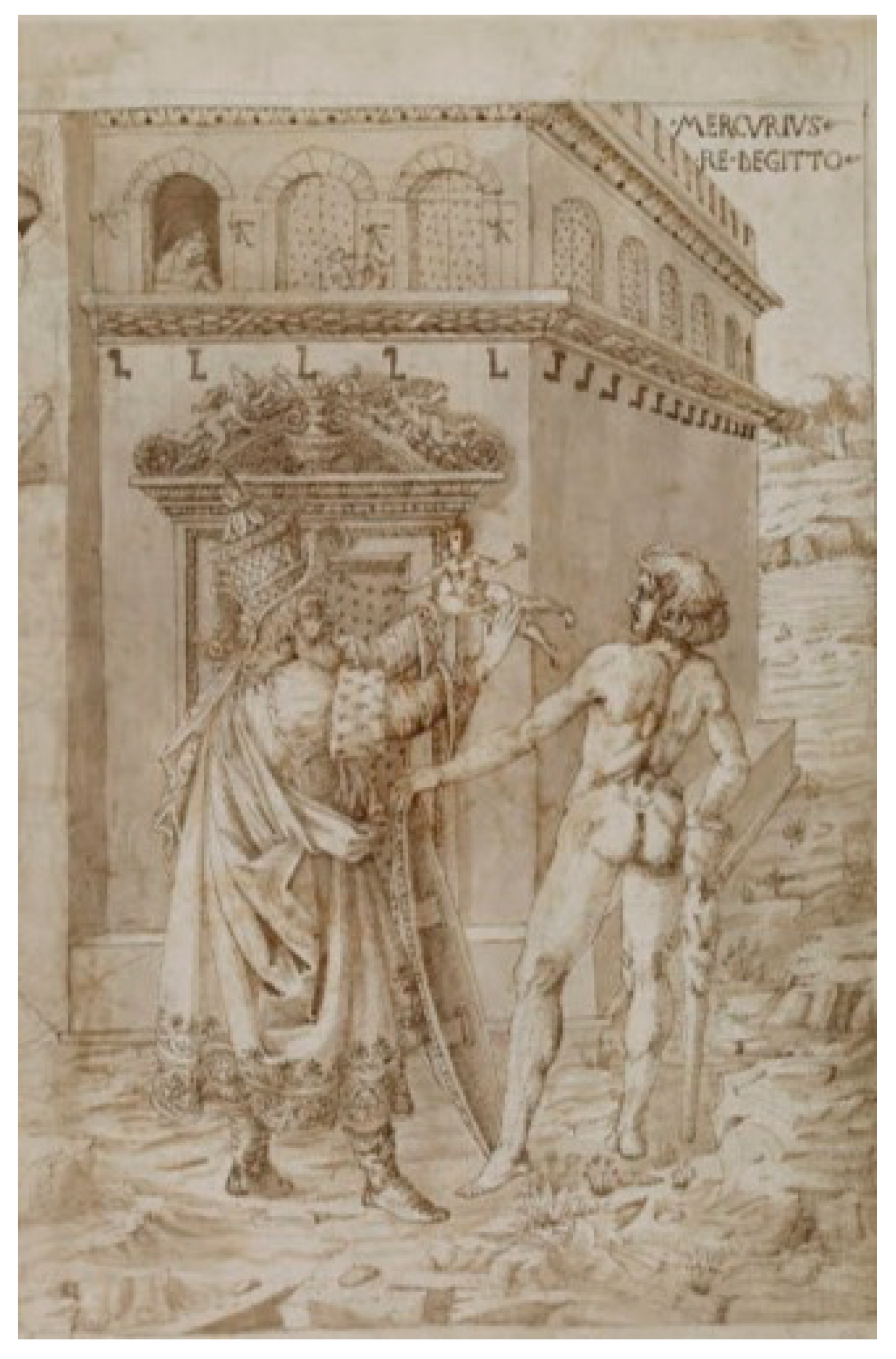
Figure 7).
Hermes is styled King of Egypt (“Mercurius Re Degitto”) and holds a diminutive, nude alchemical homunculus, symbol of the alchemical child, the Philosopher’s Stone and at times a deeply sacred conception (
Abraham 1998, pp. 102–3) (
Figure 8).
With this magical, daemonic being of alchemy, Hermes is about to make a statue of Hercules, identifiable by his club, come alive. The image is in a section of the “Florentine Picture Chronicle” devoted to the theme of magic, along with Zoroaster and Ostanes, as well as many characters of Greco-Roman mythology and the Old Testament, who appear in light of their possession of secret knowledge. The theme of magic is here an important semantic line, showing a legendary alchemical figure interacting with a creation of his own. The presence of the homunculus in the scene thus underscores Trismegistus’ identity as a magus and was likely intended to represent his mystical or alchemical wisdom.
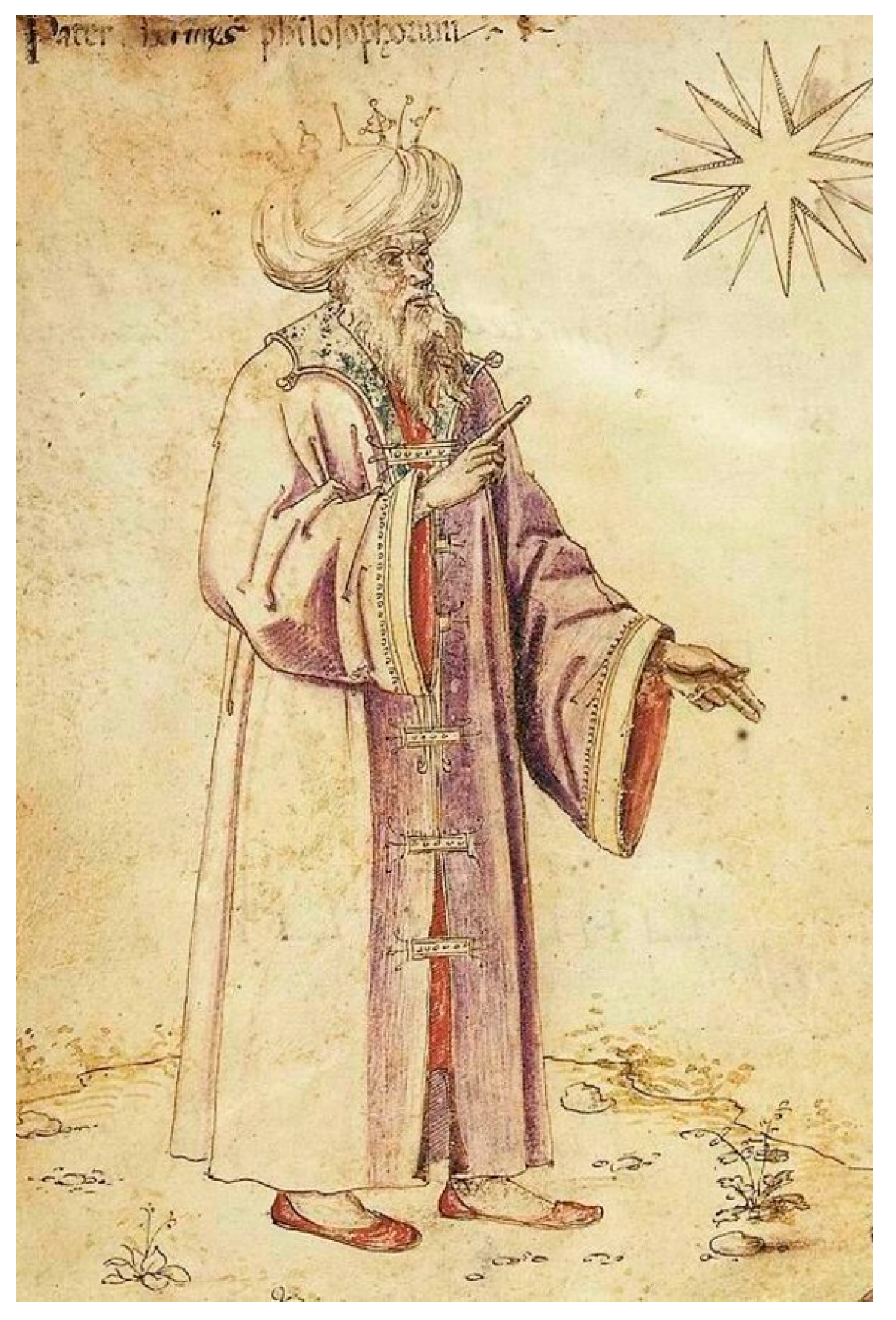
Trismegistus also appears several times as an alchemist/astrologer in an important anonymous alchemical miscellanea within which is the
Secreta secretorum philosophorum (
Ms. Ashburnam 1166 ca. 1470, f. 1v, 6r, 17r, Firenze, Biblioteca Medicea Laurenziana). The images were probably made by the Venetian painter, Lazzaro Bastiani in the late 1470s, which implies a Veneto origin for this
miscellanea alchimica. The figure of Hermes on f. 1v styles the magus, “Father of the Philosophers” (“Pater hermes Philosophorum”) (
Gnaccolini 2012, pp. 28–29). Philosophy here means astrology and alchemy, as is evident by the Egyptian mage gesturing with one hand above to a star and the other below to the natural world, a clear reference to the opening of
Emerald Tablet. We see him again on an early sixteenth-century astrolabe container frame now in the Pinacoteca Ambrosiana, identified as “Trismegistus,” seated in the role of primordial astrologer pointing to the heavens. A Latin text written around the edge of the round frame has the Hermetic axiom from
Asclepius:
Deus est sphaera intelligibilis, cuius centrum est ubique et circumferentia nusquam (“God is an intelligible sphere, the center of which is everywhere, the circumference nowhere”). The encircling phrase also alludes to the ontology of the One (“all is the One”) in alchemy from
Emerald Tablet: “And as all things were by contemplation of one, so all things arose from this one thing by a single act of adaptation.”
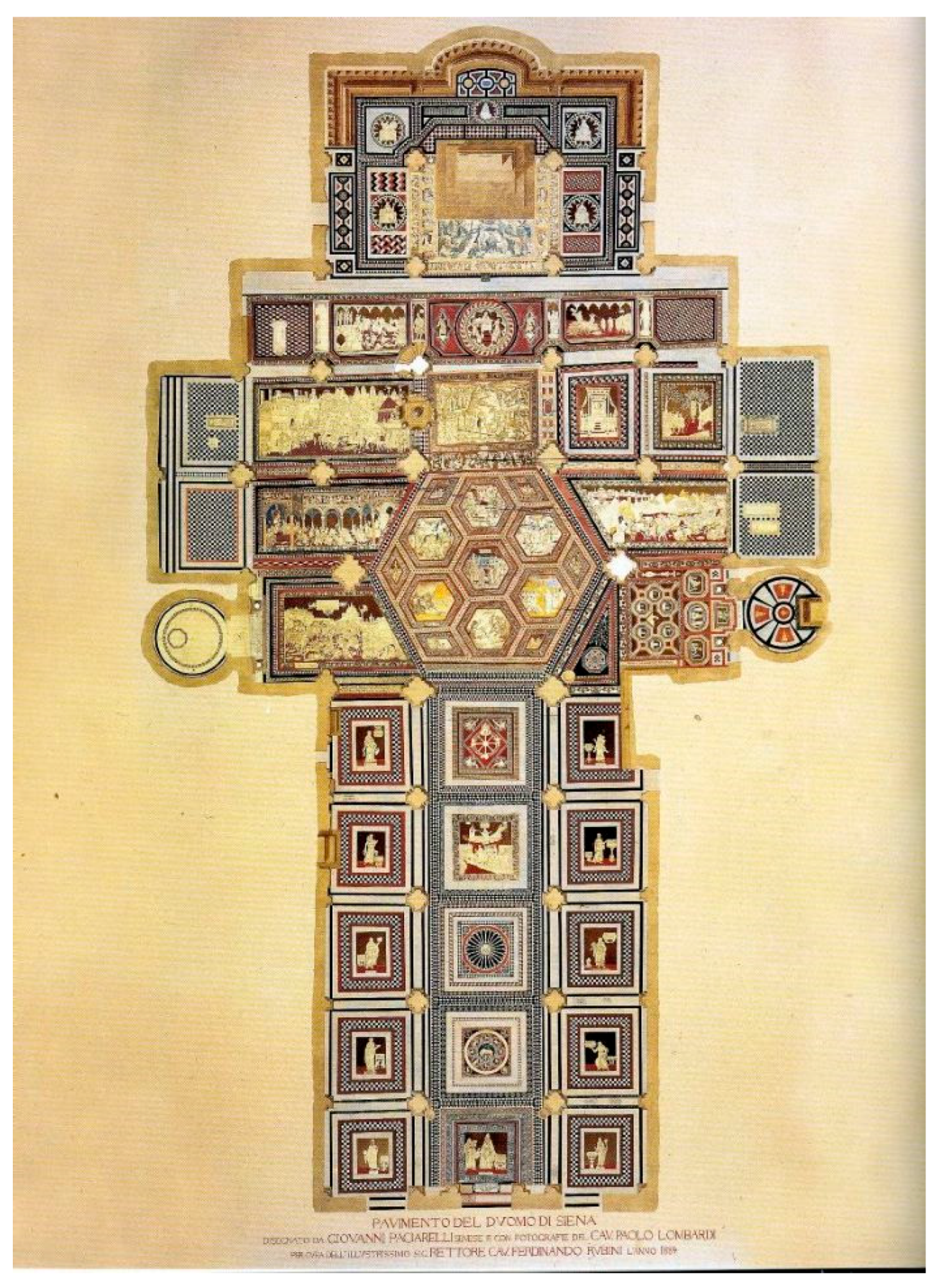
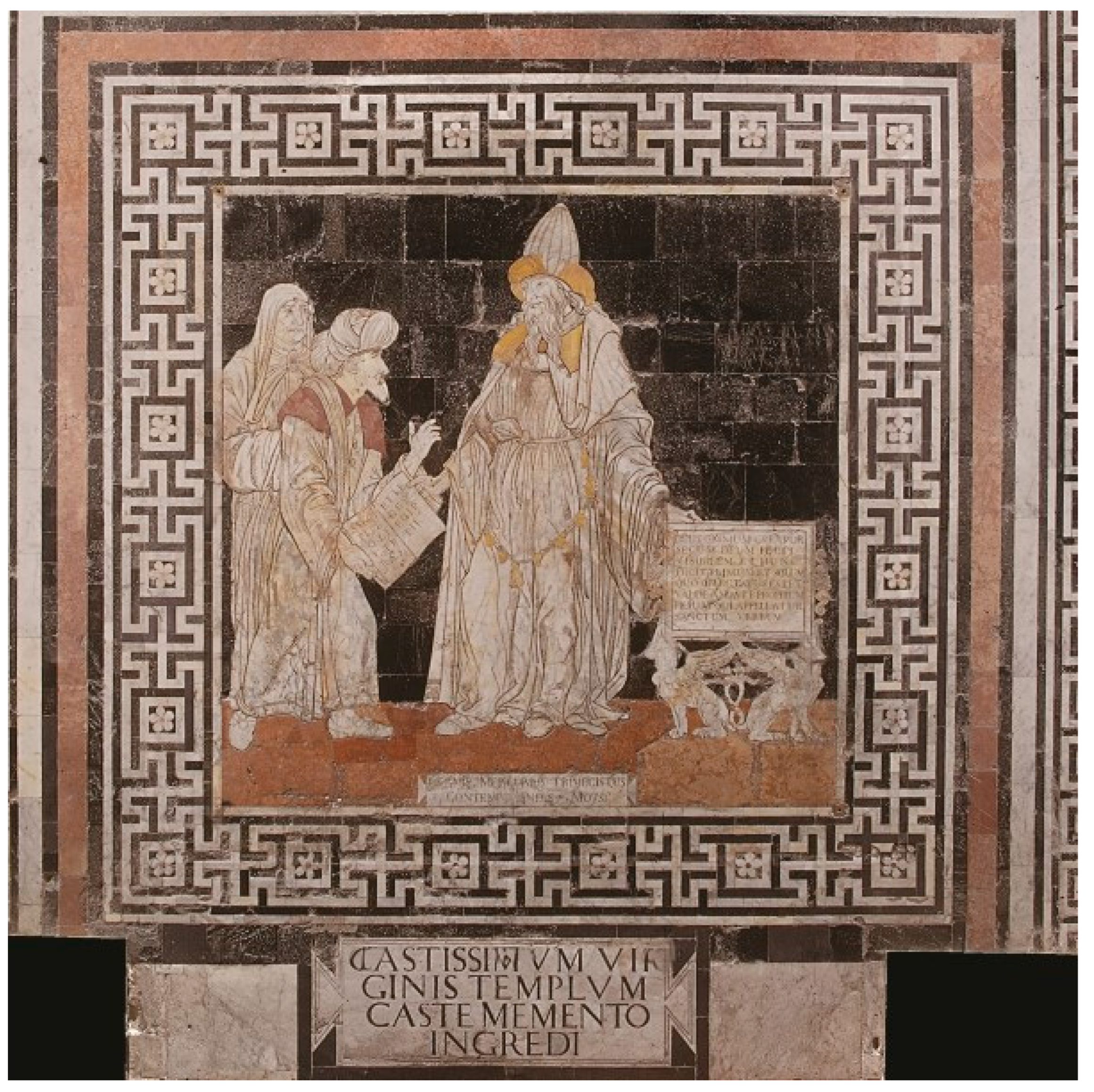
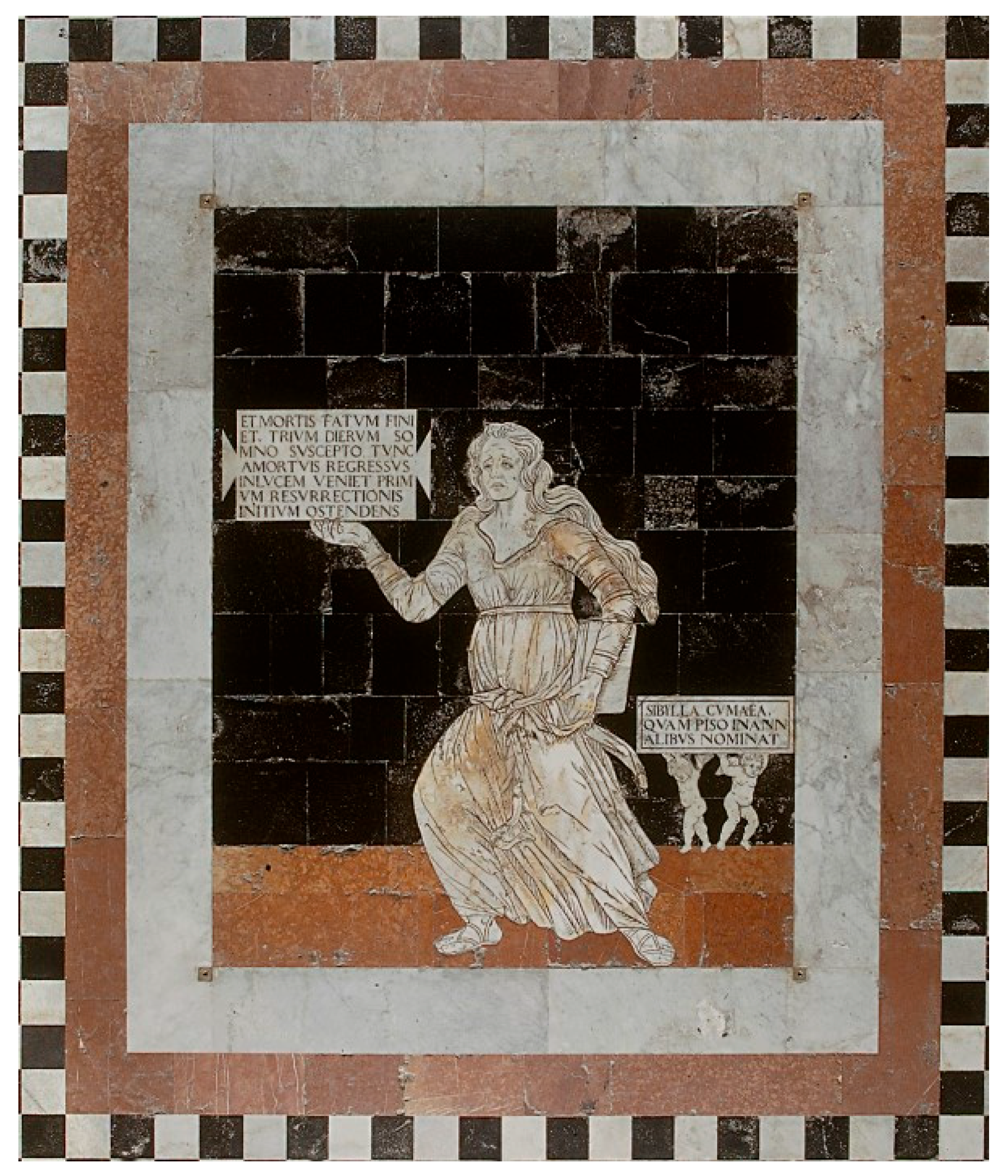
Importantly “Mercurius” also appears as a mage on the intarsia floor of the cathedral of Chigi’s native Siena, by Giovanni di Stefano in 1488 (
Figure 9). Hermes is shown as a venerable bearded sage with a wizard’s cap, identified as
Hermes Mercurius Trismegistus Contemporaneus Moysi (“Hermes Mercurius Trismegistus Contemporary of Moses”). The large image is to be prominently seen right inside the cathedral entrance. Chigi, who doubtless admired the figure on multiple occasions, I posit likely became interested in the Hermetic doctrines, at least partly, as a result of this image. His faith in astrology I believe attests to this, but which fundamentally also involves alchemy. On either side of the figure of Hermes Trismegistus, moreover, running up the side isles of the cathedral floor are those famous prophetesses of classical antiquity, the Sibyls (
Caciorgna 2022) (
Figure 10 and
Figure 11). In
Divinae institutiones (304–314) the Church father Lactantius believed Hermes Trismegistus, along with the Sibyls, had been a genuine theologian and pagan prophet of Christ (
Lactantius 1964). Hence, Ficino, following Lactantius, stressed the prophetic character of the “theological” writings of Trismegistus: “He foresaw the destruction of the ancient religion, the rising of the new faith, the coming of Christ, the day of judgment to come, the resurrection of men, the renewal of time, the glory of the blessed, the punishment of sinners (
Ficino 1561,
Opera Omnia, p. 1836).
25The pairing of Hermes Trismegistus with the ancient seers thus associates the Hermetic tradition with sibylline prophesy. Constantine of Pisa, a thirteenth-century student of medicine, provides an interesting alchemical reason why this may be so in his
The Book of the Secrets of Alchemy. Making a series of epistemological parallels, Constantine argues that alchemy is related to medicine, because both depend on
physica; to astrology, because nobody can penetrate alchemy if they do not infallibly know the motions of the stars; and finally to prophesy, because alchemy is “very profound and most obscure…like the science of the prophets, thus alchemy resides in the sphere of philosophical discourse” (
Constantine of Pisa 1990, p. 73;
Pereira 2001, p. 133). Alchemy, astrology and prophesy are, therefore, concomitant facets of ancient Wisdom traditions, to which the Hermetic doctrines were believed foundational.
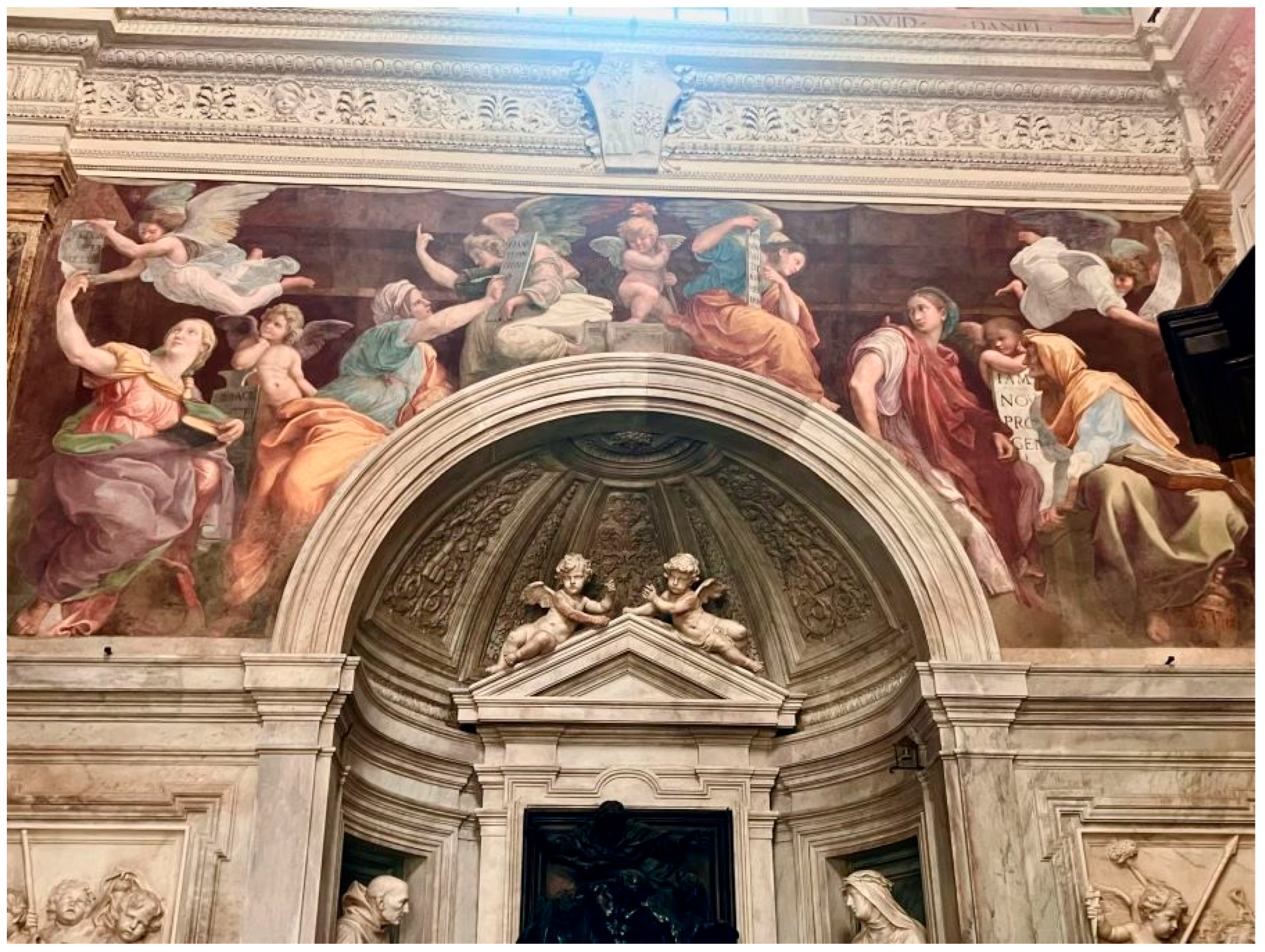
Given this connection between alchemy, astrology and prophesy, which further relates Hermes Trismegistus to the Sibyls on the Siena Duomo’s floor, it seems little coincidental that Chigi had Raphael in 1514 paint four stunningly beautiful sibyls on the wall of his family chapel at Santa Maria della Pace in Rome (
Hirst 1961, pp. 161–85) (
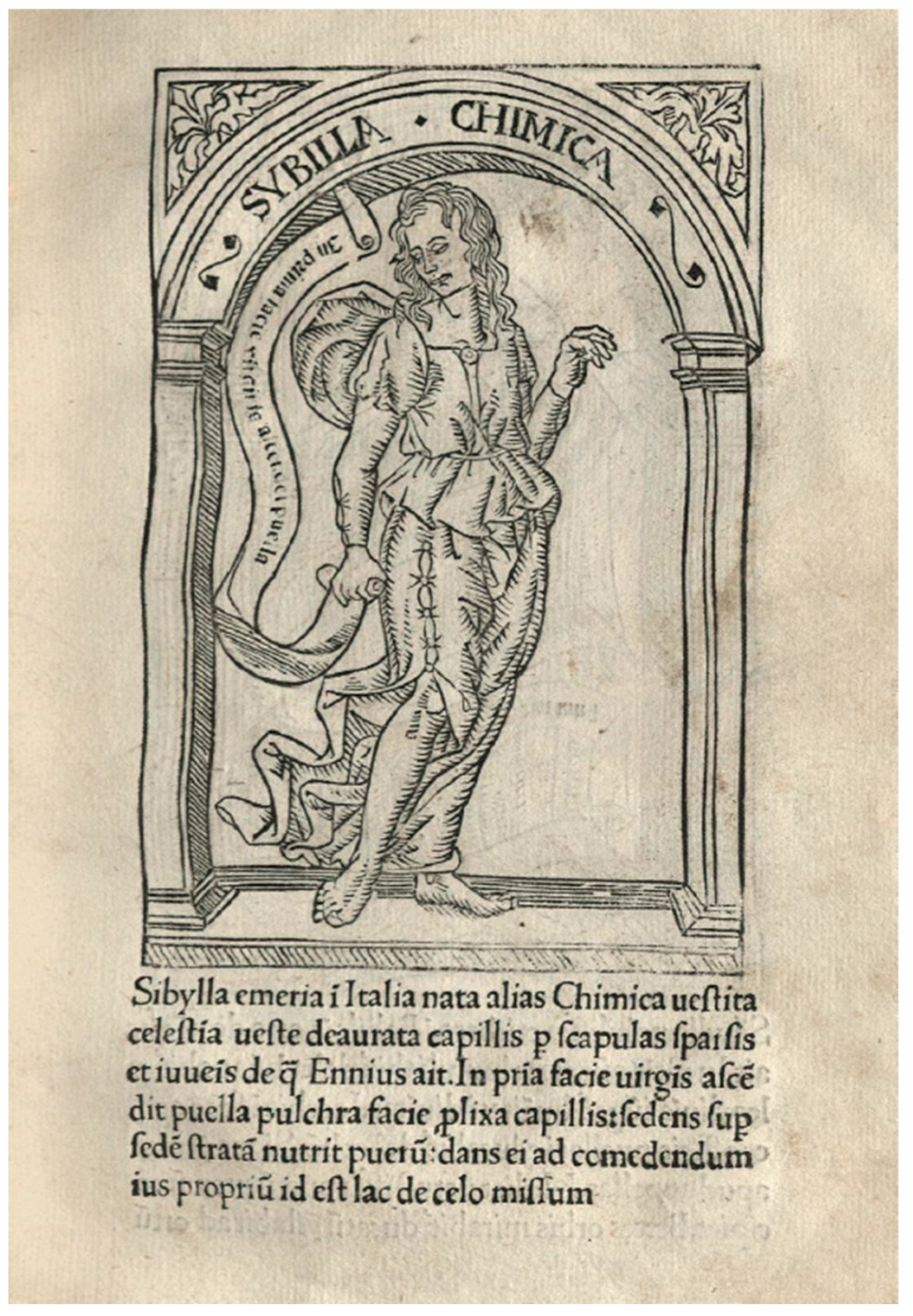
Figure 12). Since it evidences, along with Chigi’s depicted horoscope at Villa Farnesina, the banker’s interest in themes dear to Hermetic philosophy and most pertinent to alchemy. One of the sibyls portrayed by Raphael was indeed styled the
Sybilla Chimica (“Alchemical Sibyl”), alias Virgil’s Cumaean (“Emeria”) Sibyl, in Filippo Barberi’s 1481 published scientific
Opusculum, the
Discordantiae sanctorum doctorum Hieronymi et Augustini on the discordance between the Church doctors, saints Jerome and Augustine, dedicated to Cardinal Oliviero Carafa (
Smoller 2010, pp. 76–89). Filippino Lippi portrayed her among the four sibyls on the vault of the Carafa Chapel in Santa Maria Sopra Minerva, Rome in 1488–1493. In other words, she is an alchemist who knows the secrets of transmutation and the Philosopher’s Stone (
Figure 13). I think this may be important for why Carafa, who led a failed crusade against the Ottoman Empire in 1472 at the behest of Pope Sixtus IV (r. 1471–1484), and Chigi took such a keen interest in the ancient seers. It has to do with the perceived usefulness at the time of alchemy, to which the “Sibylla Chimica” was directly related, in defeating the Turks that shall be explained further below.
The Siena Hermes previously mentioned is handing an open book to a turbaned figure accompanied by a monk that says,
Suscipite o licteras et leges Egyptii (“Take up letters and laws, O Egyptians”), which may refer to the ascribed role Cicero (
Cicero 1881,
De natura deorum, 3.56), who Lactantius and Ficino quoted, gave to Hermes Trismegistus as inventor of writing and legislation. However, it may also allude, given the presence of the Sibyls, to becoming learned in philosophical letters and the laws of nature, which was fundamental for achieving success in the Hermetic arts like alchemy, astrology and prophesy. For this reason, the doctrinal side of Hermetic alchemy was not exclusively bent on laboratory practice, but the “reading of secrets” (
Crisciani 2016, pp. 73–74).
8. Chigi and Alchemy for the Extirpation of the Turk (ad Extirpandum Turcam)
It is not difficult to imagine how a banker such as Agostino Chigi could have taken a keen interest in the art of gold making for minting coins, while he would have at least been cognizant of the metallurgical science, to which alchemy was a natural consort (
Figure 14). Chigi was also a mining entrepreneur and chemical merchant with the papal Tolfa alum contract, awarded to him in 1500 by Pope Alexander VI Borgia (r. 1492–1503) (
Gilbert 1980;
Rowland 2001, pp. 78–82;
Barbieri 2023, p. 2).
31 Alum was the chemical sulfate compound, a double salt, used in glass-making, in tanning leather and creating and fixing dyes to cloth in the fabrics industry; the production of tinctures and the concoctions of the dyes themselves being incorporated into the alchemical domain and its practitioners (
Patai 1994, p. 4;
Barbieri 2023, p. 2).
Hence, alum was the salt of the alchemists’ par excellence, which, along with sulfur and mercury (salt, sulfur and mercury being the alchemical triad) is a primary agent of dissolution and coagulation of bodies in alchemical processes. One of the well-known alchemical texts during the period was Rhazes’s (al-Razi, 865–925), or pseudo-Rhazes’s,
De aluminibus et salibus (“On Alums and Salts”) (
De Jong [1969] 2014, p. 31).
32 Inspired by the Persian philosopher’s treatise, the Franciscan friar Elia da Cortona (Elias Bonusbaro, 1182–1253) wrote
Lumen Luminum Ad Fredericum Imperatorem (“Light of Lights”) for Holy Roman Emperor Frederick II (1194–1250), which discusses alums and salts in connection with the principal theories of transmutation and the production of the Philosopher’s Stone (
Califano 2016, pp. 55–56).
33 Chigi’s lucrative alum business enterprise thus had a natural affinity with the alchemical art. Until the sixteenth-century alum was primarily imported from Anatolia, which up to 1453 was part of an agonizing Byzantium. However, that year Constantinople fell to the Ottoman Turks and now Christian Europe was faced with a serious dilemma: continue to purchase alum from the infidels and so finance the Islamic campaign against itself, or buy elsewhere and financially weaken them?
34This predicament is important for Chigi’s obtaining the papal alum lease to be weaponized against the nemesis of Christendom, since it has to do with yet another possible reason the pope’s banker could have been drawn towards the
Magnum Opus. It involves the eschatological and apocalyptic currents of Renaissance alchemy, as discussed by Urszula Szulakowska, that sees the Philosopher’s Stone as the means to strengthen Christendom’s defense against the Mohammedan Turk (
Szulakowska 2017, pp. 6–7, 38–55). The catastrophe of the Ottoman conquest of Constantinople in 1453 generated apocalyptic fears in the Christian West. A series of alchemical tracts were consequently written since 1419 (
Buch der Heiligen Dreifaltigkeit or “Book of the Holy Trinity” by Frater Ulmannus, probably a certain German Franciscan spiritual Poverello or Jachomite) and into the Cinquecento that, directly or indirectly, engage the crisis for the defense of Christendom against the Turks (
Szulakowska 2017, p. 6). Such was the case of a work called
Processus sub forma missae, or the “Alchemical Mass.”
This bizarre enactment of the solemn liturgy according to alchemical processes, was transcribed by the astrologer of King Wadislas of Hungary and Bohemia, “Melichor Cibinensis” of Transylvania, sometime in the 1490s (
Szulakowska 2017, pp. 42–43;
Kiss et al. 2006, pp. 143–59). The miraculous Stone of the Wise and the elixir, it was argued, would serve to strengthen the forces of Europe. The Turkish nemesis is mentioned from the outset, while the reader is informed that “Christ, Holy One, [is the] blessed Stone of the art of “scientia” (alchemy)…which for the safety of the world inspired the light of knowledge for the extirpation of the Turk (
ad extirpandum Turcam). Lord, have mercy” (
Kiss et al. 2006, p. 159).
35 Hence, the Philosopher’s Stone in the religious sense is Christ (providing alchemy with a certain legitimizing sacrality among Christian practitioners who were often Catholic monks). The closing of the “Alchemical Mass” reads: “We have received this help [of the art of alchemy] for our salvation and well-being and giving thanks to Thy majesty, we ask that it may profit us for the safety of our body and soul and the extirpation of the Turks by our Lord Jesus Christ. Amen. Go the mass is ended. Alleluia” (
Kiss et al. 2006, p. 159).
36Now Chigi enjoyed intimate relations with popes Julius II della Rovere (r. 1503–1513), whose wars he financed, and Leo X de’ Medici (r. 1513–1521), whose pleasure activities he underwrote (
Cugnoni 1878;
Rowland 1998, pp. 72–83). Each of these popes saw an alchemical work dedicated to himself. One exhorted Julius II to use alchemy in the defense of Christendom for the vindication of the papacy against the Ottoman Turks. Entitled
De Quercu Iulii pontificis, sive De lapide philosophico (“On the Oak of Pope Julius, or, The Philosopher’s Stone”), this alchemical tract was penned by the previously mentioned Lazzarelli’s master, the Italian mystic Giovanni Mercurio da Correggio, at the Burgundian capital of Lyon in 1506. The intention of this panegyric, with its pronounced apocalyptic elements, is to convince Julius II to engage the Ottoman Empire with the alchemical “trismegistical” Phoenix (of Hermes Trismegistus), emblem of the resurrected Christ, at once the quintessential elixir and the mystical Philosopher’s Stone of occult wisdom (
Hanegraaff 2007, pp. 101–12;
Szulakowska 2017, p. 38;
Crisciani 2016, pp. 64–79).
37 Armed with the purified stone the pope would become invincible, allowing him to vanquish and subjugate the forces of the Turks, Mohammedans and all pagan nations through the power of occult wisdom, the Holy Ghost and the staff of justice (
Szulakowska 2017, p. 38).
It is, consequently, very interesting that the alum contract the Camera Apostolica provided Chigi, giving him rights on its commercialization, was defined “Appalatum Alluminum Sanctae Cruciate;” signifying that the proceeds would officially be invested in a never materialized holy crusade against the Turks. Along with filling the papal coffers, therefore, Chigi pocketed the profits (
Barbieri 2023, p. 2). Nevertheless, alum was stipulated to play a direct role in Christendom’s apocalyptic campaign against the Ottoman Empire, which, as we have just seen, brought alchemy into the picture to which the chemical salt was intimately connected. As a business agent of Julius II Chigi was, consequently, sent on a diplomatic mission to Venice in 1511, to convince the republic to stop buying alum from the Ottomans and purchase the mineral salt from the papal mines at Tolfa (
Gilbert 1980, pp. 92–93). The Senese banker was thus a key agent in Christendom’s campaign, however unsuccessful, against the Ottoman Sultanate on behalf of the pope, for whom he executed a decisive role in international affairs. Perhaps the author of
De Quercu was encouraged in his enterprise by the fact that Chigi had settled upon Lyon, where Giovanni’s work was composed, as a strategic place to sell Tolfa alum, understanding as he would have its value in alchemy, the pursuit of the Philosophers’ Stone and the latter’s perceived usefulness
ad extirpandum Turcam.
38Chigi’s and Cardinal Carafa’s previously discussed predilection for sibylline prophesy, may thus have been bound to the sibyls’ relation to alchemy (as directly testified to by the “Sybilla Chimica” of Barbari’s text dedicated to Carafa of
Figure 11) and the Noble Art’s perceived usefulness in defeating the Turks. This is especially persuasive because Sixtus IV ordered Cardinal Carafa to lead a crusade against the Turks, while Julius II, Sixtus’s nephew, for whom Michelangelo painted monumental sibyls on his uncle’s chapel ceiling, sent Chigi to put pressure on Venice to stop buying alum from the Ottoman Sultanate. So the recovery of ancient sibylline Wisdom, in its relation to alchemy, seems to have been viewed as useful to Christendom’s apocalyptic campaign against the Turkish nemesis, suggesting one reason for the popularity of the Sibyls in Renaissance Rome. The
De Quercu on using the “trismegistical” Phoenix to defeat the Turks being dedicated to Julius II, very much connects to such conceptualizations.
The other work is an alchemical poem by Giovanni Aurelio Augurelli (or Augurello) entitled
Chrysopoeia Ad Leonem Decimum Pontifex Maximus (“Gold-Making dedicated to Pope Leo X”) about transmutation into gold, published at Venice in 1515 (
Fùrnari 2023, pp. 207–34;
Soranzo 2012, pp. 87–109;
2019;
Califano 2016, p. 87;
Martels 1993, pp. 121–30;
1994, pp. 979–88). Augurelli’s poem presents Leo X de’ Medici as an alchemist, who is given the alchemical-political task to claim possession of the
elixir or
lapis occultus (the Philosopher’s Stone) of universal regeneration, in order to transform the troubled times portrayed as rife with war, devastation and schisms, into an
aurea aetas (“golden age”) of world peace and prosperity (
Soranzo 2012). The Italian painter, architect and art historian, Giorgio Vasari (1511–1574), moreover, asserted that Leo X (like Chigi a scion of a banking family) was a great student of natural philosophy, in particular alchemy (
A. R. Turner 1992, p. 66). Vasari’s claim that Leo X had a passion for alchemy, which seems to have gripped the entire Medici household, appears to be confirmed by the fact that the pope permitted the Venetian priest Giovanni Agostino Panteo (Johannes Augustinus Pantheus) in 1517 to publish in papal territory his
Ars Transmutationi Metallicae and, in 1519, the
Commentarium Transmutationis Metallicae (
Califano 2016, pp. 75, 216). Leo X, moreover, lobbied for a new crusade against the Turks, sending legates to the European monarchs for this purpose (
Fletcher 2020, p. 203). As the celebrant of Agostino Chigi’s wedding to Francesca Ordeaschi, for which the loggia again was almost certainly painted, Pope Leo X would thus have been well-positioned to grasp the hidden alchemical symbolism I maintain is present in the artwork.
9. The Psyche Myth, the Prisca Theologia and Its Learned Magic
Before turning back to the
Loggia di Psiche, however, I must address the Renaissance notion of the
prisca theologia and its learned
magia embraced and disseminated by Ficino and others in his circle, like Pico della Mirandola. The reason for this is because I posit they are also fundamental to understanding how Renaissance illustrations of the Psyche myth were meant to be perceived allegorically in relation to alchemy and astrology. The important illustrations of the Psyche myth on late Quattrocento Florentine Marriage
cassoni panels made for the Medici household I believe bear this out. Hence, the
prisca theologia, to which Hermes Trismegistus was fundamentally bound (see below), with particular reference to
magia, is I think of great cultural importance to this discussion on artistic representations of the Psyche myth in Renaissance Italy. Regarding
magia, Patricia Aakhus argues that, in fact, without considering magical thought and operations much Renaissance art and literature cannot be fully understood (
Aakhus 2008, p. 186).
Aakhus, for example, explains how images from the magical text
Picatrix, an eleventh-century Arabic compendium of astral magic and a source for Ficino’s
De vita coelitus comparanda, appear on an extraordinary collection of Hellenistic gems owned by Lorenzo the Magnificent (1449–1492), now in the Museo Nazionale of Naples (
Aakhus 2008, p. 186). Magical operations Aakhus further notes, appear as tropes in Lorenzo the Magnificent’s poetry and autobiographical writing. Furthermore, she postulates that works not explicitly about magic by Lorenzo de’ Medici, Poliziano and Botticelli, Michelangelo, Walter Raleigh, and Cellini, were colored by magical texts and thought (
Aakhus 2008, p. 186). Alchemy, astrology and magical thought, consequently, may be the actual ways to deeply understand the arcane symbolism in Renaissance imagery of the Psyche myth. This was a learned magic enshrined in the Renaissance notion of the
prisca theologia or “ancient theology” and Wisdom (
Walker 1972;
Copenhaver and Schmitt 1992, pp. 134, 148;
Hanegraaff et al. 2006, pp. 1125–29).
The concept of
prisca theologia postulated that at the core of all ancient religions there lies a common metaphysical truth, which was only fully revealed in Christ. The philosophy and mythology of the pagans was, consequently, believed to have been providentially laced through divine inspiration with some of Revelation under the poetic veils of allegory. The
prisca theologia endeavored to bring into harmony all that was considered valuable in pre- and non-Christian thought with the doctrines of the Church (
Wilkinson 2007, p. 30). Adherents of the
prisca theologia, moreover, thought a divinely revealed
disciplina was contained therein; that is, the sacred
magia of the ancient magi, involving astral Wisdom and natural philosophy (read astrology and alchemy), which presaged Christianity and proved its mysteries. That Ficino placed Zoroaster as first of the Magi, seeing as he did the Chaldean Oracles ascribed to him (that we know today rather pertain to Neoplatonic theurgy) as the font of
magia, it made sense to view
prisca theologia and magic as the same. (
Hanegraaff et al. 2006, p. 1126).
Ficino thus believed the ancient mages Zoroaster, Hermes Trismegistus, Orpheus, Aglaophemus (an Orphic teacher of Pythagoras), Pythagoras and Plato were the bearers of this holy magic; who formed a sapiential chain or genealogy of wisdom, explicitly called
prisca theologia. (
Ficino 2001,
Theologia Platonica, 17.2;
Hanegraaff et al. 2006, p. 1127)
39. Hence, Ficino allows us to understand how the
prisca theologia came to be viewed as sympathetic to a revival of magic and occult philosophy in Renaissance culture (
Hanegraaff et al. 2006, p. 1126). Ficino’s work would then reacquaint the broader European audience with the ancient
magia and philosophical gnosis (
Ockenström 2013, p. 40). All of this is I suggest highly important for illustrations of the Psyche myth on a series of late fifteenth-century Medicean Florentine marriage
cassoni panels. For these artworks appear to demonstrate in an esoteric way that the Psyche myth was regarded as having allegorized occult aspects of the
prisca theologia, with specific reference to
magia related to alchemy and astrology. Such magic involved obtaining the beneficial astral influences in preparation for the soul’s ascent, with metaphorical applications to the alchemical
opus of chemical, medicinal and spiritual transformation. These artworks, moreover, I posit form the conceptual basis, regarding magic in the disciplines of alchemy and astrology, upon which the depicted myth of Psyche by Raphael and
bottega at Villa Farnesina for Agostino Chigi must similarly be understood. Let us, then, turn towards the Psyche illustrations on the Florentine marriage
cassoni panels.
10. Illustrations of the Psyche Myth on Late Quattrocento Florentine Marriage Cassoni, Prisca Theologia and Learned Magic
These earliest pictorial representations of the Psyche myth are found on three sets of marriage
cassoni panels, all painted in Florence during the late Quattrocento (
Vertova 1979, pp. 104–21;
Nutzmann 1997, pp. 223–35;
Cavicchioli 2002, pp. 30–50;
Miziołek 2000, pp. 133–54;
2001–2002, pp. 128–32;
2019, pp. 73–90). The first set of these eminently refined tempera painted domestic objects used for storage date to ca. 1470 and consist of two
cassone fronts whose artist is identified with the so-called Master of the Argonauts, now in the Bode Museum, Berlin (
Vertova 1979, p. 111;
Miziołek 2019, p. 75). The pair was produced for the Medici, presumably as a wedding gift for the occasion of the marriage between Lorenzo de’ Medici and Clarice Orsini, for which a 1468 date, the year of the event, has been proposed (
Vertova 1979, p. 111;
Nutzmann 1997). The other two sets, also made for the Medici household, date from ca. 1490 and were painted by Jacopo del Sellaio, who according to Vasari had studied under Filippo Lippi along with the younger Botticelli (
Cavicchioli 2002, p. 47;
Vasari [1879] 1906). The first Sellaio pair are
spalliere or back-boards, now split between the Fitzwilliam Collection, Cambridge and a private collection (formerly in the Diamond Collection, New York) (
Miziołek 2019, p. 78). The second set are
cassone frontals, one now in the Museum of Fine Arts, Boston, the other in the Abegg-Stiftung, Riggisberg, Switzerland (
Miziołek 2019, p. 78). The Sellaio panels exhibit the artist’s supreme phase under Botticelli’s inspiration. In fact, there is an oneiric and fanciful Botticellian style to them.
Medici interest in Apuleius’ Psyche myth is confirmed by a family inventory that indicates both Cosimo il Vecchio and his son, Piero di Cosimo (1416–1469), owned copies of
Metamorphoses/
Golden Ass. Cosimo had requested Apuleius’ works from Pope Nicholas V (
Cavicchioli 2002, p. 47). The Medici household being the fulcrum of Florentine culture and intellectual life under Cosimo and his grandson, Lorenzo the Magnificent, indicates these Psyche
cassoni panels, with stylistically refined and intellectually profound narrative settings, were meant to provide both allegorical symbolism and hermeneutical entertainment implicit in the myth itself. (
Cavicchioli 2002, p. 48). A long history of allegorical interpretations of the Psyche myth attests to this.
According to Martianus Capella’s then popular
De Nuptiis Philologiae et Mercurii (“On the Marriage of Philology and Mercury,” c. 410–420 CE), 1, 7, for example, Psyche was the daughter of Endelechia (Aristotelian “ripeness of time”) and Apollo (“Endelechiae ac Solis filiam”)—unlike in Apuleius where she is one among three daughters of a Greek royal couple. After many adventures and suffering she triumphs as the embodiment of the Soul, gaining immortality (
Capella 1977, pp. 6–8). Later in the fifth-century the Christian Fulgentius, in part of the third book of
Mythologiae (
Fabula deae Psicae et Cupidinus), compared Psyche’s suffering, because of her disobedience to Cupid, to the fall of Adam and Eve (
Jones et al. 1971, pp. 88–90). These erudite mediators led Boccaccio (1313–1375) to insert the Psyche myth into his scholarly compendium,
Genealogia deorum gentilium (“Genealogy of the Gods of the Gentiles”), which resurrected and summarized the allegorizing zeal of the myth’s fifth-century interpretations. For example, from Martianus Capella Boccaccio identifies Psyche’s parents as Endelechia and Sol (
Cavicchioli 2002, p. 32). Cosimo il Vecchio and Piero di Cosimo each also owned a copy of Boccaccio’s
Genealogiae (
Cavicchioli 2002, p. 47).
The point is that the illustrated Psyche
cassoni panels must be understood against this background of allegorizing the myth. It is worth considering, furthermore, what André Chastel thought about three related Sellaio
spalliere Florentine marriage
cassoni panels of ca. 1485 depicting the myth of Orpheus, also products of the Medici sphere with similar esoteric intentions. Chastel wrote these Sellaio
spallieri may have been visual expressions of the ideas of the Florentine Neoplatonists (
Chastel 1959, p. 273). Prompted by the intuition Jerzy Miziołek, aware that for Ficino and Pico della Mirandola Orpheus was among the creators of the
prisca theologia; argued that the iconographical programs beautifully allegorized the “ancient theology” (
Miziołek 2009, pp. 43–47) Apparently this was the result of an allegorical transformation regarding pagan myths at Medicean Florence under first Cosimo and then Lorenzo the Magnificent, where humanist ideas about the
prisca theolgia of the ancient magi and classical authors found their most congenial development ground. I posit the Psyche
cassoni panels similarly express ideas of the Florentine academy related to the
prisca theologia, with particular reference to learned magic, because they are products of the same intellectual, artistic and cultural milieu.
Naturally, due to the limitations of space, it is not possible to go over all of these
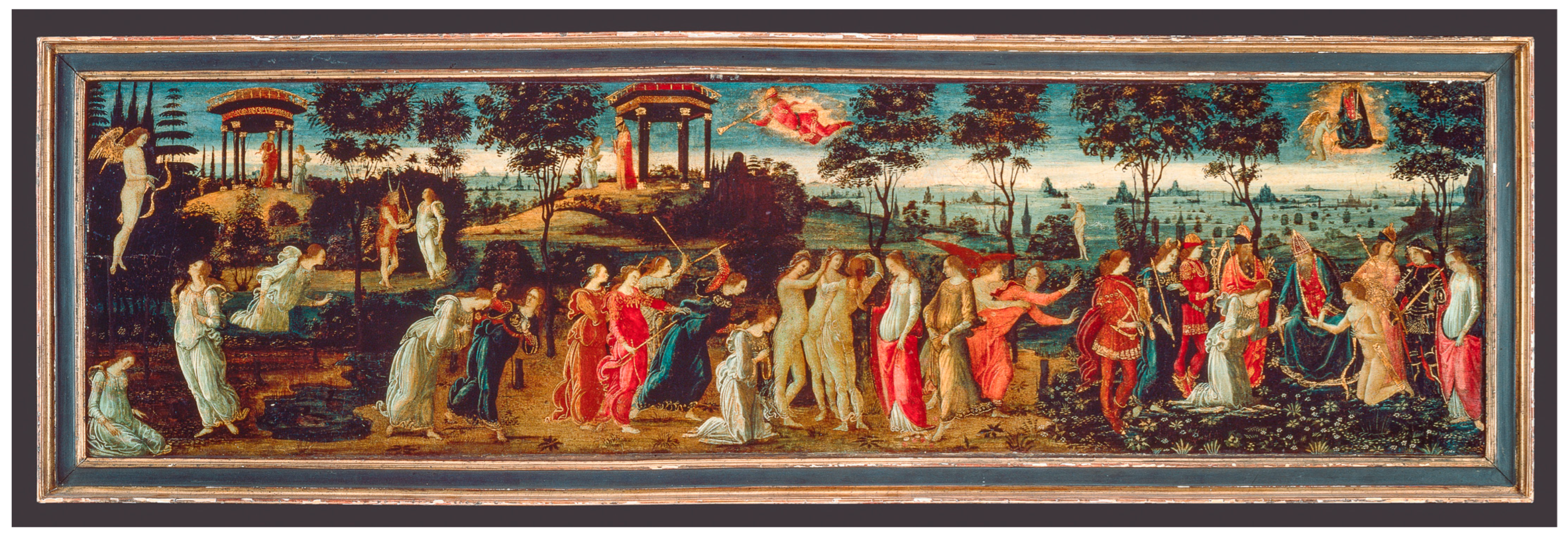
cassoni panels, so I shall limit the discussion to the Abegg-Stiftung one (
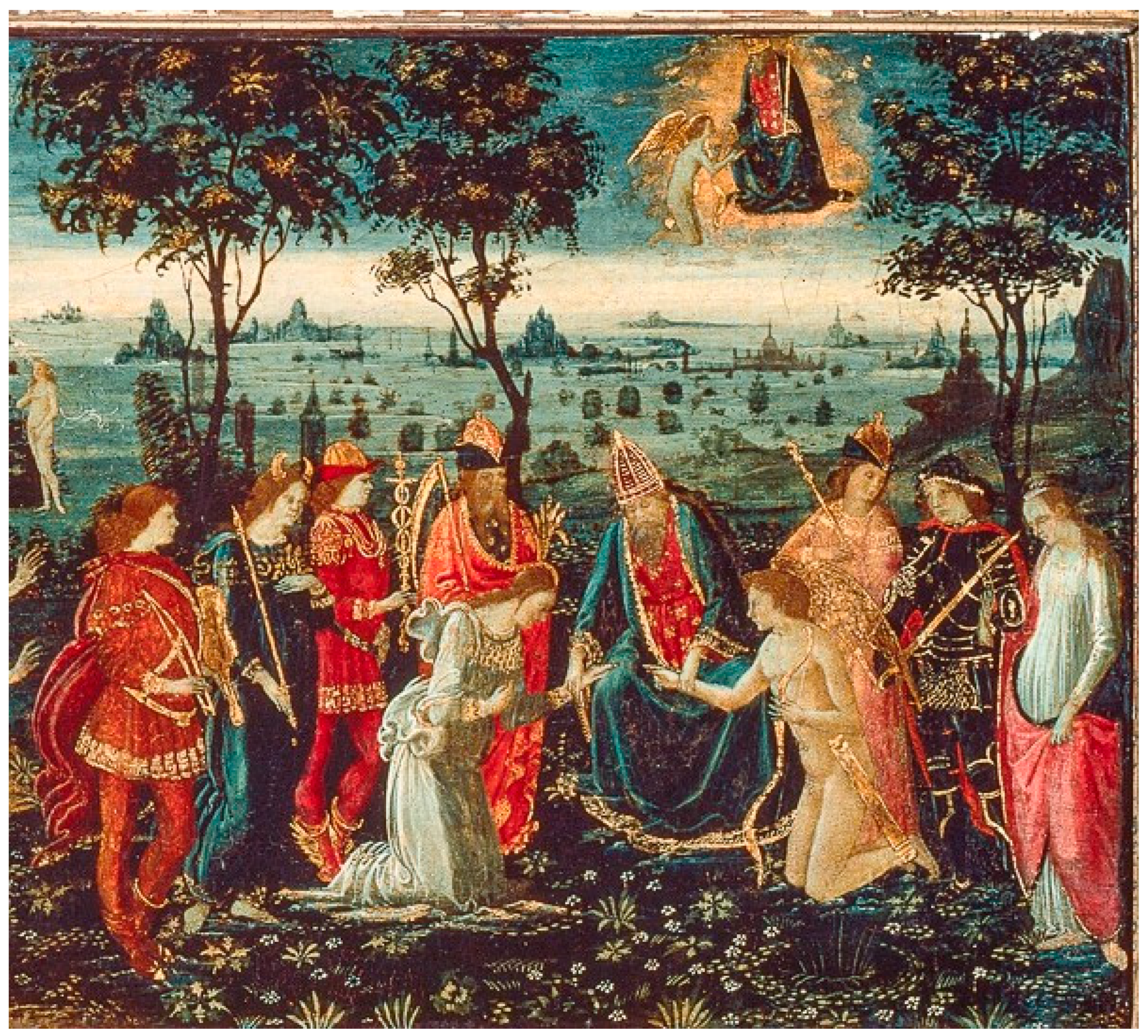
Figure 15). The three sets of these panels, however, display a similar esoteric way in which the myth is treated, with narrative affinity rendered in surreal settings having common metaphysical implications. In Apuleius’ narrative Cupid abandons Psyche when she disobediently gazed upon him, whereupon she goes into hiding in the temples of Ceres and Juno. However, Mercury is sent by Jupiter to deliver the world a message to find her. Found, Psyche is brought before Venus, flogged, then ordered by the jealous goddess to complete four terrible tasks. The last ordeal, like Orpheus, entailed a descent into Hades, but to retrieve some of Proserpina’s beauty. In the end with Cupid’s assistance, who still loved her, Psyche prevails and is redeemed; whereupon Jupiter consents to their sacred marriage union. Among certain curious and highly indicative alterations, with the four trials only implied, but not shown clearly due to a lack of space; this is the plot we see synthetically painted on the Abegg-Stiftung panel.
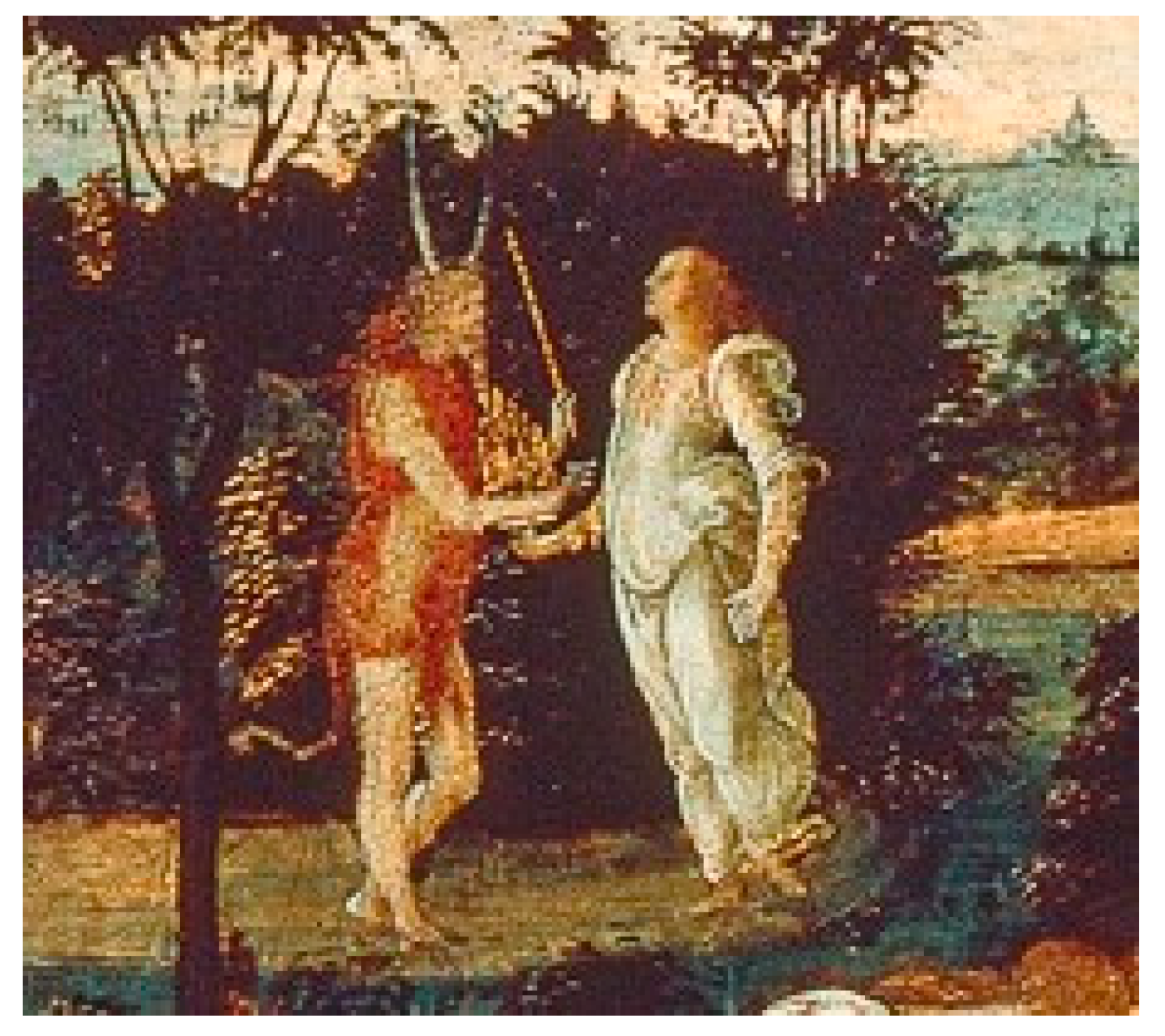
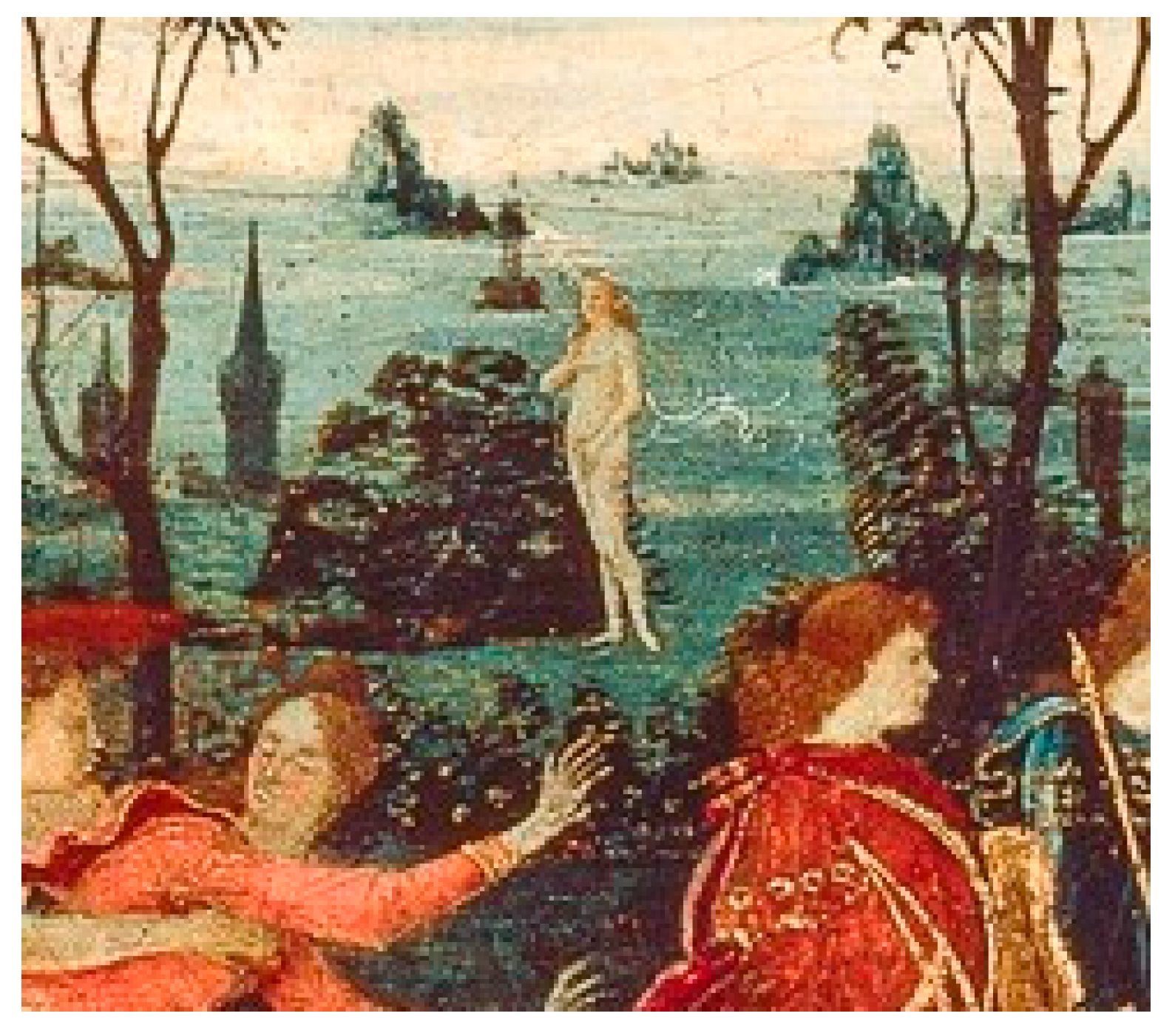
On the left side we find Cupid atop a tall cypress tree scolding Psyche for her disobedience, about to abandon her. In the background Psyche seeks hiding places at two tempietto-like temples, respectively those of Ceres and Juno. Beneath these edifices in the middle ground are the episodes of Psyche attempting to drown herself in a river and her subsequent encounter with Pan. At the center above, Mercury flies with his golden horn to announce the delivery of his message by which secretive Psyche shall be found. Below in the middle foreground we see Psyche’s capture and flogging before Venus. Here the hermeneutical entertainment is further heightened, because, as Jerzy Miziołek (
Miziołek 2001–2002, pp. 128–32;
2019, pp. 73–89) and independently Huber Jr. (
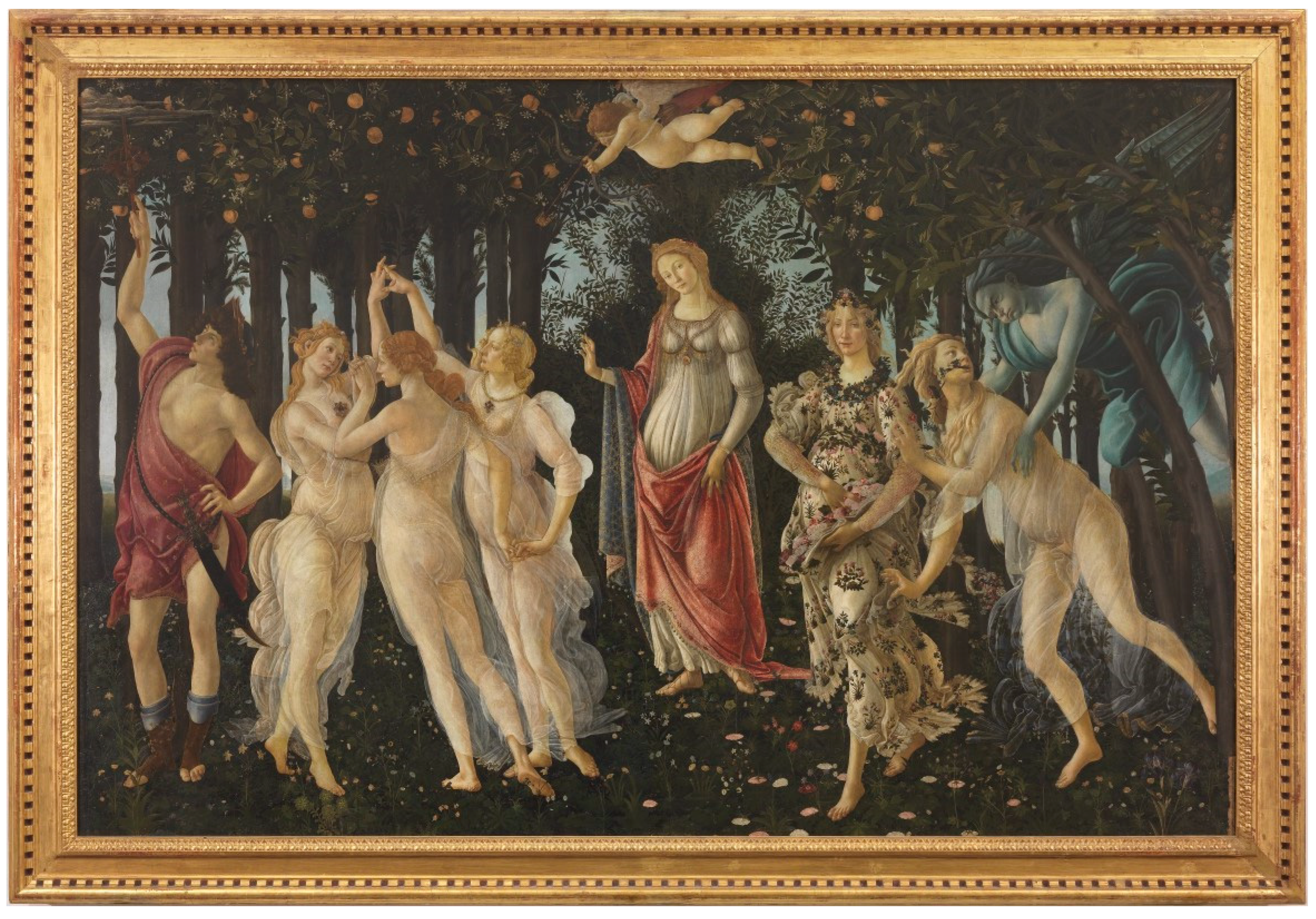
Huber 2019, p. 280) noticed, we observe a curious adaptation of Botticelli’s famous
Primavera, with a further element that recalls the artist’s
Birth of Venus. Both paintings were Medici household commissions (
Levi d’Ancona 1992, pp. 7–15).
40 Obviously this adaptation has nothing to do with Apuleius’ narrative, so it must be key to understanding the artwork’s hermeneutical significance.
In the central section of the Sellaio panel Psyche kneels before Venus, hands folded in prayer, as she seeks divine assistance in her moment of duress. Behind Psyche Venus’ servants are about to flog her, which is the only part of this scene described in
Metamorphoses. To Venus’ left stand the three Graces, clearly inspired by those in
Primavera, while at the goddess’ right appear Flora, Zepherus and Cloris. Hence, the affinity with Botticelli’s
Primavera is straightforward (
Miziołek 2019, p. 80). Doubtless these extra-narrative additions from
Primavera were meant to underscore the notion that the Psyche myth contains a “secret mystery,” the meaning of which shall be expounded upon below. Needless to say, it is not possible to give a detailed account of
Primavera in this essay. For analogy purposes with the Abegg-Stifting panel, however, some preliminary observations can be made.
41 11. Botticelli’s Primavera and the Soul’s “Second Birth”
In a remarkable recent study, Alison M. Roberts, prompted by the Renaissance scholar of Ficino and his magic, Angela Voss, masterfully describes how
Primavera, painted sometime between 1477–1482, should be understood as a complex allegory of alchemy (
Roberts 2022, pp. 267–304) (
Figure 16). Roberts’ thesis, which draws upon alchemical texts (Arabic and Latin) and diverse authors from Ovid, Plutarch, Apuleius, Dante, Angelo Poliziano, Aurelio Augurello and, of course, Marsilio Ficino, is very compelling. I try to summarize some of the main points in what follows. The crux of the argument is that
Primavera’s arrangement of nine figures corresponds to the 9-h day of alchemy, which the alchemists associated with both nature’s seasonal cycle and the sun’s diurnal rhythm (
Roberts 2022, p. 290).
The alchemical 9-h “work of the day” sees the metallic soul rise in the vas or alembic, initiated by a fertilizing “coupling” with a “fleeing female,” which in
Primavera would be represented by Zephyrus’ rape of Chloris that “fertilizes” Flora or, as
Kline (
2011, pp. 665–88) thinks, the two seasonal Horae of winter and spring for the female figures. The alchemical
opus culminates in the “White” crowning and a “second birth,” embodied by the central goddess. This occurs when the sun reaches the midheaven zenith during the ninth hour of the day. Simultaneously the sun enters the fiery zodiac constellation of Leo, when the alchemical
opus arrives at the last “reddening” (
rubedo) phase in the production of the Philosopher’s Stone (
Roberts 2022, p. 290). The moment of the painting would thus be the “ninth hour” of circularity, as a “second birth” of a heavenly soul under the auspices of the central goddess, mostly identified as Venus, indicating love and fecundity, but alternatively Persephone (
Kline 2011, pp. 665–88) or Egyptian Isis (
Gillies 2010, pp. 32–43).
In Roberts’ interpretation, the circling movements of the painting’s three Graces are also required for this “second birth.” (
Roberts 2022, p. 292). Charles Dempsey thought
Primavera a portrayal of love arising from the Neoplatonic philosophy of the Florentine humanists (
Dempsey 1992). Indeed, much celestial Love is required in this transformative alchemy of the “second birth,” as blindfolded Cupid taking aim with his fiery dart at one of the pregnant Graces makes clear enough. Mercury, too, is necessary for heaven’s regenerative light to enter the alembic and soul, by dispelling winter’s grey, cold clouds (
Roberts 2022, p. 292). The alchemists knew fire is also needed to bring forth the purified Stone, but a controlled warmth, not a destructive blaze burning too fiercely. The early fifteenth-century alchemical treatise
Aurora Consurgens instructs it should be maintained at the “fourth degree,” to not send everything up in smoke (
Roberts 2022, p. 292). The flickering flames on Mercury’s red chlamys and blindfolded Cupid’s enflamed arrowhead, Roberts argues, let us know in Botticelli’s
Primavera that a carefully regulated solar fire is called for, heated with precision, which makes everything joyfully ripen and not burn destructively out of control (
Roberts 2022, p. 292). Everything must become solar in this regenerative springtime moment of the ninth-hour, “second birth” of the heavenly soul.
Roberts considers iconographically relevant here the Arabic alchemical treatise entitled
Epistle of the Secret, which arrived in Italy in Latin form by the 1470s, (
Roberts 2022, p. 271). In it Hermes teaches Theosebia to seek her elusive, indefinable red companion, Mercury (mercurial cinnabar), to succeed in her quest to obtain the purified Stone. If she does this, Hermes assures, Thesebia will earn heaven’s wisdom: “The clouds will be dispelled, the heavenly region will become clear, and you will forever attain the fruit of the Wise” (
Roberts 2022, p. 271). Mercury dispelling the clouds with his raised caduceus, illuminating the fruitful grove in
Primavera, conforms well to this passage of
Epistle of the Secret. It is no ordinary messenger god, however, which Botticelli paints in
Primavera. For this Mercury, with scimitar slung at his side, is the one who charmed the all-seeing Argus to sleep with a lullaby played on his panpipes or syrinx and then decapitated him (Ovid,
Metamorphoses 1.28 and 748–9) (
Roberts 2022, p. 289;
Freedman 2011, pp. 220–21). The slaying of Argus Panoptes restored the nymph Io to her human form, who jealous Juno had changed into a wandering heifer. Fearing Jupiter, the nymph’s lover, would intervene, Juno sent her hundred-eyed faithful servant Argus to keep watch over the Io-heifer. In fact, the lord of Olympus did intercede by sending the cleverest of gods, Mercury, to Io’s rescue.
Now the Roman statesman Cicero wrote (
Cicero 1881,
De natura deorum, 3.56) that this Mercury, for there were many versions of the god, after slaying Argus flew to Egypt. There the Egyptians worshiped him as the Thrice-great one. Hence, this Mercurius became known among the ancient Greeks as Hermes Trismegistus. Luba Freedman thus perceptively got the message, but which escaped Roberts, that the Mercury in
Primavera makes a secretive nod to the father and patron of alchemy, Hermes Trismegistus (
Freedman 2011, p. 221). The “hidden” presence of Hermes Trismegistus provides a tantalizing clue that suggests Botticelli has indeed presented us with an enchanting allegory of Hermetic alchemy in
Primavera. The action of Botticelli’s Mercury, furthermore, relates to what Ficino wrote in his
Argumentum prefacing the
Corpus Hermeticum about Mercurius Trismegistus; namely that he banishes “the mists of the fantasies” obscuring the flow of the divine mind into the human soul (
Roberts 2022, p. 271). We detect a whiff of the
prisca theologia and its transformative
magia in the air of the artwork’s Hesperides-like grove.
Primavera was already interpreted in relation to alchemy by Barbara Gallati (
Gallati 1983, pp. 99–121) and to both astrology and alchemy by
D’Ancona (
1983) and
Gillies (
2010). Interesting in this regard is Gillies argument that in reading the artwork from right to left, we observe the thematic color triad of alchemy, morphing from black (
nigredo), to white (
albedo), culminating with the final red (
rubedo) phase; when the Blessed stone takes on its brilliant vermilion color, embodied by the far left side, red-robed figure of Mercury as the alchemical Red King (
Gillies 2010, pp. 32–43).
The central figure, who Roberts identifies as Venus, wears a sun and moon pendant around her neck, which Mauro Zanchi believes is a Hermetic image of the alchemically significant circular snake devouring its own tail, the Ouroboros (
Roberts 2022, p. 270;
Zanchi 2011, p. 33). Now the alchemists, as we have seen, were much concerned with the union of opposites; in particular Sun (sulfur) and Moon (mercury), male and female (
Roob [1997] 2018, pp. 36–37, 116). So in a decidedly alchemical turn of phrase, Ficino wrote “the Moon by virtue of the Sun is the lady of generation” (
Roberts 2022, p. 289;
Voss 2006, p. 197). The sun and moon pendant worn by our “lady of generation,” may thus relate to alchemy. Moreover, the solar-like gem encased in the crescent moon is a ruby, whose color is interestingly that of the Philosopher’s Stone. According to Roberts, the pendant image marks the central goddess of
Primavera as “generative,” in connection with the “generative Venus” of the already-mentioned early fifteenth-century version of the alchemical treatise,
Aurora Consurgens (
Roberts 2022, p. 290). Another literary source to consider in this regard is a work by the sixth-century Greco-Egyptian alchemist, Olympiodorus, contained in the Byzantine treatise owned by Cardinal Bessarion,
Marcianus Graecus 299, now in the Macian Library, Venice. It discusses the alchemical “copper union” that Roberts finds central to
Primavera’s meaning (
Roberts 2022, p. 271). Here an elusive “woman of vapor” is identified with “the Cyprian” (Venus/Aphrodite), who presides over the copper bearing regions (
Roberts 2022, p. 287). She is also “the Egyptian with the tresses of Gold,” like those of the dress worn by our fair goddess at the center of
Primavera.
Roberts makes a further connection regarding alchemy’s soul-creating “second birth” and the alchemically inspired
Masnavi (ca. 1258–1273), by the Persian Jalāl al-Dīn Rūmī. The birthing,
Masnava teaches, brings the gestating fetus to maturity in the retort, a power “turning rocks to gems, the ruby red [like that of the central goddess’ sun and moon pendant], and nourishing gold;” so too it creates a reborn, mature human being, capable of turning mind-soul to celestial inspiration (
Roberts 2022, p. 292). It is a “second birth,” therefore, that has much in common with the
magia Ficino describes in
De vita coelitus comparanda, in which, as quoted above, he says the magus turning towards the cosmos “subjugates the things of nature to the things of the heavens.” It is a
magia that also brings to mind Lazzarelli’s application of Hermetic philosophy towards realizing the palingenesis of souls, as described in
Via Christi et Crater Hermetis (composed between 1486–1494). The mysterious doctrine, Lazzarelli’s proclaims, allows a man under sublime inspiration, who possess the fullness of Wisdom rendering him so similar to God, to replicate creation; not only by regenerating his own soul, but those of his listeners (
Hanegraaff and Bouthoorn 2005, pp. 57–96). This alchemical “second birth” of the soul, moves the initiate, who is baptized in Hermes’ jug, towards a state of rapture; who then becomes accessible to the true mystery, before finally grasping the revelation. The process of obtaining heaven’s light that gives a “second birth” to the human soul, therefore, needs the philosophy (
prisca theologia) of Mercurius Trismegistus; just as, Roberts notes, “Mercury dispels
Primavera’s clouds that might obscure its shining on eternal fruitful life” (
Roberts 2022, p. 292).
12. The Relevance of Primavera for the Abegg-Stiftung Psyche Panel
The “second birth” of the soul is what the Psyche myth in the Renaissance is really allegorically all about and this is why, I posit, Sellaio found Botticelli’s
Primavera suitable imagery for adaptation on the Abegg-Stiftung
cassone panel. It is important, therefore, to know something about the origin and “first birth” of the soul, because it will be useful to understand how the “second birth” is allegorically rendered in Sellaio’s artwork. The soul’s “first birth” is told in
Kore Kosmou (“Maiden of the Universe”), interestingly a Hermetic dialogue that has evident traces of alchemy (
Pereira 2001, p. 32). This work is found in the so-called
Stobaei Anthologium (compiled ca. 500 C.E. by Johannes Stobaeus of Macedonia), contained in a manuscript set of the library of Photius, the ninth-century Patriarch of Constantinople, which was owned by Cardinal Bessarion, who presumably read it, and is now in the Marcian Library of Venice (
Marcianus Graecus 450 and 451) (
Taylor 2020, pp. 403–26; Faivre in
Hanegraaff et al. 2006, p. 540).
Kore Kosmou is a dialogue between Isis and her son Horus, in which the Egyptian lunar goddess tells her son what she learned from Hermes Trismegistus about the creation and fall of human souls. God created human souls in a cauldron from his own divine essence with Hermes’ help. Having added the necessary quantity of celestial water to the dry primary matter prepared by God, Hermes explains how the heavenly souls transgressed the divine order to remain fixed in their cosmic houses (
Kore Kosmou 1989, xxiii, p. 24, Italian trans.;
Bull 2018, pp. 101–21). As punishment for such insubordination the Supreme Being cast the souls below through the celestial spheres into human bodies, a first birth (
Kore Kosmou 1989, xxiii, p. 30, Italian trans.;
Bull 2018, pp. 101–21). The
Corpus Hermeticum (3.3) says the human soul is forged and tempered “through the course of the cycling gods,” i.e., the seven planets (Van der Broek in
Hanegraaff et al. 2006, p. 561). During the soul’s passage through the celestial spheres into birth, however, each planet leaves a negative imprint: Venus, lust; Mercury, greed; Mars, rage; Jupiter, vanity and so forth (
Roob [1997] 2018, p. 38). Consequently, in life one must liberate oneself from the negative planetary accretions and cosmic influences, the soul’s sickness, to be made worthy of reaching the divine sphere, like Psyche did, after death. (
Roob [1997] 2018, p. 38). This was to be done through obtaining perfect moral qualities and the gift of gnosis regarding the heavenly planets and signs, as specified in
Asclepius, 22, to allow the soul during its cosmic ascent to pass the tests of the seven spheres and return to God (Van der Broek in
Hanegraaff et al. 2006, p. 563;
Roob [1997] 2018, p. 38).
Kore Kosmou is thus a kind of Hermetic Genesis; however, one which then sees Isis inform Horus of how she and Osiris were sent by God to the world to teach the retched race of humans the ways of civilization, laws and sacred religious rites to be liberated from vile and bestial behavior for their own salvation (
Kore Kosmou 1989, xxiii, pp. 64–66, Italian trans.;
Bull 2018, pp. 101–21). The euhemerized Osiris and Isis, who were instructed by Hermes about the ascending order to God, thus ingeniously prepared the prophets so that, whenever they raised their hands to the heavenly bodies, “philosophy and magic nourish the soul” (
Kore Kosmou 1989, xiii, pp. 68–69, Italian trans.;
Bull 2018, p. 401). From this Hermetic doctrine, which teaches how the Creator ordered that the things below be tempered to the things above, the sacred rites (of
magia and
philosophia), vertically connected to the mysteries of the heavens, came into being (
Kore Kosmou 1989, xiii, p. 68, Italian trans.) In this way the gap between humans and the cosmos was bridged, so as to act favorably upon the soul’s good reception by the planets during its ascent
ad astra back to its true heavenly home (
Kore Kosmou 1989, xiii, pp. 68–69, Italian trans.;
Bull 2018, pp. 101–21). It is interesting that magic, like philosophy, is viewed as a remedy of the soul, for this is just what I posit the allegory of
Primavera and its adaptation in the Psyche myth of Sellaio’s marriage
cassone panel were meant to convey.
It is the magic Ficino embraced in
De vita coelitus comparanda (
Roberts 2022, p. 290), which he defended in his
Apologia of it as “pleasing to the Gospels.” “From this workshop,” Ficino wrote, “the Magi, before anyone else, adored the new-born Christ…thus that wise man, that priest, for the sake of human welfare
tempers the lower parts of the world to the upper parts…” (
Ficino 1561,
Opera Omnia, 603, 18–21). Arising from the
prisca theologia, then, this magic puts “celestial powers into terrestrial ones” in the work of the soul’s “second birth,” be it in the alchemical vessel or the person.
De vita coelitus comparanda was dedicated to Ficino’s pupil and patron, Lorenzo the Magnificent, which implies that Lorenzo and the Medici household were fascinated by the topic and doubtless wished to learn this magic—or what was the point of Ficino writing it? Such
magia, furthermore, “for the sake of human welfare,” beyond healing the soul, was thought capable of forging a better world.
In a letter to the Venetian ambassador to Florence, Bernardo Bembo, written sometime between September 1477 and April 1478, Ficino states that there is “now a need for this transforming alchemy which turns iron into gold, so that the worst ages, which come as iron because of suffering, may be transformed at least for us into gold through the exercise of patience” (
Roberts 2022, p. 273;
Forshaw 2011, p. 253). Ficino is referring to alchemy’s power to transform base iron into noble gold. Such power, however, is cast upon the age-old cyclical notion of history and the passage of time from an age of iron (the metal of Mars), to one of gold (the metal of Apollo, the Sun). Ficino says “this transforming alchemy” would be brought about through cathartic patience, but apparently much ground had already been gained. In a letter to Paul of Middleburg (1445–1533) of 1492 Ficino wrote: “So if we are to call any age golden, it must certainly be our age which has produced such a profusion of golden intellects. Evidence of this is provided by the inventions of this age. For this century, like a golden age, has restored to light the liberal arts that were almost extinct: grammar, poetry, oratory, painting, sculpture, architecture, music, the ancient singing of songs to the Orphic lyre, and all this in Florence” (
Ficino 1561, p. 944).
Interestingly, such patience recalls the myth of Psyche as interpreted by Boiardo in the previously cited
Capitoli del giuoco dei tarocchi, (“Excerpts on the Tarot Game”), a deckgame which plausibly concerns alchemy: “Psyche had patience in her trials/And so was rescued in her desperation/And in the end was made a Goddess, which is an example to us all” (
Boiardo 1944, pp. 752–53). Psyche’s metamorphosis from human to goddess, therefore, I posit offered the Medici household (and later Chigi at Villa Farnesina) a means to see aptly enacted the ends joined to new beginnings through the circular movement of “this transforming alchemy.” The extent to which new golden age genesis occupied minds at the time is demonstrated by Giovanni Mercurio da Correggio’s prophecy of the renewal of time before the End. (
Vasoli 1981, p. 58). According to the
Epistola Enoch of Ludovico Lazzarelli on Palm Sunday in 1484 Giovanni gave a sensational performance. He galloped through the streets of Rome on a white horse announcing, based on the great astrological conjunction, the advent of a new golden age under the sign of Hermes Trismegistus (
Foà 2001, pp. 784–86;
Kristeller 1956, p. 256). Dressed as a surrogate Christ with a crown of thorns and tao cross, the histrionic knight called himself the Lord’s chosen servant Poimandres, the divine nous of the
Corpus Hermeticum (
Hanegraaff et al. 2006, p. 680).
Implicit in Giovanni Mercurio da Correggio’s faith in Trismegistus, as Cesare Vasoli explained, are concepts of a “renovatio” of religion that would bring about a great “mutation” in human history and a new golden age (
Vasoli 1981, p. 58). The period’s golden age genesis and eschatological expectations are also expressed in Ficino’s erstwhile disciple Egidio da Viterbo’s 1507
libellus on the golden age,
De aurea aetate (
O’Malley 1969). They are likewise implied in the alchemical tracts against the Turks mentioned above, in which alchemy, with its “Trismegestical phoenix,” would favorably act upon the fulfillment of Providence and regenerate the world. The spirit of “this transforming alchemy” Roberts finds to have been encapsulated in Botticelli’s
Primavera, I posit is further connected to the period’s millennialism, bound to a notion of the clockwork alteration of History and the genesis of a new age of gold—propitiously announced by astral signs. According to Vasoli the Hermetic, Orphic and Kabbalistic themes upon which Giovanni Mercurio da Correggio relied, resulted in a more intimate, secret and “spiritual” religiosity, which frequently took access to the symbols and language of the
prisca theologia (
Vasoli 1981, p. 58).
Plausibly, therefore, Primavera and the Florentine Psyche tale marriage cassoni panels (like the Orpheus ones) were intended as graphic illustrations, for private contemplation, of this occult spirituality and magical religiosity of the prisca theologia that concerned both the human soul’s salvation and the genesis of a new golden age. They are alchemies of paint, which, on the one hand, wonderfully capture “this transforming alchemy” of golden age genesis to which Ficino referred and, on the other, the luminous soul’s “second birth” in a harmonious heavenly union with the divine. Let us, then, consider the Abegg-Stiftung Psyche panel as an allegorical expression, like Primavera, of “this transforming alchemy” of birthing a “heavenly soul.” Two highly significant elements, beyond the adaptation of Primavera, convey this very well: the encounter between Psyche and Pan and the curious image, not mentioned in Metamorphoses at all, of Venus Urania from Botticelli’s “Birth of Venus.”
14. Pan as Christ
That Pan for some in the Renaissance stood for Christ, the
Bonus Pastor (“Good Shepherd”), was explained over a century ago by the classicist Wilfred H. Schoff (
Schoff 1912, pp. 512–32). The story goes that Eusebius of Caesarea (263–339 CE) in Book V of his
Praeparatio Evangelica (“Preparation of the Gospel”) observed that the account of Pan’s death during Tiberius’ reign in Plutarch’s (40-ca. 125 CE) dialogue,
De Defectu Oraculaorum (“On the Obsolescence of Oracles”), coincided with the time of Christ’s dying on the cross (
Schoff 1912, p. 525). Extricated from its context the tale served in the late Middle Ages as grounds for belief that by Christ’s birth, life, crucifixion and resurrection, all (“pan”) the pagan gods of the ancient world came to pass and a new order of Christianity was instituted (
Schoff 1912, p. 525). Later Christian authors from Fulgentius to Boccaccio took note of Eusebius’ observation about the matching deaths of Pan and Christ, which fostered grave speculation in the Middle Ages over the nature of “Pan,” whether evil or good. The idea, consequently, among some that goatish Pan represented the devil, because the horned and tailed deity supplied some of the distinctive features of Satan, was balanced by the equally suggestive context that Pan was to be assimilated with Christ. Abbott Anselme, as the French archaeologist Salomon Reinach observed, Schoff reports, in 1715 summarized their conclusions: “whether the god Pan was, as some have thought, Jesus Christ himself, as if the divine Savior had needed to borrow the name of one of his enemies, or whether the devil was forced himself to confess his total defeat by the Cross” (
Schoff 1912, p. 526).
In this way Pan, at least since Boccaccio (
Eclogues, 10), was sometimes a figure for Christ. In his tenth eclogue under the Dantean title,
The Dark Valley (“Vallis opaca”), Boccaccio scripts an
allegoria mitologica of the incumbent threat of an infernal region (Hell), as divine punishment for the sins of the world, with the hope that Pan (Christ) will bring about the restoration of the bucolic idleness of the
locus amoenis (Paradise) (
Lumus 2013, pp. 164–65). The infernal eclogue ends with the shepherd Dorilus’ prayer to Pan: “Divinity long honored by the forests/Oh Pan, I pray, be present, let the day/come to me: from the flock a fatter lamb/you may be sure will gladly be struck down/upon the altars which I raise to you/and I’ll prolong your sacred games with song.” (
Lumus 2013, pp. 164–65). Boccaccio’s eclogue was a Christianized, medieval Platonic allegory for the created world, involving the threat of its fall through moral decay and material corruption, to the promise of ultimate redemption through cosmic love and restored spiritual values (
Lumus 2013, p. 165). This cosmic and regenerative Platonic interpretation of Pan/Christ, I posit may in part indicate the god’s symbolic meaning on the Sellaio’s Abegg-Stiftung Psyche
cassone panel.
Boccaccio’s medieval explanation, furthermore, was adapted by Rabelais (1483 or 1494–1553), in which Plutarch’s unaltered tale about Tiberius is told from the mouth of the absurd Pantagruel (ca. 1532) (
Schoff 1912, p. 527). Here Pantagruel relates: “For my part, I understand of that great Savior of the faithful, who was shamefully put to death at Jerusalem, by the envy and wickedness of the doctors, priests and monks of the Mosaic law and methinks, my interpretation is not improper for he may be said in the Greek tongue to be Pan since he is our all. For all that we are, all that we have, all that we hope, is him, by him, from him, and in him. He is the good Pan, the great shepherd, who, as the loving shepherd Corydon affirms, hath not only a tender love and affection for his sheep, but also their shepherds. At his death, complaints, sighs, fears, and lamentations were spread through the whole fabric of the universe, whether heavens, land, sea, or hell. The time also concurs with this interpretation of mine for this most good, most mighty Pan, our only Saviour, died near Jerusalem, during the reign of Tiberius Caesar” (
Pantagruel 4.28, quoted in
Schoff 1912, p. 527). Playing on cheap pun on the Greek word of the god Pan, the “all,” the laughing shepherd-god is identified with the crucified Savior.
On behalf of Pan as Christ, the third book of the novel
Pantagruel interestingly says that the soul in heaven contemplates an infinite sphere of which the center is in every part of the universe, but its circumference is nowhere adding “c’est Dieu selon la doctrine de Hermes Trismegistus” (
Schoff 1912, p. 527). In fact, Pantagruel is paraphrasing the famous already-mentioned dictum of Hermes Trismegistus (in
Asclepius): “God is an intelligible sphere, the center of which is everywhere, the circumference nowhere.” Rabelais, therefore, in
Pantagruel makes a connection between the Pan/Christ figure and Hermetic philosophy. The meaning of Pan on the Sellaio Abegg-Stiftung
cassone panel, with his
verga aurea (golden magic wand) and antennae, I suggest arises from this relation.
Psyche’s encounter with the god of the flocks would thus stand for the soul’s experience with Christ, who, however, in Sellaio’s hermeneutics reveals to her the Hermetic theology of “this transforming alchemy” that leads to the soul’s “second birth” and cosmic ascent. Moreover, Pan, the “All,” in his association with the Hermetic definition of God as the “infinite intellectual sphere,” which the humanists referred to as the “circle of Trismegistus,” plausibly allowed for Sellaio’s image of the wood deity to be understood as coinciding with the circularity of the alchemical opus and, hence, alchemy itself. In fact, during the Renaissance Pan was associated with the Noble Art.
15. Pan the Alchemist
In the Hermetic “marriage” alchemy of Quattrocento Italy, the rustic god Pan Silvanus, part man, part goat, appears playing his panpipes (or syrinx) in the already-mentioned Ms. Ashburnham 1166 (
Miscellanea d’Alchimia), f. 18r contained in the Laurentian Library, Florence (
Roberts 2022, p. 271) (
Figure 18). It is the same manuscript with the image of Hermes Trismegistus as “Father of the Philosopher’s” mentioned above. Pan is here clearly brought into the domain of Hermetic alchemy, which its anonymous author certainly knew. The instrument of Pan in the image has completely metamorphosed into the alchemical retort, in which cosmic life has entered (inferred by the great star) so that the purifying
opus can be performed. As Robert’s so eloquently puts it: “Wind is air, air is life, and life is soul, and here Pan’s airy music is ensuring the elements circulate harmoniously within the alchemical vessel, no longer in conflict, but rather flowing into one another in a unified whole (infra). For it is this “circling” that makes the hidden beauty manifest, transforms the earthly into the heavenly, and reveals the Philosopher’s Stone, now being brought to perfection through Pan’s alchemical art” (
Roberts 2022, p. 273).
In Plato’s dialogue
Cratylus, Socrates compares Pan, as the “son of Hermes,” to the logos or “word” (
Roberts 2022, p. 288). A parallel with Christ as the logos made flesh (John 1:14) also comes to mind here. Pan’s “speech” makes “all things (pan) known,” Socrates says, always causing “them too circulate and move about” (
Roberts 2022, p. 288). Socrates also refers to Pan’s “double-sided” form, calling him the “tragic goat” whose “smooth” true upper parts dwell with the gods, but whose false, lower parts are “rough and goat-like” (
Cratylus 408a–d;
Roberts 2022, p. 289). Hermes Trismegistus in the opening chapter of the
Corpus Hermeticum was initiated into the sacred mysteries of the soul by the being Poimandres, or “Man-Shepherd,” an expression of the universal mind, who, like Pan, “makes all things known” (
Bull 2018, p. 122) Ficino’s disciple Ludovico Lazzarelli interestingly equated this “Man-Shepheard” with Jesus Christ in
Via Christi et Crater Hermetis, just as Pan was assimilated with the Savior (
Soranzo 2012, p. 90). Moreover, as Socrates says Pan was considered a double being, both heavenly and earthly; so the wooly pastoral god further conforms to the alchemical notion of the unity of all (“pan”), above and below, in the One as expressed in the opening lines of
Emerald Tablet.
Interestingly we find the three Greek words “One, is the All” (Ἕν τὸ πᾶν), surrounded by the Ouroboros image on the folio illustrating Cleopatra’s “gold-making” in the previously citied Greek alchemical manuscript
Marcianus Graecus 299. Hence, Pan (the “All”) may have also been viewed in association with the Ouroboros, the paradoxical serpent devouring its own tail that transmutes itself, signifying eternity and the circularity of the
opus alchymicum (
Abraham 1998, p. 181). This consists of a repeated process of evaporating and distilling matter in the retort, which is turned into a musical instrument in the Ms. Ashburnham 1166, f.18r image of Pan, purifying, cleansing and whitening it.
Ficino, as the great translator of both Plato and the Corpus Hermeticum, from Socrates’ descriptions of Pan I do not think would have failed to make these connections. The god’s duel form, as a union of opposites, cosmic and world, is akin to the synthesis sought in Hermetic “marriage” alchemy, which is further de facto expressed allegorically in the Psyche tale through her ascent and union with Cupid. In this sense, Pan on Sellaio’s Abegg-Stiftung cassone panel seems to embody the very essence of magia in the prisca theologia that tempers “the lower parts of the word to the upper parts.” And indeed Pan here wields a virga aurea, a golden magical wand. Psyche, therefore, instructed by double-bodied Pan, who makes all things known so that “philosophy and magic nourish the soul,” will find the means to be granted access to the divine realm that saves her.
Pan, furthermore, played an important role in Medici family symbolism. The cosmic and pastoral reading of Pan, for example, had particular resonance with the leading Florentine household in reference to the play of words in Italian between
Cosmo (“Cosmos” = Pan or All) and
Cosimo, the name of the
pater familias, Cosimo il Vecchio (
Cavicchioli 2002, p. 55). Pan was thus a god much honored by Cosimo’s grandson, Lorenzo the Magnificent, who owned a now lost painting of Pan by Luca Signorelli of ca. 1490 and wrote poetry in the pastoral deity’s honor (
Brummer 2015, p. 30). In his
Altercazione (5.1), Lorenzo begins with a hymn to Pan
che impera a quell che si corrompe e genera (“who is master of whatever perishes and is born”) (
Cavicchioli 2002, p. 55). This, too, seems connected to the meaning of Sellaio’s Pan on the Abegg-Stiftung
cassone panel; namely as the “Good Shepherd” who tends to Psyche’s “perishment” and “new life”—like the alchemical death and rebirth of the metallic soul in the retort.
16. Venus Urania and the Marriage of Cupid and Psyche
Another image in this Sellaio
cassone panel that suggests a meaning tied to the
prisca theologia and the
magia of “this transforming alchemy,” is the curious figure of Venus Urania (as identified by
Miziołek 2019, p. 85) (
Figure 19).
Alias Venus pudica, the Sellaio’s goddess is unmistakably a reflection of Botticelli’s deity with flowing golden locks in the Birth of Venus painting now in the Uffizi Gallery. The naked goddess appears mystically beyond Chloris’ outstretched arm. The presence of Venus Urania is most plausibly explained in light of an astrological/cosmological principle, because “Urania” indicates the celestial sphere. This would point to a spiritual meaning of Venus on the Abegg-Stiftung cassone panel in connection with the heavens and the soul’s ascent. The epithet Aphrodite Urania, signifying “heavenly or spiritual,” who descended from the sky-god Uranus, in fact, distinguished her from the earthly Aphrodite Pandemos. “Urania” is also the name of the Greek muse of astrology and geometry, who often was identified with Venus Urania, thereby creating of the figure a cosmic allegory.
Venus Urania may thus relate to the role astrology plays in the alchemical
opus of birthing a heavenly soul, in this case that of cosmic bound Psyche. In the Abegg-Stiftung panel the goddess is seen next to the marriage of Cupid and Psyche, the episode with which each of the Florentine Psyche marriage
cassoni imagery ends. This suggests she is related to the nuptial moment and seems to be the numinous power that assisted Psyche’s cosmic ascent into mystical union with Cupid. In the Master of the Argonaut’s panel the wedding indeed takes place in a dark, star-spangled cosmological setting with astrological embodiments (
Cavicchioli 2002, p. 53). The Sellaio panels rather show the episode in a kind of “Garden of the Philosophers,” a metaphysical paradise, which in the Abegg-Stiftung example is set upon a florid meadow ideal for birthing a heavenly soul that was clearly inspired by the flowery lawn of
Primavera (
Miziołek 2019, pp. 81–82). Here, as in the other Sellaio and Master of the Argonauts panels, the marriage party consists of embodiments of the seven planets represented by the gods after which they are named (
Miziołek 2019, pp. 81–82;
Huber 2019, pp. 160–77) (
Figure 20).
Hence, we find Luna (Diana)
Cornuta, with her arrow and crescent horns, as Vincenzo Cartari explains;
42 Mercury with his caduceus; Saturn with his sickle and grain of wheat; Jupiter, the celebrant, with his papal tiara, solemnly uniting the joyous couples’ right hands (the ancient Roman ritual nuptial bond,
iunctio dextra); Apollo (Sol) with his golden arrow; Mars in armor and, finally, fair Venus. Venus is dressed in a white gown with red himation, exactly as she appears in the flogging of Psyche episode and, importantly, in the way the central goddess of
Primavera is clothed. Of course, this makes a strong case that the central goddess of
Primavera is indeed Venus.
The Neoplatonic-Gnostic-Hermetic tradition thought a human being needs to shape a life, and thus the world, according to virtue, in order to save the organism from its cosmic illness. One must live, therefore, in such a way—by finding the gold of spiritual love—as to lead back to the divine spark from whence the soul originated (
Roob [1997] 2018, p. 19). Applied to alchemy this meant passing through the successive stages of the metals from lead to gold; given each metal represents a period of maturity or, conversely, degeneration of the
prima materia in the bowls of the earth (metals were believed to be conceived and develop, like a gestating fetus, in the earth). Passing through Saturn, the farthest ring, representing the basest of metals, lead, symbolizes the body’s death and the putrefaction of matter; an indispensable precondition for any form of transmutation (
Roob [1997] 2018, p. 19). The successive stages of this progressive ennobling chemical/spiritual ripening are Jupiter-tin, Mars-iron, Venus-copper, Mercury-mercury, Luna-silver and Sol-gold. The chemical/philosophical discipline’s aim, therefore, was to return the metallic soul in the cucurbit to its “heavenly origin” during its post-mortem ascent in the production of the Philosopher’s Stone.
Put on the spiritual plane of the human soul this meant passing the tests of the seven planets on the way up back to God. To pass through the seven gates of the demonic planetary spheres, one must learn the “secret of the Cosmos;” and thus a knowledge of magical-astral discipline which Venus Urania here seems to embody (
Roob [1997] 2018, p. 38). In the Abegg-Stiftun
cassone panel the celebrant Jupiter’s papal tiara (like on Sellaio’s private collection one) makes of him a kind of hierophantic magus who consummates the marriage sacrament. Previously above winged Cupid kneels before Jupiter, who with crown and scepter, like God the Father, sanctions their solemn covenant (an episode also rendered in the
Loggia di Psiche) by which Psyche shall obtain immortality. This is the second birth of a “heavenly soul,” at once the
secreto mysterio of the Psyche tale. After all, as Robert’s relates, according to Abū Ḥāmid al-Ghazzālī (1058–1111) in his
Alchemy of Happiness, the aim of alchemy is to help human beings “rise from the rank of beasts to that of angels” (
Roberts 2022, p. 289). The previously cited manuscript Ashburnham 1166, in reference to alchemy, on foglio 15v interestingly says: “opus philosophorum nihil aliud est quam facere ascendere de Terra celum” (“the work of the philosophers is none other than to ascend from earth to heaven”)—as Psyche does.
Standing as a witness to the left of the marriage union, furthermore, is Apollo (or Orpheus?)
43 with his
lira da braccio (
Miziołek 2019, p. 81). Ficino in
Theologica Platonica XIII, 1.5.13–28 stresses music’s ability to cure the soul’s sickness by Apollonian incantations, that is, by philosophical reasons: “…Valetudinem vero animae curare Apollineis incantationibus quibusdam, id est philosophicis rationibus.” Apollo’s presence thus seems to indicate how the charms of music, like “magical baits” (Ficino quoting the late fourth-early fifth century Neoplatonic philosopher Synesius of Cyrene in
De vita coelitus comparanda, 3, 1), inspire the “philosophical reasons” that helped heal Psyche’s soul. In Pythagorean music harmony theory, the seven notes were mathematically set upon the vibrations of the seven planetary spheres. Hence, the enrapture caused by music allows the soul to “tune in” to the “music of the universe” and receive its beneficial planetary forces in preparation for its cosmic ascent. The seventh and eighth century Byzantine alchemist Stephanos of Alexandria considered alchemy and music as being two accessory fields, each expressing cosmic harmony in their own way. So the music accompanying the alchemical process serves to harmonize the soul with the music of the spheres, which seems to be the meaning of Apollo here (
De Jong [1969] 2014, pp. 28–29).
On this type of magical and cathartic music, Pico della Mirandola (1463–1494) in one of the Orphic
Conclusiones, which discussed the ancient bard’s hymns as bearing spiritual truths connected to natural magic related to theology and cosmology, admonishes: “He who cannot attract Pan approaches Proteus in vain” (
Wind 1958, p. 191). Hence, to obtain Protean wisdom (universal knowledge and prophesy), one must approach Pan as Psyche did. Psyche’s encounter with Pan, along with the guidance of Venus Urania, got to the bottom of the secret of the Cosmos—which seems to be the significance of the Cupid and Psyche wedding. All is resolved in the union of female and male principles, here allegorized in the marriage of Psyche to Cupid, so that what is hidden takes shape, “et occultam manifestatur,” as the well-known medieval alchemical treatise,
Turba Philosophorum 1, 58, says, in the
Opus Magnum of the alchemists (
De Jong [1969] 2014, p. 313). I posit, therefore, that the gist of Apollo as a witness to the Cupid and Psyche marriage of Sellaio’s painting reflects these philosophical and alchemical principles of music.
17. The Primavera Group
We are left with the central figures adapted from Primavera: namely the Graces, Venus, Flora (or the spring Hora) distributing flowers and Zepherus abducting Chloris (or the winter Hora). I would suggest these figures rehearse the soul’s “second birth,” as Roberts suggests they do in the blossoming springtime garden of Botticelli’s masterpiece; while similarly performing “this transforming alchemy” of clockwork new golden age genesis that Ficino so ardently desired. Sellaio’s adaptation of Botticelli’s Primavera, therefore, may provide a tantalizing clue that the Psyche myth in Apuleius was indeed read as an alchemical and astrological allegory of the soul’s “second birth” into heavenly union with Cupid; like the reborn metallic spirit rising in the retort to be united with its higher genius.
The Three Graces, however, require some further consideration. As mentioned above, these goddesses were certainly required for the circularity of the alchemical opus to succeed. In Apuleius, however, the Graces only appear at the Cupid and Psyche nuptial banquet, whereas here, as in the Loggia di Psiche of Villa Farnesina, they feature more prominently. The reason for this may be bound to Ficino’s astrological concept of the Three Graces in De vita coelitus comparanda. However, I shall reserve further discussion on that for the image of the goddesses in the Loggia di Psiche. Suffice it to say for now, the history of the allegory of the Graces has been known since Seneca. In his De Beneficiis (“On Benefits”) 1.3, the Roman philosopher reports that these nymphs stand for the giving of benefits. The Latin, gratia, denotes a “gratuitous” bestowing of “charm, grace, pleasure.” Since antiquity we find the Three Graces visually represented as intertwined in circuitous dance, at times in flowing, diaphanous robes as in Botticelli’s Primavera.
As the daughters of Jupiter and Eurynome, they are younger and rather fairer than the Hours and, as such, are assigned as companions to Venus (like we find them in
Primavera and the Abegg-Stiftung
cassone panel). In
Primavera, moreover, as Edgar Wind suggested, Mercury, like a Platonic hierophant, with his magic wand of the divine
mystagogue, a bridge between earth and heaven and a revealer of secret or “Hermetic” knowledge, is the leader of the Graces (
Wind 1958, pp. 122–24). Sellaio’s Mercury in the Abegg-Stiftung
cassone panel seems to perform this same leadership role. The messenger god hovers directly above the Three Graces brandishing his golden trumpet—the instrument he also bears in a pendentive of the
Loggia di Psiche—to sound the delivery of his message by which hiding Psyche shall be found. Now Psyche is brought before Venus and flogged, while the Graces, guided by Mercury, stand beside the fallen heroine seemingly as secret “gift-givers,” providing her with the necessary celestial benefits (see below) through which she shall gain heaven.
Ficino states that Mercury “calls the mind back to heavenly things through the power of reason,” which seems to neatly apply to Psyche, who through immoderate curiosity lost Cupid, on the Abegg-Stiftung
cassone panel (
Wind 1958, p. 124). For Wind the Graces are bound by a knot they are loath to loosen, one that connects divine Love to true Beauty and right Passion for it; that is, God, who is desirously sought by following Mercury, the guide of souls (psychopompus) (
Wind 1958, p. 124). It is this transcendent love, seemingly alluded to by blindfolded Cupid’s fiery dart in
Primavera, which Psyche must be infused with to overcome Venus’ terrible ordeals to gain immortality and celestial union with Cupid. The Sellaio Abegg-Stiftung panel, with its adaptation Botticelli’s
Primavera, along with the other Florentine marriage
cassoni examples, as well as the lost Belriguardo fresco cycle; demonstrate the special place in the history of Renaissance visual hermeneutics that the Psyche myth enjoyed. Moreover, they establish a tradition of illustrating the Psyche tale and its “secret mystery,” which must be considered when approaching the peculiar iconography of the
Loggia di Psiche at Villa Farnesina for Agostino Chigi. Such artworks relate a humanistic conceptual framework, which we should expect to have similarly informed the deeper symbolic intentions of Raphael and
bottega’s later monumental example in papal Rome. Let us, then, return to the
Loggia di Psiche. 18. The Salamander in the Furnace
In the absence of any documents proving the links between alchemy and the
Loggia di Psyche, it is the iconography of the artwork itself, like on the Florentine marriage
cassoni panels, that tells us something about the connection. In the spandrel with the reptilian creature emerging from the fires mentioned at the outset of this work, for example, we also find an Erote stealing off with Vulcan’s tools, a blacksmith’s iron hammer and tongs—in the loggia’s sixteen spandrels we see
amorini, the children of Eros, in flight, each bearing the trophies of the Olympian Gods (
Cavicchioli 2002, p. 74)
44 (
Figure 1 and
Figure 2). I believe the blazing lizard, combined with the Erote dashing off with Vulcan’s tools, allow us to correctly identify the literary source for this particular scene. The text in question is the
Tractatulus de Alchimia Avicennae:
de tinctora metallorum (“Treatise on Alchemy: on the tincture of metals”) attributed to the Arabic scholar Avicenna (980–1037) or, more probably, pseudo-Avicenna, which describes the Philosopher’s Stone as a salamander (our reptilian creature) living within the fire of the alchemical furnace: “The philosophers have called this stone our Salamander, because, like a salamander, it is fed exclusively by fire and lives in it, that is to say is perfected by it and so is our stone” (
De Jong [1969] 2014, p. 216)
45 (
Figure 2).
Helen de Jong provided an excellent appraisal of this passage’s significance, elaborating upon its full alchemical significance: “The Salamander is the Mercury substance in its final stage, in its state of perfection and indestructability; the ‘executioner Vulcan’ has no hold of it any more, that means it cannot be destroyed by fire; this is the characteristic of the Philosopher’s Stone” (
De Jong [1969] 2014, pp. 216–17). De Jong’s reference to the “executioner Vulcan,” the symbolic
artifex of alchemy (
Abraham 1998, pp. 212–13), I believe explains the Erote of the spandrel dashing off with the blacksmith’s tools of the god of the forge. For at this stage of the
opus alchymicum Vulcan’s instruments are useless, since the salamander, a symbol of transmutation in the act of becoming the Philosopher’s Stone, is impervious to fire. Evidently the god of the forge’s success in the
opus ironically lost him control over its process when the salamander appears in the fire: it can no longer be managed, like a nuclear chain reaction once fission ignites. Avicenna’s text was published for the first time in a compendium of alchemical sources in 1550, but its manuscript translation from the original Arabic into Latin, which was cited by the French Dominican friar and mystic, Vincent de Beauvais (1190 ca–1264), must have occurred before 1250 and evidently circulated thereafter amongst alchemy adepts (
Anawati 1971, pp. 327–39). Avicenna also wrote another treatise regarding alchemy and medicine called,
Healing of the Soul (which was essentially the outcome of Psyche’s trials). It was reissued in Latin in 1485 and again in 1508 and 1546 (
Patai 1994, p. 96).
Petrarch in the poem Canzoni 207 uses the salamander to represent “infinite, burning desire,” which does fit well with Psyche’s quest for redemption and union with Cupid.
Moreover, there was an age-old tradition of salamander lore in medieval bestiaries that permeated Romance love poetry. However, the allusion to Vulcan strongly suggests alchemy, for the god of the forge in alchemical symbolism represents the alchemist par excellence. Hence, the loggia’s spandrel imagery makes it rather more likely that the salamander in the fire here is bound to Noble Art, instead of merely to Romance love poetry. Since the salamander bears a strong symbolic value related to fire and transformation, however, it could simply be united to Vulcan and have an allegorical-moral meaning about fortitude and purification, which suggests the moment when the soul is forged, tempered and prepared for its amorous and celestial transfiguration, as suggested by the adjacent pendentives. Even so, this is a metallurgical metaphor that allegorically relates very well, as we have seen, to alchemy and the forging of the Philosopher’s Stone. The reference to Vulcan in the spandrel, therefore, makes it arduous to remove the Loggia di Psyche image of the salamander in the fire from the domain of alchemy. The passage of the Tractatulus de Alchimia appears to confirm this.
At the same time, the strange reptilian creature in the fire resembles the alchemical crocodile, whose amphibious nature aptly stands for the dual nature of Mercurius (see below), both as a liquid metal, quicksilver, and the transforming
arcanum of the alchemists, which allows the purified stone to release its “secret fire” or “sun.” (
Abraham 1998, p. 48). The closing law of the Hermetic
Emerald Tablet thus says: “That which I had to say about the operation of the Sun is completed.” This is the unleashing of the secret fire hidden within the alchemists’ raw material, galvanized by the application of the external material fire, which leads to transmutation into gold (
Abraham 1998, pp. 48, 76). The allusion to Vulcan by the Erote brandishing the iron hammer and tongs, may thus relate the imagery further to alchemy by alluding to the employment of fire in the
opus. This means both physical fire in the furnace and the secret fire of mercurial water, a magical transformative substance, that both the salamander in the fire and crocodile likewise incarnates.
The crocodile, however, does not live in fire, but only the salamander, as
Kore Kosmou, which again brings us into the domain of alchemy, conveys: “There are certain animals that prefer fire, like salamanders
that reach the point of nesting in fire” (
Kore Kosmou 1989, xxiv, p. 17, Italian trans.). We are, therefore, dealing with the salamander in the loggia spandrel. The similarity with the crocodile, however, I posit was to make the creature seem more powerful, as befitting of it symbolizing the emergent Philosopher’s Stone (like in Michael Maier’s
Atalanta Fugiens mentioned below). A similar stylized, monstrous way of rendering the salamander in fire is found on the heraldic emblems beneath the statues of Charlemagne and Saint Louis IX, King of France, by Pierre Lestache in 1589 on the façade of San Luigi dei Francesi, Rome. As the salamander was said to be resistant to fire, Francis I chose it as his personal emblem.
Perhaps the discretion with which the salamander appears may seem to diminish its importance in the complex iconography of the loggia. By contrast, I believe this was precisely the point; that is, to not make easily accessible to the profane the alchemical symbolism in the artwork. The notion is consistent with the already-mentioned Blosio Palladio saying Sebastiano del Piombo’s mythological scenes in the adjacent Loggia di Galatea contain a “hidden sense” that must be intellectually discovered. It is as if Chigi, Raphael and whichever scholar was behind the humanistic program, were to have hidden things in plain view.
19. Mercury and the Fornicating “Zucca”
Another example of “hiding things in plain view” in the
Loggia di Psiche that I consider relates to alchemy, is the famous fornicating squash (“zucca”) and fig on the festoon atop the south Mercury pendentive above the entrance to Chigi’s
tablinium (which makes its position obviously eminently meaningful to the patron) (
Figure 21 and
Figure 22). Mercury here, sent by Jupiter, bears a message that will result in Psyche’s capture, haranguing by Venus and ensuing terrible trials. Morel has interpreted the image of the fornicating “zucca” Mercury’s raised hand evidences, somewhat secretly, as a recollection of Priapus, protector of gardens and female fertility; hence, a symbol of Chigi’s lush estate, the
viridarium (
Morel 1985,
1990). Vasari remarked upon the graceful realism of this intriguing caprice, as something tantalizing and delightful (
Vasari [1879] 1906, VI, 558). The risqué picture at face value was certainly meant to be humorous and stimulate mirth and pleasure. Yet gesticulating Mercury indicating this obscenity gives just cause to, as Blosio Palladio again would have us do, decipher the “hidden sense.” For Mercury (Greek Hermes) plays a strong role in alchemy, who symbolized the universal agent of transmutation (
Abraham 1998, p. 124). Mercury in the Noble Art covers common mercury,
argentum vivum/quicksilver, from which all metals take their origin, and philosophical mercury, the solvent of philosophers, a composition of sulfur and argent vive (
De Jong [1969] 2014, p. 9). The alchemists most emphatically distinguished between them. The latter was the alchemists’ magical
arcanum, a transformative substance without which the
opus cannot be performed (
Abraham 1998, p. 124).
The messenger god likewise indicates the waters of destruction, in which the soul perishes, but also the Water of Life. The meaning of Mercury, therefore, approaches that of the
fons vitae in the late medieval and Renaissance alchemical canon as in
Liber Octo Capitulorum ascribed to Albertus Magnus (d. 1280): “The mercury is cold and moist, out of mercury God created minerals; it penetrates into and purifies all bodies, it is active like leaven, and red elixir, it is the eternal water, the water of life, the maiden’s milk, the source, the alum, and he who drinks from it shall not die. In its living form, mercury performs certain works; after its death it performs its greatest works. It is the serpent charming itself, fertilizing itself, giving birth in one day, killing all metals with its poison. Mercury evaporates by fire, but wise men make it fireproof, feeding it with its own earth and then it brings about transmutations. Only mercury conquers fire and is not conquered by it, but in a friendly way it joyfully finds rest in the fire,” hence, in the form of the mercurial salamander (
De Jong [1969] 2014, p. 111).
Medieval alchemical works attributed to Albertus Magnus, Roger Bacon (ca. 1214–ca. 1292), Arnaldus de Villa Nova (1240–1312) and Ramon Llull (or Lullus, 1232–1316), consequently, designate Mercury as semen or sperm (
Moureau 2013, pp. 280 and 287ff). Lullism, in particular, was the natural accompaniment of the Hermetic-Kabbalistic philosophy that underlies Renaissance Neoplatonism (at least that is what Ficino, Pico della Mirandola and others thought). Accepted by Giovanni Pico della Mirandola and Ficino, Lullian emphasis on the elements with alchemy (and pseudo-Lullian alchemy) and Mercury with sperm, became explicit in the “universal art” of Renaissance magi; notably Cornelius Agrippa and Giordano Bruno, who were both Lullists (
Yates 1982, p. 7). The most popular version rested, however, upon the theory of the two principles, sulfur and mercury, that arose from the Greek Alexandrian Hermetic tradition canonized later by the medieval alchemical author Latin Gerber, which were often seen as being active or volatile (
Califano 2016, pp. 72–73).
The alchemists called them the “seeds” of metal. Using Aristotle’s embryology as a model, they assumed that sulfur embodied by Mercury (personified by the mercurial lion, dragon or serpent, imagery by the way found in the loggia spandrels) had an active force similar to male seed or sperm, and a feminine role, called “menstruum” or “female seed,” by which the alchemists dissolve metals into the
prima materia to ripen matter into gold (
Abraham 1998, p. 124). Since the final objective of the
opus was the “marriage” of opposites in the “chemical wedding,” the alchemists were ultimately concerned with the union of substances through a reconciliation of conflicting elements (particularly fire with water). Medieval and Renaissance alchemy, therefore, favored sexual analogies and explicit hylozoism under the influence of Stoic biocosmology, the
logoi spermatikoi referred to by Plotinus, brought into the Middle Ages from Augustine’s theory of “seminal reasons,” or
rationes seminales, both mentioned by Ficino in
De vita coelitus comparanda (
Hirai 2005 pp. 245–64;
Califano 2016, pp. 72–73).
Suddenly gesturing Mercury in the south pendentive drawing attention to the fornicating “zucca” (Priapus), in what might otherwise be described as vegetal pornography (akin to Arentino’s
Sonetti lussuriosi and its depicted derivative “I Modi” by Giulio Romano), takes on an alchemical significance. Since, upon closer inspection, we notice that the “zucca” is indeed ejaculating into the fig (
Figure 22). In the Hermetic tradition Mercury was thus the outcome of “sexual chemistry,” like our fornicating squash and fig indicated by the messenger god, and bound to the alchemical phase of
coniunctio (the union of opposites in the “chemical wedding”) in the forging of the Philosophers’ Stone. This implies a deeper symbolism for the gesticulating Mercury in the pendentive as the
Mercurius alchemista or
Mercurius philosophorum that dissolves the metallic matter; the fruit and vegetable garland with its formicating “zucca” that frames the episodes of the entire loggia a kind of
hortus alchemicus, as described later by the Neapolitan occult philosopher, Giambattista Della Porta (1536–1616) (
Califano 2016, pp. 90–91). The prominence given this figure in the loggia and its position over Chigi’s office entrance certainly suggests Mercury, as god of merchants, was the banker’s symbolic supernatural patron. Yet the showcasing of Mercury here indicating the fornicating “zucca” also plausibly intimates the god’s paramount role in alchemy.
The god Mercury, who possesses a sublime, ineffable type of intelligence, was indeed the very god of alchemy (
De Jong [1969] 2014, p. 110). In this guise Hermes/Mercury reminds us that the path to the alchemical
coniunctio in this “sexual chemistry” is through acquired Hermetic wisdom. Mercury is the metallic soul of the sacred sperm, which must receive fire in order to rise. And in alchemical philosophy the lead soul imprisoned within our body/personality can, through virtue and constancy (like in Psyche’s example), be transformed into magnificent spiritual gold. This would be done by the transmutation of the “sacred sperm,” which in the spiritual sense does not mean one of the seven metals of alchemy (
argentum vivum/quicksilver), but the Mercury of occult wisdom. So Mercury is a mystery; it is the beginning, the middle and the end of the work.
46 The first Mercury was seen as the metal in a liquid state, the second was to be seen as the philosophical Mercury of spiritual initiation (an apt metaphor for Psyche’s trials), which plausibly the Mercury gesticulating to the fornicating “zucca” of the spandrel signifies in the “hidden sense.” Lastly in alchemy Mercury, as we have seen, is the metal that makes
coniunctio possible (just as Psyche in the last spandrel is accompanied by Mercury to Olympus to marry Cupid); that is the union between opposite material states, male and female, a sublimation that leads to transmutation from lead to gold.
Hence, for those familiar with the lovers’ tale, we are reminded by the fornicating “zucca” of the joyful resolution to Psyche’s plight in eventually reaching Olympus and marriage to Cupid, which by definition is a
coniunctio oppositorum. In this metaphor the god indicating the fornicating “zucca” alchemically in the Hermetic sense signifies the metallic soul’s spiritual fecundation, embodied by Psyche, by the mercurial water or sperm, as she embarks upon trials (alluded to in the subsequent two pendentives) that lead to her salvation. Chigi and Raphael (and whichever humanist scholar/s in the banker’s sphere behind the project) are using entertainment and humor to illuminate, and it is extremely witty. Now Peruzzi’s depicted horoscope of Agostino on the vault of the
Loggia di Galatea portrays Mercury, appropriately god of merchants, in the role of Chigi’s “dominus geniturae;” that is, the dominant planet at birth which is said to leave an indelible imprint on one’s life according to astrological belief (
Quinlan-McGrath 1984, p. 102ff). Chigi, as a magnet of
hermaia, therefore, in part explains the placement of the Mercury pendentive above the entrance to his office. Yet in indicating the fornicating “zucca,” Mercury’s fundamental role in alchemy is feasibly alluded to in the
Loggia di Psiche, a connection which I do not think Chigi would have failed to appreciate.
In Apuleius’
Metamorphoses Psyche died executing her last labor, but by Cupid’s grace the soul of Soul was released from the bondage of slavery to Venus and the material confinement of its bodily prison (like the death of the base metal and the liberated metallic soul of alchemy); to ascend to Olympus in the arms of Mercurius/Hermes in the last pendentive (
Figure 4). The special attention given the psychopompus deity raising Psyche through the heavens to reach Olympus, I posit was meant to metaphorically ape the Hermetic “soul ascent” of the
Corpus Hermeticum. Chapter twenty-five of
Poimanders describes the ascent of the soul through the planetary spheres and its gradual liberation from the vicious planetary concretions acquired during its decent into the material body (
Culianu 1983, p. 49). Raphael’s strategically placed salamander in the fire of the preceding spandrel reinforces the Hermetic tone of this imagery in the late narrative stage of the cycle. It suggests Psyche’s spiritual transformation that granted her access to the immortal realm in Hermes’s embrace is a well-played allegory of alchemy. All prepares the perceptive viewer for the last stage in the fabrication of the Philosopher’s Stone; when the liberated metallic soul with its mercurial substance ascends to be united with its higher spirit and obtains a perfected state (just as Psyche, accompanied by Mercury, reaches Olympus, marries Cupid and becomes a goddess).
There is a peacock flying at the top of the Mercury and Psyche pendentive, a bird associated with immortality. In alchemy, however, this bird is connected to the washing and purification of the blackened body of the Stone, succeeding the deathly black stage or
nigredo, by the mercurial water during the process of ablution (
Abraham 1998, p. 141). In this phase, the iridescent rainbow colors of the peacock’s tail (
coda pavonis) appear (
Abraham 1998, p. 140). The
nigredo phase is succeeded by the pure whitening or
albedo stage, in which the now purified matter (like reborn Psyche after her labors) is ready for re-animation by the illuminated soul in the chemical wedding (akin to Psyche’s rebirth and subsequent marriage to Cupid on Olympus). The peacock in this pendentive is white, with gold highlighting some of its plumes, so it may suggest we have entered the
albedo phase, when the mercurial water has washed and purified the blackened Stone in preparation for the last act of the
opus alchymicum. That act is again the chemical wedding, which is plausibly rehearsed symbolically in the loggia by the climactic narrative scenes on the vault’s two fictive tapestries above:
Council of the Gods, in which Jupiter (God) consents to the marriage of Cupid and Psyche (where we indeed see a peacock again, next to Juno, but now with its glorious iridescent tail fully fanned), and the concluding
Nuptial Banquet of Cupid and Psyche episode (
Figure 23 and
Figure 24).
22. Conclusions
The Dominican friar Annius of Viterbo (1437–1502), who doubtless Chigi had met in Rome at the court of Pope Alexander VI Borgia (r. 1492–1503), in his undated vernacular treatise on alchemy entitled,
Opera in alchymia, chiamata arte minore o vera pietra (“A Work on alchemy, called minor art or true stone”), compares the alchemical processes to human death, decomposition and separation of the bodily parts in the earth, to a breaking down of the metallic elements and their re-composition into a resurrected perfection.
49 This is essentially the allegorical trajectory of what Psyche endured in Apuleius’s
Metamorphoses to become a goddess. Annius wrote:
“…as Albertus Magnus says…, along with all the ancient physici, one cannot transmute metals if they are not dissolved in their prima materia. And so we have declared in our Great Work that from this primary matter all metals are given birth, as well as quicksilver and sulfur…in the veins of the earth…That’s because, as the philosopher says, in physics each thing composed of more parts can be dissolved and returned to its parts; just as we are composed of four elements, when we die our body becomes divided and remains under the earth, the water and humidity go away, the air returns to its place and likewise the fire. Given that, therefore, metal is composed of sulfuric and mercurial water, we can make it return into its primary matter. This water is its true mercury and natural sulfur, which is called the materia prima of metals. Now given that grain is dry, it cannot generate other grain if it does not first die in the earth. So it is with metal, which cannot generate another metal if first it does not die through calcination and becomes cold and saturated through dissolution [in mercury and sulfur—linked to the dissolving of the metallic material, which leads to its re-composition into a higher synthesis— embodied in the alchemical motto solve et coagula]”
Psyche has by dint of her complete love for Celestial Love (personified by Cupid), which led her even to descend into the impenetrable darkness of the netherworld, like Orpheus, like Christ’s harrowing of hell; been granted passage through the stellar spheres to reach the empyrean of the Cosmos. George Ripley put the quest for the Philosopher’s Stone in similar terms: “So you have to go through the light of darkness,” as Psyche did, “if you want to enter the light of Paradise in Purity” as Psyche did (
De Jong [1969] 2014, pp. 86–87). Psyche’s “passion, death and resurrection” then, like Christ’s, is here in the loggia made analogous to the whole process from which the Philosopher’s Stone shall arise.
51 As mentioned above, such access to eternity seems to have been conceded Psyche in the pendentive showing Cupid and Jupiter sealing their sacred covenant with a kiss, providing an apt
raison d’etre for the episode (
Figure 4). The salamander in the furnace motif from Avicenna’s
Treatise on Alchemy is similarly suited to this allegorical purpose, which creates a fusion between alchemy and mythology. In alchemy the salamander is a symbol of the
prima materia. In the alchemical process it plays the role of helping the substance under transformation to give up its secret fire, which will help the Philosopher’s Stone claim its final power. As a symbol of transmutation in the process of becoming the Philosopher’s Stone, therefore, the salamander arising from the flames aptly anticipates Psyche’s ascent to Olympus in the arms of Mercury and marriage to Cupid, which plausibly enacts the chemical wedding.
From 1487 onward, at just twenty-one years old, Chigi claimed for himself the title
Mercator senensis Romanam curiam sequens (“Sienese merchant following the Roman Curia”). He surrounded himself with erudite humanists and literati within the banker’s social sphere like the previously mentioned Blosio Palladio (
Rowland 1998, p. 72). Another such erudite was Chigi’s own Maecenas and chamberlain, Cornelio Benigno of Viterbo, who may have been the scholar behind the mythological fresco program at Villa Farnesina (
Gigante 1966;
Rowland 1998, pp. 100–1, 188, 220–21). Benigno certainly would have been acquainted with the writings of fellow Viterbese intellectuals like Annius of Viterbo and his great friend, the Augustinan prelate, Egidio da Viterbo (1469–1532). The writings of Annius and Egidio are riddled with Neo-Platonic and Hermetic resonances, on varied subjects including alchemy and astrology.
52 There thus may be a connection between the “hidden sense” of the mythological imagery at Villa Farnesina, as indicated by Blosio Palladio, in the domains of alchemy and astrology through the interaction among such humanists and literati.
On a closing note, we have the interesting case of the alchemical emblem book called
Atalanta Fugiens (published 1617), by the German alchemist and medic of Rudolph II Hapsburg of Prague, Michael Maier (1556–1622) (
De Jong [1969] 2014). Maier’s greatest work on alchemy is accompanied by fifty beautiful incisions by Matthäus Merian (1593–1650). Emblem XXIX illustrates the salamander in the fire as a symbol for the perfected Stone with the motto:
Ut Salamandra vivit igne Sic lapis (“Just as the Salamander lives in the fire, so too the stone”) (
De Jong [1969] 2014, p. 414 for the image) (
Figure 29). Doubtless the star-spangled stripe on the salamander’s back indicates the cosmic life that has united with the perfected metallic soul in forging the blessed Stone. Maier was not the inventor of this tradition, as De Jong has shown, but drew upon medieval and Renaissance texts to elucidate his theories (
De Jong [1969] 2014). Well then, a century earlier, Raphael for Chigi already depicted this reptilian creature in the alchemical furnace on the spandrel of the
Loggia di Psiche at Villa Farnesina here discussed.
The purpose of this essay was to provide alchemical starting points for a more comprehensive analysis of the Loggia di Psiche. The presence of the salamander in the fire fulfills such an alchemical starting point, while justifying a reassessment of the entire loggia’s imagery in symbolic relation to alchemy. The salamander in the fire thus indicates a path for further study of the iconography in the Loggia di Psiche, and Chigi’s art patronage in general, to see if other texts might provide clues that lead to additional revelations related to alchemy.
Supplementum: Cupid
In the very first spandrel, which precedes those of the Erotes flying off with the trophies of the three gods of the alchemical triad, we find an allusion to Cupid (Eros), because the
amorino is dashing away with the child love god’s bow and quiver about to prick his hand on a love-inducing, golden tipped arrow. (
Figure 30) The image reminds us of Cupid’s unintentional jabbing himself in Apuleius with one of his darts, which caused him to fall in love with Psyche rather than punishing her as Venus commanded. It is appropriately placed at the beginning of the depicted narrative, right before the first pendentive in which Venus gestures towards an unseen Psyche while giving Cupid his charge. The Erote in the act of being about to prick his finger with one of Cupid’s arrows is further an apropos commencement to the fresco cycle, because it reminds us the roles Eros/Cupid play in both Neoplatonic philosophy and the Hermetic alchemical tradition.
In the fable Cupid is the means by which Psyche is reborn and saved. Hence, during the Renaissance the figure of the love god was frequently interpreted in a Platonic sense: in the
Symposium (202c), for example, Socrates defines Eros as a daemon, one of those angelic beings that act as an intermediary between the realm of God and that of humanity. During the ensuing centuries, then, the passage of Plato concerning Eros encouraged scholars to elaborate a theory of demonology, which Apuleius had expounded and systematized in the brief work called
De deo Socratis: “There exist some intermediary divine powers that dwell between the highest aether and the vile baseness of Earth, which communicate our desires and our merits to the gods. They were given the name “daemons” by the Greeks and they are the go-betweens for men and the inhabitants of the heavens, in relating the prayers from down below to receive the gifts from up above…” (
Apuleius 2017,
De deo Socratis, VI, 133).
53Here we find the same interconnection between above and below and vice versa. Ficino drew upon this in his commentary on Plato’s
Symposium (“On Love”),
Commentarium in Convivium Platonis de Amore, Anno 1469 (subsequently published in the Italian vernacular as,
El Libro Dell’ Amore), which describes Amor in a Christian light as an intermediary being between God and humans, the force that pushes the soul towards the absolute and God (
Ficino 1987,
El Libro Dell’ Amore 4.1,2). In this Neoplatonic theory of love, as in part disseminated by the above-mentioned sources, Love is considered the maximum spiritual force that unifies God to the world and the world to God, which has the capacity to elevate and ennoble the human soul to the universal Creator. This is also aptly allegorized in the Cupid and Psyche tale. Ficino thus exalted Love in
De Amore 1.4 for stirring the mind/soul toward the contemplation of the Godhead and a desire for true beauty, which is God.
Raphael’s image in the pendentive of winged Cupid sealing his sacred covenant with Jupiter by a kiss, which permitted Psyche to be raised to the heavens and become a goddess, now takes on a deeper significance related to a sacred mystery (
Figure 5). This is Neoplatonically bound to the ability of Eros
qua Ficino to again elevate and ennoble the soul to God. In this pendentive, however, Raphael depicts Cupid with Hermetic singularity, endowing him as he does with the characteristic locks drawn up vertically above the forehead like a flame or pinecone of the Ptolemaic Hellenistic Alexandrian deity of silence and sacred mysteries, a fusion between Cupid and Hermes, Harpocrates. Cupid thus rendered conveys well his role as an intermediary daemon, who prepares us for the “Hermetic soul ascent” of the subsequent Mercurius/Hermes and Psyche pendentive (
Figure 6).
Moreover, this Hermetic Cupid here may have an alchemical significance for the attentive viewer, as suggested by his rainbow wings with eyes (as in the Council of the Gods of
Figure 17) that remind us of the colors of the peacock’s tail between the black and white stages of alchemy during the process known as ablution. During this phase, as Abraham describes, when “the cleansing showers of mercurial water descend from the top of the alembic to purify the blackened body below, a rainbow appears to show that the testing time of the
nigredo is past and the perfect white stage, the
albedo, is in sight. When the
albedo or white stone is reached the multi-colours of the rainbow are integrated into a single white colour, a sign that a state of pure stillness and receptivity of the soul has been obtained” (
Abraham 1998, p. 163).
There is allegorically a clear affinity with these alchemical processes and Raphael’s rainbow-winged Cupid of this pendentive that heralds the salamander in the fire (emergent Philosopher’s Stone) of the adjoining spandrel and the subsequent Mercury and Psyche pendentive (who, “like the cleansing showers of mercurial water,” descended from above to raise Psyche up high), with its hovering white peacock no less (like the albedo stone). Furthermore, Psyche’s relationship with Cupid in the fabula of Metamorphoses/Golden Ass, as evidenced in these loggia episodes, be it chemically or spiritually, relates metaphorically very well to the notion of the alchemical union of opposites or “animosity” between Aristotelian hot and cold, moist and dry, which can only be bridged or converted into “love” (Cupid) through an intermediary that would be Mercury (like Mercury elevating Psyche to Olympus). Now we arrive at the soul’s perfection (visually anticipated by the salamander in the furnace spandrel) and union with its higher genius in the chemical wedding (like the marriage of Cupid and Psyche).