1. Introduction: The One Underneath Is Now on Top
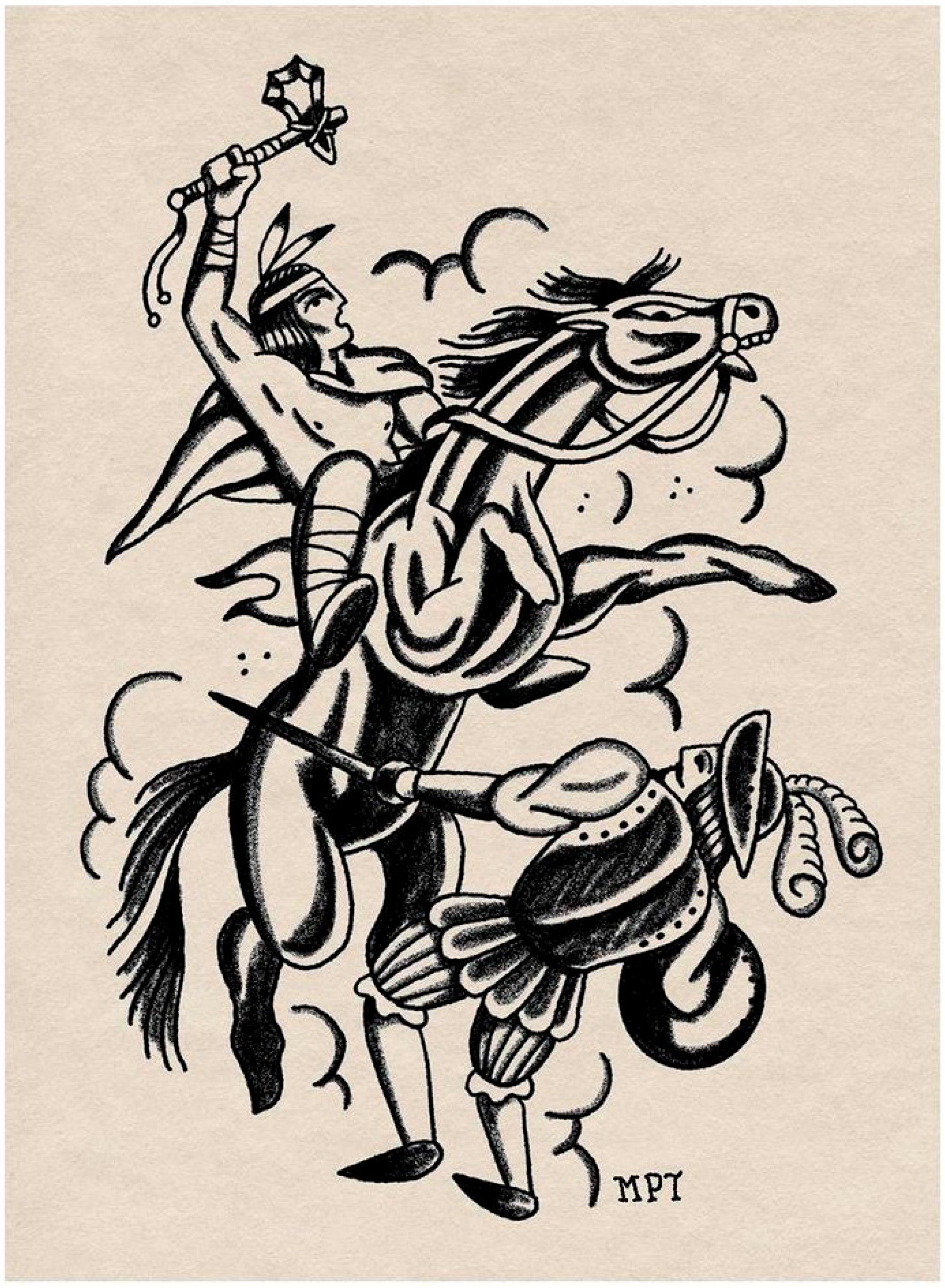
Max Puga, a famous contemporary Chilean tattoo artist whose work can be seen on Instagram, created this image (
Figure 1) that, when looked at from afar and without paying close attention to the characters represented, seems to refer to an icon widely used in the Ibero-American world: the knight St. James destroying the infidel Moors in the Iberian Peninsula, for which he became known as St. James the Moor Slayer.
Until approximately the 9th century, the Apostle Saint James was exclusively associated with the pilgrimage to Compostela for the veneration of his relics. The iconographic model that emerged from this devotion is that of the pilgrim. An important event in the life of Saint James, which contributed to the creation of his multifaceted identity, was his recounted appearance at the battles of Coimbra and Clavijo to aid the Christian forces of the Iberian Peninsula against the Muslim enemy. This miracle is what created the facet of Miles Christi, knight defender of the Christian faith. From this arose equestrian iconography, whose first appearance is a bas-relief on a tympanum of the Cathedral of Santiago de Compostela. This figure would later play a role in the so-called Reconquista of Spain against the Muslims and became the patron of Spain who then travelled to America to fight against the Indians.
It was around the thirteenth century when a new way of representing Christ’s apostle emerged in Compostela, which relates to the religious and political needs of the time, as well as to a new spirit prevailing among the ruling classes. The resulting iconography and accompanying discourse, therefore, are explained by a military and political group’s devotion and need for a saint to justify war and help them in battles. In this sense, St. James is much more than an intercessor between men and the divine, because he actively participates in the struggle. His first supposed miraculous appearance was in 850 at the Battle of Clavijo. His iconographic premiere was in the tympanum of the Cathedral of Santiago de Compostela, through a 13th-century sculptural relief. To this must be added the founding of the Military Order of St. James of the Sword in 1171, which was supposedly the result of an attempt to combine the chivalrous spirit with the crusader mentality, and to integrate the idea of fighting for faith as spiritual perfection in the monastic sphere.
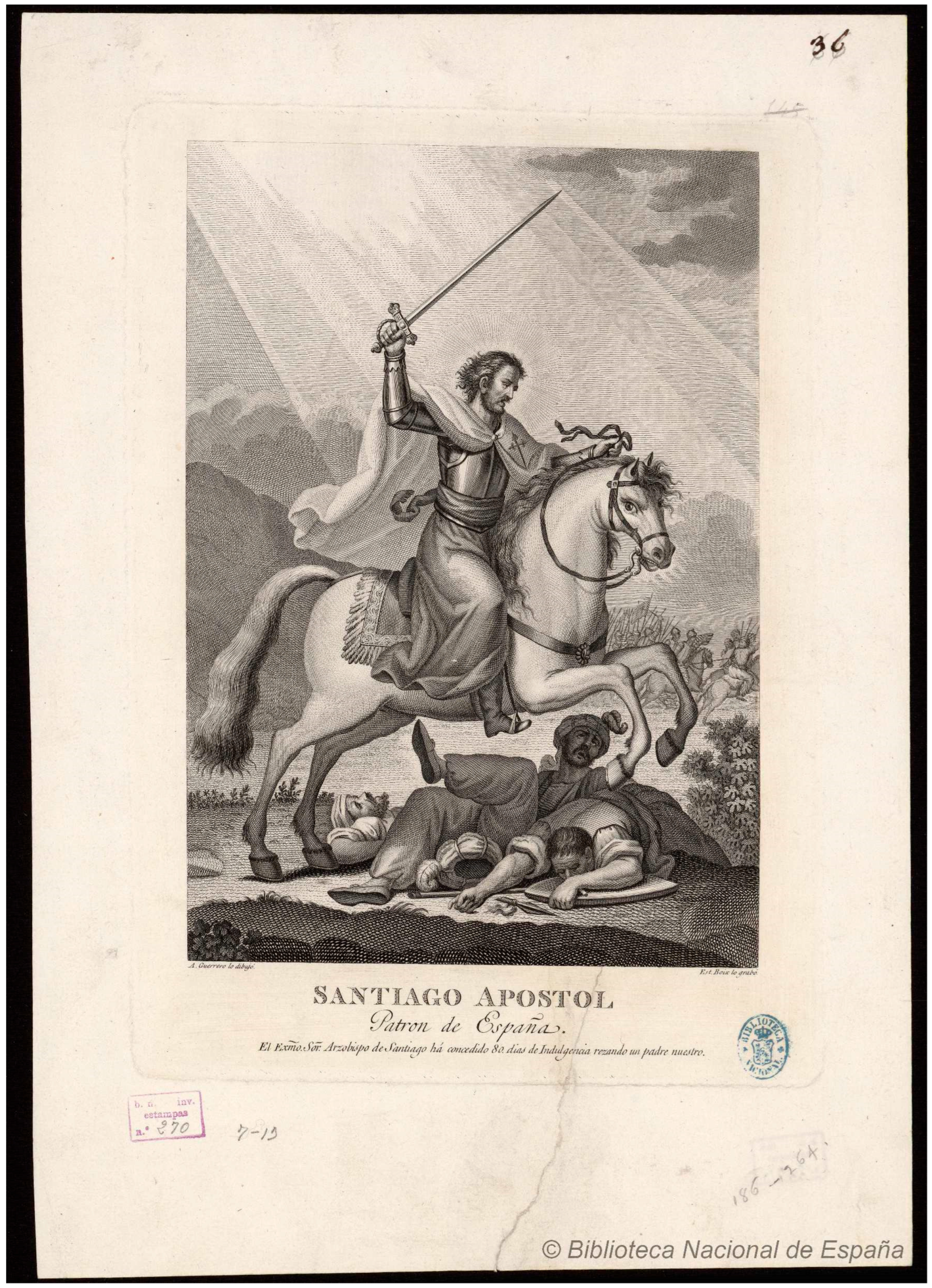
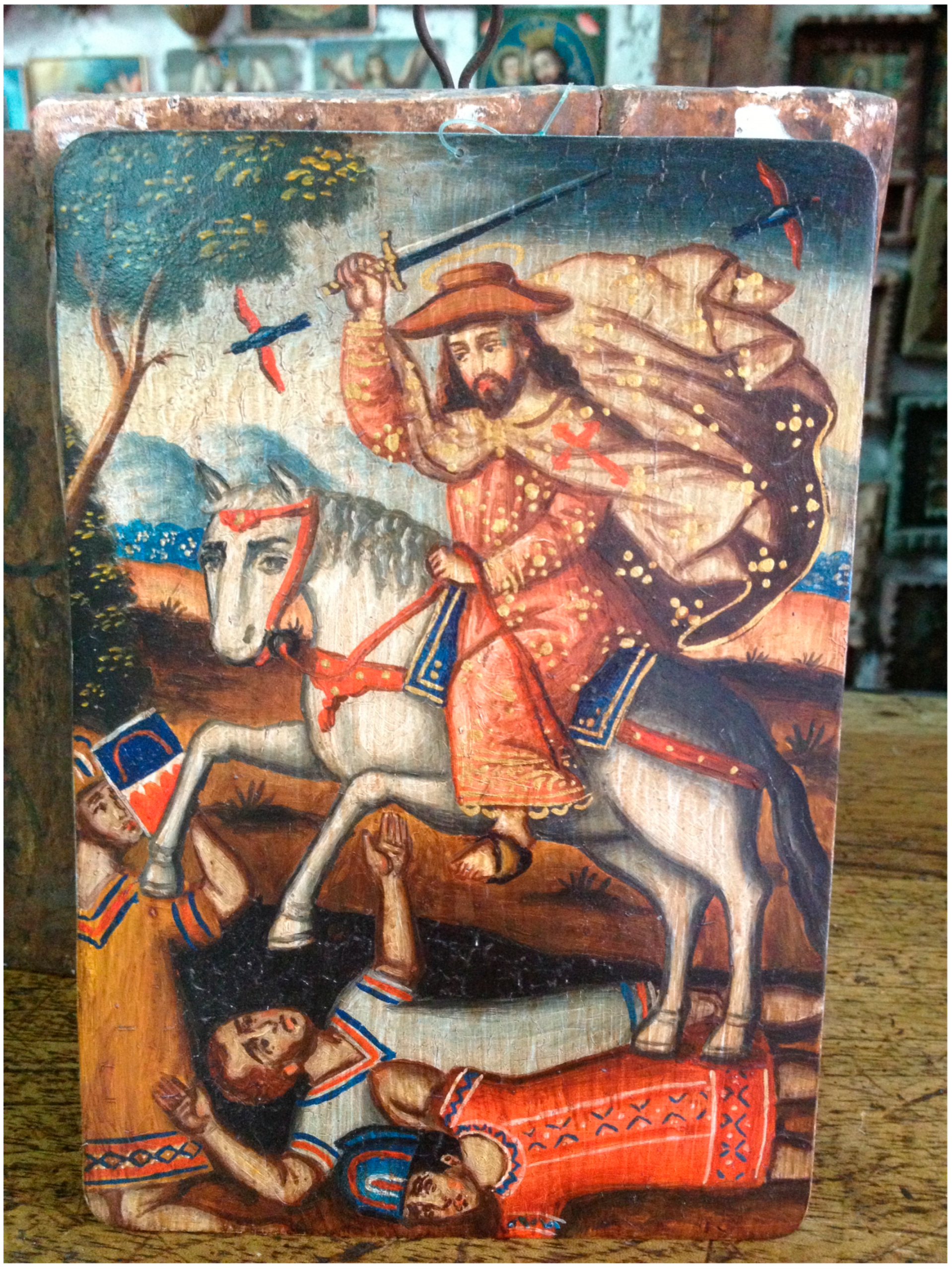
1This military iconography and its meaning passed the America where the Spanish hero slaughtering Native Americans on their own territories became St. James the Indian Slayer (
Figure 2 and
Figure 3). Nevertheless, this tattoo does not depict the apostle James destroying the enemies of his faith. In fact, it is a Mapuche Indian. These were Native people of territories that today are Chile and Argentina. They inhabited the lands of south-central Chile and were characterized by having fought against the Spaniards in the Arauco War. Their strong sense of cultural identity has led them to present resistance throughout history—first against the Spanish monarchy, then against the nation state of Chile.
2The Mapuche here depicted is probably meant to be the famed Caupolicán—on top of a prancing horse, with his traditional weapon held in the gesture of destroying a weakened Spanish conquistador, likely the Extremaduran conqueror Pedro de Valdivia.
The formula is exactly the same as seen in the figures cited, but the winner and loser are different this time. This image can be understood to contain
a pathosformel or pathos formula, a term coined by art historian Aby Warburg (
Sanfuentes 2025). This concept refers to Western visual images inherited from classical antiquity that carry the emotional impact of the time. In Western culture, there are several historical and mythological figures who depict heroes riding horses. Among the former are Alexander the Great riding Bucephalus, El Cid on his horse Babieca, and Napoleon on Marengo. Among saints on horseback, there is not only Saint James the Moor-slayer, but also Saint George slaying the dragon from horseback.
The emotions behind St. James’ image have to do with strength, violence and power applied against an enemy. It is argued here, then, that the visual formula of hero atop his spirited horse subjugating his enemy, can be activated as its emotional content is required, drawing on these figures’ familiarity and effectiveness, and the culture’s unconscious trust of them.
The interesting thing is that this formula allows one to interchange parts of an image and yet it continues to carry dense emotional content. It is important, therefore, to consider the inversion of the terms in this image. Is this a reinterpretation of history? Visual propaganda? A desire expressed in an image? A memory of violence? This image contains each of the realms suggested by these questions. What is definitive, however, is the violent and bellicose nature of the image.
In order to approach these questions, this article aims to apply Erwin Panofsky’s iconological method. It basically consists of considering three levels of analysis. The first consists of a literal description of the image. The second aims to discern the meaning of that image in its precise context of production and reception. The third is more structural and seeks deep meanings in long periods of time and extended spaces. We also take hand on the contributions of Aby Warburg, taking into account the visual characteristics of the image in question, in relation to its specific context, to the other images that during history have represented the same system and finally, to the epochal passions that call for its use.
2. The Context of the Conquest and the Creation of the ‘Other’
The history of the conquest of Chile and America, in general, is violent. A group of Spaniards fought with weapons to subject this territory’s people to the Western Christian world and to make it part of an empire created at the expense of America and its inhabitants, the Native Americans. The history of the events is mostly chronicled by the Spaniards and Europeans, that is, from the point of view of the “victors.” The nomenclature of victors is used here to account for the traditional way in which the relationship between Spaniards and indigenous people has been summarized. This was true both at the time of conquest in the chronicles and in later historical accounts of events.
3 Both the collection of facts and its narrative rest on a binary model in which some people are Christians, live in cities, speak Latin or Romance languages, dress in a certain way, engage in “appropriate” sexual behaviors and eat certain foods. Those who do not share these characteristics and ways of life represent otherness and are key to understanding a system that rests on the victory of some and the submission of others. It is a real system that seeks to divide the world into right and wrong, thus generating a device—visual in this case—to turn to when you want to imitate what is supposed to be right. Alongside the visualizations, there are a series of discourses, legal frameworks and practices that accompany this vision and justify it.
That mentioned context has been mainstream to preserve a system. While the context of violence that was exercised and justified was one, there are others that must be illuminated and addressed to show the complexity of history and to argue that historical actors are free beings and that, with creativity and conviction, they can make use of the tools available in their time to influence the course of history. Bartolomé de Las Casas, for example, drew on other postulates available at the time to argue that the indigenous people had developed full rationality through their understanding of the environment. For him, they were not only equal to Europeans but, he even argued, morally superior because they lived in harmony with nature, having built cities suited to their resources and needs, and were not cruel and greedy like the Spanish. Based on theological ideas and developing his own unique perspective, the friar dedicated his life to defending the indigenous people and writing treatises that documented this. In his arguments, he upheld a radical universalism: there are no degrees, since all human beings are rational. He also stood out for his unwavering pacifism, maintaining that war should not be waged to evangelize. War must be avoided.
Humans are not born into categories such as ‘the other’ (and its extreme—the enemy). These are social constructs that promote the creation and maintenance of a system. If someone refuses to participate in that system, will not cooperate with it or simply possesses different traits that threaten its stability, that someone is considered an enemy and, as such, must be annihilated. Alterity, therefore, is a category that is constructed and then applied and exercised on a subject or group of subjects. “To say ‘the other’ is to present it as different” (
Hartog 2005), a difference that is complex when both enter the same system and must play their roles within it.
In this context of binary division between one and the other, where the other is supposed -for some actors- to be subdued to advance through the territory, to impose a lifestyle or to steal loot, the Spanish representation of the apostle St. James collaborates with the Spanish armies to fight against the South American Indians.
Saint James can be a warrior, an apostle or a pilgrim. As a warrior, he alludes to the bellicose side of Christianity. The origin of the militant dimension of Christianity is in Christ himself: despite Christ’s message of pacifism, his death on the Cross is also, from the beginning, interpreted as a triumph, the triumph of life over death through the resurrection. The dual dimension of the Christian religion—both its peaceful and its most violent facets—serve different purposes and are embodied in various characters and speeches as needed for the interests of the Church and the Crown. Representations that collaborate with the ideas of conquering territories and fighting against enemies of the faith are used in times of spiritual conquest. This is the case, for example, of the military crusades in the Middle Ages, in which the Church called for the recovery of the Holy Places.
St. James as a warrior, is a key figure on South America’s military frontier, a space defined by integration and conflict and where the apostle embodies these dynamics. For the Spaniards who arrive in America, it is a frontier space, offering political opportunities for the expansion of their empire, but above all, the domination of an enemy of the faith, indigenous people who must be Christianized to expand Christianity. St. James crosses all geographical and temporal borders, from Europe of the Middle Ages to America of the sixteenth century, where the Spaniards invoke his warrior character to justify their war by using the phenomenon of miraculous apparition.
When America becomes part of Western history, it does so as a key cog in an empire. As a political and religious system that brought together distant territories under the same crown, the Empire of Charles V required the use of a logic that conveyed, both in discursive and visual terms, a tone of success for the Western Christian European. This required an efficient and effective visual apparatus to capture the idea of victory over the entire world. Emblems reflecting that idea were used for this purpose, such as the iconography of the pillars of Hercules with the legend Plus Ultra, which replaced the traditional inscription Non Plus Ultra. Charles V would capitalize on this image to show that not only was his empire limitless and in line with the classical tradition, but that it had dared cross the Strait of Gibraltar (Pillars of Hercules) and the Atlantic.
It also meant ruling with an iron fist those they thought to be idolatrous and uncivilized inhabitants of the discovered lands: the American Indians. The recurrence of St. James as a collaborator in the conquest—in the chronicles, in the number of cities and towns bearing his name (Santiago in Spanish), in the appearance of his image throughout the American territories—aligns with these ideas. His image stirred the collective memory of European victory, while emitting a warning to those considering turning against what was considered acceptable. Due to the gesture conveyed by the image and its many accompanying spaces and discourses, it warned the indigenous people that they must accept Christianity. If not, the same thing would happen to them that had happened to the Moors depicted in the paintings of St. James in which he defeated men from other lands: all unbelievers were to be dominated.
Among others, the image of St. James the Apostle was very useful to the Spanish empire and its goals.
4 This is why the strategy is often complemented by the presence of the Virgin Mary. Indeed, this happens in the battle of Sunturhuasi, a key battle in the struggle between the Spaniards and the Incas, when the virgin appears next to St. James, collaborating with the Spaniards by throwing sand in the eyes of the natives. Alonso de Ovalle would return to this same instance to explain the intervention of St. James and the Virgin in the battle against the Mapuche. Thus, it was easy to come to the messianic conclusion that the saints were on the side of the Spaniards, collaborating with the armies in their battles against the Indians.
The first miraculous appearance of the Jacobean saint in America would have been in 1518 at the Battle of Centla, fought by Cortés and his men in Tabasco. Years later, in the previously mentioned battle of Sunturhuasi, between Spanish and Inca rebels, his appearance is related by the chronicles of the sixteenth and seventeenth centuries. The fact that this miracle was only recounted by Juan de Betanzos in 1551, when the events had already occurred many years prior (1536), shows us that there were competing interests. It was the most important battle during the military conquest of Peru and the crown wanted to represent it as a divine victory and do away with the claims of encomenderos seeking the perpetuity of their mercies. Years later Francisco López de Gómara would use the same narrative scheme to explain another Spanish victory, which makes sense because they would have consulted the same literary source.
Along with containing an idea of history in which providence is on the side of the evangelized world, the image directly warns those who have not joined this cause, suggesting that they will be defeated by a mightier hero. It was a strong and violent visual image that warned of an ominous future if one was not aligned with the system. When St. James was invoked, it was a way of experiencing the time of the gods as well as their intentions. When St. James was called upon, this alluded to the histories of Christianity in general and Spain in particular as epics marked by military triumphs over infidels. In the story of the founding of Christianity, a Christian present was preceded by a pagan past (
Cormack 1991), so destroying the unevolved one who came before, the one who was supposedly wrong, was part of the essence of Christianity and its mission. All other ways of living at that time and relaying the founding and important facts were either eliminated or reinterpreted in the light of Christian chronologies and eschatology. The image of St. James destroying the indigenous, thus, reveals victory in the present and the future, while the defeated represent a past that has already been overcome.
3. The World Turned Upside Down?
The image of a Mapuche defeating a Spanish conqueror subverts the traditional terms described previously and leads to a new historical interpretation. It is a version of history from other points of view, different from the traditional Western ones. Among those versions are those that shows indigenous agency in the acculturation process, those which emphasize miscegenation, and at the extreme edge of the spectrum, those that shed light on the indigenous rebellion.
The image presented here is of this latter type and manages to represent a worldview of winners and losers where the indigenous people are the ones who defeat the European conqueror. In this sense, this image depicts another version of the story, different from the one experienced and narrated. Or it can be interpreted as an image that dreams of an alternative future. Temporality is now appreciated as experienced memory. The violence of the conquest, recorded in various narrative and visual media, is translated into a visuality that is capable of representing contemporary violence—which was experienced both in Republican times and during the twentieth century—although it is now inverted. In this sense, the image has effectively transcended historical times and become a container for feelings and emotions—violence in this case. Javier Domínguez García writes emphatically that the figure and archetype of St. James legitimizes a value system code that justifies violence (
García 2009, p. 74).
The are many reasons someone might tattoo this image on their body, but behind them is dissatisfaction with the system, a strategy for lending a voice—or visibility as regards the tattoo—to the defeated. The Mapuche have traditionally been portrayed as the fierce enemy of the Chilean state and in this construction, they are described as ‘other,’ uncivilized people who must be subdued in order for the system to work. Because of the Mapuche’s identity as an enemy of the nation, the political and military actions of the groups in power towards them have been characterized by dispossession, contempt, prejudice and racism. In times of social conflict in which many other denigrated identities have suffered contempt, one does not have to be Mapuche to feel represented by this image. It allows us to look out from within subalternities that experience violence. The violence associated with gender, poverty, interrupted childhood, etc., are there participating in binary systems that set one against the other. So, a reasonable conclusion is that this image system is capable of representing something more general, which is the struggle between good and evil.
Narratives and images that emerged in the past have life and resonance in the present. The continuity of the image of St. James the Moor Slayer in public spaces and the reactions of the appellees serve to confirm this. After the Al Qaeda attack on the Twin Towers in 2001 and that of the Madrid metro in 2004, some statues of the apostle had to be removed from their exhibition spaces in Spain or altered so the one who lay defeated was disguised or hidden.
This is because images have power and it is not a good idea today to play around with the dynamics of Muslims being trampled on by Western men, champions of Christianity. In a multicultural Spain like the current one, the medieval discourse of the reconquest and the chivalric figure of St. James have taken on new symbolic meaning in the war on terror discourse (
García 2009, p. 70). The leaders of the cathedral of Santiago de Compostela, in charge of this temple visited every year by thousands of followers, ended up removing the saint’s sculpture by Gambino from the church, so as “not to hurt other ethnic groups” (
Hermida 2004). Instead, they expressed their interest in promoting the image of St. James as a pilgrim, which they considered a more universal motif.
But, despite this gesture, images and their management can continue to offend or arouse the indignation of many, on both ends of the spectrum. Sometimes, deep and latent political and social problems become visible and active in relation to images. Images have power, they have agency. When public discussions of a sculpture that offends Muslims emerge, competing voices take advantage of the opportunity to cry out for the rights of other groups that have been victims of institutional violence. On social networks, people express their opinion and many say that instead of hypocritically complaining about St. James the Moor Slayer, one should worry about homophobia or the insults women and children endure, among other things. Meanwhile, there are those who take advantage of the discussion to voice Spanish nationalism, calling for a Spain free of immigrants and Muslims.
Returning to the tattoo, it is clear that those who suffer daily from the physical and symbolic abuses of oppressive power, imagine of a way out in which they also trample their oppressors. Violence is not justified on principle, but they think about each other in the same way that they have been educated to think about winners and losers. As the formula has served some, one dreams of it serving oneself.
4. St. James, Mapuches and Horses
The world seems to be upside down. Santiago, riding on his horse, came to America to destroy the American Indians, because they were idolaters and had to be converted to the religion of the Spanish Christian empire. In figures such as the one being analyzed, the saint ends up assisting the indigenous in his task. The Spaniards and their horses, which the first indigenous people who came upon them considered an apparition, brought violence and destruction to America. The horse that accompanied the Spaniards is key to the triumphant image of St. James; the horse was his truest ally in his battle against the indigenous. It also worked as a psychological weapon: Hernán Cortés reportedly left a record of the indigenous people’s fear of the horse. Bernal Díaz del Castillo says that indigenous people thought that the horse and its rider were one single thing, a compound monster. This creature, therefore, held a privileged place in reality and in the complex world of ideas and value codes. It was brought from medieval Spain to modern America (
Serrera 2014).
In both functional and symbolic terms, the horse is an important player in the story. In this sense, its allusion can work on metaphorical and literal levels together, providing ideas about gender, social organization, aesthetics, nations and power, to name a few scenarios (
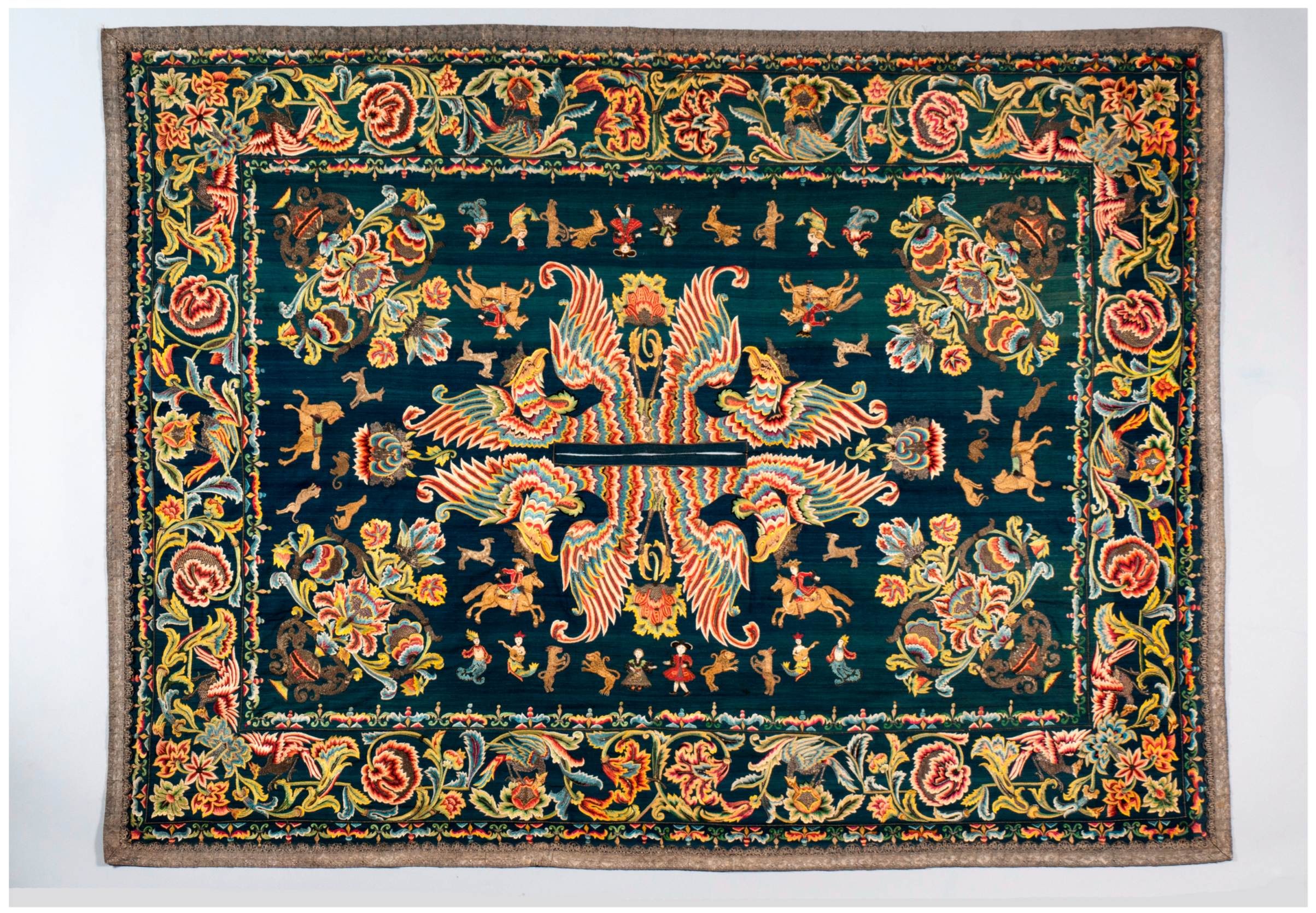
Edwards and Graham 2012). In the Hispanic-American time and space of interest to this article, its functionality is interwoven with its symbolism. For the Spaniards, it was key in the processes of conquest and colonization of the New World. They needed horses to advance through the American territories, to move people and objects, to make war, for their game of canes and for bullfighting. Horses pulled chariots and their possession conferred status and prowess. In
Figure 4, the 18th-century poncho of the Peruvian viceroyalty shown here reveals the importance of the horse and its association with the higher classes of society at the time. The rider is represented elegantly dressed and following eighteenth-century fashion. He carries a sword in his hand and is about to wield it over an enemy, which results in a gesture very similar to that which characterizes the warrior St. James. And there are more examples of this eighteenth-century visual formula: a similar character is depicted in the mural paintings of San Andrés de Pachama, a small town in the pre-cordillera of Arica, Chile. The character is performing a bullfight on horseback, typical of the eighteenth century.
The symbolic importance of the horse is evidenced, among other ways, through the equestrian portraits of famous people. There are countless examples of this genre; and I also wish to highlight portraits of kings or emperors painted as St. James: they are quite interesting. One of them is the portrait of Charles V as St. James the Moor Slayer, housed in the Worcester Museum in the United States. It is supposed to represent the triumph of the Habsburg emperor at the Battle of Tunis in 1535. Another example is the portrait of King Philip V, an anonymous painting from the Collao school, from the first half of the 18th century, found in the Museo Nacional de Arte de la Paz. According to Pedro Querejazu, it is a battle painting in which the king has been transformed into St. James with the addition of a hat and cape, and his baton becoming a sword. Querejazu adds that this is one of the few royal portraits that have survived in Bolivia (
Leytón 1994).
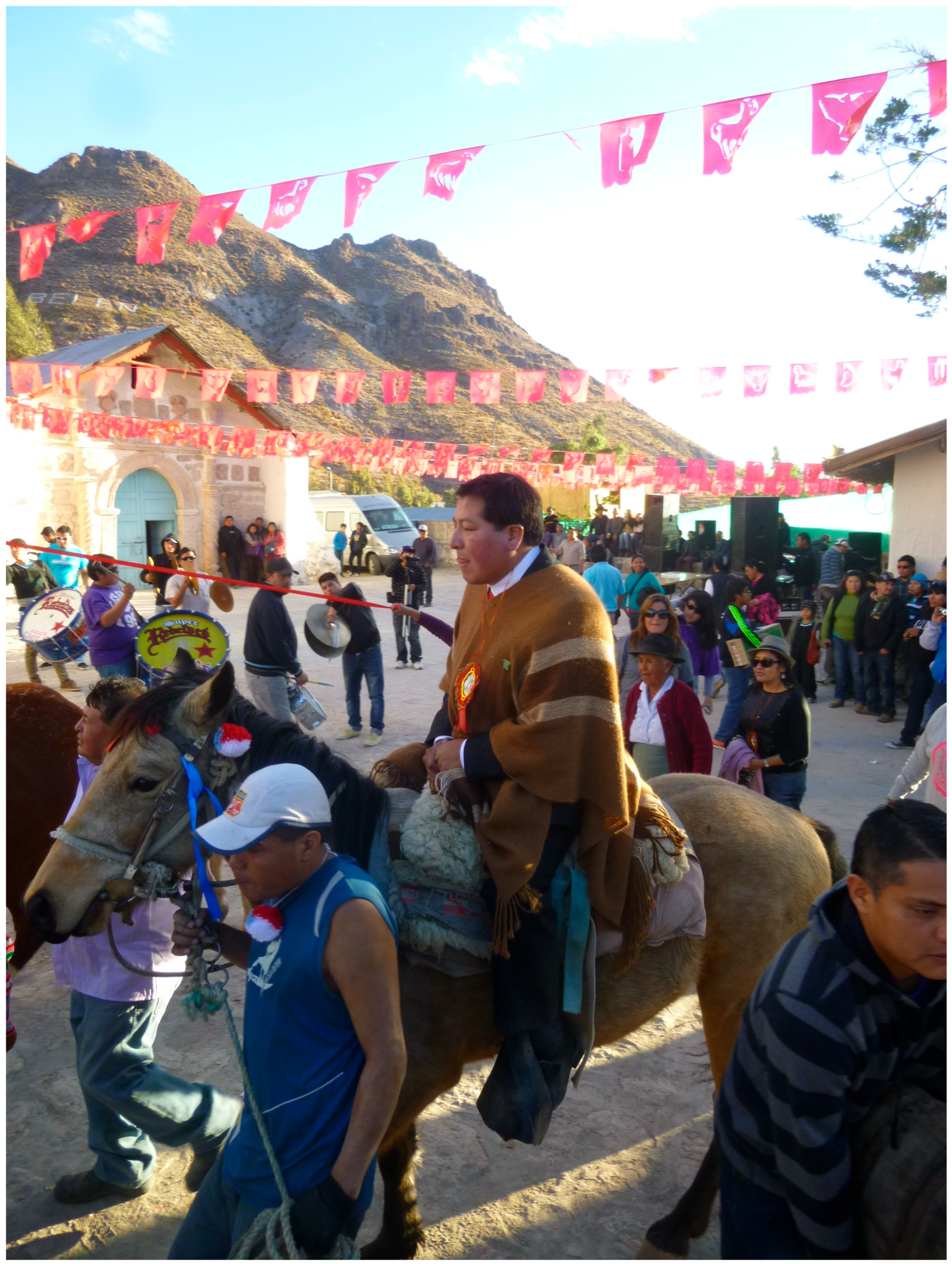
As one can see, the horse is a symbol of military power in the sixteenth and seventeenth centuries and it also acquired social power in the eighteenth century. However, for various reasons, indigenous peoples quickly adopted the horse and adapted it for their religion and others as part of their identity. This occurred in many places in America where meaning was reassigned to St. James as the patron of agricultural and livestock communities. A tremendous distance separates this European equestrian nobility from these Andean farmers and ranchers, who trust their patron saint to bring them good harvests and fair weather. In small, private altarpieces of private devotion, miniatures of the warrior apostle are accompanied by figurines of cows, llamas, mules and horses that recreate, in some way, the everyday universe of the Andean man who enters the sacred space of the altarpiece. From the world of ritualism, the high-plains Chilean town of Belén holds a community festivity for St. James during which the ensign and his wife arrive at the church on horseback, then sacrifice a rooster and drink chicha in honor of the equestrian saint. These are examples of symbolic uses of the horse by groups that are not traditionally associated with power (
Figure 5).
In other parts of South America, this animal, so important in the Spaniards’ struggle against indigenous people, was adopted by the indigenous people themselves. This is the case of the Mapuche appropriation of the horse, which collaborated in the figure of the
weichafe. The
weichafe or Mapuche warrior has a specific role in relation to war within his community. The Mapuche suffered the impact of the new and different upon the arrival of the Spanish. But once this stage was over, the Mapuche began to assimilate and adopt some elements of the invading culture, including European animals. The horse, in particular, penetrated a wide and varied range of Mapuche cultural activities. The machinery of war would involve the possession of many horses. Margarita Alvarado comments that “A Mapuche on horseback is established as a notable character within his community” (
Alvarado 1996, p. 43). The Mapuche warrior on a horse had ethical, aesthetic and symbolic connotations (
Alvarado 1996, p. 44) and its importance lies in the fact that it was incorporated into Mapuche culture as a whole and as an intrinsic symbol of the warrior, representing and complementing his power (
Alvarado 1996, p. 46).
If one views the image with this in mind, one realizes that the Mapuche imitate the Spanish in their use of the horse. The latter needed the horse to make war on the Mapuche and the former looked closely at the usefulness of this practice. Along with the horse as an attribute, Margarita Alvarado suggests that a whole performance and certain attitudes or “significant gestures” accompany the Mapuche warrior. Among these, she mentions his battle cry, through which he individualizes his performance and claims enemy casualties. In the tattoo, this cry is evident in the figure’s open mouth.
This very relevant character in Mapuche culture is assigning itself new meaning in the image under analysis. This image emerges as violence is conveyed by the non-recognition of indigenous rights and the exacerbation of their marginality, abuse and sometimes annihilation. It did not exist iconographically in the way one sees it now but was living in the collective imagination of the indigenous people, who dreamed of destroying their enemy, depicted here as the original enemy: the Spanish conqueror. Borrowing this formula makes it possible to illustrate and contain the historical antagonism between first the Spanish and Mapuche societies, and then the Chilean and Mapuche societies since the founding of the Republic of Chile. It is the violence of the system that is divined in this binary antagonism, and it is the effectiveness of the rider destroying the enemy under his feet that explains the image’s contemporary reappearance and transformation.
5. Manichaean Rhetoric
Manichaean rhetoric makes good and evil easily discernable and translatable; a visual formula used in antagonistic contexts such as the one described so far proves this. Further proof and evidence exist: in the antagonistic Spanish—Mapuche system, the Chilean religious figure and painter Fray Pedro Subercaseaux
5 (1880–1956) provides another version of occurrences and immortalizes his point of view by painting the enemy of the system (
Figure 6). In his work, the Mapuche must be represented as defeated, because the only true religion, to a priest like him, is Christianity. Add to this class dynamics and, for Subercaseaux, the Mapuche must appear defeated because this is what the nascent republic of Chile requires. Friar Pedro Subercaseaux is part of an elite that includes French and Basque emigrants, among others, who managed to link up strongly with the Chilean ruling political class. Although he was born and educated in Europe, he later returned to Chile where he dedicated himself to historical painting, taking many of Chile’s fundamental historical battles as his subjects. This made him worthy of the title of painter of “las glorias de Chile” (Chile’s glories). As he himself stated in his memoirs, he was attracted to two eras in the history of his country: the conquest and independence, because they were both heroic and picturesque. “I saw in them magnificent opportunities for dramatic compositions of intense movement and color” (
Subercaseaux 1950). This affinity also contained an educational and moralizing spirit that conveyed the desires and designs of a political and social elite who valued progress and kept its own version of history. The historical theme depicts a glorious past and seeks to prove that destiny and the divine were on the side of the victors; that it was key to creating a sense of identity and solid foundations upon which to build the future.
Friar Pedro Subercaseaux was interested in military history not simply because it shaped national identity and history, but in terms of aesthetics, as well. As Silvina states, “Subercaseaux was visually attracted to the aesthetics of heroic and glorious acts and this motivates him to translate them into painting so they will not fall into oblivion” (
Vota 2015). In this spirit, Subercaseaux’s body of work contains at least two paintings dedicated to St. James the Apostle. The first is an oil pastel on charcoal sketch entitled
St. James and them (1906). The formula mentioned here repeatedly recurs: the Spanish saint on his prancing, white horse defeats an enemy whose failure is evident by this adversary lying on the ground. The battle here is so stormy that it is difficult to distinguish the identity of the defeated. Some anatomical details suggest that they are Mapuche.
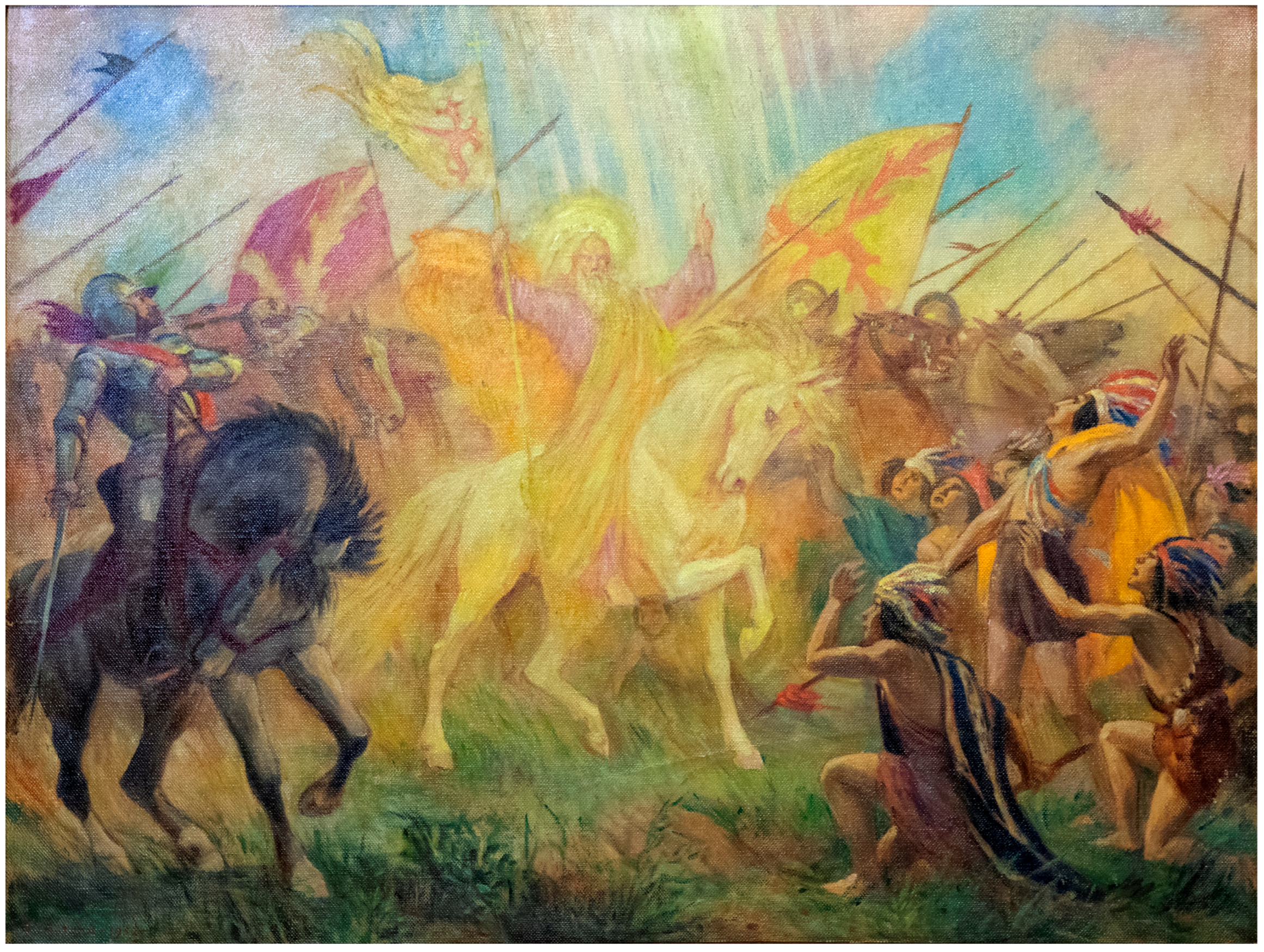
Another painting in which Fray Pedro uses his artistic gifts to glorify the Chilean armies is “
Apóstol Santiago en Penco” (
The Apostle St. James in Penco), an oil painting that belongs to the Pinacoteca de Concepción. Although some iconographic characteristics distant it from the strict formula that we have been considering, the complementary details and the title of the composition remove any doubt and place this painting firmly within the triumphant repertoire of Christianity, in general, and specifically the political power of the Republic of Chile over any insurgents on its land. St. James here wears a purple robe and a yellow cloak, but the cross of St. James and the assistance of military troops, with helmets and armor in their confrontation with the natives, confirms once again that these elements are used discursively to endorse the violence inevitable in confronting enemies (
Figure 4).
If we have so far witnessed the triumph of one over another where the former are generally higher, subduing the enemy who is subjugated at their feet, here the reading of the spatial arrangement changes. But this does not detract from the readability or effectiveness of the composition. From the left and advancing from behind, the eye rests on the order proposed where the Spaniards are taking the foreground in their offensive and glorious advance. The indigenous people, on the other hand, are on the right, but kneeling in a clear sign of defeat and trying to placate the advancing enemy. The angle of the story becomes clear and is, again, in favor of those who hold power. St. James is surrounded by an intoxicating light that suggests divine assistance in the Republic of Chile’s political projects.
The compositional strategies of the hero on his white horse with the defeated on a lower plane, as well as that of the impetuous advance of the victor towards the foreground of the composition, accompany all the work of Fray Pedro Subercaseux in which there are winners and losers. An oil painting from 1913 adorns the walls of the hall of honor of the former National Congress of Chile. It is called The Discovery of Chile by Almagro. It was commissioned from the painter, by the then presidents of the Senate and the Chamber of Deputies, to commemorate the centenary of the Republic. In this composition, one does not see a battle between the Spanish and the Indians, but the interpretation and intention of the composition are clear. Haughty and enlarged on his white horse and carrying the flag of Spain and other banners, Almagro towers over some indigenous people sitting on the ground, while another shows and orients him through a promising landscape. There is no doubt as to who the victor in this subjective interpretation of history is. Subjective, because it has gone so far as to invent a new version of the story, since the chronicles agree that Almagro’s expedition was a failure and the natives set up strong resistance.
The civilizational discourse that prevailed in the ruling classes of that time alluded to a glorious past in which Spain had supposedly defeated the American Indian. This could be read as the Hispanic version of history, which attempts to highlight the importance of the Spanish in the configuration of American societies. However, the civilizational discourse can be interpreted in a different way. It can be read again as the traditional strategy of issuing a visual warning that assigns glory to one group and defeat to the others, and thereby recommends adherence to the dominant party so as not to find oneself among the defeated. Taking away agency from the indigenous, as well as leaving out other actors of the time such as black people and women, reveals how symbolic systems of power are formed. These ideas can take hold in an era that inherited a centuries-long conflictive relationship with the Mapuche people and that consciously and unconsciously sought to reinforce and strengthen the power of a white-Creole-man dominated society
6. Final Thoughts
As noted, the system of an image is a visual artifact that can provide a formula and induce certain emotional reactions. That same visual artifact can invoke an inversion symbolically, if the emotion or drive remains the same, but the solution or production is the opposite. These emotionally charged images are therefore unearthed from time to time as weapons of power because they carry such weight in the collective memory.
In 2019, when a large-scale social movement erupted in Chile, identity claims and historical revisionism encouraged initiatives that destroyed or reassigned meaning to monuments. Many of these sided with the Mapuches, and in doing so, directed their historical anger toward the statues of conquerors commemorated in public spaces. These men had been considered and remembered in a positive light as Chile’s founders since the time of the conquest. Criticisms of the colonization process emerged during the twentieth century and have become exponentially more acute in recent years. In this context, it is easier to think of Pedro de Valdivia, founder of Chile’s capital, Santiago, as defeated by the Mapuche, whom he fought but failed to conquer. The Mapuche’s reaction to the Spanish was to resist them, making this tribe world famous for its bellicose nature. The Mapuche warrior was capable of facing his greatest adversity, guided by courage and his attachment to his land (
Pinto and González 2019).