Article

The Eyes in Close-Up: Surveillance, Control, and Montage in Three Works by Sergei Eisenstein

by
Joana Jacob Ramalho
School of European Languages, Culture & Society, University College London, London WC1E 6BT, UK
Arts 2026, 15(2), 39; https://doi.org/10.3390/arts15020039
Submission received: 20 August 2025 / Revised: 23 January 2026 / Accepted: 26 January 2026 / Published: 10 February 2026
(This article belongs to the Section Film and New Media)

Abstract

This article outlines the central role of the human eye as a consistent and recurring aesthetic strategy in the cinematic oeuvre of Sergei Eisenstein via an investigation of three films—Strike (1925), Potemkin (1925), and the unfinished, two-part Ivan the Terrible (1945, 1958). It analyses seeing, being seen, and shut and open eyes, in conjunction with the use of the close-up, as crucial to Eisenstein’s visual vocabulary and argues for the need to think about the persistent focus on eyes and vision in terms of panoptic mechanisms of political surveillance and control. Meaning is generated from eye to eye, through configurations of looking and spying, revealing and concealing—formal and aesthetic strategies which condition the gaze of the spectator, creating sites of affect that provide continuity between the films. It furthermore contextualises Soviet montage and Eisenstein’s work in relation to European avant-gardes, specifically French Impressionism and German Expressionism, whose influence on the director’s filmography has received little scholarly attention.

1. Introduction

No other art form modifies our perception as radically as cinema. Even more so when the editing, or montage, is deliberately and systematically disjunctive, as is the case in the oeuvre of prolific Soviet theorist and filmmaker Sergei M. Eisenstein (1898–1948). With its frenzied tempo and rapid cutting, the Eisensteinian elliptical and overlapping montage shows ‘the excess that remains invisible to our ordinary experience and perception’ (McGowan 2007, p. 40). Initially developed by Lev Kuleshov and Eisenstein, among others, Soviet montage cinema devised a new cinematic language—one with its own powerful visual vocabulary which attached to the moving images unprecedented affect and political implications.
In Eisenstein’s films, the mobilisation of vision through montage works in conjunction with specific techniques, such as the mixing of close-ups and long shots, the dialogue between diegetic and non-diegetic images, and the display of graphic patterns and motifs. In this regard, Jacques Aumont’s description of cinema as a ‘symbolic machine for producing points of view’ appears as particularly useful to analyse the innovative cinematic compositions and manifold manifestations of visual imagery in the productions of the filmmaker (Aumont 1997, p. 253). Aumont defines these points of view by characterising them as ‘self-serving to the degree that they must be without rival, so that the spectator may be prevented from occupying anything other than the “vantage point” offered’ (ibid., p. 253). This notion is central to a director whose dominant concern is ‘his striving to control the spectators’ psyche’ and, consequently, to re-educate the masses (Ben-Shaul 2007, p. 77). As Eisenstein explains,
The importance of our method lies in the fact that we have discovered how to force the spectator to think in a certain direction. By mounting our films in a way scientifically calculated to create a given impression on an audience, we have developed a powerful weapon for the propagation of the ideas upon which our new social [system] is based.
(qtd. in Brody 1992, p. 189)
It is on this point that cinema, the intellect, and the political crucially intertwine. Montage, especially when expertly done, can condition the spectator and generate radically new modes of apprehending the sociopolitical milieu. The use of the close-up coupled with the repeated emphasis on the eyes of the characters to engage the viewer is powerfully portrayed in Strike (1925),1 Battleship Potemkin (1925), and Ivan the Terrible (1945, 1958). This article considers Eisenstein’s approach to the human eye as a consistent and recurring aesthetic strategy in his cinematic oeuvre. It analyses seeing, being seen, shut and open eyes, and the close-up as crucial to Eisenstein’s visual vocabulary and argues for the need to think about this persistent focus on eyes and vision in terms of panoptic mechanisms of political surveillance and control. From eye to eye, and through multiple configurations of looking and spying, revealing and concealing, these formal and aesthetic strategies coordinate and condition the gaze of the spectator, creating sites of affect that provide continuity between the films. In order to understand in more depth the innovation and significance of Eisenstein’s work, such as his use of editing techniques, I propose a consideration of Soviet montage in relation to European avant-gardes, specifically French Impressionism and German Expressionism, whose influence on the director’s filmography has received little scholarly attention.

2. Montage, the Close-Up, and the Eyes of the Spectator

2.1. Soviet Montage Cinema

From the second half of the 1920s, the fervency and importance of the French impressionist and the German expressionist avant-gardes started to wane and Moscow emerged as the new centre of European film criticism and innovation. Before the October Revolution of 1917, Russian audiences were well acquainted with American, French, and German films, which monopolised the market (Joyce [1996] 2007, p. 367). Following the Bolshevik revolution, and during the civil war it left in its wake, cinema was accorded a privileged status. After a thwarted attempt to ban all American and European films—an ill-advised strategy at a time when there was no domestic film industry—Lenin recognised the political potentialities of the medium and, in 1919, moved to nationalise the film industry, funding the development of film schools and workshops (Fabe 2014, p. 21), and decided to continue with the extant policy of importing films, even those seen to promote capitalist mores and values. In the 1920s, foreign films constituted roughly two-thirds of the market (Youngblood 1992, p. 51) and were therefore, in practice, ‘subsidising the dramatic experimentation with film form undertaken by the Soviet filmmakers’ (Joyce [1996] 2007, p. 368). American productions in particular gained increasing popularity and, by 1924, accounted for 57 percent of the films screened (Ball 2003, p. 90). Already in 1922, the growing hegemony of American films motivated an in-depth commentary by director Lev Kuleshov in the radical film journal Cinema-photo. In it, he remarks that some critics and viewers, frightened by the rapid spread of American films, liken the phenomenon to an epidemic, which he terms ‘Americanitis’. Rather than disparaging American productions, however, Kuleshov embarks on a comparative and detailed study of the techniques used to excite the emotions and add ‘intensity [to] the development of action’, specifically through editing and the use of individual shots such as the close-up (Kuleshov [1922] 1974, pp. 127–28).
Soviet cinema, like other European avant-garde movements and phenomena, defined itself against its predecessor, in this case the films of pre-revolutionary Russia. Where the cinema of the Tsarist regime, especially the productions released between 1907 and 1917, privileged melodrama and the relationship of the upper classes with the working masses, the early experimental Soviet filmmakers aimed to create new modes of visual storytelling that shifted from an understanding of films as entertainment to a renewed approach to the medium that regarded cinema as ‘an agent of social, political, and cultural enlightenment’ (Youngblood 1992, pp. 37–38). In a way, they carried on the work of the French impressionists, who had set out to highlight the cinema’s photogénie and its status as art in opposition to mainstream (American) films. Their take on product differentiation, however, centred not so much on film as art, but as ideological weapon.
We can distinguish between two general strands in European avant-gardist currents. One is apolitical and aesthetic, such as French Impressionism, and is concerned predominantly with the development of medium-specific practices which culminated in essentialist debates about cinéma pur (‘pure cinema’, meaning surrealist, Dadaist, and abstract, often non-narrative films). The other strand is political and formalist, epitomised in Soviet montage cinema, which relies primarily on the innovative use of editing and ‘the sacrosanct close-up’ (Wollen 1969, p. 131). In this vein, André Bazin infamously promoted ‘a bi-polar view of the cinema’ and pitted Realism against Expressionism, denouncing the latter’s shortcomings (ibid., p. 126). This is a rather crude, or simplistic, distinction that does not allow for the rich possibilities of an overlap between the two currents. Eisenstein was neither a Realist nor an Expressionist, but brought the two traditionally antinomic traditions together into a productive dialogue.
Annette Michelson points to the similarities between Eisenstein and the filmmaker and theorist Jean Epstein (born in Warsaw, then part of the Russian Empire), namely that they both aspired ‘to the constitution of an ontology of cinema’ and prized ‘disjunctiveness’ and ‘inventiveness’ (Michelson 1976, p. 32). The significant point of divergence was that, despite viewing the cinema as ‘a critical instrument’, Epstein’s films remained ‘wholly innocent of an awareness of social or class determination’ (ibid., p. 34), whereas an overarching political sensibility was at the core of Eisenstein’s work. The special attention accorded to the role of the medium as a technology, or scientific instrument, led to cutting-edge experiments with montage techniques, including those conducted by Kuleshov. Departing from the idea that the director can elicit meaning and affect through dexterous editing, Kuleshov realised that one can fabricate meaning by combining individual shots into an organic assemblage in which the audience reads the visual impressions along with the spatial and temporal interrelationships between each element: meaning stems from a carefully planned selection and placement of shots, each dependent upon the following one. As Kuleshov writes,
The secret of mastery over cinematic material—the essence of cinematography—lies in its composition, the alternation of photographed pieces. In the main, for the organization of impressions, what is important is not what is shot in a given piece, but how the pieces in a film succeed one another, how they are structured.
The interdependence between the different elements that montage brings into direct confrontation gave rise to what became known as the ‘Kuleshov effect’, which further refers to the cinema’s ‘creative geography’, that is, its capacity to create the illusion of spatial contiguity and concomitancy where there is none (Wollen 1969, p. 39). According to Kuleshov’s method, the film spectator plays an important role in meaning-making too, to the extent that the ‘alternation’ of images requires viewers to participate actively in the decoding of the images, thereby promoting a cognitively engaged audience. As in Brecht’s radical theatre, with its Verfremdungseffekt, this type of editing encourages a reflective mode of spectatorship for the (political) message of the film, relayed through montage, to achieve its full effect.
Sergei Eisenstein studied under Kuleshov and developed his theories and technique further. Alongside Pudovkin and other Soviet film pioneers, Eisenstein ‘learned the craft from reediting foreign films’ (Youngblood 1992, p. 51). Well familiar with American cinema, he was a professed admirer of the technical skills of D.W. Griffith, whose work, he argues, played ‘a massive role in the development of montage in the Soviet film’ (Eisenstein 1977, p. 201), going as far as to remark that ‘all that is best in the Soviet cinema has its origins in Intolerance’ (Barna 1973, p. 74). Building on the craftsmanship of American cinema, Eisenstein reimagined the American editing technique and adapted it to suit his ideological priorities. In contradistinction to the invisibility of classical continuity editing, Soviet montage is conspicuous, obtrusive, and calls attention to itself. In common film parlance, this method of editing soon became known as ‘montage’. The term gained in popularity so quickly that it led German émigré cinematographer and filmmaker Karl Freund to clarify the word’s usage in a 1934 issue of American Cinematographer. ‘“Montage” is nothing new’, he writes, ‘neither is it a Russian invention’ (Freund 1934, p. 204). Tracing the term to France and its leading position in filmmaking prior to 1914, Freund reminds readers that it simply means ‘assembling’ and is thus used in the same way as ‘cutting’ or ‘editing’ (ibid., p. 204). It was Eisenstein’s ‘artful’, ‘new and virile technique’ that ‘startled the world’ and gave the word a renewed meaning (ibid., p. 204). This new sense of the term was then disseminated and adopted by different national industries to mean Russian montage techniques. Film production in Europe at the time, and especially until 1933, was a highly collaborative endeavour, marked by ‘pan-European interference [and] transnational cross-fertilisation’ (Hochscherf 2011, p. 8). Eager to learn from other film practitioners, namely about sound motion pictures, and keen to share his approach to film art, Eisenstein embarked on a long tour of Europe in 1928 and lectured in Paris and London in 1929–30 (Taylor and Christie 2005, p. 447). Freund recalls the ‘good fortune’ of meeting both Eisenstein and Pudovkin in Germany, where the Soviet directors travelled for expertise and to acquire low-priced film stock: ‘they regarded the German studios as both their base of supplies and their teacher’ (Freund 1934, p. 204). Freund attributes the vitality and originality of Soviet montage to necessity: the focus on the moving images (on telling stories visually, with minimal or no recourse to intertitles) was required so that mostly illiterate audiences were able to follow the films, while the short duration of the shots was due to lack of funding and the shortage of film stock, meaning the directors ‘had to make every inch of film count’ (ibid., p. 210).
Eisenstein’s films, which ‘were banned in many countries’, as Kristin Thompson explains, nevertheless ‘managed to reach a surprisingly large and heterogeneous audience, ranging from Berlin’s intellectual elite to farmers in the USA’ (Thompson 1993, p. 62). Writing in 1927, Walter Benjamin claims that ‘Potemkin owes its great success to Germany’, explaining that ‘[t]he greatest achievements of the Russian film industry can be seen more readily in Berlin than in Moscow’, for critics and audiences in the former city were used to high-quality productions and judiciously pre-selected the films they imported (Benjamin 2008a, p. 323).

2.2. Eisenstein’s Vision

Acts of seeing and looking are central to Eisenstein’s theories and films, appearing as imagistic motifs that are carefully controlled by the process of montage. Filmic montage is about construction, about new ways of assembling film and establishing visual and intellectual connections between previously disconnected images and meanings. Going beyond Pudovkin’s linkage editing, which understood montage as a simple ‘linkage of pieces’, Eisenstein regarded montage as more than the organisation of individual building ‘bricks’ and sought to achieve a singular kind of visual revolution (Eisenstein 1949, pp. 37–38). His editing technique is, instead, dialectical: it strives to generate meaning and convey politically charged messages through the collision or juxtaposition of opposite elements. Even though this technique was creatively developed and perfected by Eisenstein and other Soviet directors, the roots of dialectical cutting can, in fact, be found in the theories of the French impressionist avant-garde, a point often neglected in extant criticism. As soon as 1916, film critic Emile Vuillermoz discusses the power to juxtapose isolated images as one of the cinema’s most significant features. He singles out montage’s ability ‘to leap from one end of the universe to the other, to draw together antipodes, to mesh thoughts far removed from one another’, all of which would ‘permit a poet to realize his most ambitious dreams’ (qtd. in Abel 1988, p. 114). In 1920, Vuillermoz expands on this theory and extolled the poetic qualities of a true ‘cinematographist’, attributing to inspired montage the key moment of style and of ‘decisive artistic intervention’ (Vuillermoz [1920] 1988, p. 226). According to Vuillermoz, it is when ‘[h]undreds of little fragments of exposed film are there in front of the author […] that the real “construction” begins’ (ibid., p. 226). Distinguishing between the work of ‘a hack’ and a film artist, he comments that the latter
will work patiently at juxtaposing, interposing, overlapping, paralleling, and opposing all these living cells; he will calculate the rhythm of these images, their intercutting and their superimposition; he will ration out the visual impressions and psychological emotions, creating a powerful dramatic ‘progression’, a decrescendo, a surge, a diversion, an escape into dream or a harsh reawakening to reality. He will make eloquent contrasts emerge, develop the inverse of a vision, free the spirit of things; he will cut a scene at the exact moment when its trajectory ought to prolong itself […] then retrieve the interrupted scene at the exact moment when its ‘harmonics’ are about to expire in our consciousness, inspire it with a new elan, and continue to interweave the themes of his plastic symphony until the final synthesis.
(Vuillermoz [1920] 1988, pp. 226–27, my emphasis)
In this sense, it is through a creative approach to montage that film develops a truly ‘cinegraphic language’ (ibid., p. 225). The French impressionists privileged visual rhythms and the cinema’s revelatory powers, judiciously utilising techniques such as slow or reverse motion, close-ups, and flashbacks to foreground the cinema’s ‘revelationist’ potentialities, that is, the medium’s uncovering of the real through the aestheticisation of the prosaic (Turvey 2008, pp. 3–4). Films, in this sense, should not simply stylise reality or reproduce human sight but aid it in discovering the hidden or neglected properties of the everyday. Louis Delluc employs the term ‘photogénie’ to define this mythologising, transformative quality of the cinema, which permits spectators to see the world anew (Delluc [1917] 1988, p. 137). Impressionist filmmaker Germaine Dulac brings affect into the discussion, arguing that the cinema as an art form ‘augments a fact by grafting a feeling onto it by means of a technique that is proper to it’ (Dulac [1924] 1988, p. 306). Some of the core principles and writings of the Impressionists therefore clearly seem to align with the ideas that guided Eisenstein’s work and theoretical output.
While their agreement on cinema’s revelatory purposes and on the role of montage (which should surprise or jolt the spectator by establishing powerful and unexpected contrasts) seems to bring Vuillermoz, Delluc, Dulac, and Eisenstein together, the fact is that Soviet montage directors violently criticised the French impressionists. This generalised dismissive attitude could nonetheless have been due to a difficulty in viewing the oeuvre of such filmmakers as Jean Epstein, for instance, as Christophe Wall-Romana suggests, and in accessing the rich critical writings of the French avant-garde. More pointedly, however, this negative perception might have concerned the fact that the French cinéastes never fully articulated on the screen the radical montage that Vuillermoz theorised and the poetic impressionist output therefore displays an overall ‘political naïveté’ (Wall-Romana 2013, p. 35).
Eisenstein, in turn, fully engages with the remarkable poetic and political possibilities of montage. To him, cinema as a medium should engage not only the human sensorium but the critical faculties; likewise, it should not passively record impressions that demand contemplation, but rather intervene directly upon the real by giving it an ideological edge (Aumont et al. 2008, p. 56).2 Through rapid cutting, imagistic symbolism, and dialectical contrasts, Eisenstein creates causation by fabricating an interdependency between preceding and succeeding shots. In his extensive critical essays on the cinema, he discusses his revolutionary, radical montage techniques as anchored in the organisation of shots (a film’s building blocks) so as to shock and compel the audience into political awareness and action (Eisenstein [1924] 2010, p. 41). The cinema, he writes, should be ‘a tractor ploughing over the audience’s psyche in a particular class context’ (Eisenstein [1925] 2010, p. 62); it should assault the audience like a ‘Cine-Fist’ (ibid., p. 64).3
In his work, montage therefore equals conflict to the extent that it involves a collision of contrasting fragments, which will, in turn, produce a new quality. The combination of shots that share a metaphorical, spatial, and/or narrative contiguity creates ‘chains of associations’ in the mind of the viewers which generate a third, implicit, psychological ‘shot’, elaborated by the spectator (Eisenstein [1924] 2010, p. 41). In this regard, all the similarities and oppositions between consecutive shots, or even within the same shot, create a consistently complex discourse—one that extracts its meaning less from content than from form. In other words, the aesthetic of the images and what they depict is not as important as what they signify at a conceptual level.
The Eisensteinian montage is, above all, an affective discourse that demands agility of the eyes. In his taxonomy of the movement-image, Deleuze describes three types of images: the perception-image, the action-image, and the affection-image (Deleuze 1997, pp. 61–66). By means of editing, the film acquires a new meaning that allows for an overall characterisation of its type of dominant images—in every film there is one system that recurs more than the others. We could therefore talk about perceptive, active, and affective montage. Eisenstein worked at length with the affection-image and, consequently, with affective-montage, revealing a sustained use of a particular type of shot: the close-up. By drawing on a kind of montage that focuses on the close-up to guide the eyes of the spectators, Eisenstein could ‘reveal the excessive enjoyment embodied in the gaze’ (McGowan 2007, p. 39). In fact, there is a place within the film that is created especially for the viewer. When Eisenstein directs, he films the actors as well as the place of the spectators—a place where they would ideally confront their ideologies and be re-educated. A narrative technique that ‘sacrifices strict realism to perceptual and emotional impact’ is more likely to give rise to that ‘psychological shot’, that new dimension of meaning in the minds of the viewers (Bordwell 2007, p. 375). The ‘shock effect’ of montage, Benjamin advances, would furthermore help to train the viewer for the rhythms of late-capitalist societies, promoting a new model of spectatorship that opposed the ‘contemplation’ characteristic of the bourgeoisie to the productive, collective ‘distraction’ of the masses (Benjamin 2008c, pp. 39–40).
The concepts of ‘organic’ and ‘pathetic’, as formulated by Eisenstein, clarify the effect (and affect) of creating a tight rapport between determinate shots and the intended ideological outcome. The former is related to the golden section, as well as to the unity and growth of the film as a whole. On the other hand, the pathetic is the ‘development’ (Eisenstein 1970, pp. 53–62). It is not limited to the organic junction of colliding fragments, but it involves ‘the pathetic passage of the opposite into its contrary. There is not simply an organic link between two instants, but a pathetic jump, in which the second instant gains a new power’ (Deleuze 1997, p. 35). Eisenstein notes that the qualitative leaps in the action can be realised most effectively through the environment when it acquires unexpected or uncanny qualities (Eisenstein 1970, p. 59). Towards the end of Potemkin, for instance, when the mutinous battleship moves towards the tsarist squadron, the waves, the battleship, and its machinery all seem to have a life of their own. The uncanniness of this apparent animism and the excess of movement add to the intensity of the sequence, as the rhythms of the human, the object, and nature echo one another in their violent forward motions.
In the words of Eisenstein, however, the simplest method to grab the attention of the audience and to provoke emotional responses is ‘to present on the screen a human being in a state of ecstasy, that is, a character who is gripped by some emotion, who is “beside himself”’ (Eisenstein 1970, p. 59). The use of close-ups and the emphasis on the faces, and specifically on the eyes, of carefully selected actors is therefore selected as a most effective way of rapidly triggering and conveying the pathetic. The close-up animates the objects. In his ode to this technique, Béla Balázs specifies that the purpose of the close-up is to ‘show a living, moving scene or landscape as a synthesis of sectional pictures, which merge in our consciousness into a total scene’ (Balázs 1952, p. 52), ultimately aiding in the creation of that overarching organicity of the narrative and the film. The close-up is especially peculiar in that it disrupts continuity while contributing to visual cohesion and complex storytelling. It entails a specific pathos and may bring stone lions to life in Potemkin or a creamer in The General Line (1928). Furthermore, it has the power to greatly heighten emotions when focused on the human face or its most compelling synecdoche—the eye(s).
Deleuze draws on Eisenstein to theorise the affection-image which, according to him, ‘is the close-up’; to Eisenstein, Deleuze explains, ‘the close-up was not merely one type of image among others, but gave an affective reading of the whole film’ (Deleuze 1997, p. 87). Eisenstein’s predilection for characters caught in a state of distress required minute attention to the casting process. In the director’s first films, specifically Strike and Potemkin, the choice of actors was a crucial matter and the selection was based on the method of typage (developed from the stock characters of the commedia dell’arte), according to which the actors are intended as ‘types’ or ‘models’, representative of different social classes and roles. Eisenstein heavily criticised ‘the so-called “academic” acting school’ and gathered ‘the entire Proletkult collective [to act] in The Strike’; in Potemkin, ‘a few Proletkult actors were joined by more from the Odessa actors’ union’ (Kleiman 1993, p. 34). Acting skills were secondary, if not negligible, to an actor’s countenance. Actors, in these two films, are landscapes—faces and bodies that materialise particular psychosocial characteristics. This approach resulted in the creation of a ‘visual encyclopedia’ that endures as a rich historical, cultural, and sociological insight into ‘the “types” of pre-Revolutionary Russia’ (Kleiman 1988, p. 14). In full alignment with Delluc, as he himself acknowledges, Eisenstein explains that ‘an idea expressed in its completeness is photogenic; that is, an object is photogenic when it corresponds most closely to the idea that it embodies’ (Eisenstein [1924] 2010, p. 56). The appearance of each actor should thus suggest something specific to the audience. In addition, there is no psychologically motivated individual hero—the hero of the film is the people. This way, the viewers could evenly share the victories and defeats of the collective hero, and the emotional effect would be much stronger.
In his later projects, Eisenstein did focus on individual historical figures such as the folk hero Alexander Nevsky (1220–1263), in his 1938 eponymous film, and the tyrant Ivan IV Vasilyevich (1530–1584) in his unfinished trilogy Ivan the Terrible, but he still looked for those same compelling aesthetic qualities in faces that could exert the maximum power over the viewers. Likewise, the use of individual figures retains the desire to trigger a wider recognition and awareness that are not restricted to a specific historical personage. Through Nevsky, Eisenstein enacts a twofold political commentary: on the one hand, he celebrates the common people and their noble, heroic role as saviours of the nation; on the other, he overtly criticises Stalin, Stalinism, Nazism, and religious authority. This attack is perhaps most blatant in the direct equation of the thirteenth-century Teutonic Knights that Nevsky triumphantly defeats to the Nazis which Leni Riefenstahl had once more so heroically depicted on the screen that same year, in Olympia (1938). In Ivan, Eisenstein’s resolve to expose the vices of state power and articulate a vicious critique of the Stalin era has not waned. The film centres, however, on an autocrat rather than a hero, meaning that the minute attention the camera affords to the main character produces a far more extraordinary, and controversial, denunciation of the shortcomings of Stalinism, the horrors of political violence, and ‘the psychology of political ambition’ (Neuberger 2019, p. 2). Disenchanted with the twisted distortion of the class movements and ‘rebellious masses’ (Benjamin 2008b, p. 330) he had so fiercely depicted on the screen, and which had alas ‘produce[d] a revolution that replaced one horrific regime with another’ (Neuberger 2019, p. 3), Eisenstein turned to a monstrous figure as a compelling canvas for complicating simplistic interpretations of power. His Ivan steers clear of sycophantic pomp and exaggerated eulogy to the myths of yore: contrary to the conventional Soviet biopics, there is no inspirational role model for the masses. This was, in Joan Neuberger’s words, an ‘anti-mythmaking [move] by the director who brought us the original Soviet mythmaking films’ (ibid., p. 4). In highlighting contradictions and presenting a layered, at times satirical, portrayal of the ruler, Eisenstein eschews a straightforward rendering of good and evil, sympathy and animosity, repentance and ruthlessness, and ‘creates a portrait of power that […] provokes us to engage with hard questions’, namely the cyclical nature of political violence (ibid., p. 4).
While both films are overall less experimental than Eisenstein’s earlier works, they are no less innovative or significant. Ivan allowed Eisenstein to refine his montage-based style and ‘the film became a laboratory for developing new cinematic methods and testing them in practice’ (ibid., p. 2). One of these was, I suggest, the incisive and methodical focus on the eyes and the look, which pervades the director’s oeuvre. The theatrical fashion in which the actors move their eyes in Ivan, for instance, is telling of how crucial the look and the physiognomy of the actor are to a filmmaker who consistently attempted to ‘link psychology with physiology’ (Christie 1988, p. 10). The remaining sections explore in more detail the role of looking and the eyes in Strike, Potemkin, and Ivan. Moving from two earlier productions to his final film, the consistent emphasis placed on seeing, looking, and being looked at emerges as a key feature of Eisenstein’s work that has nevertheless remained largely understudied.

3. The Construction of the Look in Strike (1925), Battleship Potemkin (1925), and Ivan the Terrible (1945, 1958)

3.1. Strike (1925)

David Bordwell states that, ‘to a greater degree than his contemporaries, [Eisenstein] overtly acknowledges the audience’, and that this direct address occurs most obviously ‘in expository intertitles’, like ‘Proletarians, remember!’ and ‘Agitate everywhere’ (Bordwell 2007, p. 382). In Strike, I argue that such proximity to the audience is chiefly achieved through close-ups and theatrical (Brechtian) devices, such as looking directly at the camera and, consequently, at the audience, thus implicating us in the diegetic action. ‘Close-ups’, Balázs notes, ‘are often dramatic revelations of what is really happening under the surface of appearances’ (Balázs 1952, p. 56). Here, Eisenstein’s use of the device melds meaning and surface, that is, the close-up does not disclose what is happening under the surface, but stresses what is already evident in it: it exaggerates to the point that the eyes become somewhat detached from the characters’ faces, creating an uncanny dialogue of looks. The uncanniness of the close-up and the direct address to the spectator are noticeable from the very beginning of the film: the first human figure that appears—the factory director, a prototypical capitalist—looks just off centre, pensively, in a frontal close-up. Under a furrowed brow, his right eye is open, while the left one remains closed. From the outset, then, the controlling right eye of the director and stockholder is visually contrasted with the left eye, firmly closed, arguably representing the entrapment and silencing of the workers (Figure 1).
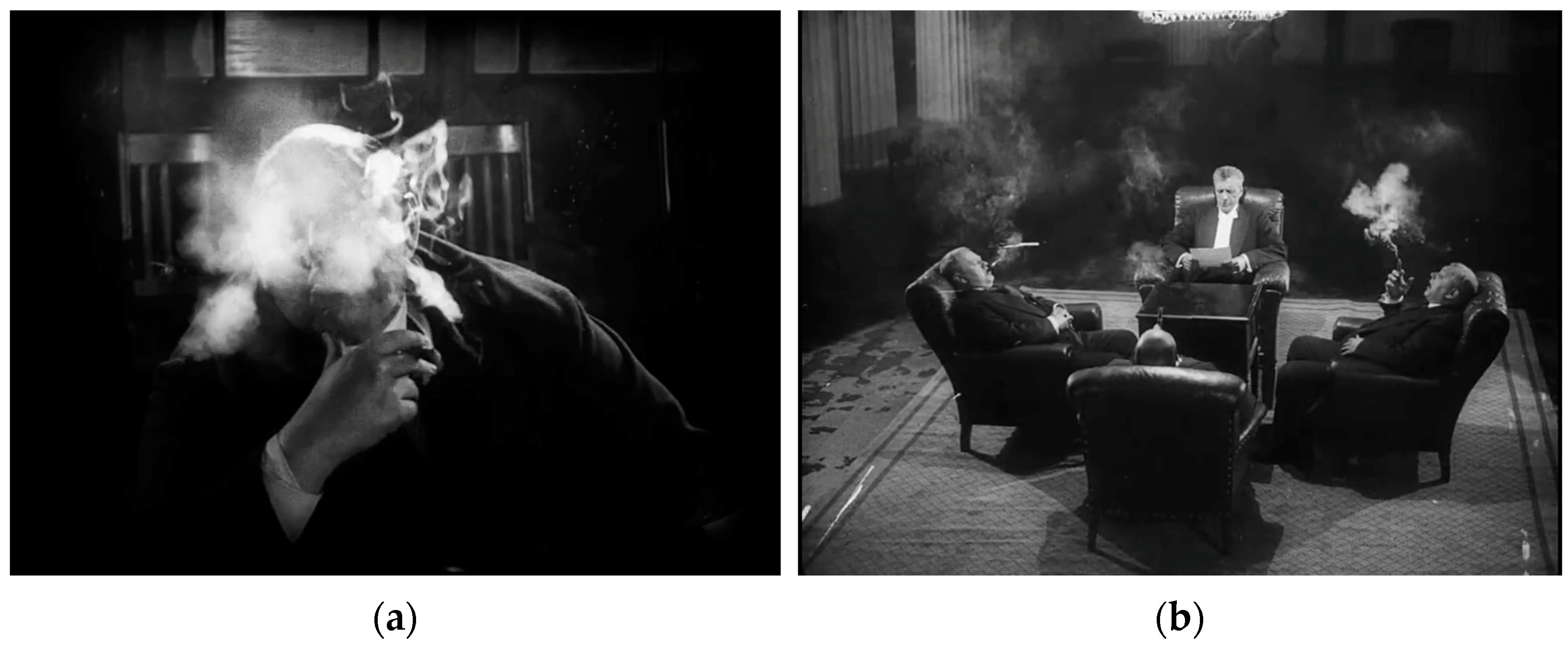
The focus on the depiction of wide-open, half-opened, and closed eyes continues until the end of the film. An exemplary instance occurs when the director and two of the spies, working for the factory management, meet in his office. Swift editing shows us four frontal shots of the director (moving from medium shot to medium close-up), looking directly at the camera, eyes half-closed. These are intercut with medium shots of the spies, bent over towards the director, and shots of other factory personnel working just outside the office. As the tension rises during the meeting, the camera cuts to a medium close-up of the director’s clenched fist, furiously bumping on his desk, filled with heaps of unread mail. The eyes of the spies remain wide open throughout the scene and each of them at one point looks straight at the camera in a medium close-up. The small eyes of the director, half hidden by the thick smoke emanating from his cigar (Figure 2a), are counterposed to the protuberant eyeballs of the workers. The exaggeration of the latter’s eye-size seems to indicate that, as spies, they have to be the eyes of the factory manager; they must be able to see better and further than everyone else. Cigar smoke reappears in part III, when the factory administration meets to read over the workers’ demands. Three out of four stockholders smoke heavily in the office, which adds movement to the frame while blurring their faces. The way in which they smoke, filmed from a high-angle long shot, mirrors the factory chimneys we saw earlier in the film and which are now still (Figure 2b).
The catalyst to the strike begins with a wretched turn of events. When a worker reports that his expensive micrometre has been stolen (worth ‘three weeks’ work under the tsar’), the factory manager, looking straight at the camera, unjustly accuses him of thievery. When he shouts ‘Thief’, he seems to be accusing us—the viewers—of complicity, too. Unable to prove his innocence, the worker hangs himself. Revolted by the suicide of their comrade, the workers decide to stop the factory and proceed to humiliate the manager and one of the spies. Closing part II is a medium shot of three workers crossing their arms against their chests, which is superimposed over the shot of a flywheel that gradually stops rolling, reinforcing the strength of the collective and the power of the united masses. Through this superimposition, the cessation of movement of an inanimate object is identified with the stillness of the bodies of the three workers, further emphasised, in turn, by the workers’ arms (a symbol of labour) folded across their chests. The simultaneity of the two juxtaposed images produces a strong visual impact that offers a distinct visual metaphor for the representation of the strikers’ valiant defiance of capitalist power. Likewise, it acts as a conveyor of the pathetic, encouraging the audience to relate to and support the cause of the proletarians. The audience’s identification with the characters is facilitated by the fact that each of the workers belongs to a different age group. Moreover, their eyes are fixed on the camera, as if they are speaking to the viewers, urging us to act. In this sense, the ‘Stop work!’ an anonymous voice had previously shouted is equally aimed at the bodies on the screen and the bodies on the seats.
The montage is also essential in another regard: to help characterise four of the undercover spies who, in a kind of ‘Hoffmannesque grotesque’ (Wollen 1969, p. 42), are intercut with shots of animals—a monkey, an owl, a fox, and a bulldog. Their inhumanness is caricatured ‘by means of the inherent visual similarities in either physical appearance or in action’ (Kuiper 1962, p. 34). Eisenstein’s ‘ciné-metaphorism’ encourages interpretative interconnections between humans and animals, offering images in which the visual interferences between the two bring forth a clear, methodical picture of a type (Kleiman 1988, p. 11). His films and drawings indeed reveal a lifelong penchant for animal–human visual metaphors that add a further, striking ideological dimension to typage. ‘Owl’, for instance, with his piercing eyes, is the prototype of the spy, whereas the overweight factory director stands as the archetypal capitalist. He too is likened to an animal—a crow—upon returning to the empty factory to discuss the workers’ demands (part III). Through zoomorphism and anthropomorphism, Eisenstein elicits associations that reframe the audience’s perception of a character, thereby politicising the film image. Typecasting is furthermore paired with medium-specific techniques, such as fades, superimpositions, and reverse motion—cinematic processes cherished and developed by the Impressionists.
Taylor notes how Eisenstein ‘makes good use of the human eye to link the narrative development’, mentioning the scene in which the Owl ‘uses a spy camera to photograph one worker tearing down the management’s rejection of the workers’ terms’ (Taylor 2007, pp. 50–51). Human and animal eyes meld with the eyes of modern optical devices. The emphasis on visual aesthetics is also demonstrated through what Eisenstein called ‘montage of attractions’ (Eisenstein 1974). The attraction should be understood, firstly, as something spectacular and ‘aggressive’, which provokes ‘a sensual or psychological impact’ (ibid., p. 78) and immediately captures the spectator’s attention: ‘as in a circus, the filmmaker should assemble a series of exciting moments to stimulate the viewer’s emotions’ (Thompson and Bordwell 2003, p. 130). Specifically, the attraction consists of an illogical visual element; a diversion in which the significance of two parallel actions will eventually mix, acquiring a recognisable and clearly defined meaning. The use of montage in the sequence where we witness the mounted police charging against the strikers while one of the stockholders uses a metal contraption to squeeze a lemon as he sits calmly in an office brings to light both the conflict between the disparate shots as well as their problematic association, constructing an emotionally charged sequence. The pathos, or emotional engagement, is formed in this visual–cognitive network of associations. The factory director then clumsily drops a slice on lemon on his polished left shoe, which he promptly wipes off with the sheets of paper outlining the worker’s demands. The close-up of his hand stands sharply against the long shots of the workers fleeing from the tsarist police. The hand is a common symbol of power and is presented in isolation, whereas the workers are shown as a collective.
The montage of attractions continues in the massacre of the striking proletarians (part VI), which is poignantly stressed by intercutting images of the workers with shots of a slaughtered bull, visually indicating that these are being slaughtered like animals. The juxtaposition of seemingly arbitrary attractions, some even independent of the narrative itself (what Bordwell calls ‘non-diegetic inserts’), within the continuity of the same sequence provokes in the spectator a sense of involvement with the images and, what is more, creates that much desired spontaneous psychological reaction (Thompson and Bordwell 2003, p. 134). Eisenstein designates this intricate process as ‘intellectual montage’. Strike was indeed planned as an ‘agit-guignol’, meant to ‘produce a chain of shocks’ (Wollen 1969, p. 39). According to Eisenstein’s conception of montage, the sheer force of the images would lead to the identification of the spectators with the fight of the proletariat.
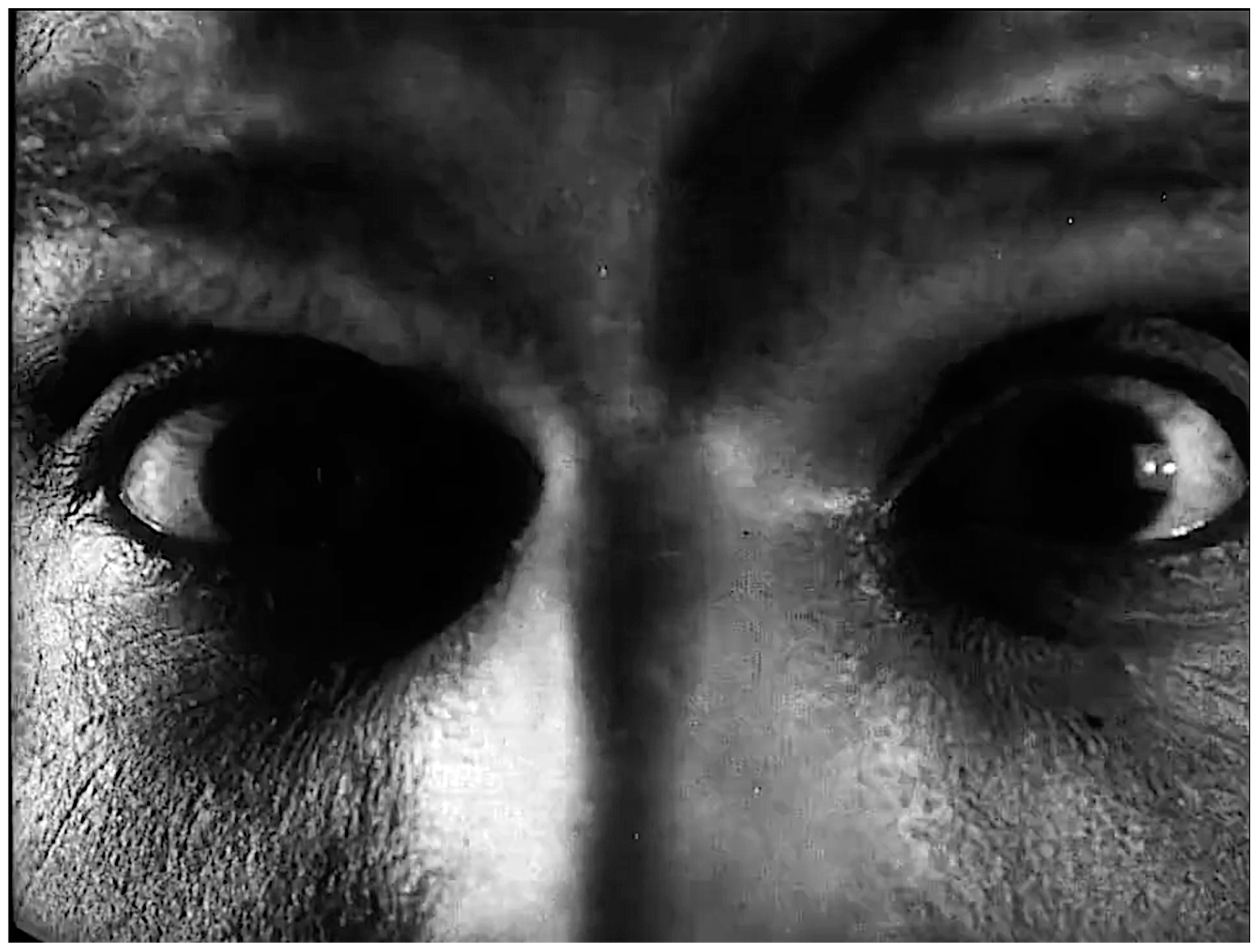
Eyes and close-ups weave a thread across sequences, producing a cohesive whole. Strike, Standish D. Lawder argues, ‘is full of such visual metaphors of vision’, such as the sequence where ‘a spy is watching and waiting in the doorway of an optometrist’s shop’ (Lawder 1975, p. 76) or when the workers meet in the factory toilets and discover they are being observed from a corner of the room. In addition, the whole factory is perceived as a place of surveillance, of trying to see without being seen, and of haunting, stalking shadows. In a film where vision and visual analogies reign supreme, it is fitting that the last two shots are a close-up, followed by an extreme close-up, of a worker’s eyes–first contracting and then widening, ‘as if representing those of every spectator who has just witnessed this poetic crescendo of violence’ (ibid., p. 68) (Figure 3). This is followed by a political message split between the two final intertitles: ‘Remember Proletarians’. The prominence given to the gaze throughout the film discloses Eisenstein’s commitment to making the audience a part of the action—and montage was by far the most powerful tool to interweave eyes, faces, and political ideology effectively.

3.2. Battleship Potemkin (1925)

Eisenstein claims that ‘films must be highly emotional narratives and not merely logical exposés of facts’, and that montage ‘is a mighty weapon for achieving this aim’ (Eisenstein 1970, p. 63). Paraphrasing Barthélemy Amengual, the montage propels the movement of ideas and generates power through mise en ordre (rhythm) and mise en forme (construction) of collective movements that are usually unorganised and incoherent. Moreover, it determines narratological suspense (Amengual 1962, pp. 27–29). To create pathos, Eisenstein notes, ‘a work must be built throughout on strong explosive action and constant qualitative changes’ (Eisenstein 1970, p. 58). The first ‘explosive action’ in Potemkin is the plate smashing sequence at the end of part I. An individual action that would not have taken more than a couple of seconds is divided into ten shots and its duration consequently expands to almost seven seconds. The overlapping of shots has startling effects on the spectator. On the one hand, it stresses the sailor’s rage and frustration by intercutting close-ups of his face with close-ups of the plate. On the other, it shows the audience several different angles of the smashing of the object. The viewer’s attention is thus directed not only towards the actual destruction of the plate but, most importantly, to the origin (the cause) of this violent action. In depicting this sequence, Eisenstein uses a graphic pattern that will recur throughout the film. The sailor smashes the plate ‘in diagonal arm movements’; in reality, ‘the whole drama of Potemkin develops beneath diagonal ship’s cannons’, swaying diagonal ropes, diagonal candlesticks, and diagonal stair patterns (Brakhage 1972, p. 89). Diagonal patterns reminiscent of expressionist cinema would re-emerge in Eisenstein’s last film, Ivan, namely as part of triangular formations, foregrounding a sense of political intrigue while also stressing the inner psychological struggles of the protagonist and the hide-and-seek dynamics of surveillance.
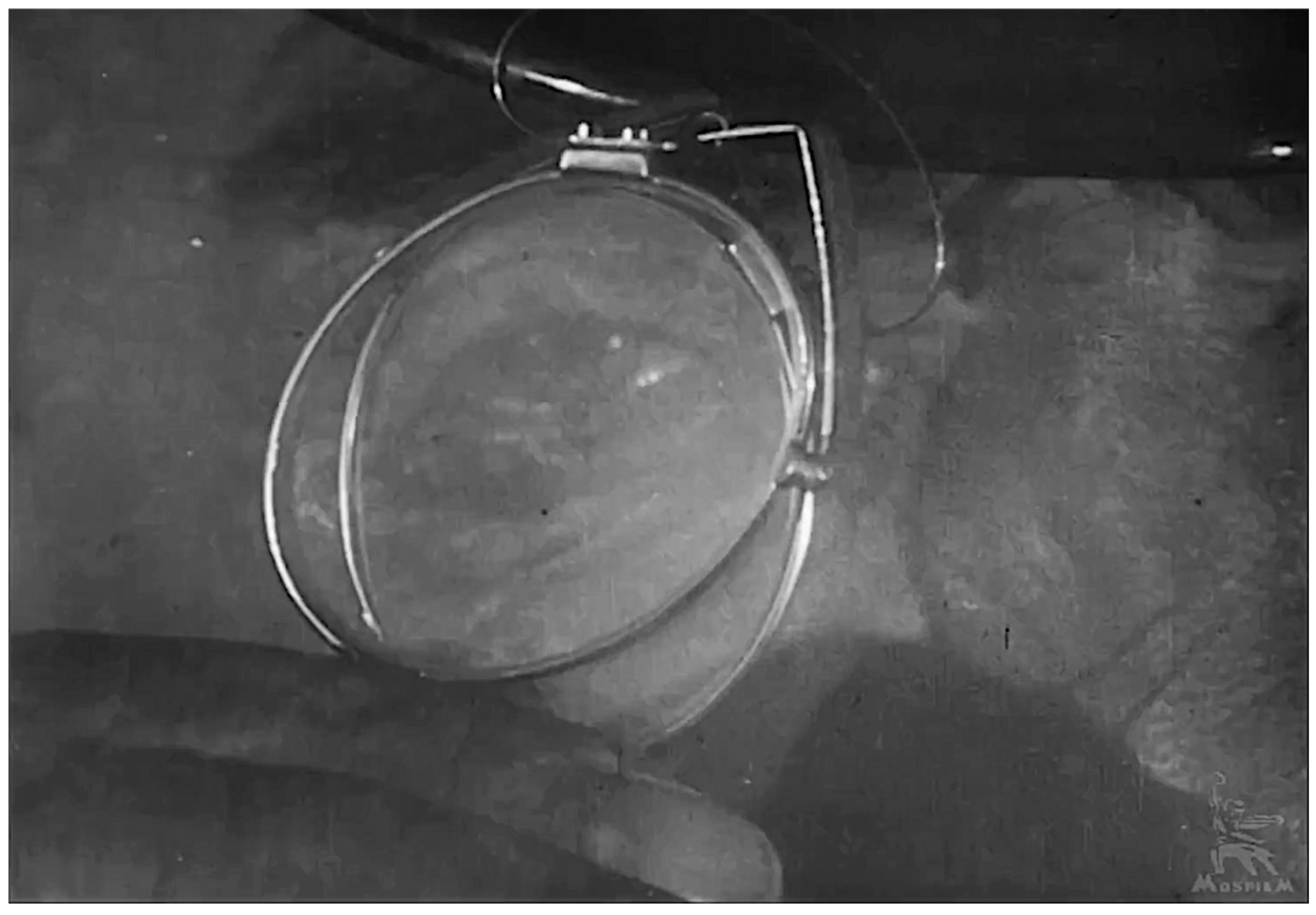
Potemkin is a mise en ordre and a mise en forme of an amalgam of close-ups of eyes, faces, and hands. In the beginning of the film, when the ship’s doctor, Smirnov, examines the rotten meat being distributed to the sailors, we watch as he removes his pince-nez in a medium shot, folds it, and then places it over one eye. Shown in an extreme close-up, the doubling of the lenses magnifies the gravity of the doctor’s educated look (Figure 4). The next shot consists of the doctor’s hand bringing the folded optical enhancement device up close to the larvae-infested meat. The learned doctor then informs the sailors that they can wash out the maggots with brine and that there is nothing wrong with the meat. His puzzling comment neatly summarises the power of vision in the film. The choice to see or not to see is a privilege that belongs exclusively to the upper classes. As in Strike, the sudden appearance of a disembodied (right) eye, in a composition that excludes the left one from the frame, is unsettling and again associates the right eye with control and status and the left with purposeful negligence of the people’s plight.
The doctor’s forged blindness (the deliberate decision to overlook) instigates the anger of the sailors and precipitates the unfolding of events. Later, when the rebellious sailors throw the doctor overboard, the camera lingers briefly on the pince-nez which, in a close-up shot, is seen dangling precariously from one of the ship’s ropes. Eisenstein again signals shifts in power relations through sight, which here flag the toppling of the ship’s hierarchy. Walter Benjamin calls these bourgeois characters ‘sadistic types’, whose value to the narrative resides not in themselves but in the film’s organic whole, which expands beyond the diegesis and onto the sociopolitical reality of power hierarchies and class relations: seemingly isolated incidents acquire meaning only when we understand them in relation to their broader context, namely, in this case, the connections ‘between the medical profession and the state’ (Benjamin 2008b, p. 331). The affective pathos of the eyes is combined with that of myriad hands washing plates, holding food and hats, covering faces, pointing, waving, shooting rifles, steering the ship’s helm, and being stepped on.
The action is suspended at the end of part II, with the introduction of the valiant sailor Vakulinchuk’s lifeless body. It is, once again, a dead body that generates the film’s most ‘explosive’ movements, just as in Strike. The collective mourning of the ‘brutally murdered’ sailor, thus described in an intertitle, is depicted in an unusual shot composition that at first distances the viewer from the action, avoiding facile melodrama. The sides of the frame are blacked out by curtains that have been pulled open, forming a triangular shape. In the foreground, part of the sailor’s corpse is visible as two kneeling figures pay their respects. In the background, the citizens of Odessa gather in homage. As the ship’s crew rally to start their uprising, more and more people arrive to honour Vakulinchuk, ‘killed for a plate of soup’. A succession of the sorrowful faces of the populace in medium close-up ensues. This sequence serves as preparation for the explosion of pathos in part IV.
The ‘epoch-making impact of Potemkin’ is often connected with the extreme visuals of the Odessa steps sequence (Benjamin 2008b, p. 330). Constructed on the basis of the confrontation of its visual elements, as if ‘violence had attacked the film itself, ripping it apart’ (Bouquet 2008, p. 35), the first image consists of a woman whose head is violently thrown back. The same action is broken into four shots which, through expert editing, assault the viewer—an example of that ‘tractor ploughing over the audience’s psyche’ that Eisenstein describes (Eisenstein [1924] 2010, p. 41). For an instant, we are unsure as to what exactly hit the woman’s head. A shot of fleeing civilians follows, signalling the mortal peril that remains offscreen, just before an open white parasol a woman is carrying covers the entire screen. From that moment on, discontinuities in editing, the frenetic rhythm of the montage, and the horde of rushing citizens (shown in a combination of long shots, medium shots, and close-ups) reveal the brutality of the massacre perpetrated by the government squadron and disorient the audience. It is as though the whiteness of that parasol has blinded us. The impossibility of seeing everything is the ideal way to witness the confrontation, for it conveys the idea that it is almost impossible to fully make sense of what is going on, that whatever is happening is inexplicable. As a result, by being forced to share the point of view of the victims and experience their disorientation, the viewers participate psychologically in the massacre. The contraction and expansion of time, as well as the abrupt changes in pace, highlight the intensity of the violence on the part of the soldiers. Paradoxically, on the other hand, the immense space of the steps—symbolically endless—indicates the impossibility of escape.
The visual descent of the steps marks the psychological crescendo of the pathos. To depict the slaughter of the populace by the soldiers, Eisenstein uses rhythmic montage, a type of editing that imbues the images with a specific rhythm. An amazing energy informs the shots throughout the sequence and the viewer is consistently bombarded by the frantic, distressing images. The pathetic pervades the rapid succession of close-ups of eyes, archetypal faces, boots, rifles, and wounded or dead bodies and is followed by long shots that let the audience take in ‘the entire environment’ which, like the people on the screen, ‘is also “beside itself”’ (Eisenstein 1970, p. 59). Moments of stillness—of people unable to react and of death—punctuate the tragedy of the Cossacks’ forwards and downwards march. Laura R. Oswald comments that the geometric visual patterns and ‘the composition of the close-ups shape (either by means of movement or by the direction of looks) lines going in every other direction: diagonally, horizontally, and vertically’ (Oswald 1994, p. 253). The consequence of this kind of editing, as the author concludes, is that it ‘scatter[s] the look all over the screen’ (ibid., p. 253). Through the overlapping of images, Eisenstein enhances our vision through quintessentially cinematic strategies and ‘we see more of the attack than we could possibly see were we to actually witness the event in reality’ (McGowan 2007, p. 40). The sequence is prolonged, extended in time, as the frenzied civilians ‘traverse the same ground multiple times’ (ibid., pp. 39–40). There is a collision of antagonist movements ‘to express mounting emotional intensity’ (Eisenstein 1970, p. 59), such as the shot of the soldiers’ downwards march, from left to right, halfway through the sequence, intercut with the shot of a grieving mother walking up the steps towards them, her dying son in her arms. Eisenstein describes these conflicting shots in the following way: ‘Mass. Headlong rush. Downward. And all of a sudden—a solitary figure. Slow and solemn. Going up. But only for a moment’ (ibid., p. 59). The apathetic Cossacks halt their movement for an instant—their giant shadows stretched menacingly over the mother—but they do not heed her desperate appeal for mercy and shoot her on the spot.
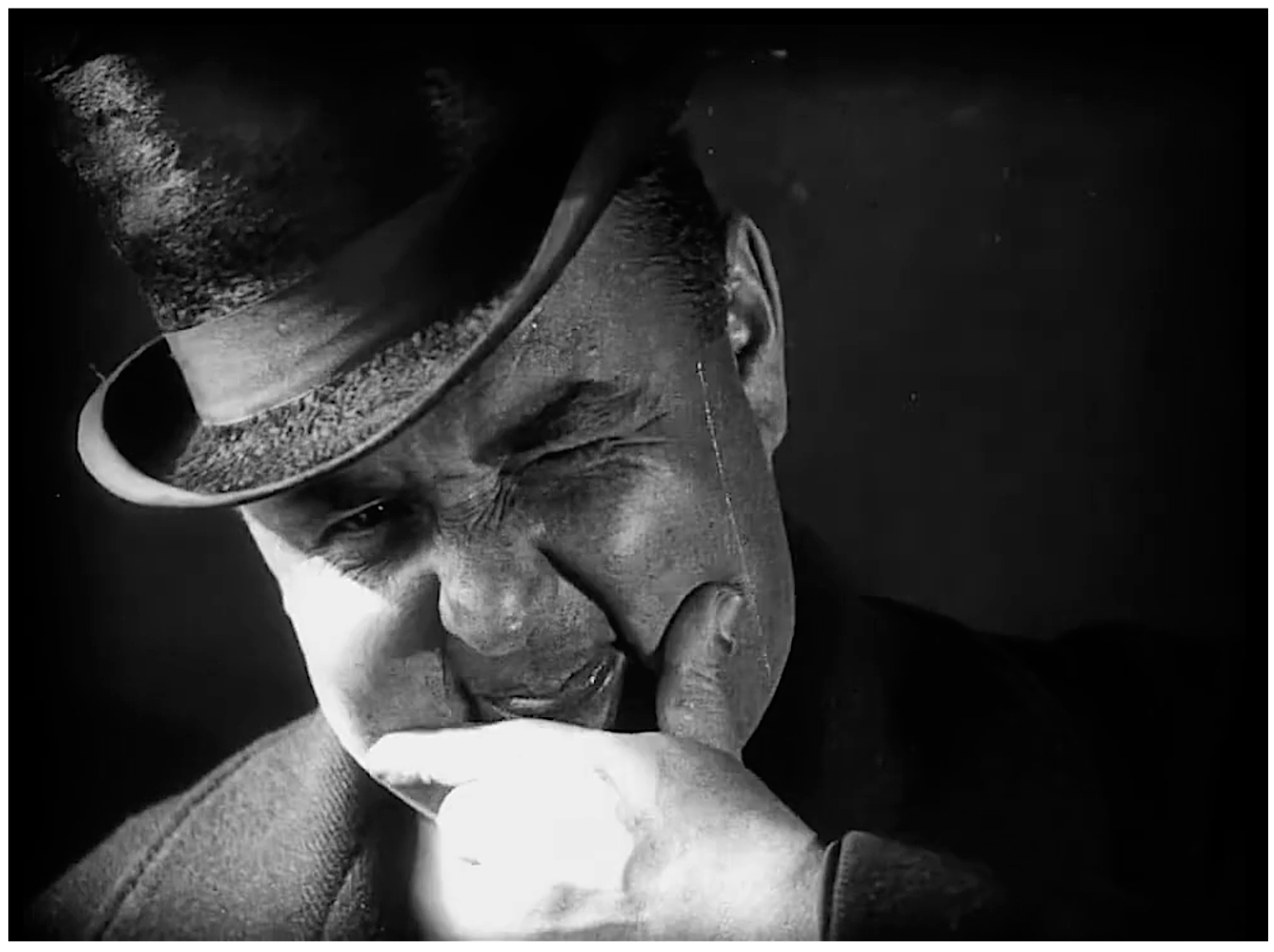
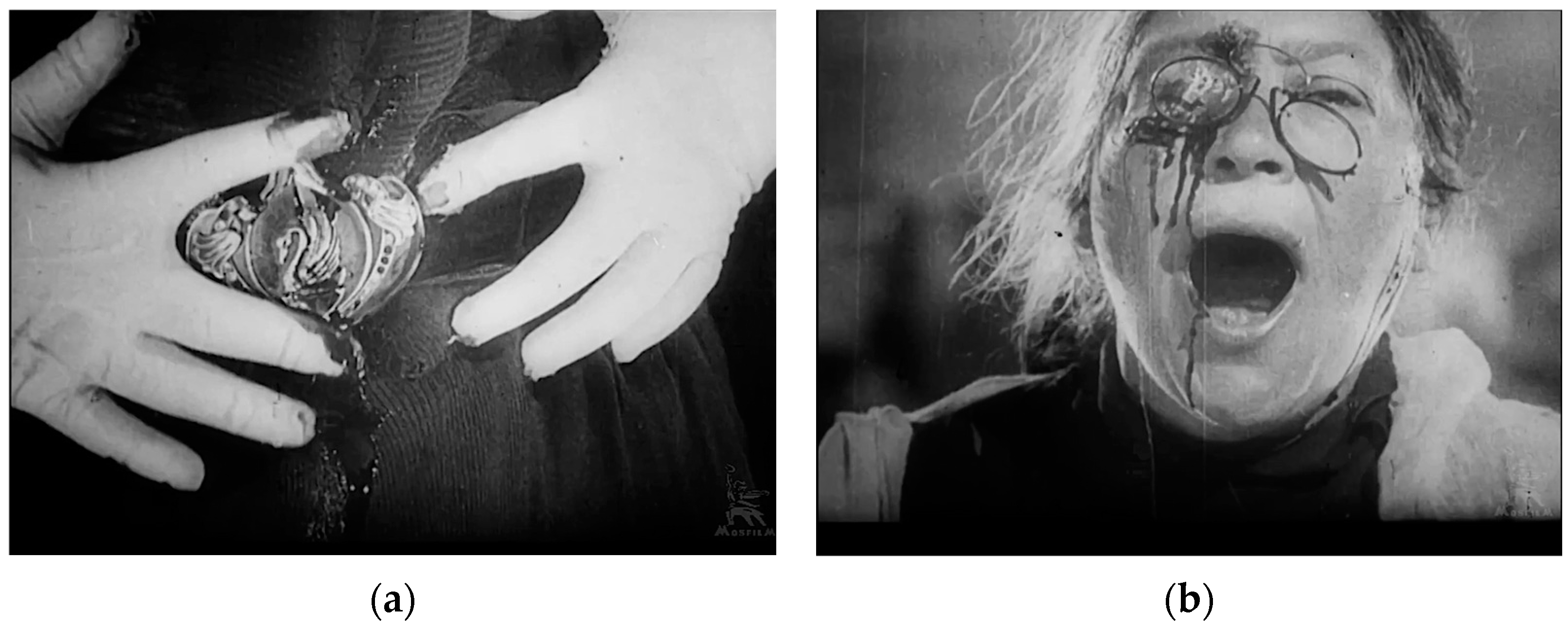
As in Strike, the unarmed civilians attacked by the Cossacks are not differentiated individuals but types. Eisenstein attributes a face to the masses, humanising that which could be trivially regarded as a multitude of anonymous, faceless heads. In this way, the director precludes emotional detachment as the spectator watches the murder of a child, a baby, older men and women, a student, amputees, and mothers. There is even a woman with a pince-nez, representative of the bourgeoisie, who attempts to reason with the troops. A swan—a symbol of family life, love, and beauty—engraved on the second mother’s belt is displayed in a close-up to heighten the emotional response of the audience. When the camera returns to the mother, the swan is covered in blood and the woman’s face gradually disappears from the frame in a downwards vertical movement as she falls to the ground, pushing the pram with her infant down the steps (Figure 5a). Marking the end of the sequence, we see a woman being shot directly through the lens of the pince-nez she is wearing (Figure 5b). The bullet to the eye impedes the movement of yet another character who actively sought to stop the massacre.
The close-up of the woman’s face furthermore represents another instance of an Eisensteinian character in a full frontal close-up missing one eye. Here, however, the missing eye is not closed, hidden by shadows, or carefully excluded from the frame, as in Strike—or in the case of Smirnov, the doctor aboard the Potemkin. The eye has been destroyed. Fittingly, this sequence, which starts with a woman being shot in the head, ends with another being shot in the eye: the massacre represents a ‘shot’ in the mind and body of the spectator. Where Buñuel slices the eye open before the calm passivity of the victim in Un Chien Andalou (1929), Eisenstein pierces it with a chilling cruelty that stuns and moves. The ‘Cine-Fist’ becomes a powerful ‘Cine-Spear’, and the close-up of the eyes intensifies the poignant senselessness of gratuitous murder. A curious detail, in line with my analysis of open and shut eyes earlier, is that unlike the typecast faces of capital, whose right eyes are kept menacingly open, here it is the right eye that is pierced, leading to streaks of blood running down the right side of the woman’s face. In addition, the right lens of the pince-nez glasses is shattered, signalling a double assault on vision. The left eye, in turn, remains frighteningly open, perhaps hinting at a sliver of resistance of the oppressed amid the savagery of the extermination.
Potemkin so impressed legendary Hollywood producer David O. Selznick that he wrote to production manager Harry Rapf in 1926, in one of his first memos at MGM, encouraging the studio to acquire a print of the film and consider bringing in the talented young director. The film, he writes, ‘is gripping beyond words’ and
a superb piece of craftsmanship. It possesses a technique entirely new to the screen, and I therefore suggest that it might be very advantageous to have the organization view it in the same way that a group of artists might view and study a Rubens or a Raphael.
(Selznick [1926] 1972, pp. 9–10)
That Selznick draws on Renaissance painters to describe the experience of viewing Potemkin is telling of its pictorial nuances, painterly qualities, formal virtuosity, and vivid realism. Selznick proposes that the film be scrutinised as a case study on how to produce, direct, and edit a motion picture. He seems to single out the individual shots as ‘exquisite pieces of photography’, lauding the film’s ‘types and their lack of make-up’ (ibid., p. 10). Indeed, on a par with the overwhelming sense of movement that subtends the film and the individual shots, (hopefully) urging the viewers to actively respond to the images, Eisenstein offers, through close-ups, brief moments of stasis, of people arrested in time, captured as in a canvas, a simultaneously mobile and still testament to history that can be read and dissected.

3.3. Ivan the Terrible (1945, 1958)

Eisenstein developed the script for Ivan the Terrible (1945, 1958) in May 1941, just one month before the German invasion of the USSR, and Western criticism has traditionally read the film as a commentary on Stalin’s dictatorship. As noted, Eisenstein’s films are deliberately political, and Ivan distinctly accentuates the formalist, aesthetic, and sociopolitical dimensions of his previous productions. With this film, which aptly followed Eisenstein’s staging of Richard Wagner’s Die Walküre at the Bolshoi Theatre in 1940 (part of the German–Soviet non-aggression pact), the director attempts the creation of his own Gesamtkunstwerk, a grand synthesis of all art forms that would bring together film, music, poetry, design, acting, drawing, and dance (Elliott 1988, pp. 39–40). His ambitious plans were nonetheless hampered by the devastating war and the workaday restrictions imposed by Stalinism. Part One took almost four years to complete, from the first draft of the story, written between January and February 1941, to the film’s general release in January 1945. It would be another year before Eisenstein finished editing Part Two, in February 1946, just before he suffered his first heart attack. Part Two would be banned in September that year and released only in 1958. The 1947 report of the Central Committee of the Party accuses Eisenstein of cheapening (i.e., sentimentalising) Ivan, ‘a man of great willpower and strong character’, by showing him ‘as a weak and feeble being, a sort of Hamlet’ (qtd. in Yurenyev 1989, p. 12). The fact that Part Two highlights the trials and tribulations Ivan undergoes could be construed as a dramatic device to underscore his triumphs, namely the ‘the creation of a powerful state and Russia’s breakthrough to the Baltic Sea’ (ibid., p. 11). Eisenstein nonetheless attempted to ‘correct’ the tone of the film and re-edit it, which involved dropping many scenes already shot for Part Two and some of those planned for Part Three. Even in its unfinished form, and despite the many hurdles of the production process, which would culminate in Eisenstein’s fatal heart attack in 1948, the films are brilliant cinematic achievements that offer an incisive and profoundly unsettling study on the corruption of power, unrestrained ambition, and their consequences.
We can detect a clear inclination towards a form of ‘expressionism’ in Eisenstein’s body of theoretical and filmic work. Kleiman notes, for example, how Eisenstein coins the term ‘everyday Expressionism’ to refer to the role of objects in relation to specific contexts and expressive schemas in Potemkin (Kleiman 1993, p. 34). Eisenstein’s drawings for Ivan also reflect an expressionistic style (Elliott 1988, p. 39), as do the uneasy angles, geometric compositions, and threatening shadows that populate the film. Significantly, one of Eisenstein’s first filmmaking experiences was to work on the re-cut of a one-part version of Fritz Lang’s expressionist film Dr Mabuse the Gambler (1922), released as Gilded Putrefaction in 1923. In ‘The Eighth Art’, Eisenstein identifies German Expressionism as one of the three most powerful trends in contemporary cinema, opposed to ‘the corrupting influence of naturalism’ (Yutkevich and Eisenstein [1922] 2010, p. 30). On this, he is of course diametrically opposed to Bazin who, as discussed, rejected the unrealistic flourishes of the expressionist style. The French critic in fact remarked upon Ivan’s experiments with film aesthetics and promptly condemned this move as ‘an aggressive return of a dangerous aestheticism’ (qtd. in Wollen 1969, p. 126). Given the reaction of the Central Committee to Part Two, Bazin is certainly correct in his classification of Eisenstein’s aestheticism as ‘dangerous’—even if Bazin meant it in a different sense, as a dangerous anti-realism. In Ivan, the chiaroscuro distortions, paranoid aesthetics, and performative theatricality typical of German Expressionism appear alongside the subjective, revelationist, and phenomenological impulses that guided French impressionist filmmaking in its search to augment and thus enhance human perception.
Eisenstein ventures into the dark atmospheres, expressionistic compositions, anachronistic elements, archaic histories, and self-conscious tone of the gothic mode with his unfinished, two-part epic. Expressionistic and impressionistic elements find their way onto the altered, stylised Eisensteinian visuals of the autocrat and his world, creating a peculiar style and tone that make the film thoroughly gothic. In effect, as a cinematic aesthetic, the Gothic emerged out of French Impressionism, German Expressionism, and other avant-garde phenomena and movements—and then developed as well from Soviet montage cinema.4 Kevin M.F. Platt uncovers a gothic quality in both the historical figure of Ivan and Eisenstein’s film—‘the most spectacular example of Gothic in the Soviet tradition’ (Platt 2019, p. 52). Stalin’s accession to power had brought back the gruesome reigns of Russian history in a gothic return of the violent past. As Platt explains,
[a]t the start of the 1920s, overt historical allegories […] were exceptions to a more commonly shared vision of Russian history that saw it as bearing little or no relationship to the Soviet present. It was precisely this untethering that made Ivan such an apt object for the Gothic vision, that activates fears of archaic forces and traumatic experiences in a seemingly safe and distant landscape. […]
[T]he reburial of an epoch of state-initiated bloodshed and violence beneath a new official legend of Ivan as heroic leader and historical visionary itself led to new possibilities for the Gothic.
(Platt 2019, p. 52)
The fears of the past transmuting, by proxy, into the fears of the present is a key convention of the Gothic and especially adept at engaging the viewer’s intellect to piece together the analogy that is taking shape on the screen. We can see this in some of the Central Committee’s objections to Part Two, which reveal how Stalin intended for the historical past to be represented. ‘You make the oprichnina [royal army] look like the Ku-Klux-Klan’, he told Eisenstein, to which the director retorted: ‘They wear white headgear; ours wore black’ (Eisenstein and Cherkasov 1998, p. 160). We can almost infer a slight deadpan sarcasm in Eisenstein’s aesthetic remark on costuming, but that, of course, would be pure speculation. Molotov, a member of the Committee, immediately intervened to add that such a detail ‘does not constitute a difference in principle’. Further along in the conversation, Molotov complains that the film ‘is too confined to vaults and cellars’, a crucial trope of the Gothic, closely connected to the loss of freedom, trauma, and a tortured mind; it is therefore unsurprising that the ‘general reliance on psychologism; on extraordinary emphases on inner psychological contradictions and personal experiences’ was likewise deemed inappropriate filmic material (ibid., pp. 160–61).
The inherent instability of gothic subjects, objects, and the mode itself position it as an ideal and quasi-ideological tool for expressing the multitudinous complexities of the era. According to his memoirs, Eisenstein drew inspiration from the works of eccentric late-Baroque painter and draughtsman Alessandro Magnasco (1667–1749), renowned for his predilection for the grotesque, the bizarre, and the satirical. His taste for ‘failing light and engulfing darkness’ (Elkins 1999, p. 51), oppressive spaces, and scenes of torture seems appropriate to convey ‘the byzantine cruelties of Tsar lvan’ (Elliott 1988, p. 39). Lingering, menacing shadows play a central role in the film, with dark, elongated silhouettes adding to the suspense and the gothic, expressionistic overtones of the narrative. Ivan and his men often lurk in enclosed spaces and emerge out of the shadowy depths of the image. At times, the daunting effect of the chiaroscuro is emphasised by the characters’ clothing, which frequently opposes fair and dark clothing, and by lit candles that cast trembling shadows on the castle’s walls. In a diary entry from 1946, Eisenstein defines the film’s ‘[o]verburdendedness with shadows’ as a poetic element inviting a close reading by the mindful spectator who longs for more in cinema than mere ‘telegraphic syntax’ (qtd. in Tsivian 2001, pp. 256–57). These pervasive shadows sometimes seem to become independent from the characters’ bodies; they ‘are almost always larger than people who cast them: they watch and judge’ (Neuberger 2003, p. 111). Neuberger suggests that this ‘shadow world is a visual sign that Ivan’s path was not predetermined’, but a result of myriad choices (ibid., p. 111). Shadows are redolent with meaning in gothic film and it is telling that these, in conjunction with another key aspect of gothic and expressionist cinema—exaggerated make-up—served as grounds for the Central Committee’s decision to ban Part Two:
Comrade Zhdanov [Secretary of the Central Committee] said that Eisenstein’s fascination with shadows distracted the viewer from the action, as did his fascination with Ivan’s beard. […] Eisenstein promised that Ivan’s beard would be shorter in future.
On a par with shadows and beards, Eisenstein opts for a close integration of set design into the film’s narrative structure. Tsivian selects two diary entries from 1941 and 1942, respectively, in which the director discusses the fundamental principle of employing a painted background ‘as an emotional commentary to dramatis personae’, as well as the imperative need to ‘merge the background wholly or almost wholly with the image’ to create ‘sinister scenes’ (Tsivian 2001, p. 257). Unsurprisingly, this ‘sinister’ aspect did not please the Committee, who intended to celebrate Ivan as a grand, decisive, and noble leader. When it comes to make-up, Eisenstein recalls the painstaking process of pinning down Ivan’s visage with the help of make-up artist V.V. Goryunov: all the details, from ‘the slit of the eyes’ to ‘the curve of the brows’ and ‘the contour of the skull’ are framed by ‘a long search for camera angles of the head and face in which the Terrible—is Terrible’ (Eisenstein 1987, pp. 280–81). This process involved as well ‘a penetrating formula of light’ that enriches tonal expression, bringing out, among other features, ‘the asymmetry of the eyes’ and ‘a certain persistent shadow in the eye socket from which the pupil, caught by the light, begins to burn’ (ibid., p. 281). The reticence of the Committee regarding make-up therefore likely concerns the dramatic weight it adds to Ivan’s characterisation and the nuances, or contradictions, it bestows upon his actions.
The aesthetic import of eyes in the gothic tradition receives a unique pictorial treatment in Ivan. Where eyes and hands had already proven central to Strike and Potemkin, the politicised figuration of hapticity reaches its aesthetic climax in that which can be considered Eisenstein’s testament film. Most significantly in its consistent depiction of the organs of sight and touch, along with the attentive use of chiaroscuro lighting, unusual geometric compositions, and theatrical acting, Ivan exudes a tactile quality or ‘haptic visuality’ throughout whereby ‘the eyes themselves function like organs of touch’ (Marks 2000, p. 162). The film invites the viewers’ eyes to wander in the images, to peruse them, as their bodies are physically affected by the film’s contagious sensorium, generating a mode of film viewing that is highly sensitive to the texture of the images. Close-ups of eyes, or shots in which the eyes are the most prominent element, elicit intimate moments of proximity between the onscreen bodies and the bodies of the viewers, in a filmic encounter that is, in effect, a ‘touch-in-separation’ (McMahon 2012, p. 2). In stressing the representation of eyes, often in association with hands, Eisenstein creates an intricate system of haptic meaning that evokes an overwhelming sense of surveillance, suspicion, and the inescapability of the tsar’s panoptic vision.
The ubiquity of eyes and eye imagery conveys the significant role of omnivoyance in the film. Visual analogies and repetitions enhance the photogénie of the images, drawing spectators to the action. In consonance with his earlier films, Eisenstein establishes formal analogies between humans and animals, with some of the characters resembling beasts, as with the spies in Strike. The most remarkable analogy concerns Ivan who, with his pointy beard, is reminiscent of a shrewd crow or a mighty bird of prey, with an ‘eaglelike fiery glance’ (Eisenstein 1987, p. 280). Although the director had long forsaken typecasting, the expressiveness and textures of faces that could convey a range of layered emotions and meanings, such as a character’s social class, were retained to great effect and combined with new visual strategies. An example of visual repetitions is the pathetic mirroring of Ivan and Anastasia. In the coronation sequence that opens Part One, we see Ivan’s eyes filled with tears, quickly followed by Anastasia’s, which immediately establishes an intimate connection between the two characters. There is another pathos-inducing visual echo further along in the film, when the camera focuses on Vladimir’s head in his mother’s lap and, later, in Ivan’s. If we consider these pietà-like compositions, alongside Ivan’s beard, both denote a similar overall triangular shape that recurs throughout the film and derives from Eisenstein’s experiments with film form.
If his early approach to the concept and practice of editing centres on the creation of a new psychological reality through collision montage, in the late 1930s, he ‘eschewed conflict as a formal strategy in favour of a calculated association of related motifs’ (Kepley 1989, p. 450). Jacques Aumont argues that what is at stake ‘is not the elaboration of methods of montage […] but a kind of ongoing and even somewhat systematic study of the principle of montage’ (Aumont 1987, p. 146). Eisenstein’s experiments with cinematic techniques evolved over the course of his career and his immense body of scholarly writing indeed seems to support Aumont’s assertion. As his reformulated approach to montage develops, he begins to concentrate as well on the movements of the film actor through a new technique based on a rigorous metaphorical and geometric system, possibly inspired by the scientific-artistic endeavours of Leonardo da Vinci, with whom Eisenstein liked to compare himself (Wollen 1969, p. 70).
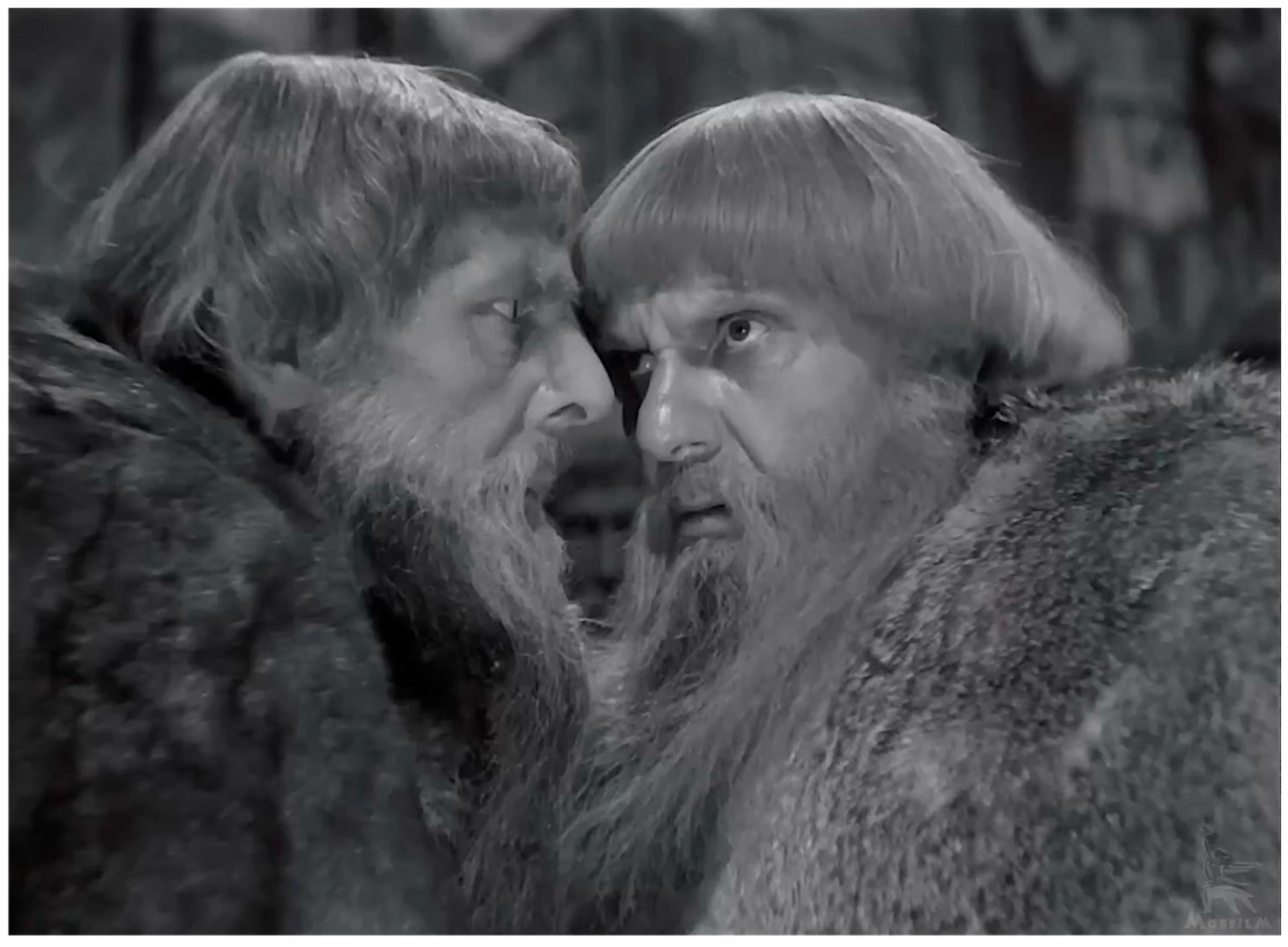
The triangle figure emerges as a striking compositional feature in Ivan, ‘reinforc[ing] [the tsar’s] humanity and ambiguity’ (Jarman 2010, p. 178). From the shot of the crown that opens the film onwards, the symmetrical geometry of the mise-en-scène is carefully organised in pyramidal lines. During his speech at the coronation ceremony, when Ivan, the Grand Duke of Moscow, is crowned Tsar of All Russia and begins to challenge the omnipotent authority of the boyars, the camera alternates medium shots and then medium close-ups of Ivan with a succession of medium close-ups of those in attendance. The first shot of members of the audience is constructed triangularly, with the heads of three characters and their respective hairdos and headgear forming the geometrical shape. A particularly ingenious composition is a shot in which the long beards of two characters facing one another delineate the bottom of an inverted pyramid (Figure 6). In all of the shots, the eyes of the characters are made to clearly stand out. The fixed direction of the glances of the attendees’ faces is contrasted with Ivan’s eyes, which move calmly and decisively from side to side. In the next sequence, Ivan and Anastasia’s wedding, triangular lines recur throughout, namely in the two thrones where the couple sit. Those conspiring against the autocrat are likewise framed in a pyramidal shape, implying that they might not be so different in their thirst for power. After their decision to invade Kazan, Anastasia, Ivan, and Kurbsky are shot as a pyramid and, later on, in Ivan’s bedroom, Kurbsky, Yefrosinia, and Anastasia form an inverted pyramid, denoting shifts in the power dynamics. The aesthetic recourse to this shape continues throughout the film, with a continued focus on the characters’ eyes.
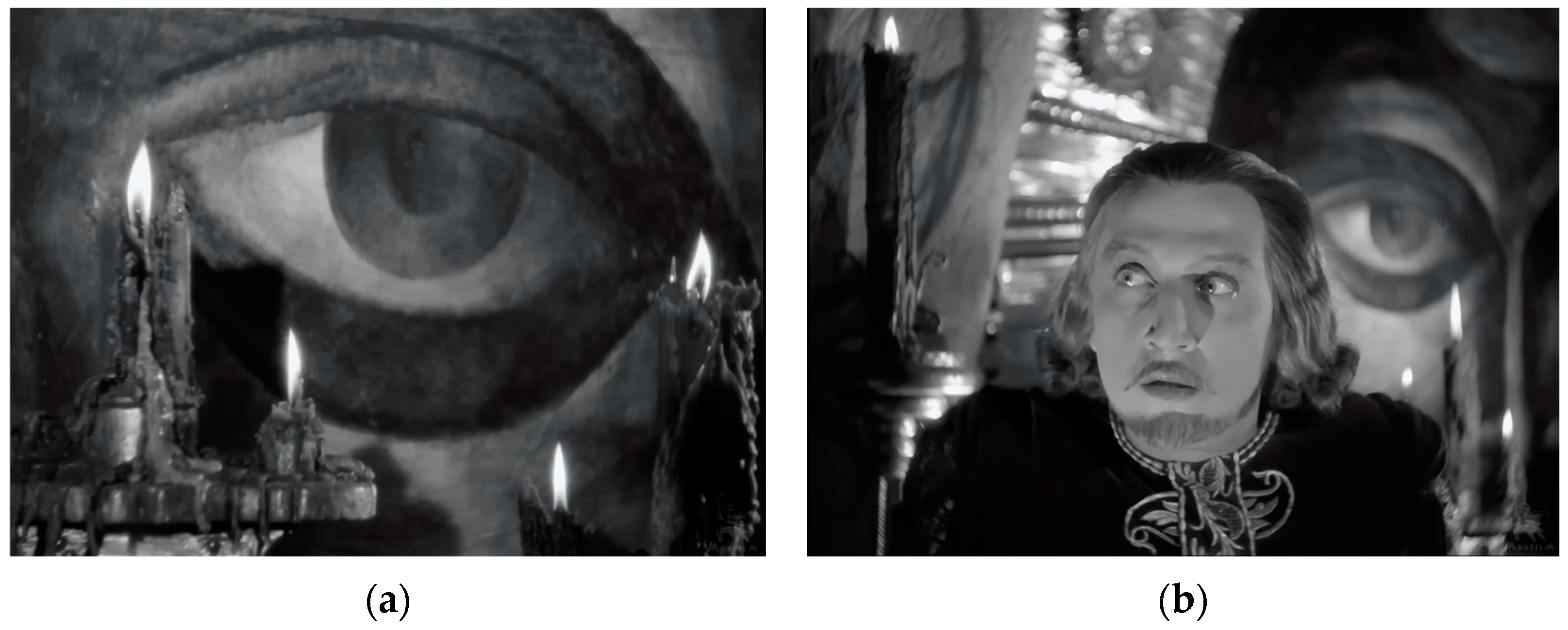
The exchange of looks between Anastasia and expatriate prince Kurbsky, for instance, is explored at length in Part One. Malyuta, in turn, is called ‘the tsar’s all-seeing eye’. Even the wall decorations that frame the characters have pictures of giant eyes, explicitly demonstrating the inescapability from the pervasiveness of seeing and looking. An illustrative example is the scene in which Kurbsky tries to convince Anastasia to marry him. As he calls her ‘his tsarina’, the camera cuts to a giant eye on the wall, which has already featured in the background of multiple scenes (Figure 7a). A stand-in for Ivan’s surveillance of his environs, the eye remains visible behind the couple as Anastasia warns Kurbsky, much to his chagrin, that he ‘oughtn’t bury the man who is not dead’ (Figure 7b). After she leaves, the camera returns to the earlier shot of the single eye on the wall, framed by four candles. A cut positions Kurbsky again in front of the eye, as he utters the words ‘Kurbsky is doomed…’. Suddenly, something startles him and he turns to look at the eye, as though he has sensed he is being watched. Similarly, at the beginning of Part Two, when Ivan goes to talk to the boyars, there are two enormous bright eyes on the walls, hinting that everyone is under permanent scrutiny. The small-sized doors of that claustrophobic palace-prison further emphasise the feeling of surveillance, intrigue, and the vain attempts to see without being seen.
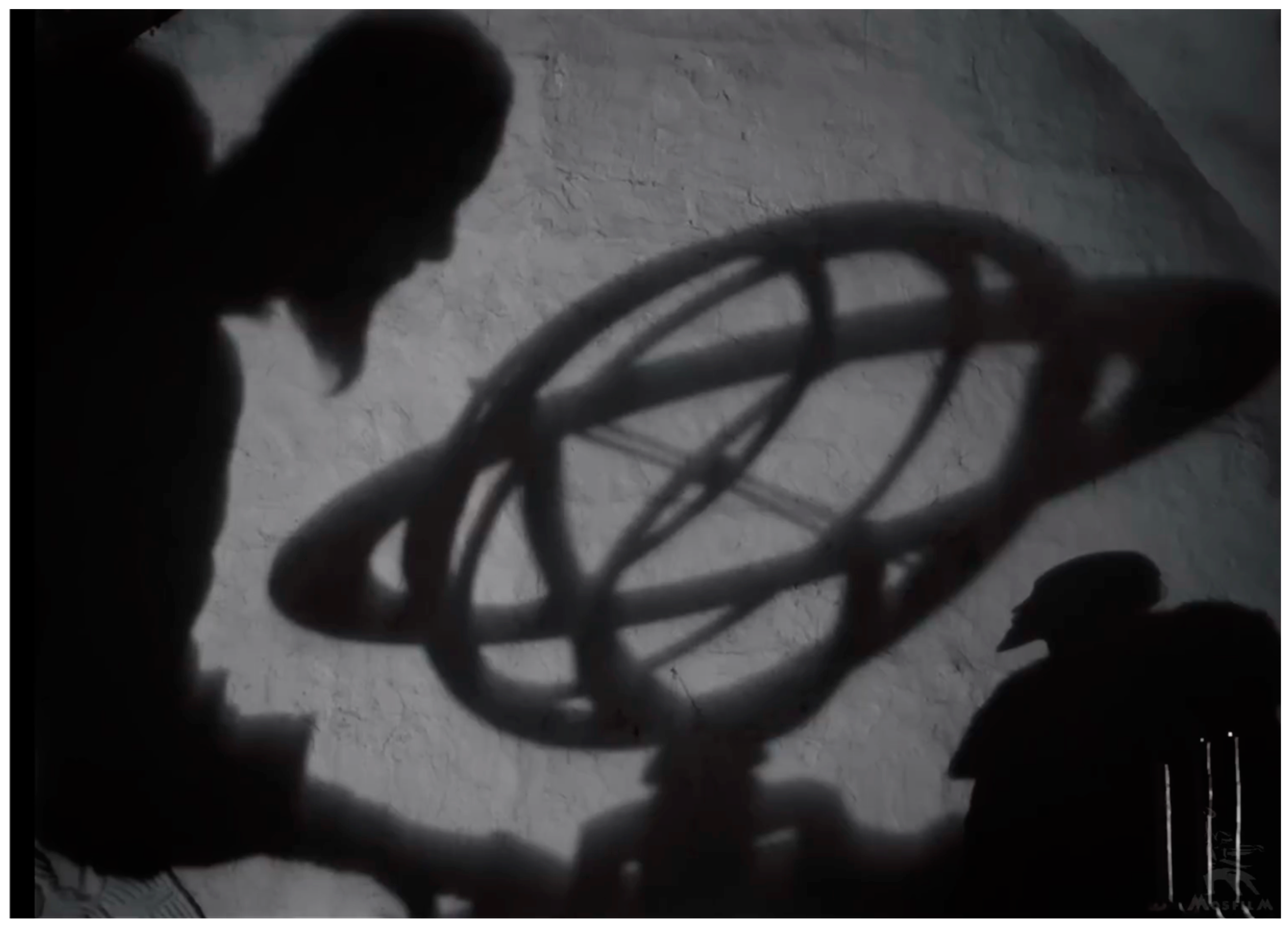
In the stateroom sequence where Ivan talks foreign policy with his envoy to Britain, an awe-inspiring, magnanimous shadow cast on the wall by Ivan’s head seems to dwarf him and ‘to free itself from [his] body’, taking on a life of its own (Neuberger 2003, p. 111). His impressive shadow, which adds movement and menace to the scene, is paired with that of an armillary sphere, which might be read as signifying Ivan’s political prowess, ‘the dimension of statesmanship’, and in Eisenstein’s own words, ‘a maze of his cosmic world thoughts’ (Tsivian 2002, p. 45). If we look closely, we can uncover an eye-like silhouette formed by the metal rings of the sphere, located in the centre of the astronomical device and the screen, further accentuating Ivan’s dominance (Figure 8).
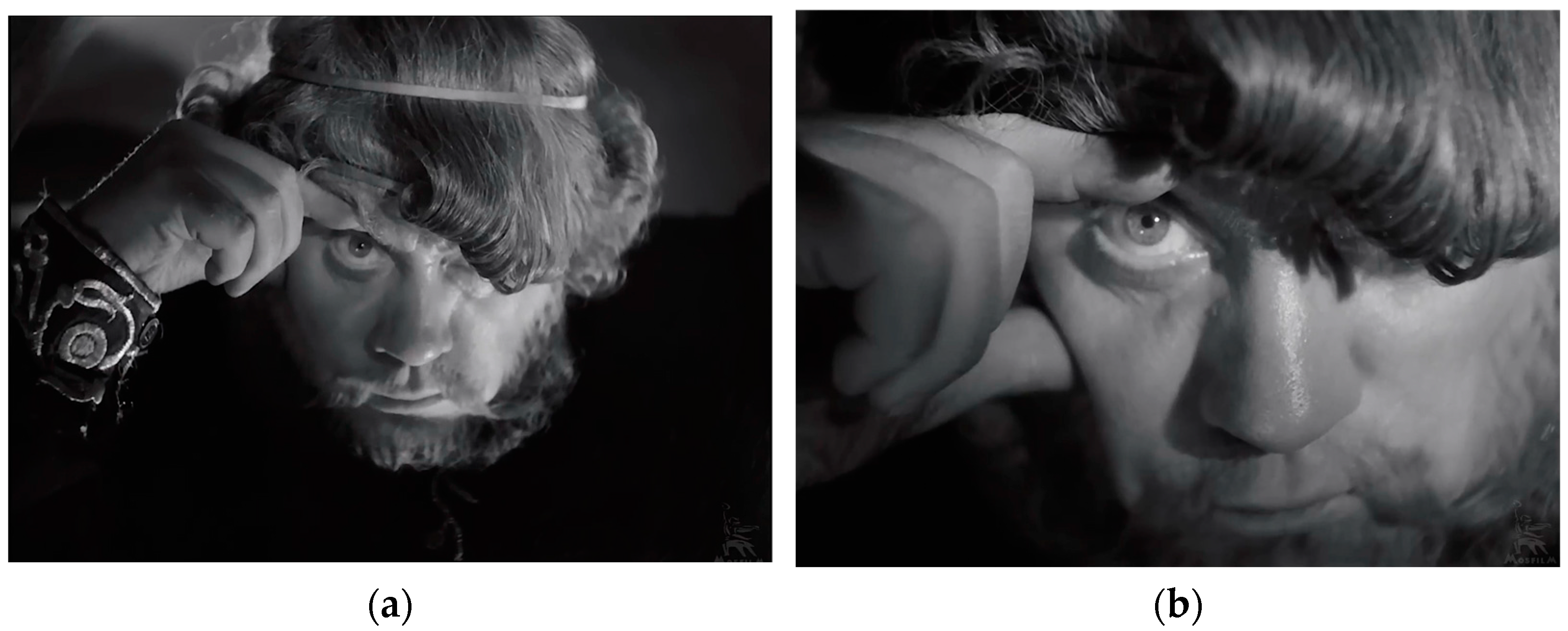
When Ivan is taken ill, Yefrosinia and Kurbsky continue to conspire against him as she tries to convince Kurbsky to fight for Ivan’s throne. Malyuta walks in on them and opens his right eye with his hand (his left eye is hidden by his hair). The action is shown first in a close-up (Figure 9a) and then in an extreme close-up (Figure 9b).
Oswald claims that the ‘disjunctive montage builds to a climax in the scene of Ivan’s illness, where cuts between eyes looking and objects of the look signify the paradoxical blindness to which the characters looking are prey’ (Oswald 1994, p. 252). The stylised dialogue of the eyes in Ivan’s bedroom is intense and emotionally charged. Ivan’s crazed eyes remain exaggeratedly open while he speaks and moves somewhat theatrically, as if possessed. The other characters meta-communicate through glances until Ivan’s fateful realisation of who is betraying him.
The mise-en-scène of eyes throughout the film is in tune with the multiple sources of light, including flames from lit candles and the consistently bright whites of the characters’ eyes. These, in turn, combine with light and dark coloured costumes, methodical frame composition, and expressive make-up in a choreographed, expressionist play of light and shadows. To go back to the painter Magnasco, whose work inspired the director, what we have in Ivan ‘is light, talking to darkness—a dyad’ (Elkins 1999, p. 52). Crucially, many of the failings that the Central Committee identifies in Part Two concern aesthetic choices, rather than being focused purely on content. Colour, beards, darkened chambers, confined spaces, light, and engulfing shadows—all these intensify the contradictions and idiosyncrasies of the despot, effectively ‘Shakespearising’ him (Yurenyev 1989, p. 13). Throughout the film, Ivan’s eyes are restless, cunning, exaggerated—an all-enveloping gaze that uses even the eyes of others to see as much it possibly can, including the things it should not: eyes that, in their minute canvassing of their surroundings, risk mis-seeing. Ivan’s look is set on the future, a trait emphasised by Eisenstein’s abandonment of Ivan’s childhood scenes, as dictated by the state (Yurenyev 1989, p. 13). It is this ability to see only his desire and the actualisation of his abstract ideas about a united Russia that imbue nuance to the dichotomies of will and duty, dream and reality, humanity and cruelty. Looking equals control—it means to dominate from afar, to exert superiority over another by turning them into an object of our gaze. Ivan, in this sense, is always in control—of others and of his surroundings.


4. Conclusions

Eisenstein makes the human face his main canvas. This is stressed by the fact that the act of looking is chiefly directed towards human beings. Using highly visual and energetic close-ups that jump out of the screen, he engages the viewer in the experience of cinema. Many of his characters peer at one another or at the camera with open staring eyes, filmed in close-up. Often only one eye is open or visible, meaning that vision systematically appears interrupted and eyes disembodied in their isolation from the full face, thus magnifying the political importance of sight in Eisenstein’s oeuvre. These networks of sight help us to better understand the immense impact the director’s productions have had on film as (sociopolitical) art to this day.
The use of expressive faces along with the many ellipses, jump cuts, and conflicts at the level of composition, camera angles, and montage pervade Strike, Potemkin, and Ivan the Terrible—films which furthermore reflect the links between Soviet montage, French Impressionism, and German Expressionism. The eyes and the close-ups form a thematic unitary concept, making each film a polyphonic, organic whole, and establish a clear continuity across all three productions. Amengual centres this continuity on opposition. He compares Potemkin and Ivan, remarking that the former opposes bourgeoisie and proletariat, military and popular forces, land and sea, whereas the latter opposes boyars and sovereigns, temporal power and the Church, love and ambition (Amengual 1962, p. 67). In Strike, I would add, we oppose, for instance, light and darkness, workers and capitalists, quietness and noise. Oppositions are likewise conveyed through the affective intensity of the look and a virtuosic mise-en-scène of eyes that allow the director to establish connections between his carefully curated characters, on one level, and the audience, on another. The multiple dialogues of looks that underlie his films dispense with the verbal—in both his silent and sound productions. Meaning is generated from eye to eye, through configurations of seeing and being seen, revealing and concealing.
The way in which Eisenstein accounts for the spectators within the films, the place he carves out for them, creates an imperative need to look, to look further, and see everything. He ‘picks out remarkable instants’ (Deleuze 1997, p. 6), directing the gaze of the spectator and thus effectively ‘controlling the viewer’s associations’ (Tsivian 2001, p. 265) through a series of diagonal lines, triangular figures, eyes, faces, and hands. ‘With the help of the close-up’, Eisenstein writes, ‘the spectator plunges into the most intimate matters on the screen: a flinching eye-lash, a trembling hand’ (Eisenstein 1968, p. 150). Indeed, at its core, the close-up is not a question of distance, but enlargement—it is ‘a Zeitlupe’ that entraps time and allows the viewers to inspect a frozen moment, heightening the sensorial experience of the images (Aumont 1992, p. 100). There is a lingering, uneasy quality stemming from the montage of pathetic close-ups which invites us to dwell on the many eyes that demand our attention and which makes us aware that in Eisenstein ‘an image never seems to exist in itself, but always for another image’ (Grilo 2007, p. 97).

Funding

This research received no external funding.

Institutional Review Board Statement

Not applicable.

Informed Consent Statement

Not applicable.

Data Availability Statement

The original contributions presented in this study are included in the article. Further inquiries can be directed to the corresponding author.

Acknowledgments

I am grateful to Julian Graffy, whose 2009 module on Russian Cinema at University College London first introduced me to Strike and the method of typage.

Conflicts of Interest

The author declares no conflicts of interest.

Notes

1
Strike was completed in 1924, but its theatrical release was delayed until 1925.
2
All translations are by the author, unless otherwise noted.
3
Eisenstein counterposed his ‘Cine-fist’ to the Vertovian ‘Cine-eye’.
4
For more on the relationship between the Gothic, French Impressionism, German Expressionism, and other artistic avant-gardes, see my monograph, Memory and the Gothic Aesthetic in Film (Jacob Ramalho 2024).

References

  1. Abel, Richard, ed. 1988. Photogénie and Company. In French Film Theory and Criticism: 1907–1929. Princeton: Princeton University Press, vol. 1, pp. 95–124. [Google Scholar]
  2. Amengual, Barthélemy. 1962. S. M. Eisenstein. Premier Plan 25: 27–29. [Google Scholar]
  3. Aumont, Jacques. 1987. Montage Eisenstein. London: BFI. [Google Scholar]
  4. Aumont, Jacques. 1992. Du Visage au cinéma. Condé-sur-Noireau: Cahiers du Cinéma. [Google Scholar]
  5. Aumont, Jacques. 1997. The Variable Eye, or the Mobilization of the Gaze. In The Image in Dispute: Art and Cinema in the Age of Photography. Edited by Dudley Andrew. Translated by Charles O’Brien, and Sally Shafto. Austin: University of Texas Press, pp. 231–58. [Google Scholar]
  6. Aumont, Jacques, Alain Bergala, Michel Marie, and Marc Vernet. 2008. Esthétique du film. Paris: Armand Collin. [Google Scholar]
  7. Balázs, Béla. 1952. Theory of the Film: Character and Growth of a New Art. Translated by Edith Bone. London: Dennis Dobson. [Google Scholar]
  8. Ball, Alan M. 2003. Imagining America: Influence and Images in Twentieth-Century Russia. Lanham: Rowman and Littlefield. [Google Scholar]
  9. Barna, Yon. 1973. Eisenstein. Edited by Oliver Stallybrass. Translated by Lise Hunter. Bloomington: Indiana University Press. [Google Scholar]
  10. Benjamin, Walter. 2008a. On the Present Situation of Russian Film [1927]. In The Work of Art in the Age of Its Technological Reproducibility, and Other Writings on Media. Edited by Michael W. Jennings, Brigid Doherty and Thomas Y. Levin. Cambridge: The Belknap Press of Harvard University Press, pp. 323–27. [Google Scholar]
  11. Benjamin, Walter. 2008b. Reply to Oscar A. H. Schmitz [1927]. In The Work of Art in the Age of Its Technological Reproducibility, and Other Writings on Media. Edited by Michael W. Jennings, Brigid Doherty and Thomas Y. Levin. Cambridge: The Belknap Press of Harvard University Press, pp. 328–32. [Google Scholar]
  12. Benjamin, Walter. 2008c. The Work of Art in the Age of Its Technological Reproducibility: Second version. In The Work of Art in the Age of Its Technological Reproducibility, and Other Writings on Media. Edited by Michael W. Jennings, Brigid Doherty and Thomas Y. Levin. Cambridge: The Belknap Press of Harvard University Press, pp. 19–55. [Google Scholar]
  13. Ben-Shaul, Nitzan. 2007. Film: The Key Concepts. Oxford: Berg. [Google Scholar]
  14. Bordwell, David. 2007. Monumental Heroics: Form and Style in Eisenstein’s Silent Films. In The Silent Cinema Reader. Edited by Lee Grieveson and Peter Krämer. London: Routledge, pp. 368–88. [Google Scholar]
  15. Bouquet, Stéphane. 2008. Serguei Eisenstein. Special Edition for the Portuguese newspaper Público. Madrid: Cahiers du Cinéma. [Google Scholar]
  16. Brakhage, Stan. 1972. The Brakhage Lectures: George Méliès, David Wark Griffith, Carl Theodore Dreyer, Sergei Eisenstein. Chicago: The GoodLion. [Google Scholar]
  17. Brody, Samuel. 1992. Eisenstein in Paris in 1930: An Eyewitness Report. In Celluloid Power: Social Film Criticism from the Birth of a Nation to Judgement at Nuremberg. Edited by David Platt. London: The Scarecrow Press, pp. 187–92. [Google Scholar]
  18. Christie, Ian. 1988. Willie the Whale and Ivan the Terrible. In Eisenstein at Ninety. Edited by Ian Christie and David Elliott. Oxford: Museum of Modern Art Oxford, pp. 8–10. [Google Scholar]
  19. Deleuze, Gilles. 1997. Cinema 1: The Movement-Image. Translated by Hugh Tomlinson, and Barbara Habberjam. Minneapolis: University of Minnesota Press. [Google Scholar]
  20. Delluc, Louis. 1988. Beauty in the Cinema. In French Film Theory and Criticism: 1907–1939. Edited by Richard Abel. Princeton: Princeton University Press, pp. 137–39. First published 1917. [Google Scholar]
  21. Dulac, Germaine. 1988. The Expressive Techniques of the Cinema. In French Film Theory and Criticism: 1907–1939. Edited by Richard Abel. Translated by Stuart Liebman. Princeton: Princeton University Press, pp. 305–14. First published 1924. [Google Scholar]
  22. Eisenstein, Sergei. 1949. Film Form: Essays in Film Theory. Edited by Jay Leyda. Orlando: Harcourt, Brace & Company. [Google Scholar]
  23. Eisenstein, Sergei. 1968. Film Essays. Edited by Jay Leyda. London: Dennis Dobson. [Google Scholar]
  24. Eisenstein, Sergei. 1970. Notes of a Film Director. New York: Dover Publications. [Google Scholar]
  25. Eisenstein, Sergei. 1974. Montage of Attractions: For ‘Enough Stupidity in Every Wiseman’. The Drama Review: TDR 18: 77–85. [Google Scholar] [CrossRef]
  26. Eisenstein, Sergei. 1977. Film Form: Essays in Film Theory. San Diego: Harcourt Brace. [Google Scholar]
  27. Eisenstein, Sergei. 1987. Nonindifferent Nature: Film and the Structure of Things. Cambridge: Cambridge University Press. [Google Scholar]
  28. Eisenstein, Sergei. 2010. The Montage of Film Attractions. In Sergei Eisenstein: Selected Works, Writings 1922–34. Edited by Richard Taylor. London: I.B. Tauris, pp. 39–58. First published 1924. [Google Scholar]
  29. Eisenstein, Sergei. 2010. The Problem of the Materialist Approach to Form. In Sergei Eisenstein: Selected Works, Writings 1922–34. Edited by Richard Taylor. London: I.B. Tauris, pp. 59–64. First published 1925. [Google Scholar]
  30. Eisenstein, Sergei, and Nikolai Cherkasov. 1998. Stalin, Molotov and Zhdanov on Ivan the Terrible Part Two. In The Eisenstein Reader. Edited by Richard Taylor. Translated by Richard Taylor, and William Powell. London: BFI, pp. 160–66. [Google Scholar]
  31. Elkins, James. 1999. What Painting Is: How to Think About Oil Painting, Using the Language of Alchemy. New York: Routledge. [Google Scholar]
  32. Elliott, David. 1988. Taking a Line for a Dance. In Eisenstein at Ninety. Edited by Ian Christie and David Elliott. Oxford: Museum of Modern Art Oxford, pp. 19–40. [Google Scholar]
  33. Fabe, Marilyn. 2014. Closely Watched Films: An Introduction to the Art of Narrative Film Technique. Berkeley: University of California Press. [Google Scholar]
  34. Freund, Karl. 1934. Just what is “Montage”? American Cinematographer 15: 204, 210. [Google Scholar]
  35. Grilo, João Mário. 2007. As Lições do Cinema—Manual de Filmologia. Lisbon: Edições Colibri. [Google Scholar]
  36. Hochscherf, Tobias. 2011. The Continental Connection: German-Speaking Émigrés and British Cinema, 1927–45. Manchester: Manchester University Press. [Google Scholar]
  37. Jarman, Derek. 2010. Dancing Ledge. Minneapolis: University of Minnesota Press. [Google Scholar]
  38. Joyce, Mark. 2007. The Soviet Montage Cinema of the 1920s. In Introduction to Film Studies. Edited by Jill Nelmes. London: Routledge, pp. 364–97. First published 1996. [Google Scholar]
  39. Kepley, Vance, Jr. 1989. Montage Eisenstein by Jacques Aumont. Russian Review 48: 450–51. [Google Scholar]
  40. Kleiman, Naum. 1988. Eisenstein’s Graphic Work. In Eisenstein at Ninety. Edited by Ian Christie and David Elliott. Oxford: Museum of Modern Art Oxford, pp. 11–17. [Google Scholar]
  41. Kleiman, Naum. 1993. Arguments and Ancestors. In Eisenstein Rediscovered. Edited by Ian Christie and Richard Taylor. London: Routledge, pp. 32–39. [Google Scholar]
  42. Kuiper, John B. 1962. Cinematic Expression: A Look at Eisenstein’s Silent Montage. Art Journal 22: 34–39. [Google Scholar] [CrossRef]
  43. Kuleshov, Lev. 1974. Americanitis. In Kuleshov on Film: Writings. Edited and Translated by Ronald Levaco. Berkeley: University of California Press, pp. 127–30. First published 1922. [Google Scholar]
  44. Lawder, Standish D. 1975. Eisenstein and Constructivism. In The Essential Cinema: Essays on the Films in the Collection of Anthology Film Archives. Edited by P. Adams Sitney. New York: New York University Press, vol. 1, pp. 58–87. [Google Scholar]
  45. Marks, Laura U. 2000. The Skin of the Film: Intercultural Cinema, Embodiment, and the Senses. London: Duke University Press. [Google Scholar]
  46. McGowan, Todd. 2007. The Real Gaze: Film Theory After Lacan. Albany: SUNY Press. [Google Scholar]
  47. McMahon, Laura. 2012. Cinema and Contact: The Withdrawal of Touch in Nancy, Bresson, Duras and Denis. Abingdon: Legenda. [Google Scholar]
  48. Michelson, Annette. 1976. Reading Eisenstein, Reading Capital. October 2: 27–38. [Google Scholar] [CrossRef]
  49. Neuberger, Joan. 2003. Ivan the Terrible. London: I.B. Tauris. [Google Scholar]
  50. Neuberger, Joan. 2019. This Thing of Darkness: Eisenstein’s Ivan the Terrible in Stalin’s Russia. Ithaca: Cornell University Press. [Google Scholar]
  51. Oswald, Laura R. 1994. Cinema-Graphia: Eisenstein, Derrida, and the Sign of Cinema. In Deconstruction and the Visual Arts: Art, Media, Architecture. Edited by Peter Brunette and David Wills. New York: Cambridge University Press, pp. 248–63. [Google Scholar]
  52. Platt, Kevin M. F. 2019. Gothic Ivan the Terrible in the 1920s: Iurii Tarich’s Wings of a Serf and the Curious Case of Ignatii Stelletskii. Russian Literature 106: 33–60. [Google Scholar] [CrossRef]
  53. Selznick, David O. 1972. To: Mr. Harry Rapf. In Memo from David O. Selznick. Edited by Rudy Behlmer. New York: The Viking Press, pp. 9–10. First published 1926. [Google Scholar]
  54. Taylor, Richard. 2007. Stachka, The Strike. In The Cinema of Russia and the Former Soviet Union. Edited by Birgit Beumers. London: Wallflower Press, pp. 47–55. [Google Scholar]
  55. Taylor, Richard, and Ian Christie, eds. 2005. Appendix 4—People: Foreign. In The Film Factory: Russian and Soviet Cinema in Documents, 1896–1939. Abingdon: Routledge, pp. 445–47. [Google Scholar]
  56. Thompson, Kristin. 1993. Eisenstein’s Early Films Abroad. In Eisenstein Rediscovered. Edited by Ian Christie and Richard Taylor. London: Routledge, pp. 52–62. [Google Scholar]
  57. Thompson, Kristin, and David Bordwell. 2003. Film History: An Introduction. New York: McGraw-Hill. [Google Scholar]
  58. Tsivian, Yuri. 2001. What is wrong with the beard: Eisenstein’s Ivan the Terrible as an eccentric tragedy. Cinémas 11: 255–70. [Google Scholar] [CrossRef]
  59. Tsivian, Yuri. 2002. Ivan the Terrible. London: BFI. [Google Scholar]
  60. Turvey, Malcolm. 2008. Doubting Vision: Film and the Revelationist Tradition. Oxford: Oxford University Press. [Google Scholar]
  61. Vuillermoz, Emile. 1988. Before the Screen: Aesthetic. In French Film Theory and Criticism: 1907–1939. Edited by Richard Abel. Princeton: Princeton University Press, vol. 1, pp. 225–28. First published 1920. [Google Scholar]
  62. Wall-Romana, Christophe. 2013. Jean Epstein: Corporeal Cinema and Film Philosophy. Manchester: Manchester University Press. [Google Scholar]
  63. Wollen, Peter. 1969. Signs and Meaning in the Cinema. London: Indiana University Press. [Google Scholar]
  64. Youngblood, Denise J. 1992. Movies for the Masses: Popular Cinema and Soviet Society in the 1920s. Cambridge: Cambridge University Press. [Google Scholar]
  65. Yurenyev, Rostislav. 1989. From History to the Film. In Ivan the Terrible. By Sergei Eisenstein. London: Faber and Faber, pp. 9–15. [Google Scholar]
  66. Yutkevich, Sergei, and Sergei Eisenstein. 2010. The Eighth Art. On Expressionism, America and, of course, Chaplin. In Sergei Eisenstein: Selected Works, Writings 1922–34. Edited and Translated by Richard Taylor. London: I.B. Tauris, vol. 1, pp. 29–32. First published 1922. [Google Scholar]
Figure 1. The factory director’s open right eye, putatively symbolising the capital, is contrasted with his shut left eye in a visual silencing of the workers’ plight.
Arts 15 00039 g001
Figure 2. (a) Cigar smoke enveloping the director’s face. (b) Rhythmic smoking likens the stockholders to the (now still) factory chimneys.
Arts 15 00039 g002
Figure 3. Strike’s final shot revealing a worker’s startled eyes staring at the viewer.
Arts 15 00039 g003
Figure 4. The ship doctor’s skilled look, his vision augmented by the folded pince-nez.
Arts 15 00039 g004
Figure 5. (a) Blood runs down a belt with an embossed swan, a symbol of family life, love, and beauty. (b) The shot to the eye that ends the Odessa steps massacre sequence.
Arts 15 00039 g005
Figure 6. The two beards form an inverted pyramid, a geometric shape that recurs in Ivan.
Arts 15 00039 g006
Figure 7. (a) The omnipresent eye on the wall. (b) Under the watchful eye, Anastasia informs Kurbsky that Ivan is not dead.
Arts 15 00039 g007
Figure 8. The shadow of the armillary sphere whose metal rings seem to form an eye.
Arts 15 00039 g008
Figure 9. (a) Malyuta opens his eye, signifying control of his surroundings and an awareness of those conspiring against the tsar. (b) Malyuta’s eye in extreme close-up.
Arts 15 00039 g009
Disclaimer/Publisher’s Note: The statements, opinions and data contained in all publications are solely those of the individual author(s) and contributor(s) and not of MDPI and/or the editor(s). MDPI and/or the editor(s) disclaim responsibility for any injury to people or property resulting from any ideas, methods, instructions or products referred to in the content.