You are currently viewing a new version of our website. To view the old version click .
  • 0.3Impact Factor
  • 38 daysTime to First Decision

Arts, Volume 14, Issue 2

April 2025 - 24 articles

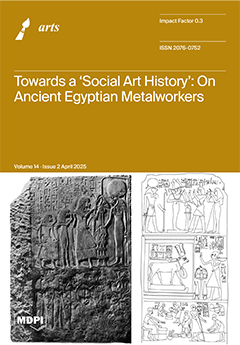
Cover Story: In this paper, I argue for a ‘social art history’ that embraces all protagonists of ancient Egyptian artistic production and integrates them into the global process of creating prestige through art. This paper aims to address the question of defining social value embedded in material artifacts, especially when owned by intermediary social categories such as the New Kingdom metalworkers. The paper will examine goldsmiths’ self-depictions as they were in charge of creating artifacts in gold, a metal connected with solar symbolism and intertwined with the divine, kingship, and membership in the high elite. Ultimately, the paper aims to tackle the question of self-presentation for people who were not part of the elite per se and uses, in a preliminary attempt, some concepts inherited from the Chicago School of Sociology. View this paper
  • Issues are regarded as officially published after their release is announced to the table of contents alert mailing list .
  • You may sign up for email alerts to receive table of contents of newly released issues.
  • PDF is the official format for papers published in both, html and pdf forms. To view the papers in pdf format, click on the "PDF Full-text" link, and use the free Adobe Reader to open them.

Articles (24)

  • Article
  • Open Access
2,621 Views
25 Pages

21 March 2025

This article examines the place of Croatian art within Hungarian art exhibitions around the turn of the century. Over close to a decade, from the 1896 Millennial Exhibition until the 1904 St. Louis World’s Fair, the way Croatian art was display...

  • Article
  • Open Access
1,737 Views
27 Pages

20 March 2025

For the Norman kings of Sicily and the ecclesiastical authorities who ruled their dioceses, Byzantine art served as both a symbol of luxury and a model of prestige. Similarly to the mosaics of Palermo, Monreale, and Cefalú, as well as textiles...

  • Article
  • Open Access
2,002 Views
13 Pages

12 March 2025

Aesthetic tendencies in architecture are disposed between two poles: rich ornamentation and formal restraint. The principle of an empty wall and the rejection of decoration are perceived as features of contemporary architecture. However, does the the...

  • Article
  • Open Access
1 Citations
2,833 Views
29 Pages

The Role of Tall Buildings in Sustainable Urban Composition—The Case of Hanza Tower in Szczecin (Poland)

  • Zbigniew Władysław Paszkowski,
  • Klara Czyńska and
  • Natalia Emilia Paszkowska-Kaczmarek

11 March 2025

Tall buildings are a unique category of architectural objects, as they are characterized by a strong self-presentation effect and have a significant visual impact on the urban composition and the surrounding cityscape. This contextual impact has a on...

  • Article
  • Open Access
2,155 Views
26 Pages

6 March 2025

The illustrated books of Kōriki Enkōan (1756–1831), a samurai and amateur illustrator from Owari domain, offer a unique window into the culture of spectacle and display that flourished in late Edo-period Japan. Included in his corpus...

  • Article
  • Open Access
2 Citations
5,140 Views
27 Pages

4 March 2025

Among the multiple zoomorphic and geometric images that dominate Upper Paleolithic decorated cave walls in Europe, some intriguing human hand stencils and finger flutings stand out. Dozens of these marks are attributed to toddlers and children aged 2...

  • Article
  • Open Access
2,411 Views
21 Pages

Outside the Palaces: About Material Culture in the Almoravid Era

  • Sophie Gilotte and
  • Yasmina Cáceres Gutiérrez

3 March 2025

The material legacy of the Almoravid dynasty is evident in a limited number of public and military works promoted by the authorities, reflecting their policies on territorial expansion and urban planning. Other aspects, such as its integration into t...

  • Article
  • Open Access
3 Citations
1,488 Views
37 Pages

3 March 2025

Humans have been monitoring light from the solar system to tell the time and plan activities since Time Immemorial. This is an analysis regarding why Native Americans living in the upper Colorado River Basin chose to monitor light from the western sk...

of 3

Get Alerted

Add your email address to receive forthcoming issues of this journal.

XFacebookLinkedIn
Arts - ISSN 2076-0752