You are currently viewing a new version of our website. To view the old version click .
  • 0.3Impact Factor
  • 38 daysTime to First Decision

Arts, Volume 12, Issue 1

February 2023 - 39 articles

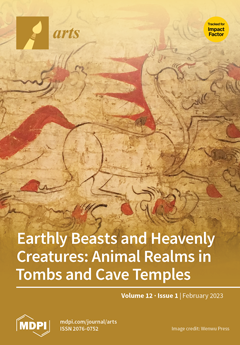
Cover Story: Fabricated worlds in tombs and cave temples of the Hexi Corridor show that animals were integral to concepts of earthly and heavenly realms in China’s early medieval period. Domestic animals in third-century tomb paintings establish microcosms, while images dated a century later fuse celestial and terrestrial worlds. In cave temples of the sixth century, proliferating buddhas and bodhisattvas crowd out animals and assert an anthropocentric view of life and paradise. These changes in animal imagery connect to the region’s social, cultural, and demographic transformations, including an initial embrace of pastoralism that was replaced by cosmopolitanism. (Image credit: Heavenly horse, Dingjiazha M5. Reprinted with permission, ©Wenwu Press.)  View this paper
  • Issues are regarded as officially published after their release is announced to the table of contents alert mailing list .
  • You may sign up for email alerts to receive table of contents of newly released issues.
  • PDF is the official format for papers published in both, html and pdf forms. To view the papers in pdf format, click on the "PDF Full-text" link, and use the free Adobe Reader to open them.

Articles (39)

  • Article
  • Open Access
5,901 Views
21 Pages

6 February 2023

Among the burials of horse herders who lived in the 4th–3rd centuries BCE Altai Mountains of South Siberia were some that contained small wooden figures of four-legged hoofed animals that represent horses, deer, or hybrid creatures. They decora...

  • Article
  • Open Access
1 Citations
5,619 Views
19 Pages

6 February 2023

Two Iron Age settlements, Tuzusai and Taldy Bulak 2 (ca. 500 BC to 1 CE), located in southeastern Kazakhstan on the Talgar alluvial fan north of the Tian Shan range, have yielded a small collection of bone, antler/horn, bronze, and stone artifacts wi...

  • Article
  • Open Access
3,639 Views
37 Pages

3 February 2023

The article focuses on two parafictional figures created by Israeli artists at about the same time in the early 2000s: Oreet Ashery’s Marcus Fisher and Roee Rosen’s Justine Frank. Through a close reading of these case studies, I examine t...

  • Article
  • Open Access
1 Citations
4,899 Views
13 Pages

30 January 2023

Wild and fantastical animals climb, fly, scamper, and prance across pictorial stone carvings decorating Eastern Han tomb doors in northern Shaanxi. Alongside dragons and other mythical animals, bears felicitously dance, tigers grin opening their mout...

  • Commentary
  • Open Access
11 Citations
11,043 Views
17 Pages

Questioning the NFT “Revolution” within the Art Ecosystem

  • Anne-Sophie V. Radermecker and
  • Victor Ginsburgh

30 January 2023

Three years after the sensational debut of non-fungible tokens (NFTs) on the art scene, it seems timely to reflect on their presumed revolutionary attributes. The speculative fascination at the beginning has gradually given way to mixed outcomes, wit...

  • Article
  • Open Access
2 Citations
4,138 Views
12 Pages

29 January 2023

This article assembles feminist articulations scattered across art histories and theories of Eastern and Central Europe, in order to reveal their potential, not only for foregrounding postsocialist feminist perspectives, but also for enriching the vo...

  • Article
  • Open Access
1 Citations
9,283 Views
25 Pages

28 January 2023

The Iron Age Saka population of the eastern Eurasian Steppe is considered one of the earliest of the Scythian groups to emerge at the beginning of the 1st millennium BCE, consequently producing some of the earliest expressions of ‘animal style&...

  • Article
  • Open Access
2 Citations
3,745 Views
13 Pages

23 January 2023

In 1984, professional wrestler Hulk Hogan defeated the Iron Sheik to win the WWF Heavyweight Title. Thus marked the birth of ‘Hulkamania’, a near-decade-long period when Hulk Hogan (real name Terry Bollea) crossed over into American popul...

  • Article
  • Open Access
4 Citations
7,727 Views
14 Pages

20 January 2023

Crime is quantified extensively, mostly in order to prevent it, therefore assuming it as something purely negative. With the concept “Crime as Pop” we argue that such a view is one-sided, since crime is often staged as something that can...

of 4

Get Alerted

Add your email address to receive forthcoming issues of this journal.

XFacebookLinkedIn
Arts - ISSN 2076-0752