
You are currently viewing a new version of our website. To view the old version click .
  • 0.3Impact Factor
  • 38 daysTime to First Decision

Arts, Volume 10, Issue 1

March 2021 - 19 articles

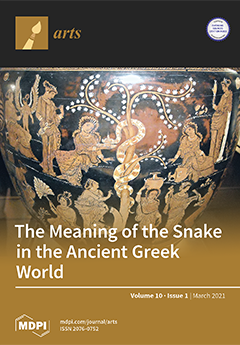
Cover Story: Part of a Special Issue on Animals on Ancient Material Culture, this article examines the symbolism of the snake in the ancient Greek world, with an emphasis on Archaic and Classical Athens. It argues that ancient Greeks perceived the existence of a special primordial force living within, emanating from, or symbolized by the snake; a force that is not more—and not less—than pure life, with all its paradoxes and complexities. The article emphasizes the importance of the snake as an excellent medium for accessing Greek ideas about the divine, anthropomorphism, and ancestry, the relationship between humans, nature, and the supernatural, and the negotiation of the inevitable dichotomy of old and new. View this paper
  • Issues are regarded as officially published after their release is announced to the table of contents alert mailing list .
  • You may sign up for email alerts to receive table of contents of newly released issues.
  • PDF is the official format for papers published in both, html and pdf forms. To view the papers in pdf format, click on the "PDF Full-text" link, and use the free Adobe Reader to open them.

Articles (19)

  • Article
  • Open Access
5,976 Views
19 Pages

5 March 2021

The rise of nationalism threatened the integrity of the Catholic milieu in borderlands such as Prussian Upper Silesia. Facing this challenge, the ecclesiastical elite developed various strategies. This article presents interpretations of sacred art w...

  • Article
  • Open Access
3 Citations
5,760 Views
27 Pages

5 March 2021

Central and Eastern European countries were subjugated to the Soviet Union in the second half of the 20th century. In this new political environment, defined as the period of dependency, the concept of space gained a new denotation as a space of depe...

  • Article
  • Open Access
2 Citations
5,700 Views
18 Pages

1 March 2021

Polish Góra św. Anny (Saint Anne Mountain), previously German Annaberg, is one of the few places in the world where art was utilized to promote two regimes—fascist and communist. With the use of art, the refuge of pagan gods and then, Christian Saint...

  • Article
  • Open Access
4 Citations
12,352 Views
13 Pages

22 February 2021

The article analyses Frank Gehry’s insistence on the use of self-twisting uninterrupted line in his sketches. Its main objectives are first, to render explicit how this tendency of Gehry is related to how the architect conceives form-making, and seco...

  • Article
  • Open Access
3 Citations
4,926 Views
20 Pages

12 February 2021

The article examines a group of exhibitions that took place in the late seventies and early eighties and are useful for grasping what was at stake regarding the debates on the tensions between modernist and post-modernist architecture. Among the exhi...

  • Article
  • Open Access
2 Citations
5,619 Views
18 Pages

7 February 2021

Depictions of the natural world are an intrinsic feature of Egyptian visual culture, with the vast array of imagery documenting animals a testimony to the fundamental role they played. Despite the significance of animals in Egypt, an anthropocentric...

  • Article
  • Open Access
5,488 Views
26 Pages

5 February 2021

Using archival records of the Sagrario Metropolitano and material analysis of extant prints, the paper presents the life and work of the only known woman printmaker in viceregal New Spain, María Augustina Meza. It traces Meza and her work through two...

  • Article
  • Open Access
1 Citations
10,815 Views
26 Pages

4 February 2021

This essay considers the possibilities of contemporary art as a viable medium of socio-political critique within a cultural terrain dominated by naturalised neoliberal economics. It begins by considering the centrality of negativity to the historical...

  • Article
  • Open Access
4,320 Views
12 Pages

1 February 2021

The imagery of the vision of the valley of dry bones (Ezek 37. 1–14) still fascinates theologians and historians of religion with its exegetical and liturgical significance. Rarely represented in medieval art, the iconography of this singular topic r...

of 2

Get Alerted

Add your email address to receive forthcoming issues of this journal.

XFacebookLinkedIn
Arts - ISSN 2076-0752