1. Introduction
The transition toward circular and socially sustainable construction compels the sector to strengthen decision-making processes that integrate interdependent environmental, economic, and social dimensions [
1,
2]. As one of the largest consumers of raw materials and energy, construction not only contributes substantially to greenhouse gas emissions and the generation of construction waste but also profoundly influences social conditions and quality of life [
1,
3]. Against this background, the Circular Economy (CE) has progressively emerged as a prominent sustainable development paradigm emphasizing material reuse, whole-life-cycle thinking and regenerative design to drive the transformation of building systems toward improved sustainability performance [
3]. However, translating circular principles into construction planning practice remains fraught with complex challenges, as planning decisions must reconcile environmental performance, economic feasibility and social value creation across multiple life-cycle stages and stakeholder demands [
3,
4].
In recent years, Artificial Intelligence (AI) technologies, including machine learning, data analytics, and intelligent decision support systems, have been widely regarded as crucial tools for addressing the aforementioned complexities [
5,
6]. However, many current AI applications continue to operate within a paradigm of technical rationality, prioritizing the automated optimization of explicit metrics such as energy consumption and costs, while frequently overlooking the indispensable contextual judgment, value trade-offs, and societal considerations inherent in planning [
6,
7]. This limitation reveals a fundamental divergence in existing research: whether AI should be conceived as an automated substitute for human judgment or as a collaborative partner that augments decision-making capabilities.
Meanwhile, Sustainability Literacy (SL), another key driver of sustainable transitions, faces challenges of conceptual applicability within the context of construction planning. Traditionally, the term has been defined as an educational construct associated with knowledge, awareness, and values related to sustainability [
8,
9]. Although this perspective is important, such a static and cognition-oriented view offers limited guidance in making decisions within dynamic, uncertain, and conflict-ridden real-world scenarios. Correspondingly, research on social sustainability also faces methodological conflicts: one strand focuses on developing universal and quantifiable indicators [
10], while another emphasizes its inherent contextual and qualitative nature [
11]. Together, these tensions suggest a persistent gap in practice between data-driven optimization logics and value-based normative reasoning.
These strands of literature reveal a critical gap at the intersection of Sustainability Literacy, AI-enabled decision support, and circular social sustainability in the construction domain. Existing CE-oriented planning studies largely emphasize quantifiable lifecycle and resource-efficiency metrics, but rarely specify how qualitative social values and stakeholder legitimacy can be integrated into decision reasoning without being reduced to residual constraints. Likewise, much AI-based construction planning research demonstrates prediction or optimization performance, yet provides limited explanation of how AI can support deliberation, transparency, and accountable justification in value-laden decisions. Existing research rarely examines how Sustainability Literacy functions within real-world planning decisions, nor how AI technologies might reshape or enhance such decision capabilities. Moreover, integrative theoretical frameworks that explicitly connect human decision-making capacities with AI systems in pursuit of circular and socially sustainable outcomes remain scarce.
Although related concepts have been discussed across CE planning, social sustainability assessment, and AI-enabled decision support, existing work remains fragmented in three ways: (i) Sustainability Literacy is predominantly treated as an educational attribute rather than a decision-process capability; (ii) AI is often positioned as optimization or automation rather than cognitive augmentation for value-laden judgment; (iii) circularity-oriented quantification and socially embedded values are seldom integrated within a single explanatory decision framework. This study addresses these gaps by reframing SL as a decision capability, clarifying AI’s augmentative role and boundaries, and providing an integrative framework that links circular and social sustainability through explicit decision mechanisms.
To address these issues, this study proposes an AI-enabled theoretical framework that reframes Sustainability Literacy as a decision capability in circular and socially sustainable construction planning. Within this framework, Sustainability Literacy is no longer merely a static repository of knowledge, but rather a dynamic, AI-enhanced set of capabilities. It empowers decision-makers to interpret complex information, evaluate multidimensional trade-offs, and align planning actions with circular and social sustainability objectives. Accordingly, the specific objectives of this study are to: (1) Reconceptualize sustainability literacy by shifting it from a predominantly awareness- and education-oriented notion toward a decision-oriented capability that is directly applicable to construction planning practice. (2) Develop an integrative theoretical framework that explicates how AI technologies can augment human cognitive and analytical capacities in support of circular and socially sustainable construction planning decisions. (3) Elucidate the theoretical and practical implications of the proposed framework for the design of AI-enabled decision support systems, planning practice, and professional education in the built environment.
2. Literature Review
2.1. Dual Dimensions of Circular Economy in Construction Planning
The circular economy (CE) has been established as a central paradigm for transformation in construction and infrastructure planning, aiming to decouple economic development from resource consumption and environmental degradation through design innovation, material circulation, and the extension of building lifespans [
1,
12]. Within the construction domain, CE principles are primarily operationalized through life-cycle-based methodologies, including Life Cycle Assessment (LCA), Life Cycle Costing (LCC), and the more integrative Life Cycle Sustainability Assessment (LCSA) [
13]. These approaches collectively form a robust technical evaluation framework capable of quantifying environmental impacts and economic costs of construction projects throughout the entire life cycle, from material production to demolition and end-of-life management [
14]. As a result, a substantial body of evidence-based planning research has focused on the development and refinement of quantitative indicator systems, seeking to embed circularity objectives at early design stages and to support data-driven optimization of planning decisions [
15,
16]. This technical–rational orientation has markedly enhanced the comparability of design alternatives and strengthened the analytical foundation for performance-oriented planning.
Nevertheless, the technically dominated approach centered on life-cycle assessment inherently constructs a relatively closed decision-making framework, focusing primarily on environmental and economic dimensions while offering limited capacity to incorporate social and institutional factors. In recent years, the scholarly community has increasingly recognized that the successful implementation of circular construction strategies, such as building refurbishment, adaptive reuse, and material recirculation, depends strongly on the socio-technical contexts within which they are embedded [
3]. Moreover, the planning and decision-making processes concerning heritage conservation, community regeneration, or cross-supply-chain collaboration are not solely matters of technical feasibility and economic efficiency but also closely intertwined with community identity, cultural values, procedural justice, and stakeholder legitimacy [
17]. This recognition reveals a critical limitation of the prevailing paradigm: superior life-cycle performance assessments do not necessarily translate into planning solutions that are socially acceptable and practically implementable.
Consequently, the circular economy principles in construction planning exhibit a distinct duality: on the one hand, these introduce an increasingly sophisticated system of technical and quantitative assessment; and on the other hand, they introduce a highly complex and context-dependent process of social implementation. The persistent disconnect between these two dimensions constitutes the core barrier to fully translating circular economy principles into sustainable construction planning practice.
2.2. The Tensions of Social Sustainability Assessment
Within the fields of built environment and construction planning, social sustainability has long exhibited conceptual and methodological tensions, most notably expressed as a binary opposition between indicator-based quantification and context-sensitive interpretation. The dominant research trajectory seeks to translate social dimensions, such as equity, health and social cohesion, into quantifiable and comparable indicator systems that can be integrated into formal planning and evaluation procedures. Early contributions by McGillivray [
18], along with subsequent frameworks developed by institutions such as the World Bank and the United Nations, as well as Social Life Cycle Assessment (S-LCA) and various sustainability certification tools derived from the built environment sector, all reflect this research orientation towards standardization [
19,
20]. The central argument posits that only through quantification can social objectives attain decision-making legitimacy equivalent to technical and economic criteria, thereby avoiding marginalization in project evaluations.
In contrast, a series of critical studies explicitly question whether quantitative measures can adequately capture the essence of social sustainability. Dempsey et al. [
21] and Vallance, Perkins, and Dixon [
22] contend that social sustainability is inherently context-dependent. Social values, such as the sense of belonging, cultural identity, and procedural justice, are profoundly place-based and dynamic, shaped by local cultural meanings, power relations, and historical conditions [
21,
22]. Reducing these values to universal indicators risks not only overlooking crucial local attributes but also shifting normative judgment from community stakeholders to expert-driven technical systems, thereby weakening community agency in defining socially desirable outcomes [
23]. Empirical research in community planning and urban regeneration increasingly conceptualizes social sustainability as a process-oriented outcome that emerges through participation, negotiation, and conflict mediation, rather than through the optimization of predefined indicators [
24].
The tension between these two perspectives reflects a deeper epistemological divergence in the field of construction planning. Indicator-based approaches provide an analytical basis for cross-project comparisons and integration into mainstream decision-support models, while context-based approaches safeguard the depth, specificity, and political nature of social values. Currently, the majority of decision-support tools favour the former approach, resulting in the social dimension being treated as secondary or superficial, which hinders the development of genuinely inclusive and community-rooted sustainable planning practices.
2.3. The Evolution of AI Cognitive Role in Construction Planning
The application of Artificial Intelligence (AI) in construction planning reflects the ongoing evolution of technological recognition and positioning within the discipline. Early research and practice predominantly regarded AI as an advanced analytical tool for handling technical tasks such as structural optimization, schedule prediction, and risk simulation [
25,
26]. At this stage, typically framed planning problems were formalized into data-intensive computational models, with the core contribution being a significant enhancement in the efficiency and precision of complex system analysis. The deep integration of construction planning with Building Information Modelling (BIM) further reinforced this instrumental attribute, enabling automated simulation and scheme comparison based on life-cycle data [
4].
As construction planning progressively engages with value-sensitive decision-making contexts, such as social impact assessments, environmental accountability, and sustainability trade-offs, the inherent limitations of purely instrumental AI cognitive models have become apparent. The main challenges include the opacity of algorithmic decision-making processes, an overreliance on structured data, and a limited capacity to interpret the socio-political contexts embedded within planning practices [
27]. These challenges have prompted a shift in research attention away from pursuing ever-higher automation and toward exploring mechanisms for effective human–AI collaboration. This shift does not negate the technical value of AI; rather, it reassesses and recalibrates AI’s function and position within the planning decision-making chain.
In response, recent research at the frontier of the field increasingly advances human-centered paradigms such as explainable artificial intelligence (XAI) and augmented intelligence. The central question is no longer whether machines can replace human decision-makers, but how they can effectively support and enhance human cognitive capabilities in complex, value-laden planning settings [
28,
29]. Within these paradigms, the value of AI extends beyond providing technically optimal solutions. AI can support planners in synthesizing diverse information, exploring trade-offs, and balancing multidimensional value objectives, thereby enabling more reflective and responsible judgment in contexts such as circular economy planning, social equity, and environmental sustainability. Accordingly, this cognitive transition from “tool” to “partner” is reshaping the landscape of human–AI collaboration in sustainable construction planning.
In the context of this study, the term “AI-enabled theoretical framework” does not refer to a predictive model, a software architecture, or a completed decision-support tool. Rather, it denotes a conceptual explanatory structure in which AI is theorized as an enabling condition for specific cognitive and analytical functions within planning decision-making. In this sense, “AI-enabled” emphasizes how AI can support interpretation, trade-off articulation, and deliberative transparency without displacing normative judgment or human accountability. This distinction is important because much construction planning research still frames AI primarily as a technical optimization instrument, whereas the present study uses AI in a conceptual, decision-process sense to explain how sustainability-oriented judgment may be augmented under circular and social sustainability constraints.
2.4. The Capability Turn of Sustainability Literacy
Sustainability literacy has traditionally been conceptualized as an educational construct, referring more specifically to the knowledge base, environmental awareness, and value orientation required for individuals to support sustainable development [
8,
30]. This cognition-oriented paradigm has long shaped construction planning education, where learning outcomes are commonly measured by assessing the acquisition of sustainability-related knowledge and ethical stances.
Although this cognitive foundation is crucial, its knowledge-centered, relatively static, and individualized framing offers limited explanatory power for dynamic, complex, and interest-laden real-world construction planning scenarios. In practice within this field, decision-makers are rarely confronted with well-structured problems in which predefined knowledge can be straightforwardly applied, but rather with judgments made in ill-structured contexts characterized by uncertainty, conflicting objectives, and far-reaching social and environmental consequences [
31]. Under such ill-structured conditions, the mere possession of sustainability knowledge proves insufficient to support responsible decision-making. In recent years, sustainability literacy has undergone theoretical reconfiguration, with scholars reframing it from individual knowledge and attitudes toward a practice-based capability or decision-making competence [
32,
33,
34].
This transition from knowledge-oriented to capability-oriented approaches not only expands the theoretical scope of sustainability literacy but also provides a crucial interface for its integration with contemporary planning tools. When sustainability literacy is conceptualized as an observable, supportable, and developable decision-making capacity, the role of AI data-driven technologies becomes clearer. The core function of AI lies not in substituting human judgment but in systematically enhancing planners’ capacity to navigate complexity, uncertainty, and conflicts among diverse values. This understanding establishes an essential theoretical foundation for human-centered, AI-enabled decision-support systems that assist complex value judgments in sustainability-oriented planning challenges.
2.5. Synthesis and Research Gap
A synthesis of the literature presented in
Section 2.1,
Section 2.2,
Section 2.3 and
Section 2.4 indicates that research on the Circular Economy, social sustainability, Artificial Intelligence, and Sustainability Literacy in construction planning has developed into several distinct, internally coherent yet largely disconnected streams. Specifically, life-cycle-based approaches provide robust environmental and economic performance assessments for the circular economy; social sustainability research continues to grapple with tensions between indicator-based quantification and context-sensitive interpretation; AI research is evolving from efficiency-oriented automation toward human-centered cognitive augmentation; and Sustainability Literacy studies increasingly adopt a practice-oriented capability perspective. Despite these advances, the relevant literature remains structurally fragmented. These streams have developed along their respective disciplinary logics, with insufficient integration between technical assessments, societal value judgments, and planners’ decision capability. To clarify this fragmentation,
Table 1 summarizes and compares the core concerns, strengths, and limitations of the principal research streams in sustainable construction planning.
As shown in
Table 1, although each stream is internally coherent, their largely parallel development constrains the translation of research insights into integrated planning decisions. This results in a clear research gap: the lack of a coherent theoretical framework that explains how planners can systematically develop and strengthen sustainability-oriented decision-making capabilities, and how AI can support these capabilities in circular and socially sustainable construction planning. To bridge this gap, this study proposes an AI-enabled framework that redefines Sustainability Literacy as decision-making capacity and clarifies the cognitive role of Artificial Intelligence in supporting responsible planning decisions.
3. Methods
3.1. Research Design and Theoretical Approach
This study is qualitative in orientation and adopts a conceptual research design with the core aim of constructing an explanatory theoretical framework to clarify how artificial intelligence (AI) supports decision-making capabilities for achieving sustainability in construction planning through cognitive augmentation mechanisms. Unlike empirical research, the study does not aim to conduct empirical testing, case-based statistical comparison, or predictive modelling. Instead, it develops a logically coherent, explanatory, and contextually transferable conceptual system through systematic literature synthesis and theory building. In this study, “systematic” refers to a transparent and reproducible procedure for literature identification, screening, and concept extraction, which supports conceptual abstraction and framework construction.
From a methodological perspective, the framework development follows the conceptual framework approach proposed by Jabareen, which emphasizes the systematic identification, abstraction, linkage, and structuring of concepts derived from multiple literature streams [
35,
36]. This approach prioritizes explanatory logic and functional relationships among concepts rather than statistical association. In addition, this study draws upon Dubin’s theoretical construction logic, conceptualizing theory as a system composed of constructs, explicit definitions, and relational rules, thereby ensuring internal consistency and analytical transparency at the conceptual level [
37].
Accordingly, this chapter reports the procedure for constructing the explanatory theoretical framework—covering literature synthesis, construct definition, and relational structuring—rather than reiterating empirical findings from the reviewed studies.
3.2. Systematic Literature Synthesis Procedure
To enhance methodological transparency, the literature work is reported as a systematic synthesis that supports conceptual framework construction. The procedure focuses on concept extraction and cross-stream integration and consists of four steps: search, screening, coding, and synthesis.
First, the literature was retrieved from Scopus, Web of Science Core Collection, and Google Scholar on 18 October 2025, covering the period from 2000 to 2025. Google Scholar was used as a supplementary source, and non-peer-reviewed items were excluded during screening. Searches were designed to cover four intersecting streams relevant to the research questions: circular economy and life-cycle-based construction planning; social sustainability and participatory/values-oriented planning; AI-enabled decision support and explainable AI; and sustainability literacy/capability-based interpretations. Keywords were developed around these streams (e.g., “circular economy” AND “construction planning”; “social sustainability” AND “planning”; “AI” OR “decision support” OR “explainable AI” AND “construction” OR “planning”; “sustainability literacy” OR “capability” AND “decision-making”).
Second, records were screened via title/abstract review followed by full-text checks. Studies were included if they (i) addressed planning/decision-making in construction or built-environment contexts and (ii) contributed conceptual definitions, mechanisms, or decision-process insights relevant to trade-offs, uncertainty, value-laden judgment, or stakeholder legitimacy. Studies were excluded if they were purely technical without decision-process relevance or were outside built-environment contexts. The final corpus comprised 92 studies.
Third, the included literature was coded to extract (i) construct definitions and conceptual boundaries, (ii) claimed relational mechanisms among constructs, and (iii) decision-process implications for circular and socially sustainable planning.
Fourth, codes were clustered into higher-order categories, and overlapping concepts were reconciled through iterative comparison to support cross-stream synthesis. This synthesis informed the explicit construct definitions (
Section 3.3) and the relational structuring of the framework in
Section 4.
3.3. Conceptual Foundations and Definition of Core Constructs
Building upon the research gap identified in the literature review, three core constructs are identified and defined: decision capability, AI-enabled cognitive augmentation, and reconceptualized sustainability literacy, which collectively form a logical chain from value-based cognition and technological empowerment to sustainability-oriented decision-making outcomes.
Decision capability is conceptualized not as a single decision act, but as a composite capacity to integrate information, balance competing objectives, and act under conditions of uncertainty and value conflict. This concept emphasizes the quality of judgment that can be exercised, rather than the amount of knowledge that is possessed. AI-enabled cognitive augmentation refers to the use of AI to systematically support and extend human cognitive functions—such as information processing, pattern recognition, scenario exploration, and option comparison—without displacing professional judgment. This construct is explicitly distinguished from techno-rational views that position AI as a fully automated decision-making tool. In this study, sustainability literacy is reconceptualized as a practice-based decision capability rather than a static set of knowledge or values. It is expressed in the ability to interpret sustainability principles contextually and translate them into responsible planning judgments.
To clarify conceptual boundaries and theoretical origins,
Table 2 systematically outlines the definition, primary theoretical sources, and functional role within the framework for each construct.
3.4. Framework Development Process
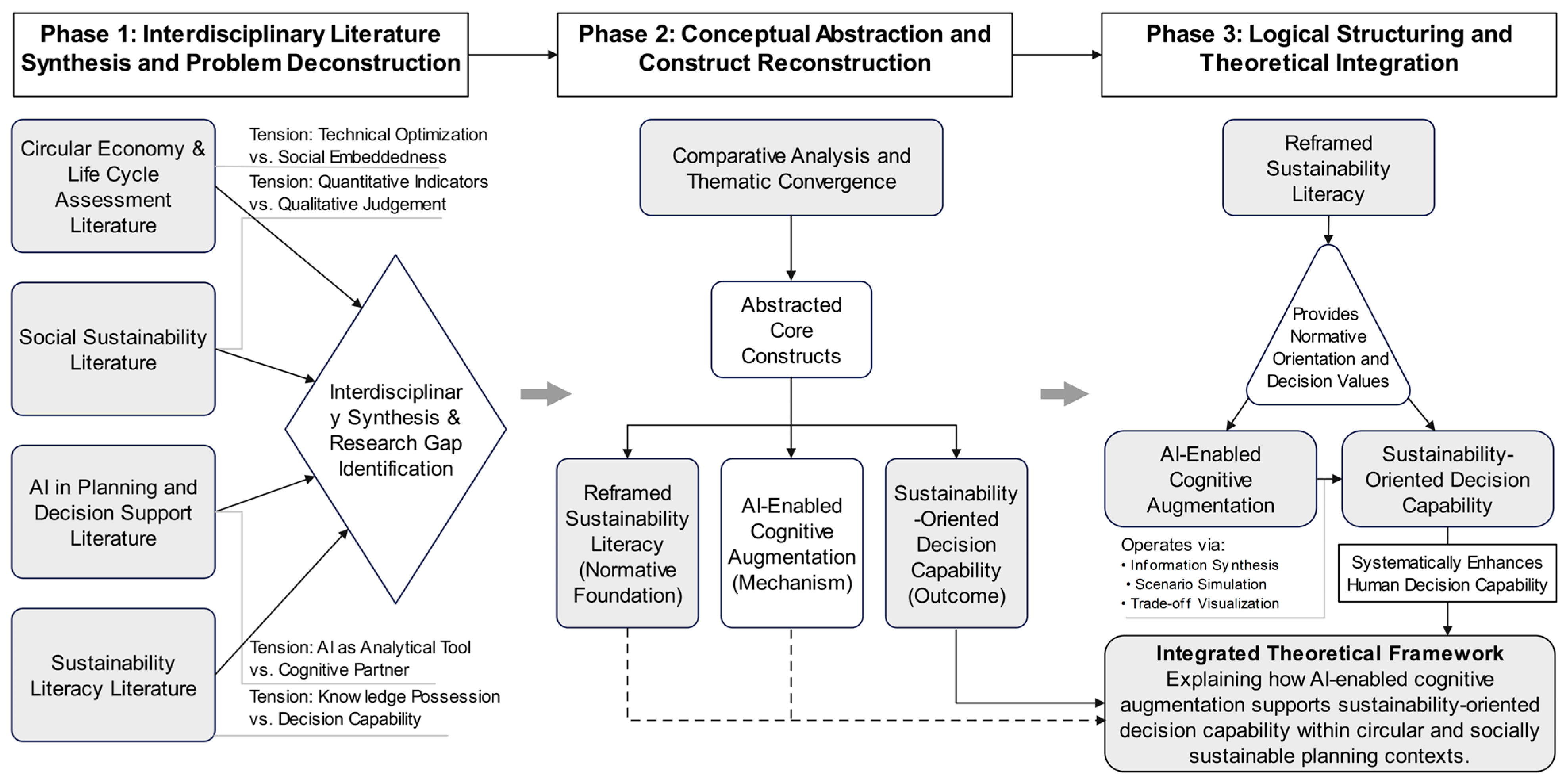
The development of this theoretical framework follows a staged and deductive process that progresses from interdisciplinary literature synthesis to conceptual abstraction and, finally, to logical structuring. The process began with a cross-disciplinary synthesis across four core research streams—circular economy and life-cycle assessment, social sustainability, artificial intelligence in planning, and sustainability literacy—to identify recurring theoretical tensions and unresolved conceptual challenges within sustainability-oriented planning research. Next, these identified tensions were translated into abstracted core constructs through comparative analysis and thematic convergence. By examining how key concepts are defined, operationalized, and positioned across different strands of literature, higher-order constructs with cross-contextual explanatory capacity were distilled, and their analytical scopes were explicitly delineated. Finally, the logical and directional relationships among the abstracted constructs were articulated and integrated into a coherent theoretical framework.
Within this structure, AI-enabled cognitive augmentation is positioned as a mediating mechanism that systematically enhances sustainability-oriented decision capability, under the normative guidance of reconceptualized sustainability literacy. As shown in
Figure 1, the framework development process emphasizes theory building through conceptual synthesis and logical deduction, rather than the aggregation or extension of existing empirical findings. The construct definitions and relational structuring reported in this chapter are directly grounded in the systematic synthesis procedure described in
Section 3.2, ensuring traceability from literature streams to framework constructs.
4. Result
4.1. Redefining Sustainability Literacy as a Decision Capability
Drawing on the literature review presented in previous sections, existing studies generally conceptualise sustainability literacy as an integrated capability comprising knowledge, awareness, values, attitudes, and skills, with a primary emphasis on its roles in educational systems, value formation, and behavioural change [
8,
30]. However, within construction planning contexts characterized by multi-objective conflicts, uncertainty, and value trade-offs, such conceptions—largely focused on cognitive preparedness or normative advocacy—are insufficient to explain how sustainability principles shape complex decision-making processes [
31,
34,
38,
39].
Responding to this conceptual limitation, this study advances a reinterpretation of sustainability literacy centered on the decision-making process. Rather than asking whether decision-makers possess sustainability knowledge or awareness, the proposed perspective focuses on whether they are able to consistently mobilize sustainability values to interpret information, evaluate trade-offs, and exercise judgment within complex planning situations. This shift repositions sustainability literacy from a static educational outcome to a dynamic capability embedded within decision-making practice. To formalize this reconceptualization, Definition 1 presents sustainability literacy explicitly as a form of decision capability within sustainability-oriented planning contexts.
Definition 1. Sustainability Literacy as a Decision Capability. In the context of circular and socially sustainable construction planning, sustainability literacy refers to the capacity of decision-makers to interpret complex sustainability-related information, evaluate trade-offs among environmental, economic, and social objectives, and exercise value-oriented judgment within specific planning contexts. This capability is inherently dynamic and can be systematically supported and enhanced through human–AI collaboration.
This re-conceptualization represents a fundamental shift in analytical focus. Sustainability literacy is no longer treated primarily as an internalized educational attribute, but as an externally observable and operational decision capability. To clarify the theoretical implications of this shift,
Table 3 systematically compares the proposed decision-oriented interpretation with conventional education- and awareness-based frameworks of sustainability literacy commonly adopted in prior research.
By redefining sustainability literacy in this manner, the concept becomes analytically compatible with decision-support technologies and planning tools. This provides the necessary conceptual foundation for the AI-enabled theoretical framework developed in subsequent sections, in which sustainability literacy is no longer an abstract normative ideal, but a capability that can be structured, augmented, and operationalized within planning and design decision processes.
4.2. Overview of the Framework: An Integrative Model of Cognitive Augmentation
Building upon the systematic identification of research gaps in
Section 2.5 and the conceptual research design outlined in
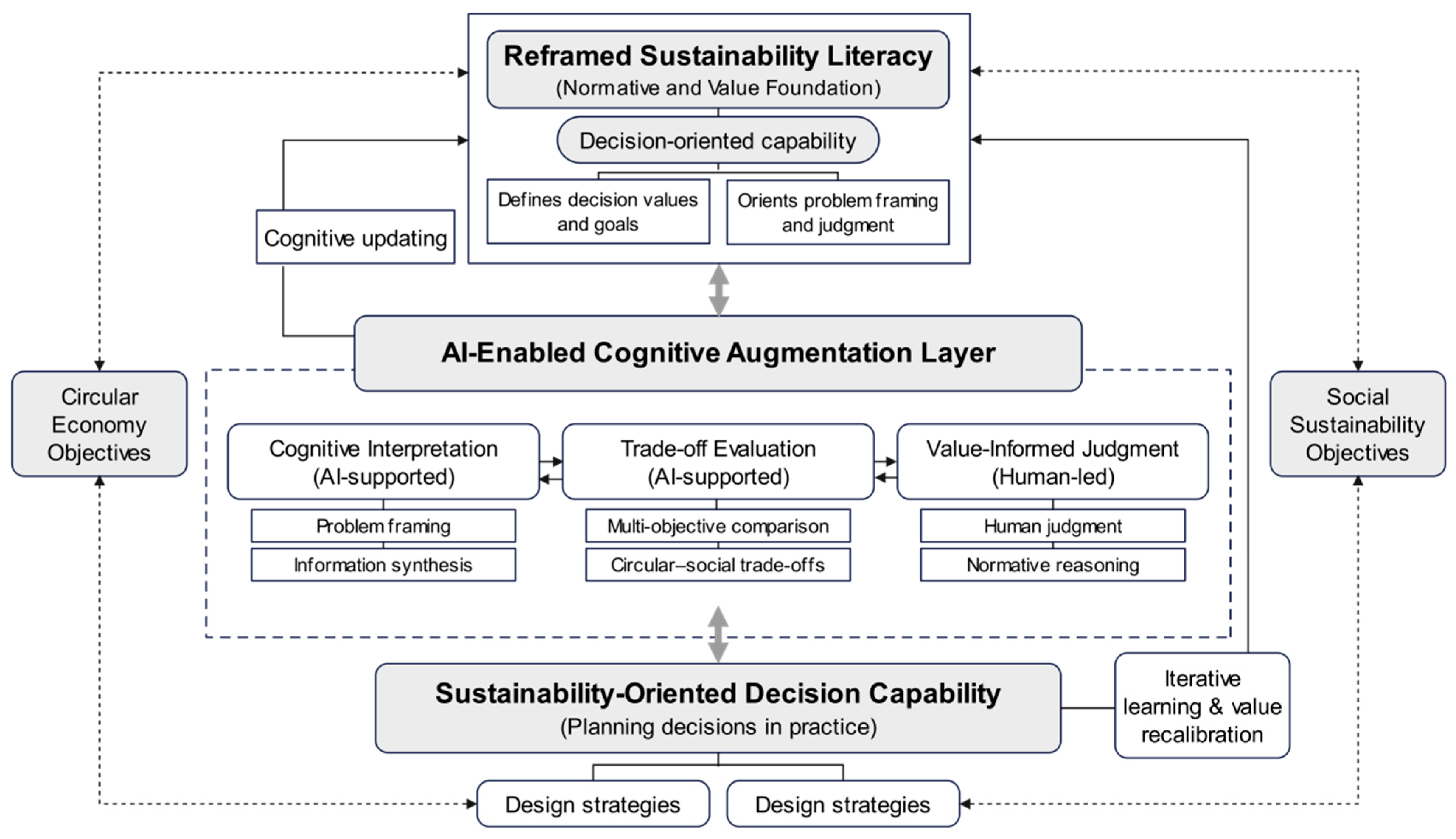
Section 3, this study proposes an AI-enabled integrative theoretical framework that explicitly operationalizes sustainability literacy as a sustainability-oriented planning decision capability within construction planning contexts (
Figure 2). Rather than offering a technical solution, the framework provides a conceptual and explanatory account of how artificial intelligence (AI) can support human judgment through cognitive augmentation when circular-economy and social-sustainability objectives must be addressed simultaneously.
As illustrated in
Figure 2, the framework conceptualizes planning decision-making as a human–AI collaborative socio-technical process organized into three dynamically interacting layers:
- (1)
A normative and value-foundation layer, represented by reconceptualized sustainability literacy, which defines decision goals and value orientations;
- (2)
An AI-augmented analytical layer, which systematically extends human cognitive processes through data integration, analysis, and representation;
- (3)
A decision capability output layer, where sustainability-oriented judgments and choices are formed in concrete planning situations.
Departing from approaches that treat sustainability as an external performance criterion, the framework’s central contribution lies in embedding sustainability as an internal cognitive driver of decision-making. Through explicitly articulated feedback loops across layers, planning is conceptualized as an iterative, learning-oriented process rather than a linear execution of predefined solutions.
4.3. Core Components and Their Interactions
This section explains how the framework’s core components interact to support sustainability-oriented construction planning decisions. It first clarifies the cognitive dimensions through which AI augments human judgment, and then provides an illustrative use-case and evidence–decision mapping to reduce abstraction and improve practical interpretability.
4.3.1. Cognitive Dimensions of AI-Augmented Decision Support
The explanatory strength of the proposed framework lies in its explicit articulation of how core components interact to support sustainability-oriented planning decisions. In particular, it clarifies how artificial intelligence (AI) augments—rather than replaces—human judgment in complex planning contexts. As shown in
Figure 2, this augmentative function operates across three analytically distinct yet interrelated cognitive dimensions: cognitive interpretation, trade-off evaluation, and value-informed judgment.
First, at the level of cognitive interpretation, the AI-augmented analytical layer supports planners by integrating heterogeneous data sources through pattern recognition, synthesis, and structured representation. This process does not generate decisions; instead, it reshapes how planning situations are cognitively framed by converting fragmented and multi-scale information into coherent situational representations. Through this enhanced interpretive capacity, planners are better able to perceive system boundaries, interdependencies, constraints, and potential downstream implications that are often obscured in complex circular and socially sustainable planning contexts.
Second, at the level of trade-off evaluation, AI facilitates the exploration of competing sustainability objectives by employing multi-objective analytical techniques and interactive visualization. Rather than collapsing plural values into a single optimized outcome, AI structures alternative courses of action as an explicit and navigable trade-off space. This enables planners to compare environmental, social, and economic considerations in a context-sensitive manner, making value conflicts visible and open to deliberation rather than implicitly resolved through algorithmic prioritization.
Third, at the level of value-informed judgment, the framework deliberately maintains a clear boundary between analytical support and normative decision-making. AI does not engage in ethical reasoning or value selection. Instead, by expanding interpretive breadth and clarifying the consequences and trade-offs associated with alternative decisions, AI creates more robust cognitive conditions under which human planners can exercise reflective, value-based judgment. Final decisions therefore remain human-led and are grounded in augmented understanding and deliberation rather than automated selection or optimization.
Taken as an integrated whole, these mechanisms make explicit the construct relationships defined in
Section 3.3, whereby reconceptualized sustainability literacy provides normative orientation for AI-enabled cognitive augmentation, which in turn supports the formation of sustainability-oriented decision capability.
4.3.2. Illustrative Use-Case and Input–Decision Mapping
To reduce abstraction and clarify how the framework can be enacted in a real construction planning situation, this section provides an illustrative use-case and a concise mapping of typical evidence inputs and decision tasks to the framework layers. The example is illustrative rather than an empirical validation; its purpose is to demonstrate what types of evidence enter each layer and how the framework supports value-laden trade-off reasoning in practice.
Consider a municipal retrofit project for an existing public building in which the planning team must select among three feasible strategies: Option A, a deep energy retrofit with substantial material replacement; Option B, adaptive reuse emphasizing material recovery and reduced embodied impacts; and Option C, phased upgrading prioritizing accessibility improvements and community co-benefits under tighter budget and disruption constraints. The decision involves competing objectives across circularity, economic feasibility, and social sustainability, making explicit trade-off handling necessary.
In the proposed framework, the normative/value foundation layer specifies decision boundaries and value commitments; the AI-augmented analytical layer structures heterogeneous evidence into comparable option profiles and makes trade-offs explicit; and the decision capability output layer supports deliberation and traceable justification while maintaining human accountability.
Table 4 summarizes the core inputs, decision tasks, and outputs associated with each layer.
Table 4 is intended as an interpretive guide for applying the framework in typical planning decisions. It clarifies input types, decision tasks, and decision artefacts, while maintaining the framework’s position that AI supports analysis and transparency rather than replacing normative judgment.
4.3.3. Operational Implications for Planning Evidence and Decision Tasks
The concise mapping in
Table 4 highlights that sustainability-oriented construction planning is shaped by evidence heterogeneity and value pluralism. Circularity- and environmental-related evidence is often expressed through quantifiable indicators (e.g., reuse potential, waste implications, embodied impacts), whereas social sustainability evidence is frequently contextual, qualitative, and contested (e.g., accessibility needs, distributional effects, and acceptability). The framework therefore treats interpretation and trade-off exposure as necessary cognitive functions to prevent decision-making from being dominated by what is easiest to quantify.
In practical terms, the framework clarifies a division of roles across the decision process. The normative/value foundation establishes decision boundaries and non-negotiable constraints; the analytical layer structures heterogeneous evidence into comparable option profiles and makes trade-offs explicit; and value-informed judgment determines acceptability thresholds and produces traceable justification. This structure strengthens transparency and contestability while maintaining clear human accountability for normative choices and final decisions.
4.4. Implementation Roadmap for AI-Enabled Decision Support
To improve practical applicability, this section translates the proposed framework into a staged implementation roadmap for AI-enabled decision support systems (DSSs) in circular and socially sustainable construction planning. The roadmap does not prescribe a single technical stack. Instead, it clarifies how different analytical functions can be assembled to support sustainability-oriented decision work while preserving human normative responsibility.
At the system level, implementation can be organized through functionally distinct components. Language-oriented components (e.g., large language models, LLMs) can assist the synthesis of unstructured materials such as policy texts, consultation records, and stakeholder submissions. Predictive or probabilistic components can support scenario estimation and uncertainty-aware consequence appraisal. Multi-criteria analytic components can structure trade-offs across environmental, economic, and social dimensions. These components are advisory in function: they expand analytic visibility but do not replace human judgment on value prioritization.
To support gradual organizational adoption, the roadmap defines four cumulative implementation stages (
Table 5). Stage 1 (Diagnostic Pilot) focuses on problem structuring, baseline mapping, and boundary clarification. Stage 2 (Trade-off Exploration) focuses on scenario comparison and explicit conflict exposure across criteria. Stage 3 (Deliberative Decision Support) focuses on explainability-enabled review and documented rationale for option selection. Stage 4 (Learning and Institutionalization) focuses on feedback integration, protocol refinement, and capability building across repeated projects.
The stage-wise operational elements are summarized in
Table 5, including system functions, human responsibilities, expected outputs, and stage-specific evaluation focus. Importantly, later stages extend earlier functions rather than replacing them, enabling progressive implementation under real organizational constraints. Accordingly, the roadmap is cumulative: later stages extend earlier functions, thereby supporting gradual institutional adoption and continuous improvement.
Overall, the staged roadmap reduces implementation ambiguity while preserving the framework’s theoretical position: AI contributes to cognitive augmentation (evidence synthesis, consequence visibility, and trade-off structuring), whereas sustainability legitimacy is achieved through transparent, participatory, and value-conscious human deliberation. The design and evaluation elements associated with each stage are detailed in
Table 5, providing a practical reference for both planning organizations and DSS developers.
4.5. Mechanisms and Feedback Loops
Sustainability-oriented construction planning is inherently dynamic, characterized by evolving problem definitions, shifting value priorities, and continuous interaction between analytical insight and normative judgment. Accordingly, the proposed framework conceptualizes sustainability literacy as a decision capability that develops through iterative human–AI interaction over time, rather than being endowed with static attributes.
Within this framework, feedback loops emerge as a central mechanism linking AI-enabled cognitive augmentation and human decision-making. As planners engage with AI-supported analytical outputs, such as synthesized data representations, scenario explorations, and trade-off visualizations, their understanding of planning contexts is progressively refined. These enhanced cognitive interpretations in turn influence subsequent analytical inquiries, guiding how new data are selected, weighted, and explored. Rather than operating as a linear input–output sequence, planning is thus framed as a recursive process in which human judgment and AI analysis continuously co-evolve.
This recursive interaction endows planning practice with a distinctly learning-oriented character. Through repeated cycles of interpretation, evaluation, and judgment, decision-makers internalize not only analytical insights but also a more profound understanding of sustainability-related value tensions. Over time, sustainability literacy is strengthened as planners become increasingly capable of recognizing complex interdependencies, anticipating unintended consequences, and articulating value-informed decisions across circular economy and social sustainability objectives. In this sense, the framework aligns sustainability literacy with the notion of dynamic capability, emphasizing adaptability, reflexivity, and contextual sensitivity.
Particularly significant is that these feedback mechanisms reinforce the human-centered orientation of the framework. While AI expands cognitive reach by managing complexity and clarifying trade-offs, it does not autonomously learn values or determine normative priorities. Instead, learning occurs primarily at the human decision-making level, with AI functioning as a cognitive support mechanism. By explicitly embedding such feedback loops, the framework demonstrates how sustainability-oriented decision capability can be continuously developed through human–AI collaboration, rather than assumed as a fixed outcome of prior knowledge or training.
4.6. An Integrated Response to Identified Research Gaps
As identified in the literature review, contemporary research on sustainable construction planning is characterized by several parallel yet fragmented theoretical streams. Core tensions persist between technical rationality and social values, quantitative assessment and contextual judgment, automated tools and human decision-making, as well as educational conceptions of literacy and practical capability. The AI-enabled framework proposed in this study is designed as a systematic response to these structural divides.
Within circular economy- and life-cycle-based planning research, dominant approaches have emphasized technical efficiency and material loop optimization [
1,
12,
13], often reinforced through LCA-driven decision models. However, scholars have increasingly highlighted that such technocentric perspectives struggle to account for social contexts, institutional conditions, and value diversity [
15,
16]. Rather than rejecting technical analysis, the proposed framework repositions reconceptualized sustainability literacy as the normative starting point of decision-making, ensuring that social goals and value orientations shape problem framing and analytical priorities prior to AI-based processing.
A similar divide is evident in social sustainability research. Indicator-based approaches seek to enhance operationalization and comparability [
18,
19,
20,
21,
22], while contextual perspectives emphasize the situated, political, and negotiated nature of social values [
21,
23,
24]. The proposed framework does not adjudicate between these positions but instead employs AI-supported scenario construction and trade-off visualization to situate quantitative indicators and qualitative concerns within a shared decision context, thereby enabling contextualized and reflective judgment.
In the domain of artificial intelligence, existing planning applications have largely framed AI as an efficiency-oriented analytical tool [
25,
26,
27,
28,
29], implicitly assuming that planning problems can be fully formalized. This assumption has been critically questioned by Volk et al. (2014) and Selbst & Barocas (2018), who point to the value-laden and uncertain nature of planning decisions [
4,
27]. By explicitly defining AI as a cognitive augmentation partner rather than a decision-making substitute, the proposed framework addresses concerns regarding black-box reasoning and value detachment.
Finally, the framework responds to the long-standing gap between sustainability literacy and planning practice. While sustainability literacy has been widely conceptualized as a set of knowledge, awareness, and values [
8,
30,
31,
32,
33], its connection to concrete decision-making remains underdeveloped. As noted by Torsdottir et al. (2024), literacy that cannot be translated into action risks remaining at a purely normative and aspirational level [
33]. By reframing sustainability literacy as a context-dependent decision capability that can be systematically supported by AI-enabled cognitive augmentation, this framework offers a structural pathway linking literacy discourse to planning practice.
In contrast to technology-centric or metric-centric approaches, the present framework contributes a decision-centered explanation. It (i) defines sustainability literacy as a decision capability, (ii) specifies cognitive-augmentation functions and their boundaries, and (iii) offers actionable and testable artifacts for implementation and evaluation.
4.7. Validation Design and Evidence Basis for the Proposed Framework
A recurring concern in conceptual research is whether theoretical coherence can be translated into empirically examinable claims. To address this concern, this section specifies a validation design for the proposed framework and clarifies the evidence basis on which the evaluation criteria are derived. This section focuses on validation logic, indicator derivation, and evidence requirements for assessing whether the framework improves sustainability-oriented decision practice in real construction planning contexts.
The validation objective follows directly from the framework’s central proposition. Since this study reframes sustainability literacy as a decision capability, empirical assessment should primarily evaluate decision-process quality under multi-criteria conflict and uncertainty, rather than relying exclusively on end-state performance metrics. Accordingly, the proposed validation design tests whether planning decisions become more explicit in trade-off handling, more transparent in justification, more inclusive in stakeholder representation, and more robust when assumptions vary.
To avoid ad hoc metric selection, the evaluation criteria are derived through a construct-to-indicator operationalization pathway. First, each core construct (
Section 4.1,
Section 4.2 and
Section 4.3) is translated into a corresponding validation dimension consistent with the framework’s causal logic. Second, each dimension is operationalized into observable indicators with specified evidence sources and measurement approaches. This derivation approach aligns with the theory-building logic adopted in this study, where abstract constructs require observable referents to become empirically testable.
Table 6 reports the resulting validation matrix. It links four framework constructs to eight validation dimensions: (1) cognitive augmentation (trade-off explicitness; user comprehensibility); (2) decision capability (justification transparency; robustness under uncertainty); (3) social sustainability orientation (social value visibility; stakeholder inclusion quality); (4) deliberative legitimacy (process contestability; accountability traceability). The matrix is designed to be applied in two empirical modes: within-case validation (comparison before and after framework-supported deliberation in the same project) and cross-case validation (comparison between conventional and framework-enabled processes across comparable projects). In both modes, the emphasis is placed on improvements in clarity, transparency, inclusion, robustness, and legitimacy—consistent with the reframing of sustainability literacy as a decision capability.
To support reproducible application,
Table 6 can be used as an evidence-collection template during deliberation (e.g., coding meeting records and decision memos) and as a comparative assessment tool after decisions are made. Importantly, the matrix is cumulative: it allows evaluation of early-stage adoption (e.g., improvements in trade-off explicitness and comprehensibility) as well as more advanced institutional use (e.g., strengthened accountability traceability and robustness under uncertainty). By specifying observable indicators and evidence requirements, this section positions the framework as conceptually grounded yet empirically testable, thereby strengthening its relevance for real-world circular and socially sustainable construction planning.
5. Discussion
5.1. Repositioning AI Rationality in Sustainability-Oriented Construction Planning
The primary contribution of this study lies in its reconceptualization of artificial intelligence (AI) within sustainability-oriented construction planning. Departing from the dominant view that treats AI as an efficiency-driven analytical instrument, the proposed framework positions AI as a cognitive partner that augments human interpretation, deliberation, and judgment. This repositioning directly challenges the instrumental rationality orientation prevalent within contemporary planning and construction management.
Crucially, this framework rejects the assumption that uncertainty, value pluralism and social trade-offs can be entirely resolved through optimization models. Instead, these characteristics are regarded as irreducible intrinsic attributes of sustainability-oriented planning that demand cognitive support rather than computational closure. This stance aligns with long-standing critiques in planning theory, which emphasize that sustainability decisions are inherently value-laden, context-dependent, and socially contested.
By embedding AI within a human-centered decision capability, the framework reframes AI deployment as an enabling mechanism that facilitates reflective, transparent and accountable judgment under conditions of complexity and uncertainty. In this formulation, AI does not supplant human reasoning or act as an autonomous decision-maker. Rather, it extends the boundaries of human cognition while preserving normative responsibility and accountability.
5.2. An Integrative Meta-Theoretical Perspective on Sustainability-Oriented Planning
Beyond repositioning the role of AI, the proposed framework contributes to sustainability planning theory by offering an integrative meta-theoretical perspective. It addresses persistent tensions in the literature, particularly the divisions between technical optimization and social context, quantitative indicators and qualitative judgment, as well as normative aspirations and operational decision-making.
The framework demonstrates how such tensions can be productively integrated within a decision-oriented structure, without favouring either side of the aforementioned dichotomy. Sustainability values are neither reduced to abstract principles nor exhaustively translated into indicators. Instead, they are embedded as guiding orientations within a cognitively augmented decision process. This allows technical analyses and social considerations to coexist without forcing premature closure or claims of false objectivity.
In this sense, the framework operates less as a domain-specific model and more as an explanatory lens. It clarifies how heterogeneous forms of knowledge—data-driven, experiential, and normative—can be coherently mobilized in sustainability-oriented planning. More significantly, this integrative perspective also prompts a fundamental reconceptualization of the notion of sustainability literacy itself. Within this framework, sustainable literacy is no longer regarded as an educational concept centered on cultivating cognition or attitudes; it is defined as a decision capability enacted through situated judgment. This reconceptualization addresses a long-standing disconnect between sustainability education and planning practice by clarifying how sustainability-related knowledge and values are translated into actionable guidance within real decision-making contexts.
5.3. Toward Decision-Centered Transformation in Planning Practice
The proposed framework provides multifaceted insights for planning practice and the design of AI-enabled decision support systems. By highlighting the central role of cognitive augmentation in decision-making, the study indicates that future system design should prioritize interpretability, scenario exploration, and value transparency. Predictive accuracy and optimization efficiency should be treated as supportive attributes rather than primary design objectives.
At the planning level, this framework points towards a shift in planning logic. Conventional linear, solution-driven approaches give way to more iterative and learning-oriented practices. In such practices, AI-enabled tools function as reflective supports that facilitate deliberation, comparison, and reconsideration throughout the decision process.
The implications also extend to professional education. When sustainability literacy is redefined as a decision-making capability, training objectives expand beyond mere knowledge transfer to encompass capacity building. Educational programmes are thus encouraged to emphasize judgment under uncertainty, articulation of values, and critical engagement with AI-supported analyses.
From this perspective, planning capability is not a predefined or fully codifiable attribute, but a dynamic capacity that evolves through iterative human–AI interaction, learning, and reflection across decision cycles.
5.4. Scope Conditions and Ethical Boundaries of the Framework
Despite its integrative ambition, the proposed framework is not without limitations. Its effective application remains constrained by multiple conditions, including institutional environments that permit deliberative decision-making, access to diverse and reliable data resources, and organizational cultures that support reflective engagement with AI. In highly constrained, technocratically driven, or politically polarized contexts, these conditions may be difficult to fully satisfy. Furthermore, ethical considerations remain centrally important. Cognitive augmentation does not eliminate risks related to data bias, unequal access to decision-support technologies, or over-reliance on algorithm-mediated representations.
Accordingly, the framework is not proposed as a universally applicable solution, but as a theoretical foundation and guiding principle applicable to situations where sustainability decisions are inherently value-laden, fraught with uncertainty, and rooted in social contexts. Its primary contribution lies in clarifying how, and under what conditions, AI can meaningfully support sustainability-oriented decision-making processes, while clearly articulating its underlying assumptions and limitations.
5.5. Ethical Governance and Bias Mitigation in AI-Augmented Sustainability Planning
Section 5.4 has clarified that cognitive augmentation does not remove ethical risks, including data bias, unequal access to decision-support technologies, and over-reliance on algorithm-mediated representations.
Building on these scope conditions, this section specifies a governance-oriented response that is consistent with the framework’s human-centered position: AI is treated as an analytic support that expands visibility, while normative legitimacy remains grounded in accountable, participatory judgment. The objective is to make ethical safeguards explicit and operational, particularly for social sustainability contexts where values are contested and evidence is often qualitative.
5.5.1. Why Bias and Ethics Are Structurally Salient in This Framework
The framework deliberately shifts planning away from narrow technical rationality and single-metric optimization, recognizing that sustainable planning involves uncertainty, value pluralism, and social trade-offs.
Under these conditions, bias is not a peripheral technical error; it is a structural risk that can reshape what is made visible, what is considered legitimate evidence, and whose concerns are recognised in decision-making. This risk is amplified when circularity is operationalised through highly quantifiable indicators while social sustainability relies on context-sensitive, qualitative, and interpretive inputs.
Accordingly, ethical governance in AI-augmented planning must address not only model accuracy, but also representational fairness, interpretive transparency, and accountability of final choices.
5.5.2. Bias Pathways Relevant to Circular and Social Sustainability Decisions
To align with the framework’s decision-centered orientation, bias is treated as emerging through multiple pathways across the socio-technical decision process:
Representation and data-coverage bias: Social impacts, vulnerable groups, and informal practices are often weakly represented in available datasets or project documentation, producing systematic blind spots. This can lead the system to reflect what is easily measurable rather than what is socially consequential.
Metric dominance and commensuration bias: Quantified circularity and cost metrics may implicitly dominate appraisal when qualitative social values are translated into simplified proxies or treated as residual constraints. This pathway directly reflects the concern that AI may privilege circularity-oriented quantitative evidence over social-value reasoning.
Institutional and participation bias: Unequal access to decision-support tools, time, and interpretive capacity can distort who can meaningfully engage with AI-supported analysis. Even when “participation” is formally present, deliberative power may remain uneven.
Automation and authority bias: When AI outputs are presented in authoritative formats, decision-makers may over-trust recommendations or treat them as neutral facts rather than situated analyses, increasing the risk of over-reliance on algorithm-mediated representation.
These pathways indicate that bias governance requires both technical safeguards and procedural safeguards.
5.5.3. Governance Requirements: From Ethical Boundaries to Operational Controls
Consistent with the framework’s human–AI collaborative positioning, governance is specified as a set of minimum design and process controls that can be embedded into AI-enabled DSS development and planning practice:
Evidence documentation and coverage disclosure: For each planning case, the DSS should document data sources, coverage limits, and known omissions—especially for social sustainability evidence. This requirement reduces “silent exclusions” and enables stakeholders to contest incompleteness rather than treating outputs as comprehensive.
Co-equal representation of social criteria in appraisal structures: To prevent metric dominance, social sustainability criteria should appear as first-order appraisal dimensions in scenario comparison templates and decision logs, rather than being relegated to narrative appendices. This control aligns with the framework’s intent to integrate qualitative and contextual concerns without reducing them to superficial indicators.
Explainability oriented toward deliberation, not technical exposition: Explainability should disclose assumptions, key drivers, and sensitivity patterns in a form usable for deliberative scrutiny. The governance aim is not to provide a purely technical explanation, but to support contestability: stakeholders should be able to ask why a scenario is preferred, what trade-offs it implies, and how conclusions change under alternative priorities.
Human accountability with explicit override and rationale requirements: Final decisions must remain human-led. Planning teams should record the reasons for accepting or rejecting AI-supported options, including explicit statements where social-value concerns override performance-led recommendations. This preserves normative responsibility and counters automation bias.
Participation safeguards and capacity support: Given unequal AI literacy and organisational constraints, ethical deployment requires minimum participation safeguards: accessible presentation formats, structured opportunities for non-technical stakeholders to question outputs, and facilitation mechanisms that prevent technical expertise from becoming a gatekeeping resource. This requirement also responds to the barrier-to-entry concern raised in the review.
Together, these controls operationalise the ethical boundaries already acknowledged in
Section 5.4 and clarify how “cognitive partnership” can remain socially accountable in practice.
5.5.4. Stakeholder Roles and Responsibility Allocation
To strengthen relevance for social sustainability, governance also requires clear allocation of responsibilities across actor groups, rather than assigning all responsibility implicitly to planners:
Planners and project decision-makers are responsible for defining normative priorities, documenting rationale, and ensuring that social criteria are materially represented in appraisal.
Community and affected stakeholders contribute contextual knowledge, articulate lived impacts, and contest omissions or distortions in how social values are represented.
Technical experts and developers are responsible for transparency of data pipelines, explanation interfaces, and auditability of model outputs.
Public authorities and institutional actors provide procedural guarantees (e.g., minimum participation standards) and ensure that accountability mechanisms are aligned with governance requirements.
This allocation reinforces that legitimacy is co-produced through socio-technical interaction, rather than delivered by analytical outputs alone.
5.5.5. Linking Governance to Empirical Monitoring
Ethical governance must be monitorable, otherwise it remains aspirational. In this paper, the construct-to-indicator matrix proposed in
Table 6 also functions as a governance monitoring tool. Indicators such as social value visibility, stakeholder inclusion quality, process contestability, and accountability traceability provide observable signals of whether AI-supported planning drifts toward metric-dominant optimisation or maintains deliberative legitimacy. In this way, empirical validation and ethical governance are mutually reinforcing: the same evidence used to test framework effectiveness can also be used to audit bias risks and participation quality.
5.6. Limitations and Future Validation Needs
This study is conceptual in design and therefore does not provide full field validation of the proposed framework in a real construction planning project. The framework is intended to clarify decision logic, construct relationships, and implementation and evaluation pathways rather than to demonstrate empirical performance claims at this stage.
A key limitation concerns the availability and quality of planning evidence, particularly for social sustainability dimensions. While circularity- and cost-related information is often more readily structured, social sustainability evidence is frequently contextual, qualitative, and unevenly documented. This variability may reduce comparability across projects and affect the consistency and reliability of decision-support processes.
In addition, real-world adoption of AI-enabled decision support depends on organisational capacity, digital infrastructure, and stakeholder participation conditions, all of which vary across planning settings. These contextual differences may shape both the feasibility of implementation and the legitimacy of AI-supported deliberation.
These limitations do not diminish the theoretical contribution of the study; rather, they define the conditions under which the framework should be examined and refined. The implementation roadmap, validation matrix, and ethical governance discussion are provided to support future case-based testing and iterative refinement.
6. Conclusions
This study focuses on a core challenge in sustainability-oriented architectural planning, where sustainability literacy has long been regarded as an educational or normative concept which is difficult to translate into operational decision-making capacity within real planning contexts. To respond to this challenge, an AI-enabled theoretical framework was developed that reconceptualizes sustainability literacy as a decision capability and positions artificial intelligence (AI) as a cognitive partner that augments human judgment rather than replacing it.
The core contribution of this research lies in reframing planning rationality under the conditions of circular economy and social sustainability. Rather than treating sustainability solely as an external performance criterion subject to optimization, the proposed framework conceptually embeds sustainability values within the structure of decision-making. This shifts the analytical focus toward decision-centered processes in which uncertainty, value pluralism, and social trade-offs are treated as fundamental features of sustainable planning.
This reconceptualization has implications for both circular economy and social sustainability research. For circular economy planning, the framework shifts attention from metric-led optimization toward how material efficiency and life-cycle considerations are interpreted within value-informed decision contexts. For social sustainability, it provides a structured basis for integrating qualitative, contextual, and contested social concerns with quantitative analysis while keeping their interpretive character explicit. More broadly, the framework offers an integrative theoretical lens for examining how human–AI collaboration may support sustainability-oriented judgment in complex planning environments.
To strengthen practical relevance, this paper also specifies implementation and validation bridges that translate the conceptual model into testable applications. A staged implementation roadmap clarifies cumulative system functions and human responsibilities for AI-enabled decision support in planning practice, while a construct-to-indicator validation matrix operationalizes the framework’s core claims into observable evidence requirements for case-based assessment. Together, these elements reduce implementation ambiguity and make the framework empirically examinable without shifting the study away from its conceptual research design.
While the framework does not claim universal applicability, its value lies in clarifying conditions under which AI may support sustainability-oriented decision-making in socially embedded and value-laden contexts. Future research should apply the proposed validation matrix through within-case (before/after) and cross-case (conventional vs. AI-enabled) comparisons, using process-oriented indicators such as trade-off explicitness, justification transparency, stakeholder inclusion quality, and robustness under uncertainty. Further work should also examine governance conditions—particularly bias risks, participation asymmetries, and accountability mechanisms—to assess whether cognitive augmentation remains ethically robust and socially legitimate in practice.
In conclusion, this study offers a decision-centered theoretical foundation for rethinking sustainability literacy, AI, and planning rationality. By showing how sustainability values can be operationalized through augmented human judgment rather than automated optimization, it provides a basis for advancing circular economy and social sustainability in planning theory, decision-support design, and professional practice—subject to empirical examination in future applications.