Abstract
Photovoltaic double-skin façades (PV-DSFs) can block solar radiation heat, mitigate air heat transfer, facilitate ventilation cooling, and generate electricity, making them a high-performance building envelope suitable for hot southern regions in summer. The thermal performance of DSFs is relatively well understood; however, with the addition of photovoltaic glass panels, the influence of design parameters is altered due to thermoelectric coupling effects. Then, the influence of design parameters on their thermoelectric performance remains unclear, hindering their design optimization. This paper establishes a mathematical model for DSFs with MATLAB (R2023a) to analyze their thermoelectric performance and the impact of design parameters. The results indicate that the daily power generation of PV-DSFs is primarily influenced by the solar radiation on the west-facing vertical surface. The wall exterior surface gains heat via longwave radiation during the day and loses heat at night, while convective heat dissipation occurs throughout the entire day, with radiative heat flux being the dominant mechanism. The power generation of photovoltaic cells is significantly influenced by their coverage ratio, while the impact of other factors can be neglected. The temperature of the wall’s exterior surface is significantly influenced by the heat storage of the outer cladding panel, the solar absorptivity of the exterior surface, and the emissivity of the interior surface. Among these factors, the heat storage of the outer cladding panel primarily affects the attenuation and delay of peak values and temperature fluctuations on the exterior surface. Meanwhile, the solar absorptivity of the exterior surface and the emissivity of the interior surface mainly influence the peak temperature of the wall’s exterior surface, with the effect becoming more pronounced when the interior surface emissivity is lower.
1. Introduction
Minimizing heating and cooling demands while enabling electricity generation is a crucial pathway toward achieving zero-carbon buildings, with building envelopes that offer high thermal insulation and power generation capabilities being key to this goal [1]. The traditional envelope design only uses a single technical measure, and the energy-saving effect is limited [2]. However, by integrating multiple technologies, the indoor thermal environment can be optimized to its maximum extent [3]. Der et al. [4] improved the thermal conductivity of the building envelope by introducing a closed-loop serpentine channel. Maqbool et al. [5] discussed improving the thermal conductivity of phase change composite walls by incorporating fins.
The design of building envelopes must be adapted to the local climate [6]. The primary climatic parameters affecting the thermal performance of building envelopes are temperature and solar radiation [7]. Therefore, these factors are essential considerations in building envelope design. In the hot regions of southern China, the average outdoor air temperature can exceed 26 °C in summer. Due to solar radiation, the comprehensive outdoor temperature on building exterior surfaces can reach over 50 °C [8]. Therefore, thermal insulation in these regions during summer primarily involves blocking solar radiant heat, as well as mitigating heat from the ambient air. A double-skin façade (DSF) can effectively shade solar radiant heat, mitigate ambient air heat, and facilitate ventilation for heat dissipation. Cadmium telluride (CdTe) photovoltaic cells exhibit strong performance under low-light conditions and a low temperature coefficient [9], ensuring relatively stable electricity generation during mornings, evenings, and overcast or rainy days, as well as in high-temperature periods under sunny conditions. The integration of these two technologies forms a photovoltaic double-skin façade (PV-DSF), which combines excellent thermal insulation properties with electricity generation capabilities.
Current research predominantly focuses on the impact of various design parameters on the thermoelectric performance of composite walls. These parameters include glazing [10], the thickness of the ventilated air cavity [11], the area of ventilation openings [12], thermal storage walls [13], and photovoltaic cells [14]. Cai et al. [15] found that among thermoelectric ventilated walls, the external circulation type demonstrated the best thermal insulation performance, followed by the interconnected internal and external ventilation type, with the sealed cavity type being the least effective. Wang et al. [16] showed that the solar heat gain coefficient of PV-DSFs could be as low as 0.152 due to the cooling effect provided by ventilation. Ke et al. [17] numerically analyzed the thermoelectric performance of CdTe ventilated windows on a typical summer day in Hefei. They found that appropriately increasing the photovoltaic cell coverage can enhance the overall performance. Lin et al. [18] conducted field tests in Tianjin under sunny conditions to examine the effects of different design parameters on the thermal insulation performance of the DSFs. Their results indicated that the solar radiation absorptivity of the external surface of the shading panels is a critical parameter. Hou et al. [19] found that a lower emissivity of the interior surface of the insulation curtain in a phase-change Trombe wall cavity can suppress convective heat transfer in the air cavity and reduce heat transfer through the wall. Stazi et al. [20] found that the thermal insulation performance of the DSF is better when the shading panel contains hollow bricks. The above studies analyzed the thermoelectric properties of structures similar to PV-DSFs and the influence of design parameters on these properties. These indicated that PV-DSF possesses favorable thermoelectric potential and that these parameters serve as critical design variables. This provides an important foundation for research on PV-DSFs. However, since the configurations of these structures differ from PV-DSFs, the effects of their design parameters cannot be directly applied to PV-DSFs. Therefore, further investigation is required regarding the thermoelectric performance of PV-DSFs and the impact of the design parameters.
The above studies analyzed the impact of design parameters on the thermoelectric performance of composite walls similar to PV-DSFs. However, due to structural differences, their thermoelectric characteristics are different from those of PV-DSFs. In addition, the influence of design parameters also differs. Therefore, the thermoelectric performance still needs to be analyzed for PV-DSFs, as does the influence of the design parameters. This paper establishes a model of a PV-DSF with MATLAB (R2023a) and analyzes its thermoelectric performance and the influence of design parameters based on unsteady heat transfer calculations. The results of this study can provide guidance for the optimized design of the thermoelectric performance of PV-DSFs. Since existing research on PV-DSFs and PV-Trombe walls does not include outer cladding panels, while PV-DSF with outer cladding panels is a commonly used structural form, this paper addresses the gap in this area of study. The influence patterns of design parameters on the thermoelectric performance of PV-DSFs obtained in this research are of significant importance for guiding the design of PV-DSFs.
2. Materials and Methods
2.1. Physical Model
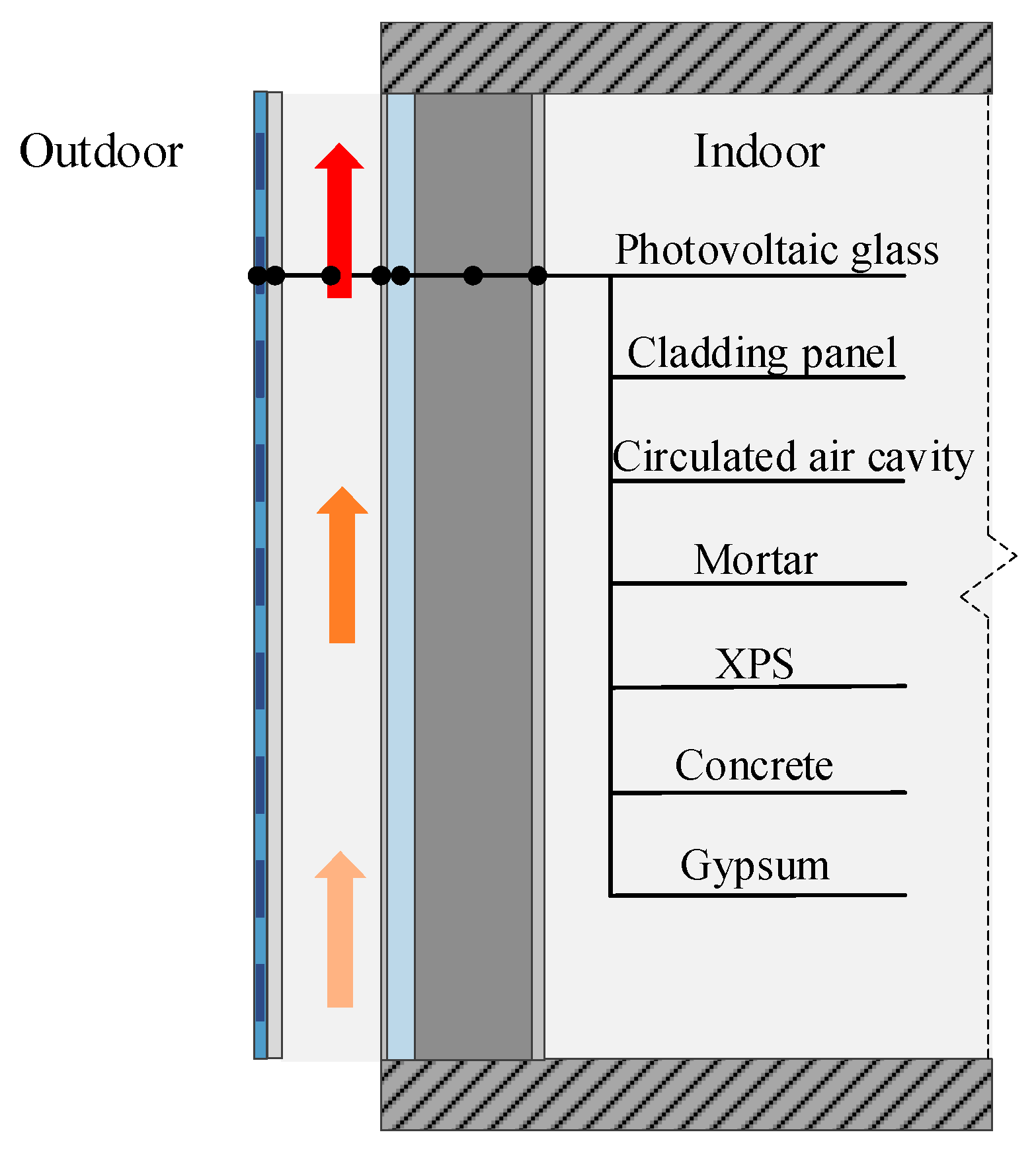
In hot climates, PV-DSFs are frequently implemented on the western elevations of office buildings. As illustrated in Figure 1, the system’s architecture consists of a photovoltaic curtain wall, a circulated air cavity, and an inner wall. The outer cladding panel, serving as a sunshade component, often utilizes materials such as terracotta panels or metal plates, as exemplified by the new building of Nanjing Drum Tower Hospital and the Hangzhou Low-Carbon Technology Museum. Attaching photovoltaic panels to the exterior of the cladding panels is a common approach to forming PV-DSF systems. The photovoltaic curtain wall consisted of photovoltaic glass and an outer cladding panel, while the wall is composed of mortar, XPS, concrete, and gypsum. The PV-DSF had a height of 3 m, a width of 1 m, a thickness of the circulated air cavity of 0.15 m, and a ventilation opening area of 0.15 m2. The solar radiation absorptance of the outer cladding panel exterior surface is 0.9, the longwave radiation emissivity of its interior surface is 0.6, and the longwave radiation emissivity of the wall exterior surface is also 0.6. The power generation efficiency of the CdTe photovoltaic cells at the reference temperature (25 °C) is 14%, with a temperature coefficient of 0.2%·K−1. The transmittance of the glass is 0.8, and the solar radiation absorptance of the photovoltaic glass is 0.05. Table 1 lists the thermal properties of the various materials integrated into the PV-DSFs [21].
Figure 1.
The schematics of PV-DSF (arrows indicate the direction of airflow).
Table 1.
Thermal properties of the various materials in PV-DSFs.
2.2. Mathematical Model
A mathematical model of a PV-DSF was established for simulation purposes. One-dimensional heat transfer was considered, and the finite difference method with the implicit scheme was applied for the outer cladding panel and wall.
2.2.1. Model of Photovoltaic Glass Power Generation
The power generation of photovoltaic glass is calculated as follows [10].
where ε is the photovoltaic cell coverage ratio; qs is the solar radiation on the west-facing vertical surface, W·m−2; ηref is the photovoltaic power generation efficiency at reference temperature; Br is the temperature coefficient of photovoltaic glass; and TPV is the photovoltaic glass panel temperature, K.
2.2.2. Model of Photovoltaic Glass Heat Transfer
The heat balance equation for photovoltaic glass is expressed as follows [22].
where cPV is the specific heat of photovoltaic glass, J·kg−1·K−1; ρPV is the density of photovoltaic glass, kg·m−3; dPV is the thickness of photovoltaic glass, m; Δt is the time step, s; λPV is the thermal diffusivity of photovoltaic glass, W·m−1·K−1; Te,1 is the exterior surface temperature of the outer cladding panel, K; To is the outdoor air temperature, K; α is the absorption rate of photovoltaic glass; τ is the transmittance of photovoltaic glass; hout is the overall heat transfer coefficient of the exterior surface and can be calculated in Appendix A.
2.2.3. Model of Outer Cladding Panel
The heat balance equation for the outer cladding panel is expressed as follows [23].
where Δx is the spatial step, m; hc,ew defines the convective heat transfer coefficient at the interior surface of the external cladding, W·m−2·K−1; and hr,w characterizes the radiative heat transfer coefficient between the wall and the outer cladding panel, and can be calculated in Appendix B.
2.2.4. Model of Air in the Circulated Air Cavity
Following [24], the energy balance for the air inside the circulated cavity can be expressed as:
Considering the vertical temperature variation in air caused by buoyancy effects, the thermal resistance for the heat exchange between the room and the circulated air cavity is given by [25]:
where hc,iw denotes the convective heat transfer coefficient at the exterior surface of the wall, W·m−2·K−1; Tf signifies the air temperature in the circulated air cavity, °C; H is the wall height, m; Ac, Aa, and Av are the areas of the wall, the cavity cross-section, and the air vents, respectively, m2; hc,ew and hc,iw are the convective heat transfer coefficient for the outer cladding panel interior surface and wall exterior surface, respectively, and can be calculated in Appendix C.
2.2.5. Model of Wall
The heat balance equations for the ith (i = 1, 2, …, n) layer of the wall are expressed as follows [26].
where Ti,n is the temperature of the wall’s exterior surface, in °C; Tin is the indoor thermal design temperature for air-conditioned spaces, i.e., 26 °C [21]; hin is the exterior surface’s overall heat transfer coefficient, i.e., 8.7 W·m−2·K−1.
2.3. Spatial and Time Step Test and Model Validation
2.3.1. Spatial and Time Step Test
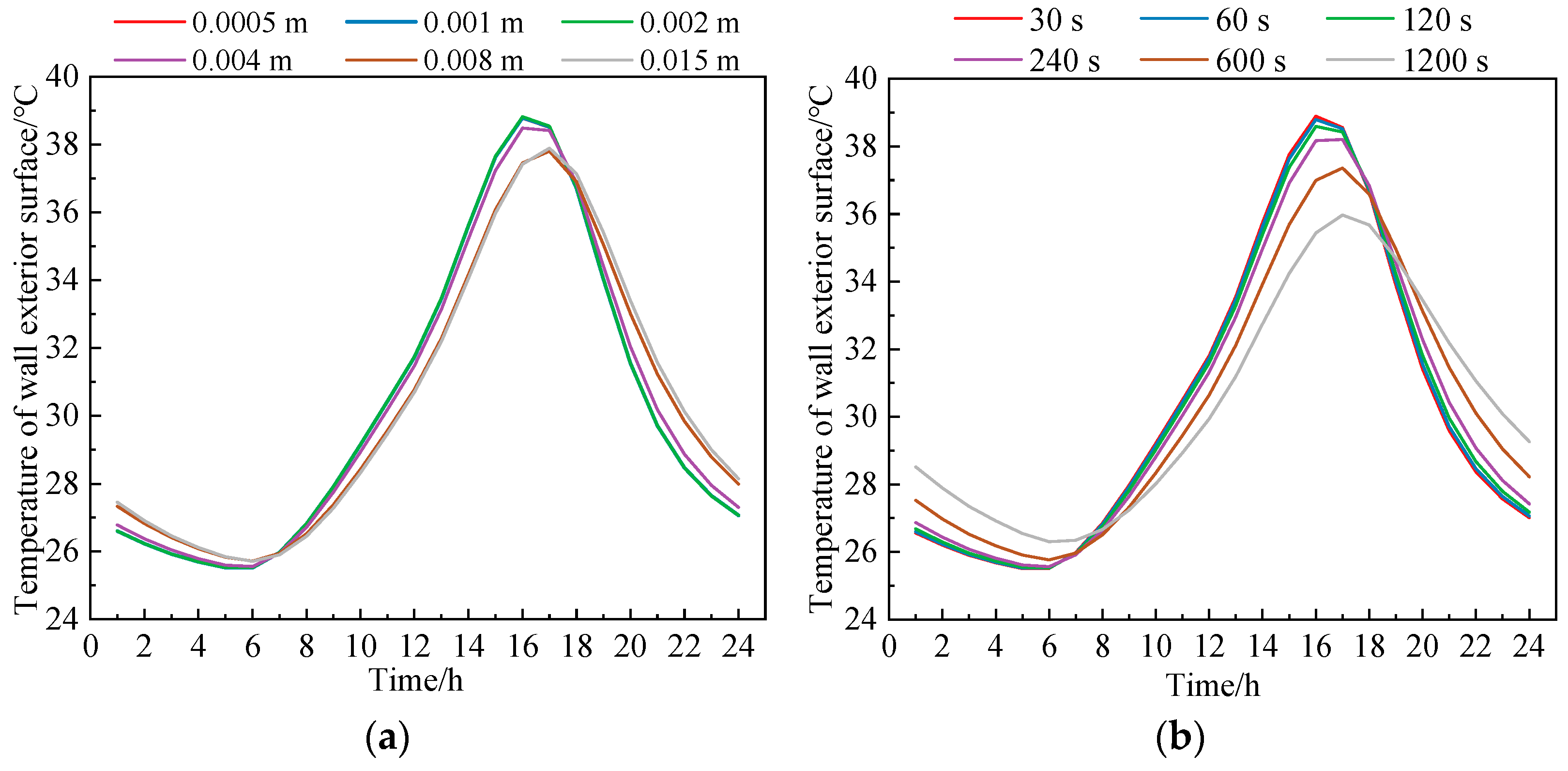
To ensure computational accuracy, a sensitivity analysis was performed on both spatial and time steps. The temperature of the wall’s exterior surface was the focus, so it was selected for analysis. 0.0005 m, 0.001 m, 0.002 m, 0.004 m, 0.01 m, and 0.015 m were used for comparison, as shown in Figure 2a. It was observed that the results were close when the spatial step was maintained below 0.008 m. Because of the short calculation time, the spatial step of 0.001 m was also reasonable. As well, 30 s, 60 s, 120 s, 240 s, 600 s, and 1200 s were chosen for analysis, as shown in Figure 2b. When the time step was more than 240 s, the results were inaccurate. And the results for other time steps were close. Consequently, a time step of 60 s was selected to ensure both precision and stability.
Figure 2.
(a) Grid step test; (b) Time step test.
2.3.2. Model Validation
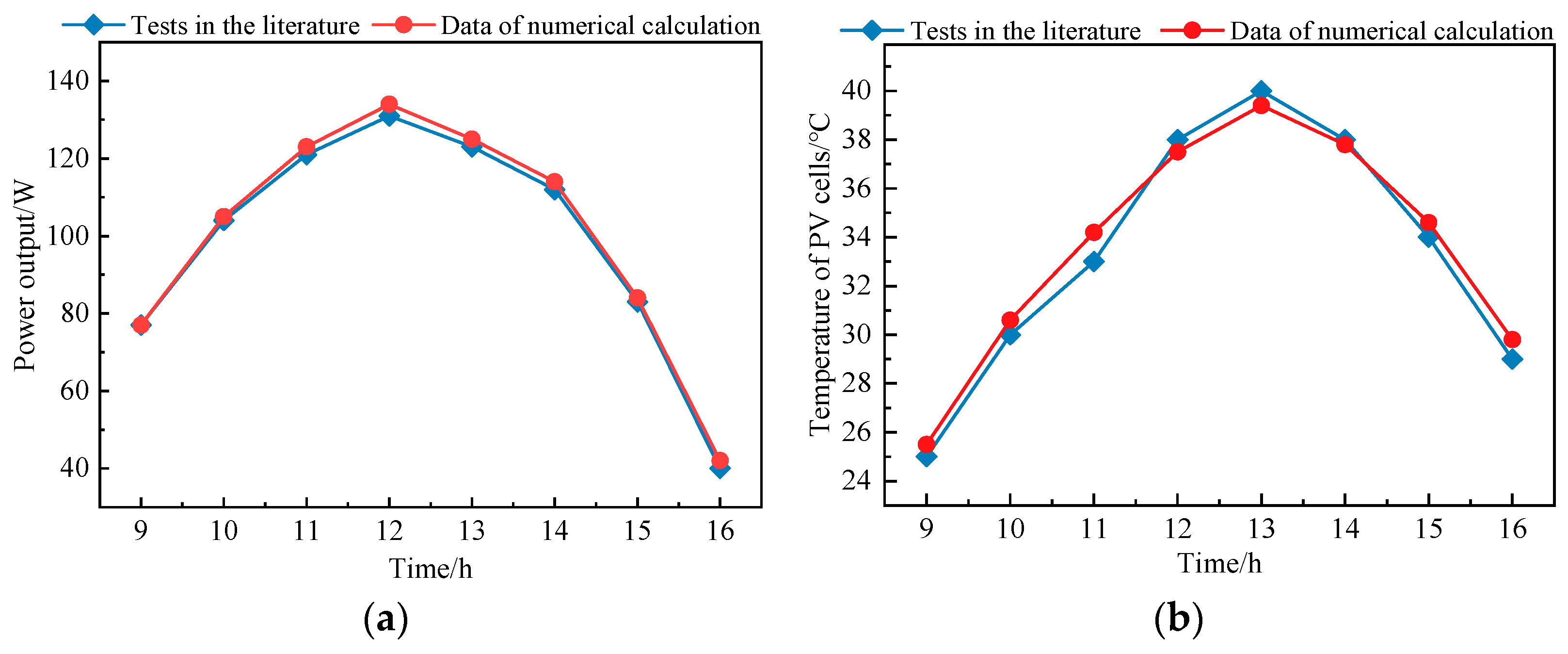
The mathematical model was verified based on experimental data reported in a previous study [14], maintaining identical parameter configurations between the numerical simulations and experimental tests. The performance metrics, specifically the power output and PV cell temperature, are shown in Figure 3 for comparative purposes. The differences between the test data and numerical results were small for the power output, where mean absolute error (MAE) was 1.63 W and root mean square error (RMSE) was 1.84 W. The simulated values obtained for the temperature of PV cells were in good agreement with the experimental results. The RMSE and MAE were determined as 0.68 °C and 0.63 °C. The discrepancies in temperature are primarily attributed to the simplified approximation of the exterior surface’s heat transfer coefficient. Overall, the validation results confirm the reliability of the proposed model for simulating the thermal performance of PV-DSFs.
Figure 3.
Comparison of calculations and test results: (a) power output and (b) temperature of PV cells.
3. Results and Discussion
3.1. Thermoelectric Performance of PV-DSFs
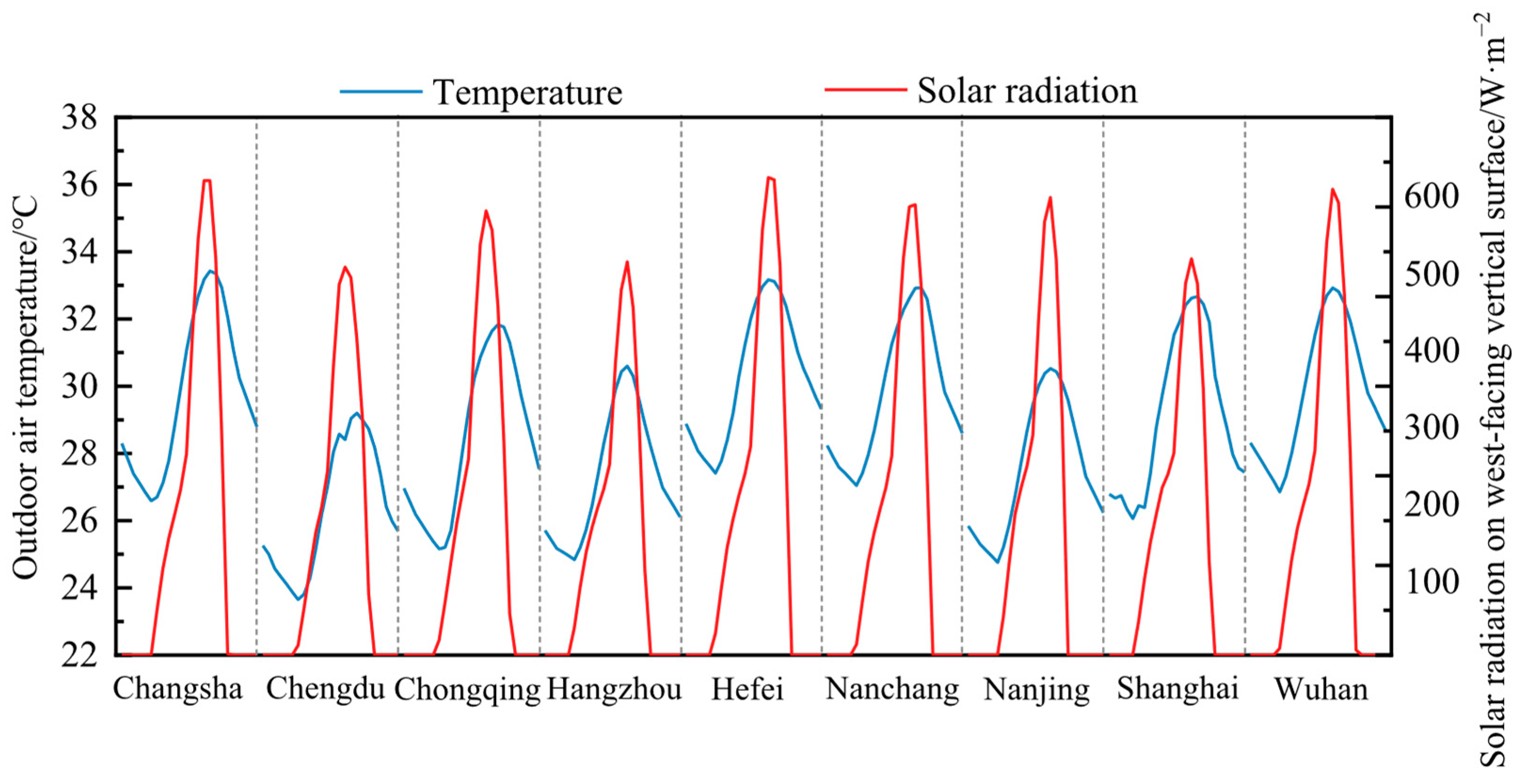
Nine typical representative cities in the hot summer and cold winter zone were selected. Based on the hourly meteorological data for July from the Typical Meteorological Year (TMY) specified in standard [27], a typical day was derived. First, based on the hourly global horizontal irradiance, direct normal irradiance, and diffuse horizontal irradiance in July, the hourly solar radiation on the west-facing vertical surface for 31 days was calculated and obtained. The hourly outdoor air temperature and the solar radiation on the west-facing vertical surface for the 24 h of the typical day were obtained through arithmetic averaging of the values at each corresponding time point across 31 days. The arithmetic averaging method can extract typical climatic characteristics for July. The outdoor air temperature and solar radiation on the west-facing vertical surface for the typical day in the representative cities are shown in Figure 4. Chengdu and Hangzhou exhibited relatively low outdoor air temperatures and west-facing vertical surface solar radiation, with average values of 26.33 °C and 122.23 W·m−2, and 27.29 °C and 118.43 W·m−2, respectively. In contrast, Changsha, Hefei, Nanchang, and Wuhan showed relatively high values, with corresponding averages of 29.76 °C and 142.28 W·m−2, 30.28 °C and 147.52 W·m−2, 29.79 °C and 137.46 W·m−2, and 29.81 °C and 140.61 W·m−2.
Figure 4.
Outdoor air temperature and solar radiation on the west-facing vertical surface for the typical day in representative cities.
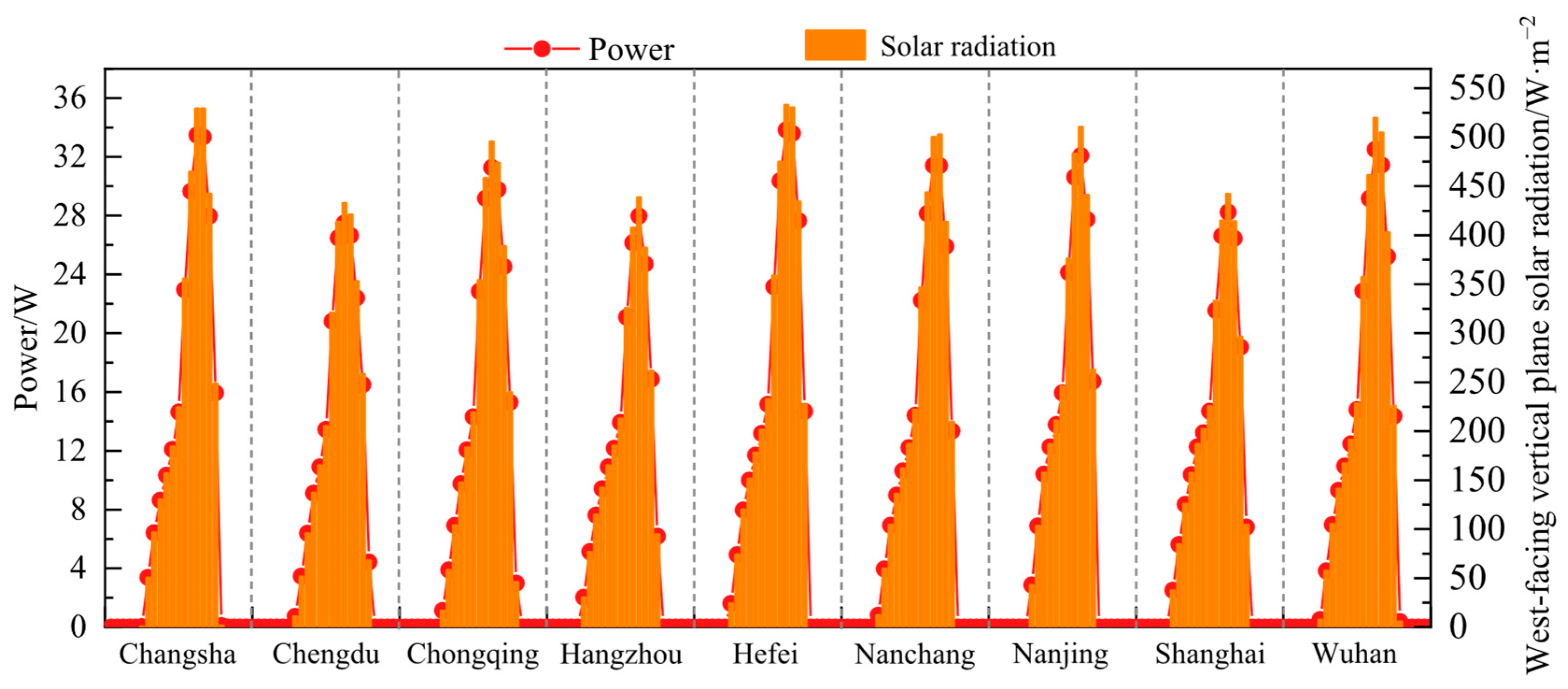
The power generation of the PV-DSF and the solar radiation on the west-facing vertical surface are shown in Figure 5. The variation trend of PV power generation was largely consistent with that of the west-facing vertical solar radiation, indicating a positive correlation—the former increases as the latter increases. However, they do not exhibit a strictly proportional relationship. This is primarily because PV power generation is also slightly influenced by the temperature of the photovoltaic glass, which varies at different times depending on the incident solar radiation. The solar radiation on the west-facing vertical surface increases slowly in the morning, followed by a sharp rise and subsequent fall after noon. This pattern is primarily due to the fact that diffuse radiation is the main contributor in the morning, while direct radiation becomes accessible in the afternoon, after which solar radiation diminishes toward sunset. The solar radiation on the west-facing vertical surface peaked around 15:00, and the peak power generation in each representative city was 33.48 W (Changsha), 27.48 W (Chengdu), 31.27 W (Chongqing), 27.98 W (Hangzhou), 33.84 W (Hefei), 31.41 W (Nanchang), 32.08 W (Nanjing), 28.23 W (Shanghai), and 32.51 W (Wuhan).
Figure 5.
Power generation of the PV-DSFs and west-facing vertical plane solar radiation.
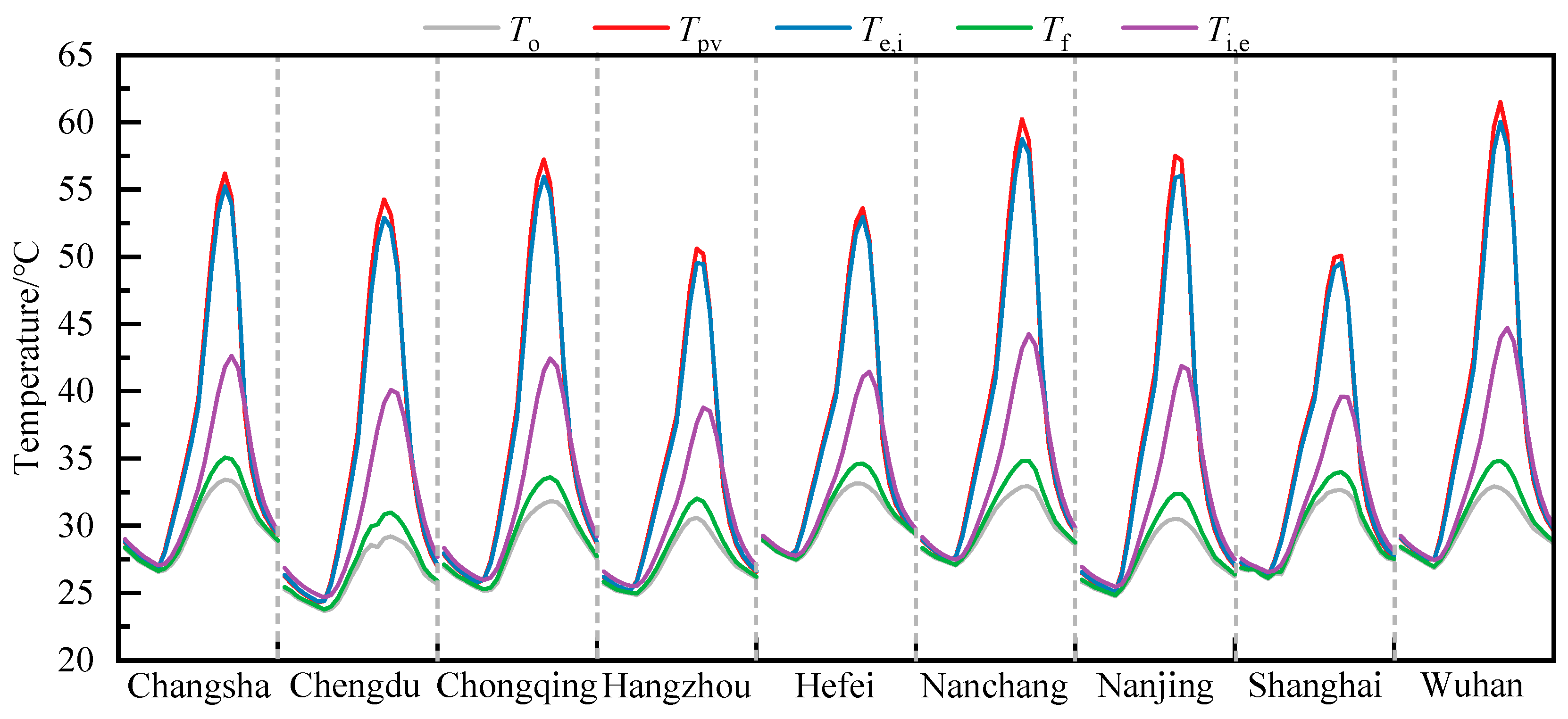
The temperatures of various components of the PV-DSF are shown in Figure 6. Their variation trends were largely consistent with that of the outdoor air temperature, while the temperature of the exterior wall surface exhibited a delay of approximately 1~2 h. The temperature of the photovoltaic glass was comparable to that of the interior surface of the outer cladding panel. During the daytime, both were substantially higher than the outdoor air temperature, with their peaks reaching 17.40–28.59 °C and 16.86–27.08 °C above it, respectively. This phenomenon was attributed primarily to the significant influence of solar radiation on the west-facing vertical surface. The temperature of the interior surface of the outer cladding panel was higher than that of the wall exterior surface during the daytime, while the opposite was true at night. This pattern indicates that the exterior wall surface gains heat through longwave radiation exchange during the day and loses heat at night. The peak temperature of the interior surface of the outer cladding panel exceeded that of the wall exterior surface by 9.93 °C to 15.28 °C, demonstrating that the photovoltaic glass and the outer cladding panel collectively provide effective shielding against solar radiation. The air temperature in the circulated cavity was relatively close to the outdoor air temperature, although it remained below the wall exterior surface temperature throughout the day, indicating convective heat dissipation from the wall surface at all times.
Figure 6.
Component temperatures of the PV-DSF.
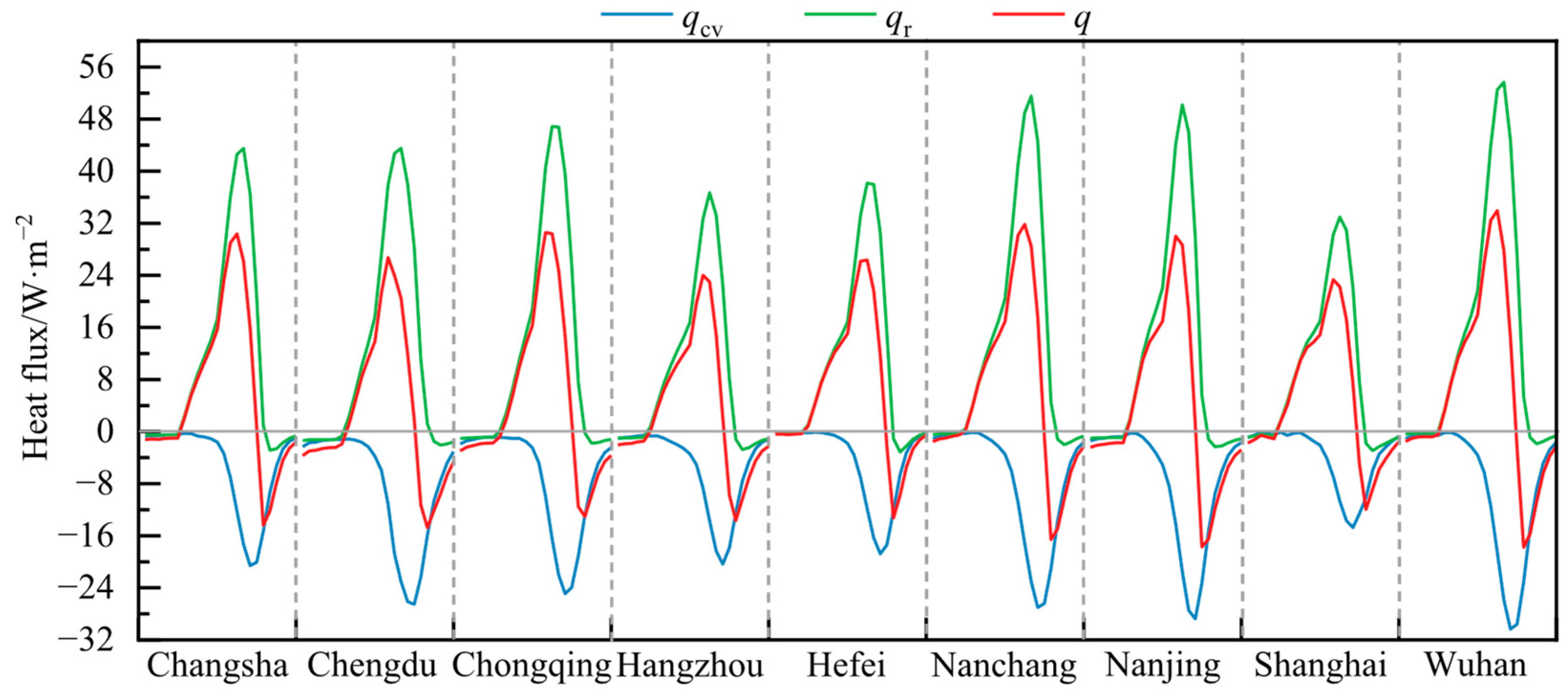
The heat fluxes of the wall exterior surface for the PV-DSF are shown in Figure 7. The radiative heat flux was positive during the day and negative at night, meaning that the wall exterior surface gained heat in the daytime and lost heat at night through longwave radiation. The convective heat flux remained negative throughout the day, resulting in continuous heat loss from the wall exterior surface at all times. As the radiative heat flux played a dominant role, the overall heat flux exhibited a variation pattern that closely aligned with that of the radiative heat flux. It was worth noting that the peak time of radiative heat flux lagged behind that of convective heat flux by 1–2 h, while the peak time of total heat flux lagged behind that of radiative heat flux by approximately 1 h. The convective, radiative, and total heat fluxes at the wall exterior surface over the full day ranged from −196.76 W to −94.62 W, 204.69 W to 329.48 W, and 67.27 W to 139.29 W, respectively.
Figure 7.
Heat fluxes of wall’s exterior surface for the PV-DSF.
3.2. Effects of Design Parameters
Based on the climates of the representative cities, two cities with substantial climatic differences were selected for analysis. Hangzhou is characterized by relatively low outdoor air temperature and west-facing vertical solar radiation, whereas Wuhan exhibits comparably high values for both. Hence, Hangzhou and Wuhan were chosen. For the analysis of the influence of design parameters on the thermoelectric performance of the PV-DSF, all other parameters were held constant.
3.2.1. Effects of the Photovoltaic Cell Coverage Ratio
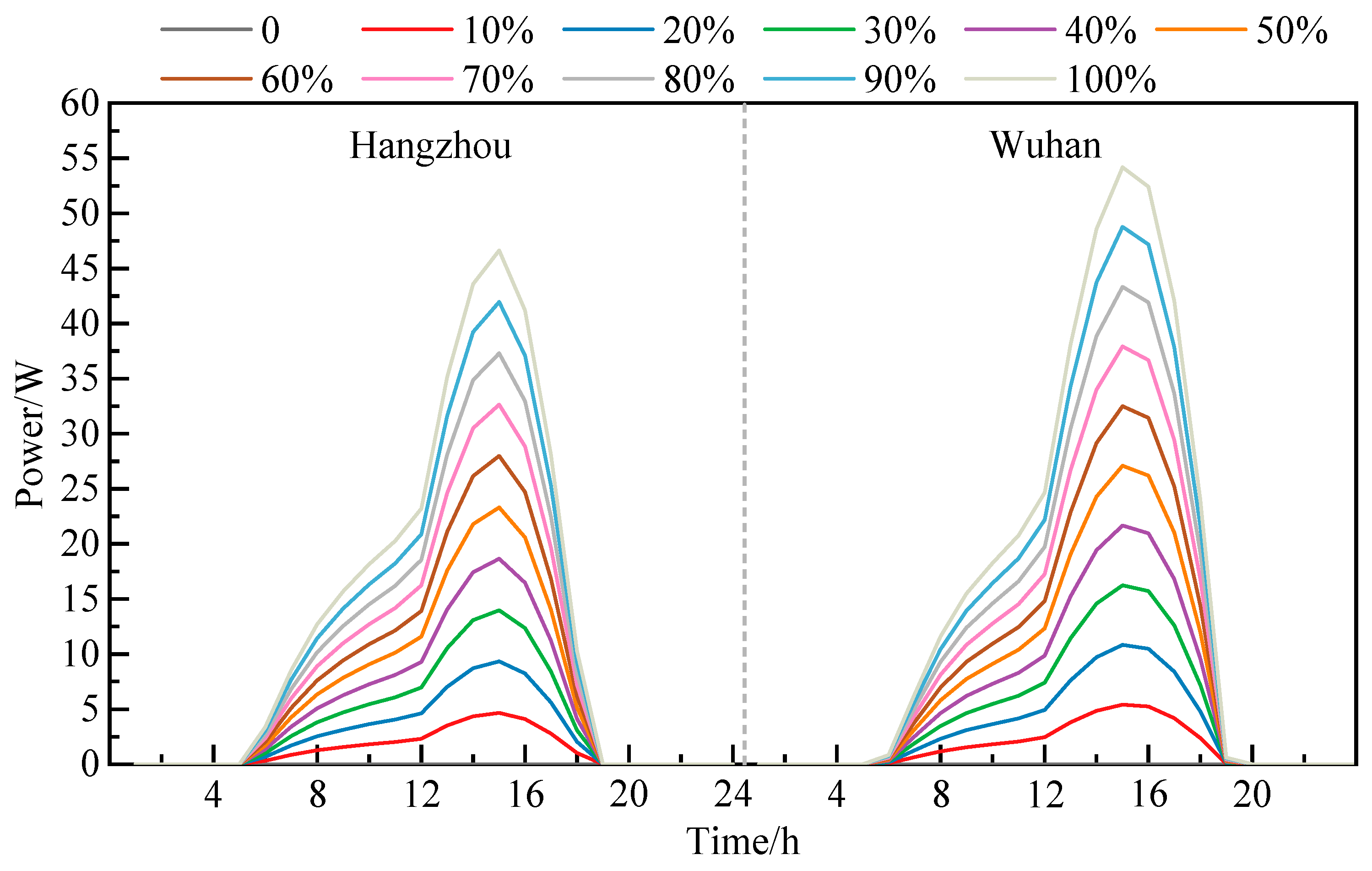
The effects of the photovoltaic cell coverage ratio on the power generation of the PV-DSF are depicted in Figure 8. The instantaneous PV power output throughout the day varied with solar irradiance, exhibiting a positive correlation. The power generation of the photovoltaic system increased approximately proportionally with a higher photovoltaic cell coverage ratio. When the coverage ratio reaches 100%, the daily total power generation in Hangzhou and Wuhan increases to 306.94 W and 357.92 W, respectively. Therefore, increasing the photovoltaic cell coverage ratio is an effective measure to enhance power generation.
Figure 8.
Effects of the photovoltaic cell coverage ratio on power output.
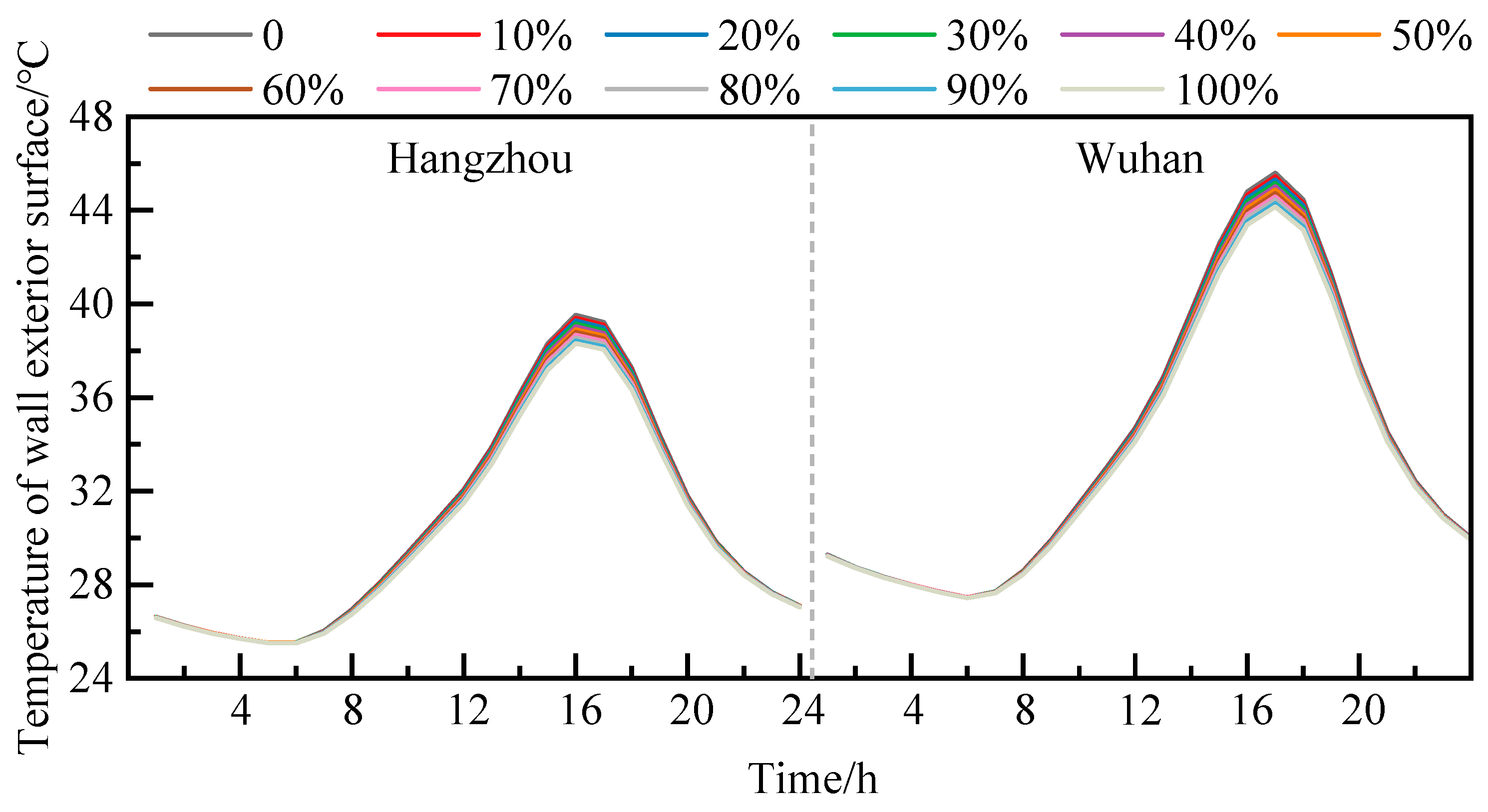
The effects of the photovoltaic cell coverage ratio on the wall exterior surface temperature are shown in Figure 9. The influence of photovoltaic cell coverage on the wall exterior surface temperature was relatively minor. As the photovoltaic cell coverage increased, the maximum temperature of the wall’s exterior surface decreased slightly. This was primarily because the PV cells blocked a portion of solar radiation, thereby reducing the amount of solar radiation incident on the outer cladding panel. Consequently, the peak temperature of the outer cladding panel interior surface was slightly lowered, leading to a slight reduction in the amount of heat transferred to the wall exterior surface via longwave radiation. As the photovoltaic cell coverage ratio increased from 0% to 100%, the maximum wall’s exterior surface temperature dropped from 39.52 °C to 38.30 °C in Hangzhou and from 45.59 °C to 44.15 °C in Wuhan. The photovoltaic cell coverage has a minor impact on the peak temperature of the wall exterior surface, and its effect on the wall exterior surface temperature throughout the day can be negligible.
Figure 9.
Effects of the photovoltaic cell coverage ratio on the temperature of wall’s exterior surface.
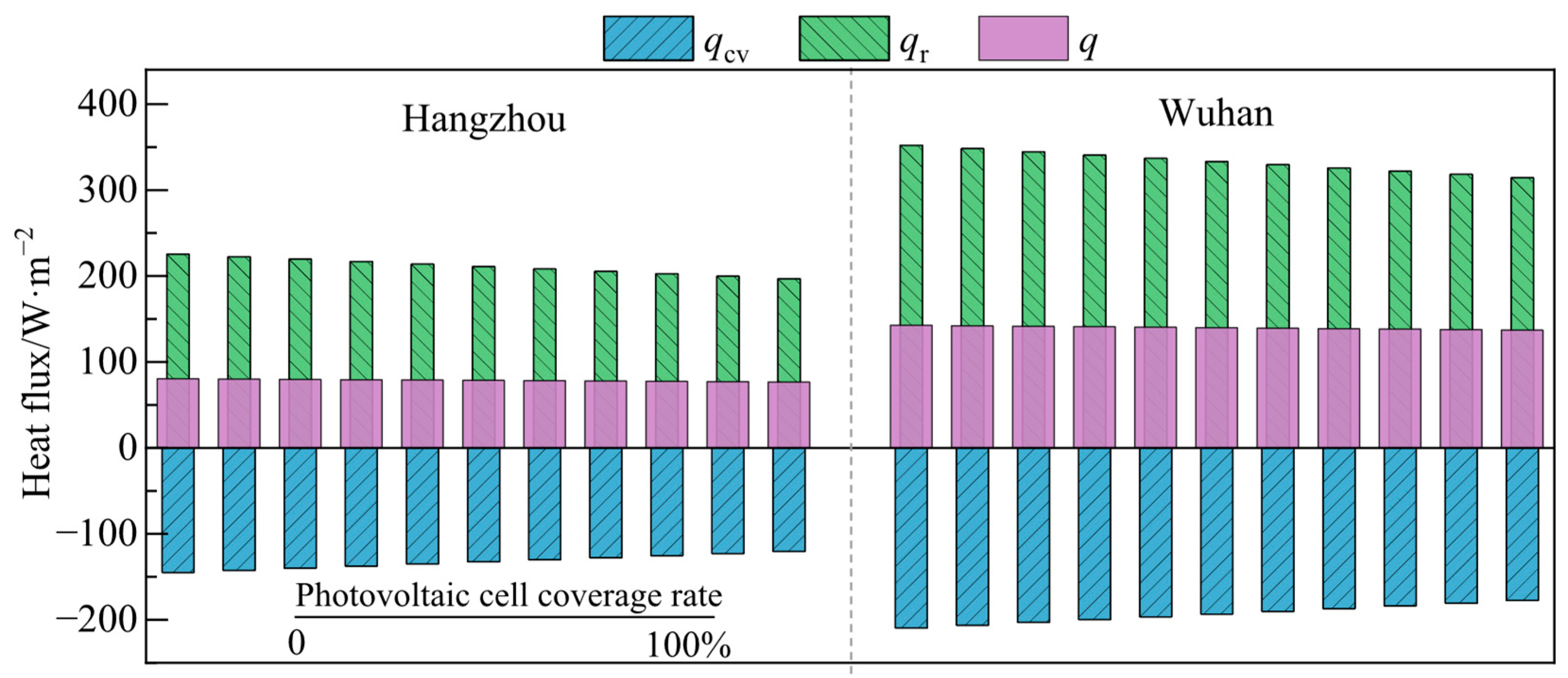
The effects of the photovoltaic cell coverage ratio on the heat flux of the wall’s exterior surface are shown in Figure 10. A negative heat flux indicates heat loss, whereas a positive value signifies heat gain. The wall’s exterior surface lost heat via convective exchange with the air in the cavity while simultaneously gaining heat through longwave radiation. The radiative heat flux was dominant, accounting for the net positive heat flux. As the PV coverage increases, both the convective and radiative heat fluxes decrease. However, since they act in opposite thermal directions, this results in a slight decrease in the net total heat flux. As the photovoltaic cell coverage ratio increased from 0% to 100%, the convective, radiative, and total heat fluxes in Hangzhou decreased from 144.99 to 120.45 W·m−2, 225.39 to 196.95 W·m−2, and 80.40 to 76.50 W·m−2, respectively. In Wuhan, the corresponding decreases were from 209.56 to 177.46 W·m−2, 352.18 to 314.55 W·m−2, and 142.62 to 137.09 W·m−2. This pattern indicates that increasing the photovoltaic cell coverage can reduce both the radiative and convective heat fluxes at the wall exterior surface, yet it has only a limited effect on reducing the total heat flux.
Figure 10.
Effects of the photovoltaic cell coverage ratio on the heat flux of wall’s exterior surface.
In summary, increasing photovoltaic cell coverage can significantly enhance power generation, yet it has a negligible impact on the wall exterior surface temperature and only a minor effect on improving thermal insulation performance. Compared with literature [14], this study obtains the variation characteristics of different types of heat flux, specifically revealing the influence mechanism of photovoltaic cell coverage rates on thermal performance. This finding holds certain guiding significance for the PV design of PV-DSFs.
3.2.2. Effects of the Outer Cladding Panel Thickness
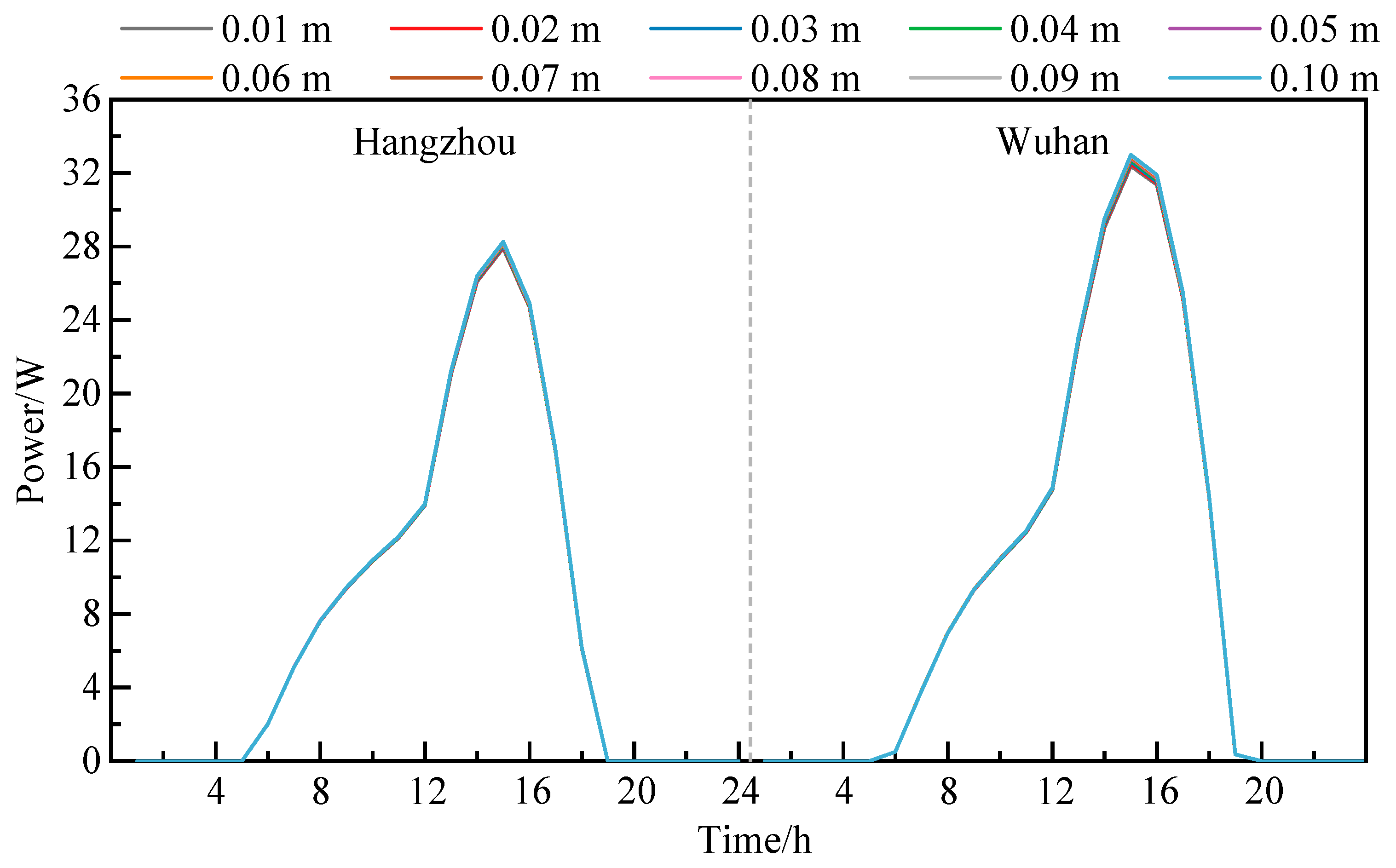
The effects of the outer cladding panel thickness on the power generation of the PV-DSF are shown in Figure 11. Its effect on PV power output was largely negligible, primarily because altering the panel thickness changed the heat transfer to the photovoltaic glass, which in turn affected the glass temperature. However, given that the resultant temperature variation in the PV glass was minimal and the influence of temperature on PV efficiency was limited, the overall impact on power generation remained insignificant. As the thickness of the outer cladding panel increased from 0.01 m to 0.10 m, the peak photovoltaic power generation in Hangzhou rose from 27.92 W to 28.26 W, and in Wuhan from 32.38 W to 32.99 W. Hence, the effect of the outer cladding panel thickness on PV power output is considered negligible.
Figure 11.
Effects of the outer cladding panel thickness on power output.
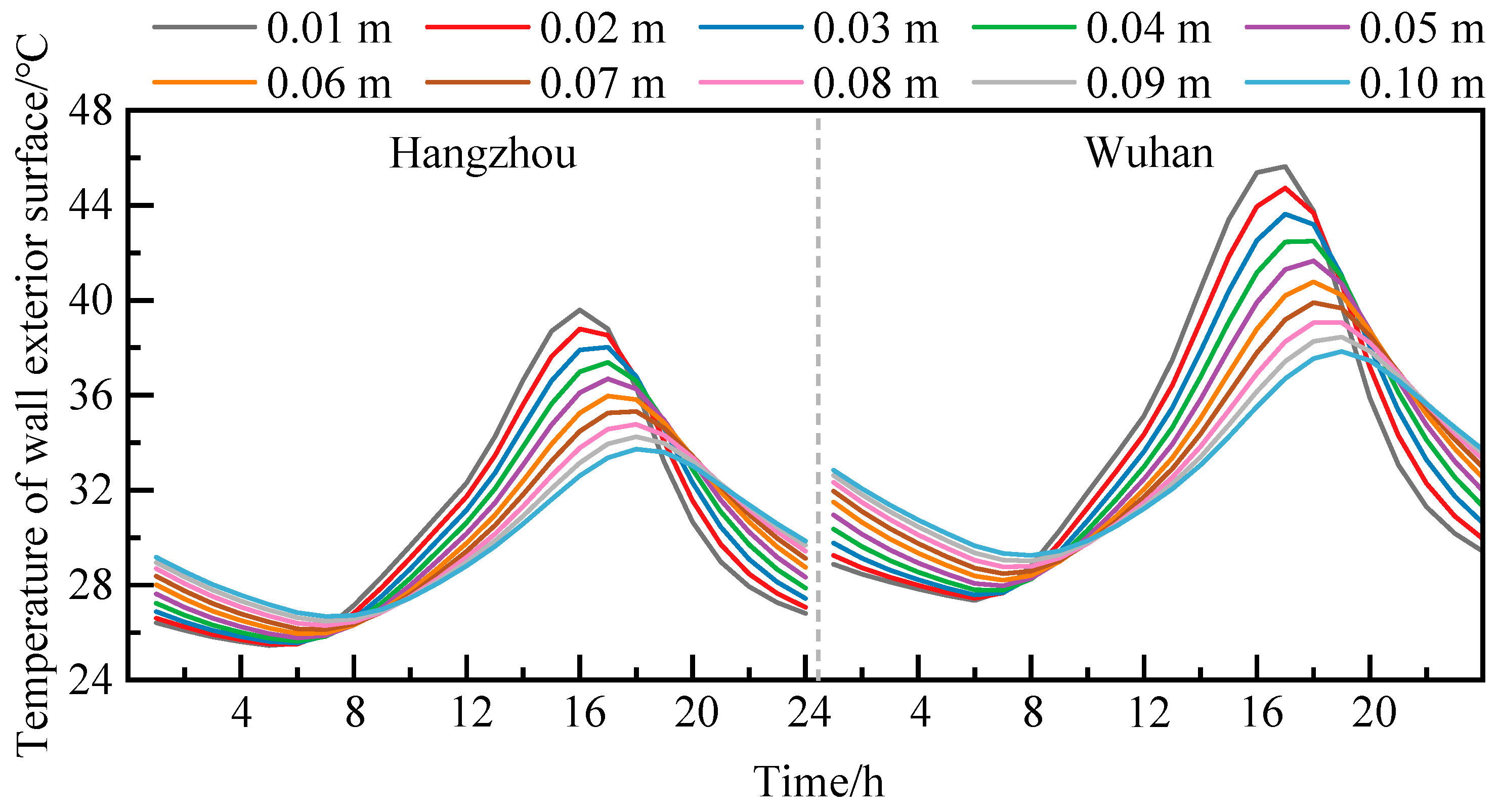
The effects of the outer cladding panel thickness on the wall exterior surface temperature are shown in Figure 12. An increase in panel thickness introduced a noticeable attenuation delay in the exterior surface temperature. This is primarily owing to the enhanced thermal inertia of the panel, which delays the temperature attenuation at its interior surface. This delayed thermal signal is then transferred to the exterior surface via longwave radiation exchange, resulting in a corresponding delay in its temperature response. As the thickness of the outer cladding panel increased from 0.01 m to 0.10 m, the exterior wall surface temperature in Hangzhou exhibited a 5.87 °C reduction in the peak, a 1.22 °C increase in the trough, and a 2-h delay in the peak time. In Wuhan, the corresponding changes were a 7.80 °C reduction in the peak, a 1.90 °C increase in the trough, and a 2-h peak delay. Therefore, increasing the thickness of the outer cladding panel can reduce the peak temperature of the wall exterior surface, delay the occurrence of the peak, and attenuate temperature fluctuations on the wall exterior surface.
Figure 12.
Effects of the outer cladding panel thickness on the temperature of wall’s exterior surface.
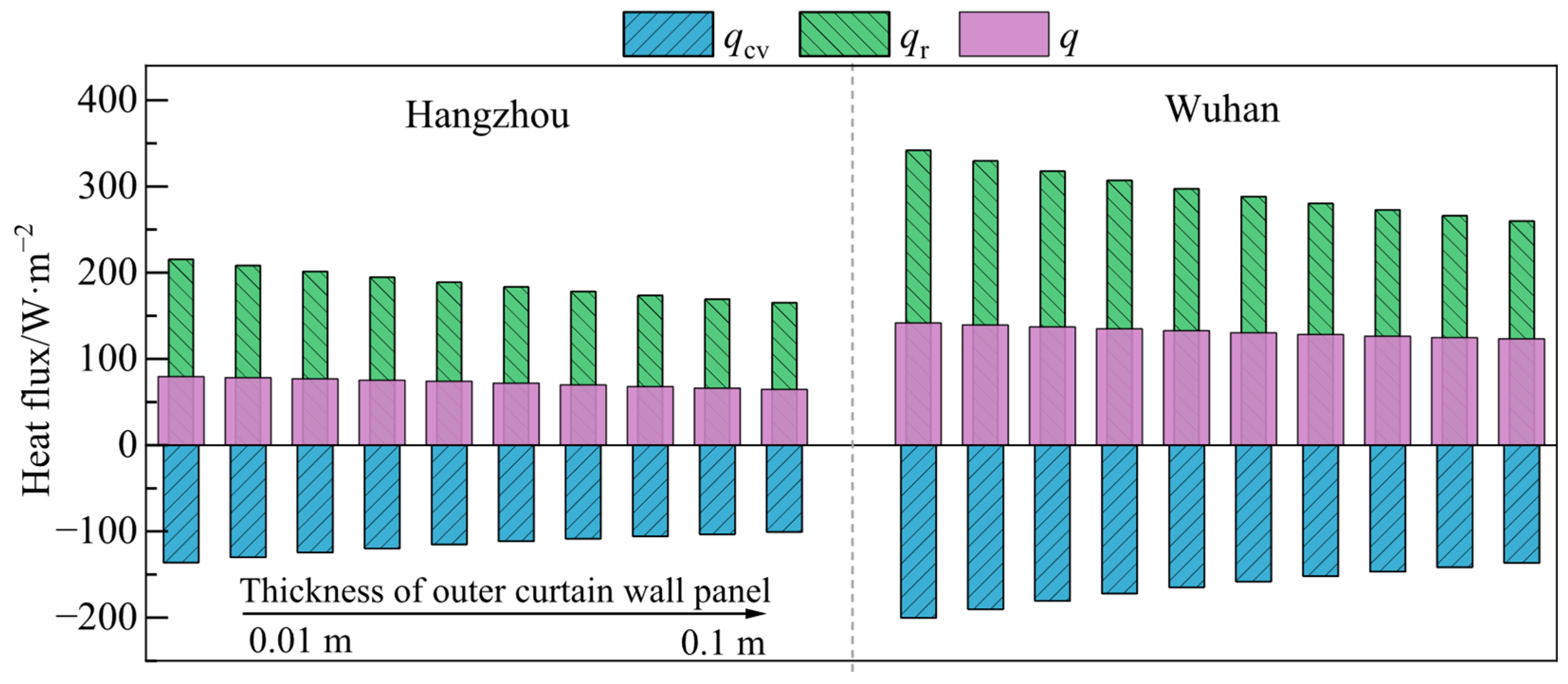
The effects of the outer cladding panel thickness on the heat flux of the wall exterior surface are shown in Figure 13. As the panel thickness increased, both the convective and radiative heat fluxes of the exterior surface decreased, with the total heat flux also decreasing owing to the more pronounced reduction in radiative heat flux. This occurs primarily because the thickness alteration changes the temperature of the panel interior surface, which exerts a strong thermal influence on the exterior surface via longwave radiation. In contrast, the indirect convective pathway—where the thickness affects the cavity air temperature, which then influences the exterior surface convection—is comparatively weaker. Increases in the outer cladding panel thickness from 0.01 m to 0.10 m resulted in reductions of 35.50, 50.23, and 14.74 W·m−2 in the convective, radiative, and total heat fluxes of the wall exterior surface in Hangzhou, respectively. Corresponding reductions in Wuhan were 63.40, 82.00, and 18.60 W·m−2. These demonstrate that increasing the thickness of the outer cladding panel can reduce both convective and radiative heat fluxes at the wall exterior surface, decrease the total heat flux, and enhance thermal insulation performance.
Figure 13.
Effects of the outer cladding panel thickness on the heat fluxes of wall’s exterior surface.
In summary, enhancing the heat storage of the outer cladding panel can attenuate and delay the maximum temperature of the wall’s exterior surface, reduce temperature fluctuations on the wall’s exterior surface, and decrease heat gain at the wall’s outer surface. However, its impact on photovoltaic power generation is negligible. Compared with literature [20], which focused on the overall temperature impact, this study provides a more detailed understanding of the influence of thermal storage on peak temperature and temperature fluctuations, offering valuable guidance for the thermal storage design of PV-DSFs’ outer cladding panels.
3.2.3. Effects of the Solar Absorptivity of the Outer Cladding Panel Exterior Surface
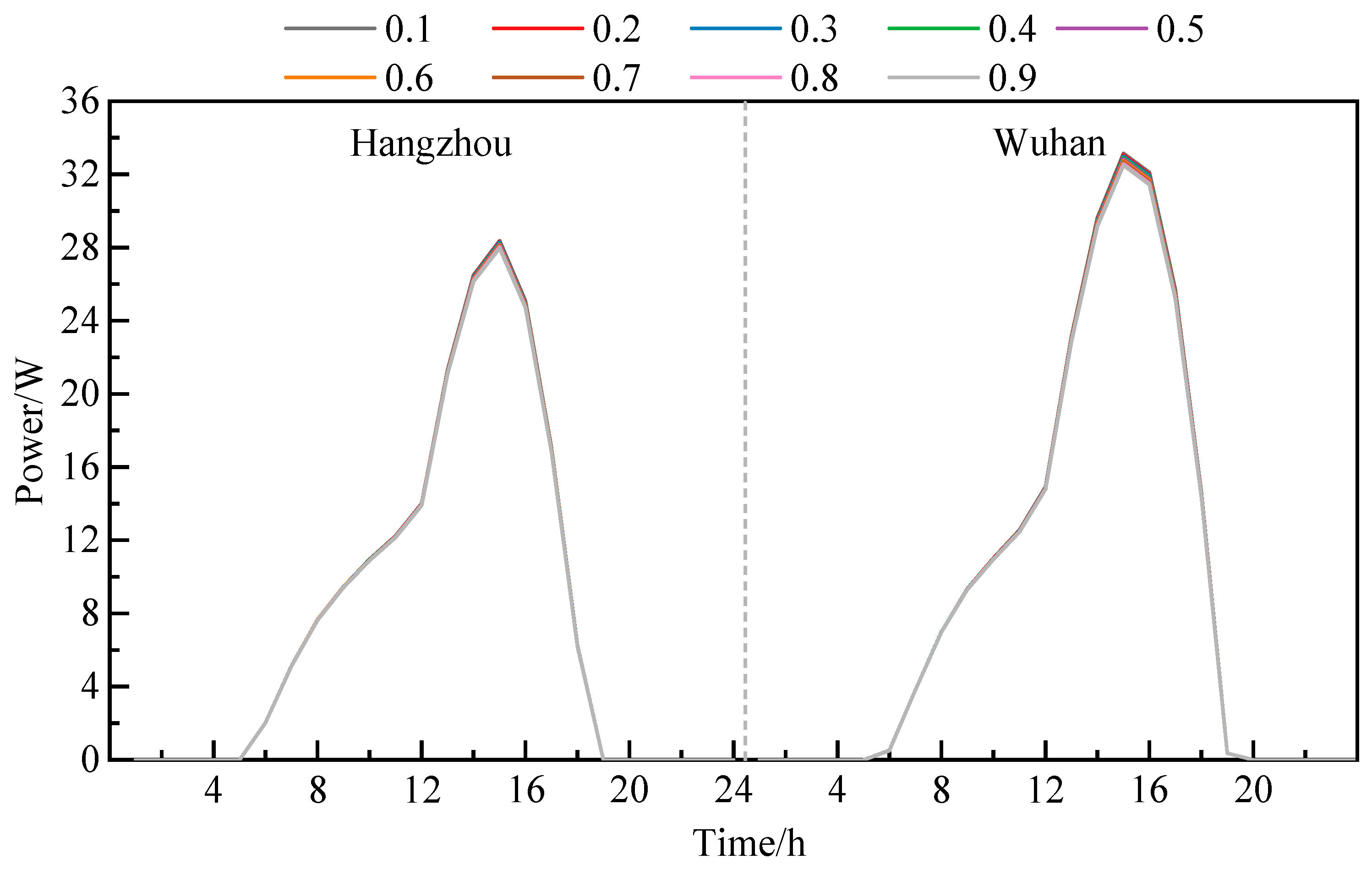
The effects of the solar absorptivity of the outer cladding panel exterior surface on the power generation of the PV-DSF are shown in Figure 14. Its impact on PV power output is negligible. This is primarily because altering the absorptivity changes the amount of solar heat absorbed by the panel, varying its temperature, which in turn changes the heat transfer to the photovoltaic glass, leading to a variation in the glass temperature. However, since the resultant temperature change in the PV glass is minimal and the influence of temperature on PV efficiency is limited, the overall effect on power generation remains insignificant. A decrease in the solar absorptivity of the outer cladding panel exterior surface from 0.9 to 0.1 resulted in an increase in peak photovoltaic power generation from 27.98 W to 28.38 W in Hangzhou and from 32.51 W to 33.14 W in Wuhan. The influence of the absorptivity on PV power output can therefore be considered negligible.
Figure 14.
Effects of the solar absorptivity of the outer cladding panel exterior surface on power output.
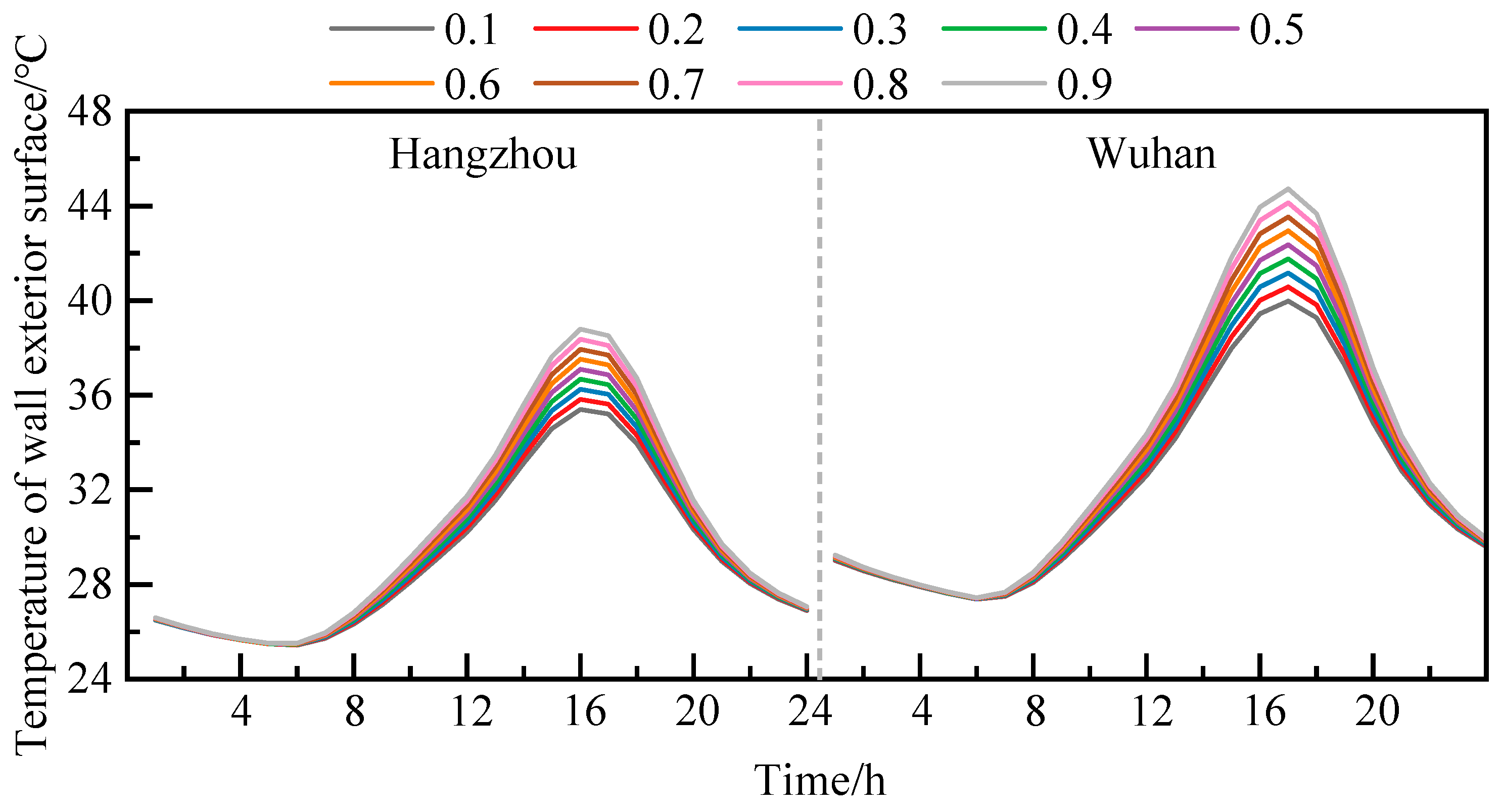
The effects of the solar absorptivity of the outer cladding panel exterior surface on the wall exterior surface temperature are shown in Figure 15. A reduction in absorptivity leads to a decrease in the exterior surface temperature. This is primarily because less solar heat is absorbed by the panel, which in turn lowers the temperature of its interior surface. Consequently, the radiative and convective heat transfer on the wall exterior surface is reduced. A reduction in the solar absorptivity of the outer cladding panel exterior surface from 0.9 to 0.1 led to decreases in the peak exterior surface temperature from 38.79 °C to 35.40 °C in Hangzhou and from 44.73 °C to 39.98 °C in Wuhan. The exterior surface temperature exhibits a fairly uniform response to changes in the absorptivity. Therefore, lowering the solar absorptivity can effectively reduce the peak temperature of the wall’s exterior surface.
Figure 15.
Effects of the solar absorptivity of the outer cladding panel exterior surface on the temperature of wall’s exterior surface.
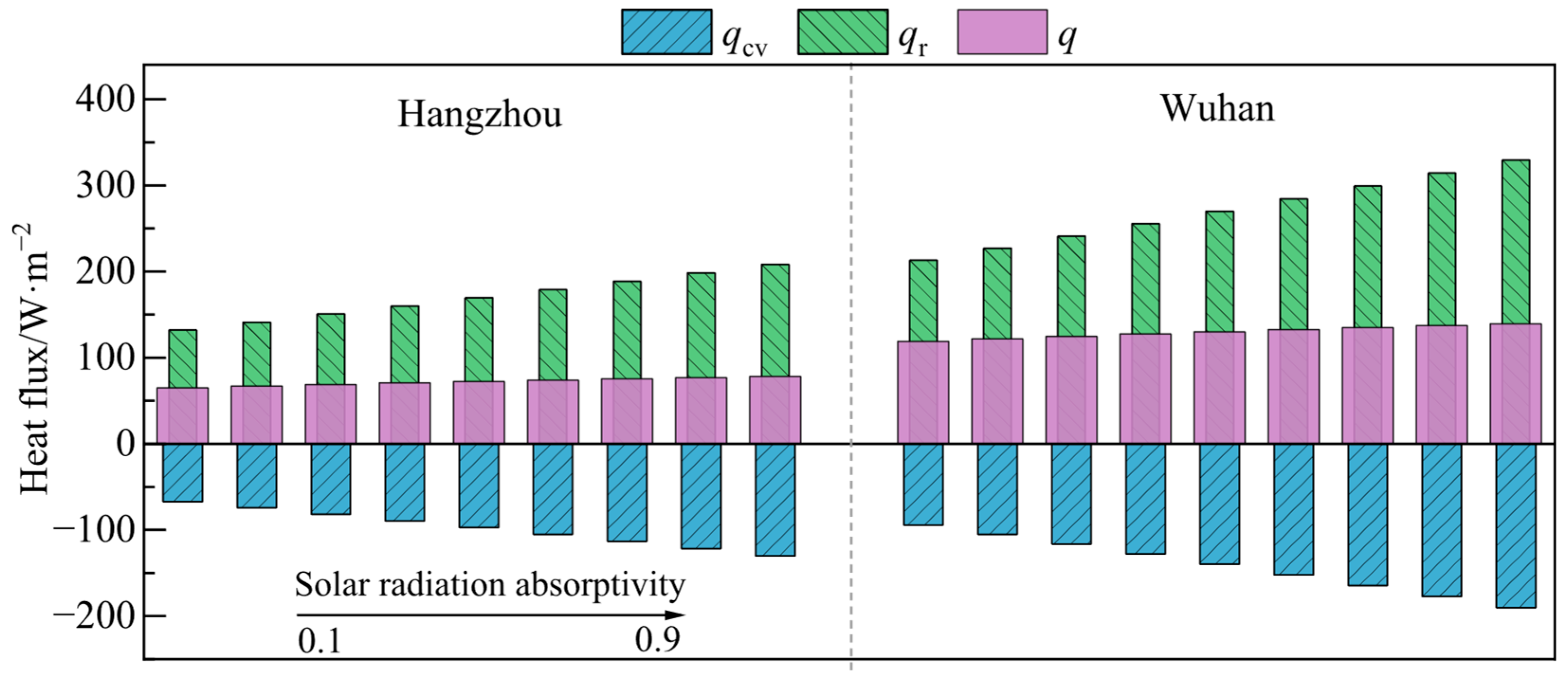
The effects of the solar absorptivity of the outer cladding panel exterior surface on the heat flux of the wall exterior surface are shown in Figure 16. As the absorptivity decreases, both the convective and radiative heat fluxes of the exterior surface decrease, leading to a reduction in the total heat flux. This is primarily because a lower absorptivity reduces the solar heat absorbed by the panel, consequently lowering the temperature of its interior surface. Reducing the solar absorptivity of the outer cladding panel exterior surface from 0.9 to 0.1 resulted in reductions of 62.99, 76.25, and 13.25 W·m−2 in the convective, radiative, and total heat fluxes in Hangzhou, respectively. Corresponding reductions in Wuhan were 95.97, 116.44, and 20.46 W·m−2. This demonstrates that reducing the solar absorptivity of the outer cladding panel exterior surface can decrease both convective and radiative heat fluxes at the wall exterior surface, lower the total heat flux, and enhance thermal insulation performance.
Figure 16.
Effects of the solar absorptivity of the outer cladding panel exterior surface on the heat fluxes of wall exterior surface.
Compared with the influence of outer cladding panel surface color [28], this study reveals the impact patterns of different solar absorptivity levels. In summary, reducing the solar absorptivity of the outer cladding panel exterior surface can lower the peak temperature of the wall exterior surface and decrease its heat gain, while its impact on photovoltaic power generation is negligible.
3.2.4. Effects of the Emissivity of the Outer Cladding Panel Interior Surface
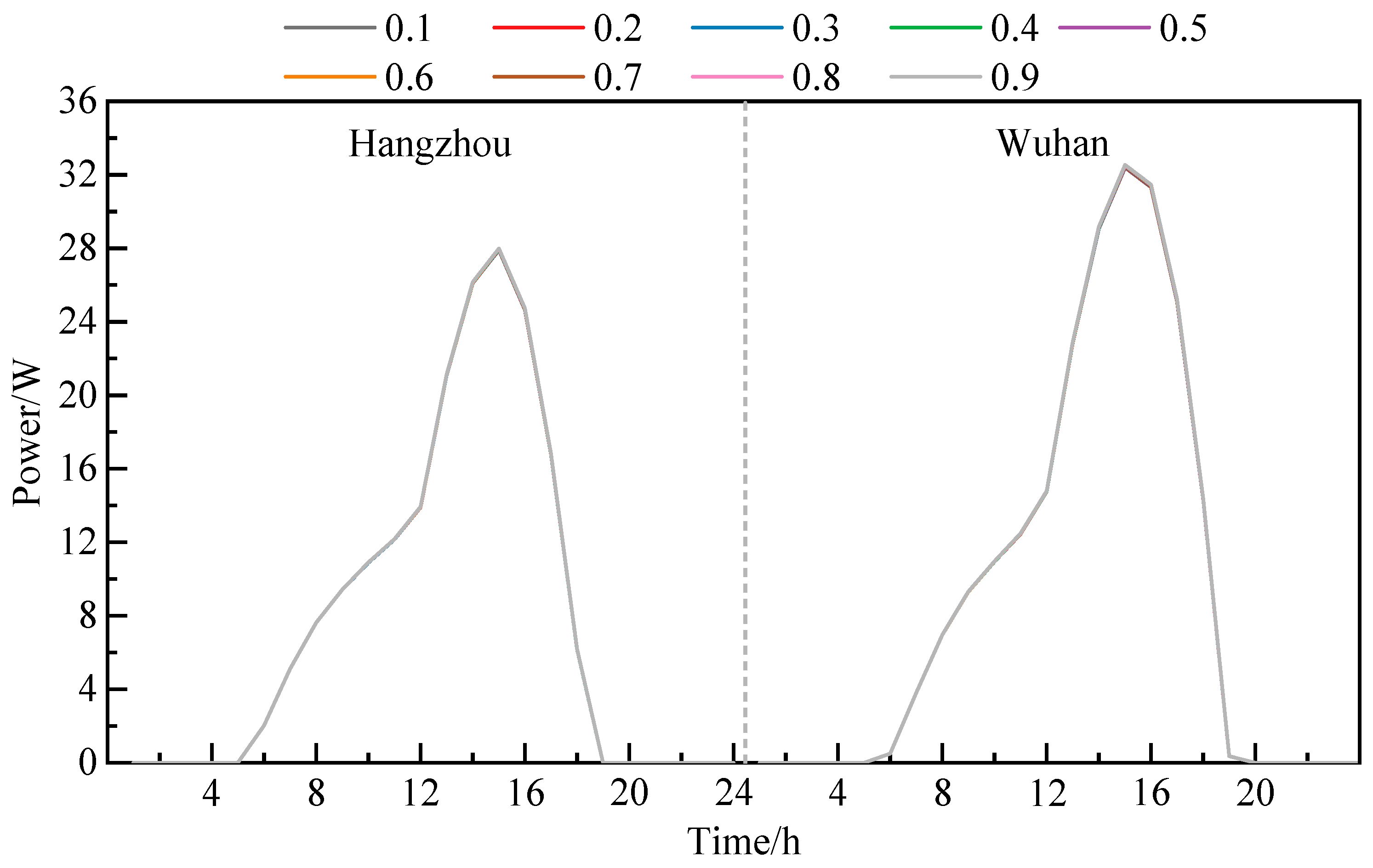
The effects of the emissivity of the outer cladding panel interior surface of the PV-DSF are shown in Figure 17. The PV power output was virtually unaffected by variations in the emissivity. This insensitivity stems from the fact that changes in the interior surface emissivity negligibly alter the temperature of the outer cladding panel, and consequently, the temperature of the photovoltaic glass remains almost constant. A reduction in the emissivity from 0.9 to 0.1 resulted in negligible decreases of 0.07 W and 0.13 W in the peak power generation in Hangzhou and Wuhan, respectively. The interior surface emissivity can therefore be reasonably considered to have no practical effect on photovoltaic power output.
Figure 17.
Effects of the emissivity of the outer cladding panel interior surface on power output.
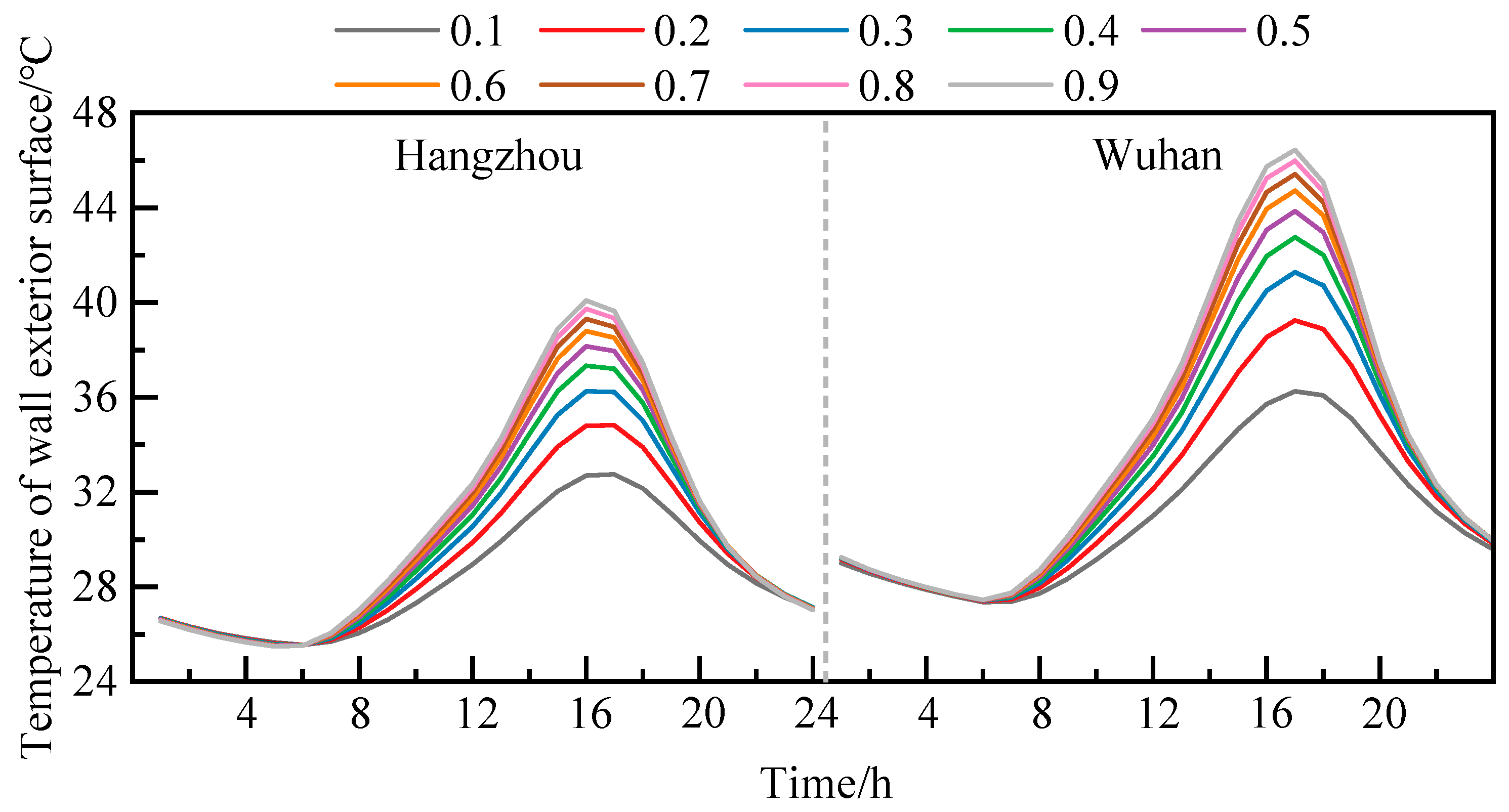
As shown in Figure 18, the exterior surface temperature of the wall correlates positively with the emissivity of the cladding’s inner surface. This effect is particularly intensified when the emissivity is further reduced, showing higher sensitivity at lower values. This is primarily because a lower emissivity of the outer cladding panel interior surface reduces the amount of heat transferred to the wall exterior surface through radiation. A reduction in the emissivity from 0.9 to 0.1 led to significant decreases in the peak exterior surface temperature from 40.09 °C to 32.75 °C in Hangzhou and from 46.45 °C to 36.26 °C in Wuhan. Therefore, lowering the emissivity is an effective strategy to reduce the peak temperature of the wall exterior surface, and this effect is more pronounced when the emissivity is relatively small.
Figure 18.
Effects of the emissivity of the outer cladding panel interior surface on the temperature of wall’s exterior surface.
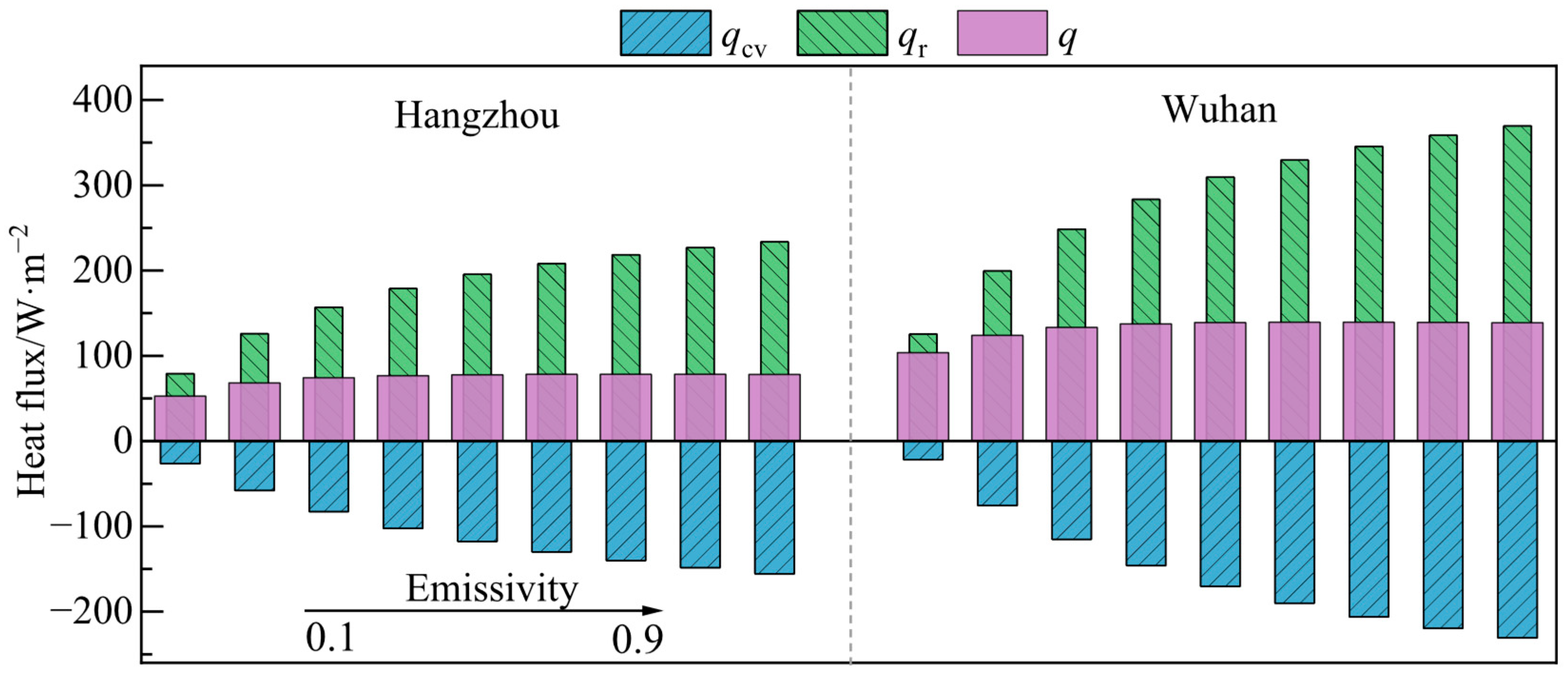
The effects of the emissivity of the outer cladding panel interior surface on the heat flux of the wall exterior surface are shown in Figure 19. As the emissivity decreases, both the convective and radiative heat fluxes of the exterior surface decrease, leading to a reduction in the total heat flux. This is primarily because a lower emissivity reduces the longwave radiant heat transfer from the panel interior surface to the wall exterior surface. Given that radiative heat transfer predominates in this configuration, the overall heat gain at the exterior surface is consequently lower. A reduction in the emissivity from 0.9 to 0.1 resulted in decreases of 154.64, 129.29, and 25.35 W·m−2 in the radiative, convective, and total heat fluxes in Hangzhou, respectively. Corresponding decreases in Wuhan were 244.05, 209.09, and 34.95 W·m−2. These results demonstrate that reducing the emissivity of the outer cladding panel interior surface can significantly decrease both radiative and convective heat fluxes at the wall exterior surface, lower the total heat flux, and enhance thermal insulation performance.
Figure 19.
Effects of the emissivity of the outer cladding panel interior surface on the heat fluxes of wall’s exterior surface.
Compared to the fact that low emissivity can suppress convective heat transfer [19], this study elucidates the influence of emissivity on both convective and radiative heat transfer. In summary, reducing the emissivity of the outer cladding panel interior surface can significantly decrease the peak temperature of the wall exterior surface and reduce heat gain, while its impact on photovoltaic power generation is negligible.
The outer cladding panels are typically made of lightweight, thin panels that are easy to install, such as ceramic or metal plates. Studies have found that compared to conventional walls, PV-DSFs can achieve 11.4% energy savings in summer while maintaining minimal construction and operational complexity. When both cost and energy efficiency are considered, PV-DSFs offer favorable economic benefits [18]. In summary, this technical approach is practical, effective, reliable, and economical and demonstrates a certain degree of broad applicability. The detailed parametric analysis in this study provides guidance for the optimized design of PV-DSFs and simultaneously offers theoretical support for developing their thermoelectric design methodology.
4. Conclusions
In the present study, we established a mathematical model of the PV-DSF. Based on this model, we analyzed the heat transfer characteristics and thermoelectric performance of PV-DSFs. The study investigated how various structural configurations influence both energy performance and thermal shielding capabilities. The essential conclusions drawn from this analytical process are summarized as follows.
- (1)
- The diurnal variation in power generation in the PV-DSF closely follows the solar radiation on the west-facing vertical surface, while outdoor air temperature exerts a minor influence. The wall’s exterior surface gains heat via longwave radiation during the day and loses heat at night, while convective heat dissipation occurs throughout the entire day, with radiative heat flux being the dominant mechanism.
- (2)
- Photovoltaic power generation is primarily influenced by the coverage ratio of the photovoltaic cells, while the effects of the heat storage of the outer cladding panel, the solar absorptivity of its exterior surface, and the emissivity of its interior surface are negligible.
- (3)
- Increasing the heat storage of the outer cladding panel can attenuate and delay the peak temperature of the wall exterior surface while reducing temperature fluctuations. Reducing the solar absorptivity of the exterior surface or the emissivity of the interior surface of the outer cladding panel can lower the peak temperature of the wall exterior surface, with the effect being more pronounced when the interior surface emissivity is lower. The thermal insulation performance of the PV-DSFs is significantly influenced by these three factors, whereas the impact of photovoltaic cell coverage is negligible.
Last but not least, many thanks for the support of the Academic Specialty Group for Urban Sensing in Chinese Society of Urban Planning.
Author Contributions
Conceptualization, L.H.; methodology, Y.L.; software, Y.L.; formal analysis, R.X.; investigation, Y.L. and H.Y.; data curation, R.X.; validation, H.Y.; writing—original draft preparation, Y.L.; writing—review and editing, L.H.; funding acquisition, Y.L. and L.H.; All authors have read and agreed to the published version of the manuscript.
Funding
This work was supported by Collaborative Innovation Center for Natural Resources Planning and Marine Technology of Guangzhou, grant number 2023B04J0301, Key Research and Development Program of Guangdong Province and Guangdong Enterprise Key Laboratory for Urban Sensing, Monitoring and Early Warning, grant number 2025B04J0031 and Zhejiang Province Construction Research Project, grant numbers 2024K065 and 2025K064.
Data Availability Statement
Data will be available on request.
Conflicts of Interest
Author Yang Li was employed by Guangzhou Urban Planning & Design Survey Research Institute Co., Ltd. The remaining authors declare that the research was conducted in the absence of any commercial or financial relationships that could be construed as a potential conflict of interest.
Abbreviations
The following abbreviations are used in this manuscript:
| CdTe | Cadmium telluride |
| DSF | Double-skin façade |
| PV-DSF(s) | Photovoltaic double-skin façade(s) |
Appendix A
Auxiliary equations for heat balance equations for photovoltaic glass.
Neglecting the long-wave radiative heat transfer on the exterior surface of the photovoltaic glass, the overall heat transfer coefficient of the exterior surface depends on the outdoor wind speed [29].
where v is the outdoor average wind speed, m·s−1.
Appendix B
Auxiliary equations for heat balance equations for outer cladding panel.
Due to the small thickness of the air cavity in PV-DSFs, the effect of edge radiative heat transfer is neglected. The radiative heat transfer coefficient between the outer cladding panel and wall is obtained as follows [30].
where Te,n is the outer cladding panel’s interior surface temperature, K; Ti,1 is the exterior surface temperature of the wall, K; εe,i is the outer cladding panel’s interior surface emissivity; and εi,e is the wall’s exterior surface emissivity.
Appendix C
Auxiliary equations for heat balance equations for air in the circulated air cavity.
The convective heat transfer coefficient for the outer cladding panel interior surface and wall exterior surface can be determined by the Nusselt number.
The Nusselt number is calculated as follows [31].
where , , , , and .
Following [29], we presume a linear relationship between the air’s physical parameters and its temperature inside the flow channel, justified by the restricted thermal span involved.
where Nuew and Nuiw are the convective Nusselt numbers of the outer cladding panel’s interior surface and wall’s exterior surface, respectively; Raew and Raiw are the convective Rayleigh numbers of the outer cladding panel’s interior surface and wall’s exterior surface; Pr is the Prandtl numbers of the air in the circulation cavity; ρf, cf, λf, μf, υf, and af are the density, specific heat, thermal conductivity, dynamic viscosity, kinematic viscosity, and thermal diffusivity of the air in the circulation cavity.
References
- Zhang, G.P.; Wu, H.J.; Liu, J.; Liu, Y.C.; Ding, Y.J.; Huang, H.K. A review on switchable building envelopes for low-energy buildings. Renew. Sustain. Energy Rev. 2024, 202, 114716. [Google Scholar] [CrossRef]
- Suo, H.; Angelotti, A.; Zanelli, A. Thermal-physical behavior and energy performance of air-supported membranes for sports halls: A comparison among traditional and advanced building envelopes. Energy Build. 2015, 109, 35–46. [Google Scholar] [CrossRef]
- Peng, J.Q.; Yan, J.Y.; Zhai, Z.Q.; Markides, C.N.; Lee, E.S.; Eicker, U.; Zhao, X.D.; Kuhn, T.E.; Sengupta, M.; Taylor, R.A. Solar energy integration in buildings. Appl. Energy 2020, 264, 114740. [Google Scholar] [CrossRef]
- Der, O.; Edwardson, S.; Marengo, M.; Bertola, V. Engineered composite polymer sheets with enhanced thermal conductivity. IOP Conf. Ser. Mater. Sci. Eng. 2019, 613, 012008. [Google Scholar] [CrossRef]
- Maqbool, Z.; Hanief, M.; Parveez, M. Review on performance enhancement of phase change material based heat sinks in conjugation with thermal conductivity enhancers for electronic cooling. J. Energy Storage 2023, 60, 106591. [Google Scholar] [CrossRef]
- GB 55015-2021; General Code for Energy Efficiency and Renewable Energy Application in Buildings. Ministry of Housing and Urban–Rural Development: Beijing, China, 2021. (In Chinese)
- Liu, D.L.; Sun, T.; Han, Y.F.; Yan, X.Y. The influence of calculation error of hourly marine meteorological parameter on building energy consumption calculation. Front. Archit. Res. 2022, 11, 981–991. [Google Scholar] [CrossRef]
- Feng, C.; Lu, B.; He, Y.; Huang, X.Q.; Liu, G.; Gao, S. Experimental study on the cooling and electricity-saving effects of radiative cooling coating applied to communication base station. Energy Build. 2025, 326, 115064. [Google Scholar] [CrossRef]
- Sarkar, K.; Banerjee, S. Se induced CdTe solar cell: A simulated study on structure and properties. Results Eng. 2026, 29, 108328. [Google Scholar] [CrossRef]
- Wang, Y.T.; Hu, X.; Gu, T.; Ji, J.; Li, N.; Yu, B.D. The design, experimental and numerical study on a novel double-skin glass ventilation wall with PV blind integrated with thermal catalytic materials for synergistic energy generation and air purification. Energy 2024, 313, 134028. [Google Scholar] [CrossRef]
- Jia, J.; Gao, F.; Cheng, Y.D.; Wang, P.S.; EI-Ghetany, H.H.; Han, J. A comparative study on thermoelectric performances and energy savings of double-skin photovoltaic windows in cold regions of China. Sol. Energy 2020, 206, 464–472. [Google Scholar] [CrossRef]
- Ji, J.; Yi, H.; He, W.; Pei, G.; Lu, J.P.; Jiang, B. Modeling of a novel Trombe wall with PV cells. Build. Environ. 2007, 42, 1544–1552. [Google Scholar] [CrossRef]
- Ke, W.; Ji, J.; Zhang, C.Y.; Xie, H.; Tang, Y.Y.; Wang, C.Y. Effects of the PCM layer position on the comprehensive performance of a built-middle PV-Trombe wall system for building application in the heating season. Energy 2023, 267, 126562. [Google Scholar] [CrossRef]
- Lin, Y.; Ji, J.; Zhou, F.; Ma, Y.; Luo, K.; Lu, X.Y. Experimental and numerical study on the performance of a built-middle PV Trombe wall system. Energy Build. 2019, 200, 47–57. [Google Scholar] [CrossRef]
- Cai, Y.; Huang, X.Y.; He, J.W.; Huang, Y.X.; Zhao, F.Y. Investigation of thermoelectric ventilated building envelope for simultaneously passive cooling and energy savings: Critical analysis and parametric characteristics. Energy Build. 2023, 297, 113421. [Google Scholar] [CrossRef]
- Wang, M.; Peng, J.Q.; Li, N.P.; Yang, H.X.; Wang, C.L.; Li, X.; Lu, T. Comparison of energy performance between PV double skin facades and PV insulating glass units. Appl. Energy 2017, 194, 148–160. [Google Scholar] [CrossRef]
- Ke, W.; Ji, J.; Wang, C.Y.; Zhang, C.Y.; Xie, H.; Tang, Y.Y.; Lin, Y. Comparative analysis on the electrical and thermal performance of two CdTe multi-layer ventilated windows with and without a middle PCM layer: A preliminary numerical study. Renew. Energy 2022, 189, 1306–1323. [Google Scholar] [CrossRef]
- Lin, Z.H.; Song, Y.H.; Chu, Y.N. An experimental study of the summer and winter thermal performance of an opaque ventilated facade in cold zone of China. Build. Environ. 2022, 218, 109108. [Google Scholar] [CrossRef]
- Hou, L.Q.; Liu, Y.; Liu, T.; Yang, L.; Feng, Y.P.; Gao, Q.L. Dynamic heat preservation at night for a Trombe wall with a built-in panel curtain in Western China. Sol. Energy 2021, 213, 284–299. [Google Scholar] [CrossRef]
- Stazi, F.; Ulpiani, G.; Pergolini, M.; Di Perna, C.; D’Orazio, M. The role of wall layers properties on the thermal performance of ventilated facades: Experimental investigation on narrow-cavity design. Energy Build. 2020, 209, 109622. [Google Scholar] [CrossRef]
- GB 50176-2016; Code for Thermal Design Code of Civil Building. Ministry of Housing and Urban–Rural Development: Beijing, China, 2016. (In Chinese)
- Jarimi, H.; Lv, Q.H.; Ramadan, O.; Zhang, S.H.; Riffat, S. Design, mathematical modelling and experimental investigation of vacuum insulated semi-transparent thin-film photovoltaic (PV) glazing. J. Build. Eng. 2020, 31, 101430. [Google Scholar] [CrossRef]
- Hou, L.Q.; Liu, Y.; Zhu, Y.Y.; Zhao, X.L.; Yang, L. Thermal performance of cavity masonry walls and thermal design investigation in Western China. Energy 2024, 292, 130298. [Google Scholar] [CrossRef]
- Abdeen, A.; Serageldin, A.A.; Ibrahim, M.G.E.; El-Zafarany, A.; Ookawara, S.; Murata, R. Experimental, analytical, and numerical investigation into the feasibility of integrating a passive Trombe wall into a single room. Appl. Therm. Eng. 2019, 154, 751–768. [Google Scholar] [CrossRef]
- Kalogirou, S.A. Solar Energy Engineering: Processes and Systems; Academic Press: Cambridge, MA, USA, 2013. [Google Scholar]
- Abbassi, F.; Dimassi, N.; Dehmani, L. Energetic study of a Trombe wall system under different Tunisian building configurations. Energy Build. 2014, 80, 302–308. [Google Scholar] [CrossRef]
- JGJ/T 346-2014; Standard for Weather Data of Building Energy Efficiency. Ministry of Housing and Urban–Rural Development of the People’s Republic of China: Beijing, China, 2014. (In Chinese)
- Fantucci, S.; Serra, V.; Carbonaro, C. An experimental sensitivity analysis on the summer thermal performance of an Opaque Ventilated Façade. Energy Build. 2020, 225, 110354. [Google Scholar] [CrossRef]
- Hou, L.Q.; Tai, H.X.; Liu, Y.; Zhu, Y.Y.; Zhao, X.L.; Yang, L. Thermal design of insulation on the outside of the cavity for a Trombe wall with phase change materials. Energy Build. 2024, 311, 114168. [Google Scholar] [CrossRef]
- Wang, J.C.; Guo, J.C.; Liu, C.; Li, Y.C.; Li, C.H. Experimental investigation and mathematical modelling of the heat and mass transfer processes in a solar chimney. Renew. Energy 2024, 237, 121540. [Google Scholar] [CrossRef]
- He, J.W.; Deng, J.H.; Huang, X.Y.; Shu, Z.Y.; Cai, Y.; Lv, Y.; Zhao, F.Y. Comparative study on the performance of a solar photocatalytic Trombe wall with different types of collectors: Copper/Thermoelectric/PV plate. Appl. Therm. Eng. 2024, 239, 122131. [Google Scholar] [CrossRef]
Disclaimer/Publisher’s Note: The statements, opinions and data contained in all publications are solely those of the individual author(s) and contributor(s) and not of MDPI and/or the editor(s). MDPI and/or the editor(s) disclaim responsibility for any injury to people or property resulting from any ideas, methods, instructions or products referred to in the content. |
© 2026 by the authors. Licensee MDPI, Basel, Switzerland. This article is an open access article distributed under the terms and conditions of the Creative Commons Attribution (CC BY) license.