Article

Study on the Influence of Rainfall Patterns on the Stability of Reinforced Soil Gabion Retaining Walls


1
Shandong Electric Power Engineering Consulting Institute Co., Ltd., Jinan 250013, China
2
College of Civil Engineering, Shandong Jianzhu University, Jinan 250101, China
3
Shandong Luqiao Group Co., Ltd., Jinan 250014, China
4
Key Laboratory of Building Structure Reinforcement and Underground Space Engineering, Ministry of Education, College of Civil Engineering, Shandong Jianzhu University, Jinan 250101, China
*
Author to whom correspondence should be addressed.
Buildings 2026, 16(5), 1003; https://doi.org/10.3390/buildings16051003
Submission received: 15 January 2026 / Revised: 13 February 2026 / Accepted: 17 February 2026 / Published: 4 March 2026

Abstract

Rainfall is recognised as one of the major external factors affecting the stability of retaining walls. The magnitude of rainfall directly influences the overall stability of retaining walls, while rainfall patterns alter the infiltration process and the saturation state of the soil, thereby affecting soil shear strength and retaining wall stability. In order to investigate the effects of rainfall pattern and intensity on the stability of reinforced soil gabion retaining walls, numerical simulations were carried out to examine wall stability under two typical rainfall patterns (uniform and intermittent) and three rainfall intensities (20 mm/d, 50 mm/d, and 80 mm/d). The results indicate that: (1) under uniform rainfall conditions, the extent of the soil pore water pressure response zone is greater than that under intermittent rainfall of the same intensity, and as the uniform rainfall intensity increases from 20 mm/d to 80 mm/d, the pore water pressure response zone expands by approximately four times; (2) the rainfall pattern exerts a certain influence on the distribution characteristics of the time-history curves of lateral displacement of the retaining wall, with the horizontal displacement under intermittent rainfall exhibiting a non-uniform growth pattern associated with the rainfall pattern; (3) uniform heavy rainfall has a more pronounced effect on the horizontal displacement of reinforced soil gabion retaining walls, with the maximum absolute horizontal displacement reaching approximately 12.89 mm; and (4) rainfall pattern affects the evolution of the slope stability coefficient, which gradually decreases and eventually stabilises under uniform rainfall, whereas under intermittent rainfall it shows a continuous decreasing trend characterised by alternating rates of reduction, with a greater reduction observed under uniform rainfall conditions. These findings elucidate the influence of different rainfall patterns and intensities on the displacement behaviour and stability of reinforced soil gabion retaining walls, and provide a reference for risk assessment of reinforced soil gabion retaining walls.

1. Introduction

Large quantities of excavated soil and rock are generated during mountainous infrastructure construction activities, such as highways, transmission line tower foundations, and wind power foundations [1,2,3]. In engineering practice, one approach to the disposal of excavated soil and spoil involves resource utilisation, for example, by processing waste rock for use as concrete aggregates [4], while another approach relies on the adoption of structural measures, including gravity retaining walls, pile–slab retaining walls, and reinforced soil retaining walls, to manage the generated spoil and excavated soil [5,6,7]. While meeting the requirements of engineering safety and construction efficiency, these spoil-retaining structures are also applicable to a wide range of geological and environmental conditions. Among them, reinforced soil gabion retaining walls, which integrate reinforced soil technology with gabion wall structures, are characterised as flexible support systems and offer advantages such as favourable permeability, structural flexibility, and strong adaptability to complex terrain [8,9]. Consequently, they have been widely applied in engineering practice.
Based on the aforementioned engineering application background, extensive experimental investigations, numerical simulations, and theoretical analyses have been conducted by numerous scholars on reinforced soil gabion structures [10,11,12]. Field experimental studies on reinforced soil gabion retaining walls were carried out by Liu Ze and Jiang Jianqing et al. [13,14], in which the variation characteristics of earth pressure, reinforcement strain, and deformation of gabion cages were analysed. The results indicated that changes in reinforcement spacing and length exert a significant influence on the lateral displacement of reinforced soil retaining walls. Laboratory model tests on the seismic dynamic response of reinforced soil retaining walls with stone cage panels and geobag panels were performed by Meng et al. [15], and the results demonstrated that deformation responses of reinforced soil structures vary with different facing types, with the overall displacement of structures with stone cage panels being smaller than that of structures with geobag panels. Dynamic loading tests on green reinforced soil retaining walls were conducted by Lin et al. [16] through laboratory model experiments, revealing that structural deformation is strongly affected by loading amplitude and loading period. Numerical simulations were performed by Wang et al. [17] to analyse the stability of combined structures consisting of reinforced soil gabion retaining walls and embedded pile foundations, and the design parameters of the structural foundation were optimised accordingly. Numerical analyses and experimental studies on reinforced gabion retaining walls were carried out by Yang Guolin et al. [18] to investigate the distribution characteristics of tensile strain in the reinforcement, lateral deformation of the retaining wall, and potential slip surfaces. The results showed that the safety factor of reinforced slopes gradually decreases with increasing external loads. By combining model tests and numerical simulations, Lin et al. [19] investigated the dynamic response characteristics of geogrid-reinforced soil walls under repeated loading, and demonstrated that the dynamic deformation of reinforced soil walls is jointly influenced by vibration cycles, dynamic load amplitude, and vibration frequency, with the maximum lateral displacement typically occurring in the reinforced layer region near the mid-height of the wall. Numerical simulations were employed by Zou Weilie et al. [20] to analyse the effects of geogrid reinforcement on the horizontal displacement of retaining walls as well as the horizontal displacement and horizontal stress of the backfill soil. The results indicated that reinforcement effectively reduces the horizontal displacement of both the retaining wall and the backfill soil, and that under static loading conditions, reinforced retaining walls exhibit markedly improved stability and reduced displacement compared with unreinforced retaining walls.
During the service life of reinforced soil retaining walls, their stability is readily affected by external environmental factors. An analysis of 19 failure cases conducted by Jason et al. [21] demonstrated that rainfall is a critical trigger for the failure of reinforced soil retaining walls, and consequently, extensive studies have been carried out by numerous researchers on the stability of reinforced soil retaining walls under rainfall conditions. Laboratory model tests were performed by Li et al. [22] to investigate the responses of rainfall infiltration characteristics and facing displacement of reinforced soil retaining walls under different rainfall intensities. The results indicated that increasing rainfall intensity reduces the shear strength of the soil, thereby causing reinforced soil structures to sustain greater loads. The overall mechanical behaviour of reinforced soil retaining walls under rainfall infiltration was examined by Yang et al. [23] through laboratory model tests, and the results showed that rainfall infiltration significantly alters the volumetric water content and pore water pressure distribution within the soil mass behind the wall, which in turn affects the spatial distribution and evolution of reinforcement stress–strain responses. Santos et al. [24] investigated the overall stability of geogrid-reinforced soil retaining walls under rainfall conditions using laboratory model tests, and demonstrated that rainfall intensity has a pronounced effect on the distribution of soil suction within the reinforced soil mass, with the influence mainly concentrated in the soil layers near the base of the structure. As rainfall intensity increases, soil suction was observed to continuously decrease, leading to a reduction in the overall structural stability. On the basis of the traditional G–A infiltration model, Ma et al. [25] derived a calculation formula for the overall stability of composite soil-nailed retaining walls under rainfall conditions, enabling a more accurate evaluation of the stability of unsaturated loess slopes supported by composite soil nail walls during rainfall events.
The significant influence of rainfall on the stability of geotechnical engineering structures has been widely acknowledged by researchers worldwide, and in recent years, increasing attention has been paid to the mechanisms by which different rainfall patterns affect geotechnical stability. Numerical case studies conducted by Kim et al. [26] indicated that, compared with conventional rainfall events, variations in rainfall patterns can induce slope instability at an earlier stage during rainfall. Tang et al. [27] systematically analysed slope stability under three typical rainfall patterns and found that slope stability is highly sensitive to rainfall patterns and is largely governed by the temporal distribution characteristics of rainfall intensity. The results reported by Yoo et al. [28] showed that rainfall patterns influence the overall stability of reinforced soil walls by modifying the pore water pressure response characteristics of the backfill soil behind the wall. Using numerical simulation methods, Wu et al. [29] investigated slope stability under four rainfall patterns and demonstrated that different rainfall patterns significantly affect the distribution of shallow pore water pressure on slope surfaces, thereby altering rainfall infiltration conditions and ultimately exerting a substantial influence on the slope safety factor. Song, Gui, and Rahimi et al. [30,31,32] consistently concluded that differences in rainfall patterns markedly modify the evolution of pore water pressure and failure modes of slopes, with delayed rainfall patterns being the most unfavourable for slope stability.
Yang et al. [33] found that the rainfall triggered a significant Lisse effect and decreased the slope factor of safety (Fs). When the rainfall intensity (Ri) was higher than the saturated hydraulic conductivity (Ks), the Lisse effect and the Fs slightly changed with the increase in the Ri, and the slope tended to be unstable with continuous rainfall. Therefore, the stability of the retaining wall is highly sensitive to rainfall. This study discusses the impact of different rainfall patterns and intensities on its stability.
In summary, existing studies on reinforced soil gabion retaining walls have primarily focused on horizontal displacement, reinforcement force characteristics, and overall stability under rainfall and non-rainfall conditions, as well as on the stability evolution of geotechnical slopes under rainfall pattern control. However, key issues such as the internal seepage behaviour and the evolution of stability of reinforced soil gabion retaining walls under different rainfall patterns remain insufficiently understood. In view of this, the present study takes reinforced soil gabion retaining walls as the research object, and adopts a combined approach of numerical simulation and physical model testing to investigate the effects of different rainfall patterns and intensities. Particular emphasis is placed on the rainfall infiltration characteristics, wall facing displacement, stability evolution, and variation in the extent of potential slip surfaces of reinforced soil gabion retaining walls.

2. Model Development and Verification

2.1. Physical Model Tests of Reinforced Soil Gabion Retaining Walls

The test model for assessing the bearing-capacity stability of the reinforced soil gabion retaining wall was designed with reference to the in situ spoil-disposal method using reinforced soil gabion retaining walls along the route of an ultra-high-voltage (UHV) DC transmission project. Considering the similarity requirements and the load-carrying capacity of the vertical loading actuator, a physical model of a composite gabion–geogrid reinforced soil retaining wall was established with a geometric similarity ratio of 1:3.33, so as to represent a prototype retaining wall with a height of 2.5 m. The similarity relationships of key parameters for the scaled test were determined in accordance with the calculation principles proposed in the literature [34,35], as listed in Table 1. The physical tests are used only for mechanical validation rather than hydro-mechanical processes [36].
Four main types of materials were employed in the model: (1) gabion mesh cages: square-aperture steel wire mesh(Anping Second Wire Mesh Factory, Hengshui, China) was selected, the Square-aperture mesh was chosen to avoid problems with scaling hexagonal mesh and cages with dimensions of 50 cm (length) × 15 cm (width) × 15 cm (height) were fabricated to form the gabion wall facing, with stepped overlapping adopted; (2) geogrid: a uniaxial geogrid (TGDG—50 kN, Shandong Shenghan New Materials Co., Ltd., Tai’an, China) was used, with a longitudinal tensile strength of 13 kN/m (two-thirds of the longitudinal ribs were removed in the test), and the reinforcement length was set to 1.0 m; (3) cage infill: hard river pebbles (Guangdong Zhangshi Stone Co., Ltd., Guangdong, China) resistant to weathering and hydrolysis were used to fill the gabion cages, with particle sizes of approximately 35–50 mm; and (4) backfill: poorly graded standard sand (Xiamen ISO Standard Sand Co., Ltd., Xiamen, China) was adopted. The basic parameters of the standard sand were as follows: D10 = 0.18 mm, D30 = 0.29 mm, D60 = 0.37 mm, Gs = 2.86, Cu = 2.055, and Cc = 1.262; the maximum dry density was 1.99 g/cm3, and the minimum dry density was 1.52 g/cm3. The model was constructed at a relative density of 0.7, corresponding to an adopted dry density of 1.82 g/cm3.
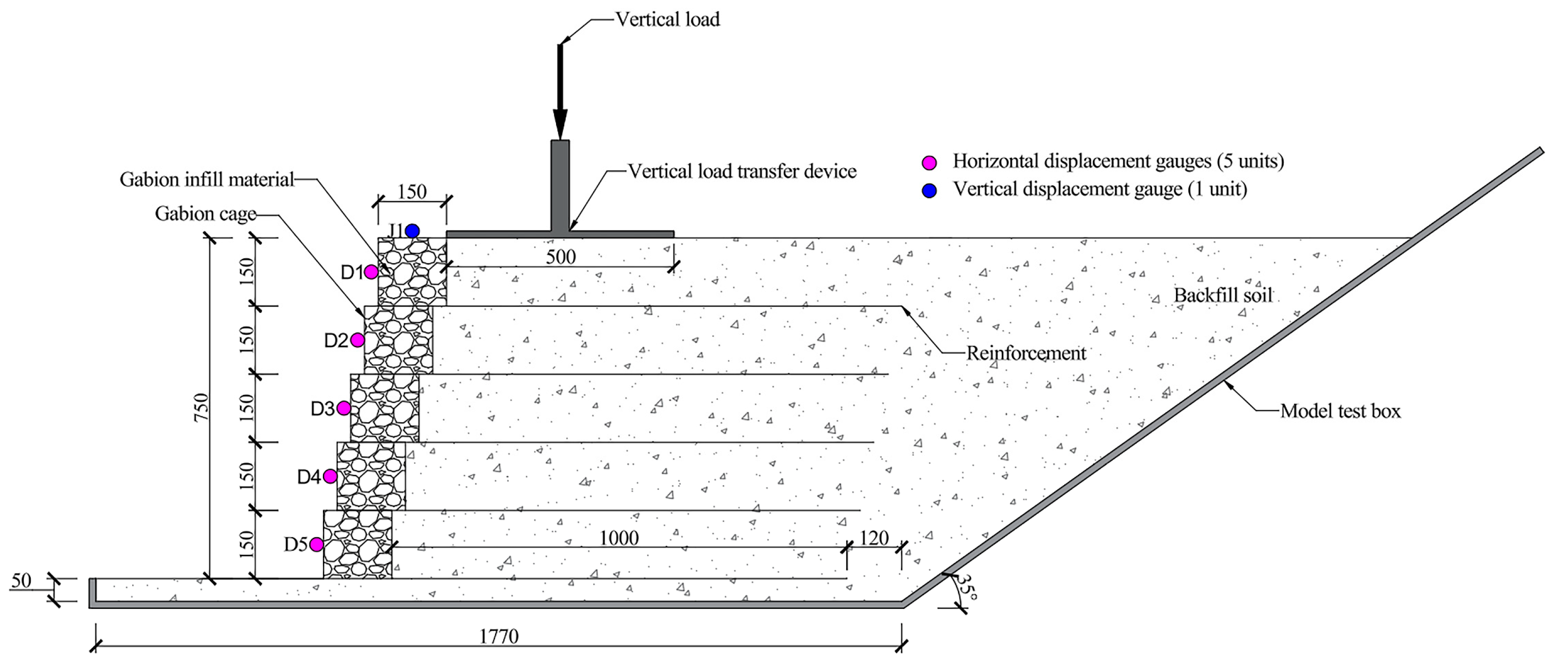
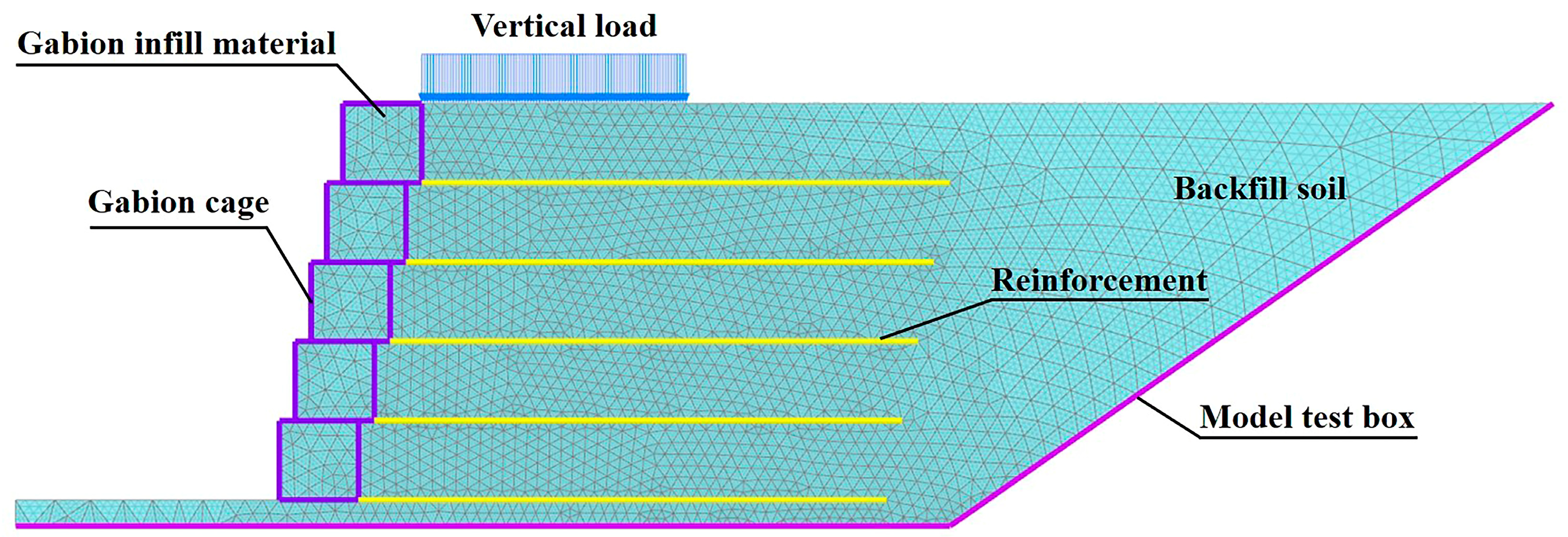
The design of the reinforced soil gabion retaining wall model is shown in Figure 1. The overall height of the model was 0.85 m, with a wall height of 0.75 m. The geogrid reinforcement was arranged horizontally, and the inclination of the model container was set to 35° to simulate the in situ ground slope. A vertical load transfer device was installed at the backfill behind the wall crest, by which the vertical force applied by the actuator was transformed into an equivalent surface load acting on the backfill surface. Stepwise loading was adopted to progressively increase the load level, so as to investigate the deformation response and displacement development of the reinforced soil gabion retaining wall under externally applied vertical surcharge loads. In addition, displacement transducers were installed at various positions on the wall facing panels and at different locations along the wall crest to monitor the horizontal deformation of the facing panels and the settlement response at the wall crest. The experimental model of the reinforced soil gabion retaining wall is shown in Figure 1.

2.2. Numerical Model Development

Numerical simulations in this study were conducted using the specialised geotechnical finite element software PLAXIS 2D V22, which is highly effective in modelling complex soil-structure interactions and handling the non-linear characteristics of geomaterials through robust computational algorithms. The reinforced gabion retaining wall is modelled as a two-dimensional (2D) plane strain problem. This simplification is justified by the geometric and kinematic characteristics of the structure. In geotechnical engineering, retaining walls are typical longitudinal structures where the length (L) is significantly larger than the cross-sectional width (B) and height (H). Throughout the majority of the wall’s length, the cross-sectional geometry (including gabion dimensions and reinforcement spacing), geological conditions, and external loads (such as earth and hydrostatic pressures) remain consistent. Consequently, the deformation is constrained by adjacent sections, implying that the normal and shear strains in the longitudinal direction (Z-axis) are negligible ( ϵ z = 0 ). Therefore, the stress–strain state of a representative 2D cross-section effectively reflects the mechanical behaviour of the entire structure.
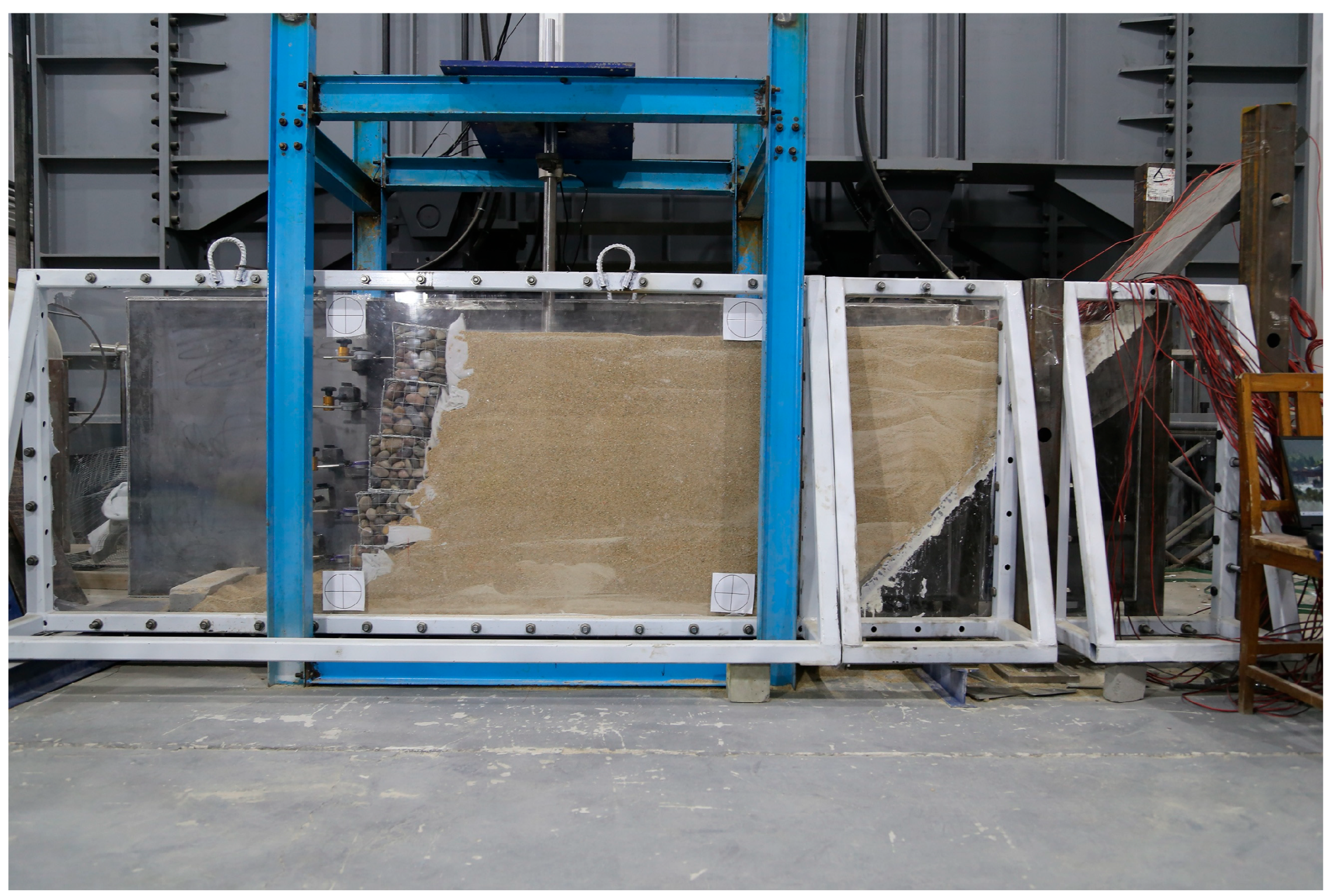
So, to verify the consistency between the numerical approach and experimental results, a numerical calculation model was established based on the laboratory test model of the reinforced soil gabion retaining wall shown in Figure 2. The numerical model of the reinforced soil gabion retaining wall is presented in Figure 3.
As shown in Figure 3, the numerical calculation model consists of four components: the foundation, the gabion retaining wall facing panels, the backfill soil, and the reinforcement. The foundation is formed by compacted backfill soil and is modelled using the Mohr–Coulomb (M–C) elastoplastic constitutive model. The gabion retaining wall facing panels are composed of gabion cages infilled with rock blocks, in which the gabion mesh is represented by structural geogrid elements, while the rock blocks are modelled using the M–C elastoplastic constitutive model. The backfill soil is standard sand and is also described by the M–C model. Interface elements were established between structural units following the method described by Grodecki [37]. The material parameters and interface settings used in the numerical simulation are listed in Table 2 and Table 3.

2.3. Numerical Model Verification

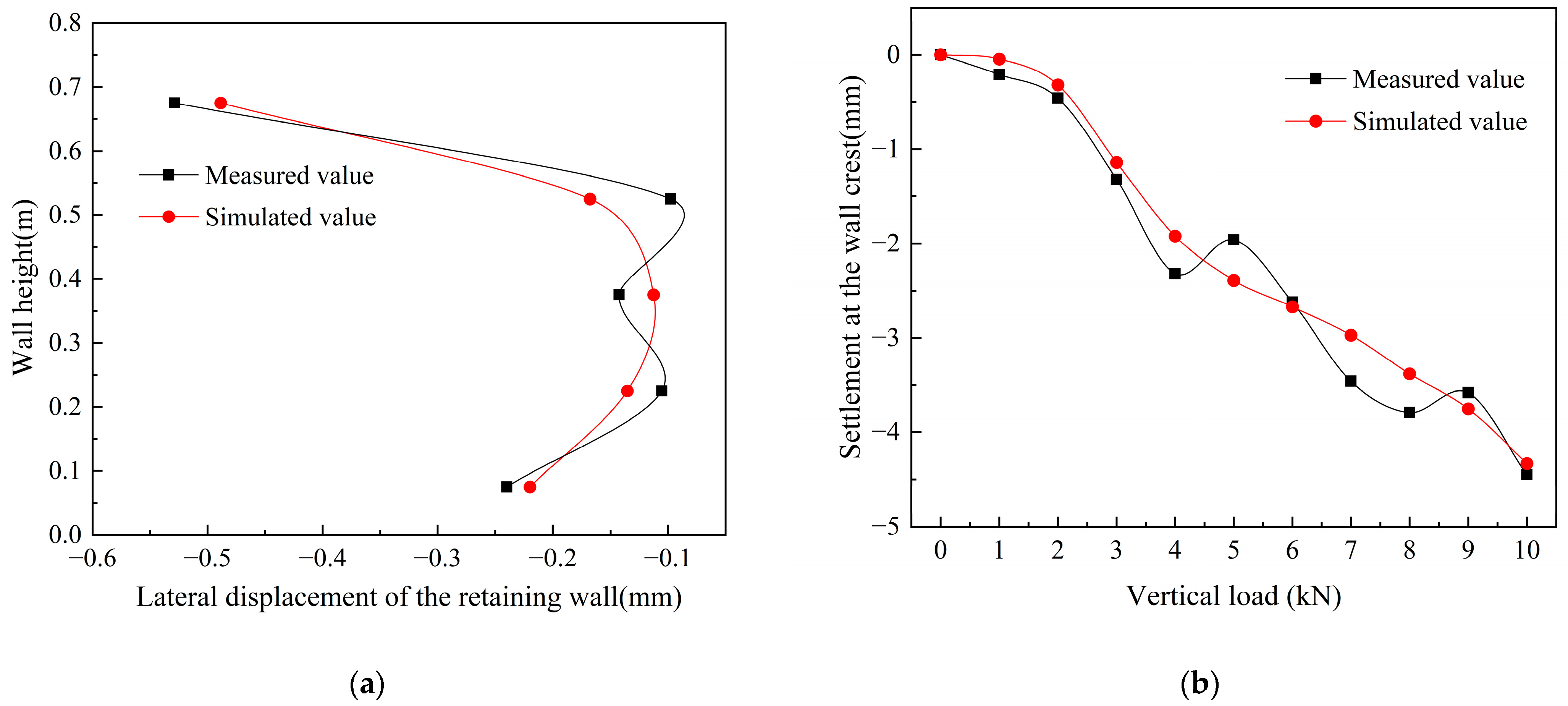
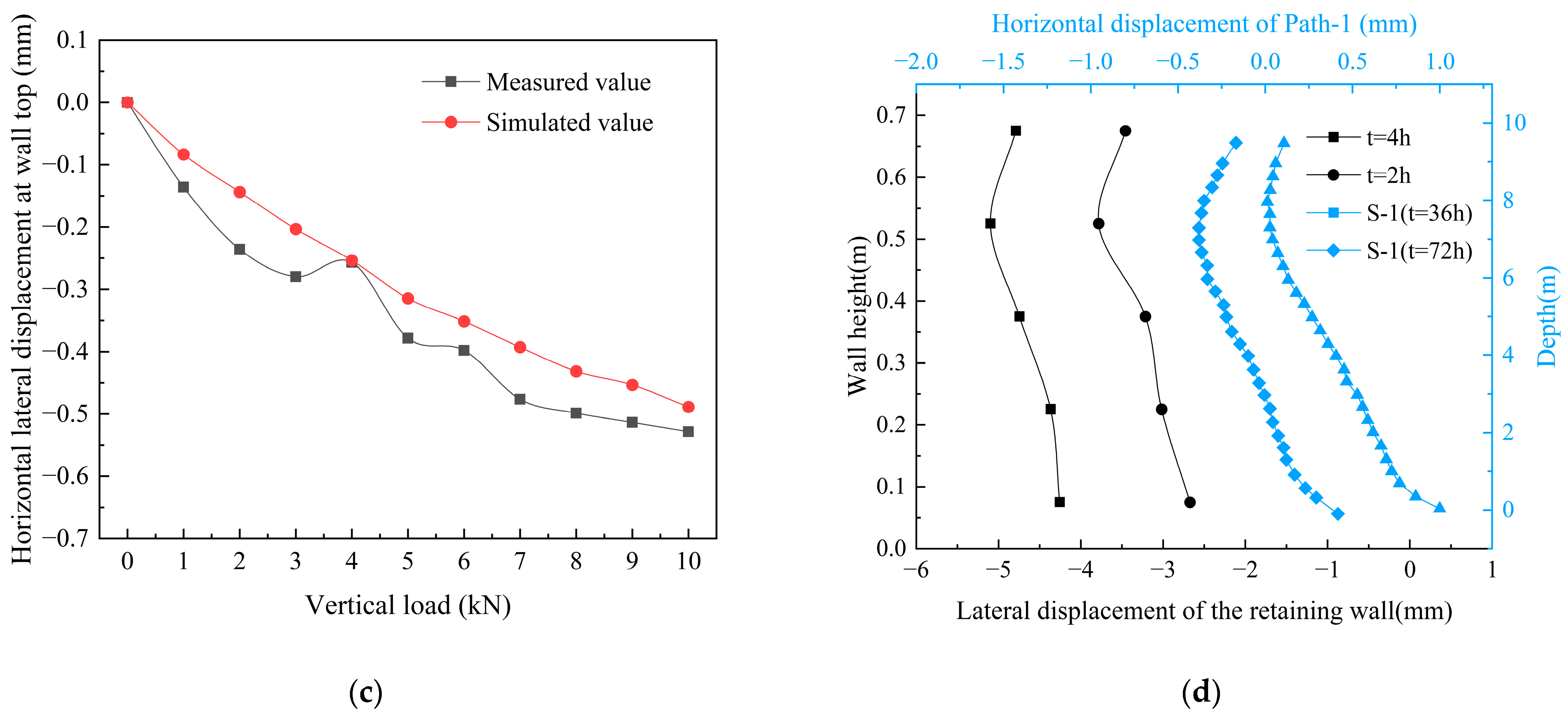
The loading conditions applied in the laboratory physical model test were simulated numerically. Figure 4 presents a comparison between the model test results and the numerical simulation results for the lateral deformation of the wall facing panels and the settlement at the wall crest measured at each monitoring point (as shown in Figure 1). The curves in Figure 4a, Figure 4b and Figure 4c represent the simulated values and the experimentally measured values, respectively. The comparison indicates that although discrepancies exist between the absolute values obtained from the model tests and the numerical calculations, the differences are relatively small and the overall distribution trends are in good agreement. Therefore, it can be concluded that the numerical model is capable of adequately reproducing the overall stability behaviour of the reinforced soil gabion retaining wall, thereby validating the material parameters and modelling settings adopted in the numerical simulations. Figure 4d shows the displacement of the reinforced soil retaining wall under rainfall effects. The displacement trend in Figure 4d is similar to is similar to that reported in Li et al. [38], thereby validating that the numerical model established in this study accurately reflects the effects of rainfall.

3. Numerical Simulation Study of Reinforced Soil Gabion Retaining Walls on Slopes Under Rainfall Conditions

3.1. Numerical Model

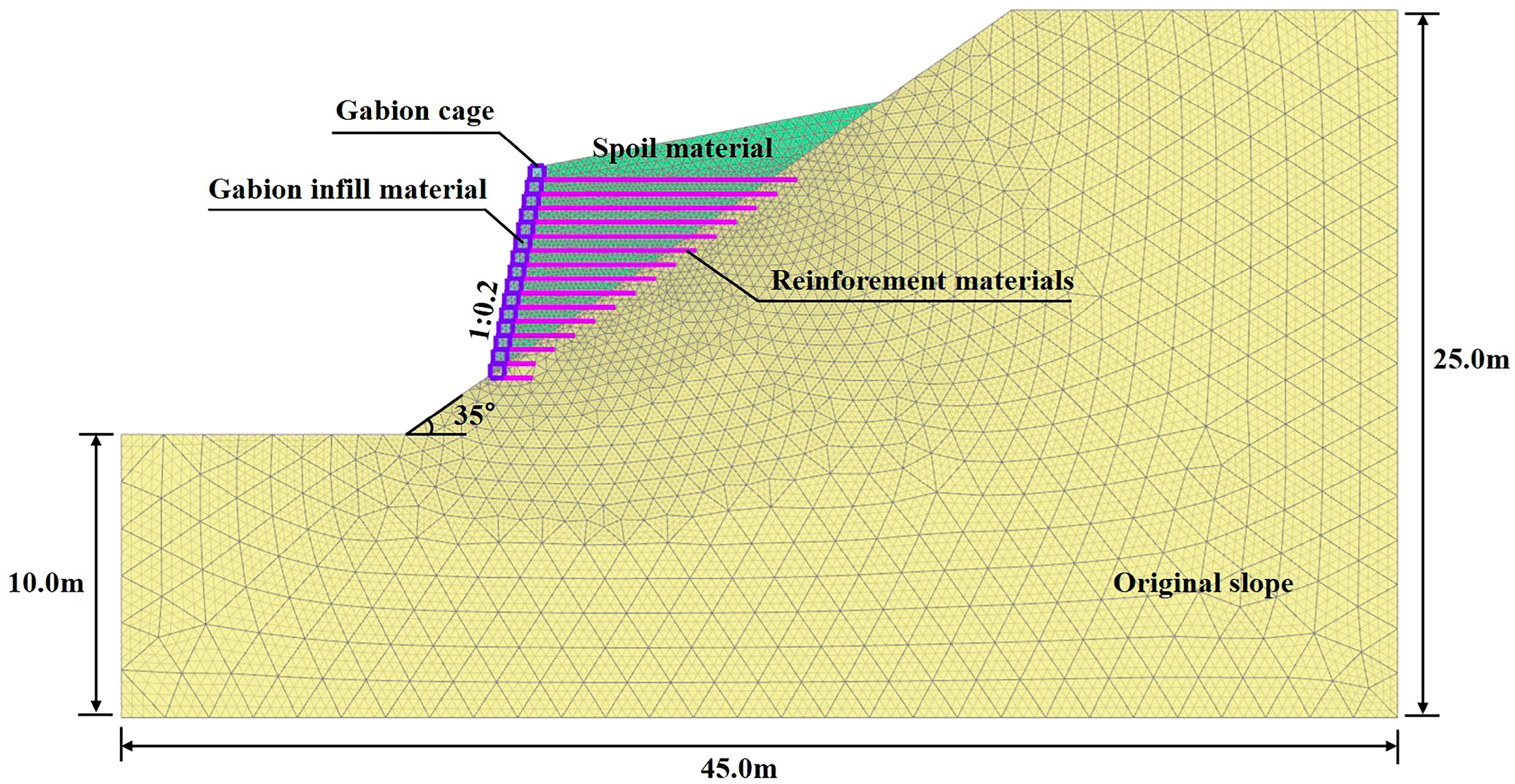
In accordance with the numerical modelling approach and procedures described above, a model of a reinforced soil gabion spoil retaining wall was established to simulate a transmission-line tower foundation project along a power transmission corridor. The numerical model adopted a representative cross-section at the pile foundation construction location with the steepest terrain gradient along the transmission line, with a maximum ground slope of 35° being selected as the computational profile. The model domain measured 45 m × 25 m; the slope height was 15 m, and the slope length was 21.4 m. The groundwater head was represented by a polyline varying with the slope surface elevation and extending across the model cross-section. The total height of the reinforced soil gabion retaining wall was 7.5 m. Each gabion cage layer had dimensions of 0.5 m × 0.5 m, and reinforcements of varying lengths were arranged behind each layer; all reinforcement layers were anchored 1.0 m into the intact slope mass. The finite element computational model of the reinforced soil gabion retaining wall is shown in Figure 5.

3.2. Model Parameters

In the established finite element model, both the gabion cages and the reinforcement were simulated using structural geogrid elements, and different tensile stiffness values were assigned to the gabion mesh and the reinforcement. The material parameters of the gabion cages and the reinforcement are presented in Table 4.
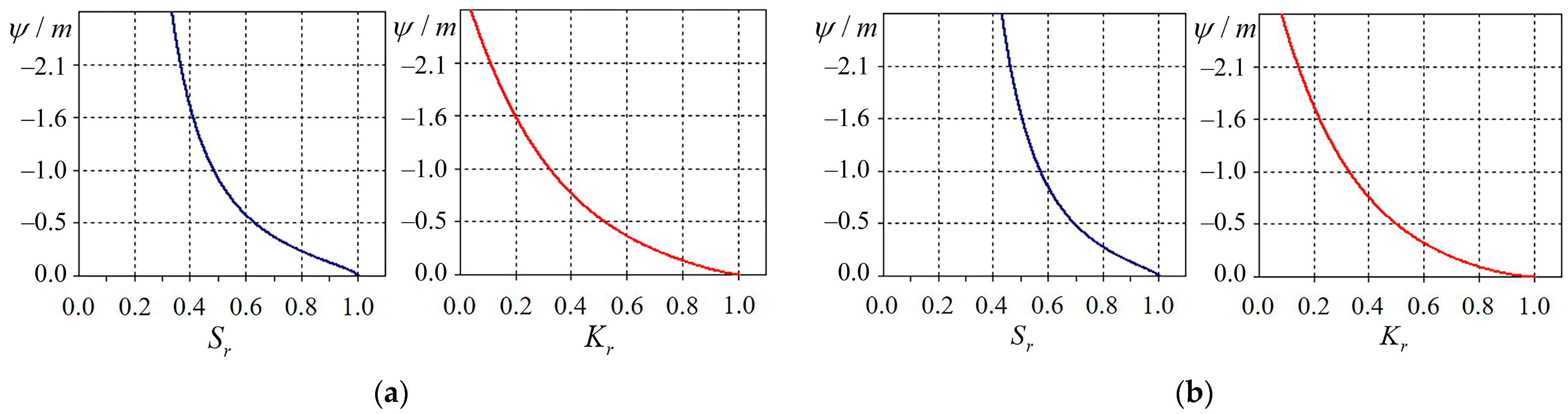
The soil–water characteristic curve (SWCC) is a constitutive function that describes the relationship between soil matric suction and water content. The Van Genuchten model is a characteristic curve model used to represent the relationship between effective degree of saturation and matric suction. In addition, a nonlinear relationship exists among permeability, degree of saturation, and matric suction, such that the corresponding matric suction and soil permeability can be obtained for different degrees of saturation:
k w = k w s 1 + α u a u w ρ w g n
S e = S S r 1 S r = 1 1 + α u a u w n 1 1 n
In these expressions, k w and k w s denote the permeability coefficient of the soil at an arbitrary degree of saturation and that of the saturated soil, respectively, while S e and S r represent the effective degree of saturation and the residual degree of saturation of the soil. This study draws on Mahmood et al. [39], where the effect of matric suction on the stability of unsaturated soil is indirectly reflected through the evolution of pore pressure.
As the internal structure of the typical computational cross-section is predominantly composed of completely weathered rock strata, an original slope was established in the model, with the original slope soil being described by the Mohr–Coulomb constitutive model. The physical and mechanical parameters of the original slope soil were determined with reference to values obtained from the site investigation report. In addition, the gabion cages, reinforcement, and gabion infill were modelled separately. Both the gabion infill and the soil material behind the wall were described using the Mohr–Coulomb constitutive model. Based on the overall geotechnical characteristics of the gabion retaining wall and the spoil material, including particle gradation and relevant experimental data, the physical and mechanical parameters of the gabion infill, spoil material, and original slope soil adopted in the numerical analysis were obtained, as listed in Table 5. Furthermore, the soil–water characteristic curves and soil permeability functions used in this study were derived by fitting the Van Genuchten equation within the PLAXIS 2D V22 software, as shown in Figure 6.
The Mohr–Coulomb model used in this study assumes that soil stiffness is constant. However, for unsaturated soils, the stiffness varies with changes in matric suction, resulting in different stress–strain responses. Under lower moisture conditions, unsaturated soils exhibit higher stiffness, while under wetter conditions, they may become weaker. The simple Mohr–Coulomb model fails to fully account for the stress-dependent variations in unsaturated soils under different moisture states. As a result, the displacements calculated for the pre-rainfall condition in this study may be overestimated, potentially underestimating the stability of the retaining wall. In contrast, for the post-rainfall condition, the calculated displacements may be underestimated, potentially overestimating the stability of the retaining wall. The numerical simulation results have been validated by the findings of Ni et al. [40], and the selection of the constitutive model may introduce an error of approximately 10%. The loss of matric suction is indirectly reflected through the evolution of pore pressure.

3.3. Boundary Conditions

The boundary conditions of the finite element model for the reinforced soil gabion retaining wall slope were defined as follows: the left and right boundaries were subjected to normal displacement constraints and specified as permeable boundaries; the bottom boundary was assigned a fixed constraint and defined as an impermeable boundary; and the upper surface was prescribed as a rainfall flux boundary, with no additional external loads applied.

3.4. Simulation Scenario Settings

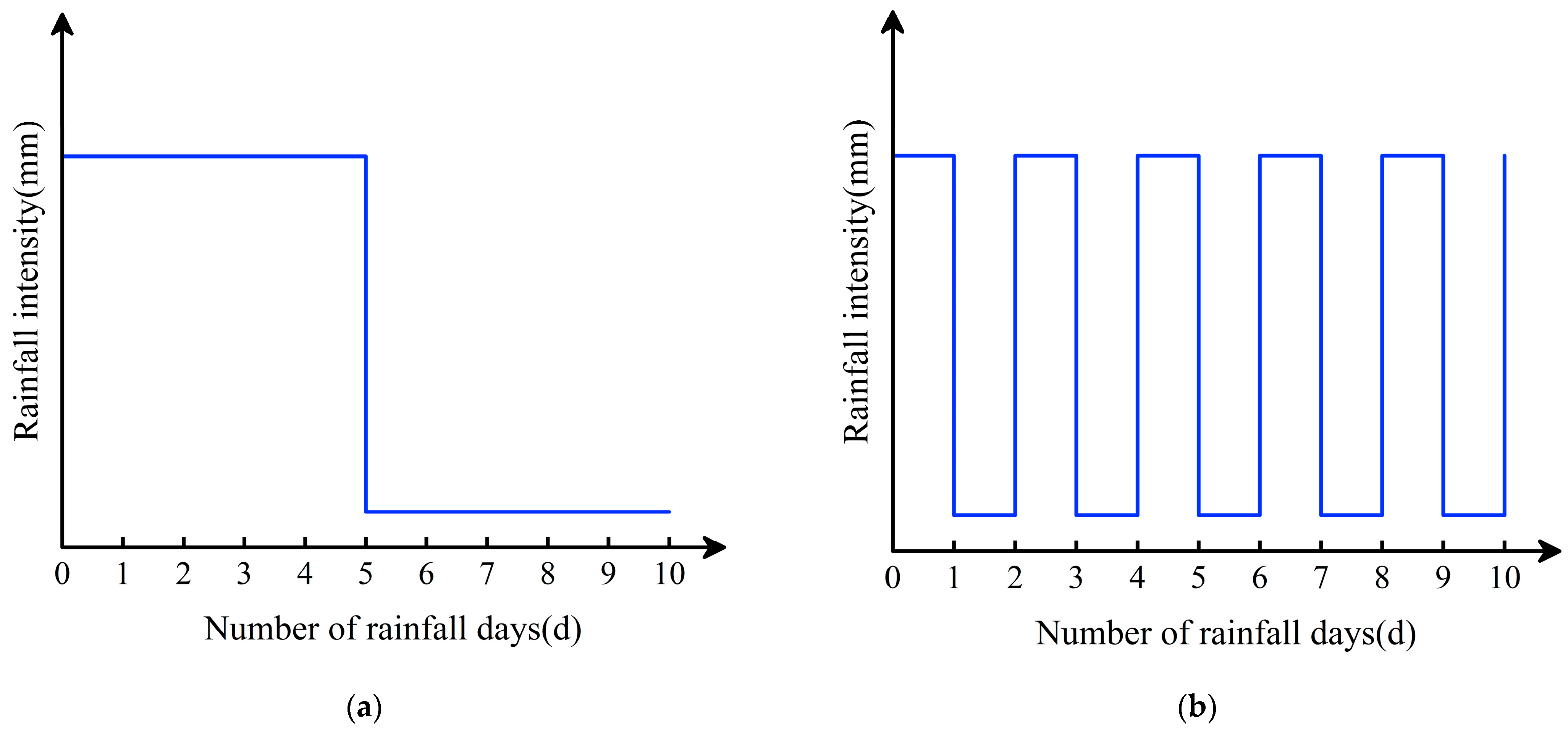
With reference to the locations along the UHV DC transmission project corridor and local meteorological records, rainfall intensities of 20 mm/d (moderate rain), 50 mm/d (heavy rain), and 80 mm/d (rainstorm) were specified. In addition, to highlight the governing role of rainfall infiltration rhythm on the evolution of pore water pressure and slope stability, while maintaining computational tractability, the rainfall process was categorised into two typical rainfall patterns based on the statistical characteristics of long-term precipitation data in the project area: uniform rainfall and intermittent rainfall. Wang and Li [41] emphasised that the infiltration flux of the soil is related to the soil’s permeability coefficient. Continuous rainfall will cause the rainwater to persistently infiltrate into the slope, while excess surface runoff will be neglected. Rainfall occurs only on the surface of the slope, and the rainfall is able to infiltrate into the slope body through the surface. The lateral and bottom boundaries of the 2D slope are set as impermeable.
The uniform pattern reflects continuous and steady infiltration, whereas the latter represents the commonly observed alternation between rainfall and rainfall cessation in the project area. Together, these two patterns encompass the most dominant infiltration processes encountered in engineering practice [42]. Consequently, they can effectively characterise the effects of rainfall pattern differences on the accumulation rate of pore water pressure, the degree of matric suction dissipation, the growth mode of reinforcement displacement, and the evolution of the safety factor. The rainfall pattern curves adopted in this study are shown in Figure 7, and the rainfall scenario settings are summarised in Table 6.

4. Discussion

4.1. Analysis of Horizontal Displacement of the Wall Facing

4.1.1. Horizontal Displacement Analysis of the Retaining Wall Under Uniform Rainfall

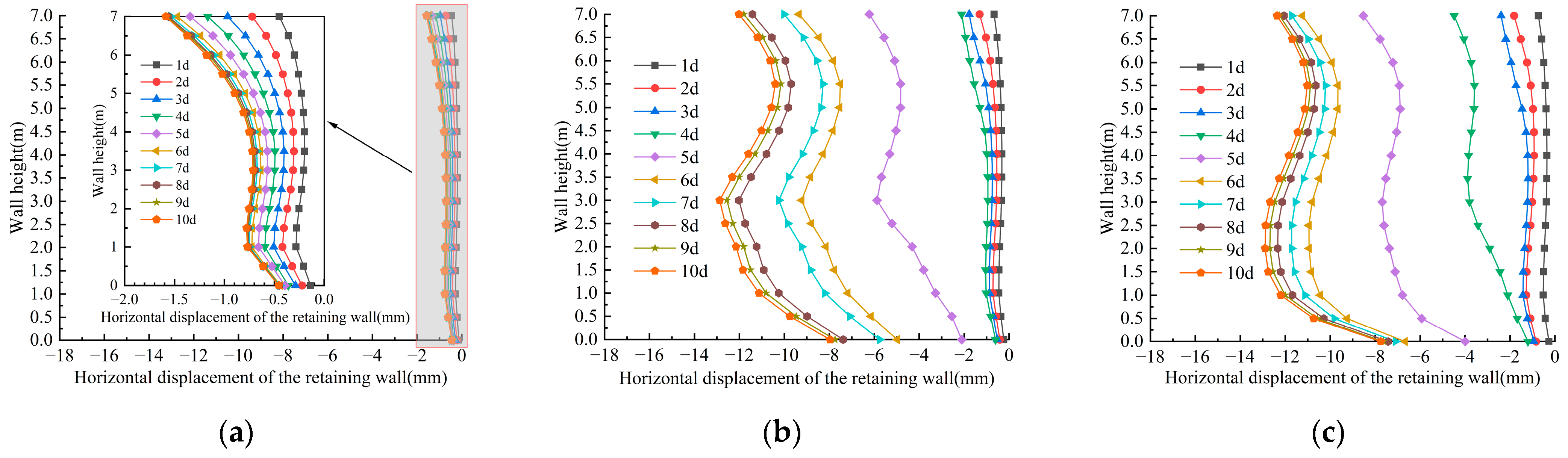
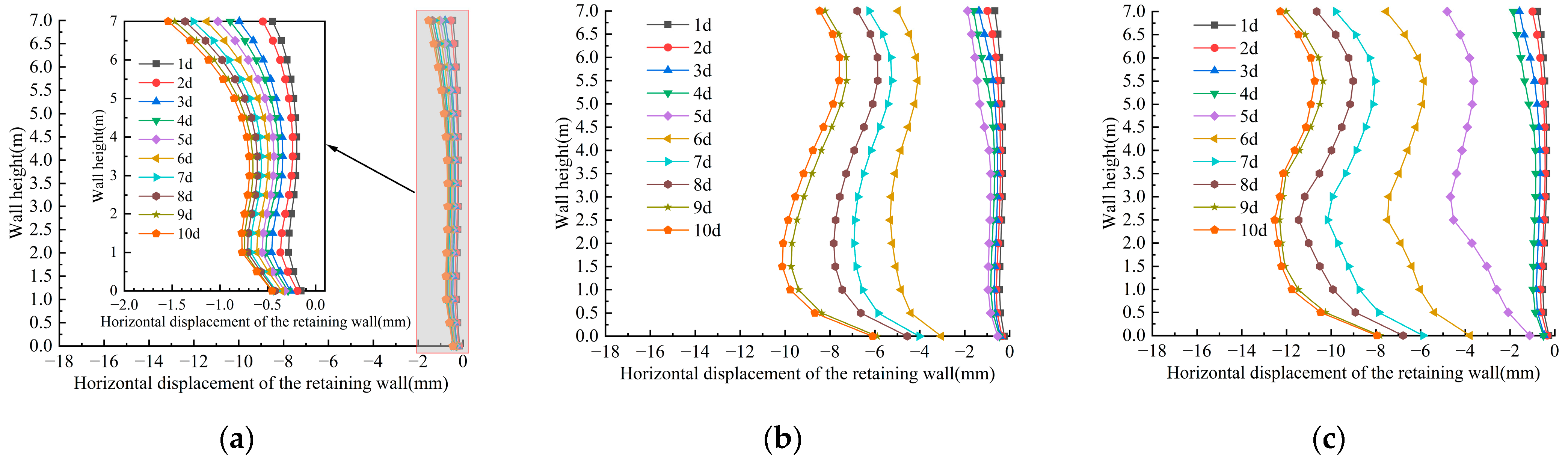
Figure 8 illustrates the variation curves of horizontal displacement of the reinforced soil gabion retaining wall under uniform rainfall conditions. With increasing rainfall duration, the absolute values of horizontal displacement of all reinforcement layers exhibit a continuous increasing trend, indicating that the accumulation of rainfall duration leads to a rise in pore water pressure and a reduction in soil shear strength, which in turn results in an increase in the absolute horizontal displacement of the retaining wall. When the rainfall intensity is 20 mm/d, and the rainfall duration reaches 10 d, the maximum absolute horizontal displacement of the retaining wall is 1.59 mm, indicating relatively small overall deformation. However, when the rainfall intensity increases to 50 mm/d under the same rainfall duration, the maximum absolute horizontal displacement of the retaining wall rises sharply to 12.87 mm. At a rainfall intensity of 80 mm/d, the maximum absolute horizontal displacement is comparable to that at 50 mm/d, reaching 12.89 mm, suggesting that the reinforced soil gabion retaining wall is capable of effectively restraining the overall lateral deformation of the retaining wall under rainfall conditions.
With regard to the location of maximum displacement, at a rainfall intensity of 20 mm/d, the maximum displacement consistently occurs at the wall crest throughout the 10 d rainfall period. At a rainfall intensity of 50 mm/d, no pronounced displacement is observed during the first 1–4 d of rainfall; however, a sudden increase in displacement occurs on the fifth day, after which the maximum lateral displacement of the retaining wall predominantly appears in the middle-to-lower portion of the wall as well as at the wall crest. At a rainfall intensity of 80 mm/d, a sudden change in lateral deformation occurs as early as the fourth day, and subsequently, the maximum overall lateral displacement is likewise concentrated in the middle-to-lower section of the wall and at the crest. These observations indicate that with increasing rainfall intensity, pore water pressure induced by rainfall infiltration accumulates more rapidly within the slope, causing an earlier onset of abrupt increases in the lateral displacement of the retaining wall.

4.1.2. Horizontal Displacement Analysis of the Retaining Wall Under Intermittent Rainfall

Figure 9 presents the variation curves of horizontal displacement of the reinforced soil gabion retaining wall under intermittent rainfall conditions. Overall, the growth trend of the time-history curves of horizontal displacement under intermittent rainfall is broadly consistent with that observed under uniform rainfall. Moreover, the horizontal displacement of the retaining wall is significantly intensified with increasing rainfall intensity. At the end of the rainfall duration, when the rainfall intensity is 20 mm/d, the maximum absolute horizontal displacement along the wall height is 1.54 mm, indicating relatively minor overall deformation, which is slightly smaller than that observed under uniform rainfall at the same intensity. When the rainfall intensity increases to 50 mm/d and 80 mm/d, the maximum absolute horizontal displacement of the retaining wall increases to 10.12 mm and 12.52 mm, respectively, both of which remain smaller than the corresponding values under uniform rainfall conditions with the same rainfall intensities.
In addition, Figure 9 shows that under a rainfall intensity of 20 mm/d, deformation during the early stage of rainfall is relatively uniform, and the horizontal displacement of the retaining wall increases gradually. Under the rainfall intensity of 50 mm/d, a pronounced sudden increase in the displacement curve occurs from the sixth day onwards. Subsequently, the reinforcement displacement exhibits a non-uniform growth pattern associated with intermittent rainfall, namely the alternating “rainfall–dry” process. Specifically, rainfall infiltration leads to a reduction in soil shear strength parameters and an increase in the active earth pressure coefficient, thereby increasing earth pressure and causing a rapid growth in lateral displacement of the retaining wall. During the dry period, pore water pressure within the soil gradually dissipates, and although the lateral displacement of the retaining wall continues to increase, the growth rate is significantly lower than that during the rainfall stage. As a result, a nonlinear “fast–slow alternating” growth pattern is observed. Furthermore, when the rainfall intensity increases to 80 mm/d, this nonlinear time-history behaviour of lateral displacement becomes evident as early as the fifth day of the rainfall duration.

4.2. Analysis of Pore Water Pressure Variation

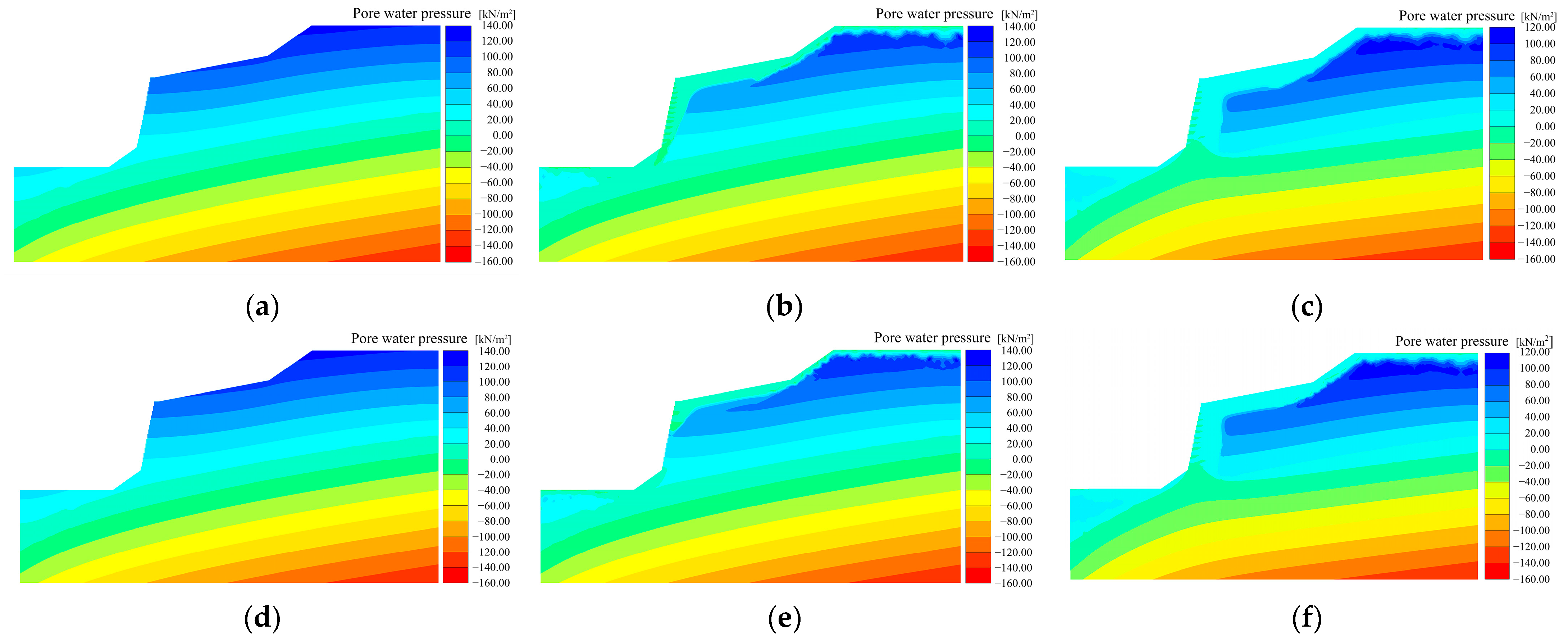
Figure 10 illustrates the contour distributions of pore water pressure in the reinforced soil gabion retaining wall under different rainfall patterns at a rainfall intensity of 50 mm/d, where locations with zero pore water pressure represent the groundwater table. Following steady-state groundwater seepage analysis, the initially polyline-shaped groundwater table is transformed into a streamline-shaped distribution. A comparison of pore water pressure contours at key time steps under the two rainfall patterns indicates that the initial pore water pressure distributions are essentially identical. After a rainfall duration of 5 d, under uniform rainfall conditions, the saturated zone within the reinforced soil gabion retaining wall model expands markedly compared with the initial state, and rainfall infiltration has almost penetrated the entire retaining wall structure and part of the backfill soil behind it. In contrast, under intermittent rainfall conditions, although the saturated zone also expands significantly relative to the initial condition, both its depth and extent remain smaller than those observed under uniform rainfall. At the end of the rainfall duration, pronounced pore water pressure responses are observed in the models under both uniform and intermittent rainfall, with the saturated zones expanding substantially and penetrating through the reinforced retaining wall structure and the backfill soil. Moreover, the infiltration depth and extent of saturation induced by uniform rainfall are slightly greater than those under intermittent rainfall, indicating that uniform rainfall is more conducive to the continuity and expansion of the saturated zone, whereas intermittent rainfall, characterised by alternating wetting and drying, promotes pore pressure dissipation and results in relatively delayed soil saturation.
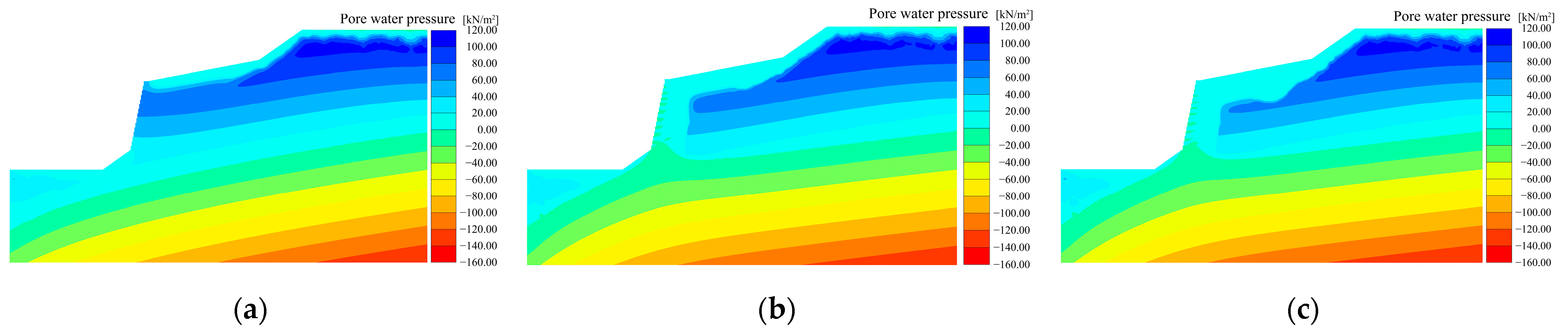
Figure 11 presents the pore water pressure contours of the reinforced soil gabion retaining wall under uniform rainfall with different rainfall intensities at the end of the rainfall duration. It can be observed that, under the same rainfall pattern, an increase in rainfall intensity leads to an expansion of the rainfall infiltration range [43]. When the rainfall intensity is 20 mm/d, the saturated zone remains relatively limited and is confined to the shallow surface layer of the wedge-shaped backfill near the wall crest, with almost no infiltration occurring within the gabion retaining wall. As the rainfall intensity increases to 50 mm/d, greater rainfall infiltration occurs per unit time with increasing rainfall duration, exceeding the drainage capacity of the gabion wall, which results in rainfall infiltration into the backfill soil and a pronounced expansion of the saturated zone. When the rainfall intensity is further increased to 80 mm/d, the infiltration rate far exceeds the drainage capacity of the wall, leading to large-scale saturation of the soil behind the wall, with the extent of the saturated zone expanding by approximately four times.

4.3. Stability Analysis

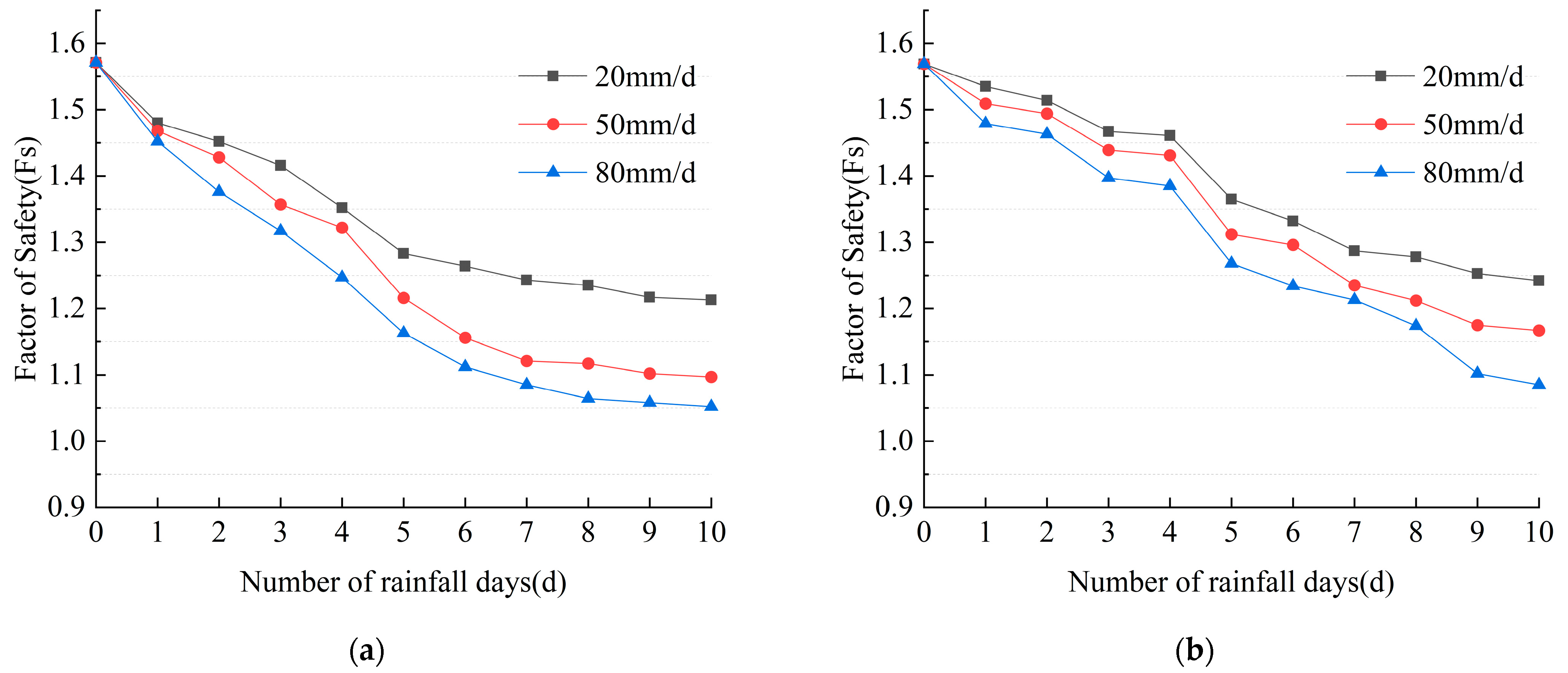
Previous research by Griffiths and Lane or Matsui and San [44,45] has demonstrated the superiority of the finite element method (FEM) over traditional limit equilibrium methods (LEM) for slope stability analysis. Within the framework of finite element numerical simulation, the Factor of Safety (Fs) serves as a critical quantitative indicator for evaluating the global stability of reinforced soil gabion walls. The stability coefficient is an important indicator for evaluating the overall stability of reinforced soil gabion retaining walls on slopes. The stability coefficients of reinforced soil gabion retaining walls under different rainfall patterns and rainfall intensities were analysed, and the variation curves of the safety factor for each working condition were obtained, as shown in Figure 12.
As can be observed from Figure 12:
When the reinforced soil gabion retaining wall is subjected to uniform rainfall conditions, the slope safety factor decreases with increasing rainfall intensity. This result is consistent with the trends reported in the literature regarding the influence of rainfall intensity on the safety factor [46,47,48]. Under uniform rainfall, the initial safety factor prior to rainfall is 1.571 for all rainfall intensities. At the end of the rainfall process, the safety factor of the reinforced soil gabion retaining wall model decreases to 1.213 for a rainfall intensity of 20 mm/d, corresponding to a reduction of 22.8%. When the rainfall intensity is 50 mm/d, the final safety factor decreases to 1.097, with a reduction of 30.2%, while at a rainfall intensity of 80 mm/d, the final safety factor further decreases to 1.052, representing a reduction of 33.0%. Under uniform rainfall conditions, the reduction in the slope safety factor exhibits a lagging behaviour. This is attributed to the fact that during the early stage after rainfall cessation, although surface soils no longer receive external rainfall input, the previously infiltrated rainwater continues to percolate to deeper zones under the combined effects of gravity and capillarity. As a result, the extent of rainfall infiltration within the slope continues to increase, causing the slope safety factor to remain in a decreasing trend during the early dry period and to gradually stabilise as the duration of rainfall cessation increases. This trend is consistent with the variation in slope safety factors under uniform rainfall conditions reported in the literature [42]. Combined with the analysis of lateral displacement characteristics under uniform rainfall, the horizontal displacement of the retaining wall exhibits a significant, abrupt trend around the 4th to 5th day of rainfall duration. A comparison with the evolution curve of the factor of safety reveals that the rate of decline in stability also increases during this stage compared to the previous period. This suggests a strong consistency between the sudden surge in wall displacement and the accelerated deterioration of overall stability.
Under intermittent rainfall conditions, the slope safety factor at the end of the rainfall duration is higher than that under uniform rainfall with the same rainfall intensity, and a negative correlation between rainfall intensity and slope safety factor is observed. This finding is in agreement with the numerical results reported in the literature regarding slope safety factors under uniform and intermittent rainfall conditions [49]. For intermittent rainfall, the initial safety factor prior to rainfall is 1.571 for all three rainfall intensities. At the end of the rainfall process, the safety factor decreases to 1.242 for a rainfall intensity of 20 mm/d, corresponding to a reduction of 20.9% when the rainfall intensity is 50 mm/d, the final safety factor decreases to 1.167, with a reduction of 25.7% and when the rainfall intensity reaches 80 mm/d, the final safety factor further decreases to 1.085, corresponding to a reduction of 30.9%. Moreover, under intermittent rainfall conditions, the relationship between the safety factor and time is characterised by a gradual decreasing trend, with the rate of decrease during rainfall periods being significantly higher than that during dry periods. This is reflected in the time-history curves of the safety factor, where the slope of the curve during rainfall periods is noticeably steeper than that during dry periods. This behaviour can be attributed to the partial dissipation of pore water pressure during dry intervals under intermittent rainfall, which leads to a relative increase in soil shear strength compared with the rainfall stage, thereby slowing the reduction in slope safety factor during dry periods. Analysis of the lateral displacement under intermittent rainfall reveals that the reduction in the factor of safety is minimal in the early stages. From the 4th day onwards, the stability coefficient follows an overall decreasing trend with alternating ‘fast-slow’ cycles, mirroring the stepwise growth characteristics of the wall’s lateral displacement under the same rainfall pattern.

4.4. Analysis of Slip Surface Evolution of Reinforced Soil Gabion Retaining Walls on Slopes

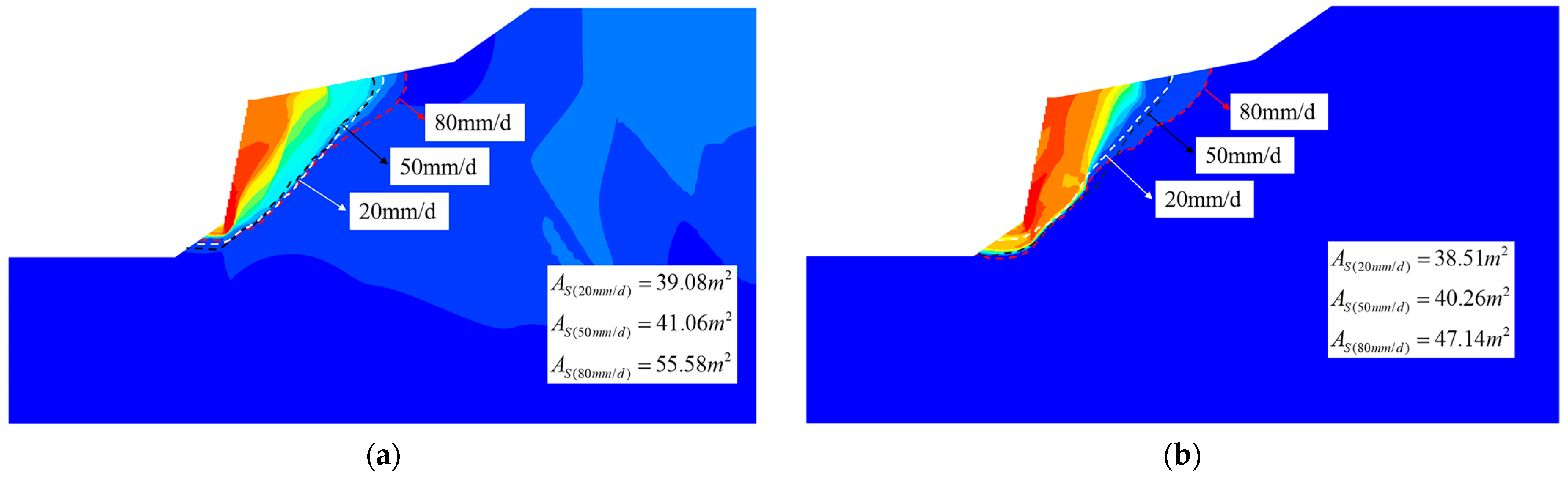
Slope sliding failure invariably develops along a specific slip surface, which is defined as the most critical or dangerous slip surface [50]. Existing studies have demonstrated that rainfall pattern is one of the key factors governing the evolution characteristics of slope slip surface extent [51]. In PLAXIS 2D, the determination of slope slip surfaces is primarily based on safety factor analysis, particularly through the strength reduction method, by which potential slip surfaces and their stability are identified. Figure 13 shows the variation in slip surfaces in the reinforced soil gabion retaining wall under different rainfall patterns and intensities at the end of the duration (Day 10). As rainfall intensity increases, the sliding area (As) of the reinforced soil gabion retaining wall correspondingly increases [23]. Under uniform rainfall conditions, when the rainfall intensity increases from 20 mm/d to 50 mm/d, the sliding area increases from 39.08 m2 to 41.06 m2, and reaches its maximum value at a rainfall intensity of 80 mm/d (As = 55.58 m2). Under intermittent rainfall conditions, when the rainfall intensity increases from 20 mm/d to 50 mm/d, the sliding area increases from 38.51 m2 to 40.26 m2, and similarly reaches its maximum at a rainfall intensity of 80 mm/d (As = 47.14 m2). These results indicate that higher rainfall intensities are associated with greater slope sliding risk [43,52]. Overall, for the same rainfall intensity, the reinforced soil gabion retaining wall model subjected to uniform rainfall exhibits a larger sliding area, indicating a higher susceptibility to sliding compared with intermittent rainfall conditions.

5. Conclusions

In this study, numerical simulation methods were employed to analyse the variation characteristics of horizontal displacement, pore water pressure, safety factor, and slip surfaces of reinforced soil gabion retaining walls under different rainfall patterns and rainfall intensities. The following conclusions can be drawn:
(1)
For a given rainfall intensity, the absolute horizontal displacement of the retaining wall induced by uniform rainfall is generally greater than that induced by intermittent rainfall, indicating that uniform rainfall exerts a more pronounced influence on the overall deformation of the retaining wall. Under the same rainfall pattern, the maximum absolute horizontal displacement of the retaining wall increases with increasing rainfall intensity. Under uniform rainfall, the maximum absolute horizontal displacements corresponding to rainfall intensities of 20, 50, and 80 mm/d are 1.59 mm, 12.87 mm, and 12.89 mm, respectively, while the corresponding values under intermittent rainfall are 1.54 mm, 10.12 mm, and 12.52 mm. The reason for this phenomenon is that after the rainfall reaches a certain level, the soil may enter a fully saturated state, meaning that the pores in the soil are filled with water. In this case, further rainfall may not significantly increase the pore-water pressure and thus, will not further drive the displacement of the slope.
(2)
Rainfall pattern has a significant influence on the distribution characteristics of the time-history curves of the horizontal displacement of the retaining wall. Under uniform rainfall conditions, the growth of horizontal displacement over time is relatively uniform, although sudden increases may occur over short time intervals. In contrast, under intermittent rainfall, the horizontal displacement of the retaining wall exhibits a rainfall-pattern-dependent non-uniform growth behaviour associated with the alternating “rainfall–dry” process.
(3)
For a given rainfall pattern, heavy rainfall results in greater infiltration depth and a wider affected zone within the slope soil. Compared with a rainfall intensity of 20 mm/d, a rainfall intensity of 80 mm/d increases the affected zone of the slope soil by approximately four times. Under the same rainfall intensity, the infiltration range of soil induced by uniform rainfall is larger than that under intermittent rainfall.
(4)
Under uniform rainfall conditions, the time-history curve of the slope safety factor shows a decreasing trend during the rainfall stage and the early period after rainfall cessation, and eventually tends to stabilise. In contrast, under intermittent rainfall, the safety factor exhibits a rainfall-pattern-related continuously decreasing trend characterised by alternating fast and slow reduction rates. Under uniform rainfall, the slope safety factor decreases from an initial value of 1.571 to 1.213 (20 mm/d), 1.097 (50 mm/d), and 1.052 (80 mm/d), respectively. Under intermittent rainfall, the corresponding values decrease to 1.242, 1.167, and 1.085.
(5)
The depth and extent of the slip surface are jointly controlled by rainfall intensity and rainfall pattern. With increasing rainfall intensity, the sliding area expands significantly, leading to a higher likelihood of instability and failure. For the same rainfall intensity, the sliding area under uniform rainfall is larger than that under intermittent rainfall, indicating a greater risk of sliding failure under uniform rainfall conditions.

Author Contributions

Conceptualisation, W.S.; methodology, X.T. and C.L.; software, F.L.; validation, Y.Z. and M.F.; formal analysis, W.J.; investigation, L.Z. and W.J.; data curation, L.Z. and F.L.; writing—original draft preparation, L.Z.; writing—review and editing, W.S. and W.J.; visualisation, M.F.; supervision, W.S. All authors have read and agreed to the published version of the manuscript.

Funding

This research was funded by the National Natural Science Foundation of China (Grant Number 52278507).

Data Availability Statement

The original contributions presented in this study are included in the article. Further inquiries can be directed to the corresponding author(s).

Conflicts of Interest

Lijuan Zhang, Xuekai Tian and Mingkun Fang were employed by the company Shandong Electric Power Engineering Consulting Institute Co., Ltd. Cunyou Lin was employed by the company Shandong Luqiao Group Co., Ltd. The remaining authors declare that the research was conducted in the absence of any commercial or financial relationships that could be construed as a potential conflict of interest.

References

  1. Zhang, H.; Wu, Z.; Zan, Y.; Li, Y.; Gong, C.; Xiong, F.; Che, T. Soil Erosion and Control of Wind Power Project Areas in Jiangxi Mountainous Area. Bull. Soil Water Conserv. 2018, 38, 7–13. [Google Scholar] [CrossRef]
  2. Wu, Z.; Huang, C.; Hao, S.; Li, J.; Miao, L.; Zhang, T. Stability Analysis of a Transmission Line Tower and Slope under Heavy Rainfall. Water 2023, 15, 3654. [Google Scholar] [CrossRef]
  3. Liu, B.; Wagner, L.E.; Ning, D.; Qu, J. Estimation of Wind Erosion from construction of a railway in arid Northwest China. Int. Soil Water Conserv. Res. 2017, 5, 102–108. [Google Scholar] [CrossRef]
  4. Kinuthia, J.; Snelson, D.; Gailius, A. Sustainable Medium-Strength Concrete (CS-Concrete) from Colliery Spoil in South Wales UK. J. Civ. Eng. Manag. 2009, 15, 149–157. [Google Scholar] [CrossRef]
  5. Yang, Y.-Y.; Wu, H.-N.; Shen, S.-L.; Horpibulsuk, S.; Xu, Y.-S.; Zhou, Q.-H. Environmental Impacts Caused by Phosphate Mining and Ecological Restoration: A Case History in Kunming, China. Nat. Hazards 2014, 74, 755–770. [Google Scholar] [CrossRef]
  6. Zhou, Y.-G.; Ning, S.; Cao, Y.; Chen, Y.-M. Centrifuge Model Test on the Effect of Soil Fluidization on The Bending Moment of the Sheet Pile Wall. Soil Dyn. Earthq. Eng. 2025, 195, 109411. [Google Scholar] [CrossRef]
  7. Cho, D.-S.; Kim, J. Stability of the Front Wall and the Horizontal Behavior of Composite Reinforced-Earth Retaining Walls. Acta Geotech. 2024, 19, 8165–8176. [Google Scholar] [CrossRef]
  8. Xu, R.; Chen, L.; Fang, Q.; Zheng, Y.; Li, Z.; Cao, M. Protective Effects of Gabion Wall Against Blast Waves from Large TNT-Equivalent Explosions. Eng. Struct. 2021, 249, 113389. [Google Scholar] [CrossRef]
  9. Balasbaneh, A.T.; Yeoh, D.; Juki, M.I.; Ibrahim, M.H.W.; Abidin, A.R.Z. Assessing the Life Cycle Study of Alternative Earth-Retaining Walls from an Environmental and Economic Viewpoint. Environ. Sci. Pollut. Res. 2021, 28, 37387–37399. [Google Scholar] [CrossRef]
  10. Bergado, D.T.; Youwai, S.; Teerawattanasuk, C.; Visudmedanukul, P. The Interaction Mechanism and Behavior of Hexagonal Wire Mesh Reinforced Embankment with Silty Sand Backfill on Soft Clay. Comput. Geotech. 2003, 30, 517–534. [Google Scholar] [CrossRef]
  11. Bathurst, R.J.; Karpurapu, R. Large-Scale Triaxial Compression Testing of Geocell-Reinforced Granular Soils. Geotech. Test. J. 1993, 16, 296–303. [Google Scholar] [CrossRef]
  12. Jayasree, P.K. Performance of Gabion Faced Reinforced Earth Retaining Walls. Ph.D. Thesis, Cochin University of Science & Technology, Kochi, India, 2008. [Google Scholar]
  13. Liu, Z.; Huang, X.; Yang, G. Study of a Combined Panel Earth Retaining Wall Reinforced with Double Twisted Hexagonal Wire Mesh by Using Site Test. Rock Soil Mech. 2011, 32, 3295–3300. [Google Scholar] [CrossRef]
  14. Jiang, J.; Yang, G. Field Test and Numerical Simulation on Mechanical Behavior of Red Bed Soil-Rock Embankment Reinforced with Gabion. Rock Soil Mech. 2016, 37, 156–165. [Google Scholar] [CrossRef]
  15. Meng, Y.; Xu, C.; Yang, Y.; Li, G.; Wei, X.; Jia, B. Seismic Performance of Reinforced Soil Slopes with Gabions and Geobags as Slope Facings in Shaking Table Test. Soil Dyn. Earthq. Eng. 2025, 198, 109645. [Google Scholar] [CrossRef]
  16. Lin, Y.L.; Yang, G.L. Dynamic Deformation Behavior and Life Analysis of Green Reinforced Gabion Retaining Wall. Appl. Mech. Mater. 2012, 256–259, 251–255. [Google Scholar] [CrossRef]
  17. Wang, Y.; Smith, J.V.; Nazem, M. Effect of Various Rainfall Conditions on the Roadside Stabilisation of Slopes in Gippsland. Int. J. Civ. Eng. 2023, 21, 173–192. [Google Scholar] [CrossRef]
  18. Yang, G.; Shen, Q.; Xu, J. Site Test and Numerical Analysis on Reinforeed Earth Retaining Wall with Green Gabion on Expressway. China J. Highw. Transp. 2015, 28, 18–23. [Google Scholar] [CrossRef]
  19. Lin, Y.; Liu, S.; He, B.; Li, L.; Qiao, L. Mechanical Behavior of Geogrid Flexible Reinforced Soil Wall Subjected to Dynamic Load. Buildings 2024, 14, 1628. [Google Scholar] [CrossRef]
  20. Zou, W.; Leng, J.; Wang, X. Numerical Analysis of Working Properties and Soil Pressure Calculation of Geosynthetic-Reinforced Soil Gravity Retaining Wall. Rock Soil Mech. 2011, 32, 70–75. [Google Scholar] [CrossRef]
  21. Wu, J.Y.; Chou, N.N. Forensic Studies of Geosynthetic Reinforced Structure Failures. J. Perform. Constr. Facil. 2013, 27, 604–613. [Google Scholar] [CrossRef]
  22. Li, X.; Cai, X.; Li, S.; Huang, X.; Zhu, C.; Xu, H. Analysis of the Structural Behavior Evolution of Reinforced Soil Retaining Walls Under the Combined Effects of Rainfall and Earthquake. Buildings 2025, 15, 115. [Google Scholar] [CrossRef]
  23. Yang, K.-H.; Wu, H.-M.; Tseng, T.-L.; Yoo, C. Model Tests of Geosynthetic-Reinforced Soil Walls with Marginal Backfill Subjected to Rainfall. Geotext. Geomembr. 2023, 51, 342–359. [Google Scholar] [CrossRef]
  24. Santos, M.C.; C, Y.; Portelinha, F.H.M. Influence of Rainfall and Drying Periods on the Performance of a Large-Scale Segmental Grs Wall Model Built with Poorly Draining Local Soil. Geotext. Geomembr. 2025, 53, 847–866. [Google Scholar] [CrossRef]
  25. Ma, Z. Slope Stability Analysis Considering Rainfall Infiltration Based on Energy Conservation. Shock Vib. 2025, 2025, 5525588. [Google Scholar] [CrossRef]
  26. Kim, J.; Jeong, S.; Regueiro, R.A. Instability of Partially Saturated Soil Slopes Due to Alteration of Rainfall Pattern. Eng. Geol. 2012, 147–148, 28–36. [Google Scholar] [CrossRef]
  27. Tang, G.; Huang, J.; Sheng, D.; Sloan, S.W. Stability Analysis of Unsaturated Soil Slopes under Random Rainfall Patterns. Eng. Geol. 2018, 245, 322–332. [Google Scholar] [CrossRef]
  28. Yoo, C.; Tabish, A.; Yang, J.W.; Abbas, Q.; Song, J.S. Effect of Internal Drainage on Deformation Behavior of GRS Wall During Rainfall. Geosynth. Int. 2022, 29, 137–150. [Google Scholar] [CrossRef]
  29. Wu, L.Z.; Xu, Q.; Zhu, J.D. Incorporating Hydro-Mechanical Coupling in An Analysis of the Effects of Rainfall Patterns on Unsaturated Soil Slope Stability. Arab. J. Geosci. 2017, 10, 386. [Google Scholar] [CrossRef]
  30. Song, X.; Tan, Y. Experimental Investigation on the Influences of Rainfall Patterns on Instability of Sandy Slopes. Environ. Earth Sci. 2021, 80, 803. [Google Scholar] [CrossRef]
  31. Gui, M.-W.; Chu, H.-A.; Chung, M.-C.; Chih, L.-S. Integrating Rainfall Distribution Patterns and Slope Stability Analysis in Determining Rainfall Thresholds for Landslide Occurrences: A Case Study. Water 2025, 17, 1240. [Google Scholar] [CrossRef]
  32. Rahimi, A.; Rahardjo, H.; Leong, E.C. Effect of Antecedent Rainfall Patterns on Rainfall-Induced Slope Failure. J. Geotech. Geoenviron. Eng. 2011, 137, 483–491. [Google Scholar] [CrossRef]
  33. Yang, Z.; Cheng, D.; Xia, J. Effects of the Rainfall-Triggered Lisse Effect on the Stability of Loess Slopes. J. Earth Sci. 2024, 35, 1254–1262. [Google Scholar] [CrossRef]
  34. Li, S.; Cai, X.; Jing, L.; Xu, H.; Huang, X.; Zhu, C. Lateral Displacement Control of Modular-Block Reinforced Soil Retaining Walls under Horizontal Seismic Loading. Soil Dyn. Earthq. Eng. 2021, 141, 106485. [Google Scholar] [CrossRef]
  35. Cai, X.; Zhang, S.; Li, S.; Xu, H.; Huang, X.; Zhu, C.; Liu, X. Dynamic Characteristics of Reinforced Soil Retaining Wall with Composite Gabion Based on Time Domain Identification Method. Sustainability 2022, 14, 16321. [Google Scholar] [CrossRef]
  36. Li, C.; Zhang, R.; Zhu, J.; Lu, B.; Wang, X.; Xu, F.; Shen, X.; Liu, J.; Cai, W. Model Test Study on Response of Weathered Rock Slope to Rainfall Infiltration under Different Conditions. J. Earth Sci. 2024, 35, 1316–1333. [Google Scholar] [CrossRef]
  37. Grodecki, M. Numerical modelling of gabion joints. Tech. Trans. 2017, 114, 83–89. [Google Scholar] [CrossRef]
  38. Li, Z.; Huang, D.; Liang, Y.; Song, Y. Control effect of a novel high-permeability counterfort retaining wall on rainfall-induced landslides. Environ. Earth Sci. 2025, 84, 96. [Google Scholar] [CrossRef]
  39. Mahmood, K.; Kim, J.M.; Ashraf, M.; Ziaurrehman. The Effect of Soil Type on Matric Suction and Stability of Unsaturated Slope under Uniform Rainfall. KSCE J. Civ. Eng. 2016, 20, 1294–1299. [Google Scholar] [CrossRef]
  40. Ni, P.; Mei, G.; Zhao, Y. Influence of Raised Groundwater Level on the Stability of Unsaturated Soil Slopes. Int. J. Geomech. 2018, 18, 04018168. [Google Scholar] [CrossRef]
  41. Wang, M.; Li, L. Slope Stability Analysis Considering Degradation of Soil Properties Induced by Intermittent Rainfall. Water 2025, 17, 814. [Google Scholar] [CrossRef]
  42. Chen, J.; Zhou, C.; Lin, M.; Dong, G.; Gao, P. Stability Analysis of Mixed Granite Cutting Slope under Different Rainfall Types. Saf. Environ. Eng. 2024, 31, 150–162. [Google Scholar] [CrossRef]
  43. Wu, Z.; Yang, G.; Li, W.; Chen, X.; Liu, F.; Zheng, Y. Numerical Simulation Study of Rainfall-Induced Saturated-Unsaturated Landslide Instability and Failure. Water 2025, 17, 2229. [Google Scholar] [CrossRef]
  44. Griffiths, D.V.; Lane, P.A. Discussion: Slope stability analysis by finite elements. Géotechnique 2001, 51, 653–654. [Google Scholar] [CrossRef]
  45. Matsui, T.; San, K.-C. Finite element slope stability analysis by shear strength reduction technique. Soils Found. 1992, 32, 59–70. [Google Scholar] [CrossRef]
  46. Huang, J.; Chen, Z.; Qin, W. Reliability Analysis of Two-Dimensional Slope Stability under Rainfall Conditions. J. Fuzhou Univ. 2017, 45, 501–507. [Google Scholar] [CrossRef]
  47. Liu, Y.; Yang, Y.; Hu, A. Stability Analysis of Loess Slope Combined with Limit Equilibrium Method under Different Rainfall Intensities. Appl. Math. Nonlinear Sci. 2024, 9, 1–22. [Google Scholar] [CrossRef]
  48. Lin, H.; Zhong, W. Influence of Rainfall Intensity and Its Pattern on the Stability of Unsaturated Soil Slope. Geotech. Geol. Eng. 2019, 37, 615–623. [Google Scholar] [CrossRef]
  49. Gao, X.; Zha, W.; Qi, X.; Xu, T.; Ji, C. Numerical Simulation of Three-Dimensional Seepage Deformation and Stability of Unsaturated Soil Landslide under Different Rainfall Conditions. Sci. Technol. Eng. 2025, 25, 8445–8454. [Google Scholar] [CrossRef]
  50. Ye, S.; Shi, Y. Stability Analysis of Multi-Stage High Slope with Loess under Rainfall Infiltration. J. Eng. Geol. 2018, 26, 1648–1656. [Google Scholar] [CrossRef]
  51. Yang, G.; Tao, H.; Lei, S.; Zhang, M. Analysis of Seepage and Stability of Unsaturated Soil Slopes Under Different Rainfall Patterns. Water Resour. Power 2022, 40, 166–170. [Google Scholar]
  52. Chinkulkijniwat, A.; Tirametatiparat, T.; Supotayan, C.; Yubonchit, S.; Horpibulsuk, S.; Salee, R.; Voottipruex, P. Stability Characteristics of Shallow Landslide Triggered by Rainfall. J. Mt. Sci. 2019, 16, 2171–2183. [Google Scholar] [CrossRef]
Figure 1. Experimental Design of the Reinforced Soil Gabion Retaining Wall Model.
Buildings 16 01003 g001
Figure 2. Experimental Model of the Reinforced Soil Gabion Retaining Wall.
Buildings 16 01003 g002
Figure 3. Numerical Calculation Model of the Reinforced Soil Gabion Retaining Wall.
Buildings 16 01003 g003
Figure 4. Comparison between Model Test and Numerical Simulation Results: (a) Variation in Lateral Displacement of Wall Facing Panels along Wall Height; (b) Variation in Wall Crest Settlement with Load; (c) Curves of horizontal displacement at the wall top versus load; (d) The displacement of the reinforced soil retaining wall under rainfall effects.
Buildings 16 01003 g004aBuildings 16 01003 g004b
Figure 5. Finite Element Computational Model.
Buildings 16 01003 g005
Figure 6. Soil–Water Characteristic Curves and Soil Permeability Functions: (a) Spoil Material; (b) Original slope.
Buildings 16 01003 g006
Figure 7. Rainfall Patterns: (a) Uniform Rainfall; (b) Intermittent Rainfall.
Buildings 16 01003 g007
Figure 8. Horizontal Displacement Curves of the Retaining Wall under Uniform Rainfall with Different Rainfall Intensities: (a) 20 mm/d; (b) 50 mm/d; (c) 80 mm/d.
Buildings 16 01003 g008
Figure 9. Horizontal Displacement Curves of the Retaining Wall under Intermittent Rainfall with Different Rainfall Intensities: (a) 20 mm/d; (b) 50 mm/d; (c) 80 mm/d.
Buildings 16 01003 g009
Figure 10. Pore Water Pressure Contours of the Reinforced Soil Gabion Retaining Wall under Different Rainfall Patterns (Rainfall Intensity: 50 mm/d): (a) Condition 2 at the Initial Stage; (b) Condition 2 after 5 d; (c) Condition 2 after 10 d; (d) Condition 5 at the Initial Stage; (e) Condition 5 after 5 d; (f) Condition 5 after 10 d.
Buildings 16 01003 g010
Figure 11. Pore Water Pressure Contours of the Reinforced Soil Gabion Retaining Wall under Uniform Rainfall with Different Rainfall Intensities at the End of the Rainfall Duration: (a) 20 mm/d; (b) 50 mm/d; (c) 80 mm/d.
Buildings 16 01003 g011
Figure 12. Variation Curves of the Safety Factor of the Reinforced Soil Gabion Retaining Wall under Different Rainfall Patterns and Rainfall Intensities: (a) Uniform Rainfall; (b) Intermittent Rainfall.
Buildings 16 01003 g012
Figure 13. Slip surfaces of the reinforced soil gabion retaining wall under different rainfall patterns and intensities at the end of the duration (Day 10): (a) Uniform Rainfall; (b) Intermittent Rainfall.
Buildings 16 01003 g013
Table 1. Similarity Ratios of Physical Quantities in the Model Test.
No.Physical QuantitySimilarity RelationshipSimilarity Ratio
1:3.33
1 Geometric scale L C L 3.33
2 Elastic modulus E C E = C L 3.33
3 DensityDensity ρ C ρ = 1 1
4 Cohesion c C c = C L 3.33
5 Internal friction angle φ C φ = 1 1
6 Poisson’s ratio μ C μ = 1 1
7 Duration d T d 1.825
8 Frequency ω C ω = C L 0.5 0.578
9 Angular displacement θ C θ = 1 1
10 Linear displacement s C s = C L 3.33
11 Stress σ C σ = C L 3.33
12 Strain ε C ε = 1 1
13 Gravitational acceleration g C g = 1 1
Table 2. Soil Material Parameters.
Name Unit Weight
γ/(kN·m−3)
Saturated Unit Weight γsat/(kN·m−3) Elastic Modulus
E r e f / M P a
Poisson’s Ratio μCohesion c/(kPa) Internal Friction Angle φ/(°) Interface Strength Reduction Factor Rint er
Gabion infill material23.024.15000.302041°0.67
Backfill soil18.219.32000.30533°1.0
Table 3. Material Parameters of Structural Elements.
No.Material NameMaterial TypeTensile Stiffness/(kN·m−1)Unit Weight/(kN·m−3)
1ReinforcementElastoplastic420.4219.0
2Gabion cageElastoplastic26821.2
Table 4. Material Model Parameters of Gabion Cages and Reinforcement.
No.Material NameMaterial TypeTensile Stiffness/(kN·m−1)Unit Weight/(kN·m−3)
1ReinforcementElastoplastic420.4219.0
2Gabion cageElastoplastic26821.2
Table 5. Physical and Mechanical Parameters of Geotechnical Materials.
Name Unit Weight γ/(kN·m−3) Saturated Unit Weight γsat/(kN·m−3) Horizontal Permeability Coefficient kx/(m/d) Vertical Permeability Coefficient ky/(m/d) Elastic Modulus Eref/MPa Poisson’s Ratio μ Cohesion c/(kPa) Internal Friction Angle φ/(°) Interface Strength Reduction Factor Rin ter
Original slope20.6220.020.025000.30533°0.67
Spoil material2122.50.4320.432600.281018°0.5
Gabion infill material25261.01.012000.302045°1.0
Table 6. Rainfall Scenario Settings.
ConditionRainfall PatternRainfall Duration/(d)Rainfall Intensity/(mm·d−1)
Condition 1Uniform patternRainfall for 5 days followed by a 5-day dry period20
Condition 250
Condition 380
Condition 4Intermittent patternRainfall for 1 day followed by a 1-day dry period (repeated cyclically over 10 days, with a cumulative rainfall duration of 5 days)20
Condition 550
Condition 680
Disclaimer/Publisher’s Note: The statements, opinions and data contained in all publications are solely those of the individual author(s) and contributor(s) and not of MDPI and/or the editor(s). MDPI and/or the editor(s) disclaim responsibility for any injury to people or property resulting from any ideas, methods, instructions or products referred to in the content.