


Abstract
This study presents a systematic investigation into the seismic performance of precast concrete shear walls using cold-extruded sleeve connections for reinforcement splicing. Quasi-static cyclic loading tests were conducted on a full-scale precast wall specimen and a cast-in-place reference wall to evaluate the influence of construction joint detailing on structural behavior. The experimental results show that the precast wall exhibited progressive crack propagation, stable energy dissipation, and slightly higher ultimate lateral load and deformation capacity compared to the cast-in-place counterpart. In contrast, the cast-in-place wall experienced abrupt failure due to concrete spalling and out-of-plane splitting, highlighting the critical importance of reinforcement continuity and joint configuration. To further investigate key design parameters, high-fidelity finite element models were developed in ABAQUS. Concrete was modeled using the Concrete Damaged Plasticity model, while steel rebars and sleeves were simulated with a bilinear constitutive law. The numerical simulations, validated against experimental data, achieved good agreement in terms of load-drift response, crack patterns, and stress distributions. A parametric study was conducted by varying the wall aspect ratio, axial compression ratio, and longitudinal reinforcement ratio in the boundary elements. The results indicate that both the aspect ratio and axial compression ratio have significant effects on lateral load capacity and drift capacity, whereas the reinforcement ratio in the boundary elements exerts a relatively minor influence. For walls with low shear-span-to-depth ratios and high axial compression, increasing both longitudinal and horizontal reinforcement leads to noticeable improvements in load-carrying capacity and ductility. These findings confirm the reliability of the cold-extruded sleeve connection system in precast shear wall applications. The study establishes a validated numerical framework for seismic performance prediction and provides practical guidance for optimizing the design of prefabricated walls. This contributes to enhancing structural safety and improving seismic ductility, thereby supporting the broader adoption of precast systems in sustainable construction.
1. Introduction
Compared with traditional cast-in-place concrete structures, precast concrete shear wall systems have gained widespread adoption in engineering practice due to their faster construction speed, higher quality control, reduced environmental impact, and better alignment with sustainable development goals. The structural integrity of precast concrete shear walls relies primarily on the performance of construction joints, which connect prefabricated components into a monolithic system capable of meeting required load-bearing capacity and stiffness under wind and seismic actions. Consequently, the mechanical behavior of these joints plays a decisive role in the overall structural performance.
Numerous studies have examined the seismic performance of precast reinforced concrete (RC) shear walls employing grouted sleeve connections or grouted lap splices. Research has focused on the connection performance of grouted sleeve splices under various influencing factors, including embedded depth, sleeve dimensions, and infill grout properties [1,2]. For instance, a pseudo-dynamic substructure test on a full-scale six-story precast box-modularized structure with RC shear walls demonstrated that wall-to-wall and wall-to-floor grouted sleeve connections exhibited satisfactory mechanical behavior, contributing to the structure’s excellent overall seismic performance [3]. Regarding the axial-bending capacity of grouted-anchorage precast shear walls, four calculation assumptions were proposed and applied using two reduction methods—based on actual internal forces and the equivalent principle of component shear capacity—to adjust the strength of longitudinal wall rebars in formulas from the Code for Design of Concrete Structures, with calculated results subsequently compared [4]. Furthermore, systematic investigations into the bond and seismic performance of sleeve vertical splices in steel fiber-reinforced lightweight aggregate precast shear walls identified an optimal sleeve depth of 150 mm combined with exposed aggregate surface treatment [5]. Additionally, the seismic performance of two horizontal joint types (U-shaped anchored joints and steel plate joints) in concrete-filled multi-cell steel tube composite shear walls was evaluated through experiments and finite element simulations. Results indicated that jointed specimens exhibited similar failure modes and seismic capacity as non-jointed ones, and a corresponding load-bearing capacity calculation method was proposed, providing a basis for the performance-based design of such prefabricated structures [6].
While some research has been conducted on cold-extruded sleeve connections, most studies have focused on single-component tests or specific application scenarios. There is a lack of systematic parametric analysis and in-depth investigation into failure mechanisms, and comprehensive research on the influence of key design parameters and the interactions between parameters remains insufficient—this has restricted the widespread application of this connection technology in prefabricated shear wall structures. Compared with the well-established research on grouted sleeve connections, studies on cold-extruded sleeve connections still lack systematic insights into the influence rules of key design parameters and targeted recommendations for structural design calculations. Existing research related to cold-extruded sleeve connections is mostly confined to single-component tests, with insufficient comprehensive analysis of how factors such as axial compression ratio and shear span ratio affect the seismic performance of structures. Meanwhile, the unified failure criterion model for this type of connection remains incomplete, making it challenging to directly guide engineering design. This study aims to fill the aforementioned gaps through a combined approach of experimental testing and numerical simulation, thereby providing a theoretical basis and design reference for the widespread application of cold-extruded sleeve connections in precast shear walls. For instance, seismic performance tests on precast frame and shear wall components with extruded sleeve rebar lap splices have been conducted, but the absence of standardized design guidelines means the connection performance has not yet been systematically evaluated [7]. Similarly, experimental and numerical investigations into the seismic behavior of assembled beam-column joints using pressed sleeve splices have been carried out, yet comprehensive parametric understanding is still limited [8]. In contrast, studies on other connection types are more advanced. The corrugated pipe-constrained grouted anchor connection has been optimized, with systematic examination of the effects of grout strength, anchorage length, and stirrup spacing on bond performance [9]. A novel horizontal friction-based connection for prefabricated shear walls has also been proposed, demonstrating reliable energy dissipation and stiffness characteristics under cyclic loading [10]. Furthermore, a new steel shear connector for horizontal joints has been developed through simulation and parametric analysis, showing stable shear behavior and good energy dissipation [11]. Given the limited systematic investigation into cold-extruded sleeve connections—particularly regarding their parametric behavior, failure mechanisms, and design implications—this study aims to address this gap through combined experimental and numerical analysis.
Cold-extruded sleeve connections in shear wall joints exhibit excellent seismic performance, and some scholars have carried out a series of studies on the seismic performance of cold-extruded sleeve connections in shear wall joints. The seismic performance of pressed-sleeve connections combined with recycled fine aggregate concrete was systematically investigated. The results demonstrated that this connection effectively transferred rebar stresses, allowing prefabricated components to exhibit hysteretic behavior and energy-dissipation capacity comparable to cast-in-place specimens, thereby verifying the applicability of existing design methods for this novel composite system [12]. The seismic performance of prefabricated recycled fine aggregate (RFA) concrete columns with pressed-sleeve connections was systematically investigated. The results indicated that RFA columns exhibited good load-bearing capacity, ductility, and energy-dissipation performance, validating the feasibility of pressed-sleeve connections in prefabricated recycled concrete structures and the applicability of existing design codes [13]. The seismic performance of prefabricated shear walls with pressed conical sleeve connections was systematically investigated using combined experimental and finite element methods. The results indicated that this novel connection effectively avoided the construction defects associated with traditional grouted sleeves, enabling prefabricated components to achieve seismic performance equivalent to cast-in-place walls [14]. The effects of anchorage defects in grouted sleeves on the seismic performance of prefabricated concrete shear walls were systematically investigated through cyclic loading tests. A combined reinforcement method using steel plates and high-strength grout was proposed, which effectively restored the strength, stiffness, and energy-dissipation capacity of damaged specimens [15]. Tassi investigated the mechanical model for the uniaxial loading behavior of extruded sleeves and proposed a mechanical solution model for extruded sleeve connections that accounts for different yield points via a correction matrix [16].
In this study, a precast concrete shear wall with vertical rebars pressed sleeve splicers located in the construction joint, and a cast-in-place benchmark wall were tested under reversed cyclic loading. A finite element model was established using the ABAQUS program and validated with test results. Then parametric analysis was conducted to investigate the influence of wall aspect ratio, axial load level and longitudinal reinforcement ratio in boundary elements on the seismic performance of the precast concrete shear wall.
2. Experimental Investigations
2.1. Specimen Design
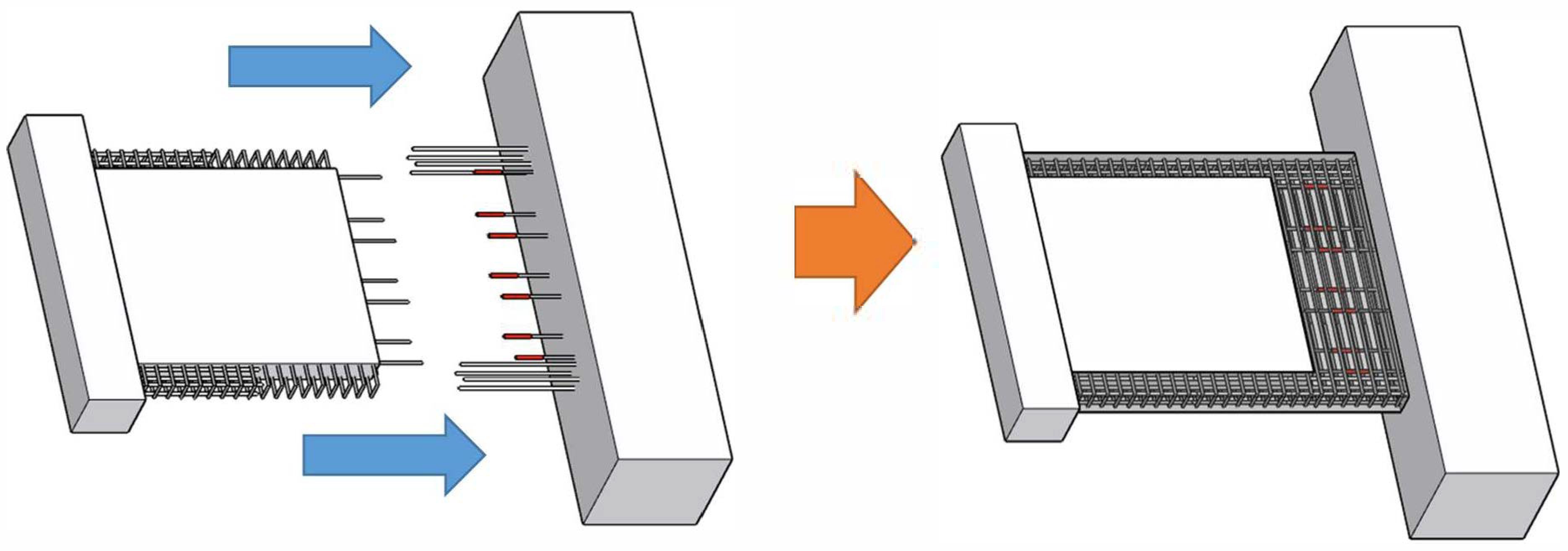
To evaluate the feasibility and structural performance of pressed sleeve splicers in precast concrete shear walls, a series of low-cyclic lateral loading tests was conducted on both a precast specimen and a monolithic cast-in-place reference specimen for comparative analysis. The fabrication process of the precast specimen was meticulously designed to ensure structural integrity and consistency. First, the upper wall panel and the lower reinforced concrete (RC) footing were cast separately under controlled laboratory conditions to achieve uniform material properties and sufficient initial curing. Upon reaching the required strength, the wall panel was accurately positioned 400 mm above the RC footing to form the designated interface. Pressed sleeve splicers were then used to mechanically connect the aligned vertical rebars across the two components, ensuring proper bar alignment and reliable load transfer through the joint. Subsequently, the boundary elements and the construction joint were cast in situ to complete the assembly. A schematic illustration of the specimen fabrication procedure is presented in Figure 1, which depicts the installation details of the cold extrusion sleeve connection device prior to concrete casting.

Figure 1.
Schematic illustration of specimen fabrication procedure.
The entire specimen was cured for more than 28 days to ensure the full development of concrete strength prior to testing. This rigorous fabrication procedure established a solid foundation for assessing the mechanical behavior and seismic performance of the precast system under low-cyclic lateral loading. Detailed dimensions of the specimen are provided in Figure 2, with the hatched region indicating the post-poured concrete segment.

Figure 2.
Geometry details of specimen (mm). (a) Front elevation. (b) Side elevation.
In the precast wall panel, longitudinal steel rebars were mechanically spliced using pressed sleeve connectors, whereas conventional lap splicing was adopted for the longitudinal rebars in the boundary elements. The process diagram of the cold extrusion sleeve connection for reinforcing bars is shown in Figure 3, providing a detailed overview of the specimen fabrication workflow to facilitate readers’ comprehension.

Figure 3.
Process illustration of cold-extruded sleeve splicing for reinforcing bars.
The longitudinal reinforcement ratio within the boundary elements was 3.14% (4D12), while the wall panel was reinforced with horizontally distributed bars (D8) spaced at 120 mm intervals. Primary load-carrying rebars (7D12) and secondary detailing rebars (7D6) were arranged in two staggered rows to ensure sufficient strength and ductility. To facilitate the installation of the pressed sleeve splicers, the vertical detailing rebars were intentionally terminated prior to reaching the concrete at the construction joint. The boundary elements were effectively anchored to the wall panel through U-shaped hoops (D8 @ 60 mm), which were embedded into the wall panel and overlapped with the horizontal distribution bars over the required minimum development length, ensuring adequate confinement and effective load transfer. A schematic illustration of the reinforcement layout in the precast specimen is presented in Figure 4. For the cast-in-place benchmark specimen, the reinforcement configuration was identical to that of the precast specimen, except that the longitudinal rebars extended continuously across the construction joint, eliminating the need for pressed sleeve splicers. This consistent reinforcement detailing enabled a reliable comparison between the precast and monolithic systems under low-cycle lateral loading conditions.

Figure 4.
Steel bar layout of the precast specimens.(a) Reinforcement layout of the wall panel. (b) Reinforcement layout of the boundary element.
Two distinct grades of concrete were employed in the fabrication of the precast and post-pour components to ensure the desired structural performance and material compatibility at the construction joints. The precast concrete exhibited an average cubic compressive strength of 57.6 MPa, while the post-pour concrete achieved an average strength of 61.4 MPa, as determined from standard cube tests. The steel reinforcement used in the specimens consisted of C12 and C16 deformed bars, with measured yield strengths of 477 MPa and 472 MPa, respectively. These mechanical properties provided the basis for the design of the reinforcement layout and ensured that both the precast and post-pour components satisfied the strength and ductility requirements under low-cycle lateral loading conditions. The selected combination of concrete grades and steel types enabled a reliable assessment of the performance of pressed sleeve splicers and the overall structural behavior of the precast wall system under simulated seismic loading. The dimensions of the sleeves and the mechanical properties of the connected steel rebars are summarized in Table 1.

Table 1.
Sizes of sleeves and tensile strengths of connected rebars. (Unit: mm, MPa).
The loading setup for the quasi-static test is illustrated in Figure 5. The axial compression load level was maintained at a constant value of 0.45 for all specimens. Figure 6 shows the target drift ratio history applied during testing. The drift ratio was defined as the ratio of the lateral displacement at the loading point to the total height of the wall, which was 1625 mm. At each target drift level, two complete loading cycles were implemented to capture the cyclic response of the specimen. Prior to the application of lateral loading, a constant axial compressive force was applied and sustained throughout the test to simulate the service-stage vertical loading conditions. Lateral displacement reversals were then imposed at the top reinforced concrete (RC) beam using two synchronized MTS actuators (Manufactured by MTS Systems Corporation, Eden Prairie, MN, USA) with a combined capacity of 2000 kN. The test was continued until either the specimen could no longer support the prescribed axial load or the horizontal load resistance decreased to below 85% of the peak measured value, indicating significant structural deterioration. This testing protocol enabled a systematic evaluation of the wall’s lateral load-carrying capacity, deformation characteristics, and failure mechanisms under controlled cyclic loading conditions.

Figure 5.
Test setup.

Figure 6.
Loading protocol.
2.2. Experimental Results
During lateral loading of the precast specimen (PW), initial yielding of the tensile steel rebars was observed at a drift ratio of 1/400, indicating the onset of inelastic behavior in the tension zone. As the drift ratio increased to 1/100, cracking became progressively more severe: the maximum crack width in the tension zone exceeded 1 mm, and cracks at the bottom of the construction joint widened to more than 2 mm. At this stage, the specimen reached its peak lateral load-bearing capacity of 786.91 kN, corresponding to the development of significant inelastic deformations and full activation of the reinforcement system. These observations identify the critical drift ratios that govern the initiation and propagation of flexural cracking in precast shear walls.
Similarly, for the cast-in-place specimen (SW), initial yielding of the tensile steel rebar was observed at a drift ratio of 1/400, indicating the onset of inelastic deformation in the tension zone. However, as the lateral drift increased toward the target value of 1/100, the specimen experienced a sudden and significant loss of axial load-carrying capacity. This failure was characterized by extensive spalling of concrete from the backside of the wall panel, accompanied by out-of-plane splitting of the entire wall, reflecting a brittle and unstable failure mode. In contrast to the precast specimen (PW), which exhibited gradual crack propagation and stress redistribution prior to reaching peak lateral capacity, the cast-in-place specimen demonstrated limited ductility and underwent abrupt collapse once critical stress levels were exceeded. These observations highlight the significant influence of reinforcement detailing, continuity, and joint configuration on the lateral load resistance and ductile performance of reinforced concrete shear walls under cyclic loading conditions.
The vertex horizontal load-displacement angle (P − θ) hysteretic curve is presented in Figure 7, where Δ denotes the horizontal displacement at the specimen’s top. The failure modes of both PW and SW are classified as predominantly flexural, given the presence of characteristic failure indicators—such as tensile rebar rupture, concrete crushing, and the development of numerous flexural or flexural-shear cracks—in both specimens. The hysteresis loops are presented in Figure 7. Both curves exhibit a well-defined bow-tie shape, with a pronounced pinching effect evident in the later loading cycles. Experimental results indicate that the precast wall exhibits progressive crack propagation and stable energy dissipation behavior. Its ultimate lateral load-bearing capacity is marginally higher than that of the cast-in-place wall, while the ultimate drift ratio is slightly lower—this aligns with the general principle that precast connections may incur minor ductility loss due to joint effects.

Figure 7.
Hysteretic curves of test specimens. (a) PW. (b) SW.
3. Finite Element Analysis (FEA)
3.1. Finite Element Modeling
The finite element program ABAQUS was used to conduct a detailed numerical analysis of the tested specimens, enabling a comprehensive assessment of their structural behavior under cyclic lateral loading. In addition to replicating the experimental results, a parametric study was performed to systematically investigate the influence of key design parameters—specifically, wall aspect ratio, axial load level, and longitudinal reinforcement ratio in the boundary elements—on the seismic performance of shear walls incorporating pressed sleeve connections.
For the numerical modeling, a bilinear constitutive model was adopted to represent the mechanical behavior of steel rebars and pressed sleeve splicers, with yield strengths directly derived from material test data. The concrete was modeled using the Concrete Damaged Plasticity (CDP) model to capture its nonlinear triaxial response under combined compressive and tensile stresses. The CDP model accounts for the confinement effect provided by transverse reinforcement in both precast and cast-in-place concrete components. To define the uniaxial stress–strain relationships for concrete in compression and tension, the Mander model was employed based on experimentally measured cubic compressive strength values, which were subsequently used to calibrate the associated scalar damage variables. This modeling approach enabled accurate simulation of concrete cracking and crushing, as well as steel yielding and post-yield behavior, thereby providing a reliable basis for evaluating the impact of critical design parameters on the overall seismic performance of the wall specimens [17].
Finite element models of the specimens were initially developed prior to testing to predict their ultimate load-bearing capacities. Following the experiments, the numerical models were calibrated and refined using detailed experimental observations and measured test data to enhance simulation accuracy. In the modeling process, the concrete and pressed sleeve splicers were discretized using eight-node linear brick elements with reduced integration (C3D8R), which are well suited for capturing nonlinear behavior under complex stress states. The longitudinal and transverse reinforcement was represented by two-node three-dimensional truss elements (T3D2), capable of accurately simulating axial force transfer while neglecting bending stiffness, consistent with the actual mechanical behavior of steel rebars. This combination of element types enabled a reliable representation of both concrete cracking and crushing, as well as steel yielding and post-yield response, thereby establishing a robust framework for analyzing the structural performance of the wall specimens under cyclic lateral loading.
This study employs the Concrete Plastic Damage (CPD) model. The fundamental material parameters include Poisson’s ratio (ν), dilatancy angle (φ), eccentricity (e), biaxial-to-uniaxial compressive strength ratio (fb0/fc0), yield surface projection shape parameter (Kc), and viscosity parameter (μ). For concrete structures, the dilatancy angle typically ranges from 31° to 42°; herein, a value of 40° is adopted, referencing studies [18,19,20]. The remaining parameters are selected in accordance with conventional practices in relevant research. Specific parameter values are presented in the table below.Specific parameter values are presented in Table 2.
Table 2.
Material parameters for the Concrete Damaged Plasticity (CDP) model.
In this study, the uniaxial tensile stress-strain (σt-εt) and compressive stress-strain (σc-εc) relationships of concrete are calculated in accordance with the relevant formulas specified in Code. The tensile and compressive damage factors (dₜ, dc) are derived from existing literature, with the parameters bₜ and bc assigned values of 0.1 and 0.7, respectively [21].
For steel materials (e.g., reinforcing bars and steel plates), their constitutive behavior is modeled using a bilinear elastoplastic model. Based on the experimentally measured stress-strain curves from steel material property tests, the elastic modulus in the strain-hardening stage is set to 0.01 Eₛ, and the ultimate strain is specified as 0.1.
The center point of the top loading beam was defined as a reference node, which was kinematically coupled to the entire top loading beam to ensure uniform displacement transmission. Both axial loads and lateral displacements, derived from the target drift ratio (Figure 6), were applied at this reference node. As shown in Figure 8a, fixed boundary conditions were assigned to the ends and the bottom of the lower footing to fully restrain translational and rotational degrees of freedom.

Figure 8.
FE model. (a) Concrete model. (b) Steel cage.
3.2. Mesh Sensitivity Analysis
To ensure the accuracy and reliability of the finite element model (FEM) for the wall segment, a mesh sensitivity analysis was performed, with three mesh sizes (10 mm, 20 mm, and 30 mm) selected for comparison. The results indicate that when the mesh size is 20 mm, the simulated load–displacement angle curves exhibit good agreement with the experimental data, while maintaining high computational efficiency. Therefore, a mesh size of 20 mm was adopted for the FEM of the wall segment in this study.
3.3. Verification of FEA Results
The finite element analysis (FEA) results and the corresponding experimental results are comparatively presented in Figure 9, depicted in the form of backbone envelope curves. A detailed comparison reveals that the simulated load-drift ratio curves closely align with the experimentally measured responses across most of the loading history. Minor discrepancies are observable primarily in the post-peak response phase and near the extremities of the hysteresis loops; however, these variations remain within the anticipated margin for experimental and numerical error. The overall correlation between the simulation and the test data demonstrates that the developed finite element model effectively captures the key behavioral characteristics of the specimen, including its initial stiffness, overall strength capacity, and the general trend of stiffness degradation.

Figure 9.
Experimental and numerical backbone envelope curves.
Figure 10a presents the crack patterns of the precast wall under peak load, illustrating the distribution and propagation characteristics of cracks across the wall surface. The failure mode is primarily characterized by diagonal shear cracks originating from the base corners, together with flexural cracks distributed along the height of the wall panel. Figure 10b shows the equivalent plastic strain (PEEQ) distribution in the concrete wall panel at peak load. The contour plot reveals that strain concentrations are predominantly localized in the lower region of the wall, particularly near the corners. A maximum plastic strain of 0.0032 is observed at the bottom corner, indicating the initiation of concrete crushing and spalling, which corresponds to the onset of compressive damage.

Figure 10.
Experimental and numerical damage distributions. (a) Crack pattern of PW. (b) Equivalent plastic strain (PEEQ) of FEM.
As shown in Figure 11, the stress levels in the longitudinal rebars in both the compression and tension zones exceed the yield strength, confirming that the reinforcement has yielded and entered the plastic deformation stage. The stress–strain responses exhibit distinct strain hardening after yielding, reflecting the ductile behavior of the steel. In contrast, the sleeve connections attain stresses of only 183 MPa in the compression zone and 398 MPa in the tension zone (Figure 12), both significantly lower than those in the adjacent rebars. This discrepancy suggests that the sleeve connections were not fully activated and did not reach their ultimate load-carrying capacity. The asymmetry in sleeve stress between the tension and compression zones may be attributed to differing load transfer efficiencies or constraint conditions. Furthermore, the measured sleeve stresses remain below the yield strength of the sleeve material, indicating that the sleeves remained elastic throughout the loading history, without undergoing plastic deformation. The phenomenon whereby sleeve stress is significantly lower than that of adjacent rebars and remains elastic primarily stems from the stiffness matching characteristics between the sleeve and rebars, as well as the rational load transfer mechanism of the connection. On the one hand, cold-extruded sleeves are fabricated from high-strength steel, exhibiting a larger cross-sectional area and higher stiffness compared to the connected rebars. This stiffness discrepancy enables the sleeve to effectively dissipate the stress transferred by rebars, thereby preventing premature strength yielding of the sleeve relative to rebars. On the other hand, the sleeve and rebars form a robust mechanical connection via cold extrusion, ensuring a continuous and stable load transfer path. During loading, rebars—with relatively low yield strength—enter the yielding stage first, whereas the sleeve, which possesses higher strength and stiffness, does not reach its own yield limit and maintains an elastic state. This stress distribution characteristic indicates that cold-extruded sleeve connections have sufficient safety margins, and the sleeve will not fail prior to rebars, thus guaranteeing the reliability of the connection system.

Figure 11.
Maximum principal stresses of rebars.

Figure 12.
Maximum principal stresses of sleeves.
The contrast between the numerical results and the test data showed that the selection of constitutive relationship, element and interaction in this finite element model was reasonable in predicting the seismic performance of the precast concrete shear wall incorporating pressed sleeve reinforcement connection.
4. Parametric Analysis
Through finite element simulations, the present study extends the investigation to two key parameters, axial compression ratio and shear span-to-depth ratio, enabling a more comprehensive assessment of their influence on the structural behavior of shear walls. For walls predominantly governed by flexural–compressive action, the longitudinal reinforcement ratio in the boundary elements and the vertical reinforcement ratio within the wall panel are critical determinants of the ultimate load-bearing capacity. Therefore, these parameters were included as variables in the parametric study. Additionally, in shear walls with relatively low shear span-to-depth ratios and high axial compression levels, the horizontal distribution reinforcement may yield under lateral loading; hence, this parameter was also incorporated as a variable.
To systematically evaluate the factors influencing the seismic performance of precast shear walls with cold-extruded sleeve connections, the finite element models were designed with variations in the shear span-to-depth ratio, axial compression ratio, and longitudinal reinforcement ratio in the boundary elements. All other modeling assumptions—including material constitutive relationships, element types, and contact definitions—were held constant to isolate the effects of the targeted parameters. This approach provides a controlled and rigorous framework for evaluating how key design variables influence the lateral load capacity, ductility, and overall seismic response of precast shear walls.
4.1. Axial Load Level
Figure 13 presents a detailed comparison of the normalized backbone curves for specimens with identical shear span-to-depth ratios but varying axial compression ratios, as part of a comprehensive finite element parametric analysis. The curves illustrate the relationship between the base shear coefficient and the drift angle under cyclic loading. As clearly shown in Figure 13, the axial compression ratio has a significant influence on overall structural performance, particularly on load-bearing capacity. Increasing the axial compression ratio from 0.09 to 0.80 results in a marked increase in the peak load that the specimens can sustain. This trend—where higher axial compression leads to greater load-bearing capacity—is consistent with patterns reported in previous experimental studies.

Figure 13.
Effect of different axial compression ratios on the backbone curves of specimens with the same shear span-to-depth ratio. (a) Wall aspect ratio = 1.06. (b) Wall aspect ratio = 1.35. (c) Wall aspect ratio = 1.6. (d) Wall aspect ratio = 1.85.
The increase in axial compression ratio enhances the ultimate lateral bearing capacity, primarily driven by the strengthened bending-compression coupling effect. Axial pressure constrains the propagation of transverse cracks in concrete, increasing the effective compressive area of the section and the contribution of concrete to lateral bearing capacity. In contrast, the reduction in ductility stems from intensified brittle failure of concrete in the compression zone: as the axial compression ratio increases, concrete in the compression zone is more susceptible to crushing under lateral loading, the extent of plastic hinge formation is narrowed, and the bond-slip between rebars and concrete is exacerbated—all of which lead to accelerated post-peak strength degradation and reduced deformation capacity.
Moreover, the axial compression ratio significantly influences the ductility characteristics and post-peak behavior of the shear walls. Specimens under higher axial compression levels typically reach their peak load at larger drift angles. After peak load attainment, their backbone curves exhibit steeper descending branches, indicating more rapid strength degradation. In contrast, specimens with lower axial compression ratios display a more gradual softening phase beyond the peak. The difference in the slope of the descending branch underscores the role of axial compression in modifying the energy dissipation capacity and deformation capability of the structural members. The analysis confirms that while axial compression enhances strength, it may simultaneously reduce the deformation ductility of shear walls.
4.2. Wall Aspect Ratio
Figure 14 presents a comparison of the backbone curves for specimens with the same axial compression ratio but different shear span-to-depth ratios, as part of the finite element parametric study. As shown in Figure 14, variations in the shear span-to-depth ratio have a significant effect on the load-bearing capacity of the specimens. When the shear span-to-depth ratio increases from 1.06 to 1.90, the load-bearing capacity decreases progressively, a trend that is consistent with the experimental results. The shear span-to-depth ratio also influences the ductility of the shear walls: specimens with smaller shear span-to-depth ratios reach their peak load at larger drift angles, and their post-peak backbone curves exhibit steeper descending branches.

Figure 14.
Effect of different shear span-to-depth ratios on the backbone curves of specimens with the same axial compression ratio. (a) Axial load level = 0.09. (b) Axial load level = 0.25. (c) Axial load level = 0.45. (d) Axial load level = 0.6. (e) Axial load level = 0.8.
4.3. Longitudinal Reinforcement Ratio in the Boundary Elements
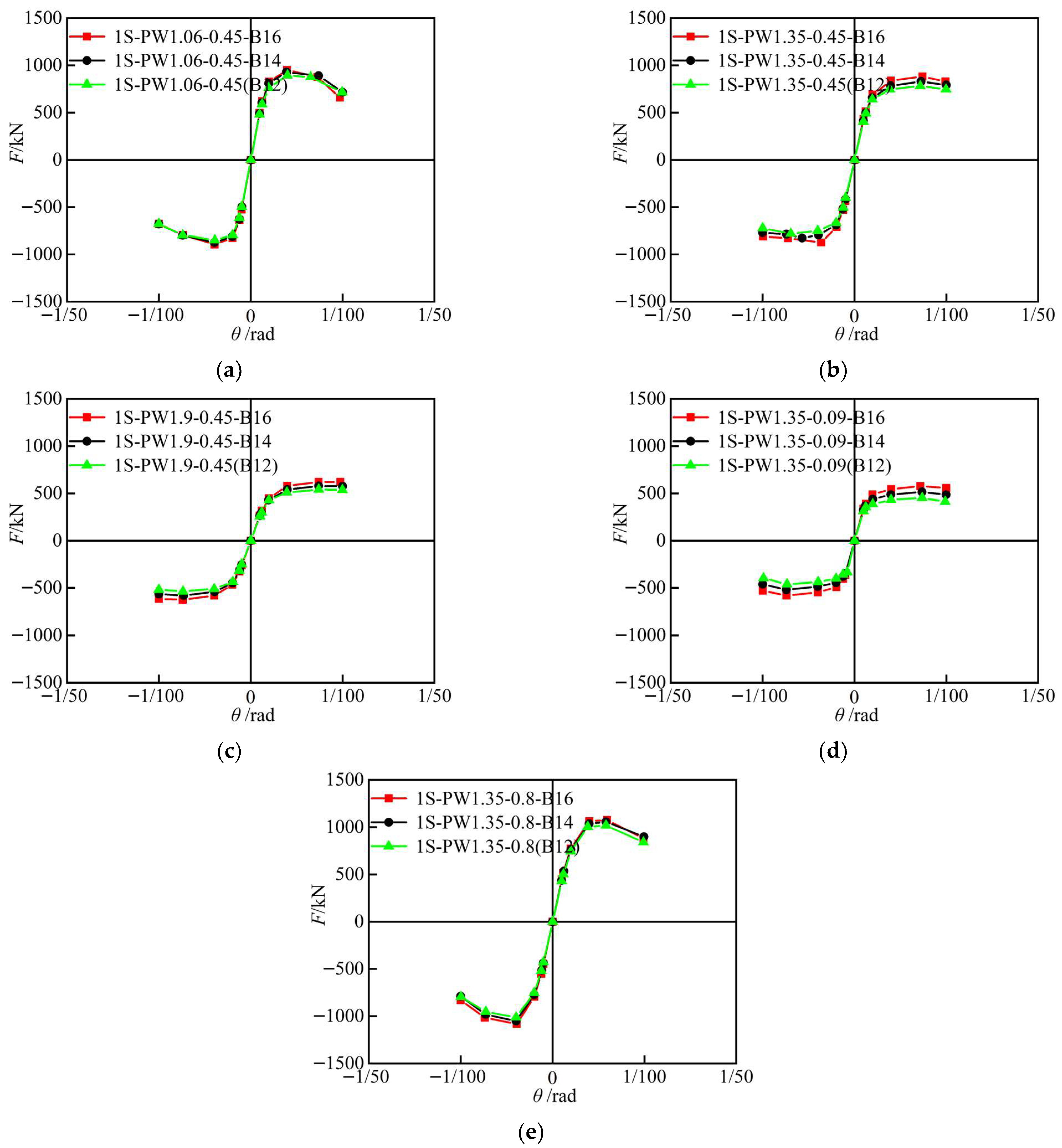
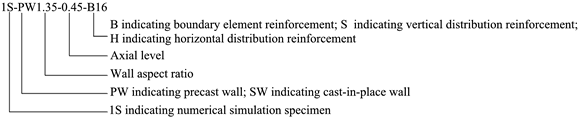
Figure 15 presents a comparison of the backbone curves for specimens with identical axial compression ratios and shear span-to-depth ratios but varying reinforcement in the boundary elements, as part of the finite element parametric study. As shown in Figure 15, increasing the boundary element reinforcement leads to a modest improvement in the specimens’ load-bearing capacity. The effect is more pronounced in specimens with relatively low axial compression and large shear span-to-depth ratios. For instance, when the shear span-to-depth ratio is 1.35 and the axial compression ratio is 0.09, increasing the diameter of the longitudinal reinforcement in the boundary elements by one bar grade results in an approximately 10% increase in load-bearing capacity. This indicates that the load-bearing capacity of the specimens is primarily governed by the section’s flexural–compressive capacity, while the tensile reinforcement plays a secondary but noticeable role in controlling structural performance.

Figure 15.
Effect of different boundary element reinforcement on the backbone curves of specimens with the same shear span-to-depth ratio and axial compression ratio. (a) Wall aspect ratio = 1.06 Axial load level = 0.45. (b) Wall aspect ratio = 1.35 Axial load level = 0.45. (c) Wall aspect ratio = 1.9 Axial load level = 0.45. (d) Wall aspect ratio = 1.35 Axial load level = 0.09. (e) Wall aspect ratio = 1.35 Axial load level = 0.8.
4.4. Variation of Vertical Distribution Reinforcement Ratio
Figure 16 presents a comparison of the backbone curves for specimens with identical axial compression ratios and shear span-to-depth ratios but varying vertical distribution reinforcement, as part of the finite element parametric study. As shown in Figure 16, changes in the vertical distribution reinforcement have minimal influence on both the load-bearing capacity and ductility of the specimens. This indicates that the load-bearing capacity is primarily provided by the longitudinal reinforcement in the boundary elements, while the vertical reinforcement within the wall panel plays a relatively minor role.

Figure 16.
Effect of different vertical distribution reinforcement on the backbone curves of specimens with the same shear span-to-depth and axial compression ratios. (a) Wall aspect ratio = 1.06 Axial load level = 0.45. (b) Wall aspect ratio = 1.35 Axial load level = 0.45. (c) Wall aspect ratio = 1.9 Axial load level = 0.45. (d) Wall aspect ratio = 1.35 Axial load level = 0.09. (e) Wall aspect ratio = 1.35 Axial load level = 0.8.
4.5. Variation of Horizontal Distribution Reinforcement Ratio
Figure 16 presents the backbone curves of specimens with the same axial compression ratio and shear span-to-depth ratio but different horizontal distribution reinforcement in the finite element parametric study. As shown in Figure 16, variations in the horizontal distribution reinforcement have a relatively small effect on the specimens’ load-bearing capacity. However, for specimens with small shear span-to-depth ratios and high axial compression ratios, increasing the horizontal distribution reinforcement can slightly enhance ductility. This indicates that, under small shear span-to-depth conditions, the specimens experience some shear effects near the peak load, while under high axial compression conditions, inclined compression effects occur near the peak load. Therefore, in these two scenarios, increasing the horizontal distribution reinforcement provides a modest improvement in both load-bearing capacity and ductility.
In summary, numerical simulations and parametric analyses of ABAQUS finite element models for novel RC prefabricated shear walls with cold-extruded sleeve connections and steel plate–bolt connections indicate that both the axial compression ratio and the shear span-to-depth ratio significantly influence the load-bearing capacity and ductility of the shear walls. The failure modes observed for the two connection types are generally similar. In shear walls with steel plate–bolt connections, the increased stiffness at the connection zone leads to failure concentration above and on both sides of the base connection, while concrete damage within the connection itself remains relatively minor. Increasing reinforcement detailing has a relatively limited effect on the overall load-bearing capacity of the shear walls. However, for specimens with small shear span-to-depth ratios and high axial compression, enhancing the longitudinal reinforcement in the boundary elements and the horizontal distribution reinforcement in the wall results in a noticeable improvement in both load-bearing capacity and ductility for shear walls with both types of novel connections.
4.6. Validation of Bearing Capacity Calculation Methods
The calculation of the normal-section flexural–compression capacity was performed in accordance with the simplified calculation method specified in Code for Seismic Design of Buildings [22,23]. The formulas for normal-section flexural–compression capacity are denoted as Equations (1)–(3):
In the formulas, x denotes the depth of the compression zone; N represents the axial load acting on the shear wall; Ast and Asc respectively stand for the effective area of tensile reinforcement and reinforcement in the edge members; fyt and fyc are the yield strengths of longitudinal reinforcement in the tensile and compressive edge members, respectively; fc is the compressive strength of concrete; as and a’s denote the distances from the resultant force point of longitudinal reinforcement in the tensile and compressive edge members to the tensile and compressive edges, respectively; h is the depth of the normal section of the shear wall; b is the width of the normal section of the shear wall; hw0 is the distance between the resultant force point of tensile reinforcement and the edge of the compression zone (hw0 = h-as); fyw refers to the yield strength of vertical distributed reinforcement in the wall; ρw is the reinforcement ratio of vertical distributed reinforcement in the wall; M represents the flexural bearing capacity of the normal section at the wall base.
The diagonal-section shear capacity is determined in accordance with the calculation Formula (4) for the shear capacity of cast-in-place concrete members:
In the formula, Fsh denotes the diagonal-section shear capacity of the shear wall; λ represents the shear span ratio of the shear wall; Ash stands for the total cross-sectional area of horizontal distributed reinforcement in the wall; fyh is the yield strength of horizontal distributed reinforcement in the wall; ftk refers to the tensile strength of concrete in the wall; s is the spacing of horizontal distributed reinforcement; N is the axial compressive force acting on the shear wall section (when N > 0.2 fcbhw0, take 0.2 fcbhw0).
The minimum value of the normal-section bearing capacity and diagonal-section shear capacity derived from Equation (5) is defined as the calculated bearing capacity Fcal of the RC prefabricated shear wall with cold-extruded sleeve connections for steel bars. This value is compared with the numerical simulation result FP obtained in this study. In the calculation, the strengths of concrete and steel are adopted as the standard values derived from material mechanical property tests. The calculation results are presented in Table 3.
Table 3.
Comparison of bearing capacities between numerical simulation (Fp) and code-calculated values (F, Fsh, Fcal).
As indicated in Table 3, the bearing capacity of each specimen is predominantly governed by the normal-section compression-bending bearing capacity of the wall. The mean value and standard deviation of the Fcal/Fp ratio are 0.85 and 0.08, respectively. The overall results are conservative, primarily due to two factors: first, the material strength values adopted in the calculations did not account for the confining effect of edge members on concrete; second, the strain hardening of steel after yielding was not considered. For specimens with smaller shear-span ratios and larger axial compression ratios, the actual stresses in the longitudinal reinforcement of the compressive edge members and the vertical tensile reinforcement of the wall did not reach the fully yielded state assumed in the calculations, as the height of the compressive zone increased. Consequently, the predicted values are underestimated. Overall, the bearing capacity calculation formula for RC prefabricated shear walls with steel bar extrusion sleeve connections proposed in this study is in good agreement with the experimental results, demonstrating that the proposed bearing capacity calculation method can accurately predict the failure mode and bearing capacity of the shear walls.
5. Conclusions
Based on the experimental and numerical results presented in this study, the following conclusions can be drawn within the scope of the current research:
- (1)
- Superior Seismic Performance of the Novel Connection System. The quasi-static cyclic tests demonstrate that the precast concrete shear wall with cold-extruded sleeve connections achieves a progressive, ductile failure mode characterized by stable crack propagation and energy dissipation. Compared to the cast-in-place reference wall, which exhibited abrupt failure from concrete spalling and out-of-plane splitting, the precast wall showed marginally higher ultimate lateral load capacity and comparable deformation capacity. This confirms that the cold-extruded sleeve provides reliable reinforcement continuity, effectively transferring stresses and enabling monolithic behavior.
- (2)
- Validated Predictive Numerical Framework. A high-fidelity finite element model was successfully developed in ABAQUS, incorporating the Concrete Damaged Plasticity model for concrete and a bilinear model for steel components. The model accurately reproduced the experimental load-drift response, crack patterns, and stress distributions. Crucially, the simulation revealed that the sleeve stresses remained significantly below the yield strength of the connected rebars, indicating that the connection has a substantial safety margin and that failure is governed by the wall component itself, not the splice.
- (3)
- Key Design Parameter Influences and Interactions. The parametric study elucidated the distinct and interactive effects of critical design variables:
Shear Span-to-Depth Ratio (Aspect Ratio): Has a dominant influence, with decreasing ratios leading to significantly increased lateral strength but reduced ductility and drift capacity, shifting behavior towards a shear-influenced response.
Axial Compression Ratio: Similarly, exerts a major impact. Higher axial load enhances lateral strength due to increased compression zone effectiveness but accelerates concrete crushing, leading to steeper post-peak strength degradation and reduced ductility.
Boundary Element Reinforcement Ratio: Its influence is secondary. Increasing this ratio yields only a modest improvement in lateral strength while slightly reducing ductility, confirming that the wall’s flexural capacity is the primary governing mechanism.
- (4)
- Design Optimization Strategy for Critical Conditions. Under demanding conditions—specifically low shear span-to-depth ratios combined with high axial compression—the parametric analysis indicates that targeted reinforcement enhancements are effective. Increasing both the longitudinal reinforcement in boundary elements and the horizontal distributed reinforcement in these critical regions can mitigate strength loss and improve ductility, providing a practical design pathway to enhance overall seismic resilience.
- (5)
- Practical Design Verification and Identified Research Frontiers. The bearing capacity of the walls, calculated using a simplified code-based approach for normal-section flexural compression, showed conservative yet reasonably accurate agreement with numerical results (mean Fcal/Fp = 0.85), validating the applicability of existing design frameworks. This study also identifies specific directions for future work: expanding the experimental database, investigating performance with lower-strength concretes, exploring the influence of sleeve geometric parameters, and validating dynamic performance through pseudo-dynamic or shaking table tests.
- (6)
- This study has several limitations that warrant further refinement in future research:
First, only two specimens (one prefabricated and one cast-in-place) were employed in the tests, which may compromise the statistical significance of the results. Subsequent studies should increase the number of specimens to validate the repeatability of the experimental findings.
Second, the concrete strength grade used in this study ranges from 57 to 61 MPa, which is higher than the commonly utilized C20–C35 concrete in engineering practice. The seismic performance of cold extrusion sleeve connections in low-strength concrete requires further investigation.
Third, the parameter analysis only considered the effects of wall limb aspect ratio, axial compression ratio, and reinforcement ratio, while excluding sleeve structural parameters (e.g., length, thickness) and construction process parameters (e.g., extrusion pressure). Future research should expand the parameter scope to optimize the design of cold extrusion sleeve connections.
Fourth, this study only conducted pseudo-static cyclic loading tests. The seismic performance of this connection system under dynamic loads (e.g., seismic action) needs to be verified through pseudo-dynamic tests or shaking table tests.
Author Contributions
Conceptualization, G.-B.P.; Methodology, Y.-R.C.; Software, G.-B.P.; Validation, J.C.; Formal analysis, G.-B.P.; Investigation, Y.-R.C.; Resources, J.C.; Data curation, G.-B.P.; Writing—original draft, G.-B.P.; Writing—review & editing, Y.-R.C.; Visualization, G.-B.P.; Supervision, J.C.; Project administration, G.-B.P.; Funding acquisition, Y.-R.C. All authors have read and agreed to the published version of the manuscript.
Funding
This research was funded by Specialized Innovative Project for Undergraduate Institutions of Guangdong Provincial Department of Education (No. 2023KTSCX304), Ministry of Education’s China University Industry-Academia-Research Innovation Fund—Beichuang Teaching Assistant Program (Phase III) (No. 2022BC059), Science and Technology Youth Project of Guangzhou Panyu Polytechnic (No. 2023KJ22), Guangdong Provincial Key Area Special Project for Universities (Serving the “Hundred-Thousand-Ten Thousand Project”) (No. 2024ZDZX4109).
Data Availability Statement
The original contributions presented in this study are included in the article. Further inquiries can be directed to the corresponding author.
Conflicts of Interest
The authors declare no conflicts of interest.
References
- Alias, A.; Zubir, M.A.; Shahid, K.A.; Rahman, A.B.A. Structural Performance of Grouted Sleeve Connectors with and without Transverse Reinforcement for Precast Concrete Structure. Procedia Eng. 2013, 53, 116–123. [Google Scholar] [CrossRef]
- Xu, C.; Liu, H.; Du, X. Experimental study on connection performance of grouted sleeve splicing for rebars under high stress repeated tension-compression loading. J. Build. Struct. 2018, 39, 178–184+193. (In Chinese) [Google Scholar]
- Xu, G.; Wang, Z.; Wu, B.; Bursi, O.S.; Tan, X.; Yang, Q.; Wen, L.; Jiang, H. Pseudodynamic tests with substructuring of a full-scale precast box-modularized structure made of reinforced concrete shear walls. Struct. Des. Tall Spec. Build. 2017, 26, e1354. [Google Scholar] [CrossRef]
- Wu, D.Y.; Liang, S.T.; Guo, Z.X.; Xiao, Q.D. Bending bearing capacity calculation of the improved steel grouted connecting precast wall. J. Harbin Inst. Technol. 2015, 47, 112–116. (In Chinese) [Google Scholar]
- Yang, Y.; Deng, L.; Yang, J.; Zhao, M.; Zhao, S. Experimental and numerical study on seismic behavior of precast shear walls assembled with a socket vertical joint. Structures 2024, 62, 106290. [Google Scholar] [CrossRef]
- Qu, X.; Zhang, Y.; Rong, X. Seismic behavior and bearing capacity prediction of assembled concrete-filled multi-cellular steel tube composite shear walls with different horizontal joints. J. Build. Eng. 2025, 111, 113462. [Google Scholar] [CrossRef]
- Li, N.; Qian, J.; Ye, L.; Liu, S. Tests on seismic behavior of precast RC shear walls with vertical rebar splicing by pressed sleeve. J. Build. Struct. 2016, 37, 31–40. (In Chinese) [Google Scholar]
- Chen, Q.; Pan, Z.; Cai, J.; Chen, Q.; Zuo, Z.; Liu, Y. Experimental research on seismic behaviors of assembled beam-column joints with rebars spliced by pressed sleeves. J. Southeast Univ. (Nat. Sci. Ed.) 2019, 49, 918–925. (In Chinese) [Google Scholar]
- Liu, F.; Qian, H.; Zhang, Z.; Zhang, H. Experimental Study on the Mechanical Properties of Vertical Corrugated Pipe Grout Anchor Connection Joints. Appl. Sci. 2023, 13, 11889. [Google Scholar] [CrossRef]
- Xiong, E.; Zhang, H.; Fu, C.; Hu, Q.; Fan, Y.; Taciroglu, E. Research on design and mechanical behavior of a new horizontal connection device of prefabricated shear wall. Constr. Build. Mater. 2023, 370, 130713. [Google Scholar] [CrossRef]
- Wu, X.; Wang, Y.; Ji, S.; Liu, M.; Wang, D. Numerical Study on Mechanical Behaviors of New Type of Steel Shear-Connection Horizontal Joint in Prefabricated Shear Wall Structure. Buildings 2023, 13, 3000. [Google Scholar] [CrossRef]
- Yuan, C.; Cai, J.; Chen, Q.-J.; Liu, X.; Zuo, Z.; He, A.; Huang, H. Experimental study on seismic behaviour of pre-cast recycled fine aggregate concrete columns with pressed sleeve connections. Structures 2023, 48, 1373–1390. [Google Scholar] [CrossRef]
- Yuan, C.; Cai, J.; Wang, F.; He, A.; He, B.; Chen, Q.; Zuo, Z. Testing of precast recycled aggregate concrete shear wall with pressed sleeve connection subjected to cyclic loading. Struct. Concr. 2023, 24, 5887–5908. [Google Scholar] [CrossRef]
- Tang, H.; Tan, H.; Zhang, J.; Yang, Y.; Yao, Y. Study on seismic behavior of prefabricated shear wall with pressed cone sleeves (PCSs). Soil Dyn. Earthq. Eng. 2024, 184, 108824. [Google Scholar] [CrossRef]
- Qiao, Q.; Ye, M.; Liu, W.; Xu, H.; Cao, W. Seismic performance evaluation of prefabricated concrete shear walls with anchorage defects. Eng. Struct. 2024, 314, 118392. [Google Scholar] [CrossRef]
- Tassi, G.; Rzsa, P.; Magyari, B. Matrix analysis of a one-dimensional discrete problem (forces in a pressed sleeve splice). Acta Mech. 1985, 56, 17–29. [Google Scholar] [CrossRef]
- Mander, J.B.; Priestley, M.J.N.; Park, R. Theoretical stress-strain model of confined concrete. J. Struct. Eng. ASCE 1988, 114, 1804–1826. [Google Scholar] [CrossRef]
- Ferreira, F.P.V.; Martins, C.H.; De Nardin, S. Assessment of web post buckling resistance in steel-concrete com-posite cellular beams. Thin-Walled Struct. 2021, 158, 106969. [Google Scholar] [CrossRef]
- Genikomsou, A.S.; Polak, M.A. Finite element analysis of punching shear of concrete slabs using damaged plas-ticity model in ABAQUS. Eng. Struct. 2015, 98, 38–48. [Google Scholar] [CrossRef]
- Wang, N.; Zhou, F.; Xu, H.; Xu, Z. Seismic behaviour of flat connections between steel-plate composite (SC) walls and reinforced concrete (RC) walls. J. Constr. Steel Res. 2020, 168, 105929. [Google Scholar] [CrossRef]
- Birtel, V.; Mark, P. Parameterised Finite Element Modelling of RC Beam Shear Failure. In Proceedings of the 19th Annual International ABAQUS Users’ Conference, Boston, MA, USA, 23–25 May 2006. [Google Scholar]
- GB 50010-2010; Code for Design of Concrete Structures 2015. China Architecture & Building Press: Beijing, China, 2015. (In Chinese)
- GB 50011-2010; Code for Seismic Design of Buildings 2016. China Architecture & Building Press: Beijing, China, 2016. (In Chinese)



Disclaimer/Publisher’s Note: The statements, opinions and data contained in all publications are solely those of the individual author(s) and contributor(s) and not of MDPI and/or the editor(s). MDPI and/or the editor(s) disclaim responsibility for any injury to people or property resulting from any ideas, methods, instructions or products referred to in the content. |
© 2026 by the authors. Licensee MDPI, Basel, Switzerland. This article is an open access article distributed under the terms and conditions of the Creative Commons Attribution (CC BY) license.