Skip to Content
BuildingsBuildings
  • Article
  • Open Access

18 February 2026

A Novel Hybrid Intelligent Optimization Framework for Shield Construction Parameters Based on CWG-LSTM-CPSOS


,
,
,
and
1
School of Civil Engineering, Xi’an University of Architecture and Technology, Xi’an 710055, China
2
Shaanxi Key Laboratory of Geotechnical and Underground Space Engineering, Xi’an University of Architecture and Technology, Xi’an 710055, China
3
College of Water Resources and Architectural Engineering, Northwest A&F University, Xianyang 712100, China
4
College of Information Engineering, Xi’an Fanyi University, Xi’an 710105, China

Abstract

Reasonable adjustment of construction parameters is of great value to reduce surface settlement and ensure the safety of shield construction. A novel hybrid intelligent optimization framework based on combination weighting and gray correlation analysis methods (CWG), a long short-term memory (LSTM) model and a chaotic particle swarm optimization with sigmoid-based acceleration coefficients (CPSOS) algorithm was proposed. The CWG method was employed to screen key construction parameters and determine the weights of various influencing factors of surface settlement, thereby constructing a CWG-LSTM prediction model for surface settlement. On this basis, the prediction model served as the objective function for optimizing construction parameters, and the CPSOS algorithm was used for the optimization of shield construction parameters. Based on the Qingdao Metro Line 4 in China, sample sets were collected to verify the performance of the developed framework. The CWG-LSTM model achieved coefficients of determination (R2) of 0.92 and 0.91 on the train and test sets, respectively, along with root mean square errors (RMSE) of 1.29 and 1.03, and mean absolute percentage errors (MAPE) of 15.60% and 17.18%. Its prediction ability surpasses that of other comparison models, such as the Gated Recurrent Unit, Random Forest, Transformer, and Multiple Linear Regression, demonstrating higher accuracy. Optimized construction parameters derived from the CWG-LSTM-CPSOS facilitated shield tunneling in the unconstructed section. All surface settlement monitoring results recorded during excavation fell within the safety threshold, demonstrating that the proposed hybrid intelligent optimization framework effectively manages surface settlement during shield tunneling and serves as a reliable optimization approach for construction parameters.

1. Introduction

Transportation demand in densely populated cities is strong, prompting the launch of large-scale subway projects one after another. Shield machines are widely used in subway construction for their advantages of high speed, no impact on ground traffic, and a high degree of automation [1,2,3,4,5,6]. Surface settlement is inevitable during shield excavation, while excessive settlement may seriously threaten the surrounding buildings, public safety, and construction progress [7,8,9,10]. Therefore, precise control of surface settlement is essential to ensure construction safety and efficiency.
Construction parameters during shield tunneling have a significant impact on surface settlement; for example, excessive advance speed (AS) can lead to rapid stress release and changes in pore water pressure, resulting in large surface settlement [11,12]. Therefore, site engineers need to regulate the construction parameters in time to cope with the complex and changing geological conditions, to ensure that the surface settlement is within the safe range. To facilitate the decision-making of site engineers, scholars have carried out extensive research on optimizing construction parameters, and the selection of optimization algorithms is especially critical. Traditional optimization algorithms include the gradient descent method, conjugate gradient method, and Newton’s method [13,14,15]. Although these optimization algorithms have the advantages of simple implementation and high efficiency in optimizing large-scale linear problems, they also have obvious shortcomings. For instance, the gradient descent method is prone to getting stuck in local minima in high-dimensional and nonconvex issues and is computationally costly for complex problems. The conjugate gradient method and Newton’s method are constrained by the selection of initial values, with the former performing inadequately on nonlinear problems and the latter incurring high computational and storage costs in high-dimensional problems [16]. To overcome the above issues, meta-heuristic optimization algorithms, which seek the optimal solution by simulating nature and human intelligence, have been widely studied. The swarm intelligence optimization algorithm, as an important branch of meta-heuristic algorithms, mainly simulates the intelligence of a group to obtain the global optimal solution. In this type of algorithm, each population is a biological population that completes tasks that individuals cannot accomplish through collaborative behavior among individuals in the population. Common swarm intelligence optimization algorithms include the particle swarm optimization (PSO) algorithm [16,17,18], ant colony optimization (ACO) algorithm [19], gray wolf optimization (GWO) algorithm [20,21] and whale optimization algorithm (WOA) [22,23]. The PSO algorithm has the advantages of few parameters, fast convergence, and easy implementation, so it is widely used in engineering optimization [24]. However, the PSO algorithm fails to trade off exploration and exploitation abilities well, making it prone to localized extremes. For this reason, Tian et al. [25] improved the PSO algorithm based on chaos theory and the acceleration coefficients correction method, and proposed a chaotic particle swarm optimization with sigmoid-based acceleration coefficients (CPSOS) algorithm that can quickly find the optimal solution to the optimization problem. Therefore, the CPSOS algorithm is introduced in this paper to optimize the construction parameters during shield construction.
When surface settlement is controlled by optimizing the construction parameters, the suitable surface settlement prediction method should be selected as the fitness function. At present, relevant prediction methods are mainly divided into the following categories: (i) empirical formula method mainly based on observation data, (ii) indoor model test method, and (iii) numerical simulation method based on finite element and discrete element. For the empirical formula method, Gui and Chen [26] assumed the shield settlement profile to be a normal distribution curve, which then determined the surface settlement calculation method for double-O tunnel construction. Li et al. [27] proposed an approximate prediction method for the surface settlement of shield in multi-layered soil by modifying the empirical formula based on the measured data of the metro project in Hohhot, China. For the indoor model test method, Song et al. [28] simulated shield excavation in the water-rich sand pebble stratum based on the miniature shield machine model, in order to study the surface settlement law of the stratum. In the numerical simulation method, Zhong et al. [29] established a fine three-dimensional finite element model based on the data of a shallow buried section of the Chongqing Metro Ring Line, analyzed the influence of key construction parameters on the surface settlement, and compared the numerical prediction results with the on-site monitoring data. Ren et al. [30] conducted numerical simulation analysis on the construction process of tunnels crossing existing buildings and explored the key factors affecting the width and depth of surface settlement troughs.
Although the above methods give insights into surface settlement prediction, they have limitations in practical applications. For example, the empirical formula method is based on a large amount of field observation data, theoretical analysis, and some assumptions for surface settlement calculation. In the face of a complex and changeable site construction environment, this prediction method is less applicable [31,32]. The indoor model test method is expensive, time-consuming to obtain results under different working conditions, and cannot fully consider all the details of the excavation process [33,34]. The numerical simulation method can accurately calculate the surface settlement values under specific geological conditions and complex construction processes. However, its model construction and verification have high computational costs, which cannot provide a basis for rapid decision-making in on-site construction.
With the continuous development of automated shield construction data collection technology, the convenient collection and large-scale storage of massive data make it possible to use deep learning methods for surface settlement prediction. This type of method treats the complex nonlinear relationship between the factors influencing surface settlement and surface settlement as a “black box” [35], and the implicit relationship between them can be established by building a deep learning model without assumptions to realize real-time and accurate prediction. Wang et al. [36] used deep learning methods such as wavelet smooth relevance vector machine (wsRVM) to achieve dynamic prediction of surface settlement for shield construction, taking into account geometrical, geological, and construction parameters. Hu et al. [37] developed a tunnel construction surface settlement prediction model based on an improved PSO algorithm and back propagation neural network. The model can achieve good prediction results when the surface settlement changes gently and has large concavity and convexity. Yang et al. [38] applied the Random Forest algorithm and three optimization algorithms based on 148 sets of measured data from the Singapore Circle Line project to achieve an accurate prediction of surface settlement and found that the average water content of the soil layer, the AS, and the tail-hole grouting pressure have a greater influence through sensitivity analysis. Yu et al. [39] trained sparse settlement data using a time series clustering enhancement method and developed a Bayesian optimization-based extreme gradient boosting (XGBoost) shield tunneling surface settlement prediction model. Su et al. [40] used Bayesian-optimized classification boosting with enhanced multi-objective optimization to improve settlement control and excavation efficiency in large-diameter slurry shield tunneling.
The surface settlement data during shield excavation is a non-stationary time series, but these aforementioned deep learning methods do not take into account the influence of the previous time series information on the current surface settlement, resulting in their limited computational accuracy. To solve this problem, recurrent neural networks (RNNs) considering sequential and time dependencies were proposed [41]. However, the propagation error of RNNs is prone to the problem of exploding and vanishing gradients, which largely restricts their computational accuracy and efficiency. To overcome this shortcoming, Hochreiter and Schmidhuber [42] proposed long short-term memory (LSTM) with the addition of a forget gate to RNNs. Wen et al. [43] developed an Internet of Things (IoT)- and data-driven prediction model that uses an attention mechanism and a tensorized LSTM to integrate multi-ring data, improving ground settlement prediction in multi-section shield tunnels. Yang et al. [44] integrated multi-head self-attention into a bidirectional LSTM to capture spatiotemporal correlations in settlement data, enabling dynamic prediction with strong generalization under varied conditions. Due to the numerous construction parameters that affect surface settlement, the application of the LSTM algorithm for surface settlement prediction often encounters the problem of the “curse of dimensionality”. Additionally, different input variables exert varying degrees of influence on surface settlement, and undifferentiated inputs can compromise computational accuracy [12].
Therefore, this paper constructs a novel hybrid intelligent optimization framework that integrates combination weighting and gray correlation analysis methods (CWG), a long short-term memory (LSTM) model, and a chaotic particle swarm optimization with sigmoid-based acceleration coefficients (CPSOS) algorithm. First, the factors affecting the surface settlement of shield excavation were determined based on theoretical analysis and literature research. Secondly, the key construction parameters were screened by the CWG method, based on which surface settlement influencing factor after combination weighting was used as an input variable of CWG-LSTM, to establish the surface settlement prediction model of shield tunneling. Finally, the well-trained model was used as the fitness function, and the CPSOS algorithm was introduced to intelligently optimize the construction parameters based on determining a reasonable values range of variables. To verify the applicability and reliability of the proposed CWG-LSTM-CPSOS hybrid intelligent optimization framework for construction parameters, a case study was conducted based on the shield tunneling construction project of Qingdao Metro Line 4 in China.
The primary contributions of this study are summarized as follows: First, innovative feature engineering is achieved through the proposed CWG method, which integrates entropy weight, principal component analysis (PCA), and gray correlation analysis to eliminate high-dimensional redundancy and enable dynamic identification of dominant parameters. Second, deep algorithmic integration is realized by establishing a coupled “prediction–optimization” framework, where the CWG-LSTM model serves as the objective function for the CPSOS algorithm, further enhanced by a sigmoid-based adaptive acceleration coefficient to ensure efficient optimization under non-linear constraints. Third, a shift in decision paradigm is facilitated through the systematic “identification–prediction–optimization” scheme, transitioning from passive settlement prediction to proactive parameter intervention and providing a physically compliant, real-time guidance strategy for shield tunneling under complex geological conditions.
The remainder of the paper is structured as follows. Section 2 constructs a shield construction parameter hybrid intelligent optimization framework based on CWG-LSTM-CPSOS. Section 3 verifies the reliability and accuracy of the proposed method for surface settlement prediction and construction parameter optimization based on Line 4 of the Qingdao Metro in China. Section 4 provides the conclusions of this paper.

2. Methodology

2.1. Data Collection for Prediction Model of Surface Settlement

During the shield construction, the surface settlement will be affected by many factors, and it is impossible to accurately predict by studying only a single factor or a few factors. Therefore, multisource data such as tunnel geometrical parameters of the surface settlement monitoring section, geological parameters, shield construction parameters [36,45,46], and surface settlement monitoring data were selected as influence factors of the surface settlement for establishing the CWG-LSTM prediction model in this study. Among them, the input parameters include geometrical, geological, construction parameters, and the surface settlement value of the previous settlement monitoring point, and the output parameter is the surface settlement value of the current settlement monitoring point.
This study determines the input parameters based on the analysis of the shield excavation process and the summary of existing studies [47,48]. The deeper the tunnel is buried, the smaller the vertical surface settlement and the wider the settlement trough [49]. The cover–span ratio CSR of a tunnel section is the ratio of the burial depth of the tunnel to the diameter, which is closely related to the burial depth [33,50]. Therefore, it was taken as a geometrical parameter affecting the surface settlement. The burial depths were obtained from the geological profile map.
In the geological parameters, the proportion of soft and hard strata and the mechanical properties of soft strata were selected as the influential factors for surface settlement prediction. The proportion of soft and hard strata is expressed by the ratio TR of the thickness of the soft soil layer in the shield excavation section to the total thickness, that is, it is assumed that there are only soft soil and hard rock in the excavation section, and TR is the thickness ratio of soft soil to the tunnel diameter D. The deformation modulus E0 of the soft strata has a significant impact on the surface settlement [12]. Therefore, the E0 was selected as one of the geological parameters. The E0 was determined according to geological survey data, and the E0 of the composite strata was the weighted average of the strata where the tunnel face was located. The E0 of silty clay was 3.5 times the compression modulus in the geological survey report. The slightly and moderately weathered tuff was regarded as an incompressible layer, and the E0 was taken from the elastic modulus in the geological survey report. In addition, Poisson’s ratio and internal friction angle are also important parameters affecting surface settlement, and both have a functional relationship with the coefficient of earth pressure at rest K0 of the soil, as shown in Equations (1) and (2); therefore, the K0 was adopted as another geological parameter to comprehensively reflect the changes in Poisson’s ratio and internal friction angle. The K0 was determined based on geological survey data, and the weighted average value of the strata where the tunnel face is located was taken for composite strata. Moreover, groundwater seepage at the shield face or shield tail can lead to a reduction in pore water pressure and subsequent soil consolidation, thereby inducing surface settlement [12]. Consequently, the water table is considered one of the critical factors influencing surface settlement during shield tunneling. In this study, the tunnel depth below the water table (Wb) is employed as an indicator to quantify the influence of the water table on surface settlement [45].
K 0 i = 1 sin φ ,   i f   i = 0 0.95 sin φ ,   i f   i = 1
K 0 = ν 1 ν
where K 0 i is the coefficient of earth pressure at rest for rock and soil mass class i, i = 0 for clay, i = 1 for sand, φ is the internal friction angle, and ν is the Poisson’s ratio.
In the process of construction, the AS dynamically reflects the excavation volume of the soil; if the AS is too low, the construction progress will be affected; on the contrary, if the AS is too high, over-excavation of the site can easily occur, resulting in a larger loss of strata and surface settlement [11,33]. The reasonable setting of chamber earth pressure (CEP) is used to guarantee the balance between the pressure in the earth chamber of the shield machine and the earth pressure on the tunnel face. When CEP < active earth pressure on the excavation face, the excavation face is prone to collapse, which leads to the surface settlement, and when CEP > passive earth pressure on the excavation face, the excavation face will move upward, which causes the ground to be uplifted. Therefore, CEP is one of the main factors in controlling surface settlement [51]. Moreover, CEP is strongly influenced by cutterhead torque (CT), cutterhead rotation speed (CRS), and screw rotation speed (SRS); therefore, CT, CRS, and SRS are also the main construction parameters affecting surface settlement. Gross thrust (GT) is mainly used to overcome the frictional resistance of soil and the resistance of the cutterhead. Excessive GT causes significant disturbance to the surrounding soil, which can easily lead to a certain degree of surface settlement [10,52]. Shield tail grouting is used to fill the tail clearance to ensure the stability of the surrounding soil, and an unreasonable grouting amount (GA) may cause excessive surface settlement [53,54]. The balance between the shield muck amount (SMA) and the excavation amount can ensure the stability of the tunnel face, so the SMA is crucial for controlling the surface settlement [55]. Based on the above analysis, eight main construction parameters, including AS, CEP, CT, CRS, SRS, GT, GA, and SMA, were selected as input parameters of the surface settlement prediction model. These construction parameter data come from the PLC data acquisition system of the shield machine and the construction site record sheet; specifically, the average value of each ring was taken to represent the construction parameter of that ring.

2.2. Handling Data Outliers and Normalization

To mitigate the impact of manual operations and mechanical anomalies, this study utilized the boxplot method to identify outliers based on interquartile ranges. Identified outliers were then rectified using the average of the two adjacent observed values to ensure data consistency. In addition, due to the significant differences in the dimensions of various construction parameters, to eliminate the impact of dimensional differences on prediction and optimization results, and avoid the phenomenon of weakening the data with small values in comparative analysis, the min-max normalization method (as shown in Equation (3)) was used to preprocess the data [1,56], mapping each parameter to the interval [0, 1], so that the influence of each parameter is comparable.
x * = x x min x max x min
where x is the actual value of the construction parameter, xmax is the maximum value in the dataset, xmin is the minimum value in the dataset, and x* is the normalized value of the construction parameter.

2.3. Key Construction Parameters Selection Based on CWG

The impact of construction parameters on surface settlement varies, and considering multiple parameters when constructing a surface settlement prediction model can lead to a high input dimension, exacerbating the difficulty of model prediction. Therefore, this study attempts to differentiate the importance of construction parameters using the weighting method and to screen out the key construction parameters. The commonly used weighting methods are mainly divided into subjective and objective weighting [57]. The subjective weighting approach mostly relies on experts’ experience to derive results, which lacks objectivity, whereas the objective weighting method can largely avoid errors caused by human factors in the results, making it more suitable for weighting parameters. To reduce the error caused by single parameter evaluation to a greater extent, this study proposed a hybrid method combining combination weighting, i.e., entropy weight method and principal component analysis, and gray relational analysis. First, the combination weights of construction parameters were determined through the integration of two objective weighting methods. Then, these weights were introduced into the gray relational degree calculation to identify key construction parameters with significant impacts on surface settlement.

2.3.1. Calculation Model of Combination Weights

The entropy weight method was used to objectively assess the influence of each parameter, while PCA extracted variance contributions to reduce dimensionality and alleviate multicollinearity. The weight Wi calculated by the information entropy theory [58] and the weight Wj determined by the PCA method [59] were combined to obtain the combination weights Wij of each influencing factor.
W i j = W i W j i , j = 1 m W i W j
where m is the number of factors.

2.3.2. Gray Correlation Analysis Considering Combination Weights

In conducting the gray relational analysis [60], let the comparison sequence X be
X 1 = x 1 1 , x 1 2 , , x 1 n X 2 = x 2 1 , x 2 2 , , x 2 n X m = x m 1 , x m 2 , , x m n
Let the set M = {i|i = 0, 1, …, m} be the set of subscripts of the factor Xi and N = {j|j = 0, 1, …, n} be the set of symbols of the parameters. Equation (3) was used for the dimensionless processing of each parameter and the processed reference sequence is shown in Equation (6). Thus, the relational degree coefficient ξi(j) can be obtained according to Equation (7).
X i = x 1 j , x 2 j , , x m j
ξ i j = Δ min + ρ Δ max Δ i ( j ) + ρ Δ max
Δ min = min i   min j x i j y i j
Δ max = max i   max j x i j y i j
Δ i ( j ) = y i j x i j
Δ α = 1 m n i = 1 m j = 1 n y i j x i j
where ρ is the resolution coefficient, and previous studies often directly take the ρ as the average weight 0.5, which weakens the difference of various influencing factors and greatly reduces the accuracy of the calculation results. In practical application, the appropriate resolution coefficient should be dynamically selected according to the characteristics of diverse data and can be divided according to Equation (12).
Δ α Δ max ρ 1.5 Δ α Δ max ,   i f   When   Δ max > 3 Δ α , 1.5 Δ α Δ max ρ 2 Δ α Δ max , i f   Δ max 3 Δ α ,
The relational degree is γ0i = ξi(j)/n when weight is not considered. The combination weights were used to improve the gray correlation analysis method, the weight coefficients were introduced to modify the relational degree, and the modified relational degree was obtained, as shown in Equation (13). The relational degree can be used to analyze the correlation between different comparison sequences and reference sequences [61]; the larger the relational degree, the stronger the correlation between the comparison sequence and the reference sequence. Based on the order of the obtained relational degree, the key construction parameters affecting the surface settlement of shield construction can be identified.
γ 0 i = W i j j = 1 n ξ i j

2.4. CWG-LSTM-CPSOS Framework for Shield Construction Parameters

2.4.1. LSTM Model

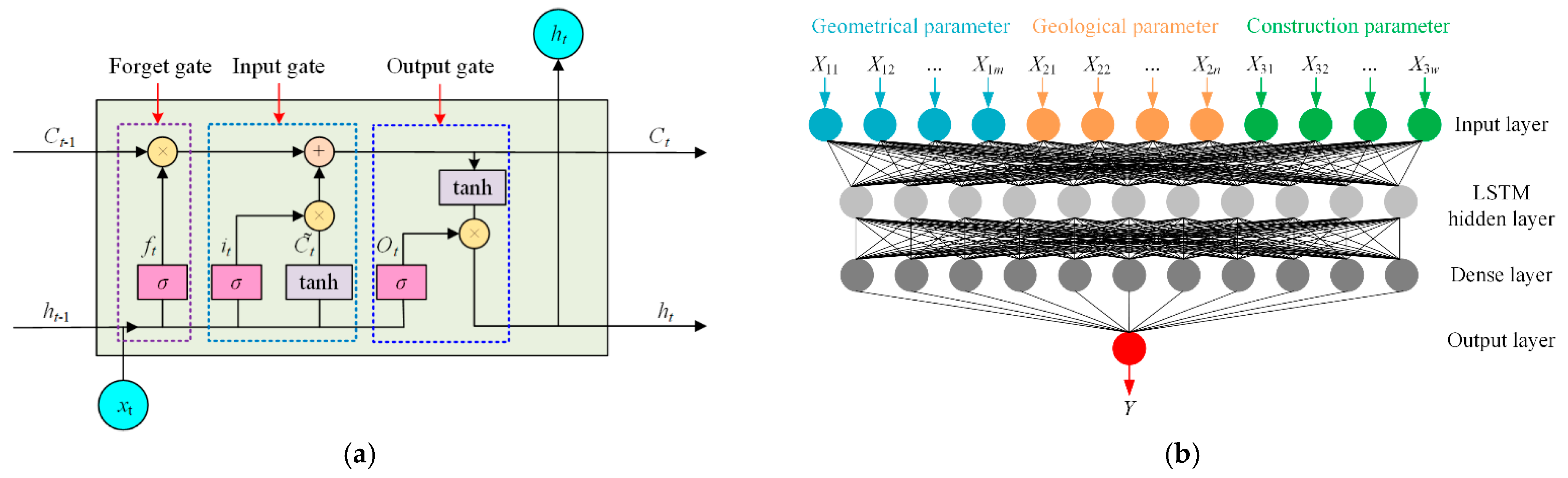
The surface settlement data in shield construction in composite strata is temporal, and to deeply explore the temporal information contained in the data and improve the processing accuracy, a time series neural network needs to be used for intelligent prediction. RNNs, as a temporal neural network, have an additional function of information memory in the hidden layer compared with the traditional neural network, that is, RNNs can remember the information of the previous moment and combine it with the output of the input layer to serve as the input of the hidden layer at the next moment. Therefore, the output layer can output the result containing the previous data information and has a higher prediction effect [41,62]. However, RNNs are prone to the problem of exploding weight matrix dimensions and vanishing propagation gradients during back propagation when dealing with long-time sequences. LSTM improves upon this by adding memory cells and gate units, enhancing prediction accuracy [1,42,63]. LSTM includes a forget gate, input gate, and output gate; the corresponding structure is shown in Figure 1. Among them, the forget gate selectively forgets unimportant cell information from the previous moment, the input gate is used to determine the information to be retained and updated and control the proportion of updated cell states, and the output gate is used to control the information that needs to be output at each time step. The specific calculation equations for the three gates are as follows:
f t = σ W f h t 1 + W f x t + b f
where ft is the output of the forget gate at time t, σ is the sigmoid activation function with the value range of 0~1, Wf is the weight parameter of the forget gate, ht−1 is the hidden layer state at time t − 1, xt is the input data at time t, and bf is the deviation parameter of the forget gate.
i t = σ W i h t 1 + W i x t + b i
C ˜ t = tanh σ W c h t 1 + W f x t + b c
C t = f t × C t 1 + i t × C ˜ t
where it is the input of the input gate at time t, C ˜ t is the candidate memory cell state at time t, Ct is the updated cell state at time t, Wt is the weight parameter of the input gate, Wc is the weight parameter of the current cell state updating, bt is the deviation parameter of the input gate, bc is the deviation parameter of the current cell state updating, and tanh is the activation function with the value range of −1 to 1.
Figure 1. Structure of LSTM and the topology of surface settlement prediction based on LSTM. (a) Structure of LSTM; (b) Topology of surface settlement prediction based on LSTM.
Based on this, the hidden layer state at time t is determined by the output gate and the updated cell state at time t:
O t = σ W o h t 1 + W o x t + b o
h t = O t + tanh C t
where Ot is the output of the output gate at time t; Wo is the weight parameter of the output gate; bo is the deviation parameter of the output gate; ht is the hidden layer state at time t and the input state at time t + 1.

2.4.2. Principle of CPSOS

The CPSOS algorithm, based on the PSO, realizes the balance between exploration and exploitation by introducing the chaos theory and the sigmoid-based acceleration coefficients, which effectively overcomes the defects of the PSO algorithm that fall into the local extremes [25]. Chaos theory was primarily employed to generate diverse initial populations, with the specific generation mode illustrated in Equation (20). The sigmoid function was utilized to improve the traditional acceleration coefficients to increase the population diversity at the initial optimization and strengthen the exploitation ability at the late optimization. The corresponding calculation for acceleration coefficients c1 and c2 and the inertia weight w are shown in Equations (21)–(24).
y j i + 1 = μ × y j i × 1 y j i
where y j i ∈ (0,1), μ is the bifurcation coefficient, i denotes the iteration number, j = 1, 2, ∙∙∙, D, and yj is the jth chaotic variable.
For i = 1, 2, ∙∙∙, N, the swarm based on the chaos logistic map can be initialized in the search space as follows:
x i j = x min , j + y j i × x max , j x min , j
c 1 ( t ) = 1 1 + e ( λ t / t max ) + 2 ( c 1 f c 1 i ) ( t t max 1 ) 2
c 2 ( t ) = 1 1 + e ( λ t / t max ) + ( c 1 f c 1 i ) ( t t max ) 2
where λ = 0.0001 is an adjustable parameter, and c1(t) and c2(t) represent the individual cognitive coefficient and social learning coefficient at the t-th iteration, respectively. c1f and c1i are the final and initial values of the cognitive acceleration coefficient, which are set to 2.5 and 0.5, respectively. t and tmax are the current iteration and maximum number of iterations, respectively.
w ( t ) = ( w max w min ) × t max t t max + w max
where w(t) is the dynamic inertia weight. wmax and wmin represent the upper and lower limits of the inertia weight, which are typically set to 0.9 and 0.4, respectively.
In the early stage of algorithm optimization, when the particle fitness value fi is less than or equal to the population average fitness value favg, Equation (21) is used to re-initialize the population; otherwise, the particle position and velocity are updated based on Equations (25) and (26) [64]. Accordingly, when the optimization is in the late stage and fifavg, population mutation is performed based on the Gaussian mutation, as shown in Equations (29) and (30); otherwise, particle velocity and position are updated by Equations (27) and (28). The method for updating individual and global optimal positions of particles is consistent with the PSO algorithm.
v i d t + 1 = w × v i d t + c 1 × r a n d 1 × p b e s t i d t x i d t + c 2 × r a n d 2 × g b e s t i d t x i d t
x i d t + 1 = x i d t + v i d t + 1 + x ρ l ( x )
where v i d t and x i d t denote the velocity and position of the particle i at dth dimension in tth iteration respectively, rand1 and rand2 denote two random numbers which are uniformly distributed in the range from 0 to 1, ρ is the control factor, and xρl(x) is termed as regular varying function.
v i d t + 1 = w × v i d t + c 1 × r a n d 1 × p b e s t i d t x i d t + c 2 × r a n d 2 × g b e s t i d t x i d t
x i d t + 1 = x i d t + v i d t + 1 + l ( x )
p i j = p i j +   gaussian j (   )
g j = g j +   gaussian j (   )
where gaussian( ) is a random number constructed by Gaussian distribution and l(x) is termed as the slowly varying function.

2.4.3. Mathematical Optimization Model

The input parameters of the CWG-LSTM surface settlement prediction model constructed in this paper are geometrical parameters, geological parameters, and key construction parameters. Therefore, under specific burial depths and geological conditions, the input of key construction parameters can predict the surface settlement at the corresponding location. Therefore, effective control of surface settlement can be achieved by optimizing key construction parameters, and the corresponding mathematical optimization model is shown in Equation (31). The minimization of the predicted surface settlement P is set as the objective function.
min X 1 X u P = min X 1 X u f X 1 , , X u s . t . X 1 [ X 1 min , X 1 max ] X 2 [ X 2 min , X 2 max ] X u [ X u min , X u max ]
where Xi,min, and Xi,max are the maximum and minimum values of the ith key construction parameter, i = 1, 2, …, u, respectively.

2.4.4. Detailed Procedures for CWG-LSTM-CPSOS Framework

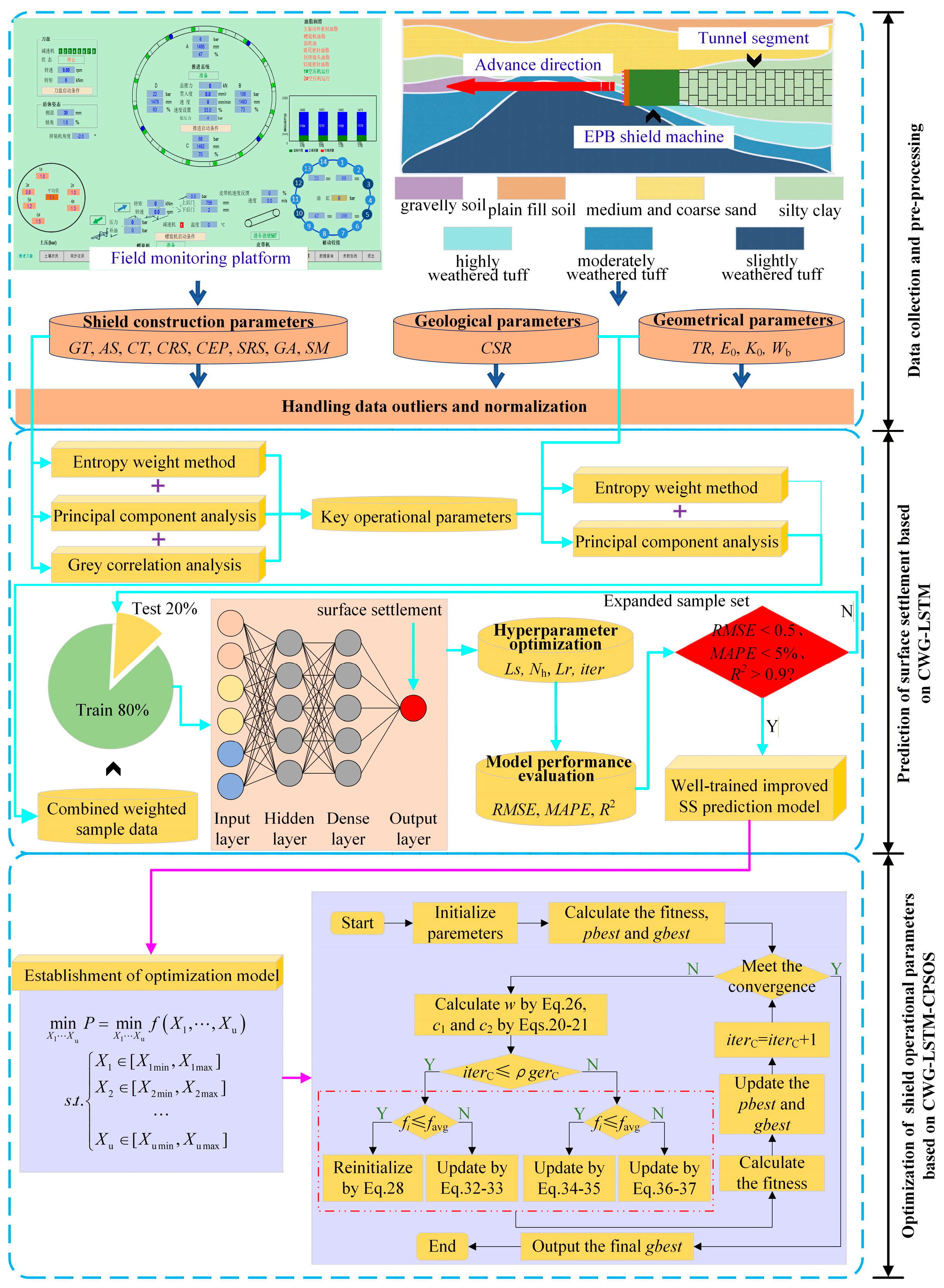
To effectively control surface settlement in shield construction, this study proposes a hybrid intelligent optimization framework for shield construction parameters based on CWG-LSTM-CPSOS, as shown in Figure 2. The hybrid framework mainly consists of data collection and preprocessing, surface settlement prediction based on CWG-LSTM, and optimization of shield construction parameters based on CWG-LSTM-CPSOS. The detailed implementation process is as follows:
Figure 2. Hybrid intelligent optimization framework for shield construction parameters based on the CWG-LSTM-CPSOS.
  • Step 1: data collection and preprocessing
Collect the sample data of geometrical, geological, and construction parameters identified as affecting surface settlement during shield construction according to the analysis in Section 2.1. For the collected data, the boxplot method described in Section 2.2 was used to identify outliers, and the average of the two observed values before and after the outlier was used to correct the outlier. Then, Equation (3) was used to normalize the sample data to eliminate the effect of different parameter dimensions, and the ratio of the train set to the test set was set to 8:2.
  • Step 2: construction of CWG-LSTM model
The CWG method, as detailed in Section 2.3, was applied to determine the key shield construction parameters. On this basis, the influencing factors of surface settlement (CSR, TR, E0, K0, Wb, and key construction parameters) were weighted based on the combination weighting method and used as input parameters for the CWG-LSTM model together with the surface settlement value of the previous monitoring section. The corresponding output parameter is the surface settlement of the current settlement monitoring point. Therefore, the CWG-LSTM model in this study has an input layer node count of 6 + the number of key construction parameters, and an output layer node count of 1. The adaptive moment (Adam) estimation optimizer was selected as the optimization algorithm for the CWG-LSTM model. Meanwhile, to further improve the convergence speed, the learning rate decay is fused into the Adam algorithm, which reduces the learning rate when the loss value tends to be locally stable.
  • Step 3: hyperparameter optimization of CWG-LSTM model
Hyperparameters can greatly affect the performance of the CWG-LSTM model, so it is necessary to combine and optimize hyperparameters to ensure that the model can perform optimally. The hyperparameters involved in this study include the number of hidden layers ls, hidden layer nodes Nh, iterations iter, and the initial learning rate lr, and the hyperparameter optimization was carried out using the 5-fold cross-validation grid search method. The evaluation indicators currently used in research mainly include the coefficient of determination (R2), mean square error (MSE), root mean square error (RMSE), mean absolute error (MAE), and mean absolute percentage error (MAPE) [65,66]. Among them, R2 can reflect the degree of correlation between predicted and true values; MSE and RMSE have the same essence, but RMSE is of the same order of magnitude as the sample data, which can better describe the model error; MAPE can predict the proportion of error relative to the true value. Therefore, this paper selects R2, RMSE, and MAPE as performance evaluation indicators for hyperparameter optimization (as shown in Equations (32)–(34)), and uses the hyperparameter ranked first in the comprehensive ranking of the three indicators as the optimal hyperparameter for model training.
R 2 = 1 i = 1 m Y i y i 2 i = 1 m y i y ¯ i 2
R M S E = 1 m i = 1 m Y i y i 2
M A P E = 1 m i = 1 m Y i y i y i
where Yi is the predicted value of the sample; yi is the measured value of the sample; i is the sample number; and m is the total number of input samples.
  • Step 4: training and performance evaluation of CWG-LSTM model
The CWG-LSTM surface settlement prediction model was trained with the train set, and the model performance was evaluated based on the test set. In addition, the prediction results need to be de-normalized before evaluation:
x = x ( x max x min ) + x min
Similarly, R2, RMSE, and MAPE were selected to evaluate the predictive performance of the model.
  • Step 5: parameter initialization of CPSOS
The initial parameters of the CPSOS algorithm include population size Np, solution space dimension D, control factor ρ, maximum iteration times tmax, etc. Np has a large impact on the ability of the algorithm to search; for more complex problems take 100~200, in this study take Np = 150. D is equal to the number of construction parameters to be optimized, ρ is taken as 0.55, and tmax is set to 2000.
  • Step 6: population initialization
Set boundary values for particle velocity and position, and randomly initialize the velocity and position of particles. The position interval is the search range of the particle in the iterative process. The maximum and minimum boundaries of the position are the maximum and minimum of each construction parameter, and the velocity boundary was obtained by reducing the position boundary to a certain proportion. Let the current iteration number t = 0.
  • Step 7: calculation of pbest, gbest, c1, c2 and w
Calculate the fitness value of the current particle, that is, calculate the surface settlement corresponding to the current construction parameters based on the CWG-LSTM prediction model. The surface settlement calculated from the current construction parameter was compared with the historical minimum surface settlement in the optimization process. If the current surface settlement is smaller, the current construction parameter is used as the new pbest; otherwise, the pbest is not changed. If the surface settlement corresponding to the current construction parameter is the minimum in the current iteration process, the current construction parameter is regarded as gbest; otherwise, gbest is not adjusted. Equations (22) to (23) were used to determine the values of c1 and c2, and w was calculated based on Equation (24).
  • Step 8: update on particle velocity and position
The velocity and position of the particle were updated using Equations (21), (25)–(30). If the velocity or position of the particle exceeds the specified boundary during the updating process, it is processed according to Equations (36)–(37). Let the current iteration number t = t + 1.
v i d t + 1 = v i d t + 1 , i f   v i d t + 1 v m a x   v i d t + 1 v i d t + 1 × v m a x ,   i f   v i d t + 1   >   v m a x  
x i t + 1 = x m a x   ( x i t + 1 x m a x ) ,   i f   x i t + 1 x m a x x m i n + ( x m i n x i t + 1 ) ,   i f   x i t + 1   <   x m i n
where vmax is the maximum boundary value of particle velocity, xmax and xmin are the maximum and minimum position boundary values of particle, and vt+1id′ and xt+1id′ are the velocity and position of particle i at dth dimension in t + 1th iteration after reset.
  • Step 9: obtaining the optimal key construction parameters
When t < tmax, repeat steps 7 and 8; otherwise, CPSOS optimization ends, pbest is the optimal value of the key construction parameter, and its corresponding particle fitness value is the minimum of the surface settlement.

3. Case Study

In this section, the performance evaluation of the CWG-LSTM-CPSOS hybrid intelligent optimization framework for construction parameters is carried out based on the shield construction section of Qingdao Metro Line 4 in China. All experiments were performed using the MATLAB 2020a platform on a PC with a 2.20 GHz Intel i9-13900k 24-Core CPU and 64 GB of RAM.

3.1. Project Background

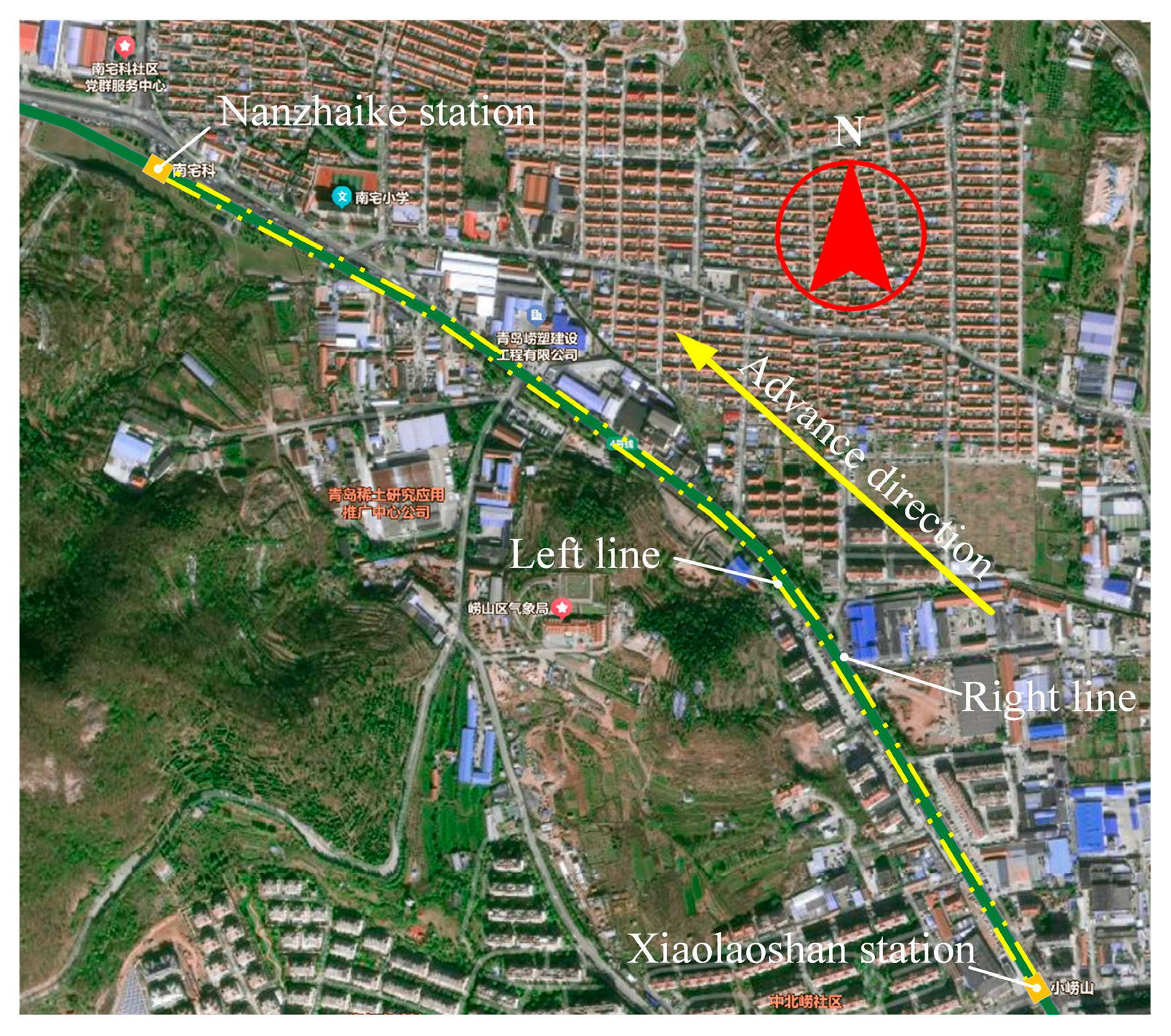
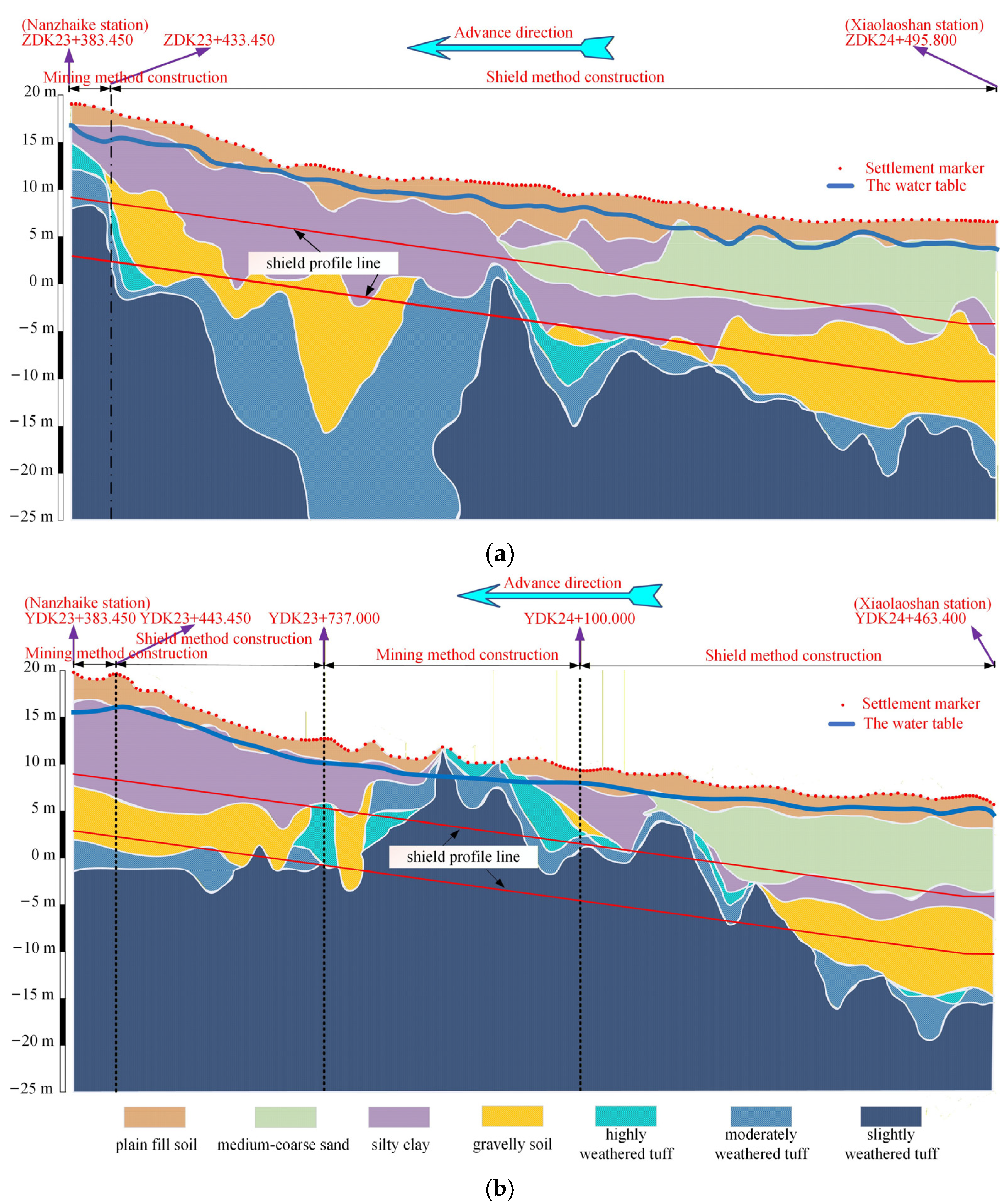
From Xiaolaoshan station to Nanzhaike station (X-N, i.e., advance direction) of Qingdao Metro Line 4, the design starting and ending mileage of the left line is ZDK23+383.45 and ZDK24+495.80, and the right line is YDK23+383.45 and YDK24+463.40. The project location is shown in Figure 3. Both the left and right lines are constructed by a mixture of the shield method and mining method, and the design starting and ending mileage of shield method construction is ZDK23+433.45 and ZDK24+495.80, YDK23+443.45 and YDK23+737.00, and YDK24+100.00 and YDK24+463.40. The thickness of soil covering the X-N section is 10.9~16.4 m, and the strata through which the tunnel passes along the longitudinal path are composed of medium-coarse sand, silty clay, coarse gravel sand, and highly, moderately, and slightly weathered tuff. The physical and mechanical parameters of soil layers are shown in Table 1, and the geological profile of the left and right lines of the section is shown in Figure 4. The settlement monitoring section is arranged along the tunnel axis at a spacing of 10 m and locally encrypted at a spacing of 5 m. The settlement monitoring points are shown as red dots in Figure 4. In accordance with the construction design requirements of Qingdao Metro Line 4, the alert threshold for surface settlement is set at 10 mm to ensure construction safety.
Figure 3. Plan location of the X-N station of Qingdao Metro Line 4.
Table 1. Physical and mechanical parameters of soil layers.
Figure 4. Geological profile map from Xiaolaoshan Station to Nanzhaike Station. (a) Left line; (b) Right line.

3.2. Data Collection and Processing

To verify the effectiveness of the CWG-LSTM surface settlement prediction model, construction and monitoring data of ZDK23+433.45~ZDK24+495.80 and YDK24+100.00~YDK24+463.40 were collected. The construction parameter data comes from the PLC data acquisition system of the shield machine and the construction site record sheet. The maximum surface settlement (MSS) is derived from the data of the surface settlement monitoring points above the tunnel axis. Application of the boxplot method to the PLC time-series data identified 82 instantaneous intra-ring outliers. To maintain data consistency, these outliers were rectified by replacing them with the mean of their neighboring data points. The construction parameters for each monitoring section are processed using the “ring-averaging” method within the midpoints of adjacent sections. While this approach smooths instantaneous fluctuations, it effectively preserves core anomalous information of significant engineering value. From a mechanical perspective, surface settlement is a delayed and cumulative geological response driven by the collective “influence zone” of multi-ring excavation; thus, high-frequency noise is naturally dissipated by the damping effect of soil layers, making ring-level averages more physically consistent with the temporal scale of settlement monitoring. Regarding data characteristics, this method filters out stochastic interference while fully retaining critical trend-level features, such as abnormal fluctuations in chamber pressure. This ensures that the CWG-LSTM model remains highly sensitive to the trend information governing settlement evolution. Cumulatively, 178 sets of sample data were obtained, outliers and normalization were applied using the method described in Section 2.2, and the statistical information of the sample data is shown in Table 2. Although the 178 samples used in this study are relatively small in scale for general deep learning tasks, they are representative in shield tunneling settlement prediction due to the limited arrangement of monitoring sections. As shown in Table 2, the maximum settlement ranges from −19.9 mm to −1.84 mm, with a mean of −6.82 mm, covering conditions from minor disturbances to cases exceeding the warning threshold (10 mm). This indicates that the dataset has sufficient diversity to support the model in capturing complex nonlinear patterns.
Table 2. Brief description of the dataset for predicting surface settlement in shield excavation.

3.3. Selection of Key Shield Construction Parameters

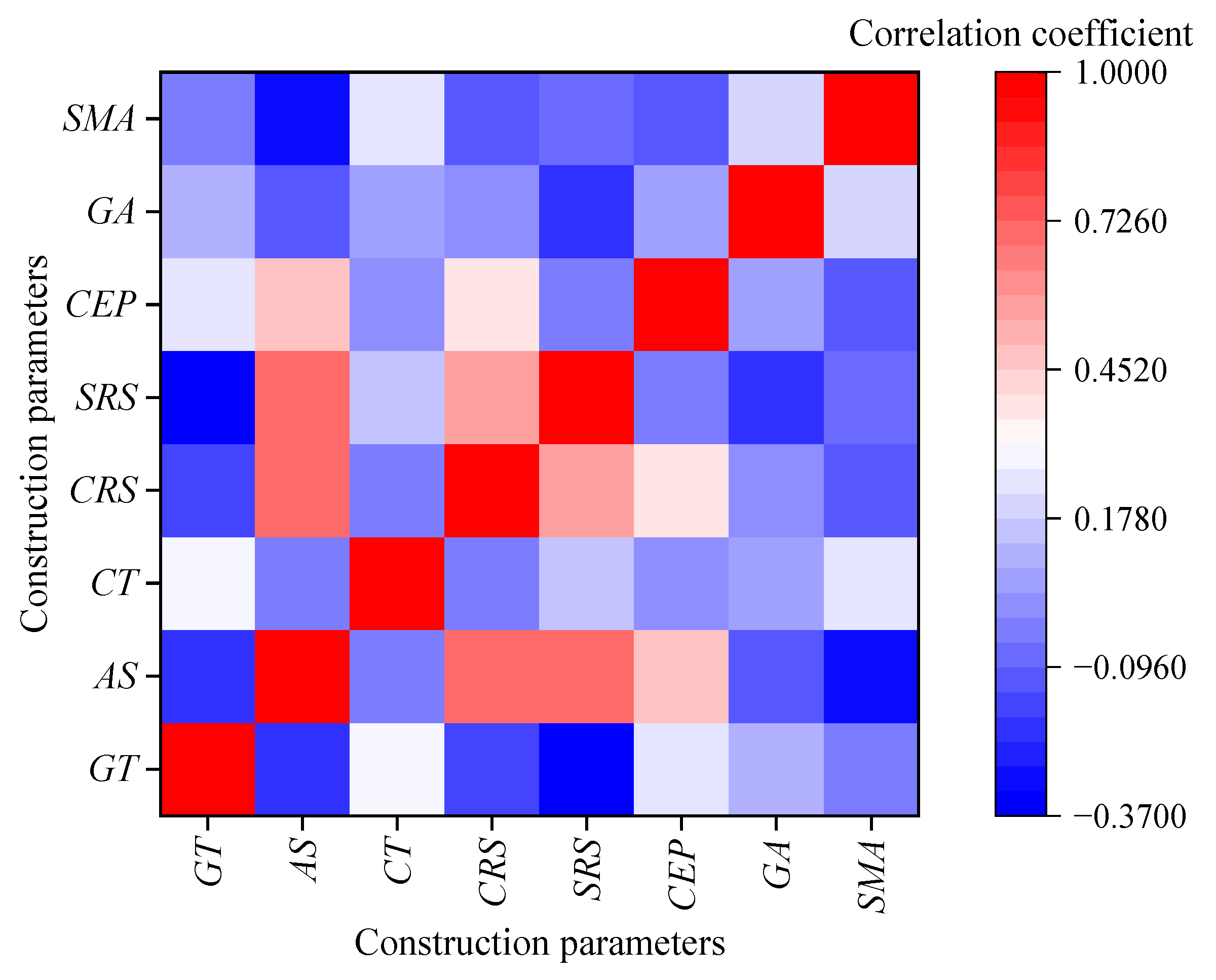
The MSS in the sample data was taken as the reference sequence, and eight construction parameters, including AS, GT, CT, CRS, CEP, SRS, GA, and SMA, were taken as the comparison sequence. The relational degree between construction parameters and MSS was calculated using the CWG method proposed in Section 2.3. Firstly, the EW method-based weights of construction parameters can be obtained. Further, the correlation coefficient among construction parameters was calculated, as shown in Figure 5. It can be seen that the correlation coefficient among some is greater than 0.6, indicating that a strong correlation and PCA could be carried out. The principal components were extracted by calculating eigenroots and variance contribution rates, and then the loading coefficient matrix of the first three principal components was calculated. The greater the loading coefficient, the greater the correlation, and the correlation between the variables and the principal components is stronger when the loading coefficient exceeds 0.4. The linear combination coefficients of principal components were calculated, and the results are shown in Table 3. On this basis, the PCA-based weights of each construction parameter were obtained.
Figure 5. Correlation coefficient between different pairs of parameters.
Table 3. Principal component loading coefficients and linear combination coefficients.
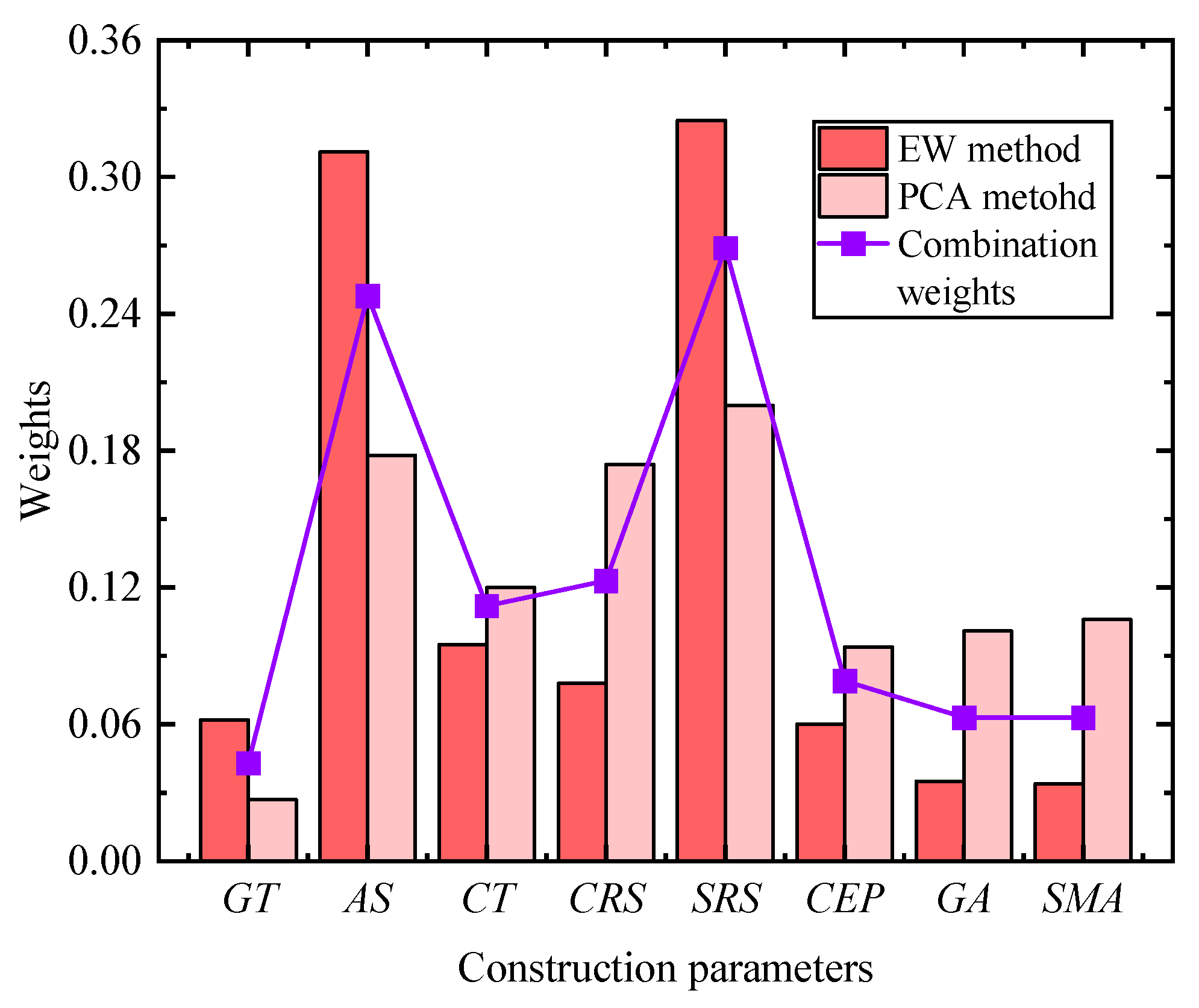
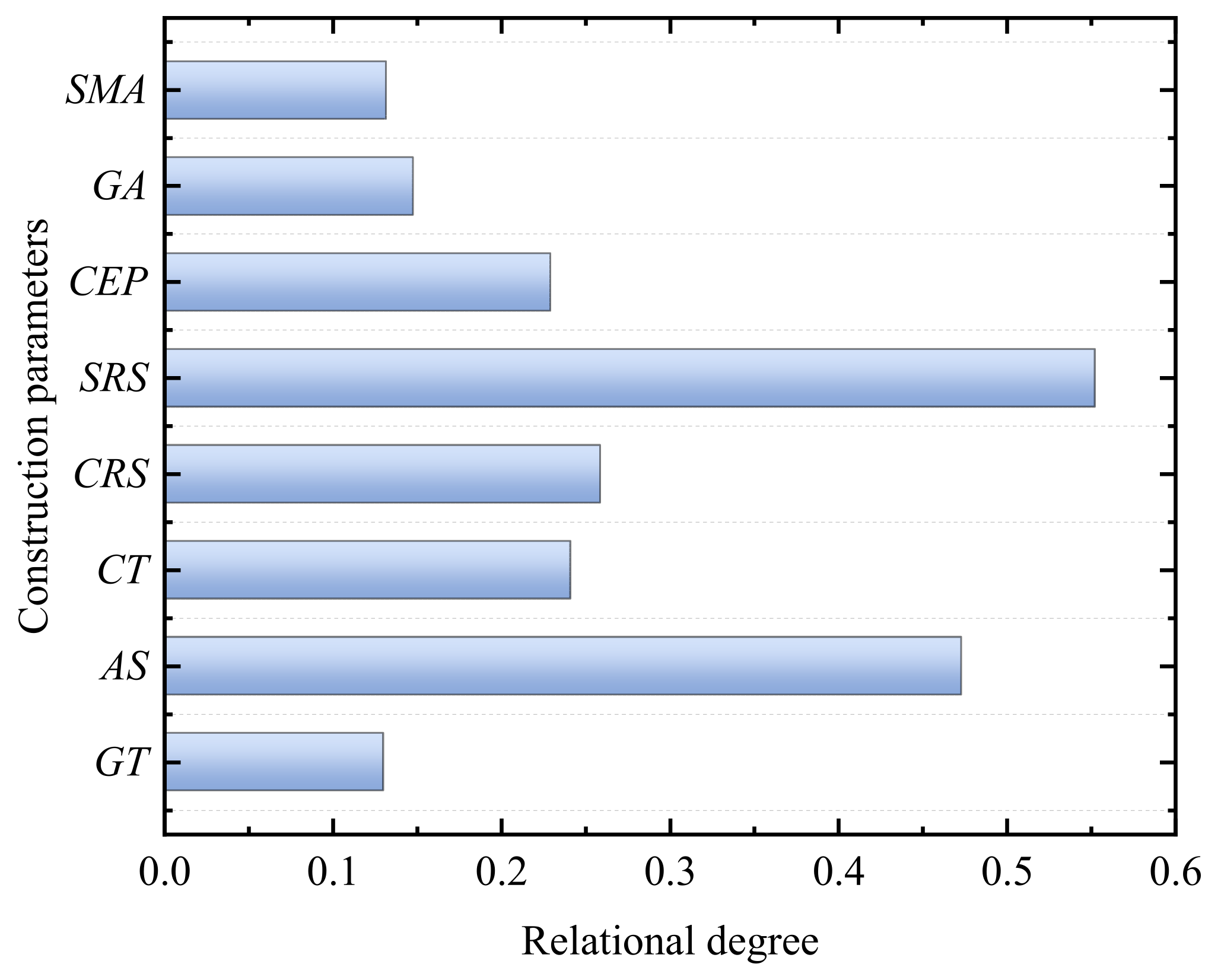
The combination weights based on the CWG method were calculated according to Equation (4), and the results are shown in Figure 6. The gray relational degree of construction parameters was calculated from Equation (13), and the results are shown in Figure 7. From the figure, the influence of construction parameters on surface settlement is in the following order from large to small: SRS > AS > CRS > CT > CEP > GA > SMA > GT. In this paper, the first five construction parameters that have a great influence on the surface settlement were selected as the model input, namely, SRS, AS, CRS, CT, and CEP.
Figure 6. Three weight calculation results for construction parameters.
Figure 7. Gray relational degree of various construction parameters.

3.4. Surface Settlement Prediction Based on CWG-LSTM

3.4.1. Designing the Structure of the Model

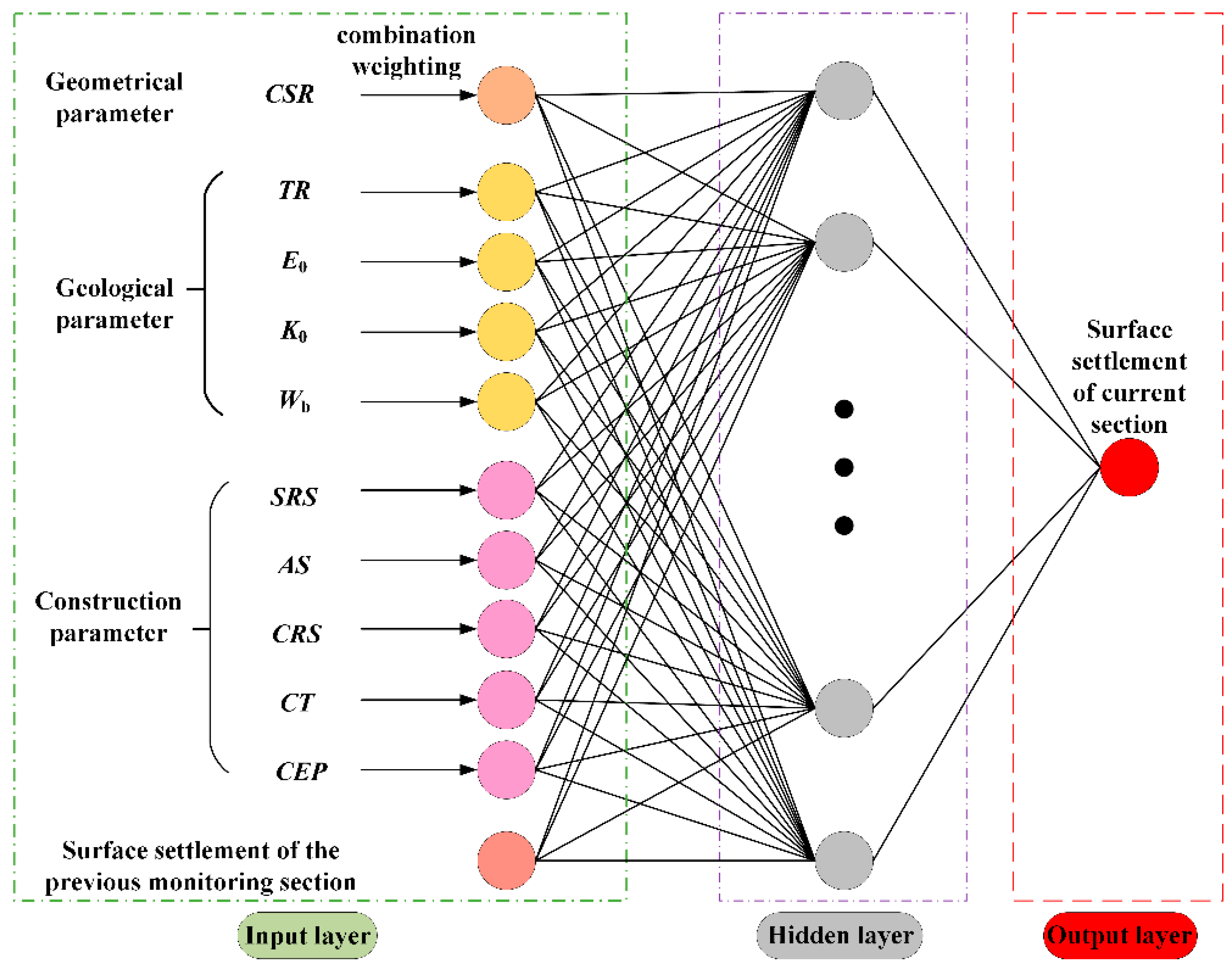
The input parameters of the CWG-LSTM surface settlement prediction model include CSR, TR, E0, K0, SRS, AS, CRS, CT, CEP, and the maximum surface settlement MSSk−1 at the previous monitoring point. The output parameter is the surface settlement MSSk of the current settlement monitoring point. Therefore, the input and output layers of the CWG-LSTM model contain 10 and 1 nodes, respectively. The geometrical, geological, and construction parameters were combined and weighted as input data for the model, and the weights of each parameter are shown in Table 4. Then, 80% of the dataset (143 sets) was randomly selected as the train set and the remaining 20% (35 sets) comprised the test set. To ensure robust generalization of the model under small-sample conditions (178 data sets), hyperparameters were optimized based on the training set using a 5-fold cross-validation grid search. The hyperparameter types, value ranges, and optimal values are summarized in Table 5.
Table 4. Input parameter weights for CWG-LSTM surface settlement prediction model.
Table 5. Hyperparameter value range and optimal value results of the CWG-LSTM prediction model.
Based on the above analysis, the CWG-LSTM model comprises an input layer with 10 nodes, a hidden layer with 64 nodes, and an output layer with 1 node. The structure of the model is illustrated in Figure 8. Based on the dataset size, the batch size was set to 32. At this point, the model input is organized as a three-dimensional tensor with dimensions of (32, 1, 10). Within this structure, “32” represents the batch size, used to optimize computational efficiency; “1” denotes the time step, signifying that the model performs real-time mapping based on the operational status of the current ring; and “10” refers to the dimension of the input features. For the training parameters, the initial learning rate was set to 0.1 and decayed by 0.2 after every 100 iterations. During training, L2 regularization was applied by adding a squared-weight penalty to the loss function, constraining parameter magnitudes to reduce overfitting and improve generalization.
Figure 8. Structure of the CWG-LSTM surface settlement prediction model.

3.4.2. Analysis of the Predicted Results

Upon completion of the training phase, the performance of the CWG-LSTM model was evaluated using the test set, with the corresponding evaluation metrics defined in Equations (32)–(34). To rigorously verify the predictive superiority of the proposed model, its performance was benchmarked against several classic models, including Gated Recurrent Unit (GRU), Random Forest (RF), Transformer, and Multiple Linear Regression (MLR). Regarding hyperparameter configuration, a 5-fold cross-validation grid search method was employed to determine the optimal settings for each baseline. Specifically, for the GRU model, the number of hidden layers, hidden nodes, and the initial learning rate were selected as the primary hyperparameters for optimization. For the RF model, while the minimum samples per leaf and minimum samples for internal splitting were fixed at 1 and 2, respectively, the number of estimators, maximum depth, and maximum feature count were systematically optimized. For the Transformer model, the optimization focused on the number of encoders and decoders. The comprehensive search ranges and the resulting optimal hyperparameter values are summarized in Table 6.
Table 6. Hyperparameter value range and optimal value results of various comparison models.
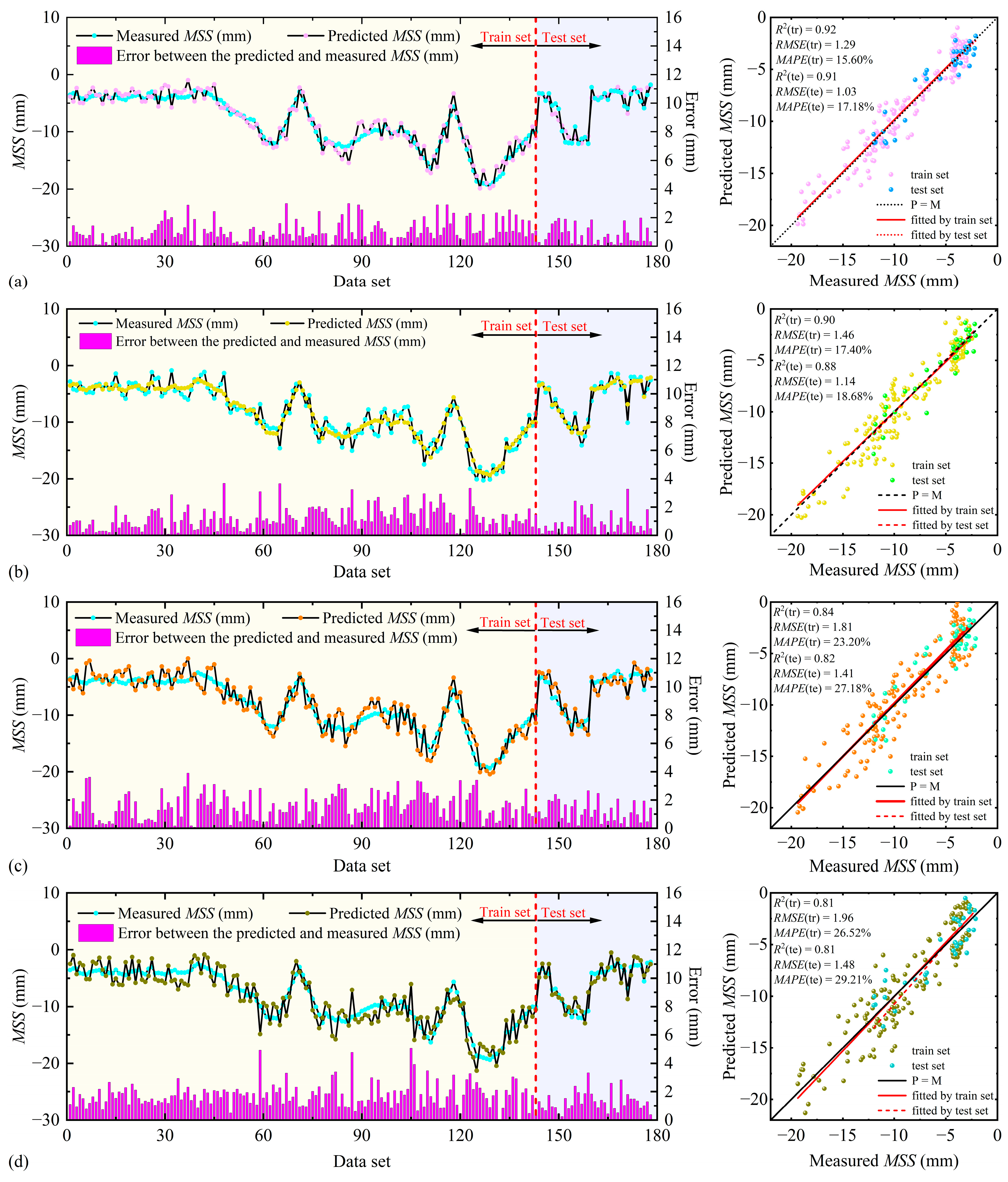
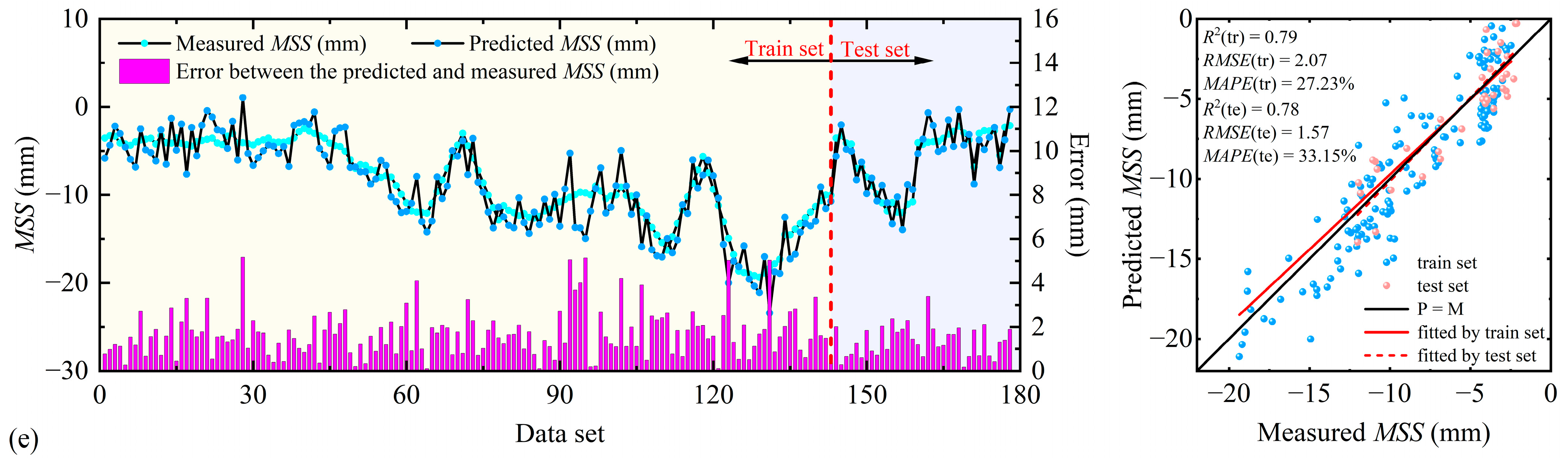
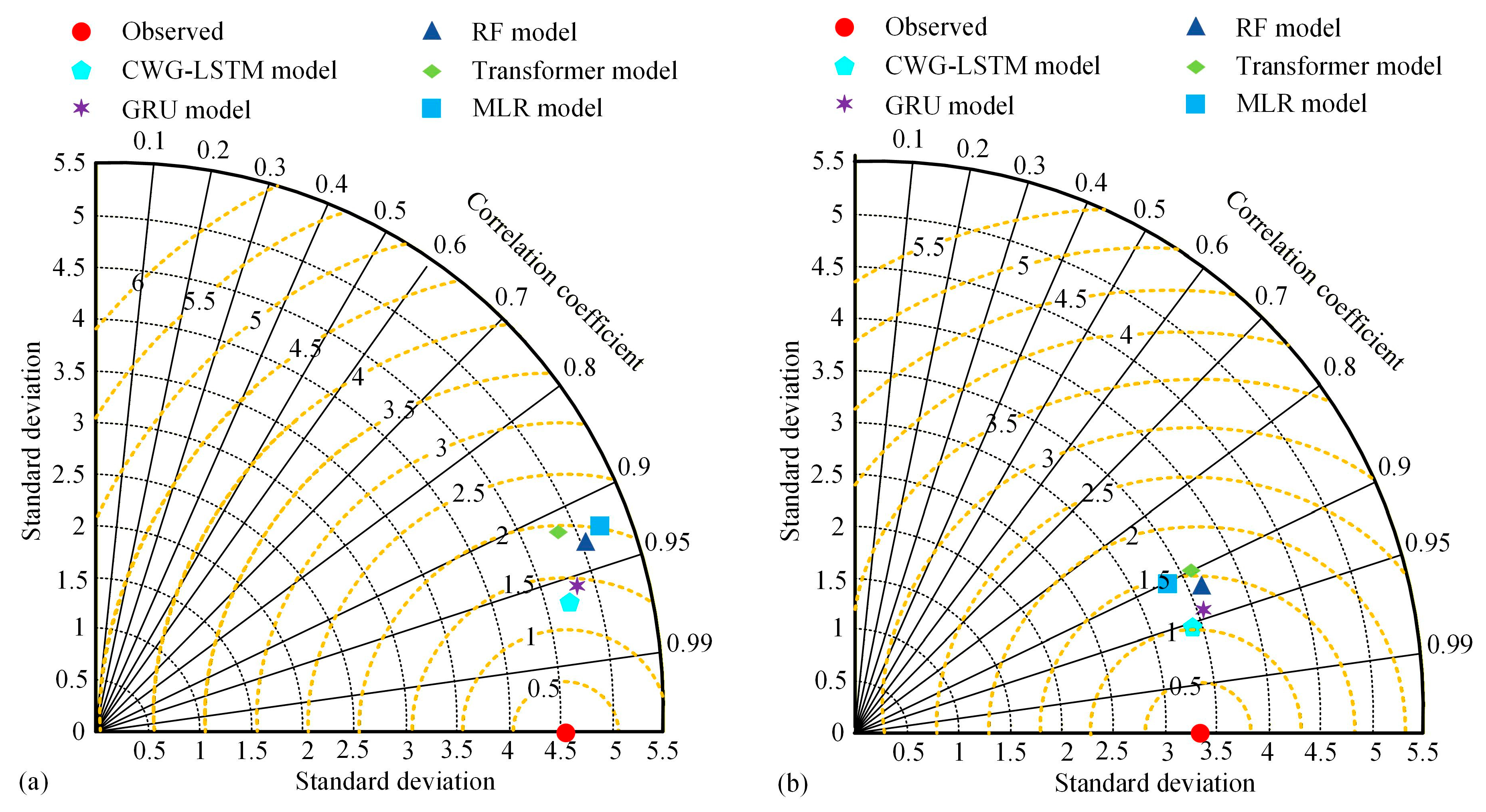
The prediction results of the various models are illustrated in Figure 9, where a reference line reflects the correlation between the predicted and measured values. It is intuitively evident that the CWG-LSTM model achieves the highest accuracy, as its predicted curves align most closely with the measured data, showing minimal dispersion around the reference line. To quantitatively evaluate the performance, the evaluation indicators are summarized in Table 7. As shown in the table, the CWG-LSTM model yields R2 values of 0.92 and 0.91 on the training and test sets, respectively, outperforming the GRU, RF, Transformer, and MLR models. This indicates a superior goodness of fit for the proposed model. Regarding prediction error, the CWG-LSTM model exhibits the lowest RMSE and MAPE across both datasets, with training and test RMSE of 1.29 and 1.03, respectively, and MAPE of 15.60% and 17.18%. Specifically, compared to the GRU model, the test RMSE and MAPE of CWG-LSTM decreased by 9.65% and 8.03%, respectively. Compared to the RF model, the test indicators were reduced by 26.95% and 36.79%. Furthermore, the CWG-LSTM model outperformed the Transformer by reducing the test RMSE and MAPE by 30.41% and 41.18%, and exhibited a significant improvement over the MLR model with reductions of 34.39% and 48.17%, respectively. As further evidenced by the Taylor diagram in Figure 10, the CWG-LSTM model consistently demonstrates superior comprehensive performance. Consequently, it can be concluded that the proposed model provides higher fitting and prediction accuracy, making it highly applicable for surface settlement prediction under complex geological conditions.
Figure 9. Prediction results of each prediction model on the dataset. (a) CWG-LSTM model; (b) GRU model; (c) RF model; (d) Transformer model; (e) MLR model.
Table 7. Predictive performance evaluation of various surface settlement prediction models.
Figure 10. Taylor diagram visualization of each model on the train and test set. (a) Train set; (b) Test set.

3.5. Optimization of Shield Construction Parameters Using CWG-LSTM-CPSOS

3.5.1. Establishment of Optimization MODEL

To verify the practicability of the proposed CWG-LSTM-CPSOS hybrid intelligent optimization framework for construction parameters in practical engineering, real-time optimization of construction parameters was carried out during the excavation process of the unconstructed section of the right line from YDK23+443.45 to YDK23+737.00, and the reasonable suggested values are given, which guide the setting of the construction parameters in this section. The geometrical and geological parameters of some monitoring sections in this section are shown in Table 8. Suppose the optimized construction parameters are used for construction and the surface settlement is less than 10 mm. In that case, it indicates that the construction parameter optimization framework proposed in this paper has guiding significance for surface settlement control in actual shield construction.
Table 8. Geometrical and geological parameters of construction parameter optimization section.
Based on the key construction parameters determined in Section 3.3 and the optimization model for construction parameters identified in Section 2.4.3, the optimization model for this case is transformed from Equations (31)–(38).
min X 1 X 5 P = min X 1 X 5 f X 1 , , X 5 s . t . X 1 [ X 1 min , X 1 max ] X 2 [ X 2 min , X 2 max ] X 3 [ X 3 min , X 3 max ] X 4 [ X 4 min , X 4 max ] X 5 [ X 5 min , X 5 max ]
where decision variables X1~X5 are SRS, AS, CRS, CT, and CEP, respectively. The value ranges of construction parameters in different sections are shown in Table 9.
Table 9. Value range of key construction parameters.

3.5.2. Optimization Results of Shield Construction Parameters

Utilizing the well-trained CWG-LSTM prediction model, the CPSOS algorithm was implemented to optimize construction parameters across different sections in real-time. The CPSOS algorithm was configured with a population size of 40, a maximum iteration count of 1000, and a bifurcation coefficient μ of 4. Consequently, optimized construction parameters were obtained for the interval from YDK23+443.45 to YDK23+737.00. For the sake of conciseness, Table 10 summarizes the optimization results for key construction parameters across various strata within the optimized interval, presenting their statistical characteristics as the minimum, maximum, and mean values.
Table 10. Real-time optimization results of construction parameters.
To prevent excessive wear of the cutterhead caused by hard rock, the AS and CRS should be properly reduced when shield tunneling in the rock with greater strength. Additionally, when tunneling in the upper soft and lower hard strata, the AS and CRS should be lower than the mixed layer of soft soil and soft rock. Moreover, as the strength of the hard rock in the lower part of that stratum is greater, the stability of the tunnel face can be maintained by keeping the CEP at a low level. Therefore, the AS, CRS, and CEP of sections DBC59 to DBC66 should be lower than those of DBC37 to DBC58. The optimization results of construction parameters in Table 10 conform to this principle, indicating that the CWG-LSTM-CPSOS hybrid intelligent optimization framework proposed in this paper can obtain reasonable values of construction parameters, which helps control the surface settlement during construction.
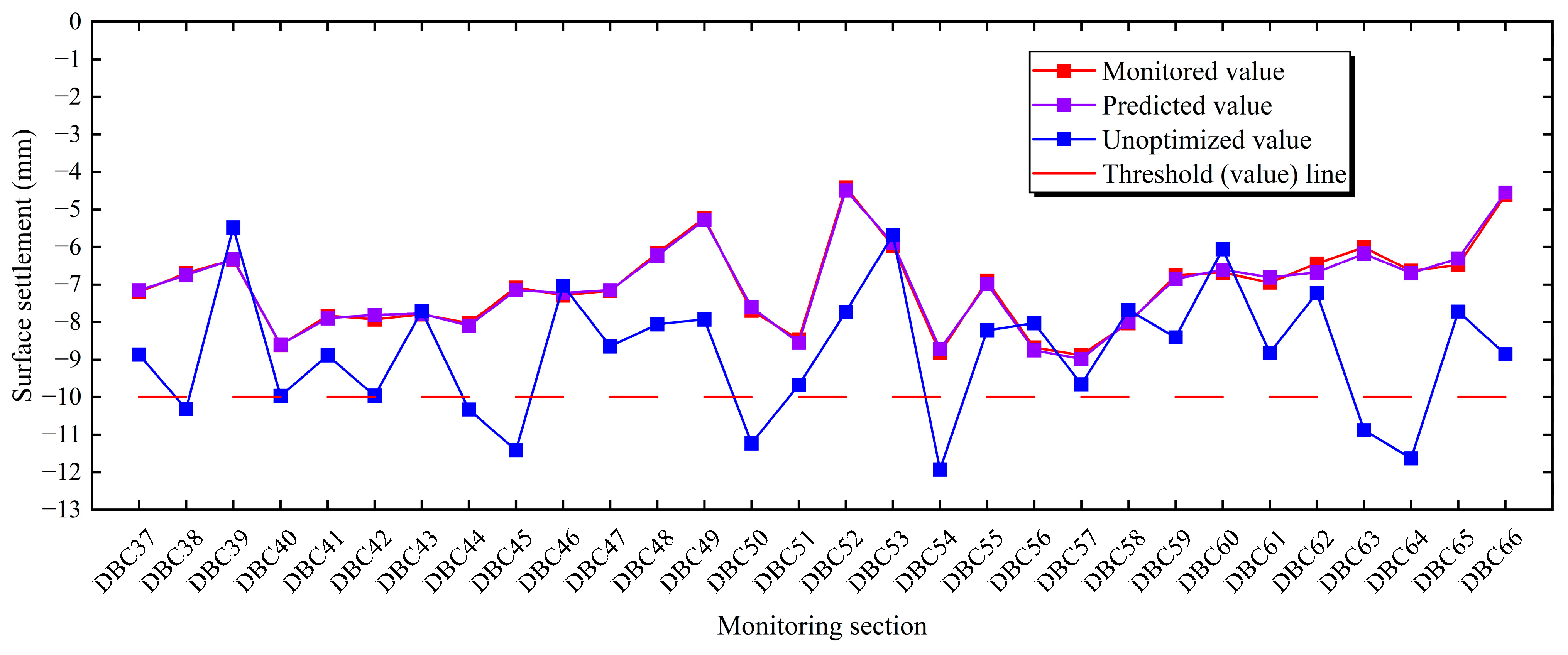
During shield tunneling, real-time construction guidance was provided based on the optimized construction parameters and the actual site conditions. Meanwhile, surface settlements were continuously monitored during the excavation, and monitoring data for sections DBC37–DBC66 were obtained. To quantitatively evaluate the optimization performance of the CWG-LSTM-CPSOS framework, predicted settlement values under empirical parameter conditions, predicted values under optimized parameter conditions, and actual monitoring values were comparatively analyzed (see Figure 11). The results show that under empirical parameter conditions, the predicted settlements for some cross-sections exceeded the safety threshold of 10 mm; in contrast, after the CPSOS algorithm was applied to optimize key construction parameters, the actual monitored settlements were stably maintained within 10 mm, verifying that the proposed CWG-LSTM-CPSOS framework can provide reliable real-time parameter guidance for shield tunneling. Further analysis revealed that the optimized predicted settlements closely matched the actual monitoring values, indicating that the CWG-LSTM model can accurately characterize the nonlinear relationship between construction parameters and surface settlement. These findings quantitatively highlight the significant advantage of the proposed method in controlling surface settlement.
Figure 11. Predicted and measured surface settlements of sections DBC37–DBC66 under empirical parameters and after CWG-LSTM-CPSOS optimization.

4. Conclusions

Reasonable values of construction parameters are crucial for effectively controlling surface settlement and ensuring the safety of shield tunneling construction. In this paper, a hybrid intelligent optimization framework for shield construction parameters based on the CWG method, LSTM model and CPSOS optimization algorithm was proposed, and its applicability and feasibility were validated based on a shield section of Qingdao Metro Line 4 in China. The main conclusions are as follows:
(1)
The key construction parameters (such as SRS, AS, CRS, CT, and CEP) affecting the surface settlement of shield construction can be determined by the CWG method. The determination of these parameters is conducive to improving the accuracy of surface settlement prediction.
(2)
The CWG-LSTM model differentiates the importance of various parameters that affect surface settlement and can reliably predict surface settlement. The prediction accuracies outperform the GRU, RF, Transformer, and MLR models, with R2 of 0.92 and 0.91, RMSE of 1.29 and 1.03, and MAPE of 15.60% and 17.18% on the train and test set, respectively.
(3)
The CWG-LSTM-CPSOS hybrid intelligent optimization framework was used to optimize the construction parameters of the unconstructed section, and the shield construction was carried out concerning the optimization results. The surface settlement values remained within safe limits during construction, confirming the applicability and feasibility of the proposed optimization framework. Therefore, this optimization framework can guide tunneling construction management in the field of shield construction and help to ensure the safety of construction.
While the proposed CWG-LSTM-CPSOS framework has demonstrated effectiveness in shield tunneling parameter optimization, certain limitations persist. The reliance on a single-section case study with a limited sample size may constrain the model’s generalizability across diverse geological conditions. Additionally, the empirical tuning of optimization parameters potentially limits search efficiency and result stability. Future research will focus on: (1) expanding the database with multi-project and cross-geological data to enhance model robustness and transferability; and (2) incorporating adaptive parameter strategies or multi-agent collaborative optimization to further improve the global search performance and reliability of the framework.

Author Contributions

Conceptualization, L.L.; methodology, L.L. and Z.W.; software, Z.W.; validation, C.H. and L.F.; formal analysis, L.L.; investigation, Z.W. and P.Z.; resources, C.H. and P.Z.; data curation, L.L. and L.F.; writing—original draft preparation, L.L. and Z.W.; writing—review and editing, C.H.; visualization, L.L.; supervision, C.H.; project administration, C.H.; funding acquisition, C.H. and Z.W. All authors have read and agreed to the published version of the manuscript.

Funding

This work was supported by the National Natural Science Foundation of China [grant numbers 52508408 and 52408393], the Key Research and Development Program of Shaanxi Province [grant number 2021SF-523], and the Natural Science Basic Research Program of Shaanxi [grant number 2022JQ-375].

Data Availability Statement

The original contributions presented in the study are included in the article; further inquiries can be directed to the corresponding authors.

Conflicts of Interest

Author Peng Zhang was employed by the company Southern Engineering Co., Ltd. The remaining authors declare that the research was conducted in the absence of any commercial or financial relationships that could be construed as a potential conflict of interest.

References

  1. Yu, S.H.; Zhang, Z.X.; Wang, S.F.; Huang, X.; Lei, Q.H. A performance-based hybrid deep learning model for predicting TBM advance rate using Attention-ResNet-LSTM. J. Rock Mech. Geotech. Eng. 2024, 16, 65–80. [Google Scholar] [CrossRef]
  2. Cheng, Q.; Wang, X.; Sun, J.; Zhao, H.; Liu, X. Research on BIM-based visualization, simulation, and early warning system for shield tunnel construction. Buildings 2025, 15, 746. [Google Scholar] [CrossRef]
  3. Wu, F.; Gong, Q.M.; Li, Z.G.; Huang, L.; Sun, Q.W.; Liu, Q.Y. Study on Tunnelling Performance of Dual-Mode Shield TBM by Cutterhead Working Performance and Tunnelling Difference Comparison: A Case in Shenzhen Metro Line 12. Rock Mech. Rock Eng. 2023, 56, 5315–5333. [Google Scholar] [CrossRef]
  4. Mahmoodzadeh, A.; Nejati, H.R.; Mohammadi, M.; Ibrahim, H.H.; Rashidi, S.; Ibrahim, B.F. Forecasting Face Support Pressure During EPB Shield Tunneling in Soft Ground Formations Using Support Vector Regression and Meta-heuristic Optimization Algorithms. Rock Mech. Rock Eng. 2022, 55, 6367–6386. [Google Scholar] [CrossRef]
  5. Zhang, X.; Wang, L.; Ma, M.; Li, W.; Wang, Y. Stability analysis of the foundation pit and the twin shield tunnels during adjacent construction. Buildings 2023, 13, 1000. [Google Scholar] [CrossRef]
  6. Zhou, X.H.; Shen, S.L.; Zhou, A. A novel data-driven approach for proactive risk assessment in shield tunnel construction. Transp. Geotech. 2025, 50, 101466. [Google Scholar] [CrossRef]
  7. Shang, W.T.; Li, Y.; Wei, H.W.; Qiu, Y.B.; Chen, C.W.; Gao, X.R. Prediction method of longitudinal surface settlement caused by double shield tunnelling based on deep learning. Sci. Rep. 2024, 14, 908. [Google Scholar] [CrossRef]
  8. Liu, X.R.; Suliman, L.; Zhou, X.H.; Wang, J.W.; Linfeng, W.; Elmageed, A.A. Settlement Characteristic Due to Excavate Parallel Tunnels in a Fill-rock Slope: Model Test and Numerical Analysis. Rock Mech. Rock Eng. 2022, 55, 7125–7143. [Google Scholar] [CrossRef]
  9. Wang, F.; Du, X.L.; Li, P.F. Prediction of subsurface settlement induced by shield tunnelling in sandy cobble stratum. J. Rock Mech. Geotech. Eng. 2024, 16, 192–212. [Google Scholar] [CrossRef]
  10. Chen, R.P.; Zhang, P.; Kang, X.; Zhong, Z.Q.; Liu, Y.; Wu, H.N. Prediction of maximum surface settlement caused by earth pressure balance (EPB) shield tunneling with ANN methods. Soils Found. 2019, 59, 284–295. [Google Scholar] [CrossRef]
  11. Liu, Y.; Chen, H.Y.; Zhang, L.M.; Wang, X.J. Risk prediction and diagnosis of water seepage in operational shield tunnels based on random forest. J. Civ. Eng. Manag. 2021, 27, 539–552. [Google Scholar] [CrossRef]
  12. Mahmoodzadeh, A.; Mohammadi, M.; Daraei, A.; Farid Hama Ali, H.; Kameran Al-Salihi, N.; Mohammed Dler Omer, R. Forecasting maximum surface settlement caused by urban tunneling. Autom. Constr. 2020, 120, 103375. [Google Scholar] [CrossRef]
  13. Feng, F.; Zhang, J.N.; Jin, J.; Na, W.C.; Yan, S.X.; Zhang, Q.J. Efficient FEM-Based EM Optimization Technique Using Combined Lagrangian Method With Newton’s Method. IEEE Trans. Microw. Theory Tech. 2020, 68, 2194–2205. [Google Scholar] [CrossRef]
  14. Van Den Doel, K.; Ascher, U. The Chaotic Nature of Faster Gradient Descent Methods. J. Sci. Comput. 2012, 51, 560–581. [Google Scholar] [CrossRef]
  15. Kobayashi, H.; Narushima, Y.; Yabe, H. Descent three-term conjugate gradient methods based on secant conditions for unconstrained optimization. Optim. Methods Softw. 2017, 32, 1313–1329. [Google Scholar] [CrossRef]
  16. Tang, L.B.; Na, S. Comparison of machine learning methods for ground settlement prediction with different tunneling datasets. J. Rock Mech. Geotech. Eng. 2021, 13, 1274–1289. [Google Scholar] [CrossRef]
  17. Zhang, Z.; Xu, S.; Wang, P.; Cheng, H.; Zhang, S. Decentralized Microenvironment-Based Particle Swarm Optimization Algorithm for Insect-Intelligent Building Platform. Buildings 2025, 15, 1778. [Google Scholar] [CrossRef]
  18. Dehghanbanadaki, A. Intelligent modelling and design of soft soil improved with floating column-like elements as a road subgrade. Transp. Geotech. 2021, 26, 100428. [Google Scholar] [CrossRef]
  19. Fu, K.; Qiu, D.H.; Xue, Y.G.; Tao, Y.; Kong, F.M. Research on optimization strategy of TBM tunneling parameters based on stratum perception and simulation tunneling experiment. Tunn. Undergr. Space Technol. 2024, 147, 105743. [Google Scholar] [CrossRef]
  20. Ding, X.H.; Hasanipanah, M.; Rouhani, M.M.; Nguyen, T. Hybrid catboost models optimized with metaheuristics for predicting shear strength in rock joints. Bull. Eng. Geol. Environ. 2025, 84, 150. [Google Scholar] [CrossRef]
  21. Bardhan, A.; Asteris, P.G. Application of hybrid ANN paradigms built with nature inspired meta-heuristics for modelling soil compaction parameters. Transp. Geotech. 2023, 41, 100995. [Google Scholar] [CrossRef]
  22. Liu, Y.S.; Li, A.; Dai, F.; Jiang, R.C.; Liu, Y.; Chen, R. An AI-powered approach to improving tunnel blast performance considering geological conditions. Tunn. Undergr. Space Technol. 2024, 144, 105508. [Google Scholar] [CrossRef]
  23. Ren, Z.; Wang, E.; Liu, J.; Jiang, H.; Yao, Z. Characterization and prediction of compressive strength in ultralow-temperature frozen soil using nuclear magnetic resonance and WOA-ENN Model. Transp. Geotech. 2023, 43, 101143. [Google Scholar] [CrossRef]
  24. Yuan, Y.; Hu, C.; Li, L.; Mei, Y.; Wang, X. Regional-modal optimization problems and corresponding normal search particle swarm optimization algorithm. Swarm Evol. Comput. 2023, 78, 101257. [Google Scholar] [CrossRef]
  25. Tian, D.P.; Zhao, X.F.; Shi, Z.Z. Chaotic particle swarm optimization with sigmoid-based acceleration coefficients for numerical function optimization. Swarm Evol. Comput. 2019, 51, 100573. [Google Scholar] [CrossRef]
  26. Gui, M.W.; Chen, S.L. Estimation of transverse ground surface settlement induced by DOT shield tunneling. Tunn. Undergr. Space Technol. 2013, 33, 119–130. [Google Scholar] [CrossRef]
  27. Li, S.H.; Li, C.; Yao, D. Functional Relationship of Parameters in Different Theoretical Models for Ground Settlement Caused by Shield Tunneling. KSCE J. Civ. Eng. 2020, 24, 310–321. [Google Scholar] [CrossRef]
  28. Song, S.G.; Li, S.C.; Li, L.P.; Shi, S.S.; Zhou, Z.Q.; Liu, Z.H.; Shang, S.C.; Sun, H.Z. Model test study on vibration blasting of large cross-section tunnel with small clearance in horizontal stratified surrounding rock. Tunn. Undergr. Space Technol. 2019, 92, 103013. [Google Scholar] [CrossRef]
  29. Zhong, Z.L.; Li, C.; Liu, X.R.; Fan, Y.F.; Liang, N.H. Analysis of ground surface settlement induced by the construction of mechanized twin tunnels in soil-rock mass mixed ground. Tunn. Undergr. Space Technol. 2021, 110, 103746. [Google Scholar] [CrossRef]
  30. Ren, T.; Zhang, H.L.; Guo, Y.C.; Tang, Y.; Li, Q.L. Numerical simulation of ground surface settlement of underpass building in tunnel boring machine double-line tunnels. Front. Earth Sci. 2022, 10, 937524. [Google Scholar] [CrossRef]
  31. Fu, J.Y.; Yang, J.S.; Klapperich, H.; Wang, S.Y. Analytical Prediction of Ground Movements due to a Nonuniform Deforming Tunnel. Int. J. Geomech. 2016, 16, 04015089. [Google Scholar] [CrossRef]
  32. Lin, S.S.; Zhang, N.; Zhou, A.; Shen, S.L. Time-series prediction of shield movement performance during tunneling based on hybrid model. Tunn. Undergr. Space Technol. 2022, 119, 104245. [Google Scholar] [CrossRef]
  33. Chen, H.Y.; Liu, J.; Shen, G.Q.; Martínez, L.; Deveci, M.; Chen, Z.S.; Liu, Y. Multisource information fusion for real-time optimization of shield construction parameters. Knowl.-Based Syst. 2024, 286, 111413. [Google Scholar] [CrossRef]
  34. Ling, X.Z.; Kong, X.X.; Tang, L.; Zhao, Y.Z.; Tang, W.C.; Zhang, Y.F. Predicting earth pressure balance (EPB) shield tunneling-induced ground settlement in compound strata using random forest. Transp. Geotech. 2022, 35, 100771. [Google Scholar] [CrossRef]
  35. Kong, F.; Lu, D.; Ma, Y.; Tian, T.; Yu, H.; Du, X. Novel hybrid method to predict the ground-displacement field caused by shallow tunnel excavation. Sci. China Technol. Sci. 2023, 66, 101–114. [Google Scholar] [CrossRef]
  36. Wang, F.; Gou, B.C.; Qin, Y.W. Modeling tunneling-induced ground surface settlement development using a wavelet smooth relevance vector machine. Comput. Geotech. 2013, 54, 125–132. [Google Scholar] [CrossRef]
  37. Hu, D.; Hu, Y.J.; Yi, S.; Liang, X.Q.; Li, Y.S.; Yang, X. Prediction method of surface settlement of rectangular pipe jacking tunnel based on improved PSO-BP neural network. Sci. Rep. 2023, 13, 5512. [Google Scholar] [CrossRef] [PubMed]
  38. Yang, P.X.; Yong, W.X.; Li, C.Q.; Peng, K.; Wei, W.; Qiu, Y.G.; Zhou, J. Hybrid Random Forest-Based Models for Earth Pressure Balance Tunneling-Induced Ground Settlement Prediction. Appl. Sci. 2023, 13, 2574. [Google Scholar] [CrossRef]
  39. Yu, G.; Jin, Y.C.; Hu, M.; Li, Z.S.; Cai, R.B.; Zeng, R.C.; Sugumaran, V. Improved Machine Learning Model for Urban Tunnel Settlement Prediction Using Sparse Data. Sustainability 2024, 16, 4693. [Google Scholar] [CrossRef]
  40. Su, F.; Wu, X.; Li, T.; Liu, Y. Development of data-driven predictive model and enhanced multiobjective optimization to improve the excavation performance of large-diameter slurry shields. Eng. Appl. Artif. Intell. 2025, 162, 112402. [Google Scholar] [CrossRef]
  41. Shan, F.; He, X.Z.; Jahed Armaghani, D.; Xu, H.D.; Liu, X.L.; Sheng, D.C. Real-time forecasting of TBM cutterhead torque and thrust force using aware-context recurrent neural networks. Tunn. Undergr. Space Technol. 2024, 152, 105906. [Google Scholar] [CrossRef]
  42. Hochreiter, S.; Schmidhuber, J. Long Short-Term Memory. Neural Comput. 1997, 9, 1735–1780. [Google Scholar] [CrossRef] [PubMed]
  43. Wen, Z.; Guo, L.; Meng, S.; Rong, X.; Shi, Y. IoT-assisted feature learning for surface settlement prediction caused by shield tunnelling. Comput. Commun. 2023, 203, 276–288. [Google Scholar] [CrossRef]
  44. Yang, M.; Song, M.; Guo, Y.; Lyv, Z.; Chen, W.; Yao, G. Prediction of shield tunneling-induced ground settlement using LSTM architecture enhanced by multi-head self-attention mechanism. Tunn. Undergr. Space Technol. 2025, 161, 106536. [Google Scholar] [CrossRef]
  45. Zhang, P.; Chen, R.P.; Wu, H.N. Real-time analysis and regulation of EPB shield steering using Random Forest. Autom. Constr. 2019, 106, 102860. [Google Scholar] [CrossRef]
  46. Suwansawat, S.; Einstein, H.H. Artificial neural networks for predicting the maximum surface settlement caused by EPB shield tunneling. Tunn. Undergr. Space Technol. 2006, 21, 133–150. [Google Scholar] [CrossRef]
  47. Feng, X.T.; Zhang, C.Q.; Qiu, S.L.; Zhou, H.; Jiang, Q.; Li, S.J. Dynamic design method for deep hard rock tunnels and its application. J. Rock Mech. Geotech. Eng. 2016, 8, 443–461. [Google Scholar] [CrossRef]
  48. Chen, D.F.; Feng, X.T.; Xu, D.P.; Jiang, Q.; Yang, C.X.; Yao, P.P. Use of an improved ANN model to predict collapse depth of thin and extremely thin layered rock strata during tunnelling. Tunn. Undergr. Space Technol. 2016, 51, 372–386. [Google Scholar] [CrossRef]
  49. Heng, C.; Sun, S.; Zhou, Z.; Zhang, J. Prediction of Surface Settlement with Ultra-shallow-burial and Large Rectangular Cross-section Urban Underpass. KSCE J. Civ. Eng. 2019, 23, 4641–4650. [Google Scholar] [CrossRef]
  50. Liu, X.; Liu, D.; Xiong, F.; Han, Y.; Liu, R.; Meng, Q.; Zhong, Z.; Chen, Q.; Weng, C.; Liu, W. Experimental and numerical study on the stability of slurry shield tunneling in circular-gravel layer with different cover-span ratios. Geomech. Eng. 2022, 28, 265–281. [Google Scholar] [CrossRef]
  51. Liu, X.; Xu, S.; Huang, Y. Optimal control for earth pressure balance of shield machine based on action-dependent heuristic dynamic programming. ISA Trans. 2019, 94, 28–35. [Google Scholar] [CrossRef]
  52. Kim, D.K.; Pham, K.; Park, S.Y.; Oh, J.Y.; Choi, H. Determination of effective parameters on surface settlement during shield TBM. Geomech. Eng. 2020, 21, 153–164. [Google Scholar] [CrossRef]
  53. Chen, H.Y.; Wang, J.Y.; Feng, Z.B.; Liu, Y.; Xu, W.; Qin, Y.W. Research on the risk evaluation of urban wastewater treatment projects based on an improved fuzzy cognitive map. Sustain. Cities Soc. 2023, 98, 104796. [Google Scholar] [CrossRef]
  54. Kasper, T.; Meschke, G. A numerical study of the effect of soil and grout material properties and cover depth in shield tunnelling. Comput. Geotech. 2006, 33, 234–247. [Google Scholar] [CrossRef]
  55. Jin, D.L.; Guo, Y.D.; Li, X.G.; Yang, Y.; Fang, Y.R. Numerical study on the muck flow behavior in the screw conveyor during EPB shield tunneling. Tunn. Undergr. Space Technol. 2023, 134, 105017. [Google Scholar] [CrossRef]
  56. Zhang, K.; Zhang, K.; Cai, C.X.; Liu, W.L.; Xie, J.B. Displacement prediction of step-like landslides based on feature optimization and VMD-Bi-LSTM: A case study of the Bazimen and Baishuihe landslides in the Three Gorges, China. Bull. Eng. Geol. Environ. 2021, 80, 8481–8502. [Google Scholar] [CrossRef]
  57. Yan, H.Y.; Zhao, X.Y.; Wünnemann, B.; Jian, L.M.; Chen, M.H.; Xiao, D. A method for predicting the subgrade uplift intensity along a high-speed railway track in red-bed areas in China. Bull. Eng. Geol. Environ. 2023, 82, 303. [Google Scholar] [CrossRef]
  58. Xue, Y.G.; Li, X.; Gong, H.M.; Kong, F.M. An analytical model for assessing soft rock tunnel collapse risk and its engineering application. Geomech. Eng. 2020, 23, 441–454. [Google Scholar] [CrossRef]
  59. Zurawskis, N.C.; Macdonald, L.M.; Baldock, J.A.; Sullivan, A.L.; Roxburgh, S.H.; Polglase, P.J. Exploring how fire spread mode shapes the composition of pyrogenic carbon from burning forest litter fuels in a combustion wind tunnel. Sci. Total Environ. 2020, 698, 134306. [Google Scholar] [CrossRef]
  60. Zhang, Y.M.; Shang, K.J. Evaluation of mine ecological environment based on fuzzy hierarchical analysis and grey relational degree. Environ. Res. 2024, 257, 119370. [Google Scholar] [CrossRef] [PubMed]
  61. Lu, Z.; Shi, K. A novel VMD-LHPO-KELM machine learning-based TBM boring parameter prediction. Earth Sci. Inform. 2023, 16, 2925–2938. [Google Scholar] [CrossRef]
  62. Li, X.; Gong, G.F. Predictive control of slurry pressure balance in shield tunneling using diagonal recurrent neural network and evolved particle swarm optimization. Autom. Constr. 2019, 107, 102928. [Google Scholar] [CrossRef]
  63. Hu, L.; Feng, X.-T.; Yao, Z.-B.; Zhang, W.; Niu, W.-J.; Bi, X.; Feng, G.-L.; Xiao, Y.-X. Rockburst time warning method with blasting cycle as the unit based on microseismic information time series: A case study. Bull. Eng. Geol. Environ. 2023, 82, 121. [Google Scholar] [CrossRef]
  64. Liang, H.T.; Kang, F.H. Adaptive mutation particle swarm algorithm with dynamic nonlinear changed inertia weight. Optik 2016, 127, 8036–8042. [Google Scholar] [CrossRef]
  65. Zhang, Q.L.; Hu, W.F.; Liu, Z.Y.; Tan, J.R. TBM performance prediction with Bayesian optimization and automated machine learning. Tunn. Undergr. Space Technol. 2020, 103, 103493. [Google Scholar] [CrossRef]
  66. Li, E.M.; Yang, F.H.; Ren, M.H.; Zhang, X.L.; Zhou, J.; Khandelwal, M. Prediction of blasting mean fragment size using support vector regression combined with five optimization algorithms. J. Rock Mech. Geotech. Eng. 2021, 13, 1380–1397. [Google Scholar] [CrossRef]
Disclaimer/Publisher’s Note: The statements, opinions and data contained in all publications are solely those of the individual author(s) and contributor(s) and not of MDPI and/or the editor(s). MDPI and/or the editor(s) disclaim responsibility for any injury to people or property resulting from any ideas, methods, instructions or products referred to in the content.

Article Metrics

Citations

Article Access Statistics

Multiple requests from the same IP address are counted as one view.