1. Introduction
The progressive aging of civil infrastructure worldwide has necessitated a fundamental paradigm shift in bridge maintenance, moving from reactive, scheduled inspections to continuous, proactive Structural Health Monitoring (SHM) [
1]. To realize data-centric safety evaluations, existing SHM systems employ high-density sensor arrays to capture detailed structural responses. However, data incompleteness remains a pervasive challenge to system reliability. This issue typically stems from inevitable disruptions such as sensor malfunctions, communication dropouts, or adverse environmental conditions [
2]. Such signal discontinuities pose critical risks, as they threaten to obscure evidence of structural deterioration or trigger spurious alerts, thereby compromising the fidelity of safety assessments.
To effectively extract features from complex monitoring data, advanced signal processing techniques have been widely adopted [
3]. Statistical methods, such as Gaussian Process Regression (GPR), have been widely utilized for missing data imputation in bridge structural health monitoring due to their ability to provide uncertainty estimates [
4]. However, to capture complex non-linear spatio-temporal dependencies in high-dimensional sensor arrays, deep learning approaches are increasingly preferred. To fully leverage the potential of these data-driven models, extracting effective features from the raw, complex monitoring signals is a critical prerequisite. Although Empirical Mode Decomposition (EMD) [
5] was traditionally a preferred adaptive technique, it is constrained by intrinsic drawbacks, particularly mode mixing [
6]. To overcome these limitations, Dragomiretskiy and Zosso introduced Variational Mode Decomposition (VMD) in 2014, providing a method with a rigorous mathematical foundation and superior resilience against noise [
7]. Comparative analyses on experimental benchmarks have quantitatively verified that VMD yields superior signal decomposition performance for SHM applications compared to traditional methods [
8]. While VMD is highly effective for processing non-stationary signals, its performance highly depends on proper parameter initialization, specifically the number of mode components (
K) [
9]. At present, determining
K remains largely subjective and empirical [
10]. Inappropriate selection can result in either under-decomposition or over-decomposition, thereby undermining the accuracy of subsequent data analysis.
The rapid evolution of artificial intelligence has solidified deep learning as a dominant paradigm for analyzing sequential data [
11]. Recurrent Neural Networks (RNNs) have demonstrated remarkable efficacy in this domain, effectively handling tasks characterized by temporal dependencies [
12]. However, when facing long data sequences, standard RNNs frequently suffer from gradient instability—manifesting as either vanishing or exploding gradients [
13]—which hinders the capture of long-term patterns. To overcome these issues, advanced gated architectures such as Long Short-Term Memory (LSTM) [
14] and Gated Recurrent Units (GRU) [
15] were developed. The GRU presents a more streamlined architectural design by merging the input and forget gates into a single update mechanism [
16]. This optimization enables GRU to achieve superior computational efficiency while delivering predictive performance comparable to, or in some instances surpassing, that of LSTM models [
17,
18].
Although deep learning architectures have demonstrated substantial promise, they face persistent limitations when processing increasingly intricate monitoring datasets [
19]. Conventional Recurrent Neural Networks (RNNs) and their variants, such as Long Short-Term Memory (LSTM) and Gated Recurrent Units (GRUs), inherently rely on sequential processing mechanisms. This characteristic precludes parallelization, resulting in high computational costs and a diminished capacity to capture long-range dependencies within long time series. Conversely, although Temporal Convolutional Networks (TCNs) enable parallel computation [
20], their dependence on fixed kernel structures restricts their adaptability to sudden signal fluctuations or subtle short-term variations. Beyond these specific structural constraints, conventional deep learning models face a broader limitation in their isolation from environmental thermodynamics and structural physics. To bridge the gap between data-driven patterns and physical interpretability, integrating domain knowledge has emerged as a promising direction. Notably, the recent literature demonstrates the successful application of physics-informed machine learning in monitoring highway viaducts [
21], highlighting the potential of such hybrid approaches to enhance model reliability. Building upon these advancements, this study proposes a prior-knowledge-guided framework [
22,
23], termed SP-VMD-CNN-GRU, which is designed to efficiently process multi-channel inputs while incorporating complex spatio-temporal correlations and physical deterioration mechanisms. The principal contributions of this work are summarized as follows:
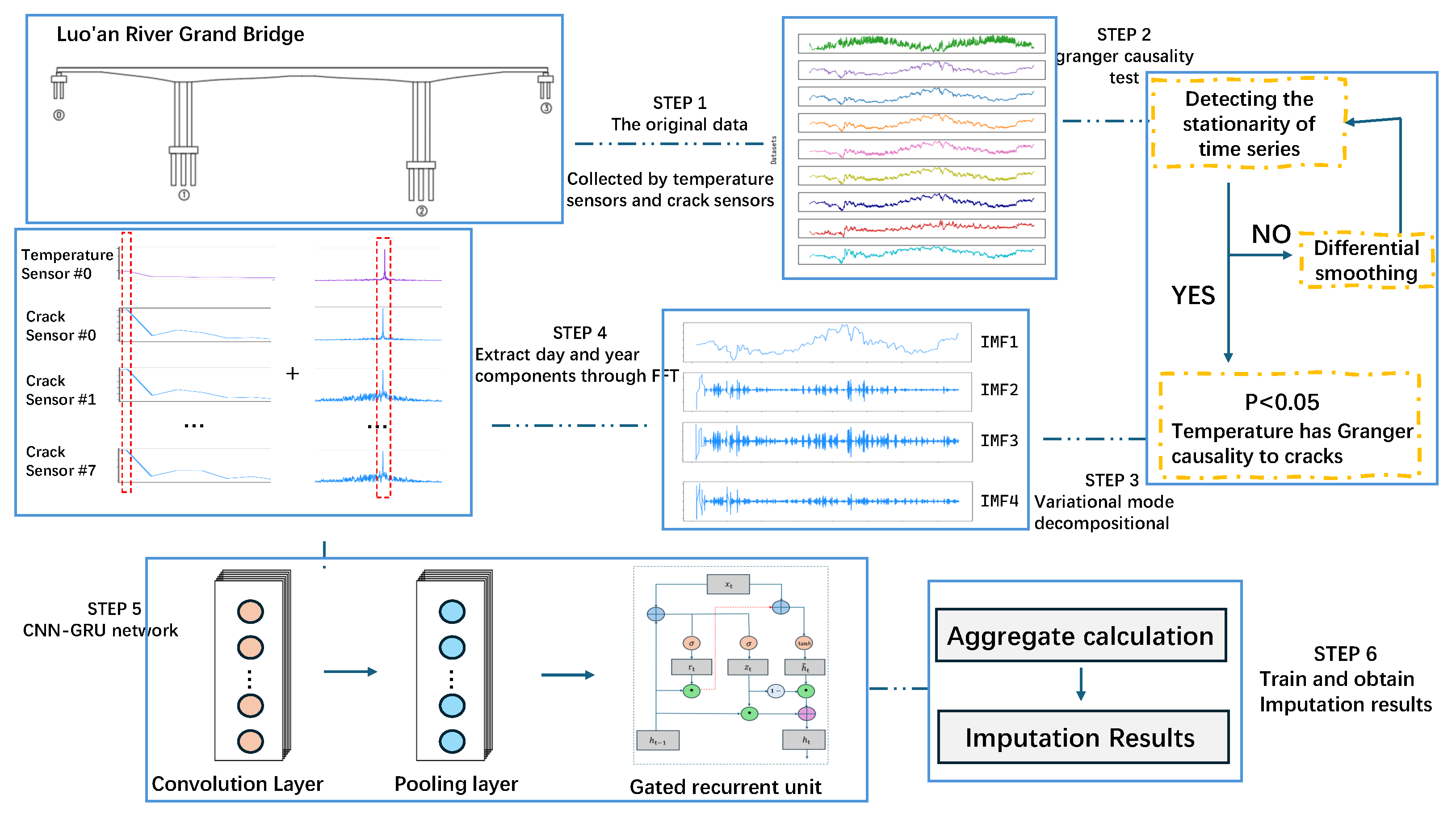
We propose the Shared-Period VMD (SP-VMD) approach to overcome the reliance on subjective parameter estimation. Grounded in Granger causality tests that validate temperature as the primary driver, this technique adaptively decouples temperature-induced annual and diurnal periodicities from stochastic noise, aligning the extracted features with established physical prior knowledge. These physics-validated features enable the hybrid CNN-GRU network to robustly model complex spatio-temporal dependencies. Rigorous statistical validation (e.g., Diebold–Mariano and Model Confidence Set tests) confirms that this prior-knowledge-guided approach significantly outperforms standard black-box baselines, providing a highly accurate and stable solution for structural health monitoring.
To systematically validate the proposed physics-guided framework, the remainder of this paper is organized as follows.
Section 2 details the methodology, explaining the theoretical foundations of Granger causality, SP-VMD decomposition, and the CNN-GRU network construction.
Section 3 outlines the specific implementation workflow of the proposed method, establishing the statistical causal link between temperature and cracks, and defines the evaluation metrics.
Section 4 presents the case study of the Luo’an River Grand Bridge, describing the dataset, data preprocessing, and the optimization of model parameters.
Section 5 provides a comprehensive performance evaluation, validating the efficacy and superiority of the approach through comparative analysis against benchmark models and rigorous statistical tests (e.g., DM test and MCS procedure). Finally,
Section 6 concludes the study and outlines directions for future research.
4. Case Study
4.1. Project Overview
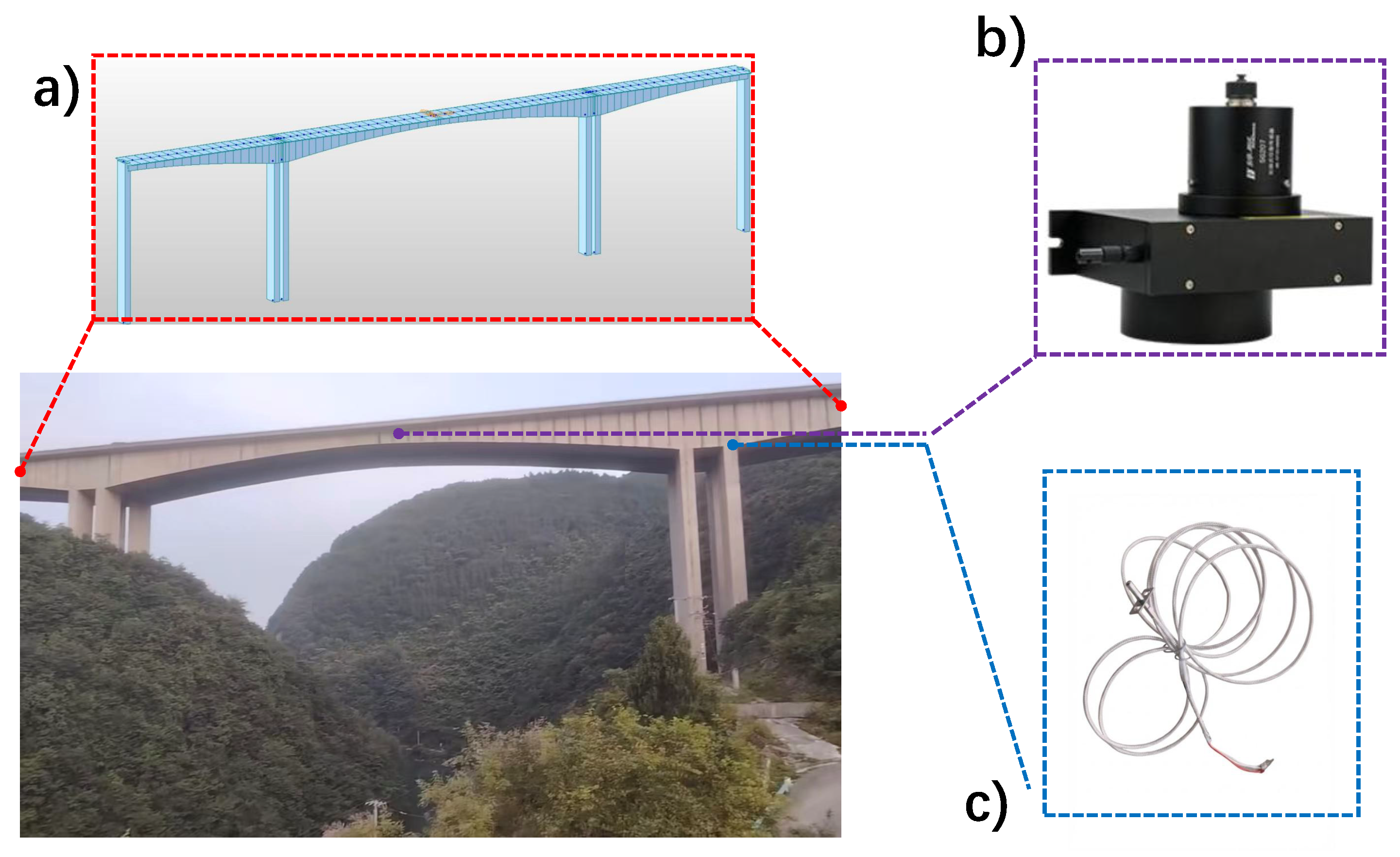
The engineering background for this study is the Luo’an River Grand Bridge. This bridge is situated on the G56 Hangzhou-Ruili Expressway (Zunyi section) and spans the Luo’an River, a third-level tributary of the Wu River in Zunyi County. The bridge site is connected to the G326 national highway via rural roads. The bridge site and the interior of the box girder are depicted in
Figure 3. The bridge serves as the main line, with a central pile number of K1583+014 and a total length of 381 m. The superstructure is a (95 + 180 + 95) m variable cross-section, prestressed concrete continuous rigid frame. The box girder has a single-box, single-cell cross-section with straight webs; the top slab is 12.75 m wide, and the bottom slab is 7 m wide. The beam height of the box girder is 11.5 m at the root and 4.0 m at the mid-span and side-span closure sections. The lower edge of the bottom slab varies according to a 1.6-power parabola. The main piers of the down-line bridge are double hollow thin-walled piers, measuring 7 m in the transverse direction and 3 m in width, with a 13 m spacing between the outer edges of the double walls. The main pier foundation employs a monolithic cap, 5 m in thickness, supported by 18 bored piles, each with a diameter of 2.5 m. The piles are designed as end-bearing piles.
For structural analysis, a spatial frame model of the Luo’an River Grand Bridge is developed using the general-purpose finite element software MIDAS/Civil 2022. The superstructure is discretized using spatial beam elements, dividing the entire bridge into 92 elements and 97 nodes. The finite element model of the main bridge is shown in
Figure 3a.
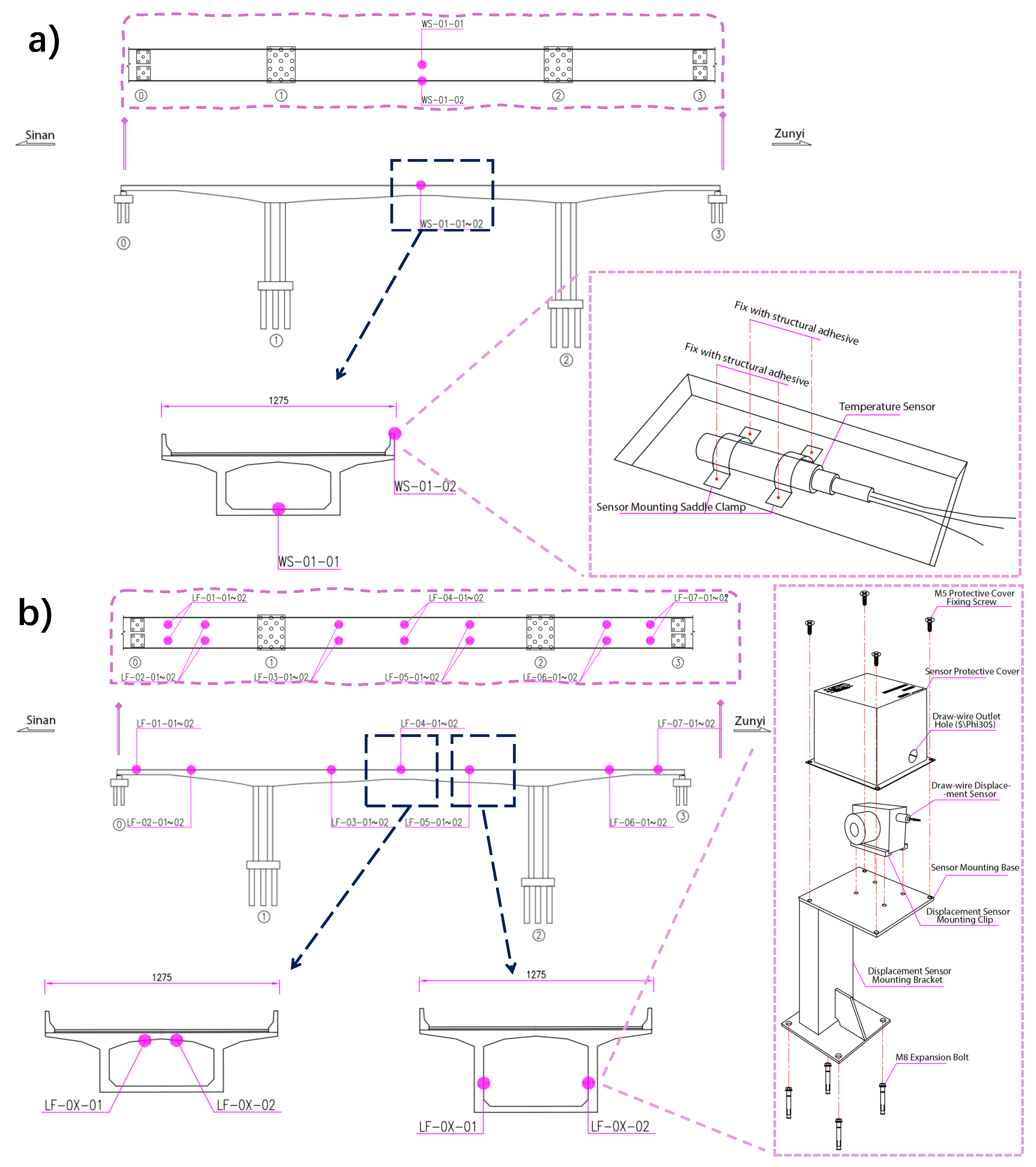
A Structural Health Monitoring (SHM) system is implemented on the Luoyang River Grand Bridge (Upstream line) to support structural assessment. The monitoring network consists of 14 crack meters (Model: MPS-XXS-100-R, Shenzhen Miran Technology Co., Ltd., Shenzhen, China; Range: 25 mm; Resolution: ≤0.01 mm) distributed across 7 sections to capture minute structural changes. As detailed in the sensor schematic in
Figure 3b, these are pull-wire displacement sensors operating on a potentiometric principle, where the linear extension of the wire—driven by crack opening—is converted into precise voltage signals. Complementing this, two high-precision temperature sensors (Model: BD-SP-PT100, Sichuan Bodian Technology Co., Ltd., Chengdu, China; Accuracy: ≤0.5 °C) are installed to track thermal conditions. As depicted in
Figure 3c, the temperature sensors are firmly anchored using structural adhesive and saddle clamps adjacent to the crack meters, ensuring strict spatial synchronization between thermodynamic and mechanical data. To collect the diurnal and annual datasets required for this study, the system utilizes an automated data acquisition pipeline. Analog signals are digitized by a local DAQ unit at a sampling frequency of 1 Hz and transmitted wirelessly via a 4G network to a cloud server, ensuring continuous, gap-free time-series recording without manual intervention. The spatial layout and technical details of the instruments are illustrated in
Figure 4. Specifically,
Figure 4a depicts the temperature sensor, while
Figure 4b shows the crack sensor.
4.2. Data Preprocessing
The dataset is derived from actual records collected by the field monitoring system of the Luo’an River Grand Bridge, representing structural response data under real-world environmental conditions. Due to factors such as on-site environmental interference, fluctuations in sensor performance, and instability in the transmission link, the sampling intervals of the raw data exhibit a certain degree of variation. To eliminate the impact of irregular sampling on time-series analysis, the raw data is resampled to a uniform interval of 1 h [
33]. Specifically, the arithmetic mean of all sample points within each hour is taken as the representative value for that time segment, thereby forming an evenly spaced time series. For anomalous values (outliers) present in the dataset, such as those significantly deviating from the normal range due to transient interference or temporary equipment faults, a linear interpolation method within the temporal neighborhood is used for correction. This involves replacing the outlier with the average of the valid observations from the immediately adjacent time periods (one sampling period before and one after). This approach effectively smooths out atypical transient disturbances while preserving the overall trend of the data, thereby enhancing the consistency and quality of the dataset and providing a more reliable foundation for subsequent modeling and analysis.
To ensure numerical stability and fair comparison across different models, all resampled time series are normalized to the range of
using Min-Max scaling, defined as:
where
and
are the minimum and maximum values of the training dataset, respectively. It should be noted that the validation and testing sets are scaled using the same parameters derived from the training set to prevent data leakage. All error metrics, including RMSE and MAE, are calculated based on the original physical scale of the crack width (mm) to ensure that the reported predictive accuracy reflects actual engineering requirements.
4.3. Time Step of Input Variables
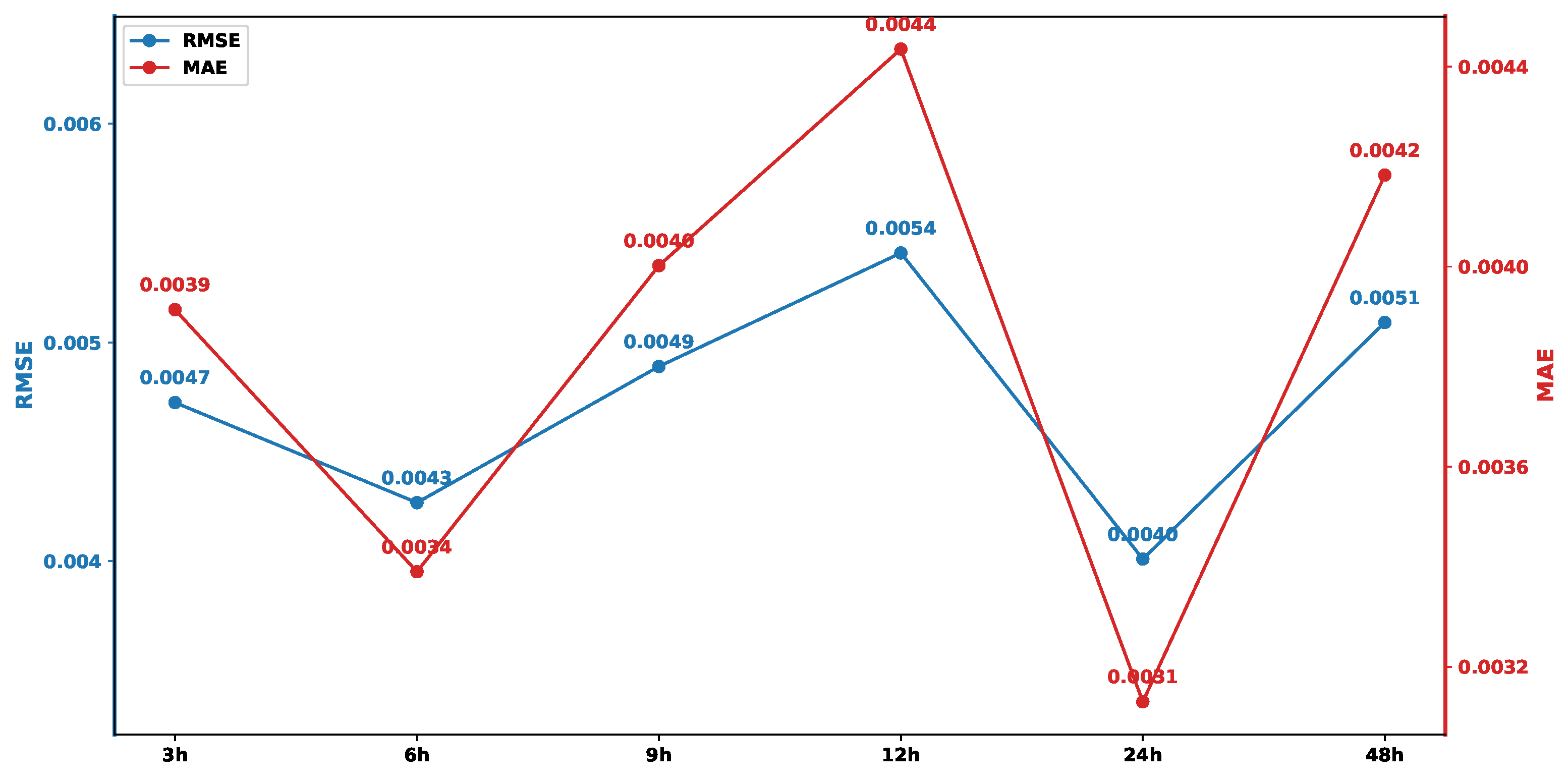
To determine the optimal historical time step for the model input, the effects of six different settings—3 h, 6 h, 9 h, 12 h, 24 h, and 48 h—on prediction performance are comparatively analyzed. An excessively short historical time step may limit the model’s ability to fully learn the temporal features, whereas an overly long one can easily introduce noise, leading to overfitting [
34]. As shown in
Figure 5, the Root Mean Square Error (RMSE) and Mean Absolute Error (MAE) of the model exhibit a distinct trend under different time steps. When the time step is set to 24 h, both the RMSE and MAE reached their minimum values (0.0031 and 0.0040, respectively), indicating that the model achieved its optimal prediction accuracy and stability at this point. Therefore, the historical time step for the input variables is determined to be 24 h. It is important to clarify that while a 24-h window primarily targets the capture of short-term diurnal loop characteristics, the seasonal thermodynamic context is not lost. Since the input data is the reconstructed signal incorporating the annual trend component (IMF1) extracted via SP-VMD, the seasonal “thermal boundaries” (e.g., the expansion in summer or contraction in winter) are inherently encoded in the varying baseline amplitude of the time series. Consequently, the model can perceive the macro-seasonal state through the magnitude of the data within the 24-h window, without requiring an excessively long input sequence (e.g., 365 days) to learn the annual context.
4.4. Number of Modes for VMD
The performance of VMD relies on selecting an appropriate number of modes (
K) to balance signal separation fidelity against the risk of over-decomposition. Instead of relying on arbitrary empirical selection, we determine the optimal
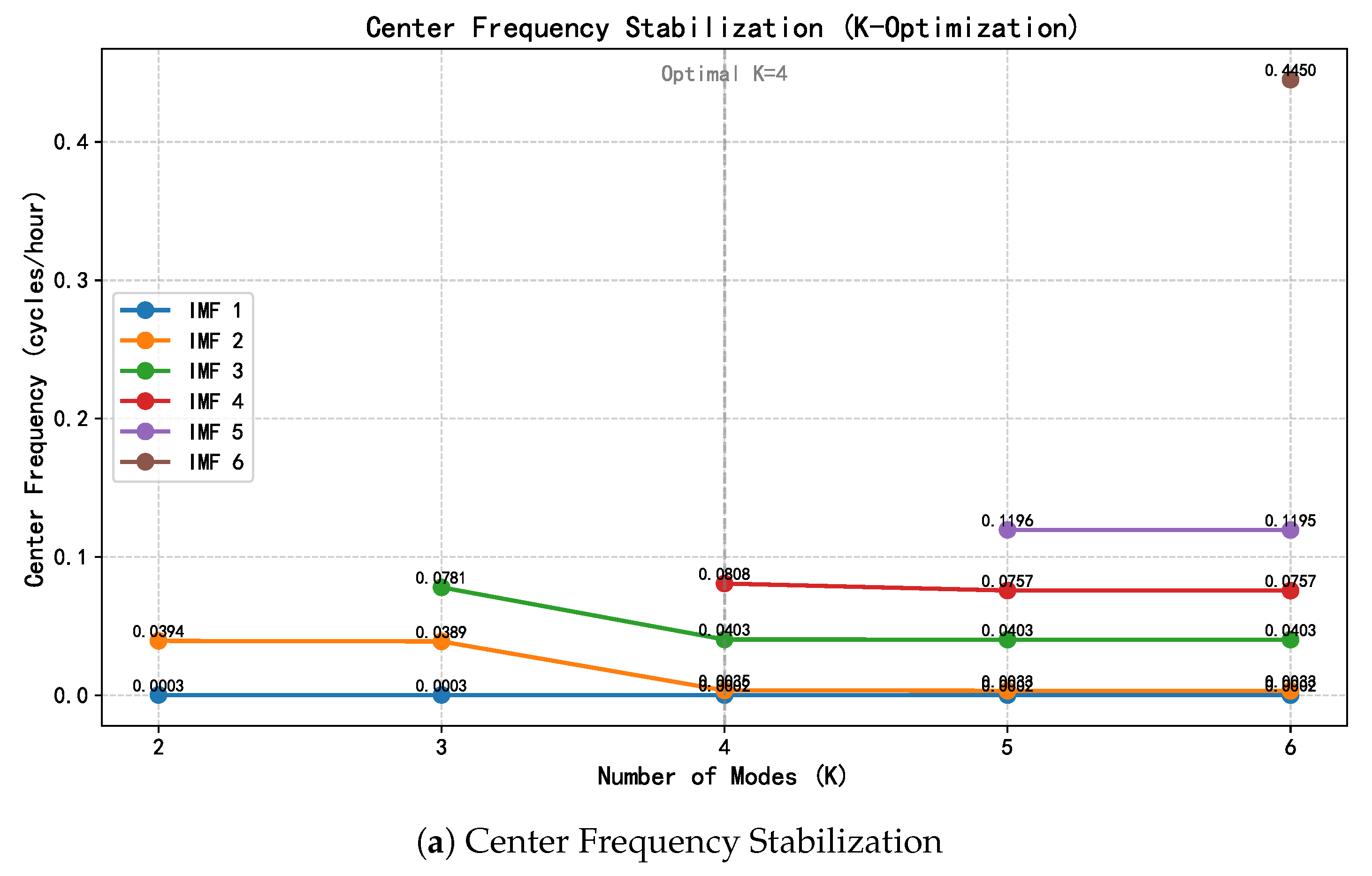
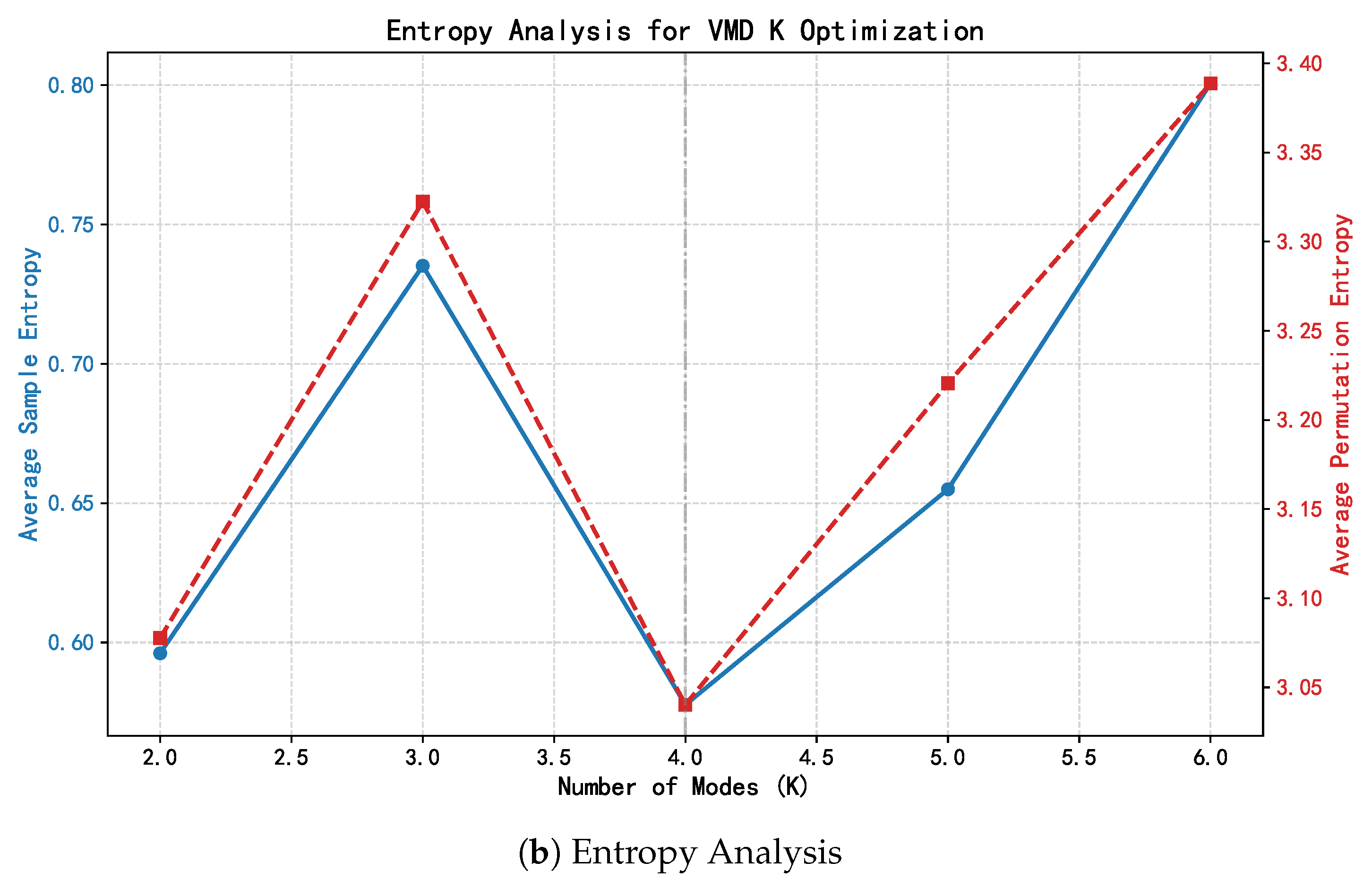
K through a rigorous dual-validation strategy combining physical consistency (Center Frequency Method) and statistical complexity (Entropy Analysis), as illustrated in
Figure 6.
Figure 6a depicts the application of the Center Frequency Stabilization Criterion. Observing the spectral evolution for
, the dominant thermodynamic components—specifically the annual trend (IMF 1, ≈0.0002 cph) and the diurnal cycle (IMF 3, ≈0.040 cph)—exhibit distinct convergence at
. Crucially, the spectral intervals between these modes remain distinct, providing clear evidence that no mode aliasing or adjacency occurs at this decomposition level. When
K is increased to 5, the primary physical modes remain stable, whereas the newly emerged component (≈0.12 cph) manifests as high-frequency stochastic noise rather than a structural response.
Complementing this spectral analysis, the Entropy Analysis presented in
Figure 6b offers a quantitative validation. The evolution of Sample Entropy (SampEn) reveals a characteristic “V-shaped” trajectory: a sharp spike at
indicates severe mode mixing where multiple physical scales are entangled, followed by a drastic reduction to a global minimum at
(SampEn
). This minimum signifies that the signal has been optimally decoupled into orderly, deterministic physical trends. Conversely, the subsequent entropy rise at
reflects the intrusion of high-entropy noise. Collectively, these physical and statistical metrics robustly identify
as the optimal parameter.
4.5. Crack Data Extraction
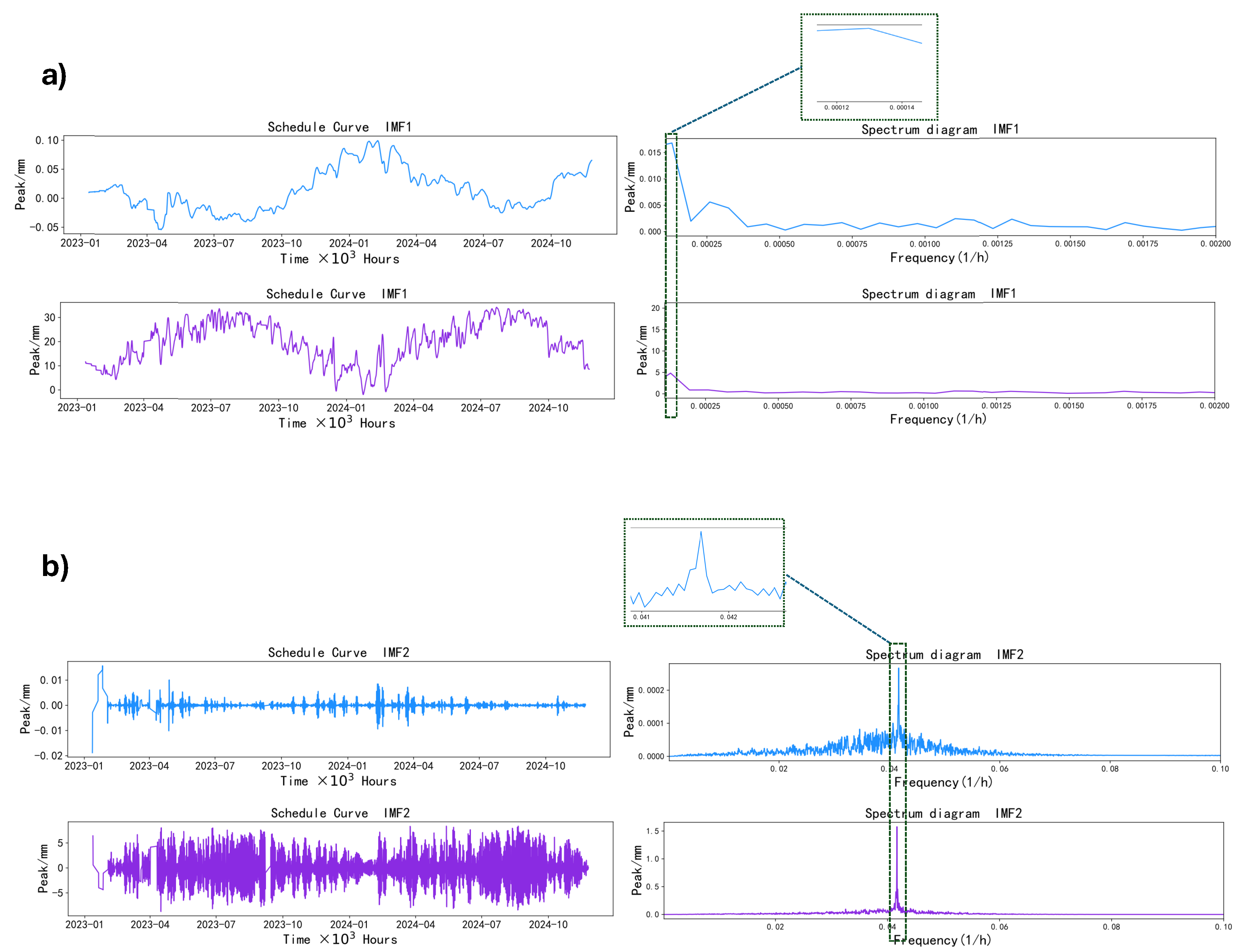
After determining the optimal number of modes, Variational Mode Decomposition is performed on the temperature data and the crack data, respectively. Taking the crack data collected by sensor #0 as an example, its VMD decomposition results are shown in
Figure 7. By applying a Fast Fourier Transform to each Intrinsic Mode Function (IMF), the frequency spectra distributions for the temperature and crack signals are obtained. The spectrum analysis revealed that the IMF1 components of both the temperature and crack data exhibit a significant peak at a frequency of 0.000114. Given that the data sampling interval is 1 h, with a total of 24 sample points per day, the period corresponding to this frequency is:
days [
35]. This period is approximately one year, indicating that IMF1 effectively reflects the annual cycle characteristics, which can be attributed to the influence of seasonal temperature variations on the structure. On the other hand, the IMF2 component shows a peak at a frequency of 0.041683, with a corresponding period of:
day. This indicates that IMF2 captures the periodic fluctuations on a daily basis, primarily reflecting the structural response caused by diurnal temperature differences. Based on these shared-period features, the annual-cycle IMF and the diurnal-cycle IMF, which are common to both the temperature and crack data, are extracted. Although a degree of spectral overlap may exist between seasonal thermal effects and early-stage shrinkage, the dominant power of the annual cycle allows IMF1 to serve as a high-fidelity proxy for the temperature-induced response. By reconstructing these shared-period components, the model establishes a physically consistent input, effectively mitigating the interference of non-thermal stochastic noise.
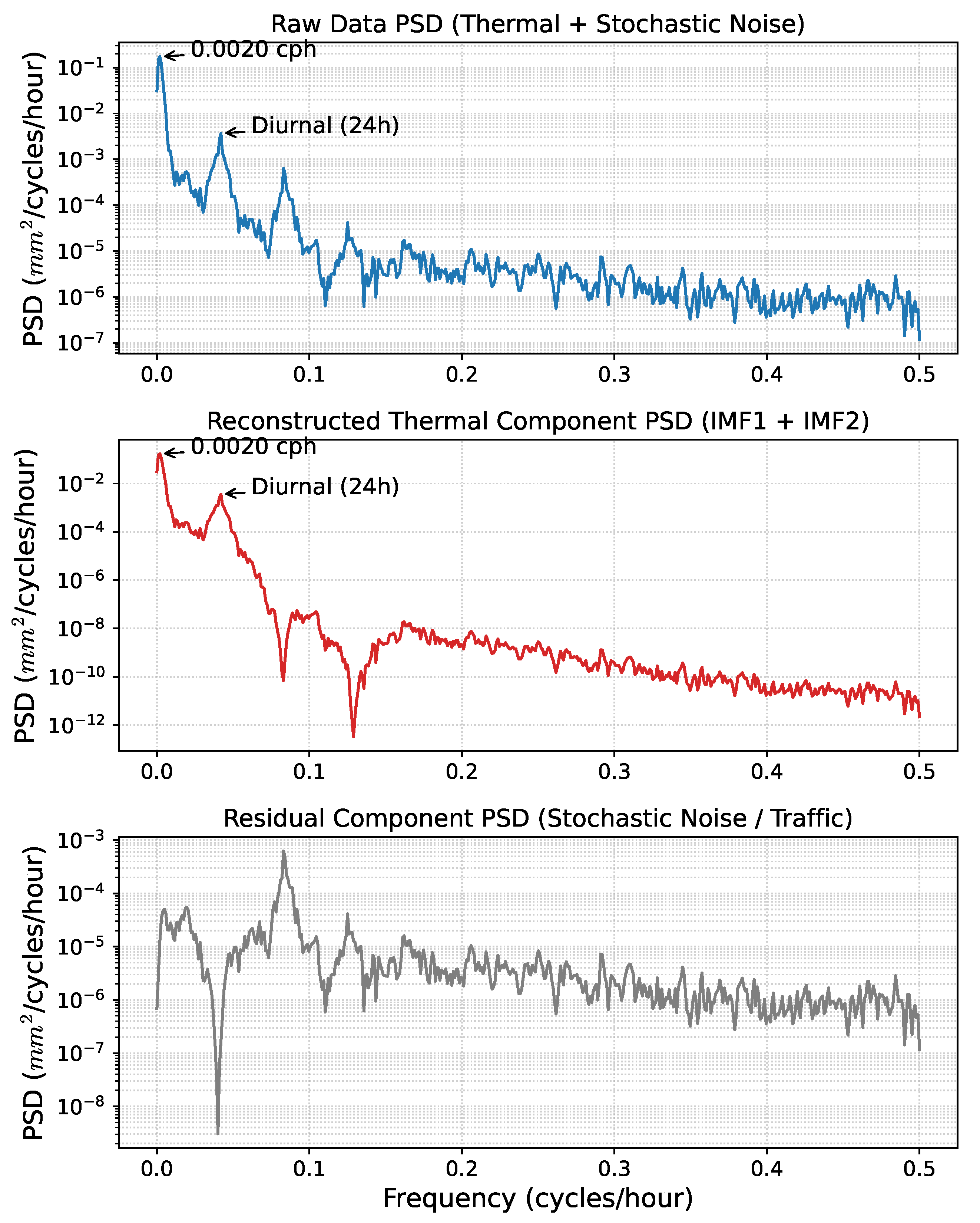
To rigorously validate the efficacy of the proposed decomposition strategy, a comparative Power Spectral Density (PSD) analysis is performed on the raw monitoring data, the extracted thermal component, and the residual component, as illustrated in
Figure 8. As observed in the middle panel, the reconstructed signal (comprising IMF1 and IMF2) strictly preserves the deterministic Annual (0.0020 cph) and Diurnal (0.0417 cph) spectral peaks. Crucially, these peaks manifest as sharp, narrowband features, demonstrating the retention of smooth thermodynamic responses while suppressing the background noise floor by several orders of magnitude. In sharp contrast, the residual component (bottom panel) effectively isolates non-thermal disturbances, which appear as broadband stochastic fluctuations (
cph) typical of dynamic vehicle loads and measurement noise. Most notably, the semi-diurnal component (≈0.08 cph)—often exhibiting spectral overlap between secondary thermal harmonics and the dual-peak patterns of traffic rush hours—is conservatively retained in the residual to ensure the physical purity of the input baseline. This distinct spectral separation quantitatively confirms that the SP-VMD framework functions as a physics-guided narrowband filter, successfully decoupling the dominant, physics-governed structural response from broadband stochastic interference.
4.6. Data Management and Spatial Correlation Analysis
To guarantee the reproducibility and physical fidelity of our data-driven framework, a rigorous management protocol is established. This study utilizes an extensive longitudinal dataset spanning 12 January 2023, to 25 November 2024 ( hourly samples). Unlike short-term records, this period encompasses nearly two complete annual cycles, capturing the full spectrum of seasonal thermodynamic variations. Prior to model ingestion, raw signals are refined via the SP-VMD method. By isolating deterministic annual and diurnal components, this physics-guided filtering process effectively decouples the temperature-driven structural response from high-frequency stochastic noise, yielding robust “Temperature-Crack” pairs.
Feature selection is governed by spatial correlation analysis to exploit the collaborative sensing potential of the network. Designating the mid-span sensor (#2) as the target faulty node, we quantified its linear dependence with neighboring channels (
Table 3). A distinct spatial decay law emerged: sensors within the same cross-section exhibited near-unity correlation, followed closely by those in the adjacent left span (>0.98), whereas distal sensors in the right span showed the weakest linkage. This decay characteristic provides a solid physical basis for prioritizing highly correlated neighbors to reconstruct the target signal.
Data partitioning adhered to a strict chronological protocol to eliminate temporal data leakage. The dataset is divided into a Training Set (first 90%) and a Testing Set (final 10%). While validation splits are customary for mitigating overfitting in limited datasets, the extensive temporal horizon of this study offers a superior safeguard. By enabling the model to learn comprehensive seasonal dynamics—such as summer expansion and winter contraction—over multiple years, combined with Dropout regularization (0.5), we ensure robust generalization without the need to sequester data for a separate validation split.
4.7. Structure of the CNN-GRU Model
A multi-layer CNN-GRU network can more effectively extract and characterize the complex features within the data, thereby enhancing prediction performance. However, excessive structural complexity must be avoided to mitigate the risk of overfitting [
36]. Therefore, the appropriate setting of the model’s architecture and hyperparameters is particularly crucial.
To validate the model’s effectiveness, multiple iterative experiments are conducted. The results indicate that the CNN-GRU model can effectively capture the dynamic trends of the crack data. As shown by the evaluation metrics listed in
Table 4, the Coefficient of Determination (
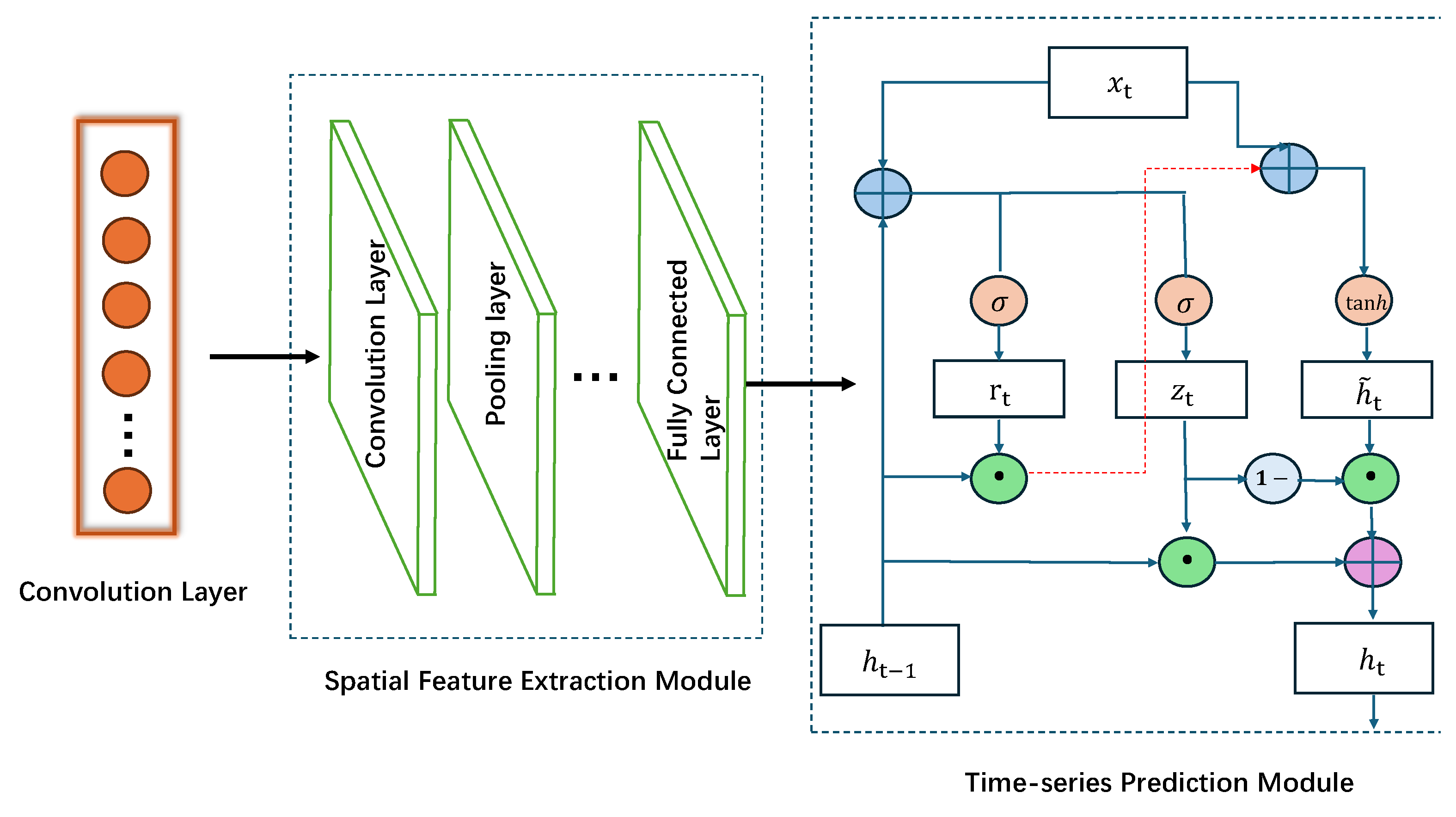
) in all test scenarios is higher than 0.9500, which demonstrates a high degree of consistency between the predicted and measured values at each layer and signifies a good model fit. Further architectural comparisons revealed that a network comprising one CNN layer and two GRU layers performed optimally. Its prediction curve most closely matched the actual observed values, suggesting that a moderate level of complexity is beneficial for balancing the model’s expressive power and generalization performance. After extensive hyperparameter optimization, the final model hyperparameters are determined as follows: Given the multivariate 1D time-series nature of the bridge crack data, a 1D Convolutional Neural Network (1D-CNN) is employed to extract local feature patterns. Specifically, the CNN layer is configured with 256 filters, a kernel size of 2, a stride of 1, and a padding of 2. The extracted features are then processed by a Max-Pooling layer before being fed into a 2-layer GRU with a hidden size of 64 and a dropout ratio of 0.5. The Adam optimizer is selected with a learning rate of 0.00001, a batch size of 64, and a training duration of 100 epochs. The Mean Squared Error (MSE) is employed as the loss function to optimize the accuracy of the regression prediction
4.8. Model Training
The specific configuration for this training is detailed in
Table 5. The training strategy is structured to progressively evaluate the efficacy of spatial information through a hierarchical experimental design. We initiate the process with a single-channel baseline, where the model is tasked with reconstructing the trajectory of the target sensor (#2), relying exclusively on the input from sensor #5. To capture more complex local dependencies, we advance to a dual-channel configuration by integrating data from sensor #4, effectively testing the model’s ability to synthesize information from adjacent monitoring points. The experiment culminated in a comprehensive multi-channel extension, where the input dimension is scaled to seven distinct channels—specifically comprising sensors #5, #4, #0, #1, #3, #7, and #6. This full-spectrum setup allows the model to leverage global spatial correlations across the bridge span. Throughout these experimental phases, we adhere to a rigorous temporal partitioning protocol: the initial 90% of the sequential data is dedicated to optimizing the model parameters, while the final 10% is strictly reserved for validation purposes to monitor generalization performance and prevent overfitting.
To guarantee the reproducibility of the experimental results, strict data processing protocols are implemented before the training loop. Firstly, the raw dataset underwent a cleaning procedure followed by global normalization to the [0,1] range. Subsequently, the SP-VMD mechanism is applied to each sensor channel using a penalty factor and modes. By performing FFT peak detection on the decomposed modes, we isolate and reconstruct the physics-guided trends—specifically the annual and diurnal components—which serve as the clean input for the model. These processed trends are then organized into input tensors using a sliding window of 24 h (stride=1) to preserve temporal continuity.
Regarding model configuration, the hyperparameter selection is driven by a rigorous sensitivity analysis rather than arbitrary assignment. We conduct a grid search across a range of learning rates and batch sizes to identify the optimal convergence behavior. The analysis reveals that a learning rate of combined with a batch size of 64 provides the most stable gradient descent and the lowest validation loss. Consequently, the final CNN-GRU network is trained using these optimal parameters, employing the Adam optimizer and a Mean Squared Error (MSE) loss function over a course of 100 epochs. All experiments are executed using the PyTorch(version 2.7.1+cu126) framework on a computational platform equipped with an Intel i7-14650HX CPU(Intel Corporation, Santa Clara, CA, USA) and an NVIDIA RTX 4060 GPU (NVIDIA Corporation, Santa Clara, CA, USA). The computing platform is a Yaoshi 15 Pro laptop (MECHREVO, Beijing, China).
5. Results and Discussion
5.1. Imputation Results and Evaluation
Before evaluating the specific model architectures, we investigate the impact of spatial information density on imputation performance. As demonstrated in
Table 6, imputation accuracy proves to be highly sensitive to the number of input sensor channels. Specifically, increasing the input from a single channel (#5) to five channels significantly reduces the RMSE from 0.01537 to 0.00450. This improvement confirms the hypothesis that a dense sensor array captures redundant spatial information effectively, which is critical for reconstructing missing signals. Notably, introducing the sixth channel resulted in a slight degradation in performance, with MAPE rising to 24.01%. This phenomenon suggests that incorporating sensors with weaker correlations—as identified in the previous correlation analysis—may introduce more noise than valid signal information. However, when the full set of seven channels is utilized, the model effectively learns to filter this noise, achieving an optimal RMSE of 0.00401. Consequently, the 7-channel configuration is established as the standard input for all subsequent comparative analyses.
To validate the superiority of the proposed framework, we conduct a comparative analysis against five benchmark models, including TCN, LSTM, GRU, and their CNN-hybrid counterparts. To guarantee the fairness of this comparative analysis, we establish a strictly controlled experimental environment where all models are evaluated under identical conditions. Crucially, every candidate model receives the identical set of SP-VMD extracted features rather than raw noisy data, ensuring that any performance deviation is solely attributed to the neural network architecture’s ability to interpret these physics-guided trends. Furthermore, we standardize the hyperparameter configuration across all baselines—adopting the same 24-h look-back window, a unified 9:1 data partition, and the optimal learning rate and batch size identified in our sensitivity analysis. By aligning these preprocessing and training protocols, we successfully isolate the architectural efficiency of the models, confirming that the performance gains of the CNN-GRU derive from its superior spatio-temporal modeling capabilities rather than discrepancies in hyperparameter optimization or input quality.
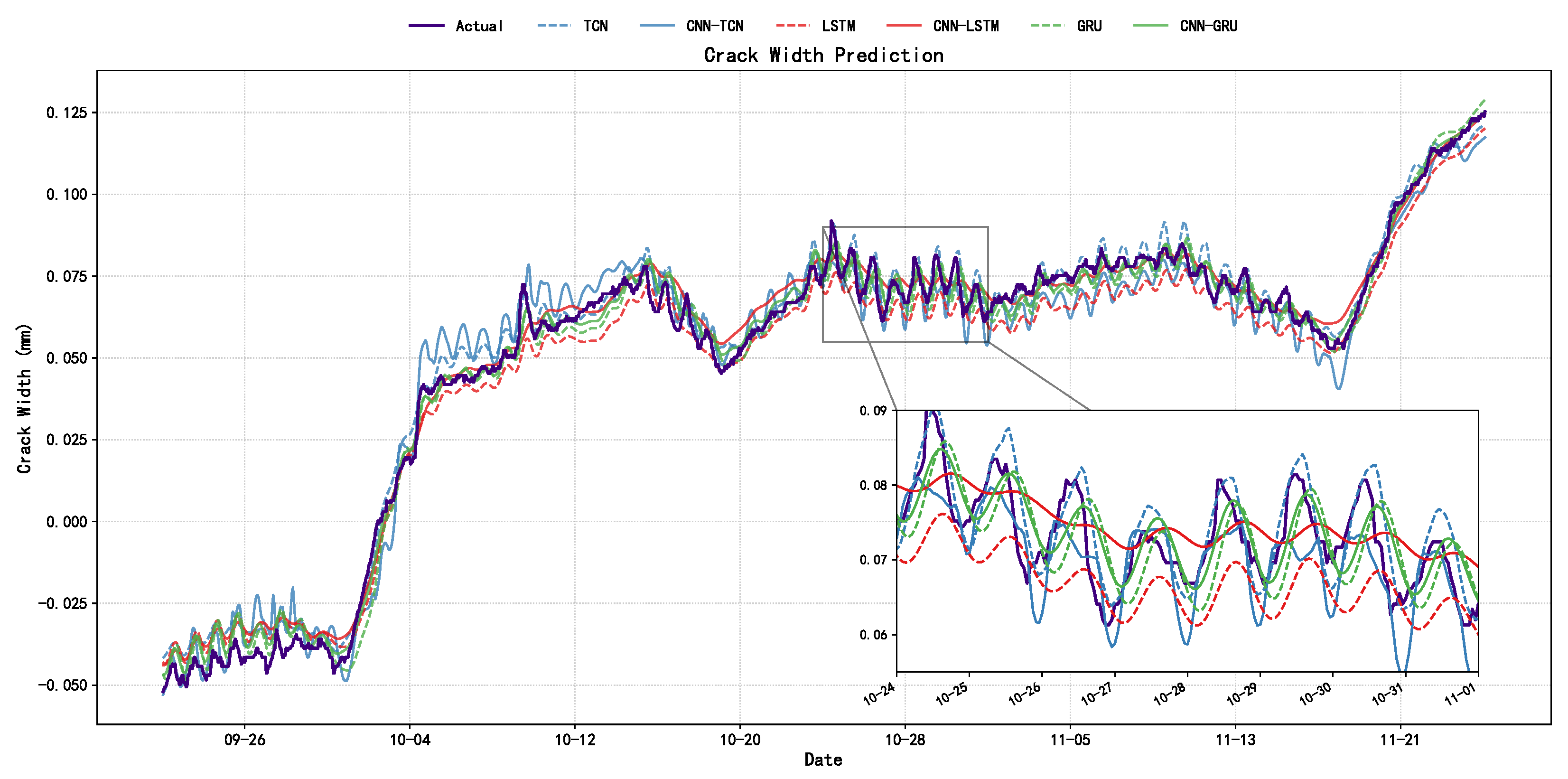
The comparative analysis, as visualized in
Figure 9 and detailed in
Table 7, indicates a discernible performance hierarchy wherein CNN-hybrid models consistently outperform their standalone counterparts, validating the synergy between local spatial feature extraction and temporal modeling. Among the evaluated architectures, the proposed CNN-GRU framework demonstrates superior predictive fidelity, yielding an
of 0.9916 and a MAPE of 12.95%. To provide a comprehensive interpretation of these metrics—particularly the contrast between the near-perfect correlation and the percentage error—it is essential to interpret them within the physical characteristics of the target signal. The high
value is grounded in the rigorous experimental design defined in
Section 4.6, where a strict chronological split is implemented to reserve testing data, thereby mitigating temporal data leakage; rather than implying overfitting, this accuracy underscores the effectiveness of the physics-guided preprocessing, as the model focuses on recovering deterministic thermal trends (IMF1 + IMF2) isolated from high-frequency stochastic noise via SP-VMD. Conversely, the relatively high MAPE (>10%) is primarily influenced by the “small denominator effect” characteristic of micro-scale monitoring, where minute crack widths (approaching 0 mm) mathematically amplify marginal absolute deviations, rendering absolute error metrics (RMSE, MAE) and trend correlation (
) the more robust indicators of reconstruction fidelity in this engineering context.
While the SP-VMD framework effectively extracts temperature-driven periodicities, the inherent spectral overlap between thermal responses and long-term structural phenomena (e.g., creep or shrinkage) remains a subtle challenge. In this study, such non-periodic variations are treated as secondary to dominant thermal drivers. However, the precision of this physical decoupling is intrinsically tied to the fidelity of the monitoring data.
Consequently, the model’s performance relies on a substantial volume of high-quality monitoring records, as the presence of noise or outliers can impact the reconstruction accuracy. In practical SHM deployment, significant shifts in the monitoring environment, loading conditions, or structural state may alter the learned mapping between physical features and crack evolution. Under such circumstances, periodic data re-collection and model retraining would be necessary to maintain imputation fidelity, representing a requisite investment in computational resources and time.
5.2. Practicality Analysis
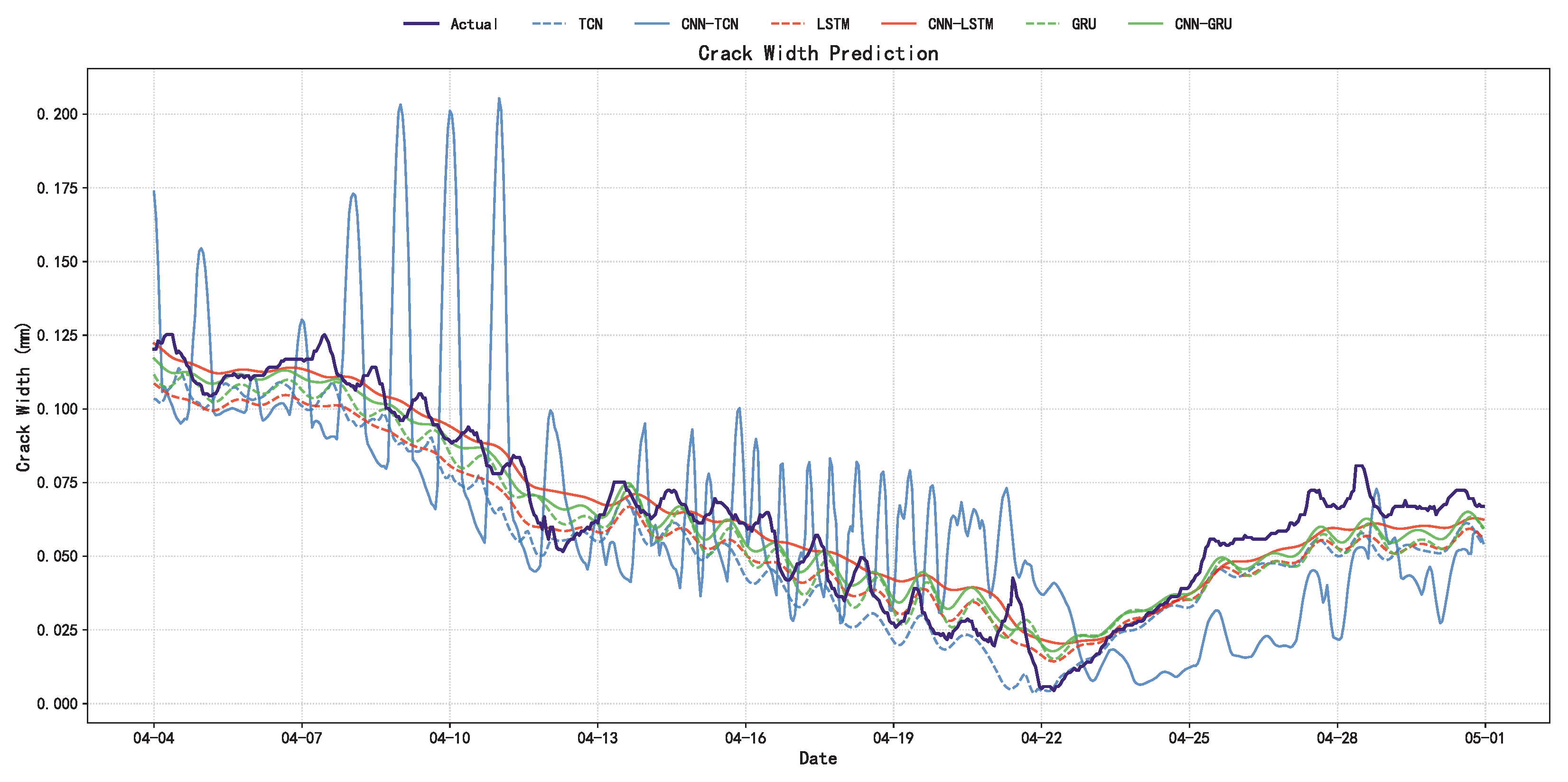
A robust Structural Health Monitoring (SHM) model must perform consistently across diverse time periods and environmental conditions. To evaluate this generalization capability, we apply the trained models to a new dataset recorded in spring (7 April to 2 May 2023), a period characterized by different thermal gradients compared to the autumn training set. The results, visualized in
Figure 10 and detailed in
Table 8, reinforce the findings from the primary experiment, showing that the CNN-GRU model maintains its performance lead with an
of 0.9349 and an RMSE of 0.0079. Regarding dynamic response, significant differences emerge during the sharp fluctuations observed between 17 April and 22 April. While TCN-based models struggle to converge and exhibit large deviations, the CNN-GRU and CNN-LSTM models successfully capture the trend reversals. This stability is largely attributed to the SP-VMD preprocessing, which ensures that the input data retains clear, physically driven trends—specifically annual and diurnal components—enabling the deep learning model to generalize effectively even when the raw data distribution shifts due to seasonal changes.
From the quantitative metrics in
Table 8, the CNN-GRU model achieves the lowest RMSE (0.007887) and MAE (0.006701), alongside the highest
(0.934941) among all comparators, signifying the smallest prediction error and the best goodness-of-fit. Although the CNN-LSTM performs closely in terms of the MAE metric, the CNN-GRU maintains a distinctive lead in both RMSE and
, demonstrating superior overall stability and explanatory power. In summary, the CNN-GRU model proves capable of accurately simulating the actual temporal evolution of cracks, establishing itself as the optimal choice in terms of both imputation accuracy and practical utility.
Beyond demonstrating temporal adaptability, the framework possesses broad potential for structural generalization by being anchored in fundamental physical principles. Although this study validated the method on a concrete bridge, the core mechanism—decoupling shared thermal drivers via SP-VMD—is theoretically transferable to other material types, including steel bridges. In fact, the distinct material properties of steel may further enhance the applicability of this approach. Since steel structures exhibit higher thermal conductivity and more pronounced thermal expansion than concrete, the thermally induced response is typically more significant relative to background noise. This higher signal-to-noise ratio (SNR) of the thermal component could theoretically facilitate the SP-VMD algorithm in identifying and extracting periodic trends. Given that the strategy fundamentally relies on frequency synchronization (periodicity) rather than absolute signal amplitude, the framework is expected to remain robust—and potentially more effective—when applied to steel infrastructure.
5.3. Statistical Tests
Before evaluating the comparative predictive performance, it is requisite to reaffirm the statistical validity of the temperature-driven mechanism that underpins the SP-VMD framework. Recalling the Granger Causality analysis presented in
Section 3.1 (
Table 2), the test results at a lag length of 24 h yielded F-statistics significantly surpassing the critical threshold, with
p-values consistently at 0.0000 (≪0.05) across all sensor channels. This statistical evidence decisively rejects the null hypothesis, confirming that temperature is not merely correlated but is a deterministic Granger-cause of crack evolution. This result statistically justifies the efficacy of the proposed SP-VMD in isolating temperature-governed components from the raw signals.
To rigorously validate the superiority of the proposed model from a statistical perspective, this section introduces the Diebold–Mariano (DM) test, the Model Confidence Set (MCS) procedure, and the Giacomini–White (GW) test. These are aimed at conducting an in-depth evaluation of the predictive accuracy and capability of the various models.
First, the DM test [
37] is performed to examine whether there are significant differences between the prediction errors of different models. In this test, the proposed CNN-GRU model is set as the benchmark and compared pairwise against the other five models (TCN, CNN-TCN, LSTM, CNN-LSTM, and GRU). The results, as shown in
Table 8, indicate that the DM statistics for all comparison models are significantly negative. This suggests that, in a statistical sense, the prediction error of the CNN-GRU model is significantly smaller than that of all other competing models, proving the clear superiority of its predictive accuracy.
Next, to select the best subset of models from the candidate group, the Model Confidence Set (MCS) [
38] procedure is employed. As shown in
Table 9, at a 10% significance level (
), the MCS procedure evaluates the relative performance of models based on their
p-values; a higher
p-value indicates a greater likelihood that the model belongs to the “set of best models.” The analysis reveals that the proposed CNN-GRU model obtains the highest
p-value (1.000), definitively positioning it as the top-performing model. Concurrently, the LSTM and CNN-TCN models exhibit low
p-values (both 0.003) and are thus excluded from the 90% confidence-level set of best models, further confirming their relatively inferior performance.
Finally, to quantify the specific performance enhancement contributed by the CNN module, a direct pairwise comparison is conducted between the proposed CNN-GRU model and the second-best performing single model, GRU, using both the DM test and the more general Giacomini–White (GW) test. As detailed in
Table 10 in the comparison between CNN-GRU and GRU, the DM test statistic is −13.8571 (
), and the GW test statistic is 27.1073 (
). The p-values from both tests are far below the 5% significance level, indicating a highly significant difference in the predictive capabilities of the two models. This provides compelling evidence that the introduction of the CNN module is not a simple structural addition but significantly enhances the model’s overall predictive performance through its powerful local feature extraction capabilities.
In summary, this series of statistical tests provides robust statistical support from multiple perspectives—including predictive accuracy, model set selection, and capability enhancement—for the superiority of the proposed SP-VMD-CNN-GRU model in the task of bridge crack data imputation.
6. Conclusions
This study addresses the critical challenge of data loss in bridge Structural Health Monitoring (SHM) by bridging the gap between physical interpretation and deep representation learning. By explicitly integrating the thermodynamic mechanisms of concrete structures into a deep learning pipeline, we established the SP-VMD-CNN-GRU framework. The core innovation lies in the use of Granger causality to guide the signal decomposition process, ensuring that the input features represent genuine, temperature-driven structural responses rather than stochastic noise. The indispensability of this physics-informed preprocessing was rigorously corroborated by an ablation study; the exclusion of the SP-VMD step precipitated a marked degradation in predictive performance, with dropping from 0.9916 to 0.9751 and MAPE increasing from 12.95% to 18.59%. These findings fundamentally underscore that explicit physical guidance is not merely an auxiliary step but a prerequisite for pushing the limits of imputation accuracy in complex monitoring environments.
In terms of architectural efficacy, the proposed framework leverages a synergistic combination of 1D-CNN and GRU layers to capture the intricate spatio-temporal dependencies inherent in sensor arrays. The 1D-CNN effectively extracts inter-sensor spatial correlations, while the GRU models the long-term temporal evolution of crack widths. While the CNN-GRU model incurs a marginal computational increase compared to the CNN-LSTM baseline (training time of 92.00 s versus 87.69 s per epoch), this slight overhead is outweighed by a substantial improvement in reconstruction fidelity, effectively reducing the Mean Absolute Percentage Error by approximately 28%. This establishes the CNN-GRU architecture as an optimal trade-off, prioritizing high-precision structural assessment with a manageable computational footprint suitable for practical engineering applications. However, the current framework provides point estimates without probabilistic uncertainty intervals, which remains a limitation to be addressed in future work to enhance decision-making reliability.
Furthermore, our sensitivity analysis highlights that data imputation performance relies on identifying an optimal subset of highly correlated sensors rather than simply maximizing input dimensions. Based on these insights, future work will focus on optimizing the adaptive parameter determination mechanism for VMD to enhance automation. Additionally, the method will be extended to other monitoring indicators, such as displacement and strain, to verify its generality, and eventually integrated with downstream tasks like damage identification to construct a holistic technical chain from data processing to condition assessment.



 ,
,