Stability Study of Bridge Piles Subject to Construction Activities and Channel Excavation in Deep Soft Soil Areas


Abstract
1. Introduction
2. Channel Project and Site Conditions
3. Field Measure
4. Monitoring Results
4.1. Monitoring Data of Pile Shaft Axial Force
4.2. Monitoring Data of Pile Inclination Angle
4.3. Monitoring Data of Bridge Pier Displacement
5. Discussion
5.1. Pile Shaft Axial Force
5.2. Pile Inclination Angle
5.3. Bridge Pier Displacement
6. Conclusions
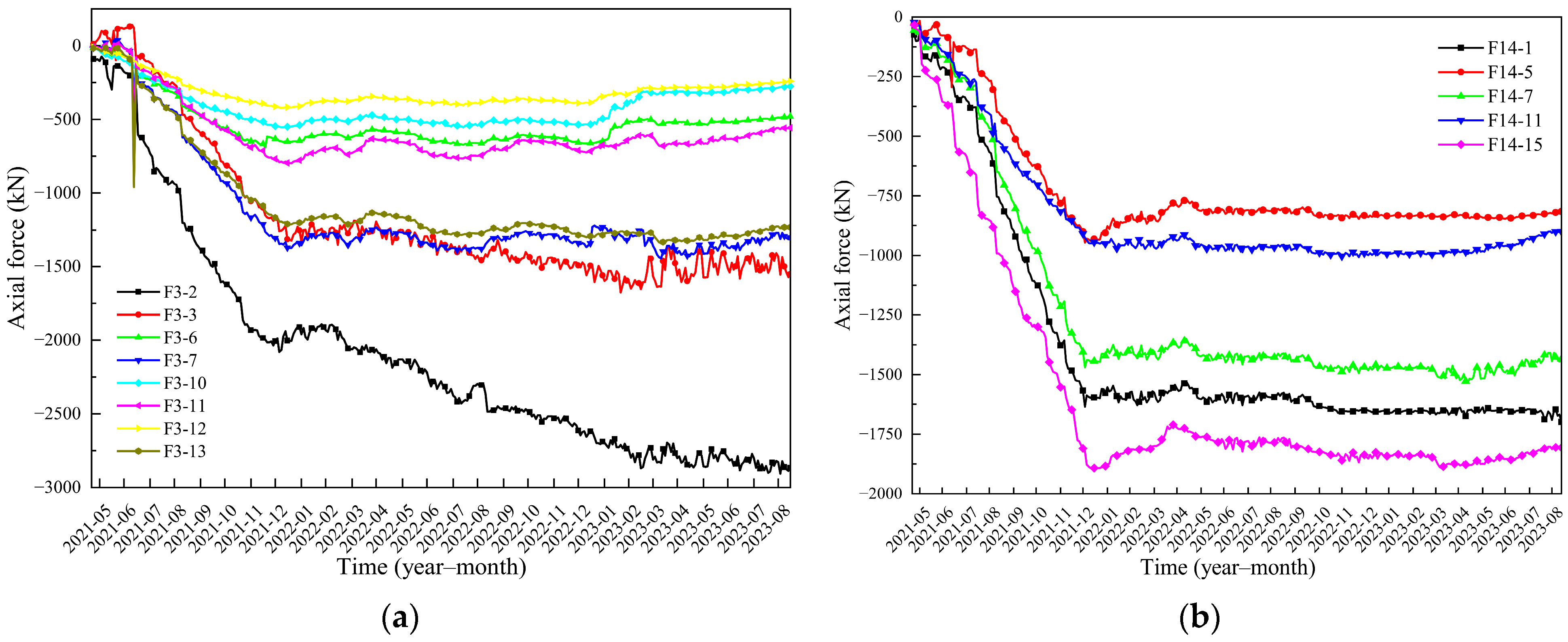
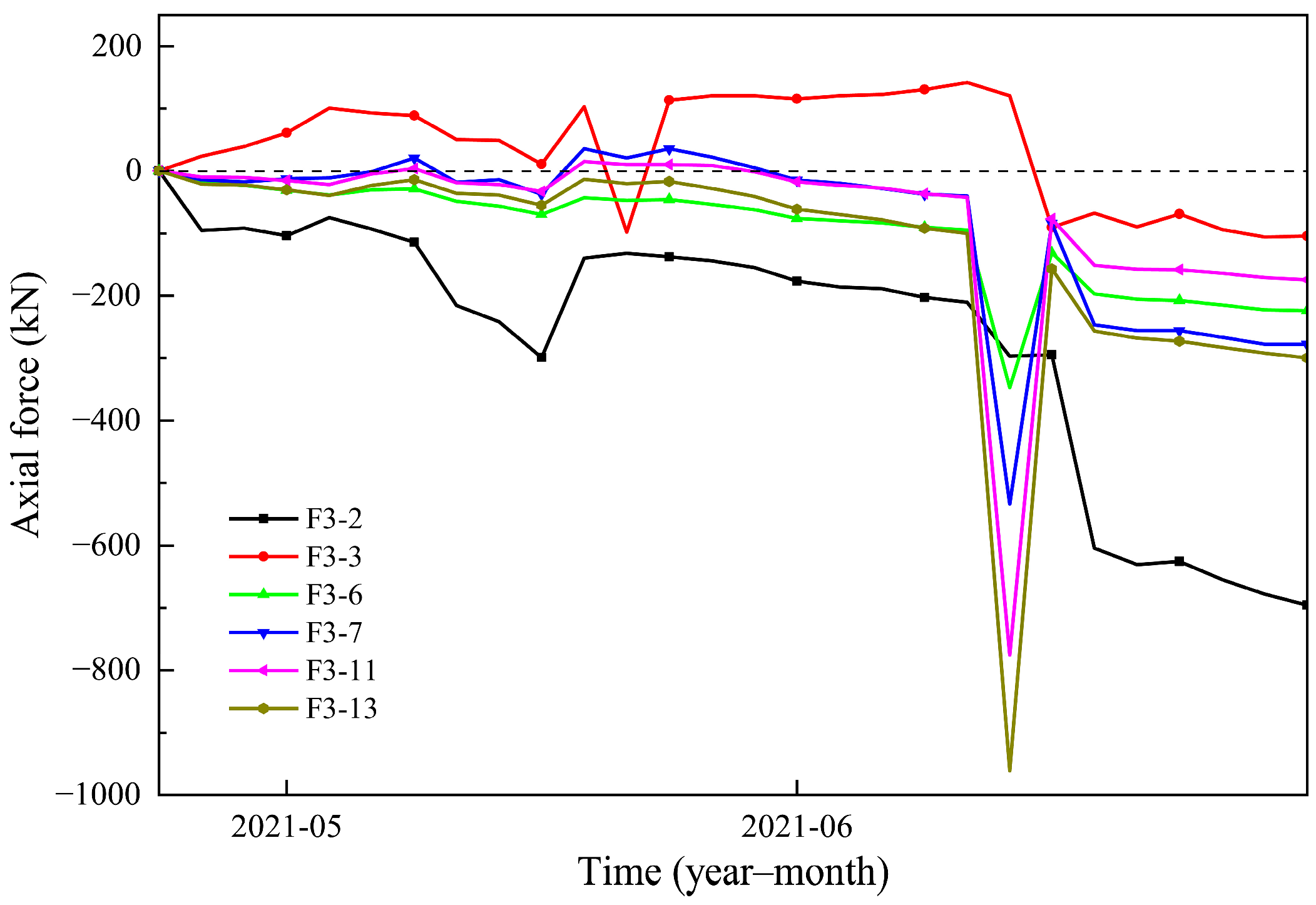
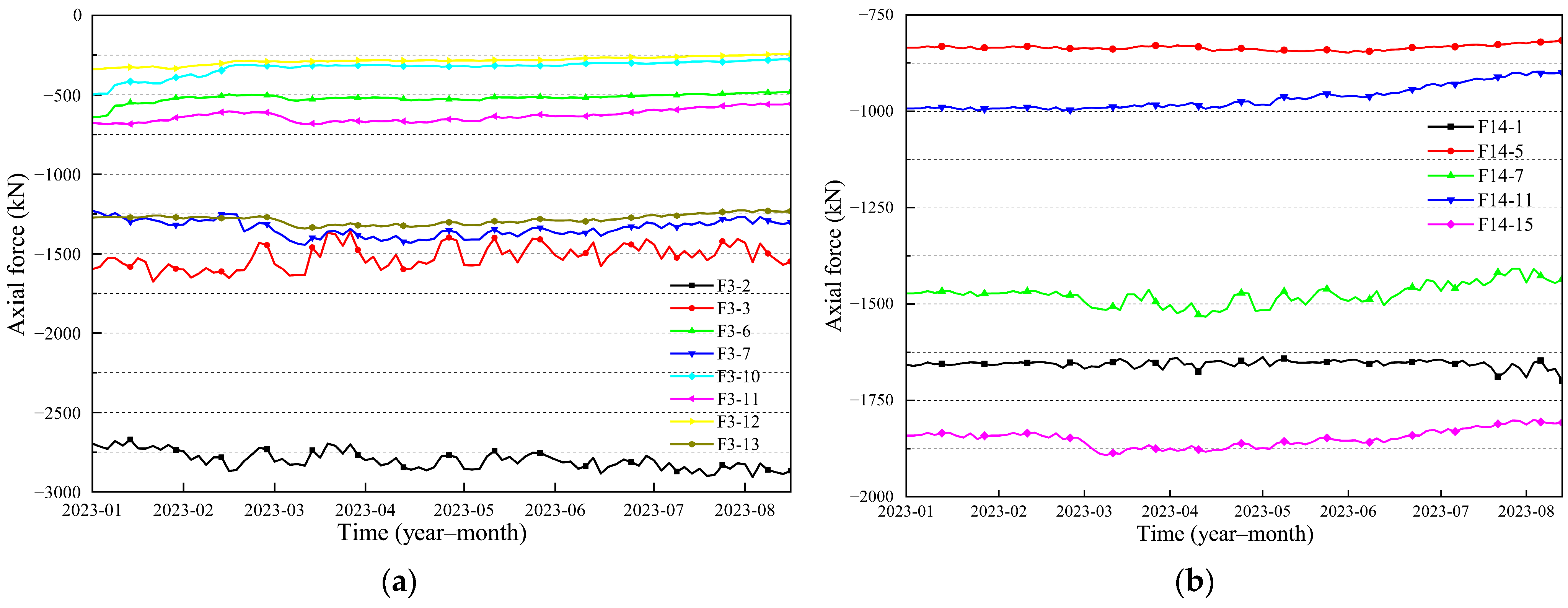
- The axial force in the pile reached its maximum at the pile head and exhibits a gradual reduction with increasing depth, consistent with the typical distribution pattern observed in friction piles. However, within the rock-socketed section, the relative displacement between the pile and the surrounding soil diminished, leading to the accumulation of dragload and a localized increase in the axial force.
- Upon the filling of the channel with water, infiltration into the adjacent soil occurred, leading to an increase in soil moisture content. The rising groundwater table increased buoyancy while simultaneously reducing NSF, which collectively decreased the axial force of the pile.
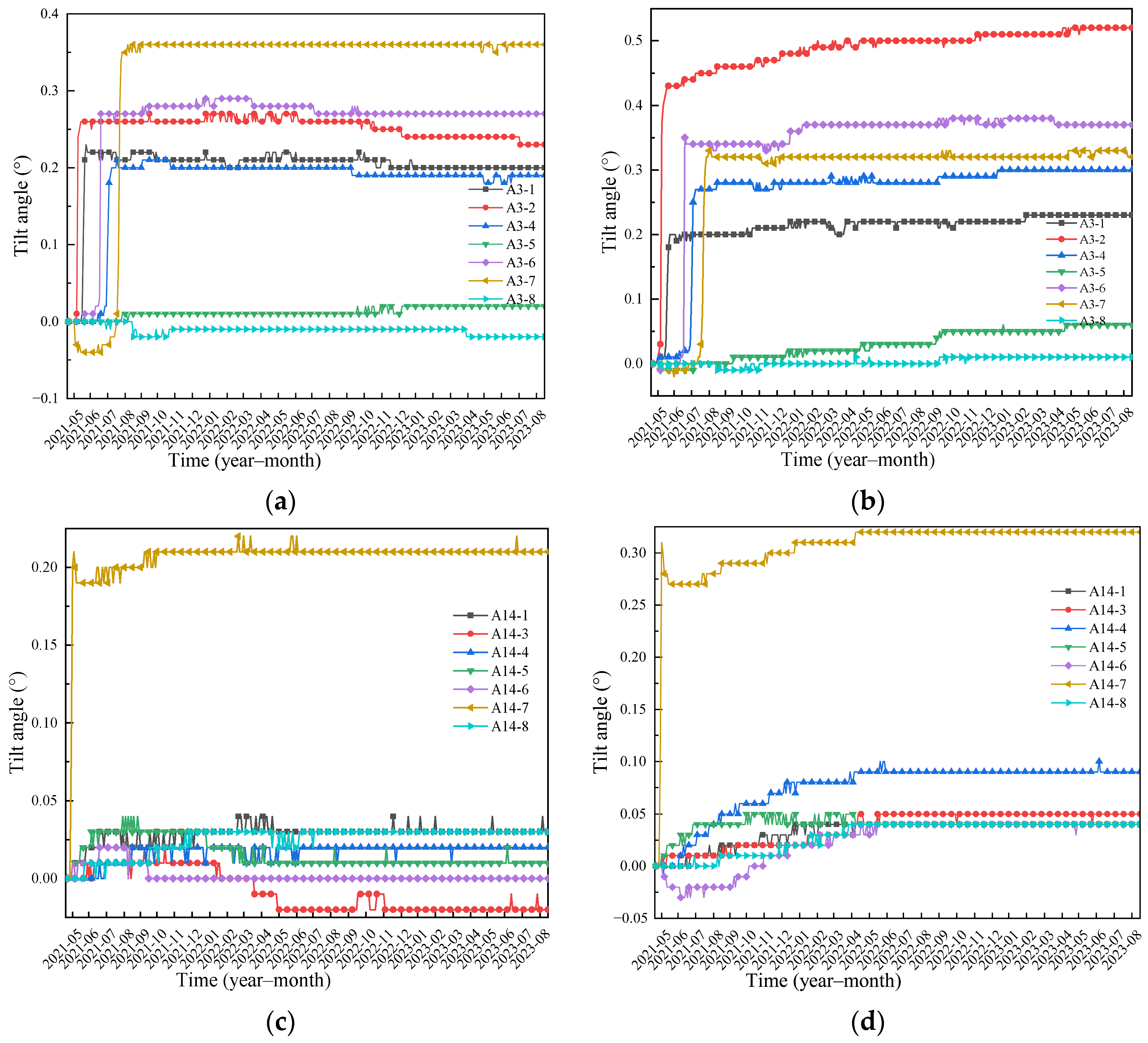
- Soil excavation substantially influenced the inclination angle of the pile body, with the effect being particularly pronounced in the mid-section of the soft soil layer. This depth acted as an amplification zone for deformation due to strain localization and the lack of lateral confinement. This observation indicates that pile foundations in soft soil are highly susceptible to plastic flow and instability under external loading and soil disturbances.
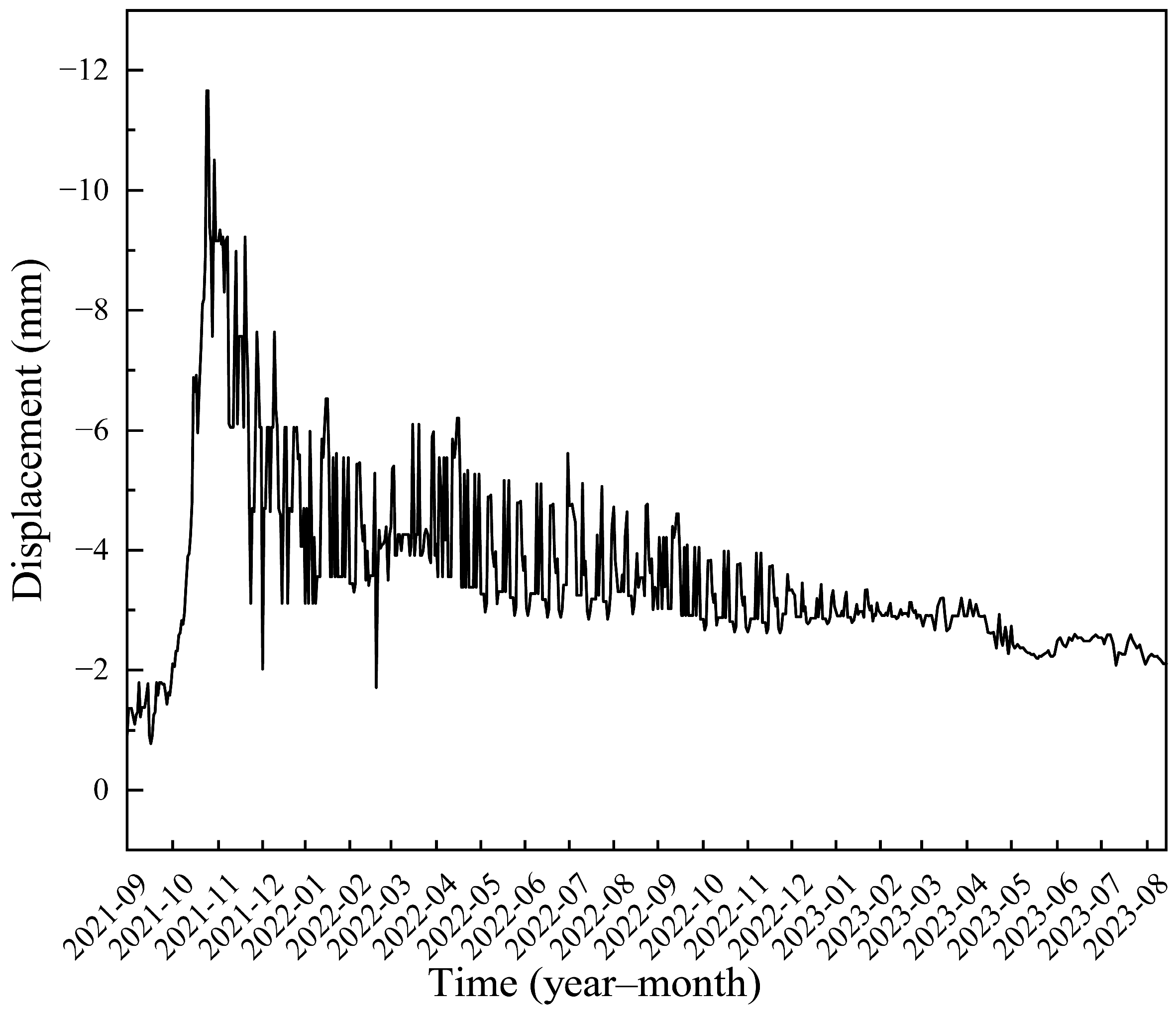
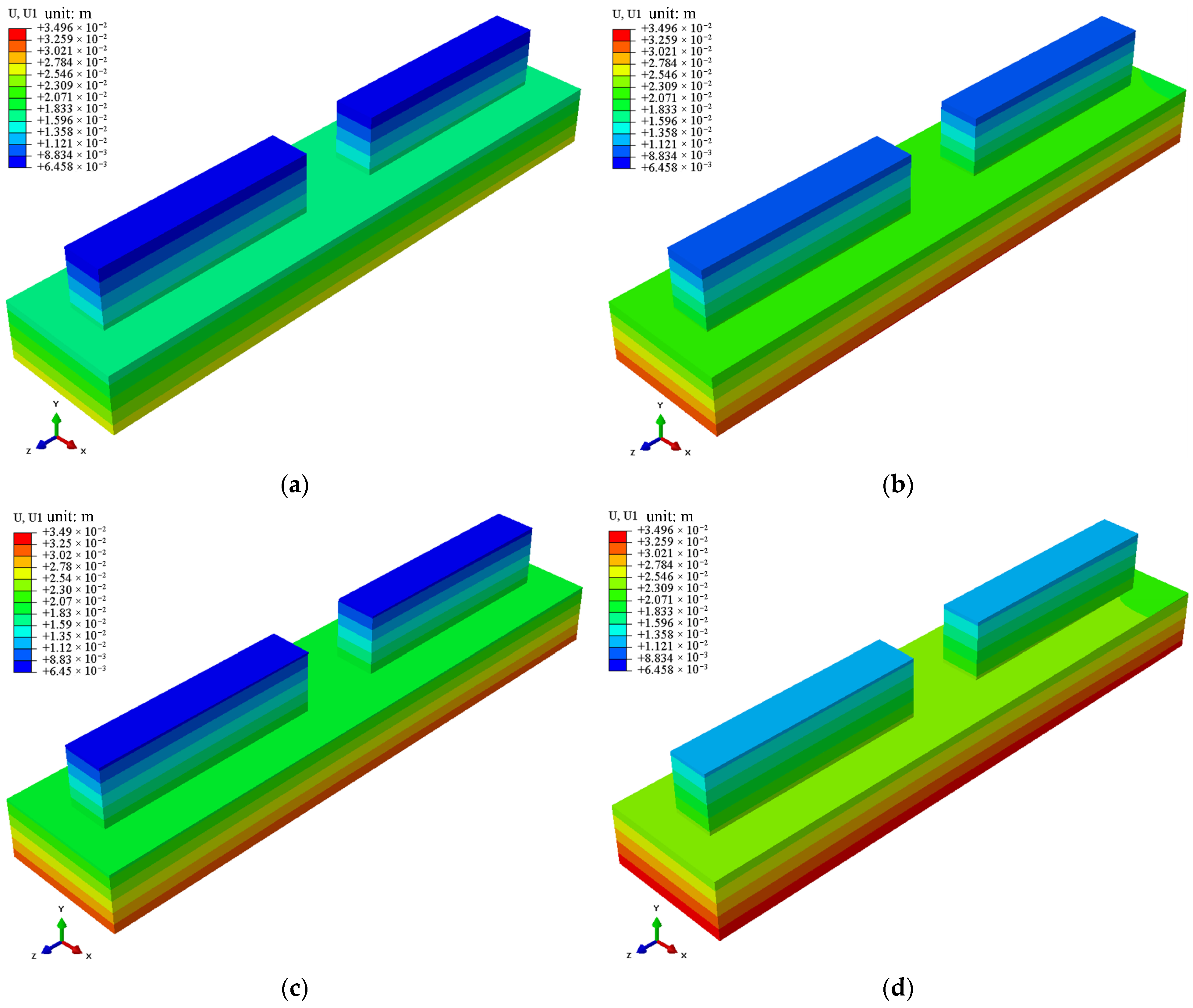
- Asymmetric soil excavation and surcharge loads significantly influenced pier displacement by transforming the foundation into a passive pile, thereby compromising the structural stability of the bridge. This underscores the critical need for meticulous management of excavation processes and load distribution during construction to mitigate potential risks. Practical solutions such as enforcing a strict safety setback distance for machinery, real-time monitoring of pore water pressure, and avoiding asymmetric excavation are recommended.
Author Contributions
Funding
Data Availability Statement
Conflicts of Interest
References
- Namazi, E.; Mohamad, H.; Hajihassani, M. 3D behaviour of buildings due to tunnel induced ground movement. Transp. Geotech. 2021, 31, 10661. [Google Scholar] [CrossRef]
- Wu, Y.; Hao, R.; Zhang, T.; Huang, D.; Xiong, Z. Experimental and numerical study on the impact of multi-line TBM tunneling in fractured zones on building deformation. Buildings 2025, 15, 3322. [Google Scholar] [CrossRef]
- Zhang, X.; Zhao, D.; Shi, X.; Gao, X.; Zhang, Y.; Wang, S. Investigation into the impacts of cover-and-cut top-down metro station construction on adjacent buildings: A case study. Buildings 2025, 15, 4149. [Google Scholar] [CrossRef]
- Mao, Z.; Ding, T.; Hu, F.; Ye, S.; Ding, L.; Shu, R.; Zhang, X.; Song, M. The deformation characteristics and patterns of adjacent existing metro structures caused by foundation pit excavation under different support forms. Buildings 2025, 15, 4178. [Google Scholar] [CrossRef]
- Richards, P.W.; Rollins, K.M.; Stenlund, T.E. Experimental testing of pile-to-cap connections for embedded pipe piles. J. Bridge Eng. 2011, 16, 286–294. [Google Scholar] [CrossRef]
- Matsumoto, K.; Panting, C.A.L.; Kitratporn, N.; Takeuchi, W.; Nagai, K.; Iwasaki, E. Performance assessment using structural analysis and spatial measurement of a damaged suspension bridge: Case study of Twantay bridge, Myanmar. J. Bridge Eng. 2018, 23, 05018008. [Google Scholar] [CrossRef]
- Bi, J.; Wang, G.; Mu, W.; Wen, H.; Pei, W.; Zhang, Q.; Yang, S.; Mao, M.; Lin, G.; Wang, C. A matrix for estimating the unfrozen water content of freezing soils. CATENA 2025, 256, 109050. [Google Scholar] [CrossRef]
- Zhang, L.; Zhang, P.; Xu, D.; Zhou, T. Seismic damage analysis of piled pier system constructed on soft clay ground. J. Bridge Eng. 2021, 26, 04020133. [Google Scholar] [CrossRef]
- Tian, N.; Li, M.; Huang, Q.; Yang, X.; Sun, Y.; Chen, J. Deformation response of underlying twin shield tunnels induced by large excavation in soft soils. Buildings 2025, 15, 4023. [Google Scholar] [CrossRef]
- Zheng, X.; Wang, X.; Shen, K.; Gu, X. Determination of HSS model parameters for soft clays in Hangzhou: Statistical analysis and engineering validation. Buildings 2025, 15, 3886. [Google Scholar] [CrossRef]
- Liu, Y.; Chen, Q.; Chen, X.; Liao, C. Seismic damage mechanism of five-story and three-span underground complex in soft soil site. Buildings 2025, 15, 2380. [Google Scholar] [CrossRef]
- Finno, R.J.; Blackburn, J.T.; Roboski, J.F. Three-dimensional effects for supported excavations in clay. J. Geotech. Geoenvironmental Eng. 2007, 133, 30–36. [Google Scholar] [CrossRef]
- Zhao, W.; Du, C.; Sun, L.; Chen, X. Field measurements and numerical studies of the behaviour of anchored sheet pile walls constructed with excavating and backfilling procedures. Eng. Geol. 2019, 259, 105165. [Google Scholar] [CrossRef]
- Bi, J.; Pan, Y.; Mu, W.; Yang, S.; Wang, G.; Mao, M.; Wang, S.; Wei, T. Predicting the unfrozen water content of freezing soils using an artificial neural network model. J. Cold Reg. Eng. 2026, 40, 04025050. [Google Scholar] [CrossRef]
- Shi, J.; Wei, J.; Ng, C.W.W.; Lu, H.; Ma, S.; Shi, C.; Li, P. Effects of construction sequence of double basement excavations on an existing floating pile. Tunn. Undergr. Space Technol. 2022, 119, 104230. [Google Scholar] [CrossRef]
- Mukherjee, S.; Kumar, J. Stability analysis of a vertical excavation reinforced with horizontal nails using three-dimensional finite elements limit analysis. Transp. Geotech. 2024, 44, 101168. [Google Scholar] [CrossRef]
- Ashour, M.; Abbas, A.I.; Boskovic, S. Pile cap interaction with bridge pile foundations under lateral loads. J. Bridge Eng. 2019, 24, 04019053. [Google Scholar] [CrossRef]
- Rezvani, R.; Tutunchian, M.A. Horizontal displacement of urban deep excavated walls supported by multistrands anchors, steel piles, and in situ concrete piles: Case study. Int. J. Geomech. 2021, 21, 05020008. [Google Scholar] [CrossRef]
- Yang, Y.; Li, J.; Liu, C.; Ma, J.; Zheng, S.; Chen, W. Influence of deep excavation on adjacent bridge piles considering underlying karst cavern: A case history and numerical investigation. Acta Geotech. 2022, 17, 545–562. [Google Scholar] [CrossRef]
- Mo, P.; Marshall, A.M.; Fang, Y. Cavity expansion–contraction-based method for tunnel–soil–pile interaction in a unified clay and sand model: Drained analysis. Int. J. Geomech. 2021, 21, 04021055. [Google Scholar] [CrossRef]
- Lu, H.; Shi, J.; Ng, C.W.W.; Lv, Y. Three-dimensional centrifuge modeling of the influence of side-by-side twin tunneling on a piled raft. Tunn. Undergr. Space Technol. 2020, 103, 103486. [Google Scholar] [CrossRef]
- Fan, Y.; Cai, J.; Wang, J. An analytical method evaluating the evolution of group effect for vertically loaded pile groups subjected to tunnel excavation. Appl. Sci. 2023, 13, 517. [Google Scholar] [CrossRef]
- Liu, X.; Liu, Y.; Qu, W.; Tu, Y. Internal force calculation and supporting parameters sensitivity analysis of side piles in the subway station excavated by Pile-Beam-Arch method. Tunn. Undergr. Space Technol. 2016, 56, 186–201. [Google Scholar] [CrossRef]
- Faheem, H.; Cai, F.; Ugai, K.; Hagiwara, T. Two-dimensional base stability of excavations in soft soils using FEM. Comput. Geotech. 2003, 30, 141–163. [Google Scholar] [CrossRef]
- Bal, A.R.L.; Dang, T.S.; Meschke, G. A 3D particle finite element model for the simulation of soft soil excavation using hypoplasticity. Comput. Part. Mech. 2020, 7, 151–172. [Google Scholar] [CrossRef]
- Li, G.; Qin, F.; Yan, N.; Qiao, X.; Si, L.; Zhao, S. Surface deformation characteristics and influencing factors in deep foundation pit excavations for subway projects in Ningbo’s soft soil area. Buildings 2025, 15, 1229. [Google Scholar] [CrossRef]
- Feng, W.; Xu, J.; Zhang, R.; Yan, Z.; Fu, L.; Zhu, Y.; Zhang, G.; Chen, Z. Study on excavation response of metro station foundation pit in water-bearing strata adjacent to tall buildings. Buildings 2025, 15, 3982. [Google Scholar] [CrossRef]
- Xu, J.; Deng, H.; Liu, Z.; Dai, G.; Ke, L.; Guo, X.; Zhang, Z. Protection of low-strength shallow-founded buildings around deep excavation: A case study in the Yangtze River soft soil area. Buildings 2025, 15, 4094. [Google Scholar] [CrossRef]
- Blackburn, J.T.; Finno, R.J. Three-dimensional responses observed in an internally braced excavation in soft clay. J. Geotech. Geoenvironmental Eng. 2016, 133, 1364–1373. [Google Scholar] [CrossRef]
- Liang, Y.; Liu, N.; Yu, F.; Gong, X.; Chen, Y. Prediction of response of existing building piles to adjacent deep excavation in soft clay. Adv. Civ. Eng. 2019, 2019, 8914708. [Google Scholar] [CrossRef]
- Choosrithong, K.; Schweiger, H.F. Numerical investigation of sequential strut failure on performance of deep excavations in soft soil. Int. J. Geomech. 2020, 20, 04020063. [Google Scholar] [CrossRef]
- Chen, S.; Cui, J.; Liang, F. Case study on the deformation coupling effect of a deep foundation pit group in a coastal soft soil area. Appl. Sci. 2022, 12, 6205. [Google Scholar] [CrossRef]
- Yang, Y.; Chen, C.; Liu, C.; Huang, L.; Chen, W.; Lin, N.; Cui, J.; Xie, W. Performance of a deep excavation and the influence on adjacent piles: A case history in karst region covered by clay and sand. Undergr. Space 2023, 8, 45–60. [Google Scholar] [CrossRef]
- Li, H.; Liu, S.; Tong, L. Evaluation of lateral response of single piles to adjacent excavation using data from cone penetration tests. Can. Geotech. J. 2019, 56, 236–248. [Google Scholar] [CrossRef]
- Li, Y.; Zhang, W.; Jiang, N.; Li, H. Surface settlement damage model of pile-anchor supporting structure in deep excavation. Adv. Civ. Eng. 2020, 2020, 1907526. [Google Scholar] [CrossRef]
- Yamashita, K.; Yamada, T.; Hamada, J. Investigation of settlement and load sharing on piled rafts by monitoring full-scale structures. Soils Found. 2011, 51, 513–532. [Google Scholar] [CrossRef]
- Stepanov, M.A.; Volosyuk, D.V.; Bartolomey, L.A. Geotechnical monitoring results of 22-storey buildings on combined strip pile foundations with prestressed soil bases. J. Phys. Conf. Ser. 2021, 1928, 012027. [Google Scholar] [CrossRef]
- Fellenius, B.H.; Kim, S.R.; Chung, S.G. Long-term monitoring of strain in instrumented piles. J. Geotech. Geoenvironmental Eng. 2009, 135, 1583–1595. [Google Scholar] [CrossRef]
- Nguyen, V.D.; Luo, Q.; Wang, T.; Zhang, L.; Zhan, Y.; Nguyen, T.P. Monitoring of an instrumented geosynthetic-reinforced piled embankment with a triangular pile configuration. Int. J. Rail Transp. 2023, 11, 69–91. [Google Scholar] [CrossRef]
- Chen, Z.; Zhang, N.; Zhang, X. Settlement monitoring system of pile-group foundation. J. Cent. South Univ. Technol. 2011, 18, 2122–2130. [Google Scholar] [CrossRef]
- Kister, G.; Winter, D.; Gebremichael, Y.M.; Leighton, J.; Badcock, R.A.; Tester, P.D.; Krishnamurthy, S.; Boyle, W.J.O.; Grattan, K.T.V.; Fernando, G. Methodology and integrity monitoring of foundation concrete piles using Bragg grating optical fibre sensors. Eng. Struct. 2007, 29, 2048–2055. [Google Scholar] [CrossRef]
- Mohamad, H.; Soga, K.; Pellew, A.; Bennett, P.J. Performance monitoring of a secant-piled wall using distributed fiber optic strain sensing. J. Geotech. Geoenvironmental Eng. 2011, 137, 1236–1243. [Google Scholar] [CrossRef]
- Guo, Z.; Zhao, Z. Application of distributed optical fiber sensing technique in pile foundation monitoring. IOP Conf. Ser. Earth Environ. Sci. 2018, 189, 052074. [Google Scholar] [CrossRef]
- Liu, F.; Xu, Q.; Liu, Y. Condition diagnosis of long-span bridge pile foundations based on the spatial correlation of high-density strain measurement points. Sustainability 2021, 13, 12498. [Google Scholar] [CrossRef]
- Klar, A.; Bennett, P.J.; Soga, K.; Mair, R.J.; Tester, P.; Fernie, R.; St John, H.D.; Torp-Peterson, G. Distributed strain measurement for pile foundations. Proc. Inst. Civ. Eng. Geotech. Eng. 2006, 159, 135–144. [Google Scholar] [CrossRef]
- Momeni, E.; Poormoosavian, M.; Tehrani, H.S.; Fakher, A. Reliability analysis and risk assessment of deep excavations using random-set finite element method and event tree technique. Transp. Geotech. 2021, 29, 100560. [Google Scholar] [CrossRef]
- Lai, V.; Kounlavong, K.; Keawsawasvong, S.; Banyong, R.; Wipulanusat, W.; Jamsawang, P. Undrained basal stability of braced circular excavations in anisotropic and non-homogeneous clays. Transp. Geotech. 2023, 39, 100945. [Google Scholar] [CrossRef]
- Poulos, H.G.; Chen, L.T. Pile response due to excavation-induced lateral soil movement. J. Geotech. Geoenvironmental Eng. 1997, 123, 94–99. [Google Scholar] [CrossRef]
- Ong, D.E.; Leung, C.E.; Chow, Y.K. Pile behavior due to excavation-induced soil movement in clay. I: Stable wall. J. Geotech. Geoenvironmental Eng. 2006, 132, 36–44. [Google Scholar] [CrossRef]
- Fan, Z.; Xu, C.; Yang, K.; Xue, X.; Zeng, C. Experimental study on the influence of rising water levels on the buoyancy of building structure. Water 2025, 17, 1377. [Google Scholar] [CrossRef]
- Zhang, Y.; Zhou, L.; Wang, M.; Ding, X.; Wang, C. Experimental study on the negative skin friction of the pile group induced by rising and lowering the groundwater level. Adv. Civ. Eng. 2021, 2021, 2574727. [Google Scholar] [CrossRef]
- Chalajour, S.; Blatz, J.A. Assessment of the unified design method for piles subjected to negative skin friction using field studies and numerical modeling. Can. Geotech. J. 2025, 62, 1–17. [Google Scholar] [CrossRef]
- JGJ94-2008; Technical Code for Building Pile Foundations. Ministry of Housing and Urban-Rural Development of the People’s Republic of China: Beijing, China; China Architecture & Building Press: Beijing, China, 2008.
- Yu, H.; Chen, X.; Yi, L.; Qiu, J.; Gu, Z.; Zhao, H. Parameter inversion and application of soft soil modified Cambridge model. Rock Soil Mech. 2023, 44, 3318–3326. (In Chinese) [Google Scholar] [CrossRef]
- Bao, X.; Cheng, Z.; Lv, C.; Shen, J.; Chen, X.; Cui, H. Analysis of the influence of deep foundation excavation on adjacent viaduct pile foundation considering train dynamic loads. Appl. Sci. 2023, 13, 1572. [Google Scholar] [CrossRef]



| Soil Type | Ρ (kg/m3) | c/kPa | φ/° | E/MPa | μ | H/m |
|---|---|---|---|---|---|---|
| Silty clay | 1850 | 22.5 | 18.6 | 17.3 | 0.36 | 12 |
| Muddy clay | 1730 | 12.8 | 9.2 | 7.3 | 0.48 | 45 |
| Silt | 1900 | 16.0 | 22.6 | 24.0 | 0.34 | 10 |
| Moderately weathered bedrock | 2400 | 30.0 | 35.0 | 42.0 | 0.36 | 33 |
| Soil Type | λ | κ | M | e0 |
|---|---|---|---|---|
| Silty clay | 0.038 | 0.012 | 1.123 | 0.967 |
| Muddy clay | 0.050 | 0.021 | 1.076 | 1.712 |
| Case | Simulated Scenarios |
|---|---|
| 1 | No soil accumulation, symmetric excavation |
| 2 | No soil accumulation, no symmetric excavation |
| 3 | Soil accumulation, symmetric excavation |
| 4 | Soil accumulation, no symmetric excavation |
Disclaimer/Publisher’s Note: The statements, opinions and data contained in all publications are solely those of the individual author(s) and contributor(s) and not of MDPI and/or the editor(s). MDPI and/or the editor(s) disclaim responsibility for any injury to people or property resulting from any ideas, methods, instructions or products referred to in the content. |
© 2026 by the authors. Licensee MDPI, Basel, Switzerland. This article is an open access article distributed under the terms and conditions of the Creative Commons Attribution (CC BY) license.
Share and Cite
Ding, W.; Wang, S.; Wang, G.; Hu, W.; Liu, J. Stability Study of Bridge Piles Subject to Construction Activities and Channel Excavation in Deep Soft Soil Areas. Buildings 2026, 16, 385. https://doi.org/10.3390/buildings16020385
Ding W, Wang S, Wang G, Hu W, Liu J. Stability Study of Bridge Piles Subject to Construction Activities and Channel Excavation in Deep Soft Soil Areas. Buildings. 2026; 16(2):385. https://doi.org/10.3390/buildings16020385
Chicago/Turabian StyleDing, Wanpeng, Shengnian Wang, Guoxu Wang, Wentao Hu, and Jian Liu. 2026. "Stability Study of Bridge Piles Subject to Construction Activities and Channel Excavation in Deep Soft Soil Areas" Buildings 16, no. 2: 385. https://doi.org/10.3390/buildings16020385
APA StyleDing, W., Wang, S., Wang, G., Hu, W., & Liu, J. (2026). Stability Study of Bridge Piles Subject to Construction Activities and Channel Excavation in Deep Soft Soil Areas. Buildings, 16(2), 385. https://doi.org/10.3390/buildings16020385