Integrating Circular Economy Principles into Energy-Efficient Retrofitting of Post-1950 UK Housing Stock: A Pathway to Sustainable Decarbonisation


Abstract
1. Introduction
2. Energy-Efficient Retrofitting in the UK
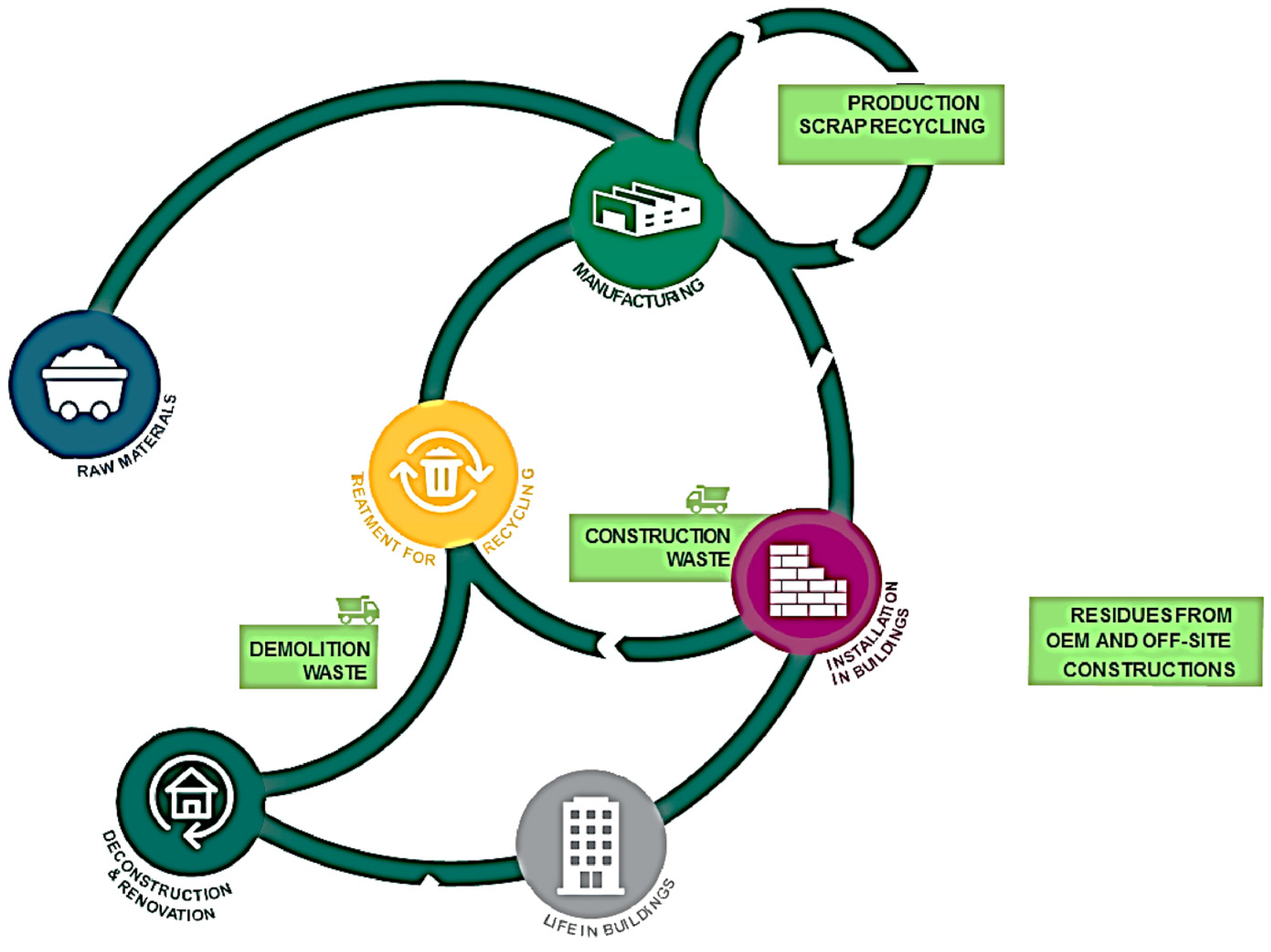
2.1. Circular Economy in the Built Environment
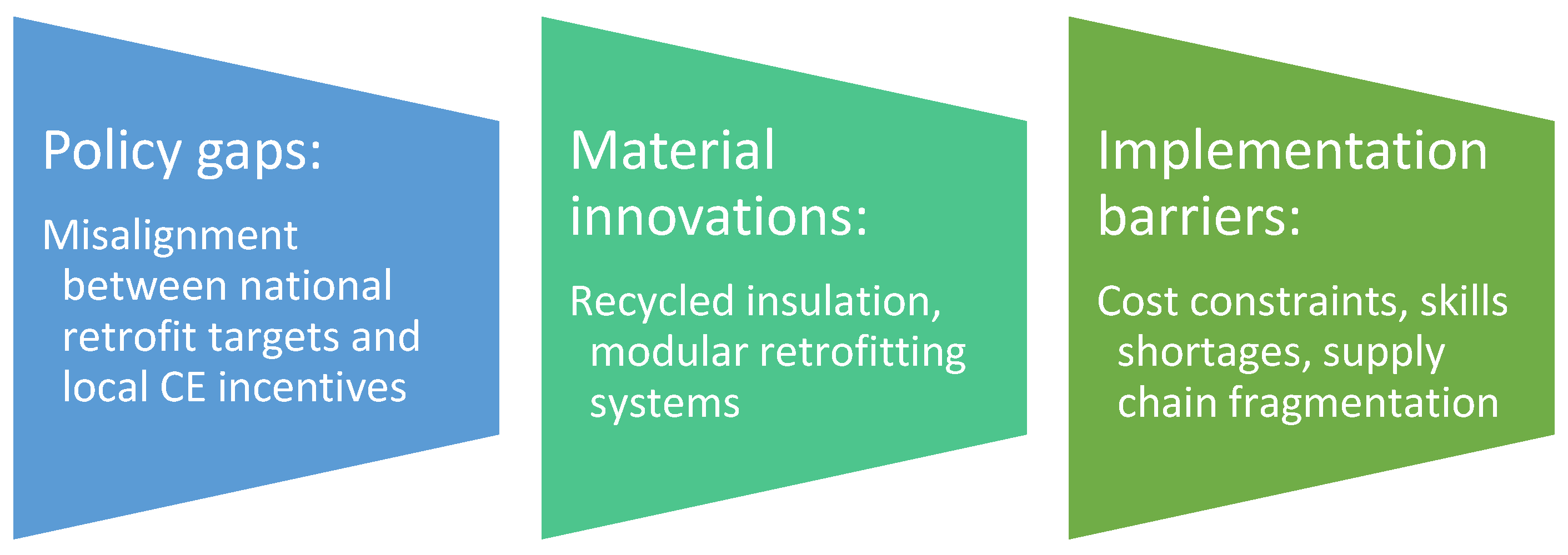
2.2. Gaps in Existing Research
2.3. Technical Implementation Barriers
2.4. Economic and Market Constraints
2.5. Policy and Regulatory Framework Deficiencies
2.6. Social and Behavioural Dimensions
2.7. Integration with Energy-Efficiency Objectives
3. Methodology
3.1. Research Design Approach: Three Interconnected Phases
3.1.1. Phase 1: Foundation Building Through Document Analysis
3.1.2. Phase 2: Stakeholder Insights Through Semi-Structured Interviews
3.1.3. Phase 3: Framework Validation Through Expert Consensus
3.1.4. The Processes Applied
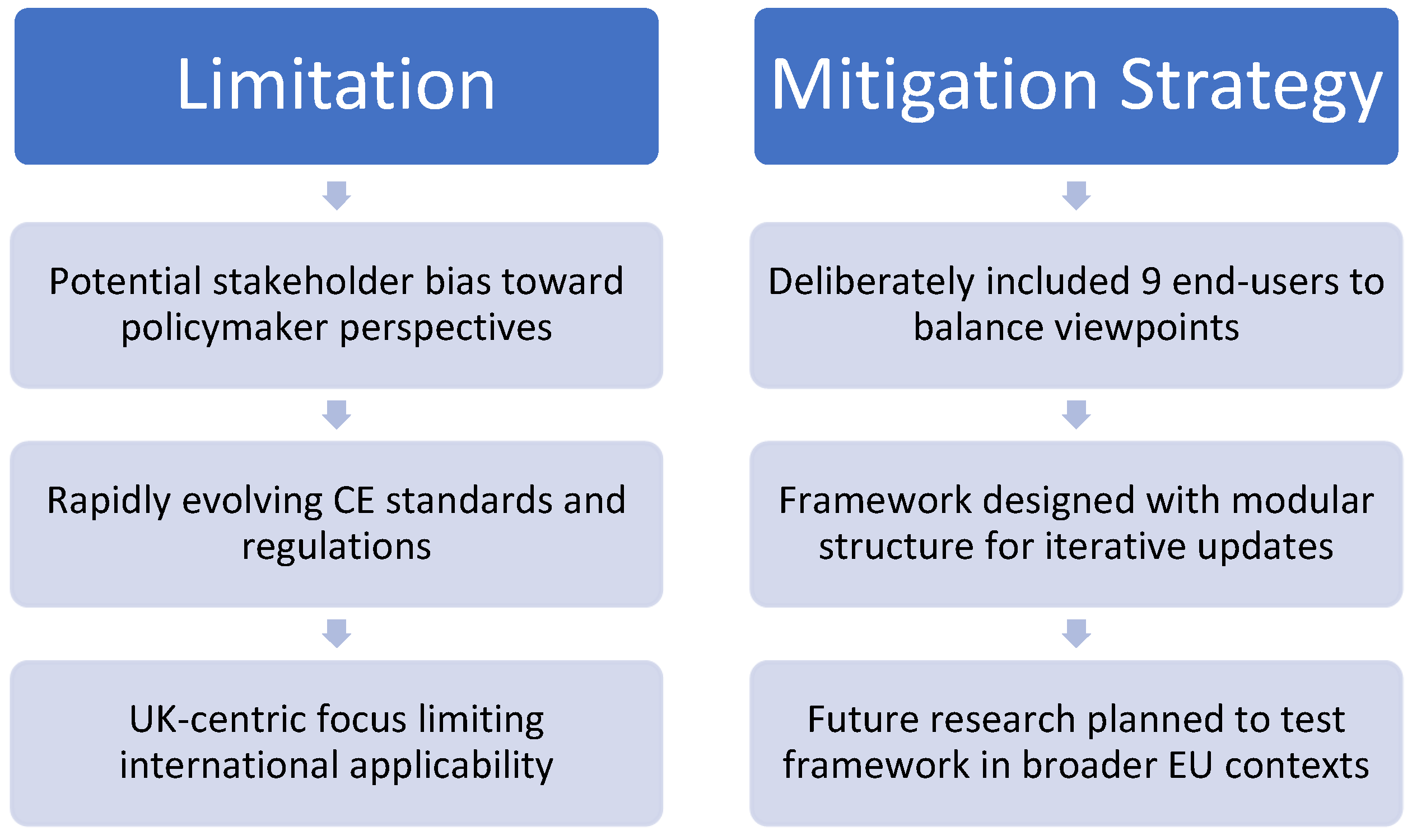
Quality Assurance and Limitations
Research Contribution and Next Steps
4. Findings and Discussion
4.1. Stakeholder Perceptions: Promise Versus Practice
4.2. Bio-Based Materials: Environmental Panacea or Performance Compromise?
4.3. Knowledge Deficits: Symptom or Cause?
4.4. Regulatory Framework: Policy Failure or Political Choice?
4.5. Supply Chain Limitations: Market Reality or Transitional Challenge?
4.6. The Proposed Framework: Ambition Versus Feasibility
4.7. Economic Viability: Optimism or Evidence?
5. Circular Economy Integration Framework for UK Retrofitting Practices
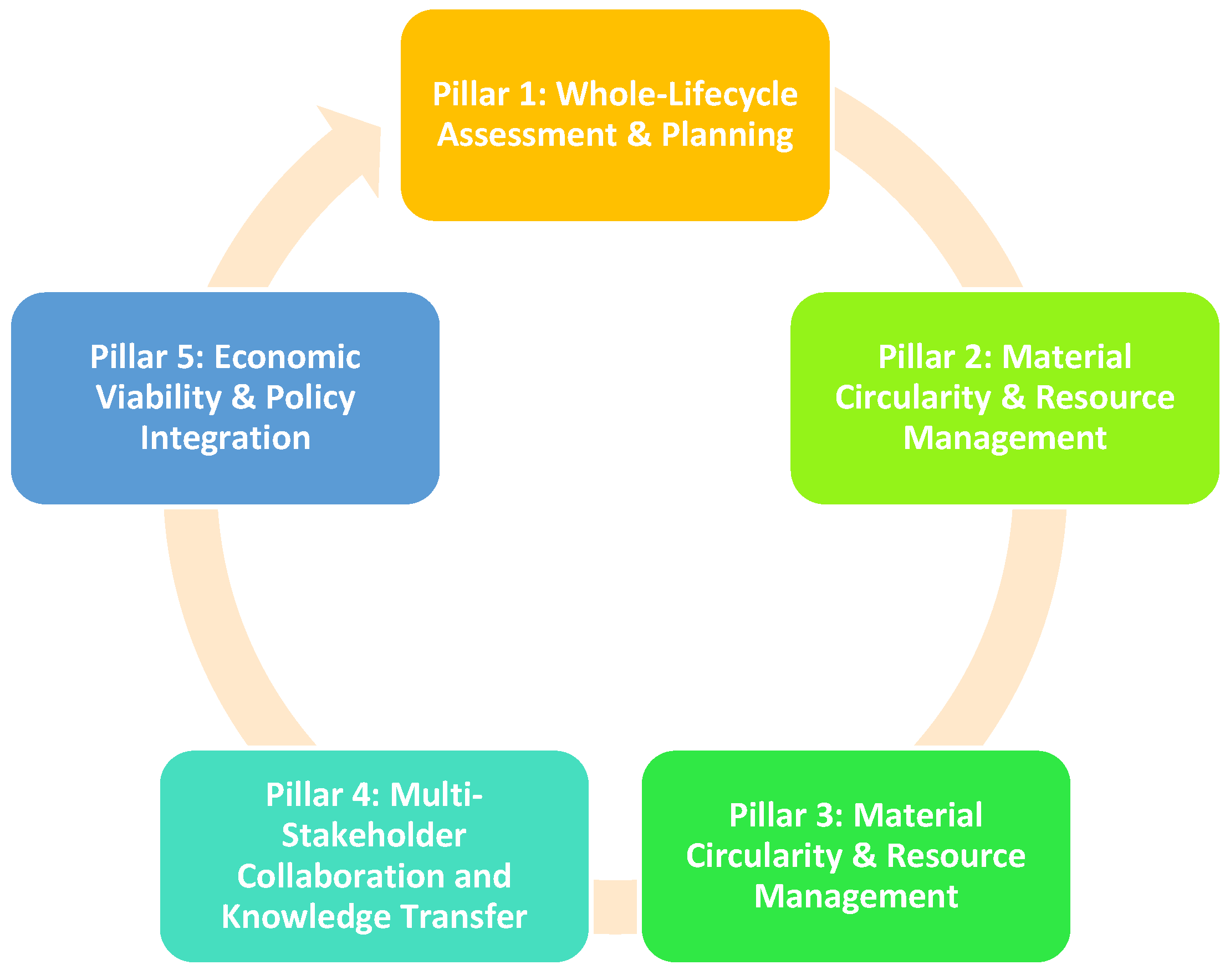
5.1. Pillars of Circular Economy Integration Framework for UK Retrofitting Practices
5.1.1. Pillar 1: Whole-Lifecycle Assessment and Planning
5.1.2. Pillar 2: Material Circularity and Resource Management
5.1.3. Pillar 3: Material Circularity and Resource Management
5.1.4. Pillar 4: Multi-Stakeholder Collaboration and Knowledge Transfer
5.1.5. Pillar 5: Economic Viability and Policy Integration
5.2. Implementation Pathways
5.2.1. Phase 1: Foundation Building (Years 1–2)
5.2.2. Phase 2: Market Development (Years 3–5)
5.2.3. Phase 3: Mainstream Integration (Years 6–10)
5.3. Contributions to Circular Economy and Retrofitting Knowledge
6. Conclusions
Author Contributions
Funding
Institutional Review Board Statement
Informed Consent Statement
Data Availability Statement
Conflicts of Interest
Abbreviations
| CE | Circular Economy |
| LCA | Life Cycle Assessment |
| LCT | Life Cycle Thinking |
| HVAC | Heating, Ventilation, and Air Conditioning |
| NDCs | Nationally Determined Contributions (NDCs) |
| ECO | Energy Company Obligation |
| DfD | Design for Disassembly Deconstruction |
| ER | Energy Retrofit/Energy Efficiency Retrofit |
| ECO | Green Homes Grant |
| GHG | Greenhouse Gas |
| GHG | Green Homes Grant |
| UK | United Kingdom (used in context of case studies, policies, retrofitting) |
| CEPs | Circular Economy Principles (sometimes used in discussion of policies) |
References
- Department for Business, Energy & Industrial Strategy (BEIS). Net Zero Strategy: Build Back Greener; UK Government, Department for Energy Security and Net Zero: London, UK, 2022; pp. 79, 136.
- Ionescu, C.; Baracu, T.; Serban, A.; Vlad, G.E.; Necula, H. The historical evolution of the energy efficient buildings. Renew. Sustain. Energy Rev. 2015, 49, 243–253. [Google Scholar] [CrossRef]
- Alabid, J.; Bennadji, A.; Seddiki, M. A review on the energy retrofit policies and improvements of the UK existing buildings, challenges and benefits. Renew. Sustain. Energy Rev. 2022, 159, 112161. [Google Scholar] [CrossRef]
- Huang, B.; Xing, K.; Pullen, S.; Zuo, J. A life cycle thinking framework to mitigate the environmental impact of building materials. One Earth 2020, 3, 564–573. [Google Scholar] [CrossRef]
- De Oliveira, C.C.; Vaz, I.C.M.; Ghisi, E. Retrofit strategies to improve energy efficiency in buildings: An integrative review. Energy Build. 2024, 321, 114624. [Google Scholar] [CrossRef]
- Department for Environment, Food & Rural Affairs (DEFRA). Resources and Waste Strategy Annual Progress Report; DEFRA: London, UK, 2023.
- Zhang, L.; Zhou, K.; Yang, S.; Shao, Z. Decarbonising residential building energy towards achieving the intended nationally determined contribution at subnational level under uncertainties. J. Clean. Prod. 2020, 272, 122760. [Google Scholar] [CrossRef]
- EURIMA. Circular Economy. 2025. Available online: https://www.eurima.org/circular-economy (accessed on 15 July 2025).
- Aljashaami, B.A.; Mohammed, H.J.; Hasan, A.N.; Al-Juboori, R.A.; Hasan, H.A.; Al-Farhany, K. Recent improvements to heating, ventilation, and cooling technologies for buildings based on renewable energy to achieve zero-energy buildings: A systematic review. Results Eng. 2024, 23, 102769. [Google Scholar] [CrossRef]
- Ellen MacArthur Foundation. Circular Economy in Cities; Ellen MacArthur Foundation: Cowes, UK, 2021. [Google Scholar]
- Department for Business, Energy & Industrial Strategy (BEIS). Heat and Buildings Strategy; HM Government: London, UK, 2023.
- Collins, M.; Dempsey, S. Residential energy efficiency retrofits: Potential unintended consequences. J. Environ. Plan. Manag. 2018, 62, 2010–2025. [Google Scholar] [CrossRef]
- PAS 2035:2019; Specification for Retrofitting Dwellings. Updated 2023; British Standards Institution (BSI): London, UK, 2023.
- Charef, R.; Lu, W.; Hall, D. The transition to the circular economy of the construction industry: Insights into sustainable approaches to improve the understanding. J. Clean. Prod. 2022, 364, 132421. [Google Scholar] [CrossRef]
- Kaewunruen, S.; Chen, C.; Li, D.; Wang, Y. Comparisons of stakeholders’ influences, inter-relationships, and obstacles for circular economy implementation on existing building sectors. Sci. Rep. 2024, 14, 61863. [Google Scholar] [CrossRef]
- Pomponi, F.; Moncaster, A. Circular economy for the built environment: A research framework. J. Clean. Prod. 2017, 143, 710–718. [Google Scholar] [CrossRef]
- Hart, J.; Adams, K.; Giesekam, J.; Tingley, D.D.; Pomponi, F. Barriers and drivers in a circular economy: The case of the built environment. Procedia CIRP 2019, 80, 619–624. [Google Scholar] [CrossRef]
- Benachio, G.L.F.; Freitas, M.C.D.; Tavares, S.F. Circular economy in the construction industry: A systematic literature review. J. Clean. Prod. 2020, 260, 121046. [Google Scholar] [CrossRef]
- Johansson, N.; Corvellec, H. Waste policies gone soft: An analysis of European and Swedish waste prevention plans. Waste Manag. 2018, 77, 322–332. [Google Scholar] [CrossRef] [PubMed]
- Foster, G. Circular economy strategies for adaptive reuse of cultural heritage buildings to reduce environmental impacts. Resour. Conserv. Recycl. 2020, 152, 104507. [Google Scholar] [CrossRef]
- Fořt, J.; Černý, R. Limited interdisciplinary knowledge transfer as a missing link for sustainable building retrofits in the residential sector. J. Clean. Prod. 2022, 343, 131079. [Google Scholar] [CrossRef]
- Densley Tingley, D.; Davison, B. Design for deconstruction and material reuse. Proc. Inst. Civ. Eng. Energy 2011, 164, 195–204. [Google Scholar] [CrossRef]
- Akanbi, L.A.; Oyedele, L.O.; Akinade, O.O.; Ajayi, A.O.; Davila Delgado, M.; Bilal, M.; Bello, S.A. Salvaging building materials in a circular economy: A BIM-based whole-life performance estimator. Resour. Conserv. Recycl. 2018, 129, 175–186. [Google Scholar] [CrossRef]
- Sansom, M.; Avery, N. Briefing: Reuse and recycling rates of UK steel demolition arisings. Proc. Inst. Civ. Eng. Eng. Sustain. 2014, 167, 89–94. [Google Scholar] [CrossRef]
- AlJaber, A.; Martinez-Vazquez, P.; Baniotopoulos, C. Barriers and Enablers to the adoption of Circular Economy concept in the building sector: A Systematic literature review. Buildings 2023, 13, 2778. [Google Scholar] [CrossRef]
- Adams, K.T.; Osmani, M.; Thorpe, T.; Thornback, J. Circular economy in construction: Current awareness, challenges and enablers. Proc. Inst. Civ. Eng. Waste Resour. Manag. 2017, 170, 15–24. [Google Scholar] [CrossRef]
- Mahpour, A. Prioritising barriers to adopt circular economy in construction and demolition waste management. Resour. Conserv. Recycl. 2018, 134, 216–227. [Google Scholar] [CrossRef]
- Munaro, M.R.; Tavares, S.F.; Bragança, L. Towards circular and more sustainable buildings: A systematic literature review on the circular economy in the built environment. J. Clean. Prod. 2020, 260, 121134. [Google Scholar] [CrossRef]
- Ness, D.A.; Xing, K. Toward a resource-efficient built environment: A literature review and conceptual model. J. Ind. Ecol. 2017, 21, 572–592. [Google Scholar] [CrossRef]
- Trencher, G.; Healy, N.; Hasegawa, K.; Coffman, D.M. Innovative policy practices to advance building energy efficiency and retrofitting: Approaches, impacts and challenges in ten C40 cities. Environ. Sci. Policy 2016, 66, 353–365. [Google Scholar] [CrossRef]
- Wilson, C.; Crane, L.; Chryssochoidis, G. The conditions of normal domestic life help explain homeowners’ decisions to renovate. Tyndall Cent. Clim. Change Res. 2018, 8, 371–413. [Google Scholar]
- Bowen, G.A. Document analysis as a qualitative research method. Qual. Res. J. 2009, 9, 27–40. [Google Scholar] [CrossRef]
- Fink, A. Conducting Research Literature Reviews: From the Internet to Paper, 5th ed.; Sage Publications: Thousand Oaks, CA, USA, 2019. [Google Scholar]
- Creswell, J.W.; Creswell, J.D. Research Design: Qualitative, Quantitative, and Mixed Methods Approach, 5th ed.; Sage Publications: Thousand Oaks, CA, USA, 2018. [Google Scholar]
- Flanagan, J.C. The critical incident technique. Psychol. Bull. 1954, 51, 327–358. [Google Scholar] [CrossRef]
- Butterfield, L.D.; Borgen, W.A.; Amundson, N.E.; Maglio, A.S.T. Fifty years of the critical incident technique: 1954–2004 and beyond. Qual. Res. 2005, 5, 475–497. [Google Scholar] [CrossRef]
- Braun, V.; Clarke, V. Using thematic analysis in psychology. Qual. Res. Psychol. 2006, 3, 77–101. [Google Scholar] [CrossRef]
- Densley Tingley, D.; Cooper, S.; Cullen, J. Understanding and overcoming the barriers to structural steel reuse, a UK perspective. J. Clean. Prod. 2017, 148, 642–652. [Google Scholar] [CrossRef]
- Oyedele, L.O.; Ajayi, S.O.; Kadiri, K.O. Use of recycled products in UK construction industry: An empirical investigation into critical impediments and strategies for improvement. Resour. Conserv. Recycl. 2014, 93, 23–31. [Google Scholar] [CrossRef]
- Ajayi, S.O.; Oyedele, L.O.; Akinade, O.O.; Bilal, M.; Alaka, H.A.; Owolabi, H.A.; Kadiri, K.O. Reducing waste to landfill: A need for cultural change in the UK construction industry. J. Build. Eng. 2016, 5, 185–193. [Google Scholar] [CrossRef]
- Ajayi, S.O.; Oyedele, L.O.; Akinade, O.O.; Bilal, M.; Owolabi, H.A.; Alaka, H.A.; Kadiri, K.O. Optimising material procurement for construction waste minimization: An exploration of success factors. Sustain. Mater. Technol. 2017, 11, 38–46. [Google Scholar] [CrossRef]
- Gorgolewski, M. Designing with reused building components: Some challenges. Build. Res. Inf. 2008, 36, 175–188. [Google Scholar] [CrossRef]
- Ajayi, S.O.; Oyedele, L.O.; Bilal, M.; Akinade, O.O.; Alaka, H.A.; Owolabi, H.A. Critical management practices influencing on-site waste minimization in construction projects. Waste Manag. 2017, 59, 330–339. [Google Scholar] [CrossRef]
- Yussif, M.; Taiwo, R.; Shakor, P.; Han, T.; Mohandes, S.R.; Antwi-Afari, M.F.; Qazi, K.; Singh, A.K.; Christo, M.S.; Shah, M.A. A comprehensive literature review on risk identification and assessment in green building construction projects. Clean. Eng. Technol. 2025, 29, 101089. [Google Scholar] [CrossRef]
- Askar, R.; Bragança, L.; Gervásio, H. Adaptability of Buildings: A Critical Review on the Concept Evolution. Appl. Sci. 2021, 11, 4483. [Google Scholar] [CrossRef]
- Conejos, S.; Langston, C.; Smith, J. Designing for better building adaptability: A comparison of adaptSTAR and ARP models. Habitat Int. 2014, 41, 85–91. [Google Scholar] [CrossRef]
- Anarene, C.B.; Saha, S.; Davies, P.; Kamrul, M.D. Decision Support System for Sustainable Retrofitting of Existing Commercial Office Buildings. Int. J. Sci. Res. Manag. 2024, 12, 7191–7212. [Google Scholar] [CrossRef]
- Sakr, D.A.; Sherif, A.; El-Haggar, S.M. Environmental management systems’ awareness: An investigation of top 50 contractors in Egypt. J. Clean. Prod. 2009, 18, 210–218. [Google Scholar] [CrossRef]
- Dahlmann, F.; Roehrich, J.K.; Grosvold, J. Sustainable supply chain management and partner engagement to manage climate change information. Bus. Strategy Environ. 2019, 28, 1632–1647. [Google Scholar] [CrossRef]
- Leising, E.; Quist, J.; Bocken, N. Circular economy in the building sector: Three cases and a collaboration tool. J. Clean. Prod. 2018, 176, 976–989. [Google Scholar] [CrossRef]
- Pitt, M.; Tucker, M.; Riley, M.; Longden, J. Towards sustainable construction: Promotion and best practices. Constr. Innov. 2009, 9, 201–224. [Google Scholar] [CrossRef]
- Curtain, R. An energy balance and greenhouse gas profile for county Wexford, Ireland in 2006. Appl. Energy 2011, 88, 3773–3781. [Google Scholar] [CrossRef]
- Aksoy, T.U.; Inalli, M. Impacts of some building passive design parameters on heating demand for a cold region. Build. Environ. 2006, 41, 1779–1789. [Google Scholar] [CrossRef]
- Chapman, R.; Howden-Chapman, P.; Viggers, H.; O’Dea, D.; Kennedy, M. Retrofitting houses with insulation: A cost–benefit analysis of a randomised community trial. J. Epidemiol. Community Health 2009, 63, 271–277. [Google Scholar] [CrossRef]
- Williams, J. Circular cities. Urban Stud. 2019, 56, 2746–2762. [Google Scholar] [CrossRef]
- Duran, X.; Lenihan, H.; O’Regan, B. A model for assessing the economic viability of construction and demolition waste recycling—The case of Ireland. Resour. Conserv. Recycl. 2006, 46, 302–320. [Google Scholar] [CrossRef]




| Core Phase | Core Dimension |
|---|---|
| Policy and Regulation | Incentivizing material passports and CE standards |
| Design and Technology | Modular retrofitting systems and innovation adoption |
| Supply Chain and Logistics | Local material hubs and circular procurement |
| Stakeholder Collaboration | Integrated project delivery models |
| User Engagement | Co-design approaches with residents |
Disclaimer/Publisher’s Note: The statements, opinions and data contained in all publications are solely those of the individual author(s) and contributor(s) and not of MDPI and/or the editor(s). MDPI and/or the editor(s) disclaim responsibility for any injury to people or property resulting from any ideas, methods, instructions or products referred to in the content. |
© 2026 by the authors. Licensee MDPI, Basel, Switzerland. This article is an open access article distributed under the terms and conditions of the Creative Commons Attribution (CC BY) license.
Share and Cite
Gyoh, L.; Ebohon, O.J.; Zhou, J.; Ogan, D.D. Integrating Circular Economy Principles into Energy-Efficient Retrofitting of Post-1950 UK Housing Stock: A Pathway to Sustainable Decarbonisation. Buildings 2026, 16, 262. https://doi.org/10.3390/buildings16020262
Gyoh L, Ebohon OJ, Zhou J, Ogan DD. Integrating Circular Economy Principles into Energy-Efficient Retrofitting of Post-1950 UK Housing Stock: A Pathway to Sustainable Decarbonisation. Buildings. 2026; 16(2):262. https://doi.org/10.3390/buildings16020262
Chicago/Turabian StyleGyoh, Louis, Obas John Ebohon, Juanlan Zhou, and Deinsam Dan Ogan. 2026. "Integrating Circular Economy Principles into Energy-Efficient Retrofitting of Post-1950 UK Housing Stock: A Pathway to Sustainable Decarbonisation" Buildings 16, no. 2: 262. https://doi.org/10.3390/buildings16020262
APA StyleGyoh, L., Ebohon, O. J., Zhou, J., & Ogan, D. D. (2026). Integrating Circular Economy Principles into Energy-Efficient Retrofitting of Post-1950 UK Housing Stock: A Pathway to Sustainable Decarbonisation. Buildings, 16(2), 262. https://doi.org/10.3390/buildings16020262