Indoor Environment Improvement and Energy-Saving Effects of Light Shelf System with Integrated Radiant Heating and Cooling Panel



Abstract
1. Introduction
2. Methodology
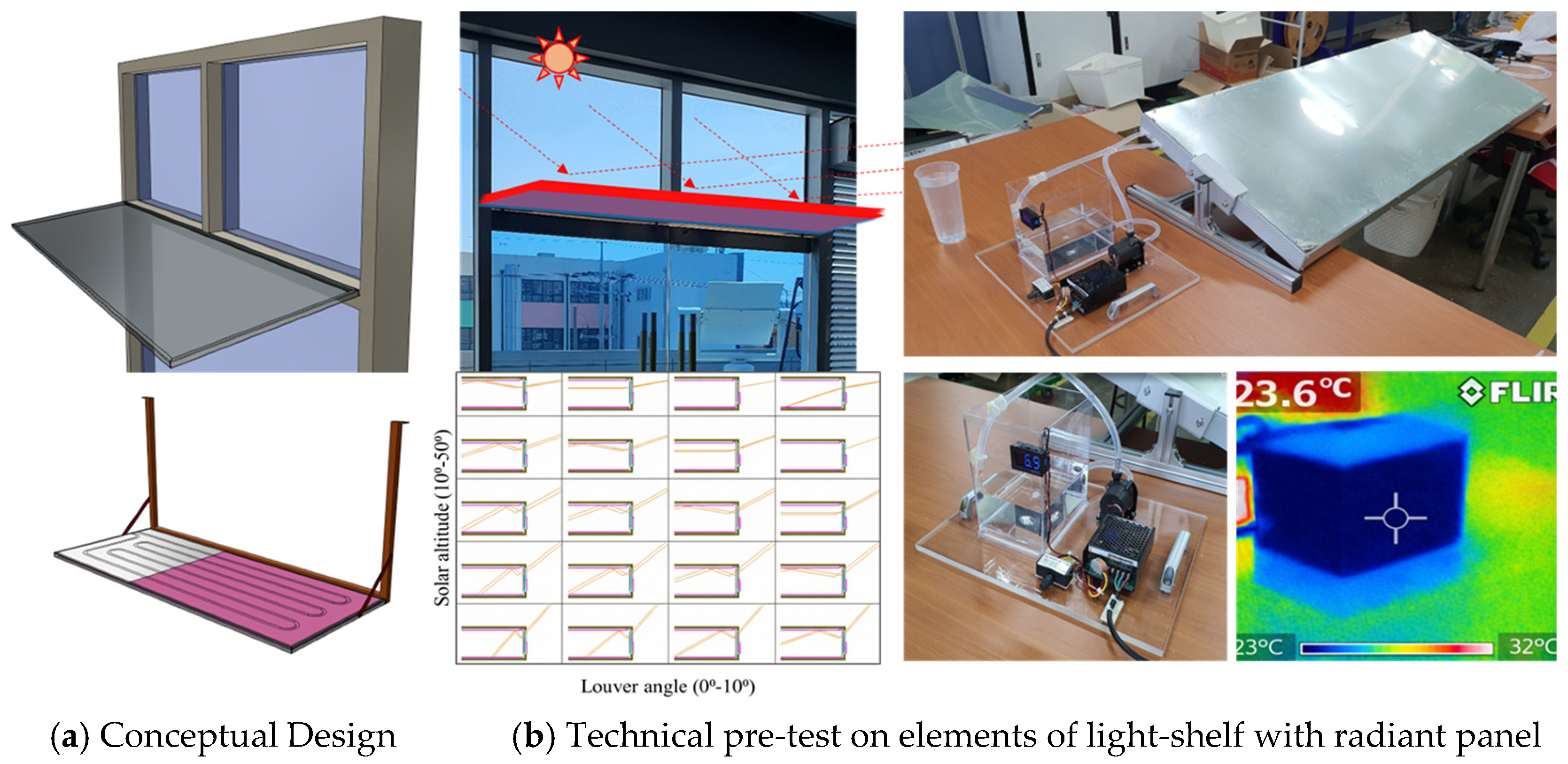
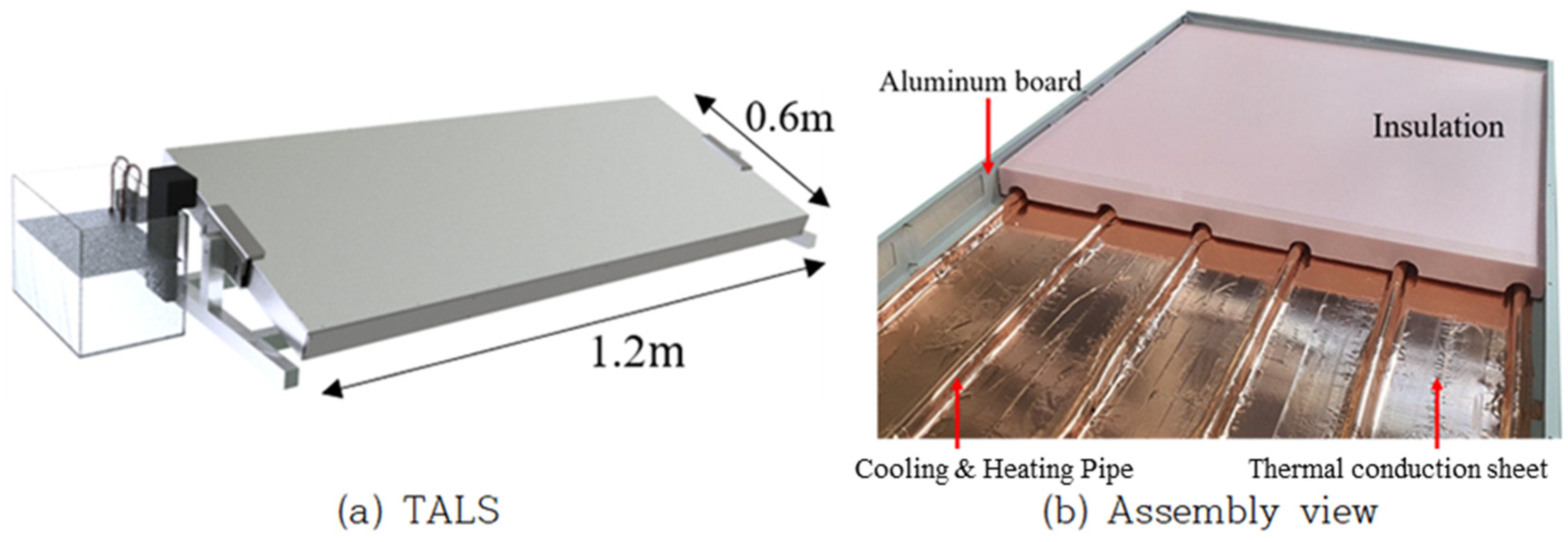
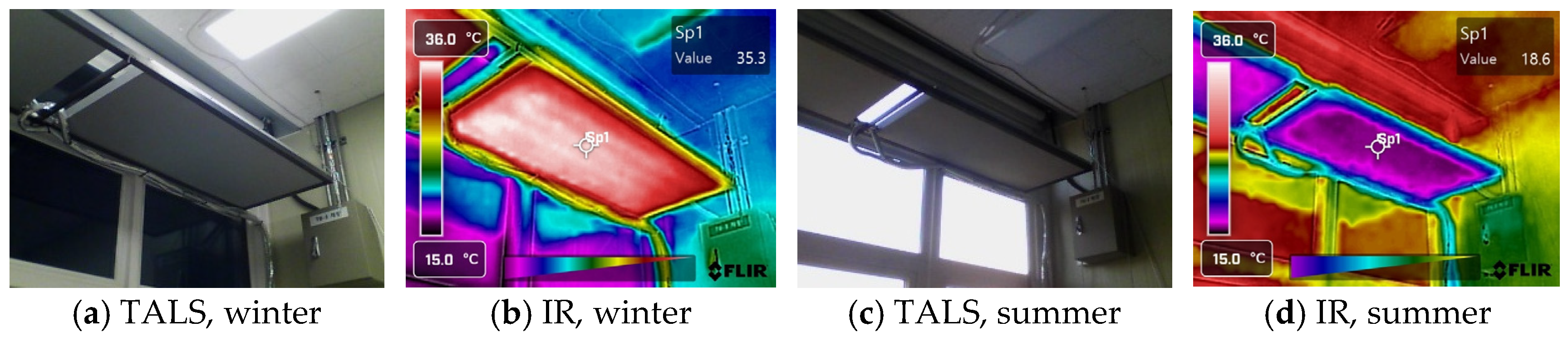
2.1. TALS System Concept
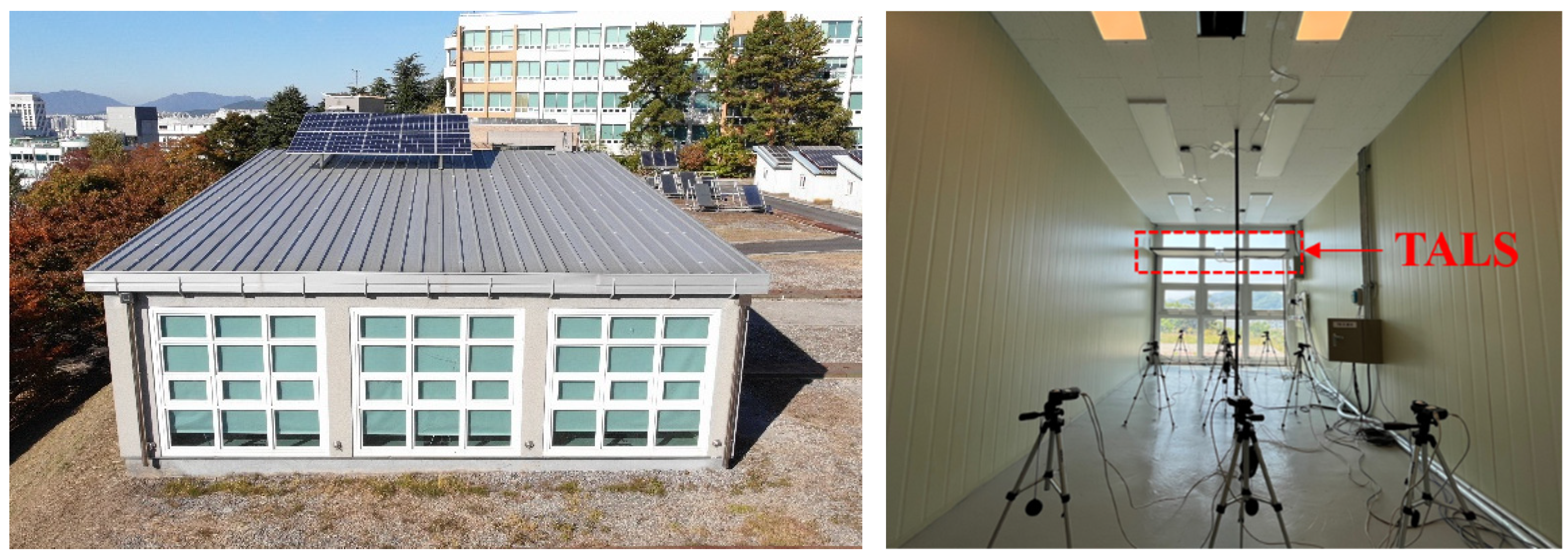
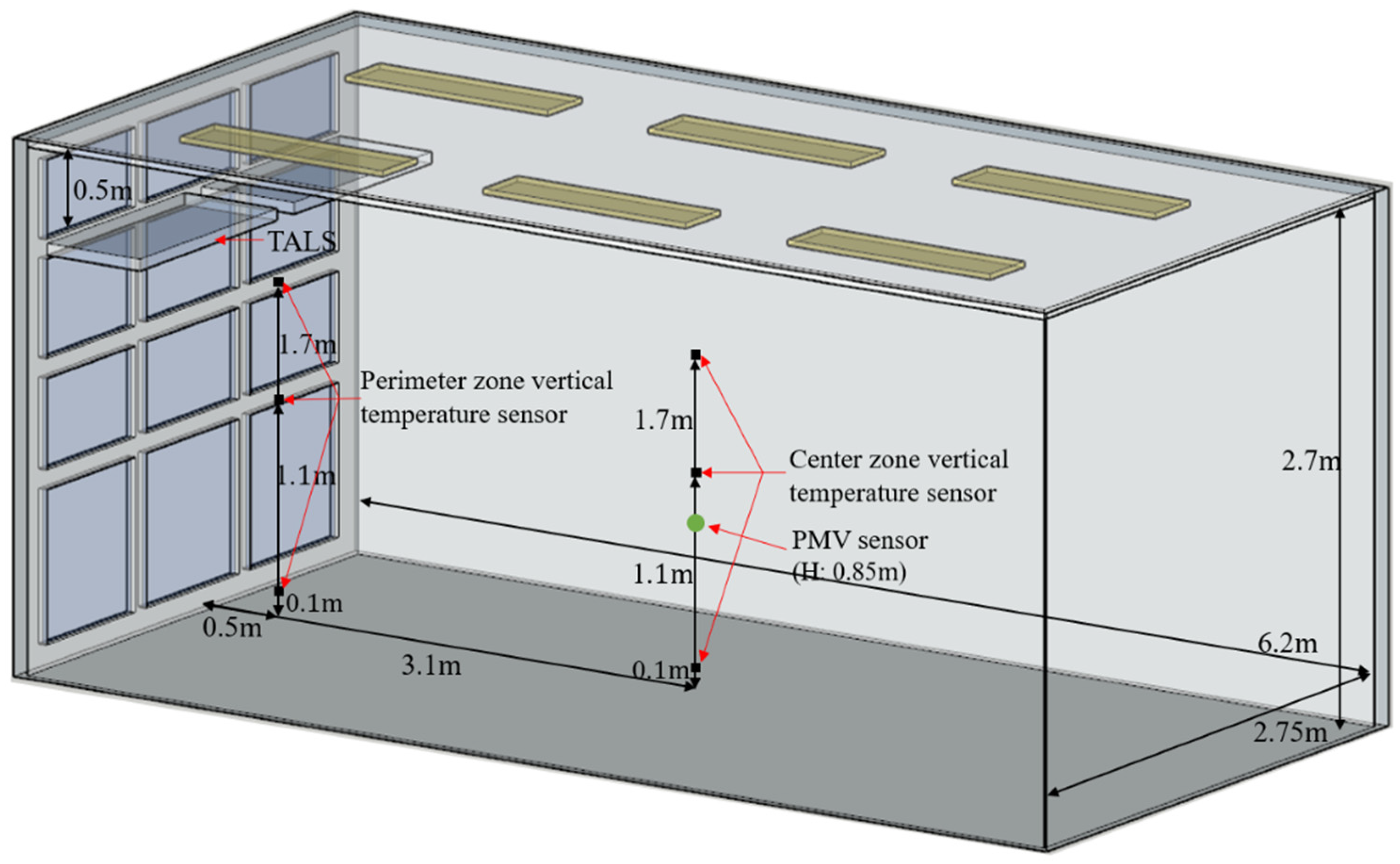
2.2. Specifications of Test Bed
3. Results
3.1. Indoor Thermal Environment Performance Evaluation
3.1.1. Vertical Temperature Distribution
- (1)
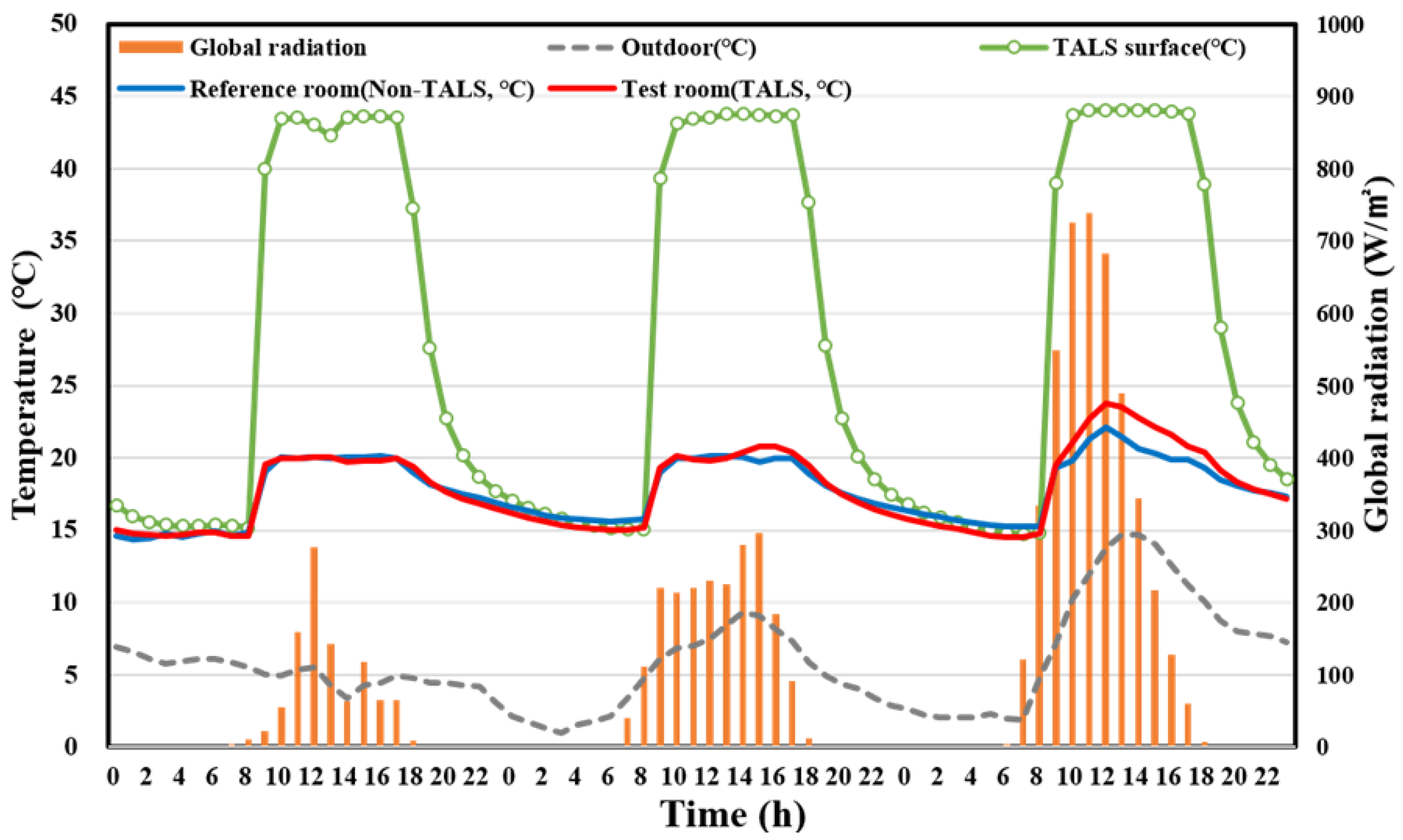
- Winter Vertical Temperature Measurement Results
- (2)
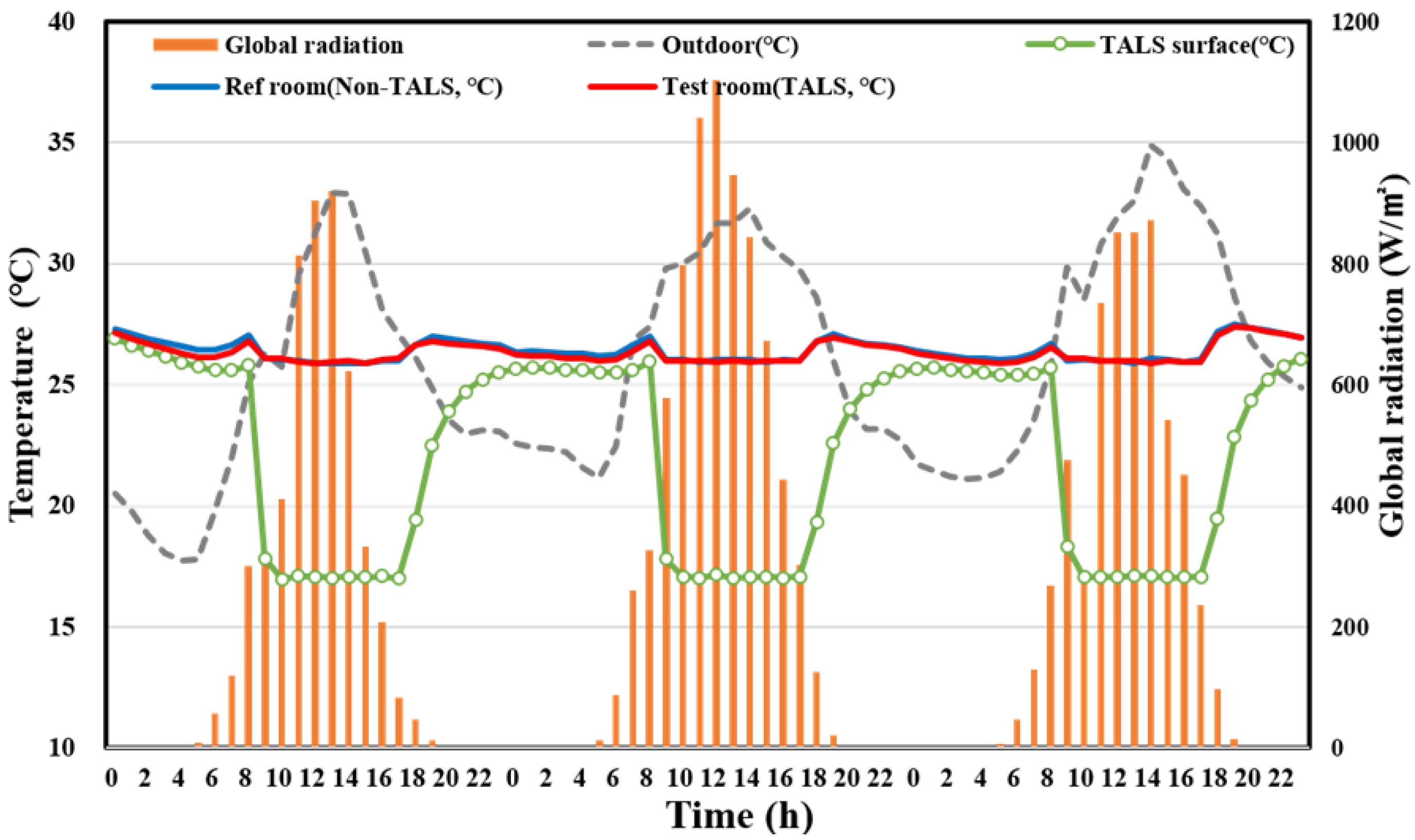
- Summer Vertical Temperature Measurement Results
3.1.2. Local Discomfort
- (1)
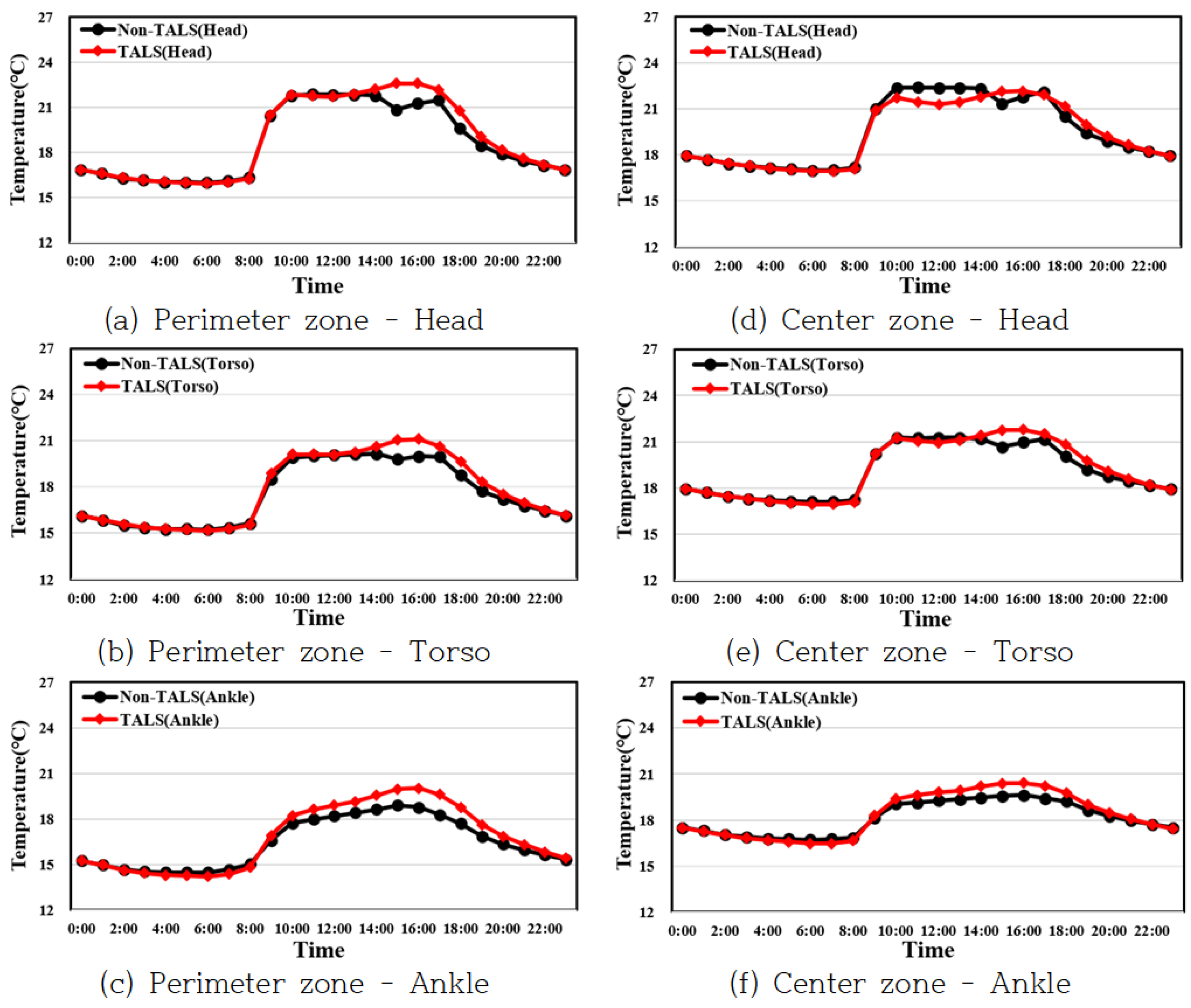
- Winter Local Discomfort Analysis Results.
- (2)
- Summer Local Discomfort Analysis Results
3.1.3. Predicted Mean Vote
- (1)
- Winter PMV Measurement Results
- (2)
- Summer PMV Measurement Results
3.2. Heating and Cooling Energy Savings
3.2.1. Heating Energy Saving Results
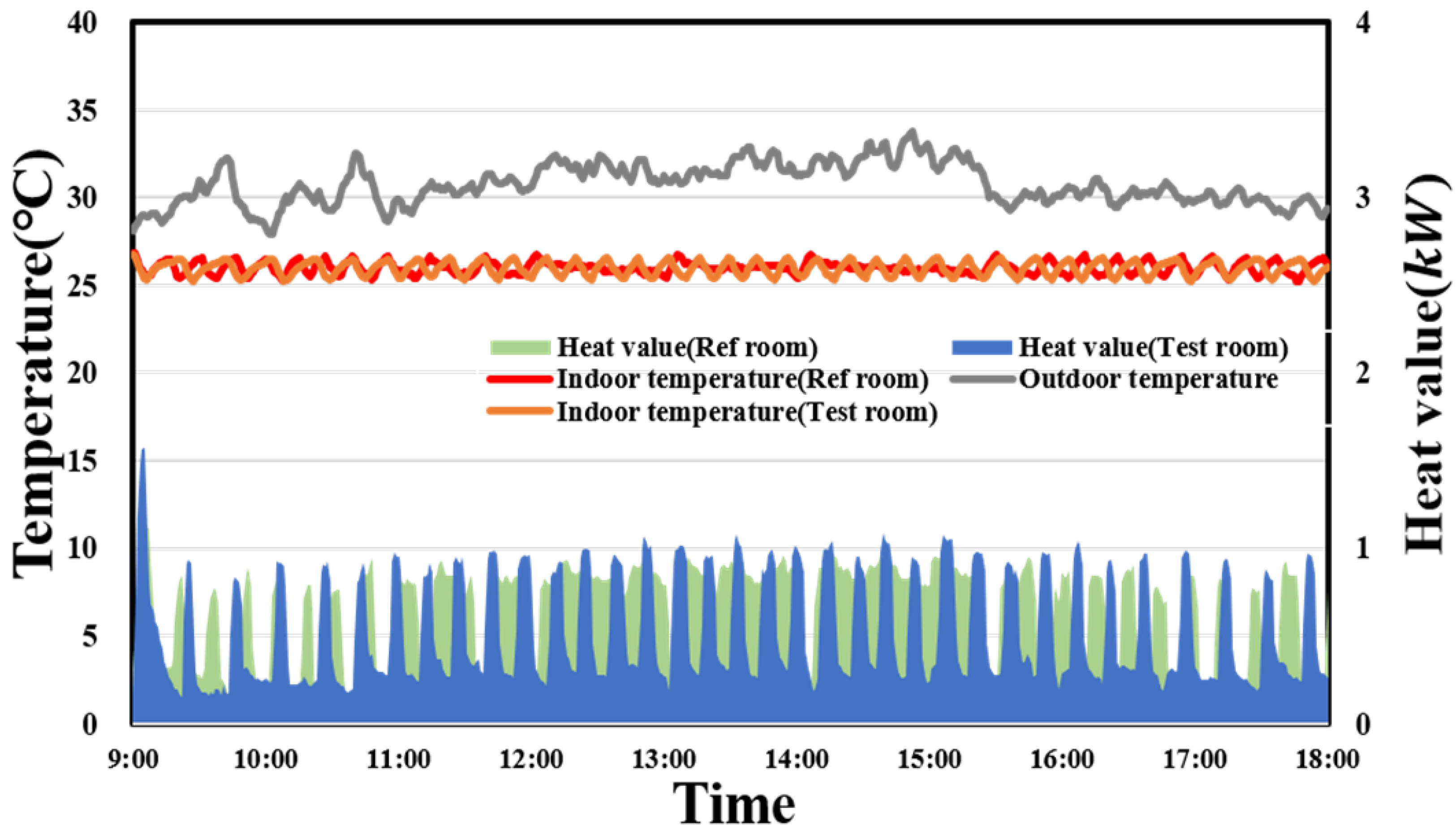
3.2.2. Cooling Energy Usage Comparison and Analysis
4. Discussion
5. Conclusions
- (1)
- A hybrid light shelf system was developed that allows radiant heating and cooling on the bottom surface of a normal light shelf, and experiments were performed in a test bed that simulated an office space. The results indicated that the TALS was effective for improving the comfort of the indoor environment and saving heating and cooling energy.
- (2)
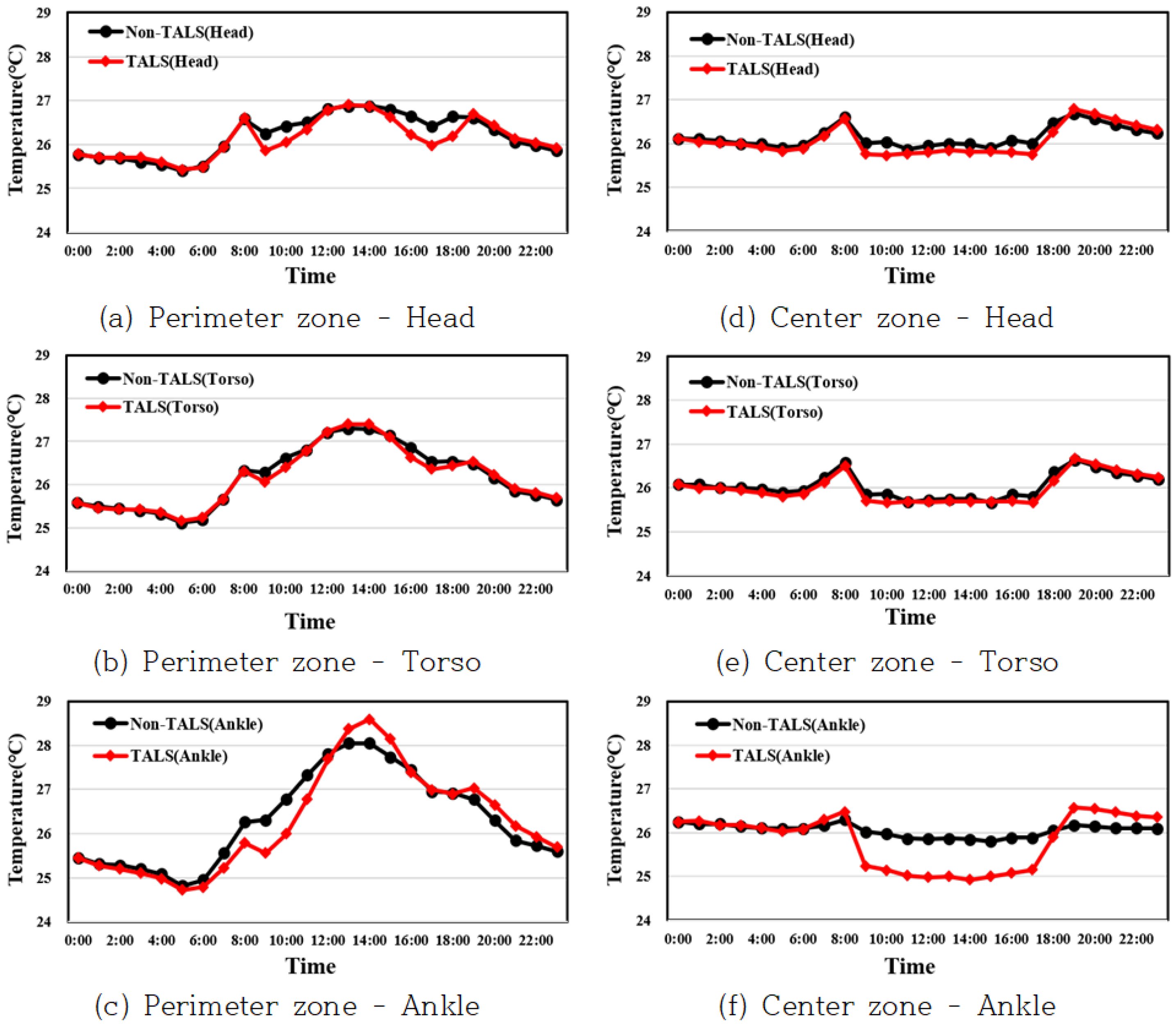
- The local discomfort caused by vertical temperature differences that can occur owing to TALS’ radiant heating and cooling was evaluated, and the results indicated that in the building perimeter zone during winter, the non-TALS room was in category A (−0.2 < PMV < +0.2, < 2 °C) of the ISO 7730 comfort standard, whereas the TALS room was in categories B and C, suggesting that there is a need for improvement regarding the local discomfort caused by the TALS’ vertical temperature differences. In contrast, at the center of the room, which can be considered representative of the overall room thermal environment, both rooms generally satisfied the ISO 7730 comfort criteria, but the TALS room showed slightly smaller PD values and a shorter duration in Category C than the non-TALS room. This indicates a modest improvement in overall room comfort associated with the TALS, although the influence is weaker than in the perimeter zone and results from the combined radiant and convective effects of the system.
- (3)
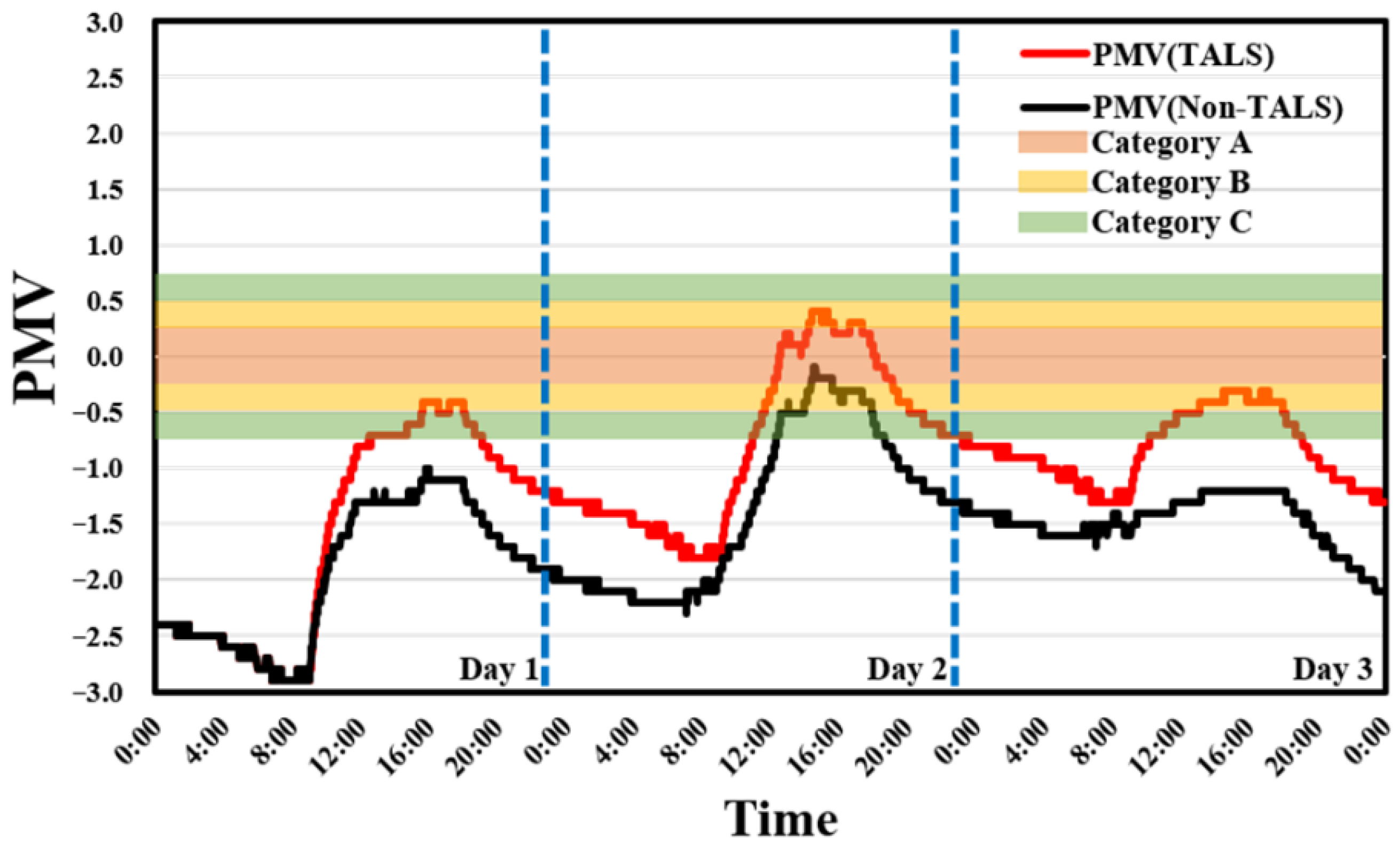
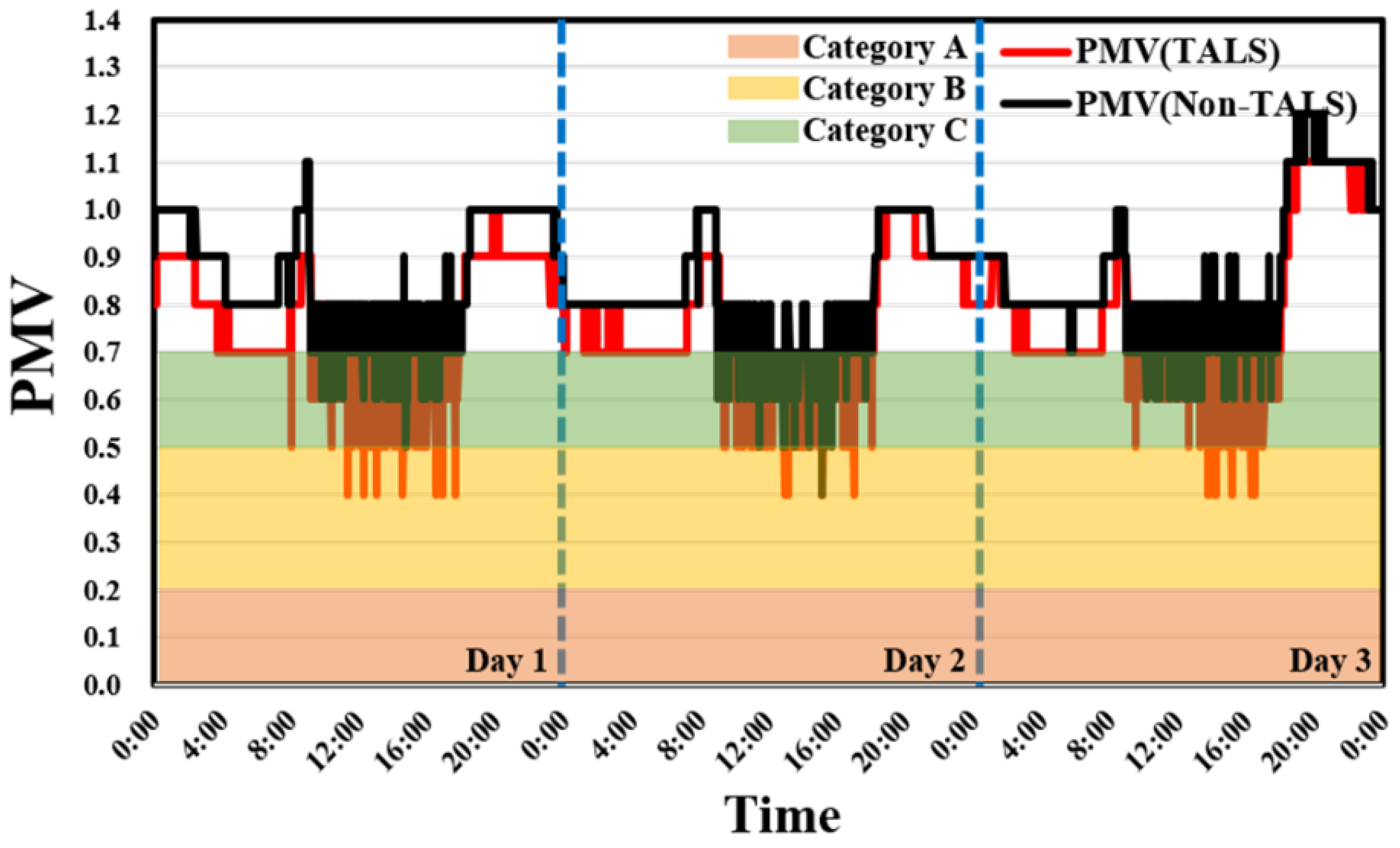
- The results for the PMV, which is an evaluation index for indoor thermal environments as felt by the occupants, due to the TALS’ radiant heating and cooling were −2.9 < PMV < +0.4 for the TALS room and −2.9 < PMV < −0.1 for the non-TALS room in winter and +0.4 < PMV < +1.1 for the TALS room and +0.4 < PMV < +1.2 for the non-TALS room in summer. However, an analysis of 3 days of data corresponding to operating hours indicated that the TALS room was approximately 3.4 times more effective at heating and approximately 7.8 more effective at cooling than the non-TALS room with regard to the cumulative time for which the ISO 7730 comfortable range (categories A and B) was maintained. This suggested that the TALS can provide occupants with high levels of indoor thermal environment comfort.
- (4)
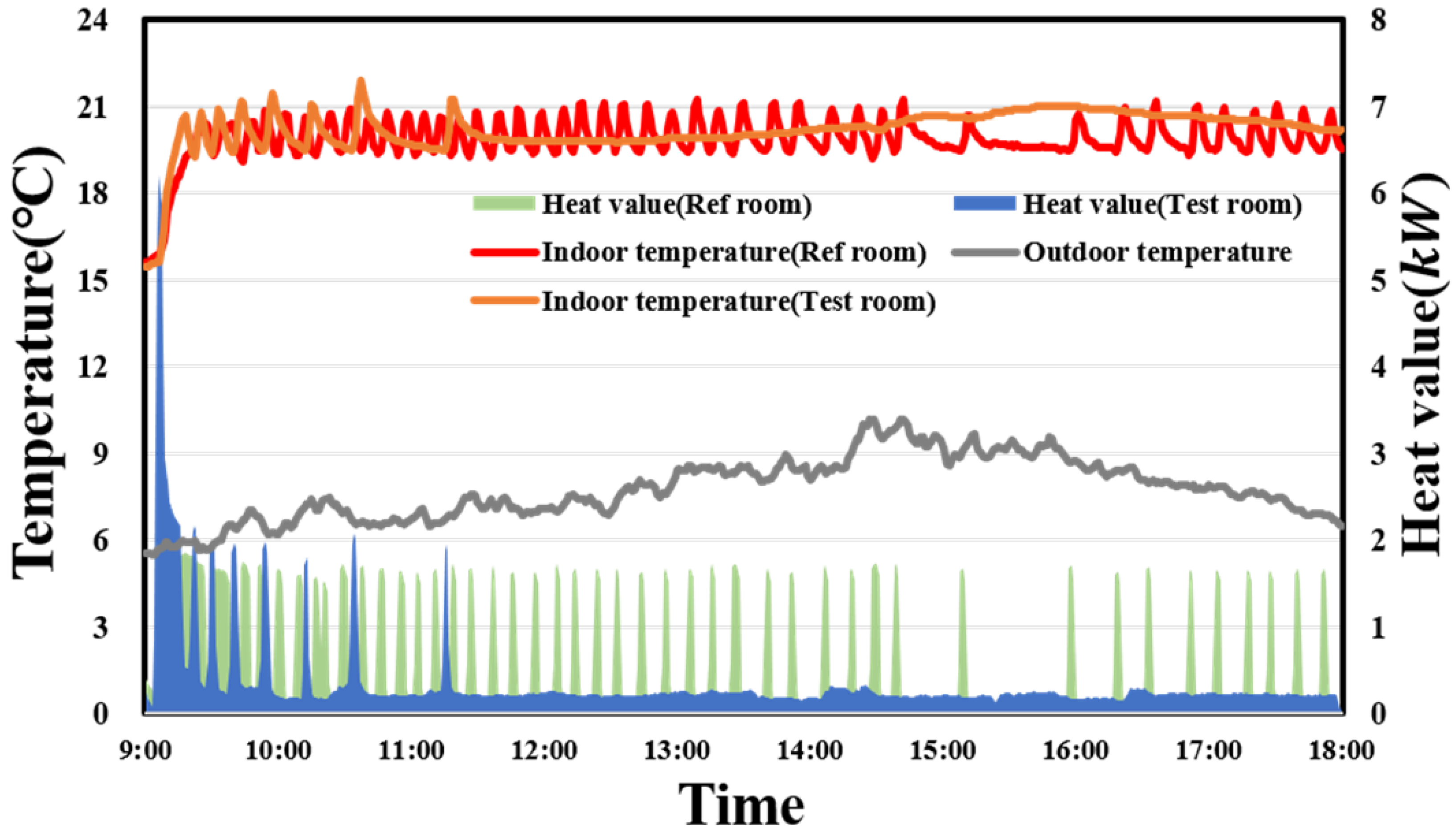
- Under the present full-scale mock-up test-bed conditions, the TALS reduced the room-side heating energy demand by approximately 39.2% on a representative clear winter day and the cooling energy demand by approximately 7.7% on a representative hot summer day, compared with the non-TALS configuration. In winter, the TALS mainly assists the heating system by providing radiant heating in the perimeter zone and modifying the perimeter heat losses, whereas in summer it primarily acts as a shading and radiant cooling element that helps to control unwanted solar and transmission gains. These results indicate that the proposed TALS has the potential to reduce both heating and cooling energy use; however, the reported percentages are specific to the tested prototype, climate, and control strategy, and a broader whole-building energy analysis should be conducted in future work.
- (5)
- The winter results reveal a trade-off between perimeter-zone comfort and heating energy savings: the TALS reduces total heating energy use and improves comfort at the center of the room, but it increases vertical temperature differences near the window, leading to Category B–C local discomfort during some hours. Future work should focus on design and control strategies (e.g., adjusting the installation height, supply-water temperature, or providing gentle air mixing) that mitigate this local discomfort while preserving the heating and cooling energy savings demonstrated in this study.
Author Contributions
Funding
Data Availability Statement
Conflicts of Interest
References
- Ruck, N.; Aschehoug, Ø.; Aydinli, S. Daylight Buildings. A Source Book on Daylighting Systems and Components; IEA SHC: Cedar, MI, USA, 2000. [Google Scholar]
- Lee, H. A basic study on the performance evaluation of a movable light shelf with a rolling reflector that can change reflectivity to improve the visual environment. Int. J. Environ. Res. Public Health 2020, 17, 8338. [Google Scholar] [PubMed]
- Meresi, A. Evaluating daylight performance of light shelves combined with external blinds in south-facing classrooms in Athens, Greece. Energy Build. 2016, 116, 190–205. [Google Scholar] [CrossRef]
- Lee, H.; Han, S.; Seo, J. Light Shelf Development Using Folding Technology and Photovoltaic Modules to Increase Energy Efficiency in Building. Buildings 2022, 12, 81. [Google Scholar] [CrossRef]
- Rao, S.; Wang, C.; Li, Z.; Yu, Y. Optimizing the Design of Light Pipe Systems and Collaborative Control Strategy Using Artificial-Lighting Systems for Indoor Sports Venues. Buildings 2025, 15, 3469. [Google Scholar] [CrossRef]
- Ministry of Land, Infrastructure and Transport. Green Building Design Manual; Korea Agency for Infrastructure Technology Advancement: Anyang-si, Republic of Korea; Ministry of Land, Infrastructure and Transport: Sejong City, Republic of Korea, 2014.
- Mangkuto, R.A.; Feradi, F.; Putra, R.E.; Atmodipoero, R.T.; Favero, F. Optimisation of daylight admission based on modifications of light shelf design parameters. J. Build. Eng. 2018, 18, 195–209. [Google Scholar] [CrossRef]
- Ebrahimi-Moghadam, A.; Ildarabadi, P.; Aliakbari, K.; Fadaee, F. Sensitivity analysis and multi-objective optimization of energy consumption and thermal comfort by using interior light shelves in residential buildings. Renew. Energy 2020, 159, 736–755. [Google Scholar] [CrossRef]
- Hammes, S.; Weninger, J. Optimizing User Distributions in Open-Plan Offices for Communication and Their Implications for Energy Demand and Light Doses: A Living Lab Case Study. Buildings 2025, 15, 3458. [Google Scholar] [CrossRef]
- Lim, Y.W.; Heng, C.Y.S. Dynamic internal light shelf for tropical daylighting in high-rise office buildings. Build. Environ. 2016, 106, 155–166. [Google Scholar] [CrossRef]
- Hwang, T.; Kim, J.T.; Chung, Y. Power performance of photovoltaic-integrated lightshelf systems. Indoor Built Environ. 2014, 23, 180–188. [Google Scholar] [CrossRef]
- Cheraghzad, T.; Zamani, Z.; Hakimazari, M.; Norouzi, M.; Karimi, A. Multi-Objective Optimization of a Folding Photovoltaic-Integrated Light Shelf Using Non-Dominated Sorting Genetic Algorithm III for Enhanced Daylighting and Energy Savings in Office Buildings. Buildings 2025, 15, 2958. [Google Scholar] [CrossRef]
- Chaloeytoy, K.; Ichinose, M.; Sasaki, R. Comparing the occupants’ comfort between perimeter zone and interior zone in Asian office. In IOP Conference Series: Earth and Environmental Science; IOP Publishing: Tokyo, Japan, 2019; p. 012075. [Google Scholar]
- Alsukkar, M.; Hu, M.; Gadi, M.; Su, Y. A Study on Daylighting Performance of Split Louver with Simplified Parametric Control. Buildings 2022, 12, 594. [Google Scholar] [CrossRef]
- Kim, S.-Y.; Hwang, T.; Jung, G.-J.; Rhee, K.-N. Cooling capacity evaluation of thermally activated light shelf (TALS) systems. Build. Environ. 2023, 235, 110214. [Google Scholar] [CrossRef]
- KS C 9306:2022; Air Conditioners. Korean Standards Association: Seoul, Republic of Korea, 2022.
- Ministry of Land, Infrastructure and Transport. Standards for Energy Conservation in Building; Notice of the Ministry of Land, Infrastructure and Transport; Ministry of Land, Infrastructure and Transport: Sejong City, Republic of Korea, 2023.
- KS F 2278:2017; Standard Test Method for Thermal Resistance for Windows and Doors. Korean Standards Association: Seoul, Republic of Korea, 2022.
- ISO 7730:2005; Ergonomics of the Thermal Environment—Analytical Determination and Interpretation of the Thermal Comfort Using Calculation of the PMV and PPD Indices and Local Thermal Comfort Criteria. International Organization for Standardization: Geneva, Switzerland, 2005.
- ASHRAE Standard 55:2020; Thermal Environmental Conditions for Human Occupancy. ASHRAE: Peachtree Corners, GA, USA, 2020.
- EN 675:2011; Glass in Building: Determination of Thermal Transmittance (U Value)—Heat Flow Meter Method. European Standard (EU): Geneva, Switzerland, 2011.
- ISO 15099:2003; Thermal Performance of Windows, Doors and Shading Devices—Detailed Calculations. The International Organization for Standard (ISO): Geneva, Switzerland, 2003.
- ISO 7243:2017; Ergonomics of the Thermal Environment—Assessment of Heat Stress Using the WBGT (Wet Bulb Globe Temperature) Index. International Organization for Standardization: Geneva, Switzerland, 2017.
- ISO 7726:2025; Ergonomics of the Thermal Environment—Instruments for Measuring and Monitoring Physical Quantities. International Organization for Standardization: Geneva, Switzerland, 2025.
- DIN EN 27726:1993-12; Thermal Environments—Instruments and Methods for Measuring Physical Quantities (ISO 7726:1985). German Version EN 27726:1993; Deutsches Institut für Normung e. V.: Berlin, Germany, 1993.
- DIN 33403-3:2011-07; Climate at the Workplace and Its Environments—Part 3: Assessment of the Climate in the Warm and Hot Working Areas Based on Selected Climate Indices. Deutsches Institut für Normung e. V.: Berlin, Germany, 2011.
- Kong, H.; Yun, G.; Kim, J. A field survey of thermal comfort in office building with thermal environment standard. Korea Inst. Ecol. Archit. Environ. 2011, 11, 37–42. [Google Scholar]
- Koenen, A.; Marquis, D.; Dehn, S. Reference Materials for Thermal Conductivity Measurements: European Situation. Buildings 2024, 14, 2795. [Google Scholar] [CrossRef]
- Moon, S.; Kim, T.; Jang, D.; Hong, W. A study on occupants’ subjective evaluation and measurement of indoor environments of an office building. J. Archit. Inst. Korea 2009, 25, 279–286. [Google Scholar]
- Jung, S.Y.; Han, S.; Lee, M.G.; Lee, H. Development of a Solar Tracking-Based Movable Louver System to Save Lighting Energy and Create a Comfortable Light Environment. Buildings 2022, 12, 2017. [Google Scholar] [CrossRef]



| Property | Value | |
|---|---|---|
| Test bed size | 10.35 m (W) × 12.4 m (L) × 2.7 m (H) | |
| Test cell size | 2.75 m (W) × 6.2 m (L) × 2.7 m (H) | |
| Latitude, longitude, azimuth | 35.13°, 126.92°, 23° | |
| Heating and cooling system | EHP (electric, 1-way ceiling type) | |
| Heating set point temperature | 20 °C (dead band 0.5 °C) | |
| Cooling set point temperature | 26 °C (dead band 0.5 °C) | |
| U-value | Wall | 0.32 W/m2K |
| Roof | 0.26 W/m2K | |
| Slab | 0.35 W/m2K | |
| Window | 1.80 W/m2K, THK26 (5LE + 16AR + 5LE) | |
| Operation schedule | 09:00–18:00 | |
| Device | Feature | Explanation |
|---|---|---|
| Globe thermometer | Range | 0–120 °C |
| Application | ISO 7243 [23], ISO 7726 [24], DIN EN 27726 [25], DIN 33403 [26] | |
| Turbulence probe | Temperature range (accuracy) | 0–50 °C (±0.5 °C) |
| Absolute pressure range (accuracy) | 700~1100 hpa (±3 hpa) | |
| Wind speed range (accuracy) | 0–5 m/s (±0.03 m/s) | |
| CO2 probe | Temperature range (accuracy) | 0–50 °C (±0.5 °C) |
| Humidity range (accuracy) | 5–95% (±3%) | |
| Absolute pressure range (accuracy) | 700–1100 hpa (±3 hpa) | |
| CO2 range (accuracy) | 0–10,000 ppm (±50 ppm) |
| Category | General Comfort | Local Discomfort | |
|---|---|---|---|
| PMV | PD (%) | Vertical Temperature Difference (°C) | |
| A | −0.2 < PMV < +0.2 | <3 | <2 |
| B | −0.5 < PMV < +0.5 | <5 | <3 |
| C | −0.7 < PMV < +0.7 | <10 | <4 |
| Time | TALS | Non-TALS | ||||||||||||||
|---|---|---|---|---|---|---|---|---|---|---|---|---|---|---|---|---|
| Perimeter Zone | Center Zone | Perimeter Zone | Center Zone | |||||||||||||
| 1.1 m | 0.1 m | ΔT | PD (%) | 1.1 m | 0.1 m | ΔT | PD (%) | 1.1 m | 0.1 m | ΔT | PD (%) | 1.1 m | 0.1 m | ΔT | PD (%) | |
| 9:00 | 18.57 | 17.13 | 1.44 | 1.07 | 19.43 | 18.83 | 0.60 | 0.52 | 18.28 | 17.55 | 0.72 | 0.58 | 19.56 | 18.74 | 0.82 | 0.63 |
| 10:00 | 22.41 | 19.52 | 2.89 * | 3.60 * | 22.41 | 20.39 | 2.02 * | 1.75 | 21.55 | 20.28 | 1.27 | 0.92 | 21.51 | 19.77 | 1.73 | 1.37 |
| 11:00 | 24.87 | 21.58 | 3.29 ** | 5.00 ** | 24.42 | 21.85 | 2.56 * | 2.75 | 24.21 | 22.84 | 1.36 | 1.00 | 23.92 | 21.36 | 2.57 * | 2.76 |
| 12:00 | 26.52 | 23.37 | 3.16 ** | 4.49 * | 25.89 | 23.12 | 2.77 * | 3.27 * | 25.82 | 24.64 | 1.19 | 0.86 | 25.46 | 22.45 | 3.01 ** | 3.98 * |
| 13:00 | 27.93 | 25.10 | 2.83 * | 3.44 * | 27.11 | 24.81 | 2.30 * | 2.21 | 27.14 | 26.06 | 1.08 | 0.79 | 26.54 | 24.02 | 2.52 * | 2.66 |
| 14:00 | 28.75 | 26.40 | 2.35 * | 2.30 | 27.81 | 24.53 | 3.28 ** | 4.95 * | 27.94 | 26.91 | 1.03 | 0.75 | 27.31 | 23.82 | 3.49 ** | 5.90 ** |
| 15:00 | 29.66 | 27.33 | 2.33 * | 2.27 | 28.69 | 25.48 | 3.21 ** | 4.68 * | 27.58 | 26.72 | 0.86 | 0.65 | 26.88 | 23.21 | 3.66 ** | 6.75 ** |
| 16:00 | 27.73 | 26.39 | 1.34 | 0.98 | 26.97 | 23.82 | 3.15 ** | 4.46 * | 26.46 | 25.79 | 0.66 | 0.55 | 26.20 | 23.04 | 3.16 ** | 4.50 * |
| 17:00 | 24.65 | 24.31 | 0.34 | 0.42 | 24.59 | 22.85 | 1.74 | 1.37 | 23.23 | 23.10 | 0.13 | 0.35 | 23.80 | 22.28 | 1.53 | 1.15 |
| Time | TALS | Non-TALS | ||||||||||||||
|---|---|---|---|---|---|---|---|---|---|---|---|---|---|---|---|---|
| Perimeter Zone | Center Zone | Perimeter Zone | ||||||||||||||
| 1.1 m | 0.1 m | ΔT | PD (%) | 1.1 m | 0.1 m | ΔT | PD (%) | 1.1 m | 0.1 m | ΔT | PD (%) | 1.1 m | 0.1 m | ΔT | PD (%) | |
| 9:00 | 26.07 | 25.56 | 0.51 | 0.49 | 25.70 | 25.24 | 0.46 | 0.47 | 26.28 | 26.30 | 0.02 | 0.31 | 25.85 | 26.02 | 0.17 | 0.27 |
| 10:00 | 26.40 | 26.00 | 0.40 | 0.44 | 25.66 | 25.14 | 0.52 | 0.49 | 26.61 | 26.78 | 0.17 | 0.27 | 25.86 | 25.97 | 0.11 | 0.29 |
| 11:00 | 26.77 | 26.78 | 0.01 | 0.31 | 25.69 | 25.02 | 0.67 | 0.55 | 26.80 | 27.32 | 0.52 | 0.20 | 25.68 | 25.86 | 0.18 | 0.27 |
| 12:00 | 27.23 | 27.68 | 0.46 | 0.21 | 25.67 | 24.98 | 0.69 | 0.57 | 27.20 | 27.81 | 0.61 | 0.19 | 25.73 | 25.86 | 0.13 | 0.28 |
| 13:00 | 27.41 | 28.37 | 0.97 | 0.14 | 25.70 | 25.00 | 0.70 | 0.57 | 27.30 | 28.05 | 0.75 | 0.17 | 25.74 | 25.86 | 0.12 | 0.28 |
| 14:00 | 27.40 | 28.59 | 1.19 | 0.11 | 25.69 | 24.93 | 0.76 | 0.60 | 27.29 | 28.05 | 0.76 | 0.16 | 25.75 | 25.85 | 0.10 | 0.29 |
| 15:00 | 27.10 | 28.14 | 1.05 | 0.13 | 25.69 | 25.01 | 0.68 | 0.56 | 27.13 | 27.74 | 0.60 | 0.19 | 25.67 | 25.80 | 0.13 | 0.28 |
| 16:00 | 26.63 | 27.38 | 0.75 | 0.16 | 25.70 | 25.08 | 0.62 | 0.53 | 26.87 | 27.44 | 0.58 | 0.19 | 25.85 | 25.89 | 0.04 | 0.30 |
| 17:00 | 26.36 | 26.99 | 0.63 | 0.18 | 25.66 | 25.15 | 0.50 | 0.48 | 26.53 | 26.96 | 0.43 | 0.23 | 25.80 | 25.89 | 0.08 | 0.29 |
| Time | TALS | Non-TALS | ||||||||
|---|---|---|---|---|---|---|---|---|---|---|
| FCU | Source | FCU | Source | |||||||
| Operating Time | Electricity Usage (kWh) | Inlet (°C) | Outlet (°C) | Heat Value (kWh) | Operating Time | Electricity Usage (kWh) | Inlet (°C) | Outlet (°C) | Heat Value (kWh) | |
| 9:00 | 24 min 5 s | 0.011 | 43.47 | 40.70 | 1.333 | 39 min 40 s | 0.019 | 43.50 | 40.83 | 1.277 |
| 10:00 | 5 min 2 s | 0.002 | 43.33 | 42.50 | 0.397 | 27 min 35 s | 0.013 | 43.37 | 41.45 | 0.917 |
| 11:00 | 2 min 59 s | 0.001 | 43.76 | 43.14 | 0.299 | 21 min 8 s | 0.010 | 43.80 | 42.34 | 0.699 |
| 12:00 | - | - | 43.83 | 43.36 | 0.227 | 18 min 6 s | 0.008 | 43.87 | 42.60 | 0.611 |
| 13:00 | - | - | 44.09 | 43.62 | 0.228 | 16 min 4 s | 0.007 | 44.14 | 43.01 | 0.542 |
| 14:00 | - | - | 44.16 | 43.66 | 0.237 | 13 min 4 s | 0.006 | 44.19 | 43.26 | 0.456 |
| 15:00 | - | - | 44.07 | 43.61 | 0.222 | 5 min 35 s | 0.003 | 44.11 | 43.81 | 0.155 |
| 16:00 | - | - | 43.99 | 43.53 | 0.219 | 9 min 29 s | 0.004 | 44.01 | 43.26 | 0.369 |
| 17:00 | - | - | 44.07 | 43.60 | 0.228 | 15 min 4 s | 0.007 | 44.11 | 43.07 | 0.500 |
| Total | FCU: 0.015 kWh | TALS: 3.391 kWh | FCU: 0.077 kWh | Non-TALS: 5.527 kWh | ||||||
| Time | TALS | Non-TALS | ||||||||
|---|---|---|---|---|---|---|---|---|---|---|
| FCU | Source | FCU | Source | |||||||
| Operating Time | Electricity Usage (kWh) | Inlet (°C) | Outlet (°C) | Heat Value (kWh) | Operating Time | Electricity Usage (kWh) | Inlet (°C) | Outlet (°C) | Heat Value (kWh) | |
| 9:00 | 14 min 2 s | 0.007 | 14.60 | 15.68 | 0.501 | 20 min 5 s | 0.009 | 14.74 | 15.79 | 0.489 |
| 10:00 | 19 min 43 s | 0.009 | 15.16 | 16.21 | 0.491 | 31 min 6 s | 0.015 | 15.31 | 16.30 | 0.465 |
| 11:00 | 24 min 25 s | 0.011 | 15.11 | 16.42 | 0.613 | 44 min 1 s | 0.021 | 15.25 | 16.69 | 0.673 |
| 12:00 | 24 min 6 s | 0.011 | 15.23 | 16.59 | 0.635 | 58 min 1 s | 0.027 | 15.37 | 17.08 | 0.801 |
| 13:00 | 29 min 44 s | 0.014 | 15.09 | 16.53 | 0.674 | 55 min 1 s | 0.026 | 15.23 | 16.97 | 0.812 |
| 14:00 | 27 min 23 s | 0.013 | 15.19 | 16.62 | 0.670 | 55 min 2 s | 0.026 | 15.33 | 17.04 | 0.800 |
| 15:00 | 29 min 1 s | 0.014 | 15.18 | 16.58 | 0.654 | 46 min 1 s | 0.021 | 15.33 | 16.79 | 0.686 |
| 16:00 | 19 min 3 s | 0.009 | 15.11 | 16.31 | 0.558 | 32 min 1 s | 0.015 | 15.26 | 16.33 | 0.502 |
| 17:00 | 15 min 4 s | 0.007 | 15.23 | 16.23 | 0.470 | 24 min 4 s | 0.011 | 15.38 | 16.25 | 0.407 |
| Total | FCU: 0.095 kWh | TALS: 5.266 kWh | FCU: 0.171 kWh | Non-TALS: 5.635 kWh | ||||||
Disclaimer/Publisher’s Note: The statements, opinions and data contained in all publications are solely those of the individual author(s) and contributor(s) and not of MDPI and/or the editor(s). MDPI and/or the editor(s) disclaim responsibility for any injury to people or property resulting from any ideas, methods, instructions or products referred to in the content. |
© 2025 by the authors. Licensee MDPI, Basel, Switzerland. This article is an open access article distributed under the terms and conditions of the Creative Commons Attribution (CC BY) license (https://creativecommons.org/licenses/by/4.0/).
Share and Cite
Go, B.; Rhee, K.-N.; Kim, J.; Hwang, T. Indoor Environment Improvement and Energy-Saving Effects of Light Shelf System with Integrated Radiant Heating and Cooling Panel. Buildings 2025, 15, 4561. https://doi.org/10.3390/buildings15244561
Go B, Rhee K-N, Kim J, Hwang T. Indoor Environment Improvement and Energy-Saving Effects of Light Shelf System with Integrated Radiant Heating and Cooling Panel. Buildings. 2025; 15(24):4561. https://doi.org/10.3390/buildings15244561
Chicago/Turabian StyleGo, Beomseok, Kyu-Nam Rhee, Joowook Kim, and Taeyon Hwang. 2025. "Indoor Environment Improvement and Energy-Saving Effects of Light Shelf System with Integrated Radiant Heating and Cooling Panel" Buildings 15, no. 24: 4561. https://doi.org/10.3390/buildings15244561
APA StyleGo, B., Rhee, K.-N., Kim, J., & Hwang, T. (2025). Indoor Environment Improvement and Energy-Saving Effects of Light Shelf System with Integrated Radiant Heating and Cooling Panel. Buildings, 15(24), 4561. https://doi.org/10.3390/buildings15244561