Comparative Analysis of Finite Element and Discrete Element Methods for the Deformation and Failure of Embankment Slope

Abstract
1. Introduction
2. Materials and Methods
2.1. Study Area
2.2. Direct Shear Test
2.3. Finite Element Method
2.4. Discrete Element Method
2.5. Boundary Conditions of Loading and Seepage
3. Results
3.1. Direct Shear Test Results Under Different Water Contents
3.2. Seepage Field Variation in Embankment Slopes
3.3. Deformation Field Variation in Embankment Slopes
4. Discussion
4.1. Deformation Differences Between Two Methods
4.2. Field Case Study
4.3. Limitations of This Work
5. Conclusions
- (1)
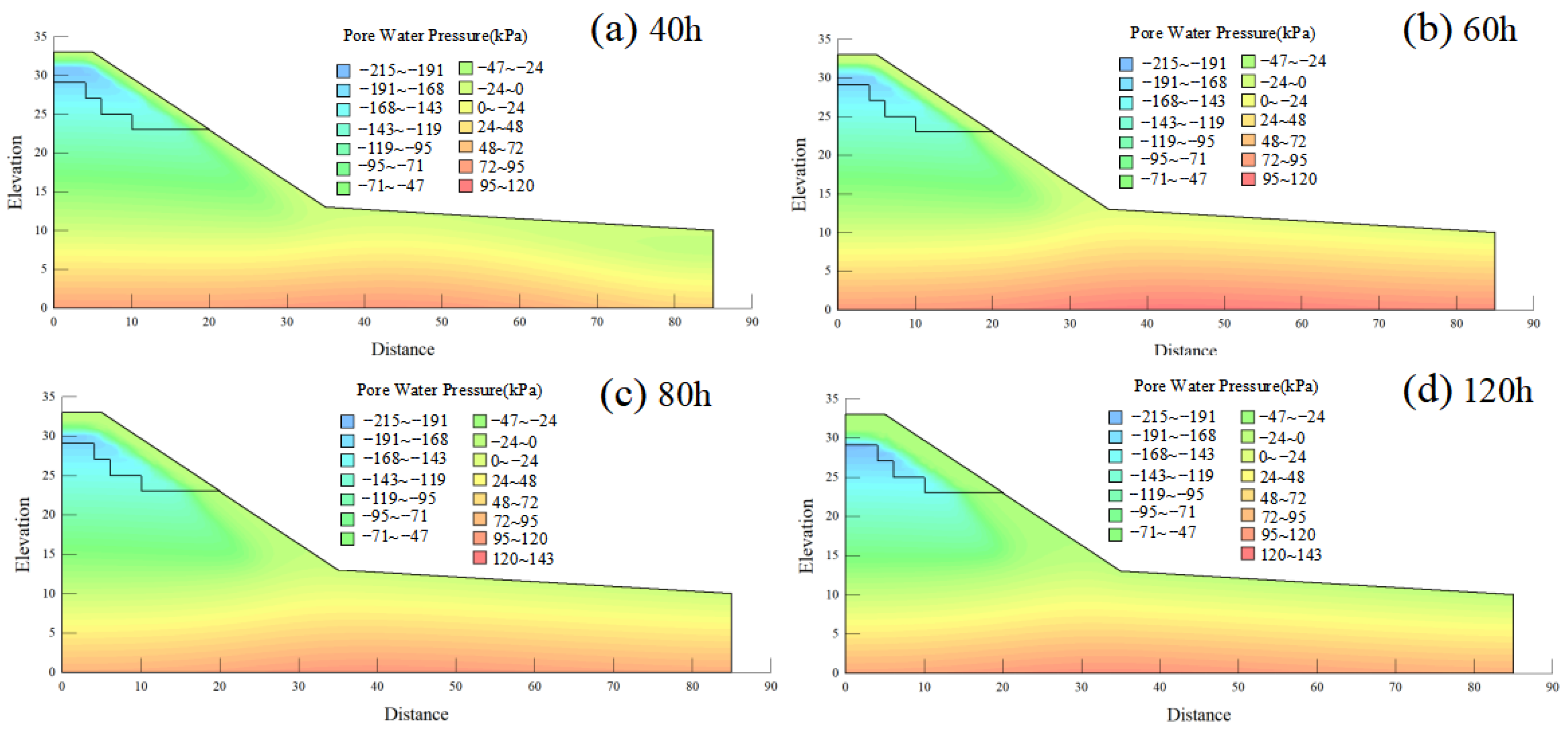
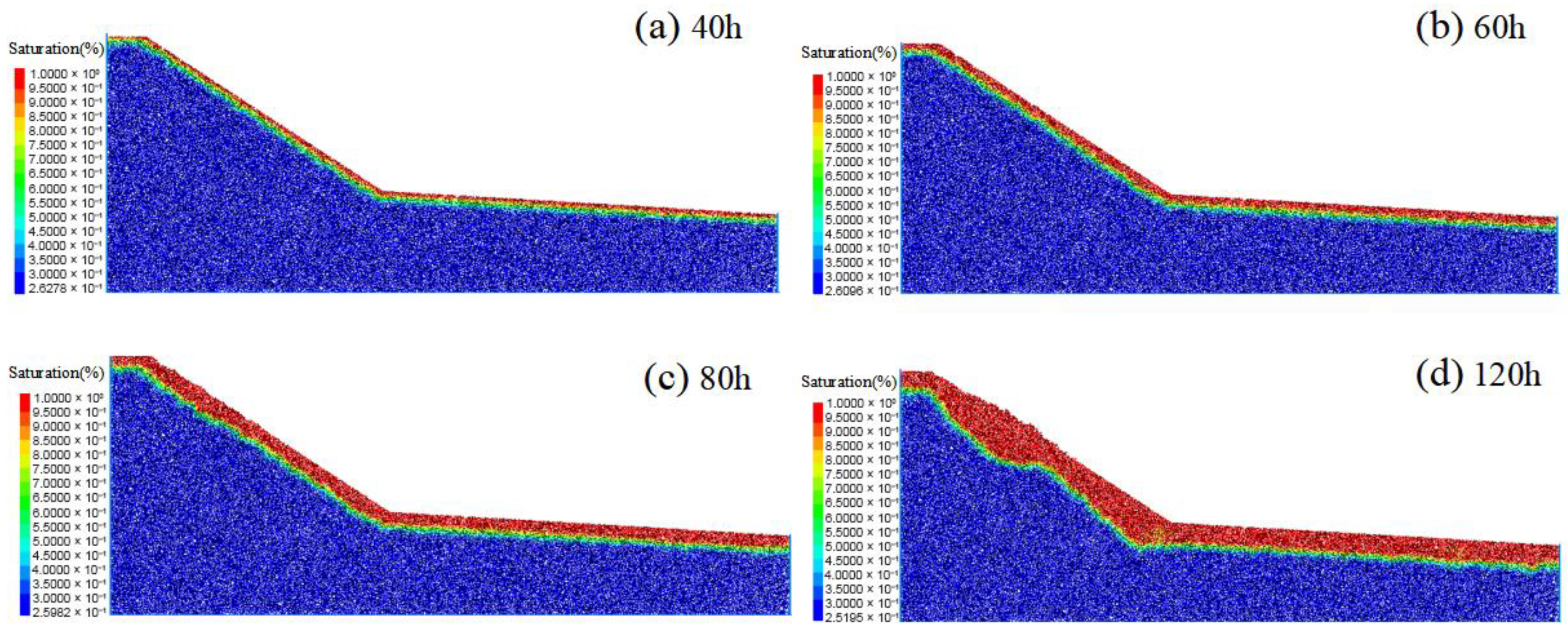
- Rainfall infiltration leads to progressive expansion of the internal saturated zone of the embankment slope. With prolonged rainfall, the saturation zone spreads from the surface downward toward the slope toe. FEM and DEM produce consistent predictions of seepage evolution, with maximum infiltration depths of about 3.5 m and 3.8 m, respectively, suggesting that both approaches adequately represent soil seepage behavior under rainfall conditions.
- (2)
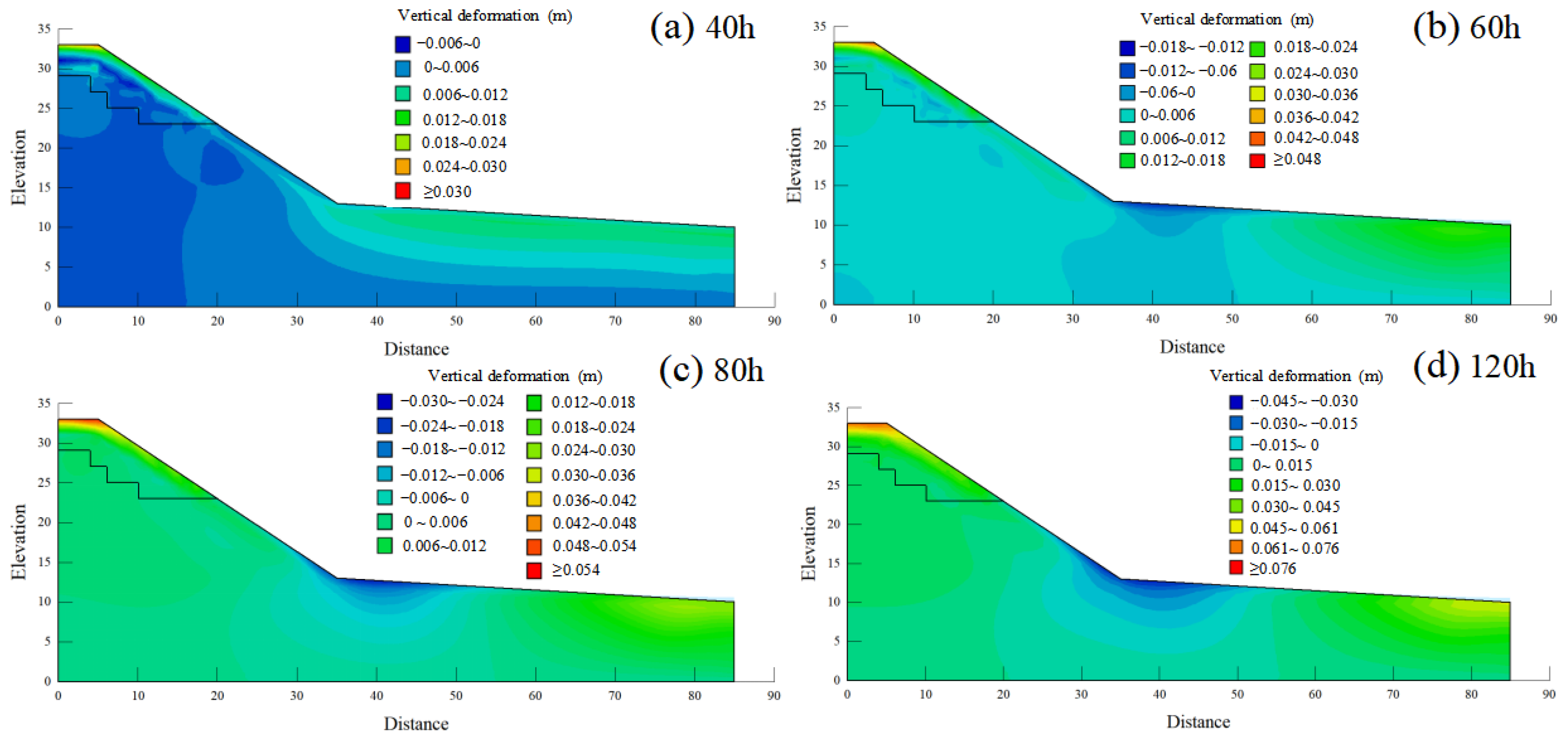
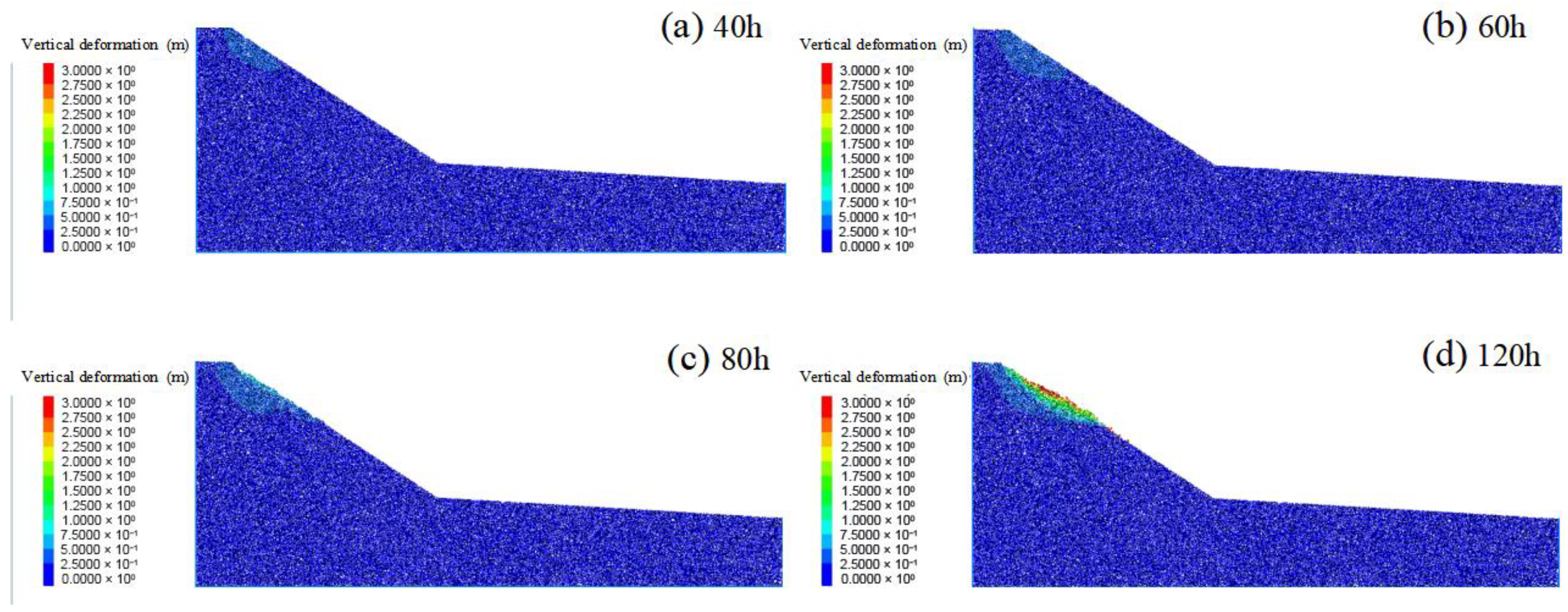
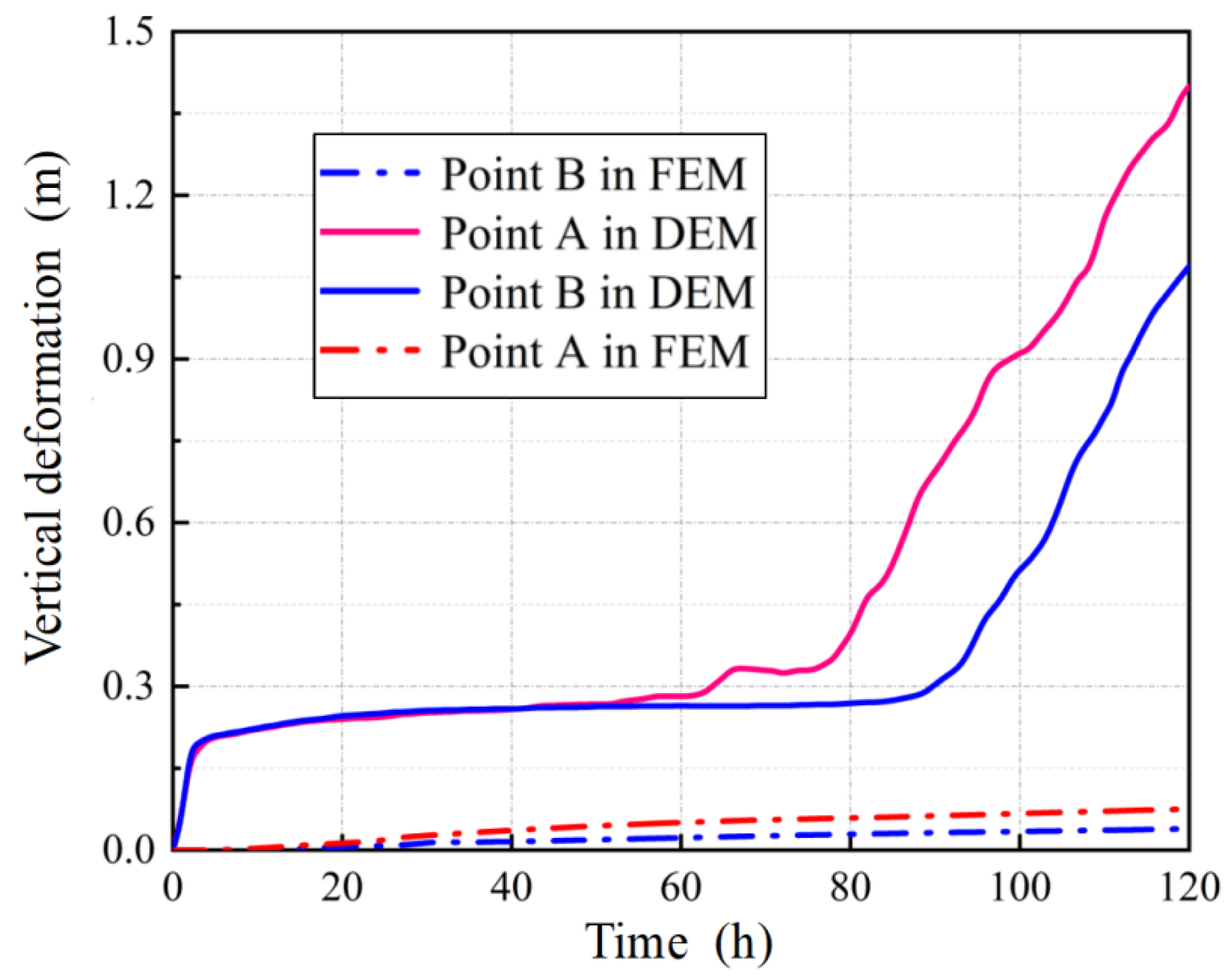
- Regarding deformation response, DEM effectively reproduces the full sequence of slope failure progress under rainfall, from crest deformation to sliding band penetration and eventual overall collapse. Crest deformation reaches 1.4 m in the DEM simulation after the rainfall, indicating clear slope failure. In contrast, FEM predicts relatively slow deformation, with a maximum crest displacement of only 0.075 m over the same period, indicating that the embankment remains stable.
- (3)
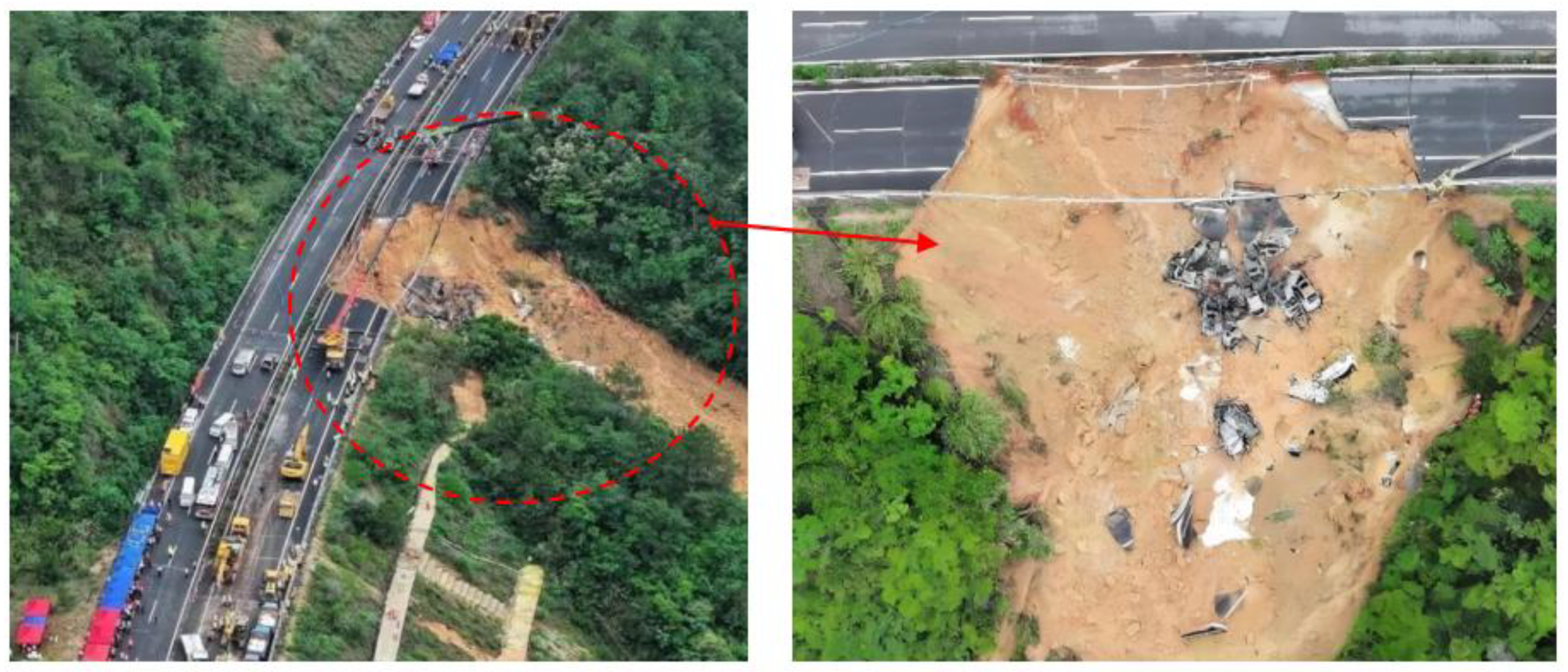
- By comparing the FEM and DEM results with field survey data and site photographs, it is evident that DEM best replicates the observed failure patterns, including crack initiation, soil detachment, and progressive landslide development. In contrast, traditional FEM fails to capture the complex failure process of GRS embankments. Thus, DEM is clearly the most appropriate approach for analyzing the instability mechanisms of GRS slopes.
Author Contributions
Funding
Data Availability Statement
Conflicts of Interest
References
- Yin, S.; Liu, P.; Zhang, X.; He, W.; Yan, P.; Sun, Y. Field testing of shear strength of granite residual soils. J. Rock Mech. Geotech. Eng. 2024, 16, 3718–3732. [Google Scholar] [CrossRef]
- Zhang, X.; Liu, X.; Chen, C.; Xu, Y.; Liu, H. Evolution of disintegration properties of granite residual soil with microstructure alteration due to wetting and drying cycles. Bull. Eng. Geol. Environ. 2022, 81, 93. [Google Scholar] [CrossRef]
- Liu, X.; Zhang, X.; Kong, L.; Wang, G.; Lu, J. Disintegration of granite residual soils with varying degrees of weathering. Eng. Geol. 2022, 305, 106723. [Google Scholar] [CrossRef]
- Li, X.; Ishikawa, T.; Kasama, K.; Zhang, T. Slope stability-soil runout integrated analysis considering surface flow during heavy rainfall. Eng. Geol. 2025, 108268. [Google Scholar] [CrossRef]
- Xie, W.; Liu, Z.; Kong, Z.; Jing, L.; Xiao, R. A Multi-Scale Investigation of Sandy Red Clay Degradation Mechanisms During Wet–Dry Cycles and Their Implications for Slope Stability. Appl. Sci. 2025, 15, 4085. [Google Scholar] [CrossRef]
- Liu, X.; Zhang, X.; Kong, L.; Wang, G.; Liu, H. Formation mechanism of collapsing gully in southern China and the relationship with granite residual soil: A geotechnical perspective. Catena 2022, 210, 105890. [Google Scholar] [CrossRef]
- Yu, H.S.; Salgado, R.; Sloan, S.W.; Kim, J.M. Limit analysis versus limit equilibrium for slope stability. J. Geotech. Geoenviron. Eng. 1998, 124, 1–11. [Google Scholar] [CrossRef]
- Azarafza, M.; Akgün, H.; Ghazifard, A.; Asghari-Kaljahi, E.; Rahnamarad, J.; Derakhshani, R. Discontinuous rock slope stability analysis by limit equilibrium approaches—A review. Int. J. Digit. Earth 2021, 14, 1918–1941. [Google Scholar] [CrossRef]
- Liu, S.Y.; Shao, L.T.; Li, H.J. Slope stability analysis using the limit equilibrium method and two finite element methods. Comput. Geotech. 2015, 63, 291–298. [Google Scholar] [CrossRef]
- Li, X. Finite element analysis of slope stability using a nonlinear failure criterion. Comput. Geotech. 2007, 34, 127–136. [Google Scholar] [CrossRef]
- Sun, Y.; Yang, K.; Hu, R.; Wang, G.; Lv, J. Model test and numerical simulation of slope instability process induced by rainfall. Water 2022, 14, 3997. [Google Scholar] [CrossRef]
- Gao, W.; Yang, H.; Hu, R. Soil–rock mixture slope stability analysis by microtremor survey and discrete element method. Bull. Eng. Geol. Environ. 2022, 81, 121. [Google Scholar] [CrossRef]
- Onate, E.; Rojek, J. Combination of discrete element and finite element methods for dynamic analysis of geomechanics problems. Comput. Methods Appl. Mech. Eng. 2004, 193, 3087–3128. [Google Scholar] [CrossRef]
- Hu, Y.; Lu, Y. Study on soil-rock slope instability at mesoscopic scale using discrete element method. Comput. Geotech. 2023, 157, 105268. [Google Scholar] [CrossRef]
- Deng, D.; Li, L.; Zhao, L. Limit equilibrium method (LEM) of slope stability and calculation of comprehensive factor of safety with double strength-reduction technique. J. Mt. Sci. 2017, 14, 2311–2324. [Google Scholar] [CrossRef]
- Zeng, Y.; Zhang, Y.; Hu, W.; Chen, M.; Hu, Q.; Liu, X.; Zhu, X. A case study on soil slope landslide failure and parameter analysis of influencing factors for safety factor based on strength reduction method and orthogonal experimental design. PLoS ONE 2024, 19, e0300586. [Google Scholar] [CrossRef] [PubMed]
- Garo, T.; Tesfaye, M.; Karuppannan, S. Slope stability modeling using limit equilibrium and finite element methods: A case study of the Adama City, Northern Main Ethiopian Rift. Quat. Sci. Adv. 2024, 15, 100228. [Google Scholar] [CrossRef]
- Melentijević, S.; Berisavljević, Z.; Graterol, E.; Berisavljević, D. Application of LEM, FEM and DEM in Stability Analysis of Highly Jointed Rock Slopes. Transp. Infrastruct. Geotechnol. 2025, 12, 135. [Google Scholar] [CrossRef]
- Das, T.; Rao, V.D.; Choudhury, D. Numerical investigation of the stability of landslide-affected slopes in Kerala, India, under extreme rainfall event. Nat. Hazards 2022, 114, 751–785. [Google Scholar] [CrossRef]
- Yang, J.; Zhang, J.; Wu, G.; Zhang, H.; Ni, P. Analysis of instability and failure mechanisms in a soilbag slope protection structures under rainfall infiltration: Field test and DEM simulation. Constr. Build. Mater. 2025, 477, 141337. [Google Scholar] [CrossRef]
- Li, R.; Wu, F.; Jiang, S.; He, M.; Pan, H. Field-based investigation of failure modes and thresholds of granite residual soil slopes under heavy rainfall conditions. PLoS ONE 2025, 20, e0317836. [Google Scholar]
- Wang, X.; Yang, J.; Liu, Q.; Zhang, Y.-M.; Zhao, C. A comparative study of numerical modelling techniques for the fracture of brittle materials with specific reference to glass. Eng. Struct. 2017, 152, 493–505. [Google Scholar] [CrossRef]
- Fattahi, M.; Malekshahi, M.; Permanoon, A. Mesoscale numerical modeling of unreinforced masonry wall response to underground dynamic loads: A comparative study utilizing FEM and DEM. Structures 2024, 63, 106460. [Google Scholar] [CrossRef]
- Bravo-Zapata, M.F.; Muñoz, E.; Lapeña-Mañero, P.; Montenegro-Cooper, J.M.; King, R.W. Analysis of the Influence of geomechanical parameters and geometry on slope stability in granitic residual soils. Appl. Sci. 2022, 12, 5574. [Google Scholar] [CrossRef]
- Yan, T.; Xiong, J.; Ye, L.; Gao, J.; Xu, H. Field investigation and finite element analysis of landslide-triggering factors of a cut slope composed of granite residual soil: A case study of Chongtou Town, Lishui City, China. Sustainability 2023, 15, 6999. [Google Scholar] [CrossRef]
- Xu, J. Failure process of saturated granite residual soil slope: A 3D viscoelastic-plastic finite element modeling approach with nonstationary parameter creep. Bull. Eng. Geol. Environ. 2023, 82, 276. [Google Scholar] [CrossRef]
- Hu, B.; Hu, Q.; Liu, Y.; Tao, G. Research on the Improvement of granite residual soil caused by fly ash and its slope stability under rainfall conditions. Appl. Sci. 2024, 14, 3734. [Google Scholar] [CrossRef]
- Yin, S.; Huang, J.; Kong, L.; Zhang, X.; Liu, P. Laboratory and in situ tests on dynamic shear modulus of granite residual soil. Bull. Eng. Geol. Environ. 2022, 81, 480. [Google Scholar] [CrossRef]
- Zhang, W.G.; Zhang, R.H.; Han, L.; Goh, A. Engineering properties of the Bukit Timah Granitic residual soil in Singapore. Undergr. Space 2019, 4, 98–108. [Google Scholar] [CrossRef]
- Sun, Q.; Wang, G. Introduction to Particle Mechanics; Science Press: Beijing, China, 2009. (In Chinese) [Google Scholar]
- Ma, Q.; Guo, H.; Luo, X. Analysis on Shear Characteristics and Shear Strength of Unsaturated Granite Residual Soil. J. South China Univ. Technol. (Nat. Sci. Ed.) 2024, 52, 55–68. (In Chinese) [Google Scholar]



| Bulk Density (kN·m−3) | Cohesion (kPa) | Internal Friction Angle (°) | Elastic Modulus (Mpa) | Poisson’s Ratio | Permeability Coefficient (m/d) | |
|---|---|---|---|---|---|---|
| Embankment fill | 18 | 20 | 20 | 100 | 0.25 | 0.43 |
| Natural slope | 20 | 25 | 25 | 60 | 0.32 | 0.38 |
| Water Content/% | Friction Coefficient | Normal Bond Strength/N | Tangential Bond Strength/N | |
|---|---|---|---|---|
| Natural slope | 16.3% | 0.73 | 5.6 × 10⁴ | 5.76 × 10⁴ |
| 20% | 0.68 | 4.8 × 10⁴ | 5.0 × 10⁴ | |
| 25% | 0.62 | 4.0 × 10⁴ | 4.22 × 10⁴ | |
| 30% | 0.55 | 3.5 × 10⁴ | 3.6 × 10⁴ | |
| Embankment fill | 16.3% | 0.5 | 3.3 × 10⁴ | 3.4 × 10⁴ |
| 20% | 0.46 | 3.0 × 10⁴ | 3.1 × 10⁴ | |
| 25% | 0.4 | 2.5 × 10⁴ | 2.7 × 10⁴ | |
| 30% | 0.35 | 2 × 10⁴ | 2.1 × 10⁴ |
| Permeability Coefficient (m/s) | θs/% | θr/% | α | n | m |
|---|---|---|---|---|---|
| 5 × 10⁻⁶ | 42.11 | 5.38 | 0.01854 | 1.3862 | 0.2786 |
Disclaimer/Publisher’s Note: The statements, opinions and data contained in all publications are solely those of the individual author(s) and contributor(s) and not of MDPI and/or the editor(s). MDPI and/or the editor(s) disclaim responsibility for any injury to people or property resulting from any ideas, methods, instructions or products referred to in the content. |
© 2025 by the authors. Licensee MDPI, Basel, Switzerland. This article is an open access article distributed under the terms and conditions of the Creative Commons Attribution (CC BY) license (https://creativecommons.org/licenses/by/4.0/).
Share and Cite
Gong, J.; Li, Y.; Liu, Y.; Guo, Q.; Ding, H.; Li, L.; Huang, Y.; Chen, W. Comparative Analysis of Finite Element and Discrete Element Methods for the Deformation and Failure of Embankment Slope. Buildings 2025, 15, 4562. https://doi.org/10.3390/buildings15244562
Gong J, Li Y, Liu Y, Guo Q, Ding H, Li L, Huang Y, Chen W. Comparative Analysis of Finite Element and Discrete Element Methods for the Deformation and Failure of Embankment Slope. Buildings. 2025; 15(24):4562. https://doi.org/10.3390/buildings15244562
Chicago/Turabian StyleGong, Jian, Yongwei Li, Yangqing Liu, Qiaoming Guo, Haibin Ding, Lihua Li, Yu Huang, and Weiwei Chen. 2025. "Comparative Analysis of Finite Element and Discrete Element Methods for the Deformation and Failure of Embankment Slope" Buildings 15, no. 24: 4562. https://doi.org/10.3390/buildings15244562
APA StyleGong, J., Li, Y., Liu, Y., Guo, Q., Ding, H., Li, L., Huang, Y., & Chen, W. (2025). Comparative Analysis of Finite Element and Discrete Element Methods for the Deformation and Failure of Embankment Slope. Buildings, 15(24), 4562. https://doi.org/10.3390/buildings15244562