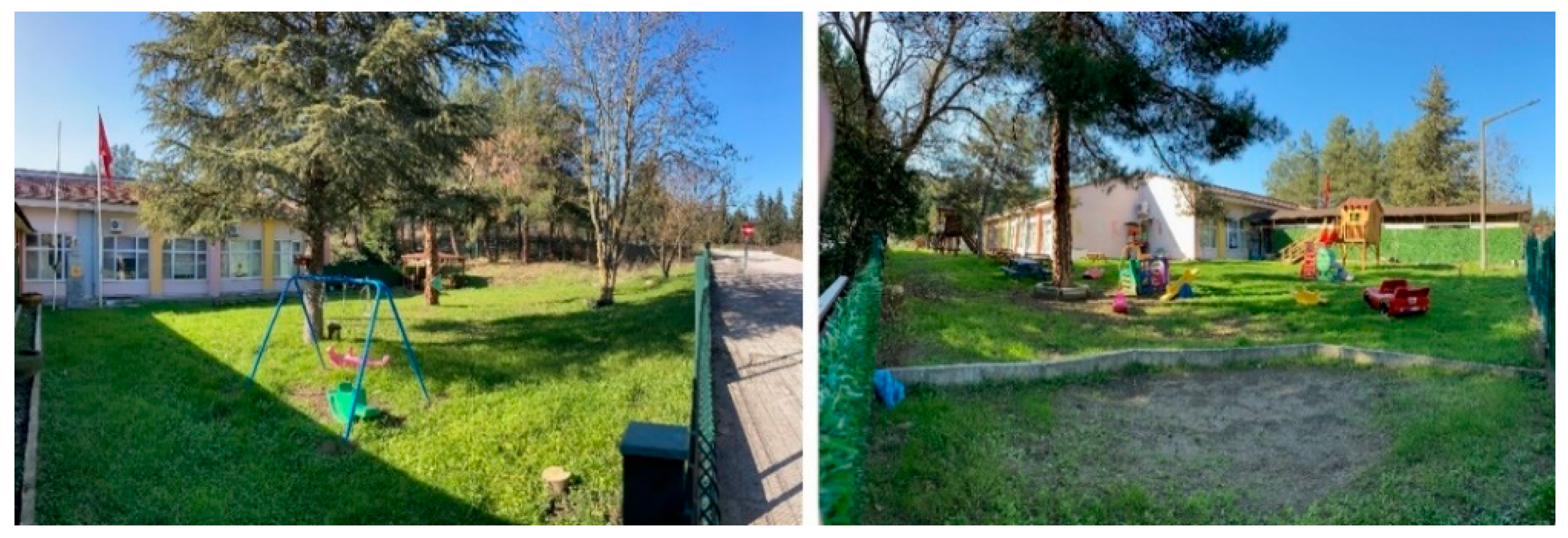
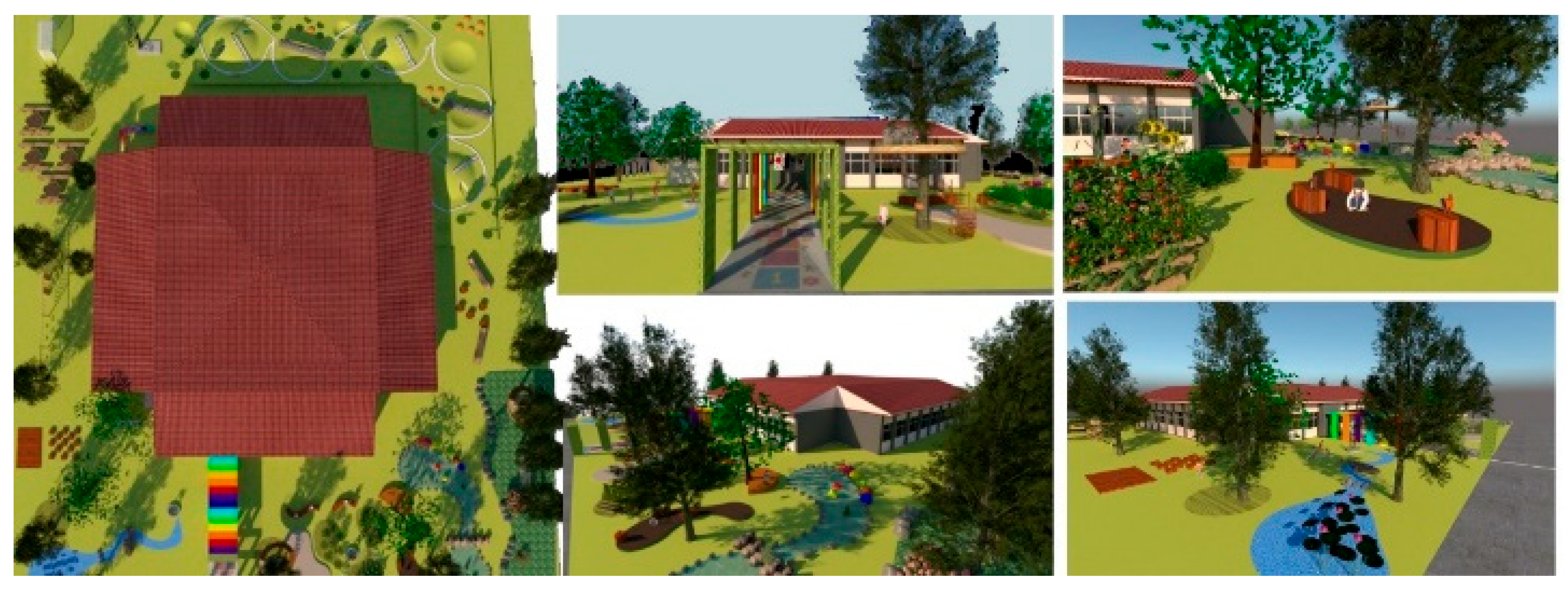
Exploring Spatial Expectations in a Natural Playground Designed by Children for Kindergartens

Abstract
1. Introduction
- What play actions (affordances) do five-year-old children wish to engage in within natural playgrounds?
- What experiences do five-year-old children desire from a natural playground in a kindergarten?
- What types of spaces and spatial elements can five-year-old children design for natural playgrounds in kindergartens?
2. Background
2.1. The Importance of Natural Playgrounds for Early Childhood and Education
2.2. Experiences of Preschool Children in Natural Playgrounds
2.3. Participatory Studies Reflecting Preschool Children’s Expectations of Outdoor Playgrounds
3. Methods
3.1. Ethical Considerations
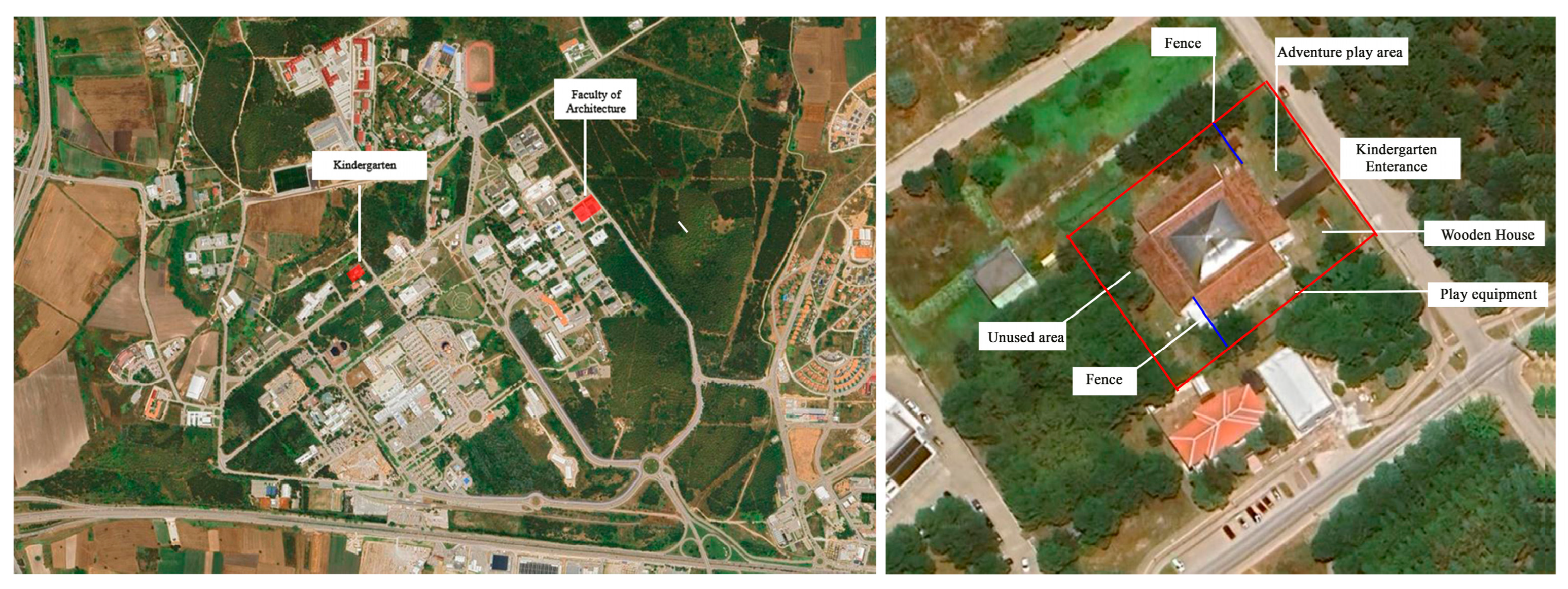
3.2. Setting
3.3. Participants
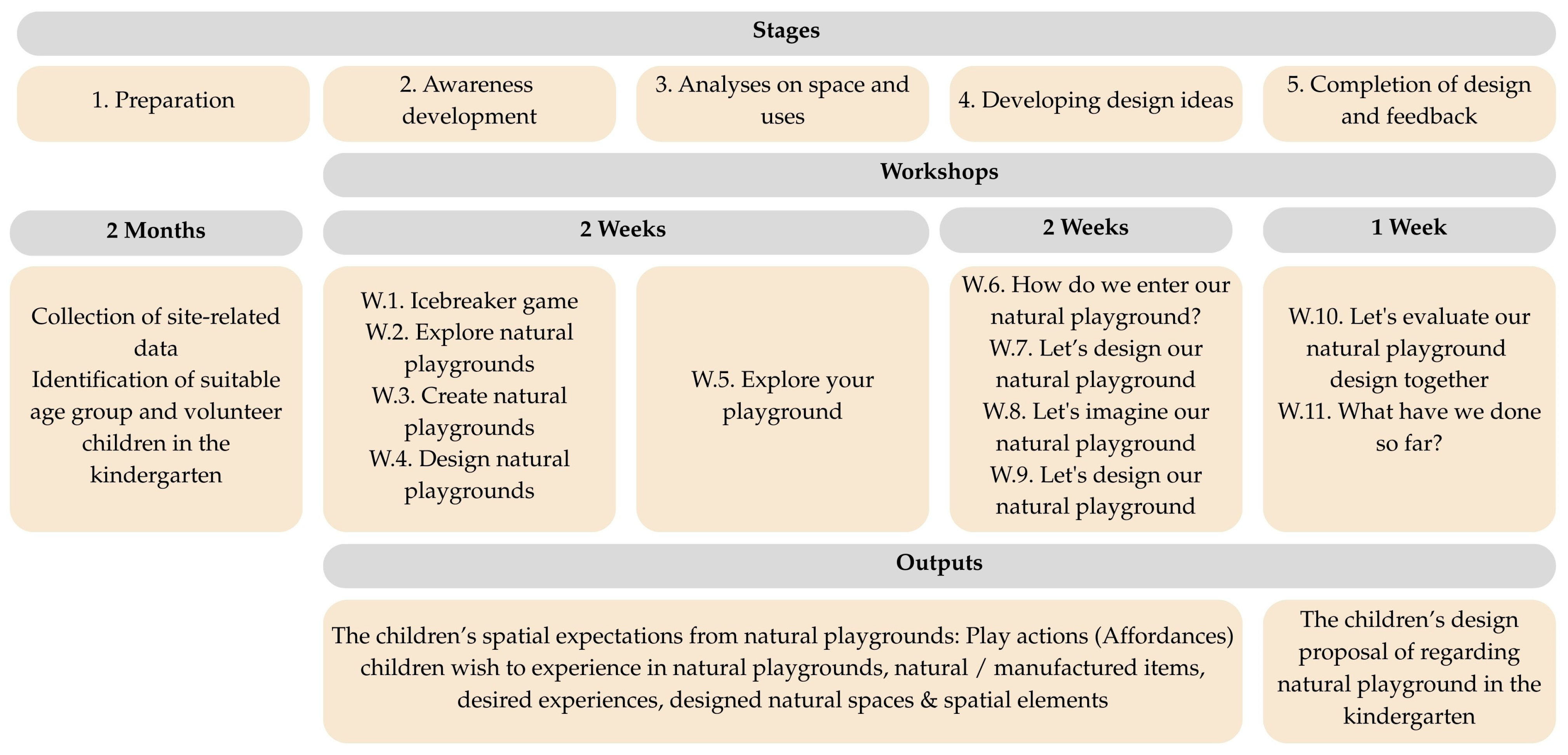
3.4. Workshops
3.5. Data Analysis
4. Findings
4.1. Awareness Development
4.2. Analysis of Space and Uses, Development of Design Ideas
4.2.1. Exploring the Potential of Water Through Active, Passive, and Imaginative Experiences
4.2.2. Learning and Having Fun with Trees
4.2.3. Exploring the Life Cycle with Plants, Creativity, and Developing Aesthetic Sensibilities
4.2.4. Incorporating Topography into Active and Passive Experiences
4.2.5. Communicating with Animals
4.2.6. Experiencing Movement and Stillness with Stones
4.2.7. Developing Hands-On Creation Practices with Soil/Sand
4.2.8. Experiencing Construction/Creation Practices with Loose Parts
5. Discussion and Conclusion
5.1. Natural Playgrounds for Early Childhood and Education
5.2. Experiences and Spatial Expectations of Preschool Children in Natural Playgrounds
5.3. Participatory Design Process for Natural Playgrounds
Author Contributions
Funding
Institutional Review Board Statement
Informed Consent Statement
Data Availability Statement
Acknowledgments
Conflicts of Interest
References
- Richard, B.; Turner, J.; Stone, M.R.; McIsaac, J.-L.D. How an early learning and child care program embraced outdoor play: A case study. J. Child. Educ. Soc. 2023, 4, 306–321. [Google Scholar] [CrossRef] [Scilit]
- Kalpogianni, D.E. Why are the children not outdoors? Factors supporting and hindering outdoor play in Greek public day-care centres. Int. J. Play 2019, 8, 155–173. [Google Scholar] [CrossRef] [Scilit]
- Hogarth, H. ‘I like to dance with the flowers!’: Exploring the possibilities for biodiverse futures in an urban forest school. Child. Soc. 2024; ahead of print. [CrossRef] [Scilit]
- Kernan, M.; Devine, D. Being Confined within? Constructions of the Good Childhood and Outdoor Play in Early Childhood Education and Care Settings in Ireland. Child. Soc. 2010, 24, 371–385. [Google Scholar] [CrossRef] [Scilit]
- Lerstrup, I.; Konijnendijk van den Bosch, C. Affordances of outdoor settings for children in preschool: Revisiting Heft’s functional taxonomy. Landsc. Res. 2016, 42, 47–62. [Google Scholar] [CrossRef] [Scilit]
- Herrington, S.; Studtmann, K. Landscape interventions: New directions for the design of children’s outdoor play environments. Landsc. Urban Plan. 1998, 42, 191–205. [Google Scholar] [CrossRef] [Scilit]
- Fjørtoft, I. Landscape as playscape: The effects of natural environments on children’s play and motor development. Child. Youth Environ. 2004, 14, 21–44. [Google Scholar] [CrossRef] [Scilit]
- Kucks, A.; Hughes, H. Creating a sensory garden for early years learners: Participatory designing for student wellbeing. In School Spaces for Student Well-Being and Learning: Insights from Research and Practice; Franz, J., Hughes, H., Willis, J., Eds.; Springer: Singapore, 2019; pp. 221–238. [Google Scholar] [CrossRef] [Scilit]
- Wang, X.; Woolley, H.; Tang, Y.; Liu, H.; Luo, Y. Young children’s and adults’ perceptions of natural play spaces: A case study of Chengdu, southwestern China. Cities 2018, 72, 173–180. [Google Scholar] [CrossRef] [Scilit]
- Norðdahl, K.; Einarsdóttir, J. Children’s views and preferences regarding their outdoor environment. J. Adventure Educ. Outdoor Learn. 2014, 15, 152–167. [Google Scholar] [CrossRef] [Scilit]
- Wishart, L.; Cabezas-Benalcázar, C.; Morrissey, A.M.; Versace, V.L. Traditional vs. naturalised design: A comparison of affordances and physical activity in two preschool playscapes. Landsc. Res. 2018, 44, 1031–1049. [Google Scholar] [CrossRef] [Scilit]
- Prins, J.; van der Wilt, F.; van Santen, S.; van der Veen, C.; Hovinga, D. The importance of play in natural environments for children’s language development: An explorative study in early childhood education. Int. J. Early Years Educ. 2022, 31, 450–466. [Google Scholar] [CrossRef] [Scilit]
- Kiviranta, L.; Lindfors, E.; Rönkkö, M.L.; Luukka, E. Outdoor learning in early childhood education: Exploring benefits and challenges. Educ. Res. 2023, 66, 102–119. [Google Scholar] [CrossRef] [Scilit]
- Merewether, J. Young children’s perspectives of outdoor learning spaces: What matters? Australas. J. Early Child. 2015, 40, 99–108. [Google Scholar] [CrossRef] [Scilit]
- Squires, K.; van Rhijn, T.; Harwood, D.; Haines, J.; Barton, K. Exploring early childhood educators’ perceptions of children’s learning and development on naturalized playgrounds. Early Child. Educ. J. 2023, 53, 599–613. [Google Scholar] [CrossRef] [Scilit]
- Schlembach, S.; Kochanowski, L.; Brown, R.D.; Carr, V. Early childhood educators’ perceptions of play and inquiry on a nature playscape. Child. Youth Environ. 2018, 28, 82–101. [Google Scholar] [CrossRef] [Scilit]
- Dudek, M. Nurseries Design Guide; Routledge: London, UK; New York, NY, USA, 2013. [Google Scholar]
- Clark, A. Talking and listening to children. In Children’s Spaces; Dudek, M., Ed.; Architectural Press: Oxford, UK, 2005; pp. 1–13. [Google Scholar]
- Muela, A.; Larrea, I.; Miranda, N.; Barandiaran, A. Improving the quality of preschool outdoor environments: Getting children involved. Eur. Early Child. Educ. Res. J. 2019, 27, 385–396. [Google Scholar] [CrossRef] [Scilit]
- Bakr, A.F.; El Sayad, Z.T.; Shokralla Thomas, S.M. Virtual reality as a tool for children’s participation in kindergarten design process. Alex. Eng. J. 2019, 58, 209–219. [Google Scholar] [CrossRef] [Scilit]
- Hart, R. Children’s Participation: From Tokenism to Citizenship; UNICEF International Child Development: Florence, Italy, 1992. [Google Scholar]
- Clark, A. Transforming Children’s Spaces: Children’s and Adults’ Participation in Designing Learning Environments; Routledge: London, UK, 2010. [Google Scholar] [CrossRef] [Scilit]
- Langston, A.; Abbott, L.; Lewis, V.; Kellet, M. Early childhood. In Doing Research with Children and Young People; Fraser, S., Lewis, V., Ding, S., Kellett, M., Robinson, C., Eds.; Sage: London, UK, 2004; pp. 147–160. [Google Scholar]
- Roberts-Holmes, G. Doing Your Early Years Research Project: A Step-By-Step Guide; Sage: London, UK, 2005. [Google Scholar]
- Brinck, J.; Leinonen, T.; Lipponen, L.; Kallio-Tavin, M. Zones of participation–a framework to analyse design roles in early childhood education and care (ECEC). CoDesign 2022, 18, 208–226. [Google Scholar] [CrossRef] [Scilit]
- Lansdown, G. Can You Hear Me? The Right of Young Children to Participate in Decisions Affecting Them; Bernard van Leer Foundation: The Hague, The Netherlands, 2005; p. 36. [Google Scholar]
- Rocca, L.; Donadelli, G.; Ziliotto, S. Let’s plan the school garden: A participatory project on sustainability in a nursery school in Padua. Rev. Int. Geogr. Educ. Online 2012, 2, 219–243. [Google Scholar]
- Menconi, M.E.; Grohmann, D. Participatory retrofitting of school playgrounds: Collaboration between children and university students to develop a vision. Think. Ski. Creat. 2018, 29, 71–86. [Google Scholar] [CrossRef] [Scilit]
- Ministry of National Education [Milli Eğitim Bakanlığı]. Milli Eğitim Bakanlığı Okul Öncesi Eğitimi Programı [Ministry of National Education Preschool Education Program]. 2013. Available online: https://mufredat.meb.gov.tr/Dosyalar/20195712275243-okuloncesi_egitimprogrami.pdf (accessed on 14 November 2025).
- Güngör, S. Examining the gardens of preschool educational institutions in terms of landscape design and space usage: Example of Selçuklu District. J. Agric. Fac. Gaziosmanpaşa Univ. 2017, 34, 153–163. [Google Scholar] [CrossRef] [Scilit]
- Kaçan, M.O.; Halmatov, M.; Olcay Kartaltepe, O. Examining the gardens of the preschool education institutions. J. Early Child. Stud. 2017, 1, 60–70. [Google Scholar]
- Öztürk, Y.; Özer, Z. Outdoor play activities and outdoor environment of early childhood education in Turkey: A qualitative meta-synthesis. Early Child Dev. Care 2021, 192, 1752–1767. [Google Scholar] [CrossRef] [Scilit]
- Geney, F.; Özsoy, Z.; Bay, D.N. Outdoor properties of preschool education institutions: Sample of Eskisehir. J. Soc. Sci. Eskiseh. Osman. Univ. 2019, 20, 735–767. [Google Scholar] [CrossRef] [Scilit]
- Büyükçınar, A.; Özemir, F.P. A review study on co-research with children in preschool environments. In World Children Conference III (22–24 April 2022) Proceedings Book; Altınay, Z., Altınay, F., Eds.; IKSAD Global Publishing House: Antalya, Turkey, 2022; Volume II, pp. 900–910. [Google Scholar]
- Ergüneş Kütük, G. Children’s Participation and Biophilic Design in Preschool Learning Environments. Design Studies Master Program. Master’s Thesis, İzmir University of Economics, İzmir, Türkiye, 2019. [Google Scholar]
- Şahin, B.E.; Polat, S. A participatory design model for children to create natural playgrounds in kindergartens. Child. Youth Serv. Rev. 2025, 1792, 108602. [Google Scholar] [CrossRef] [Scilit]
- Aslan, F. Okul Öncesi Eğitim Kurumlarında dış Mekân Tasarımında Çocukların Beklentilerinin Belirlenmesi. Ph.D. Thesis, Ankara University, Ankara, Türkiye, 2010. [Google Scholar]
- Arabacı, N.; Çıtak, Ş. Okul öncesi dönemdeki çocukların “oyun” ve “açık alan (bahçe)” etkinlikleri ile ilgili görüşlerinin incelenmesi ve örnek bir bahçe düzenleme çalışması [Review of opinions regarding the “play” and “open spaces (gardens)” for pre-school children and a study on arranging a sample playground]. Akdeniz Eğitim Araştırmaları Derg. 2017, 11, 28–43. [Google Scholar]
- European Commission/EACEA/Eurydice. Key Data on Early Childhood Education and Care in Europe—2025; Eurydice Report; Publications Office of the European Union: Luxembourg, 2025. [Google Scholar]
- The Council of the European Union. Council Recommendation of 16 June 2022 on Learning for the Green Transition and Sustainable Development 2022/C 243/01 (Text with EEA Relevance). Official Journal of the European Union. 2022. Available online: https://eur-lex.europa.eu/legal-content/EN/TXT/?uri=CELEX%3A32022H0627%2801%29 (accessed on 14 November 2025).
- Little, H.; Eager, D. Risk, challenge and safety: Implications for play quality and playground design. Eur. Early Child. Educ. Res. J. 2010, 18, 497–513. [Google Scholar] [CrossRef] [Scilit]
- Hinchion, S.; McAuliffe, E.; Lynch, H. Fraught with frights or full of fun: Perspectives of risky play among six-to-eight-year-olds. Eur. Early Child. Educ. Res. J. 2021, 29, 696–714. [Google Scholar] [CrossRef] [Scilit]
- Brussoni, M.; Ishikawa, T.; Brunelle, S.; Herrington, S. Landscapes for play: Effects of an intervention to promote naturebased risky play in early childhood centres. J. Environ. Psychol. 2017, 54, 139–150. [Google Scholar] [CrossRef] [Scilit]
- Meng, W.; He, M. Utilisation and design of kindergarten outdoor space and the outdoor activities: A case study of kindergartens in Bergen, Norway and Anji in China. Int. Perspect. Early Child. Educ. Dev. 2021, 34, 95–110. [Google Scholar] [CrossRef] [Scilit]
- Squires, K.; van Rhijn, T.; Breau, B.; Harwood, D.; Haines, J.; Coghill, M. A quasi-experimental investigation of young children’s activity levels and movements in equipment-based and naturalized outdoor play environments. J. Environ. Psychol. 2024, 97, 102364. [Google Scholar] [CrossRef] [Scilit]
- Yuan, Y.; Zeng, W.; Kloos, H.; Brown, R.; Carr, V. Preschool engineering play on nature playscapes. Early Child. Educ. J. 2024, 53, 2207–2216. [Google Scholar] [CrossRef] [Scilit]
- Alme, H.; Reime, M.A. Nature kindergartens: A space for children’s participation. J. Outdoor Environ. Educ. 2021, 24, 113–131. [Google Scholar] [CrossRef] [Scilit]
- Dankiw, K.A.; Kumar, S.; Baldock, K.L.; Tsiros, M.D. Parent and early childhood educator perspectives of unstructured nature play for young children: A qualitative descriptive study. PLoS ONE 2023, 18, e0286468. [Google Scholar] [CrossRef] [Scilit]
- Nicholson, S. How not to cheat children: The theory of loose parts. Landsc. Archit. 1971, 62, 30–35. [Google Scholar]
- Gibson, J.J. The Ecological Approach to Visual Perception; Houghton Mifflin Company: Boston, MA, USA, 1979. [Google Scholar]
- Heft, H. Affordances of children’s environments: A functional approach to environmental description. Child. Environ. Q. 1988, 5, 29–37. [Google Scholar]
- Hagen, A.; Skaug, H.N.; Synnes, K. Children’s favorite places on the kindergarten playground—According to the staff. J. Eur. Teach. Educ. Netw. 2019, 14, 16–28. [Google Scholar]
- Cetken-Aktas, S.; Sevimli-Celik, S. Play preferences of preschoolers according to the design of outdoor play areas. Early Child. Educ. J. 2023, 51, 955–970. [Google Scholar] [CrossRef] [Scilit]
- Zamani, Z. Young children’s preferences: What stimulates children’s cognitive play in outdoor preschools? J. Early Child. Res. 2017, 15, 256–274. [Google Scholar] [CrossRef] [Scilit]
- Dyment, J.; O’Connell, T.S. The impact of playground design on play choices and behaviors of pre-school children. Child. Geogr. 2013, 11, 263–280. [Google Scholar] [CrossRef] [Scilit]
- Sutton, S.E.; Kemp, S.P. Integrating social science and design inquiry through interdisciplinary design charrettes: An approach to participatory community problem-solving. Am. J. Community Psychol. 2006, 38, 125–139. [Google Scholar] [CrossRef] [Scilit]
- Nikkola, T.M.; Kangas, J.; Reunamo, J. Children’s creative participation as a precursor of 21st-century skills in Finnish early childhood education and care context. Learn. Individ. Differ. 2024, 111, 102437. [Google Scholar] [CrossRef] [Scilit]
- Sevón, E.; Mustola, M.; Siippainen, A.; Vlasov, J. Participatory research methods with young children: A systematic literature review. Educ. Rev. 2023, 77, 1000–1018. [Google Scholar] [CrossRef] [Scilit]
- Iltus, S.; Hart, R.A. Participatory planning and design of recreational spaces with children. Archit. Et Comport. 1994, 10, 361–370. [Google Scholar]
- Sahimi, N.N. Preschool children preferences on their school environment. Procedia-Soc. Behav. Sci. 2012, 42, 55–62. [Google Scholar] [CrossRef] [Scilit]
- Salı, G.; Akyol, A.K.; Baran, G. An analysis of pre-school children’s perception of schoolyard through their drawings. Procedia-Soc. Behav. Sci. 2014, 116, 2105–2114. [Google Scholar] [CrossRef] [Scilit]
- Haas, C.; Ashman, G. Kindergarten children’s introduction to sustainability through transformative, experiential nature play. Australas. J. Early Child. 2014, 39, 21–29. [Google Scholar] [CrossRef] [Scilit]
- Ward, K. What’s in a dream? Natural elements, risk and loose parts in children’s dream playspace drawings. Australas. J. Early Child. 2018, 43, 34–42. [Google Scholar] [CrossRef] [Scilit]
- Nordén, B.; Avery, H. Redesign of an outdoor space in a Swedish preschool: Opportunities and constraints for sustainability education. Int. J. Early Child. 2020, 52, 319–335. [Google Scholar] [CrossRef] [Scilit]
- Cakan, A.; Acer, D. Analysis of preschool children’s outdoor play behaviours. J. Outdoor Environ. Educ. 2024, 1–27. [Google Scholar] [CrossRef] [Scilit]
- Cologon, K. “But Marley can’t play up here!” Children designing inclusive and sustainable playspaces through practitioner research. Sustainability 2024, 16, 6626. [Google Scholar] [CrossRef] [Scilit]
- Cañón-Vargas, A.M.; Melo-Mora, S.P.; Sosa, E. School gardens as a research setting for early childhood children to strengthen their environmental awareness and scientific skills. Discov. Educ. 2025, 4, 1–25. [Google Scholar] [CrossRef] [Scilit]
- Lansdown, G. Every Child’s Right to be Heard: A Resource Guide on the Committee on the Rights of Children General Comment No 12; Save the Children and UNICEF: New York, NY, USA, 2011. [Google Scholar]
- Lozanovska, M.; Xu, L. Children and university architecture students working together: A pedagogical model of children’s participation in architectural design. CoDesign 2012, 9, 209–229. [Google Scholar] [CrossRef] [Scilit]
- Trudeau, M. ‘What is natural in natural playgrounds?’: Nature, sustainability and environmental education in Calgary’s natural playgrounds. Environ. Educ. Res. 2024, 31, 74–91. [Google Scholar] [CrossRef] [Scilit]
- Ministry of National Education [Milli Eğitim Bakanlığı]. Harezmi Eğitim Modeli Çerçeve Metni [Framework Document of the Hârezmî Education Model]. 2023. Available online: https://ogm.meb.gov.tr/meb_iys_dosyalar/2024_04/02131433_harezmiegitimmodelicerceveprogram.pdf (accessed on 14 November 2025).
- Derr, V.; Chawla, L.; Mintzer, M. Placemaking with Children and Youth; New Village Press: New York, NY, USA, 2018. [Google Scholar]
- Manassakis, E.S. Children’s participation in the organisation of a kindergarten classroom. J. Early Child. Res. 2020, 18, 18–28. [Google Scholar] [CrossRef] [Scilit]
- Braun, V.; Clarke, V. Reflecting on reflexive thematic analysis. Qual. Res. Sport. Exerc. Health 2019, 11, 589–597. [Google Scholar] [CrossRef] [Scilit]
- Braun, V.; Clarke, V. Using thematic analysis in psychology. Qual. Res. Psychol. 2006, 3, 77–101. [Google Scholar] [CrossRef] [Scilit]
- Deng, H.; Ismail, M.A.; Sulaiman, R. Exploring the impact of biophilic design interventions on children’s engagement with natural elements. Sustainability 2025, 17, 3077. [Google Scholar] [CrossRef] [Scilit]
- Luken, E.; Carr, V.; Douglas Brown, R. Playscapes: Designs for play, exploration and science inquiry. Child. Youth Environ. 2011, 21, 325–337. [Google Scholar] [CrossRef] [Scilit]
- Herrington, S.; Lesmeister, C. The design of landscapes at child-care centres: Seven Cs. Landsc. Res. 2006, 31, 63–82. [Google Scholar] [CrossRef] [Scilit]
- Kamal, A.M. Building a Child-Developing Play Space in Cairo Through Listening to Children. The City at Eye Level. 2019. Available online: https://thecityateyelevel.com/stories/building-a-child-developing-play-space-in-cairo-through-listening-to-children/ (accessed on 13 November 2025).
- Hart, R.A. Stepping Back from “The Ladder”: Reflections on a Model of Participatory Work with Children. In Participation and Learning: Perspectives on Education and the Environment, Health and Sustainability; Reid, A., Jensen, B.B., Nikel, J., Simovska, V., Eds.; Springer: Dordrecht, The Netherlands, 2008; pp. 19–31. [Google Scholar]

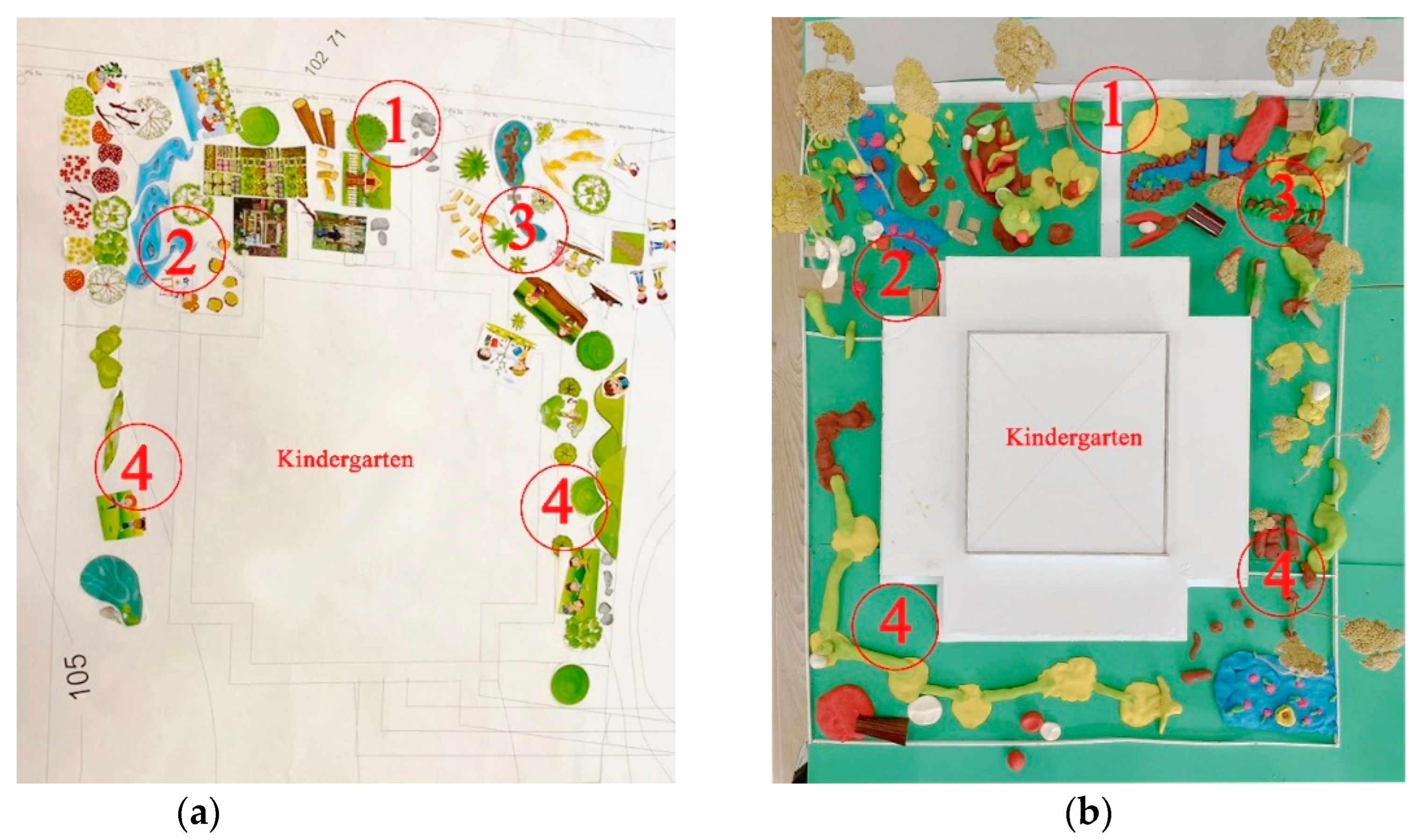


| Workshops | Children’s Design Examples | ||
|---|---|---|---|
| W.2. Explore natural playgrounds |  |  |  |
| D.4: We are playing blindfold tag with the tree. We try to find the tree. | A.3.: I am playing football with my tree. I am climbing a tree with my friend. I have a treehouse. | D.2: Here, I am playing ball with my friend. I am planting. | |
| W.3. Create natural playgrounds | 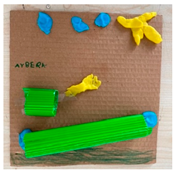 | 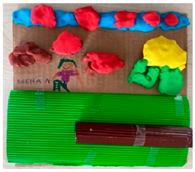 |  |
| A.3: You can jump into the water. You can slide through the tunnel. I am lying on the grass. | E.: I wanted to enter the brown tunnel. I am jumping on the stones on the water. | Ç.: There is a green slide next to a river. The brown circles are stones. I can jump on the stones. There is mud. Children can pass through the hole. | |
| W.4. Design natural playgrounds | 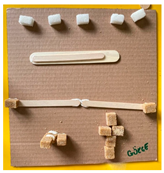 |  | 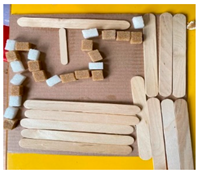 |
| G.: There is a tunnel that can be walked through. You go over the bridge and then jump down to the ground. I built a house. There is a hopscotch area. | A.1: There is an area with planks where I can build and play. There are benches and a soil play area. | A.2.: There are clouds. There is a tunnel that can be passed through. You go over the bridge and then jump to the ground. | |
| Workshops | Children’s Design Examples | ||
|---|---|---|---|
| W.6. How do we enter our natural playground? | 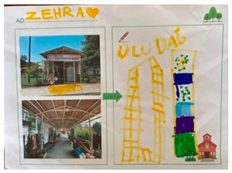 |  |  |
| Z.2: I made the entrance path out of grass. There are green and blue grass areas, and then green stones that we jump across. | N.: I would like there to be pictures and trees along the entrance path. I would like flowers and colorful lights on the ceiling at the entrance. I would like a hopscotch and seating area along the entrance path. | G.: I imagined the walls of the entrance path in different colors. I also thought of a waterfall beside it. On the entrance roof, I would like blue decorations made of seashells and a red ceiling. | |
| W.7. Let’s design our natural playground |  |  | 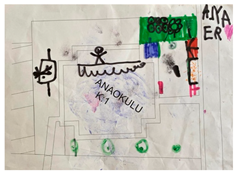 |
| Z.1: Next to it, there is a pond with stones and fish. We can take water from the pond to water the trees and flowers. There is a potion area where we make potions. There is a place for growing fruits and vegetables. There are an ice-skating rink and an amusement park. | G.: We can jump on the stones in the water and on the stones on the ground. There are rabbits that we can feed. There is a climbing area. There is a cave where we can rest. There is a seesaw. There is a cherry tree where we can pick cherries. There is a trampoline and we can jump on it. | A.1.: I have a place where I plant seeds. Next to it, there is a chemistry lab. Experiments are conducted there. There is a storage room where the materials for experiments are kept. I use the water in the garden for the plants and for experiments. | |
| Play Actions (Affordances) Children Wish to Experience in Natural Playgrounds | Code: Natural/Manufactured Items | Theme: Desired Experiences | Categories: Designed Natural Spaces & Spatial Elements |
|---|---|---|---|
| Collecting stones from flowing water, imagining stones as fish and catching them, entering the water, floating objects in the water, making waves, fetching water from a well/fountain, crossing a stone/wooden bridge over water, observing aquatic plants (like water lilies, reeds) | Water Stone Fish/Frogs Aquatic plants Floating object | (1) Exploring the potential of water through active, passive, and imagination-based experiences | - Pond - Water channel - Fountain - Bridge |
| Watering trees, picking fruits/honey, climbing trees, jumping from trees, hanging from trees, resting, sitting under the tree, finding a tree with eyes closed (blind man’s buff), playing hide-and-seek, hiding inside logs, sitting on logs, tying a rope to a tree and playing jump rope/volleyball/soccer, playing in a tree house, lighting fires from branches | Trees Stairs Log Rope Water Fruits Balls Fire | (2) Learning and having fun with trees | - Fruit trees - Tree logs - Tree house |
| Observing flowers, learning colors, painting and drawing using branches on snow, soil, and leaves, making music by striking branches, planting flowers and seedlings, growing and watering fruits, vegetables, and flowers, making potions and cooking, hiding and playing in a plant maze, | Plants Water Flowers Vegetables Fruits | (3) Exploring the life cycle and creativity through plants | - Flower/vegetable/ fruit garden - Craft/art space - Music wall - Vegetable-fruit/ potion kitchen - Plant maze - Fire pit |
| Sitting, resting, observing the surroundings, and eating something, having a picnic, making parties and celebrations activities, lying on the grass, climbing grassy/soil hills, sliding down grassy hills, running and doing gymnastics, playing soccer and basketball, going through tunnels under the hills, digging tunnels | Surfaces Hill Grass Soil | (4) Integrating topography into active and passive experiences | - Grassy hill - Flat grassy area - Picnic area - Sports field - Running/ survivor track -Tunnel - Activity stage |
| Observing fish and frogs in the water, exploring and observing insects, taking care of rabbits and cats | Animals Fish Frogs Insects Rabbits Cats | (5) Strengthening communication with animals | - Natural pond - Flower garden - Animal shelter/ coop |
| Jumping over stones, hiding/resting in a cave, climbing and balancing | Stone | (6) Experiencing movement and stillness with stones | - Rocky area - Cave |
| Playing with mud, making mud pies, decorating mud pies with flowers, building shapes and structures, digging | Soil/Sand Water Mud | (7) Developing hands-on creation practices with mud/sand | - Soil play area - Mud kitchen - Sand play area |
| Creating seating, resting, and dining areas, building huts/fences/rooms/shops, constructing balance beams/seesaws/slides/tunnels/mazes/jumping and hopping courses/hopscotch areas/playgrounds/stages with wooden blocks and sticks, making hand crafts, storing items/toys, climbing and balancing, doing sports/racing | Loose parts Wooden blocks Wooden sticks Hand craft materials | (8) Experiencing construction/creation practices with loose parts | - Manufactured loose parts - Craft/art space - Storage - Running/ survivor track |
Disclaimer/Publisher’s Note: The statements, opinions and data contained in all publications are solely those of the individual author(s) and contributor(s) and not of MDPI and/or the editor(s). MDPI and/or the editor(s) disclaim responsibility for any injury to people or property resulting from any ideas, methods, instructions or products referred to in the content. |
© 2025 by the authors. Licensee MDPI, Basel, Switzerland. This article is an open access article distributed under the terms and conditions of the Creative Commons Attribution (CC BY) license (https://creativecommons.org/licenses/by/4.0/).
Share and Cite
Şahin, B.E.; Polat, S.; Zülfikar, A.B.; Akar, H. Exploring Spatial Expectations in a Natural Playground Designed by Children for Kindergartens. Buildings 2025, 15, 4542. https://doi.org/10.3390/buildings15244542
Şahin BE, Polat S, Zülfikar AB, Akar H. Exploring Spatial Expectations in a Natural Playground Designed by Children for Kindergartens. Buildings. 2025; 15(24):4542. https://doi.org/10.3390/buildings15244542
Chicago/Turabian StyleŞahin, B. Ece, Sibel Polat, A. Burcu Zülfikar, and Hande Akar. 2025. "Exploring Spatial Expectations in a Natural Playground Designed by Children for Kindergartens" Buildings 15, no. 24: 4542. https://doi.org/10.3390/buildings15244542
APA StyleŞahin, B. E., Polat, S., Zülfikar, A. B., & Akar, H. (2025). Exploring Spatial Expectations in a Natural Playground Designed by Children for Kindergartens. Buildings, 15(24), 4542. https://doi.org/10.3390/buildings15244542