Article

Vision-Guided Dynamic Risk Assessment for Long-Span PC Continuous Rigid-Frame Bridge Construction Through DEMATEL–ISM–DBN Modelling

1
School of Transportation Science and Engineering, Harbin Institute of Technology, Harbin 150090, China
2
The First Company of China Eighth Engineering Division Ltd., Jinan 250014, China
3
Heilongjiang Provincial Expressway Service Center, Harbin 150000, China
*
Author to whom correspondence should be addressed.
Buildings 2025, 15(24), 4543; https://doi.org/10.3390/buildings15244543
Submission received: 5 November 2025 / Revised: 27 November 2025 / Accepted: 10 December 2025 / Published: 16 December 2025
(This article belongs to the Special Issue Big Data and Machine/Deep Learning in Construction)

Abstract

In response to the challenges posed by the complex evolution of risks and the static nature of traditional assessment methods during the construction of long-span prestressed concrete (PC) continuous rigid-frame bridges, this study proposes a risk assessment framework that integrates visual perception with dynamic probabilistic reasoning. By combining an improved YOLOv8 model with the Decision-making Trial and Evaluation Laboratory–InterpretiveStructure Modeling (DEMATEL–ISM) algorithm, the framework achieves intelligent identification of risk elements and causal structure modelling. On this basis, a dynamic Bayesian network (DBN) is constructed, incorporating a sliding window and forgetting factor mechanism to enable adaptive updating of conditional probability tables. Using the Tongshun River Bridge as a case study, at the identification layer, we refine onsite targets into 14 risk elements (F1–F14). For visualization, these are aggregated into four categories—“Bridge, Person, Machine, Environment”—to enhance readability. In the methodology layer, leveraging causal a priori information provided by DEMATEL–ISM, risk elements are mapped to scenario probabilities, enabling scenario-level risk assessment and grading. This establishes a traceable closed-loop process from “elements” to “scenarios.” The results demonstrate that the proposed approach effectively identifies key risk chains within the “human–machine–environment–bridge” system, revealing phase-specific peaks in human-related risks and cumulative increases in structural and environmental risks. The particle filter and Monte Carlo prediction outputs generate short-term risk evolution curves with confidence intervals, facilitating the quantitative classification of risk levels. Overall, this vision-guided dynamic risk assessment method significantly enhances the real-time responsiveness, interpretability, and foresight of bridge construction safety management and provides a promising pathway for proactive risk control in complex engineering environments.

1. Introduction

With the continued expansion and increasing complexity of bridge construction projects, long-span PC continuous rigid-frame bridges (LSPCCRFBs) are being increasingly exposed to significant safety risks during their construction phase [1]. These projects often involve parallel operations, dense spatial coupling, and rapid state transitions. Even seemingly minor disturbances within the interconnected “bridge–human–machine–environment” system can amplify and evolve into severe accidents [1]. In previous research on the construction-phase risks of bridges and other infrastructure, scholars have focused mainly on unsafe human behaviours, machinery and lifting equipment, environmental conditions, and the vulnerability of structural components. For example, Shan et al. systematically collected 126 bridge construction accident cases and organized 25 secondary risk factors into four primary categories—human, equipment, management, and environment—and then analysed how their coupling led to accidents in bridge construction [2]. Li et al. developed a safety risk indicator system for highway bridge construction and used entropy-weighted cloud models to assess overall construction risk levels, highlighting that working-at-height operations, heavy lifting equipment, temporary structures, and complex environmental conditions are the dominant contributors to safety risk [3].
On the methodological side, many studies rely on checklists, safety inspection tables, accident statistics, and expert ratings, which are then processed using AHP–fuzzy comprehensive evaluation, cloud models, or related multicriteria techniques to obtain comprehensive risk scores for specific bridge projects [3,4]. Classical process-safety methods such as FMEA and their enhanced variants have also been introduced into bridge engineering, but they essentially depend on static scoring tables and expert workshops for hazard identification [5]. In terms of probabilistic modelling, Zhang, Wu, and Skibniewski proposed a Bayesian-network-based safety risk analysis framework for construction projects, in which human, equipment, environmental, and management factors are represented as nodes, and their conditional probabilities are elicited from experts or historical data [6]. However, these approaches are typically implemented as one-off, static assessments: network structures and conditional probability tables are fixed over time, the temporal evolution of risks during the construction process is not explicitly modelled, and onsite monitoring data—particularly vision-based observations of workers, machinery, and protective facilities—are seldom integrated. As a result, existing frameworks have a limited ability to capture how risks propagate over time or to provide multistep predictive information for proactive scheduling and resource allocation.
Recent advances in computer vision technology have opened new possibilities for improving construction safety. Over the past few years, the YOLO family of algorithms has shown strong real-time detection capability and precision across construction settings [7,8], making it possible to automatically recognize personnel, machinery, and protective equipment. Enhanced versions such as YOLOv7 and YOLOv8 have further advanced performance in detecting small objects and operating under low-light conditions [9,10]. The inclusion of attention mechanisms and multiscale feature fusion has also improved adaptability in visually complex scenes [11,12]. However, much of the current research remains confined to the “detection layer,” rarely extending towards causal inference or dynamic forecasting, leaving a persistent methodological gap in understanding “how to transform detection outputs into causal inference and dynamic forecasting” [13,14].
In the domain of causal modelling, the DEMATEL–ISM approach has gained traction for uncovering cause–effect relationships and hierarchical patterns among multiple risk factors within complex engineering systems [1,15]. For instance, Li (2024) proposed an accident-chain analysis model based on fuzzy DEMATEL–ISM [16], whereas Xue (2025) examined the layered evolution of risks in shield tunneling construction [17]. Nevertheless, most studies to date still rely on static topological structures and lack integration with dynamic probabilistic modelling [18,19], limiting their responsiveness to time-dependent changes in risk behaviour.
DBNs, on the other hand, have proven effective in managing uncertainty and temporal dependency in evolving systems [20,21,22,23]. By defining conditional probability tables (CPTs), DBNs are capable of updating risk states over time. However, many existing implementations employ fixed CPTs or static datasets, which hinders adaptability to the nonstationary nature of construction sites [22,24]. Moreover, these models often focus solely on posterior inference and lack forwards-looking prediction with quantified uncertainty, restricting their ability to support resource allocation and task scheduling [25].
In this study, we explicitly position the proposed framework in relation to existing risk assessment methods for bridge and infrastructure construction and highlight three main innovations. First, unlike traditional checklist-, questionnaire-, or expert-based approaches, we fuse an enhanced YOLOv8 model with a structured “human–machine–environment–bridge” labelling system so that key risk elements are extracted directly from onsite images rather than being inferred solely from subjective scoring. Second, instead of using DEMATEL/ISM only to rank factors or to obtain a static hierarchy, we transform the credibility-weighted influence relations into a directed acyclic topology that is explicitly designed to serve as the structure of a dynamic Bayesian network, thereby resolving bidirectional and cyclic links while preserving dominant causal chains. Third, in contrast to conventional static Bayesian-network or risk-matrix applications that provide only one-off assessments, we embed this topology into a DBN with sliding-window learning and a forgetting factor and apply particle filtering to generate time-varying, scenario-level risk probabilities over multiple future time steps. In combination, these features allow the framework to move beyond mature but static methods towards a vision-guided, dynamically updated, and decision-oriented risk assessment tool for LSPCCRFB construction.
The main contributions of this paper are as follows: (1) at the perception stage, an enhanced YOLOv8 model is designed with multi-attention modules, dynamic convolution, and auxiliary segmentation–distillation strategies to strengthen risk recognition in complex environments; (2) at the causal modelling stage, an improved DEMATEL–ISM algorithm fuses expert insights with YOLO-based observations to construct credibility-weighted causal chains and hierarchical structures; and (3) at the reasoning stage, a dynamic Bayesian network is employed, where sliding-window learning and a forgetting-factor mechanism enable adaptive CPT updates. Combined with particle filtering and Monte Carlo forwards propagation, this framework can generate multistep probabilistic forecasts of risk evolution, offering a comprehensive and dynamic approach to construction safety assessment.

2. Dynamic Risk Assessment Framework

2.1. YOLOv8-Based Image Recognition Algorithm

2.1.1. Object Detection Modelling

Within the YOLOv8-based detection framework, the input image is first divided into dense prediction grids, with each grid responsible for predicting a multidimensional detection vector [26,27] to simultaneously achieve object localization and class identification. Each grid cell outputs a prediction vector y ^ , which is defined as follows:
y ^ = o ^ , b ^ x , b ^ y , b ^ w , b ^ h , p ^ 1 , , p ^ C
In this prediction vector, o ^ is the foreground confidence reflecting target presence; b ^ x and b ^ y denote the offsets of the box centre relative to the grid centre; b ^ w and b ^ h specify the width and height ratios of the predicted box (PB); and p ^ k (k ∈ (1,C)) denotes the predicted probability for the k-th class. This unified parameterization jointly encodes localization and classification, which streamlines the downstream loss computation.
To rigorously assess the bounding-box prediction quality, the complete intersection-over-union (CIoU) loss is adopted [28]:
L b b o x = 1 IoU + ρ 2 c , c ^ d 2 + α υ
Specifically, the first term 1-IoU quantifies the overlap between the PB and the ground-truth box (GTB), the second term ρ2(c, c ^ )/d2 constrains the distance between the centre points of the PB and the GTB, and the third term αv regularizes the discrepancy in the aspect ratio between the PB and the GTB. This combination enables the network to converge more quickly and stably towards accurate position and scale regression. By combining the bounding-box regression loss, the classification loss, and the object confidence loss, a comprehensive detection loss is formulated [29]:
L det = λ b L b b o x + λ c L c l s + λ o L o b j
In this formulation, λb, λc and λo are balancing factors for the three loss components. They are adaptively adjusted online to ensure balanced gradient propagation, thereby enabling the network to simultaneously optimize regression, classification, and object confidence during training.

2.1.2. Structural Improvements of the Model

To address the challenges associated with complex bridge construction environments—such as large-scale variations, frequent occlusion of small objects, and difficulty in recognizing elongated targets—we introduce targeted structural improvements to the YOLOv8 network. Specifically, we incorporate a dynamic convolution mechanism [12], which adaptively generates convolutional kernel weights for the input features, thereby enhancing the efficiency of feature extraction:
Y = d = 1 D Softmax φ X d W d X
Specifically, the attention module φ(X) automatically learns to generate weight distributions for multiscale and texture features on the basis of the input, thereby adapting to detection targets with different materials (e.g., concrete, steel, and polyester fibres).
To accurately capture the spatial orientation information of elongated targets, a multibranch coordinate attention mechanism is employed [30,31]:
A = σ W 2 δ W 1 g x ; g y , F = A F
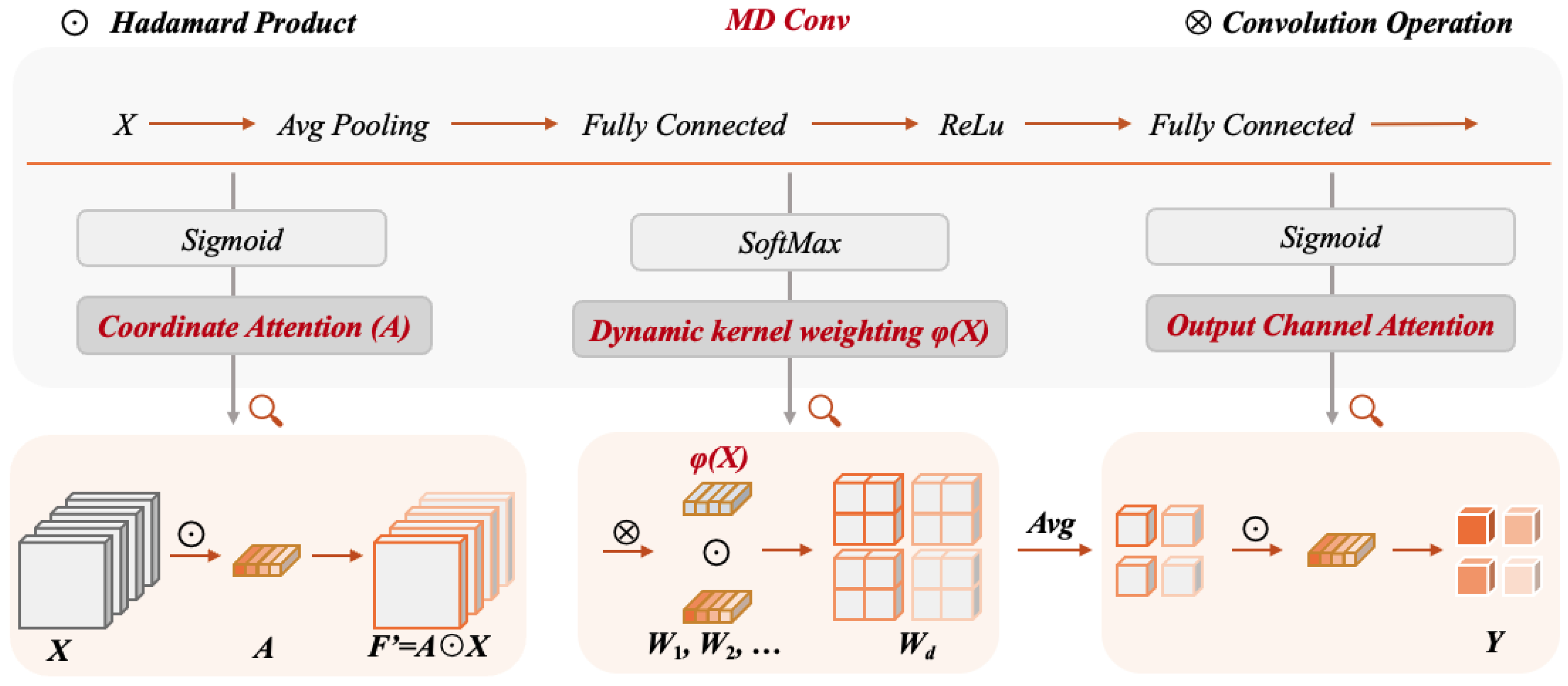
By performing one-dimensional global pooling in both the horizontal and vertical directions to derive gx and gy, the network gains an enhanced ability to identify elongated structures such as bridge reinforcement bars, cables, and scaffolding. The structural module that integrates dynamic convolution with the multibranch attention mechanism is shown in Figure 1.
In Figure 1, the improved MD-Conv block combines the dynamic convolution mechanism in Equation (4) with the multibranch coordinate attention in Equation (5). The input feature map X is first processed by the multibranch coordinate attention module, which performs one-dimensional global pooling to obtain gx and gy and generates an attention map A. The reweighted feature is F’ = AX. Moreover, the dynamic convolution mechanism uses φ(X) to compute adaptive weights for the base kernels W1, W2, …, forming the dynamic kernel Wd. The output feature map Y is then obtained as Y = F’Wd. The symbols ⊙ and ⊗ denote the Hadamard product and convolution operator, respectively.
In addition, we introduce a semantic segmentation task to refine the recognition of hazardous areas in the environment and incorporate online knowledge distillation to improve the performance of lightweight models [32,33].
The segmentation loss integrates Dice and binary cross-entropy (BCE) terms to refine the pixelwise segmentation of hazardous areas.
L s e g = λ 1 L B C E + λ 2 L D i c e
Here, LBCE denotes the BCE loss measuring the classification error at each pixel; LDice = 1 − 2 P G P + G denotes the Dice loss optimizing the overlap between the predicted mask (PM) and ground-truth mask (GTM); P and G represent the PM and GTM, respectively; and λ1 and λ2 are weighting coefficients empirically set between 0.5 and 1.0.
Distillation loss: Kullback–Leibler (KL) divergence is adopted to align the outputs of the lightweight student network with those of the large teacher network.
L d i s t i l l = i = 1 N K L σ z i T T σ z i S T
Here, ziT and ziS denote the logit outputs of the teacher and student networks for the i-th class, respectively; σ(·) denotes the softmax function; T is the temperature parameter (typically set to 2–4) for smoothing the distilled “soft labels”; and KL denotes the Kullback–Leibler divergence, which measures the consistency between the teacher and student output distributions.
Comprehensive loss: Optimal weight allocation is sought across multiple tasks to enable efficient overall training of the network.
L t o t a l = L det + α L s e g + β L d i s t i l l
Here, Ldet denotes the original YOLOv8 detection loss, which includes classification, confidence, and bounding-box regression losses, and α and β are hyperparameters used to regulate the relative weights of the segmentation and distillation tasks. In this study, the default values are set to 0.6 and 0.4, and the experimental results confirm that these values improve the segmentation quality of hazardous areas without compromising detection performance.
Although the MD Conv and auxiliary segmentation–distillation branches introduce additional parameters and operations compared with baseline YOLOv8, they are embedded within a single-stage detector and kept lightweight. Therefore, the present study emphasizes methodological feasibility rather than detailed latency benchmarking. A dedicated engineering study is needed to quantify FPS, memory usage, and power consumption on representative construction site hardware before large-scale deployment.

2.1.3. Spatiotemporal Risk Inference

Since single-frame detection is insufficient for evaluating dynamic risks at construction sites, we treat object trajectories as sequential information and employ a transformer network for risk reasoning. The trajectory sequence is defined as follows [13]:
Z i = s i t T + 1 , , s i t , s i t = x , y , υ x , υ y , c
Each state vector sit consists of the object’s positional information (x, y), velocity information (vx, vy), and class identifier c, forming the input foundation for subsequent risk reasoning.

2.1.4. Verification of Image Annotation and Results

Construction site images were collected during the construction of the LSPCCRFB project under typical operating conditions, covering different working areas, viewpoints, and periods to capture a wide range of “bridge–human–machine–environment” interactions. All the images were subsequently annotated using the open-source platform CVAT, which combines single-frame labelling with cross-frame verification. Domain experts manually labelled every visible risk element, and cross-checking adopted an intersection-over-union (IoU) consistency threshold of ≥0.85; samples with lower agreement were re-examined to ensure high label quality. To comprehensively represent the main risk factors in bridge construction, we designed a labelling scheme comprising four categories—bridge, human, machine, and environment—with 14 subcategories in total, as summarized in Table 1. After annotation, the dataset was partitioned into training, validation, and testing subsets at a 7:2:1 ratio, ensuring broad coverage of sites, camera perspectives and time spans while maintaining balanced class distributions. Some low-frequency classes (such as unprotected personnel and warning signs) were further supplemented by data augmentation to alleviate class imbalance. The resulting annotated dataset provides the basis for training the improved YOLOv8 detector and for extracting the risk elements that enter the subsequent DEMATEL–ISM analysis and DBN-based dynamic risk assessment.
The performance of the improved YOLOv8 detector is evaluated on the annotated construction image dataset using standard object-detection metrics. For each risk element, we compute precision P and recall R on the basis of the number of true positives, false positives and false negatives under a given confidence threshold and intersection-over-union (IoU) criterion. By varying the confidence threshold from 0 to 1, we obtain classwise precision–recall (PR) curves, from which the average precision (AP) of each class and the mean average precision (mAP) across all classes are calculated [34].
To further analyse the trade-off between precision and recall, we plot the F1–confidence curve, where the F1 score F1 = 2PR/(P + R) is computed for different confidence thresholds. The optimal operating point is selected as the threshold that maximizes the F1 score on the validation set and is subsequently used in the case study for all the quantitative analyses. In addition, a confusion matrix is constructed to summarize the classification performance of the model across the four high-level categories (bridge, human, machine, and environment) and their corresponding risk elements, highlighting typical confusion patterns between visually similar classes [35].
These verification procedures (PR curves, F1–confidence curves, confusion matrix and mAP) are first defined in this section and then applied to the Tongshun River Bridge dataset in the case study section to assess the reliability of the detection results that are fed into the DEMATEL–ISM analysis and DBN-based dynamic risk assessment [36].

2.2. Improved DEMATEL–ISM Algorithm

2.2.1. DEMATEL Theory

Let R = (R1, R2,…, Rn) denote the set of risk elements. For any two elements Ri and Rj, m senior experts are invited to assess the direct influence strength on a four-level scale {0, 1, 2, 3, 4}, as summarized in Table 2, thereby constructing the direct influence matrix [1]. Let A = [aij] denote the direct influence matrix with entries aij ∈ {0, 1, 2, 3, 4} and aij = 0 for all i = j; then, the factors do not exert direct influence upon themselves.
A = a i j , a i j 0 , 1 , 2 , 3 , 4 , a i j = 0
Since variations may exist in scoring ranges and preferences among experts, maximum row-sum normalization is applied to project A into a consistent measurement space.
N = A max 1 i n j = 1 n a i j
where N = [nij] ∈ [0, 1]n×n. When the spectral radius is less than ρ(N) < 1,
T = N 1 N 1 = N + N 2 + N 3 +
The Neumann series [1] converges, yielding the comprehensive influence matrix T = [Tij], where each element Tij represents the cumulative effect of Ri on Rj through all possible paths. The row sum Di = ∑j Tij and column sum Ri = ∑j Tij are further introduced to define prominence and causality [15].
C i = D i + R i , E i = D i R i
Prominence Ci measures the overall importance of a risk element within the network, whereas causality Ei distinguishes between “cause” roles (Ei > 0) and “effect” roles (Ei < 0).

2.2.2. ISM Theory

While the comprehensive influence matrix T provides influence strength, it does not reveal the hierarchical position of risk elements within the causal chain. Interpretive structural modelling (ISM) decomposes the network into a directed acyclic hierarchical graph via Boolean operations. Initially, μT and σT, corresponding to the matrix’s average and variability, are determined [18].
μ T = 1 n 2 i , j T i j
σ T = 1 n 2 i , j T i j μ T 2
Afterwards, a threshold λ = μT + T (k ∈ [0.5, 1]) is applied to binarize T, producing matrix T*, where the condition Tij* = 1 holds if and only if Tijλ. Consequently, element pairs with Tij < λ do not appear as direct edges in the DEMATEL graph; their interactions are represented only through indirect multistep paths via intermediate nodes. To obtain all reachable relationships in the Boolean sense, T* is added to the identity matrix and repeatedly multiplied under Boolean operations until transitive closure is reached [17].
R = T + I ( reach )
If the reachable set of a node is entirely contained within its predecessor set, denoted as Reach(i) Ante(i) = Reach(i), then the node is assigned to the current top layer. By iteratively removing the nodes in each layer, a hierarchical topological structure can be derived in a top-down manner.

2.2.3. Coupling of Subjective–Objective Weights and Confidence Levels

In the construction of continuous rigid-frame bridges, both expert experience and real-time image monitoring (YOLOv8) serve as complementary sources of risk information. To integrate these two information sources, fusion weights are assigned to each risk element using a linear combination [16].
w i = α s i + ( 1 α ) o i k = 1 n α s k + ( 1 α ) o k , 0 α 1
Here, si denotes the expert-assessed weighting factor derived from the analytic hierarchy process (AHP), oi is the normalized value based on the recognition frequency and severity index, and α balances the entropy-minimized uncertainty with the Delphi consensus. Moreover, to mitigate errors caused by divergences in expert opinions or insufficient monitoring confidence, a discounting function is applied to the edges [16].
c i j = 1 = exp σ i j 2 / γ 1 p ¯ i j , γ = 0.5
Specifically, σij2 denotes the variance in expert scores, and p ¯ i j represents the average confidence of detecting event “RiRj” from the images. When both indicators are reliable, cij approaches 1; otherwise, it tends towards 0. By combining node weights with edge confidence values, a corrected direct relation matrix is obtained.
a ˜ i j = w i c i j a i j , a ˜ i j = 0 , A ˜ = a ˜ i j
This matrix preserves the original causal directions while incorporating adjustments aligned with data quality.
Conceptually, Section 2.2 first introduces the DEMATEL theory (Section 2.2.1) and the ISM theory (Section 2.2.2) and then presents our integrated subjective–objective weighting scheme (Section 2.2.3) that connects them. In the subsequent case study, the DEMATEL-based direct relation matrix and the integrated weighting formulas in Section 2.2.3 are applied first to obtain the corrected influence matrix, and then the ISM procedure in Section 2.2.2 is used to derive the hierarchical risk structure.

2.2.4. Causal Matrix and Hierarchical Topology Generation

By substituting A ˜ into Equation (12) for normalization and expansion according to Equation (13), the comprehensive influence matrix T ˜ , which integrates both subjective and objective information, is obtained. The threshold selection and closure operations defined in Equations (15)–(17) are subsequently applied to generate R ˜ . Finally, by performing recursive peeling on R ˜ , a credibility-weighted causal chain and multilevel topological graph are derived. These results not only reveal the “bridge–human–machine–environment” risk transmission pathways with precision but also provide structural priors for probabilistic propagation in the dynamic Bayesian network (Section 2.3).

2.3. Dynamic Bayesian Network

2.3.1. Construction of the DBN Topological Structure

On the basis of the results of the aforementioned DEMATEL–ISM analysis, we constructed a causal relationship network among risk factors at the construction site. In the DBN, this causal network serves as the topological structure of the Bayesian network. The DBN extends the classical Bayesian network by incorporating the temporal dimension into its structure, thereby enabling dynamic risk assessment and prediction [37].
For dynamic risk assessment at construction sites, the DBN topology is defined such that, at each time step t, a set of risk elements is established, where each element represents the state of a risk factor on site. To construct the Bayesian network across temporal sequences, cross-time dependencies must be considered, namely, the causal influences between time slices. By constructing a “two-slice DBN,” nodes in each time slice are linked with nodes in the preceding slice. Equation (20) defines the set of risk elements at time t:
X t = X 1 ( t ) , X 2 ( t ) , , X n ( t ) , X i ( t ) 0 , 1 ( 0 = s a f e , 1 = r i s k )
Equation (21) presents the joint probability distribution of the DBN, which describes the conditional probability relationships between risk states within each time slice and their parent nodes from the previous slice.
P X t , X t 1 = i = 1 n P X i ( t ) P a i ( t ) , P a i ( t 1 )
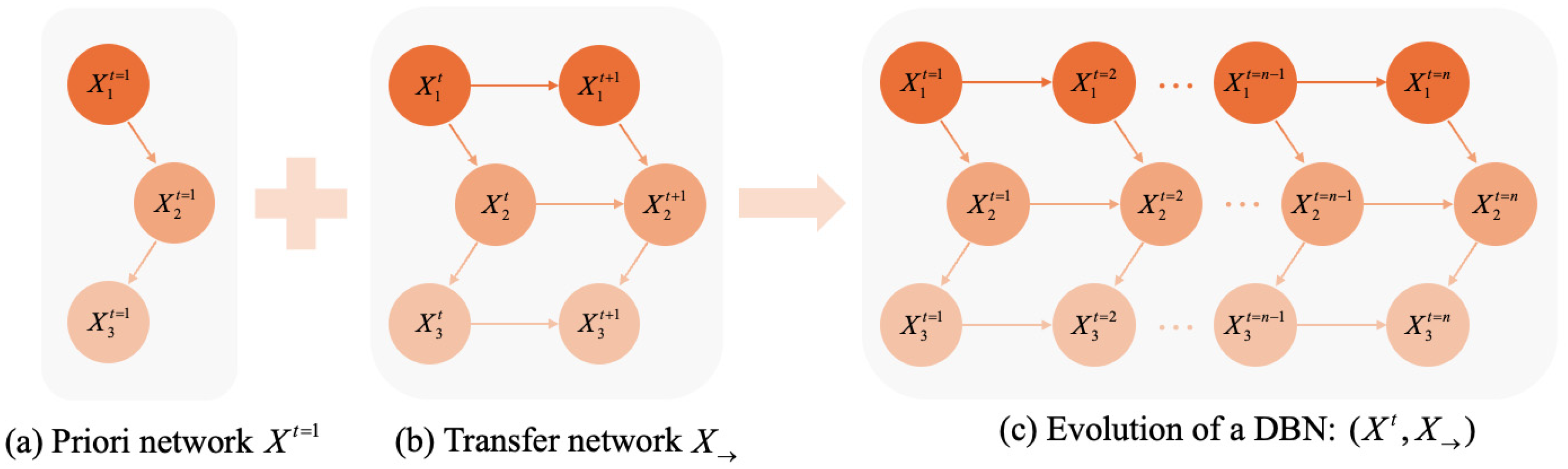
Here, Pai(t) and Pai(t−1) denote the sets of parent nodes at times t and t − 1, respectively, and represent the causal dependencies between the current and prior risk states. The fundamental structure of the DBN is depicted in Figure 2, with only three node variables shown for clarity.

2.3.2. Sliding-Window Learning of CPTs

The core of the DBN lies in the CPT, which specifies each node’s conditional probability distribution on its parent nodes. In real-time site monitoring, the frequency and patterns of risks may change over time; therefore, a sliding-window learning method is employed to update the CPT in real time, ensuring that it reflects the most recent construction environment and risk conditions. At each time t, historical data are sampled using a sliding window to update the CPT. By introducing an exponential forgetting factor, older observations gradually decrease, enabling the model to respond more sensitively to recent data.
Equation (22) describes the recursive counting process within the sliding window [22]:
N i , p a ( t ) = γ N i , p a ( t 1 ) + l X i ( t ) = x i , P a i = p a
Here, γ is the forgetting factor (0 < γ < 1), which controls the decay rate of historical data, and l{·} is an indicator function denoting whether the current state Xi(t) matches a parent-node configuration pa. The CPT is updated through Bayesian inference to obtain the posterior distribution, as shown in Equation (23).
P ^ X i = x i P a i = p a = N i , p a + α x i N i , p a + α
Here, α is the Bayesian smoothing parameter, typically set to α = 1 to avoid the zero-probability problem.

2.3.3. Posterior Updating via Particle Filtering

At construction sites, risk assessment relies not only on static data but also on real-time reasoning based on new observations. To enable real-time reasoning in dynamic environments, particle filtering is adopted to update inference within the DBN.
Particle filtering is a Monte Carlo-based approximate inference technique that represents the posterior distribution of risk nodes through a set of particles and updates their weights on the basis of real-time observations [38]. Its core steps include sampling predictions from the previous set of particles, updating particle weights using observation data, and performing resampling to prevent particle degeneracy.
Particle prediction process [39]:
x i t ~ P X i ( t ) P a i ( t )
Update the particle weights [39]:
w ( t ) = w ( t 1 ) P obs ( t ) x ( t )
Posterior probability of nodes [25]:
P X i ( t ) = x = k = 1 M w k ( t ) l x i , k ( t ) = x
Here, wk(t) is the weight of the k-th particle, and obs(t) is the observation at time t.
In the DBN, each risk element Xi(t) is represented as a discrete node with two states, {safe, risk}. The scenario nodes Sk(t) are also modelled as binary variables indicating whether the corresponding risk scenario is inactive or active. For nodes with parents, the conditional probability tables (CPTs) are parameterized using the Noisy-OR/Noisy-AND formulations given in Equations (28)–(30) so that the contribution of each parent risk element and each protective factor is explicitly weighted. The initial CPT parameters are elicited from expert judgement and are then adapted over time by the sliding-window Bayesian updating scheme in Equations (22) and (23). The DEMATEL–ISM and DBN models, including sliding-window CPT updating and particle filtering, were implemented in Python3.9 using standard scientific computing and probabilistic modelling libraries.

2.3.4. Forwards Monte Carlo Propagation

To predict future risks at construction sites, especially over longer time windows, a forwards Monte Carlo propagation method is employed [40].
Equation (27) describes the calculation of future risk element probabilities during forwards propagation [39].
P ^ R c ( t + H ) = 1 = 1 M m = 1 M l x c , m ( t + H ) = 1
Here, Rc(t+H) denotes the key risk element c at future time t + H, and H is the look-ahead time window.

2.3.5. Theory of Safety Risk Levels Assessment

To achieve traceable connectivity from the identification layer to the evaluation layer, this paper defines risk occurrence scenarios Sk on the basis of the DEMATEL–ISM causal prior and employs Noisy-OR for risk probability synthesis [41]:
P S k = 1 R 1 , R 2 , , R n = 1 i = 1 n 1 w k i P R i
Here, P(Sk) denotes the composite probability of risk scenario Sk, P(Ri) represents the probability of risk element Ri occurring, and wki indicates the influence weight of risk element Ri on scenario Sk, which is calculated via Equation (17). The product term signifies “the scenario does not occur when none of the risk elements trigger,” whereas the outer “1-” denotes “the scenario occurs when at least one triggers.”
In Equation (28), we employ a Noisy-OR gate, which assumes that the parent risk elements influence the scenario state in a conditionally independent manner. This simplifying assumption keeps the scenario model tractable but may not fully capture correlated causes (e.g., unprotected personnel and missing guard lines). These dependencies are partly reflected in the upstream DEMATEL–ISM and DBN structure, and future work will explore more general noisy-gate or full-CPT formulations.
For scenarios that require multiple risk factors to act simultaneously to trigger an event, the noisy-AND model can be employed:
P S k = 1 R = i R k P R i w k i
Protective or environmental risk factors may serve as suppressive factors in the adjustment process:
P S k = P S k j R k 1 η k j P R i
Rk denotes the set of risk elements with protective effects, and ηkj represents their suppression weights.
Currently, numerical analysis, the risk matrix method, and risk mapping are among the principal approaches adopted for risk assessment. Drawing from engineering practice, the evaluation framework couples the probability of risk occurrence with its corresponding loss, ensuring stronger alignment with real-world risk conditions and effectively satisfying assessment objectives. Considering the multitude of risk factors inherent in LSPCCRFB construction, together with the pronounced hierarchical nature of risk-source identification derived from operational decomposition, the risk matrix method proves particularly suitable for this context. The mathematical representation of the risk matrix method is provided in Equation (31) [42].
R = P × L
Here, R denotes the risk level, P represents the composite probability of risk scenarios, and L is the consequence or loss resulting from the risk event.
Through a detailed analysis of risk probabilities, the severity of accidents associated with different risk elements at bridge construction sites is determined, followed by the corresponding risk and loss levels. In bridge construction, safety risk refers to the likelihood of hazard occurrence, as shown in Table 3.
The extent of losses associated with construction risks at bridge sites denotes the magnitude of accident severity, which is evaluated mainly in terms of human casualties and economic impact, as illustrated in Table 4.
Table 5 presents the safety risk assessment matrix for LSPCCRFB construction, where risks are determined by combining the likelihood of occurrence with event severity.
Finally, safety risk acceptability and the corresponding mitigation strategies are classified into four distinct categories, as outlined in Table 6.

3. Case Study: Dynamic Risk Assessment of Long-Span PC Continuous Rigid-Frame Bridge Construction

3.1. Project Overview

Building on the proposed framework, we apply it to a case study. The Tongshun River Bridge is a key control project on the Wuhan Metropolitan Ring Expressway. The main bridge spans the Tongshun River, a class VI inland waterway, where geological, hydrological, navigation, and construction conditions are complex.
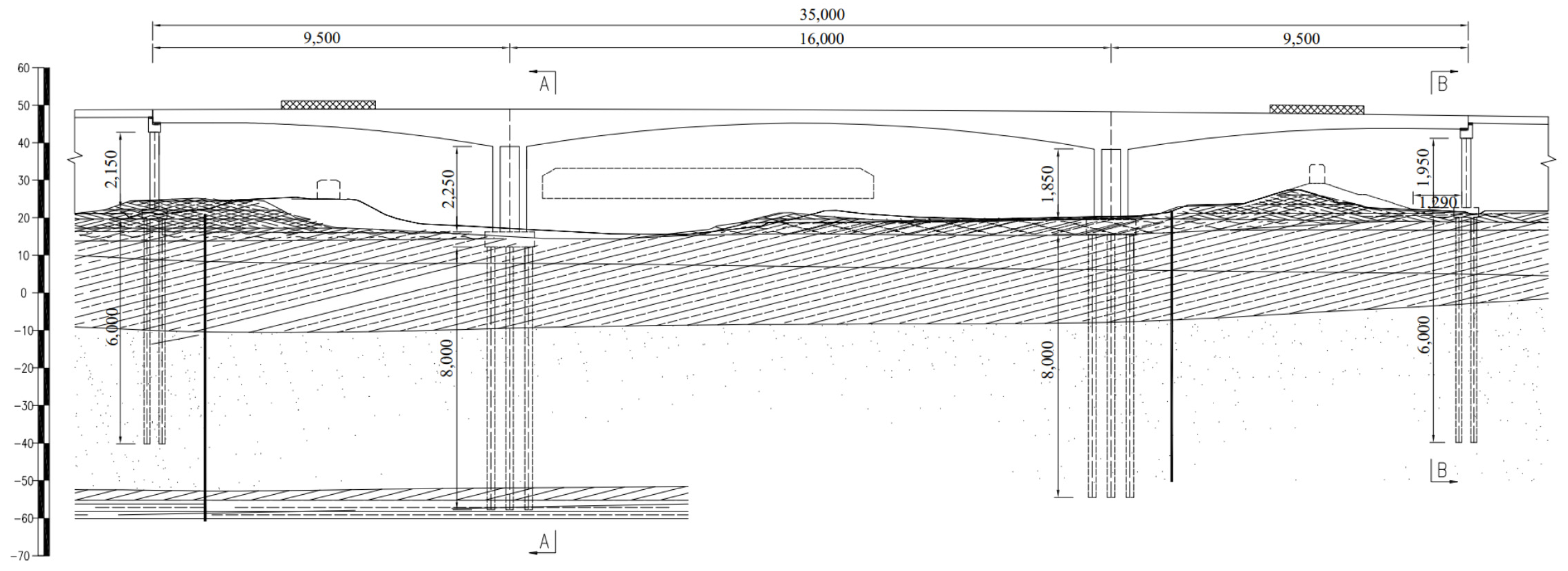
The bridge adopts a three-span, variable cross-section PC continuous rigid-frame scheme with a main span of 160 m. Cantilever construction with travelling formwork (hanging baskets) is employed. Owing to the tall main piers and pronounced structural flexibility, controlling stresses and deformations during construction is challenging. The structure exhibits the typical features of a long-span–tall pier–long cantilever; the plan layout is shown in Figure 3.
During construction, the structure is subject to a time-varying, coupled, multiple-condition, and uncertain state driven by multiple factors. Key milestones include zero block casting, segmental cantilever casting using hanging baskets, side-span cast-in-place segments, and closure. These factors—temperature effects, stressing sequences, concrete creep and shrinkage, hanging basket stiffness degradation, and cumulative errors—can deviate structural responses, resulting in schedule delays, quality issues, or safety risks. In addition, the site lies in a humid central climate zone with rapidly rising water levels during flood seasons and short construction windows. Subsurface conditions include deep soft soils, making the stability control of falsework and working platforms difficult. Overall, construction-phase risks are highly dynamic, interactive, and nonlinear.
Current projects typically rely on static forms, expert judgement, or preset risk lists for safety management, which are ill suited to the multisource coupling and dynamic evolution described above. Therefore, taking the Tongshun River Bridge as a case study, we develop a construction-phase risk assessment framework that integrates DEMATEL–ISM-based causal identification with a DBN. The framework enables risk chain modelling, key factor identification, and probabilistic inference, providing methodological support for the intelligent safety management of complex bridge construction.

3.2. Data Acquisition and Preprocessing

3.2.1. Data Acquisition

To comprehensively cover the typical risk factors at construction sites, we constructed a labelling scheme comprising four categories—bridge, human, machine, and environment—with 14 subcategories in total (Section 2.1.4). Table 7 reports the risk element counts and proportions.

3.2.2. Image Preprocessing and Augmentation

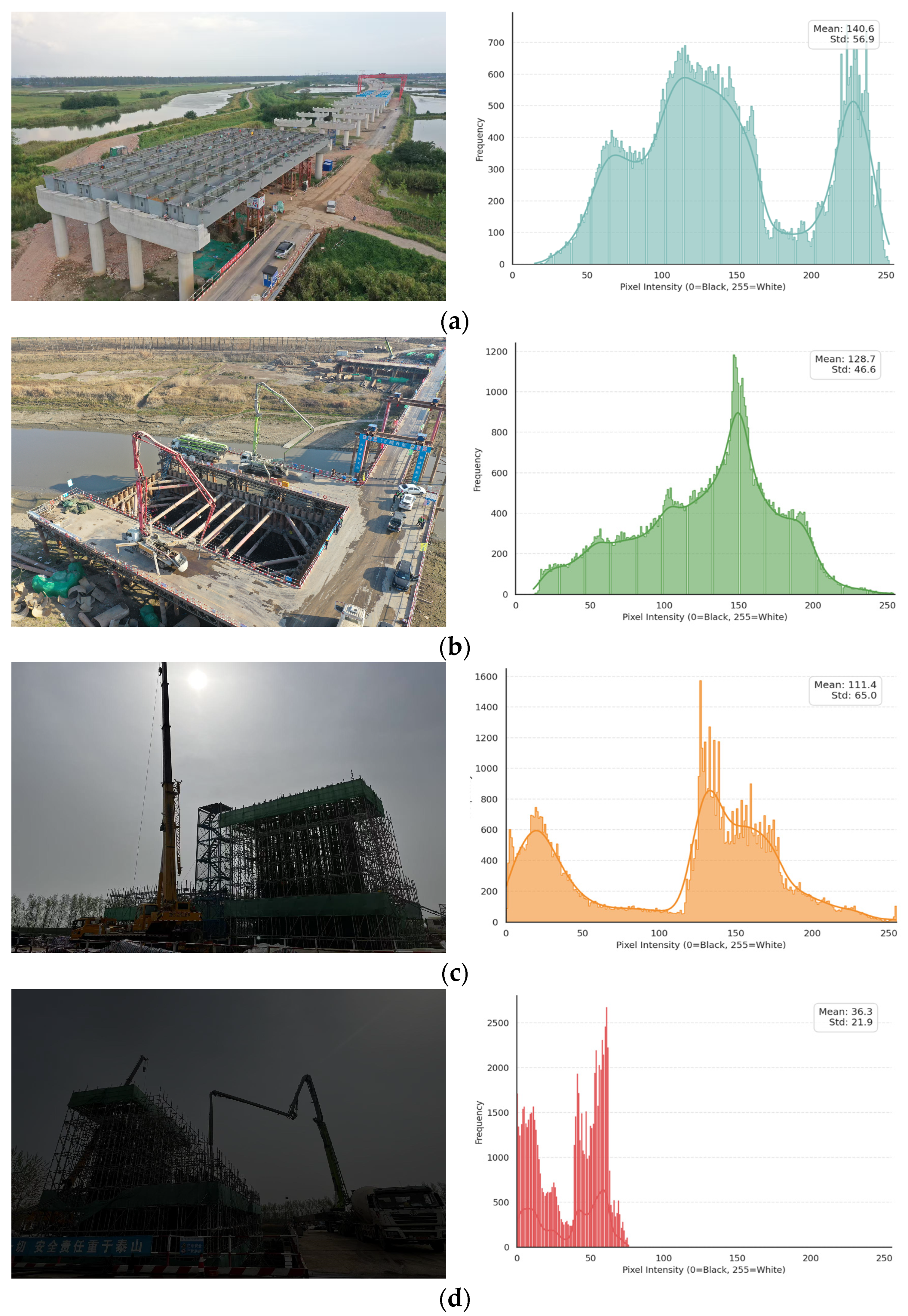
Images collected on site vary markedly in quality because of natural lighting, auxiliary illumination, and occlusions. To analyse the effects of illumination on detection, grayscale histograms were constructed, and the images were grouped into four typical lighting conditions:
(1)
Well-lit scenes: The exposure is adequate, with clear edges and rich details for primary targets. The grey levels range mainly from 50–180, and the mean grey values are >100.
(2)
Partial shadow/occlusion: Shadows from equipment, scaffolding, or structures cause marked local brightness variations. The grey levels range mainly from 12–255, and the mean grey values ≈ 130.
(3)
Low/backlighting: The images are taken at dusk or night with insufficient fill light. Edges are blurred, and contours are degraded. The grey levels range mainly from 0–50 and 120–180, with a mean ≈ 110.
(4)
Very dark scenes: The images include long-range night surveillance or areas without temporary lighting. The grey levels range mainly from 0–70, with a mean < 40.
Histograms under the four lighting conditions are shown in Figure 4. Table 8 summarizes the image counts for well-lit, partially shadowed/occluded, low-light, and dark scenes.
To improve the robustness to small objects and complex scenes, all the annotated images were resized to 1280 × 720 while preserving the aspect ratio. Augmentations include mosaics, random horizontal flips, brightness/contrast perturbations, and copy–paste to expand effective samples for rare classes. For classes comprising <2% (e.g., unprotected workers and warning signs), random oversampling and MixUp are applied during training to mitigate class imbalance.
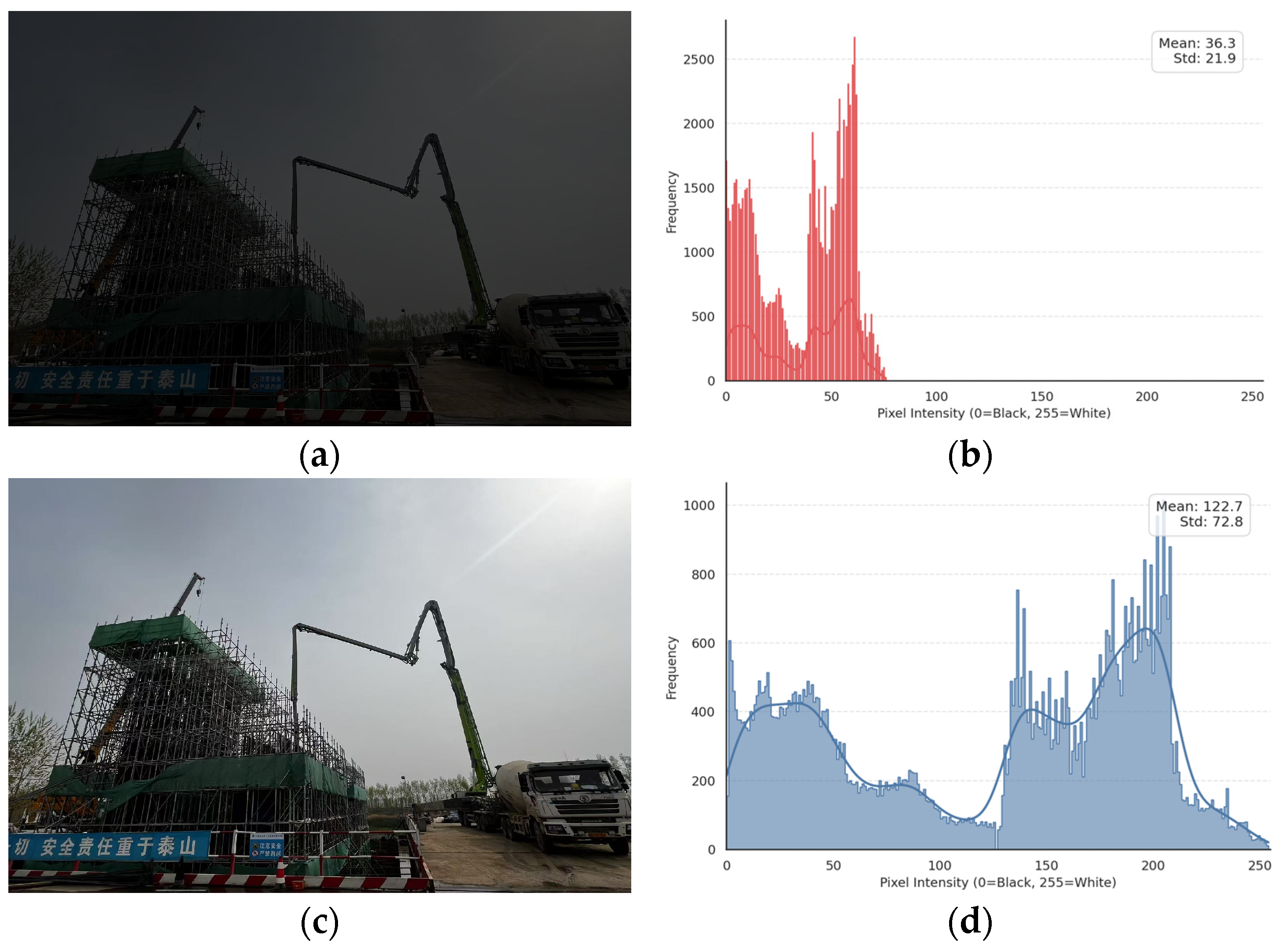
To validate the effectiveness of histogram-based analysis and augmentation, a representative low-light example is shown in Figure 5. The original image (Figure 5a) is dim, with a histogram concentrated between 0 and 70 (Figure 5b). After CLAHE and gamma correction, the brightness and local contrast improve markedly (Figure 5c), and the histogram widens (Figure 5d), facilitating more accurate feature extraction.

3.3. Image Detection Performance and Risk Element Recognition

We evaluated the improved YOLOv8 model using standard detection metrics, including classwise precision–recall (PR) curves, F1–confidence curves, mAP, and a four-class confusion matrix (bridge, human, machine, environment). The computation of these metrics follows the procedures described in Section 2.1.3, and the resulting curves for the Tongshun River Bridge dataset are presented in Figure 6, Figure 7 and Figure 8.

3.3.1. Detection Performance Analysis

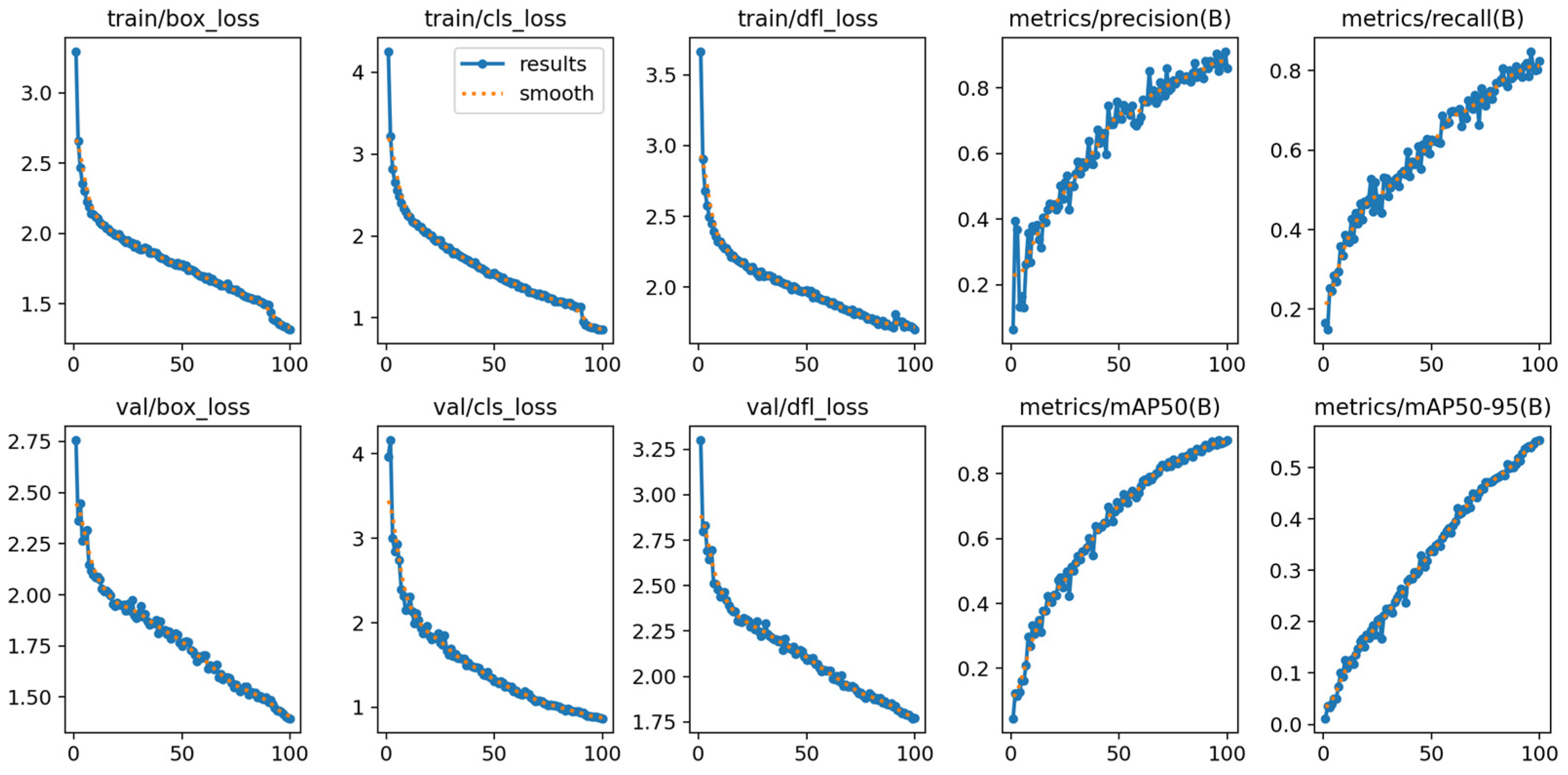
The improved YOLOv8 detector was trained for up to 100 epochs with early stopping on the basis of the validation mAP, and the best checkpoint near the 100th epoch was used for all subsequent experiments. We used stochastic gradient descent (SGD) with an initial learning rate of 0.01, momentum of 0.937, weight decay of 5 × 10⁻⁴, and a batch size of 16, together with a cosine learning-rate schedule and three warm-up epochs.
Training ran for up to 100 epochs with early stopping—training was terminated when the mean validation accuracy did not significantly improve for several epochs. The best model was obtained when approaching the 100th epoch. The finalized model was evaluated using the test dataset, and the performance trends for the training and validation phases are illustrated in Figure 6. In total, the annotated dataset contains 17,649 image frames. Among them, 12,354 frames are used for training, 1765 for validation, and 3530 for testing, following the 7:2:1 ratio described above. The evolution of the loss and performance metrics on the training and validation sets is shown in Figure 6, while the final detector is selected on the basis of the validation performance and evaluated on the held-out test set.
The overall training and test performance of a single multiclass YOLO-based detector trained jointly on all the annotated risk elements are shown in Figure 6. Images containing bridge-, human-, machine- and environment-related elements are combined in each mini-batch, and a unified multiclass loss is optimized so that gradients from all 14 risk elements contribute jointly to the model update. As shown in Figure 6, the box, objectness and classification losses for both the training and validation sets decrease monotonically and remain close to each other throughout 100 epochs, indicating stable convergence without obvious overfitting. Moreover, the precision, recall and mAP@[0.5:0.95] steadily increase with training. This behaviour confirms that the improved YOLOv8 model has learned a consistent representation of the Tongshun River Bridge scenes and can provide reliable visual evidence for subsequent DEMATEL–ISM–DBN risk assessment. All curves in Figure 6 are aggregated over all 14 risk elements; category-specific detection performance is further analysed in the confusion matrix (Figure 7) and related discussion.
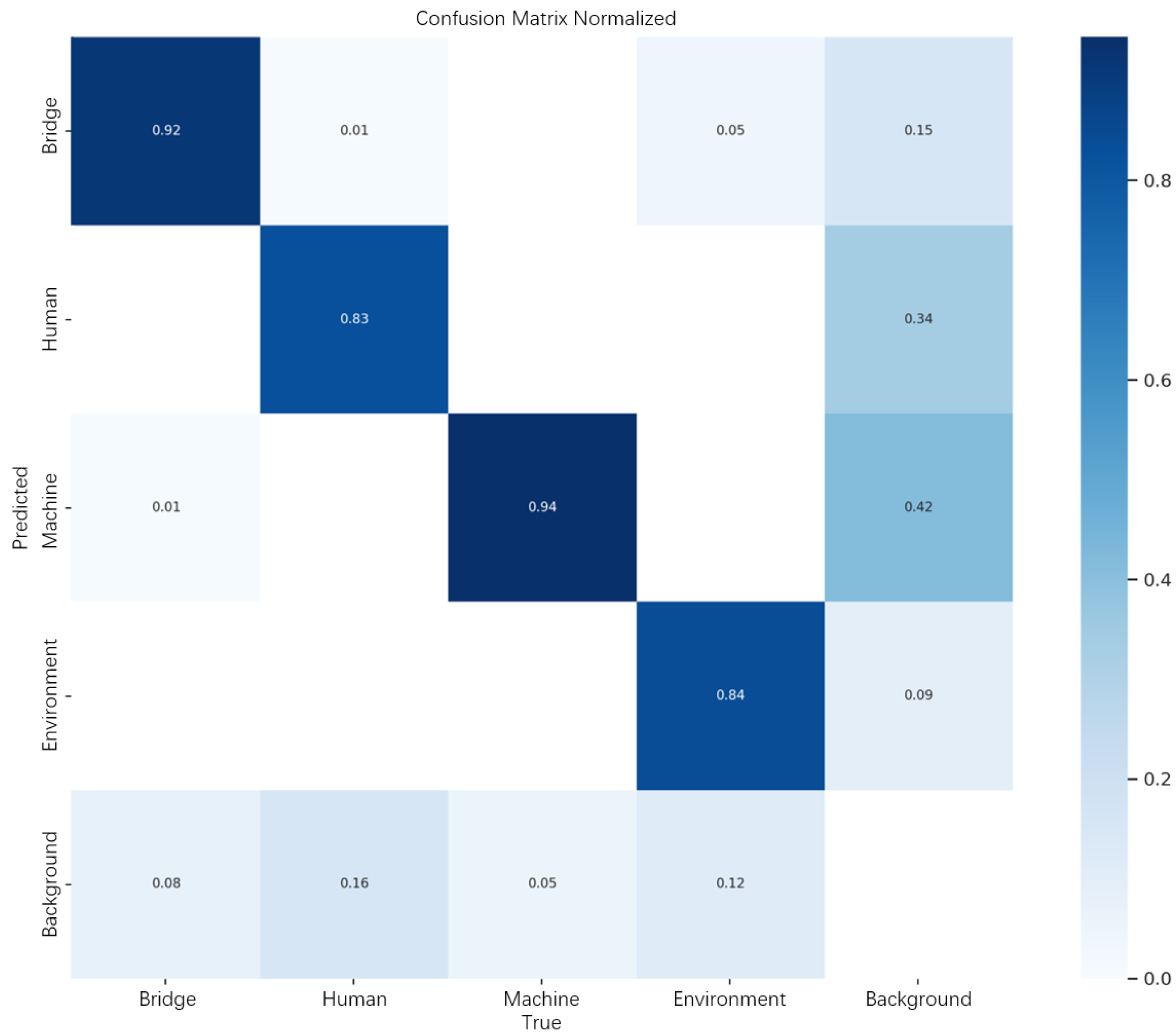
The confusion matrix for the four categories (structure, personnel, machinery, and environment) is presented in Figure 7. Rows denote the ground truth, columns denote predictions, and diagonal entries indicate correct detection rates. High accuracy is achieved across all categories. On the test set, the normalized confusion matrix in Figure 7 has a recall of 0.90 for bridge structures, 0.89 for humans, 0.94 for machinery and 0.88 for the environment, while the background recall reaches 0.87. From a safety perspective, such high recalls for the human- and environment-related categories mean that workers, temporary facilities and protective devices are rarely missed by the detector. This greatly reduces the probability that hazardous situations, such as working at height without adequate guarding or entering poorly protected lifting zones, remain completely unseen in the subsequent causal-chain analysis and DBN-based risk inference.
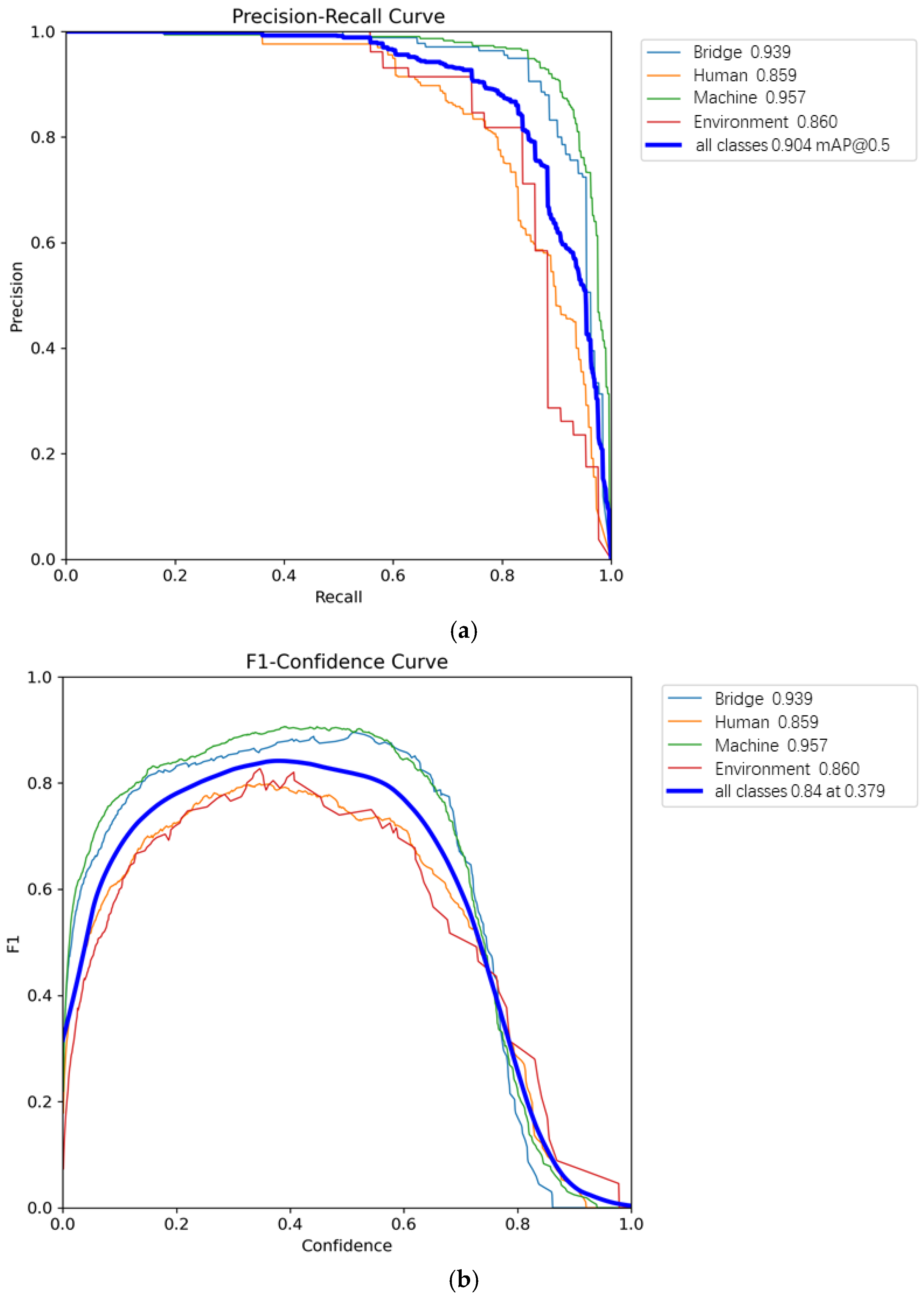
The precision–recall (PR) curves and the F1–confidence curves computed on the validation set are shown in Figure 8. These validation curves are used to select the confidence threshold that maximizes the F1 score on the validation data, and this operating point is then adopted for all subsequent test and case-study analyses. The precision–recall curves in Figure 8a yield AP @ 0.5 values of 0.93, 0.85, 0.97 and 0.88 for the bridge, human, machinery and environment categories, respectively, and an overall mAP@0.5 of 0.94 across all four categories. These results indicate that the detector maintains high precision over a wide range of recall levels, even for the human and environment categories that are most directly related to onsite safety conditions.
As shown in Figure 8b, the F1–confidence curves peak at 0.89, 0.83, 0.87 and 0.82 for the bridge, human, machinery and environment, respectively, with an overall maximum F1 of 0.87 for all classes at an optimal confidence threshold of 0.31. This operating point achieves a favourable trade-off between missed detections and false alarms, ensuring that safety-critical objects are detected with high reliability while spurious warnings are kept at a manageable level for practical use at the construction site.
Therefore, the improved YOLOv8 model provides a robust perceptual front-end for the proposed DEMATEL–ISM–DBN framework, providing credible observations of structural, human, machinery and environmental elements that underpin the subsequent dynamic risk assessment for LSPCCRFB construction.

3.3.2. Risk Element Recognition and Visualization

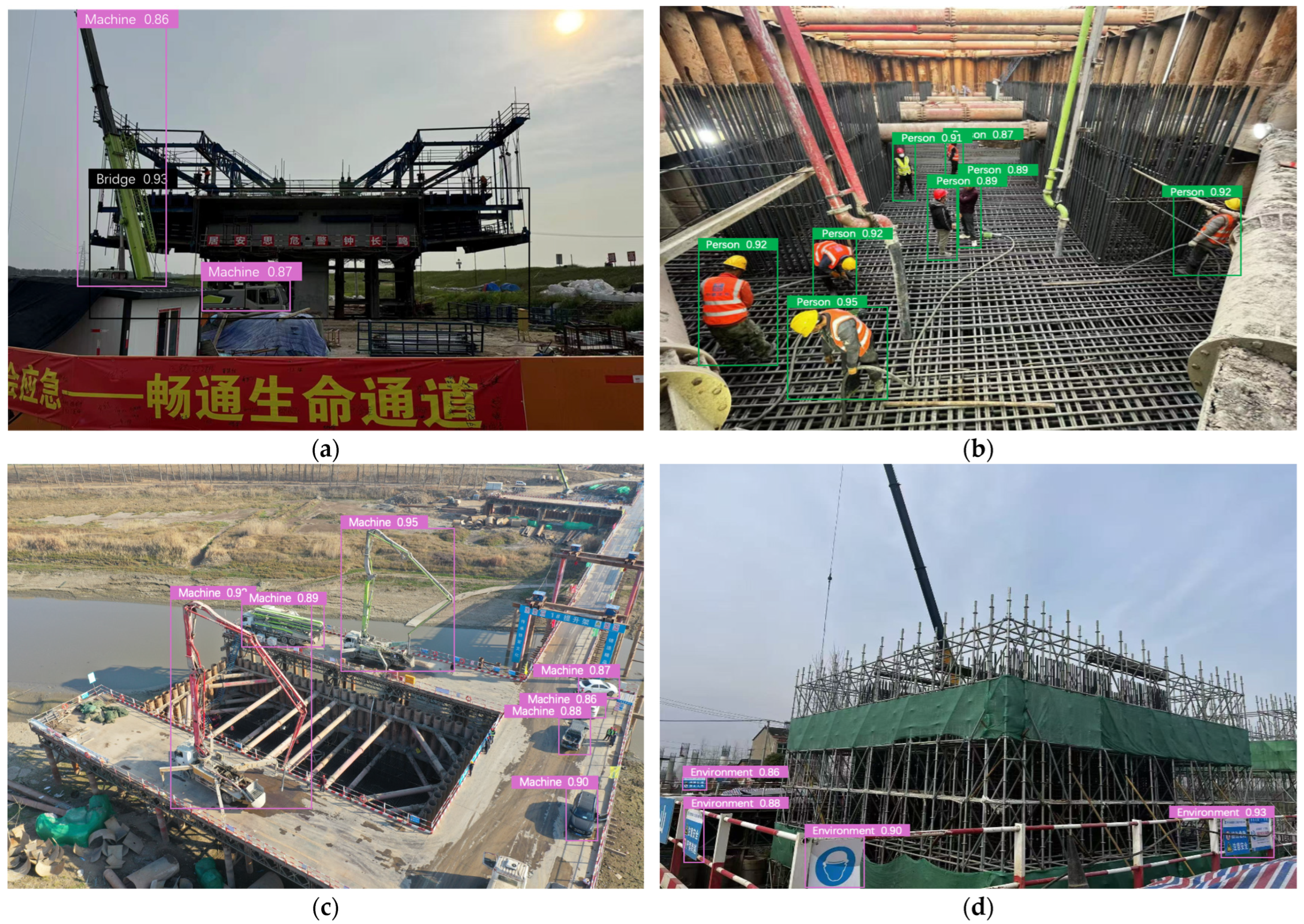
As a further step of the validation procedure described in Section 3.3.1, we also conduct a qualitative validation of the detector. Representative detection results on nontraining images are shown in Figure 9. The four categories (‘bridge’, ‘person’, ‘machine’, and ‘environment’) are correctly localized and classified in typical bridge construction scenes, including complex backgrounds and varying illumination conditions. This qualitative validation complements the quantitative validation metrics (loss, precision–recall, and F1–confidence curves) and visually confirms the model’s ability to recognize risk elements in realistic construction scenarios.

3.4. Causal Matrix and Hierarchical Topology Analysis

3.4.1. Factor Attribute Analysis Based on DEMATEL

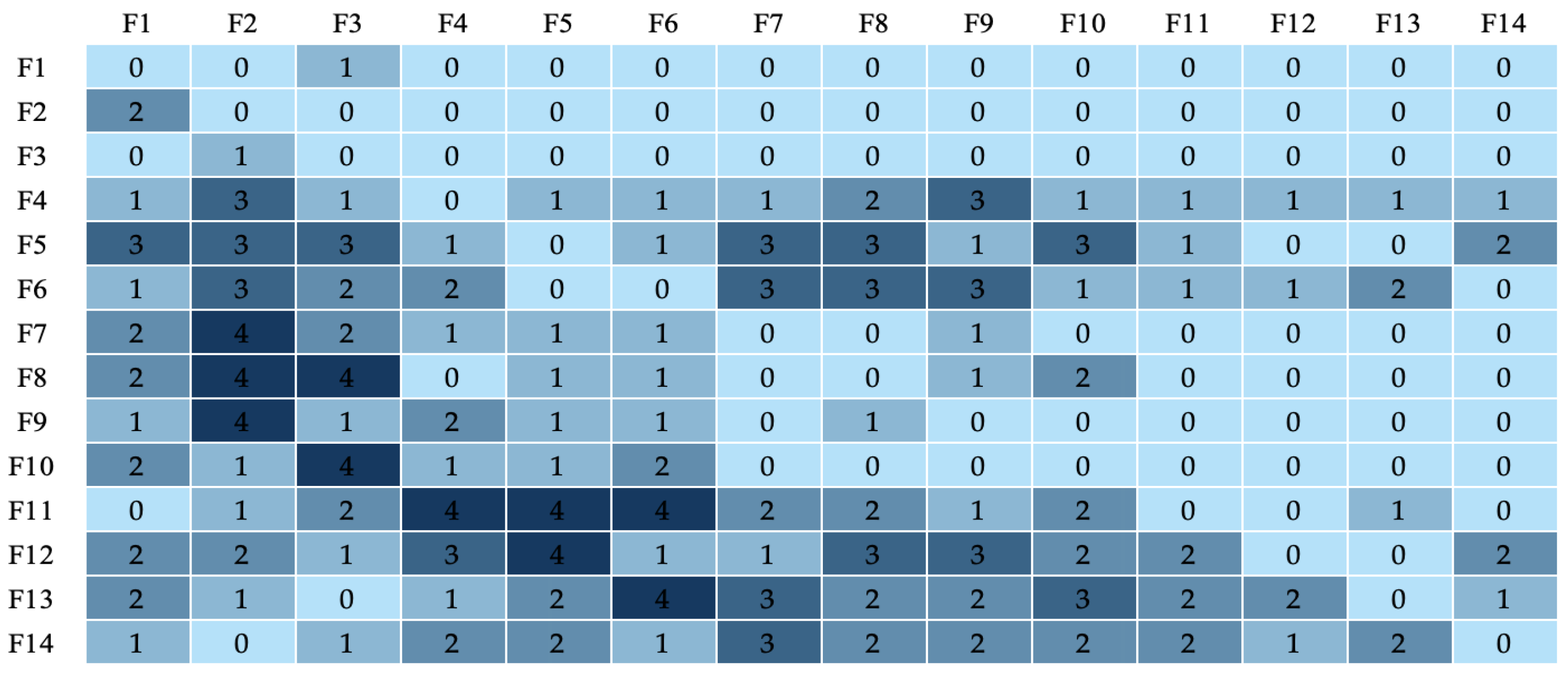
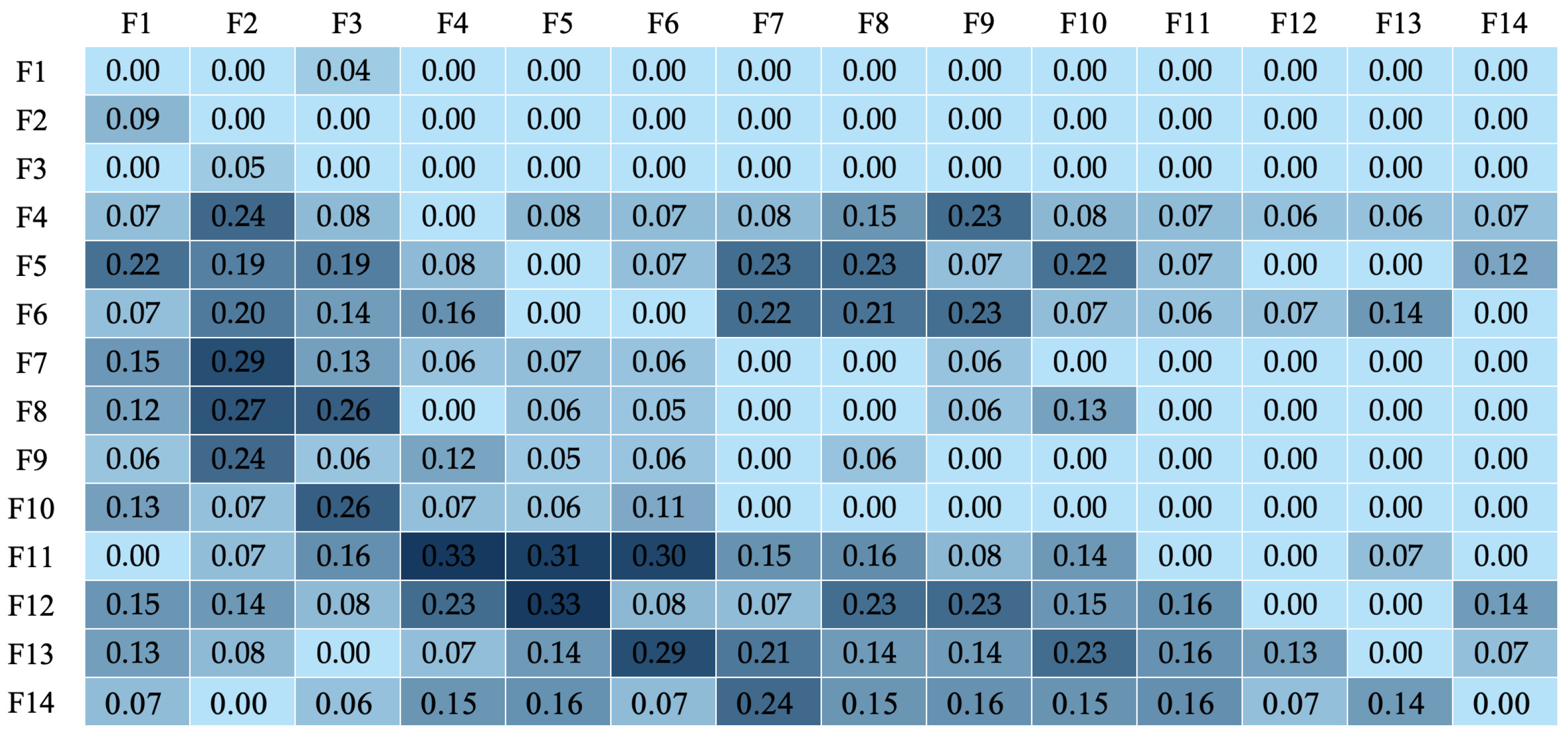
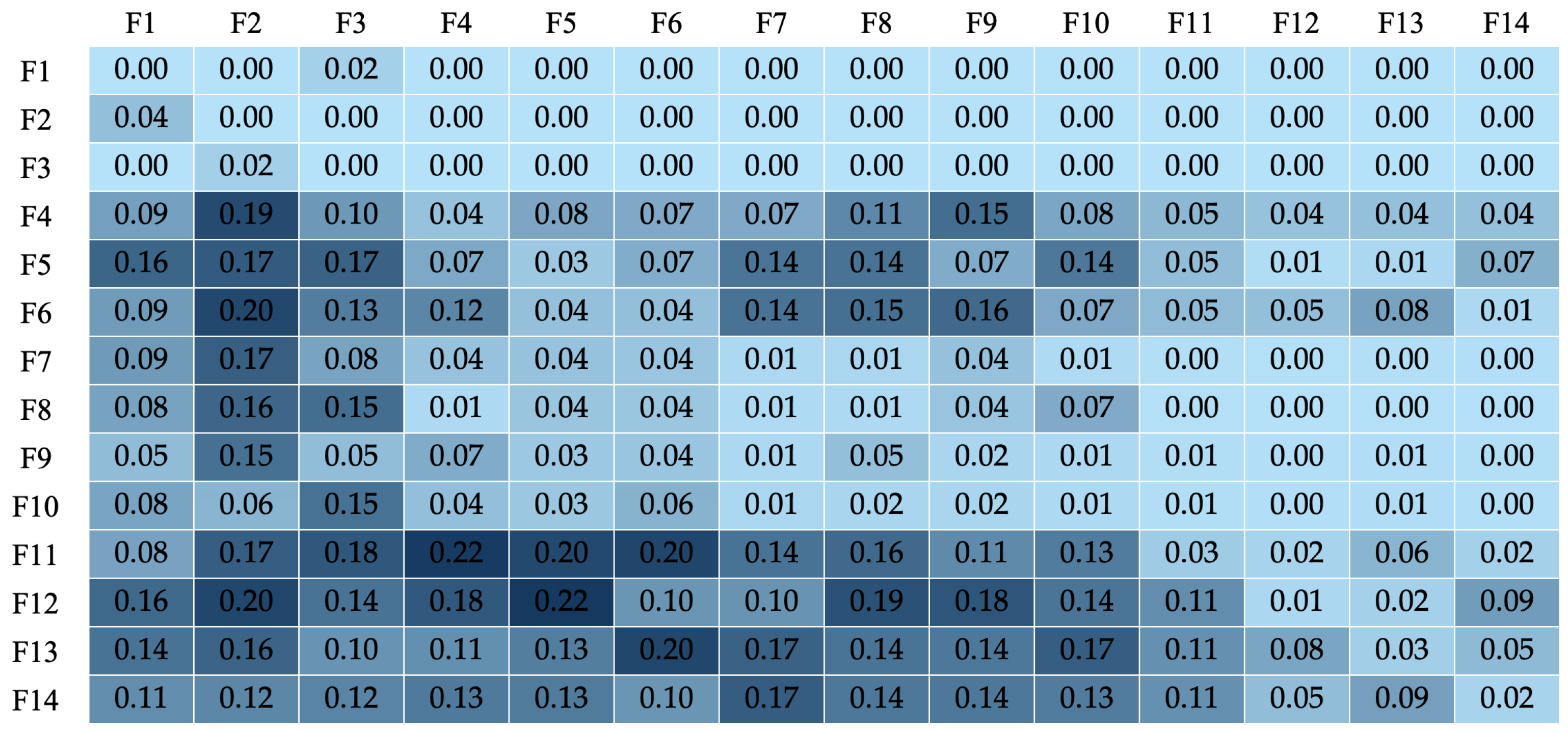
To ensure representative inputs, a “dual-source fusion” strategy is used. Nine senior experts scored the direct influence between any pair Ri, Rj; their averaged, rounded scores form the expert matrices A(k) (Figure 10). The maximum interexpert difference per item does not exceed 1, indicating strong consistency and reliability. Objective information is derived from the detections in Section 3.3: frequency ci and mean confidence pij (when Ri may trigger Rj). The expert rating matrices were first subjected to consistency checks and normalization. Specifically, the direct-relation matrix A is constructed from expert scores according to Equation (10). Before implementing the ISM hierarchical decomposition in Section 2.2.2, the DEMATEL results from Section 2.2.1 must be applied to the integrated subjective-objective weighting scheme (Equations (17)–(19) in Section 2.2.3) to obtain the fused direct relationship matrix shown in Figure 11.
As illustrated in Figure 10, strong outgoing influences from unprotected personnel, commanders, guard lines and signs correspond to typical accident chains in LSPCCRFB construction, such as workers entering crane and lifting-hook operation zones when barriers or instructions are missing. Section 2.3.5 describes how such element-level impacts are mapped onto scenario-level risks, and Table 9 shows this mapping for the defined Fall, Collision, Injury and other risk scenarios.
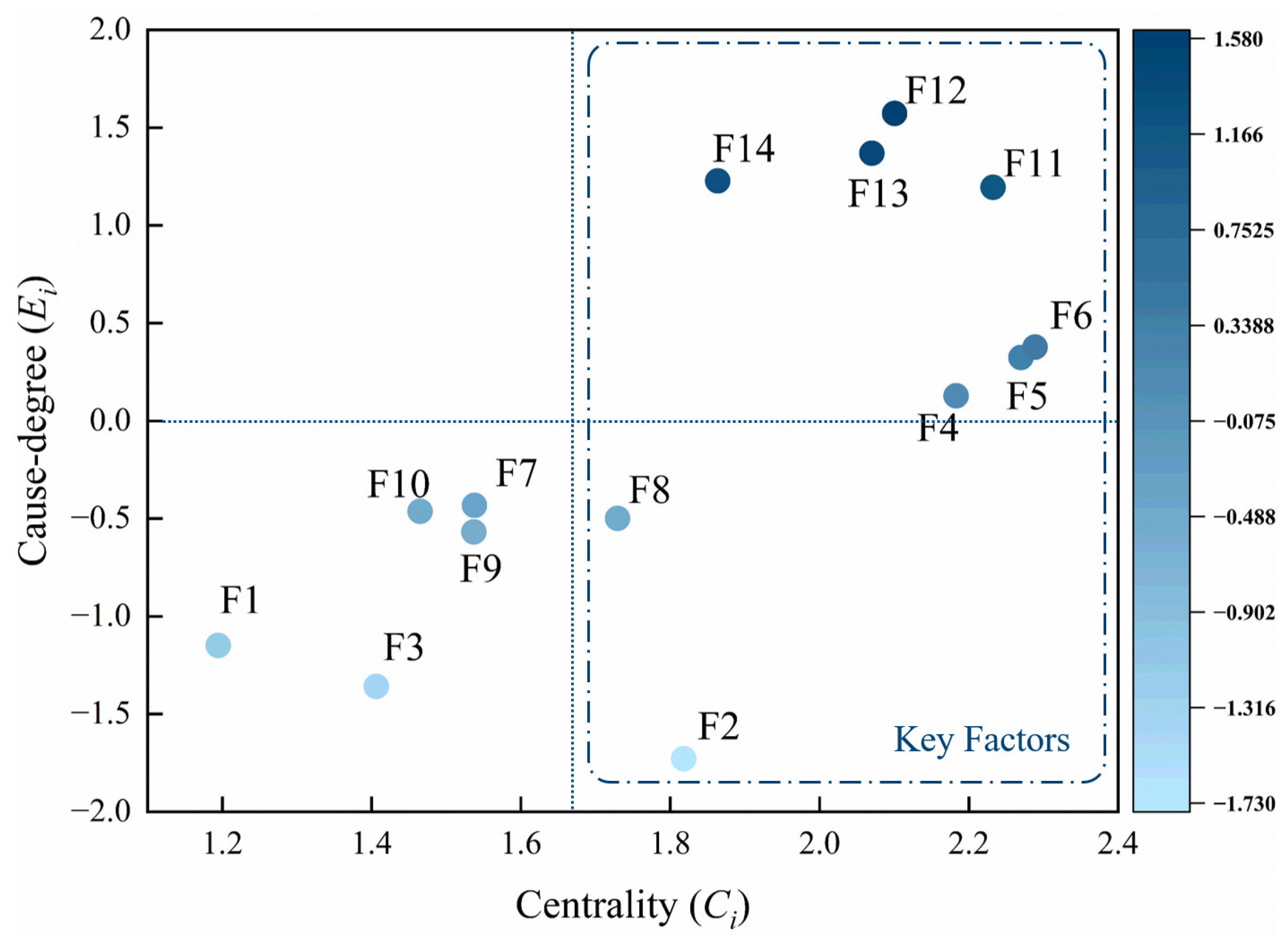
To elucidate more precisely the causal linkages among these influencing factors within the established framework, normalization was carried out according to Equation (11) using the “maximum row sum” criterion, resulting in a standardized matrix. This matrix was then expanded using Equation (12) to obtain the comprehensive influence matrix, as presented in Figure 12. The prominence Ci and causality Ei values reported in Table 9 are computed from the comprehensive influence matrix T using Equation (13), revealing that out of the 14 influencing factors, seven act as causes, while the remaining seven serve as effects.
The data in Table 10 indicate that Unprotected personnel (F6) and Commanders (F5) have the highest prominence values, whereas the Guard line (F11) and Sign (F12) also lie in the causal quadrant with strong positive Ei, underscoring their role as critical environmental protection drivers rather than the numerically highest-prominence factors. Unprotected personnel, Commander, Lighting, Operator, and Yard also fall into the causal layer, highlighting the dominant impact of human factors and site layout. In the effect layer, bridge pier, main beam, and cap have high prominence but negative causality (<−1.0), indicating that they are terminal nodes receiving accumulated upstream risk. Vehicles, excavators, cranes, and lifting hooks are likewise effect-layer factors influenced by human, environmental, and operational risks. The prominence versus causality is plotted in Figure 13.
In Figure 13, the dotted rectangle encloses ‘key factors’, defined as nodes with prominence Ci above the median and positive causality Ei > 0 (e.g., F5, F6, F11–F14). These factors are both influential and upstream in the network and therefore prioritized for proactive control.

3.4.2. Hierarchical Risk Topology Analysis

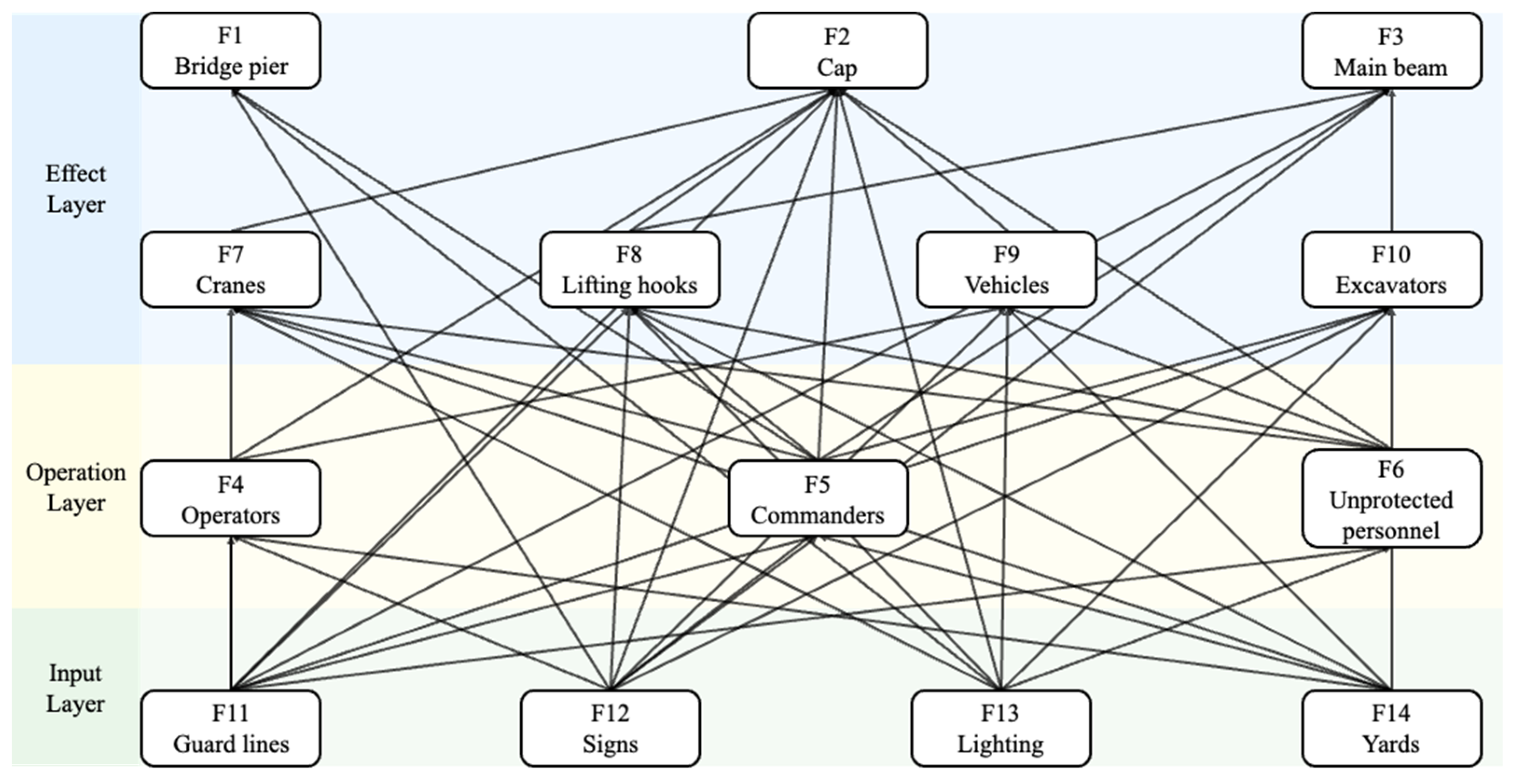
To obtain an acyclic DBN from the DEMATEL–ISM graph, the bidirectional links are resolved by retaining the edge with a larger Tij, and small cycles (e.g., among F1–F3) are broken by imposing a construction-stage-consistent ordering (F1→F2→F3) and removing the weakest edge. Thus, Figure 14 shows the refined DAG used for DBN inference. Following DEMATEL, ISM organizes the 14 factors into three hierarchical levels—input, operation, and effect groups. The reachability and hierarchical levels are derived by constructing the reachability matrix and performing the iterative decomposition procedure described in Equations (14)–(18).
Because the binarized matrix T* retains only entries Tijλ = μT + kσT, some intuitive but relatively weak direct influences (e.g., from personnel or the yard layout to the bridge pier, F1) are represented indirectly via intermediate machinery and environment nodes. This explains why certain ‘cause’ nodes appear unlinked to specific ‘effect’ nodes in Figure 10, despite belonging to the same physical risk chain.
As shown in Figure 14, Unprotected personnel (F6) is consistently treated as an upstream causal factor that influences both structural effect nodes (e.g., F1–F3) and the scenario variables. The scenario definitions in Table 9 therefore describe how combinations of such causal factors and structural context activate the corresponding scenario nodes without changing the parent–child roles in the DBN.

3.5. Risk Probability Inference and Safety Assessment

3.5.1. Network Mapping and Dynamic Modelling

In the DBN, cross-time causal edges connect slices, enabling inference of current states from previous ones. Observations are obtained from the improved YOLOv8: risk labels serve as state variables, and detection confidence serves as observation reliability, ensuring causal consistency while remaining responsive to real-time monitoring. Formally, the DBN state vector at each time slice and the joint distribution over all the slices follow the definitions in Equations (20) and (21), ensuring consistency with the topological structure introduced in Section 2.3.

3.5.2. Dynamic Learning of Conditional Probability Tables

Because conditions and behaviours are time-varying, static CPTs are inadequate. We therefore update CPTs with a sliding window and exponential decay (Equations (22) and (23)), using weighted counts over joint states and Bayesian smoothing to avoid zero probabilities for rare events.
In this study, the primary risk scenarios selected are fall, collision, injury, structural damage and strike. The mapping relationships between these five risk scenarios and risk elements are shown in the table below. These five scenarios are defined by combining the DEMATEL–ISM causal structure (Figure 14) with typical accident types in LSPCCRFB construction. For each scenario Sk, we select the risk elements Ri that simultaneously satisfy (i) belonging to the causal chains leading to this accident type in Figure 14 and (ii) meeting the necessary condition in Table 10 (e.g., ‘work at heights’ for Fall and ‘equipment in motion/hoisting’ for Collision). Each scenario is thus implemented as a subnetwork of the full DBN, containing only the corresponding risk elements and their parents.
In Table 10, the column ‘Necessary condition’ does not represent effect nodes in the DBN but the joint presence of causal factors and structural context required for a scenario to become likely. For example, the Fall scenario involves elevated structural elements (F1–F3) together with the causal factor Unprotected personnel (F6). In the DEMATEL–ISM and DBN models, F6 remains an upstream causal node that influences these structural effect nodes and the Fall scenario variable rather than being treated as a child node itself.
In terms of engineering, the five scenarios correspond to typical construction failure modes. ‘Fall’ mainly captures workers falling from decks, hanging baskets, or scaffolds when guard lines or personal protection are inadequate. ‘Collision’ denotes impacts between cranes, vehicles, lifting hooks and structural members during hoisting or transport. ‘Injury’ and ‘Strike’ represent personnel entering prohibited zones and being hit by moving equipment or falling objects, whereas ‘Structural Damage’ refers to cracking, deformation, or local collapse of piers, caps, or main beams caused by heavy impacts.
At each time step t, the DBN with particle filtering provides posterior probabilities P(Ri(t)) for all risk elements. For each scenario Sk, these element-level probabilities are then aggregated into a scenario-level probability P(Sk(t)) using the Noisy-OR/Noisy-AND and suppression formulations in Equations (28)–(30): the elements listed in Table 10 as ‘risk elements’ form the triggering set Rk, whereas protective or environmental factors form the suppressing set Rk. Thus, the internal interaction within each scenario is captured by the weighted contributions and suppressions of its associated risk elements.
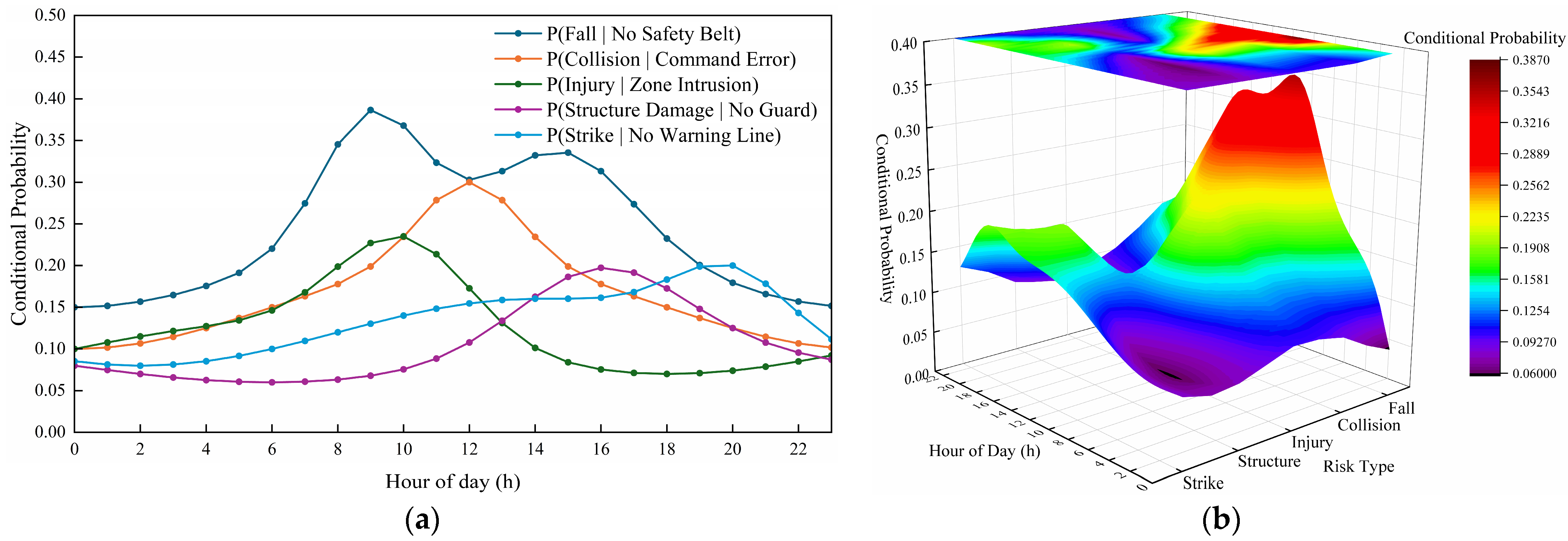
Using the DBN with particle filtering, we obtain diurnal conditional probability trajectories. The patterns align with task rhythms, personnel states, and environmental factors, demonstrating the model’s fidelity. For each of the five scenarios, the DBN yields the probability that the corresponding binary scenario variable is in the ‘risk’ state at each time step. The curves in Figure 15 plot the evolution of this probability over the 24 h horizon. Specifically, for each hour within the 24 h horizon, particle filtering yields {P(Ri(t))}, and Equations (28)–(30) are applied to compute P(Sk(t)) for k = 1, …, 5. The curves and surfaces in Figure 15 therefore plot the time series of these scenario probabilities P(Sk(t)), i.e., the conditional probabilities of the five construction risk chains within 24 h. Distinct temporal patterns emerge: fall-from-height risk peaks at 8–10 a.m. and 2–4 p.m.; equipment-collision risk increases at midday; zone-intrusion injuries cluster in late morning; damage from missing protection increases through the afternoon; and object-strike risk without guard lines is more prominent from dusk to night.
Across the 24 h horizon, the greatest changes in posterior probability occur for human-related nodes (e.g., unprotected personnel and commanders) and environmental nodes (e.g., yard environment and guard line), whereas structural nodes such as bridge piers, cap beams and main beams show relatively small temporal variations. Qualitatively, the predicted daily risk peaks align with the observed rhythms of high-intensity construction tasks and crane and hoisting operations reported in the site logs, and this consistency has been confirmed by onsite experts. This suggests that the DBN captures the main temporal patterns of human- and environment-driven risk, although a formal quantitative validation remains to be conducted.
These patterns result from coupled human–process–environment drivers: human factors (attention ramp-up in the early morning; fatigue and circadian effects after noon) explain peaks in falls and injuries; process factors (crane operations; material transport concentrated around noon) increase collision risk; environmental/management factors (adjustments/removal of protections and lax oversight in the afternoon) increase structural damage; and low illumination plus missing barriers at night amplify the risk of object strike. Single-peaked curves reflect transient human–process coupling, whereas monotonic increases reflect cumulative structural/environmental effects approaching saturation.

3.5.3. Particle Filtering Inference and Future-State Prediction

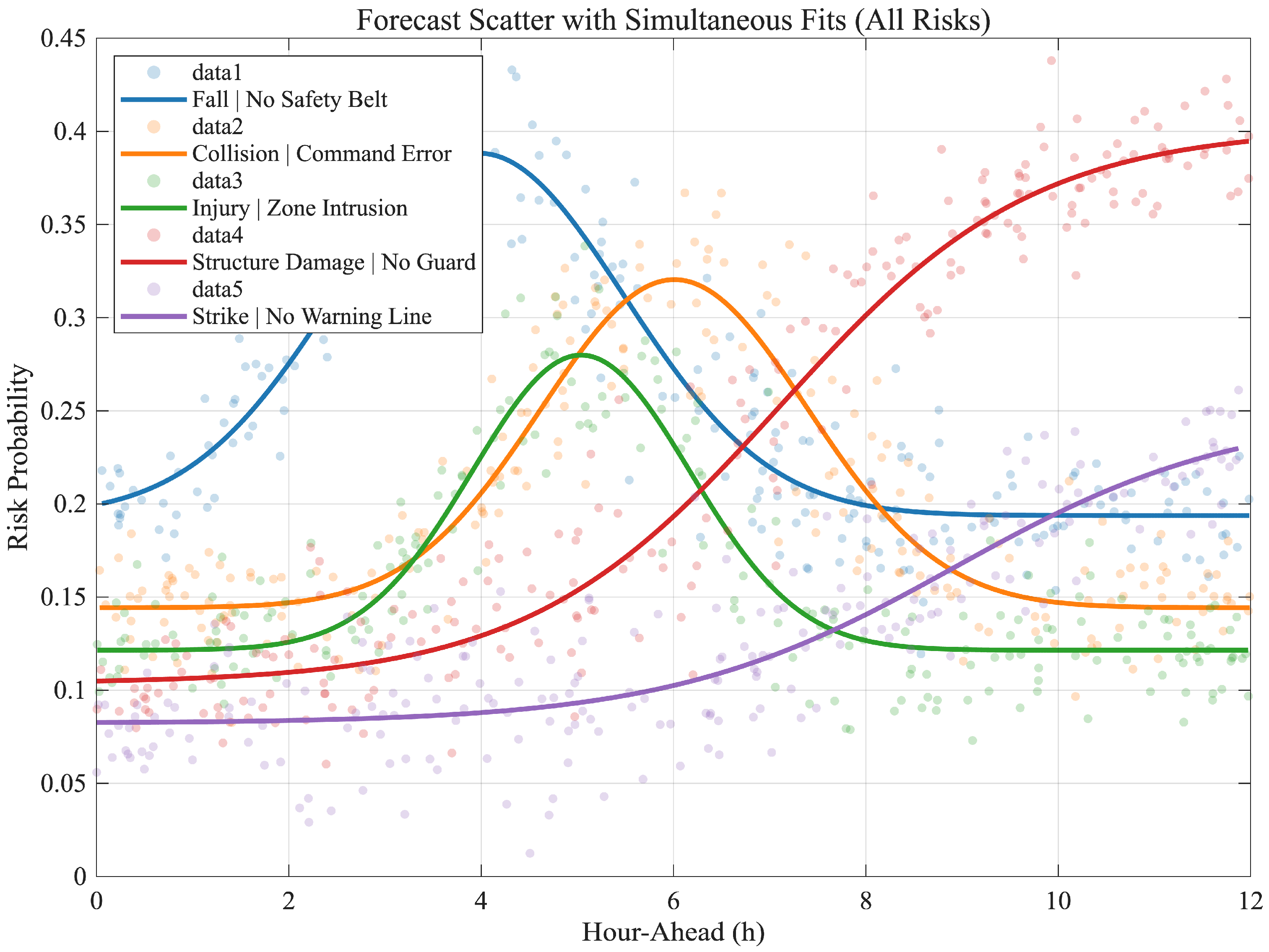
Given image-based observations and updated CPTs, particle filtering is used to infer posterior state distributions. Each particle encodes a hypothesized combination of risk-element states; weights are updated per Equation (15) and resampled to obtain current risk probabilities and scores. Forwards Monte Carlo propagation (Equation (17)) then produces H-step forecasts for planning (Figure 16).
The figure presents the prediction samples obtained via particle filtering in scatter plot form. Fall-from-height without safety belts, collisions due to command errors, and injuries from zone intrusion exhibit typical unimodal trajectories: their probabilities increase as work intensity and cross-task coordination increase and then decline after the associated operations are completed. In contrast, structural damage caused by missing protections and object strikes due to the absence of guard lines displays monotonically increasing trends that converge towards a plateau, reflecting cumulative mechanisms and the gradual deterioration of site conditions. The unimodal trajectories result from transient human–process coupling, whereby attention, crowding, and coordination load increase and subsequently decrease within the prediction window. The monotonic trajectories, by contrast, reflect cumulative structural and environmental effects, under which risks continue to accumulate until they are near saturation in the absence of sufficient protective measures.
The particle-filter and forwards Monte Carlo results in Figure 15 and Figure 16 are intended as proof-of-concept demonstrations of the proposed framework. A rigorous convergence study—including explicit reporting of particle numbers, Monte Carlo sample sizes, and the impact of variance-reduction techniques—is left to future work, where these settings will be documented and calibrated to ensure stable risk estimates for operational decision-making.

3.5.4. Safety Risk Level Assessment

Following Section 3.5, representative probability values are extracted from particle-filtered trajectories by averaging over the observation window and capturing steady-state behaviour. These are fed into the loss model in Section 2.3 to yield risk ratings. Loss levels were calibrated via historical accident data from similar projects, ensuring the model’s applicability to the specific context of LSPCCRFB construction. Table 11 reports the grades of major site risks.
The data in Table 11 indicate that Fall has a probability of only 0.2985 but is rated as Level IV because of catastrophic consequences. Structural damage has the highest probability, reflecting structural instability during construction, and is rated as Level III. Collision and Strike have moderate probabilities of having severe consequences; hence, they are classified as Level III. Injury has a lower probability with moderate losses but can disrupt operations without adequate protection and is also rated as Level III.
Overall, human and structural risks dominate the high-risk levels, whereas mechanical and environmental risks are mainly moderate. Safety management should therefore prioritize personnel protection and structural stability while also addressing weaknesses in organizational management and environmental safeguards.

4. Conclusions

This study demonstrates that the proposed vision-guided probabilistic framework significantly enhances the accuracy and adaptability of dynamic risk assessment in LSPCCRFB construction. By integrating improved YOLOv8-based perception with DEMATEL–ISM causal modelling and dynamic Bayesian inference, the method effectively captures the temporal evolution of complex construction risks under nonstationary conditions. To our knowledge, this represents the first comprehensive approach that links visual detection, causal reasoning, and probabilistic forecasting within a unified, data-driven workflow for engineering safety management.
These findings address the long-standing limitations of static, expert-driven risk evaluation by providing a mechanism for continuous, uncertainty-aware prediction. In doing so, the framework bridges the methodological gap between onsite visual monitoring and dynamic probabilistic decision-making. Beyond its theoretical contribution, this work offers practical guidance for improving real-time safety interventions—supporting proactive resource allocation, targeted supervision, and early warning of cumulative hazards in complex construction environments.
However, certain limitations remain. The reliance on expert input for initializing DEMATEL–ISM relations may introduce subjective bias, and the use of a single site dataset constrains the generalizability of the model. Moreover, the current implementation primarily emphasizes short-horizon forecasts, which may limit long-term predictive robustness. Owing to space limitations, we do not tabulate all time-varying conditional probability tables, but qualitative inspection of the posterior distributions reveals that human-related and environmental nodes undergo the greatest adjustments over time, whereas structural nodes change only modestly. A further limitation is the lack of formal out-of-sample validation of the DBN; future work will incorporate cross-project validation and quantitative predictive scoring to more rigorously assess forecasting performance.
Future work will systematically evaluate the sensitivity of risk estimates to particle numbers, sample sizes, and variance-reduction strategies and will report these quantities explicitly. In addition, we should expand the dataset across multiple construction sites and environmental contexts to improve generalizability. Exploring adaptive structural learning within the DBN to enable real-time causal updates would also be valuable. Integrating IoT-based telemetry and schedule data could further strengthen the framework’s predictive capacity, paving the way for fully automated, closed-loop safety management systems in bridge engineering and other large-scale infrastructure projects.


Author Contributions

Conceptualization, W.W.; Methodology, L.Z. and Y.D.; Software, W.W.; Validation, L.Z. and Y.D.; Formal analysis, Y.H.; Investigation, L.S.; Resources, Y.H. and L.S.; Data curation, Y.D.; Writing—original draft, L.Z. and Y.D.; Writing—review & editing, Q.G.; Visualization, L.S.; Supervision, Q.G.; Project administration, Y.H. All authors have read and agreed to the published version of the manuscript.

Funding

This research received no external funding.

Data Availability Statement

The original contributions presented in the study are included in the article, further inquiries can be directed to the corresponding author.

Conflicts of Interest

Authors Liangbo Sun and Yajun Hou were employed by the company The First Company of China Eighth Engineering Division Ltd. Authors Wei Wang was employed by the company Heilongjiang Provincial Expressway Service Center. The remaining authors declare that the research was conducted in the absence of any commercial or financial relationships that could be construed as a potential conflict of interest.

References

  1. Ebrahimi, H.; Zarei, E.; Ansari, M.; Nojoumi, A.; Yarahmadi, R. A System Theory Based Accident Analysis Model: STAMP-Fuzzy DEMATEL. Saf. Sci. 2024, 173, 106445. [Google Scholar] [CrossRef]
  2. Shan, Z.; Qiu, L.; Chen, H.; Zhou, J. Coupled analysis of safety risks in bridge construction based on N–K model and SNA. Buildings 2023, 13, 2178. [Google Scholar] [CrossRef]
  3. Li, Q.; Zhou, J.; Feng, J. Safety risk assessment of highway bridge construction based on cloud entropy power method. Appl. Sci. 2022, 12, 8692. [Google Scholar] [CrossRef]
  4. Wang, Y. Research on safety risk assessment method of highway bridge construction based on AHP–fuzzy comprehensive evaluation. Appl. Mech. Mater. 2014, 1030–1032, 855–859. [Google Scholar]
  5. Ajayi, A. Enhanced FMEA methods for proactive bridge failure risk analysis. IOSR J. Mech. Civ. Eng. 2025, 22, 29–46. [Google Scholar] [CrossRef]
  6. Zhang, L.; Wu, X.; Skibniewski, M.J.; Zhong, J.; Lu, Y. Bayesian-network-based safety risk analysis in construction projects. Reliab. Eng. Syst. Saf. 2014, 131, 29–39. [Google Scholar] [CrossRef]
  7. Jahan, M.K.; Bhuiyan, F.I.; Amin, A.; Mridha, M.F.; Safran, M.; Alfarhood, S.; Che, D. Enhancing the Yolov8 Model for Realtime Object Detection to Ensure Online-Platform Safety. Sci. Rep. 2025, 15, 21167. [Google Scholar] [CrossRef]
  8. Park, M.; Tran, D.Q.; Bak, J.; Park, S. Small and Overlapping Worker Detection at Construction Sites. Autom. Constr. 2023, 151, 104856. [Google Scholar] [CrossRef]
  9. Chen, X.; Deng, L.Y.; Hu, C.; Xie, T.Y.; Wang, C.Q. Dense Small Object Detection Based on An Improved Yolov7 Model. Appl. Sci. 2024, 14, 7665. [Google Scholar] [CrossRef]
  10. Xue, C.; Xia, Y.L.; Wu, M.J.; Chen, Z.Q.; Cheng, F.Y.; Yun, L.Y. El-Yolo: An Efficient and Lightweight Low-Altitude Aerial Objects Detector for Onboard Applications. Expert Syst. Appl. 2024, 256, 124848. [Google Scholar] [CrossRef]
  11. Wen, G.; Li, S.B.; Liu, F.C.; Luo, X.Y.; Er, M.J.; Mahmud, M.; Wu, T. Yolov5s-CA: A Modified Yolov5s Network with Coordinate Attention for Underwater Target Detection. Sensors 2023, 23, 3367. [Google Scholar]
  12. Zhang, T.; Wan, F.; Duan, H.; Tong, K.W.; Deng, J.; Long, Y. FMD Conv: Fast Multi-Attention Dynamic Convolution Via Speed–Accuracy Trade-Off. Knowl.-Based Syst. 2025, 317, 113393. [Google Scholar]
  13. Yang, M.; Wu, C.K.; Guo, Y.J.; Jiang, R.; Zhou, F.X.; Zhang, J.L.; Yang, Z.L. Transformer-Based Deep Learning Model and Video Dataset for Unsafe Action Identification in Construction Projects. Autom. Constr. 2023, 146, 104703. [Google Scholar] [CrossRef]
  14. Zaidi, S.F.A.; Yang, J.; Abbas, M.S.; Hussain, R.; Lee, D.; Park, C. Vision-Based Construction Safety Monitoring Utilizing Temporal Analysis to Reduce False Alarms. Buildings 2024, 14, 1878. [Google Scholar] [CrossRef]
  15. Mohandes, S.R.; Sadeghi, H.; Fazeli, A.; Mahdiyar, A.; Hosseini, M.R.; Arashpour, M.; Zayed, T. Causal Analysis of Accidents on Construction Sites: A Hybrid Fuzzy Delphi and DEMATEL Approach. Saf. Sci. 2022, 151, 105–115. [Google Scholar] [CrossRef]
  16. Li, L.; Xu, K.L.; Yao, X.W.; Li, J.S. A Method for The Core Accident Chain Based on Fuzzy-DEMATEL-ISM: An Application to Aluminium Production Explosion. J. Loss Prev. Process Ind. 2024, 92, 105414. [Google Scholar]
  17. Xue, Y.; Luo, X.; Li, H.; Liu, J. Shield Construction Safety Risks and Their Interrelations Analysis of Subway Tunnel Undercrossing A River Based on Grey-DEMATEL-ISM. Front. Public Health 2025, 13, 1536706. [Google Scholar] [CrossRef]
  18. Ghorbani, M.; Ebrahimi, H.; Vosoughi, S.; Eskandari, D.; Hanifi, S.M.; Mandali, H. Analysing the Influential Factors of Process Safety Culture By Hybrid Hidden-Content Analysis and Fuzzy DEMATEL. Sci. Rep. 2024, 14, 1470. [Google Scholar]
  19. Liu, J.Y.; Zhang, S.; Liu, Y.H.; Zheng, W.W.; Hu, X.Y. Evaluation and Improvement of Construction Safety for Prefabricated Buildings Under the Concept of Resilience. Buildings 2024, 14, 3459. [Google Scholar] [CrossRef]
  20. Fan, H.W.; Jia, H.Y.; He, X.Z.; Lyu, J. Navigating uncertainty: A Dynamic Bayesian Network-Based Risk Assessment Framework for Maritime Trade Routes. Reliab. Eng. Syst. Saf. 2024, 250, 110311. [Google Scholar] [CrossRef]
  21. Jiang, M.; Lu, J. Maritime Accident Risk Estimation for Sea Lanes Based on A Dynamic Bayesian Network. Marit. Policy Manag. 2020, 47, 649–664. [Google Scholar] [CrossRef]
  22. Wang, J.; Chen, Z.; Song, Y.; Liu, Y.; He, J.; Ma, S. Data-Driven Dynamic Bayesian Network Model for Safety Resilience Evaluation of Prefabricated Building Construction. Buildings 2024, 14, 570. [Google Scholar] [CrossRef]
  23. Chen, H.Y.; Lei, Y.; Xia, L.Y.; Deveci, M.; Chen, Z.S.; Liu, Y. Dynamic Evaluation of The Safety Risk During Shield Construction Near Existing Tunnels Via A Pair-Copula Bayesian Network. Appl. Soft Comput. 2025, 169, 112583. [Google Scholar]
  24. Li, X.; Lv, C.Q.; Wang, W.H.; Li, G.; Yang, L.F.; Yang, J. Generalized Focal Loss: Towards Efficient Representation Learning for Dense Object Detection. IEEE Trans. Pattern Anal. Mach. Intell. 2023, 45, 3139–3153. [Google Scholar] [CrossRef]
  25. Kuptametee, C.; Aunsri, N. A Review of Resampling Techniques in Particle Filtering Framework. Measurement 2022, 193, 110836. [Google Scholar] [CrossRef]
  26. Zheng, Z.H.; Wang, P.; Liu, W.; Li, J.Z.; Ye, R.G.; Ren, D.W. Distance-Iou Loss: Faster and Better Learning for Bounding Box Regression. In Proceedings of the AAAI Conference on Artificial Intelligence, New York, NY, USA, 2–7 February 2020; Volume 34, pp. 12993–13000. [Google Scholar]
  27. Rezatofighi, H.; Tsoi, N.; Gwak, J.; Sadeghian, A.; Reid, I.; Savarese, S. Generalized Intersection Over Union: A Metric and A Loss for Bounding Box Regression. In Proceedings of the IEEE/CVF Conference on Computer Vision and Pattern Recognition, Long Beach, CA, USA, 16–20 June 2019; pp. 658–666. [Google Scholar]
  28. Su, K.; Cao, L.; Zhao, D.H.X. N-IOU: Better IOU-Based Bounding Box Regression Loss for Object Detection. Neural Comput. Appl. 2024, 36, 3049–3063. [Google Scholar]
  29. Dang, M.; Liu, G.; Chen, C.; Wang, D.; Li, X.K.; Wang, Q. Adaptive Spatial and Scale Label Assignment for Anchor-Free Object Detection. Pattern Recognit. 2025, 164, 111549. [Google Scholar] [CrossRef]
  30. Hou, Q.B.; Zhou, D.Q.; Feng, J.S. Coordinate Attention for Efficient Mobile Network Design. In Proceedings of the IEEE/CVF Conference on Computer Vision and Pattern Recognition, Nashville, TN, USA, 19–25 June 2021; pp. 13708–13717. [Google Scholar]
  31. Chen, Y.P.; Dai, X.Y.; Liu, M.C.; Chen, D.D.; Yuan, L.; Liu, Z.C. Dynamic Convolution: Attention Over Convolution Kernels. In Proceedings of the IEEE/CVF Conference on Computer Vision and Pattern Recognition, Seattle, WA, USA, 14–19 June 2020; pp. 11027–11036. [Google Scholar]
  32. Panta, M.; Thapa, P.J.; Hoque, M.T.; Niles, K.N.; Sloan, S.; Flanagin, M.; Pathak, K.; Abdelguerfi, M. Application of Deep Learning for Segmenting Seepages in Levee Systems. Remote Sens. 2024, 16, 2441. [Google Scholar]
  33. Cao, X.C.; Hu, Y.L.; Zhang, H.K. LKD-YOLOV8: A Lightweight Knowledge Distillation-Based Method for Infrared Object Detection. Sensors 2025, 25, 4054. [Google Scholar]
  34. Everingham, M.; Eslami, S.M.A.; Van Gool, L.; Williams, C.K.I.; Winn, J.; Zisserman, A. The PASCAL visual object classes challenge: A retrospective. Int. J. Comput. Vis. 2015, 111, 98–136. [Google Scholar]
  35. Ferri, C.; Hernández-Orallo, J.; Modroiu, R. An experimental comparison of performance measures for classification. Pattern Recognit. Lett. 2009, 30, 27–38. [Google Scholar] [CrossRef]
  36. Saito, T.; Rehmsmeier, M. The precision–recall plot is more informative than the ROC plot when evaluating binary classifiers on imbalanced datasets. PLoS ONE 2015, 10, e0118432. [Google Scholar] [CrossRef]
  37. Murphy, K.P. Dynamic Bayesian Networks: Representation, Inference and Learning. Ph.D. Thesis, University of California, Berkeley, CA, USA, 2002. [Google Scholar]
  38. Doucet, A.; Freitas, N.D.; Gordon, N. Sequential Monte Carlo Methods in Practice; Springer: Berlin/Heidelberg, Germany, 2001. [Google Scholar]
  39. Bishwal, J.P.N. Sequential Monte Carlo Methods for Stochastic Volatility Models: A Review. J. Interdiscip. Math. 2010, 13, 619–635. [Google Scholar] [CrossRef]
  40. Arulampalam, M.S.; Maskell, S.; Gordon, N.; Clapp, T. A Tutorial on Particle Filters for Online Nonlinear/Non-Gaussian Bayesian Tracking. IEEE Trans. Signal Process. 2002, 50, 174–188. [Google Scholar] [CrossRef]
  41. Li, G.; Zhang, H.D.; Li, S.B.; Zhang, C.C. Risk Assessment of Hydrogen Fuel System Leakage in Ships Based on Noisy-OR Gate Model Bayesian Network. J. Mar. Sci. Eng. 2025, 13, 523. [Google Scholar] [CrossRef]
  42. He, Z.Y.; Xiang, Y.; Li, L.S.; Wei, M.; Liu, B.N.; Wu, S.Y. Research on Construction Risk Assessment of Long-Span Cantilever Casting Concrete Arch Bridges Based on Triangular Fuzzy Theory and Bayesian Networks. Buildings 2024, 14, 2627. [Google Scholar] [CrossRef]
Figure 1. Architecture of the multi-attention dynamic convolution (MD Conv) block.
Buildings 15 04543 g001
Figure 2. DBN topology structure diagram based on the DEMATEL–ISM design.
Buildings 15 04543 g002
Figure 3. Plan layout of the Tongshun River Bridge.
Buildings 15 04543 g003
Figure 4. Images and corresponding grayscale histograms acquired under different illumination conditions: (a) well-illuminated image with its grayscale histogram; (b) image affected by partial shadow or occlusion and its corresponding histogram; (c) low-light image along with its grayscale histogram; (d) dark-scene image and its related histogram.
Buildings 15 04543 g004
Figure 5. Comparison of typical low-light construction images before and after enhancement: (a) dark-scene image; (b) gray-scale histogram of dark-scene image; (c) enhanced image; (d) gray-scale histogram of enhanced image.
Buildings 15 04543 g005
Figure 6. Performance values for the improved YOLOv8 model.
Buildings 15 04543 g006
Figure 7. Confusion matrix for the proposed model.
Buildings 15 04543 g007
Figure 8. Performance evaluation curves of YOLOv8 for object detection. (a) Precision–recall curve; (b) F1–confidence curve.
Buildings 15 04543 g008
Figure 9. Qualitative validation results: representative detection outputs on nontraining images, illustrating the correct localization and classification of the four risk-element categories in typical long-span bridge construction scenes: (a) bridge scene detection results; (b) person scene detection results; (c) machine scene detection results; (d) environment scene detection results.
Buildings 15 04543 g009
Figure 10. Expert rating matrices A(k).
Buildings 15 04543 g010
Figure 11. Direct relation matrix after subjective–objective coupling.
Buildings 15 04543 g011
Figure 12. Comprehensive influence matrix.
Buildings 15 04543 g012
Figure 13. Cause–effect diagram of critical factors influencing bridge construction.
Buildings 15 04543 g013
Figure 14. Three-level hierarchical risk topology derived from the improved DEMATEL–ISM method.
Buildings 15 04543 g014
Figure 15. Conditional probabilities of construction site risks within 24 h. (a) Conditional probability curves of five typical construction risk chains; (b) Three-dimensional evolution surface of the conditional probabilities for five typical construction risk chains.
Buildings 15 04543 g015
Figure 16. Particle filter-based risk probability forecasts with 95% confidence intervals.
Buildings 15 04543 g016
Table 1. Conceptual classification of risk elements.
Risk ElementRisk Element SubjectInspection Recommendations
BridgeBridge pier, Cap, Main beamWhether there is a risk of a collapse
HumanOperator, Commander, Unprotected personnelPersonnel status classification
MachineCrane, Lifting hook, Vehicle, ExcavatorDangerous mechanical motion trajectory
EnvironmentGuard line, Sign, Lighting, YardIntegrity of protective facilities
Table 2. Direct impact of the values of aji on matrix A.
ValueDescription
0Factor i exerts no observable effect upon factor j
1Factor i produces only a slight impact on factor j
2Factor i demonstrates a moderate level of effect on factor j
3Factor i imposes a considerable influence upon factor j
4Factor i exhibits a markedly strong impact on factor j
Note: When i = j, aij = 0.
Table 3. Probability of safety risks arising in LSPCCRFB construction.
Frequency DescriptionAccident Probability
Rare0.01 ≥ P > 0
Occasional0.3 ≥ P > 0.01
Possible0.9 ≥ P > 0.3
Frequent1 ≥ P > 0.9
Table 4. The degree of loss associated with safety risks in the construction of the LSPCCRFB.
Description of the Severity of the AccidentDescription of Accident LossesAccident Severity Score
CatastrophicSubstantial financial losses accompanied by schedule overrunsL = 100
SeriousPersonnel injuries with moderate financial impact and construction schedule disruption99 ≥ L > 90
MediumAbsence of injuries and negligible influence on additional performance metrics89 ≥ L > 30
SlightMinimal or nearly insignificant effect30 ≥ L > 0
Table 5. Risk assessment matrix for construction safety of LSPCCRFB.
ProbabilityExtent of the Loss
CatastrophicSeriousMediumSlight
RareIVIVIVIII
OccasionalIVIVIIIII
PossibleIIIIIIIII
FrequentIIIIII
Table 6. Security risk grading and acceptability categorization.
Risk LevelAcceptability Level of RiskCountermeasures
UnacceptableImmediate shutdown and rectification required
Rectification requiredFocus on and address risks
AcceptablePay attention to risk prevention
NegligibleRoutine management
Table 7. Annotated risk element counts of the dataset.
Labels (Sign)Number of Annotated InstancesLabels (Sign)Number of Annotated Instances
Bridge pier (F1)2185Lifting hooks (F8)946
Cap (F2)1461Vehicles (F9)862
Main beam (F3)2266Excavators (F10)614
Operators (F4)1985Guard lines (F11)821
Commanders (F5)1845Signs (F12)886
Unprotected personnel (F6)1088Lighting (F13)612
Cranes (F7)1763Yards (F14)315
Note: Counts refer to labelled instances of each element across all the images, not to the number of image frames.
Table 8. Overview of image counts across varying illumination conditions.
DatasetWell-Lit ImagesPartial Shadow or Occlusion ImagesLow-Lighting ImagesDark-Lighting ImagesTotal
Bridge2185146113329345912
Human198518459201684918
Machine17639468626144185
Environment8218866123152634
Table 9. Mapping relationships between risk scenarios and risk elements.
Risk ScenarioNecessary ConditionRisk ElementOut Put
FallWork at heights is presentF1, F2, F3, F6P(S1)
CollisionEquipment is in motion/hoistingF4, F5, F7, F8, F9, F10P(S2)
InjuryDefined alert zones/equipment operationF6, F11, F12, F13P(S3)
Structure DamageHeavy objects approaching the structureF1, F3, F7, F8, F9P(S4)
StrikePersonnel/objects present in the machinery operation areaF6, F7, F8, F9, F10P(S5)
Note: Factors listed as ‘Necessary condition’ act as causal parents of the scenario node in the DEMATEL–ISM and DBN models, whereas the scenario variable (Fall, Collision, etc.) is the child node representing the resulting accident type.
Table 10. Results of the DEMATEL analysis.
FactorsDiRiCiEiRankAttribute
F10.02281.17181.1946−1.14914Effect
F20.04481.77311.818−1.72838Effect
F30.02441.38191.4063−1.357613Effect
F41.15561.02732.18280.12834Causal
F51.29720.97252.26970.32462Causal
F61.33280.95572.28850.37711Causal
F70.55310.98481.5379−0.431710Effect
F80.61561.11381.7294−0.49829Effect
F90.48451.05231.5369−0.567811Effect
F100.50150.96351.4649−0.46212Effect
F111.71350.51892.23241.19463Causal
F121.8370.26352.10051.57345Causal
F131.71950.35062.07011.3696Causal
F141.54560.31811.86371.22757Causal
Table 11. Assessment results of primary risk sources.
Primary RiskProbabilityFrequencyLoss LevelRisk Level
Fall0.2985OccasionalCatastrophicIV ± 5%
Collision0.3584PossibleSeriousIII ± 7%
Injury0.2764OccasionalMediumIII ± 6%
Structure Damage0.6528PossibleCatastrophicIII ± 8%
Strike0.3217PossibleSeriousIII ± 6%
Disclaimer/Publisher’s Note: The statements, opinions and data contained in all publications are solely those of the individual author(s) and contributor(s) and not of MDPI and/or the editor(s). MDPI and/or the editor(s) disclaim responsibility for any injury to people or property resulting from any ideas, methods, instructions or products referred to in the content.