LOINSH Information Structure for the Assessment of Occupational Risks in the Execution of Roads Based on the LOIN Standard
 , and
, and 
Abstract
1. Introduction
2. Materials and Methods
2.1. Occupational Risk Assessment Methodology
2.2. Level of Information for Safety and Health (LOINSH)
2.3. LOINSH 100
2.3.1. Graphical Information Level
- Level of detail: Determined by elements that have a conceptual geometry, with some division intended to mark a specific risk and that allows for the association of Alphanumeric Information.
- Dimensionality: BIM objects can be two-dimensional or three-dimensional, but in any case, they must allow for the association of parametric information.
- Location: They must be in absolute coordinates.
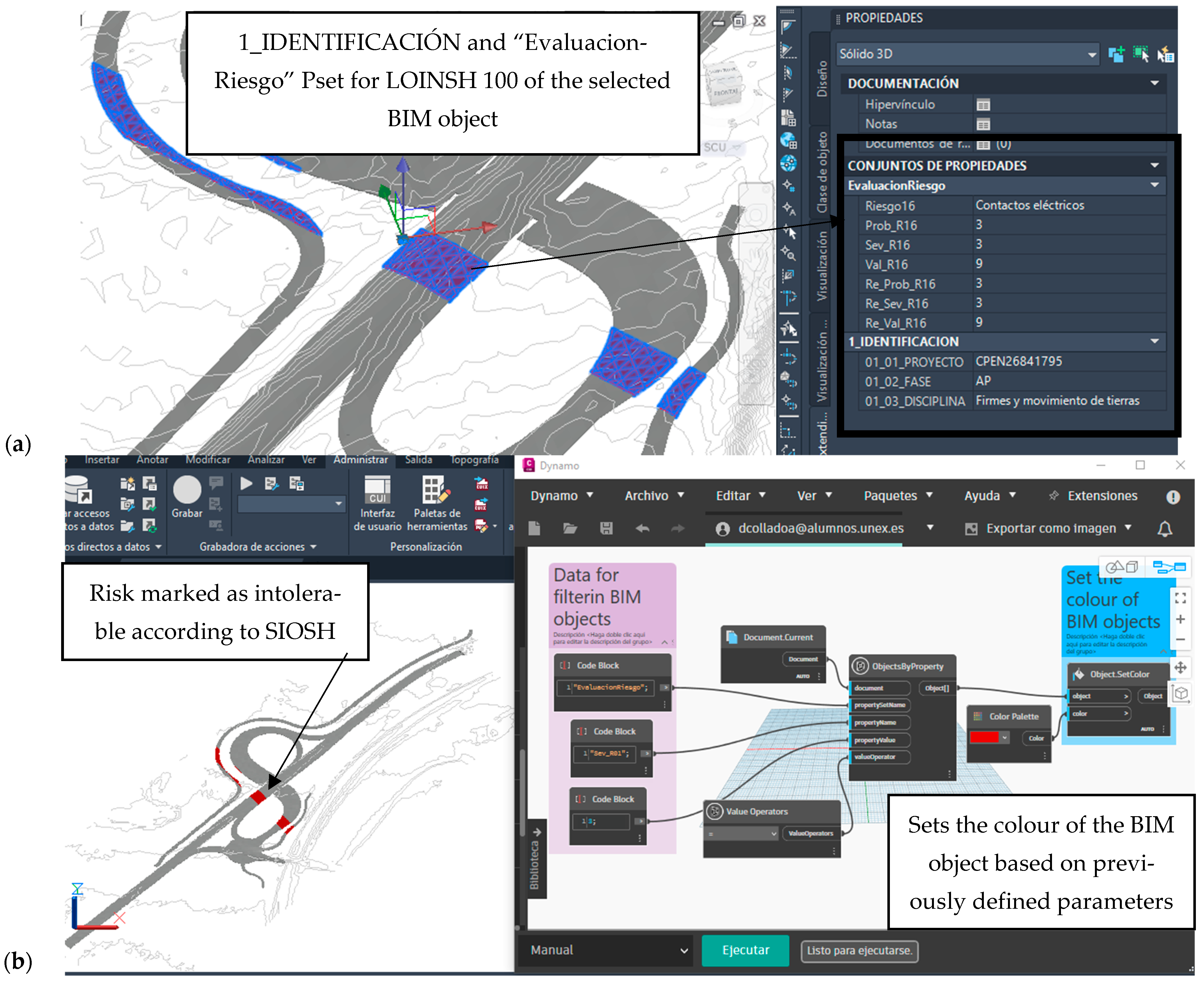
- Appearance: BIM objects must have a colour based on the result of the risk assessment and re-evaluation according to the SIOSH methodology to be able to visualize it graphically within the model. If this is not possible due to requirements because a single model with all the information is desired, the BIM object will maintain the colour of the corresponding material. Even so, having the associated parameters, it should be possible to make colour filters through any visualization programme.
- Parametric behaviour: The health and safety team will carry out a risk assessment on fixed information on the design of the road, so parametric behaviour is not necessary. If after the risk assessment it is necessary to make changes in the design, these must be made by the work team of the discipline involved.
2.3.2. Level of Alphanumeric Information
2.3.3. Level of Documentary Information
2.4. LOINSH 200
2.4.1. Graphical Information Level
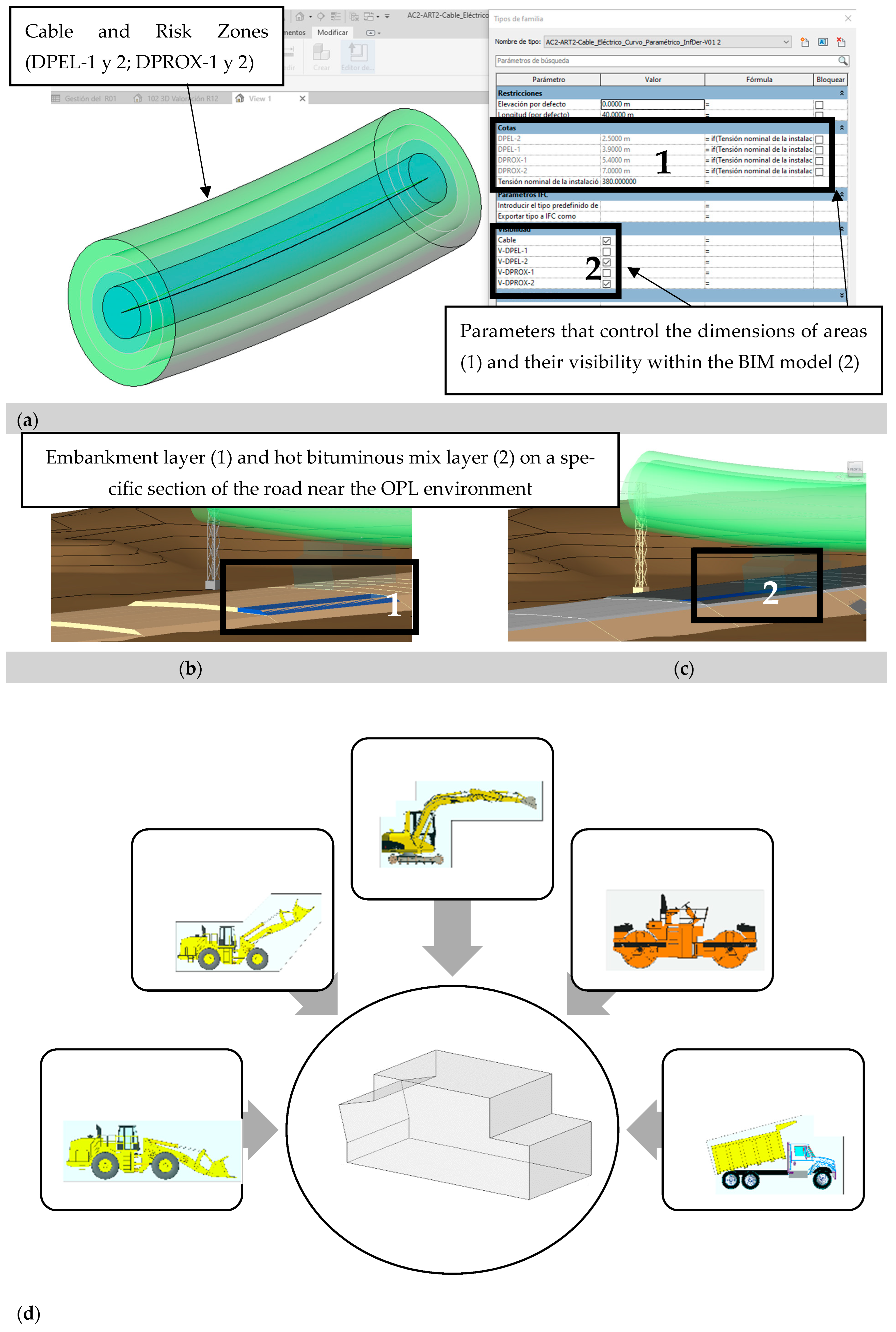
- Level of detail: Determined by BIM objects that represent the typology of the element in a generic way, with a level of metric precision. It is possible that the same BIM object encompasses several elements of the project. In particular, about the discipline of pavements and earthworks, the BIM object can be grouped into a basic section in which the same BIM object contains the different layers of the pavement and represents the finished level of the grading together with the cut slopes. It shall also be possible to divide the layout into sections along project axes or when there is a significant geometrical or constructional difference. It is not necessary to resolve road intersections with precision, but the coordination in plan and elevation must be maintained with the required precision. With regard to the disciplines of structures, drainage, and affected services, the BIM objects must be modelled with the external envelopes of their main elements with the precision required for this LOINSH.
- In the case of BIM objects in the discipline of health and safety, objects will be modelled that represent preventive measures (barriers, signage, etc.) with the precision required in this phase.
- Dimensionality: All elements that make up the disciplines must be three-dimensional in order to have a coordinated BIM object in plan and elevation to which the risk information results can be associated.
- Location and Appearance: The same as the LOINSH 100.
- Parametric Behaviour: The same as the LOINSH 100, with the difference that, in the case of the health and safety discipline itself, it is considered necessary to place preventive measures in an agile and effective manner.
2.4.2. Level of Alphanumeric Information
2.4.3. Level of Documentary Information
2.5. LOINSH 300
2.5.1. Graphical Information Level
- Level of detail: Determined by objects that have a geometry that defines the typology of the element it represents with centimetre precision. BIM objects must allow for interference analysis. With respect to the discipline of pavements and earthworks, it will be necessary to define a precise and complete section in which its layers are differentiated by materials and units of work. It must also be possible to divide the route into sections so that the risk areas can be precisely differentiated based on the units of work. In addition, embankment and excavation volumes must be obtained, as well as their slopes, to differentiate them, which must be coordinated in plan and elevation with the section of the road surface and with the natural terrain. With respect to the disciplines of structures, drainage, and services affected, it will be necessary to model all the elements that are the object of analysis by means of a BIM object with a geometry with centimetre precision, but it will be necessary to model fabrication details such as armatures, wall bushings, etc.
- Dimensionality: All the elements that make up the disciplines must be three-dimensional.
- Location: They must be in absolute coordinates.
- Parametric appearance and behaviour: Same as LOINSH 200.
2.5.2. Level of Alphanumeric Information
2.5.3. Level of Documentary Information
2.6. LOINSH 350
2.6.1. Graphical Information Level
2.6.2. Level of Alphanumeric Information
2.6.3. Level of Documentary Information
3. Results
3.1. Introduction and Application Case
3.2. Generation of the BIM Model for the Preliminary Project Phase with LOINSH 100 and 200 Requirements
3.3. Health and Safety Analysis in the Preliminary Design Phase
3.4. Generation of the BIM Model for the Project Phase with LOINSH 300 and 350 Requirements
3.5. Health and Safety Analysis in the Project Phase
3.6. Health and Safety Analysis of Special Risks in the Project Phase
3.7. Documentary Information
4. Discussion
4.1. Safety Information from the Design Phase
4.2. LOINSH and Pset Structure
4.3. LOINSH Risk Assessment
4.4. Limitations and Future Lines of Research
- The correct establishment of the LOINSH required at each milestone and for each risk is key to the correct application of the methodology. Oversetting can lead to inefficiencies that will become exponential as the project becomes larger.
- This definition of LOINSH is based on the qualitative SIOSH methodology. If another methodology of the same type is used, it should be adapted accordingly with regard to the identification and assessment of risks. The methodology would not be valid if a quantitative risk assessment is used.
- The general frameworks of the methodology are transversal to any BIM software, making minor adjustments regarding the introduction of non-graphical information, modelling, and discretization of BIM objects. However, if this software does not allow for the use of visual programming such as Dynamo, Grasshopper, or similar, the processes to be automated will have to be performed manually. This will result in increased time and errors due to the human factor.
- The assessment methodology used is qualitative and does not allow for sensitivity analysis.
- Extend the LOINSH data structures to address the other phases of a road’s life cycle: construction, maintenance, and operation.
- To contrast the reduction in on-site accidents in a road project through the application of the methodology presented in this thesis, a comparison with a project carried out in the traditional way must be performed in order to obtain metrics that allow for the quantitative validation of the effectiveness of the proposed standardization of information. This will serve to reinforce the conclusions of this study and the research referenced.
- Create new automations that allow us to move from one LOINSH to another with ease, as well as to transfer the codes developed in Dynamo to an internal programming software so that it is integrated as a command within it, facilitating its application.
- Analyze the development of LOINSH in relation to quantitative risk assessment.
5. Conclusions
Author Contributions
Funding
Data Availability Statement
Acknowledgments
Conflicts of Interest
Abbreviations
| CDE | Common Data Environment |
| DOC | Associated Documentation |
| HMA | Hot Mix Asphalt |
| IFC | Industry Foundation Classes |
| LOG | Level Of Geometric Information |
| LOI | Level of Information |
| LOIN | Level Of Information Necessary |
| LOINSH | Level Of Information Necessary for Safety and Health |
| NAPWC | Navarre Association of Public Works Construction Companies |
| SIOSH | Spanish Institute for Occupational Safety and Health |
| Pset | Property Set |
| PtD | Prevention Through Design |
References
- ILOSTAT. Statistics on Safety and Health at Work. Available online: https://ilostat.ilo.org/topics/safety-and-health-at-work/ (accessed on 10 July 2025).
- Choi, J.; Gu, B.; Chin, S.; Lee, J.S. Machine Learning Predictive Model Based on National Data for Fatal Accidents of Construction Workers. Autom. Constr. 2020, 110, 102974. [Google Scholar] [CrossRef]
- Xu, Q.; Xu, K. Analysis of the Characteristics of Fatal Accidents in the Construction Industry in China Based on Statistical Data. Int. J. Environ. Res. Public Health 2021, 18, 2162. [Google Scholar] [CrossRef]
- U.S. Bureau of Labor Statistics Census of Fatal Occupational Injuries News Release. Available online: https://www.bls.gov/news.release/cfoi.htm (accessed on 21 July 2025).
- Eurostat Accidents at Work Statistics. Available online: https://ec.europa.eu/eurostat/statistics-explained/index.php?title=Accidents_at_work_statistics (accessed on 21 July 2025).
- Mihić, M. Classification of Construction Hazards for a Universal Hazard Identification Methodology. J. Civil Eng. Manag. 2020, 26, 147–159. [Google Scholar] [CrossRef]
- UNO Spain. EL Sector Construcción e Ingeniería Civil: Contribuyendo a la Agenda 2030 La Creación de Ciudades Sostenibles y Resilientes; UNO: Madrid, Spain, 2022. [Google Scholar]
- Liu, J.; Tang, H.; Feng, R. Unraveling the Evolutionary Patterns of Construction Accidents: A Risk Assessment Framework Based on Average Mutual Information Theory. Sci. Rep. 2025, 15, 13457. [Google Scholar] [CrossRef]
- Buniya, M.K.; Othman, I.; Sunindijo, R.Y.; Kineber, A.F.; Mussi, E.; Ahmad, H. Barriers to Safety Program Implementation in the Construction Industry. Ain Shams Eng. J. 2021, 12, 65–72. [Google Scholar] [CrossRef]
- Tezel, A.; Dobrucali, E.; Demirkesen, S.; Kiral, I.A. Critical Success Factors for Safety Training in the Construction Industry. Buildings 2021, 11, 139. [Google Scholar] [CrossRef]
- Memon, A.H.; Soomro, M.A.; Memon, N.A.; Abassi, M.N. Factors Causing Health and Safety Hazards in Construction Projects in Pakistan. Mehran Univ. Res. J. Eng. Technol. 2017, 36, 559–568. [Google Scholar] [CrossRef]
- Abdul Nabi, M.; El-adaway, I.H.; Fayek, S.; Howell, C.; Gambatese, J. Contractual Guidelines for Construction Safety–Related Issues under Design–Build Standard Forms of Contract. J. Constr. Eng. Manag. 2020, 146, 04020074. [Google Scholar] [CrossRef]
- Taat, N.H.M.; Abas, N.H.; Hasmori, M.F. The Barriers of Building Information Modelling (BIM) for Construction Safety. In Proceedings of the 3rd International Conference on Green Environmental Engineering and Technology, Penang, Malaysia, 8–9 September 2021; Mohamed Noor, N., Sam, S.T., Abdul Kadir, A., Eds.; Springer: Singapore, 2022; pp. 121–130. [Google Scholar]
- Boadu, E.F.; Wang, C.C.; Sunindijo, R.Y. Challenges for Occupational Health and Safety Enforcement in the Construction Industry in Ghana. Constr. Econ. Build. 2021, 21, 1–21. [Google Scholar] [CrossRef]
- Binhomaid, O.; Hegazy, T. Agent-Based Simulation of Workers’ Behaviors, Productivity, and Safety around Construction Obstacles. Can. J. Civ. Eng. 2021, 48, 969–978. [Google Scholar] [CrossRef]
- Yap, J.B.H.; Lam, C.G.Y.; Skitmore, M.; Talebian, N. Barriers to the adoption of new safety technologies in construction: A developing country context. J. Civil Eng. Manag. 2022, 28, 120–133. [Google Scholar] [CrossRef]
- Shepherd, R.; Lorente, L.; Vignoli, M.; Nielsen, K.; Peiró, J.M. Challenges Influencing the Safety of Migrant Workers in the Construction Industry: A Qualitative Study in Italy, Spain, and the UK. Saf. Sci. 2021, 142, 105388. [Google Scholar] [CrossRef]
- Maliha, M.N.; Abu Aisheh, Y.I.; Tayeh, B.A.; Almalki, A. Safety Barriers Identification, Classification, and Ways to Improve Safety Performance in the Architecture, Engineering, and Construction (Aec) Industry: Review Study. Sustainability 2021, 13, 3316. [Google Scholar] [CrossRef]
- Sarvari, H.; Edwards, D.J.; Rillie, I.; Roberts, C. Barriers, Bottlenecks, and Challenges in Implementing Safety I- and Safety II-Enabled Safe Systems of Working in Construction Projects: A Scoping Review. Buildings 2025, 15, 347. [Google Scholar] [CrossRef]
- Marhavilas, P.K.; Koulouriotis, D.; Gemeni, V. Risk Analysis and Assessment Methodologies in the Work Sites: On a Review, Classification and Comparative Study of the Scientific Literature of the Period 2000–2009. J. Loss Prev. Process Ind. 2011, 24, 477–523. [Google Scholar] [CrossRef]
- Das, D.K. Exploring the Factors and Measures to Improve Safety in Road Construction in India. J. Constr. Dev. Ctries. 2022, 27, 139–152. [Google Scholar] [CrossRef]
- Kim, N.; Yan, N.; Grégoire, L.; Anderson, B.A.; Ahn, C.R. Road Construction Workers’ Boredom Susceptibility, Habituation to Warning Alarms, and Accident Proneness: Virtual Reality Experiment. J. Constr. Eng. Manag. 2023, 149, 04022175. [Google Scholar] [CrossRef]
- Kumar Das, D.; Olatunji Aiyetan, A.; Mostafa Hassan Mostafa, M. A Systemic Archetype for Enhancing Occupational Safety in Road Construction Projects through Worker Behavior. Transp. Res. Interdiscip. Perspect. 2024, 26, 101154. [Google Scholar] [CrossRef]
- Mohammadi, A.; Tavakolan, M.; Khosravi, Y. Developing Safety Archetypes of Construction Industry at Project Level Using System Dynamics. J. Saf. Res. 2018, 67, 17–26. [Google Scholar] [CrossRef] [PubMed]
- Bilim, A.; Çelik, O.N. Estimating the Possibility of Workday Loss Accidents in Road Construction. Gradjevinar 2023, 75, 1183–1192. [Google Scholar] [CrossRef]
- Ministerio de la Presidencia. Real Decreto 1627/1997, de 24 de Octubre, Por el Que se Establecen Disposiciones Mínimas de Seguridad y de Salud en Las Obras de Construcción; Ministerio de la Presidencia: Madrid, Spain, 1997; pp. 1–24. [Google Scholar]
- Instituto Nacional de Seguridad e Higiene en el Trabajo. Evaluación de Riesgos Laborales; Instituto Nacional de Seguridad e Higiene en el Trabajo: Madrid, Spain, 2000. [Google Scholar]
- Collado-Mariscal, D.; Cortés-Pérez, J.P.; Cortés-Pérez, A.; Cuevas-Murillo, A. Proposal for the Integration of Health and Safety into the Design of Road Projects with BIM. Buildings 2022, 12, 1753. [Google Scholar] [CrossRef]
- Chong, D.; Wang, C.; Hao, G.; Jia, S.; Guo, X. Prediction and Quantification of Occupational Health Risk in Road Construction Workers Exposed to Asphalt Emissions. J. Clean. Prod. 2024, 434, 140328. [Google Scholar] [CrossRef]
- López Valcárcel, A. Panorama Internacional de La Seguridad y Salud En El Trabajo de Construcción. El Criterio de La OIT 2003, 1–12. Available online: https://www.cplp.org/Admin/Public/Download.aspx?file=Files/Filer/MIC_IT/Ficheiros/Biblioteca/Saude_Seg/Segurana_e_sade_construcao_2.pdf (accessed on 19 October 2025).
- Yuan, J.; Li, X.; Xiahou, X.; Tymvios, N.; Zhou, Z.; Li, Q. Accident Prevention through Design (PtD): Integration of Building Information Modeling and PtD Knowledge Base. Autom. Constr. 2019, 102, 86–104. [Google Scholar] [CrossRef]
- Landis Floyd, H.; Valdes, M.E. Leveraging Prevention through Design Principles (PtD) in Electrical Installations. IEEE Trans. Ind. Appl. 2021, 57, 1212–1221. [Google Scholar] [CrossRef]
- Kamardeen, I. 8D BIM Modelling Tool for Accident Prevention Through Design. In Proceedings of the 26th Annual ARCOM Conference, Leeds, UK, 6–8 September 2010; Association of Researchers in Construction Management; pp. 281–289. [Google Scholar]
- Al-Bayati, A.J.; Bazzi, K.; Karakhan, A.A.; Jensen, E. Clearing the Path: Overcoming Barriers to Prevention through Design (PtD) Utilization in the US Construction Industry. Safety 2024, 10, 74. [Google Scholar] [CrossRef]
- Forcael, E.; Ferrari, I.; Opazo-Vega, A.; Pulido-Arcas, J.A. Construction 4.0: A Literature Review. Sustainability 2020, 12, 9755. [Google Scholar] [CrossRef]
- Adriaensen, A.; Decré, W.; Pintelon, L. Can Complexity-Thinking Methods Contribute to Improving Occupational Safety in Industry 4.0? A Review of Safety Analysis Methods and Their Concepts. Safety 2019, 5, 65. [Google Scholar] [CrossRef]
- Musarat, M.A.; Alaloul, W.S.; Irfan, M.; Sreenivasan, P.; Rabbani, M.B.A. Health and Safety Improvement through Industrial Revolution 4.0: Malaysian Construction Industry Case. Sustainability 2023, 15, 201. [Google Scholar] [CrossRef]
- Olugboyega, O.; Oseghale, G.E.; Aigbavboa, C. Multiple Holistic Case Study of Project-Level Building Information Modelling (BIM) Adoption in Nigeria. Constr. Innov. 2023, 23, 567–586. [Google Scholar] [CrossRef]
- European Parliament Directive 2014/24/EU of The European Parliament and of The Council of 26 February 2014 on Public Procurement and Repealing Directive 2004/18/EC (Text with EEA Relevance). Bruss. Comment. EU Public Procure. Law 2014, 28, 29–126. [CrossRef]
- Castañeda, K.; Sánchez, O.; Peña, C.A.; Herrera, R.F.; Mejía, G. BIM Uses for Mitigating Deficiencies in Road Scheduling Planning. Sustainability 2025, 17, 2729. [Google Scholar] [CrossRef]
- Muñoz, S.; Llamo, J. Revisión sistemática de la implementación BIM basada en modelos de diseño para la construcción de obras viales. Cuad. Act. 2023, 14, 119–133. [Google Scholar] [CrossRef]
- Sampaio, A.Z.; Constantino, G.B.; Almeida, N.M. 8D BIM Model in Urban Rehabilitation Projects: Enhanced Occupational Safety for Temporary Construction Works. Appl. Sci. 2022, 12, 577. [Google Scholar] [CrossRef]
- Hire, S.; Sandbhor, S.; Ruikar, K. A Conceptual Framework for BIM-Based Site Safety Practice. Buildings 2024, 14, 272. [Google Scholar] [CrossRef]
- Petrullo, M.; Morton, B.; Jones, S.A.; Laquidara-Carr, D.; Lubrano, S.; Lorenz, A.; Yamada, T.; Buckley, B.; Logan, K.; Barnett, S. SmartMarket Report Chief Executive Officer Safety Management in the Construction Industry 2017 SmartMarket Report Executive Editor Chief Marketing Officer SmartMarket Report. 2017. Available online: https://www.cpwr.com/wp-content/uploads/Dodge_Safety_Report_2017.pdf (accessed on 19 October 2025).
- Farghaly, K.; Collinge, W.; Mosleh, M.H.; Manu, P.; Cheung, C.M. Digital Information Technologies for Prevention through Design (PtD): A Literature Review and Directions for Future Research. Constr. Innov. 2022, 22, 1036–1058. [Google Scholar] [CrossRef]
- Hee Lee, D.; Young Park, J.; Sang Youm, H. A Study on the Effect of Improvement of Safety Management on the Promotion of Safety and Health of Workers in Construction Sites. J. Soc. Disaster Inf. 2021, 17, 568–578. [Google Scholar] [CrossRef]
- Tariq Shafiq, M.; Afzal, M. Evaluating 4D-BIM and VR for Effective Safety Communicaton and Training: A Case Study of Multilingual Construction Job-Site Crew. Buildings 2021, 11, 319. [Google Scholar] [CrossRef]
- Lee, Y.; Kim, I.; Choi, J. Development of BIM-Based Risk Rating Estimation Automation and a Design-for-Safety Review System. Appl. Sci. 2020, 10, 3902. [Google Scholar] [CrossRef]
- Cortés-Pérez, J.P.; Cortés-Pérez, A.; Prieto-Muriel, P. BIM-Integrated Management of Occupational Hazards in Building Construction and Maintenance. Autom. Constr. 2020, 113, 103115. [Google Scholar] [CrossRef]
- Belcher, E.J.; Abraham, Y.S. Lifecycle Applications of Building Information Modeling for Transportation Infrastructure Projects. Buildings 2023, 13, 2300. [Google Scholar] [CrossRef]
- Cavieres-Lagos, S.; Muñoz La Rivera, F.; Atencio, E.; Herrera, R.F. Integration of BIM Tools for the Facility Management of Railway Bridges. Appl. Sci. 2024, 14, 6209. [Google Scholar] [CrossRef]
- Collado-Mariscal, D.; Cortés-Pérez, J.P.; Cortés-Pérez, A.; Cuevas-Murillo, A. Proposal for the Integration of the Assessment and Management of Electrical Risk from Overhead Power Lines in BIM for Road Projects. Int. J. Environ. Res. Public Health 2022, 19, 13064. [Google Scholar] [CrossRef]
- Ait-Lamallam, S.; Yaagoubi, R.; Sebari, I.; Doukari, O. Extending the Ifc Standard to Enable Road Operation and Maintenance Management through Openbim. ISPRS Int. J. Geo-Inf. 2021, 10, 496. [Google Scholar] [CrossRef]
- ISO 16739-1:2024; Industry Foundation Classes (IFC) for Data Sharing in the Construction and Facility Management Industries—Part 1: Data schema. International Organization for Standardization (ISO): Geneva, Switzerland, 2024. Available online: https://www.iso.org/es/contents/data/standard/08/41/84123.html (accessed on 19 October 2025).
- BS EN ISO 19650-1: 2018; Organization and Digitization of Information About Buildings and Civil Engineering Works, Including Building Information Modelling (BIM). Information Management Using Building Information Modelling. Part 1, Concepts and Principles. British Standards Institution: London, UK, 2018; p. 46.
- Pan, X.; Mateen Khan, A.; Eldin, S.M.; Aslam, F.; Kashif Ur Rehman, S.; Jameel, M. BIM Adoption in Sustainability, Energy Modelling and Implementing Using ISO 19650: A Review. Ain Shams Eng. J. 2024, 15, 102252. [Google Scholar] [CrossRef]
- ISO 7817-1:2024; Building Information Modelling—Level of Information Need Part 1: Concepts and Principles. International Organization for Standardization (ISO): Geneva, Switzerland, 2024; p. 23.
- Godager, B.; Merschbrock, C.; Klakegg, O.J.; Huang, L. Towards an Improved Framework for Enterprise BIM: The Role of ISO 19650. J. Inf. Technol. Constr. (ITcon) 2022, 27, 1076. [Google Scholar] [CrossRef]
- ISO/AWI TS 7817-2; Building Information Modelling—Level of Information Need—Part 2: Guidance for Application. International Organization for Standardization (ISO): Geneva, Switzerland. Available online: https://www.iso.org/es/contents/data/standard/08/90/89075.html (accessed on 19 October 2025).
- Massimo-Kaiser, I.M.; Fröch, G.; Salzgeber, H.; Flora, M. LOIN Für Elemente Des Geologisch-Geotechnischen Baugrundmodells. Bautechnik 2025, 102, 207–214. [Google Scholar] [CrossRef]
- Lindholm, J.; Johansson, P.; Yitmen, I. Toward a BIM Information Delivery Framework Based on Common Data Environment. Constr. Innov. 2025, 25, 139–157. [Google Scholar] [CrossRef]
- Akbas, E.; Bolpagni, M.; Borrmann, A.; Boeykens, S.; Filardo, M.M.; Liu, L.; Beetz, J. A Holistic Approach to Information Requirements: Integration of Level of Information Need and Information Delivery Specification. J. Inf. Technol. Constr. 2025, 30, 731–744. [Google Scholar] [CrossRef]
- Salzano, A.; Cascone, S.; Zitiello, E.P.; Nicolella, M. Construction Safety and Efficiency: Integrating Building Information Modeling into Risk Management and Project Execution. Sustainability 2024, 16, 4094. [Google Scholar] [CrossRef]
- Pham, T.-A.; Likhitruangsilp, V.; Ioannou, P.G. A BIM-Based Digital Twin for Construction Pollution Management in Building Renovation Projects. In Advances in Information Technology in Civil and Building Engineering, Proceedings of the International Conference on Computing in Civil and Building Engineering, Montreal, QC, Canada, 25–28 August 2024; Francis, A., Miresco, E., Melhado, S., Eds.; Springer: Montreal, QC, Canada, 2025; pp. 461–477. [Google Scholar]
- ANECOP. Guide to the Evaluation of Labor Risks in the Work Units; de Navarra, G., Ed.; ANECOP: Comunidad Foral de Navarra, Spain, 2006. [Google Scholar]
- Comisión Interdepartamental Para la Implementación de Trabajo y Tecnología Del; Building Information Modelling (BIM) del Comité técnico BIM. In Manual BIM Modelitzat d’Informació de Construcció; Generalitat de Catalunya; Departament de Territori: Barcelona, Spain, 2022.
- Dirección General de Movilidad e Infraestructuras Viarias de la Junta de Extremadura. Guía BIM. 2023. Available online: https://www.juntaex.es/w/guia-bim (accessed on 19 October 2025).

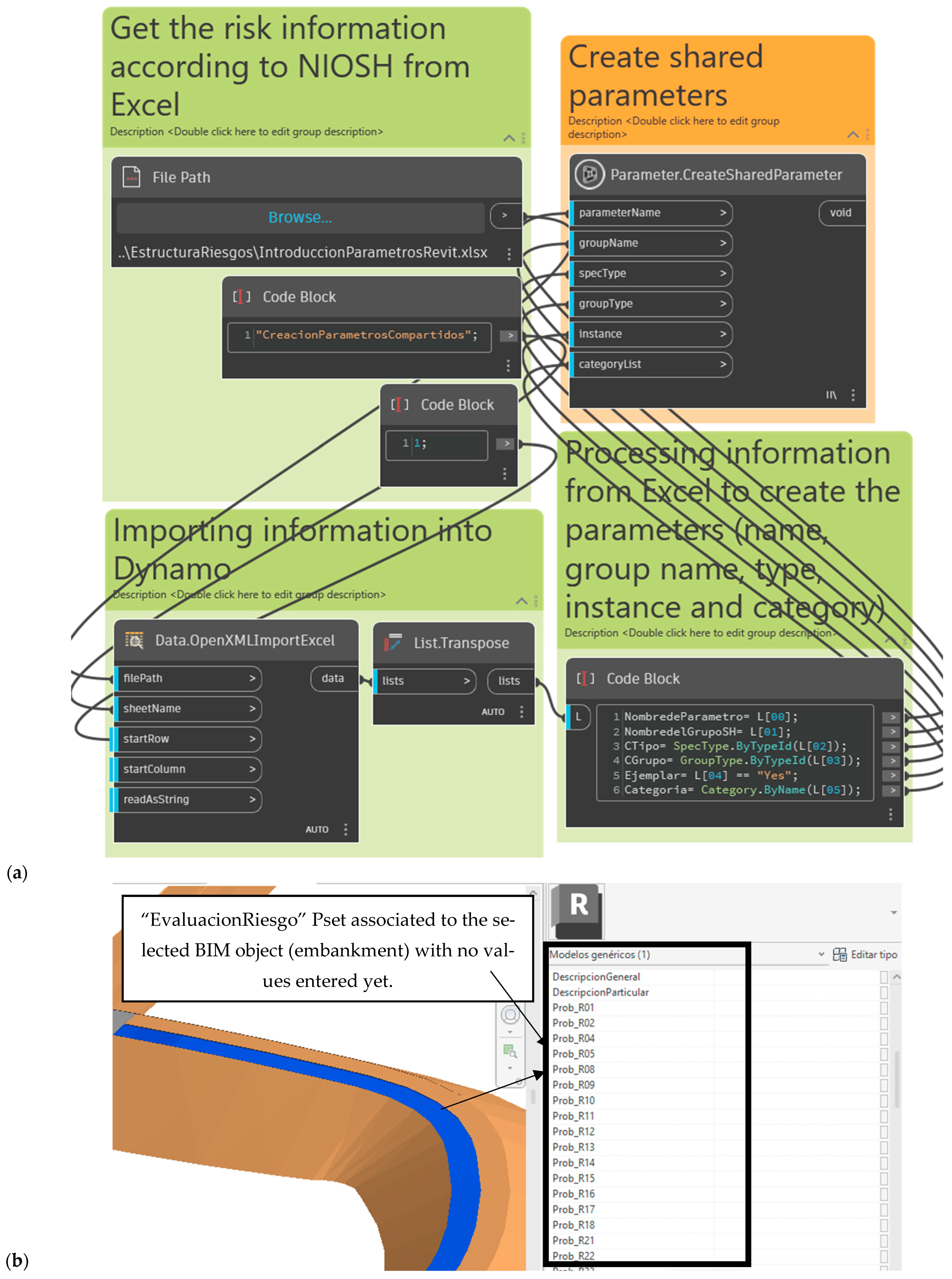
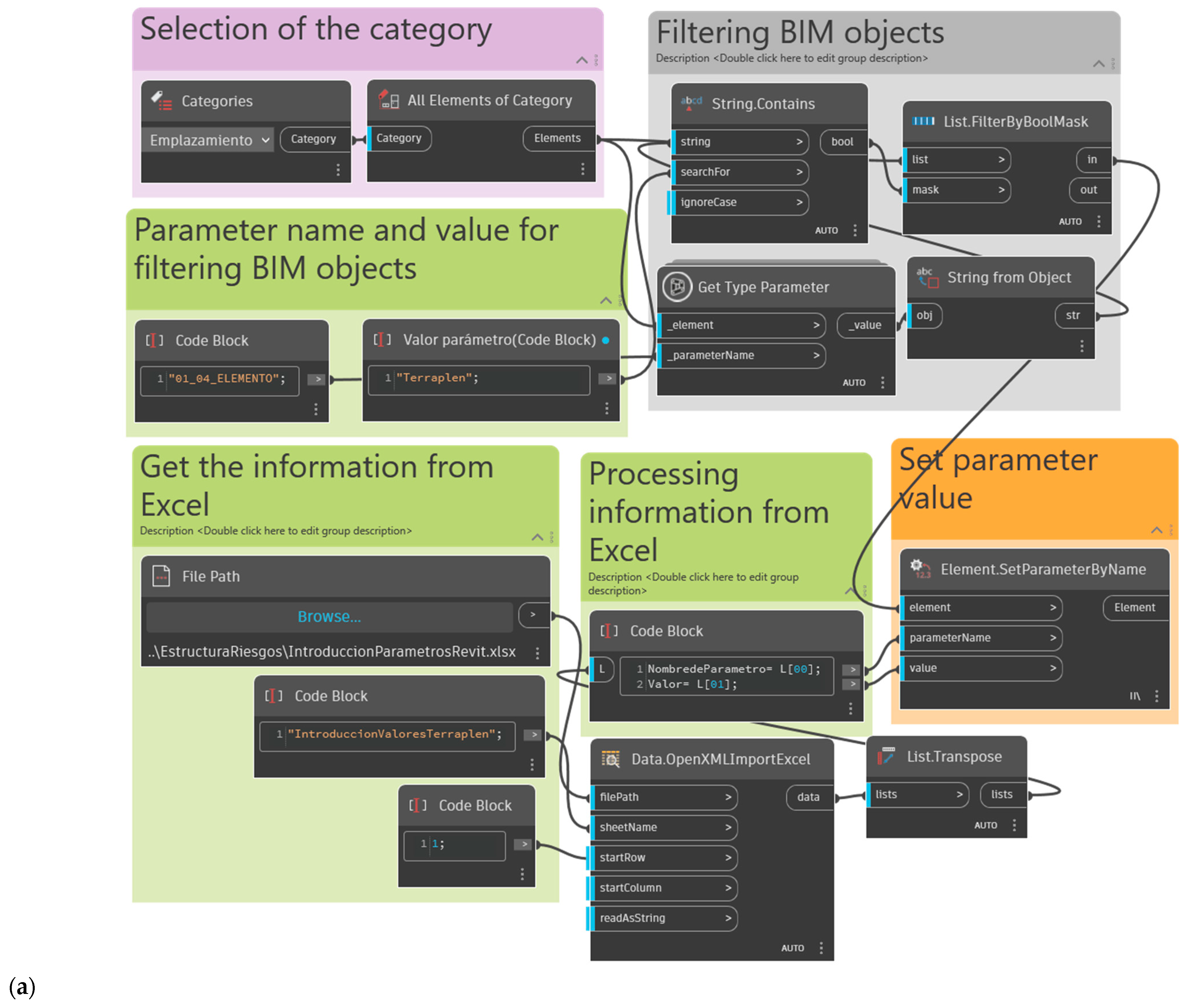
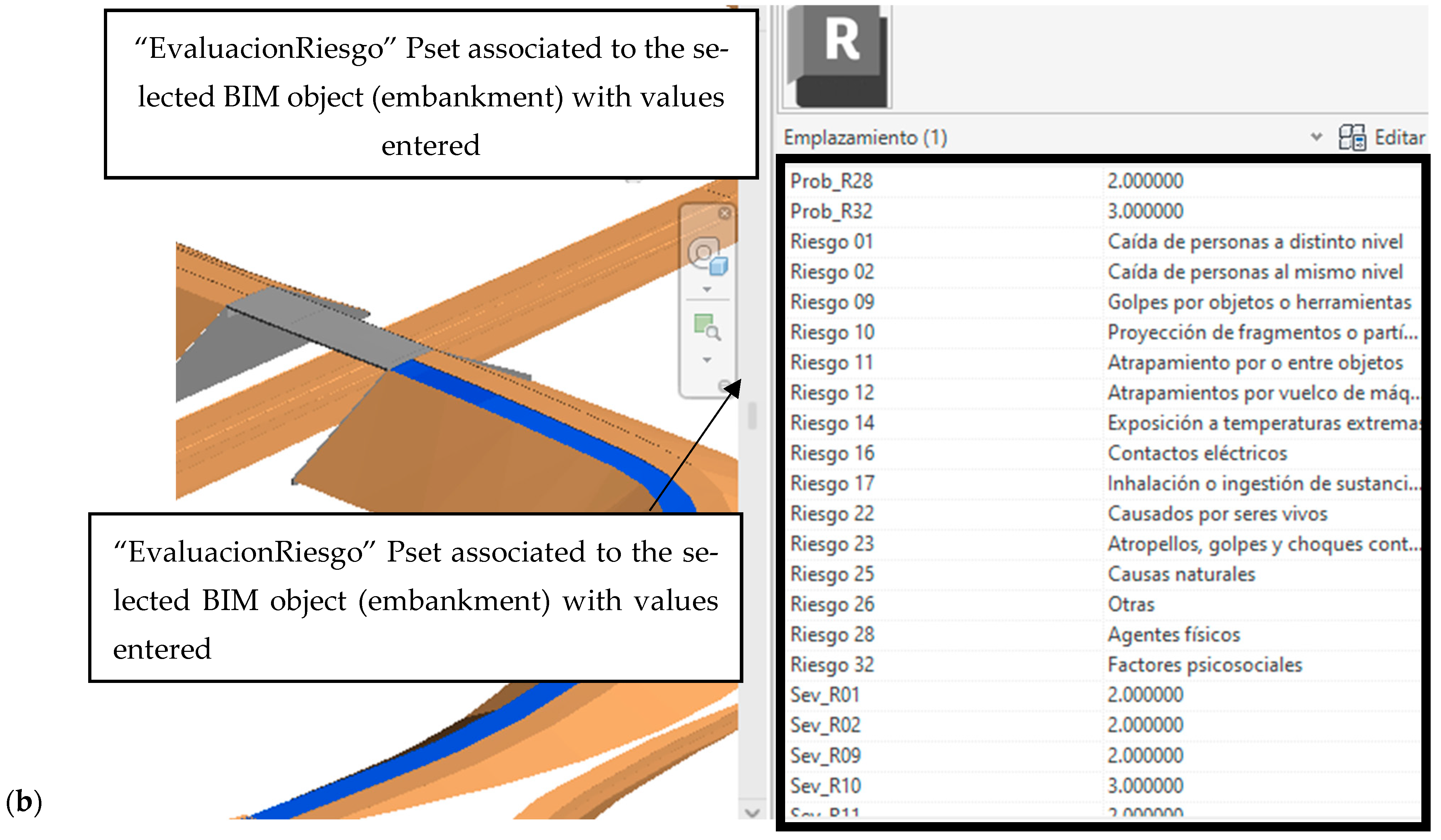
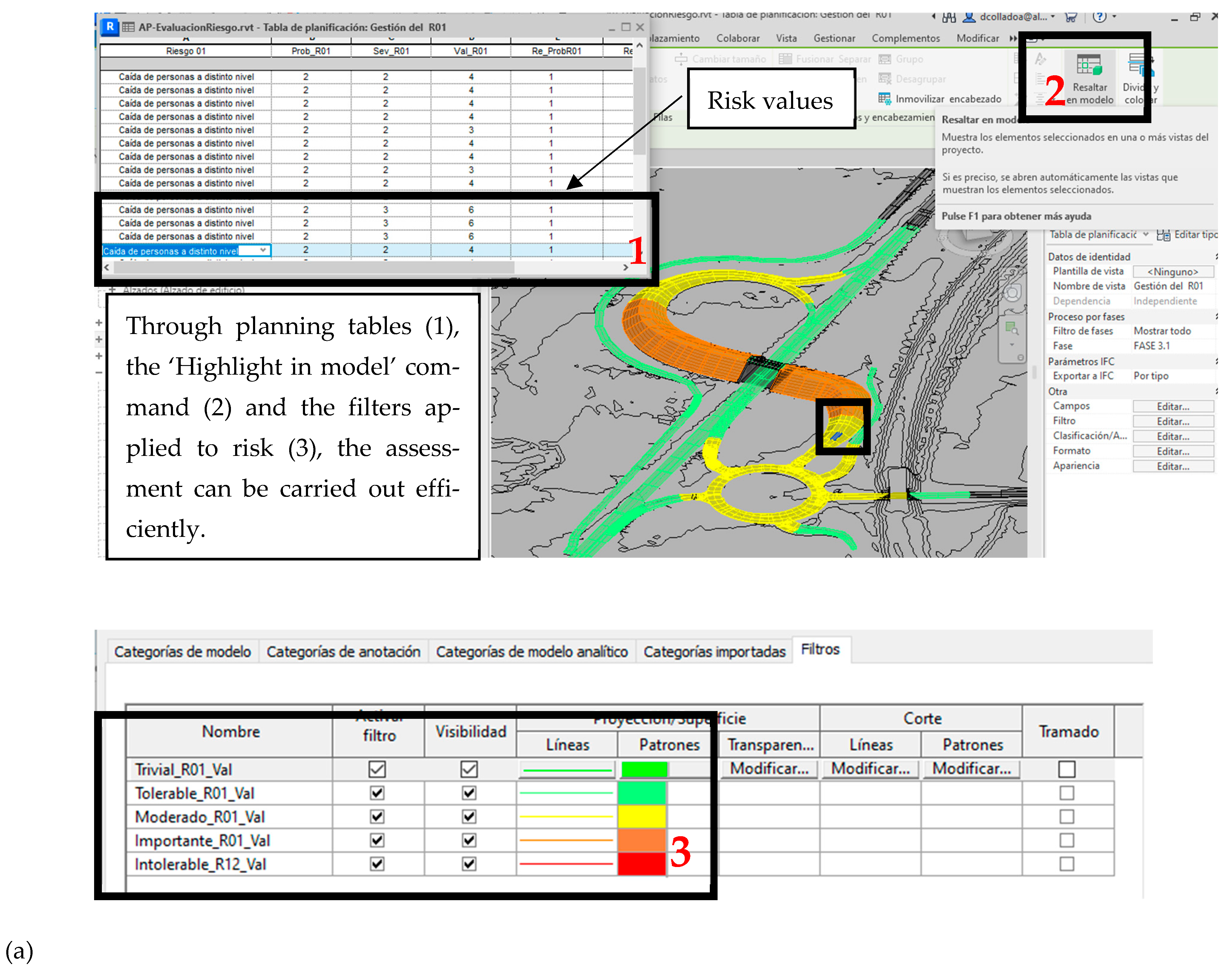
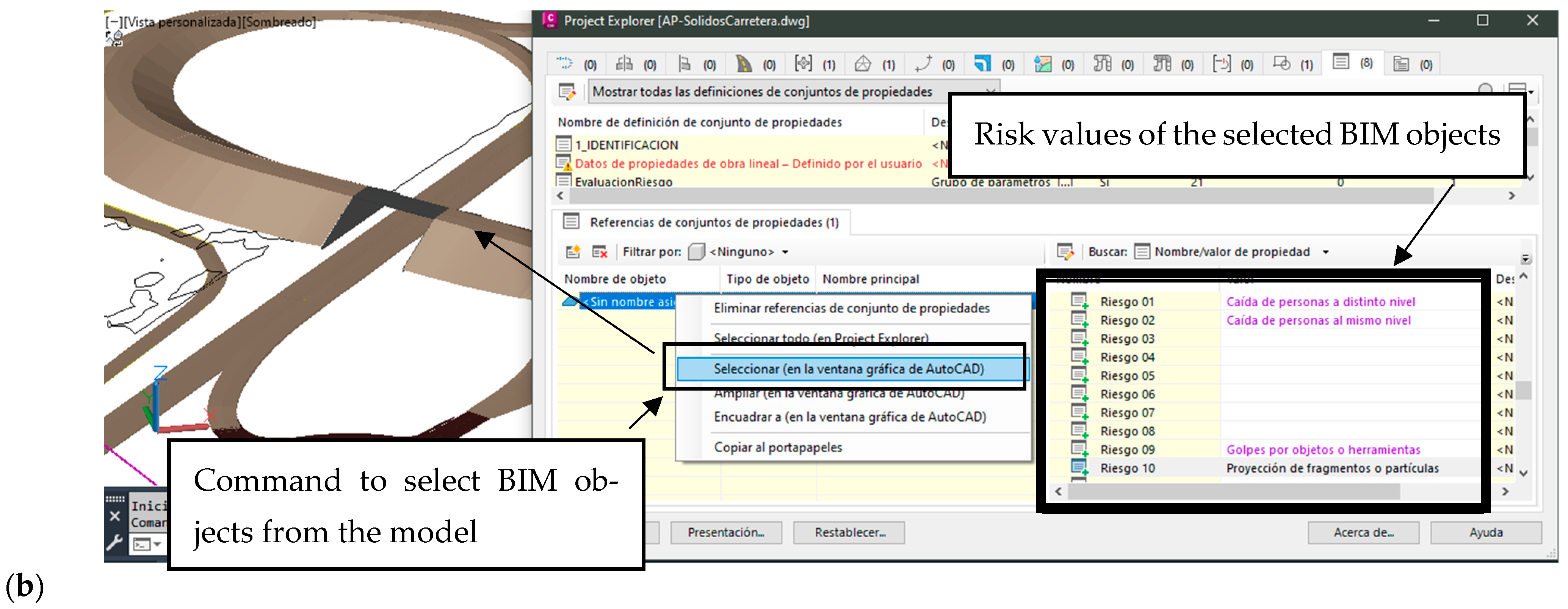
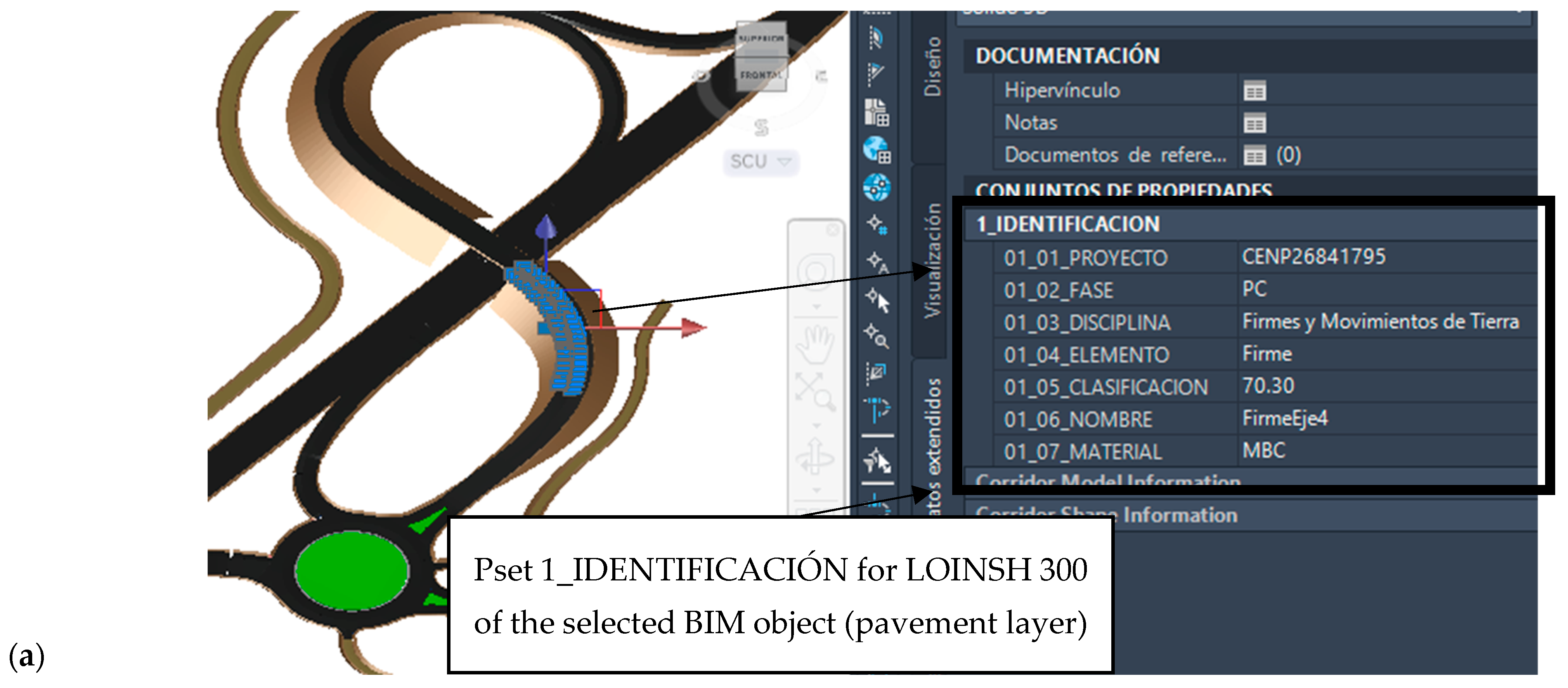
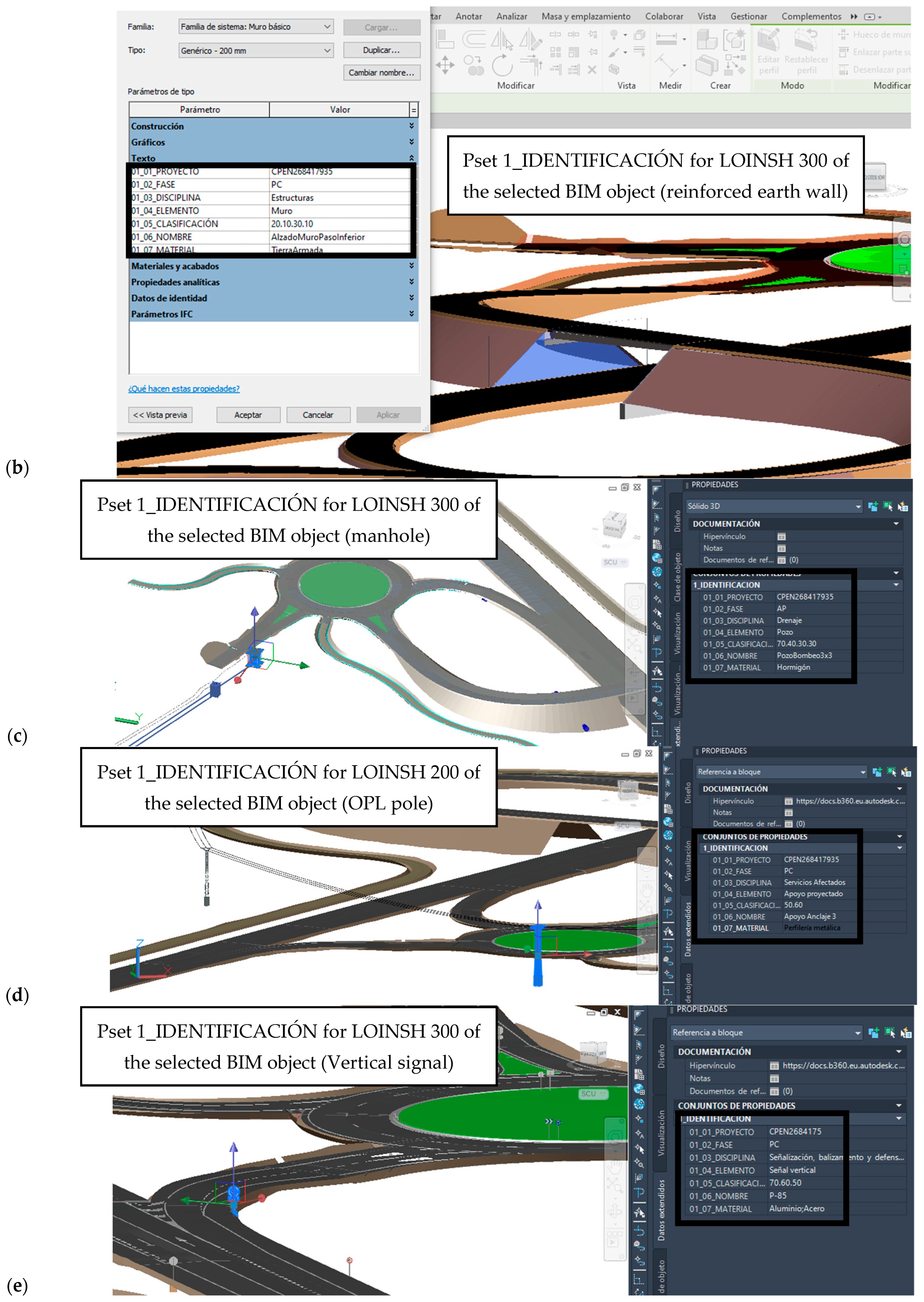
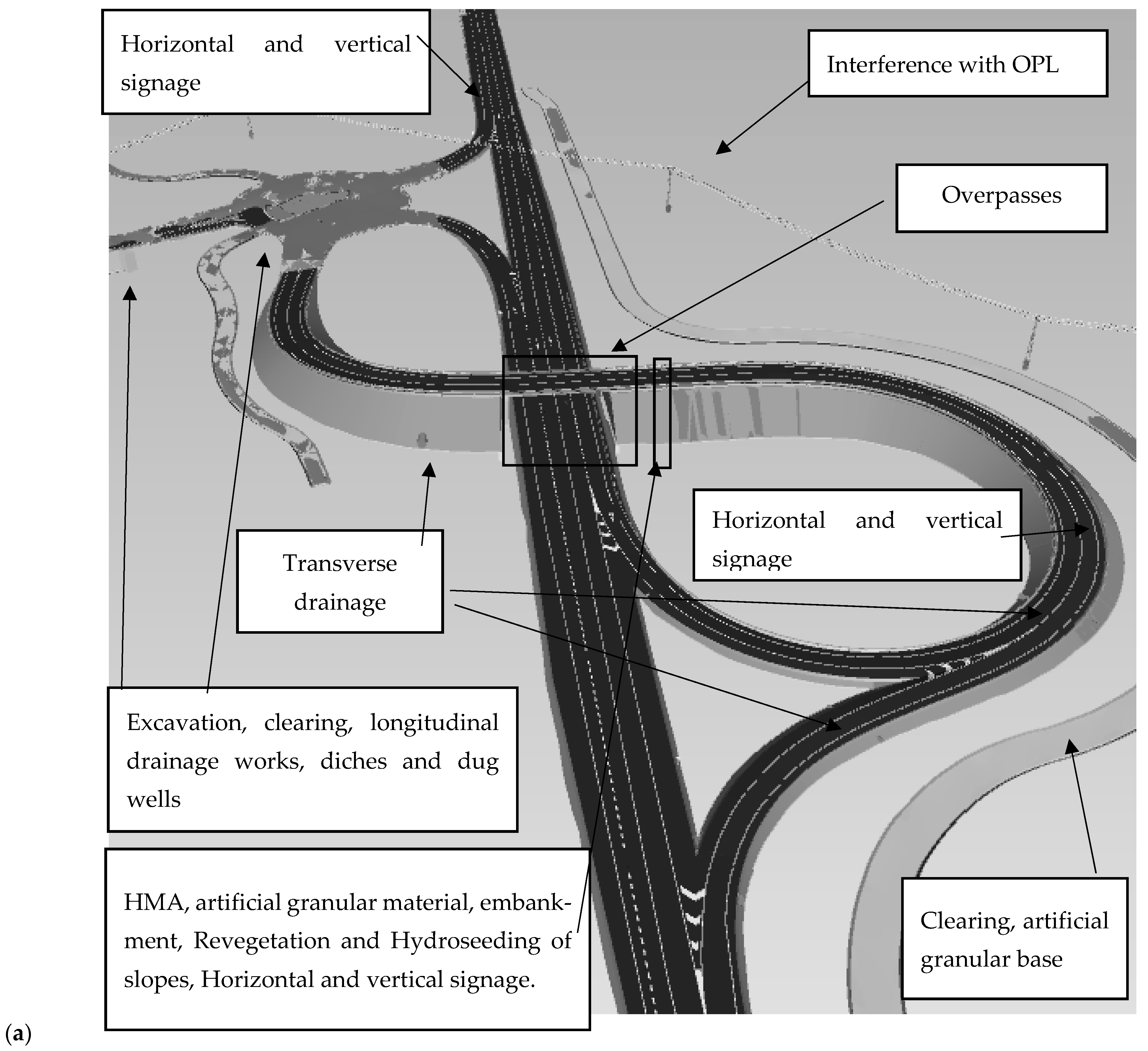




| Pset | Property | LOINSH | Type of Data | Description |
|---|---|---|---|---|
| 1_IDENTIFICACION | 01_01_PROYECTO | 100/200/300/350 | TEXT | Project code |
| 1_IDENTIFICACION | 01_02_FASE | 100/200/300/350 | TEXT | Identification of the phase in which the model element is within the project life cycle |
| 1_IDENTIFICACION | 01_03_DISCIPLINA | 100/200/300/350 | TEXT | Project discipline |
| 1_IDENTIFICACION | 01_04_ELEMENTO | 200/300/350 | TEXT | Element type |
| 1_IDENTIFICACION | 01_05_CLASIFICACION | 200/300/350 | TEXT | Classification code |
| 1_IDENTIFICACION | 01_06_NOMBRE | 200/300/350 | TEXT | Short name of the element |
| 1_IDENTIFICACION | 01_07_MATERIAL | 200/300/350 | TEXT | Reference to the material of the element |
| 2_PROYECTO | 02_01_CAPITULO | 300 only for HS discipline/350 | TEXT | Chapter of the budget for the work unit to which the element refers |
| 2_PROYECTO | 02_02_SUBCAPITULO | 300 only for HS discipline/350 | TEXT | Subchapter of the budget for the work unit referred to in the element |
| 2_PROYECTO | 02_03_LONGITUD | 300 only for HS discipline | NUMBER | Element measurement value |
| 2_PROYECTO | 02_04_AREA | 300 only for HS discipline | NUMBER | Element measurement value |
| 2_PROYECTO | 02_05_VOLUMEN | 300 only for HS discipline | NUMBER | Element measurement value |
| 2_PROYECTO | 02_06_PESO | 300 only for HS discipline | NUMBER | Element measurement value |
| 2_PROYECTO | 02_07_UD OBRA | 300 only for HS discipline/350 | TEXT | Code of the work unit to which the element refers |
| 2_PROYECTO | 02_08_INDIRECTO | 300 only for HS discipline/350 | TEXT | Code of the indirect work unit or units separated by ‘;’ |
| 2_PROYECTO | 02_09_FASE DE OBRA | 300 only for HS discipline | TEXT | Project phase |
| 3_OBRA | 03_01_TAREA | 350 | TEXT | Code of the task in the work plan to which the element belongs |
| EvaluacionRiesgo | Riesgo 0i | 100/200/300/350 | TEXT | Name of risk i according to the classification of the INSST |
| EvaluacionRiesgo | Prob_R0i | 100/200/300/350 | NUMBER | Probability of occurrence of risk i |
| EvaluacionRiesgo | Sev_R0i | 100/200/300/350 | NUMBER | Severity of the consequence of the occurrence of risk i |
| EvaluacionRiesgo | Val_R0i | 100/200/300/350 | NUMBER | Risk assessment i as a result of the product of its probability and consequence |
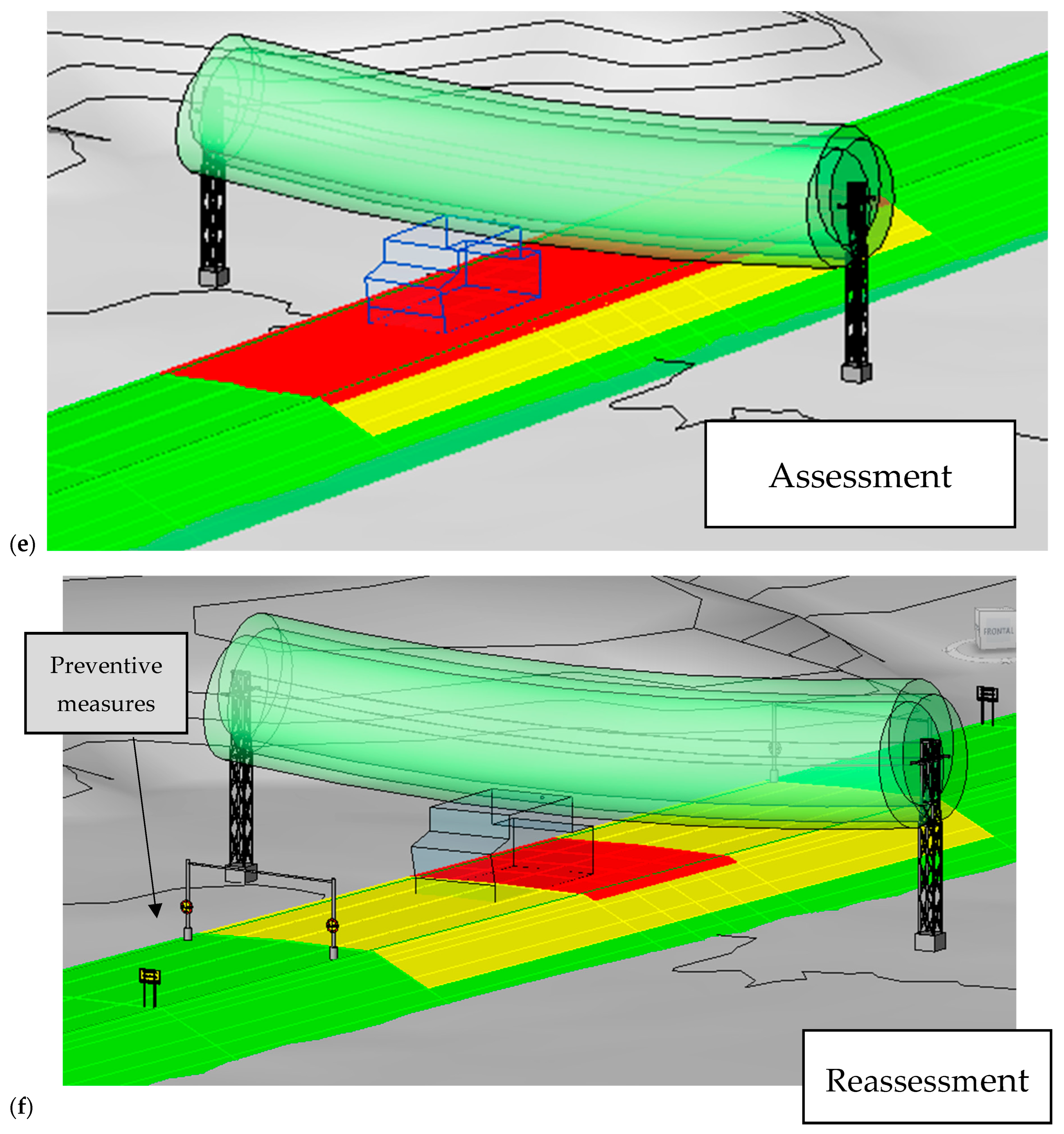
| EvaluacionRiesgo | Re_Prob_R0i | 100/200/300/350 | NUMBER | Probability of occurrence of risk i once preventive measures have been implemented |
| EvaluacionRiesgo | Re_Sev_R0i | 100/200/300/350 | NUMBER | Severity of the consequence of the occurrence of risk i once the preventive measures have been implemented |
| EvaluacionRiesgo | Re_Val_R0i | 100/200/300/350 | NUMBER | Risk assessment i as a result of the product of its probability and consequence once the preventive measures have been implemented |
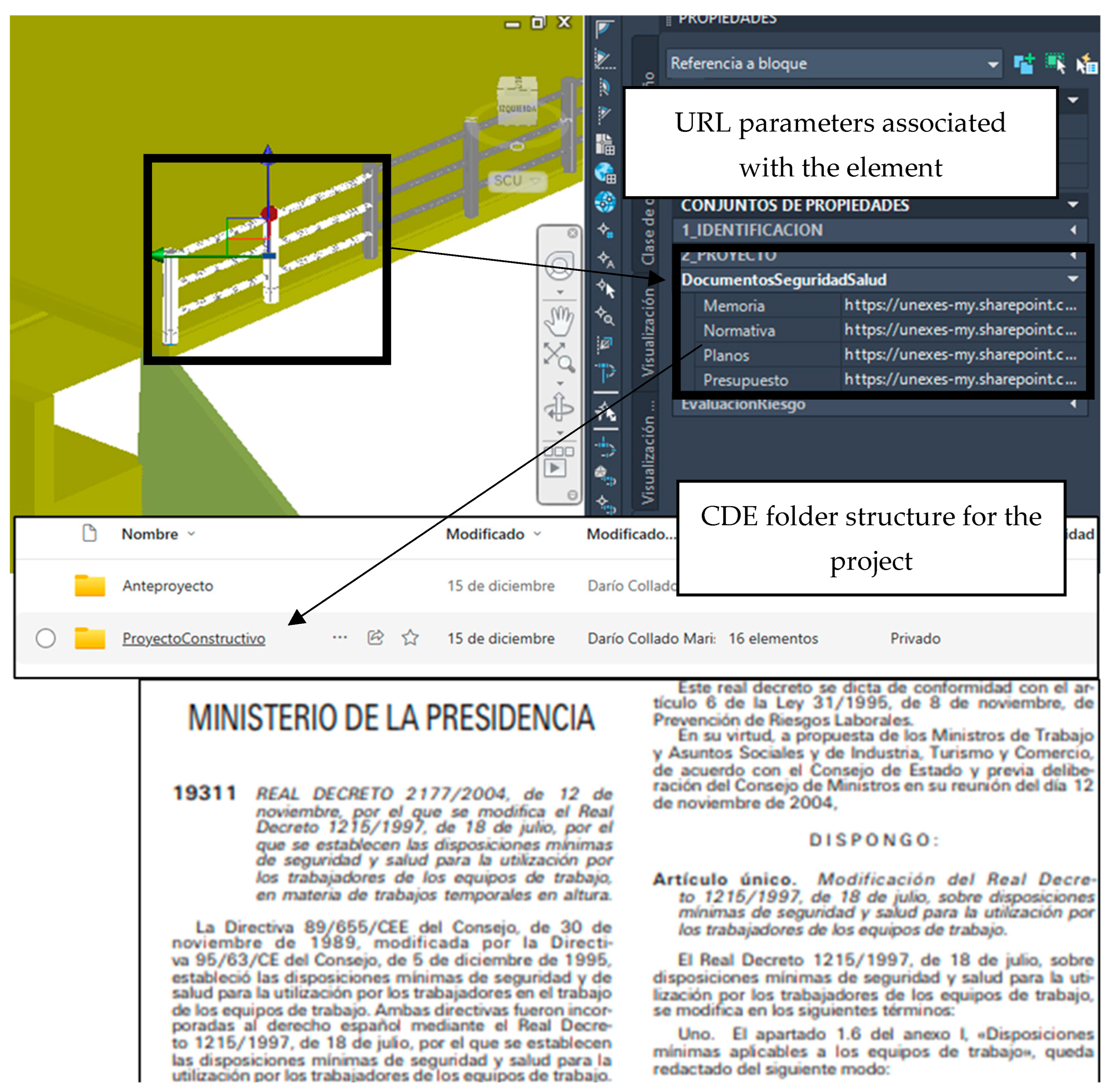
| DocumentosSeguridadSalud | Normativa | 100/200/300/350 only for HS discipline | LINK | Link to the folder within the CDE in which the prescriptions that apply to them are found and the procedure for assembly, maintenance, and disassembly of the preventive measures by discipline |
| DocumentosSeguridadSalud | Memoria | 100/200/300/350 only for HS discipline | LINK | Link to the folder within the CDE in which the report of the Health and Safety Study is located |
| DocumentosSeguridadSalud | Planos | 300/350 only for HS discipline | LINK | Link to the folder within the CDE in which the plans by discipline of the Health and Safety Study are found |
| DocumentosSeguridadSalud | Presupuesto | 300/350 only for HS discipline | LINK | Link to the folder within the CDE in which the measurements and prices by discipline and the budget of the Health and Safety Study are found |
| Discipline | Road Element | Risks Grouped by Work Units According to [65] |
|---|---|---|
| Pavements and earthworks | Hot mix asphalt layers | Hot mix asphalt (HMA) |
| Base | Artificial granular base | |
| Subbase | Natural granular base | |
| Natural terrain | Topography | |
| Clearing surface | Clearing | |
| Excavation volume | Excavation | |
| Embankment volume | Embankment | |
| Slope excavation | Revegetation and hydroseeding of slopes | |
| Slope embankment | Revegetation and hydroseeding of slopes | |
| Structures | Overpass | Overpasses |
| Prefabricated frame | Prefabricated frame | |
| Drainage | Gutters | Longitudinal drainage |
| Manholes and pipes | Ditches and dug wells | |
| Cross drainage culverts | Transverse drainage | |
| Affected services | Underground services | Reposición de canalizaciones de servicios |
| Overhead power lines | Interference with overhead lines | |
| Signalling, beaconing, and defence | Horizontal and vertical signage | Horizontal and vertical signage |
| Health and safety | Preventive measures | Signage during the execution of the work |
| Preliminary Design | Construction Project | ||||
|---|---|---|---|---|---|
| Level of Information | Discipline/Work Team | LOINSH 100 | LOINSH 200 | LOINSH 300 | LOINSH 350 |
| Level of Graphic Information | |||||
| Detail | Pavements and earthworks | Conceptual objects with some specific division. Schematic accuracy. | Generic objects of the levelling level and of the excavation and embankment slopes. Metric accuracy. | Objects that define the typology with centimetre accuracy. Division and distribution by layers. Incorporate excavation and backfill objects, as well as excavation slope object and backfill with centimetre accuracy. | Objects with centimetre accuracy. Division by layers based on construction simulation. |
| Structures | Conceptual objects. Schematic accuracy. | Generic main objects with metric accuracy. | Objects that define the typology with centimetre accuracy. | Objects with centimetre accuracy. Division based on construction simulation. | |
| Drainage | Conceptual objects. Schematic accuracy. | Generic main objects with metric accuracy. | Objects that define the typology with centimetre accuracy. | Objects with centimetre accuracy. Division based on construction simulation. | |
| Affected Services | Conceptual objects. Schematic accuracy. | Generic main objects with metrically accurate dimensions. | Objects that define the typology with centimetre accuracy. | Objects with centimetre accuracy. Division based on construction simulation. | |
| Signage, Beaconing, and Defence | Not required | Not required | Objects that define the typology with centimetre accuracy. | Objects with centimetre accuracy. Division based on construction simulation. | |
| Health and Safety | Conceptual objects. Schematic accuracy. | Generic objects with metric accuracy. | Objects that define the typology with centimetre accuracy. | Objects with centimetre accuracy. Division based on construction simulation. Delimitation of machinery work areas in accordance with construction simulations, as well as areas of special risk for the safety and health of workers. | |
| Dimensionality | Pavements and Earthworks | 2D/3D | 3D | 3D | 3D |
| Structures | 2D/3D | 3D | 3D | 3D | |
| Drainage | 2D/3D | 3D | 3D | 3D | |
| Affected Services | 2D/3D | 3D | 3D | 3D | |
| Signage, Beaconing, and Defence | Not required | Not required | 3D | 3D | |
| Health and Safety | 2D/3D | 3D | 3D | 3D | |
| Location | Pavements and Earthworks | Absolute | Absolute with metric accuracy. | Absolute with centimetre accuracy. | Absolute with centimetre accuracy. |
| Structures | Absolute | Absolute with metric accuracy | Absolute with centimetre accuracy. | Absolute with centimetre accuracy. | |
| Drainage | Absolute | Absolute with metric accuracy | Absolute with centimetre accuracy. | Absolute with centimetre accuracy. | |
| Affected Services | Absolute | Absolute with metric accuracy | Absolute with centimetre accuracy. | Absolute with centimetre accuracy. | |
| Signage, Beaconing, and Defence | Not required | Not required | Absolute with centimetre accuracy. | Absolute with centimetre accuracy. | |
| Health and Safety | Absolute | Absolute with metric accuracy | Absolute with centimetre accuracy. | Absolute with centimetre accuracy. | |
| Appearance | Pavements and Earthworks | Colour according to risk assessment or generic. | Colour according to risk assessment or by material. | Colour according to risk assessment or by material. | Colour according to risk assessment or by material. |
| Structures | Colour according to risk assessment or generic. | Colour according to risk assessment or by material. | Colour according to risk assessment or by material. | Colour according to risk assessment or by material. | |
| Drainage | Colour according to risk assessment or generic. | Colour according to risk assessment or by material. | Colour according to risk assessment or by material. | Colour according to risk assessment or by material. | |
| Affected Services and Complementary Works | Colour according to risk assessment or generic. | Colour according to risk assessment or by material. | Colour according to risk assessment or by material. | Colour according to risk assessment or by material. | |
| Signage, Beaconing, and Defence | Not required | Not required | Colour according to risk assessment or by material. | Colour according to risk assessment or by material. | |
| Health and Safety | Colour according to risk assessment or generic. | Colour according to risk assessment or by material. | Colour according to risk assessment or by material. | Colour according to risk assessment or by material. | |
| Parametric Behaviour | Pavements and Earthworks | Non-existent | Non-existent | Non-existent | Non-existent |
| Structures | Non-existent | Non-existent | Non-existent | Non-existent | |
| Drainage | Non-existent | Non-existent | Non-existent | Non-existent | |
| Affected Services | Non-existent | Non-existent | Non-existent | Non-existent | |
| Signage, Beaconing, and Defence | Not required | Not required | Non-existent | Non-existent | |
| Health and Safety | Non-existent | Partial | Partial | Partial | |
| Level of Alphanumeric Information | |||||
| Identification * | Pavements and Earthworks | Pset_1_IDENTIFICACION | Pset_1_IDENTIFICACION | Pset_1_IDENTIFICACION | Pset_1_IDENTIFICACION |
| Structures | Pset_1_IDENTIFICACION | Pset_1_IDENTIFICACION | Pset_1_IDENTIFICACION | Pset_1_IDENTIFICACION | |
| Drainage | Pset_1_IDENTIFICACION | Pset_1_IDENTIFICACION | Pset_1_IDENTIFICACION | Pset_1_IDENTIFICACION | |
| Affected Services | Pset_1_IDENTIFICACION | Pset_1_IDENTIFICACION | Pset_1_IDENTIFICACION | Pset_1_IDENTIFICACION | |
| Signage, Beaconing, and Defence | Pset_1_IDENTIFICACION | Pset_1_IDENTIFICACION | Pset_1_IDENTIFICACION | Pset_1_IDENTIFICACION | |
| Health and Safety | Pset_1_IDENTIFICACION | Pset_1_IDENTIFICACION | Pset_1_IDENTIFICACION | Pset_1_IDENTIFICACION | |
| Associated Information * | Pavements and Earthworks | Pset_EvaluacionRiesgo | Pset_EvaluacionRiesgo | Pset_EvaluacionRiesgo | Pset_EvaluacionRiesgo; Pset_2_PROYECTO; Pset_3_OBRA |
| Structures | Pset_EvaluacionRiesgo | Pset_EvaluacionRiesgo | Pset_EvaluacionRiesgo | Pset_EvaluacionRiesgo; Pset_2_PROYECTO; Pset_3_OBRA | |
| Drainage | Pset_EvaluacionRiesgo | Pset_EvaluacionRiesgo | Pset_EvaluacionRiesgo | Pset_EvaluacionRiesgo; Pset_2_PROYECTO; Pset_3_OBRA | |
| Affected Services | Pset_EvaluacionRiesgo | Pset_EvaluacionRiesgo | Pset_EvaluacionRiesgo | Pset_EvaluacionRiesgo Pset_2_PROYECTO; Pset_3_OBRA | |
| Signage, Beaconing, and Defence | Pset_EvaluacionRiesgo | Pset_EvaluacionRiesgo | Pset_EvaluacionRiesgo | Pset_EvaluacionRiesgo; Pset_2_PROYECTO; Pset_3_OBRA | |
| Health and Safety | Pset_EvaluacionRiesgo | Pset_EvaluacionRiesgo | Pset_EvaluacionRiesgo; Pset_2_PROYECTO; | Pset_EvaluacionRiesgo; Pset_2_PROYECTO; Pset_3_OBRA | |
| Documentary Information | |||||
| Linked Information | Pavements and Earthworks | Not required | Not required | Not required | Not required |
| Structures | Not required | Not required | Not required | Not required | |
| Drainage | Not required | Not required | Not required | Not required | |
| Affected Services | Not required | Not required | Not required | Not required | |
| Signage, Beaconing, and Defence | Not required | Not required | Not required | Not required | |
| Health and Safety * | Pset_DocumentosSeguridadSalud | Pset_DocumentosSeguridadSalud | Pset_DocumentosSeguridadSalud | Pset_DocumentosSeguridadSalud | |
Disclaimer/Publisher’s Note: The statements, opinions and data contained in all publications are solely those of the individual author(s) and contributor(s) and not of MDPI and/or the editor(s). MDPI and/or the editor(s) disclaim responsibility for any injury to people or property resulting from any ideas, methods, instructions or products referred to in the content. |
© 2025 by the authors. Licensee MDPI, Basel, Switzerland. This article is an open access article distributed under the terms and conditions of the Creative Commons Attribution (CC BY) license (https://creativecommons.org/licenses/by/4.0/).
Share and Cite
Collado-Mariscal, D.; Cortés-Pérez, J.P.; Núñez-Fernández, M.; Cortés-Pérez, A. LOINSH Information Structure for the Assessment of Occupational Risks in the Execution of Roads Based on the LOIN Standard. Buildings 2025, 15, 4452. https://doi.org/10.3390/buildings15244452
Collado-Mariscal D, Cortés-Pérez JP, Núñez-Fernández M, Cortés-Pérez A. LOINSH Information Structure for the Assessment of Occupational Risks in the Execution of Roads Based on the LOIN Standard. Buildings. 2025; 15(24):4452. https://doi.org/10.3390/buildings15244452
Chicago/Turabian StyleCollado-Mariscal, Darío, Juan Pedro Cortés-Pérez, Mario Núñez-Fernández, and Alfonso Cortés-Pérez. 2025. "LOINSH Information Structure for the Assessment of Occupational Risks in the Execution of Roads Based on the LOIN Standard" Buildings 15, no. 24: 4452. https://doi.org/10.3390/buildings15244452
APA StyleCollado-Mariscal, D., Cortés-Pérez, J. P., Núñez-Fernández, M., & Cortés-Pérez, A. (2025). LOINSH Information Structure for the Assessment of Occupational Risks in the Execution of Roads Based on the LOIN Standard. Buildings, 15(24), 4452. https://doi.org/10.3390/buildings15244452