You are currently viewing a new version of our website. To view the old version click .
Buildings
  • Review
  • Open Access

23 October 2025

Machine Learning in Landscape Architecture: A Comprehensive Review of Advancements, Applications, and Future Directions


,
,
,
and
1
School of Architecture, Nanjing Tech University, 30 Puzhu South Road, Nanjing 211816, China
2
School of Architecture and Urban Planning, Shandong Jianzhu University, 1000 Fengming Road, Jinan 250101, China
*
Authors to whom correspondence should be addressed.
This article belongs to the Special Issue Energy Efficiency, Health and Intelligence in the Built Environment

Abstract

As a key AI technology, Machine learning (ML) has witnessed growing adoption in landscape architecture through advanced algorithms and computational techniques. Despite this progress, a critical gap persists in systematically analyzing ML’s transformative impacts and emerging opportunities through an application-driven lens. This study integrates bibliometric analysis with a systematic literature review to synthesize methodological advancements and domain-specific applications. After systematically reviewing the applications of machine learning in the field of landscape architecture, five categories were identified: simulation and prediction, layout generation, image post-processing, management and evaluation, and text analysis. Furthermore, this paper proposes strategic implementation frameworks for ML integration while establishing methodological benchmarks for intelligent design systems.

1. Introduction

Artificial intelligence (AI) is one of the most cutting-edge paradigms in the field of computer science today. In recent years, AI has expanded from singular applications to multidisciplinary and multi-branch fields [1]. Machine learning (ML), a significant branch of artificial intelligence, has seen rapid progress in computational power, algorithms, and iterative improvements, leading to an expanding scope of applications [2]. Transforming the architecture and built environment industries, it has begun to integrate into various areas of the landscape architecture discipline, including landscape ecological predictions, effect simulations, and the generation of plan drawings and renderings [3].
In traditional landscape architecture design processes, practitioners may encounter challenges such as design homogeneity and repetitive drawing revisions. Traditional approaches reliant on experience and qualitative analysis struggle to respond effectively to diverse and dynamic challenges, such as climate change, biodiversity conservation, and heritage resource revitalization. Machine learning (ML) delivers transformative capabilities to the landscape architecture field through its capacity for the efficient processing of vast datasets and pattern recognition. ML can integrate and analyze multidimensional complex information, and when combined with various technical tools, it can address issues ranging from spatial data analysis at different scales and climate response simulations to intelligent assessments of biological habitats and the extraction and revitalization design of cultural heritage value. It is equally important that the integration of ML into landscape architecture is not detached from the communities it ultimately serves. Embedding participatory approaches—such as community co-design workshops, participatory mapping, and the inclusion of local knowledge datasets—ensures that ML-generated outcomes align with cultural values, heritage identity, and the everyday needs of local populations. Machine learning can analyze extensive design possibilities and environmental data to generate solutions tailored to specific needs and conditions [4]. It also enables dynamic effect simulations, allowing designers to model unbuilt landscapes and offer users an immersive experience of the intended design outcomes. Furthermore, using existing databases, such as meteorological and soil data, ML can predict future changes in climate, weather patterns, and soil moisture levels, thereby enhancing the efficiency of landscape adaptability assessments.
ML has demonstrated its powerful features and capabilities in research and practice in the field of the built environment. Scholars have conducted related reviews on the use of ML in architecture [5,6,7]. However, the number of application cases in landscape architecture remains low, and there is a significant lack of up-to-date systematic reviews. The current research exhibits the following gaps: (1) the existing work focuses on employing ML methods to address individual tasks of varying types, without generating a complete optimization chain; (2) there exists no systematic comparison between different ML approaches or between ML and traditional methods; and (3) there is no comprehensive discussion on how ML can better integrate human ideas within the field of landscape architecture or on the inherent issues within ML itself. Therefore, to systematically bridge this gap and provide a foundational framework for future research and practice, this paper addresses the following research questions:
  • Which ML algorithms and tools have been or can be applied in the field of landscape architecture to handle different types of tasks?
  • What are the differences between ML and traditional methods in various task environments within the field of landscape architecture?
  • What are the issues that need to be improved and enhanced in the application of ML in the field of landscape architecture?

2. Materials and Methods

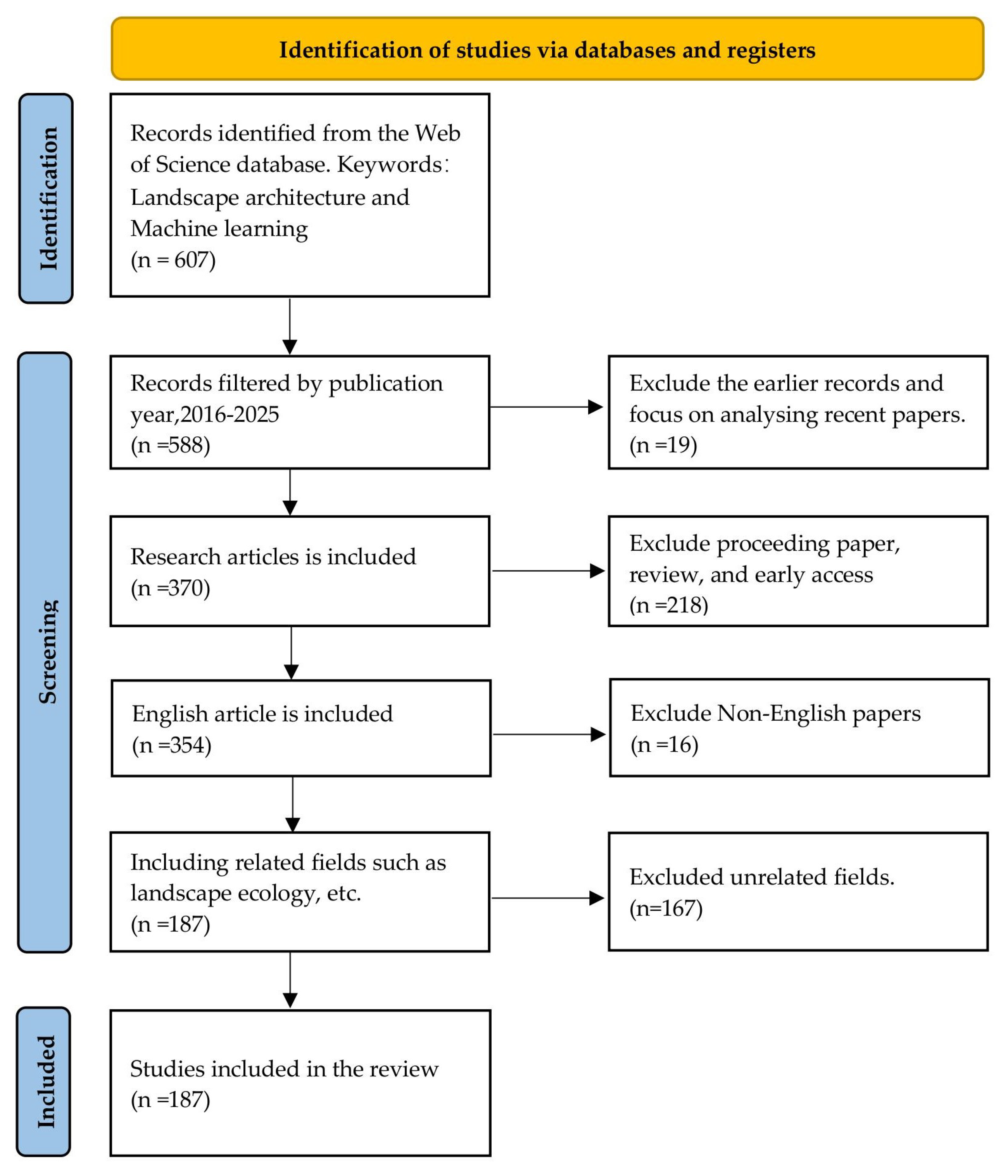
To achieve the goals of this review, multiple rounds of literature searches, readings, and summaries were conducted in the past two years (from December 2023 to May 2025), ultimately forming this comprehensive review. Specifically, the process was divided into four steps, as illustrated in Figure 1. This systematic review was conducted following the Preferred Reporting Items for Systematic Reviews and Meta-Analyses (PRISMA) 2020 guidelines. The PRISMA checklist can be found in Table A1.
Figure 1. PRISMA flowchart for the systematic literature selection process.
Step 1: Preliminary Search. In the first step, an initial search was conducted using the keywords “Landscape architecture and Machine learning” in the Web of Science database. After this, the bibliometric analysis software CiteSpace 2025 was utilized to perform a preliminary analysis of factors such as the number of publications, year-wise distribution, and keywords from subfields. Several keywords related to the built environment were revealed in the analysis, including architectural style, style transformation, prediction, landscape ecology, and the built environment. Subsequently, these keywords were employed in further searches, including Google Scholar and Scopus, to ensure that the scope encompassed applications ranging from the urban scale to the architectural scale and from data processing to diverse use cases. The initial selection of the literature was formed in this step. To ensure comparability, the dataset was restricted to English-language publications, which we acknowledge may exclude relevant studies in other languages. In addition, the scope was limited to peer-reviewed journal articles and conference proceedings indexed in major databases, while the grey literature, such as reports, theses, and unpublished manuscripts, was excluded to maintain quality control.
Step 2: Abstract Screening. The abstract of all articles in the initial selection was reviewed against the following criteria for the construction of a database of articles pertinent to this review:
  • Highlighting subfield-specific keywords that were trending during the search process.
  • Excluding papers that were not pertinent to the focus of this review.
  • Limiting the publication years to the range of 2015–2025.
Studies were included only if they demonstrated a direct and substantive application of ML techniques to landscape architecture or closely related subfields (e.g., landscape ecology, landscape planning, or landscape visualization). Papers where ML was applied in a purely generic computational context without a clear link to landscape architecture issues were excluded. Priority was given to peer-reviewed articles in reputable journals, and in cases of earlier works (prior to 2018), the citation frequency and methodological clarity were used as relevance indicators.
Following this process, 607 relevant articles were identified.
Step 3: Secondary Screening. The abstracts of all 607 articles underwent a detailed review to ensure alignment with the scope of this study. Additionally, some classic theoretical studies pertinent to ML algorithms were incorporated. For papers that fulfilled the inclusion criteria, the full text was reviewed. To ensure a comprehensive collection of resources, the references of the included articles were also scrutinized in order to uncover additional studies relevant to the topic. Since the volume of research on ML applied to landscape architecture has grown significantly since 2018, the focus has been placed on the literature published post-2018. For studies published prior to 2018, their citation counts were reviewed to ensure that no unique or significant works from that period were overlooked.
Step 4: Summary and Analysis. Following the secondary screening process, 187 target articles were selected for in-depth reading and analysis. The focus was on summarizing the applications of ML in landscape architecture, identifying differences between ML methods and traditional approaches, and pinpointing areas where ML methods require improvement or enhancement in this field.

Investigated ML Tools Applied in Landscape Architecture

Artificial intelligence (AI) techniques encompass a diverse array of methods, with ML and deep learning holding significant potential for application in landscape architecture research. ML, a branch of AI and an interdisciplinary research field, is primarily categorized into three fundamental paradigms: supervised learning, unsupervised learning, and reinforcement learning [8]. Deep learning, as a subset of machine learning, utilizes neural network algorithms to enable machines to process large amounts of unstructured data, such as images and text [9].
Supervised learning relies on labeled data to learn a function that maps inputs to outputs [10,11]. It primarily comprises classification and regression tasks, with algorithms like linear regression predicting continuous values and classification algorithms like logistic regression (LR) predicting discrete values [12]. Representative supervised learning algorithms encompass the K-nearest neighbor algorithm (KNN), support vector machines (SVMs) [13,14], decision trees (DTs) [15], random forests (RFs) [16,17], and neural networks.
Unsupervised learning encompasses ML paradigms where algorithms automatically identify patterns or structures in the data without manual labeling, thereby extracting the underlying structures or patterns [18]. Its core tasks include clustering, dimensionality reduction, density estimation, and anomaly detection. Common unsupervised learning methods include K-means clustering, hierarchical cluster analysis (HCA), and principal component analysis (PCA). In landscape design, unsupervised learning can process heterogeneous data from multiple sources, offering a data-driven approach for landscape pattern analysis, ecological process simulation, and human–environment relationship studies.
Reinforcement learning enables an intelligent agent to learn to obtain the maximum cumulative reward in a specific environment [19,20]. The algorithms include value function methods such as Q-learning and Q-network (DQN) algorithms, as well as policy-based methods, such as the deep deterministic policy gradient (DDPG) algorithm [21].
As a prominent subset of machine learning, deep learning utilizes neural network algorithms to enable machines to process large amounts of unstructured data, such as images and text [9]. Convolutional Neural Networks (CNNs) employ convolutional structures to extract image features [22]. This effectively reduces the number of network parameters and alleviates the model’s overfitting problem. Recurrent Neural Networks (RNNs) and Long Short-Term Memory Networks (LSTMs) are core models for processing sequential data. RNNs introduced recurrent connections in the time dimension, pioneering the short-term memory function. As an improved RNN architecture, LSTMs address the long-term dependency problem of RNNs through their gating mechanism [23,24].
Variational Autoencoders (VAEs) and Generative Adversarial Networks (GANs) have garnered attention due to their output methods. GANs, which can transform different styles of images into each other through the mutual confrontation of generators and discriminators, have been trained with a series of derived models, such as Pix2Pix and CycleGAN [25]. Similarly, diffusion models [26] have been used in text-to-picture generation due to the adoption of the U-Net architecture and novel generation methods [27]. Graph neural networks (GNNs) can be used for data learning of graph structures [28], although there are still limitations in real-time dynamic graph updating and incremental learning scenarios [29]. Common deep learning models also include DeepLab, Xception, and Transformer.

3. Results

3.1. Bibliometric Results

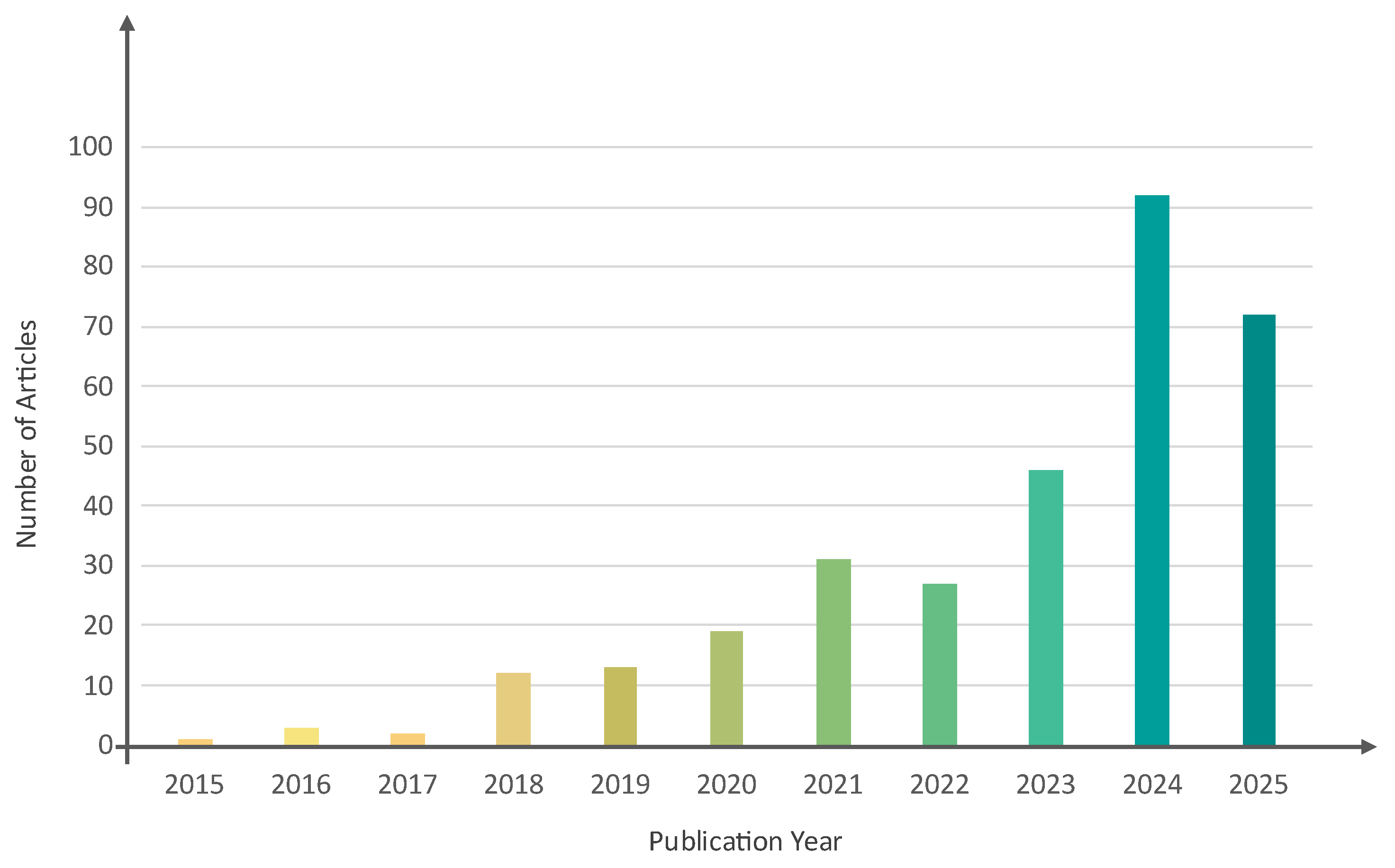
Through the statistical analysis of the publication trends in the initially screened literature (Figure 2), it was found that the number of publications was relatively stable prior to 2017, with no significant growth observed. Starting in 2018, the annual number of published papers showed a steady increasing trend, reflecting the growing interest in and application of ML technologies within the field of landscape architecture. A sharp surge in publication volume occurred in 2024, indicating an explosive growth of research efforts and attention toward this topic.
Figure 2. Number of articles using ML in landscape architecture.
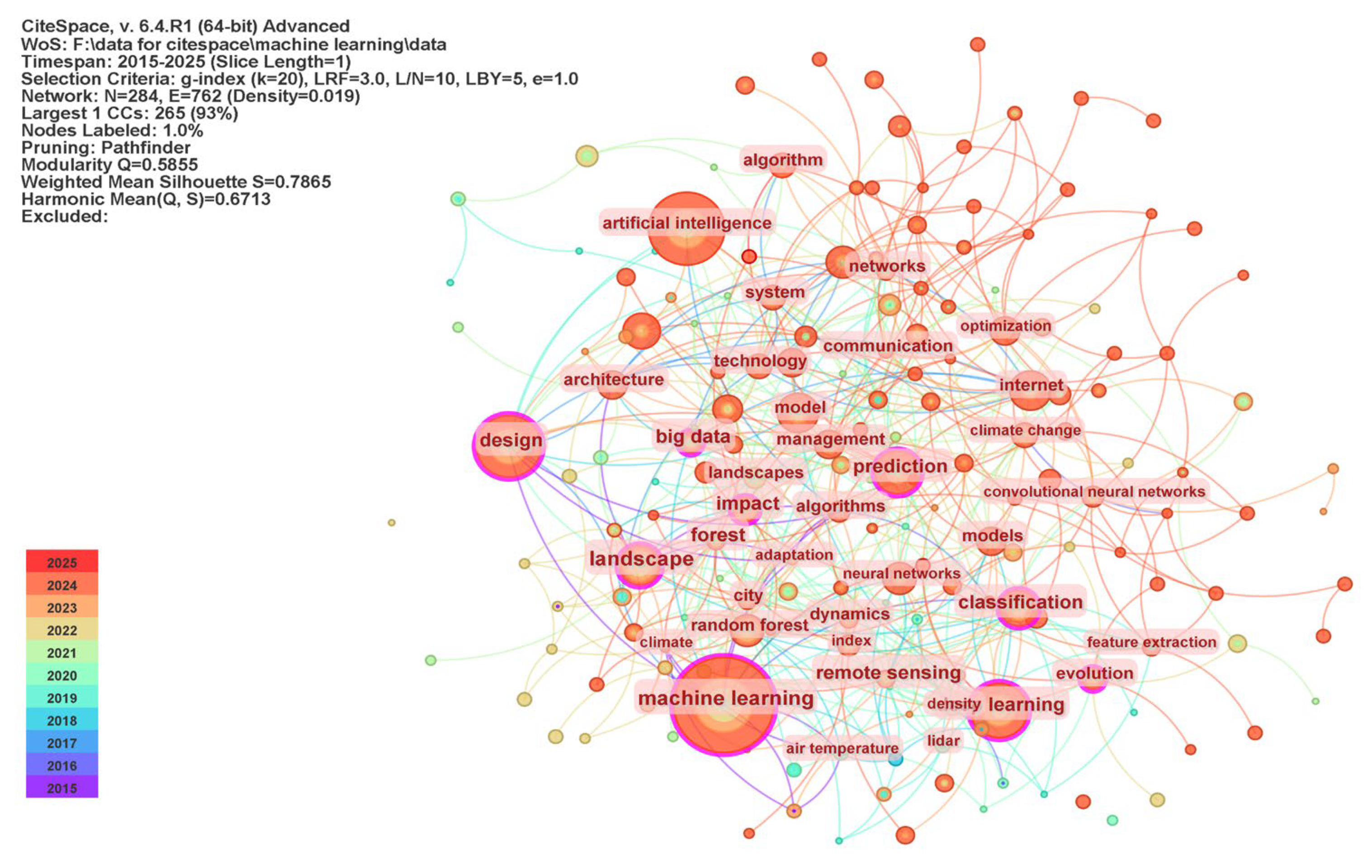
Through the results of keyword co-occurrence analysis using CiteSpace (Figure 3), it was observed that the field of landscape architecture has begun to incorporate artificial intelligence, primarily focusing on ML and deep learning. ML is closely connected to artificial intelligence, indicating that ML is a key application domain of artificial intelligence in landscape architecture research. It also exhibits a strong connection with deep learning. As a subfield of ML, deep learning is based on neural network architectures and can be applied in landscape studies for the analysis of complex landscape data. Additionally, big data demonstrate significant relevance, suggesting that landscape research involves the processing of extensive datasets. ML is utilized as an effective tool for handling large-scale data, such as data obtained from satellite remote sensing. The random forest algorithm, commonly used in ML, plays a significant role in tasks like classification and prediction, such as classifying different landscape types. Moreover, the term “climate change” emerges as a focal point, highlighting the application of ML in the realms of ecological environment simulation, analysis, and prediction.
Figure 3. Keyword co-occurrence relationship diagram.

3.2. Application of ML in the Field of Landscape Architecture

In the field of landscape architecture, the primary application of ML encompasses landscape ecology, simulation and prediction, generation of design schemes, image and effect processing, evaluation of built landscapes, and policy and text analysis. These categories are not mutually exclusive, but rather represent interrelated clusters of applications. In practice, they often overlap and interact—for example, simulation and prediction may provide input data for layout generation, while image post-processing may be combined with text analysis to enhance management workflows. Articles of high relevance have been selected and are presented below.

3.2.1. Landscape Ecology

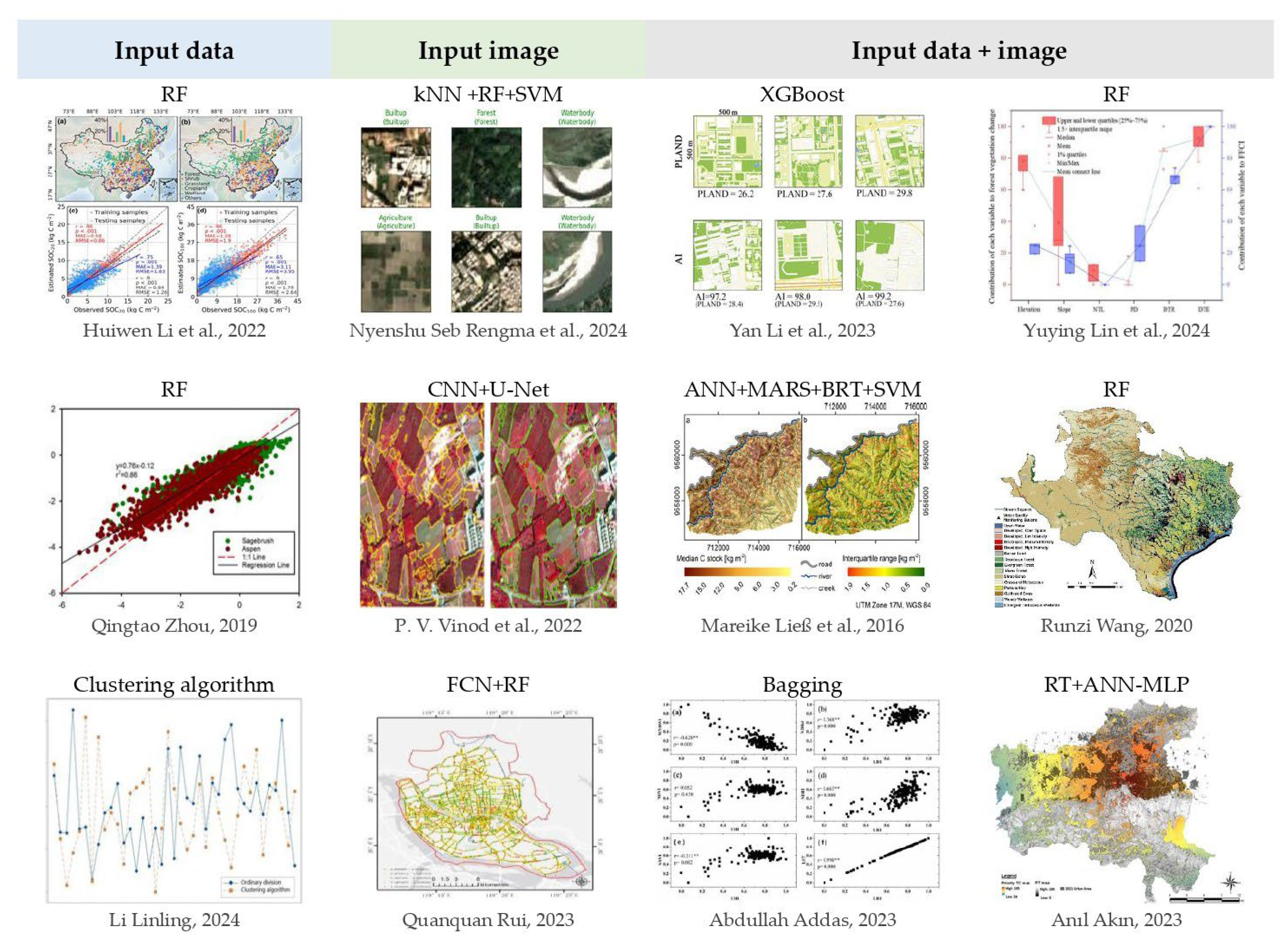
ML methods can accurately infer geophysical parameters from remotely sensed data. Their application in landscape ecology has been on the rise in recent years (Figure 4 and Table A2 in the Appendix A). The main purpose of these studies is to analyze existing ecological factors and to provide references by predicting future changes based on the patterns they exhibit. Specific aims include the mitigation effect of green space on land surface temperature [30], soil moisture [31], carbon content [32], and the impact of different factors on water quality [33], among others [34,35]. In this part of the article, the main type of data used is remote sensing data, which are mostly publicly available and can be collected from relevant websites in each study area. These data include Landsat NDVI data, MODIS surface temperature data, satellite image data, such as Sentinel-2 medium-resolution remote sensing image data, water quality monitoring data [33,36], land use data, topographic data, soil data [30,31], temperature with explanatory ML [30,37], etc. In addition, there are also some studies where researchers have used personally collected field test data [38,39]. Many of these studies have used random forests [32,35], Bagging, AdaBoost [30], and other integrated algorithms. These models can capture complex nonlinear relationships and improve the accuracy of prediction; at the same time, they can better deal with complex data, improve the robustness and predictive performance of the model, and solve the problem of data imbalance. Zhang et al. [34] proposed a CNN encoder–decoder framework with multi-head attention to process multimodal meteorological data (e.g., temperature, precipitation, and wind speed) for landscape ecology—this framework simultaneously captures spatial-temporal patterns, improving the accuracy of meteorological disaster predictions (e.g., predicting heavy rain-induced landscape waterlogging) and adapting to the large data volume of urban-scale landscape studies. Ahmed et al. [31] proposed a hybrid deep learning model (BRF-LSTM), which is superior to a single model in predicting soil moisture. Vinod et al. [40] used Convolutional Neural Networks (CNNs) combined with the U-Net architecture to build a model that was able to automatically extract features and process complex image data to improve the accuracy of TOF classification.
Figure 4. ML tasks related to landscape ecology [30,32,33,35,37,40,41,42,43,44,45,46].

3.2.2. Simulation and Prediction

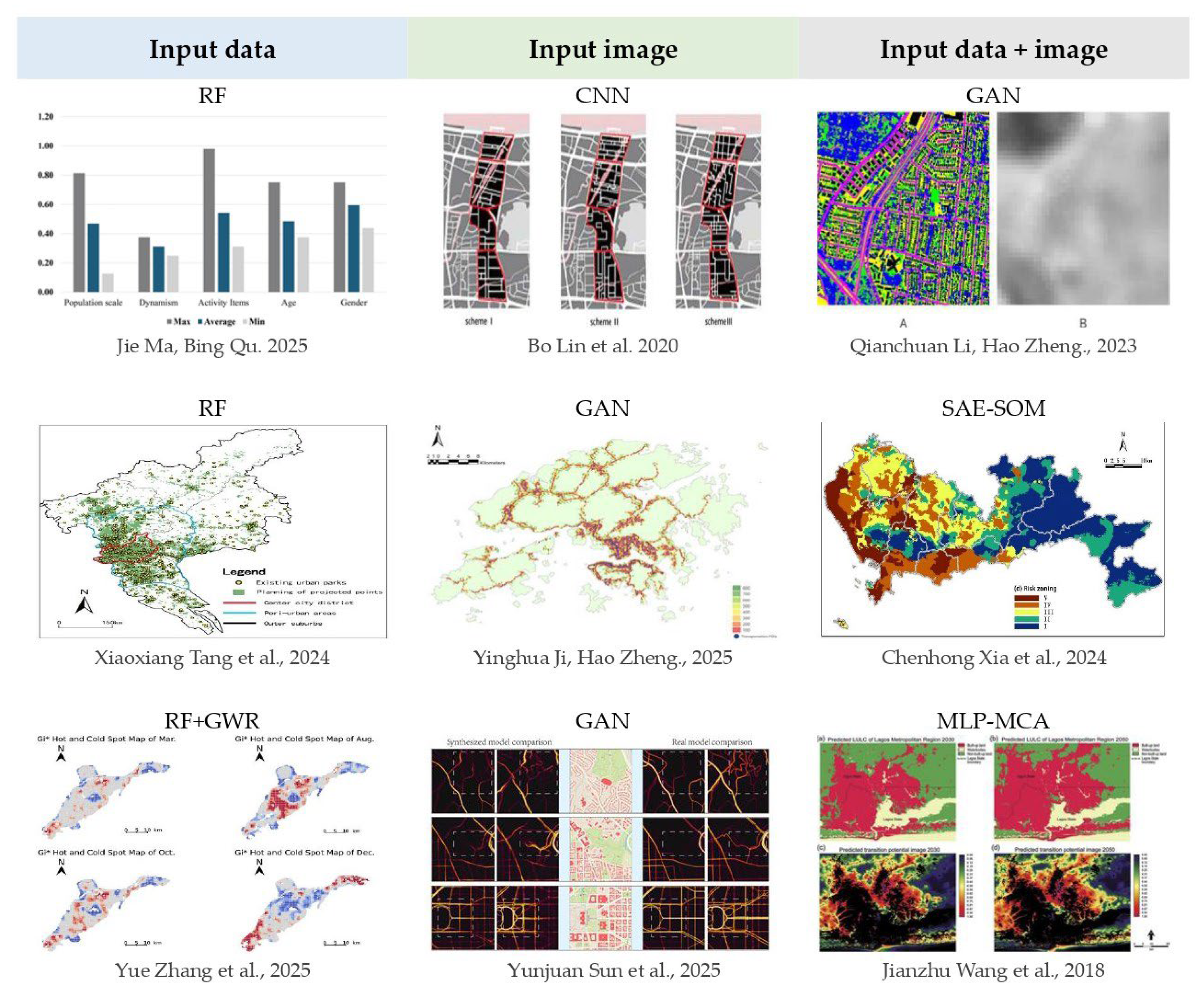
ML has been frequently employed for simulation and prediction in the field of landscape architecture due to its capacity to identify potential patterns in existing data (Figure 5 and Table A3 in the Appendix A). From the perspective of urban design, ML models can predict the potential future distribution of human behavioral vitality based on factors such as the built environment, population density [47,48,49], and the number of people in the city, thereby providing a reference for park landscape design [50] and proposing an urban space synthesis process based on prediction to develop an intelligent design model for urban landscape space.
Figure 5. ML tasks related to simulation and prediction [47,49,50,51,52,53,54,55,56].
In the context of landscape ecology, ML is frequently utilized to investigate the effects of urban surface temperature and blue-green space [51], as well as to predict soil drought [57]. On a more macroscopic level, numerous studies have categorized land use and land cover in urban and coastal regions [52] to monitor alterations in landscape patterns [58]. Commonly employed datasets include Landsat satellite remote sensing data [41,52], Landsat surface temperature data, RapidEye satellite image data, Digital Elevation Model (DEM) data, and Light Detection and Ranging (LiDAR) data [53,58]. Urban scenario datasets such as city-specific map data, Strava data [47], high-resolution population density data, point-of-interest (POI) data, park-use footprint data, and urban Design Database, etc. [54]. Additionally, some researchers have utilized field observation data [50].
The reviewed studies mainly utilized GANs and various complex supervised learning frameworks. Most studies used GAN models [47,49,53,57], which can efficiently process high-resolution image data and provide real-time feedback to predict behavioral distributions more accurately than traditional planning tools. Other supervised learning architectures, such as random forests, gradient boosted trees [50], and the decision tree model ID3 algorithm [54], can automatically learn and optimize decision-making, avoiding the subjectivity of human selection and more accurately predicting results. Support vector machines [58] also perform well in classification accuracy. Wu et al. [59] used optimized BP neural networks to enhance the global search capability and prediction accuracy. Some studies have proposed modifications and extensions to these models to solve particular problems. For example, Zhang et al. [51] combined geographically weighted regression (GWR) and random forest (RF) to adequately ensure the effect of spatial heterogeneity and identify the blue-green spatial indicators that have the greatest impact on surface temperature. Wang and Maduako [52] combined multilayer perceptron (MLP), Markov chain analysis (MCA), and remote sensing (RS) to simulate landscape land use changes: MLP models the nonlinear relationship between urban expansion and green space reduction, and MCA quantifies the transition probability of landscape types; together, they predict future land use patterns to guide landscape conservation planning. These techniques are mainly based on the existing data provided by the researcher, from which the analysis is carried out and patterns are identified to achieve the purpose of simulation and prediction and to provide a scientific basis for different research problems.
In addition to architectures like decision trees, random forests, and support vector machines, which are often used in other fields to predict outcomes, architecture that focuses on image processing, such as CNNs and GANs, are also widely used. However, most of these tools are limited by their training sets and generation methods. If there are no explicit features in the training data or the parameters are not set properly, they may produce results that do not meet expectations, such as overfitting.

3.3. Layout Generation

ML methods can analyze extensive databases of design drawings, extracting their characteristics to produce a variety of design drawings in similar styles. The generated drawings, featuring a variety of layouts, can offer designers a rich array of design references. ML tools are the subject of relevant studies on planar generation in the fields of architecture, urban and rural planning, and landscape architecture.

3.3.1. Generation in Architecture

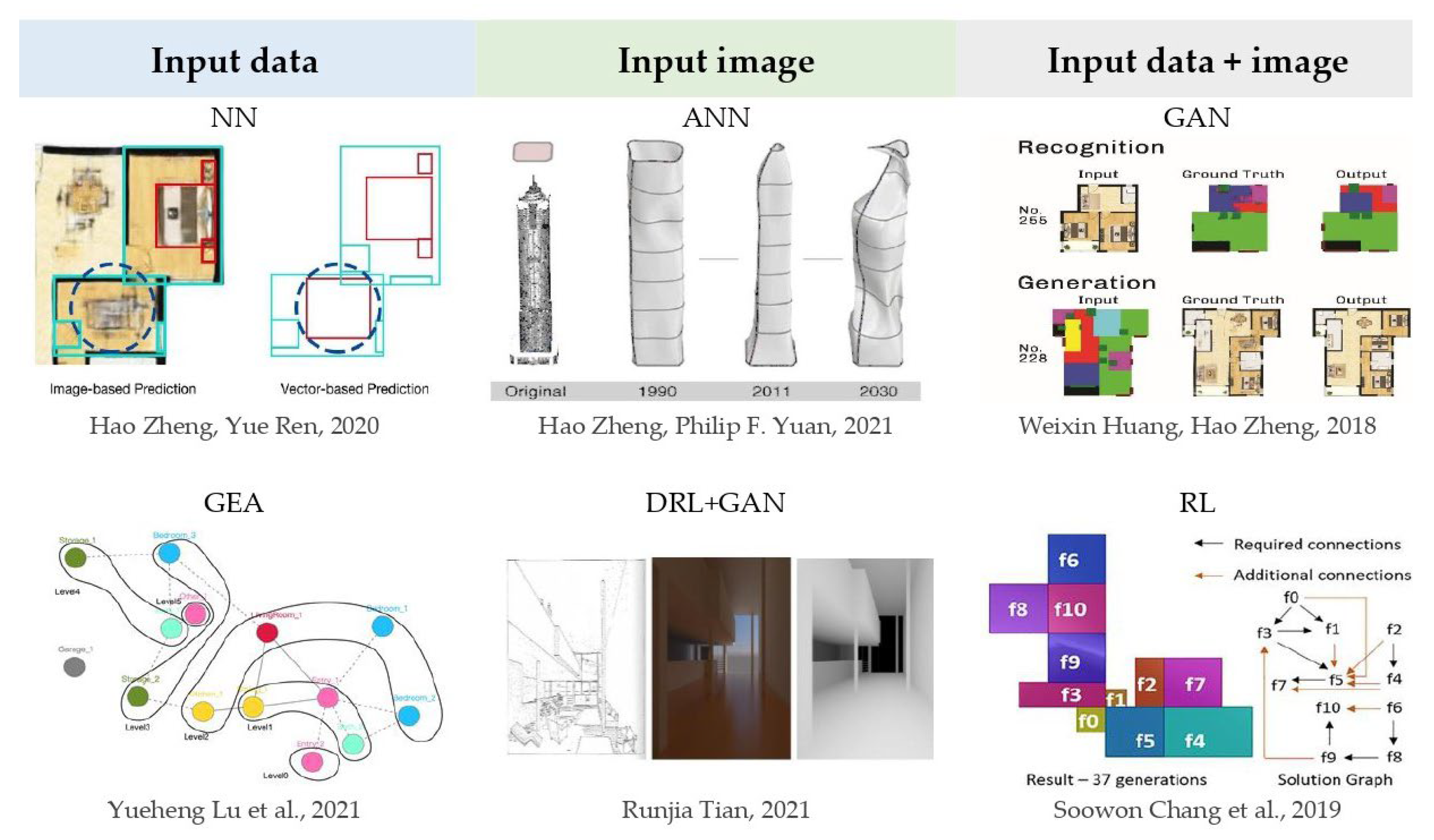
In the field of architecture, ML techniques have been employed to address issues related to design automation, optimization, and innovation (Figure 6 and Table A4 in the Appendix A). In terms of improving design efficiency, some studies have focused on addressing the limitations of traditional architectural design methods in terms of accuracy and computational efficiency [60], thereby avoiding the loss of accuracy and waste of computation associated with traditional pixelization [61]. The research findings contribute to reducing the designer’s workload in the early design stage [62,63]. Furthermore, some studies have integrated user experience to develop innovative and adaptive solutions that meet user expectations and enhance design efficiency [64,65,66].
Figure 6. ML tasks related to generation in architecture [60,61,64,66,67,68].
These studies utilized various types of databases, most of which were developed by the researchers themselves. For instance, the flat floor plan image dataset [62] and other architectural design datasets are primarily collected and produced by researchers from different platforms [67]. Some of these datasets may be restricted by the permissions of the institutions and platforms [64]. Some researchers have generated 3D geometric modeling data, such as the NURBS control point data used by Zheng et al. [61], and the model rendering dataset produced by Dosovitskiy et al. [69]. The vectorized design drawing datasets used in some studies are often specifically created by researchers to meet the study’s objectives [61,65].
A variety of ML models were applied in the aforementioned literature. Among them, Generative Adversarial Networks (GANs) and their variants can generate high-quality, detail-rich images based on given conditions, such as the frequently appearing Pix2Pix model in these studies [62,65,67]. Reinforcement learning can continuously adjust its strategy based on environmental feedback, is highly adaptive, and can integrate multiple methods to provide comprehensive decision support [64,66]. In addition, the features of Convolutional Neural Networks (CNNs) for the automatic extraction of image features, customized artificial neural networks [60], and the advantages of custom artificial neural networks to quickly generate solutions contribute to the applicability of these models. From a comprehensive point of view, GANs are used more frequently and can generate image data that meet the requirements based on different input conditions to meet the needs of the architectural and urban design field for the visual presentation of design solutions, and each model has its own applicable scenarios and characteristics.

3.3.2. Generation in Urban Planning

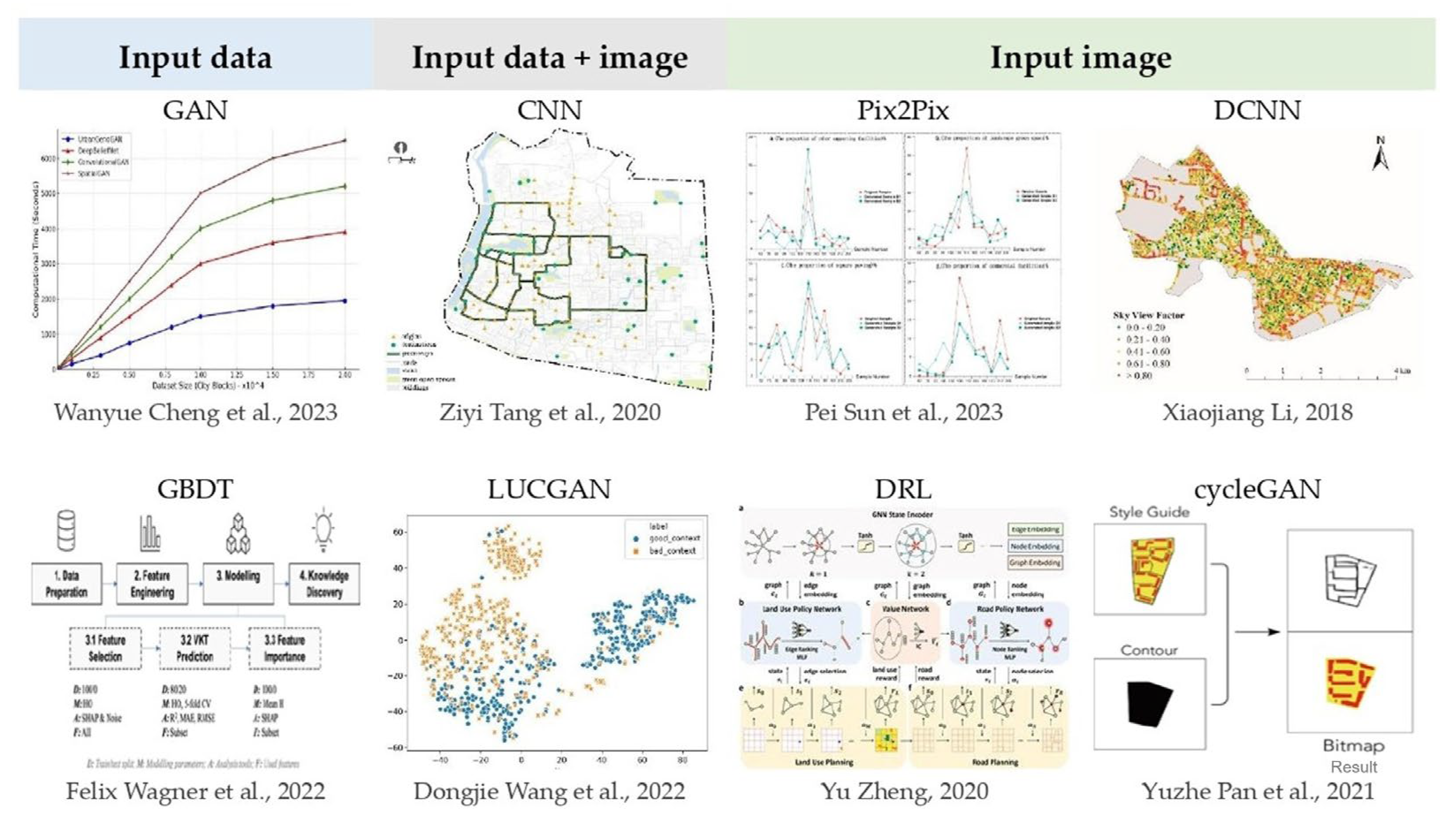
Research in the planning profession has also focused on using ML techniques to solve complex problems in urban planning and design, including urban spatial layout optimization, community planning, site planning, greenway planning, etc., at a macro level (Figure 7 and Table A4—planning section in the Appendix A). For the spatial layout optimization problem, many studies have tried to address the lack of spatial efficiency of traditional methods [70,71,72]. Some researchers have used the incorporation of user needs as an entry point to optimize urban blocks and neighborhoods to meet multi-user needs [73,74,75]. Many studies have been devoted to the automation of site planning in an attempt to solve the problem of complex planning constraints in urban planning [76]. For greenway and transport planning, Tang et al. [77] proposed to incorporate human-scale factors into greenway network generation, advancing the development of greenway planning methodology. Felix Wagner et al.’s [78] in-depth understanding of how urban form shapes sustainable mobility attempts to reduce the commuting distance problem through planning to support low-carbon urban planning strategies.
Figure 7. ML tasks related to generation in urban planning [65,70,75,76,77,78,79,80].
These studies involve a variety of datasets, some of which are publicly available and some of which were produced or collected by the researchers. Tang et al. [77] and Wang et al. [76] used urban data such as points of interest (POIs), location-based services (LBSs), positioning data, street view images, traffic track data, etc., which were partly obtained from publicly available urban data platforms and partly through field collection. On the other hand, Jiang et al. [74] and Chen et al. [81,82] used urban data such as building footprints, census blocks, land use types, etc., mostly from publicly available data sources. Some open-source GIS datasets are also available on relevant data sharing platforms or research organization websites [71]. Some studies used multiple samples from different eras of a particular designer or city, and these data were often compiled by the researchers themselves [72,75].
These studies have made extensive use of a variety of ML models, with GANs and their variants being the most widely used. Different scholars have optimized different GAN models for different problems. For example, Gan et al. [72] proposed UDGAN, which combines GANs and multi-objective optimization algorithms, such as UrbanGenoGAN, a new urban spatial planning algorithm that combines GANs, Genetic Optimization Algorithms (GOAs), and Geographic Information Systems (GIS), to predict, optimize, and analyze urban development scenarios at the same time. Pan et al. [75] proposed the use of the GauGAN model, which is more suitable for general layout generation, to improve the clarity of generation and make subsequent vectorization easier. In addition, Chen et al. [82] combined GANs with GOAs and GIS to simultaneously predict, optimize, and analyze urban development scenarios, integrating the generative capability of GANs, the optimization capability of GOAs, and the spatial analysis capability of GIS. Compared to other models, GANs have an obvious advantage in generating complex urban spatial layouts. It can generate diverse and realistic design solutions, providing more innovative possibilities for urban planning. Other algorithms, such as deep reinforcement learning [70] and gradient boosting decision trees [78], have also been applied.
Current research in the field of architecture and urban design actively explores the application of ML techniques at different levels. Numerous studies have proposed distinctive solutions to the limitations of traditional design methods, such as insufficient accuracy and efficiency, and the heavy burden of designers’ preliminary work. Regarding the datasets, due to the specificity and relevance of the research, most of them are collected or produced by the researchers themselves, with limited publicity, reflecting the personalized needs for data acquisition and integration in this field. The choice of ML models shows diversity, and the development and optimization of each model provides strong support for the intelligence, automation, and innovation of architecture and urban design. The application and exploration of ML in these fields have also provided a valuable reference for its introduction into the field of landscape architecture.

3.3.3. Generation in Landscape Architecture

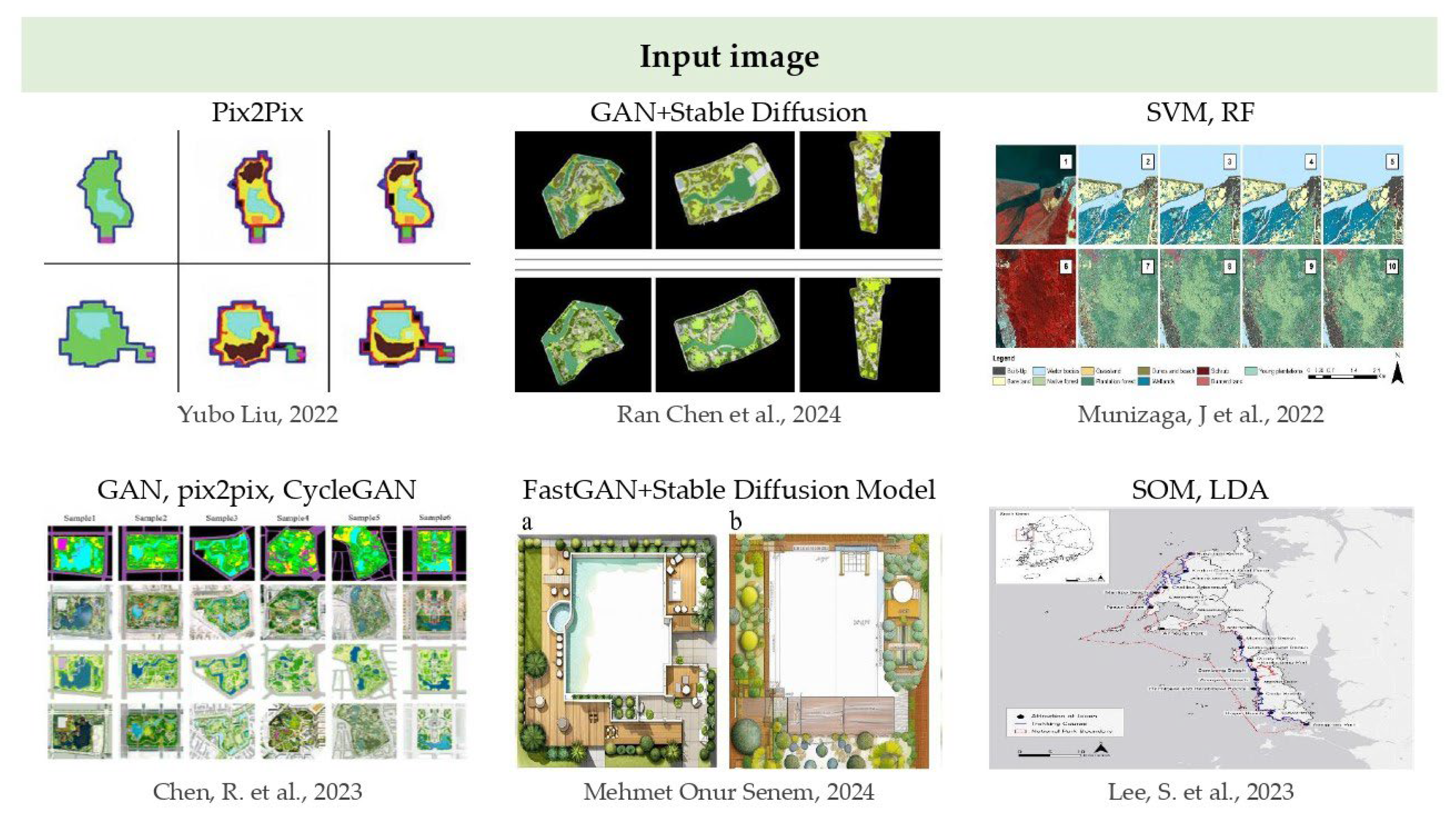
The literature on ML in landscape architecture primarily focuses on utilizing ML techniques to address various key issues in landscape design and planning, encompassing a broad spectrum of aspects, including design efficiency improvement and site information mining (Figure 8). In terms of improving design efficiency, ML models can be integrated with various artificial intelligence techniques [83] to more accurately identify site factors [4] and user needs [84], thereby breaking through the traditional experience-dependent design approach [85], constructing a more comprehensive automatic generation process of park green space [81,82,86], and applying different art styles to the design. It significantly enhances design efficiency and diversity while reducing the duplication of labor.
Figure 8. ML tasks related to generation in landscape architecture [58,81,82,85,86,87].
For problems such as landscape image recognition, urban color impression analysis, terrain generation, and elevation prediction in digital design, ML provides a variety of intelligent tools and methods for landscape garden design [88], offering landscape architects potential applications for assisted case analysis and assisted plan drawing [89] and reducing the subjectivity in human annotation [90]. For some landscape types that are not recognized from an official perspective, ML can utilize crowdsourced photos created and uploaded by users to map the distribution of landscape types, thereby providing new perspectives and data support for the management of protected areas [87].
Some of the datasets used in these studies are publicly available, such as remote sensing image datasets, park design datasets [82], land use and road conditions datasets [84], public landscape resource libraries [83], and online design competition platforms, such as https://jp.arcbazar.com/ [86]. Some of the landscape photos used in the studies were collected and produced by the researchers from the internet [87,88]. Additionally, numerous researchers have utilized self-annotated, fieldwork-acquired datasets [4,81,85,89].
These studies employed various ML models to address garden landscape design and related problems, among which GANs and their variants, such as Pix2Pix, CycleGAN, and Arbi-DCGAN, are widely used, primarily due to their powerful capabilities in image generation and data processing. In recent years, newly emerging generative diffusion models have also shown great advantages in image generation and other tasks. Chen et al. [82] combined GANs and Stable Diffusion to construct a full-process park generation design method. Compared to the traditional single GAN model, Stable Diffusion significantly improves the information richness and detail performance of the generated results [86]. Pix2Pix is capable of generating landscape layout designs based on input conditions, such as land use conditions or site plans, and performs well in condition-guided image generation tasks [81,85]. Deep neural networks (DNNs) are suitable for handling large amounts of complex data and feature extraction and classification tasks and have also been used in some of the studies [83]. The K-means clustering algorithm and Extreme Random Tree Classifier are traditional ML algorithms that have also been applied to work with other algorithms to achieve more comprehensive data analysis and processing [88]. In addition, random forest has demonstrated the ability to efficiently process high-resolution data and accurately identify small-scale topography and geomorphology, which reduces the time spent on mapping topography and geomorphology and improves the generation efficiency [90].
This literature focuses on the wide application and in-depth exploration of ML technology in the field of landscape design and planning, providing a rich theoretical foundation and technical support for the intelligent development of landscape design. By using various advanced ML models such as GANs, deep neural networks, the Stable Diffusion Model, etc., and by combining various kinds of public or homemade datasets, researchers have achieved remarkable results in solving the problems of traditional landscape design, improving the design efficiency and quality, and exploring the potential information of the site, which also provides many valuable references for further research and technical application in this field in the future.

3.4. Image Post-Processing

3.4.1. Style Transfer

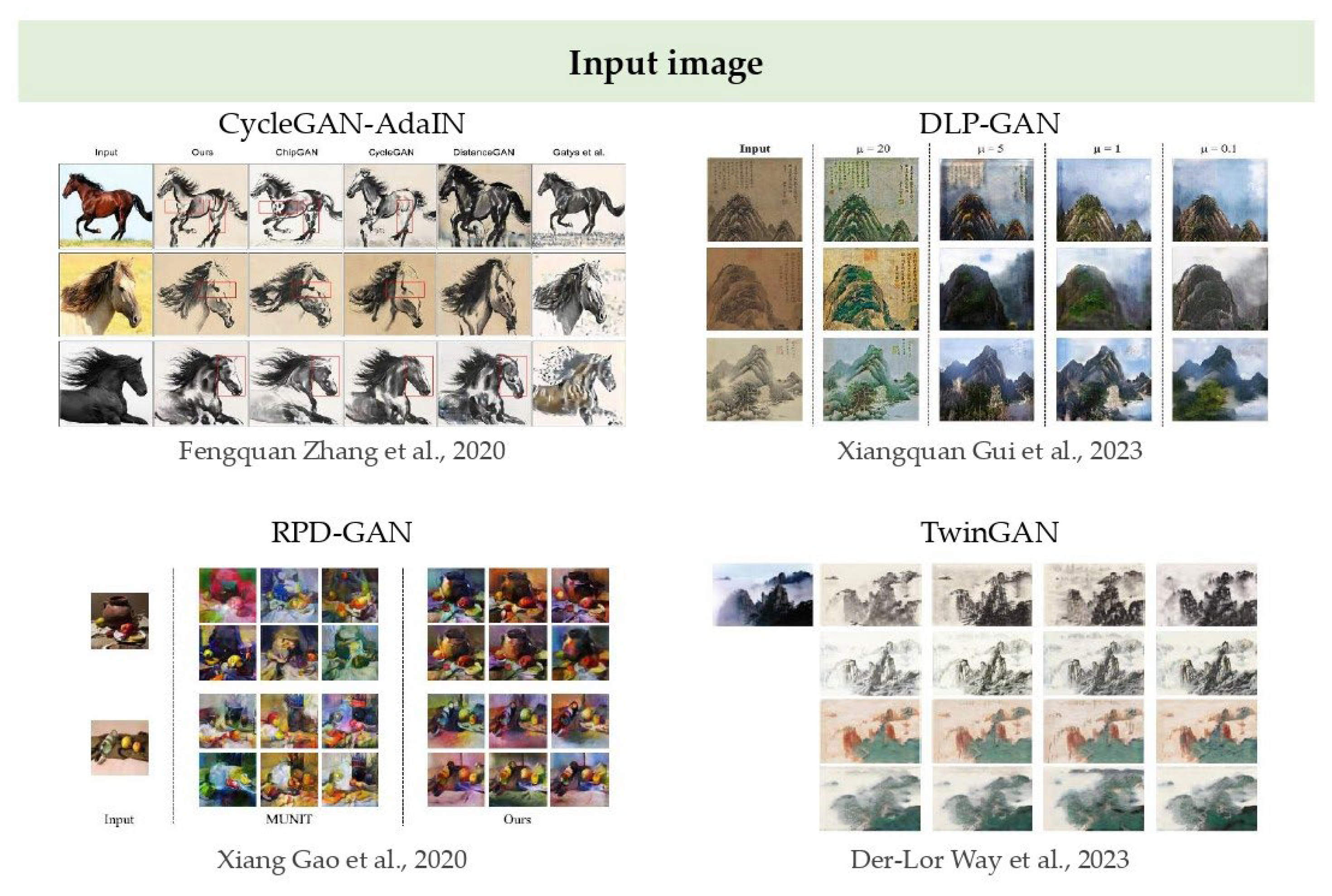
ML is frequently employed for the style conversion of various drawing styles. Overall, these studies focus on image style conversion techniques based on GANs, addressing the three core issues of insufficient semantic information retention, limitations in capturing stylistic features, and unstable quality of cross-domain mapping in traditional image translation tasks (Figure 9 and Table A5 in the Appendix A). Most studies address the needs of style migration in the field of art creation and explore how to enhance the visual authenticity and artistic expression of the generated images by improving the GAN architecture or loss function. Some of these studies propose innovative solutions for specific problems. For example, the CycleGAN-AdaIN framework proposed by Zhang et al. [91] addressed the problem of detail loss and style deviation in ink painting transformation by introducing an adaptive instance normalization (AdaIN) module and one-way cyclic consistency loss. Chung and Huang [92] designed the Boundary-Enhanced Generative Adversarial Network (BEGAN), which focused on improving the conversion distortion caused by blurred boundaries of ink paintings and enhancing user control through interactive labeling. Challenges in special scenarios have also seen breakthroughs. For example, Gui et al. [93] achieved the transformation from ancient landscape paintings to modern photographs. Way et al. [94] proposed TwinGAN, which used SketchGAN and RenderGAN to construct a two-stage generative strategy to simulate diverse landscape painting styles while preserving the structure of the input images. These studies demonstrate the general advantages of GANs in cross-domain translation, as well as customized improvements for the specific needs of the art domain.
Figure 9. ML tasks related to style transfer [91,93,94,95].
The datasets used in these studies can be divided into two categories: publicly available databases and researcher-created datasets. The remaining studies rely on self-constructed datasets, such as that collected by Zhang et al. [91], which contains ink paintings themed around horses and landscapes, and the paired data of ink paintings and real mountain scenery photos constructed by Chung and Huang [92]. Gui et al. [93] integrated cross-domain data of ancient landscape paintings and modern landscape photos. Among them, the self-constructed datasets mostly focus on specific art styles or cultural elements, and their construction process involves specialized domain knowledge, such as manual filtering to ensure stylistic consistency. Overall, existing studies have limitations in terms of data diversity, and there is a need to promote the standardized construction and sharing mechanism of cross-cultural style datasets in the future.
In these tasks, GANs are often used as the core framework, but with various improvements to meet the task requirements. CycleGAN and its variants are the most widely used, including CycleGAN-AdaIN [91], BEGAN [92], and RPD-GAN [95]. The advantages are that cross-domain mapping can be achieved without pairwise data and that content retention is constrained by cyclic consistency loss, which is especially suitable for data-scarce scenarios in art style transformation. For example, CycleGAN-AdaIN addresses the shortcomings of the traditional CycleGAN in modeling complex textures (e.g., ink strokes) by introducing the AdaIN module to dynamically adjust the style features. Two-stage generative models are gradually gaining attention, such as TwinGAN [94], which completes line drawing generation and style rendering in stages, and DLP-GAN [93], which improves the fineness of complex artistic expressions. Compared to traditional methods, the advantages of GANs are reflected in three aspects: (1) higher-order style capture, which learns the overall features of the target domain, such as color and texture, through adversarial training; (2) content-style decoupling capability, such as AdaIN and dense fusion module to achieve independent modulation of stylistic features; and (3) user-interaction extensibility, such as BEGAN, to support marker-guided local editing. However, the training stability and pattern crash risk of GANs are still common issues that need to be optimized.

3.4.2. Sketch Processing

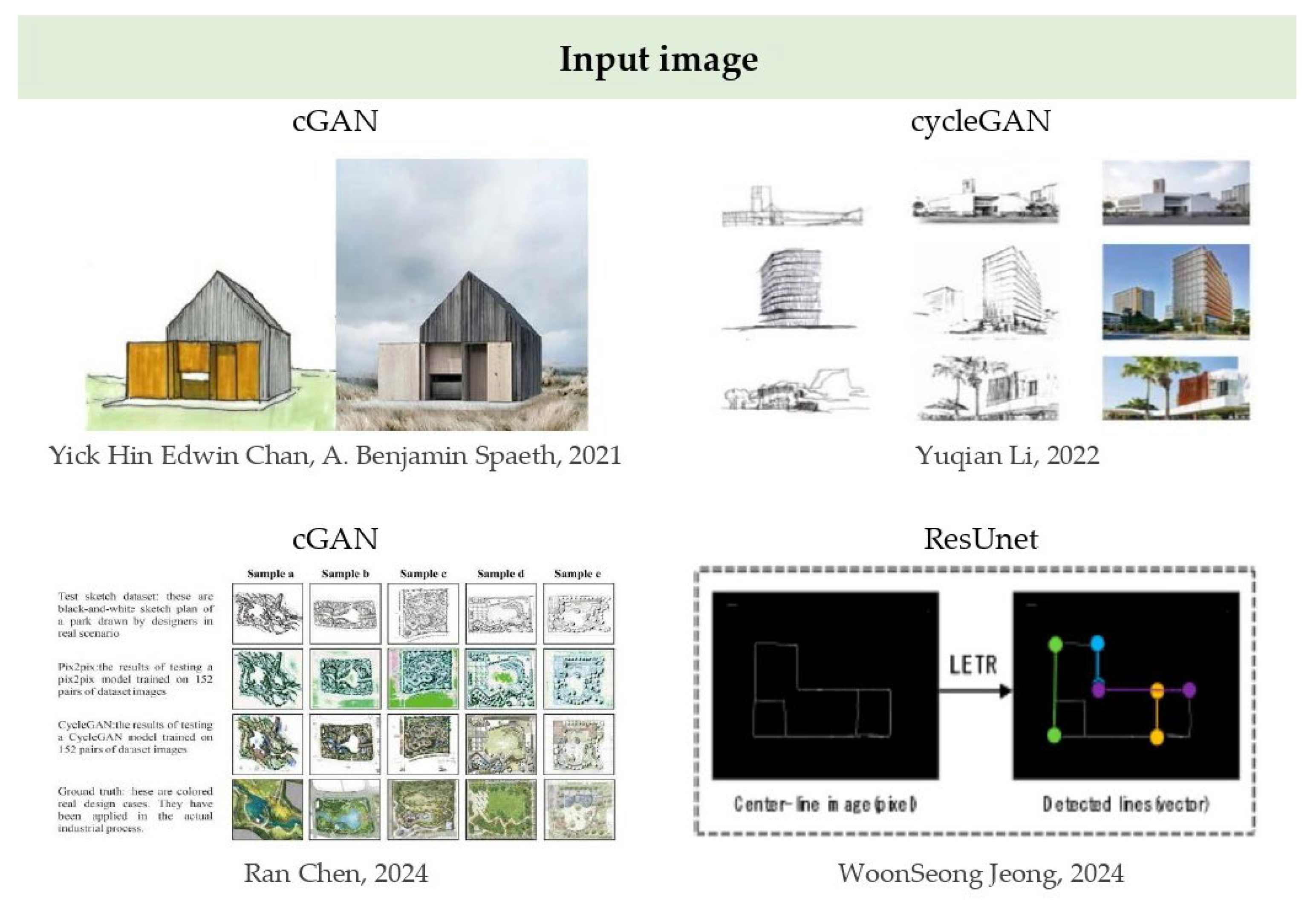
In recent years, research in the field of architecture and urban design has gradually been shifting towards intelligence and automation. It is gradually becoming possible to create renderings through architects’ sketches. This literature addresses three main core issues: efficiency optimization of the design process, mapping conversion of sketches to design outcomes, and human–machine collaboration. Studies have focused on reducing the manual design burden through generative modeling, such as the one proposed by Zhao et al. [96], who combined Y-GAN and a DDIM model to solve the dual task of coloring architectural sketches and fusing multiple drawings and overcome the shortcomings of traditional methods in complex structural processing. Chen et al. [97] achieved the conversion of black-and-white sketches to color designs using a conditional GAN to meet the need for rapid rendering of park sketches, which significantly improved the design iteration speed. In addition, Jeong et al. [98] constructed an automated framework from sketches to BIM models by using ResUnet and LETR models, which solved the problem of the language barrier in building information model generation and the semantic recognition and structural mapping problems in building information model generation. Some studies, such as Sun et al. [99], have explored the possibility of human–computer co-creativity by allowing users to dynamically generate cartoon landscape drawings through semantic labels. Lin et al. [55] combined Wave Function Collapse (WFC) and CNNs to generate an urban space layout, breaking through the rule dependency of traditional parametric design. These studies not only optimize the design efficiency but also provide technical support for the expansion of design thinking (Figure 10).
Figure 10. ML tasks related to sketch processing [97,98,100,101].
The datasets used in the research can be divided into two categories: public datasets and self-built datasets. Public data include Columbia University building plans, Google Map satellite images, etc., which are mostly used in urban design and building plan generation tasks [102]. However, most of the literature relies on self-built datasets, such as the architectural sketches and their corresponding color images collected by Zhao et al. [96], black-and-white sketches of parks paired with color design drawings collected by Chen et al. [97], and the sketch-BIM model mapping library constructed by Jeong [98]. These self-constructed data are usually labeled for specific tasks but are not explicitly open-access. Only a few studies [100] used publicly available CycleGAN benchmark datasets for cross-domain transformation of sketches to images. Overall, the dataset is significantly customized, reflecting the diversity and specialized needs of tasks in the architectural domain, but the lack of data sharing may limit model reproduction and generalization.
The research mainly uses GANs and their variants, including Pix2pix, CycleGAN, cGAN, etc., which account for more than 70% of the work, followed by diffusion models (DDIMs), Convolutional Neural Networks (CNNs), and hybrid architectures (e.g., ResUnet or WFC). Two major strengths of GANs for image generation tasks are that (1) they are able to capture the complexity through adversarial training data distribution to generate high-fidelity images, e.g., using Pix2pix to generate color design maps, as proposed by Chen et al. [97], and (2) they are able to use unlabeled data, such as CycleGAN [100], to complete the conversion of sketches to architectural images without pairing data. Compared to traditional methods, GANs are able to handle fuzzy, abstract inputs [101] and improve generalization through data augmentation. In addition, among non-GAN models, diffusion models have been used in studies, such as Zhao et al. [96], and other studies demonstrated superior detail generation and noise suppression. ResUnet [98] improves the accuracy of sketch segmentation through residual linkage, and the combination of WFC and CNN [55] achieves unsupervised generation of urban space. However, GANs, which can both learn stylistic features and control the output through conditional inputs to satisfy the creative needs of architectural design, are still in a more dominant position in image generation.

3.4.3. Optimization

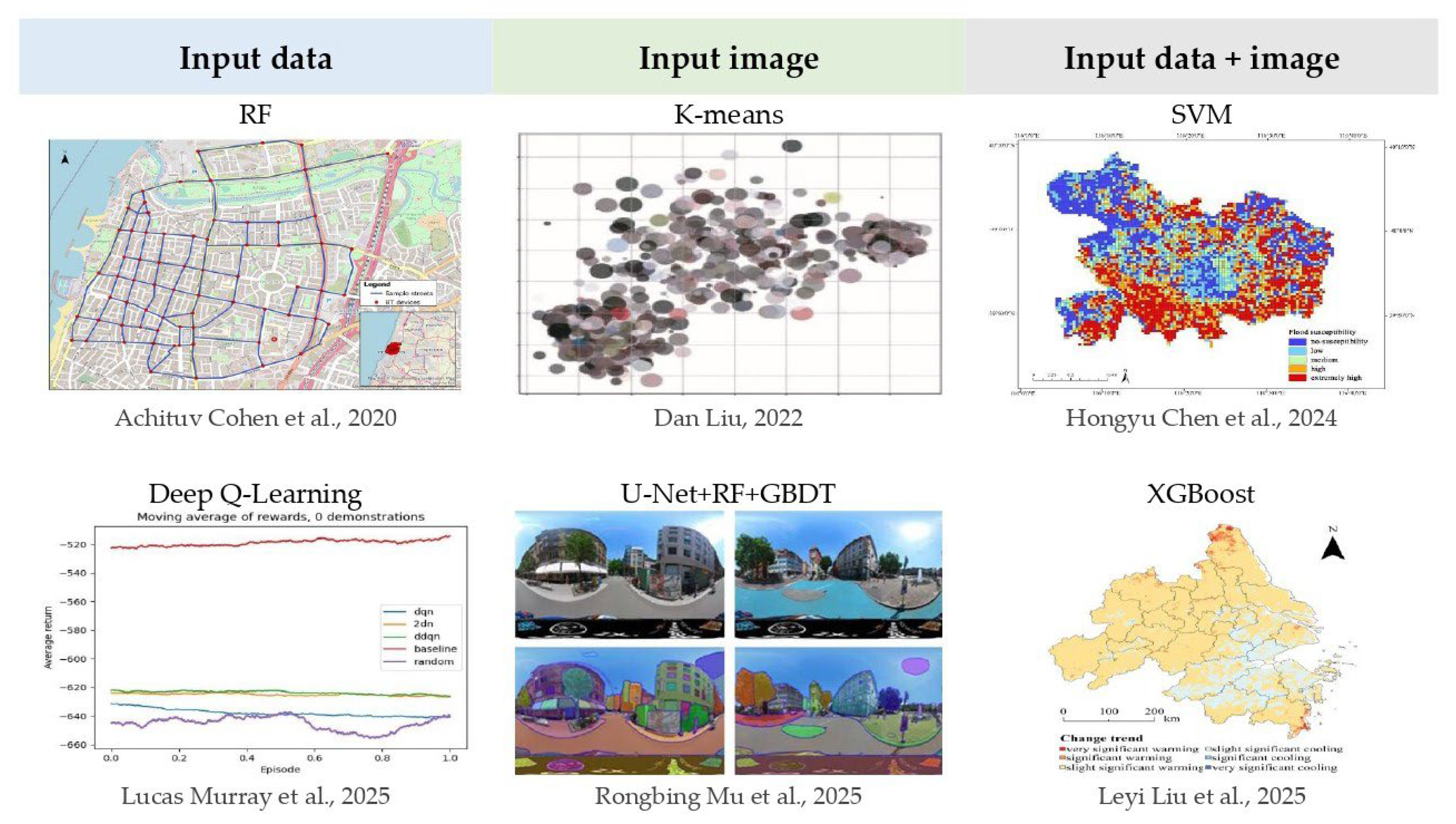
Currently, the application of ML technology in the field of landscape design and urban planning has exhibited significant diversity, and its model selection and task requirements demonstrate a high degree of adaptability. GANs, as a core tool for creative design, effectively address the efficiency bottleneck of traditional design methods in image generation and spatial reconstruction through the adversarial training mechanism (Figure 11). The research cases show that GANs based on StyleGAN [103] and Arbi-DCGAN [89] are capable of capturing the visual attributes and implicit qualities of urban places. The introduction of an arbitration mechanism significantly enhances the stability and quality of the generated images and improves the efficiency of the conversion from plan to rendering by more than 80%. In the field of dynamic system optimization, deep reinforcement learning (DRL) overcomes the dependence of traditional optimization methods on explicit environment modeling through trial-and-error learning mechanisms. For instance, Dueling Double Deep Q-Learning [104] achieves autonomous adaptation to complex fire spread dynamics in firebreak placement. Its pre-training strategy enhances the decision-making speed of large-scale instances by a factor of 3, demonstrating a unique advantage in spatio-temporally coupled problems.
Figure 11. ML tasks related to optimization [104,105,106,107,108,109].
On the other hand, the supervised learning model focuses on balancing the needs of prediction accuracy and decision interpretability. The integration of support vector machines (SVMs) and the SHapley Additive exPlanations (SHAP) interpretation framework [105] not only achieves a high accuracy assessment of urban flood susceptibility but also reveals the key drivers of green infrastructure planning through the quantification of feature contributions, providing a transparent basis for multi-objective optimization. Meanwhile, the ID3 decision tree [110] extracts the priority sequence of the layout of service facilities for older people from POI data using rule-mining technology. Its white-box feature makes it easier for the planning scheme to be adopted by the management. In terms of pattern discovery and complex relationship modeling, K-means clustering [106] and the U-Net network [107] are used. This constructs a complete technological chain from plant landscape classification to low-carbon spatial optimization.
The widely used public datasets in the study include Cityscapes, Google Street View images, and Landsat 8 satellite data, which have the characteristics of standardization and multi-source fusion. Some of the studies are based on the researcher’s self-labeled and self-annotated data, such as geospatial data of the central urban area of Beijing [105] and the Harbin residential district field landscape data [111]. Most of these datasets are customized for specific research needs. Some scholars use hybrid data, such as geographic and cultural data of Hlai ethnic villages [112], and point-of-interest (POI) data of Guangzhou City [110], integrating public geographic information with manually collected specialized attribute data. About 40% of the publicly available data are focused on generic scenarios, while the self-constructed datasets are more tailored to specific research objectives, reflecting the demand for scenario-segmented data in domain studies.
Compared to traditional methods that rely on physical modeling and rules of thumb, the core advantages of ML models are reflected in the following: (1) generative models replace manual design of a priori knowledge through data-driven feature learning to break through the stereotypes of human thinking in creative tasks, (2) reinforcement learning can be applied to firebreak placement by transforming complex constraints into reward functions [104], and (3) the combination of supervised learning and explanatory techniques not only retains the high efficiency of data mining but also bridges the gap between technical rationality and humanistic decision-making through interpretable outputs. This technological evolution marks a paradigm shift from static experience-driven to dynamic data-driven landscape design, providing a new methodological foundation for addressing the nonlinear multi-scale challenges of urban systems. These works address the semantic preservation, style fidelity, and generative controllability challenges in cross-domain mapping. In terms of model selection, GANs and their variants dominate by virtue of their unsupervised advantages. Future research needs to further explore the model generalization capability in small data scenarios and promote the co-construction and sharing of multimodal art datasets to facilitate the deep application of generative AI in cultural heritage digitization and creative design.

3.5. Evaluation and Management

3.5.1. Evaluation

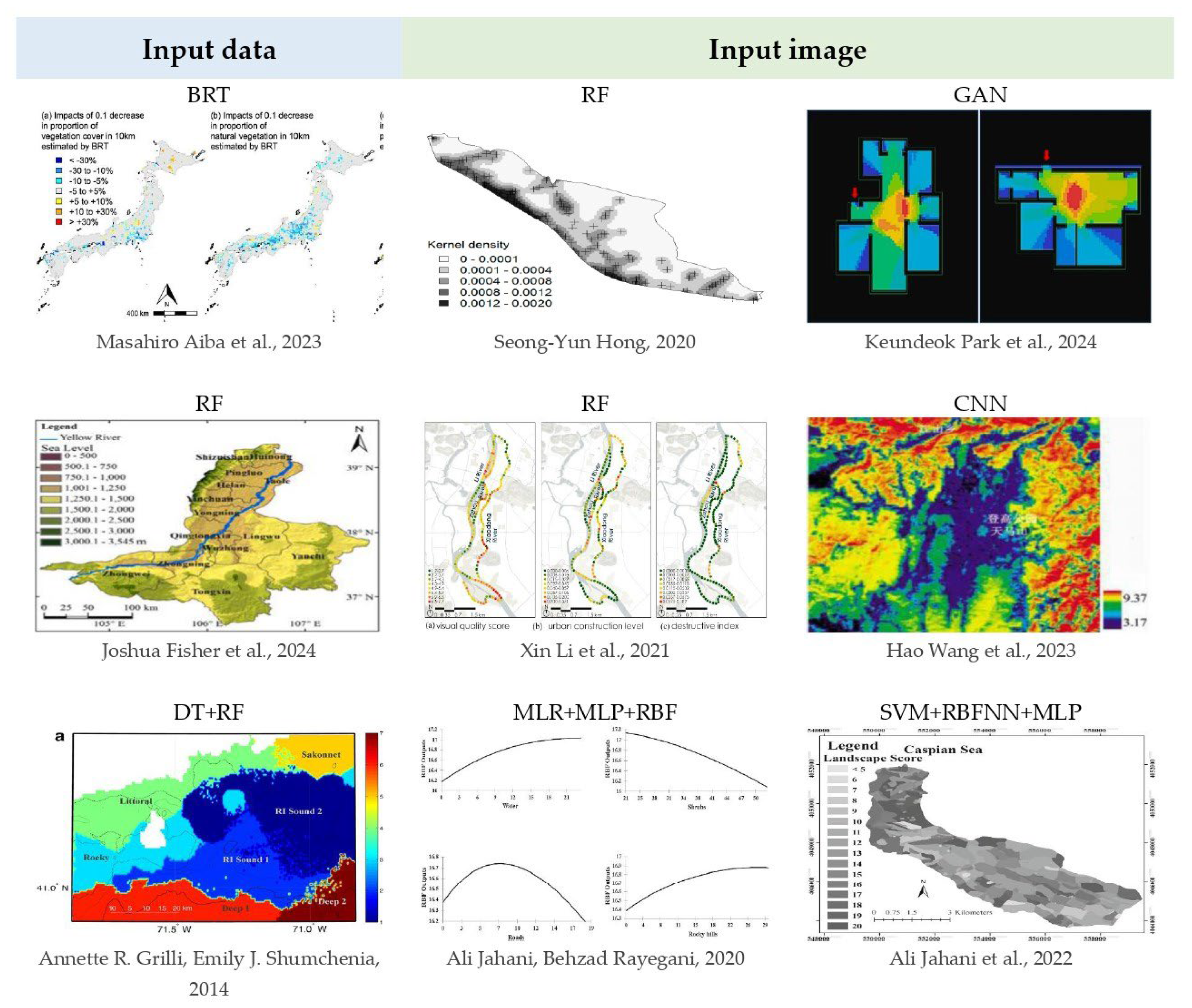
In recent years, the application of artificial intelligence technology in the field of landscape assessment and design has exhibited a diversified development trend (Table A6 in the Appendix A). From a macroscopic perspective, relevant research has focused on three core issues: the innovation of landscape visual quality assessment methods, the generation and optimization of landscape design driven by AI technology, and the construction of an intelligent evaluation system for ecological safety and health effects (Figure 12). In terms of landscape visual quality assessment, several articles have developed quantitative evaluation tools for various landscape types, including forests, rivers, and urban streets. For instance, Jahani and Rayegani [113] constructed a forest aesthetic quality assessment system based on the RBF neural network and the SVM model to develop a quantitative evaluation tool for various landscape types. With the breakthrough of deep learning technology, the research has gradually developed towards dynamization and multimodality. For example, Kido et al. [114] developed an augmented mixed reality system that realizes the dynamic assessment of future landscapes through semantic segmentation technology. In terms of ecological security assessment, the HEAL tool developed by Wang et al. [115] reveals the association mechanism between the morphology of community greenspace and non-communicable diseases through the random forest algorithm. Some studies have broken through the traditional landscape evaluation dimensions. For example, Hong [116] used computer vision technology to extract linguistic diversity indicators from street-level images, thereby expanding the quantitative path of linguistic landscape research. The data sources of these studies can be classified into three categories: publicly available databases, researcher-created datasets, and multi-source fusion data. Publicly available data include the WRPLAN floor plan dataset [117] and Open Street View images [42]. The data collected by the researchers themselves constitute the main body, such as the landscape attribute data collected by Jahani and Rayegani [113] in Iranian forests, data on the Li River basin, and dynamic video data of the MR system collected by Kido et al. [114]. Satellite remote sensing data [115] have become an emerging trend, where such multi-source data are fused with cross-media features through deep learning. Overall, approximately 60% of the studies use self-constructed datasets, focusing on solving specific scenarios, 30% combine public data to enhance the universality of the method, and 10% break through the unimodal limitation through multi-source fusion.
Figure 12. ML tasks related to evaluation [113,115,116,117,118,119,120,121].

3.5.2. Management

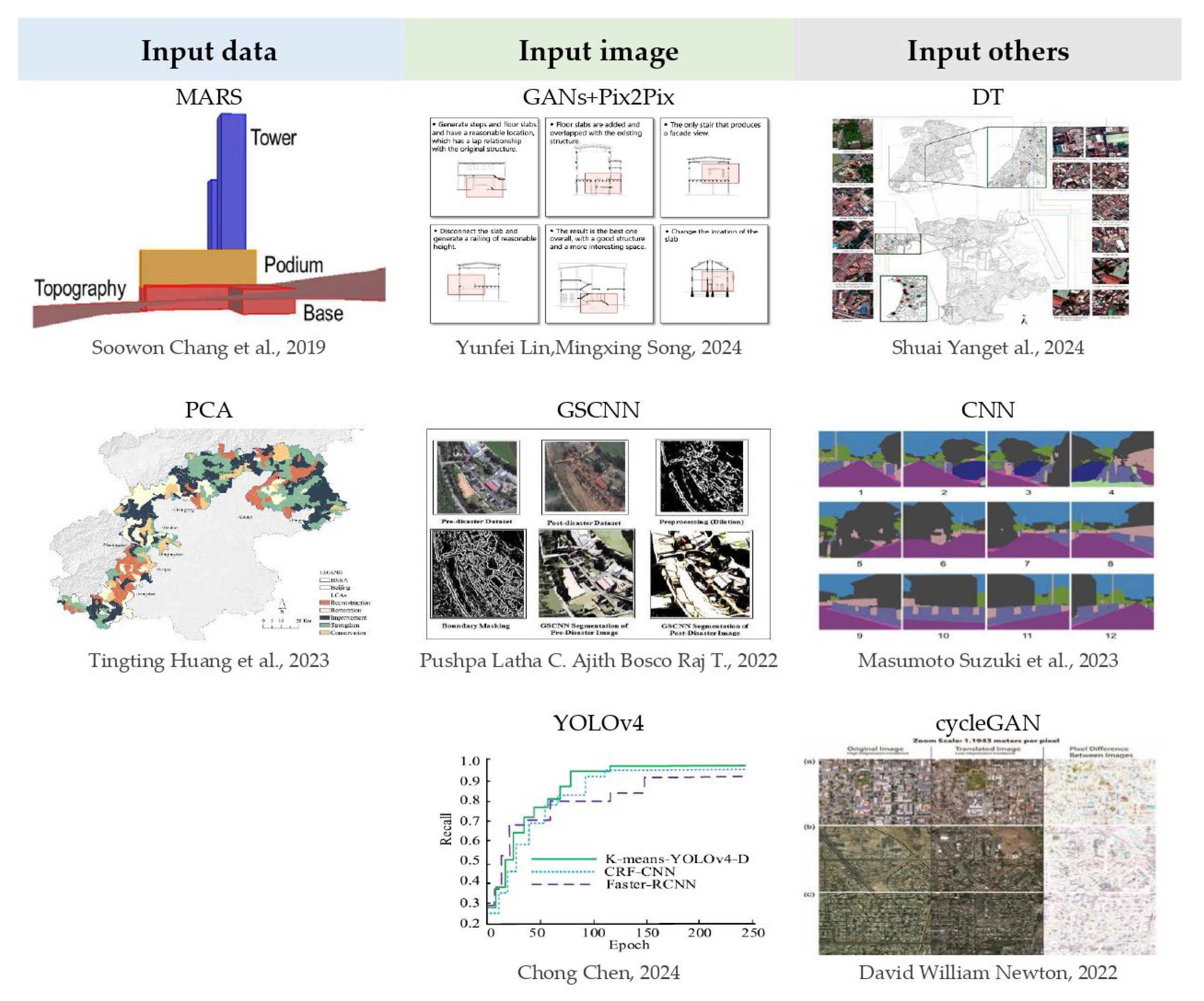
At the macro level, studies explore the application of intelligent technologies in landscape management and urban design, aiming to address the limitations of traditional methods in terms of efficiency, accuracy, and interdisciplinary integration. Most of them focus on how ML and deep learning techniques can be used to optimize tasks such as landscape feature recognition, disaster impact assessment, cultural heritage conservation, and urban spatial planning (Figure 13). For example, Pushpa and Ajith [122] enhanced the semantic segmentation accuracy of pre- and post-disaster aerial images through an improved GSCNN model, while Chen [123] developed an improved YOLOv4 algorithm to efficiently detect building cracks. In addition, some studies focus on the application of data-driven methods in complex social problems. For example, Newton [124] used CycleGAN to analyze the correlation between urban morphology and mental health, providing a psychological basis for urban planning. Special problem-solving is reflected in cross-cutting innovations. For example, Santana et al. [125] proposed an ethical framework for the digitization of heritage, bridging the humanistic gap in the application of technology. Huang et al. [126] combined PCA and GMM models to classify and manage the landscape in shallow hilly areas, solving the inefficiency problem of traditional geographic analysis methods. Together, these studies reflect the potential of ML techniques in multi-scale and multidimensional spatial management while balancing technical performance and social value. The research data sources can be categorized into three types: public datasets, self-constructed datasets, and hybrid data. Public datasets include the Inria aerial imagery dataset, Google Street View imagery, and California Health Survey data, which have standardized annotations and wide applicability for cross-study validation. Some of the literature uses self-constructed data, such as the study of resident satisfaction in the Historic Centre of Macau [127], which collected localized data through questionnaires. The Shenzhen Territorial Spatial Risk Assessment [56] integrates multi-source geospatial data, which are more targeted but have higher access thresholds. In addition, hybrid data applications are more common, such as Zhao et al. [128], who combined publicly available data on the Internet with statistical data to construct a tourism competitiveness model. The ML models used in these studies are diversified and can be divided into three categories: deep learning models, traditional ML algorithms, and hybrid methods. Deep learning models are widely used, such as the variant of Convolutional Neural Networks, GSCNN [122], and CycleGAN [124], which are outstanding in image segmentation and generation tasks due to their ability to automatically extract multilevel features and process high-dimensional data. Among them, GSCNN enhances the shape information capturing ability through the gating mechanism, which significantly improves the edge segmentation accuracy compared to traditional CNNs. Traditional ML algorithms such as random forests, decision trees, and principal component analysis (PCA) are mostly used for structured data analysis. In the study of resident satisfaction [127], decision trees were used to analyze nonlinear relationships in the questionnaire data. While random forest, with high interpretability, was used in predicting the economic value of landscapes [129]. Hybrid methods are more innovative, such as Huang et al. [126], who combined PCA dimensionality reduction and GMM clustering to achieve landscape feature classification. Xia et al. [56] handled heterogeneous data from multiple sources by stacking self-encoders and self-organizing mapping (SOM). In terms of model selection motivation, the advantage of deep learning in image and generation tasks stems from its end-to-end learning capability, while traditional algorithms are more suitable for small samples or scenarios requiring decision transparency due to their high computational efficiency and interpretability. In comparison, deep models are more competitive in terms of accuracy and level of automation but rely on large-scale labeled data. Traditional methods are more practical with small data or when rapid prototype validation is required. Reinforcement learning and Generative Adversarial Networks (GANs) have seen a gradual increase in applications, reflecting the need for modeling complex systems with multi-objective optimization. Future research needs to further explore the integration of techniques for small-sample learning, cross-domain model migration, and ethical frameworks to address the increasingly diverse challenges of urbanization.
Figure 13. ML tasks related to management [66,122,123,124,126,127,129,130].

3.6. Text Analysis

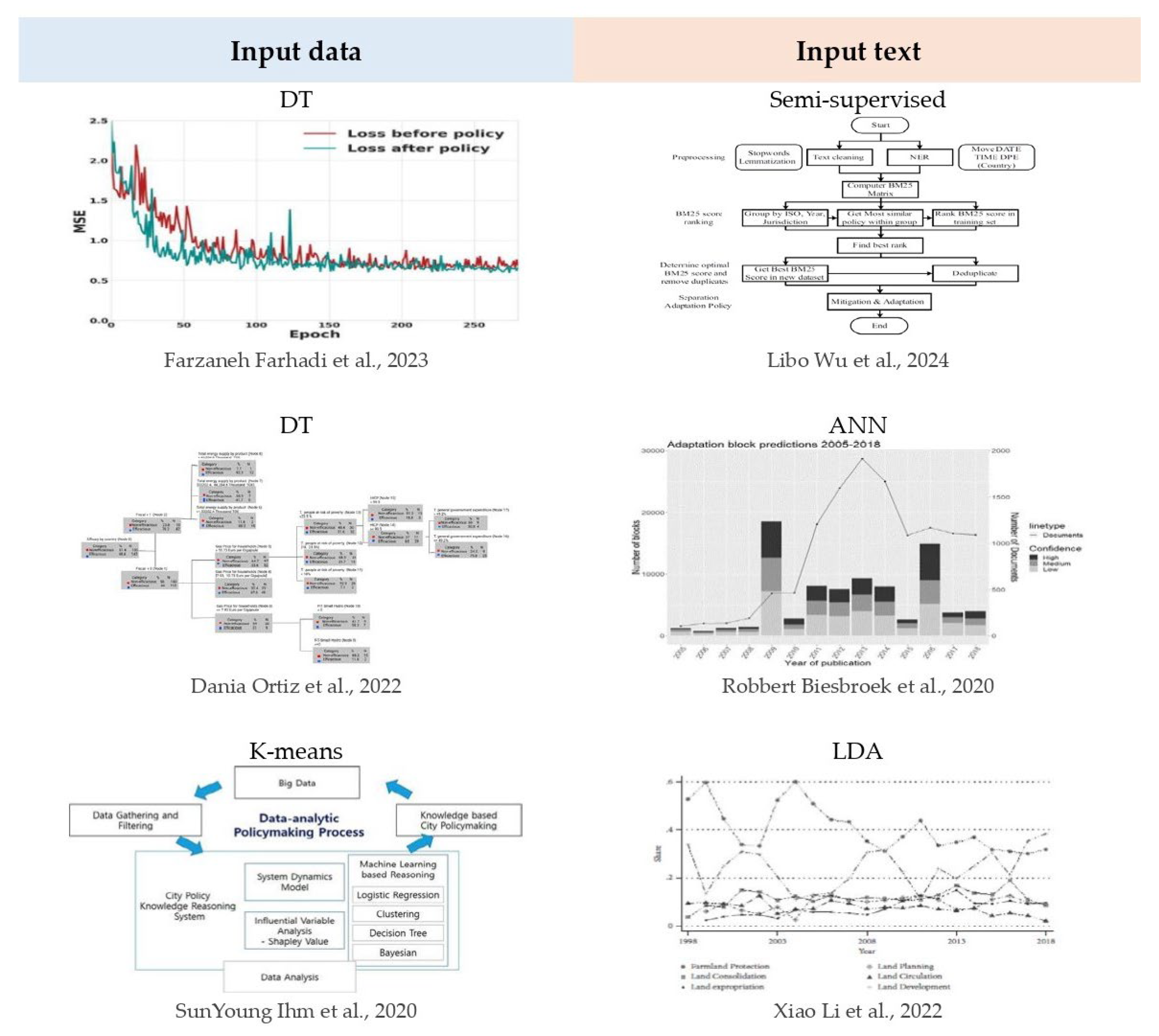
The existing literature focuses on the innovative application of ML methods in public policy formulation and evaluation, aiming to enhance the efficiency, scientificity, and systematicity of policy analysis (Figure 14 and Table A7 in the Appendix A). Specific research questions can be divided into three categories: (1) Scientific support for policy formulation. For instance, by constructing an urban policy knowledge system and integrating multiple models, such as clustering and Bayesian analysis, Ihm et al. [131] addressed the integration of logical policy reasoning and data-driven decision-making. (2) Quantitative evaluation of policy effects and goals. Ortiz et al. [132] analyzed the effectiveness of renewable energy policies and predicted the degree to which policy goals were achieved based on a decision tree model. Farhadi et al. [133] verified the impacts of transport policies on air quality through a time series model. (3) Integration and standardization. Wu et al. [134] constructed the Global Climate Policy Dataset (GCCMPD). The semi-supervised hybrid approach unifies heterogeneous data from multiple sources to fill the underlying data gap for policy analysis. Additionally, some studies focus on the automated analysis of policy texts, such as Biesbroek and Robbert [135], who used artificial neural networks to mine adaptation actions in UK climate policy texts. Li et al. [136] revealed the spatio-temporal evolution of land policy in China based on the LDA model. These studies not only address the challenges of data complexity and decision-making subjectivity in public policy but also provide targeted solutions for specific policy scenarios. Publicly available databases in these studies include the Boston house price data [131] and the Newcastle City Observatory air quality data [133]. Researcher-created datasets make up the majority of the databases, such as the Seoul business data [131], UK policy texts [133], and Chinese land policy texts [136], which rely on institutional cooperation or are collected manually. The GCCMPD dataset, constructed by Wu et al. [134], integrates global climate policy texts and expert knowledge. It adopts a semi-supervised approach to achieve standardized classification and is a typical researcher-built composite dataset. Although this kind of dataset is not completely public, its construction methods (e.g., dictionary mapping and natural language processing) provide technical references for subsequent research. Overall, policy research data are still mainly non-public or domain-specific, while open data are mostly focused on classical economic and social indicators, and the sharing mechanism of policy text and customized data needs to be improved.
Figure 14. ML tasks related to text analysis [131,132,133,134,135,136].
The research involves the following ML models: supervised learning (decision trees, LightGBM, and regression analysis) [132,133], unsupervised learning (K-means and LDA) [131,136], semi-supervised methods [134], and deep learning [133]. Among them, decision trees and their derived models are most frequently used because of their high interpretability and suitability for classification and rule extraction problems. In unsupervised learning, the LDA model [136] has outstanding performance in policy text topic mining, which can extract potential policy topics from unstructured text. The semi-supervised approach [134] alleviates the bottleneck of insufficient annotated data by integrating expert knowledge and has a unique advantage in the integration of complex policy data. Compared to traditional models, ML technology significantly improves the dimension and efficiency of policy analysis: (1) the models can handle heterogeneous data from multiple sources, which breaks through the limitations of traditional statistical analyses, (2) the high interpretability of models such as decision trees and LDA meets the needs of policymakers for transparent decision-making, and (3) models such as LightGBM and ANN support large-scale policy simulation and real-time evaluation by optimizing computational efficiency. However, the application of deep learning in the policy domain still needs to be expanded, and the contradiction between its “black box” characteristics and the demand for policy interpretation needs to be further reconciled. The cross-fertilization of ML models and policy sciences in the existing research has led to a diversification of methods, with decision trees, LDA, and semi-supervised methods becoming the mainstream choices due to their interpretability and adaptability, but the data sharing mechanism still needs to be improved.

4. Discussion

With the advancement of computer technology, the tools employed to address problems in landscape architecture have evolved from manual design and drawing, the emergence of metaheuristic and optimization algorithms, and the growth of parametric design and big data to the current prevalent application of ML. The application of ML represents an emerging research direction in the field of landscape architecture in recent years and holds significant potential for further exploration.

4.1. Trends

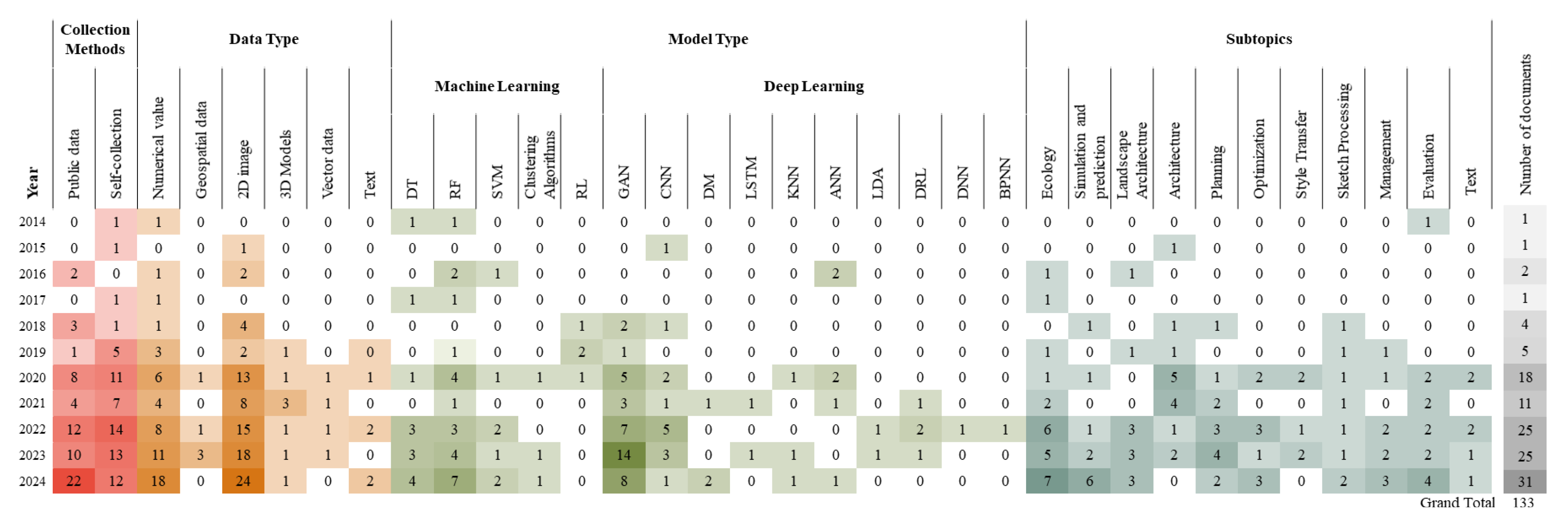
Figure 15 presents the distribution of papers in terms of data type, model type, and sub-theme dimensions for each year between 2014 and 2024. In terms of data type, its usage varies depending on the research topic. In 2014, the number of publications was limited, and data usage was also low. With the evolution of network information, the openness of data was improved in 2024, with 22 publications using public data. At the same time, the convenience of data collection increased, with 12 papers using self-collected data. In addition, the application of multimodal data, such as numerical data, geospatial data, and 3D images, showed an increasing trend. With technological advances, the importance of complex spatial data in architectural research has become increasingly prominent.
Figure 15. Trends of data and ML model type in relation to different topics.
In terms of model types, the application of ML has undergone significant changes. In the early stages, traditional ML methods such as decision trees (DTs), random forests (RFs), and support vector machines (SVMs) were applied, but in limited numbers. In 2016, with the popularization of computer technology and the growing audience for ML, deep learning began to emerge, and the application scope of Generative Adversarial Networks (GANs) and Convolutional Neural Networks (CNNs) has continued to expand since then. In 2022, there were 14 publications applying GANs and 5 applying CNNs, highlighting the strengthened dominance of deep learning in architectural research. At the same time, the application of traditional ML methods has also become more widespread.
In terms of sub-themes, research interests across various fields are undergoing dynamic changes. The increase in the number of papers related to ecology reflects society’s growing concern about ecological impacts. Given the basic task attributes of ML, such as fitting and classification, the number of papers on simulation and prediction has gradually increased. Traditional architectural landscapes are rich in image data, such as floor plans and renderings, and some deep learning models trained on image data are favored for design and post-processing work, reflecting the pursuit of innovation and intelligence in architectural design.
In summary, over the past decade, research in the field of architecture has exhibited a diversified and dynamic trend in terms of data types, model applications, and sub-themes. Data types have evolved from simple to complex and diverse. In terms of models, deep learning is more aligned with the needs of architectural environment research in terms of image recognition, feature extraction, and generation capabilities. Moreover, sub-themes have expanded from basic research to broader applications and interdisciplinary fields.

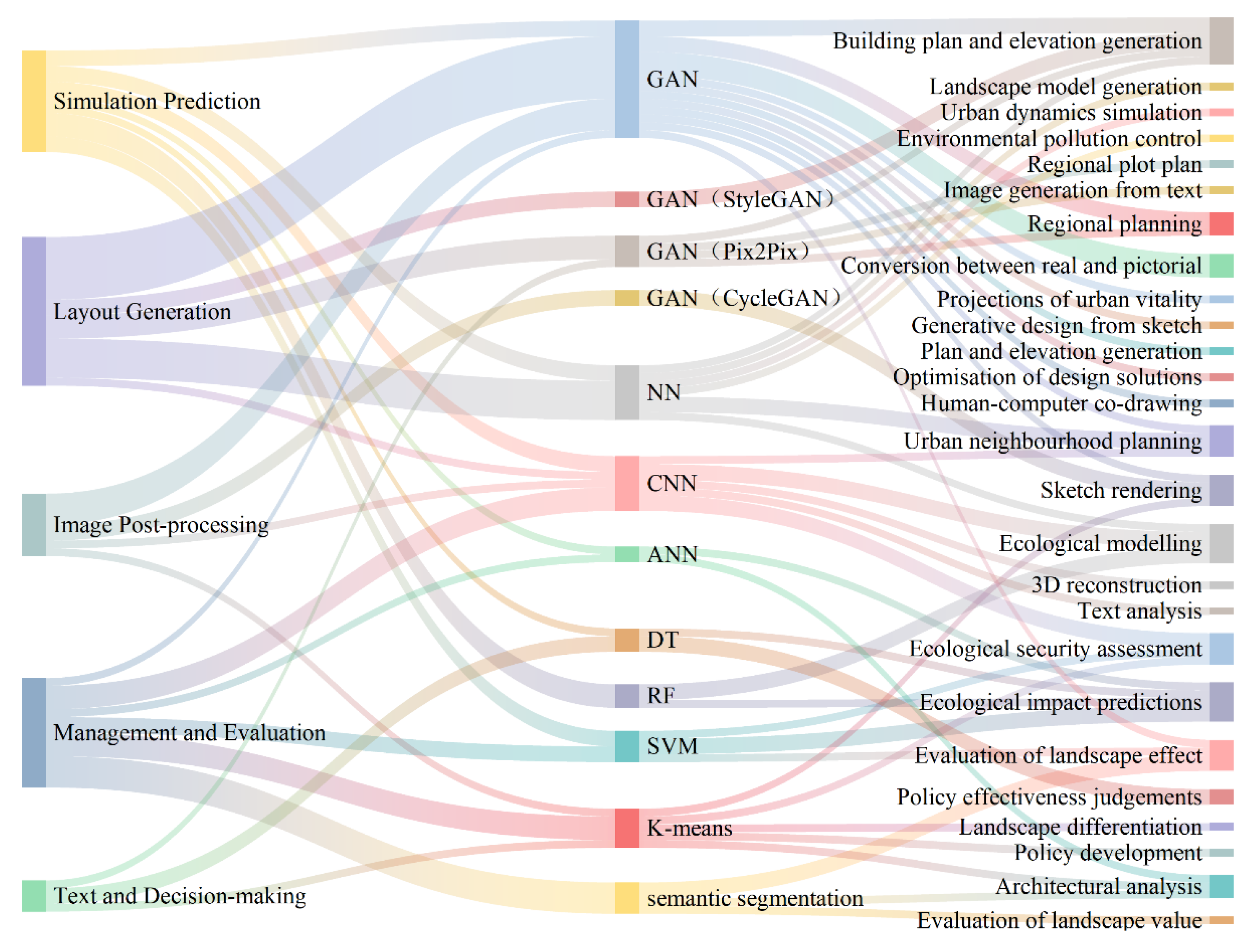
4.2. Application of ML Algorithm Tools

Figure 16 shows the task classification and ML methods used in the field of landscape research involved in this article. Among different algorithms, Generative Adversarial Networks (GANs) and their variants are the most commonly used. GANs are utilized for both the generation of layouts [62,63,137] and image processing [91,92,93] in landscape architecture. In layout generation, GANs can generate diverse and creative garden planar layout schemes through the interactive training of the generator and discriminator based on the given label data [138]. In the field of image processing, GANs are capable of executing tasks including style transfer and image restoration on landscape architecture images [97,100]. Neural networks are also extensively utilized in the field of landscape architecture. The Convolutional Neural Network (CNN) demonstrates superior capabilities in the field of landscape architecture image processing, particularly in ecological security assessment [55] and ecological modeling [40,139]. Owing to its robust feature extraction capabilities, CNNs can accurately discern the characteristic information of various landscape elements from two-dimensional images, including building outlines [140] and plant forms [40]. Artificial neural networks (ANNs) primarily concentrate on uncovering and modeling the complex nonlinear relationships inherent in image data. In the processing of landscape architecture images, ANNs can construct complex network structures to model the deep semantic relationships among landscape elements, including associations between plant communities and ecological functions [37], as well as the interactive relationships between landscape spatial layouts and user behaviors and psychology, thereby providing a foundation for design and research.
Figure 16. Sankey diagram of the tasks and ML algorithms.
Supervised learning methods, such as the decision tree (DT), random forest (RF), and the support vector machine (SVM), are instrumental. The DT serves as an effective analytical tool in landscape architecture. In the process of formulating, implementing, and evaluating landscape architecture policies, the DT enables a systematic dissection of key clauses, goal orientations, implementation conditions, and other elements in policy texts [131,132]. Owing to its superior fitting capabilities, RF can uncover potential patterns from complex data and construct new ecological prediction models [90,141]. The SVM, by constructing the optimal classification hyperplane, can classify and assess the project management level based on diverse landscape architecture project data [112].
Distinct variations are observed in the ML methods utilized across different fields. In the field of landscape architecture design and creation, including layout generation [67,85], urban dynamic simulation [70,78], and scheme optimization [108], GANs are predominant. Innovation and style shaping are essential in design and creation, enabling GANs to generate numerous design schemes and landscape evolution scenarios, thereby offering increased inspiration. In the field of image processing, CNNs emphasize rapid and accurate feature extraction and geometric form construction, making them suitable for tasks such as 3D reconstruction [142] and sketch recognition [143]. In the field of landscape architecture management and policy, the SVM and DT primarily facilitate data-driven management decisions and performance evaluations. By analyzing and processing extensive project data, they can offer scientifically sound management strategies and improvement directions [144]. RF is predominantly employed for ecological modeling and prediction, analyzing data with significant dynamic changes, and identifying potential patterns [108].
Reinforcement learning (RL) is a method with significant applicative potential. It finds extensive application in the field of architecture and is often integrated with other ML methods to address architectural problems [145]. For instance, during the design stage of buildings, RL is utilized across various specialized domains, including the optimization of interior design [146], architectural floor plans [147], and building group layouts [66,148]. The use of RL in the above architectural issues also offers insights into how landscape architecture addresses issues. Analogous to building layout, RL can be employed in landscape design to optimize the arrangement of functional zones. Parallel to the application of ML in the optimization of energy-efficient systems for building services, the approach can also be applied to the intelligent management of landscape facilities, such as the optimization of energy conservation in irrigation and lighting operations.
Diffusion models also possess significant application potential. Leveraging their robust generative capabilities, diffusion models have emerged as a prominent topic within the realm of generative models. Their applications are expanding into various domains, including natural language processing [148], audio synthesis [149], and text-to-video conversion [150,151,152]. In comparison to GANs, the images produced by the Stable Diffusion (SD) Model are highly realistic. Each training iteration yields superior outcomes, demonstrating enhanced generalization capabilities. Liao et al. [153] introduced Calliffusion, a system employing diffusion models to produce high-quality Chinese calligraphy. This model’s architecture uses Denoising Diffusion Probabilistic Models (DDPMs), enabling it to emulate the styles of renowned calligraphers and produce common characters across five distinct font styles. Furthermore, the Low-Rank Adaptation (LoRA) model facilitates the transfer of Chinese calligraphic styles to novel characters and extends to out-of-domain symbols, including English letters and numerals. It demonstrates the versatility of diffusion models, capable of accomplishing generation tasks that were previously dominated by GANs. This approach represents a promising exploration in the application of novel modeling techniques.

4.3. Differences Between ML and Traditional Methods

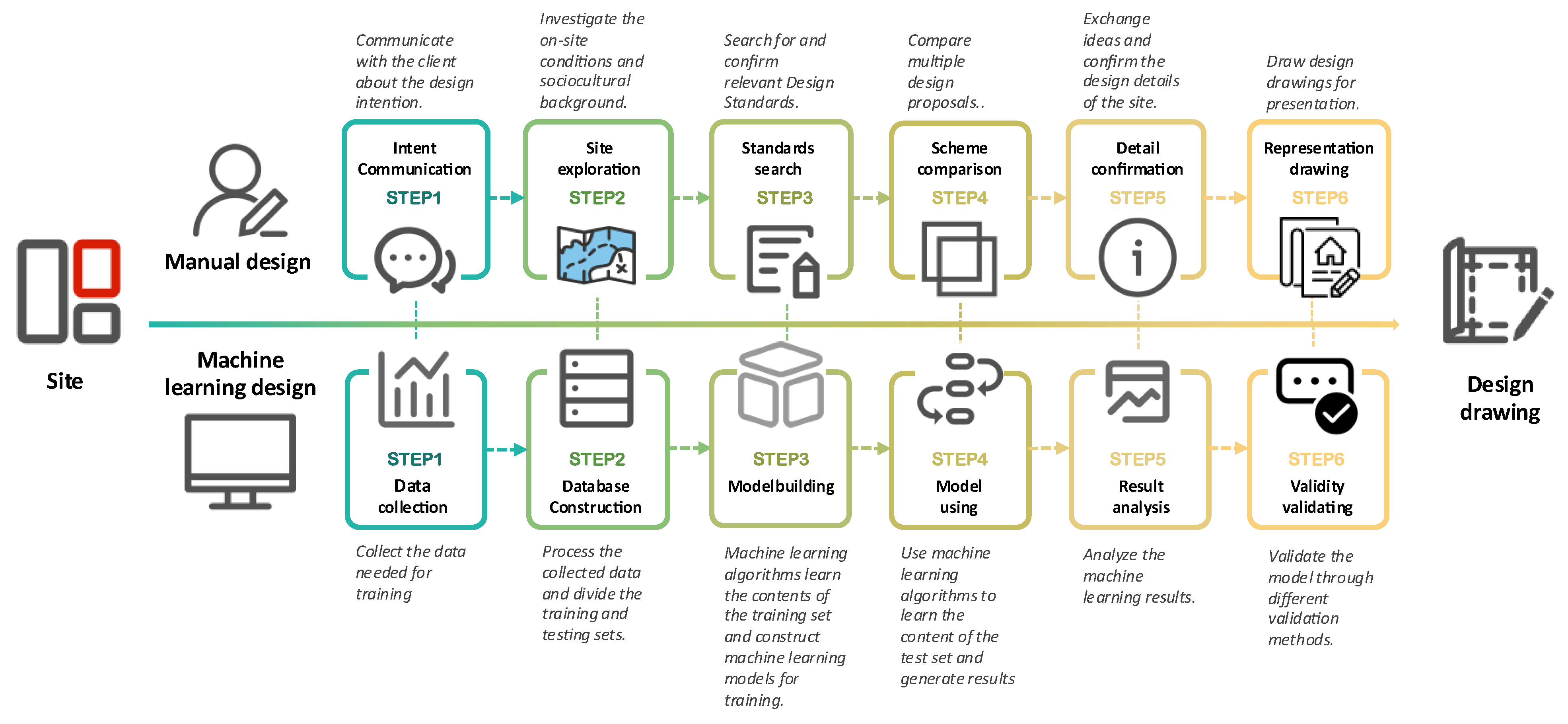
Planning and design are a major part of the landscape architecture realm. There are significant differences between traditional manual design methods and ML-based design methods, which have been summarized in Figure 17. In traditional methods, humans exhibit flexible creativity and can conduct relatively comprehensive considerations of humanistic emotions and social culture, among others. For a given site, designers combine a deep understanding of the cultural, historical, and social backgrounds, combine design specifications, and deepen the design with rich connotations. However, when faced with complex data and large-scale projects, the manual design process becomes highly complex and inefficient. ML can (1) analyze large volumes of data in the training set, (2) simulate new design drawings according to the training set, (3) conduct verification of the effectiveness of the results, and, finally, (4) generate the required schematic diagrams. However, since the data that ML models learn are based on existing design cases, the models lack originality compared to human designers. The generated results easily fail to fully integrate the social and cultural characteristics of the actual site, and they cannot guarantee compliance with design specifications. It is preferable to use ML to compare or optimize schemes rather than directly implement the schemes generated.
Figure 17. Comparison of the workflow between manual design and ML design.
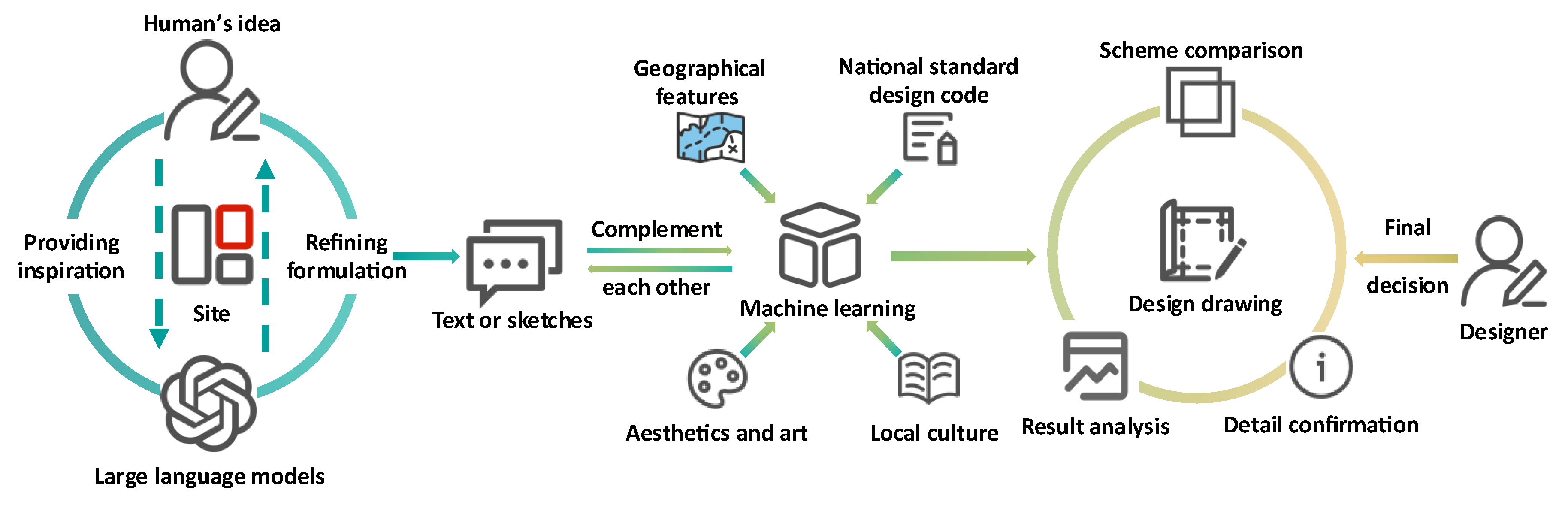
In the near future, people may witness the emergence of innovative design models that facilitate human–machine interaction, including design methodologies integrating human insights, large language models (LLMs) such as GPT, and ML for collaborative endeavors (Figure 18). In this collaborative mode, designers can contribute their original ideas to large language models such as GPT, DLP, and LLM. The large language models can analyze and provide more descriptive inspiration for the designers, enhancing their original ideas. This collaborative framework can be further expanded to include community participation, where ML tools support participatory workshops by visualizing alternative scenarios, analyzing crowdsourced data (e.g., geotagged photos and public surveys), and enabling stakeholders to directly shape the design process. Such approaches not only enhance transparency but also ensure that the cultural narratives and lived experiences of local residents are embedded in algorithmic decision-making. Following iterative deliberation, designers will refine detailed and professional specifications to be utilized by ML models for generation. Throughout the generative process, regional characteristics, national industry standards, aesthetics, artistic principles, and local cultural factors are integrated into the design. Subsequently, the generated images are refined through human analysis and adjustment, culminating in preliminary design drafts. After iterative refinement, the process is concluded, with the ultimate selection of a design scheme being at the discretion of the human designer.
Figure 18. Human–computer interaction design scenarios.
In the field of ecology, traditional linear modeling methods are ineffective due to the presence of specialized datasets, chaos theory, complexity of changes, variations in data structure characteristics, and the uniqueness of data structures. ML methods process and analyze large amounts of data to uncover hidden patterns and predict future trends [154]. Van Giffen et al. [155] posit that biases can be mitigated by handling outliers in the data, consulting with domain experts on data selection, and employing techniques such as relabeling and reweighting to minimize the adverse impact of the parameters on the results.
In practice, ML methods are not isolated. Algorithms are often combined to harness the strengths of various ML approaches and compensate for the shortcomings of individual methods, ensuring task requirements are met and optimal results are achieved. This integration extends beyond machine learning algorithms to encompass the entire digital workflow, where human expertise and computational tools interact through iterative optimization cycles.
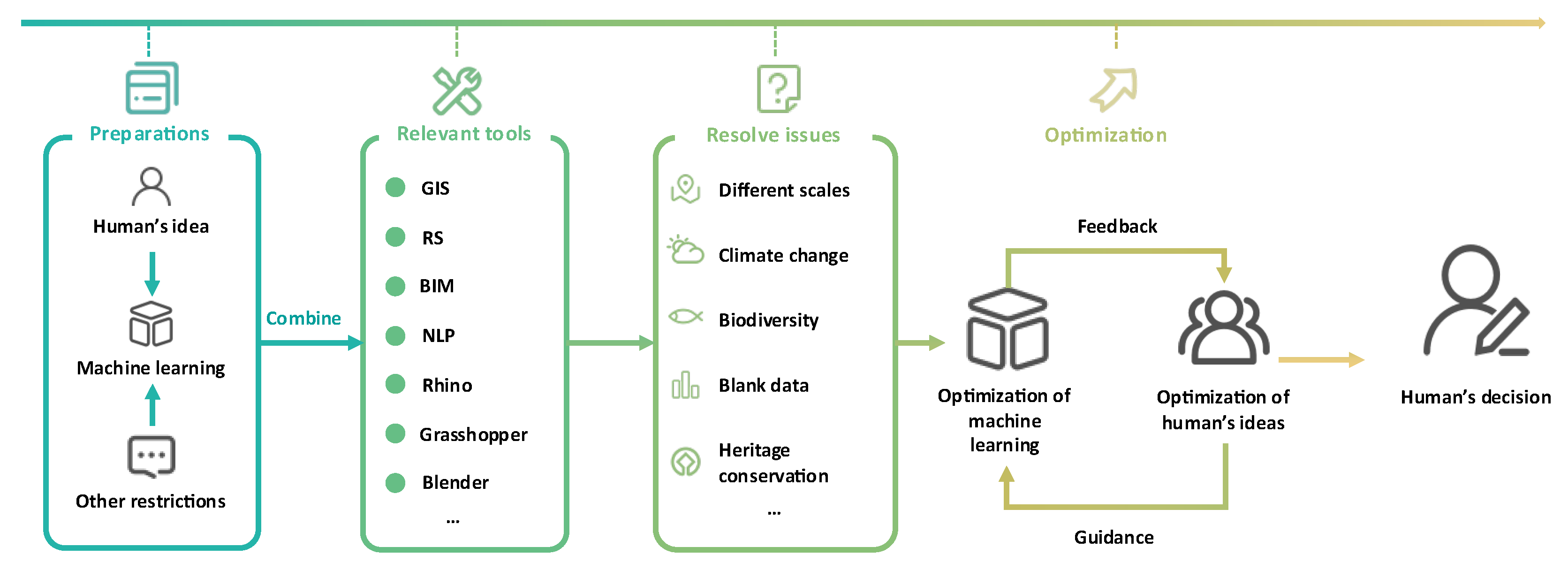
Figure 19 illustrates a workflow that deconstructs the task-tackling process into four distinct layers: the data layer, the tool layer, the optimization layer, and the decision layer. First, human creativity and relevant standards are input into a machine learning system. Subsequently, various pertinent tools are integrated, including Geographic Information Systems (GIS) [156] for spatial analysis, Remote Sensing (RS) [157] for environmental monitoring, Building Information Modeling (BIM) [158] for semantic modeling, and text-based multimodal large language models (MLLMs) such as ChatGPT. For instance, when addressing planting design challenges, ChatGPT can integrate the Landscape Design Manual, plant databases, and local regulations to construct a vertical knowledge graph [159]. Operating within an integrated framework, this knowledge graph simultaneously invokes specialized tools and executes cross-platform optimization workflows. These tools synergistically address multi-scale challenges ranging from site-specific interventions to climate change adaptation strategies: they multidimensionally interpret user requirements, generate design concept scripts, and propose combinatorial strategies, and they iteratively refine these outputs by merging human concepts with optimization algorithms, with final solutions determined by human decision-making.
Figure 19. Workflow of human-led, ML combined with digital tools in different issues.
This collaborative approach achieves continuous refinement through feedback loops and human guidance. Within iterative decision-making, machine learning optimization complements human creative conception. The integration of complementary tools, such as Rhino, Grasshopper, and Blender, further expands the digital ecosystem, establishing a robust environment for addressing complex landscape architecture challenges through integrated technical solutions. Similarly, multimodal large language models (MLLMs) possess robust cross-modal comprehension and generation capabilities (such as processing joint inputs of text, images, and spatial data), enabling seamless integration across data and tool layers. For instance, MLLMs can serve as efficient front-end interfaces, parsing ambiguous cross-modal design intentions input by designers via natural language or sketches and converting them into structured machine-readable constraints. This provides precise inputs for backend generative models, such as Generative Adversarial Networks (GANs) and diffusion models. Following scheme generation, MLLMs can undertake intelligent analysis and evaluation functions: performing automated semantic interpretation of generated proposals (e.g., analyzing spatial functionality rationality and assessing landscape style compatibility) and even simulating feedback from diverse user groups. This provides designers with multidimensional, natural language-based decision support, significantly enriching the feedback mechanisms within the optimization layer [160]. Regarding reinforcement learning and deep reinforcement learning (DRL), their paradigm of achieving optimization through trial-and-error interaction with the environment is well-suited for tackling complex, multi-objective spatial optimization problems (such as optimizing green space layouts to balance ecological benefits, social activity demands, and economic efficiency). Within this framework, spatial planning problems can be modeled as a Markov Decision Process (MDP), with planning objectives (such as spatial accessibility, biodiversity conservation, and enhanced carbon sequestration capacity) defined as reward functions. Through continuous interaction with the environment, the agent learns optimal spatial configuration strategies, thereby achieving dynamic and adaptive optimization of solutions. This process, illustrated by the iterative optimization loop in Figure 19, fully embodies the human–machine collaborative optimization paradigm under the ‘human-in-the-loop’ philosophy.
The proposed framework constitutes an open technological integration ecosystem. Its modular nature permits the replacement or enhancement of data, tool, optimization, and decision layers with more advanced algorithmic modules without restructuring the overall architecture. Technologies reviewed herein, such as Generative Adversarial Networks (GANs) and Convolutional Neural Networks (CNNs), represent current-stage concrete implementations within this framework.
Looking ahead, machine learning could develop natural language design interfaces based on MLLMs, lowering the technical barrier to entry and stimulating design creativity. Furthermore, constructing DRL-based multi-agent simulation environments for urban spaces could facilitate the validation and optimization of large-scale, city-level landscape planning schemes, exploring collaborative working models between humans and diverse tools.

4.4. Limitations of ML in Landscape Architecture

4.4.1. Inherent Limitations of ML

  • Limitations of Algorithms
ML depends on various algorithms, which possess inherent imperfections. For example, neural networks can handle massive, sparse data with complex relationships, but they exhibit high sensitivity to outliers and necessitate manual intervention to prevent overfitting [161,162]. DTs have good model interpretability and inherent robustness but are highly prone to overfitting and have limited ability to express nonlinear relationships. DTs are not suitable for text and image processing, but ensemble learning can address this issue [159]. RFs are suitable for ML problems that require fast training of large samples. They can train models efficiently, even when the dimensionality of sample features is high, and they possess a strong generalization ability. They can also rank the importance of variables after model fitting, facilitating ecological research. Nevertheless, they are prone to overfitting on sample sets with high noise levels [163]. SVMs can address tasks with small samples, improve out-of-sample prediction accuracy, and manage high-dimensional, nonlinear problems. However, they are sensitive to missing data, and when the feature dimension exceeds the number of samples, their performance deteriorates, limiting applicability to large datasets [159]. Therefore, when using ML algorithm models to solve problems, it is necessary to choose the appropriate model based on the properties of the problem and the characteristics of the data or to use multiple models comprehensively.
2.
Dependence on Data Quality and Quantity
The performance of ML models is highly dependent on the quality and quantity of data. A sufficient amount of data provides rich learning samples for the model, enabling it to better understand and grasp various complex patterns and rules. Data quality issues arise when sampling methods are unreasonable or observation times are inappropriate, thereby introducing data bias [164,165]. These data biases may cause the model to make incorrect judgments and perform poorly in practical applications.
Obtaining high-quality and fully annotated data in the field of landscape architecture is challenging. Landscape architecture involves numerous and complex factors that necessitate professional knowledge and substantial time for accurate data annotation. Manual annotation consumes manpower and material resources. Additionally, it introduces new measurement uncertainties due to subjective differences among annotators.
Moreover, the robustness of current ML models is often challenged when faced with incomplete, noisy, or heterogeneous spatial datasets, which are common in landscape projects. Promising strategies to mitigate these issues include active learning, where models iteratively query the most informative samples for labeling to maximize efficiency, and transfer learning, which leverages knowledge from related domains to reduce the need for extensive labeled datasets. These approaches can help alleviate data scarcity and improve the adaptability of ML models in landscape architecture contexts, thereby enhancing both reliability and scalability.
3.
Interpretability
The interpretability of a model is, to a certain extent, closely related to the robustness of both the data and the model. For instance, data poisoning attacks during model training can compromise model prediction and interpretation [166]. Three types of methods have been proposed: application-based, human-based, and function-based. These methods assess the interpretability of ML algorithms. Among function-based methods, LIME (Local Interpretable Model-agnostic Explanations), proposed by Ribeiro et al. [167], optimizes the objective function using the sampled dataset to find the best interpretable model. It helps users understand the relationship between instance features and model predictions by providing textual/visual interpretations. This enhances trust in model predictions and assists in decision-making. During the verification process, LIME performs well in most cases, with a higher recall rate than other methods. LIME can accurately capture the model’s predictions within a local range through local approximation. Compared to other global approximation models, it can more accurately reflect the model’s behavior.
4.
Insufficient Generalization Ability of Models
Deep learning models may perform well on training datasets, but they often encounter generalization challenges in practical applications, particularly with new data. Further research and enhancements are required to address this issue [168]. Current methods for improving generalization ability include the following:
  • Image Data Augmentation: Enhance the sample set and mitigate overfitting by applying random transformations to the training data, including rotations, cropping, and color adjustments [9].
  • Regularization: Constrain model complexity to curb overfitting [169].
  • Normalization: Normalize layer inputs to expedite convergence and bolster generalization performance [170,171].
  • Learning Rate Scheduling: Adjust the learning rate to aid in locating optimal solutions [172].
  • Model Ensemble: Aggregate predictions from multiple models, such as Bagging or Boosting, to enhance generalization [173].
5.
Ways to Validate ML Effectiveness Beyond Bibliometrics
While bibliometric indicators such as publication counts and citation frequencies provide a useful overview of research activity, they do not fully capture the practical effectiveness of ML applications in landscape architecture. To ensure that impact is measured in tangible terms, ML methods should be validated using a combination of technical, design-oriented, and sustainability-focused performance metrics. Technical validation can rely on widely used indicators, such as accuracy, precision, recall, F1 scores for classification tasks or RMSE, MAE, and R2 values for regression and predictive modeling. In design-oriented contexts, evaluation may extend to spatial performance measures, including accessibility, connectivity, and shading, as well as the diversity and novelty of generative design outcomes. Beyond computational performance, sustainability-oriented metrics—such as ecosystem service provision, biodiversity enhancement, resilience to climate impacts, and reductions in urban heat island intensity—offer crucial insights into the ecological effectiveness of ML-supported interventions. Human-centered validation also plays a vital role: expert review and participatory workshops allow designers and communities to assess the usability, creativity, and cultural appropriateness of ML outputs. Finally, longitudinal impact tracking, comparing realized outcomes of ML-informed projects with conventional approaches, is essential for establishing whether ML contributes to long-term environmental and social benefits. These approaches provide a more comprehensive framework for evaluating the real-world effectiveness of ML in landscape architecture beyond bibliometric visibility.

4.4.2. Limitations of the Application of ML in Landscape Architecture

1.
Technical and Methodological Limitations
ML typically necessitates significant amounts of high-quality data for algorithm training. However, in real landscape architecture projects, there are often insufficient historical and on-site data or excessively high costs associated with data collection. The accuracy and representativeness of data significantly influence the results of ML algorithms, with poor-quality data potentially leading to statistically significant deviations from ideal outcomes. To address the broad applicability of proposed methodological benchmarks, additional efforts should include defining unified core metrics and building a cross-regional validation dataset to align implementation across institutions and geographic contexts.
2.
Humanistic and Emotional Integration Challenges
Landscape architecture design encompasses complex processes that integrate multiple variables and objectives, touching on aspects like ecology, society, culture, and economy [174,175]. ML can mimic the human design process to a certain extent, but it may lack genuine creativity and sensitivity to specific cultural contexts [176]. Embedding participatory approaches provides one pathway to mitigate this limitation: community co-design sessions, participatory GIS, and citizen-science-driven data collection can directly feed into ML training and validation. In this way, cultural depth, local ecological knowledge, and social priorities become part of the computational workflow, reducing the risk of context-insensitive outputs. Currently, ML models are predominantly utilized in landscape architecture research for investigation, analysis, simulation, prediction, and evaluation. However, their application in the planning and design stages of landscape architecture is rare. This gap exists primarily because landscape emerges through the interplay between subjective emotions and objective conditions. However, at present, ML is still in the stage of early developmental stages; thus, it lacks autonomous consciousness and cannot replace human emotional needs. This results in a deficiency of individuality and cultural depth in landscape architecture design, failing to fully encapsulate local characteristics and the humanistic spirit.
3.
Ethical Implications and Accountability Frameworks
The integration of ML in landscape architecture introduces profound ethical challenges that extend beyond technical limitations. A primary concern involves bias embedded within training data, where models trained on geographically or culturally limited datasets may perpetuate and amplify existing societal and environmental inequalities, potentially leading to culturally insensitive or ecologically inappropriate solutions. Researchers may encounter ambiguities during ML-assisted research processes, particularly when design flaws or unanticipated environmental impacts occur. For instance, digital workflows in heritage documentation—such as 3D scanning and drone-based photogrammetry—offer transformative applications for conservation but also introduce risks, including the misrepresentation of cultural values, data ownership disputes, and long-term data accessibility challenges.
The automation of design decision-making further complicates liability attribution. If AI-proposed schemes inadvertently cause ecological damage or cultural misinterpretation, accountability must be clearly assigned among developers, data curators, and human decision-makers. This underscores the urgency of establishing standardized ethical frameworks that emphasize human-centric accountability and enhanced transparency through algorithmic decision auditing. The proliferation of AI-assisted landscape design raises critical ethical and accountability challenges. First, intellectual property rights for AI-generated solutions require clear demarcation. While open licenses provide foundational frameworks for algorithmic outputs, disputes persist regarding originality, particularly when AI models derive designs from copyright-protected design precedents.
4.
Preserving Human Agency and Creativity
Beyond technical implementation, the potential erosion of human creativity represents a fundamental philosophical concern. The delegation of generative tasks to machines should not diminish the landscape architect’s role as the creative and ethical core of the design process. Instead, ML should be positioned as a co-creative tool that augments human intelligence through a "human-in-the-loop" paradigm, ensuring that designer expertise, cultural understanding, and aesthetic judgment remain central to refining and implementing ML-generated outcomes. These threats underscore the urgency of establishing standardized ethical frameworks, such as adherence to international guidelines, to clarify accountability and ensure culturally sensitive stewardship of digital heritage records [125].
5.
Practical Implementation and Future Directions
The structures designed by ML must meet economic indicators and other requirements. Therefore, integrating generative ML algorithms with multi-objective and multi-scale optimization algorithms is essential to ensure designs meet multiple considerations and objectives [7]. Future efforts should establish domain-specific ethical guidelines that position AI as a collaborative tool rather than an autonomous agent [177], prioritizing cultural continuity, ecological sensitivity, and human oversight to ensure that technological advancement enhances, rather than undermines, the discipline’s core values of sustainable and socially responsible design.

5. Conclusions

This comprehensive review reveals a fundamental transformation in landscape architecture: the transition from intuitive, experience-based practices to evidence-driven methodologies empowered by ML. The core strength of ML lies in its capacity to process multi-scalar and multimodal data, enabling insights that transcend conventional analytical approaches. Key advancements span the following:
First, predictive modeling has redefined environmental and social assessment. ML algorithms (e.g., RF, CNNs, and LSTMs) enable precise simulations of ecological dynamics (e.g., soil moisture and urban heat islands) and human behavior patterns, outperforming traditional linear models in handling nonlinear, multi-scale datasets.
Second, generative design tools like GANs and diffusion models have reshaped the creative process. By generating diverse urban space configurations, landscape layouts, and architectural plans, these technologies reduce the laborious iterations typically required in manual design workflows. The result is not efficiency at the expense of creativity, but rather expanded creative possibilities.
Third, image post-processing techniques—such as style transfer and sketch-to-rendering tools (e.g., CycleGAN and TwinGAN)—have transformed visual communication. These methods enhance the representation of landscape designs while culturally preserving specific aesthetic traditions, bridging the gap between technical precision and artistic expression.
Beyond these advancements, critical challenges must be addressed. The field grapples with data dependency, as high-quality annotated datasets for culturally unique landscapes remain limited. Techniques like active learning offer promising solutions, but the interpretability gap persists, especially with deep neural networks. Methods such as SHAP and LIME are essential for demystifying algorithmic decision-making and ensuring outputs align with human design logic.
Crucially, ML should complement, rather than replace, human expertise. The socio-cultural nuances of landscape design demand human judgment. Future systems must emphasize "human-in-the-loop" workflows, where designers refine AI-generated proposals through iterative feedback. Looking ahead, hybrid intelligence systems—integrating ML with GIS, BIM, and participatory platforms—could harmonize computational power with local knowledge. Standardized benchmarks are needed to evaluate generative designs holistically, considering ecological performance and user satisfaction alongside technical metrics. Ethical guidelines must also be established to address biases in training data and ensure equitable outcomes for diverse communities.
Ultimately, ML is a catalyst, not a panacea. Its true potential lies in interdisciplinary collaboration, uniting computer science, landscape ecology, and social science to create resilient and culturally attuned landscapes. Future research should prioritize scalable small-sample learning models and real-world validation, ensuring that theoretical breakthroughs translate into tangible innovations for the built environment.

Funding

This research was funded by the ‘Taishan’ Scholar Program of Shandong Province, China (Grant Number: tsqn 202211183), the Outstanding Youth Science Foundation Project of Shandong Province (Overseas) (Grant Number: 2023HWYQ-076), and the Postgraduate Research & Practice Innovation Program of Jiangsu Province [Grant number KYCX25_1798].

Conflicts of Interest

The authors declare no conflicts of interest.

Abbreviations

The following abbreviations are used in this manuscript:
ACOAnt Colony Optimization
AIArtificial Intelligence
ANNArtificial Neural Network
BIMBuilding Information Modeling
BPNNBack-Propagation Neural Network
CACellular Automata
CARTClassification And Regression Tree
CNNConvolutional Neural Network
DDPGDeep Deterministic Policy Gradient
DLDeep Learning
DLPDigital Light Projection
DMDiffusion Models
DQNDeep Q-Network
DRLDeep Reinforcement Learning
DTDecision Tree
GAGenetic Algorithm
GANGenerative Adversarial Network
GBMGradient Boosting Machine
GCNGraph Convolutional Network
GISGeographic Information System
GNNGraph Neural Network
GNNWLRGeographically Neural Network-Weighted Logistic
HCAHierarchical Cluster Analysis
ID3Iterative Dichotomiser 3
KNNK-Nearest Neighbors
LDALatent Dirichlet Allocation
LDMLatent Diffusion Model
LLMLarge Language Model
LSTMLong Short-Term Memory
MCAMarkov Chain Analysis
MDPMarkov Decision Process
MLMachine Learning
MLLMMultimodal Large Language Model
MLPMultilayer Perceptron
PCAPrincipal Component Analysis
PSOParticle Swarm Optimization
R2Coefficient of Determination
RBFNNRadical Basis Function Neural Network
RFRandom Forest
RLReinforcement Learning
RMSERoot Mean Square Error
RNNRecurrent Neural Network
RSRemote Sensing
SASimulated Annealing
SHAPSHapley Additive exPlanations
SVMSupport Vector Machine

Appendix A

Table A1. PRISMA 2020 checklist.
Section and Topic Item #Checklist Item Location Where Item is Reported
TITLE
Title 1Identify the report as a systematic review.Page 1
ABSTRACT
Abstract 2See the PRISMA 2020 for Abstracts checklist.Page 1
INTRODUCTION
Rationale 3Describe the rationale for the review in the context of existing knowledge.Page 1–2
Objectives 4Provide an explicit statement of the objective(s) or question(s) the review addresses.Page 2
METHODS
Eligibility criteria 5Specify the inclusion and exclusion criteria for the review and how studies were grouped for the syntheses.Page 3
Information sources 6Specify all databases, registers, websites, organisations, reference lists and other sources searched or consulted to identify studies. Specify the date when each source was last searched or consulted.Page 2
Search strategy7Present the full search strategies for all databases, registers and websites, including any filters and limits used.Page 3–4
Selection process8Specify the methods used to decide whether a study met the inclusion criteria of the review, including how many reviewers screened each record and each report retrieved, whether they worked independently, and if applicable, details of automation tools used in the process.Page 3
Data collection process 9Specify the methods used to collect data from reports, including how many reviewers collected data from each report, whether they worked independently, any processes for obtaining or confirming data from study investigators, and if applicable, details of automation tools used in the process.Page 3
Data items 10aList and define all outcomes for which data were sought. Specify whether all results that were compatible with each outcome domain in each study were sought (e.g., for all measures, time points, analyses), and if not, the methods used to decide which results to collect.Page 3
10bList and define all other variables for which data were sought (e.g., participant and intervention characteristics, funding sources). Describe any assumptions made about any missing or unclear information.N/A
Study risk of bias assessment11Specify the methods used to assess risk of bias in the included studies, including details of the tool(s) used, how many reviewers assessed each study and whether they worked independently, and if applicable, details of automation tools used in the process.Page 3
Effect measures 12Specify for each outcome the effect measure(s) (e.g., risk ratio, mean difference) used in the synthesis or presentation of results.N/A
Synthesis methods13aDescribe the processes used to decide which studies were eligible for each synthesis (e.g., tabulating the study intervention characteristics and comparing against the planned groups for each synthesis (item #5)).N/A
13bDescribe any methods required to prepare the data for presentation or synthesis, such as handling of missing summary statistics, or data conversions.N/A
13cDescribe any methods used to tabulate or visually display results of individual studies and syntheses.Page 3
13dDescribe any methods used to synthesize results and provide a rationale for the choice(s). If meta-analysis was performed, describe the model(s), method(s) to identify the presence and extent of statistical heterogeneity, and software package(s) used.Page 3
13eDescribe any methods used to explore possible causes of heterogeneity among study results (e.g., subgroup analysis, meta-regression).N/A
13fDescribe any sensitivity analyses conducted to assess robustness of the synthesized results.N/A
Reporting bias assessment14Describe any methods used to assess risk of bias due to missing results in a synthesis (arising from reporting biases).N/A
Certainty assessment15Describe any methods used to assess certainty (or confidence) in the body of evidence for an outcome.N/A
RESULTS
Study selection 16aDescribe the results of the search and selection process, from the number of records identified in the search to the number of studies included in the review, ideally using a flow diagram.Page 3
16bCite studies that might appear to meet the inclusion criteria, but which were excluded, and explain why they were excluded.Page 3–4
Study characteristics 17Cite each included study and present its characteristics.Page 5–40
Risk of bias in studies 18Present assessments of risk of bias for each included study.N/A
Results of individual studies 19For all outcomes, present, for each study: (a) summary statistics for each group (where appropriate) and (b) an effect estimate and its precision (e.g., confidence/credible interval), ideally using structured tables or plots.Page 22
Results of syntheses20aFor each synthesis, briefly summarise the characteristics and risk of bias among contributing studies.Page 6–22
20bPresent results of all statistical syntheses conducted. If meta-analysis was done, present for each the summary estimate and its precision (e.g., confidence/credible interval) and measures of statistical heterogeneity. If comparing groups, describe the direction of the effect.N/A
20cPresent results of all investigations of possible causes of heterogeneity among study results.N/A
20dPresent results of all sensitivity analyses conducted to assess the robustness of the synthesized results.N/A
Reporting biases21Present assessments of risk of bias due to missing results (arising from reporting biases) for each synthesis assessed.N/A
Certainty of evidence 22Present assessments of certainty (or confidence) in the body of evidence for each outcome assessed.N/A
DISCUSSION
Discussion 23aProvide a general interpretation of the results in the context of other evidence.Page 23
23bDiscuss any limitations of the evidence included in the review.N/A
23cDiscuss any limitations of the review processes used.N/A
23dDiscuss implications of the results for practice, policy, and future research.Page 29–32
OTHER INFORMATION
Registration and protocol24aProvide registration information for the review, including register name and registration number, or state that the review was not registered.N/A
24bIndicate where the review protocol can be accessed, or state that a protocol was not prepared.N/A
24cDescribe and explain any amendments to information provided at registration or in the protocol.N/A
Support25Describe sources of financial or non-financial support for the review, and the role of the funders or sponsors in the review.Page 33
Competing interests26Declare any competing interests of review authors.Page 33
Availability of data, code, and other materials27Report which of the following are publicly available and where they can be found: template data collection forms; data extracted from included studies; data used for all analyses; analytic code; any other materials used in the review.Page 33
From: Page MJ, McKenzie JE, Bossuyt PM, Boutron I, Hoffmann TC, Mulrow CD, et al. The PRISMA 2020 statement: an updated guideline for reporting systematic reviews. BMJ 2021; 372:n71. doi: 10.1136/bmj.n71. This work is licensed under CC BY 4.0. To view a copy of this license, visit https://creativecommons.org/licenses/by/4.0/.
Table A2. Application of ML in simulation and prediction (landscape ecology).
ReferenceYearIssueMethod
Chen et al. [178]2024The nonlinear impact of forest landscape elements on visitor emotionsOSANet
Li et al. [43]2024An ecological unit division method based on clustering algorithms, suitable for rural landscapesclustering algorithms
Lin et al. [35]2024Research on forest vegetation change and landscape fragmentationRF
Manteghi et al. [39]2024Digital soil mappingRF
Rengma, and Yadav [44]2024Provided analysis for land use and land cover classification in IndiakNN
Wilson et al. [179]2024Modeling of the relationships among urban tree canopies, landscape heterogeneity, and surface temperatureGBM
Addas et al. [41]2023Mapping the impact of urban heat islandsbagging
Akin et al. [37]2023Modeling of forest canopy cover and evaluation of driving factorsANN-MLP
Li et al. [30]2023Joint mitigation of PM2.5 and surface temperature by green space configurationXGBoost and SHAP
Zhu et al. [180]2023Forest restorationSVM
Vinod et al. [40]2023Deep learning-enabled urban tree canopy mapping using satellite imageryCNN
Ali et al. [139]2022Land cover classificationCNN
Li et al. [32]2022Simulation of soil organic carbon dynamicsRF
Liu et al. [181]2022Nonlinear cooling effect of street green space morphologyDT
Wang et al. [38]2022Impact of landscape features on water qualityDT, RF
Zhang et al. [34]2022Meteorological simulation and predictionCNN
Ahmed et al. [31]2021Simulation of soil moistureLSTM
Ge et al. [182]2020Land use and land cover classification of oasis–desert mosaic landscapes in arid regions provides a referencekNN, RF, and SVM
Wang et al. [33]2020Simulation and protection strategies for water qualityRF
Shin et al. [36]2017Prediction of algal bloomsDT
HSU et al. [183]1997Prediction of precipitationNN
Table A3. Application of ML in simulation and prediction (spatial–temporal issues).
ReferenceYearIssueMethod
Chen and Zheng [57]2025A GAN-based urban planning prediction model capable of predicting urban surface drought trendsGAN
Ji and Zheng [49]2025A public transport station planning method based on population density forecastsGAN
Ma and Qu [50]2025Behavior prediction provides a reference for park landscape designRF
Zhang et al. [51]2025Identified the distribution patterns of blue-green spaces that have the greatest impact on surface temperatureRF
Zhao et al. [128]2024The mechanism of the role of location in influencing tourism competitivenessGNNWLR
Regmi et al. [90]2024Mapping of hilly landformsRF
Tang et al. [54]2024Research on site selection and planning of urban parksDT
Ye et al. [141]2024Analyzed the relationship between urban environment, park attributes, and configuration attributes with visitor distribution in urban national parksRF
Li et al. [53]2023Proposed a GAN-based prediction model for urban planning and surface temperature heat mapsGAN
Liu et al. [112]2023Establishment of a landscape indicator systemSVM
Wu et al. [59]2022Intelligent design model for landscape spaceBPNN
Lin et al. [55]2020Simulation of urban spaceCNN
Sun et al. [47]2020Predicting urban behavioral vitalityGAN
Zhou et al. [45]2019Predicting future land use changes in the Lagos metropolitan areaMLP-MCA
Wang et al. [52]2018Urban growth dynamicsMLP-MCA
Ließ [46]2016Able to handle complex spatial relationships and improve prediction accuracyRF
Table A4. Application of ML in layout generation.
ReferenceYearIssueMethod
Architecture Field
Sun et al. [65]2023Generative design framework for ML-based residential planningPix2Pix
Keshavarzi et al. [137]2021Establishing an interactive generative spatial layout systemGAN
Zheng and Yuan [60]2021Quickly generate architectural forms with specific stylesAnn
Tian [64]2021Proposed the Enactive Genesis framework, which views architectural design as an incremental trial-and-error processProximal Policy Optimization
Lu et al. [68]2021Floor plans of room relationships generated from structured building datasets.GAN
Shen et al. [63]2020GAN-based urban design plan generation from site condition mapsGAN
Zheng et al. [62] 2020Generation of apartment floor plans GAN
Zheng et al. [61]2020Bedroom layout generation from boundary-conditioned vector inputsNN
Mandow et al. [147]2020Using reinforcement learning to operate the three stages of the building generation processRL
Chang et al. [66]2019Campus space exploration generates building layoutsMarkov chain
Huang et al. [67]2018Recognition and generation of architectural drawingsPix2Pix
Planning Field
Jiang et al. [74]2024Adapting automated site planning to different citiesCAIN-GAN
Liu et al. [184]2022Exploration of campus layoutPix2Pix
Gan et al. [72]2024Proposed UDGAN for automatically generating stylized urban design plansPix2Pix
Xiaohu Tang [84]2024Proposed an urban landscape layout model to achieve automated design of emotional orientation and urban landscape assessmentPix2Pix
Sun et al. [65]2023Exploring machine learning preferences in generative design for residential site planning and layoutPix2Pix
Chen et al. [79]2023Integrating GAN, genetic optimization algorithms, and GIS for urban spatial planningGAN
Zheng et al. [70]2023Urban community spatial planning DRL
Wang et al. [76]2022Automated urban planning based on adversarial learning: quantification, generation, and evaluationLUCGAN
Wagne et al. [78]2022Shaping sustainable transportation in urban formGBDT
Runjia Tian [71]2021Automatically generate building layouts as a reference for architects, landscape architects, and urban designersPix2Pix
Pan et al. [75]2021Hierarchical GauGAN for northern Chinese community morphogenesisGauGAN
Tang et al. [77] 2020Data-informed analysis of human-scale greenway planningSegNet
Yu et al. [73]2020Explore the feasibility of machine learning in reprogramming the spatial layout of urban blocksNN
Li et al. [80]2018Accurately identifying various urban features from street view imageryCNN
Landscape Architecture Field
Senem et al. [86]2024Generation of landscape layout GAN, DM
Chen et al. [82]2024Generation of green spaces in parks GAN, DM
Chen, R. [81]2023Improve the diversity and innovation of design generation and reduce design pressure by automatically generating design solutionsGAN, pix2pix, CycleGAN
Lee et al. [87]2023Analysis of the impact of landscape types and spatial distribution on user perceptionLDA
Cui et al. [89]2023Generation of garden landscapesGAN
Liu et al. [85]2022Exploration of machine learning in layout generationPix2Pix
Zheng et al. [4]2021Site plan design for landscape architectureNN
Table A5. Application of ML in image post-processing.
ReferenceYearIssueMethod
Style Transfer
Way et al. [94]2023Simulating five styles of ink and wash landscape paintingsTwinGAN
Gui et al. [93]2023Converting landscape paintings into modern photosGAN
Hong et al. [185]2023Transforming the aesthetic styles of landscape paintings into virtual scenes of classical private gardensDNN
Chung et al. [92]2022Converting Chinese ink and wash paintings into real landscape imagesGAN
Zhang et al. [91]2020Transforming real landscape photos into Chinese ink and wash paintingsGAN
Sketch Processing
Chen, R et al. [97]2024Generation of park landscape renderings from sketchesGAN
Li et al. [100] 2021Generation of building renderings from sketchesCycleGAN
Zhou et al. [138] 2021Rendering from RGB color layout maps to texture planning mapsCycleGAN
Optimization
Feng et al. [110]2024Optimization of the layout of elderly service facilitiesDT
Chen et al. [105]2024Optimization of urban-scale green infrastructure planningSVM
Li et al. [111]2024Optimization of the visual perception of the landscape space in cold-region residential areasKNN
Murray et al. [104]2025Applying reinforcement learning to fire prevention and landscape management planningDeep Q-Learning
Cohen et al. [108]2020Optimization of the walking routes for the blindRF
Table A6. Application of ML in management and evaluation.
ReferenceYearIssueMethod
Evaluation
Lin Tao [88]2025Data analysis and automated generationK-means and GAN
Chen et al. [123]2024Detection of building safetyK-means
Chen et al. [178]2024Evaluation of the influence of landscape on emotionsXGBoost and SHAP
Fang et al. [186]2024Evaluation of the visual aesthetic quality of street landscapesBPNN
Yang et al. [127]2024The decision tree model was used to visually illustrate the key factors affecting resident satisfactionDT
Yin et al. [187]2024Analysis of the reasons for the emotional experience of tourist attractionsSVM and LDA
Jeon et al. [188]2023Evaluation of the walkability of street scenesSemantic segmentation
Huang et al. [126]2023Comprehensive evaluation of landscape sensitivityPCA and K-means
Lu et al. [189]2023Analysis of building energy consumption factorsANN
Suzuki et al. [129]2023Evaluation of the economic value of landscapesSemantic segmentation
Du et al. [190]2021Control analysis of residential multi-zone HVAC systemsDDPG
Qiu et al. [191]2020Building cooling water system managementQ-learning
Grilli et al. [118]2014Approach for Predicting Ecological Regions Based on Marine Landscape CharacteristicsRF
Management
Fisher et al. [119]2024Provided empirical support for the impact of protected areas on social welfareRF
Wang et al. [144]2024Assessment of the impact of community green space morphology on healthRF
Lin and Song [130]2024Established a factory renovation profile generation modelGAN
Park et al. [117] 2024A method for evaluating whether data-driven design models comply with architectural design principlesGAN
Aiba et al. [120]2023Revealed the complexity and context dependence of vegetation characteristics on recreational servicesBRT
Rui and Cheng [42]2023Method for assessing the quality of street landscape spaces in large citiesFCN and RF
Wang et al. [115]2023Evaluation of the ecological security of rehabilitation landscapesCNN
Kido et al. [114]2021Evaluation of future landscapes Semantic segmentation
Li et al. [121]2021Visual quality assessment of urban river landscapes based on visual perceptionRF
Hong [116]2020Provides a scalable and repeatable method for assessing the language landscapeRF
Table A7. Application of ML for text analysis.
Reference YearIssueMethod
Farhadi et al. [133]2023Evaluated the effectiveness of policies to reduce air pollutionNN
Ortiz et al. [132]2022Predicted the policy effectivenessDT
Li et al. [136]2022Investigated of the differences in the number and spatial–temporal patterns of land policiesLDA
Ihm et al. [131]2021Analyzed variables and determined policies using ML techniques based on the collected urban policiesDT and Bayesian analysis
Biesbroek et al. [135]2020Research on the integration of climate change adaptation policiesANN and SVM

References

  1. Gruetzemacher, R.; Whittlestone, J. The transformative potential of artificial intelligence. Futures 2022, 135, 102884. [Google Scholar] [CrossRef]
  2. Zhang, C.; Lu, Y. Study on artificial intelligence: The state of the art and future prospects. J. Ind. Inf. Integr. 2021, 23, 100224. [Google Scholar] [CrossRef]
  3. Baduge, S.K.; Thilakarathna, S.; Perera, J.S.; Arashpour, M.; Sharafi, P.; Teodosio, B.; Shringi, A.; Mendis, P. Artificial intelligence and smart vision for building and construction 4.0: Machine and deep learning methods and applications. Autom. Constr. 2022, 141, 104440. [Google Scholar] [CrossRef]
  4. Zheng, Q.; Vega, K. Landscape-freestyle: Restyling site plans for landscape architecture with machine learning. In Proceedings of the 24th International Conference on Intelligent User Interfaces, California, CA, USA, 17–20 March 2019; ACM: New York, NY, USA, 2019; pp. 101–102. [Google Scholar] [CrossRef]
  5. Wu, A.N.; Stouffs, R.; Biljecki, F. Generative Adversarial Networks in the built environment: A comprehensive review of the application of GANs across data types and scales. Build. Environ. 2022, 223, 109477. [Google Scholar] [CrossRef]
  6. Topuz, B.; Çakici Alp, N. Machine learning in architecture. Autom. Constr. 2023, 154, 105012. [Google Scholar] [CrossRef]
  7. Liao, W.; Lu, X.; Fei, Y.; Gu, Y.; Huang, Y. Generative AI design for building structures. Autom. Constr. 2024, 157, 105187. [Google Scholar] [CrossRef]
  8. Jordan, M.I.; Mitchell, T.M. Machine learning: Trends, perspectives, and prospects. Science 2015, 349, 255–260. [Google Scholar] [CrossRef] [PubMed]
  9. Krizhevsky, Q.A.; Sutskever, I.; Hinton, G.E. ImageNet classification with deep convolutional neural networks. In Advances in Neural Information Processing Systems; Curran Associates. Inc.: Red Hook, NY, USA, 2012; Available online: https://proceedings.neurips.cc/paper/2012/hash/c399862d3b9d6b76c8436e924a68c45b-Abstract.html (accessed on 6 January 2025).
  10. Bishop, C.M.; Nasrabadi, N.M. Pattern Recognition and Machine Learning; Springer: Berlin/Heidelberg, Germany, 2006. [Google Scholar]
  11. Hastie, T. The Elements of Statistical Learning: Data Mining. Inference, and Prediction; Springer: Berlin/Heidelberg, Germany, 2009. [Google Scholar]
  12. Dietterich, T.G. Ensemble methods in machine learning. In Multiple Classifier Systems; Springer: Berlin/Heidelberg, Germany, 2000; pp. 1–15. [Google Scholar] [CrossRef]
  13. Singh, A.; Thakur, N.; Sharma, A. A review of supervised machine learning algorithms. In Proceedings of the 2016 3rd International Conference on Computing for Sustainable Global Development (Indiacom), New Delhi, India, 16–18 March 2016; pp. 1310–1315. Available online: https://ieeexplore.ieee.org/abstract/document/7724478 (accessed on 28 February 2025).
  14. Cortes, C.; Vapnik, V. Support-vector networks. Mach. Learn. 1995, 20, 273–297. [Google Scholar] [CrossRef]
  15. Quinlan, J.R. Induction of decision trees. Mach. Learn. 1986, 1, 81–106. [Google Scholar] [CrossRef]
  16. Talekar, B.; Agrawal, S. A detailed review on decision tree and random forest. Biosci. Biotechnol. Res. Commun. 2020, 13, 245–248. [Google Scholar] [CrossRef]
  17. Breiman, L. Random forests. Mach. Learn. 2001, 45, 5–32. [Google Scholar] [CrossRef]
  18. Chander, S.; Vijaya, P. 3-unsupervised learning methods for data clustering. In Artificial Intelligence in Data Mining; Binu, D., Rajakumar, B.R., Eds.; Academic Press: Cambridge, MA, USA, 2021; pp. 41–64. [Google Scholar] [CrossRef]
  19. Shakya, A.K.; Pillai, G.; Chakrabarty, S. Reinforcement learning algorithms: A brief survey. Expert Syst. Appl. 2023, 231, 120495. [Google Scholar] [CrossRef]
  20. Liu, T.; Tan, Z.; Xu, C.; Chen, H.; Li, Z. Study on deep reinforcement learning techniques for building energy consumption forecasting. Energy Build. 2020, 208, 109675. [Google Scholar] [CrossRef]
  21. Lillicrap, T.P.; Hunt, J.J.; Pritzel, A.; Heess, N.; Erez, T.; Tassa, Y.; Silver, D.; Wierstra, D. Continuous control with deep reinforcement learning. arXiv 2019, arXiv:1509.02971. [Google Scholar]
  22. Zhou, W.; Newsam, S.; Li, C.; Shao, Z. Learning low dimensional convolutional neural networks for high-resolution remote sensing image retrieval. Remote Sens. 2017, 9, 489. [Google Scholar] [CrossRef]
  23. Hochreiter, S.; Schmidhuber, J. Long short-term memory. Neural Comput. 1997, 9, 1735–1780. [Google Scholar] [CrossRef]
  24. Pawar, K.; Jalem, R.S.; Tiwari, V. Stock market price prediction using LSTM RNN. In Emerging Trends in Expert Applications and Security; Rathore, V.S., Worring, M., Mishra, D.K., Joshi, A., Maheshwari, S., Eds.; Springer: Singapore, 2019; pp. 493–503. [Google Scholar] [CrossRef]
  25. Zhu, J.-Y.; Park, T.; Isola, P.; Efros, A.A. Unpaired Image-to-Image Translation Using Cycle-Consistent Adversarial Networks. In Proceedings of the 2017 IEEE International Conference on Computer Vision (ICCV), Venice, Italy, 22–29 October 2017; pp. 2242–2251. [Google Scholar] [CrossRef]
  26. Song, J.; Meng, C.; Ermon, S. Denoising Diffusion Implicit Models. arXiv 2021, arXiv:2010.02502. [Google Scholar]
  27. Rombach, R.; Blattmann, A.; Lorenz, D.; Esser, P.; Ommer, B. High-Resolution Image Synthesis with Latent Diffusion Models. In Proceedings of the 2022 IEEE/CVF Conference on Computer Vision and Pattern Recognition (CVPR), New Orleans, LA, USA, 18–24 June 2022; pp. 10674–10685. [Google Scholar] [CrossRef]
  28. Wu, Z.; Pan, S.; Chen, F.; Long, G.; Zhang, C.; Yu, P.S. A comprehensive survey on graph neural networks. IEEE Trans. Neural Netw. Learn. Syst. 2021, 32, 4–24. [Google Scholar] [CrossRef] [PubMed]
  29. Zhou, J.; Cui, G.; Hu, S.; Zhang, Z.; Yang, C.; Liu, Z.; Wang, L.; Li, C.; Sun, M. Graph neural networks: A review of methods and applications. AI Open 2020, 1, 57–81. [Google Scholar] [CrossRef]
  30. Li, Y.; Zhang, Y.; Wu, Q.; Xue, R.; Wang, X.; Si, M.; Zhang, Y. Greening the concrete jungle: Unveiling the co-mitigation of greenspace configuration on PM2.5 and land surface temperature with explanatory machine learning. Urban For. Urban Green. 2023, 88, 128086. [Google Scholar] [CrossRef]
  31. Ahmed, A.A.M.; Deo, R.C.; Ghahramani, A.; Raj, N.; Feng, Q.; Yin, Z.; Yang, L. LSTM integrated with boruta-random forest optimiser for soil moisture estimation under RCP4.5 and RCP8.5 global warming scenarios. Stoch. Environ. Res. Risk Assess. 2021, 35, 1851–1881. [Google Scholar] [CrossRef]
  32. Li, H.; Wu, Y.; Liu, S.; Xiao, J.; Zhao, W.; Chen, J.; Alexandrov, G.; Cao, Y. Decipher soil organic carbon dynamics and driving forces across china using machine learning. Glob. Change Biol. 2022, 28, 3394–3410. [Google Scholar] [CrossRef]
  33. Wang, R. Investigating Landscape-Stream Water Quality Relationships and Stream Water Quality Preservation Strategies in the Texas Gulf Region Using A Hybrid of Machine Learning and Hydrological Modeling Approach. Ph.D. Thesis, Michigan State University, East Lansing, MI, USA, 2020. [Google Scholar]
  34. Zhang, X.; Jin, Q.; Yu, T.; Xiang, S.; Kuang, Q.; Prinet, V.; Pan, C. Multi-modal spatio-temporal meteorological forecasting with deep neural network. ISPRS J. Photogramm. Remote Sens. 2022, 188, 380–393. [Google Scholar] [CrossRef]
  35. Lin, Y.; Jin, Y.; Ge, Y.; Hu, X.; Weng, A.; Wen, L.; Zhou, Y.; Li, B. Insights into forest vegetation changes and landscape fragmentation in southeastern china: From a perspective of spatial coupling and machine learning. Ecol. Indic. 2024, 166, 112479. [Google Scholar] [CrossRef]
  36. Shin, J.; Yoon, S.; Cha, Y. Prediction of cyanobacteria blooms in the lower Han River (South Korea) using ensemble learning algorithms. Desalin. Water Treat. 2017, 84, 31–39. [Google Scholar] [CrossRef]
  37. Akın, A.; Çilek, A.; Middel, A. Modelling tree canopy cover and evaluating the driving factors based on remotely sensed data and machine learning. Urban For. Urban Green. 2023, 86, 128035. [Google Scholar] [CrossRef]
  38. Wang, J.; Yin, W.; Wang, L.X.; Li, N.X.; Hao, R.; Xu, J.F.; Xiao, H.B.; Zhong, Z.M.; Zhang, Y.P.; Shi, Z.H. Unraveling the effects of hydrological connectivity and landscape characteristics on reservoir water quality. J. Hydrol. 2022, 613, 128410. [Google Scholar] [CrossRef]
  39. Manteghi, S.; Moravej, K.; Mousavi, S.R.; Delavar, M.A.; Mastinu, A. Digital soil mapping for soil types using machine learning approaches at the landscape scale in the arid regions of Iran. Adv. Space Res. 2024, 74, 1–16. [Google Scholar] [CrossRef]
  40. Vinod, P.V.; Trivedi, S.; Hebbar, R.; Jha, C.S. Assessment of trees outside forest (TOF) in urban landscape using high-resolution satellite images and deep learning techniques. J. Indian Soc. Remote Sens. 2023, 51, 549–564. [Google Scholar] [CrossRef]
  41. Addas, A. Machine learning techniques to map the impact of urban heat island: Investigating the city of Jeddah. Land 2023, 12, 1159. [Google Scholar] [CrossRef]
  42. Rui, Q.; Cheng, H. Quantifying the spatial quality of urban streets with open street view images: A case study of the main urban area of Fuzhou. Ecol. Indic. 2023, 156, 111204. [Google Scholar] [CrossRef]
  43. Linling, L. Dividing ecological units of rural landscape based on clustering algorithm. In Proceedings of the 2024 International Conference on Integrated Circuits and Communication Systems (ICICACS), Raichur, India, 23–24 February 2024; pp. 1–5. [Google Scholar] [CrossRef]
  44. Rengma, N.S.; Yadav, M. Generation and classification of patch-based land use and land cover dataset in diverse indian landscapes: A comparative study of machine learning and deep learning models. Environ. Monit. Assess. 2024, 196, 568. [Google Scholar] [CrossRef] [PubMed]
  45. Zhou, Q.; Fellows, A.; Flerchinger, G.N.; Flores, A.N. Examining interactions between and among predictors of net ecosystem exchange: A machine learning approach in a semi-arid landscape. Sci. Rep. 2019, 9, 2222. [Google Scholar] [CrossRef] [PubMed]
  46. Ließ, M.; Schmidt, J.; Glaser, B. Improving the spatial prediction of soil organic carbon stocks in a complex tropical mountain landscape by methodological specifications in machine learning approaches. PLoS ONE 2016, 11, e0153673. [Google Scholar] [CrossRef] [PubMed]
  47. Sun, Y.; Jiang, L.; Zheng, H. A machine learning method of predicting behavior vitality using open source data. In Proceedings of the 40th Annual ACADIA Conference (ACADIA 2020): Distributed Proximities, Association for Computer Aided Design in Architecture (ACADIA), Online and Global, 24–30 October 2020; pp. 160–168. [Google Scholar] [CrossRef]
  48. Tanaka, Y.; Iwata, T.; Kurashima, T.; Toda, H.; Ueda, N.; Tanaka, T. Time-delayed collective flow diffusion models for inferring latent people flow from aggregated data at limited locations. Artif. Intell. 2021, 292, 103430. [Google Scholar] [CrossRef]
  49. Ji, Y.; Zheng, H. Configuration of public transportation stations in Hong Kong based on population density prediction by machine learning. Int. J. Appl. Earth Obs. Geoinf. 2025, 136, 104339. [Google Scholar] [CrossRef]
  50. Ma, J.; Qu, B. Estimating the predictability of physical activities in urban parks based on landscape morphology—Empirical analysis based on 10 urban parks in Nanjing, China. Landsc. Res. 2025, 50, 39–57. [Google Scholar] [CrossRef]
  51. Zhang, Y.; Ge, J.; Bai, X.; Wang, S. Blue-green space seasonal influence on land surface temperatures across different urban functional zones: Integrating random forest and geographically weighted regression. J. Environ. Manag. 2025, 374, 123975. [Google Scholar] [CrossRef]
  52. Wang, J.; Maduako, I.N. Spatio-temporal urban growth dynamics of Lagos Metropolitan Region of Nigeria based on Hybrid methods for LULC modeling and prediction. Eur. J. Remote Sens. 2018, 51, 251–265. [Google Scholar] [CrossRef]
  53. Li, Q.; Zheng, H. Prediction of summer daytime land surface temperature in urban environments based on machine learning. Sustain. Cities Soc. 2023, 97, 104732. [Google Scholar] [CrossRef]
  54. Tang, X.; Zou, C.; Shu, C.; Zhang, M.; Feng, H. Research on site selection planning of urban parks based on POI and machine learning-taking Guangzhou city as an example. Land 2024, 13, 1362. [Google Scholar] [CrossRef]
  55. Lin, B.; Jabi, W.; Diao, R. Urban space simulation based on wave function collapse and convolutional neural network. In Proceedings of the 11th Annual Symposium on Simulation for Architecture and Urban Design, Online, 25–28 May 2020; Society for Computer Simulation International: San Diego, CA, USA, 2020; pp. 1–8. [Google Scholar] [CrossRef]
  56. Xia, C.; Ma, D.; Wang, W.; Guo, X. Research on identification and zoning control of territorial spatial risk pattern based on deep learning: A case study of Shenzhen, China. J. Clean. Prod. 2024, 481, 144132. [Google Scholar] [CrossRef]
  57. Chen, J.; Zheng, H. Forecasting land surface drought in urban environments based on machine learning model. Sustain. Cities Soc. 2025, 118, 106048. [Google Scholar] [CrossRef]
  58. Munizaga, J.; García, M.; Ureta, F.; Novoa, V.; Rojas, O.; Rojas, C. Mapping coastal wetlands using satellite imagery and machine learning in a highly urbanized landscape. Sustainability 2022, 14, 5700. [Google Scholar] [CrossRef]
  59. Wu, G.; Miao, Y.; Wang, F. Intelligent design model of urban landscape space based on optimized BP neural network. J. Sens. 2022, 2022, 9704287. [Google Scholar] [CrossRef]
  60. Zheng, H.; Yuan, P.F. A generative architectural and urban design method through artificial neural networks. Build. Environ. 2021, 205, 108178. [Google Scholar] [CrossRef]
  61. Zheng, H.; Ren, Y. Machine learning neural networks construction and analysis in vectorized design drawings. In Proceedings of the 25th International Conference on Computer-Aided Architectural Design Research in Asia (CAADRIA), Bangkok, Thailand, 5–6 August 2020; pp. 707–716. [Google Scholar] [CrossRef]
  62. Zheng, H.; An, K.; Wei, J.; Ren, Y. Apartment floor plans generation via generative adversarial networks. In Proceedings of the 25th International Conference on Computer-Aided Architectural Design Research in Asia (CAADRIA 2020), Bangkok, Thailand, 5–6 August 2020; pp. 599–608. [Google Scholar] [CrossRef]
  63. Shen, J.; Liu, C.; Ren, Y.; Zheng, H. Machine learning assisted urban filling. In Proceedings of the 25th International Conference on Computer-Aided Architectural Design Research in Asia (CAADRIA), Bangkok, Thailand, 5–6 August 2020; pp. 679–688. [Google Scholar] [CrossRef]
  64. Tian, R. Enactive Genesis: Toward Generative Architecture with Human-Centric Artificial Intelligence. Master’s Thesis, Harvard University, Cambridge, MA, USA, 2021. [Google Scholar]
  65. Sun, P.; Yan, F.; He, Q.; Liu, H. The development of an experimental framework to explore the generative design preference of a machine learning-assisted residential site plan layout. Land 2023, 12, 1776. [Google Scholar] [CrossRef]
  66. Chang, S.; Saha, N.; Castro-Lacouture, D.; Yang, P.P.-J. Multivariate relationships between campus design parameters and energy performance using reinforcement learning and parametric modeling. Appl. Energy 2019, 249, 253–264. [Google Scholar] [CrossRef]
  67. Huang, W.; Zheng, H. Architectural drawings recognition and generation through machine learning. In Proceedings of the 38th Annual Conference of the Association for Computer Aided Design in Architecture (ACADIA), Mexico City, Mexico, 18–20 October 2018; pp. 156–165. [Google Scholar] [CrossRef]
  68. Lu, Y.; Tian, R.; Li, A.; Wang, X.; Jose Luis, G.D.C.L. CubiGraph5K-Organizational Graph Generation for Structured Architectural Floor Plan Dataset; The Association for Computer-Aided Architectural Design Research in Asia (CAADRIA): Hong Kong, China, 2021; pp. 81–90. [Google Scholar] [CrossRef]
  69. Dosovitskiy, A.; Tobias Springenberg, J.; Brox, T. Learning to generate chairs with convolutional neural networks. In Proceedings of the IEEE Conference on Computer Vision and Pattern Recognition (CVPR), Boston, MA, USA, 7–12 June 2015. [Google Scholar]
  70. Zheng, Y.; Lin, Y.; Zhao, L.; Wu, T.; Jin, D.; Li, Y. Spatial planning of urban communities via deep reinforcement learning. Nat. Comput. Sci. 2023, 3, 748–762. [Google Scholar] [CrossRef]
  71. Tian, R. Suggestive site planning with conditional GAN and urban GIS data. In Proceedings of the 2020 Digital Futures; Yuan, P.F., Yao, J., Yan, C., Wang, X., Leach, N., Eds.; Springer: Singapore, 2021; pp. 103–113. [Google Scholar] [CrossRef]
  72. Gan, W.; Zhao, Z.; Wang, Y.; Zou, Y.; Zhou, S.; Wu, Z. UDGAN: A new urban design inspiration approach driven by using generative adversarial networks. J. Comput. Des. Eng. 2023, 11, 305–324. [Google Scholar] [CrossRef]
  73. Yu, D. Reprogramming urban block by machine creativity-how to use neural networks as generative tools to design space. In Proceedings of the 38th ECAADE Conference, Berlin, Germany, 16–18 September 2020; pp. 249–258. [Google Scholar] [CrossRef]
  74. Jiang, F.; Ma, J.; Webster, C.J.; Wang, W.; Cheng, J.C.P. Automated site planning using CAIN-GAN model. Autom. Constr. 2024, 159, 105286. [Google Scholar] [CrossRef]
  75. Pan, Y.; Qian, J.; Hu, Y. A preliminary study on the formation of the general layouts on the northern neighborhood community based on GauGAN diversity output generator. In Proceedings of the 2020 Digital Futures; Yuan, P.F., Yao, J., Yan, C., Wang, X., Leach, N., Eds.; Springer: Singapore, 2021; pp. 179–188. [Google Scholar] [CrossRef]
  76. Wang, D.; Fu, Y.; Liu, K.; Chen, F.; Wang, P.; Lu, C.-T. Automated urban planning for reimagining city configuration via adversarial learning: Quantification, generation, and evaluation. ACM Trans. Spat. Algorithms Syst. 2023, 9, 1–24. [Google Scholar] [CrossRef]
  77. Tang, Z.; Ye, Y.; Jiang, Z.; Fu, C.; Huang, R.; Yao, D. A data-informed analytical approach to human-scale greenway planning: Integrating multi-sourced urban data with machine learning algorithms. Urban For. Urban Green. 2020, 56, 126871. [Google Scholar] [CrossRef]
  78. Wagner, F.; Milojevic-Dupont, N.; Franken, L.; Zekar, A.; Thies, B.; Koch, N.; Creutzig, F. Using explainable machine learning to understand how urban form shapes sustainable mobility. Transp. Res. Part D Transp. Environ. 2022, 111, 103442. [Google Scholar] [CrossRef]
  79. Cheng, W.; Chu, Y.; Xia, C.; Zhang, B.; Chen, J.; Jia, M.; Wang, W. UrbanGenoGAN: Pioneering urban spatial planning using the synergistic integration of GAN, GA, and GIS. Front. Environ. Sci. 2023, 11, 1287858. [Google Scholar] [CrossRef]
  80. Li, X.; Cai, B.Y.; Ratti, C. Using street-level images and deep learning for urban landscape studies. Landsc. Archit. Front. 2018, 6, 20–30. [Google Scholar] [CrossRef]
  81. Chen, R.; Zhao, J.; Yao, X.; Jiang, S.; He, Y.; Bao, B.; Luo, X.; Xu, S.; Wang, C. Generative design of outdoor green spaces based on generative adversarial networks. Buildings 2023, 13, 1083. [Google Scholar] [CrossRef]
  82. Chen, R.; Yi, X.; Zhao, J.; He, Y.; Chen, B.; Yao, X.; Liu, F.; Li, H.; Lian, Z. A framework of full-process generation design for park green spaces based on remote sensing segmentation-GAN-diffusion. arXiv 2023, arXiv:2312.10674. [Google Scholar]
  83. Chen, X. Environmental landscape design and planning system based on computer vision and deep learning. J. Intell. Syst. 2023, 32, 20220092. [Google Scholar] [CrossRef]
  84. Tang, X.; Chung, W. Automated urban landscape design: An AI-driven model for emotion-based layout generation and appraisal. PeerJ Comput. Sci. 2024, 10, e2426. [Google Scholar] [CrossRef]
  85. Liu, Y.; Fang, C.; Yang, Z.; Wang, X.; Zhou, Z.; Deng, Q.; Liang, L. Exploration on machine learning layout generation of chinese private garden in southern Yangtze. In Proceedings of the 2020 Digital Futures; Yuan, P.F., Yao, J., Yan, C., Wang, X., Leach, N., Eds.; Springer: Singapore, 2022; pp. 35–44. [Google Scholar] [CrossRef]
  86. Senem, M.; Tuncay, H.E.; Koc, M.; As, I. Generating landscape layouts with GANs and diffusion models. J. Digit. Landsc. Archit. 2024, 2024, 137–144. [Google Scholar] [CrossRef]
  87. Lee, S.; Son, Y. Mapping of user-perceived landscape types and spatial distribution using crowdsourced photo data and machine learning: Focusing on taeanhaean national park. J. Outdoor Recreat. Tour. 2023, 44, 100616. [Google Scholar] [CrossRef]
  88. Tao, L. Machine learning based landscape garden plan analysis and rendering application. J. Inf. Sci. Eng. 2025, 41, 279–295. [Google Scholar]
  89. Cui, Y. Research on garden landscape reconstruction based on geographic information system under the background of deep learning. Acta Geophys. 2022, 71, 1491–1513. [Google Scholar] [CrossRef]
  90. Regmi, N.R.; Webb, N.D.S.; Walter, J.I.; Heo, J.; Hayman, N.W. Mapping landforms of a hilly landscape using machine learning and high-resolution LiDAR topographic data. Appl. Comput. Geosci. 2024, 24, 100203. [Google Scholar] [CrossRef]
  91. Zhang, F.; Gao, H.; Lai, Y. Detail-Preserving CycleGAN-AdaIN Framework for Image-to-Ink Painting Translation. IEEE Access 2020, 8, 132002–132011. [Google Scholar] [CrossRef]
  92. Chung, C.-Y.; Huang, S.-H. Interactively transforming chinese ink paintings into realistic images using a border enhance generative adversarial network. Multimed. Tools Appl. 2023, 82, 11663–11696. [Google Scholar] [CrossRef]
  93. Gui, X.; Zhang, B.; Li, L.; Yang, Y. DLP-GAN: Learning to draw modern chinese landscape photos with generative adversarial network. Neural Comput. Appl. 2024, 36, 5267–5284. [Google Scholar] [CrossRef]
  94. Way, D.-L.; Lo, C.-H.; Wei, Y.-H.; Shih, Z.-C. TwinGAN: Twin generative adversarial network for chinese landscape painting style transfer. IEEE Access 2023, 11, 60844–60852. [Google Scholar] [CrossRef]
  95. Gao, X.; Tian, Y.; Qi, Z. RPD-GAN: Learning to draw realistic paintings with generative adversarial network. IEEE Trans. Image Process. 2020, 29, 8706–8720. [Google Scholar] [CrossRef]
  96. Zhao, L.; Song, D.; Chen, W.; Kang, Q. Coloring and fusing architectural sketches by combining a Y-shaped generative adversarial network and a denoising diffusion implicit model. Comput.-Aided Civ. Infrastruct. Eng. 2024, 39, 1003–1018. [Google Scholar] [CrossRef]
  97. Chen, R.; Zhao, J.; Yao, X.; He, Y.; Li, Y.; Lian, Z.; Han, Z.; Yi, X.; Li, H. Enhancing Urban Landscape Design: A GAN-Based Approach for Rapid Color Rendering of Park Sketches. Land 2024, 13, 254. [Google Scholar] [CrossRef]
  98. Jeong, W.; Kong, B.; Adhikari, M.D.; Yum, S.-G. The development of a framework for the automated translation of sketch-based data into BIM models. Buildings 2024, 14, 916. [Google Scholar] [CrossRef]
  99. Sun, L.; Chen, P.; Xiang, W.; Chen, P.; Gao, W.; Zhang, K. SmartPaint: A co-creative drawing system based on generative adversarial networks. Front. Inf. Technol. Electron. Eng. 2019, 20, 1644–1656. [Google Scholar] [CrossRef]
  100. Li, Y.; Xu, W. Using CycleGAN to achieve the sketch recognition process of sketch-based modeling. In Proceedings of the 2021 Digital Futures; Yuan, P.F., Chai, H., Yan, C., Leach, N., Eds.; Springer: Singapore, 2022; pp. 26–34. [Google Scholar] [CrossRef]
  101. Chan, Y.H.E.; Spaeth, A.B. Architectural visualisation with conditional generative adversarial networks (cGAN), What Mach. Read Archit. Sketches, Ecaade 2020: Anthropol.-Archit. Fabr. Cogn. Age 2020, 2, 299–308. [Google Scholar] [CrossRef]
  102. Zheng, H. Drawing with bots: Human-computer collaborative drawing experiments. In Learning, Prototyping and Adapting—Short Papers Proceedings; Huang, W., Williams, M., Luo, D., Wu, Y.-S., Lin, Y., Eds.; The Association for Computer-Aided Architectural Design Research in Asia (CAADRIA): Hong Kong, China, 2018; pp. 127–132. [Google Scholar]
  103. Steinfeld, K. Imaging place using generative adversarial networks (GAN loci). In Machine Learning and the City; John Wiley & Sons, Ltd.: New York, NJ, USA, 2022; pp. 513–516. [Google Scholar] [CrossRef]
  104. Murray, L.; Castillo, T.; De Diego, I.M.; Weber, R.; González-Olabarria, J.R.; Garcia-Gonzalo, J.; Weintraub, A.; Carrasco, J. Deep reinforcement learning for optimal firebreak placement in forest fire prevention. Appl. Soft Comput. 2025, 175, 113043. [Google Scholar] [CrossRef]
  105. Chen, H.; Dong, Y.; Li, H.; Tian, S.; Wu, L.; Li, J.; Lin, C. Optimized green infrastructure planning at the city scale based on an interpretable machine learning model and multi-objective optimization algorithm: A case study of central Beijing, China. Landsc. Urban Plan. 2024, 252, 105191. [Google Scholar] [CrossRef]
  106. Liu, D. Application of modern urban landscape design based on machine learning model to generate plant landscaping. Sci. Program. 2022, 2022, 1610427. [Google Scholar] [CrossRef]
  107. Mu, R.; Cheng, Y.; Feng, H. Research on automated optimization of low-carbon architectural landscape spaces based on computer vision and machine learning. Int. J. Low-Carbon Technol. 2025, 20, 146–153. [Google Scholar] [CrossRef]
  108. Cohen, A.; Dalyot, S. Machine-learning prediction models for pedestrian traffic flow levels: Towards optimizing walking routes for blind pedestrians. Trans. GIS 2020, 24, 1264–1279. [Google Scholar] [CrossRef]
  109. Zhou, H.; Wang, R.; Hou, H.; Xie, B.; Hu, T. Optimizing urban thermal environments through 2D/3D landscape pattern analysis: A machine learning-driven approach for the Yangtze River delta urban agglomeration. Buildings 2025, 15, 2261. [Google Scholar] [CrossRef]
  110. Feng, H.; Tang, X.; Zou, C. Optimizing the layout of service facilities for older people based on POI data and machine learning: Guangzhou city as an example. Land 2024, 13, 700. [Google Scholar] [CrossRef]
  111. Li, X.; Huang, K.; Zhang, R.; Chen, Y.; Dong, Y. Visual Perception Optimization of Residential Landscape Spaces in Cold Regions Using Virtual Reality and Machine Learning. Land 2024, 13, 367. [Google Scholar] [CrossRef]
  112. Liu, J.; Wu, X.; Zhang, Y.; Wang, L. Visualization system of hlai ethnic village landscape design based on machine learning. Soft Comput. 2023, 27, 10001–10011. [Google Scholar] [CrossRef]
  113. Jahani, A.; Rayegani, B. Forest landscape visual quality evaluation using artificial intelligence techniques as a decision support system. Stoch. Environ. Res. Risk Assess. 2020, 34, 1473–1486. [Google Scholar] [CrossRef]
  114. Kido, D.; Fukuda, T.; Yabuki, N. Assessing future landscapes using enhanced mixed reality with semantic segmentation by deep learning. Adv. Eng. Inform. 2021, 48, 101281. [Google Scholar] [CrossRef]
  115. Wang, H.; Xu, Y.; Han, Y.; Zhang, K. Construction of ecological security evaluation model of healing landscape based on deep learning. J. Intell. Fuzzy Syst. 2023, 45, 12411–12424. [Google Scholar] [CrossRef]
  116. Hong, S.-Y. Linguistic Landscapes on Street-Level Images. IJGI Int. J. Geo Inf. 2020, 9, 57. [Google Scholar] [CrossRef]
  117. Park, K.; Ergan, S.; Feng, C. Quality assessment of residential layout designs generated by relational generative adversarial networks (GANs). Autom. Constr. 2024, 158, 105243. [Google Scholar] [CrossRef]
  118. Grilli, A.R.; Shumchenia, E.J. Toward wind farm monitoring optimization: Assessment of ecological zones from marine landscapes using machine learning algorithms. Hydrobiologia 2015, 756, 117–137. [Google Scholar] [CrossRef]
  119. Fisher, J.; Allen, S.; Yetman, G.; Pistolesi, L. Assessing the influence of landscape conservation and protected areas on social wellbeing using random forest machine learning. Sci. Rep. 2024, 14, 11357. [Google Scholar] [CrossRef] [PubMed]
  120. Aiba, M.; Shibata, R.; Oguro, M.; Nakashizuka, T. Variable effects of vegetation characteristics on a recreation service depending on natural and social environment. Sci. Rep. 2023, 13, 684. [Google Scholar] [CrossRef]
  121. Li, X.; Li, L.; Wang, X.; Lin, Q.; Wu, D.; Dong, Y.; Han, S. Visual quality evaluation model of an urban river landscape based on random forest. Ecol. Indic. 2021, 133, 108381. [Google Scholar] [CrossRef]
  122. Pushpa, L.C.; Ajith, B.R.T. Advanced deep learning method for aerial image segmentation of landscape changes in pre-and post-disaster scenarios. Glob. NEST J. 2022, 24, 544–552. [Google Scholar]
  123. Chen, C. Landscape design of aging rehabilitation in community park based on improved YOLOv4. Ain Shams Eng. J. 2024, 15, 102621. [Google Scholar] [CrossRef]
  124. Newton, D.W. Identifying correlations between depression and urban morphology through generative deep learning. Int. J. Archit. Comput. 2023, 21, 136–157. [Google Scholar] [CrossRef]
  125. Quintero, M.S.; Awad, R.; Barazzetti, L. Harnessing digital workflows for the understanding, promotion and participation in the conservation of heritage sites by meeting both ethical and technical challenges. Built Herit. 2020, 4, 6. [Google Scholar] [CrossRef]
  126. Huang, T.; Zhang, Y.; Li, S.; Griffiths, G.; Lukac, M.; Zhao, H.; Yang, X.; Wang, J.; Liu, W.; Zhu, J. Harnessing machine learning for landscape character management in a shallow relief region of China. Landsc. Res. 2023, 48, 1019–1040. [Google Scholar] [CrossRef]
  127. Yang, S.; Chen, Y.; Huang, Y.; Zheng, L.; Huang, Y. Investigating the satisfaction of residents in the historic center of macau and the characteristics of the townscape: A decision tree approach to machine learning. Buildings 2024, 14, 2925. [Google Scholar] [CrossRef]
  128. Zhao, Q.; Xu, P.; Wang, B.; Wu, S.; Wu, M.; Jin, P. Does location affect the mechanism of tourism competitiveness? Evidence from machine learning analysis. Tour. Manag. Perspect. 2024, 53, 101291. [Google Scholar] [CrossRef]
  129. Suzuki, M.; Mori, J.; Maeda, T.N.; Ikeda, J. The economic value of urban landscapes in a suburban city of Tokyo, Japan: A semantic segmentation approach using Google Street View images. J. Asian Archit. Build. Eng. 2023, 22, 1110–1125. [Google Scholar] [CrossRef]
  130. Lin, Y.; Song, M. Exploring the potential of generative adversarial networks in enhancing urban renewal efficiency. Sustainability 2024, 16, 5768. [Google Scholar] [CrossRef]
  131. Ihm, S.-Y.; Lee, H.-J.; Lee, E.-J.; Park, Y.-H. A policy knowledge- and reasoning-based method for data-analytic city policymaking. Build. Res. Inf. 2021, 49, 38–54. [Google Scholar] [CrossRef]
  132. Ortiz, D.; Migueis, V.; Leal, V.; Knox-Hayes, J.; Chun, J. Analysis of Renewable Energy Policies through Decision Trees. Sustainability 2022, 14, 7720. [Google Scholar] [CrossRef]
  133. Farhadi, F.; Palacin, R.; Blythe, P. Machine Learning for Transport Policy Interventions on Air Quality. IEEE Access 2023, 11, 43759–43777. [Google Scholar] [CrossRef]
  134. Wu, L.; Huang, Z.; Zhang, X.; Wang, Y. Harmonizing existing climate change mitigation policy datasets with a hybrid machine learning approach. Sci. Data 2024, 11, 580. [Google Scholar] [CrossRef]
  135. Biesbroek, R.; Badloe, S.; Athanasiadis, I.N. Machine learning for research on climate change adaptation policy integration: An exploratory UK case study. Reg. Environ. Change 2020, 20, 85. [Google Scholar] [CrossRef]
  136. Li, X.; Yao, Y.; Zhu, M. The temporal spatial dynamic of land policy in China: Evidence from policy analysis based on machine learning. Math. Probl. Eng. 2022, 2022, 8500272. [Google Scholar] [CrossRef]
  137. Keshavarzi, M.; Rahmani-Asl, M. GenFloor: Interactive generative space layout system via encoded tree graphs. Front. Archit. Res. 2021, 10, 771–786. [Google Scholar] [CrossRef]
  138. Huaiyu, Z.H.U.; Hailong, L.I. Artificial Intelligence Aided Design: Landscape Plan Recognition and Rendering Based on Deep Learning. Chin. Landsc. Archit. 2021, 37, 56–61. [Google Scholar]
  139. Ali, K.; Johnson, B.A. Land-use and land-cover classification in semi-arid areas from medium-resolution remote-sensing imagery: A deep learning approach. Sensors 2022, 22, 8750. [Google Scholar] [CrossRef]
  140. Wei, S.; Zhang, T.; Yu, D.; Ji, S.; Zhang, Y.; Gong, J. From lines to polygons: Polygonal building contour extraction from high-resolution remote sensing imagery. ISPRS J. Photogramm. Remote Sens. 2024, 209, 213–232. [Google Scholar] [CrossRef]
  141. Ye, Y.; Qiu, H.; Jia, Y. Understanding factors affecting tourist distribution in urban national parks based on big data and machine learning. J. Urban Plann. Dev. 2024, 150, 4024021. [Google Scholar] [CrossRef]
  142. Buyukdemircioglu, M.; Kocaman, S.; Kada, M. Deep learning for 3D building reconstruction: A review. Int. Arch. Photogramm. Remote Sens. Spat. Inf. Sci. 2022, XLIII-B2-2022, 359–366. [Google Scholar] [CrossRef]
  143. Yonder, V.M.; Çavka, H.B.; Doğan, F. A case study on architectural sketch recognition utilizing deep learning networks for exterior and interior datasets. In Blucher Design Proceedings; Blucher: Punta del Este, Uruguay, 2024; pp. 266–277. [Google Scholar] [CrossRef]
  144. Wang, H.; Tassinary, L.G.; Newman, G.D. Developing the health effect assessment of landscape (HEAL) Tool: Assessing the health effects of community greenspace morphology design on non-communicable diseases. Landsc. Urban Plan. 2024, 244, 104990. [Google Scholar] [CrossRef]
  145. Mason, K.; Grijalva, S. A review of reinforcement learning for autonomous building energy management. Comput. Electr. Eng. 2019, 78, 300–312. [Google Scholar] [CrossRef]
  146. Wang, H.; Liang, W.; Yu, L.-F. Scene mover: Automatic move planning for scene arrangement by deep reinforcement learning. ACM Trans. Graphics 2020, 39, 1–15. [Google Scholar] [CrossRef]
  147. Mandow, L.; Pérez-de-la-Cruz, J.-L.; Rodríguez-Gavilán, A.B.; Ruiz-Montiel, M. Architectural planning with shape grammars and reinforcement learning: Habitability and energy efficiency. Eng. Appl. Artif. Intell. 2020, 96, 103909. [Google Scholar] [CrossRef]
  148. Chang, S.; Saha, N.; Castro-Lacouture, D.; Yang, P.P.-J. Generative design and performance modeling for relationships between urban built forms, sky opening, solar radiation and energy. Energy Procedia 2019, 158, 3994–4002. [Google Scholar] [CrossRef]
  149. Kong, Z.; Ping, W.; Huang, J.; Zhao, K.; Catanzaro, B. DiffWave: A versatile diffusion model for audio synthesis. arXiv 2021, arXiv:2009.09761. [Google Scholar]
  150. Khachatryan, L.; Movsisyan, A.; Tadevosyan, V.; Henschel, R.; Wang, Z.; Navasardyan, S.; Shi, H. Text2Video-zero: Text-to-image diffusion models are zero-shot video generators. arXiv 2023, arXiv:2303.13439, 15954. Available online: https://openaccess.thecvf.com/content/ICCV2023/html/Khachatryan_Text2Video-Zero_Text-to-Image_Diffusion_Models_are_Zero-Shot_Video_Generators_ICCV_2023_paper.html (accessed on 6 January 2025).
  151. Wu, J.Z.; Ge, Y.; Wang, X.; Lei, S.W.; Gu, Y.; Shi, Y.; Hsu, W.; Shan, Y.; Qie, X.; Shou, M.Z. Tune-a-video: One-shot tuning of image diffusion models for text-to-video generation. arXiv. 2023, pp. 7623–7633. Available online: https://openaccess.thecvf.com/content/ICCV2023/html/Wu_Tune-A-Video_One-Shot_Tuning_of_Image_Diffusion_Models_for_Text-to-Video_Generation_ICCV_2023_paper.html (accessed on 6 January 2025).
  152. Chen, W.; Ji, Y.; Wu, J.; Wu, H.; Xie, P.; Li, J.; Xia, X.; Xiao, X.; Lin, L. Control-a-video: Controllable text-to-video diffusion models with motion prior and reward feedback learning. arXiv 2024, arXiv:2305.13840. [Google Scholar]
  153. Liao, Q.; Xia, G.; Wang, Z. Calliffusion: Chinese Calligraphy Generation and Style Transfer with Diffusion Modeling. arXiv 2023, arXiv:2305.19124. Available online: http://arxiv.org/abs/2305.19124 (accessed on 23 September 2024). [CrossRef]
  154. Qiu, J.; Wu, Q.; Ding, G.; Xu, Y.; Feng, S. A survey of machine learning for big data processing. EURASIP J. Adv. Signal Process. 2016, 2016, 67. [Google Scholar] [CrossRef]
  155. van Giffen, B.; Herhausen, D.; Fahse, T. Overcoming the pitfalls and perils of algorithms: A classification of machine learning biases and mitigation methods. J. Bus. Res. 2022, 144, 93–106. [Google Scholar] [CrossRef]
  156. Diehr, J.; Ogunyiola, A.; Dada, O. Artificial intelligence and machine learning-powered GIS for proactive disaster resilience in a changing climate. Ann. GIS 2025, 31, 287–300. [Google Scholar] [CrossRef]
  157. Alhichri, H. RS-DeepSuperLearner: Fusion of CNN ensemble for remote sensing scene classification. Ann. GIS 2023, 29, 121–142. [Google Scholar] [CrossRef]
  158. Su, T.; Li, H.; An, Y. A BIM and machine learning integration framework for automated property valuation. J. Build. Eng. 2021, 44, 102636. [Google Scholar] [CrossRef]
  159. Sheth, V.; Tripathi, U.; Sharma, A. A Comparative Analysis of Machine Learning Algorithms for Classification Purpose. Procedia Comput. Sci. 2022, 215, 422–431. [Google Scholar] [CrossRef]
  160. Zhou, Q.; Zhang, J.; Zhu, Z. Evaluating urban visual attractiveness perception using multimodal large language model and street view images. Buildings 2025, 15, 2970. [Google Scholar] [CrossRef]
  161. Kingma, D.P.; Ba, J. Adam: A method for stochastic optimization. arXiv 2017, arXiv:1412.6980. [Google Scholar]
  162. Srivastava, N.; Hinton, G.; Krizhevsky, A.; Sutskever, I.; Salakhutdinov, R. Dropout: A simple way to prevent neural networks from overfitting. J. Mach. Learn. Res. 2014, 15, 1929–1958. [Google Scholar]
  163. Mahalingam, P.; Kalpana, D.; Thyagarajan, T. Overfit analysis on decision tree classifier for fault classification in DAMADICS. In Proceedings of the 2021 IEEE Madras Section Conference (MASCON), Chennai, India, 27–28 August 2021; pp. 1–4. [Google Scholar] [CrossRef]
  164. Russakovsky, O.; Deng, J.; Su, H.; Krause, J.; Satheesh, S.; Ma, S.; Huang, Z.; Karpathy, A.; Khosla, A.; Bernstein, M.; et al. ImageNet large scale visual recognition challenge. Int. J. Comput. Vis. 2015, 115, 211–252. [Google Scholar] [CrossRef]
  165. Halevy, A.; Norvig, P.; Pereira, F. The unreasonable effectiveness of data. IEEE Intell. Syst. 2009, 24, 8–12. [Google Scholar] [CrossRef]
  166. Szegedy, C. Intriguing properties of neural networks. arXiv 2013, arXiv:1312:6199. [Google Scholar]
  167. Ribeiro, M.T.; Singh, S.; Guestrin, C. “why should I trust you?”: Explaining the predictions of any classifier. In Proceedings of the 22nd ACM SIGKDD International Conference on Knowledge Discovery and Data Mining, New York, NY, USA, 13–17 August 2016; pp. 1135–1144. [Google Scholar] [CrossRef]
  168. Liu, Y.; Yu, W. Survey for various cross-validation estimators of generalization error. Appl. Res. Comput./Jisuanji Yingyong Yanjiu 2015, 32, 1287–1290,1297. [Google Scholar]
  169. Hinton, G. Improving neural networks by preventing co-adaptation of feature detectors. arXiv 2012, arXiv:1207.0580. [Google Scholar]
  170. Ba, J.L.; Kiros, J.R.; Hinton, G.E. Layer normalization. arXiv 2016, arXiv:1607.06450. [Google Scholar] [CrossRef]
  171. Ioffe, S.; Szegedy, C. Batch normalization: Accelerating deep network training by reducing internal covariate shift. arXiv 2015, arXiv:1502.03167. [Google Scholar] [CrossRef]
  172. Loshchilov, I. Decoupled weight decay regularization. arXiv 2017, arXiv:1711:05101. [Google Scholar]
  173. Breiman, L. Bagging predictors. Mach. Learn. 1996, 24, 123–140. [Google Scholar] [CrossRef]
  174. Francis, M. A case study method for landscape architecture. Landsc. J. 2001, 20, 15–29. [Google Scholar] [CrossRef]
  175. Lipsitz, G. The racialization of space and the spatialization of race: Theorizing the hidden architecture of landscape. Landsc. J. 2007, 26, 10–23. [Google Scholar] [CrossRef]
  176. Chella, A. Artificial consciousness: The missing ingredient for ethical AI? Front. Rob. AI 2023, 10, 1270460. [Google Scholar] [CrossRef] [PubMed]
  177. Torresen, J. A review of future and ethical perspectives of robotics and AI. Front. Rob. AI 2018, 4, 75. [Google Scholar] [CrossRef]
  178. Chen, Z.; Ye, C.; Yang, H.; Ye, P.; Xie, Y.; Ding, Z. Exploring the impact of seasonal forest landscapes on tourist emotions using machine learning. Ecol. Indic. 2024, 163, 112115. [Google Scholar] [CrossRef]
  179. Wilson, B.; Kashem, S.B.; Slonim, L. Modeling the relationship between urban tree canopy, landscape heterogeneity, and land surface temperature: A machine learning approach. Environ. Plan. B Urban Anal. City Sci. 2024, 51, 1895–1912. [Google Scholar] [CrossRef]
  180. Zhu, Z.; Ma, H. Planning and design of forest park rehabilitation base oriented to an artificial intelligence algorithm. Water Supply 2023, 23, 1463–1477. [Google Scholar] [CrossRef]
  181. Liu, Z.; Ma, X.; Hu, L.; Liu, Y.; Lu, S.; Chen, H.; Tan, Z. Nonlinear cooling effect of street green space morphology: Evidence from a gradient boosting decision tree and explainable machine learning approach. Land 2022, 11, 2220. [Google Scholar] [CrossRef]
  182. Ge, G.; Shi, Z.; Zhu, Y.; Yang, X.; Hao, Y. Land use/cover classification in an arid desert-oasis mosaic landscape of China using remote sensed imagery: Performance assessment of four machine learning algorithms. Glob. Ecol. Conserv. 2020, 22, e00971. [Google Scholar] [CrossRef]
  183. Hsu, K.-L.; Gao, X.; Sorooshian, S.; Gupta, H.V. Precipitation Estimation from Remotely Sensed Information Using Artifificial Neural Networks. J. Appl. Meteorol. 1997, 36, 1176–1190. [Google Scholar] [CrossRef]
  184. Liu, Y.; Zhang, Z.; Deng, Q. Exploration on diversity generation of campus layout based on GAN. In Hybrid Intelligence; Yuan, P.F., Chai, H., Yan, C., Li, K., Sun, T., Eds.; Springer Nature: Singapore, 2023; pp. 233–243. [Google Scholar] [CrossRef]
  185. Hong, S.; Shen, J.; Lü, G.; Liu, X.; Mao, Y.; Sun, N.; Tang, L. Aesthetic style transferring method based on deep neural network between Chinese landscape painting and classical private garden’s virtual scenario. Int. J. Digit. Earth 2023, 16, 1491–1509. [Google Scholar] [CrossRef]
  186. Fang, Y.-N.; Tian, J.; Namaiti, A.; Zhang, S.; Zeng, J.; Zhu, X. Visual aesthetic quality assessment of the streetscape from the perspective of landscape-perception coupling. Environ. Impact Assess. Rev. 2024, 106, 107535. [Google Scholar] [CrossRef]
  187. Yin, X.; Jung, T. Analysing the causes of tourists’ emotional experience related to tourist attractions from a binary emotions perspective utilising machine learning models. Asia Pac. J. Tour. Res. 2024, 29, 699–718. [Google Scholar] [CrossRef]
  188. Jeon, J.; Woo, A. Deep learning analysis of street panorama images to evaluate the streetscape walkability of neighborhoods for subsidized families in Seoul, Korea. Landsc. Urban Plan. 2023, 230, 104631. [Google Scholar] [CrossRef]
  189. Lu, Y.; Chen, Q.; Yu, M.; Wu, Z.; Huang, C.; Fu, J.; Yu, Z.; Yao, J. Exploring spatial and environmental heterogeneity affecting energy consumption in commercial buildings using machine learning. Sustain. Cities Soc. 2023, 95, 104586. [Google Scholar] [CrossRef]
  190. Du, Y.; Zandi, H.; Kotevska, O.; Kurte, K.; Munk, J.; Amasyali, K.; Mckee, E.; Li, F. Intelligent multi-zone residential HVAC control strategy based on deep reinforcement learning. Appl. Energy 2021, 281, 116117. [Google Scholar] [CrossRef]
  191. Qiu, S.; Li, Z.; Li, Z.; Li, J.; Long, S.; Li, X. Model-free control method based on reinforcement learning for building cooling water systems: Validation by measured data-based simulation. Energy Build. 2020, 218, 110055. [Google Scholar] [CrossRef]
Disclaimer/Publisher’s Note: The statements, opinions and data contained in all publications are solely those of the individual author(s) and contributor(s) and not of MDPI and/or the editor(s). MDPI and/or the editor(s) disclaim responsibility for any injury to people or property resulting from any ideas, methods, instructions or products referred to in the content.

Article Metrics

Citations

Article Access Statistics

Multiple requests from the same IP address are counted as one view.