Pilot Study on Delay Factors and Solutions Strategies in Government Buildings Projects in Kuwait: Stakeholders’ Perspectives Using Confirmatory Factor Analysis (CFA)


Abstract
1. Introduction
2. Methodology
2.1. Questionnaire Design
2.2. Sample and Data Collection
- -
- Twenty project management consultants (PMCs);
- -
- Twenty contractors;
- -
- Twenty consultants.
2.3. Data Analysis
3. Results and Discussion
3.1. Reliability Analysis
3.2. The Result of Stakeholder Comparison and Delay Factors Ranking
- -
- Cronbach’s Alpha: 0.86 for delay factors;
- -
- Cronbach’s Alpha: 0.87 for mitigation strategies.
3.2.1. Ranking of Delay Factors—RII
- Poor contractor monitoring—0.783;
- Weakness of consultant project management team—0.780;
- Design faults—0.760;
- Owner experience—0.753.
3.2.2. Ranking of Mitigation Strategies—RII
- Establish a monitoring system to track subcontractor progress and address potential delays proactively—0.754;
- Ensure timely approval for the required workforce—0.753;
- Establish clear delivery schedules—0.741;
- Initiate the authorization process early in the project timeline—0.740.
3.2.3. Stakeholder Comparison
- -
- PMCs highlight of poor consultant monitoring and suggested the establishment of clear evaluation criteria to ensure fair competition.
- -
- Contractors confirm of the poor contractor monitoring and proposed the consideration of temporary off-site storage to manage limited space effectively.
- -
- Consultants recommend that the delay of subcontractor works may mitigated by implementing rigorous quality control measures, conducting regular inspections, and enforcing contractual agreements with suppliers.
3.3. Confirmatory Factors Analysis Results
3.3.1. Input Factors
3.3.2. Internal Factors
3.3.3. External Factors
3.3.4. Potential Key Solutions for Input Factors
3.3.5. Potential Key Solution for Internal Factors
3.3.6. Potential Key Solutions for External Factors
4. Conclusions
5. Limitations
Author Contributions
Funding
Data Availability Statement
Conflicts of Interest
References
- Al-Adwani, F.; Al-Adwani, M.; Mollasalehi, S.; Fleming, A. A Study of Root Causes of Delays in the Public-Sector Construction Projects in Kuwait Title a Study of Root Causes of Delays in the Public-Sector Construction Projects in Kuwait a Study of Root Causes of Delays in the Public-Sector Construction Projects in Kuwait. 2018. Available online: http://usir.salford.ac.uk/id/eprint/50346/ (accessed on 7 July 2025).
- Bennett, S.T.; Han, W.; Mahmud, D.; Adamczyk, P.G.; Dai, F.; Wehner, M.; Veeramani, D.; Zhu, Z. Usability and biomechanical testing of passive exoskeletons for construction workers: A field-based pilot study. Buildings 2023, 13, 822. [Google Scholar] [CrossRef]
- Hair, J.F.; Matthews, L.M.; Matthews, R.L.; Sarstedt, M. PLS-SEM or CB-SEM: Updated guidelines on which method to use. Int. J. Multivar. Data Anal. 2017, 1, 107–123. [Google Scholar] [CrossRef]
- Becker, J.M.; Cheah, J.H.; Gholamzade, R.; Ringle, C.M.; Sarstedt, M. Pls-Sem’s Most Wanted Guidance; Emerald Publishing: Leeds, England, 2023. [Google Scholar] [CrossRef]
- Lesia, M.P.; Aigbavboa, C.O.; Thwala, W.D. Factors influencing residential location choice in South Africa: Exploratory factor analysis (EFA) and confirmatory factor analysis (CFA). J. Hous. Built Environ. 2024, 39, 133–160. [Google Scholar] [CrossRef]
- Kassem, M.A.; Khoiry, M.A.; Hamzah, N. Risk factors in oil and gas construction projects in developing countries: A case study. Int. J. Energy Sect. Manag. 2019, 13, 846–861. [Google Scholar] [CrossRef]
- Abbasbhai, M.J.; Patel, A.S. Factor affecting performance of construction projects. Int. Res. J. Eng. Technol. 2020, 7, 2344–2351. [Google Scholar]
- Abebe, M.; Germew, S. Investigation of significant industrial project delay factors and development of conceptual framework. Cogent Eng. 2021, 8, 1938936. [Google Scholar] [CrossRef]
- Adeleke, A.Q.; Bahaudin, A.Y.; Kamaruddeen, A.M. Organizational internal factors and construction risk management among nigerian construction companies. Glob. Bus. Rev. 2018, 19, 921–938. [Google Scholar] [CrossRef]
- Akinosho, T.D.; Oyedele, L.O.; Bilal, M.; Ajayi, A.O.; Delgado, M.D.; Akinade, O.O.; Ahmed, A.A. Deep learning in the construction industry: A review of present status and future innovations. J. Build. Eng. 2020, 32, 101827. [Google Scholar] [CrossRef]
- Al Saeedi, A.S.; Karim, A.M. Major factors of delay in developing countries construction projects: Critical review. Int. J. Acad. Res. Bus. Soc. Sci. 2022, 12, 797–809. [Google Scholar] [CrossRef]
- Alsuliman, J.A. Causes of delay in Saudi public construction projects. Alex. Eng. J. 2019, 58, 801–808. [Google Scholar] [CrossRef]
- Fashina, A.A.; Omar, M.A.; Sheikh, A.A.; Fakunle, F.F. Exploring the significant factors that influence delays in construction projects in Hargeisa. Heliyon 2021, 7, e06826. [Google Scholar] [CrossRef] [PubMed]
- Shoar, S.; Banaitis, A. Application of fuzzy fault tree analysis to identify factors influencing construction labor productivity: A high-rise building case study. J. Civ. Eng. Manag. 2018, 25, 41–52. [Google Scholar] [CrossRef]
- Yap, J.B.H.; Goay, P.L.; Woon, Y.B.; Skitmore, M. Revisiting critical delay factors for construction: Analysing projects in Malaysia. Alex. Eng. J. 2021, 60, 1717–1729. [Google Scholar] [CrossRef]
- El-khalek, H.A.; Aziz, R.F.; Morgan, E.S. Identification of construction subcontractor prequalification evaluation criteria and their impact on project success. Alex. Eng. J. 2019, 58, 217–223. [Google Scholar] [CrossRef]
- Al Khatib, B.; Poh, Y.S.; El-Shafie, A. Delay factors management and ranking for reconstruction and rehabilitation projects based on the Relative Importance Index (RII). Sustainability 2020, 12, 6171. [Google Scholar] [CrossRef]
- Kassem, M.A.; Khoiry, M.A.; Hamzah, N. Using probability impact matrix (PIM) in analyzing risk factors affecting the success of oil and gas construction projects in Yemen. Int. J. Energy Sect. Manag. 2020, 14, 527–546. [Google Scholar] [CrossRef]
- Hossen, M.M.; Kang, S.; Kim, J. Construction schedule delay risk assessment by using combined AHP-RII methodology for an international NPP project. Nucl. Eng. Technol. 2015, 47, 362–379. [Google Scholar] [CrossRef]
- Kennedy, I. Sample Size Determination in Test-Retest and Cronbach Alpha Reliability Estimates. Br. J. Contemp. Educ. 2022, 2, 17–29. [Google Scholar] [CrossRef]
- Hair, J.F.; Risher, J.J.; Sarstedt, M.; Ringle, C.M. When to Use and How to Report the Results of PLS-SEM; Emerald Group Publishing Ltd.: Leeds, UK, 2019; Volume 31, pp. 2–24. [Google Scholar] [CrossRef]
- Shrestha, N. Factor Analysis as a Tool for Survey Analysis. Am. J. Appl. Math. Stat. 2021, 9, 4–11. [Google Scholar] [CrossRef]
- Kassem, M.A.; Khoiry, M.A.; Hamzah, N. Structural modelling of internal risk factors for oil and gas construction projects. Int. J. Energy Sect. Manag. 2020, 14, 975–1000. [Google Scholar] [CrossRef]
- Isaac, L.W.; McKane, R.G.; Jacobs, A.W. Pitting the Working Class against Itself: Solidarity, Strikebreaking, and Strike Outcomes in the Early US Labor Movement. Soc. Sci. Hist. 2022, 46, 315–348. [Google Scholar] [CrossRef]
- Prasad, K.V.; Venkatesan, V. Delays in Construction Projects: A Review of Causes, Need & Scope for Further Research Delays in Construction Projects: A Review of Causes, Need and Scope for Further Research. 2018. Available online: https://www.researchgate.net/publication/325381206 (accessed on 7 July 2025).
- Dong, R.R.; Muhammad, A.; Nauman, U. The influence of weather conditions on time, cost, and quality in successful construction project delivery. Buildings 2025, 15, 474. [Google Scholar] [CrossRef]
- Mbala, M.; Aigbavboa, C.; Aliu, J. Reviewing the negative impacts of building construction activities on the environment: The case of congo. In Advances in Intelligent Systems and Computing; Springer: Berlin/Heidelberg, Germany, 2019; Volume 788, pp. 111–117. [Google Scholar] [CrossRef]
- Elhusseiny, H.O.; Nosair, I.; Ezeldin, A.S. Developing a user plug-in to assess delay causes’ impact on construction projects in Egypt. Ain Shams Eng. J. 2021, 12, 3553–3568. [Google Scholar] [CrossRef]
- Parsamehr, M.; Perera, U.S.; Dodanwala, T.C.; Perera, P.; Ruparathna, R. A review of construction management challenges and BIM-based solutions: Perspectives from the schedule, cost, quality, and safety management. Asian J. Civ. Eng. 2023, 24, 353–389. [Google Scholar] [CrossRef]
- Wang, J. Construction Machinery and Equipment Management in the Existence of Deficiencies and Coping Strategies. Kinet. Mech. Eng. 2022, 3, 9–19. [Google Scholar] [CrossRef]
- Hussamadin, R.; Jansson, G.; Mukkavaara, J. Digital Quality Control System—A Tool for Reliable On-Site Inspection and Documentation. Buildings 2023, 13, 358. [Google Scholar] [CrossRef]
- Mutikanga, H.E.; Nabi, M.A.; Ali, G.G.; El-adaway, I.H.; Caldwell, A. Postaward construction and contract management of engineering, procurement, and construction hydropower projects: Two case studies from Uganda. J. Manag. Eng. 2022, 38, 05022012. [Google Scholar] [CrossRef]
- Hamouda, A.A.H. External factors of delay that affect the performance of international construction contractors in Kuwait. Int. J. Sustain. Constr. Eng. Technol. 2020, 11, 18–33. [Google Scholar]
- Yu, Y.; Junjan, V.; Yazan, D.M.; Iacob, M.E. A Systematic Literature Review on Circular Economy Implementation in the Construction Industry: A Policy-Making Perspective; Elsevier B.V.: Amsterdam, The Netherlands, 2022. [Google Scholar] [CrossRef]
- Vilkonis, A.; Antucheviciene, J.; Kutut, V. Construction contracts quality assessment from the point of view of contractor and customer. Buildings 2023, 13, 1154. [Google Scholar] [CrossRef]


| Reference | Input Factors | Internal Factors | External Factors | Methodology |
|---|---|---|---|---|
| [6] | Risk management processes, project scheduling | Organizational culture, team capabilities | Environmental regulations, political instability | Case study analysis, qualitative research |
| [7] | Material availability, labor resources | Workforce skills, management practices | Market fluctuations, economic conditions | Survey, literature review |
| [8] | Project design quality, planning | Communication within teams, leadership | Legal frameworks, governmental policies | Survey, exploratory research |
| [9] | Resource allocation, construction methods | Company structure, employee training | Market demand, country-specific regulations | Quantitative analysis, survey |
| [10] | Data collection, planning systems | Project management tools, process optimization | Technological innovations, global trends | Literature review, qualitative analysis |
| [11] | Cost estimation, resource allocation | Construction process, site management | Socio-economic factors, political environment | Critical review, case studies |
| [12] | Design plans, contractor qualifications | Team coordination, project control measures | Legal issues, cultural differences | Survey, descriptive research |
| [13] | Material handling, labor supply | Training programs, subcontractor performance | Market demand, inflation rates | Case study, qualitative research |
| [14] | Labor availability, safety measures | Labor productivity, task management | Local regulations, supply chain disruptions | Fuzzy fault tree analysis, qualitative analysis |
| [15] | Project complexity, technological requirements | Project schedule, resource optimization | External financial conditions, governmental regulations | Survey, regression analysis |
| Variable | Category | Frequency |
|---|---|---|
| Age | <20 years | 1 |
| 20–29 years | 5 | |
| 30–39 years | 18 | |
| 40–49 years | 19 | |
| 50 years and above | 17 | |
| Total | 60 | |
| Sex | Male | 38 |
| Female | 22 | |
| Total | 60 | |
| Education | Upper Secondary | 2 |
| Diploma Holder | 3 | |
| Bachelor’s Degree Holder | 50 | |
| Master’s Degree Holder | 5 | |
| Total | 60 | |
| Type of Organization | Contractor | 20 |
| Consultant | 20 | |
| Project Management Consultant (PMC) | 20 | |
| Total | 60 | |
| Occupational Level | Managerial | 10 |
| Non-Executive | 44 | |
| Executive | 6 | |
| Total | 60 | |
| Job Title | Project Manager | 11 |
| Project Engineer | 12 | |
| Construction Supervisor | 8 | |
| Other | 29 | |
| Total | 60 | |
| Work Experience | Less than 2 years | 1 |
| 2 to 5 years | 7 | |
| 6 to 10 years | 10 | |
| 11 years and above | 42 | |
| Total | 60 | |
| Field of Specialization | Structural | 22 |
| Mechanical | 9 | |
| Electrical | 8 | |
| Architectural | 12 | |
| Other | 9 | |
| Total | 60 |
| Delay Factors/Solution | No. of Items | Cronbach’s Alpha |
|---|---|---|
| Input Delay Factors | 16 | 0.878 |
| Internal Delay Factors | 56 | 0.955 |
| External Delay Factors | 12 | 0.762 |
| Solution of Input Delay Factors | 16 | 0.861 |
| Solution of Internal Delay Factors | 56 | 0.961 |
| Solution of External Delay Factors | 12 | 0.794 |
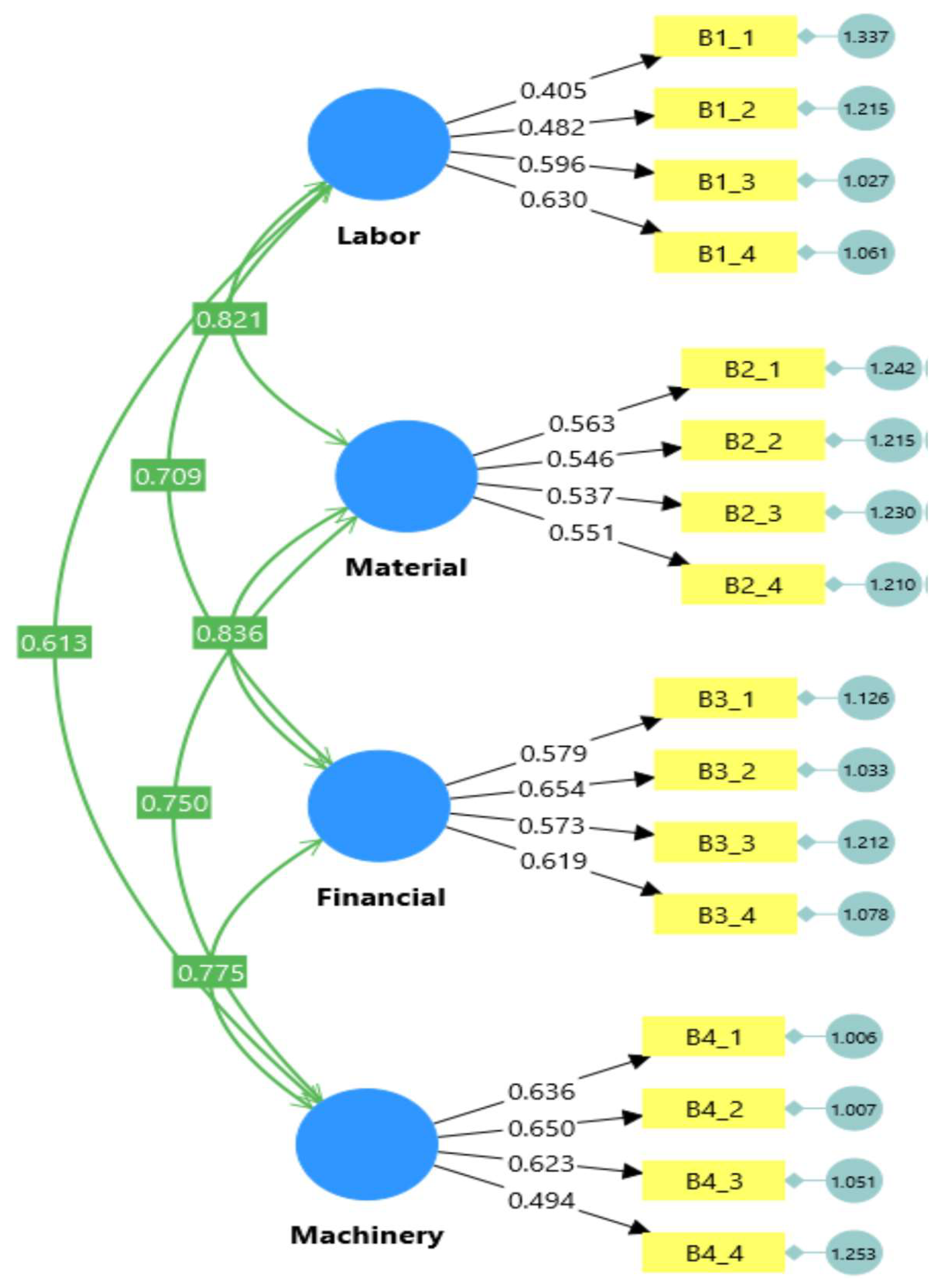
| Factors | No. | Items | Loadings (Standardized) |
|---|---|---|---|
| Labor | B1.1 | labor shortage | 0.405 |
| B1.2 | strike | 0.482 | |
| B1.3 | labor productivity | 0.596 | |
| B1.4 | labor skills | 0.630 | |
| Material | B2.1 | lack of materials in market | 0.563 |
| B2.2 | delay in receiving materials on site | 0.546 | |
| B2.3 | materials do not follow contract specifications | 0.537 | |
| B2.4 | defect in materials which is accepted | 0.551 | |
| Financial | B3.1 | project owner financial problems | 0.579 |
| B3.2 | late payments—work done | 0.654 | |
| B3.3 | project cost estimate—low | 0.573 | |
| B3.4 | owner problem—get bank loan | 0.619 | |
| Machinery | B4.1 | machinery allocation problem | 0.636 |
| B4.2 | machinery failure | 0.650 | |
| B4.3 | wrong selection of machinery | 0.623 | |
| B4.4 | lack of modern machinery | 0.494 |
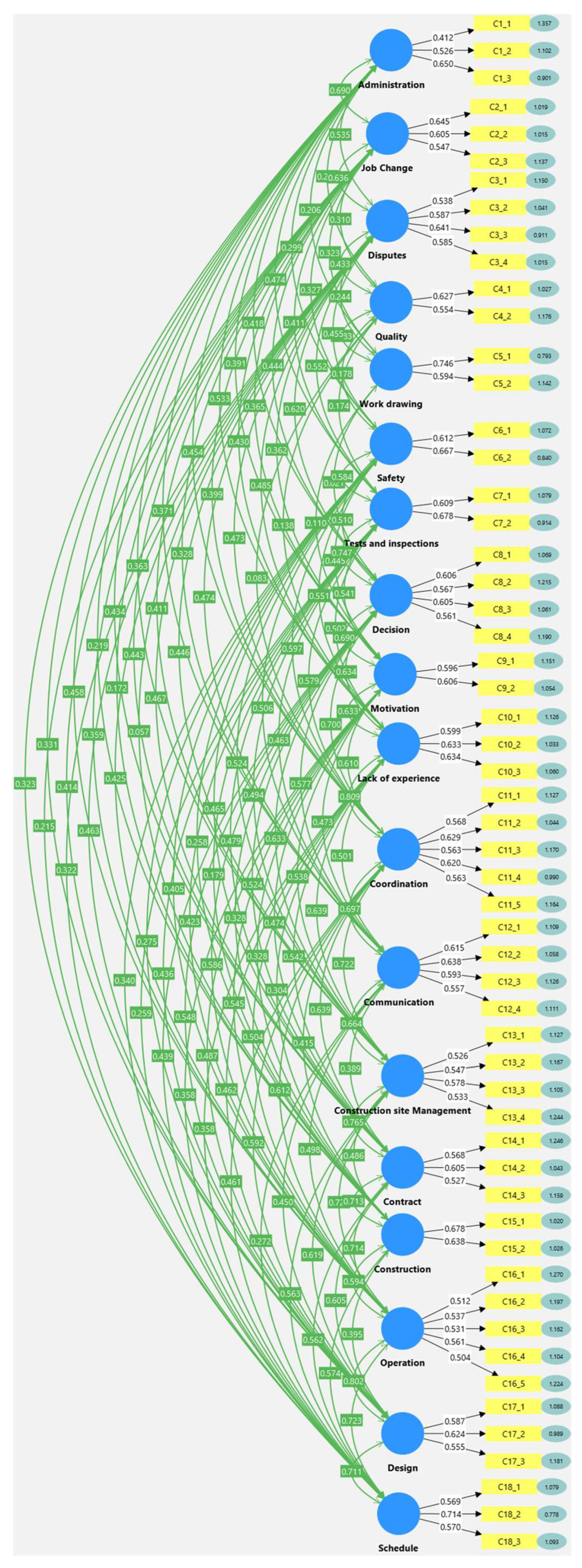
| Factors | No. | Items | Loadings (Standardized) |
|---|---|---|---|
| Administration | C1.1 | disturbances of project owner | 0.599 |
| C1.2 | internal administration problems | 0.633 | |
| C1.3 | unskilled PMC | 0.634 | |
| Job change | C2.1 | design changes | 0.568 |
| C2.2 | changes in the type or specification of the materials | 0.629 | |
| C2.3 | materials work change | 0.563 | |
| Disputes | C3.1 | contract disputes and specifications | 0.620 |
| C3.2 | environmental disputes | 0.563 | |
| C3.3 | financial disputes | 0.615 | |
| C3.4 | negotiation of other major disputes | 0.638 | |
| Quality | C4.1 | too much quality-related documentation | 0.593 |
| C4.2 | application of quality control based on specifications | 0.557 | |
| Work drawing | C5.1 | delay in preparation of work drawings | 0.526 |
| C5.2 | delay in confirming work drawings | 0.547 | |
| Safety | C6.1 | accidents during construction | 0.578 |
| C6.2 | lack of application of safety aspect | 0.533 | |
| Tests and inspections | C7.1 | lack of competent inspectors | 0.568 |
| C7.2 | slow confirmation of testing and inspection | 0.605 | |
| C7.3 | slow results from project owner | 0.527 | |
| Decision | C8.1 | late results from consultant | 0.678 |
| C8.2 | late decision from contractor | 0.638 | |
| C8.3 | approval process | 0.512 | |
| Motivation | C9.1 | incentive of early work completion | 0.537 |
| C9.2 | late fines | 0.531 | |
| Lack of experience | C10.1 | consultant experience | 0.561 |
| C10.2 | owner experience | 0.504 | |
| C10.3 | contractor experience | 0.587 | |
| Coordination | C11.1 | mismanagement of construction site | 0.624 |
| C11.2 | Coordination between parties are weak | 0.555 | |
| C11.3 | late mobilization of construction site | 0.569 | |
| C11.4 | contractor poor monitoring | 0.714 | |
| C11.5 | Consultant poor monitoring | 0.570 | |
| Communication | C12.1 | Lack of constant communication that effective construction party | 0.412 |
| C12.2 | issuing instruction delay between | ||
| construction parties | 0.650 | ||
| C12.3 | personnel problem among construction workers | 0.645 | |
| Construction Site Management | C13.1 | weakness of material procurement planning | 0.605 |
| C13.2 | late issuing of document approvals | 0.547 | |
| C13.3 | inaccuracy in documenting work quantity | 0.538 | |
| C13.4 | weakness of consultant project management team | 0.587 | |
| Contract | C14.1 | types of bidding and award | 0.641 |
| C14.2 | late contract awarding | 0.585 | |
| C14.3 | high competition between bidders | 0.627 | |
| Construction | C15.1 | delay in drawing preparation by contractor | 0.554 |
| C15.2 | unclear drawing details by the consultant | 0.746 | |
| Operation | C16.1 | work suspension | 0.594 |
| C16.2 | error during construction | 0.612 | |
| C16.3 | delay in subcontractor works | 0.667 | |
| C16.4 | incorrect construction method | 0.609 | |
| C16.5 | work interruption | 0.678 | |
| Design | C17.1 | complex design | 0.606 |
| C17.2 | poor design | 0.567 | |
| C17.3 | design faults | 0.605 | |
| Schedule | C18.1 | project construction period | 0.561 |
| C18.2 | work program | 0.596 | |
| C18.3 | working plan | 0.606 |
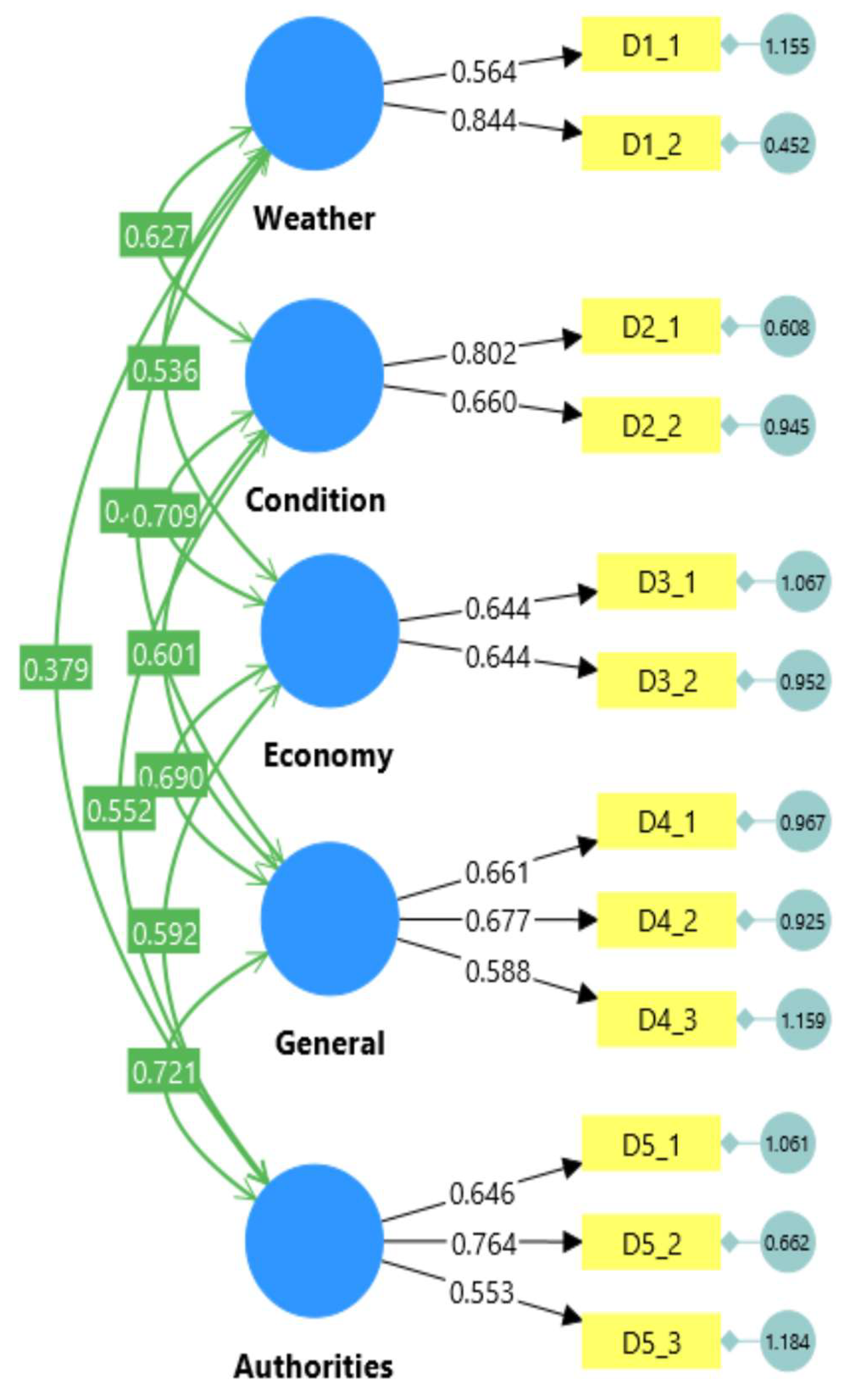
| Factors | No. | Items | Loadings (Standardized) |
|---|---|---|---|
| Weather | D1.1 | bad weather | 0.564 |
| D1.2 | natural disaster | 0.844 | |
| Site condition | D2.1 | soil condition | 0.802 |
| D2.1 | demolition of old buildings | 0.660 | |
| Economy | D3.1 | material price increase | 0.644 |
| D3.2 | labor salary increase | 0.644 | |
| General | D4.1 | activity delay due to construction public activity | 0.661 |
| D4.2 | force majeure | 0.677 | |
| D4.3 | limited construction area | 0.588 | |
| Authorities | D5.1 | government policy and law changes | 0.646 |
| D5.2 | municipality authorization delay | 0.764 | |
| D5.3 | manpower authorization delay | 0.553 |
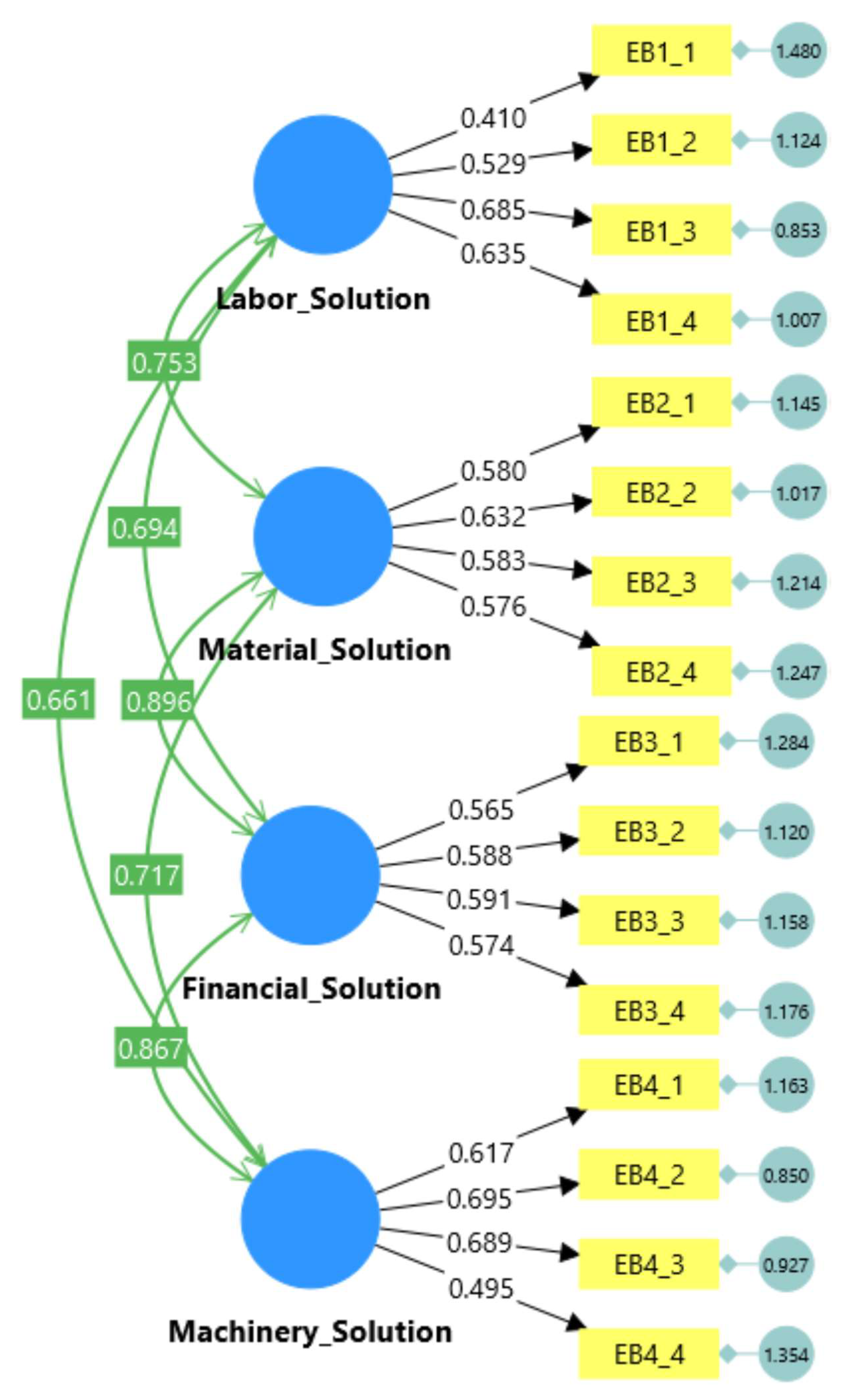
| Factors | No. | Items | Solution | Loadings (Standardized) |
|---|---|---|---|---|
| Labor | EB1.1 | labor shortage | increase recruitment efforts | 0.410 |
| EB1.2 | strike | establish contingency plans to minimize the effect of strikes | 0.529 | |
| EB1.3 | labor productivity | provide incentives to enhance worker motivation and productivity | 0.685 | |
| EB1.4 | labor skills | invest in training programs to upgrade the skills of the workforce | 0.635 | |
| Material | B2.1 | lack of materials in market | maintain strategic material reserves | 0.580 |
| EB2.2 | delay in receiving materials on site | establish clear delivery schedules | 0.632 | |
| EB2.3 | materials do not follow contract specifications | implement rigorous quality control measures, conduct regular inspections, and enforce contractual agreements with suppliers | 0.583 | |
| EB2.4 | defect in materials which is accepted | only accept materials that meet the specified standards | 0.576 | |
| Financial | EB3.1 | financial problems of project owner | explore financing options to address financial constraints | 0.565 |
| EB3.2 | late payments—work done | clearly define payment schedules in contracts | 0.588 | |
| EB3.3 | project cost estimate—low | periodically review and adjust the budget as needed | 0.591 | |
| EB3.4 | owner problem—get bank loan | explore alternative financing options | 0.574 | |
| Machinery | EB4.1 | machinery allocation problem | develop a comprehensive machinery allocation plan | 0.617 0.695 |
| EB4.2 EB4.3 EB4.4 | machinery failure wrong selection of machinery lack of modern machinery | conduct regular equipment maintenance conduct thorough research before selecting machinery continuously upgrade equipment to improve project efficiency | 0.689 0.495 |
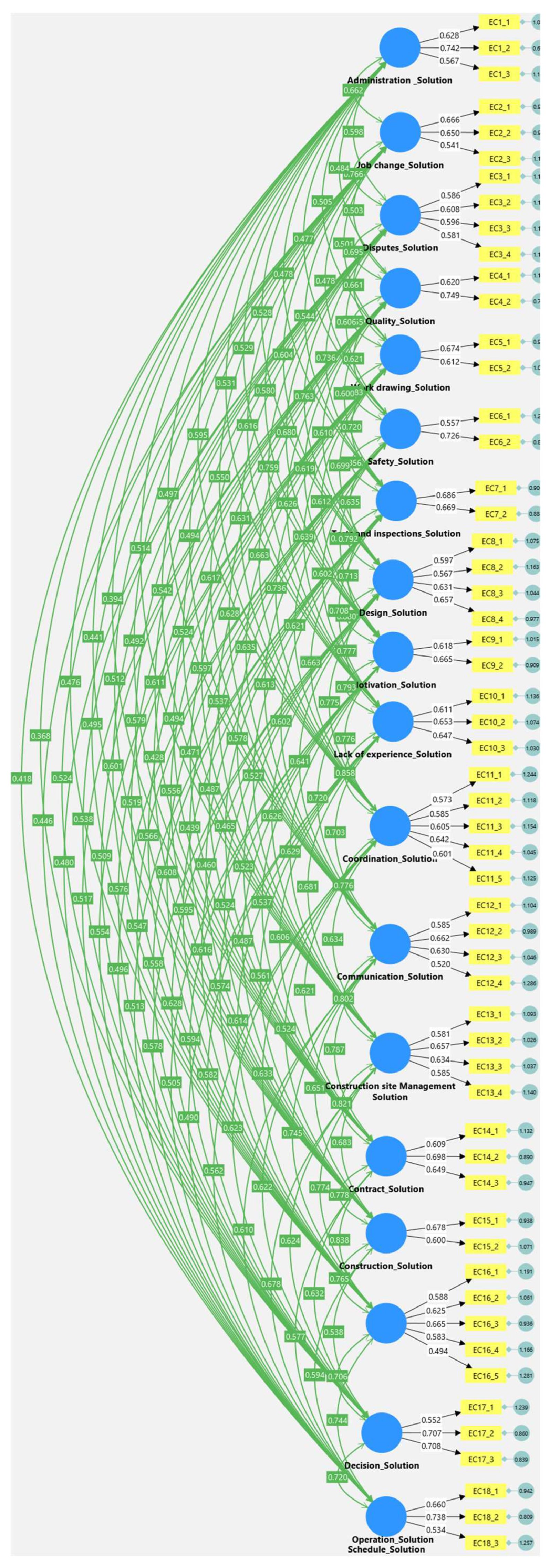
| Factors | No. | Items | Solution | Loadings (Standardized) |
|---|---|---|---|---|
| Administration | EC1.1 | disturbances of project owner | regularly update the owner on project progress | 0.611 |
| EC1.2 | internal administration problems | implement efficient project management systems | 0.653 | |
| EC1.3 | unskilled PMC | ensure that the project management consultant (PMC) has the necessary skills for the project | 0.647 | |
| Job change | EC2.1 | design changes | develop a robust design review process at the project’s outset | 0.573 |
| EC2.2 | changes in the type or specification of the materials | establish a detailed material specification document early in the project | 0.585 | |
| EC2.3 | work materials changes | maintain a comprehensive inventory of materials required for the project | 0.605 | |
| Disputes | EC3.1 | contract disputes and specifications | establish a dispute resolution mechanism to resolve issues efficiently | 0.642 |
| EC3.2 | environmental disputes | conduct a thorough environmental impact assessment before the project begins | 0.601 | |
| EC3.3 | financial disputes | engage in proactive communication to address financial concerns before they escalate into disputes | 0.585 | |
| EC3.4 | negotiation of other major disputes | engage in proactive mediation to resolve disputes before they escalate | 0.662 | |
| Quality | EC4.1 | too much quality-related documentation | focus on essential documentation and implement a digital system for easy tracking and accessibility | 0.630 |
| EC4.2 | application of quality control based on specifications | clearly define quality control criteria in the project specifications | 0.520 | |
| Work drawing | EC5.1 | delay in preparation of work drawings | regularly monitor the progress of drawing preparation | 0.581 |
| EC5.2 | delay in confirming work drawings | set clear timelines for confirmation | 0.657 | |
| Safety | EC6.1 | accidents during construction | investigate and address any safety concerns promptly to prevent accidents | 0.634 |
| EC6.2 | lack of application of safety aspect | foster a safety-first culture on the construction site | 0.585 | |
| Tests and inspections | EC7.1 | lack of competent inspectors | invest in training programs for inspectors to enhance their competency | 0.609 |
| EC7.2 | slow confirmation of testing and inspection | provide adequate resources to testing and inspection teams | 0.698 | |
| Decision | EC8.1 | slow results from project owner | regularly communicate the impact of delayed decisions on the project | 0.649 |
| EC8.2 | late results from consultant | set expectations for timely deliverables and updates | 0.678 | |
| EC8.3 | late decision from contractor | establish a project schedule that includes clear deadlines for decisions from the contractor | 0.600 | |
| EC8.4 | approval process | use digital platforms to facilitate the review and approval of documents | 0.588 | |
| Motivation | EC9.1 | incentive of early work completion | implement an incentive program that rewards contractors and project teams for completing work ahead of schedule | 0.625 |
| EC9.2 | late fines | enforce penalties consistently to motivate timely project completion | 0.665 | |
| Lack of experience | EC10.1 | consultant experience | select experienced consultants with a proven track record in similar projects | 0.583 |
| EC10.2 | owner experience | provide support and guidance to less experienced project owners | 0.494 | |
| EC10.3 | contractor experience | select contractors with a history of successful project completions | 0.552 | |
| Coordination | EC11.1 | mismanagement of construction site | address issues promptly to maintain effective site management | 0.707 |
| EC11.2 | weak coordination between parties | establish regular coordination meetings to discuss progress | 0.708 | |
| EC11.3 | late mobilization of construction site | ensure that all necessary resources and permits are obtained well in advance to avoid delays | 0.660 | |
| EC11.4 | contractor poor monitoring | regularly review and assess the contractor’s monitoring activities to ensure compliance with project requirements | 0.738 | |
| EC11.5 | consultant poor monitoring | conduct regular performance evaluations of consultants regarding monitoring activities | 0.534 | |
| Communication | EC12.1 | Lack of constant effective communication between construction party | encourage an open and transparent communication culture among all project stakeholders | 0.628 |
| EC12.2 | Delay of issuing instructions between the construction parties | implement a digital platform for issuing instructions and tracking their status | 0.742 | |
| EC12.3 | personnel problem among construction workers | address personnel issues promptly and fairly to maintain a harmonious construction site | 0.666 | |
| Construction site Management | EC13.1 | weakness of materials procurement planning | regularly update the plan based on project progress and changes | 0.650 |
| EC13.2 | late issuing of document approval | regularly monitor and enforce the document approval schedule to prevent delays | 0.541 | |
| EC13.3 | inaccuracy in documenting work quantity | regularly audit and review the accuracy of documented quantities to prevent discrepancies and delays. | 0.586 | |
| EC13.4 | weakness of consultant project management team | evaluate the competence of the consultant’s project management team during the selection process | 0.608 | |
| Contract | EC14.1 | types of bidding and award | select an appropriate bidding and award process based on the project’s complexity and requirements | 0.596 |
| EC14.2 | late contract awarding | develop a realistic timeline for the awarding of contracts | 0.581 | |
| EC14.3 | high competition between bidders | establish clear evaluation criteria to ensure fair competition | 0.620 | |
| Construction | EC15.1 | delay in drawing preparation by contractor | clearly define drawing preparation milestones in the contract | 0.749 |
| EC15.2 | unclear drawing details of the consultant | facilitate clear communication between the consultant and the contractor regarding drawing details | 0.674 | |
| Operation | EC16.1 | work suspension | clearly define the conditions under which work suspension may occur in the contract | 0.612 |
| EC16.2 | error during construction | implement quality control measures to identify and address errors during construction | 0.557 | |
| EC16.3 | delay in subcontractor works | establish a monitoring system to track subcontractor progress and address potential delays proactively | 0.726 | |
| EC16.4 EC16.5 | incorrect construction method work interruption | ensure that the chosen construction methods align with project requirements and industry standards develop contingency plans to mitigate the impact of interruptions | 0.686 0.631 0.669 | |
| Design | EC17.1 | complex design | engage in thorough planning and feasibility studies to assess the complexity of the design | 0.597 |
| EC17.2 | poor design | consider involving experienced design consultants for critical project components | 0.567 | |
| EC17.3 | design faults | implement a formalized process for revising designs as needed | 0.631 | |
| Schedule | EC18.1 | project construction period | develop a realistic and well-planned construction schedule | 0.657 |
| EC18.2 | work program | create a detailed work program that outlines tasks, milestones, and dependencies | 0.618 | |
| EC18.3 | working plan | communicate the working plan to all stakeholders and regularly assess its effectiveness; make adjustments as needed to ensure alignment with project goals | 0.665 |
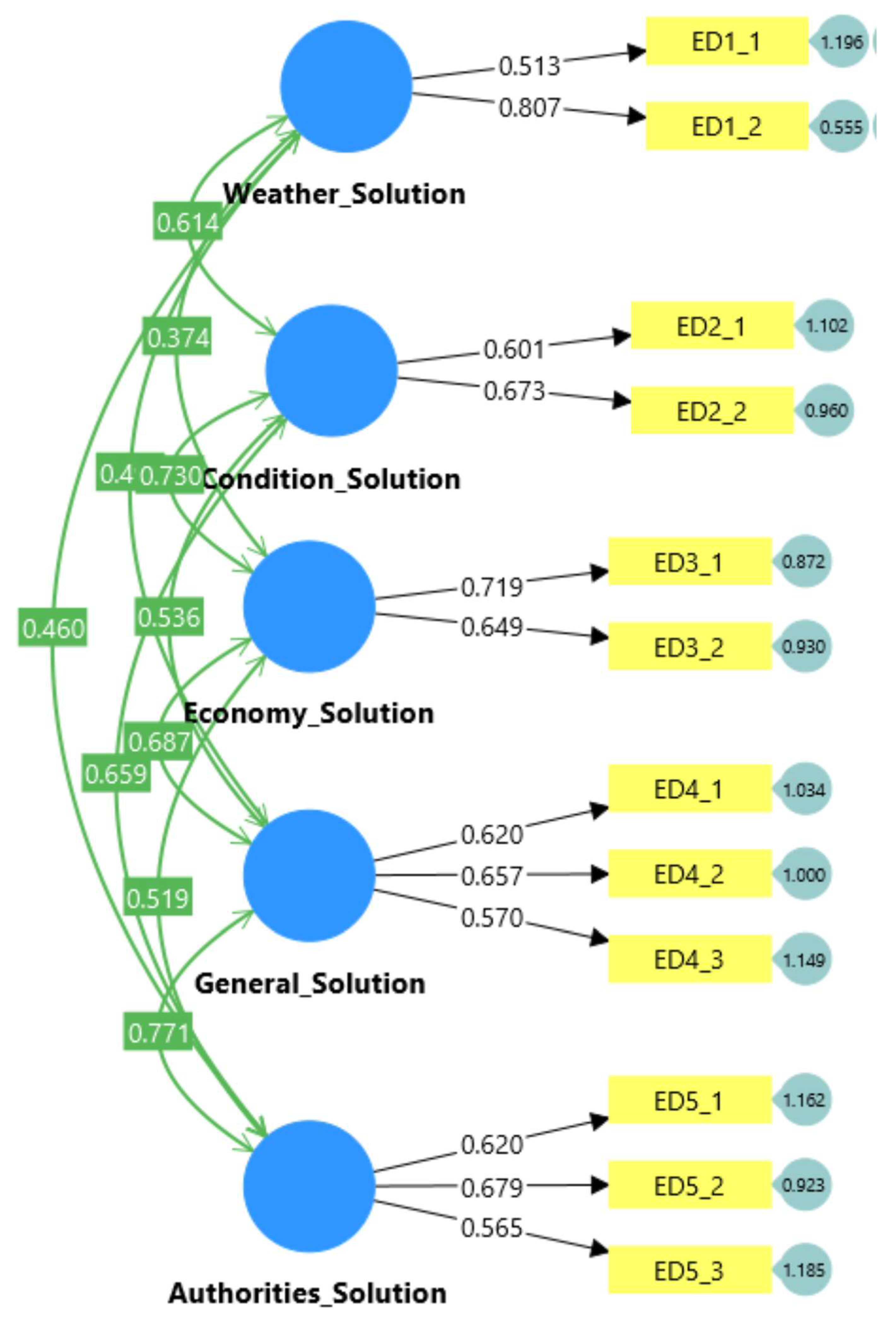
| Factors | No. | Items | Solution | Loadings (Standardized) |
|---|---|---|---|---|
| Weather | ED1.1 | bad weather | incorporate weather contingencies in the project schedule | 0.513 |
| ED1.2 | natural disaster | ensure that the construction design adheres to resilient building codes and standards to minimize the impact of natural disasters | 0.807 | |
| Site condition | ED2.1 | soil condition | conduct thorough soil investigations before the construction begins | 0.601 |
| ED2.1 | demolition of old buildings | use efficient demolition methods and consider phased demolition to allow for simultaneous construction in cleared areas | 0.673 | |
| Economy | ED3.1 | material price increase | negotiate fixed-price contracts with suppliers | 0.719 |
| ED3.2 | labor salary increase | reducing the need for additional labor | 0.649 | |
| General | ED4.1 | activity delay due to construction public activity | coordinate construction activities with local authorities | 0.620 |
| ED4.2 | force majeure | include force majeure clauses in contracts | 0.657 | |
| ED4.3 | limited construction area | consider temporary off-site storage to manage limited space effectively | 0.570 | |
| Authorities | ED5.1 | government policy and law changes | stay informed about potential changes in government policies and laws | 0.620 |
| ED5.2 | municipality authorization delay | initiate the authorization process early in the project timeline | 0.679 | |
| ED5.3 | manpower authorization delay | ensure timely approval for the required workforce | 0.565 |
Disclaimer/Publisher’s Note: The statements, opinions and data contained in all publications are solely those of the individual author(s) and contributor(s) and not of MDPI and/or the editor(s). MDPI and/or the editor(s) disclaim responsibility for any injury to people or property resulting from any ideas, methods, instructions or products referred to in the content. |
© 2025 by the authors. Licensee MDPI, Basel, Switzerland. This article is an open access article distributed under the terms and conditions of the Creative Commons Attribution (CC BY) license (https://creativecommons.org/licenses/by/4.0/).
Share and Cite
Aldammak, M.M.; Hamzah, N.B.; Khoiry, M.A. Pilot Study on Delay Factors and Solutions Strategies in Government Buildings Projects in Kuwait: Stakeholders’ Perspectives Using Confirmatory Factor Analysis (CFA). Buildings 2025, 15, 2420. https://doi.org/10.3390/buildings15142420
Aldammak MM, Hamzah NB, Khoiry MA. Pilot Study on Delay Factors and Solutions Strategies in Government Buildings Projects in Kuwait: Stakeholders’ Perspectives Using Confirmatory Factor Analysis (CFA). Buildings. 2025; 15(14):2420. https://doi.org/10.3390/buildings15142420
Chicago/Turabian StyleAldammak, Mubarak M., Noraini Binti Hamzah, and Muhamad Azry Khoiry. 2025. "Pilot Study on Delay Factors and Solutions Strategies in Government Buildings Projects in Kuwait: Stakeholders’ Perspectives Using Confirmatory Factor Analysis (CFA)" Buildings 15, no. 14: 2420. https://doi.org/10.3390/buildings15142420
APA StyleAldammak, M. M., Hamzah, N. B., & Khoiry, M. A. (2025). Pilot Study on Delay Factors and Solutions Strategies in Government Buildings Projects in Kuwait: Stakeholders’ Perspectives Using Confirmatory Factor Analysis (CFA). Buildings, 15(14), 2420. https://doi.org/10.3390/buildings15142420