


Abstract
The digital transformation of operation and maintenance (O&M) activities has been guiding the facilities management sector towards a strategic role focused on the performance of businesses and sustainable use of natural resources over assets’ lifecycles. Despite the application of information and communication technologies (ICTs), such as building information modelling (BIM) and the Internet of Things (IoT), demonstrating potential for improving such practices, evidence related to its implementation process from an FM professional’s perspective is still much needed to unlock billions of USD trapped in inefficient and fragmented processes. This research seeks such evidence by characterising current and potential applications of BIM and IoT-based solutions for FM, specifically on maintenance services. This exploratory research is based on a multiple case study where three universities’ FM sectors were investigated. Data collection and analysis included semi-structured interviews, focus groups, and inductive content analysis. By considering technology as a scaffold to enhance human activities, the investigation provided a deep understanding of technological, procedural, and policy issues in implementing BIM and IoT-based solutions in FM activities and their related benefits and limitations. Clarifying the necessary resources for such implementation could support FM sectors and organizations in justifying human and financial investments and planning the gradual digital transformation of services.
1. Introduction
The digital transformation of operation and maintenance (O&M) activities is significantly changing the facilities management (FM) sector and its strategic role in the performance of businesses and sustainable use of natural resources over an asset’s lifecycle. Conversely to the traditional “firefighting” culture, the adoption of a more predictive approach for managing the built environment is founded on the availability of relevant information for decision-making, thus enabling the conversion of “building’s in-use data and information into tangible business knowledge to augment FM performance” [1] (p. 2).
Research about Information and Communication Technologies (ICTs), such as building information modelling (BIM) and the Internet of Things (IoT), has continuously indicated the potential for improving such practices [2], where most resources and costs of a building lifecycle are consumed [3,4,5]. BIM, for example, can provide a digital golden thread of rich building information for stakeholders throughout the whole lifecycle [6,7,8], enabling the integration and automation of FM processes [4,7]. Complementarily, IoT is centred on the idea of data generated by things (i.e., sensors, radio-frequency identification (RFID) tags), exploring communication capabilities to increase the accuracy and availability of information [9,10]. Integrating BIM and IoT allows understanding of what occurs with each aspect and component of a building and their operation in real-time, increasing the quality of information, the predictability of issues, and the efficiency and efficacy of services [2,11,12,13].
However, investigations on implementing such technologies are generally disconnected from business goals [14,15]. They are more focused on acquiring and installing technological components than on the value and the process issues required for their operation and maintenance over time [8,16,17,18]. Besides, FM team members’ views regarding implementing BIM and IoT solutions, such as the definition of data requirements for FM BIM models, the upskilling of professionals for managing information, and the necessary capabilities of BIM and IoT-based systems, are usually under-explored.
Previous studies have examined the main benefits and challenges of combining BIM and IoT to support FM activities [19,20,21]. The benefits included automatization of functions and efficient management of building information over the lifecycle (i.e., gather, access, accuracy, update) [22,23,24], increased efficiency of maintenance response [25,26], and increased users’ satisfaction [26]. On the other hand, a series of challenges were identified concerning the following:
- Technology issues, such as interoperability among BIM, IoT, and FM tools [19,22,27,28,29]; lack of open systems [25,29]; lack of understanding of data capturing techniques [28];
- Process issues, such as lack of collaboration between stakeholders for managing information models [22,24]; difficulties in engaging software providers and cultural resistance to changes [22,23]; need for investments in infrastructure and training for the generation and management of information models [3,20,21,22,23];
- Policy issues including a lack of processes, standards, and clear responsibilities and roles for managing information and FM databases [1,20,21,22,23,25,30].
Therefore, clarifying how the information from BIM and IoT can be used and the changes needed to unlock their benefits for FM still constitute a knowledge gap in recent literature [10,18]. Evidence from real-world cases, methodologies, and proof of positive investment return is necessary [19,21,22,23,25].
Addressing such a gap, this research aimed to characterize current and potential applications of BIM and IoT-based solutions for FM from the perspective of FM team members, specifically on maintenance services. As exploratory research, a multiple case study approach was used for data collection with three universities’ FM sectors involving interviews, focus groups, and inductive content analysis. Understanding technology as a support for human activities, the investigation provided a deeper understanding of technological, procedural, and policy issues involved in implementing BIM and IoT-based solutions in FM activities and their related benefits and limitations. We believe this research could support FM sectors and organizations in critically planning the gradual digital transformation of services.
2. Materials and Methods
From an exploratory perspective, multiple case study was the chosen strategy, and the university campuses were the objects of investigation. University campuses are highly complex due to various building functions (e.g., teaching, research, administration, catering, accommodation, sport and leisure, and healthcare) and can be compared to a small town. As a result, demands for FM services—particularly maintenance and operations—are equally significant and complex, which justifies using university campuses as a data source.
As an empirical method, case study research ensures an in-depth and extensive investigation of data to understand complex and contemporary phenomena in their real context [31,32]. Multiple cases were selected through the logic of replication, which checks whether the findings of a case are observed in others, strengthening the validity of findings [31]. Therefore, a better comprehension of the phenomenon is provided, supporting generalization.
The multiple case study was organized into four stages, as shown in Figure 1: 1. scope and planning, 2. entering the field, 3. analysing data, and 4. theory generation. Stage 1 involved the definition of the research question (i.e., “what are the scenarios and opportunities for BIM and IoT implementation in FM sectors?”), the selection of cases through theoretical sampling, and the crafting of multi-methods instruments and protocols for field work. The selection of cases was based on the level of BIM and IoT implementation for FM activities, meaning that:
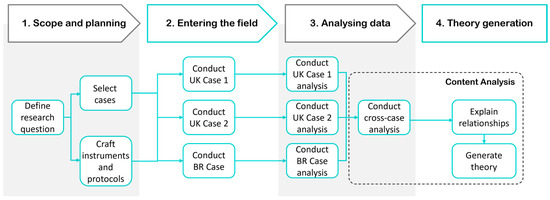
Figure 1.
Research data management.
- -
- The intermediate level involves the availability of a CAFM system; availability of online tools for users reporting faults; availability of digitalised asset information (drawings, spreadsheets, standards, etc.); availability of BIM models of buildings/university campus; use of BIM model as one, but not the only, reliable source of information for FM purposes; partial integration of BIM models and CAFM system; change management triggered by BIM implementation;
- -
- availability of IoT devices to support building management OR intention to integrate IoT devices into BIM model;
- -
- while the low level involves the availability of a CAFM system; availability of online tools for users reporting faults; availability of digitalised asset information (drawings, spreadsheets, standards, etc.)
As a result, two intermediate-level universities from the United Kingdom and one low-level university from Brazil have been selected.
In Stage 2, the investigation was conducted with the two British universities (UK University 1 and UK University 2) between September 2018 and February 2019 and the Brazilian university (BR University) between October and December 2019. Face-to-face semi-structured interviews and focus groups were conducted with university members to collect relevant data about BIM and IoT in FM activities. The interviewees were classified into two groups: professionals directly involved with managing and supervising FM activities and professionals working on Information Technologies to support asset and FM data management.
Table 1 summarises the interviews and focus groups conducted with the three universities and their transcription ID. The interviewees were identified by a code containing the organisation’s acronym and professional and chronological numbers of the interview (e.g., UK University 1_Prof_1). Appendix A shows a detailed synthesis of the interviews.

Table 1.
Summary of interviews with members of the universities.
In Stage 3, the analysis of data involved case and cross-case analyses, looking beyond the first impressions, and seeing evidence through distinct lenses [33]. In Stage 4, theory generation was based on hypothesis shaping and literature enfolding. Inductive content analysis was used for examining the semi-structured interviews and focus group transcriptions generated by the three cases. Considered a central technique for social science research [34], content analysis is an investigative approach that describes communication contents through objective, systematic, and reliable procedures, avoiding personal bias [31]. As an inductive instrument, it enables the raising of underlying meanings for supporting interpretations and inferences about an observed phenomenon in semiotic, oral, and written communication formats (e.g., interviews, messages, discussions, and books) [35].
In this study, an information-based qualitative approach characterized the scenario for current and potential applications of BIM and IoT-based solutions for FM services, particularly for maintenance services. The analytical process was organized into three steps, according to [35], namely i. pre-analysis, ii. exploration of the corpus, and iii. treatment and interpretation of results, as shown in Table 2.
Table 2.
Content analysis steps.
The methodological approach imposes limitations to generalization. While having interviews provides in-depth insights related to the status of digitalisation, it also limits the extent to which the results represent the sector. Considering the relatively small sample, a complementary survey would be necessary for wider generalisation, so readers must consider this aspect. Interviewees can also provide a biased opinion based on their interests in digitalising. The interviews were semi-structured and designed to mitigate bias. However, we acknowledge that some results can contain some bias and that the study would have benefited from a larger and more diverse sample of universities from different countries and with different BIM and IoT implementation levels. Other data types, such as objective measures of FM performance before and after BIM and IoT implementation, would also have strengthened the research.
3. Results and Discussion
The content analysis used data from the interviews and focus group transcriptions of universities team members. The pre-analysis (i) was carried out through the “free-floating reading” of transcriptions, the selection of the key documents for analysis named “corpus”, and the definition of the analysis aims [35]. This analysis aimed to characterize the scenario for current and potential applications of BIM and IoT-based solutions for FM services, particularly maintenance services. Questions to be addressed included:
- What is the capability of FM team members in asset data and information management?
- What are the technological abilities and requirements necessary to support FM digital transformation?
- What is the role played by standards and mandates in FM digital transformation?
- What is the level of engagement with digital transformation among the distinct stakeholders?
In sequence, the corpus (ii) was explored in three steps as proposed by [35]. First, the interviewees’ answers for each question were defined as the recording units, while the university FM sectors environment as the context units. Second, the presence of sets of words was set as the index for the enumeration stage. The third step was classifying the corpus according to semantic categories and themes. The classification process was progressively developed through the differentiation and clustering of elements. BIM competency sets proposed by [37] and BS EN 15221-1:2006 Facility management—Terms and definitions [38] supported the categorization according to three themes: technology, process, and policy, and the related categories, as presented in Table 3. Table 4 depicts the themes, category groups, categories, codes examples, and statement examples.
Table 3.
Content analysis themes, category groups and categories.
Table 4.
Content analysis classification.
Finally, the treatment and interpretation of results (iii) were undertaken according to the proposed categories and supported by the interviewees’ statements, thus revealing the hidden meaning of the empirical data.
A set of current and potential applications of BIM and IoT in universities’ FM activities have been described by the interviewees, such as: (i) an app for tracking craftsman work, recording the time and cost spent in the services, and an alternative to the traditional paper time sheet (UK UNIVERSITY 1, 2019b); (ii) the integrated use of CAFM systems (e.g., Archibus), building management systems (BMS) and BIM software for the visualization of building components characteristics and management of information, supporting FM team members and external stakeholders on problems of communication, diagnosis, and repair (UK UNIVERSITY 1, 2019b; UK UNIVERSITY 2, 2018); (iii) the use of construction design and management (CDM) walkthrough and augmented reality into the BIM model to support a multidisciplinary professional group (maintenance team, design team, contractor team) on the visualization of “soft clashes” and planning maintenance and operational services (UK UNIVERSITY 2, 2018); (iv) an IoT system for monitoring external lighting, able to detect and report failed light bulbs and to manage the nearby light bulbs to provide correct lighting (BR UNIVERSITY, 2019a); (v) the use of IoT solutions for the prediction of problems before occurrence, particularly in places without visibility and occasions without human presence (e.g., heating systems) (UK UNIVERSITY 1, 2019b; UK UNIVERSITY 1, 2019c); (vi) the adoption of IoT systems for space management, using real time data regarding the number of users in a room to control the environmental conditions (i.e., lighting, heating) and obtain information about the rational use of the space (UK UNIVERSITY 1, 2019d); (vii) the integration of IoT and fire systems, providing to the university staff the users’ location through the wi-fi accessed point (UK UNIVERSITY 1, 2019d); (viii) the use of an IoT-based computer location system, informing the position of free devices (UK UNIVERSITY 1, 2019d).
The success of implementing such solutions and boosting FM digital transformation depends on the balance among the three thematic pillars—technology, process and policy [17], as subsequently discussed in Section 3.1, Section 3.2 and Section 3.3.
3.1. Technology
From the technological point of view, a gap between the available default solutions and the FM sector requirements and needs is observed. As described by the interviewees, despite the progress of ICT technologies, the rigid (and occasionally “a bit clunky” (UK UNIVERSITY 2, 2018)) structure and technical limitations of commercial systems and software hamper the execution of FM current activities and the exploration of new business opportunities [39,40]. The default abilities are usually insufficient or inappropriate to the FM sector needs due to the complexity of the processes or the individual characteristics of each organization, as exemplified by one of the interviewees:
“So, we are using Archibus to link Archibus to Revit, and my experience with CAFM software, in general, hasn’t been great. I think they, from what I’ve seen, are like the kinds of systems that were created in the 80 s that haven’t really moved a lot since. So, I think for this [kind of ...] digital campus I don’t know if any system will really kind of live up to the expectations [...]. They have very rigid data structures. Archibus, for example, uses inside the room number as a primary key which means if you want to change the room number and [...] add it again with a different new code, you will lose all of the data. So, it is a really poor structure, I think.”(UK UNIVERSITY 2, 2018)
This perception is corroborated by the literature, which provides examples of restrictions related to CAFM software (e.g., visualization based only on 2D drawings and images [41]), BAS systems (e.g., lack of capability to inspect algorithms for smart analytics [42]), and BIM software (e.g., lack of flexibility for adjustments and modifications [19]). Another limitation stated by the literature is the lack of involvement of software providers, “including fragmentation among different vendors, competition, and lack of common interests” [22]. Such issues might affect organisations’ confidence in these technologies [42], discouraging robust investments and raising doubts about their suitability for digital transformation.
As a mitigation strategy, the FM sector generally opts for developing or adapting in-house solutions to address specific activities, involving an iterative process between FM and IT professionals, as described by one of the interviewees:
“So, I would go back to the IT people and [say] “Look, this is not working, here I need a form for me to sign, to forward, because that person does not have access to our computers”, or “because it needs a way to forward to the purchasing [department] to buy something that is missing when a material is missing, or else they need to be able to return to me.”(BR UNIVERSITY, 2019a)
However, difficulties in managing and updating such systems were identified, thus bringing uncertainty regarding their implementation. As highlighted by the interviewees, “getting the systems to talk to each other” (UK UNIVERSITY 1, 2019c) is essential for FM departments to make better decisions, automate processes, and generate savings. As approached in previous studies [5,8,17,19,22,43,44,45], the lack of interoperability among systems and devices over the building lifecycle figures among the core challenges faced by the AEC industry ICT users, hampering collaboration, one of the basic principles of BIM [46].
In the context of the selected organizations, the interoperability issues are mainly related to the integration among CAFM software and other supportive systems, such as financial systems, occurrence reporting systems, BMS systems, IoT systems, and BIM software, thus concerning the FM team members: “I do not like this, I would like to see everything coming together”, said one of the interviewees (UK UNIVERSITY 1, 2019c).
One of the interviewees also emphasized the limitations imposed by proprietary protocols and vendor lock-in for operating and integrating systems and devices (e.g., such as the unavailability of technical support, difficulties in getting information out of the systems, and a lack of integration with other manufacturers’ products), reducing the potential applications of the systems:
“And what some companies do is, once you are bought into their system, you cannot integrate into other manufacturers’ products. So, basically, you “buy their stuff” […] or you do not have their system. […] there are certain protocols that are only supported and maintained by one vendor and their proprietary system, so we take the decision of just not using them because if we later buy from another, it will not work, and we will have to buy all from that one company and that in my opinion is really risky. Because they can double the prices, or rack prices up […] So, we avoid that. […] So, that is the biggest thing that annoys me. But I know why companies do it. They do it because they want more money, basically. I might be wrong, but I am pretty sure […] that’s business.”(UK UNIVERSITY 1, 2019d)
For one of the interviewees, this issue might be addressed by developing open platforms trigged by IoT solutions: “Hopefully, IoT is going to be the disruptor that the industry needs, getting things talking to a common platform” (UK UNIVERSITY 2, 2018). According to the literature, developing methodologies considering all involved stakeholders [24], strengthening the relationship between IT developers and users [39], and supporting open platform developments are vital for the FM sector’s progress towards full digitalization, as reinforced by [24] (p. 272): “the differing life span of technologies and buildings suggests that there is a requirement for open source standards that aid in maintaining the usability of models”. A strategic approach is imperative for defining the systems and devices that will better address FM sector needs in the medium and long term, considering the concepts of functionality, flexibility, scalability, and interoperability.
The importance of precise and available information was evidenced from strategic to operational levels. The interviewees reported that easy access to accurate and reliable information is key for improving service performance and decision-making since what “BIM does not solve is bad information” (UK UNIVERSITY 2, 2019b). As one of the interviewees exemplified, updated asset drawings and BIM models can save significant amounts of time and resources in non-added value tasks, such as field surveys and engaging the staff with core activities (BR UNIVERSITY, 2019a).
The literature corroborates that accessibility, availability, accuracy, and reliability of information over FM processes have emerged as essential requirements for improving FM service performance [22,24,25,47,48] and effectively implementing BIM [3,17,30,49,50] and IoT solutions [51]. Although security aspects must be considered for establishing tiers of information access [17], strategies that ensure a uniform distribution of reliable, effortlessly retrievable, and traceable information among stakeholders must be assured [22].
In the IoT context, the real-time monitoring of facilities must generate a rich database of performance records, driving efforts to critical assets at the right moment. In this perspective, technological solutions that optimize data gathering, storing, and sharing must be prioritized by organizations. The information overload was described as a concern by one of the participants, who has emphasized the necessity of a strategic implementation to define the number, type, and location of sensors to support the extraction of relevant data for asset management:
“I think the interesting thing with sensors is that you can have so many that you could almost become overwhelmed by data. So, I think it is essential getting the balance right and understanding the right sort of sensor for the right place.”(UK UNIVERSITY 1, 2019c)
The literature supports such a position. At the strategic level, ref. [52] proposed a decentralized decision-making structure, reducing the dependence of the facility manager on problem-solving. At the operational level, ref. [3] (p. 8) recommended the use of approaches that enable users “to query and visualize only the required fraction of the history data”. The same logic concerning BIM was discussed by [8,20,53]—These authors recommended the generation of a simplified copy of the construction model, which should include only essential data for operations.
3.2. Process
In addition to the technological aspects of digitalization, people issues and strategic, tactical, and operational FM links drive the ICT implementation within universities. FM team members and sectors have various levels of awareness regarding BIM and IoT. Some demonstrate a good understanding of BIM and IoT definitions, functionalities, standards, and impacts on the FM sector, discussing technical, processual, and regulatory challenges for effective implementation:
“IoT is the internet of things, and there are a lot of systems that are connected to the network, but they are not accessed through the internet. […] So, it is a local network of things (LAT).”(UK UNIVERSITY 1, 2019d)
“It is the way every university uses BIM with CAFM.”(UK UNIVERSITY 1, 2019b)
“[…] we were talking about innovative ways to change how the university is working with IT.”(UK UNIVERSITY 1, 2019b)
Others reveal an incipient awareness level, especially regarding the BIM implementation driven by a national mandate:
“We took this information by surprise in the AutoCAD course. And then we started to argue with each other, so we have, of course, an obligation to implement it by 2021, but we also have the desire to implement it, to start using Revit, because the projects that come to us will also start arriving in Revit, we have to know, right?”(BR UNIVERSITY, 2019a)
These results can be explained by the distinct professional backgrounds (e.g., computer science, civil engineering, architecture), job positions (e.g., BIM manager, FM manager, designer, CAD technician), and years of experience. Moreover, a clear understanding of ICT applications and requirements can influence the interest of individuals in developing specialized skills, hence supporting technological implementations.
A correlation was observed between the interviewee’s BIM and IoT awareness and engagement levels and the FM sector initiatives towards digital transformation. In general, benefits of these solutions for FM performance described in the literature were emphasized by the participants, such as navigation and visualization of building components characteristics in BIM models for diagnosis and repair, thus reducing the period of disruption [24,54,55], prediction of problems (e.g., monitoring of facilities performance particularly in places with no visibility or human presence), space management (e.g., information on room occupation), and emergency management (e.g., information on users’ location and evacuation routes [22]).
As stated by one of the interviewees, in a bottom-up strategy, individual efforts towards persuading the head of the department on the benefits of BIM were decisive for its implementation. Accordingly, a top-down response was generated by hiring specialised professionals and acquiring supportive technological solutions. The engagement of stakeholders from all FM sector levels and the establishment of a clear strategy of implementation addressing the business goals [15,17,52] may trigger significant actions towards digital transformation.
Moreover, some staff members reported dissatisfaction with the FM sector strategies to manage services and drive digital transformation, expressing disappointment at not being involved in decision-making processes (i.e., setting parameters for the acquisition of new CAFM systems versions) or encouraged to develop in-house ICT solutions (i.e., systems and mobile applications). This scenario was described by [56] (p. 57), who emphasized that the maintenance sector “is not always consulted on issues that relate to new development”. Despite the challenges of improving maintenance processes [57], the approximation between the FM staff from all hierarchical levels must be considered an opportunity to develop a more collaborative and creative environment.
Besides the individual and organizational willingness to move FM to a fully digitized status, FM team capabilities are a matter of concern. Since ICT implementation imposes technological, managerial, and regulatory changes, new skills and roles are required from all FM stakeholders [17,22,25,45,58,59,60]. Although some interviewees demonstrated enthusiasm for BIM and IoT implementation, the resistance of members of the FM team to change traditional practices is emphasized as a challenge for moving the AEC industry to a fully digitalized environment:
“People do not like it... it is more comfortable an incremental change, but that is not what we need. We need a monumental change! We need to get from a very bad position to a very good position.”(UK UNIVERSITY 2, 2018)
The literature supports the idea that cultural changes are frequently perceived as a threat by FM team members, leading to resistance behaviours [17,52].
Furthermore, some interviewees have reported limitations of the FM team’s expertise (e.g., development of IT solutions and management of data information in BIM models) and size influence, not only in the scope and performance of the provided services but also opportunities to advance towards ICT implementation:
“The tip of the spear is people with low digital literacy; this is our difficulty. Because, for example, the bricklayer, excellent bricklayers, but they are not use to work with computers, for example.”(BR UNIVERSITY, 2019a)
According to one of the participants, the lack of personnel has significantly contributed to the failure of the lighting system, one of the few IoT initiatives in the organization:
“But the problem ended up in whoever is going to manage it. We were unable to have a person to say, “This guy will manage, will test the system, will know how to change the system, will know how to dim, will know how to do, how to sector to be able to try this”, so there was no person who was appointed to do that, in addition to some system failures as well.”(BR UNIVERSITY, 2019a)
Given that labour cost represents approximately 70% of the total maintenance cost [56], investments in staff capabilities are crucial for improving both the engagement of professionals with the activities and the service performance [61]. Upskilling initiatives, such as training and education programmes [17,53,56], workshops with other AEC and FM sector stakeholders [62], and adoption of intuitive interfaces (i.e., those that demand elementary IT skills), might contribute to improving the capabilities of the team [63], as reinforced by [17] (p. 237) “when team members understand why they are doing something, they are more likely to buy into new ideas and support organizational change”. The optimization of FM processes focusing on core activities and critical assets could improve service performance. ICT solutions play a key role at the operational level (i.e., automating tasks, broadening access to information, guiding information exchange), thus supporting more proactive decision-making.
The interviewees have discussed the feasibility of ICT implementation from distinct perspectives, and, apart from technological and human factors, budget restrictions were described as crucial barriers to FM digital transformation, particularly in the public sector, as corroborated by some authors [24,56,64] and exemplified by one of the participants:
“When you have got an established building where you have not got BIM, you have not got air conditioning survey; possibly, you have not got a facility management system set up to that level of detail that would be very expensive to set up.”(UK UNIVERSITY 1, 2019c)
The costs involved in developing and implementing new systems and devices [43], adaptation of data information structure, and staff training can be high [3] and are commonly seen as expenses with no clear return. The purchase of technologies is only the first step [17] of a consistent implementation plan.
However, as explained by one of the interviewees, the transition from the current status to a fully digitized one requires capital investments initially and might be solved with financial savings in the long run. According to one of the participants (UK UNIVERSITY 2, 2018), even though there is no systematic efficiency measurement procedure, time savings have been identified in light bulb replacements, usually costing USD 40.000 a year. Traditionally, this process would take around 0.6 to 1.0 h, involving many activities (e.g., visiting the site, standing a ladder, taking the fitting of the bulb, putting it back, leaving the site, going to the stores, coming back to the site, getting documents signed off the client). By checking the BIM model on a tablet, part of these non-value-adding activities would be removed, representing a time reduction by approximately a third and significant savings in the annual budget.
The existing literature endorses this position. Investigating the application of BIM for FM at a university complex, ref. [25] estimated potential savings from both reduction of CAD technician labour time (approximately USD 25.000/year salary) and future improvements in work order completion. The financial return of BIM would also come with the development of maintainability studies for preventive maintenance, supporting the achievement of “optimum performance throughout the life span of a facility with a minimum life cycle cost” [22] (p. 436).
Return on investment (ROI) analysis based on earnings and costs variables could be considered for supporting organizations in identifying the most appropriate technologies and training programmes towards the expected productivity gains. Regarding BIM implementation, ref. [25] (p. 272) recommended that FM sectors should take into consideration a “long-term view” of at least five years and diverse information formats and standards.
University functional, organizational, and building characteristics were considered obstacles to ICT implementation. For instance, the flexibility of spaces has been mentioned as a core requirement to address the frequent changes imposed on the university building environment over the years (UK UNIVERSITY 1, 2019c). Moreover, characteristics such as the university establishment time and the age of the buildings have been pointed as challenges for digitalization:
“So, I think there are two things to say: a brand new building, absolutely, would be really helpful, but for an older building, older state, there are many holes behind the walls, if you know what I mean, that we do not know what goes on because we were not here when the first fix was done, it is a lot more difficult, does that make you understand?”(UK UNIVERSITY 1, 2019c)
Even more complex organizations, such as hospitals and airports, have been working towards overcoming barriers and digitizing their assets. In this sense, diagnosing inner organization characteristics [65] is a prior and fundamental step for developing a realistic ICT implementation, which considers all the necessary resources and organizational changes.
The value of FM services perceived by the university community can contribute to obtaining investments for service performance improvement and digital transformation. For some interviewees, services provided to accommodation and hospitality are highly valued by universities since, from a business perspective, accommodation plays an important role in private university finances. On the contrary, infrastructure services, special underground plumbing, and electrical facilities, are less valued by the organizations as the users do not perceive their benefits. This observation is supported by [66], who states that addressing users’ requirements and expectations is vital since buildings have been assuming a new role of services provider rather than a container of activities. The interest in ensuring user satisfaction through the supply of services could trigger ICT implementation in this group of assets towards improved service performance.
The way FM is perceived has significantly shifted from a support service to a strategic and core business function [67]. As discussed by [24], maintenance activity has moved to a new status due to its potential to extend building lifespan and generate financial and environmental savings. Ref. [56] considers maintenance a multidisciplinary business since it integrates areas such as finance, engineering, and technology and must focus on preserving the performance of buildings rather than reacting to their inadequacies.
3.3. Policy
Finally, regulatory and contractual factors were approached as fundamental parts of the digital transformation process. The interviews revealed that establishing internal protocols and procedures for supporting operation and maintenance processes (e.g., service prioritization and budget setting) is crucial for service performance. Their efficacy requires permanent updates of documents according to the organization’s circumstances and the training of FM stakeholders on following instructions.
The intricacy of FM processes, especially after ICT implementation, demands setting clear responsibilities and requirements to FM stakeholders towards the right output of each stage. As exemplified by one of the interviewees, an obstacle to be overcome is the supply chain’s lack of compliance with BIM handover, which generates poor-quality information (UK UNIVERSITY 2, 2019b). In this sense, government mandates, guidelines, and standards might trigger and drive ICT implementation since they establish contractual and procedural bases that support the AEC supply chain on service delivery.
Given the complexity of BIM data and information management for FM [1], some authors have emphasized the importance of developing open and specific BIM standards and technologies (i.e., templates, specifications, formats, platforms) [8,15,25], identifying users’ information needs [15], and defining owner’s BIM requirements already in the design and construction stage [22,24,45,55] towards digitalized, accurate, and consistent asset data. Adapting contracts and specifications [53] and developing BIM execution plans (BEPs) driven by designers and contractors are essential to assist the adoption of BIM processes and technologies. For instance, BEP could contribute to overcoming inaccuracies in BIM models by frequently including excessive or incomplete information for operation activities [20].
Nevertheless, adopting such mandates, guidelines, and standards is not straightforward for inexperienced professionals and organizations since it requires individual skills to translate complex concepts into effective practices. As discussed by [62], although most of these skills are gradually developed throughout the professional career, a more collaborative environment with the participation of AEC industry stakeholders could support the upskilling process.
4. Conclusions
A deeper understanding of technological, processual and policy aspects involved in implementing BIM and IoT-based solutions in FM activities was provided by the multiple case study and supported by the literature. Clear benefits for FM service performance were highlighted, such as improving the identification, visualization, and diagnosis of problems. Interoperability, flexibility, and user-friendliness are crucial for making software, systems, and devices suitable for FM purposes. Encouraging the development of open platforms and strengthening the relationship among FM team members, IT developers, and providers are imperative for addressing this issue. Furthermore, effective information management is key to supporting FM decision making and providing accessible, accurate, and reliable information to the stakeholders involved.
Understanding technology as a support for human activities, the investigation of process aspects regarding BIM and IoT implementation revealed distinct levels of awareness, engagement, satisfaction, and capabilities among FM team members towards digital transformation. Beyond the individual willingness to embrace a new approach to work, the importance of upskilling actions and establishing a clear strategy of implementation adherent to the university’s business goals was reinforced. Furthermore, the FM sector budget restrictions emphasized the necessity of investments in technology based on return on investment (ROI) analysis to achieve the expected productivity gains. Moving FM services from an operational to a strategic position contributes to gradual BIM and IoT implementation advancements.
In addition, regulatory and contractual aspects of conducting FM activities in a digitalized environment have emerged. Standards and guidelines are essential to structure FM services, such as budget setting and allocation, service group classification (i.e., reactive, preventive), service prioritization (e.g., emergency and urgency), support information management, setting roles, responsibilities, and information requirements. To ensure service efficacy, these documents must follow not only external references (i.e., mandates, technical normalisation, professional bodies), but also the organisation’s individual needs. Balancing the technological, processual, and policy issues is decisive for successfully implementing BIM and IoT.
Clarifying the necessary resources for such implementation might support FM sectors and organizations in justifying human and financial investments and planning the gradual digital transformation of services. The findings provide a perspective on the creation and management of buildings for real, sustainable, and complex contexts, considering the requirements and value of information supported by innovative ICTs, such as BIM and IoT, for decision making across the building lifecycle. Developed in the context of Brazilian and British universities, and supported by governmental funding, the investigation addressed an agenda for innovative, sustainable, and efficient building management, mitigating the AEC industry’s environmental impacts and contributions to climate change.
Further studies involving the development of tools, methods, guidelines, and standards to support the implementation of BIM and IoT-based systems in FM sectors are recommended for advancements in the findings of this study.
Author Contributions
Conceptualization, B.C.F., M.M.F. and R.C.; Methodology, B.C.F., M.M.F. and R.C.; Validation, M.M.F. and R.C.; Formal analysis, B.C.F.; Resources, B.C.F. and M.M.F.; Data curation, B.C.F.; Writing—original draft, B.C.F.; Writing—review & editing, B.C.F. and R.C.; Visualization, B.C.F.; Supervision, M.M.F. and R.C.; Project administration, B.C.F.; Funding acquisition, B.C.F., M.M.F. and R.C. All authors have read and agreed to the published version of the manuscript.
Funding
This research was funded by the Coordenação de Aperfeiçoamento de Pessoal de Nível Superior—Brazil (CAPES)—Finance Code 001 and Grant No. 88881.188668/2018-01 and the Conselho Nacional de Desenvolvimento Científico e Tecnológico—Brazil (CNPq)—Grant No. 306185/2015-6.
Data Availability Statement
The data presented in this study are available on request from the corresponding author. The data are not publicly available due to the presence of information that may allow the identification of participants in this research.
Acknowledgments
This research was developed as part of the PhD of the first author. We would like to thank the University of São Paulo, University of Bath, and Federal University of São Carlos for the administrative and scientific support; the FM professionals for providing data and interviews; and the examiners who indirectly contributed to the research.
Conflicts of Interest
The authors declare no conflict of interest.
Appendix A
Table A1.
Synthesis of interviews with members of the UK University 1.
Table A1.
Synthesis of interviews with members of the UK University 1.
| Date | 6 December 2018 | 15 February 2019 | 25 February 2019 | 27 February 2019 |
|---|---|---|---|---|
| Duration | 00:30:00 | 01:28:00 | 01:00:29 | 00:12:54 (Part 1) 42:56:00 (Part 2) |
| Interview ID | UK University 1_Interview_1 (2018) (Interview discarded for Content Analysis due to the lack of structured transcription) * | UK University 1_Interview_2 (2019) | UK University 1_Interview_3 (2019) | UK University 1_Interview_4 (2019) |
| Interviewee identification | UK University 1_Prof_1 | UK University 1_Prof_2 UK University 1_Prof_3 | UK University 1_Prof_4 | UK University 1_Prof_5 |
| Job Title | General Maintenance Manager | Technical Lead CAFM/CAD/BIM Technician | Director of Estates Operations | Network Engineer |
| Department/ Sector | FM Sector | Computing Services FM Sector | FM Sector | Computing Services |
| Type of interview | Not structured | Semi-structured | Semi-structured | Not structured |
| Recording tools | Written notes | Audio record and questionnaire | Audio record and questionnaire | Audio record |
| Transcription ID | (UK UNIVERSITY 1, 2018a) | (UK UNIVERSITY 1, 2019b) | (UK UNIVERSITY 1, 2019c) | UK UNIVERSITY 1, 2019d) |
| Topics | FM sector FM budget Critical maintenance RMS process Building database CAFM system BIM model | CAFM system BMS system Database BIM model Financial information RMS process model IoT uses App for monitoring FM craftsman | Characterization of FM sector and services (scope, hierarchy, professionals, budget) BIM and IoT implementation (solutions, costs, impact on RM efficiency, benefits, and barriers) | Current and potential applications of IoT to FM activities (e.g., emergency lighting system management) |
Table A2.
Synthesis of interviews with members of the UK University 2.
Table A2.
Synthesis of interviews with members of the UK University 2.
| Date | 19 December 2018 | 18 February 2019 |
|---|---|---|
| Duration | 01:15:35 | 00:48:04 |
| Interview ID | UK UNIVERSITY 2_Interview_1_2018 | UK UNIVERSITY 2_Interview_2_2019 |
| Interviewee identification | UK UNIVERSITY 2_Prof_1 | UK UNIVERSITY 2_Prof_1 |
| Job Title | Digital/BIM Manager | Digital/BIM Manager |
| Department/ Sector | Digital Campus Innovations Team Estates|FM Sector | Digital Campus Innovations Team Estates|FM Sector |
| Type of interview | Semi-structured interview | Semi-structured interview |
| Recording tools | Audio record and questionnaire | Audio record and questionnaire |
| Transcription ID | (UK UNIVERSITY 2, 2018) | (UK UNIVERSITY 2, 2019b) |
| Topics | CAFM system RMS process model BIM model | FM sector BIM benefits and barriers for RM IoT uses Financial information |
Table A3.
Synthesis of interviews and focus group with members of the BR University.
Table A3.
Synthesis of interviews and focus group with members of the BR University.
| Date | 15 October 2019 | 13 December 2019 |
|---|---|---|
| Duration | 00:07:49 (Part 1) 01:23:50 (Part 2) | 00:55:41 |
| Interview ID | BR University_FocusGroup (2019) | BR University_Interview (2019) |
| Interviewee identification | BR University_Prof_1 BR University_Prof_2 BR University_Prof_3 | BR University_Prof_1 |
| Job Title | General Maintenance Chief Architect CAD Technician | General Maintenance Chief |
| Department/ Sector | Division of Maintenance and Operation | Division of Maintenance and Operation |
| Type of interview | Semi-structured | Semi-structured |
| Recording tools | Audio record and questionnaire | Audio record and questionnaire |
| Transcription ID | (BR UNIVERSITY, 2019a) | (BR UNIVERSITY, 2019b) |
| Topics | Characterization of FM sector RMS process Maintenance support system Potential BIM advantages for FM Critical maintenance problems to benefit from BIM adoption Steps for BIM adoption Project documentation for the campus management Main problems for the campus management related to cost, labour, risk, and disruption | Maintenance support system RMS process Database characterization of FM sector and services (scope, hierarchy, professionals, budget) BIM and IoT implementation (solutions, costs, impact on RM efficiency, benefits, and barriers) |
References
- Hosseini, M.R.; Roelvink, R.; Papadonikolaki, E.; Edwards, D.J.; Pärn, E. Integrating BIM into facility management: Typology matrix of information. Int. J. Build. Pathol. Adapt. 2018, 36, 2–14. [Google Scholar] [CrossRef]
- Pishdad-Bozorgi, P. Future Smart Facilities: State-of-the-Art BIM-Enabled Facility Management. J. Constr. Eng. Manag. 2017, 143, 02517006. [Google Scholar]
- Akcamete, A.; Akinci, B.; Garrett, J.H. Potential utilization of building information models for planning maintenance activities. In International Conference on Computing in Civil and Building Engineering; Nottingham University Press: Nottingham, UK, 2010. [Google Scholar]
- Royal Institution Of Chartered Surveyors. International BIM Implementation Guide, 1st ed.; RICS guidance Note Global, Ed.; RICS: London, UK, 2015. [Google Scholar]
- Talamo, C.; Bonanomi, M. Knowledge Management and Information Tools for Building Maintenance and Facility Management; Springer: Berlin/Heidelberg, Germany, 2016. [Google Scholar]
- Corry, E.; O’Donnell, J.; Curry, E.; Coakley, D.; Pauwels, P.; Keane, M. Using semantic web technologies to access soft AEC data. Adv. Eng. Inform. 2014, 28, 370–380. [Google Scholar]
- Eastman, C.; Teicholz, P.; Sacks, R.; Liston, K. Manual de BIM: Um Guia de Modelagem da Informação da Construção Para Arquitetos, Engenheiros, Gerentes, Construtores e Incorporadores; Bookman: Porto Alegre, Brazil, 2014. [Google Scholar]
- European Federation of Engineering Consultancy Associations. BIM and ISO 19650 from a Project Management Perspective; EFCA: Brussels, Belgium, 2019. [Google Scholar]
- Ashton, K.; That ‘Internet of Things’ Thing. In the Real World Things Matter More than Ideas. RFiD J. 2009. Available online: https://www.rfidjournal.com/that-internet-of-things-thing (accessed on 22 August 2023).
- Love, P.E.D.; Matthews, J. The ‘how’ of benefits management for digital technology: From engineering to asset management. Autom. Constr. 2019, 107, 102930. [Google Scholar] [CrossRef]
- Al-Fuqaha, A.; Guizani, M.; Mohammadi, M.; Aledhari, M.; Ayyash, M. Internet of Things: A Survey on Enabling Technologies, Protocols, and Applications. IEEE Commun. Surv. Tutor. 2015, 17, 2347–2376. [Google Scholar]
- Gunduz, M.; Isikdag, U.; Basaraner, M. Integration of BIM, web maps and IoT for supporting comfort analysis. In Annals of the Photogrammetry, Remote Sensing and Spatial Information Sciences; ISPRS: Safranbolu, Turkey, 2017. [Google Scholar]
- Wong JK, W.; Ge, J.; He, S.X. Digitisation in facilities management: A literature review and future research directions. Autom. Constr. 2018, 92, 312–326. [Google Scholar]
- Keller, C. CAFM/IWMS: Balancing Technology, Processes, and Objectives. In Technology for Facility Managers: The Impact of Cutting-Edge Technology on Facility Management; Teicholz, E., Ed.; John Wiley & Sons: Hoboken, NJ, USA, 2012; pp. 3–20. [Google Scholar]
- Munir, M.; Kiviniemi, A.; Jones, S.W. Business value of integrated BIM-based asset management. Eng. Constr. Archit. Manag. 2019, 26, 1171–1191. [Google Scholar]
- Colemen, C.; Damodaran, S.; Chandramouli, M.; Deuel, E. Making Maintenance Smarter: Predictive Maintenance and the Digital Supply Network; Deloitte University Press: New York, NY, USA, 2017. [Google Scholar]
- Lewis, A. The Role of People and Process in Technology. In International Facility Management Association (IFMA)—Technology for Facility Managers: The Impact of Cutting-Edge Technology on Facility Management; John Wiley & Sons: Hoboken, NJ, USA, 2012; pp. 229–244. [Google Scholar]
- Valks, B.; Arkesteijn, M.H.; Koutamanis, A.; den Heijer, A.C. Towards a smart campus: Supporting campus decisions with Internet of Things applications. Build. Res. Inf. 2021, 49, 1–20. [Google Scholar]
- Pärn, E.A.; Edwards, D.J.; Draper, R. A Case Study of Building Information Modelling Enabled ‘Information Totem’ for Operations and Maintenance Integration. In Proceedings of the CIB World Building Congress, Tampere, Finland, 30 May–3 June 2016. [Google Scholar]
- Mcarthur, J.J. A building information management (BIM) framework and supporting case study for existing building operations, maintenance and sustainability. Procedia Eng. 2015, 118, 1104–1111. [Google Scholar]
- Volk, R.; Stengel, J.; Schultmann, F. Building Information Modeling (BIM) for existing buildings—Literature review and future needs. Autom. Constr. 2015, 38, 109–127. [Google Scholar]
- Becerik-Gerber, B.; Jazizadeh, F.; Li, N.; Calis, G. Application Areas and Data Requirements for BIM-Enabled Facilities Management. J. Constr. Eng. Manag. 2012, 138, 431–442. [Google Scholar] [CrossRef]
- Codinhoto, R.; Kiviniemi, A.; Kemmer, S. BIM-FM Implementation: An Exploratory Investigation. Int. J. 3-D Inf. Model. 2013, 2, 1–15. [Google Scholar] [CrossRef][Green Version]
- Pinti, L.; Bonelli, S.; Brizzolari, A.; Mirarchi, C.; Dejaco, M.C.; Kiviniemi, A. Integrated information management for the FM: Building information modelling and database integration for the italian Public Administration. In Proceedings of the 12th European Conference on Product & Process Modelling, Copenhagen, Denmark, 12–14 September 2018; ECPPM: Copenhagen, Denmark, 2018. [Google Scholar]
- Kassem, M.; Kelly, G.; Dawood, N.; Serginson, M.; Lockley, S. BIM in facilities management applications: A case study of a large university complex. Built Environ. Proj. Asset Manag. 2015, 5, 261–277. [Google Scholar]
- Pin, C.; Medina, C.; Mcarthur, J.J. Supporting Post-Occupant Evaluation Through Work Order Evaluation and Visualization in FM-BIM. In Proceedings of the 35th International Symposium on Automation and Robotics in Construction, Berlin, Germany, 20–25 July 2018; ISARC: Berlin, Germany, 2018. [Google Scholar]
- Codinhoto, R.; Kiviniemi, A.; Kemmer, S.; Ubon, M.; Donato, V.; Lais, G. BIM-FM Manchester Town Hall Complex: Research Report 2; University of Salford: Manchester, UK, 2013. [Google Scholar]
- Edirisinghe, R.; London, K.A.; Kalutara, P.; Aranda-Mena, G. Building information modelling for facility management: Are we there yet? Eng. Constr. Archit. Manag. 2017, 24, 1119–1154. [Google Scholar]
- Ibrahim, K.F.; Abanda, F.H.; Vidalakis, C.; Woods, G. BIM for FM: Input versus Output data. In Proceedings of the 33rd CIB W78 Conference, Brisbane, QLD, Australia, 31 October–2 November 2016. [Google Scholar]
- Zadeh, P.A.; Staub-French, S.; Pottinger, R. Review of BIM quality assessment approaches for facility management. In Proceedings of the 5th International/11th Construction Specialty Conference, Vancouver, BC, Canada, 8 June-10 June 2015. [Google Scholar]
- Bryman, A. Social Research Methods, 4th ed.; Oxford University Press: Oxford, UK, 2012. [Google Scholar]
- Yin, R.K. Case Study Research and Applications: Design and Methods, 6th ed.; SAGE Publications: Thousand Oaks, CA, USA, 2018. [Google Scholar]
- Eisenhardt, K.M. Building Theories from Case Study. Acad. Manag. Rev. 1989, 14, 532–550. [Google Scholar] [CrossRef]
- Krippendorff, K. Content Analysis: An Introduction to Its Methodology, 2nd ed.; SAGE Publications: Thousand Oaks, CA, USA, 2004. [Google Scholar]
- Bardin, L. Análise do Conteúdo, 1st ed.; Edições: São Paulo, Brazil, 2011. [Google Scholar]
- Creswell, J.W. Research Design: Qualitative, Quantitative, and Mixed Methods Approaches, 4th ed.; SAGE Publications: Thousand Oaks, CA, USA, 2014. [Google Scholar]
- Succar, B. Building Information Modelling Maturity Matrix. In Handbook of Research on Building Information Modeling and Construction Informatics: Concepts and Technologies; Underwood, J., Isikdag, U., Eds.; IGI Global: Hershey, PA, USA, 2010; pp. 65–103. [Google Scholar]
- The British Standard Institution. BS EN 15221-1: Facility Management-Part 1: Terms and Definitions; BSI: London, UK, 2006. [Google Scholar]
- Jia, M.; Komeily, A.; Wang, Y.; Srinivasan, R.S. Adopting Internet of Things for the development of smart buildings: A review of enabling technologies and applications. Autom. Constr. 2019, 101, 111–126. [Google Scholar]
- Rashid, K.M.; Louis, J.; Fiawoyife, K.K. Wireless electric appliance control for smart buildings using indoor location tracking and BIM-based virtual environments. Autom. Constr. 2019, 101, 48–58. [Google Scholar]
- Aziz, N.D.; Nawawi, A.H.; Ariff, N.R.M. ICT Evolution in Facilities Management (FM): Building Information Modelling (BIM) as the Latest Technology. Procedia Soc. Behav. Sci. 2016, 234, 363–371. [Google Scholar] [CrossRef]
- Misic, T.; Gilani, S.; Mcarthur, J.J. BAS Data Streaming for Smart Building Analytics. In Proceedings of the 37th CIB W78 Information Technology for Construction Conference, São Paulo, Brazil, 18–20August 2020. [Google Scholar]
- Arslan, M.; Riaz, Z.; Kiani, A.K.; Azhar, S. Real-time environmental monitoring, visualization and notification system for construction H&S management. J. Inf. Technol. Constr. 2014, 19, 72–91. [Google Scholar]
- Edmondson, V.; Cerny, M.; Lim, M.; Gledson, B.; Lockley, S.; Woodward, J. A smart sewer asset information model to enable an ‘Internet of Things’ for operational wastewater management. Autom. Constr. 2018, 91, 193–205. [Google Scholar]
- Marmo, R.; Nicolella, M.; Polverino, F.; Tibaut, A. A methodology for a performance information model to support facility management. Sustainability 2019, 11, 7007. [Google Scholar] [CrossRef]
- Araszkiewicz, K. Digital Technologies in Facility Management-The state of Practice and Research Challenges. Procedia Eng. 2017, 196, 1034–1042. [Google Scholar]
- Lee, S.; Akin, Ö. Shadowing tradespeople: Inefficiency in maintenance fieldwork. Autom. Constr. 2009, 18, 536–546. [Google Scholar] [CrossRef]
- Zhan, J.; Ge, X.J.; Huang, S.; Zhao, L.; Wong JK, W.; He, S.X. Improvement of the inspection-repair process with building information modelling and image classification. Facilities 2019, 37, 395–414. [Google Scholar]
- Cavka, H.B.; Staub-French, S.; Pottinger, R. Evaluation of organisational context and requirements for leveraging building information models to support handover and operations & maintenance. In Proceedings of the 5th International/11th Construction Specialty Conference, Vancouver, BC, Canada, 8–10 June 2015. [Google Scholar]
- Kensek, K. BIM guidelines inform facilities management databases: A Case Study over Time. Buildings 2015, 5, 899–916. [Google Scholar] [CrossRef]
- Mirarchi, C.; Pavan, A.; De Marco, F.; Wang, X.; Song, Y. Supporting Facility Management Processes through End-Users’ Integration and Coordinated BIM-GIS Technologies. ISPRS Int. J. Geo-Inf. 2018, 7, 191. [Google Scholar] [CrossRef]
- Barrett, P.; Finch, E. Facilities Management: The Dynamics of Excellence, 3r ed.; John Wiley & Sons Ltd.: Chichester, UK, 2014. [Google Scholar]
- Sacks, R.; Eastman, C.; Lee, G.; Teicholz, P. BIM Handbook: A Guide to Building Information Modeling for Owners, Managers, Designers, Engineers and Contractors, 3rd ed.; John Wiley & Sons: Hoboken, NJ, USA, 2018. [Google Scholar]
- Costin, A.; Pradhananga, N.; Teizer, J. Passive RFID and BIM for Real-time Visualization and Location Tracking. In Proceedings of the Construction Research Congress, Atlanta, GA, USA, 19–21 May 2014. [Google Scholar]
- Patacas, J.; Dawood, N.; Kassem, M. Supporting building owners and facility managers in the visualisation of an Integrated Asset Information model (AIM) based on open standards. In Proceedings of the 16th International Conference on Construction Applications of Virtual Reality, Hong Kong, China, 11–13 December 2016. [Google Scholar]
- Abdul-Lateef, O.A. Quantitative Analysis of Criteria in University Building Maintenance in Malaysia. Australas. Constr. Econ. Build. 2010, 10, 51–61. [Google Scholar] [CrossRef]
- Márquez, A.C.; de León, P.M.; Fernández, J.G.; Márquez, C.P.; González, V. The maintenance management framework: A practical view to maintenance management. In Safety, Reliability and Risk Analysis: Theory, Methods and Applications, 1st ed.; Martorell, S., Guedes, S.C., Barnett, J., Eds.; CRC Press: London, UK, 2009. [Google Scholar]
- Lin, Y.-C.; Su, Y.-C.; Chen, Y.-P. Developing mobile BIM/2D barcode-based automated facility management system. Sci. World J. 2014, 2014, 16. [Google Scholar]
- Mobley, R.K.; Higgins, L.R.; Wikoff, D.J. (Eds.) Maintenance Engineering Handbook, 7th ed.; McGraw-Hill: New York, NY, USA, 2008. [Google Scholar]
- Teicholz, E. Technology for Facility Managers: The Impact of Cutting-Edge Technology on Facility Management; John Wiley & Sons: Hoboken, NJ, USA, 2012. [Google Scholar]
- Ofori, I.; Duodu, P.M.; Bonney, S.O. Establishing Factors Influencing Building Maintenance Practices. J. Econ. Sustain. Dev. 2015, 6, 184–193. [Google Scholar]
- de Souza, M.P.; Fialho, B.C.; Ferreira, R.C.; Fabricio, M.M.; Codinhoto, R. Modelling and coordination of building design: An experience of BIM learning/upskilling. Archit. Eng. Des. Manag. 2021, 19, 74–91. [Google Scholar]
- Johnson, I.; Wyton, P. What skills are required to utilise a CAFM System: Cases from the NHS Research Background & Objectives. In Proceedings of the 14th EuroFM Research Symposium, Glasgow, Scotland, 1–3 June 2015. [Google Scholar]
- Martins, R.M.D.P. Análise do Processo de Projeto de Reforma de Edificações em Universidade Pública. Master’s Thesis, Universidade Federal de Minas Gerais, Belo Horizonte, Brazil, 2014. [Google Scholar]
- Codinhoto, R.; Fialho, B.C.; Pinti, L.; Fabricio, M.M. BIM and IoT for Facilities Management: Understanding Key Maintenance Issues. In Handbook of Research on Driving Transformational Change in the Digital Built Environment, 1st ed.; Underwood, J., Shelbourn, M., Eds.; IGI Global: Hershey, PA, USA, 2021; pp. 209–231. [Google Scholar]
- Desogus, G.; Quaquero, E.; Sanna, A.; Gatto, G.; Tagliabue, L.C.; Rinaldi, S.; Ciribini, A.L.C.; Di Giuda, G.; Villa, V. Preliminary performance monitoring plan for energy retrofit: A cognitive building: The “Mandolesi Pavillon” at the University of Cagliari. In Proceedings of the International Annual Conference: Infrastructures for Energy and ICT: Opportunities for Fostering Innovation, AEIT 2017, Cagliari, Italy, 20–22 September 2017. [Google Scholar]
- Kulatunga, U.; Liyanage, C.; Amaratunga, D. Performance measurement and management in facilities management. Facilities 2010, 25, 63–68. [Google Scholar]
Disclaimer/Publisher’s Note: The statements, opinions and data contained in all publications are solely those of the individual author(s) and contributor(s) and not of MDPI and/or the editor(s). MDPI and/or the editor(s) disclaim responsibility for any injury to people or property resulting from any ideas, methods, instructions or products referred to in the content. |
© 2023 by the authors. Licensee MDPI, Basel, Switzerland. This article is an open access article distributed under the terms and conditions of the Creative Commons Attribution (CC BY) license (https://creativecommons.org/licenses/by/4.0/).