Barriers to BIM-Based Life Cycle Sustainability Assessment for Buildings: An Interpretive Structural Modelling Approach

Abstract
1. Introduction
2. Background to Study
2.1. Building Information Modelling in the Built Environment
2.2. Building Sustainability Assessment (BSA)
2.3. Life Cycle Sustainable Assessment (LCA)
2.4. Methods and Tools for Buildings Environmental Performance
2.5. BIM-Based Life Cycle Sustainability Assessment (LCA) for Buildings
2.6. Global Adoption
2.7. Barriers
3. Materials and Methods
3.1. Barriers
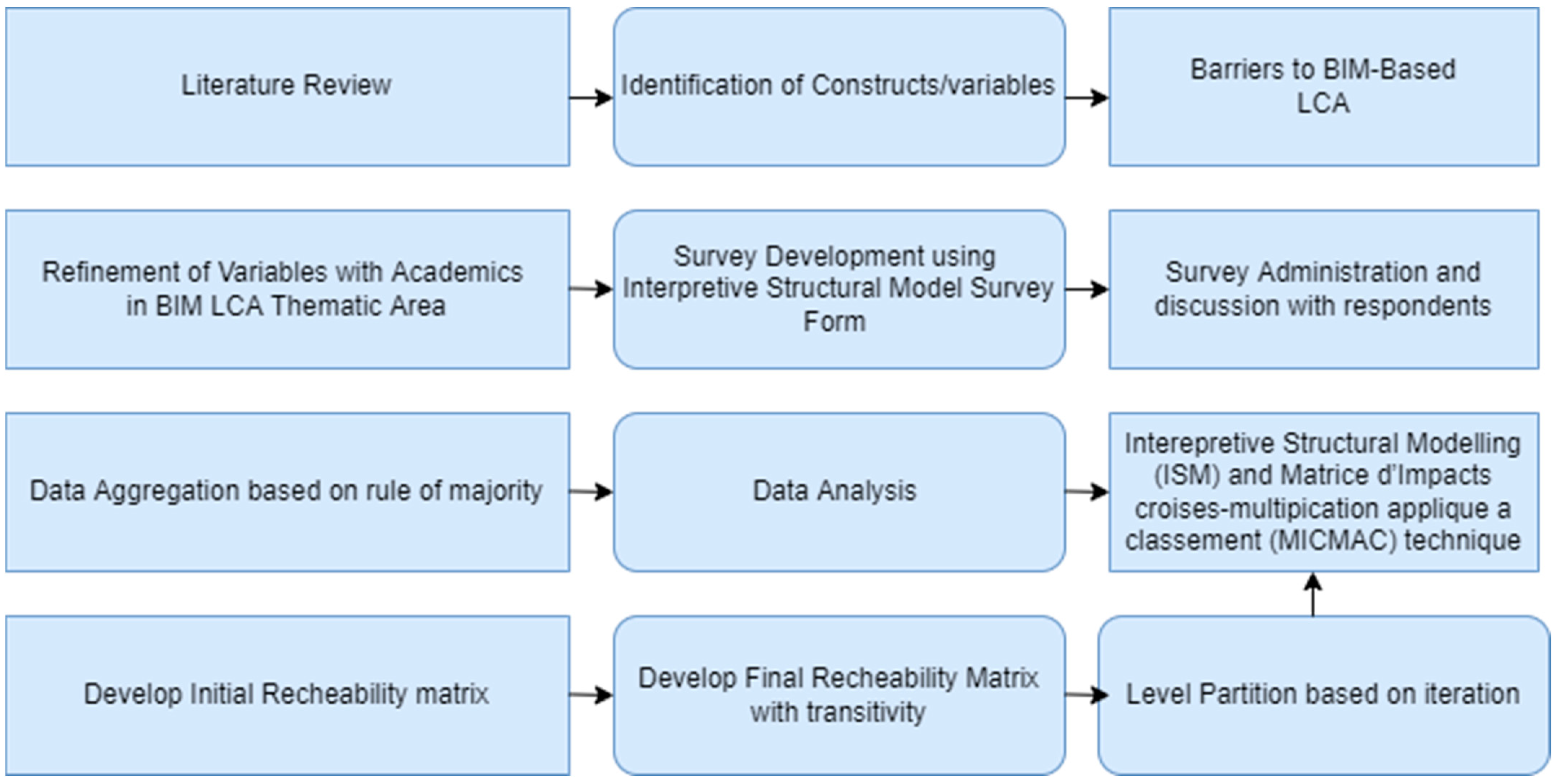
3.2. Interpretive Structural Modelling Analysis
The Structural Self-Interaction Matrix (SSIM)
- (1)
- V: Barrier i helps to influence j, and j does not influence i.
- (2)
- A: Barrier j helps to influence i and i does not influence j.
- (3)
- X: Barrier i helps to influence j, and j also influences i.
- (4)
- O: Barriers i and j do not have any link
- ❖
- If the cell (i, j) is V, then cell (i, j) entry is 1 and cell (j, i) entry is 0.
- ❖
- If the cell (i, j) is A, then cell (i, j) entry is 0 and cell (j, i) entry is 1.
- ❖
- If the cell (i, j) is X, then cell (i, j) entry is 1 and cell (j, i) entry is 1.
- ❖
- If the cell (i, j) is O, then cell (i, j) entry is 0 and cell (j, i) entry is 0.
4. Results
4.1. Final Reachability Matrix
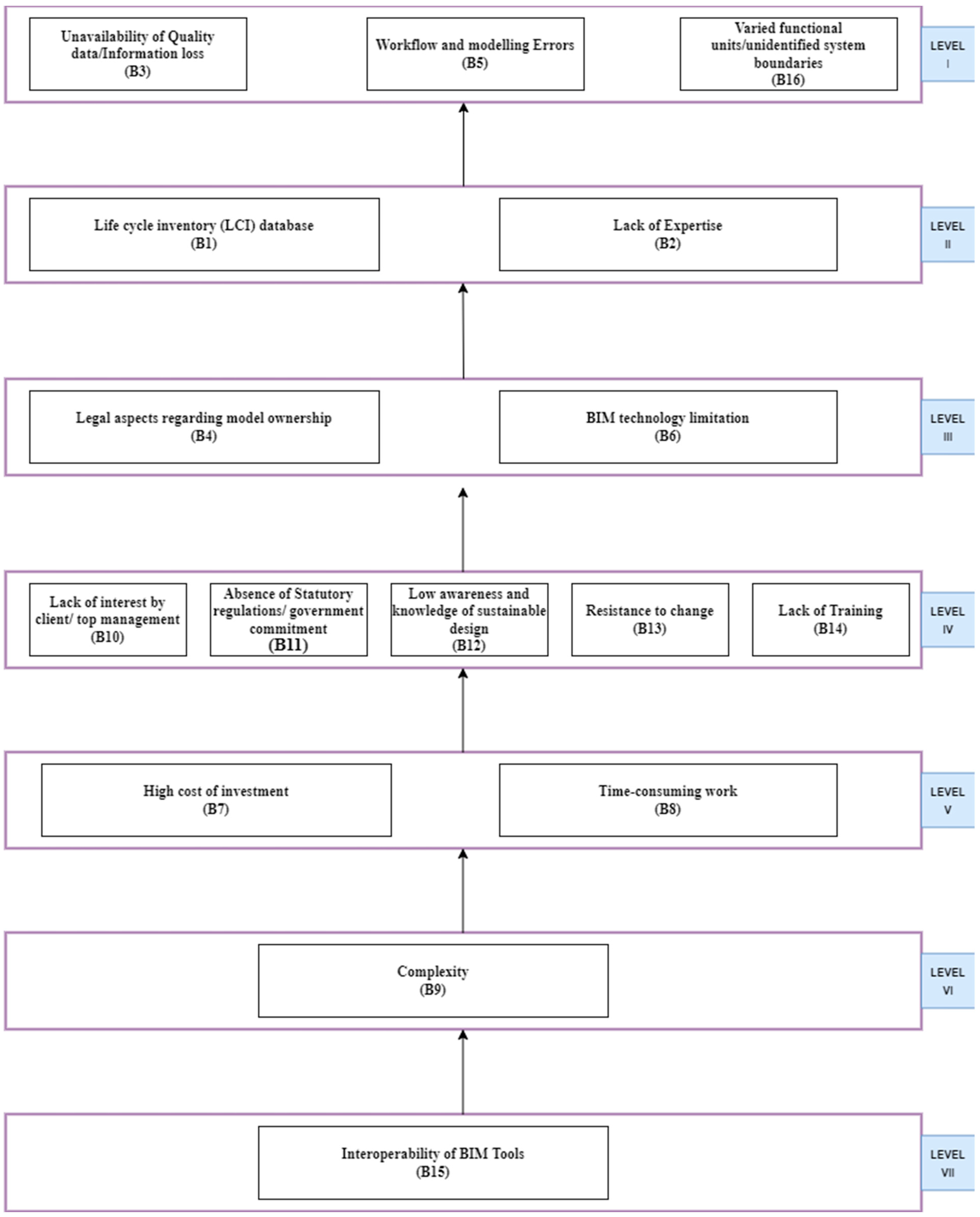
4.2. Hierarchical Structure and Level Partitioning
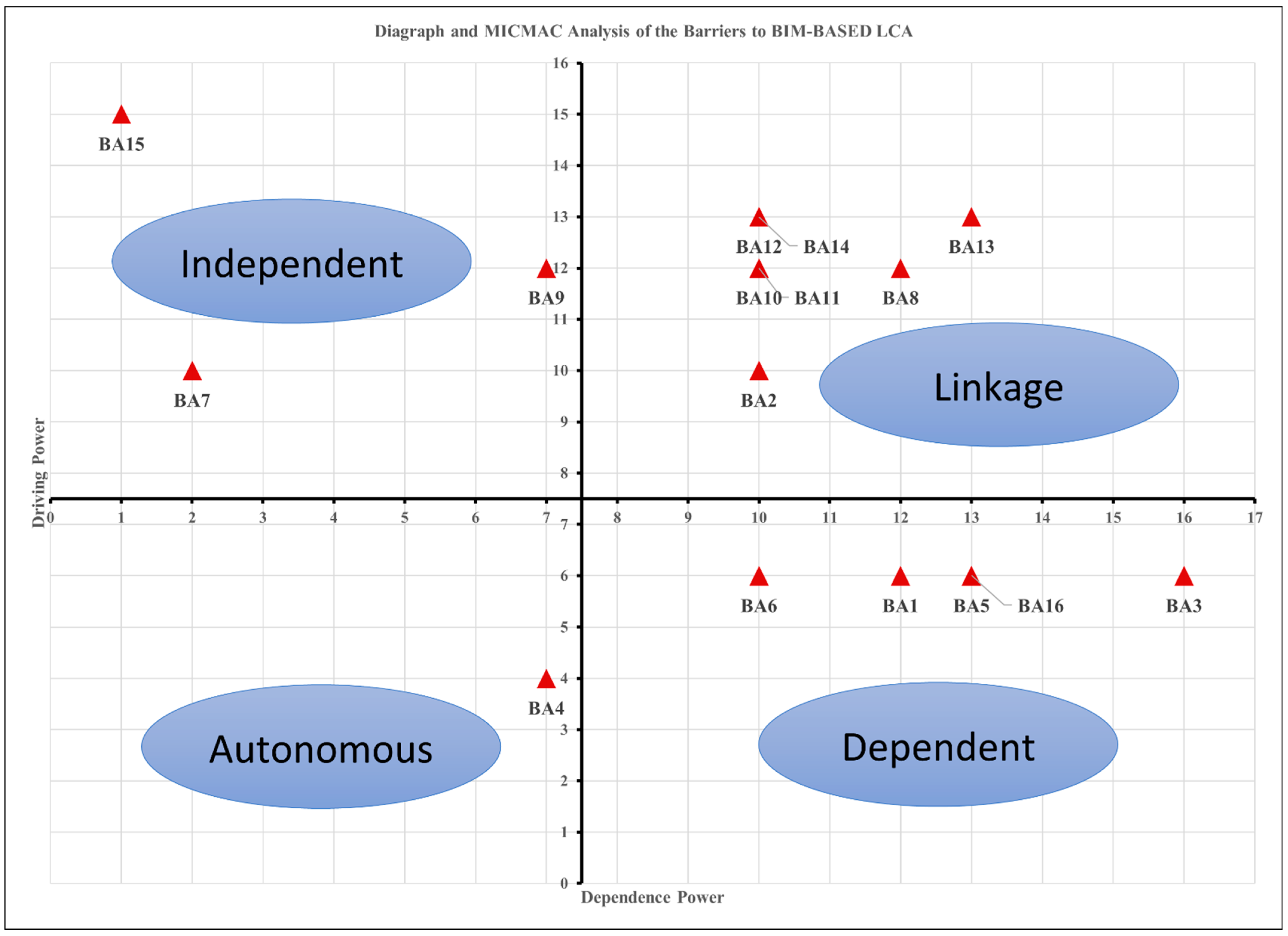
4.3. MICMAC Analysis
4.4. Discussion of Findings
5. Conclusions
Author Contributions
Funding
Institutional Review Board Statement
Informed Consent Statement
Data Availability Statement
Conflicts of Interest
References
- Carvalho, J.P.; Villaschi, F.S.; Bragança, L. Assessing Life Cycle Environmental and Economic Impacts of Building Construction Solutions with BIM. Sustainability 2021, 13, 8914. [Google Scholar] [CrossRef] [Scilit]
- Nwodo, M.N.; Anumba, C.J.; Asadi, S. BIM-Based Life Cycle Assessment and Costing of Buildings: Current Trends and Opportunities. In Computing in Civil Engineering 2017; American Society of Civil Engineers: Reston, VA, USA, 2017; pp. 51–59. [Google Scholar] [CrossRef] [Scilit]
- Soust-Verdaguer, B.; Llatas, C.; García-Martínez, A. Critical Review of Bim-Based LCA Method to Buildings. Energy Build. 2017, 136, 110–120. [Google Scholar] [CrossRef] [Scilit]
- Olawumi, T.O.; Chan, D.W.M. Identifying and Prioritizing the Benefits of Integrating BIM and Sustainability Practices in Construction Projects: A Delphi Survey of International Experts. Sustain. Cities Soc. 2018, 40, 16–27. [Google Scholar] [CrossRef] [Scilit]
- Asare, K.A.B.; Ruikar, K.D.; Zanni, M.; Soetanto, R. BIM-Based LCA and Energy Analysis for Optimised Sustainable Building Design in Ghana. SN Appl. Sci. 2020, 2, 1–20. [Google Scholar] [CrossRef] [Scilit]
- Olawumi, T.O.; Chan, D.W.M. Green-Building Information Modelling (Green-BIM) Assessment Framework for Evaluating Sustainability Performance of Building Projects: A Case of Nigeria. Archit. Eng. Des. Manag. 2020, 17, 458–477. [Google Scholar] [CrossRef] [Scilit]
- Carvalho, J.P.; Bragança, L.; Mateus, R. A Systematic Review of the Role of BIM in Building Sustainability Assessment Methods. Appl. Sci. 2020, 10, 4444. [Google Scholar] [CrossRef] [Scilit]
- Lee, S.; Tae, S.; Jang, H.; Chae, C.U.; Bok, Y. Development of Building Information Modeling Template for Environmental Impact Assessment. Sustainability 2021, 13, 3092. [Google Scholar] [CrossRef] [Scilit]
- Altohami, A.B.A.; Haron, N.A.; Ales@Alias, A.H.; Law, T.H. Investigating Approaches of Integrating BIM, IoT, and Facility Management for Renovating Existing Buildings: A Review. Sustainability 2021, 13, 3930. [Google Scholar] [CrossRef] [Scilit]
- Basbagill, J.; Flager, F.; Lepech, M.; Fischer, M. Application of Life-Cycle Assessment to Early Stage Building Design for Reduced Embodied Environmental Impacts. Build. Environ. 2013, 60, 81–92. [Google Scholar] [CrossRef] [Scilit]
- Santos, R.; Costa, A.A.; Silvestre, J.D.; Pyl, L. Integration of LCA and LCC Analysis within a BIM-Based Environment. Autom. Constr. 2019, 103, 127–149. [Google Scholar] [CrossRef] [Scilit]
- Seyis, S. Mixed Method Review for Integrating Building Information Modeling and Life-Cycle Assessments. Build. Environ. 2020, 173, 106703. [Google Scholar] [CrossRef] [Scilit]
- Eleftheriadis, S.; Mumovic, D.; Greening, P. Life Cycle Energy Efficiency in Building Structures: A Review of Current Developments and Future Outlooks Based on BIM Capabilities. Renew. Sustain. Energy Rev. 2017, 67, 811–825. [Google Scholar] [CrossRef] [Scilit]
- Azhar, S.; Carlton, W.A.; Olsen, D.; Ahmad, I. Building Information Modeling for Sustainable Design and LEED ® Rating Analysis. Autom. Constr. 2011, 20, 217–224. [Google Scholar] [CrossRef] [Scilit]
- Zimmermann, R.K.; Bruhn, S.; Birgisdóttir, H. Bim-Based Life Cycle Assessment of Buildings—An Investigation of Industry Practice and Needs. Sustainability 2021, 13, 5455. [Google Scholar] [CrossRef] [Scilit]
- Obrecht, T.P.; Röck, M.; Hoxha, E.; Passer, A. BIM and LCA Integration: A Systematic Literature Review. Sustainability 2020, 12, 5534. [Google Scholar] [CrossRef] [Scilit]
- Vik, A.L. Investigation of Requirements for Use of BIM-Based LCA in Early Stages of Building Design. Master’s Thesis, Norwegian University of Science and Technology, Trondheim, Norway, 2018. [Google Scholar]
- Abd Rashid, A.F.; Yusoff, S. A Review of Life Cycle Assessment Method for Building Industry. Renew. Sustain. Energy Rev. 2015, 45, 244–248. [Google Scholar] [CrossRef] [Scilit]
- Anand, C.K.; Amor, B. Recent Developments, Future Challenges and New Research Directions in LCA of Buildings: A Critical Review. Renew. Sustain. Energy Rev. 2017, 67, 408–416. [Google Scholar] [CrossRef] [Scilit]
- Mahmoud, S.; Zayed, T.; Fahmy, M. Development of Sustainability Assessment Tool for Existing Buildings. Sustain. Cities Soc. 2019, 44, 99–119. [Google Scholar] [CrossRef] [Scilit]
- Carvalho, J.P.; Bragança, L.; Mateus, R. Optimising Building Sustainability Assessment Using BIM. Autom. Constr. 2019, 102, 170–182. [Google Scholar] [CrossRef] [Scilit]
- El Jazzar, M.; Schranz, C.; Urban, H.; Nassereddine, H. Integrating Construction 4.0 Technologies: A Four-Layer Implementation Plan. Front. Built Environ. 2021, 7, 1–14. [Google Scholar] [CrossRef] [Scilit]
- Vilches, A.; Garcia-Martinez, A.; Sanchez-Montañes, B. Life Cycle Assessment (LCA) of Building Refurbishment: A Literature Review. Energy Build. 2017, 135, 286–301. [Google Scholar] [CrossRef] [Scilit]
- Carvalho, J.P.; Alecrim, I.; Bragança, L.; Mateus, R. Integrating BIM-Based LCA and Building Sustainability Assessment. Sustainability 2020, 12, 7468. [Google Scholar] [CrossRef] [Scilit]
- Dupuis, M.; April, A.; Lesage, P.; Forgues, D. Method to Enable LCA Analysis through Each Level of Development of a BIM Model. Procedia Eng. 2017, 196, 857–863. [Google Scholar] [CrossRef] [Scilit]
- Kanafani, K.; Zimmermann, R.K.; Rasmussen, F.N.; Birgisdóttir, H. Learnings from Developing a Context-Specific LCA Tool for Buildings-The Case of Lcabyg. Sustainability 2021, 13, 1508. [Google Scholar] [CrossRef] [Scilit]
- Atabay, S.; Pelin Gurgun, A.; Koc, K. Incorporating BIM and Green Building in Engineering Education: Assessment of a School Building for LEED Certification. Pract. Period. Struct. Des. Constr. 2020, 25, 04020040. [Google Scholar] [CrossRef] [Scilit]
- Wastiels, L.; Decuypere, R. Identification and Comparison of LCA-BIM Integration Strategies. In IOP Conference Series: Earth and Environmental Science; IOP Publishing: Bristol, UK, 2019; Volume 323, p. 012101. [Google Scholar]
- Häfliger, I.-F.; John, V.; Passer, A.; Lasvaux, S.; Hoxha, E.; Saade, M.R.; Habert, G. Buildings Environmental Impacts’ Sensitivity Related to LCA Modelling Choices of Construction Materials. J. Clean. Prod. 2017, 156, 805–816. [Google Scholar] [CrossRef] [Scilit]
- Frischknecht, R.; Balouktsi, M.; Lützkendorf, T.; Aumann, A.; Birgisdottir, H.; Ruse, E.G.; Hollberg, A.; Kuittinen, M.; Lavagna, M.; Lupišek, A. Environmental Benchmarks for Buildings: Needs, Challenges and Solutions—71st LCA Forum. Int. J. Life Cycle Assess 2019, 24, 2272–2280. [Google Scholar] [CrossRef] [Scilit]
- Röck, M.; Hollberg, A.; Habert, G.; Passer, A. LCA and BIM: Visualization of Environmental Potentials in Building Construction at Early Design Stages. Build. Environ. 2018, 140, 153–161. [Google Scholar] [CrossRef] [Scilit]
- Chong, H.Y.; Lee, C.Y.; Wang, X. A Mixed Review of the Adoption of Building Information Modelling (BIM) for Sustainability. J. Clean. Prod. 2017, 142, 4114–4126. [Google Scholar] [CrossRef] [Scilit]
- Sehrawy, A.A.; Amoudi, O.; Tong, M.; Callaghan, N. A Review of the Challenges to Integrating BIM and Building Sustainability Assessment. In AIP Conference Proceedings; AIP Publishing LLC: Melville, NY, USA, 2021; Volume 2428, p. 020005. [Google Scholar]
- Mellado, F.; Lou, E.C.W. Building Information Modelling, Lean and Sustainability: An Integration Framework to Promote Performance Improvements in the Construction Industry. Sustain. Cities Soc. 2020, 61, 102355. [Google Scholar] [CrossRef] [Scilit]
- Soust-Verdaguer, B.; Galeana, I.B.; Llatas, C.; Montes, M.V.; Hoxha, E.; Passer, A. How to Conduct Consistent Environmental, Economic, and Social Assessment during the Building Design Process. A BIM-Based Life Cycle Sustainability Assessment Method. J. Build. Eng. 2021, 45, 103516. [Google Scholar] [CrossRef] [Scilit]
- Djokoto, S.; Dadzie, J.; Ohemeng-Ababio, E. Barriers to Sustainable Construction in the Ghanaian Construction Industry Consultants Perspectives. J. Sustain. Dev. 2014, 7, 134–143. [Google Scholar] [CrossRef] [Scilit]
- Xue, K.; Uzzal Hossain, M.; Liu, M.; Ma, M.; Zhang, Y.; Hu, M.; Chen, X.; Cao, G. Bim Integrated Lca for Promoting Circular Economy towards Sustainable Construction: An Analytical Review. Sustainability 2021, 13, 1310. [Google Scholar] [CrossRef] [Scilit]
- Ametepey, O.; Aigbavboa, C.O.; Ansah, K. Barriers to Successful Implementation of Sustainable Construction in the Ghanaian Construction Industry. Procedia Manuf. 2015, 3, 1682–1689. [Google Scholar] [CrossRef] [Scilit]
- Saka, A.B.; Chan, D.W.M.; Siu, F.M.F. Drivers of Sustainable Adoption of Building Information Modelling (BIM) in the Nigerian Construction Small and Medium-Sized Enterprises (SMEs). Sustainability 2020, 12, 3710. [Google Scholar] [CrossRef] [Scilit]
- Warfield, J. Developing Interconnection Matrices in Structural Modeling. IEEE Trans. Syst. Man. Cybern. 1974, sMc-4, 81–87. [Google Scholar] [CrossRef] [Scilit]
- Mathiyazhagan, K.; Govindan, K.; NoorulHaq, A.; Geng, Y. An ISM Approach for the Barrier Analysis in Implementing Green Supply Chain Management. J. Clean. Prod. 2013, 47, 283–297. [Google Scholar] [CrossRef] [Scilit]
- Saka, A.B.; Chan, D.W.M. Profound Barriers to Building Information Modelling (BIM) Adoption in Construction Small and Medium-Sized Enterprises (SMEs): An Interpretive Structural Modelling Approach. Constr. Innov. 2020, 20, 261–284. [Google Scholar] [CrossRef] [Scilit]
- Shen, L.; Song, X.; Wu, Y.; Liao, S.; Zhang, X. Interpretive Structural Modeling Based Factor Analysis on the Implementation of Emission Trading System in the Chinese Building Sector. J. Clean. Prod. 2016, 127, 214–227. [Google Scholar] [CrossRef] [Scilit]
- Sushil. How to Check Correctness of Total Interpretive Structural Models ? Ann. Oper. Res. 2018, 270, 473–487. [Google Scholar] [CrossRef] [Scilit]
- Ma, G.; Jia, J.; Ding, J.; Shang, S.; Jiang, S. Interpretive Structural Model Based Factor Analysis of BIM Adoption in Chinese Construction Organizations. Sustainability 2019, 11, 1982. [Google Scholar] [CrossRef] [Scilit]
- Obi, L.; Awuzie, B.; Obi, C.; Omotayo, T.S.; Oke, A.; Osobajo, O. Bim for Deconstruction: An Interpretive Structural Model of Factors Influencing Implementation. Buildings 2021, 11, 227. [Google Scholar] [CrossRef] [Scilit]
- Shoar, S.; Chileshe, N. Exploring the Causes of Design Changes in Building Construction Projects: An Interpretive Structural Modeling Approach. Sustainability 2021, 13, 9578. [Google Scholar] [CrossRef] [Scilit]
- Tan, T.; Chen, K.; Xue, F.; Lu, W. Barriers to Building Information Modeling (BIM) Implementation in China’s Prefabricated Construction: An Interpretive Structural Modeling (ISM) Approach. J. Clean. Prod. 2019, 219, 949–959. [Google Scholar] [CrossRef] [Scilit]
- Eshun, B.T.B.; Chan, A.P.C. An Evaluation of Project Risk Dynamics in Sino-Africa Public Infrastructure Delivery; a Causal Loop and Interpretive Structural Modelling Approach (ISM-CLD). Sustainability 2021, 13, 10822. [Google Scholar] [CrossRef] [Scilit]
- Mor, R.S.; Bhardwaj, A.; Singh, S. Benchmarking the Interactions among Performance Indicators in Dairy Supply Chain: An ISM Approach. Benchmarking 2018, 25, 3858–3881. [Google Scholar] [CrossRef] [Scilit]
- Mora, T.D.; Bolzonello, E.; Cavalliere, C.; Peron, F. Key Parameters Featuring Bim-Lca Integration in Buildings: A Practical Review of the Current Trends. Sustainability 2020, 12, 7182. [Google Scholar] [CrossRef] [Scilit]
- Ansah, M.K.; Chen, X.; Yang, H.; Lu, L.; Lam, P.T.I. Developing an Automated BIM-Based Life Cycle Assessment Approach for Modularly Designed High-Rise Buildings. Environ. Impact Assess. Rev. 2021, 90, 106618. [Google Scholar] [CrossRef] [Scilit]
- Yılmaz, Y.; Seyis, S. Mapping the Scientific Research of the Life Cycle Assessment in the Construction Industry: A Scientometric Analysis. Build. Environ. 2021, 204, 108086. [Google Scholar] [CrossRef] [Scilit]
- Kamari, A.; Paari, A.; Torvund, H.Ø. Bim-Enabled Virtual Reality (Vr) for Sustainability Life Cycle and Cost Assessment. Sustainability 2021, 13, 249. [Google Scholar] [CrossRef] [Scilit]
- Dwivedi, Y.K.; Hughes, L.; Ismagilova, E.; Aarts, G.; Coombs, C.; Crick, T.; Duan, Y.; Dwivedi, R.; Edwards, J.; Eirug, A.; et al. Artificial Intelligence (AI): Multidisciplinary Perspectives on Emerging Challenges, Opportunities, and Agenda for Research, Practice and Policy. Int. J. Inf. Manag. 2021, 57, 101994. [Google Scholar] [CrossRef] [Scilit]
- Hollberg, A.; Genova, G.; Habert, G. Evaluation of BIM-Based LCA Results for Building Design. Autom. Constr. 2020, 109, 102972. [Google Scholar] [CrossRef] [Scilit]
- Kylili, A.; Fokaides, P.A.; Vaiciunas, J.; Seduikyte, L. Integration of Building Information Modelling (BIM) and Life Cycle Assessment (LCA) for Sustainable Constructions. J. Sustain. Archit. Civ. Eng. 2016, 13, 28–38. [Google Scholar] [CrossRef] [Scilit]
- Genova, G. Bim-Based Lca throughout the Design Process: A Dynamic Approach. WIT Trans. Built Environ. 2019, 192, 45–56. [Google Scholar] [CrossRef] [Scilit]
- Naneva, A.; Bonanomi, M.; Hollberg, A.; Habert, G.; Hall, D. Integrated BIM-Based LCA for the Entire Building Process Using an Existing Structure for Cost Estimation in the Swiss Context. Sustainability 2020, 12, 3748. [Google Scholar] [CrossRef] [Scilit]
- Di Bari, R.; Jorgji, O.; Horn, R.; Gantner, J.; Ebertshauser, S. Step-by-Step Implementation of BIM-LCA: A Case Study Analysis Associating Defined Construction Phases with Their Respective Environmental Impacts. In IOP Conference Series: Earth and Environmental Science; IOP Publishing: Bristol, UK, 2019; Volume 323, p. 012105. [Google Scholar] [CrossRef] [Scilit]
- Olawumi, T.O.; Chan, D.W.M. A Scientometric Review of Global Research on Sustainability and Sustainable Development. J. Clean. Prod. 2018, 183, 231–250. [Google Scholar] [CrossRef] [Scilit]
- Marrero, M.; Wojtasiewicz, M.; Martínez-Rocamora, A.; Solís-Guzmán, J.; Alba-Rodríguez, M.D. BIM-LCA Integration for the Environmental Impact Assessment of the Urbanization Process. Sustainability 2020, 12, 4196. [Google Scholar] [CrossRef] [Scilit]
- Oke, A.E.; Aghimien, D.O.; Aigbavboa, C.O.; Akinradewo, O.I. Appraisal of the Drivers of Smart City Development in South Africa. Constr. Econ. Build. 2020, 20, 109–126. [Google Scholar] [CrossRef] [Scilit]
- Lim, Y.W.; Chong, H.Y.; Ling, P.C.H.; Tan, C.S. Greening Existing Buildings through Building Information Modelling: A Review of the Recent Development. Build. Environ. 2021, 200, 107924. [Google Scholar] [CrossRef] [Scilit]
- Pereira, V.; Santos, J.; Leite, F.; Escórcio, P. Using BIM to Improve Building Energy Efficiency—A Scientometric and Systematic Review. Energy Build. 2021, 250, 111292. [Google Scholar] [CrossRef] [Scilit]



| Challenges | Comments |
|---|---|
| Lack of building model management for a collaborative process | Model not designed by users |
| Late commencement of models | |
| Inability to edit models | |
| No minimum demands for LOD on material information | |
| No standardisation for extraction of quantities | |
| Time consuming | |
| Lack of responsibility of the quantities in models | |
| Workflow errors | Human error when manually typing |
| Inability to detect missing quantities in Revit quantities extraction | |
| Difficult to check models for errors by third parties | |
| Paint areas are wrong if the suspended ceiling is not accounted for | |
| Lack of data availability and quality in models | Data in models is not good enough |
| Difficulty in extracting correct quantities from the models | |
| incorrect models in terms of extracting quantities | |
| Incorrect quantities | |
| Incorrect modelling | |
| Varying models quality | |
| MEP model is not used for the LCA because it is not good enough | |
| Getting information from the right source | |
| Not all materials are modelled in the model | |
| Insufficient details in models | |
| Varying details | |
| Incomplete data availability in Revit | |
| Information is not in the Revit model, only geometry | |
| Materials are not in the models | |
| Modelling errors | Wrong mensuration from modelling errors |
| No reinforcement in concrete elements | |
| Errors in the model, | |
| Double modelling | |
| Wrong dimension of elements | |
| Variations in the structure of models | Structurally different models |
| The difference in modelling across nations | |
| Data exchange and matching model data with LCIA data | Difficulty using quantity outputs units from models for LCA |
| Matching quantities with LCIA data from LCA by | |
| creating generic plugin scripts for all models | |
| Difficulty in future workflow prediction | |
| too user-friendly tools | |
| Issues with stability and workflow | |
| Manual workflow and large models | Time consuming with manual BIM–LCA workflow |
| Extracting quantities/checking data is the most time-consuming process | |
| Too much information |
| S/N | Barriers | Reference |
|---|---|---|
| 1 | Database | [24,33] |
| 2 | Lack of expertise | [8,33] |
| 3 | Lack of building model management for a collaborative process | [15,33] |
| 4 | Lack of data availability and quality in models/unwillingness to share information | [34] |
| 5 | Data exchange and matching model data with LCIA data/information loss | [15,33] |
| 6 | Legal aspects regarding model ownership | [34] |
| 7 | Manual workflow and large models | [15,33] |
| 8 | Modelling errors | [15,33] |
| 9 | BIM technology limitation | [33] |
| 10 | Variations in the structure of models | [15,33] |
| 11 | Life cycle inventory (LCI) database | [8] |
| 12 | Varied views on sustainability issues in the sector | [33,34] |
| 13 | Workflow errors | [15,33] |
| 14 | Construction materials unable to be considered, e.g., rebars | [8,33] |
| 15 | Cost | [15,33] |
| 16 | Time-consuming work | [15,33] |
| 17 | lack of quality in the models/data availability | [3,24] |
| 18 | Complexity | [15,35] |
| 19 | Absence of sustainability measures by stakeholder/lack of top management commitment | [13,15,36,37] |
| 20 | Little to no interest by clients | [36] |
| 21 | High financial requirement for investment | [36] |
| 22 | Absence of ability to execute sustainable tenets | [15,33] |
| 23 | Support from government in policy and legislation | [38] |
| 24 | Little motivation/interest in sustainability by stakeholders | [36,38] |
| 25 | Dearth of sustainability concept knowledge, information and awareness | [36,38] |
| 26 | The required increased cost of executing sustainable design and planning | [36,38] |
| 27 | Absence of proper direction for professionals in executing sustainable design | [15,33] |
| 28 | Absence of personal motivation | [17,33] |
| 29 | Absence of instructive training from the AEC education sector on sustainable development | [5,33] |
| 30 | Absence of awareness of statutory regulations | [15,33] |
| 31 | Interoperability of the BIM tools with LCA software | [19,33] |
| 32 | Resistance to change | [17,33] |
| 33 | Varied functional units | [17,33] |
| 34 | Uncertainty in data collection methods | [17,33] |
| 35 | Procedural issues in highlighting significant system boundaries | [17,33] |
| ID | Barriers |
|---|---|
| BA1 | Life cycle inventory (LCI) database |
| BA2 | Lack of expertise |
| BA3 | Unavailability of quality data/information loss |
| BA4 | Legal aspects regarding model ownership |
| BA5 | Workflow and modelling errors |
| BA6 | BIM technology limitation |
| BA7 | High cost of investment |
| BA8 | Time-consuming work |
| BA9 | Complexity |
| BA10 | Lack of interest by client/top management |
| BA11 | Absence of statutory regulations/government commitment |
| BA12 | Low awareness and knowledge of sustainable design |
| BA13 | Resistance to change |
| BA14 | Lack of training |
| BA15 | Interoperability of the BIM tools |
| BA16 | Varied functional units/unidentified system boundaries |
| Demographics | Type | Percent |
|---|---|---|
| Architect | 36% | |
| Profession | Engineer | 28% |
| Quantity surveyor | 36% | |
| Consultant | 42% | |
| Type | Contractor | 35% |
| Academia | 16% | |
| BIM systems designers | 7% | |
| Continental spread | North America | 30% |
| Europe | 35% | |
| Africa | 35% |
| BA16 | BA15 | BA14 | BA13 | BA12 | BA11 | BA10 | BA9 | BA8 | BA7 | BA6 | BA5 | BA4 | BA3 | BA2 | BA1 | |
|---|---|---|---|---|---|---|---|---|---|---|---|---|---|---|---|---|
| BA1 | O | O | O | A | A | A | A | O | O | A | X | O | A | V | O | X |
| BA2 | V | O | X | A | A | A | O | O | O | O | O | O | O | V | X | |
| BA3 | X | A | A | A | A | O | O | O | X | O | O | X | O | X | ||
| BA4 | O | O | O | O | O | A | O | O | O | O | O | O | X | |||
| BA5 | X | A | A | O | A | O | O | A | V | O | O | X | ||||
| BA6 | O | A | O | O | O | O | O | O | V | O | X | |||||
| BA7 | O | A | O | V | O | O | V | O | O | X | ||||||
| BA8 | O | O | O | V | O | O | O | A | X | |||||||
| BA9 | X | A | O | V | O | O | O | X | ||||||||
| BA10 | O | O | X | X | A | X | X | |||||||||
| BA11 | O | O | X | X | X | X | ||||||||||
| BA12 | O | O | X | A | X | |||||||||||
| BA13 | O | A | V | X | ||||||||||||
| BA14 | V | O | X | |||||||||||||
| BA15 | O | X | ||||||||||||||
| BA16 | X |
| BA1 | BA2 | BA3 | BA4 | BA5 | BA6 | BA7 | BA8 | BA9 | BA10 | BA11 | BA12 | BA13 | BA14 | BA15 | BA16 | |
|---|---|---|---|---|---|---|---|---|---|---|---|---|---|---|---|---|
| BA1 | 1 | 0 | 1 | 0 | 0 | 1 | 0 | 0 | 0 | 0 | 0 | 0 | 0 | 0 | 0 | 0 |
| BA2 | 0 | 1 | 1 | 0 | 0 | 0 | 0 | 0 | 0 | 0 | 0 | 0 | 0 | 1 | 0 | 1 |
| BA3 | 0 | 0 | 1 | 0 | 1 | 0 | 0 | 1 | 0 | 0 | 0 | 0 | 0 | 0 | 0 | 1 |
| BA4 | 1 | 0 | 0 | 1 | 0 | 0 | 0 | 0 | 0 | 0 | 0 | 0 | 0 | 0 | 0 | 0 |
| BA5 | 0 | 0 | 1 | 0 | 1 | 0 | 0 | 1 | 0 | 0 | 0 | 0 | 0 | 0 | 0 | 1 |
| BA6 | 1 | 0 | 0 | 0 | 0 | 1 | 0 | 1 | 0 | 0 | 0 | 0 | 0 | 0 | 0 | 0 |
| BA7 | 1 | 0 | 0 | 0 | 0 | 0 | 1 | 0 | 0 | 1 | 0 | 0 | 1 | 0 | 0 | 0 |
| BA8 | 0 | 0 | 1 | 0 | 0 | 0 | 0 | 1 | 0 | 0 | 0 | 0 | 1 | 0 | 0 | 0 |
| BA9 | 0 | 0 | 0 | 0 | 1 | 0 | 0 | 1 | 1 | 0 | 0 | 0 | 1 | 0 | 0 | 1 |
| BA10 | 1 | 0 | 0 | 0 | 0 | 0 | 0 | 0 | 0 | 1 | 1 | 0 | 1 | 1 | 0 | 0 |
| BA11 | 1 | 1 | 0 | 1 | 0 | 0 | 0 | 0 | 0 | 1 | 1 | 1 | 1 | 1 | 0 | 0 |
| BA12 | 1 | 1 | 1 | 0 | 1 | 0 | 0 | 0 | 0 | 1 | 1 | 1 | 0 | 1 | 0 | 0 |
| BA13 | 1 | 1 | 1 | 0 | 0 | 0 | 0 | 0 | 0 | 1 | 1 | 1 | 1 | 1 | 0 | 0 |
| BA14 | 0 | 1 | 1 | 0 | 1 | 0 | 0 | 0 | 0 | 1 | 1 | 1 | 0 | 1 | 0 | 1 |
| BA15 | 0 | 0 | 1 | 0 | 1 | 1 | 1 | 0 | 1 | 0 | 0 | 0 | 1 | 0 | 1 | 0 |
| BA16 | 0 | 0 | 1 | 0 | 1 | 0 | 0 | 0 | 1 | 0 | 0 | 0 | 0 | 0 | 0 | 1 |
| BA1 | BA2 | BA3 | BA4 | BA5 | BA6 | BA7 | BA8 | BA9 | BA10 | BA11 | BA12 | BA13 | BA14 | BA15 | BA16 | DRP | |
|---|---|---|---|---|---|---|---|---|---|---|---|---|---|---|---|---|---|
| BA1 | 1 | 0 | 1 | 0 | * 1 | 1 | 0 | * 1 | 0 | 0 | 0 | 0 | 0 | 0 | 0 | * 1 | 6 |
| BA2 | 0 | 1 | 1 | 0 | * 1 | 0 | 0 | * 1 | * 1 | * 1 | * 1 | * 1 | 0 | 1 | 0 | 1 | 10 |
| BA3 | 0 | 0 | 1 | 0 | 1 | 0 | 0 | 1 | * 1 | 0 | 0 | 0 | * 1 | 0 | 0 | 1 | 6 |
| BA4 | 1 | 0 | * 1 | 1 | 0 | * 1 | 0 | 0 | 0 | 0 | 0 | 0 | 0 | 0 | 0 | 0 | 4 |
| BA5 | 0 | 0 | 1 | 0 | 1 | 0 | 0 | 1 | * 1 | 0 | 0 | 0 | * 1 | 0 | 0 | 1 | 6 |
| BA6 | 1 | 0 | * 1 | * 1 | 0 | 1 | 0 | 1 | 0 | 0 | 0 | 0 | * 1 | 0 | 0 | 0 | 6 |
| BA7 | 1 | * 1 | * 1 | 0 | 0 | * 1 | 1 | 0 | 0 | 1 | * 1 | * 1 | 1 | * 1 | 0 | 0 | 10 |
| BA8 | * 1 | * 1 | 1 | 0 | * 1 | * 1 | 0 | 1 | 0 | * 1 | * 1 | * 1 | 1 | * 1 | 0 | * 1 | 12 |
| BA9 | * 1 | * 1 | * 1 | 0 | 1 | 0 | 0 | 1 | 1 | * 1 | * 1 | * 1 | 1 | * 1 | 0 | 1 | 12 |
| BA10 | 1 | * 1 | * 1 | * 1 | * 1 | * 1 | 0 | 0 | 0 | 1 | 1 | * 1 | 1 | 1 | 0 | * 1 | 12 |
| BA11 | 1 | 1 | * 1 | 1 | * 1 | * 1 | 0 | 0 | 0 | 1 | 1 | 1 | 1 | 1 | 0 | * 1 | 12 |
| BA12 | 1 | 1 | 1 | * 1 | 1 | * 1 | 0 | * 1 | 0 | 1 | 1 | 1 | * 1 | 1 | 0 | * 1 | 13 |
| BA13 | 1 | 1 | 1 | * 1 | * 1 | * 1 | 0 | * 1 | 0 | 1 | 1 | 1 | 1 | 1 | 0 | * 1 | 13 |
| BA14 | * 1 | 1 | 1 | * 1 | 1 | 0 | 0 | * 1 | * 1 | 1 | 1 | 1 | * 1 | 1 | 0 | 1 | 13 |
| BA15 | * 1 | * 1 | 1 | 0 | 1 | 1 | 1 | * 1 | 1 | * 1 | * 1 | * 1 | 1 | * 1 | 1 | * 1 | 15 |
| BA16 | 0 | 0 | 1 | 0 | 1 | 0 | 0 | * 1 | 1 | 0 | 0 | 0 | * 1 | 0 | 0 | 1 | 6 |
| DPP | 12 | 10 | 16 | 7 | 13 | 10 | 2 | 12 | 7 | 10 | 10 | 10 | 13 | 10 | 1 | 13 |
| Barriers | Reachability Set | Antecedent Set | Intersection Set |
|---|---|---|---|
| BA1 | BA(1, 3, 5, 6, 8 and 16) | BA(1, 4, 6, 7, 8, 9, 10, 11, 12, 13, 14 and 15) | BA(1, 6 and 8) |
| BA2 | BA(2, 3, 5, 8, 9, 10, 11, 12, 14 and 16) | BA(2, 7, 8, 9, 10, 11, 12, 13, 14 and 15) | BA(2, 8, 9, 10, 11, 12 and 14) |
| BA3 | BA(3, 5, 8, 9, 13 and 16) | BA(1, 2, 3, 4, 5, 6, 7, 8, 9, 10, 11, 12, 13, 14, 15 and 16) | BA(3, 5, 8, 9, 13 and 16) |
| BA4 | BA(1, 3, 4 and 6) | BA(4, 6, 10, 11, 12, 13 and 14) | BA(4 and 6) |
| BA5 | BA(3, 5, 8, 9, 13 and 16) | BA(1, 2, 3, 5, 8, 9, 10, 11, 12, 13, 14, 15 and 16) | BA(3, 5, 8, 9, 13 and 16) |
| BA6 | BA(1, 3, 4, 6, 8 and 13) | BA(1, 4, 6, 7, 8, 10, 11, 12, 13 and 15) | BA(1, 4, 6,8 and 13) |
| BA7 | BA(1, 2, 3, 6, 7,10, 11, 12, 13 and 14) | BA7 and BA15 | BA7 |
| BA8 | BA(1, 2, 3, 5, 8, 10, 11, 12, 13, 14 and 16) | BA(1, 2, 3, 5, 6, 8, 9, 12, 13, 14, 15 and 16) | BA(1, 2, 3, 5, 8, 12, 13, 14 and 16) |
| BA9 | BA(1, 2, 3, 5, 8, 9, 10, 11, 12, 13, 14 and 16) | BA(2, 3, 5, 9, 14, 15 and 16) | BA(2, 3, 5, 9, 14 and 16) |
| BA10 | BA(1, 2, 3, 4, 5, 6, 10, 11, 12, 13, 14 and 16) | BA(2, 7, 8, 9, 10, 11, 12, 13, 14 and 15) | BA(2, 10, 11, 12, 13 and 14) |
| BA11 | BA(1, 2, 3, 4, 5, 6, 10, 11, 12, 13, 14 and 16) | BA(2, 7, 8, 9, 10, 11, 12, 13, 14 and 15) | BA(2, 10, 11, 12, 13 and 14) |
| BA12 | BA(1, 2, 3, 4, 5, 6, 8, 10, 11, 12, 13, 14 and 16) | BA(2, 7, 8, 9, 10, 11, 12, 13, 14 and 15) | BA(2, 8, 10, 11, 12, 13 and 14) |
| BA13 | BA(1, 2, 3, 4, 5, 6, 8, 10, 11, 12, 13, 14 and 16) | BA(3, 5, 6, 7, 8, 9, 10, 11, 12, 13, 14, 15 and 16) | BA(3, 5, 6, 8, 10, 11, 12, 13, 14 and 16) |
| BA14 | BA(1, 2, 3, 4, 5, 8, 9, 10, 11, 12, 13, 14 and 16) | BA(2, 7, 8, 9, 10, 11, 12, 13, 14 and 15) | BA(2, 8, 9, 10, 11, 12, 13 and 14) |
| BA15 | BA(1, 2, 3, 5, 6, 7, 8, 9, 10, 11, 12, 13, 14, 15 and 16) | BA15 | BA15 |
| BA16 | BA(3, 5, 8, 9, 13 and 16) | BA(1, 2, 3, 5, 8, 9, 10, 11, 12, 13, 14, 15 and 16) | BA(3, 5, 8, 9, 13 and 16) |
| Barriers | Reachability Set | Antecedent Set | Intersection Set | Level |
|---|---|---|---|---|
| BA1 | BA(1, 3, 5, 6, 8 and 16) | BA(1, 4, 6, 7, 8, 9, 10, 11, 12, 13, 14 and 15) | BA(1, 6 and 8) | |
| BA2 | BA(2, 3, 5, 8, 9, 10, 11, 12, 14 and 16) | BA(2, 7, 8, 9, 10, 11, 12, 13, 14 and 15) | BA(2, 8, 9, 10, 11, 12 and 14) | |
| BA3 | BA(3, 5, 8, 9, 13 and 16) | BA(1, 2, 3, 4, 5, 6, 7, 8, 9, 10, 11, 12, 13, 14, 15 and 16) | BA(3, 5, 8, 9, 13 and 16) | I |
| BA4 | BA(1, 3, 4 and 6) | BA(4, 10, 11, 12, 13 and 14) | BA4 and BA6 | |
| BA5 | BA(3, 5, 8, 9, 13 and 16) | BA(1, 2, 3, 5, 8, 9, 10, 11, 12, 13, 14, 15 and 16) | BA(3, 5, 8, 9, 13 and 16) | I |
| BA6 | BA(1, 3, 4, 6, 8 and 13) | BA(1, 4, 6, 7, 8, 10, 11, 12, 13 and 15) | BA(1, 4, 6, 8 and 13) | |
| BA7 | BA(1, 2, 3, 6, 7, 10, 11, 12, 13 and 14) | BA(7 and 15) | BA7 | |
| BA8 | BA(1, 2, 3, 5, 8, 10, 11, 12, 13, 14 and 16) | BA(1, 2, 3, 5, 6, 8, 9, 12, 13, 14, 15 and 16) | BA(1, 2, 3, 5, 8, 12, 13, 14 and 16) | |
| BA9 | BA(1, 2, 3, 5, 8, 9, 10, 11, 12, 13, 14 and 16) | BA(2, 3, 5, 9, 14, 15 and 16) | BA(2, 3, 5, 9, 14 and 16) | |
| BA10 | BA(1, 2, 3, 4, 5, 6, 10, 11, 12, 13, 14 and 16) | BA(2, 7, 8, 9, 10, 11, 12, 13, 14 and 15) | BA(2, 10, 11, 12, 13 and 14) | |
| BA11 | BA(1, 2, 3, 4, 5, 6, 10, 11, 12, 13, 14 and 16) | BA(2, 7, 8, 9, 10, 11, 12, 13, 14 and 15) | BA(2, 10, 11, 12, 13 and 14) | |
| BA12 | BA(1, 2, 3, 4, 5, 6, 8, 10, 11, 12, 13, 14 and 16) | BA(2, 7, 8, 9, 10, 11, 12, 13, 14 and 15) | BA(2, 8, 10, 11, 12, 13 and 14) | |
| BA13 | BA(1, 2, 3, 4, 5, 6, 8, 10, 11, 12, 13, 14 and 16) | BA(3, 5, 6, 7, 8, 9, 10, 11, 12, 13, 14, 15 and 16) | BA(3, 5, 6, 8, 10, 11, 12, 13, 14 and 16) | |
| BA14 | BA(1, 2, 3, 4, 5, 8, 9, 10, 11, 12, 13, 14 and 16) | BA(2, 7, 8, 9, 10, 11, 12, 13, 14 and 15) | BA(2, 8, 9, 10, 11, 12, 13 and 14) | |
| BA15 | BA(1, 2, 3, 5, 6, 7, 8, 9, 10, 11, 12, 13, 14, 15 and 16) | BA15 | BA15 | |
| BA16 | BA(3, 5, 8, 9, 13 and 16) | BA(1, 2, 3, 5, 8, 9, 10, 11, 12, 13, 14, 15 and 16) | BA(3, 5, 8, 9, 13 and 16) | I |
| Barriers | Reachability Set | Antecedent Set | Intersection Set | Level |
|---|---|---|---|---|
| BA1 | BA(1, 6 and 8) | BA(1, 4, 6, 7, 8, 9, 10, 11, 12, 13, 14 and 15) | BA(1, 6 and 8) | II |
| BA2 | BA(2, 8, 9, 10, 11, 12 and 14) | BA(2, 7, 8, 9, 10, 11, 12, 13, 14 and 15) | BA(2, 8, 9, 10, 11, 12 and 14) | II |
| BA4 | BA1, BA4 and BA6, | BA(4, 10, 11, 12, 13 and 14) | BA4 and BA6 | |
| BA6 | BA(1, 4, 6, 8 and 13) | BA(1, 4, 6, 7, 8, 10, 11, 12, 13 and 15) | BA(1, 4, 6, 8 and 13) | |
| BA7 | BA(1, 2, 6, 7, 10, 11, 12, 13 and 14) | BA(7 and 15) | BA7 | |
| BA8 | BA(1, 2, 8, 10, 11, 12, 13 and 14) | BA(1, 2, 6, 8, 9, 12, 13, 14 and 15) | BA(1, 2, 8, 12, 13 and 14) | |
| BA9 | BA(1, 2, 8, 9, 10, 11, 12, 13 and 14) | BA(2, 9, 14 and 15) | BA(2, 9 and 14) | |
| BA10 | BA(1, 2, 4, 6, 10, 11, 12, 13 and 14) | BA(2, 7, 8, 9, 10, 11, 12, 13, 14 and 15) | BA(2, 10, 11, 12, 13 and 14) | |
| BA11 | BA(1, 2, 4, 6, 10, 11, 12, 13 and 14) | BA(2, 7, 8, 9, 10, 11, 12, 13, 14 and 15) | BA(2, 10, 11, 12, 13 and 14) | |
| BA12 | BA(1, 2, 4, 6, 8, 10, 11, 12, 13 and 14) | BA(2, 7, 8, 9, 10, 11, 12, 13, 14 and 15) | BA(2, 8, 10, 11, 12, 13 and 14) | |
| BA13 | BA(1, 2, 4, 6, 8, 10, 11, 12, 13, 14) | BA(6, 7, 8, 9, 10, 11, 12, 13, 14 and 15) | BA(6, 8, 10, 11, 12, 13 and 14) | |
| BA14 | BA(1, 2, 4, 8, 9, 10, 11, 12, 13 and 14) | BA(2, 7, 8, 9, 10, 11, 12, 13, 14 and 15) | BA(2, 8, 9, 10, 11, 12, 13 and 14) | |
| BA15 | BA(1, 2, 6, 7, 8, 9, 10, 11, 12, 13, 14 and 15) | BA15 | BA15 |
| Barriers | Reachability Set | Antecedent Set | Intersection Set | Level |
|---|---|---|---|---|
| BA4 | BA4 and BA6 | BA(4, 10, 11, 12, 13 and 14) | BA4 and BA6 | III |
| BA6 | BA(4, 6, 8 and 13) | BA(4, 6, 7, 8, 10, 11, 12, 13 and 15) | BA(4, 6, 8 and 13) | III |
| BA7 | BA(6, 7, 10, 11, 12, 13 and 14) | BA(7 and 15) | BA7 | |
| BA8 | BA(8, 10, 11, 12, 13 and 14) | BA(6, 8, 9, 12, 13, 14 and 15) | BA(8, 12, 13 and 14) | |
| BA9 | BA(8, 9, 10, 11, 12, 13 and 14) | BA(9, 14 and 15) | BA(9 and 14) | |
| BA10 | BA(4, 6, 10, 11, 12, 13 and 14) | BA(7, 8, 9, 10, 11, 12, 13, 14 and 15) | BA(10, 11, 12, 13 and 14) | |
| BA11 | BA(4, 6, 10, 11, 12, 13 and 14) | BA(7, 8, 9, 10, 11, 12, 13, 14 and 15) | BA(10, 11, 12, 13 and 14) | |
| BA12 | BA(4, 6, 8, 10, 11, 12, 13 and 14) | BA(7, 8, 9, 10, 11, 12, 13, 14 and 15) | BA(8, 10, 11, 12, 13 and 14) | |
| BA13 | BA(4, 6, 8, 10, 11, 12, 13, 14) | BA(6, 7, 8, 9, 10, 11, 12, 13, 14 and 15) | BA(6, 8, 10, 11, 12, 13 and 14) | |
| BA14 | BA(4, 8, 9, 10, 11, 12, 13 and 14) | BA(7, 8, 9, 10, 11, 12, 13, 14 and 15) | BA(8, 9, 10, 11, 12, 13 and 14) | |
| BA15 | BA(6, 7, 8, 9, 10, 11, 12, 13, 14 and 15) | BA15 | BA15 |
| Barriers | Reachability Set | Antecedent Set | Intersection Set | Level |
|---|---|---|---|---|
| BA7 | BA(7, 10, 11, 12, 13 and 14) | BA(7 and 15) | BA7 | |
| BA8 | BA(8, 10, 11, 12, 13 and 14) | BA(8, 9, 12, 13, 14 and 15) | BA(8, 12, 13 and 14) | |
| BA9 | BA(8, 9, 10, 11, 12, 13 and 14) | BA(9, 14 and 15) | BA(9 and 14) | |
| BA10 | BA(10, 11, 12, 13 and 14) | BA(7, 8, 9, 10, 11, 12, 13, 14 and 15) | BA(10, 11, 12, 13 and 14) | IV |
| BA11 | BA(10, 11, 12, 13 and 14) | BA(7, 8, 9, 10, 11, 12, 13, 14 and 15) | BA(10, 11, 12, 13 and 14) | IV |
| BA12 | BA(8, 10, 11, 12, 13 and 14) | BA(7, 8, 9, 10, 11, 12, 13, 14 and 15) | BA(8, 10, 11, 12, 13 and 14) | IV |
| BA13 | BA(8, 10, 11, 12, 13, 14) | BA(7, 8, 9, 10, 11, 12, 13, 14 and 15) | BA(8, 10, 11, 12, 13 and 14) | IV |
| BA14 | BA(8, 9, 10, 11, B12, B13 and 14) | BA(7, 8, 9, 10, 11, 12, 13, 14 and 15) | BA(8, 9, 10, 11, 12, 13 and 14) | IV |
| BA15 | BA(7, 8, 9, 10, 11, 12, 13, 14 and 15) | BA15 | BA15 |
| Barriers | Reachability Set | Antecedent Set | Intersection Set | Level |
|---|---|---|---|---|
| BA7 | BA7 | BA7 and BA15 | BA7 | V |
| BA8 | BA8 | BA8, BA9 and BA15 | BA8 | V |
| BA9 | BA8, BA9 | BA9 and BA15 | BA9 | |
| BA15 | BA7, BA8, BA9 and BA15 | BA15 | BA15 |
| Barriers | Reachability Set | Antecedent Set | Intersection Set | Level |
|---|---|---|---|---|
| BA9 | BA9 | BA9 and BA15 | BA9 | VI |
| BA15 | BA9 and BA15 | BA15 | BA15 |
| Barriers | Reachability Set | Antecedent Set | Intersection Set | Level |
|---|---|---|---|---|
| BA15 | BA15 | BA15 | BA15 | VII |
| BA1 | BA2 | BA3 | BA4 | BA5 | BA6 | BA7 | BA8 | BA9 | BA10 | BA11 | BA12 | BA13 | BA14 | BA15 | BA16 | |
|---|---|---|---|---|---|---|---|---|---|---|---|---|---|---|---|---|
| Dp Power | 12 | 10 | 16 | 7 | 13 | 10 | 2 | 12 | 7 | 10 | 10 | 10 | 13 | 10 | 1 | 13 |
| Dr Power | 6 | 10 | 6 | 4 | 6 | 6 | 10 | 12 | 12 | 12 | 12 | 13 | 13 | 13 | 15 | 6 |
Publisher’s Note: MDPI stays neutral with regard to jurisdictional claims in published maps and institutional affiliations. |
© 2022 by the authors. Licensee MDPI, Basel, Switzerland. This article is an open access article distributed under the terms and conditions of the Creative Commons Attribution (CC BY) license (https://creativecommons.org/licenses/by/4.0/).
Share and Cite
Onososen, A.; Musonda, I. Barriers to BIM-Based Life Cycle Sustainability Assessment for Buildings: An Interpretive Structural Modelling Approach. Buildings 2022, 12, 324. https://doi.org/10.3390/buildings12030324
Onososen A, Musonda I. Barriers to BIM-Based Life Cycle Sustainability Assessment for Buildings: An Interpretive Structural Modelling Approach. Buildings. 2022; 12(3):324. https://doi.org/10.3390/buildings12030324
Chicago/Turabian StyleOnososen, Adetayo, and Innocent Musonda. 2022. "Barriers to BIM-Based Life Cycle Sustainability Assessment for Buildings: An Interpretive Structural Modelling Approach" Buildings 12, no. 3: 324. https://doi.org/10.3390/buildings12030324
APA StyleOnososen, A., & Musonda, I. (2022). Barriers to BIM-Based Life Cycle Sustainability Assessment for Buildings: An Interpretive Structural Modelling Approach. Buildings, 12(3), 324. https://doi.org/10.3390/buildings12030324