Correlation Between the Accelerated-Rate Decay Mechanism in Neutral Salt Spray Tests and the Atmospheric Corrosion Kinetics Model of a 7075 Aluminum Alloy in Marine Environments

Abstract
1. Introduction
2. Experimental Methods
2.1. Material
2.2. Methods
2.2.1. Neutral Salt Spray Test
2.2.2. Outdoor Exposure Test
2.2.3. Corrosion Morphology Characterization
2.2.4. Methods for Analysing Corrosion Products
2.2.5. Corrosion Kinetics Analysis
2.2.6. Electrochemical Tests
3. Results
3.1. Neutral Salt Spray Corrosion Behavior
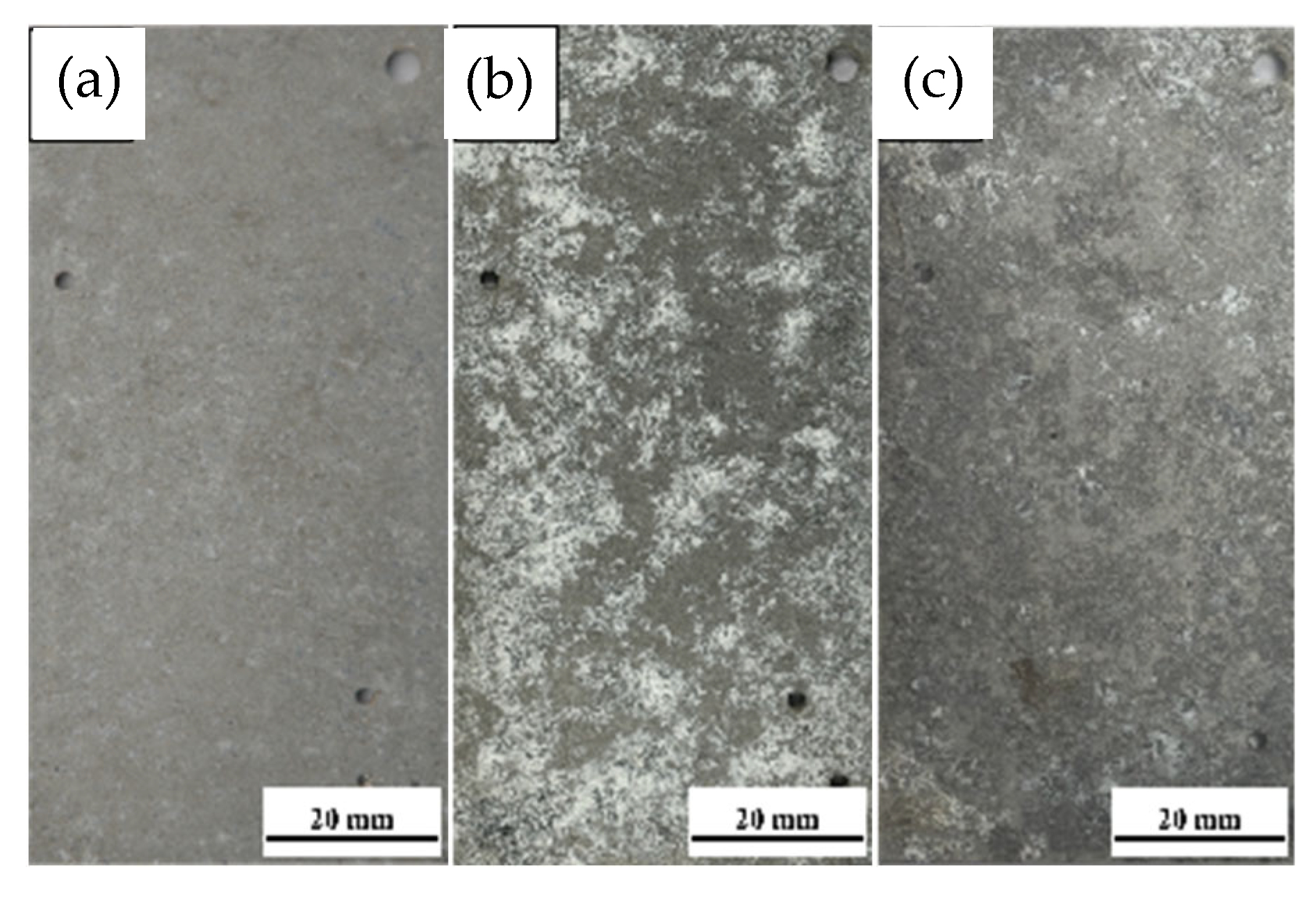
3.1.1. Macroscopic Corrosion Morphology
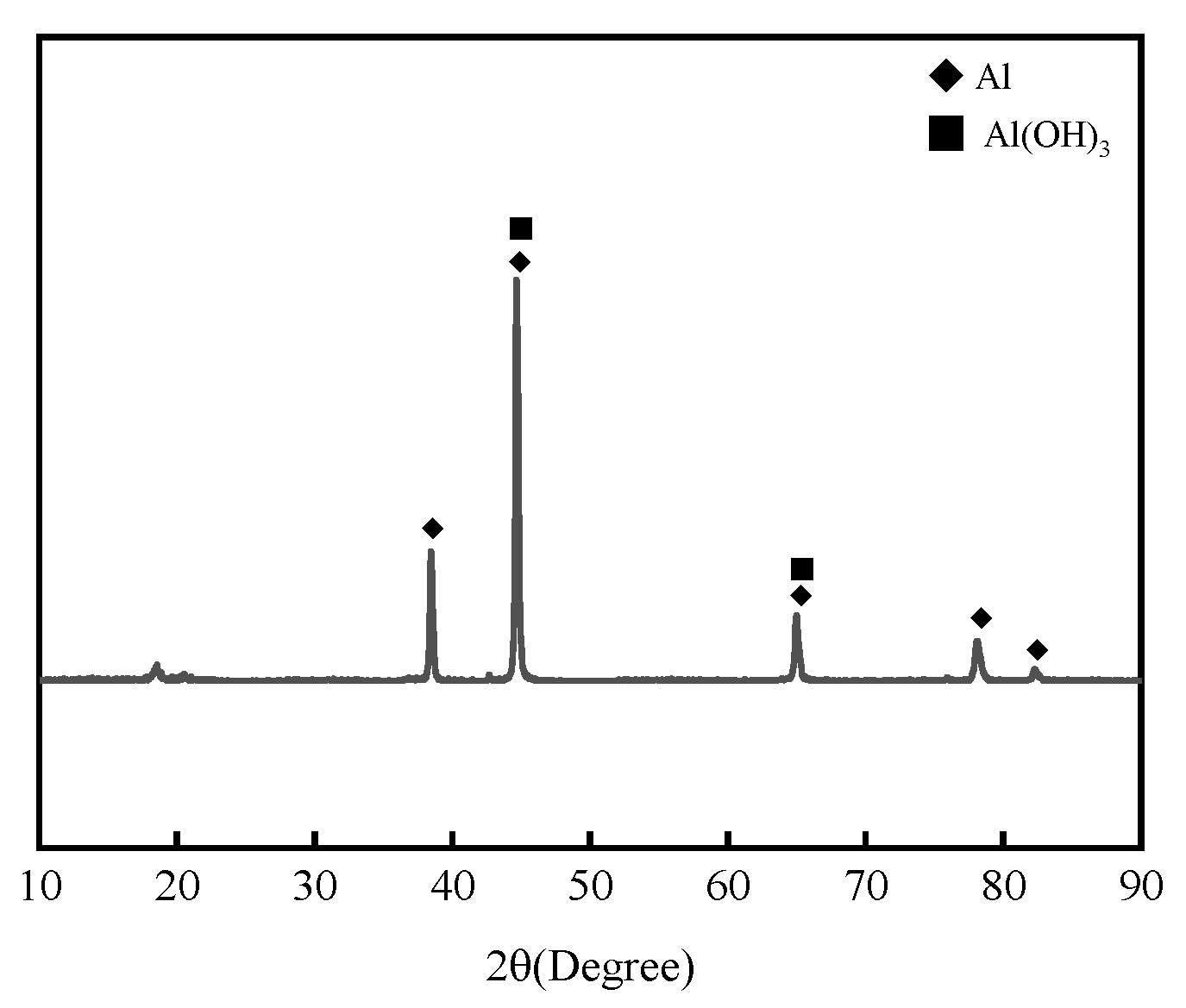
3.1.2. Corrosion Product Analysis
3.1.3. Electrochemical Corrosion Analysis
3.2. Correlation Analysis Between Indoor and Outdoor Corrosion Tests
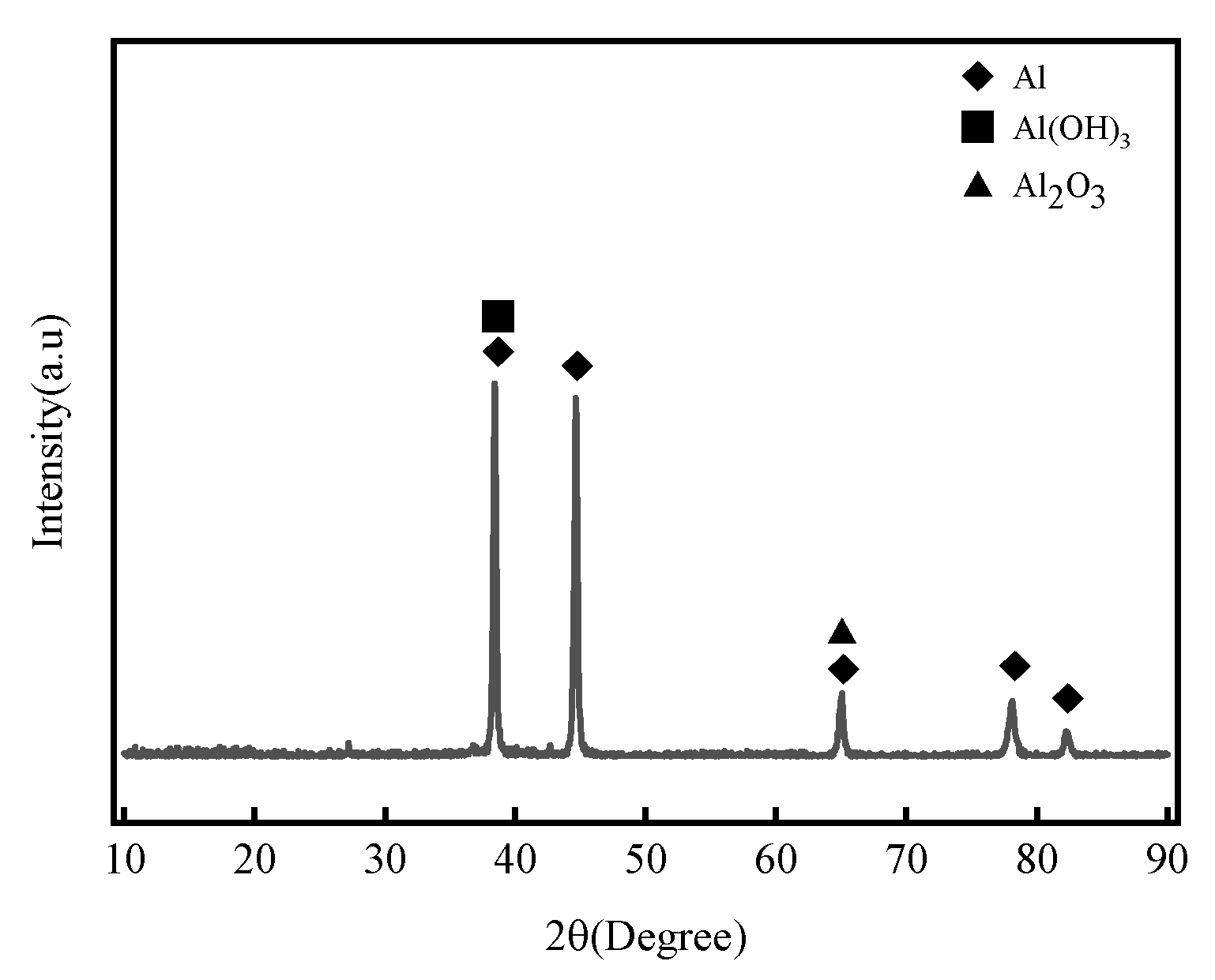
3.2.1. Correlation Analysis of Corrosion Products
3.2.2. Correlation Analysis of Electrochemical Corrosion Mechanisms
3.3. Corrosion Mechanism of 7075 Aluminum Alloy Under Chloride Ion Influence in Marine Atmospheric Environments
3.4. Kinetic Prediction Model for 7075 Aluminum Alloy Under Neutral Salt Spray Acceleration
4. Conclusions
Author Contributions
Funding
Data Availability Statement
Acknowledgments
Conflicts of Interest
References
- Babu, K.A.; Venkataramaiah, P.; Yerrathota, S. Material selection for preparation of aluminium hybrid Mmcs. Mater. Today Proc. 2018, 5, 12209–12222. [Google Scholar] [CrossRef]
- Koprowski, P.; Lech-Grega, M.; Wodziński, Ł.; Augustyn, B.; Boczkal, S.; Ożóg, M.; Uliasz, P.; Żelechowski, J.; Szymański, W. The effect of low content additives on strength, resistivity and microstructural changes in wire drawing of 1xxx series aluminium alloys for electrical purposes. Mater. Today Commun. 2020, 24, 101039. [Google Scholar] [CrossRef]
- Zhou, B.; Liu, B.; Zhang, S. The advancement of 7xxx series aluminum alloys for aircraft structures: A review. Metals 2021, 11, 718. [Google Scholar] [CrossRef]
- Zhong, X.; Liu, J.; Liu, Y.; Fan, J.; Pu, J. Enhanced repassivation accelerates wear: Tribocorrosion mechanism of 7075 Al Alloy in marine atmosphere environment. Tribol. Int. 2025, 215, 111502. [Google Scholar] [CrossRef]
- Czerwinski, F. Aluminum alloys for electrical engineering: A review. J. Mater. Sci. 2024, 59, 14847–14892. [Google Scholar] [CrossRef]
- Xiang, L.; Tao, J.; Xia, X.; Zhao, Z.; Chen, Q.; Su, Y.; Chai, S.; Zheng, Z.; Sun, J. Impact of Marine Atmospheric Corrosion on the Microstructure and Tensile Properties of 7075 High-Strength Aluminum Alloy. Materials 2023, 16, 2396. [Google Scholar] [CrossRef] [PubMed]
- Ezuber, H.; El-Houd, A.; El-Shawesh, F. A study on the corrosion behavior of aluminum alloys in seawater. Mater. Des. 2008, 29, 801–805. [Google Scholar] [CrossRef]
- Zhu, H.; Liu, W.; Su, H.; Wang, X.; Yao, X. Corrosion Behavior of 2A14 Aluminum Alloy under Marine Atmospheric Corrosion Conditions. J. Mater. Eng. Perform. 2025, 1–13. [Google Scholar] [CrossRef]
- Zhang, T.; Wu, S.; Liu, H.; Yang, L.; Chen, T.; Wang, X.; Li, Y. Research on Comparative Marine Atmospheric Corrosion Behavior of AZ31 Magnesium Alloy in South China Sea. Materials 2025, 18, 3585. [Google Scholar] [CrossRef]
- Shi, B.; Wang, L.; Qin, L.; Guo, X.; Yang, G.; Wu, W.; Li, Z.; Cheng, X. Corrosion behavior of aluminum alloys in harsh marine atmospheric environment. Anti-Corros. Methods Mater. 2025, 72, 761–775. [Google Scholar] [CrossRef]
- Shi, B.; Wang, L.; Cheng, X.; He, Z.; Qin, L.; Guo, X.; Wang, H.; Li, Z.; Li, X. Study the impact of secondary phases on the corrosion resistance and mechanical properties of aluminum alloys under simulated harsh marine environment. Surf. Interfaces 2025, 59, 105994. [Google Scholar] [CrossRef]
- Yang, Y.; Kim, S. Electrochemical Characteristics of Aluminum Alloys in Sea Water for Marine Environment. Acta Phys. Pol. A 2019, 135, 1005–1011. [Google Scholar] [CrossRef]
- Fu, Y.; Mehr, V.Y.; Toroghinejad, M.R.; Chen, X.; Jie, J.; Zhu, S. Twinning and stacking fault-induced precipitation in an aluminum alloy. J. Mater. Res. Technol. 2025, 34, 2127–2132. [Google Scholar] [CrossRef]
- Zhao, Q.; Guo, C.; Niu, K.; Zhao, J.; Huang, Y.; Li, X. Long-term corrosion behavior of the 7A85 aluminum alloy in an industrial-marine atmospheric environment. J. Mater. Res. Technol. 2021, 12, 1350–1359. [Google Scholar] [CrossRef]
- Cui, Z.Y.; Li, X.G.; Man, C.; Xiao, K.; Dong, C.F.; Wang, X.; Liu, Z.Y. Corrosion behavior of field-exposed 7A04 aluminum alloy in the Xisha tropical marine atmosphere. J. Mater. Eng. Perform. 2015, 24, 2885–2897. [Google Scholar] [CrossRef]
- Cai, B.; Xu, Z.; Liu, G.; Li, Y.; Yan, L.; Pang, X.; Gao, K. Understanding of the occurrence of intergranular corrosion in 2024 aluminum alloy under atmospheric environment. J. Mater. Res. Technol. 2025, 35, 6690–6699. [Google Scholar] [CrossRef]
- Wahid, M.A.; Siddiquee, A.N.; Khan, Z.A. Aluminum alloys in marine construction: Characteristics, application, and problems from a fabrication viewpoint. Mar. Syst. Ocean Technol. 2020, 15, 70–80. [Google Scholar] [CrossRef]
- Jebaraj, A.V.; Aditya, K.; Kumar, T.S.; Ajaykumar, L.; Deepak, C. Mechanical and corrosion behaviour of aluminum alloy 5083 and its weldment for marine applications. Mater. Today Proc. 2020, 22, 1470–1478. [Google Scholar] [CrossRef]
- Shamsudeen, S.; John, E.R.D. Effect of welding on pitting and intergranular corrosion behavior of marine grade aluminum alloy. Mater. Perform. Charact. 2019, 8, 555–570. [Google Scholar] [CrossRef]
- Cui, Z.Y.; Li, X.G.; Xiao, K.; Dong, C.F.; Wang, L.W.; Zhang, D.W.; Liu, Z.Y. Exfoliation corrosion behavior of 2B06 aluminum alloy in a tropical marine atmosphere. J. Mater. Eng. Perform. 2015, 24, 296–306. [Google Scholar] [CrossRef]
- Wang, L.; Wang, H.; Li, B.; Yu, H.; Zhang, H.; Chen, J.; Yin, C.; Xiao, K. Study on Constructing Indoor Accelerated Simulation Methods for Steel with Galvalume Coating Exposed to Marine Atmosphere. Metals 2025, 15, 1143. [Google Scholar] [CrossRef]
- Kang, W.; Zhang, H.; Chu, C.; Wang, L.; Hu, Y.; Ding, Y.; Zhang, D. Hot corrosion behavior of IN738LC alloy formed by selective laser melting. Corros. Sci. 2022, 198, 110154. [Google Scholar] [CrossRef]
- Peng, J.; Xie, S.; Xia, J.; Wang, X.; Ni, Z.; Wang, P.; Chen, N. Investigation of Process and Properties of Cu-Mn-Al Alloy Cladding Deposited on 27SiMn Steel via Cold Metal Transfer. Crystals 2025, 15, 858. [Google Scholar] [CrossRef]
- Finke, A.; Escobar, J.; Munoz, J.; Petit, M. Prediction of salt spray test results of micro arc oxidation coatings on AA2024 alloys by combination of accelerated electrochemical test and artificial neural network. Surf. Coatings Technol. 2021, 421, 127370. [Google Scholar] [CrossRef]
- Usman, B.; Scenini, F.; Curioni, M. The effect of exposure conditions on performance evaluation of post-treated anodic oxides on an aerospace aluminium alloy: Comparison between salt spray and immersion testing. Surf. Coat. Technol. 2020, 399, 126157. [Google Scholar] [CrossRef]
- Diler, E.; Peltier, F.; Becker, J.; Thierry, D. Real-time corrosion monitoring of aluminium alloys under chloride-contaminated atmospheric conditions. Mater. Corros. 2021, 72, 1377–1387. [Google Scholar] [CrossRef]
- Schindelholz, E.; Kelly, R.G. Wetting phenomena and time of wetness in atmospheric corrosion: A review. Corros. Rev. 2012, 30, 135–170. [Google Scholar] [CrossRef]
- Ramdé, T.; Fedel, M.; Rossi, S. The Effect of Spray Testing Condition on the Corrosion Performance of Hydrothermally Sealed Anodic Oxide on a 5005 Aluminum Alloy: Comparison between Neutral Salt Spray, Acetic Salt Spray and Prohesion Testing Methods. J. Electrochem. Soc. 2024, 171, 041501. [Google Scholar] [CrossRef]
- GB/T 16545-2015; Corrosion of Metals and Alloys-Removal of Corrion Products from Corrosion Test Sprcimen. Standardization Administration of China (SAC): Beijing, China, 2015.
- GB/T 14165-2008; Corrosion of Metals and Alloys-Atmospheric Corrosion Test-General Requirements for Field Tests. Standardization Administration of China (SAC): Beijing, China, 2008.
- Tian, H.; Cui, Z.; Zhang, B.; Yang, W.; Yang, Y.; Cui, H. Atmospheric corrosion and mechanical property degradation of 2524-T3 aluminum alloy in marine environments. Corros. Sci. 2024, 239, 112398. [Google Scholar] [CrossRef]
- Lamloum, C.; Gharbi, O.; Belliard, L.; Vivier, V.; Ngo, K. Real-time monitoring of the uniform corrosion rate of aluminum using picosecond acoustic method. Measurement 2025, 253, 117696. [Google Scholar] [CrossRef]

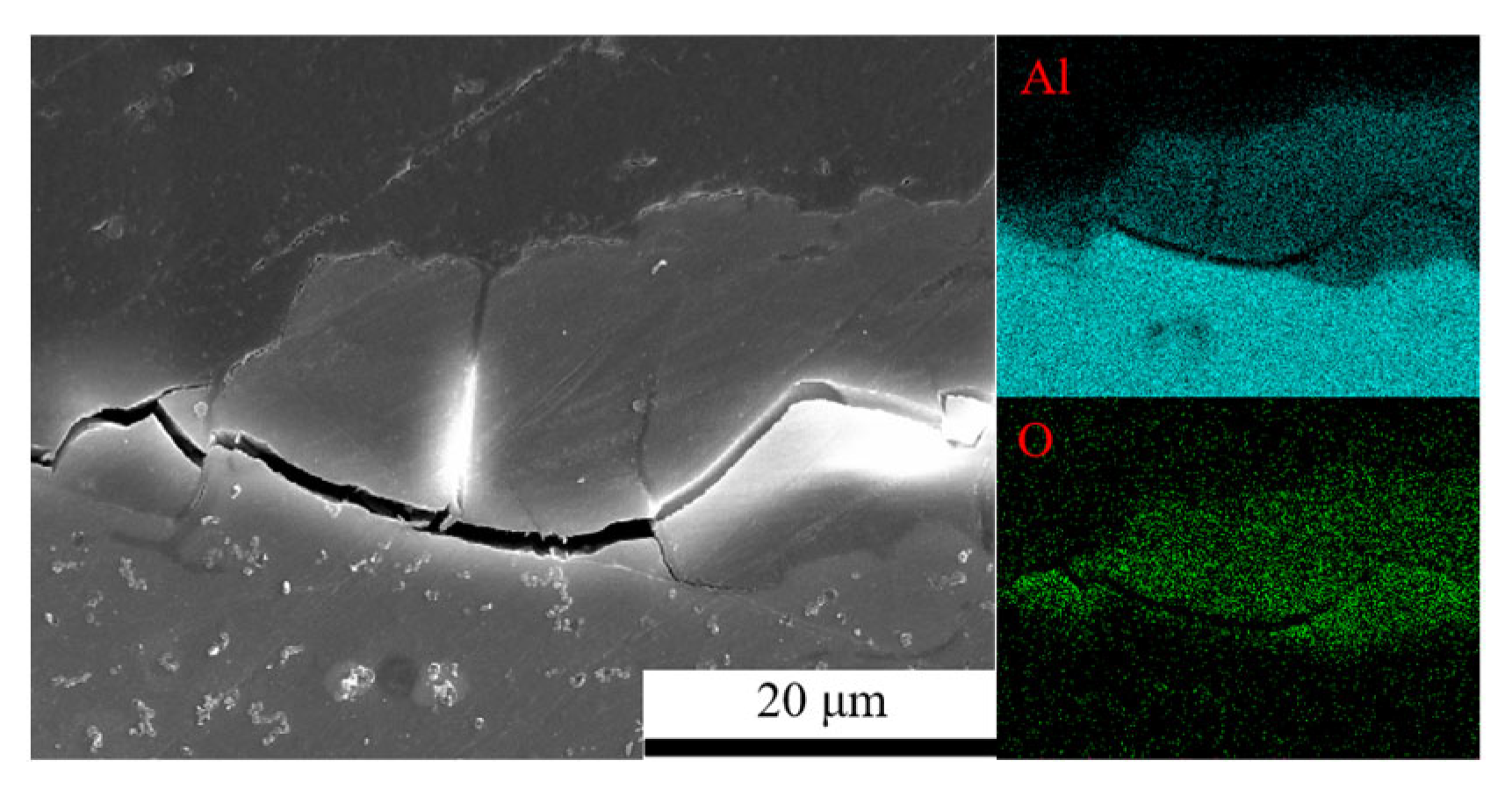


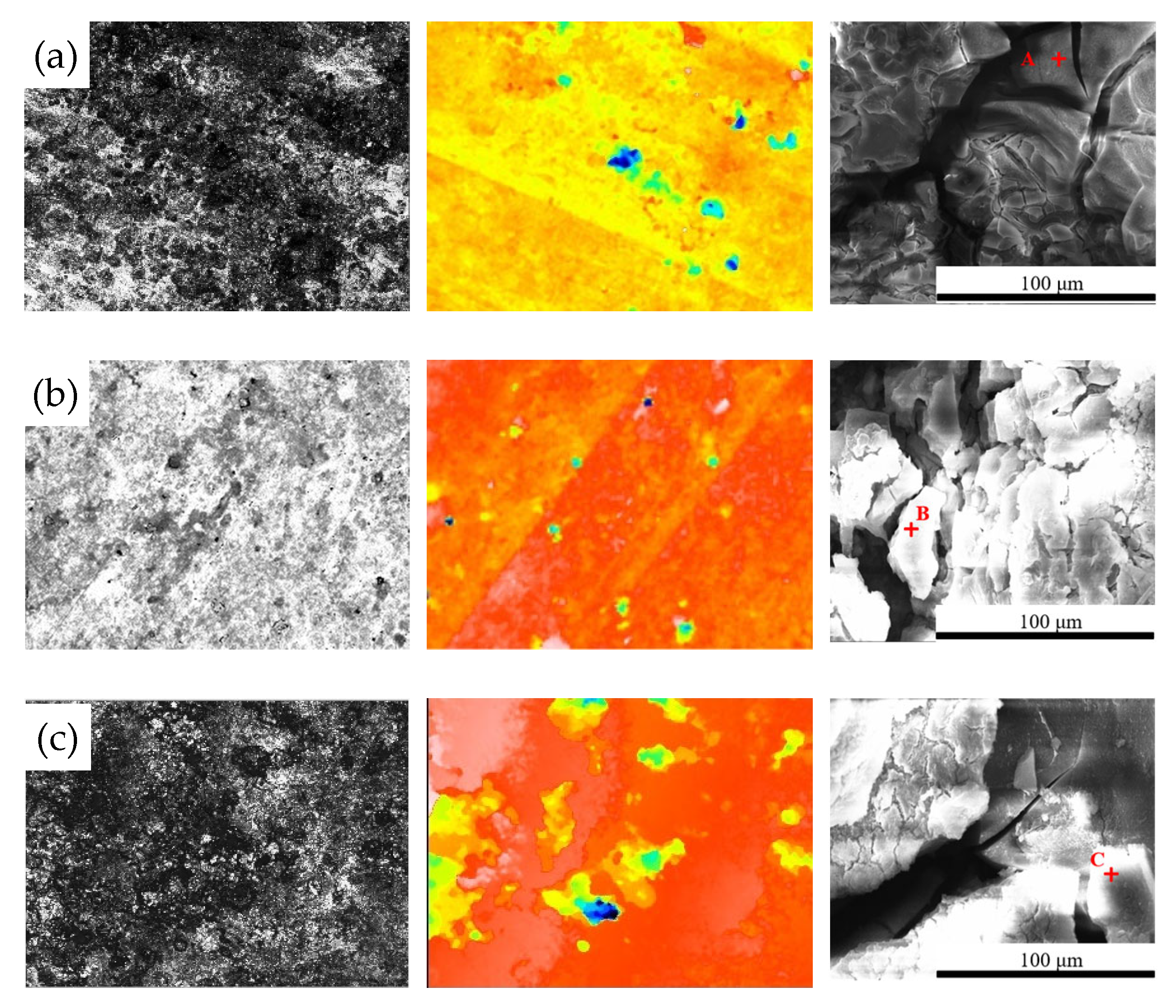
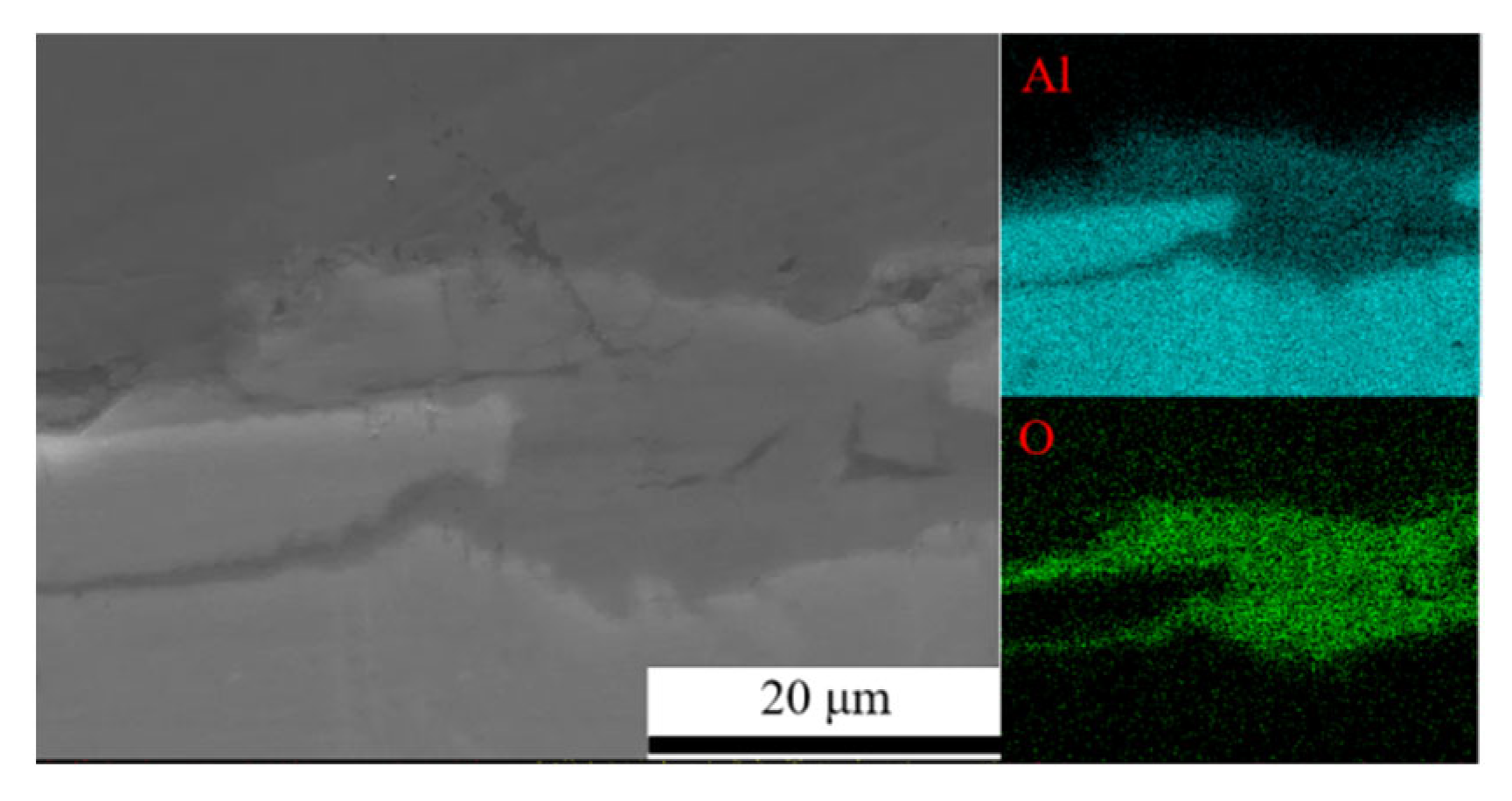



| Si | Fe | Cu | Mn | Mg | Cr | Zn | Al |
|---|---|---|---|---|---|---|---|
| 0.4 | 0.5 | 2 | 0.3 | 2.9 | 0.28 | 6.1 | 87.32 |
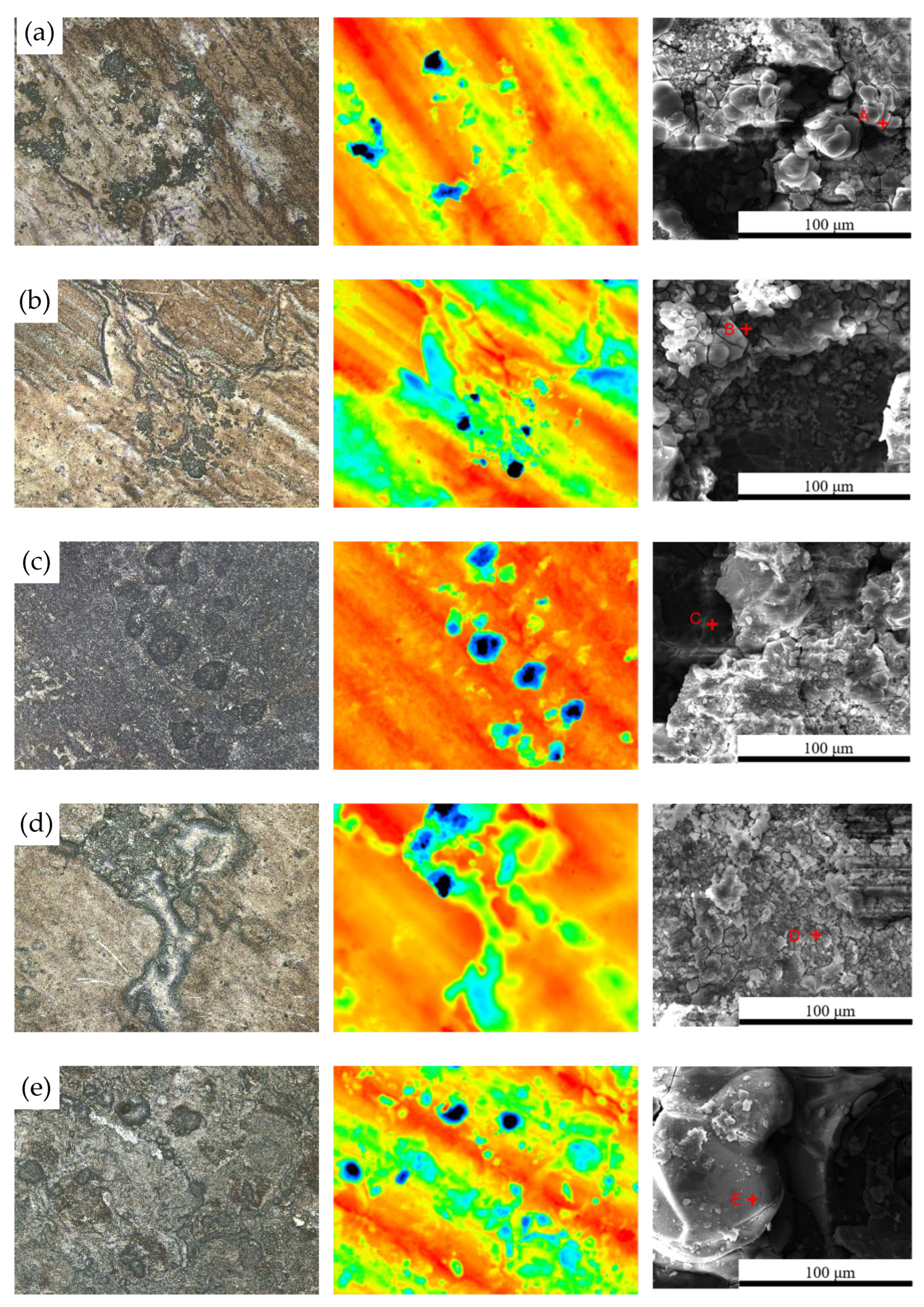
| Element | Al | O | Mg | Na | Cu | Cl | Zn |
|---|---|---|---|---|---|---|---|
| A | 64.14 | 34.16 | - | 1.70 | - | - | - |
| B | 69.21 | 18.76 | 3.47 | 1.66 | 4.04 | 2.86 | - |
| C | 55.66 | 33.69 | - | - | - | - | 10.64 |
| D | 60.86 | 37.45 | - | 1.68 | - | - | - |
| E | 62.88 | 32.54 | 4.58 | - | - | - | - |
| Component | Al | O | Mg |
|---|---|---|---|
| A | 49.01 | 49.20 | 1.79 |
| B | 38.30 | 61.70 | - |
| C | 40.30 | 59.70 | - |
| Outdoor Exposure Time (Months) | Corrosion Mass Loss (g/m2) | Corresponding Neutral Salt Spray Time (h) | Corrosion Rate (g/m2·h) | Acceleration Factor |
|---|---|---|---|---|
| 6 | 11.01 | 194.65 | 0.07449 | 45.1 |
| 12 | 14.50 | 502.33 | 0.04435 | 34.9 |
| 21 | 20.50 | 1305.03 | 0.02625 | 26.8 |
Disclaimer/Publisher’s Note: The statements, opinions and data contained in all publications are solely those of the individual author(s) and contributor(s) and not of MDPI and/or the editor(s). MDPI and/or the editor(s) disclaim responsibility for any injury to people or property resulting from any ideas, methods, instructions or products referred to in the content. |
© 2025 by the authors. Licensee MDPI, Basel, Switzerland. This article is an open access article distributed under the terms and conditions of the Creative Commons Attribution (CC BY) license.
Share and Cite
Cui, C.; Mu, X.; Sun, Z.; Xiao, K. Correlation Between the Accelerated-Rate Decay Mechanism in Neutral Salt Spray Tests and the Atmospheric Corrosion Kinetics Model of a 7075 Aluminum Alloy in Marine Environments. Metals 2026, 16, 45. https://doi.org/10.3390/met16010045
Cui C, Mu X, Sun Z, Xiao K. Correlation Between the Accelerated-Rate Decay Mechanism in Neutral Salt Spray Tests and the Atmospheric Corrosion Kinetics Model of a 7075 Aluminum Alloy in Marine Environments. Metals. 2026; 16(1):45. https://doi.org/10.3390/met16010045
Chicago/Turabian StyleCui, Changjing, Xianlian Mu, Zuodong Sun, and Kui Xiao. 2026. "Correlation Between the Accelerated-Rate Decay Mechanism in Neutral Salt Spray Tests and the Atmospheric Corrosion Kinetics Model of a 7075 Aluminum Alloy in Marine Environments" Metals 16, no. 1: 45. https://doi.org/10.3390/met16010045
APA StyleCui, C., Mu, X., Sun, Z., & Xiao, K. (2026). Correlation Between the Accelerated-Rate Decay Mechanism in Neutral Salt Spray Tests and the Atmospheric Corrosion Kinetics Model of a 7075 Aluminum Alloy in Marine Environments. Metals, 16(1), 45. https://doi.org/10.3390/met16010045