
Identification of Performance Variables in Blind 5-A-Side Football: Physical Fitness, Physiological Responses, Technical–Tactical Actions and Recovery Variables: A Systematic Review

 , ,
, ,  , , and
Abstract
1. Introduction
2. Materials and Methods
2.1. Design
2.2. Sources of Information
2.3. Inclusion and Exclusion Criteria
2.4. Search Strategy and Data Extraction
2.5. Quality Assessment
3. Results
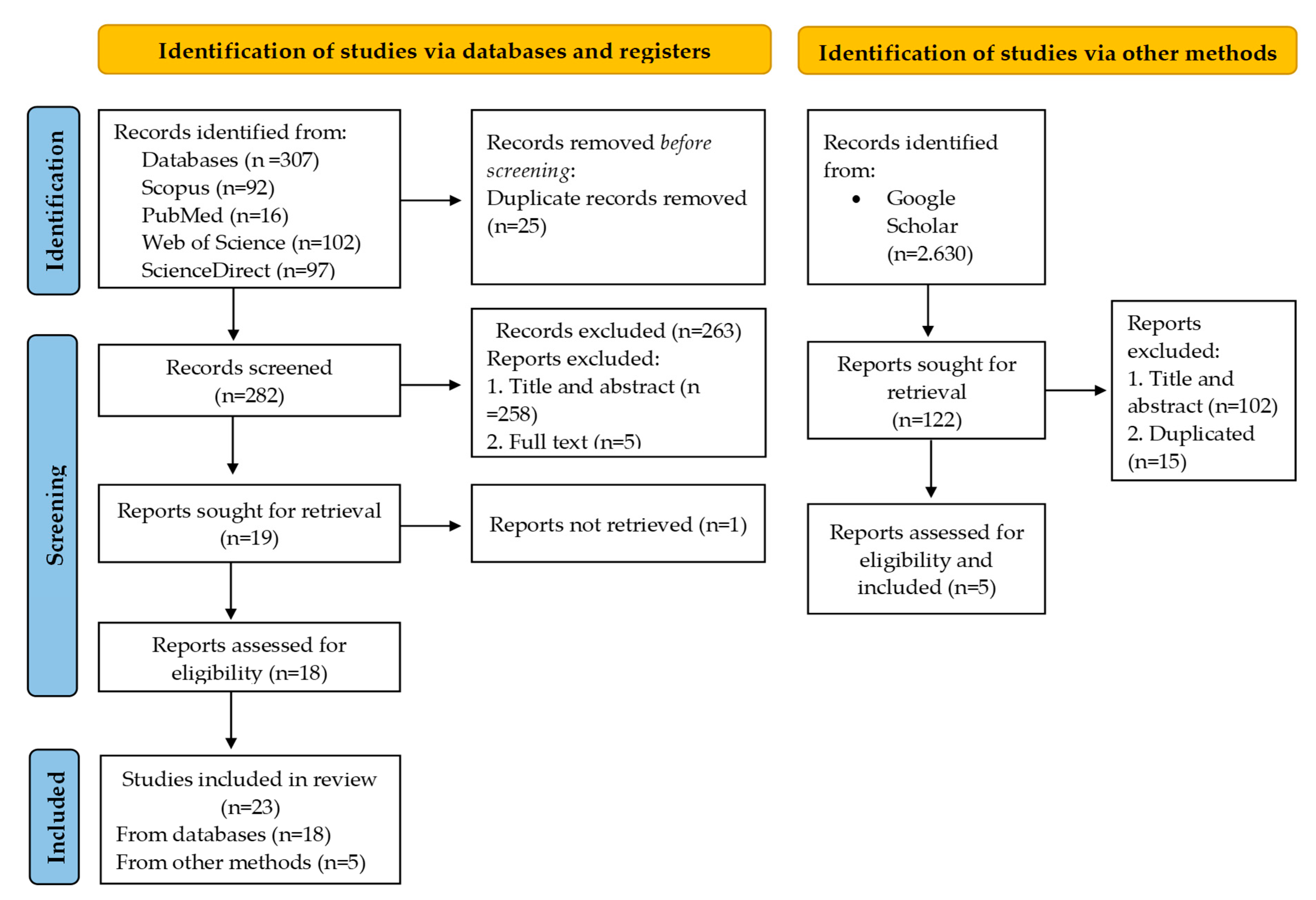
3.1. Identification and Selection of Studies
3.2. Analysis of Studies
4. Discussion
4.1. Physical/Physiological Dimensions
4.1.1. Aerobic Capacity and Cardiovascular Response
4.1.2. Anthropometric and Body Composition Variables
4.1.3. Strength, Power, and Risk of Injury
4.1.4. External Demands of Competition
4.1.5. Balance and Postural Control
4.2. Technical–Tactical Dimension
4.2.1. Sports Technique Variables and Measurement Instruments
4.2.2. Samples and Unit of Analysis
4.2.3. Shooting Effectiveness
4.2.4. Time Context and Competition Phase
4.2.5. Technical–Tactical Actions and Opposition
4.2.6. Kinematics and the Effect of Vision
4.2.7. Reliability and Validity of the Measurements
4.2.8. Comparisons, Trends, and Integrative Synthesis
4.3. Recovery Dimension
4.3.1. Sleep and Subjective Recovery Quality
4.3.2. Fatigue and Burnout
4.3.3. Biochemical and Hormonal Markers
4.4. Limitations and Future Recommendations
4.5. Practical Application
5. Conclusions
Supplementary Materials
Author Contributions
Funding
Institutional Review Board Statement
Informed Consent Statement
Data Availability Statement
Conflicts of Interest
References
- Comité Paralímpico Español. Fútbol-5. Recuperado el 3 de Julio de 2025. 2025. Available online: https://www.paralimpicos.es/deportes-paralimpicos/futbol-5 (accessed on 15 August 2025).
- Comité Paralímpico Español [CPE]. Guía Sobre la Clasificación en el Deporte Paralímpico. 2021. Available online: https://acortar.link/ONEDFE (accessed on 15 August 2025).
- Gamonales, J.M.; Muñoz-Jiménez, J.; Mancha-Triguero, D.; Ibáñez, S.J. The influence of the competition phase and the result of the match on the competitive demands in football 5-A-side for the visually impaired. Int. J. Perform. Anal. Sport 2021, 21, 1–11. [Google Scholar] [CrossRef] [Scilit]
- Becerra Patiño, B.A.; Pino-Ortega, J.; Olivares-Arancibia, J. Exploratory review of the scientific production of 5-blind soccer with the Bibliometrix tool. Retos 2025, 68, 1025–1047. [Google Scholar] [CrossRef] [Scilit]
- Gamonales, J.M.; Muñoz-Jiménez, J.; León, K.; Ibáñez, S.J. Efficacy of shots on goal in football for the visually impaired. Int. J. Perform. Anal. Sport 2018, 18, 393–409. [Google Scholar] [CrossRef] [Scilit]
- Esatbeyoğlu, F.; Kin-İşler, A. Gender differences in postural balance, physical activity level, BMI, and body composition in athletes with visual impairment. Br. J. Vis. Impair. 2021, 40, 530–544. [Google Scholar] [CrossRef] [Scilit]
- Papadopoulos, C.; Michailidis, Y.; Metaxas, T.I.; Mandroukas, A.; Fotiadou, E.G.; Giagazoglou, P.; Christoulas, K.; Tsimaras, V. Physiological Profile and Correlations between VO2max and Match Distance Running Performance of Soccer Players with Visual Impairment. Appl. Sci. 2023, 13, 10762. [Google Scholar] [CrossRef] [Scilit]
- Campos, L.F.C.C.; de Athayde Costa e Silva, A.; Teixeira Fabrício dos Santos, L.G.; Trevisan Costa, L.; Montagner, P.C.; Borin, J.P.; de Araújo, P.F.; Gorla, J.I. Effects of training in physical fitness and body composition of the Brazilian 5-A-side football team. Rev. Andal. Med. Deporte 2013, 6, 91–95. [Google Scholar] [CrossRef] [Scilit]
- Gamonales, J.M.; León, K.; Muñoz, J.; González-Espinosa, S.; Ibáñez, S.J. Validation of the IOLF5C Instrument for the Efficacy of Shooting on Goal in Football for the Blind. Rev. Int. Med. Cienc. Act. Física Deporte 2018, 18, 361–381. [Google Scholar] [CrossRef] [Scilit]
- Gamonales, J.M.; Hernández-Beltrán, V.; León, K.; Espada, M.C.; Sanabria-Jiménez, M.; Alemán-Ramírez, C.; Castelli Correia de Campos, L.F.; Muñoz-Jiménez, J. Analysis of the shots in Football for blind people in the 2021 World Grand Prix. Cult. Cienc. Deporte 2023, 18, 81–89. [Google Scholar] [CrossRef] [Scilit]
- Finocchietti, S.; Gori, M.; Oliveira, A.S. Kinematic profile of visually impaired football players during specific sports actions. Sci. Rep. 2019, 9, 10660. [Google Scholar] [CrossRef] [Scilit]
- Sakuma, T.; Kobayashi, M.; Kinoshita, H.; Matsui, Y.; Kobayashi, Y.; Watanabe, M. Three-Dimensional Kinematics Analysis of Blind Football Kicking. Sports Biomech. 2020, 22, 1136–1152. [Google Scholar] [CrossRef] [Scilit]
- Souza, R.P.; Alves, J.M.V.M.; Gorla, J.I.; Novaes, G.; Cabral, S.I.C.; Neves, E.B.; Nogueira, C.D. Characterization of the intensity of blind athletes from the Brazilian Football 5-A-side national team. J. Health Biol. Sci. 2016, 4, 218–226. [Google Scholar] [CrossRef] [Scilit]
- Becerra-Patiño, B.A.; Monterrosa-Quintero, A.; Olivares-Arancibia, J.; López-Gil, J.F.; Pino-Ortega, J. Differences in Anthropometric and Body Composition Factors of Blind 5-A-side Soccer Players in Response to Playing Position: A Systematic Review. J. Funct. Morphol. Kinesiol. 2025, 10, 238. [Google Scholar] [CrossRef] [Scilit]
- Becerra Patiño, B.A.; Montenegro Bonilla, A.D.; Paucar-Uribe, J.D.; Rada-Perdigón, D.A.; Olivares-Arancibia, J.; Yáñez-Sepúlveda, R.; López-Gil, J.F.; Pino-Ortega, J. Characterization of Fitness Profiles in Youth Soccer Players in Response to Playing Roles Through Principal Component Analysis. J. Funct. Morphol. Kinesiol. 2025, 10, 40. [Google Scholar] [CrossRef] [Scilit]
- Lameira Oliveira, G.; Adão Perini Oliveira, T.; Braz, M.; Irineu Gorla, J.; Fernandes Filho, J. Body Composition and Somatotype of Blind Athletes of 5-A-side Football of High-Performance. Retos 2023, 48, 873–877. [Google Scholar] [CrossRef] [Scilit]
- Becerra Patiño, B. Soccer as a Synergetic Model: Complexity of the Player-Game (Fútbol Como Modelo Sinérgico: Complejidad del Juego-Jugador); Kinesis: Armenia, Colombia, 2021. [Google Scholar]
- Ahmadi, F.; Khaleghi, M.M.; Zar, A.; Tejaswi, J.; Govindasamy, K.; Ardelean, V.P.; Ursu, V.E.; Geantă, V.A. Relationship Between Quality of Life and Sports Performance Among Athletes with Disabilities: A Focus on Individual Sports. Healthcare 2025, 13, 2919. [Google Scholar] [CrossRef] [Scilit]
- Gomez-Ruano, M.A.; Ibáñez, S.J.; Leicht, A.S. Editorial: Performance Analysis in Sport. Front. Psychol. 2020, 11, 611634. [Google Scholar] [CrossRef] [Scilit] [PubMed]
- Li, C.; Wu, Y.; Wang, X.; Tang, M.; Suppiah, H.T. Sleep characteristics of elite blind soccer players in China. Biol. Rhythm. Res. 2016, 48, 57–64. [Google Scholar] [CrossRef] [Scilit]
- Li, C.; Ivarsson, A.; Stenling, A.; Yandan, W. The dynamic interplay between burnout and sleep among elite blind soccer players. Psychol. Sport Exerc. 2018, 37, 164–169. [Google Scholar] [CrossRef] [Scilit]
- Muñoz-Jiménez, J.; Gámez-Calvo, L.; Rojas-Valverde, D.; León, K.; Gamonales, J.M. Analysis of Injuries and Wellness in Blind Athletes during an International Football Competition. Int. J. Environ. Res. Public Health 2022, 19, 8827. [Google Scholar] [CrossRef] [Scilit] [PubMed]
- Hostrup, M.; Bangsbo, J. Performance Adaptations to Intensified Training in Top-Level Football. Sports Med. 2023, 53, 577–594. [Google Scholar] [CrossRef] [Scilit] [PubMed]
- Tafah, M.; Majelan, A.S. Identification and Priorization of Important Attributes for Talent Identification in Blind Football. Stud. Sport Med. 2024, 15, 65–90. [Google Scholar] [CrossRef]
- Cardona-Rojas, J.; Giraldo-Caicedo, G.; González-Paz, V.; López-Florez, S.; Hincapié-Gallón, O.L.; Ávila-Valencia, J.C. Capacidad cardiorrespiratoria en deportistas de fútbol 5 sonoro, según Test de Léger y prueba de esfuerzo. Rev. Digit. Act. Física Y Deporte 2022, 8, 2462–8948. [Google Scholar] [CrossRef] [Scilit]
- Sarmento, H.; Martinho, D.V.; Gouveia, É.R.; Afonso, J.; Chmura, P.; Field, A.; Savedra, N.O.; Oliveira, R.; Praça, G.; Silva, R.; et al. The Influence of Playing Position on Physical, Physiological, and Technical Demands in Adult Male Soccer Matches: A Systematic Scoping Review with Evidence Gap Map. Sports Med. 2024, 54, 2841–2864. [Google Scholar] [CrossRef] [Scilit]
- Lopes, H.; Carrilho, D.; Vaz de Carvalho, M.; Brito, H.; Carvalho, A.; Araújo, D. The role of eco-physical variables for analyzing and modeling goal-directed behavior in sport. Acta Psychol. 2025, 261, 105826. [Google Scholar] [CrossRef] [Scilit]
- Page, M.J.; McKenzie, J.E.; Bossuyt, P.M.; Boutron, I.; Hoffmann, T.C.; Mulrow, C.D.; Shamseer, L.; Tetzlaff, J.M.; Akl, E.A.; Brennan, S.E.; et al. The PRISMA 2020 Statement: An Updated Guideline for Reporting Systematic Reviews. BMJ 2021, 372, n71. [Google Scholar] [CrossRef] [Scilit] [PubMed]
- Rico-González, M.; Pino-Ortega, J.; Clemente, F.M.; Los Arcos, A. Guidelines for Performing Systematic Reviews in Sports Science. Biol. Sport 2022, 39, 463–471. [Google Scholar] [CrossRef] [Scilit] [PubMed]
- Paucar Uribe, J.D.; Becerra-Patiño, B.A.; Olivares-Arancibia, J.; Yáñez-Sepúlveda, R.; Vasquez-Bonilla, A.; Rojas-Valverde, D.; López-Gil, J.F.; Machado, G. Visualization of the Research Panorama of Decision-Making in Soccer: Bibliometric Analysis with VOSviewer and Review of the Most Cited Studies of the Last 15 Years (2010–2024). Sports 2025, 13, 177. [Google Scholar] [CrossRef] [Scilit] [PubMed]
- Barker, T.H.; Habibi, N.; Aromataris, E.; Stone, J.C.; Leonardi-Bee, J.; Sears, K.; Hasanoff, S.; Klugar, M.; Tufanaru, C.; Moola, S.; et al. The revised JBI critical appraisal tool for the assessment of risk of bias quasi-experimental studies. JBI Evid. Synth. 2024, 22, 378–388. [Google Scholar] [CrossRef] [Scilit]
- Moola, S.; Munn, Z.; Tufanaru, C.; Aromataris, E.; Sears, K.; Sfetcu, R.; Currie, M.; Qureshi, R.; Mattis, P.; Lisy, K.; et al. Chapter 7: Systematic reviews of etiology and risk. In JBI Manual for Evidence Synthesis; Aromataris, E., Munn, Z., Eds.; JBI: North Adelaide, Australia, 2020; Available online: https://synthesismanual.jbi.global (accessed on 22 December 2025).
- Campos, L.F.; Borin, J.P.; Nightingale, T.; Silva, A.A.; Araújo, P.F.; Gorla, J.I. Alterations of cardiorespiratory and motor profile of Paralympic 5-A-side football athletes during 14-week in-season training. Int. J. Sports Sci. 2014, 4, 85–90. [Google Scholar]
- Lameira Oliveira, G.; Perini Oliveira, T.; Maioli Penello, F.; Fernandes Filho, J. Características antropométricas y aptitud aeróbica de los atletas ciegos de fútbol 5. Rev. Peru. Cienc. Act. Fis. Deporte 2020, 7, 10. [Google Scholar]
- Alves, E.S.; Lemos, V.A.; Rosa, J.P.P.; Silva, A.; Gávea, J.; Rocha, E.A.; De Mello, M.T. Profile of aerobic fitness and muscle power of athletes on the Brazilian National Paralympic Five-a-side Football Team. Rev. Bras. Educ. Física Esporte 2019, 33, 345–352. [Google Scholar] [CrossRef] [Scilit]
- Campos, L.F.C.C.; Borin, J.P.; Santos, L.G.T.F.; Souza, T.M.F.; Paranhos, V.M.S.; Tanhoffer, R.A.; Luarte, C.R.; Gorla, J.I. Avaliação isocinética em atletas da seleção brasileira de futebol de 5. Rev. Bras. Med. Esporte 2015, 21, 220–223. [Google Scholar] [CrossRef] [Scilit]
- Nascimento, M.M.; Silva, P.R.O.; Felício, L.R.; Mainenti, M.R.M.; Miranda, H.L.; Paz, G.A.; Lemos, T.; Ferreira, A.d.S.; Vigário, P.S. Postural control in football players with vision impairment: Effect of sports adaptation or visual input restriction? Mot. Rev. Educ. Física 2022, 28, e10220010821. [Google Scholar] [CrossRef] [Scilit]
- Weiler, R.; Verhagen, E.; Taylor, A.; Ahmed, O.H. Monitoring the beautiful adapted game: A 3-year prospective surveillance study of injuries in elite English para football. Sci. Med. Footb. 2022, 6, 415–420. [Google Scholar] [CrossRef] [Scilit]
- Ramirez Roman, L.E.; Hincapie Gallon, O.L.; Tierradentro Gomez, L.; Cortes Garcia, J.; Duque Cortes, D.F. Fuerza potencia, flexibilidad y riesgo de lesión, en futbolistas con discapacidad visual y auditiva. Rev. Iberoam. Cienc. Act. Física Deporte 2024, 13, 123–136. [Google Scholar] [CrossRef] [Scilit]
- Sancio, D.; Arcodia, J.L.; Roselló, M. Perfil antropométrico y velocidad con balón en jugadores argentinos profesionales de futbol sala para ciegos. Rev. Peru. Cienc. Act. Fis. Deporte 2021, 8, 12. [Google Scholar]
- Gamonales, J.M.; Muñoz-Jiménez, J.; León, K.; Ibáñez, S.J. Effectiveness of the launch at FA5 for blind persons in 2016 Paralympic Games. Rev. Int. Med. Cienc. Act. Física Deporte 2019, 19, 727–747. [Google Scholar] [CrossRef] [Scilit]
- Gamonales, J.M.; Muñoz-Jiménez, J.; León, K.; Ibáñez, S.J. Differences between Championships of Football 5-A-side for blind people. Appl. Sci. 2021, 11, 8933. [Google Scholar] [CrossRef] [Scilit]
- Pennel, A.; Gilbert, E.; Brian, A.; Beach, P.; Lieberman, L. Measurement properties of scores from novel blind football assessments. Eur. J. Adapt. Phys. Act. 2022, 15, 1–14. [Google Scholar] [CrossRef] [Scilit]
- Monma, T.; Kohda, Y.; Yamane, M.; Mitsui, T.; Ando, K.; Takeda, F. Prevalence and risk factors of sleep disorders in visually impaired athletes. Sleep Med. 2021, 79, 175–182. [Google Scholar] [CrossRef] [Scilit] [PubMed]
- Gomes, D.V.; Vigário, P.S.; Piazera, B.K.L.; Costa, F.P.; Vaisman, M.; Salerno Pinto, V. Oxidative stress biomarkers after a single maximal test in blind and non-blind soccer players. J. Sports Med. Phys. Fit. 2019, 59, 267–273. [Google Scholar] [CrossRef] [Scilit] [PubMed]
- McKay, A.K.A.; Stellingwerff, T.; Smith, E.S.; Martin, D.T.; Mujika, I.; Goosey-Tolfrey, V.L.; Sheppard, J.; Burke, L.M. Defining Training and Performance Caliber: A Participant Classification Framework. Int. J. Sports Physiol. Perform. 2022, 17, 317–331. [Google Scholar] [CrossRef] [Scilit]
- Gamonales, J.M.; León, K.; Rojas-Valverde, D.; Sánchez-Ureña, B.; Muñoz-Jiménez, J. Data mining to select relevant variables influencing external and internal workload of elite blind 5-A-side soccer. Int. J. Environ. Res. Public Health 2021, 18, 3155. [Google Scholar] [CrossRef] [Scilit] [PubMed]
- Campayo-Piernas, M.; Caballero, C.; Barbado, D.; Reina, R. Role of vision in sighted and blind soccer players in adapting to an unstable balance task. Exp. Brain Res. 2017, 235, 1269–1279. [Google Scholar] [CrossRef] [Scilit] [PubMed]
- Runswick, O.R.; Rawlinson, A.; Allen, P.M.; Sharpe, B.T.; Pocock, C.; Datson, N.; Birch, P.; Bruce, R.; Mann, D.L. The effects of simulated vision impairment on performance in football. J. Sports Sci. 2023, 41, 1410–1422. [Google Scholar] [CrossRef] [Scilit]
- Gamonales, J.M.; Muñoz-Jiménez, J.; León-Guzmán, K.; Ibáñez, S.J. 5-A-side Football for Individuals with Visual Impairments: A review of the Literature. Eur. J. Adapt. Phys. Act. 2018, 11, 4. [Google Scholar] [CrossRef] [Scilit]
- Vitale, K.C.; Owens, R.; Hopkins, S.R.; Malhotra, A. Sleep Hygiene for Optimizing Recovery in Athletes: Review and Recommendations. Int. J. Sports Med. 2019, 40, 535–543. [Google Scholar] [CrossRef] [Scilit]
- Becerra Patiño, B.A.; Escorcia-Clavijo, J.B. The transfer and dissemination of knowledge in sports training: A scoping review. Retos 2023, 50, 79–90. [Google Scholar] [CrossRef] [Scilit]
- Kerr, Z.Y.; Nimphius, S.; Stoner, L.; Ahmed, O.H.; Register-Mihalik, J.F.; Fortington, L.V. Strategies for engaging “multiple disciplinary” teams in sport- and exercise- related research. J. Sci. Med. Sport. 2021, 24, 851–854. [Google Scholar] [CrossRef] [Scilit]


| Population | Intervention | Comparison | Outcomes | Study Design |
|---|---|---|---|---|
| Blind 5-A-side players aiming to train or improve their performance | Physiological variables Physical fitness Competition monitoring GPS Technical and tactical actions Recovery variables Performance levels | Performance levels Blind athletes and sighted athletes Match analysis Competition Effects | Physiological responses (HR, VO2max, RPE) Physical Fitness (strength, speed, agility, resistance, balance) Technical–tactical actions (passing, shots on goal, dribbling) Recovery variables (stress, sleep, well-being, muscle pain, fatigue) Competition monitoring (accelerations decelerations total distance) | Cross-sectional study Longitudinal study Observational study Quasi-experimental study Prospective cohort |
| Study (Author, Year) | Design | JBI Tool Applied | Risk of Bias | Main Strengths | Main Limitations |
|---|---|---|---|---|---|
| Gamonales et al. [3] | Cross-sectional | Analytical Cross-Sectional Studies | Low–moderate | Real-match data; validated metrics | No confounder control; small sample |
| Gamonales et al. [5] | Cross-sectional | Analytical Cross-Sectional Studies | Low–moderate | Objective match analysis; validated instrument; high inter-rater reliability | No adjustment for contextual variables |
| Esatbeyoglu et al. [6] | Cross-sectional | Analytical Cross-Sectional Studies | Low–moderate | Valid measures (IPAQ, Biodex); clear inclusion | No confounder control |
| Papadopoulos et al. [7] | Cross-sectional | Analytical Cross-Sectional Studies | Moderate | Laboratory VO2max test; validated sensors | No confounder control; small sample |
| Campos et al. [8] | Quasi-experimental (16 weeks pre–post) | Quasi-Experimental Studies | Low–moderate | Standardized training; reliable tests | No control group |
| Gamonales et al. [9] | Observational study | Studies Reporting Reliability and Validity of Measurement Instruments | Low–moderate | Excellent inter-rater reliability (κ > 0.90); validated instrument | No confounder control |
| Gamonales et al. [10] | Cross-sectional | Analytical Cross-Sectional Studies | Low–moderate | Objective observation; valid coding (IOLF5C) | No confounder control |
| Finocchietti et al. [11] | Cross-sectional | Analytical Cross-Sectional Studies | Low–moderate | Valid IMU system; clear procedures | Small sample |
| Li et al. [20] | Cross-sectional | Analytical Cross-Sectional Studies | Low–moderate | Valid PSQI instrument; complete data | Self-report bias |
| Li et al. [21] | Prospective cohort (5 months) | Cohort Studies | Low–moderate | Valid tools (ABQ, PSQI); advanced Bayesian analysis; complete follow-up | No confounder control; small sample |
| Campos et al. [33] | Quasi-experimental (14-week pre–post) | Quasi-Experimental Studies | Low–moderate | Valid physiological measures; complete follow-up | Small sample; no control group |
| Oliveira et al. [34] | Cross-sectional | Analytical Cross-Sectional Studies | Moderate | Valid fitness protocols; national athletes | No confounder control Small sample (n = 5) |
| Alves et al. [35] | Cross-sectional | Analytical Cross-Sectional Studies | Low–moderate | Objective measures (ergospirometry, torque) | Small sample; no adjustment |
| Campos et al. [36] | Cross-sectional | Analytical Cross-Sectional Studies | Low–moderate | Standardized isokinetic testing | No covariate control |
| Nascimento et al. [37] | Cross-sectional | Analytical Cross-Sectional Studies | Low–moderate | Valid force platform; comparison groups | No adjustment for training load |
| Weiler et al. [38] | Prospective cohort (3 years) | Cohort Studies | Low–moderate | Clear injury definitions; medical verification; long follow-up | No adjusted analysis for confounders; small sample |
| Ramirez et al. [39] | Cross-sectional | Analytical Cross-Sectional Studies | Moderate | Reliable field tests | No confounder control |
| Sancio et al. [40] | Cross-sectional | Analytical Cross-Sectional Studies | Moderate | ISAK-certified measurements; objective timing | Very small sample (n = 8); descriptive analysis only |
| Gamonales et al. [41] | Cross-sectional | Analytical Cross-Sectional Studies | Low–moderate | Large data set; validated coding (IOLF5C) | No contextual adjustment |
| Gamonales et al. [42] | Cross-sectional | Analytical Cross-Sectional Studies | Low–moderate | Valid notational design; strong reliability | No confounder control |
| Pennell et al. [43] | Cross-sectional | Studies Reporting Reliability and Validity of Measurement Instruments | Low | Strong psychometric analysis (α = 0.81, ω = 0.85) and validity analyses | Small, convenience sample |
| Monma et al. [44] | Cross-sectional | Analytical Cross-Sectional Studies | Low | Multivariate logistic regression; large sample | Minor self-report bias |
| Gomes et al. [45] | Quasi-experimental (2-group pre–post) | Quasi-Experimental Studies | Low | strong internal validity, control group, reliable outcomes | Small sample |
| Study | Population (n, Age, Level, Visual Category) | Intervention/Context | Comparator | Variables/Physiological and Physical | Main Results (Measures, SD, CI if Available) |
|---|---|---|---|---|---|
| Gamonales et al. [3] | n = 28, (Spain, Italy, Andalusia, Czech Republic), 30.97 ± 11.51 yrs | Official matches International Tournament Phase and result | Tournament Phase and result | Distance, speed, acceleration, loads | Official matches International Changes according to phase (more demands in knockout); variations according to win/lose |
| Esatbeyoğlu et al. [6] | n = 12, B1 soccer players, >18 yrs | Anthropometric tests, PA, balance | Gender and VI | BMI, %fat, fat mass, lean mass, postural balance | VI men > BMI than VI women; women > %fat; postural differences EO vs. foam |
| Papadopoulos et al. [7] | n = 12, players with VI vs. sedentary VI, 27.0 yrs | Official matches International | Blind soccer tournament vs. sedentary | VO2max, total distance, speed, HR, anthropometry | Median distance 1820 m (993 m at P50); median speed 2.03 km/h; maximum speed 8.35 km/h; median HR 161 bpm; athletes with ↓fat and ↑VO2 vs. sedentary |
| Campos et al. [8] | n = 6, Brazil national team, 27.33 ± 5.5 yrs | Pre vs. post training | Pre vs. Post | Body mass, BMI, % fat, free mass, VO2peak, anaerobic power | VO2peak: 44.7 → 50.3 mL/kg/min (p < 0.05); ↑laps Shuttle Run; ↑anaerobic power; ↓fatigue index |
| Gamonales et al. [9] | n = 50, (Spain, Italy, Andalusia, Czech Republic) 5, 30.86 ± 11.2 yrs | Official matches | Comparisons by result, age, BMI | Accelerations, distance, HRavg, speed | ↑Accelerations/min in losers; ↑explosive distance and 21–24 km/h in goalscorers; ↑HRavg and AccMax in younger players |
| Campos et al. [33] | n = 7, Brazilian national team players (B1), 24.7 ± 5.9 yrs | Assessment before/after 14 weeks of training | Pre vs. Post | VO2max, HR, ventilatory thresholds, anaerobic power, agility, explosive strength | Significant improvements in VO2 and %HRmax at respiratory compensation point; trend towards ↑POpeak, POm, POmin; no changes in FI |
| Lameira Oliveira et al. [34] | n = 5, blind athletes (B1), competitive, Brazil, 32.6 ± 8.0 yrs | Anthropometric assessment + 20 m Shuttle Run | – | Body mass, height, BMI, skinfolds, estimated VO2max | BMI 25.1 ± 5.4 (kg/m2) within normative range; VO2max reported 36.3 ± 4.7 mL−1 kg−1 min |
| Alves et al. [35] | n = 12, Brazilian Paralympic team (B1), 25.8 ± 5.6 yrs | Cardiorespiratory tests + muscle power | – | VO2peak, VO2VT1, VO2VT2, HRmax, speeds, muscle power, I/Q ratio | VO2peak: 51.8 ± 5.8 mL/kg/min; Vmax: 17.1 ± 1.4 km/h; HRVT1: 167.2 ± 10.2 bpm; VO2VT2: 48.6 ± 5.7 mL/kg/min |
| Campos et al. [36] | n = 11, pivot/wings/fixed, Brazil national team, 25.9 ± 3.6 yrs | Isokinetic assessment (knee flexors/extensors) | Playing positions (pivot/wings/fixed) | Body mass, height, BMI, %fat, torque, power, peak | PT angle flexors/extensors at 60–300°/s; differences DL vs. NDL (~6%); wings lighter |
| Nascimento et al. [37] | n = 39, B1 vs. B2/B3, 5-A-side soccer, 25.0 ± 5.3 yrs | Postural balance assessment | Blind soccer and grade VI (B2/B3) | Elliptical area, displacement | Speed B1 = smaller displacement area than B2/B3; Footballers = ↓area and speed vs. judokas |
| Weiler et al. [38] | n = 13 blind soccer England, 26.8 ± 4.6 yrs | 3 seasons, England | Blind soccer vs. CP | Anthropometry, incidence, severity of injuries | Injury incidence 11.9× higher in matches than training; 73% lower limb injuries; ligaments more common in blind people |
| Ramirez Roman et al. [39] | n = 10 (5 hearing, five visual), Colombia, 28.6 yrs | Jump tests, flexibility, LESS | Disability groups | Vertical/horizontal jump, quadriceps and hamstring flexibility, injury risk | Jumps ≈185 cm visual; flexibility without difference; Higher risk of injury in the left ventricle (LESS test p = 0.008) |
| Sancio et al. [40] | n = 8 players from the Argentine national team, 26.8 ± 6.5 years | Old Ball speed tests | Positions (def, mid, for) | Somatotype, % fat, muscle mass, ball speed | Forwards ↑ball speed (4.5 ± 0.22 m/s, max 4.7); correlation r = 0.85 Skeletal index |
| Study | No Participants/Actions | Age | Population/Sport Level | Method/Instrument | Technical Actions | Technical Indicators | Tactical Indicators | Main Outcome Measures |
|---|---|---|---|---|---|---|---|---|
| Gamonales et al. [5] | 1497 shots (34 games)—B1 | DI | World Cup 2014 official competition | Video analysis + IOLF5C | Shot (type, foot, zone, rebound) | % success, initial zone, contact | Phase, minute, situation, score | Success ↑ if started and finished in the offensive zone; more effective with instep/toe; peaks at 5–10’ and 30–35’. |
| Gamonales et al. [9] | Experts = 12 (validation)—B1 | DI | Amateur, Italy. | Expert judgment, Aiken’s V, Cronbach’s α, κ | Definition of technical variables | Category validation | — | Aiken’s V > 0.875; α = 0.89; high κ. |
| Gamonales et al. [10] | ~424 shots—B1 | DI | WGP 2021 (Spain, Thailand, France, Japan, Argentina). International competition | Video + IOLF5C | Control + shot, foot, contact | % with opposition, spatial distribution | Opposition influence, starting zone | Success conditioned by game state, opposition, and striking zone; χ2 significant |
| Finocchietti et al. [11] | n = 6 B1 | 25–38 yrs. | Trained vs. control players. Laboratory/specific actions | Motion capture, EMG, kinematic analysis | Sprint with the ball, turn, strike | Maximum speed, trunk angles | Compensation strategies in postural control | VI < speed and turn; ↑ trunk flexion and compensatory movements; significant differences p < 0.05. |
| Gamonales et al. [41] | 730 shots across 18 Paralympic Games matches, B1 | DI | Paralympics 2016. Mundial competition | Video + IOLF5C (κ ≈ 0.95) | Type of shot, foot, rebound | % effectiveness by zone, contact. | Context: phase and score. | Initial zone and type of contact predict effectiveness; significant logistic regression analysis. |
| Gamonales et al. [42] | ~2227 shots—B1. | DI | Matches of the 2014 World Cup FA5 (n = 34) and the 2016 Paralympic Games (n = 18). Different championships compared | Video + IOLF5C | Control + shot, dribble + shot, striking foot | % effectiveness by championship. | Phase and match result. | Significant variations between championships; shot frequency linked to fatigue and phase. |
| Pennel et al. [43] | n = 57, B1 | 9–18 yrs | Formative, amateur sample, USA | Field tests. Battery of tests: dribbling, passing, shooting | Specific technical tests | Reliability (α, ICC), convergent validity | — | α ≈ 0.81; moderate correlations with shot speed; preliminary validation. |
| Study | Population (n, Age, Level, Visual Category) | Recovery Variables Measured | Instruments/Timing (Measurement Points) | Main Results (Means, % or Key Findings) |
|---|---|---|---|---|
| Li et al. [20] | n = 60 blind athletes (B1); mean age 22.8 ± 4.5 years; training ≈ 19.9 ± 8.0 h/week | Overall sleep quality and components (PSQI: subjective, latency, duration, efficiency, disturbances, medication use, daytime dysfunction). | PSQI administered by survey; comparison with a secondary dataset of athletes without disabilities. | Total PSQI 4.42 ± 2.70; 26.7% classified as “poor sleepers”. Significant differences in components (latency, duration, efficiency, dysfunction) as a function of training volume (better sleepers with higher volume). No medication use reported |
| Li et al. [21] | n = 10 (blind national selection from China). | Sleep quality (PSQI or other self-report sleep measure) and burnout (sport burnout instruments). | Monthly interviews/surveys (month 1 to month 5); dynamic analysis (p-technique/Bayesian for short series). | Lagged effect: burnout predicts worsening sleep quality in subsequent time steps; sleep does not consistently predict burnout. Robust finding in dynamic analysis despite small n. |
| Monma et al. [44] | A survey of n = 99 visually impaired athletes was conducted; 81 responses were analyzed (72.8% male); mean age 32.5 ± 12.0 years. | Sleep disorders (prevalence), sleep habits, and risk factors (stress from interpersonal relationships, schedules) | PSQI; cutoff point for disorder: PSQI ≥ 5.5; analysis by multivariate logistic regression | 26/81 (32.1%) presented with sleep disorder (PSQI ≥ 5.5). Associated independent factors: interpersonal relationship stress and late wake-up time. |
| Gomes et al. [45] | n = 8 visually impaired athletes vs. n = 15 blind (non-visually impaired) athletes (males). | Blood markers: biomarkers of oxidative stress, antioxidant capacity, CK (muscle damage marker), lactate, liver enzymes, cortisol, testosterone | Blood samples were taken before and after maximal exercise testing; biochemical analyses (TBARS, CK, GGT, ALT/AST, cortisol) | Non-visual players showed greater aerobic capacity (p < 0.05). Lactate increased fourfold post-test. CK, GGT, and oxidative and antioxidant biomarkers did not change significantly. Cortisol increased post-test; ALT/AST increased only in the non-visual players. Conclusion: Blind players showed less cellular damage after the test than the sighted group |
Disclaimer/Publisher’s Note: The statements, opinions and data contained in all publications are solely those of the individual author(s) and contributor(s) and not of MDPI and/or the editor(s). MDPI and/or the editor(s) disclaim responsibility for any injury to people or property resulting from any ideas, methods, instructions or products referred to in the content. |
© 2026 by the authors. Licensee MDPI, Basel, Switzerland. This article is an open access article distributed under the terms and conditions of the Creative Commons Attribution (CC BY) license.
Share and Cite
Becerra-Patiño, B.A.; Montenegro-Bonilla, A.D.; Valencia-Sánchez, W.G.; Olivares-Arancibia, J.; Yáñez-Sepúlveda, R.; Pino-Ortega, J. Identification of Performance Variables in Blind 5-A-Side Football: Physical Fitness, Physiological Responses, Technical–Tactical Actions and Recovery Variables: A Systematic Review. Sports 2026, 14, 3. https://doi.org/10.3390/sports14010003
Becerra-Patiño BA, Montenegro-Bonilla AD, Valencia-Sánchez WG, Olivares-Arancibia J, Yáñez-Sepúlveda R, Pino-Ortega J. Identification of Performance Variables in Blind 5-A-Side Football: Physical Fitness, Physiological Responses, Technical–Tactical Actions and Recovery Variables: A Systematic Review. Sports. 2026; 14(1):3. https://doi.org/10.3390/sports14010003
Chicago/Turabian StyleBecerra-Patiño, Boryi A., Aura D. Montenegro-Bonilla, Wilder Geovanny Valencia-Sánchez, Jorge Olivares-Arancibia, Rodrigo Yáñez-Sepúlveda, and José Pino-Ortega. 2026. "Identification of Performance Variables in Blind 5-A-Side Football: Physical Fitness, Physiological Responses, Technical–Tactical Actions and Recovery Variables: A Systematic Review" Sports 14, no. 1: 3. https://doi.org/10.3390/sports14010003
APA StyleBecerra-Patiño, B. A., Montenegro-Bonilla, A. D., Valencia-Sánchez, W. G., Olivares-Arancibia, J., Yáñez-Sepúlveda, R., & Pino-Ortega, J. (2026). Identification of Performance Variables in Blind 5-A-Side Football: Physical Fitness, Physiological Responses, Technical–Tactical Actions and Recovery Variables: A Systematic Review. Sports, 14(1), 3. https://doi.org/10.3390/sports14010003