

Evaluating the Test–Retest Reliability of Five Low-Cost, Perturbation-Based Functional Tests for Balance Recovery in Older Adults

 ,
,  ,
,  ,
,  ,
,  and
and 
Abstract
1. Introduction
2. Materials and Methods
2.1. Participants
2.2. Instruments and Procedure
2.3. Test for Compensatory Protective Step Strategies
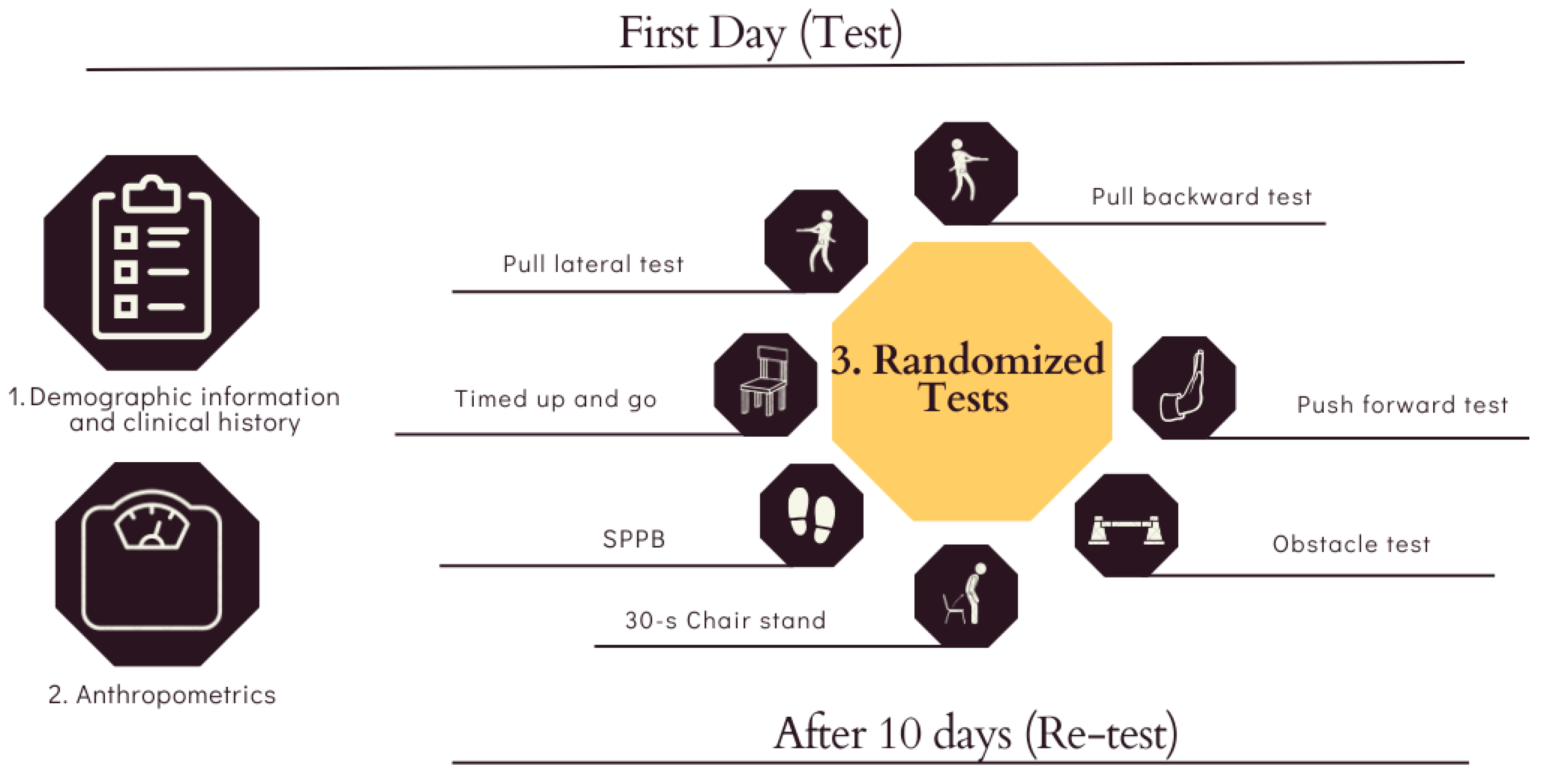
- Obstacle test: Participants walked 7.5 m at a comfortable pace. A rectangular obstacle (40 cm long × 14 cm high × 8 cm wide) was placed midway along the walkway. Scoring (1–3 points): 1 = long step strategy used effectively to clear the obstacle (safest); 2 = short step strategy used to clear the obstacle; 3 = failed execution of the chosen strategy (e.g., tripping and interrupting gait). Prior studies suggest that when reaction time permits, a lowering/long step strategy is the safer option [23,38,39]; therefore, the lowest score was assigned to the safest strategy.
- Push forward test: Standing with both feet hip-width apart, participants received a manual forward perturbation from the evaluator and were instructed to recover balance and return to the initial position. Scoring (1–2 points): 1 = single forward step longer than a usual step; 2 = multiple steps. Multiple steps to recover balance are associated with increased fall risk [40]; thus, the single-step response was scored as safer. The push was applied at a random time between 0 and 30 seconds to minimize anticipation. In addition, the evaluator applied the push form an approximately 4 cm distance to the upper back, delivered quickly, strongly and sharply.
- Pull backward test: Standing with both feet hip-width apart, participants received a manual backward perturbation (pull). Scoring (1–2 points): 1 = single backward step longer than a usual step; 2 = multiple steps. The pull was applied at a random time between 0 and 30 seconds to minimize anticipation. In addition, the evaluator performed a 4 cm pull at hip level using a rope, at maximal velocity and strongly.
- Pull lateral test (right and left): Standing with both feet hip-width apart, participants received manual lateral pulls to the right and left in random order. Scoring (1–4 points): 1 = loaded sidestep; 2 = unloaded sidestep or medial sidestep; 3 = crossover step; 4 = limb-collision compensatory step. Older adults more often exhibit unloaded or medial sidesteps, multiple steps, and collision between feet than younger adults [23,41,42]; these strategies are generally less efficient and may increase instability and collision risk [23,42]. Accordingly, the loaded sidestep received the safest score (1). Each pull was applied at a random time between 0 and 30 seconds to minimize anticipation. In addition, the evaluator performed a 4 cm pull at hip level using a rope, at maximal velocity and strongly.
2.4. Timing and Repetition Measurement
2.5. Statistical Analysis
3. Results
3.1. Participants
3.2. Test–Retest Reliability of Perturbations Tests
3.3. Correlations
4. Discussion
5. Practical and Clinical Implications
6. Conclusions
Supplementary Materials
Author Contributions
Funding
Institutional Review Board Statement
Informed Consent Statement
Data Availability Statement
Acknowledgments
Conflicts of Interest
References
- Una Población Que Envejece Exige Más Pensiones y Más Salud. Available online: https://news.un.org/es/story/2023/01/1517857#:~:text=En2021%2C761millonesde,a1600millonesen2050 (accessed on 18 June 2025).
- INE. Pirámide de La Población Empadronada En España. 2022. Available online: http://www.ine.es/dyngs/INEbase/es/operacion.htm?c=Estadistica_C&cid=1254736145519&menu=ultiDatos&idp=1254735576715 (accessed on 18 June 2025).
- Salari, N.; Darvishi, N.; Ahmadipanah, M.; Shohaimi, S.; Mohammadi, M. Global Prevalence of Falls in the Older Adults: A Comprehensive Systematic Review and Meta-Analysis. J. Orthop. Surg. Res. 2022, 17, 334. [Google Scholar] [CrossRef] [Scilit]
- Xiong, W.; Wang, D.; Ren, W.; Liu, X.; Wen, R.; Luo, Y. The Global Prevalence of and Risk Factors for Fear of Falling among Older Adults: A Systematic Review and Meta-Analysis. BMC Geriatr. 2024, 24, 321. [Google Scholar] [CrossRef] [Scilit]
- Xu, Q.; Ou, X.; Li, J. The Risk of Falls among the Aging Population: A Systematic Review and Meta-Analysis. Front. Public Health 2022, 10, 902599. [Google Scholar] [CrossRef] [Scilit]
- Vaishya, R.; Vaish, A. Falls in Older Adults Are Serious. Indian J. Orthop. 2020, 54, 69–74. [Google Scholar] [CrossRef] [Scilit] [PubMed]
- Haddad, Y.K.; Miller, G.F.; Kakara, R.; Florence, C.; Bergen, G.; Burns, E.R.; Atherly, A. Healthcare Spending for Non-Fatal Falls among Older Adults, USA. Inj. Prev. 2024, 30, 272–276. [Google Scholar] [CrossRef] [Scilit] [PubMed]
- Stergiou, N. Biomechanics and Gait Analysis; Academix Press: Omaha, NE, USA, 2020. [Google Scholar]
- Bridenbaugh, S.A.; Kressig, R.W. Laboratory Review: The Role of Gait Analysis in Seniors’ Mobility and Fall Prevention. Gerontology 2011, 57, 256–264. [Google Scholar] [CrossRef] [Scilit] [PubMed]
- Lesinski, M.; Hortobágyi, T.; Muehlbauer, T.; Gollhofer, A.; Granacher, U. Effects of Balance Training on Balance Performance in Healthy Older Adults: A Systematic Review and Meta-Analysis. Sports Med. 2015, 45, 1721–1738. [Google Scholar] [CrossRef] [Scilit]
- Balachandran, A.T.; Steele, J.; Angielczyk, D.; Belio, M.; Schoenfeld, B.J.; Quiles, N.; Askin, N.; Abou-Setta, A.M. Comparison of Power Training vs Traditional Strength Training on Physical Function in Older Adults: A Systematic Review and Meta-Analysis. JAMA Netw. Open 2022, 5, e2211623. [Google Scholar] [CrossRef] [Scilit]
- Guralnik, J.M.; Simonsick, E.M.; Ferrucci, L.; Glynn, R.J.; Berkman, L.F.; Blazer, D.G.; Scherr, P.A.; Wallace, R.B. A Short Physical Performance Battery Assessing Lower Extremity Function: Association with Self-Reported Disability and Prediction of Mortality and Nursing Home Admission. J. Gerontol. 1994, 49, M85–M94. [Google Scholar] [CrossRef] [Scilit]
- Barry, E.; Galvin, R.; Keogh, C.; Horgan, F.; Fahey, T. Is the Timed Up and Go Test a Useful Predictor of Risk of Falls in Community Dwelling Older Adults: A Systematic Review and Meta- Analysis. BMC Geriatr. 2014, 14, 14. [Google Scholar] [CrossRef] [Scilit]
- Jones, C.J.; Rikli, R.E.; Beam, W.C. A 30-s Chair-Stand Test as a Measure of Lower Body Strength in Community-Residing Older Adults. Res. Q. Exerc. Sport 1999, 70, 113–119. [Google Scholar] [CrossRef] [Scilit]
- Lichtenstein, E.; Faude, O.; Zubler, A.; Roth, R.; Zahner, L.; Rössler, R.; Hinrichs, T.; Van Dieën, J.H.; Donath, L. Validity and Reliability of a Novel Integrative Motor Performance Testing Course for Seniors: The “Agility Challenge for the Elderly (ACE)”. Front. Physiol. 2019, 10, 44. [Google Scholar] [CrossRef] [Scilit]
- Omaña, H.; Bezaire, K.; Brady, K.; Davies, J.; Louwagie, N.; Power, S.; Santin, S.; Hunter, S.W. Functional Reach Test, Single-Leg Stance Test, and Tinetti Performance-Oriented Mobility Assessment for the Prediction of Falls in Older Adults: A Systematic Review. Phys. Ther. 2021, 101, pzab173. [Google Scholar] [CrossRef] [Scilit]
- Hezel, N.; Buchner, T.; Becker, C.; Bauer, J.M.; Sloot, L.H.; Steib, S.; Werner, C. The Stepping Threshold Test for Assessing Reactive Balance Discriminates between Older Adult Fallers and Non-Fallers. Front. Sport. Act. Living 2024, 6, 1462177. [Google Scholar] [CrossRef] [Scilit]
- Mansfield, A.; Peters, A.L.; Liu, B.A.; Maki, B.E. Effect of a Perturbation-Based Balance Training Program on Compensatory Stepping and Grasping Reactions in Older Adults: A Randomized Controlled Trial. Phys. Ther. 2010, 90, 476–491. [Google Scholar] [CrossRef] [Scilit]
- Borrelli, J.; Creath, R.; Gray, V.; Rogers, M. Untangling Biomechanical Differences in Perturbation-Induced Stepping Strategies for Lateral Balance Stability in Older Individuals. J. Biomech. 2021, 114, 110161. [Google Scholar] [CrossRef] [Scilit] [PubMed]
- Allin, L.J.; Brolinson, P.G.; Beach, B.M.; Kim, S.; Nussbaum, M.A.; Roberto, K.A.; Madigan, M.L. Perturbation-Based Balance Training Targeting Both Slip- and Trip-Induced Falls among Older Adults: A Randomized Controlled Trial. BMC Geriatr. 2020, 20, 205. [Google Scholar] [CrossRef] [Scilit] [PubMed]
- Rieger, M.M.; Papegaaij, S.; Pijnappels, M.; Steenbrink, F.; van Dieën, J.H. Transfer and Retention Effects of Gait Training with Anterior-Posterior Perturbations to Postural Responses after Medio-Lateral Gait Perturbations in Older Adults. Clin. Biomech. 2020, 75, 104988. [Google Scholar] [CrossRef] [Scilit] [PubMed]
- Rogers, M.W.; Creath, R.A.; Gray, V.; Abarro, J.; McCombe Waller, S.; Beamer, B.A.; Sorkin, J.D. Comparison of Lateral Perturbation-Induced Step Training and Hip Muscle Strengthening Exercise on Balance and Falls in Community-Dwelling Older Adults: A Blinded Randomized Controlled Trial. J. Gerontol. Ser. A 2021, 76, e194–e202. [Google Scholar] [CrossRef] [Scilit]
- Melo-Alonso, M.; Murillo-Garcia, A.; Leon-Llamas, J.L.; Villafaina, S.; Gomez-Alvaro, M.C.; Morcillo-Parras, F.A.; Gusi, N. Classification and Definitions of Compensatory Protective Step Strategies in Older Adults: A Scoping Review. J. Clin. Med. 2024, 13, 635. [Google Scholar] [CrossRef] [Scilit]
- Madigan, M.L.; Aviles, J.; Allin, L.J.; Nussbaum, M.A.; Alexander, N.B. A Reactive Balance Rating Method That Correlates with Kinematics after Trip-like Perturbations on a Treadmill and Fall Risk among Residents of Older Adult Congregate Housing. J. Gerontol. Ser. A Biol. Sci. Med. Sci. 2018, 73, 1222–1228. [Google Scholar] [CrossRef] [Scilit]
- Mahboubi Anarjan, P.; Monfared, H.H.; Arslan, N.B.; Kazak, C.; Bikas, R. Analysis of the International Physical Guidelines for Data Processing and Activity Questionnaire (IPAQ)—Short and Long Forms. Acta Crystallogr. Sect. E Struct. Rep. Online 2005, 68, o2698. [Google Scholar] [CrossRef] [Scilit]
- Nasreddine, Z.S.; Phillips, N.A.; Bédirian, V.; Charbonneau, S.; Whitehead, V.; Collin, I.; Cummings, J.L.; Chertkow, H. The Montreal Cognitive Assessment, MoCA: A Brief Screening Tool for Mild Cognitive Impairment. J. Am. Geriatr. Soc. 2005, 53, 695–699. [Google Scholar] [CrossRef] [Scilit]
- Murillo-Garcia, A.; Leon-Llamas, J.L.; Villafaina, S.; Rohlfs-Dominguez, P.; Gusi, N. MoCA vs. MMSE of Fibromyalgia Patients: The Possible Role of Dual-Task Tests in Detecting Cognitive Impairment. J. Clin. Med. 2021, 10, 125. [Google Scholar] [CrossRef] [Scilit] [PubMed]
- Carson, N.; Leach, L.; Murphy, K.J. A Re-Examination of Montreal Cognitive Assessment (MoCA) Cutoff Scores. Int. J. Geriatr. Psychiatry 2017, 33, 379–388. [Google Scholar] [CrossRef] [Scilit] [PubMed]
- Hernandez, G.; Garin, O.; Pardo, Y.; Vilagut, G.; Pont, À.; Suárez, M.; Neira, M.; Rajmil, L.; Gorostiza, I.; Ramallo-Fariña, Y.; et al. Validity of the EQ–5D–5L and Reference Norms for the Spanish Population. Qual. Life Res. 2018, 27, 2337–2348. [Google Scholar] [CrossRef] [Scilit] [PubMed]
- Lomas-Vega, R.; Hita-Contreras, F.; Mendoza, N.; Martínez-Amat, A. Cross-Cultural Adaptation and Validation of the Falls Efficacy Scale International in Spanish Postmenopausal Women. Menopause 2012, 19, 904–908. [Google Scholar] [CrossRef] [Scilit]
- Delbaere, K.; Close, J.C.T.; Mikolaizak, A.S.; Sachdev, P.S.; Brodaty, H.; Lord, S.R. The Falls Efficacy Scale International (FES-I). A Comprehensive Longitudinal Validation Study. Age Ageing 2010, 39, 210–216. [Google Scholar] [CrossRef] [Scilit]
- Yardley, L.; Beyer, N.; Hauer, K.; Kempen, G.; Piot-Ziegler, C.; Todd, C. Development and Initial Validation of the Falls Efficacy Scale-International (FES-I). Age Ageing 2005, 34, 614–619. [Google Scholar] [CrossRef] [Scilit]
- Murillo-Garcia, A.; Villafaina, S.; Leon-Llamas, J.L.; Sánchez-Gómez, J.; Domínguez-Muñoz, F.J.; Collado-Mateo, D.; Gusi, N. Mobility Assessment under Dual Task Conditions in Women with Fibromyalgia: A Test-Retest Reliability Study. PM R 2021, 13, 66–72. [Google Scholar] [CrossRef] [Scilit]
- Leon-Llamas, J.L.; Villafaina, S.; Murillo-Garcia, A.; Collado-Mateo, D.; Domínguez-Muñoz, F.J.; Sánchez-Gómez, J.; Gusi, N. Strength Assessment Under Dual Task Conditions in Women with Fibromyalgia: A Test–Retest Reliability Study. Int. J. Environ. Res. Public Health 2019, 16, 4971. [Google Scholar] [CrossRef] [Scilit] [PubMed]
- Podsiadlo, D.; Richardson, S. The Timed Up and Go: A Test of Basic Functional Mobility for Frail Elderly Persons. J. Am. Geriatr. Soc. 1991, 39, 142–148. [Google Scholar] [CrossRef] [Scilit]
- Collantes, M.B.; García, C.L.A.; Fonseca, A.A.; Patiño, J.P.; Monsalve, A.; Gómez, E. Reproducibilidad de Las Pruebas Arm Curl y Chair Stand Para Evaluar Resistencia Muscular En Población Adulta Mayor. Rev. Cienc. La Salud 2012, 10, 15–29. [Google Scholar]
- Melo-Alonso, M.; Leon-Llamas, J.L.; Villafaina, S.; Gomez-Alvaro, M.C.; Olivares, P.R.; Padilla-Moledo, C.; Gusi, N. Interdisciplinary Expert Agreement on Group and Definitions for Compensatory Protective Step Strategies to Prevent Falls: A e-Delphi Method Study. Braz. J. Phys. Ther. 2025, 29, 101227. [Google Scholar] [CrossRef] [Scilit]
- Pavol, M.J.; Owings, T.M.; Foley, K.T.; Grabiner, M.D. The Sex and Age of Older Adults Influence the Outcome of Induced Trips. J. Gerontol. A. Biol. Sci. Med. Sci. 1999, 54, M103–M108. [Google Scholar] [CrossRef] [Scilit]
- Chen, H.C.; Ashton-Miller, J.; Alexander, N.; Schultz, A. Age Effects on Strategies Used to Avoid Obstacles. Gait Posture 1994, 2, 139–146. [Google Scholar] [CrossRef] [Scilit]
- Te, B.; Komisar, V.; Aguiar, O.M.; Shishov, N.; Robinovitch, S.N. Compensatory Stepping Responses during Real-Life Falls in Older Adults. Gait Posture 2023, 100, 276–283. [Google Scholar] [CrossRef] [Scilit] [PubMed]
- Batcir, S.; Shani, G.; Shapiro, A.; Alexander, N.; Melzer, I. The Kinematics and Strategies of Recovery Steps during Lateral Losses of Balance in Standing at Different Perturbation Magnitudes in Older Adults with Varying History of Falls. BMC Geriatr. 2020, 20, 249. [Google Scholar] [CrossRef] [Scilit]
- Mille, M.-L.; Johnson, M.E.; Martinez, K.M.; Rogers, M.W. Age-Dependent Differences in Lateral Balance Recovery through Protective Stepping. Clin. Biomech. 2005, 20, 607–616. [Google Scholar] [CrossRef] [Scilit] [PubMed]
- Collado-Mateo, D.; Domínguez-Muñoz, F.J.; Adsuar, J.C.; Merellano-Navarro, E.; Olivares, P.R.; Gusi, N. Reliability of the Timed up and Go Test in Fibromyalgia. Rehabil. Nurs. 2018, 43, 35–39. [Google Scholar] [CrossRef] [Scilit]
- Li, M.; Gao, Q.; Yu, T. Kappa Statistic Considerations in Evaluating Inter-Rater Reliability between Two Raters: Which, When and Context Matters. BMC Cancer 2023, 23, 799. [Google Scholar] [CrossRef] [Scilit]
- Portney, L.G. Foundations of Clinical Research: Applications to Evidence-Based Practice, 4th ed.; F.A. Davis Company: Philadelphia, PA, USA, 2020. [Google Scholar]
- Schober, P.; Boer, C.; Schwarte, L.A. Correlation Coefficients: Appropriate Use and Interpretation. Anesth. Analg. 2018, 126, 1763–1768. [Google Scholar] [CrossRef] [Scilit]
- Wang, S.; Nguyen, T.K.; Bhatt, T. Trip-Related Fall Risk Prediction Based on Gait Pattern in Healthy Older Adults: A Machine-Learning Approach. Sensors 2023, 23, 5536. [Google Scholar] [CrossRef] [Scilit] [PubMed]
- Pavol, M.J.; Owings, T.M.; Foley, K.T.; Grabiner, M.D. Mechanisms Leading to a Fall from an Induced Trip in Healthy Older Adults. J. Gerontol. Ser. A Biol. Sci. Med. Sci. 2001, 56, 428–437. [Google Scholar] [CrossRef] [Scilit] [PubMed]
- Owings, T.M.; Pavol, M.J.; Grabiner, M.D. Mechanisms of Failed Recovery Following Postural Perturbations on a Motorized Treadmill Mimic Those Associated with an Actual Forward Trip. Clin. Biomech. 2001, 16, 813–819. [Google Scholar] [CrossRef] [Scilit]
- Shih, H.T.; Gregor, R.; Lee, S.P. Description, Reliability and Utility of a Groundreaction- Force Triggered Protocol for Precise Delivery of Unilateral Trip-like Perturbations during Gait. PLoS ONE 2023, 18, e0284384. [Google Scholar] [CrossRef] [Scilit] [PubMed]
- Chippendale, T.; Raveis, V. Knowledge, Behavioral Practices, and Experiences of Outdoor Fallers: Implications for Prevention Programs. Arch. Gerontol. Geriatr. 2017, 72, 19–24. [Google Scholar] [CrossRef] [Scilit]
- Eng, J.J.; Winter, D.A.; Patla, A.E. Strategies for Recovery from a Trip in Early and Late Swing during Human Walking. Exp. Brain Res. 1994, 102, 339–349. [Google Scholar] [CrossRef] [Scilit]
- Singer, M.L.; Smith, L.K.; Dibble, L.E.; Foreman, K.B. Age-Related Difference in Postural Control during Recovery from Posterior and Anterior Perturbations. Anat. Rec. 2015, 298, 346–353. [Google Scholar] [CrossRef] [Scilit]
- Thelen, D.G.; Wojcik, L.A.; Schultz, A.B.; Ashton-Miller, J.A.; Alexander, N.B. Age Differences in Using a Rapid Step to Regain Balance during a Forward Fall. J. Gerontol. Ser. A Biol. Sci. Med. Sci. 1997, 52, 8–13. [Google Scholar] [CrossRef] [Scilit]
- Mille, M.-L.; Johnson-Hilliard, M.; Martinez, K.M.; Zhang, Y.; Edwards, B.J.; Rogers, M.W. One Step, Two Steps, Three Steps More... Directional Vulnerability to Falls in Community-Dwelling Older People. J. Gerontol. A Biol. Sci. Med. Sci. 2013, 68, 1540–1548. [Google Scholar] [CrossRef] [Scilit]
- Lee, P.-Y.; Gadareh, K.; Bronstein, A.M. Forward-Backward Postural Protective Stepping Responses in Young and Elderly Adults. Hum. Mov. Sci. 2014, 34, 137–146. [Google Scholar] [CrossRef] [Scilit]
- Batcir, S.; Shani, G.; Shapiro, A.; Melzer, I. Characteristics of Step Responses Following Varying Magnitudes of Unexpected Lateral Perturbations during Standing among Older People-a Cross-Sectional Laboratory-Based Study. BMC Geriatr. 2022, 22, 400. [Google Scholar] [CrossRef] [Scilit]
- Pidcoe, P.E.; Rogers, M.W. A Closed-Loop Stepper Motor Waist-Pull System for Inducing Protective Stepping in Humans. J. Biomech. 1998, 31, 377–381. [Google Scholar] [CrossRef] [Scilit]
- Dijkstra, B.W.; Horak, F.B.; Kamsma, Y.P.T.; Peterson, D.S. Older Adults Can Improve Compensatory Stepping with Repeated Postural Perturbations. Front. Aging Neurosci. 2015, 7, 201. [Google Scholar] [CrossRef] [Scilit] [PubMed]
- Kannan, L.; Pitts, J.; Szturm, T.; Purohit, R.; Bhatt, T. Perturbation-Based Dual Task Assessment in Older Adults with Mild Cognitive Impairment. Front. Rehabil. Sci. 2024, 5, 1384582. [Google Scholar] [CrossRef] [Scilit]
- Tangen, G.G.; Engedal, K.; Bergland, A.; Moger, T.A.; Mengshoel, A.M. Relationships between Balance and Cognition in Patients with Subjective Cognitive Impairment, Mild Cognitive Impairment, and Alzheimer Disease. Phys. Ther. 2014, 94, 1123–1134. [Google Scholar] [CrossRef] [Scilit]
- McCrum, C.; Bhatt, T.S.; Gerards, M.H.G.; Karamanidis, K.; Rogers, M.W.; Lord, S.R.; Okubo, Y. Perturbation-Based Balance Training: Principles, Mechanisms and Implementation in Clinical Practice. Front. Sport. Act. Living 2022, 4, 1015394. [Google Scholar] [CrossRef] [Scilit] [PubMed]
- Hasegawa, N.; Tanaka, S.; Mani, H.; Inoue, T.; Wang, Y.; Watanabe, K.; Asaka, T. Adaptation of the Compensatory Stepping Response Following Predictable and Unpredictable Perturbation Training. Front. Hum. Neurosci. 2021, 15, 674960. [Google Scholar] [CrossRef] [Scilit] [PubMed]
- Borrelli, J.; Creath, R.A.; Pizac, D.; Hsiao, H.; Sanders, O.P.; Rogers, M.W. Perturbation-Evoked Lateral Steps in Older Adults: Why Take Two Steps When One Will Do? Clin. Biomech. 2019, 63, 41–47. [Google Scholar] [CrossRef] [Scilit]
- Carbonneau, E.; Smeesters, C. Effects of Age and Lean Direction on the Threshold of Single-Step Balance Recovery in Younger, Middle-Aged and Older Adults. Gait Posture 2014, 39, 365–371. [Google Scholar] [CrossRef] [Scilit] [PubMed]
- Yungher, D.A.; Morgia, J.; Bair, W.-N.; Inacio, M.; Beamer, B.A.; Prettyman, M.G.; Rogers, M.W. Short-Term Changes in Protective Stepping for Lateral Balance Recovery in Older Adults. Clin. Biomech. 2012, 27, 151–157. [Google Scholar] [CrossRef] [Scilit] [PubMed]


| N-I | I | |||
|---|---|---|---|---|
| Variables | Men (n = 5) M (SD) | Women (n = 39) M (SD) | Men (n = 10) M (SD) | Women (n = 3) M (SD) |
| Age (years) | 71.80 (4.92) | 70.33 (4.82) | 77.60 (8.46) | 79.67 (8.33) |
| Height (m) | 1.66 (0.04) | 1.56 (0.09) | 1.66 (0.09) | 1.53 (0.03) |
| Weight (kg) | 76.24 (5.48) | 71 (13.05) | 78.90 (17.23) | 75.50 (16.68) |
| BMI (kg/m2) | 27.78 (2.37) | 29.86 (5.68) | 28.35 (4.86) | 30.70 (4.75) |
| Falls in the last six months | 0.20 (0.45) | 0.31 (0.66) | 0.40 (0.52) | 0.33 (0.58) |
| Falls in the last year | 1 (2.24) | 0.42 (0.86) | 0.20 (0.42) | 0.33 (0.58) |
| FES-I | 18 (1.22) | 22.87 (4.91) | 28.36 (8.94) | 28.63 (1.29) |
| MoCA | 21.40 (3.21) | 23 (5.20) | 15.20 (6.70) | 11.67 (7.10) |
| IPAQ Classification | ||||
| Intense physical activity | 1 (20%) | 15 (38.5%) | - | - |
| Moderate physical activity | 4 (80%) | 22 (56.4%) | 7 (70%) | 2 (66.7%) |
| Low physical activity | - | 2 (5.1%) | 3 (30%) | 1 (33.3%) |
| TUG (s) | 7.03 (1.68) | 7.89 (1.59) | 20.96 (10.66) | 18.14 (4.17) |
| 30s Chair (reps) | 11.40 (1.34) | 12.44 (2.56) | 4.80 (1.69) | 8.33 (4.04) |
| SPPB (Pts) | 11 (0.71) | 11.08 (1.11) | 7 (1.25) | 5.33 (1.53) |
| I (n = 13) | N-I (n = 44) | Total (n = 57) | |||||||
|---|---|---|---|---|---|---|---|---|---|
(95% CI) | (95% CI) | ICC (95% CI) | (95% CI) | (95% CI) | ICC (95% CI) | (95% CI) | (95% CI) | ICC (95% CI) | |
| Obstacle test | 0.195 (−0.254–0.644) | 0.182 (−0.400–0.763) | 0.183 (−0.383–0.652) | 0.375 (0.142–0.609) | 0.375 (0.142–0.609) | 0.500 (0.242–0.692) | 0.350 (0.144–0.555) | 0.443 (0.229–0.656) | 0.444 (0.210–0.630) |
| Push forward test | 0.418 (−0.124–0.960) | 0.418 (−0.124–0.960) | 0.424 (−0.140–0.780) | 0.500 (0.257–0.743) | 0.495 (0.285–0.705) | 0.527 (0.275–0.711) | 0.518 (0.307–0.729) | 0.518 (0.307–0.729) | 0.539 (0.326–0.700) |
| Pull backward test | 1 (1–1) | 1 (1–1) | 0.000 (−0.532–0.532) | 0.488 (0.190–0.787) | 0.488 (0.190–0.787) | 0.500 (0.242–0.692) | 0.438 (0.146–0.729) | 0.438 (0.146–0.729) | 0.440 (0.204–0.627) |
| Pull laterally left test | 0.086 (−0.130–0.303) | 0.185 (−0.168–0.538) | 0.308 (−0.269–0.722) | 0.058 (−0.064–0.179) | 0.242 (0.068–0.416) | 0.366 (0.081–0.596) | 0.067 (−0.042–0.176) | 0.239 (0.086–0.392) | 0.365 (0.118–0.570) |
| Pull laterally right test | 0.373 (−0.082–0.829) | 0.241 (−0.433–0.915) | 0.256 (−0.320–0.819) | 0.267 (0.054–0.481) | 0.270 (−0.015–0.554) | 0.291 (0.003–0.539) | 0.285 (0.080–0.490) | 0.253 (−0.036–0.543) | 0.260 (0.002–0.486) |
| MoCA ≤ 23 (n = 20) | MoCA > 23 (n = 24) | |||||
|---|---|---|---|---|---|---|
(95% CI) | (95% CI) | ICC (95% CI) | (95% CI) | (95% CI) | ICC (95% CI) | |
| Obstacle test | 0.333 (0.001–0.665) | 0.463 (0.185–0.741) | 0.527 (0.122–0.781) | 0.281 (−0.029–0.592) | 0.378 (0.089–0.668) | 0.382 (−0.016–0.676) |
| Push forward test | 0.529 (0.135–0.924) | 0.529 (0.135–0.924) | 0.542 (0.143–0.790) | 0.440 (0.118–0.762) | 0.440 (0.118–0.762) | 0.480 (0.104–0.736) |
| Pull backward test | 0.294 (−0.141–0.730) | 0.294 (−0.141–0.730) | 0.301 (−0.151–0.649) | 0.704 (0.328–1.079) | 0.704 (0.328–1.079) | 0.722 (0.456–0.869) |
| Pull laterally left test | 0.079 (−0.032–0.190) | 0.183 (−0.056–0.423) | 0.331 (−0.119–0.668) | 0.051 (−0.143–0.244) | 0.298 (0.074–0.522) | 0.400 (0.005–0.687) |
| Pull laterally right test | 0.237 (−0.041–0.515) | 0.191 (−0.166–0.548) | 0.231 (−0.224–0.604) | 0.269 (−0.026–0.562) | 0.345 (0.000–0.690) | 0.349 (−0.054–0.655) |
| Obstacle Test | Push Forward Test | Pull Backward Test | Pull Laterally Left Test | Pull Laterally Right Test | |||||||||||
|---|---|---|---|---|---|---|---|---|---|---|---|---|---|---|---|
| Variables | I (n = 13) p-Value | N-I (n = 44) p-Value | Total (n = 57) p-Value | I (n = 13) p-Value | N-I (n = 44) p-Value | Total (n = 57) p-Value | I (n = 13) p-Value | N-I (n = 44) p-Value | Total (n = 57) p-Value | I (n = 13) p-Value | N-I (n = 44) p-Value | Total (n = 57) p-Value | I (n = 13) p-Value | N-I (n = 44) p-Value | Total (n = 57) p-Value |
| TUG-T | 0.214 | 0.071 | 0.005 * | 0.187 | 0.644 | 0.525 | 0.853 | 0.675 | 0.649 | 0.175 | 0.385 | 0.840 | 0.472 | 0.374 | 0.557 |
| TUG-R | 0.730 | 0.002 * | 0.002 * | 0.337 | 0.287 | 0.429 | - | 0.044 * | 0.002 * | 0.054 | 0.559 | 0.184 | 0.554 | 0.161 | 0.012 * |
| 30s Chair-T | 0.884 | 0.258 | 0.037 * | 1.00 | 0.709 | 0.210 | 0.556 | 0.988 | 0.901 | 0.293 | 0.981 | 0.451 | 00.674 | 0.177 | 0.414 |
| 30s Chair-R | 0.842 | 0.171 | 0.171 | 0.30 | 0.450 | 0.317 | - | 0.536 | 0.044 * | 0.823 | 0.704 | 0.676 | 0.866 | 0.250 | 0.026 * |
| SPPB-T | 0.393 | 0.003 * | 0.000 * | 0.199 | 0.053 | 0.935 | 0.706 | 0.847 | 0.789 | 0.462 | 0.621 | 0.316 | 0.248 | 0.025 * | 0.196 |
| SPPB-R | 0.103 | 0.018 * | 0.018 * | 0.104 | 0.938 | 0.169 | - | 0.095 | 0.005 * | 0.343 | 0.707 | 0.544 | 0.659 | 0.990 | 0.124 |
Disclaimer/Publisher’s Note: The statements, opinions and data contained in all publications are solely those of the individual author(s) and contributor(s) and not of MDPI and/or the editor(s). MDPI and/or the editor(s) disclaim responsibility for any injury to people or property resulting from any ideas, methods, instructions or products referred to in the content. |
© 2025 by the authors. Licensee MDPI, Basel, Switzerland. This article is an open access article distributed under the terms and conditions of the Creative Commons Attribution (CC BY) license (https://creativecommons.org/licenses/by/4.0/).
Share and Cite
Melo-Alonso, M.; Leon-Llamas, J.L.; Villafaina, S.; Fuentes-García, J.P.; Domínguez-Muñoz, F.J.; Gusi, N. Evaluating the Test–Retest Reliability of Five Low-Cost, Perturbation-Based Functional Tests for Balance Recovery in Older Adults. Sports 2025, 13, 375. https://doi.org/10.3390/sports13110375
Melo-Alonso M, Leon-Llamas JL, Villafaina S, Fuentes-García JP, Domínguez-Muñoz FJ, Gusi N. Evaluating the Test–Retest Reliability of Five Low-Cost, Perturbation-Based Functional Tests for Balance Recovery in Older Adults. Sports. 2025; 13(11):375. https://doi.org/10.3390/sports13110375
Chicago/Turabian StyleMelo-Alonso, Maria, Juan Luis Leon-Llamas, Santos Villafaina, Juan Pedro Fuentes-García, Francisco Javier Domínguez-Muñoz, and Narcis Gusi. 2025. "Evaluating the Test–Retest Reliability of Five Low-Cost, Perturbation-Based Functional Tests for Balance Recovery in Older Adults" Sports 13, no. 11: 375. https://doi.org/10.3390/sports13110375
APA StyleMelo-Alonso, M., Leon-Llamas, J. L., Villafaina, S., Fuentes-García, J. P., Domínguez-Muñoz, F. J., & Gusi, N. (2025). Evaluating the Test–Retest Reliability of Five Low-Cost, Perturbation-Based Functional Tests for Balance Recovery in Older Adults. Sports, 13(11), 375. https://doi.org/10.3390/sports13110375