Two New Species of the Genus Philanthaxia Deyrolle, 1864, from Hainan Province, China (Coleoptera, Buprestidae, Thomassetiini) †


Simple Summary
Abstract
1. Introduction
2. Materials and Methods
2.1. Insect Collection and Image Processing
2.2. DNA Extraction and Sequence Analysis
3. Results
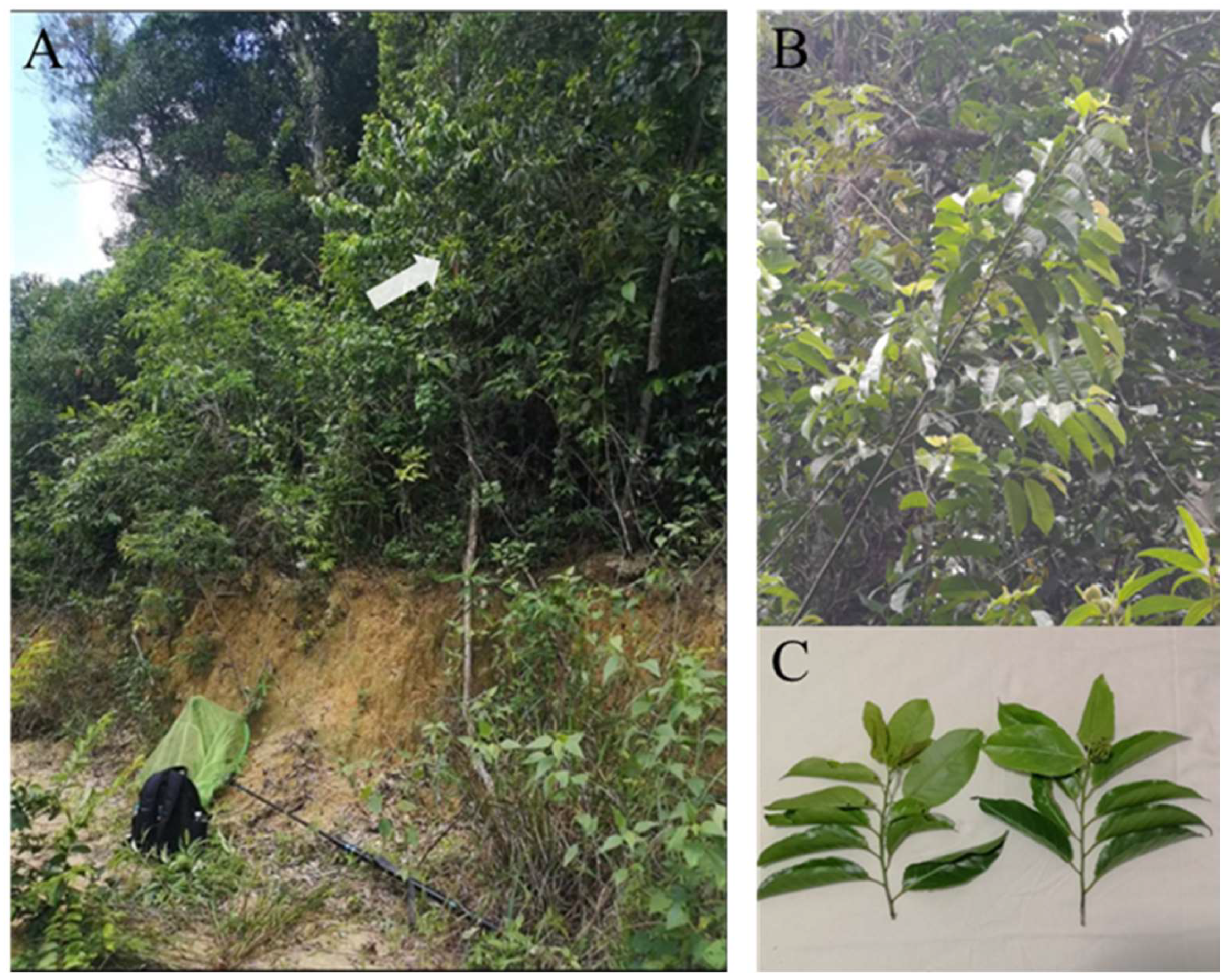
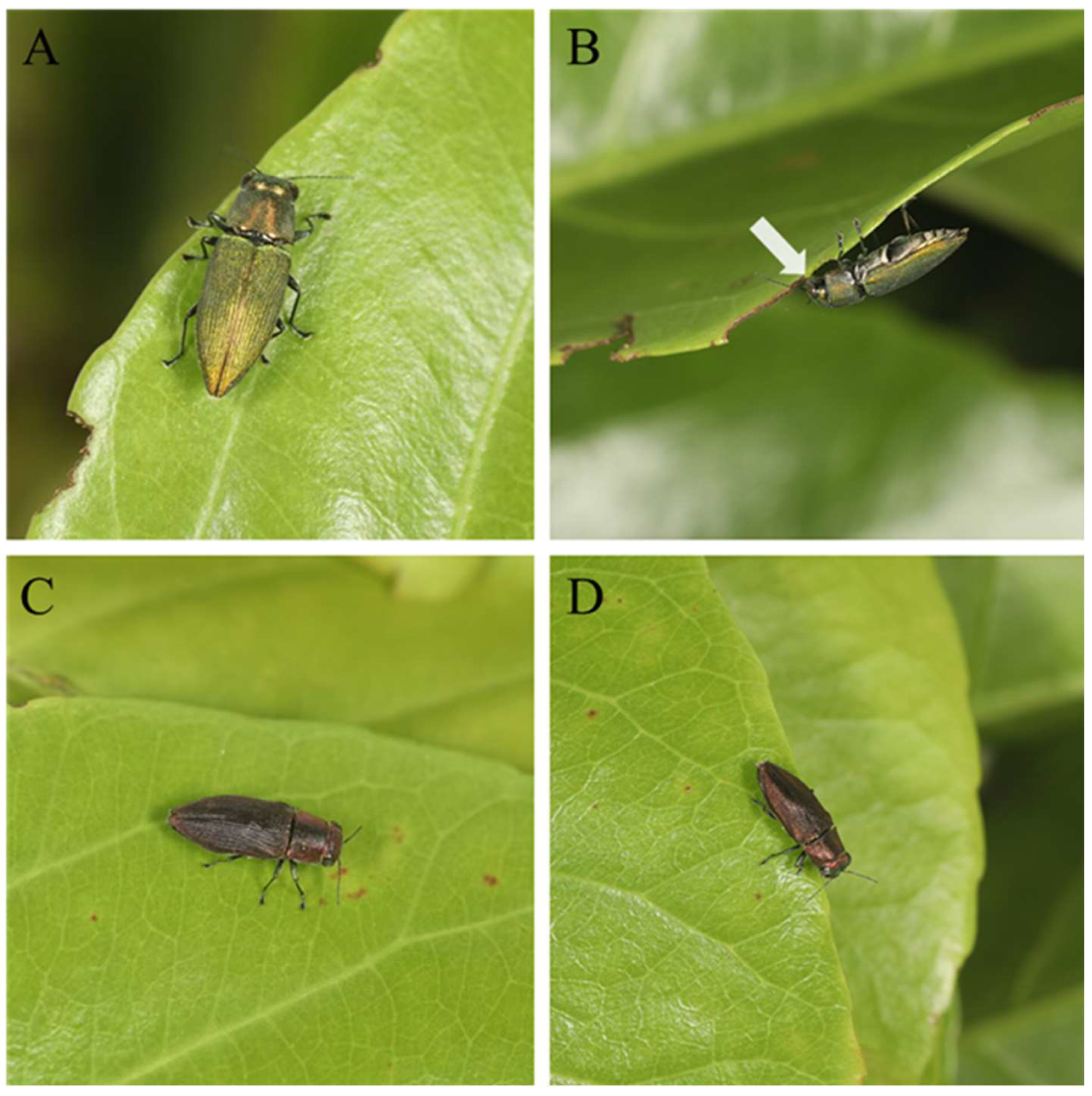
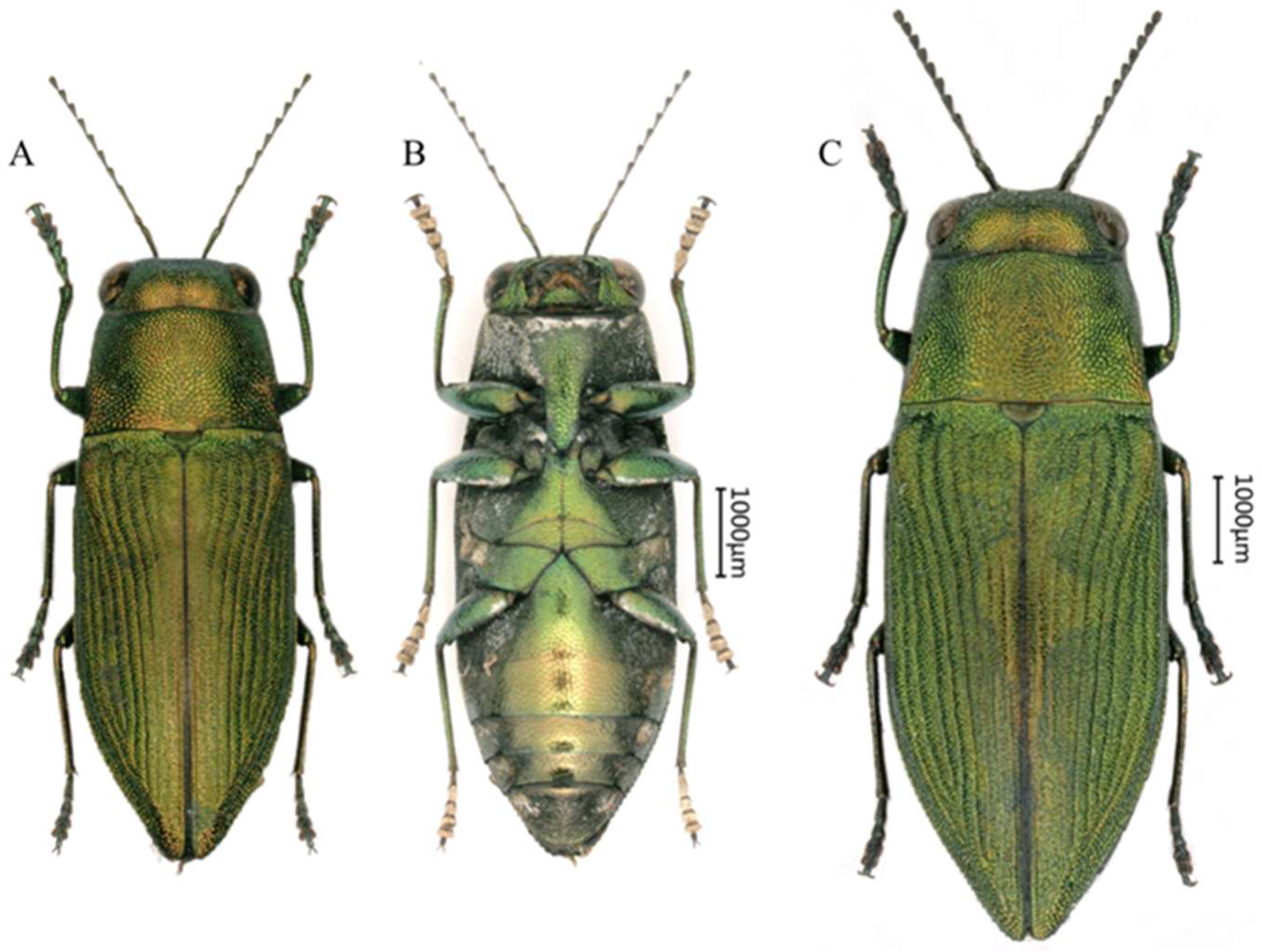
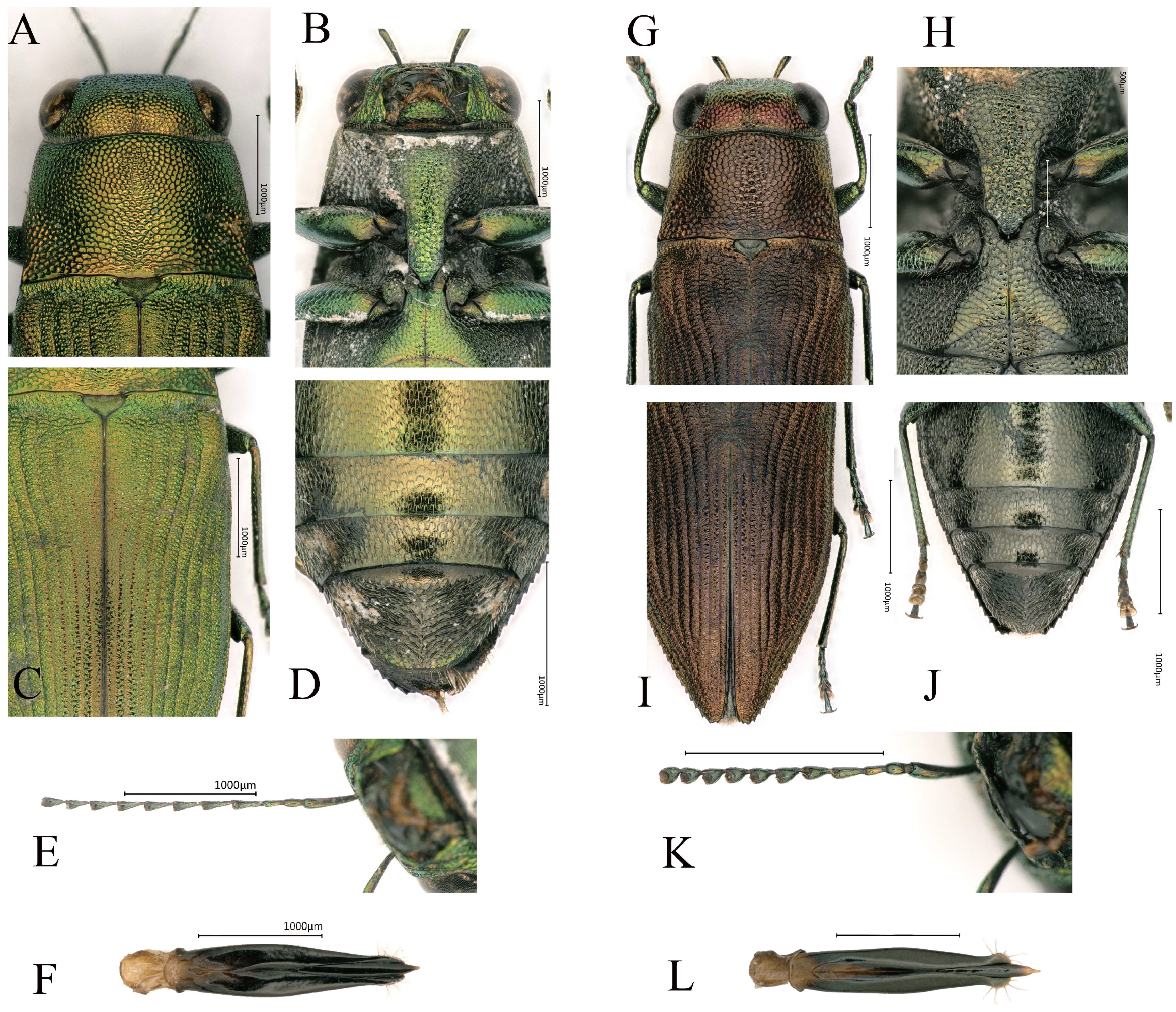
3.1. Philanthaxia longicornis Ni & Song, sp. nov.
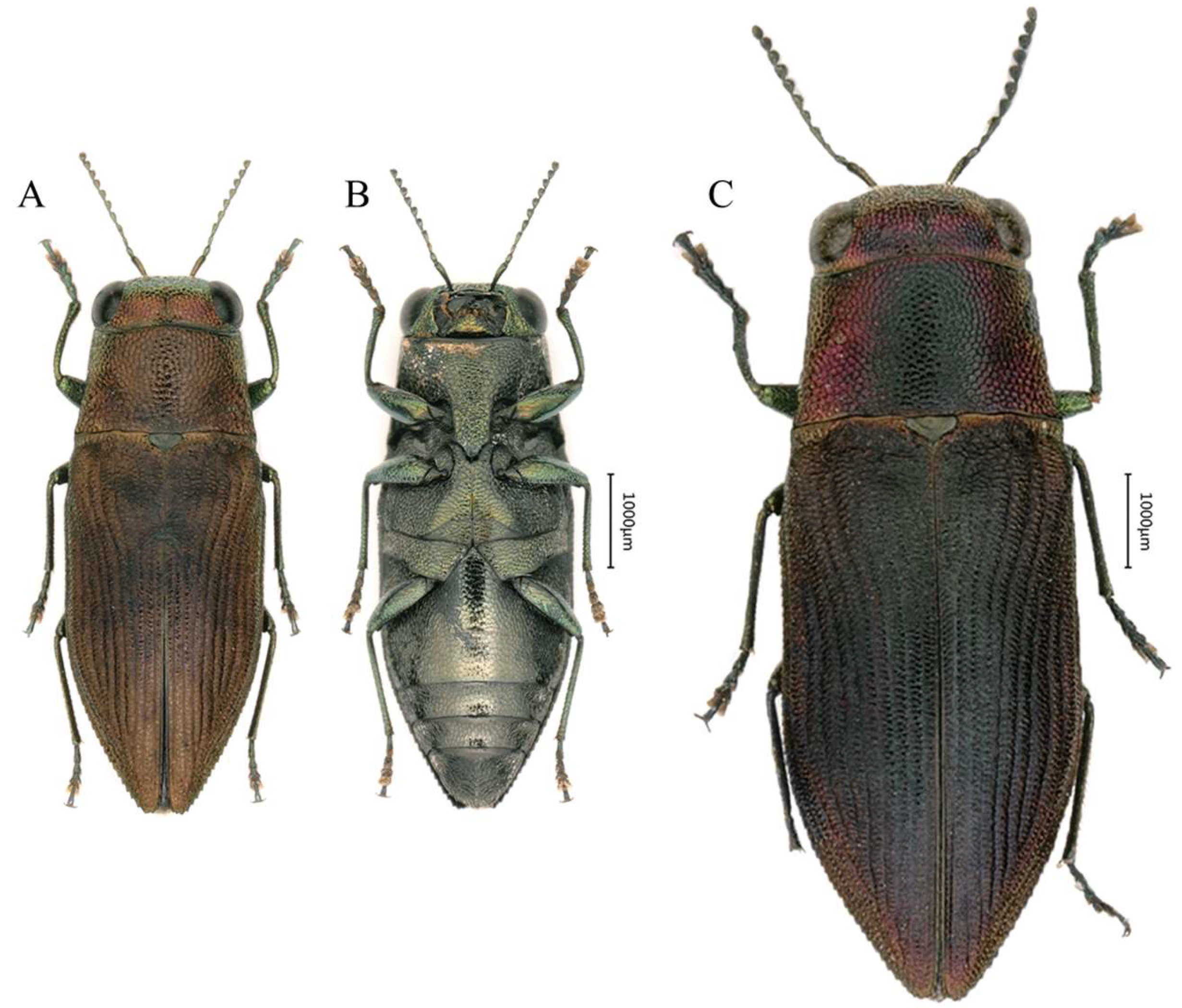
3.2. Philanthaxia lui Ni & Song, sp. nov.
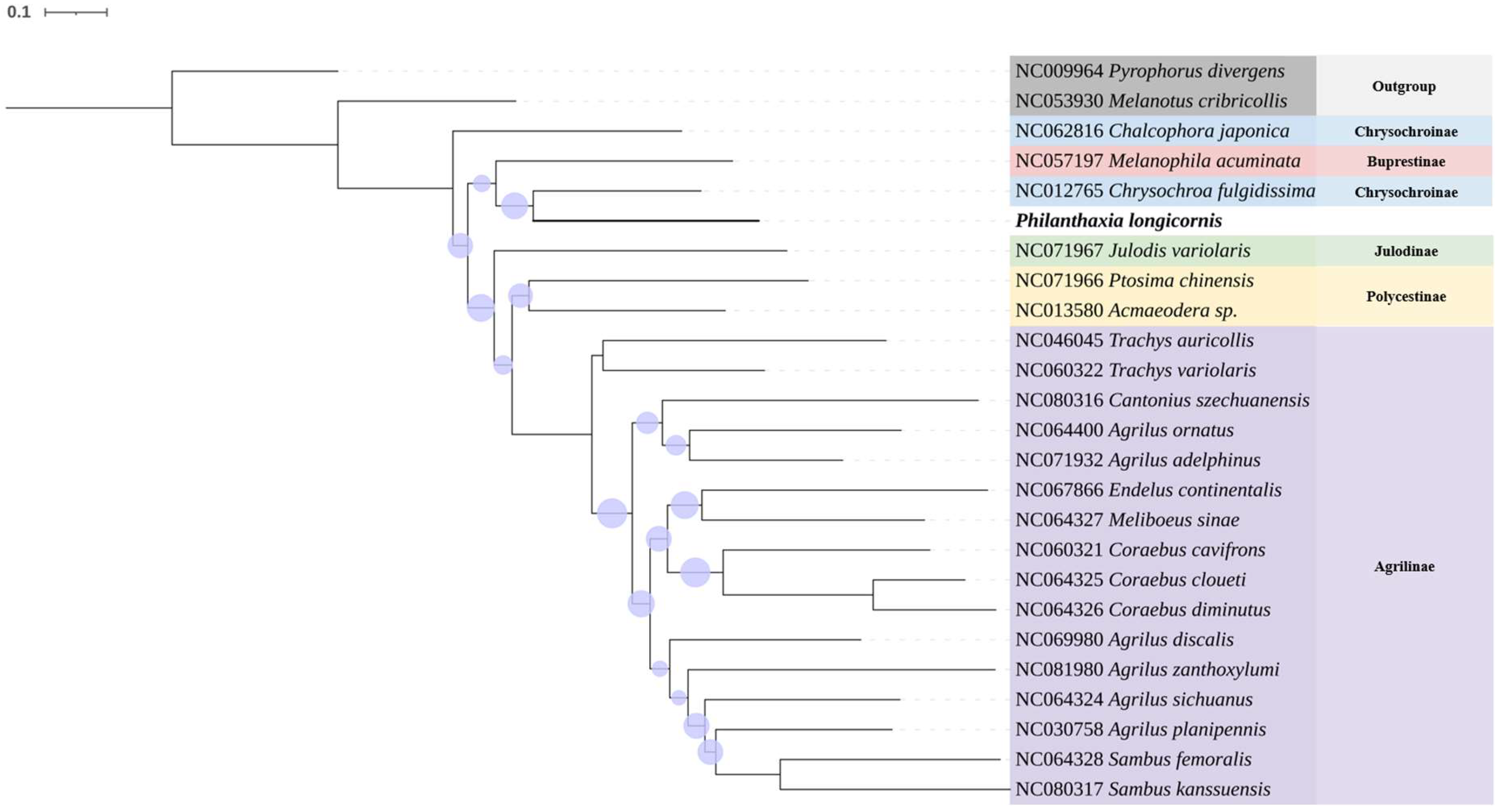
3.3. Molecular Identification of Philanthaxia longicornis Ni & Song, sp. nov.
3.3.1. DAMBE Base Sequence Analysis
3.3.2. Genetic Distance Analysis
3.3.3. Phylogenetic Analysis
4. Discussion
Supplementary Materials
Author Contributions
Funding
Data Availability Statement
Acknowledgments
Conflicts of Interest
Abbreviations
| FAF | Fujian Academy of Forestry, Fuzhou, China |
| NACRC-IOZ | National Animal Collection Resource Center, Institute of Zoology, Chinese Academy of Sciences, Beijing, China |
References
- Deyrolle, H. Description des Buprestides de la Malaisie recueillés par M. Wallace pendant son voyage dans cet Archipel. In Annales de la Société Entomologique de Belgique; 4 plates, i–iii in color; Nabu Press: Charleston, SC, USA, 1864; Volume 8, pp. 1–280. [Google Scholar]
- Bílý, S. A revision of the genera Philanthaxia Deyrolle and Pagdeniella Théry (Coleoptera, Buprestidae). Folia Heyrovskyana 1993, 1, 84–115. [Google Scholar]
- Bílý, S. Comments on the genus Philanthaxia, with descriptions of new species (Coleoptera: Buprestidae). Folia Heyrovskyana 2001, 9, 105–129. [Google Scholar]
- Bílý, S. Philanthaxia nelsoni sp. nov. from Indonesia (Coleoptera: Buprestidae). Pan-Pac. Entomol. 2006, 82, 144–146. [Google Scholar]
- Ong, U.; Hattori, T. Jewel Beetles of Taiwan; Kuá Series; Ministry of Beetles: Tainan, Taiwan, 2019; Volume 1, p. 235. [Google Scholar]
- Ong, U.; Curletti, G.; Hattori, T. Jewel Beetles of Taiwan; Buprestidae, Kud Series; Ministry of Beetles: Tainan, Taiwan, 2023; Volume 2, p. 219. [Google Scholar]
- Bílý, S.; Nakládal, O. Four new species of the genus Philanthaxia Deyrolle, 1864 from Southeast Asia and comments on P. iris Obenberger, 1938 (Coleoptera, Buprestidae, Thomassetiini). ZooKeys 2011, 116, 37–47. [Google Scholar] [CrossRef] [PubMed]
- Bellamy, C.L. A World Catalogue and Bibliography of the Jewel Beetles (Coleoptera: Buprestoidea); Buprestinae: Pterobothrini through Agrilinae: Rhaeboscelina; Pensoft Series Faunistica: Bulgaria, Sofia, 2008; Volume 3, No. 76; pp. 1265–1931. [Google Scholar]
- Bílý, S. Four new species of the genus Philanthaxia Deyrolle, 1864 (Coleoptera: Buprestidae: Thomassetiini). Zootaxa 2016, 4205, 24–30. [Google Scholar] [CrossRef] [PubMed]
- Ohmomo, S. Notes on Buprestid Beetles (Coleoptera, Buprestidae) from Thailand, IX. A Key to the Species of the Genus Philanthaxia DEYROLLE, 1865 from Thailand, with Description of a New Species. Elytra Tokyo New Ser. 2011, 1, 237–243. [Google Scholar]
- Weidlich, M. Systematik und Taxonomie der Buprestidae des mitteleozänen Geiseltales (Insecta, Coleoptera). Hallesches Jahrb. Geowissenschafen 1987, 12, 29–52. [Google Scholar]
- Qi, Z.; Ai, H.; He, X.; Su, R.; Cai, S.; Song, H. A study of Anthaxia subgen. Thailandia Bílý, 1990 from China (Coleoptera, Buprestidae, Buprestinae). ZooKeys 2023, 1154, 149–157. [Google Scholar] [CrossRef] [PubMed]
- Folmer, O.; Black, M.; Hoeh, W.; Lutz, R.; Vrijenhoek, R. DNA primers for amplification of mitochondrial cytochrome c oxidase subunit I from diverse metazoan invertebrates. Mol. Mar. Biol. Biotechnol. 1994, 3, 294–299. [Google Scholar] [PubMed]
- Evans, A.; Mckenna, D.; Bellamy, C.; Farrell, B. Large-scale molecular phylogeny of metallic wood-boring beetles (Coleoptera: Buprestoidea) provides new insights into relationships and reveals multiple evolutionary origins of the larval leaf-mining habit. Syst. Entomol. 2015, 40, 385–400. [Google Scholar] [CrossRef]
- Volkovitsh, M. The comparative morphology of antennal structures in Buprestidae (Coleoptera): Evolutionary trends, taxonomic and phylogenetic implications. Part 1. Acta Musei Morav. Sci. Biol. [Bron] 2001, 86, 43–169. [Google Scholar]
- Huang, X.; Chen, B.; Wei, Z.; Shi, A. First report of complete mitochondrial genome in the tribes Coomaniellini and Dicercini (Coleoptera: Buprestidae) and phylogenetic implications. Genes 2022, 13, 1074. [Google Scholar] [CrossRef] [PubMed]
- Wei, Z.; Huang, X.; Shi, A. First mitochondrial genome of subfamily Julodinae (Coleoptera, Buprestidae) with its phylogenetic implications. ZooKeys 2023, 1139, 165–182. [Google Scholar] [CrossRef] [PubMed]



| Philanthaxia splendida, Van De Poll, 1892 (Vietnam) | Philanthaxia sauteri Kerremans, 1912 (Taiwan, China) | Philanthaxia longicornis Ni & Song, sp. nov. (Hainan, China) | |
|---|---|---|---|
| Size | 5.0–7.2 mm | 8.0–10.0 mm | 6.7–7.9 mm |
| Color | Bright golden-green; no record of ventral side color | Dark color, mainly green, with red or black; ventral side green or reddish | Bright golden-green, same on ventral side |
| Head | Frons less convex. Eyes rather large and strongly projecting beyond outline of head. | Frons slightly depressed. Eyes rather small and slightly projecting beyond outline of head. | Frons evenly convex. Eyes middle size and projecting beyond outline of head. |
| Antenna | Antennae reach two-thirds of pronotum; length–width ratio: scape 3.3, pedicel 1.7, antennomeres 3–10 1.4–2.8, terminal 1.6 | Antennae reach half of pronotum; length–width ratio: scape 2.8, pedicel 1.9, antennomeres 3–10 1.2–1.5, terminal 1.3 | Antennae extremely long, reaching beyond elytral base and scutellum; length–width ratio: scape 6.0, pedicel 2.0, antennomeres 3–10 2.1–3.5, terminal 1.5 |
| Pronotum | Generally evenly convex on both sides; sculpture regular, dense near the base | Depressed laterally near posterior angles; sculpture forming irregular horizontal pattern | Both sides slightly depressed at base; sculpture regular polygon, dense near the base |
| Elytra | Golden-green, monochromatic | Golden-green along suture but color fading or changing reddish or violet toward sides | Golden-green, monochromatic |
| Aedeagus | Relatively short; parameres separated at one-sixth of their length from base with apical portion raised | Relatively robust; parameres separated in posterior half without being raised | Relatively slender; parameres separated at about one-quarter, with apical portion raised |
| Philanthaxia convexifrons Kurosawa, 1954 (Taiwan, China) | Philanthaxia iriei Kurosawa, 1985 (Ryukyu) | Philanthaxia lui Ni & Song sp. nov. (Hainan, China) | Philanthaxia splendida, Van De Poll, 1892 (Vietnam) | Philanthaxia sauteri Kerremans, 1912 (Taiwan) | Philanthaxia longicorna Ni & Song, sp. nov. (Hainan) | ||
|---|---|---|---|---|---|---|---|
| Size | 6.9–7.0 mm | 6.8–8.0 mm | 5.6–8.6 mm | Size | 5.0–7.2 mm | 8.0–10.0 mm | 6.7–7.9 mm |
| Color | Bronze-black; ventral side bronze-black | Bronze-black or reddish-bronze; no record of ventral side color | Bronze-black; ventral side dark green | Color | Bright golden-green; no record of ventral side color | Dark color, mainly green, with red or black; ventral side green or reddish | Bright golden-green, same with ventral side |
| Head | Frons evenly convex without any depressions or reliefs, same color in both sexes; smaller eyes, slightly projecting beyond outline of head | Frons slightly convex between eyes, female frons bronze or reddish, male frons green; larger eyes, strongly projecting beyond outline of head | Frons evenly convex, female frons reddish, male frons green; eyes large, projecting beyond outline of head | Head | Frons less convex, larger head and eyes | Frons slightly depressed, smaller head and eyes | Frons evenly convex, larger head and eyes |
| Pronotum | Generally evenly convex, bearing regular and small polygonal sculpture | Generally evenly convex, sculpture horizontally irregular, dense near the base | Both sides of base slightly depressed, with more regular and large polygonal sculpture | Antenna | Antennae reach two third of pronotum horizontally; length-width ratio: scape 3.3, pedicel 1.7, antennae 3–10 1.4–2.8, terminal 1.6 | Antennae reach half of pronotum horizontally; length/width ratio: scape 2.8, pedicel 1.9, antennae 3–10 1.2–1.5, terminal 1.3 | Antennae extremely long, reach elytra and over scutellum horizontally; length/width ratio: scape 6, pedicel 2.0, antennae 3–10 2.1–3.5, terminal 1.5 |
| Elytra | Black, slightly violet, monochromatic | Bronze-black and reddish, shiny, with serrations along lateral sides | Bronze-black, monochromatic, with serrations at posterior third of lateral sides | Pronotum | Generally evenly convex on both sides; sculpture regular, dense near the base | Depressed laterally near posterior angle; sculpture irregular horizontal pattern | Both sides of basal slightly depressed; sculpture regular polygon, dense near the base |
| 1 | 2 | 3 | 4 | 5 | 6 | 7 | 8 | 9 | 10 | 11 | 12 | 13 | 14 | 15 | 16 | 17 | 18 | 19 | 20 | 21 | 22 | 23 | |
| 1 | 0.020 | 0.020 | 0.020 | 0.023 | 0.022 | 0.021 | 0.025 | 0.024 | 0.021 | 0.019 | 0.022 | 0.020 | 0.023 | 0.020 | 0.024 | 0.021 | 0.021 | 0.025 | 0.020 | 0.022 | 0.020 | 0.021 | |
| 2 | 0.196 | 0.013 | 0.015 | 0.015 | 0.014 | 0.014 | 0.016 | 0.015 | 0.015 | 0.013 | 0.015 | 0.012 | 0.014 | 0.012 | 0.015 | 0.012 | 0.014 | 0.015 | 0.014 | 0.013 | 0.013 | 0.014 | |
| 3 | 0.236 | 0.241 | 0.015 | 0.015 | 0.016 | 0.016 | 0.018 | 0.017 | 0.016 | 0.015 | 0.016 | 0.015 | 0.015 | 0.015 | 0.015 | 0.015 | 0.016 | 0.017 | 0.016 | 0.017 | 0.015 | 0.015 | |
| 4 | 0.222 | 0.246 | 0.258 | 0.013 | 0.013 | 0.014 | 0.014 | 0.015 | 0.014 | 0.012 | 0.013 | 0.014 | 0.013 | 0.013 | 0.015 | 0.015 | 0.014 | 0.014 | 0.014 | 0.014 | 0.015 | 0.015 | |
| 5 | 0.267 | 0.258 | 0.275 | 0.243 | 0.015 | 0.016 | 0.013 | 0.014 | 0.014 | 0.015 | 0.012 | 0.015 | 0.016 | 0.015 | 0.015 | 0.015 | 0.014 | 0.016 | 0.014 | 0.015 | 0.016 | 0.013 | |
| 6 | 0.272 | 0.248 | 0.281 | 0.210 | 0.263 | 0.014 | 0.016 | 0.016 | 0.014 | 0.014 | 0.014 | 0.015 | 0.013 | 0.014 | 0.017 | 0.015 | 0.013 | 0.015 | 0.016 | 0.015 | 0.016 | 0.015 | |
| 7 | 0.259 | 0.252 | 0.271 | 0.242 | 0.270 | 0.241 | 0.015 | 0.015 | 0.014 | 0.013 | 0.015 | 0.015 | 0.014 | 0.014 | 0.016 | 0.013 | 0.014 | 0.015 | 0.013 | 0.015 | 0.016 | 0.015 | |
| 8 | 0.289 | 0.287 | 0.280 | 0.260 | 0.216 | 0.274 | 0.258 | 0.010 | 0.015 | 0.014 | 0.014 | 0.015 | 0.016 | 0.016 | 0.015 | 0.015 | 0.014 | 0.015 | 0.017 | 0.015 | 0.016 | 0.015 | |
| 9 | 0.271 | 0.259 | 0.279 | 0.251 | 0.224 | 0.266 | 0.271 | 0.137 | 0.015 | 0.014 | 0.016 | 0.016 | 0.015 | 0.017 | 0.016 | 0.015 | 0.016 | 0.016 | 0.016 | 0.016 | 0.016 | 0.017 | |
| 10 | 0.246 | 0.265 | 0.266 | 0.224 | 0.223 | 0.238 | 0.239 | 0.249 | 0.251 | 0.014 | 0.014 | 0.014 | 0.014 | 0.016 | 0.016 | 0.013 | 0.012 | 0.016 | 0.013 | 0.014 | 0.015 | 0.014 | |
| 11 | 0.215 | 0.208 | 0.244 | 0.206 | 0.257 | 0.245 | 0.241 | 0.268 | 0.263 | 0.231 | 0.013 | 0.015 | 0.014 | 0.014 | 0.014 | 0.014 | 0.014 | 0.015 | 0.014 | 0.014 | 0.015 | 0.015 | |
| 12 | 0.268 | 0.256 | 0.274 | 0.230 | 0.225 | 0.239 | 0.251 | 0.271 | 0.267 | 0.216 | 0.230 | 0.014 | 0.013 | 0.015 | 0.016 | 0.014 | 0.013 | 0.016 | 0.014 | 0.013 | 0.016 | 0.012 | |
| 13 | 0.243 | 0.237 | 0.246 | 0.220 | 0.254 | 0.254 | 0.255 | 0.265 | 0.261 | 0.212 | 0.242 | 0.239 | 0.013 | 0.014 | 0.016 | 0.013 | 0.012 | 0.014 | 0.013 | 0.012 | 0.014 | 0.013 | |
| 14 | 0.267 | 0.266 | 0.302 | 0.231 | 0.282 | 0.243 | 0.254 | 0.305 | 0.278 | 0.240 | 0.248 | 0.252 | 0.252 | 0.015 | 0.016 | 0.013 | 0.013 | 0.015 | 0.014 | 0.014 | 0.016 | 0.014 | |
| 15 | 0.235 | 0.224 | 0.264 | 0.234 | 0.283 | 0.261 | 0.244 | 0.288 | 0.289 | 0.261 | 0.230 | 0.265 | 0.247 | 0.278 | 0.014 | 0.014 | 0.014 | 0.015 | 0.015 | 0.014 | 0.015 | 0.014 | |
| 16 | 0.260 | 0.253 | 0.253 | 0.273 | 0.293 | 0.296 | 0.264 | 0.261 | 0.280 | 0.280 | 0.241 | 0.303 | 0.286 | 0.296 | 0.272 | 0.014 | 0.016 | 0.018 | 0.014 | 0.017 | 0.015 | 0.016 | |
| 17 | 0.247 | 0.230 | 0.261 | 0.231 | 0.235 | 0.233 | 0.224 | 0.254 | 0.250 | 0.206 | 0.234 | 0.226 | 0.221 | 0.234 | 0.255 | 0.255 | 0.013 | 0.014 | 0.013 | 0.013 | 0.014 | 0.013 | |
| 18 | 0.232 | 0.243 | 0.271 | 0.226 | 0.246 | 0.224 | 0.234 | 0.250 | 0.253 | 0.188 | 0.240 | 0.206 | 0.224 | 0.243 | 0.251 | 0.274 | 0.212 | 0.014 | 0.014 | 0.012 | 0.016 | 0.013 | |
| 19 | 0.308 | 0.279 | 0.291 | 0.252 | 0.287 | 0.279 | 0.252 | 0.277 | 0.295 | 0.267 | 0.262 | 0.282 | 0.250 | 0.272 | 0.270 | 0.290 | 0.248 | 0.236 | 0.015 | 0.015 | 0.017 | 0.016 | |
| 20 | 0.256 | 0.260 | 0.273 | 0.232 | 0.243 | 0.249 | 0.232 | 0.290 | 0.263 | 0.219 | 0.257 | 0.239 | 0.243 | 0.265 | 0.254 | 0.268 | 0.201 | 0.236 | 0.265 | 0.013 | 0.015 | 0.013 | |
| 21 | 0.258 | 0.233 | 0.271 | 0.224 | 0.258 | 0.251 | 0.250 | 0.265 | 0.254 | 0.224 | 0.229 | 0.219 | 0.206 | 0.245 | 0.258 | 0.289 | 0.207 | 0.210 | 0.260 | 0.219 | 0.014 | 0.014 | |
| 22 | 0.219 | 0.215 | 0.252 | 0.246 | 0.274 | 0.264 | 0.281 | 0.298 | 0.283 | 0.264 | 0.241 | 0.271 | 0.257 | 0.278 | 0.244 | 0.263 | 0.246 | 0.274 | 0.309 | 0.275 | 0.260 | 0.015 | |
| 23 | 0.238 | 0.244 | 0.269 | 0.232 | 0.234 | 0.234 | 0.249 | 0.261 | 0.249 | 0.205 | 0.243 | 0.206 | 0.221 | 0.241 | 0.246 | 0.268 | 0.194 | 0.200 | 0.270 | 0.231 | 0.222 | 0.259 |
Disclaimer/Publisher’s Note: The statements, opinions and data contained in all publications are solely those of the individual author(s) and contributor(s) and not of MDPI and/or the editor(s). MDPI and/or the editor(s) disclaim responsibility for any injury to people or property resulting from any ideas, methods, instructions or products referred to in the content. |
© 2025 by the authors. Licensee MDPI, Basel, Switzerland. This article is an open access article distributed under the terms and conditions of the Creative Commons Attribution (CC BY) license (https://creativecommons.org/licenses/by/4.0/).
Share and Cite
Ni, T.; Qi, Z.; Peng, X.; Song, H.; Wang, R. Two New Species of the Genus Philanthaxia Deyrolle, 1864, from Hainan Province, China (Coleoptera, Buprestidae, Thomassetiini). Insects 2025, 16, 839. https://doi.org/10.3390/insects16080839
Ni T, Qi Z, Peng X, Song H, Wang R. Two New Species of the Genus Philanthaxia Deyrolle, 1864, from Hainan Province, China (Coleoptera, Buprestidae, Thomassetiini). Insects. 2025; 16(8):839. https://doi.org/10.3390/insects16080839
Chicago/Turabian StyleNi, Tao, Zhihao Qi, Xiancheng Peng, Haitian Song, and Rong Wang. 2025. "Two New Species of the Genus Philanthaxia Deyrolle, 1864, from Hainan Province, China (Coleoptera, Buprestidae, Thomassetiini)" Insects 16, no. 8: 839. https://doi.org/10.3390/insects16080839
APA StyleNi, T., Qi, Z., Peng, X., Song, H., & Wang, R. (2025). Two New Species of the Genus Philanthaxia Deyrolle, 1864, from Hainan Province, China (Coleoptera, Buprestidae, Thomassetiini). Insects, 16(8), 839. https://doi.org/10.3390/insects16080839