You are currently on the new version of our website. Access the old version .

Galaxies, Volume 7, Issue 3

September 2019 - 13 articles

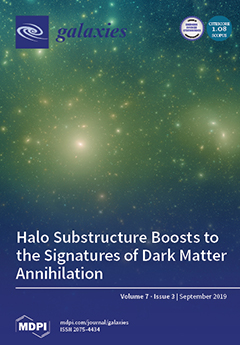
Cover Story: Dark matter structures are believed to form hierarchically and, therefore, larger halos host lots of smaller subhalos, making the halo density profiles clumpy. This will “boost” the signatures of possible dark matter annihilation, such as gamma rays. Estimating this subhalo boost factor—defined as the ratio of total luminosity due to the subhalos to that due to the smooth main component—is challenging as one needs to include the effects from all the subhalos, whose masses range over more than twenty orders of magnitude. We review the recent progress made in the literature on this topic by covering approaches based on cosmological N-body simulations and semi-analytical modeling. Although the estimates of the boost factor range quite widely, the more recent examples tend to give modest values in the order of 1–10. View this paper.
  • Issues are regarded as officially published after their release is announced to the table of contents alert mailing list .
  • You may sign up for email alerts to receive table of contents of newly released issues.
  • PDF is the official format for papers published in both, html and pdf forms. To view the papers in pdf format, click on the "PDF Full-text" link, and use the free Adobe Reader to open them.

Articles (13)

  • Review
  • Open Access
8 Citations
3,565 Views
21 Pages

The History Goes On: Century Long Study of Romano’s Star

  • Olga Maryeva,
  • Roberto F. Viotti,
  • Gloria Koenigsberger,
  • Massimo Calabresi,
  • Corinne Rossi and
  • Roberto Gualandi

18 September 2019

GR 290 (M 33 V0532 = Romano’s Star) is a unique variable star in the M33 galaxy, which simultaneously displays variability typical for luminous blue variable (LBV) stars and physical parameters typical for nitrogen-rich Wolf-Rayet (WR) stars (W...

  • Review
  • Open Access
64 Citations
6,469 Views
21 Pages

10 September 2019

Shear flows are ubiquitously present in space and astrophysical plasmas. This paper highlights the central idea of the non-thermal acceleration of charged particles in shearing flows and reviews some of the recent developments. Topics include the acc...

  • Review
  • Open Access
18 Citations
5,017 Views
19 Pages

The High Energy View of FR0 Radio Galaxies

  • Ranieri Diego Baldi,
  • Eleonora Torresi,
  • Giulia Migliori and
  • Barbara Balmaverde

5 September 2019

A new class of low-power compact radio sources with limited jet structures, named FR 0, is emerging from recent radio-optical surveys. This abundant population of radio galaxies, five times more numerous than FR Is in the local Universe (z < 0.05)...

  • Review
  • Open Access
26 Citations
6,182 Views
27 Pages

21 August 2019

Wolf–Rayet stars (WRs) represent the end of a massive star’s life as it is about to turn into a supernova. Obtaining complete samples of such stars across a large range of metallicities poses observational challenges, but presents us with...

  • Article
  • Open Access
2 Citations
4,087 Views
9 Pages

16 August 2019

We present the results of our Power Spectral Density (PSD) analysis for the BL Lac object PKS 2155-304, utilizing the nightly-binned long-term light curve from the decade-long monitoring, as well as the minute-binned intra-night light curve from the...

  • Article
  • Open Access
27 Citations
5,453 Views
31 Pages

3C 84: Observational Evidence for Precession and a Possible Relation to TeV Emission

  • Silke Britzen,
  • Christian Fendt,
  • Michal Zajaček,
  • Frédéric Jaron,
  • Ilya Pashchenko,
  • Margo F. Aller and
  • Hugh D. Aller

14 August 2019

3C 84 (NGC 1275, Perseus A) is a bright radio source at the center of an ongoing merger, where HST observations show two colliding spiral galaxies. 3C 84 holds promise to improve our understanding about how of the activity of active galactic nuclei,...

  • Review
  • Open Access
50 Citations
5,990 Views
67 Pages

The understanding of the primordial mechanism that seeded the cosmic structures we observe today in the sky is one of the major goals in cosmology. The leading paradigm for such a mechanism is provided by the inflationary scenario, a period of violen...

  • Review
  • Open Access
37 Citations
5,464 Views
35 Pages

Particle acceleration in relativistic jets, to very high levels of energy, occurs at the expense of the dissipation of magnetic or kinetic energy. Therefore, understanding the processes that can trigger this dissipation is key to the characterization...

of 2

Get Alerted

Add your email address to receive forthcoming issues of this journal.

XFacebookLinkedIn
Galaxies - ISSN 2075-4434