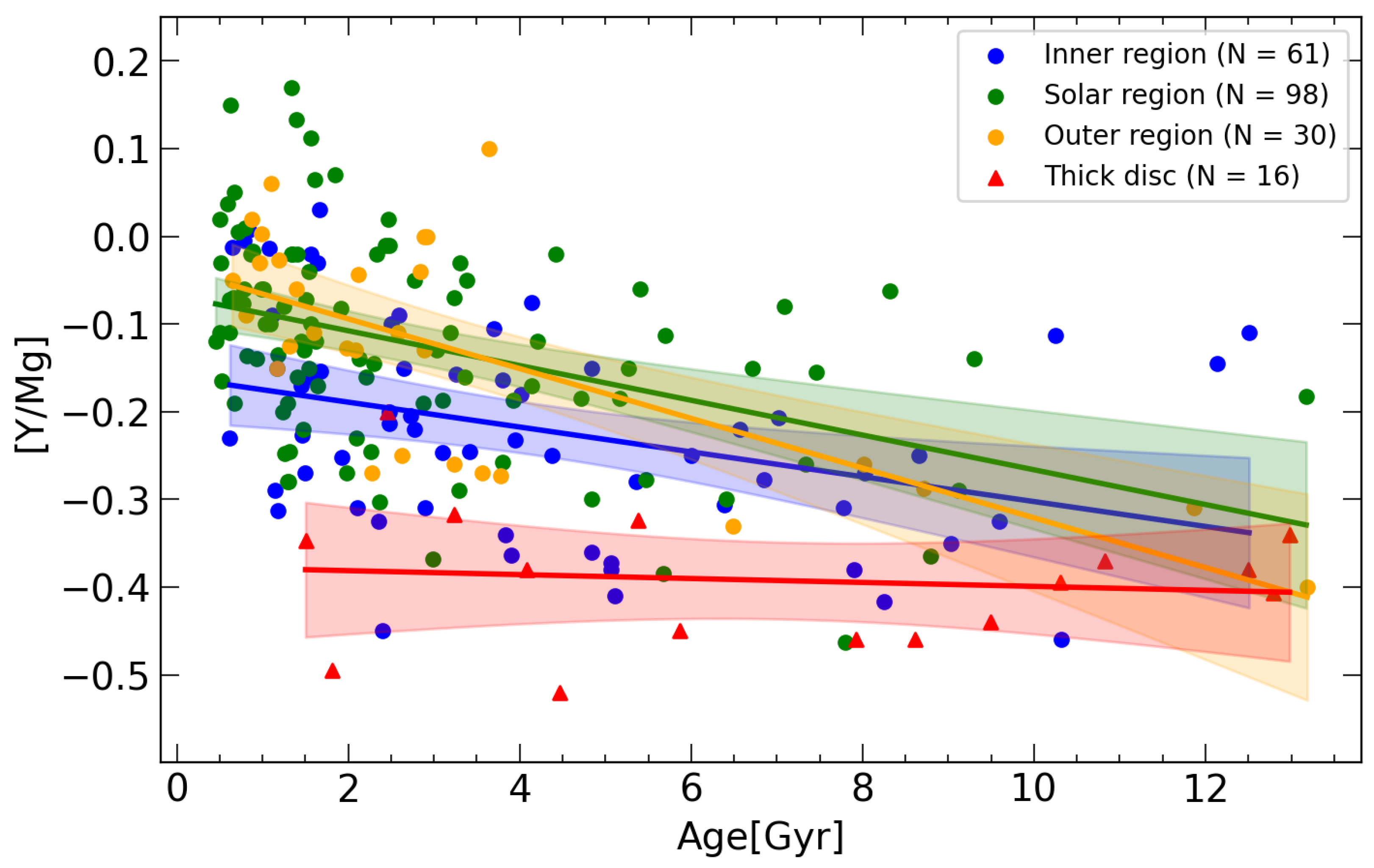

[Y/Mg] as a Stellar Chronometer: Combining Asteroseismic and Chemical Data

 ,
,  , , , , , , and
Abstract
1. Introduction
2. Methods
3. Results and Discussion
4. Conclusions
Author Contributions
Funding
Data Availability Statement
Acknowledgments
Conflicts of Interest
References
- da Silva, R.; Porto de Mello, G.F.; Milone, A.C.; da Silva, L.; Ribeiro, L.S.; Rocha-Pinto, H.J. Accurate and homogeneous abundance patterns in solar-type stars of the solar neighbourhood: A chemo-chronological analysis. Astron. Astrophys. 2012, 542, A84. [Google Scholar] [CrossRef] [Scilit]
- Nissen, P.E. High-precision abundances of elements in solar twin stars: Trends with stellar age and elemental condensation temperature. Astron. Astrophys. 2015, 579, A52. [Google Scholar] [CrossRef] [Scilit]
- Delgado Mena, E.; Moya, A.; Adibekyan, V.; Tsantaki, M.; González Hernández, J.I.; Israelian, G.; Davies, G.R.; Chaplin, W.J.; Sousa, S.G.; Ferreira, A.C.S.; et al. Abundance to age ratios in the HARPS-GTO sample with Gaia DR2: Chemical clocks for a range of [Fe/H]. Astron. Astrophys. 2019, 624, A78. [Google Scholar] [CrossRef] [Scilit]
- Casali, G.; Spina, L.; Magrini, L.; Karakas, A.I.; Kobayashi, C.; Casey, A.R.; Feltzing, S.; Van der Swaelmen, M.; Tsantaki, M.; Jofré, P.; et al. The Gaia-ESO survey: The non-universality of the age–chemical–clocks–metallicity relations in the Galactic disc. Astron. Astrophys. 2020, 639, A127. [Google Scholar] [CrossRef] [Scilit]
- Magrini, L.; Viscasillas Vázquez, C.; Casali, G.; Baratella, M.; D’Orazi, V.; Spina, L.; Randich, S.; Cristallo, S.; Vescovi, D. The abundance of s-process elements: Temporal and spatial trends from open cluster observations. Universe 2022, 8, 64. [Google Scholar] [CrossRef] [Scilit]
- Viscasillas Vázquez, C.; Magrini, L.; Casali, G.; Tautvaišienė, G.; Spina, L.; Van der Swaelmen, M.; Randich, S.; Bensby, T.; Bragaglia, A.; Friel, E.; et al. The Gaia-ESO survey: Age–chemical-clock relations spatially resolved in the Galactic disc. Astron. Astrophys. 2022, 660, A135. [Google Scholar] [CrossRef] [Scilit]
- Casamiquela, L.; Soubiran, C.; Jofré, P.; Chiappini, C.; Lagarde, N.; Tarricq, Y.; Carrera, R.; Jordi, C.; Balaguer-Núñez, L.; Carbajo-Hijarrubia, J.; et al. Abundance–age relations with red clump stars in open clusters. Astron. Astrophys. 2021, 652, A25. [Google Scholar] [CrossRef] [Scilit]
- Carbajo-Hijarrubia, J.; Casamiquela, L.; Carrera, R.; Balaguer-Núñez, L.; Jordi, C.; Anders, F.; Gallart, C.; Pancino, E.; Drazdauskas, A.; Stonkutė, E.; et al. OCCASO. V. Chemical–abundance trends with Galactocentric distance and age. Astron. Astrophys. 2024, 687, A239. [Google Scholar] [CrossRef] [Scilit]
- Tautvaišienė, G.; Viscasillas Vázquez, C.; Mikolaitis, Š.; Stonkutė, E.; Minkevičiūtė, R.; Drazdauskas, A.; Bagdonas, V. Abundances of neutron-capture elements in thin- and thick-disc stars in the solar neighbourhood. Astron. Astrophys. 2021, 649, A126. [Google Scholar] [CrossRef] [Scilit]
- Magrini, L.; Vescovi, D.; Casali, G.; Cristallo, S.; Viscasillas Vázquez, C.; Cescutti, G.; Spina, L.; Van Der Swaelmen, M.; Randich, S. Magnetic-buoyancy-induced mixing in AGB stars: A theoretical explanation of the non-universal relation of [Y/Mg] to age. Astron. Astrophys. 2021, 646, L2. [Google Scholar] [CrossRef] [Scilit]
- Molero, M.; Magrini, L.; Palla, M.; Cescutti, G.; Viscasillas Vázquez, C.; Casali, G.; Spitoni, E.; Matteucci, F.; Randich, S. Modelling chemical clocks: Theoretical evidences of the space and time evolution of [s/α] in the Galactic disc with Gaia-ESO survey. Astron. Astrophys. 2025, 694, A274. [Google Scholar] [CrossRef] [Scilit]
- Casali, G.; Montalbán, J.; Miglio, A.; Casagrande, L.; Magrini, L.; Chiappini, C.; Bragaglia, A.; Matteuzzi, M.; Brogaard, K.; Stokholm, A.; et al. Tracing the Milky Way: Calibrating chemical ages with high-precision *Kepler* data. Mon. Not. R. Astron. Soc. 2025, 541, 2631–2650. [Google Scholar] [CrossRef] [Scilit]
- Jurgenson, C.; Fischer, D.; McCracken, T.; Sawyer, D.; Giguere, M.; Szymkowiak, A.; Santoro, F.; Muller, G. Design and construction of VUES: The Vilnius University Echelle Spectrograph. J. Astron. Instrum. 2016, 5, 1650003. [Google Scholar] [CrossRef] [Scilit]
- Tautvaišienė, G.; Mikolaitis, Š.; Drazdauskas, A.; Stonkutė, E.; Minkevičiūtė, R.; Kjeldsen, H.; Brogaard, K.; von Essen, C.; Grundahl, F.; Pakštienė, E.; et al. Chemical composition of bright stars in the continuous viewing zone of the *TESS* space mission. Astrophys. J. Suppl. Ser. 2020, 248, 19. [Google Scholar] [CrossRef] [Scilit]
- Tautvaišienė, G.; Mikolaitis, Š.; Drazdauskas, A.; Stonkutė, E.; Minkevičiūtė, R.; Pakštienė, E.; Kjeldsen, H.; Brogaard, K.; Chorniy, Y.; von Essen, C.; et al. Chemical composition of bright stars in the northern hemisphere: Star–planet connection. Astrophys. J. Suppl. Ser. 2022, 259, 45. [Google Scholar] [CrossRef] [Scilit]
- Cardoso, J.V.d.M. et al. [Lightkurve Collaboration]. Lightkurve: Kepler and TESS Time Series Analysis in Python. Astrophysics Source Code Library, Record ascl:1812.013. 2018. Available online: https://ascl.net/1812.013 (accessed on 1 September 2020).
- Kjeldsen, H.; Bedding, T.R. Amplitudes of stellar oscillations: The implications for asteroseismology. Astron. Astrophys. 1995, 293, 87–106. [Google Scholar] [CrossRef] [Scilit]
- da Silva, L.; Girardi, L.; Pasquini, L.; Setiawan, J.; von der Lühe, O.; de Medeiros, J.R.; Hatzes, A.; Döllinger, M.P.; Weiss, A. Basic physical parameters of a selected sample of evolved stars. Astron. Astrophys. 2006, 458, 609–623. [Google Scholar] [CrossRef] [Scilit]
- Rodrigues, T.S.; Girardi, L.; Miglio, A.; Bossini, D.; Bovy, J.; Epstein, C.; Pinsonneault, M.H.; Stello, D.; Zasowski, G.; Allende Prieto, C.; et al. Bayesian distances and extinctions for giants observed by *Kepler* and APOGEE. Mon. Not. R. Astron. Soc. 2014, 445, 2758–2776. [Google Scholar] [CrossRef] [Scilit]
- Rodrigues, T.S.; Bossini, D.; Miglio, A.; Girardi, L.; Montalbán, J.; Noels, A.; Trabucchi, M.; Coelho, H.R.; Marigo, P. Determining stellar parameters of asteroseismic targets: Going beyond the use of scaling relations. Mon. Not. R. Astron. Soc. 2017, 467, 1433–1448. [Google Scholar] [CrossRef] [Scilit]
- Andersen, M.F.; Pallé, P.; Jessen-Hansen, J.; Wang, K.; Grundahl, F.; Bedding, T.R.; Roca Cortes, T.; Yu, J.; Mathur, S.; Gacia, R.A.; et al. Oscillations in the Sun with SONG: Setting the scale for asteroseismic investigations. Astron. Astrophys. 2019, 623, L9. [Google Scholar] [CrossRef] [Scilit]
- Paxton, B.; Cantiello, M.; Arras, P.; Bildsten, L.; Brown, E.F.; Dotter, A.; Mankovich, C.; Montgomery, M.H.; Stello, D.; Timmes, F.X.; et al. Modules for Experiments in Stellar Astrophysics (MESA): Planets, Oscillations, Rotation, and Massive Stars. Astrophys. J. Suppl. Ser. 2013, 208, 4. [Google Scholar] [CrossRef] [Scilit]
- Chabrier, G. The Galactic Disk Mass Budget. I. Stellar Mass Function and Density. Astrophys. J. 2001, 554, 1274–1281. [Google Scholar] [CrossRef] [Scilit]
- Bressan, A.; Marigo, P.; Girardi, L.; Salasnich, B.; Dal Cero, C.; Rubele, S.; Nanni, A. PARSEC: Stellar tracks and isochrones with the PAdova and TRieste Stellar Evolution Code. Mon. Not. R. Astron. Soc. 2012, 427, 127–145. [Google Scholar] [CrossRef] [Scilit]
- Jofré, P.; Jorissen, A.; Van Eck, S.; Izzard, R.G.; Masseron, T.; Hawkins, K.; Gilmore, G.; Paladini, C.; Escorza, A.; Blanco-Cuaresma, S.; et al. Cannibals in the Thick Disk: The Young α-Rich Stars as Evolved Blue Stragglers. Astron. Astrophys. 2016, 595, A60. [Google Scholar] [CrossRef] [Scilit]
- Zhang, M.; Xiang, M.; Zhang, H.-W.; Ting, Y.-S.; Rix, H.-W.; Wu, Y.-Q.; Huang, Y.; Sun, W.-X.; Tian, Z.-J.; Wang, C.; et al. Most “Young” α-Rich Stars Have High Masses but Are Actually Old. Astrophys. J. 2021, 922, 145. [Google Scholar] [CrossRef] [Scilit]
- Ratcliffe, B.; Minchev, I.; Cescutti, G.; Spitoni, E.; Jönsson, H.; Anders, F.; Queiroz, A.; Steinmetz, M. Chemical Clocks and Their Time Zones: Understanding the [s/Mg]–Age Relation with Birth Radii. Mon. Not. R. Astron. Soc. 2024, 528, 3464–3472. [Google Scholar] [CrossRef] [Scilit]
- Katz, D.; Gómez, A.; Haywood, M.; Snaith, O.; Di Matteo, P. Radial structure and formation of the Milky Way disc. Astron. Astrophys. 2021, 655, A111. [Google Scholar] [CrossRef] [Scilit]

Disclaimer/Publisher’s Note: The statements, opinions and data contained in all publications are solely those of the individual author(s) and contributor(s) and not of MDPI and/or the editor(s). MDPI and/or the editor(s) disclaim responsibility for any injury to people or property resulting from any ideas, methods, instructions or products referred to in the content. |
© 2025 by the authors. Licensee MDPI, Basel, Switzerland. This article is an open access article distributed under the terms and conditions of the Creative Commons Attribution (CC BY) license (https://creativecommons.org/licenses/by/4.0/).
Share and Cite
Viscasillas Vázquez, C.; Tautvaišienė, G.; Pakštienė, E.; Drazdauskas, A.; Chorniy, Y.; Bagdonas, V.; Mikolaitis, Š.; Minkevičiūtė, R.; Stonkutė, E. [Y/Mg] as a Stellar Chronometer: Combining Asteroseismic and Chemical Data. Galaxies 2025, 13, 136. https://doi.org/10.3390/galaxies13060136
Viscasillas Vázquez C, Tautvaišienė G, Pakštienė E, Drazdauskas A, Chorniy Y, Bagdonas V, Mikolaitis Š, Minkevičiūtė R, Stonkutė E. [Y/Mg] as a Stellar Chronometer: Combining Asteroseismic and Chemical Data. Galaxies. 2025; 13(6):136. https://doi.org/10.3390/galaxies13060136
Chicago/Turabian StyleViscasillas Vázquez, Carlos, Gražina Tautvaišienė, Erika Pakštienė, Arnas Drazdauskas, Yuriy Chorniy, Vilius Bagdonas, Šarūnas Mikolaitis, Renata Minkevičiūtė, and Edita Stonkutė. 2025. "[Y/Mg] as a Stellar Chronometer: Combining Asteroseismic and Chemical Data" Galaxies 13, no. 6: 136. https://doi.org/10.3390/galaxies13060136
APA StyleViscasillas Vázquez, C., Tautvaišienė, G., Pakštienė, E., Drazdauskas, A., Chorniy, Y., Bagdonas, V., Mikolaitis, Š., Minkevičiūtė, R., & Stonkutė, E. (2025). [Y/Mg] as a Stellar Chronometer: Combining Asteroseismic and Chemical Data. Galaxies, 13(6), 136. https://doi.org/10.3390/galaxies13060136