



Galaxies, Volume 12, Issue 3 (June 2024) – 11 articles
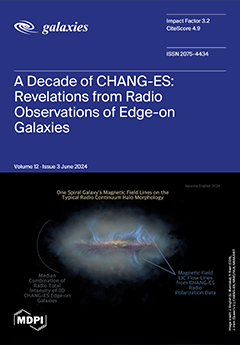
Cover Story (view full-size image):
Galaxies that are edge-on to the line of sight offer a unique perspective for analyzing the dynamic relationship between the star forming disk and the surrounding gaseous halo. By focusing on radio observations of 35 edge-on galaxies, the CHANG-ES (Continuum Halos in Nearby Galaxies—an EVLA Survey) project has revealed stunning images of the dynamic disk–halo interface, as well as cosmic rays and magnetic fields that can extend over 10 kpc from the disk. A decade of scrutiny has shown that halo magnetic fields form stable patterns on large scales, likely generated by galactic dynamos. For a summary of the many diverse results from CHANG-ES, see https://www.mdpi.com/2075-4434/12/3/22
- Issues are regarded as officially published after their release is announced to the table of contents alert mailing list.
- You may sign up for e-mail alerts to receive table of contents of newly released issues.
- PDF is the official format for papers published in both, html and pdf forms. To view the papers in pdf format, click on the "PDF Full-text" link, and use the free Adobe Reader to open them.
Previous Issue
Next Issue