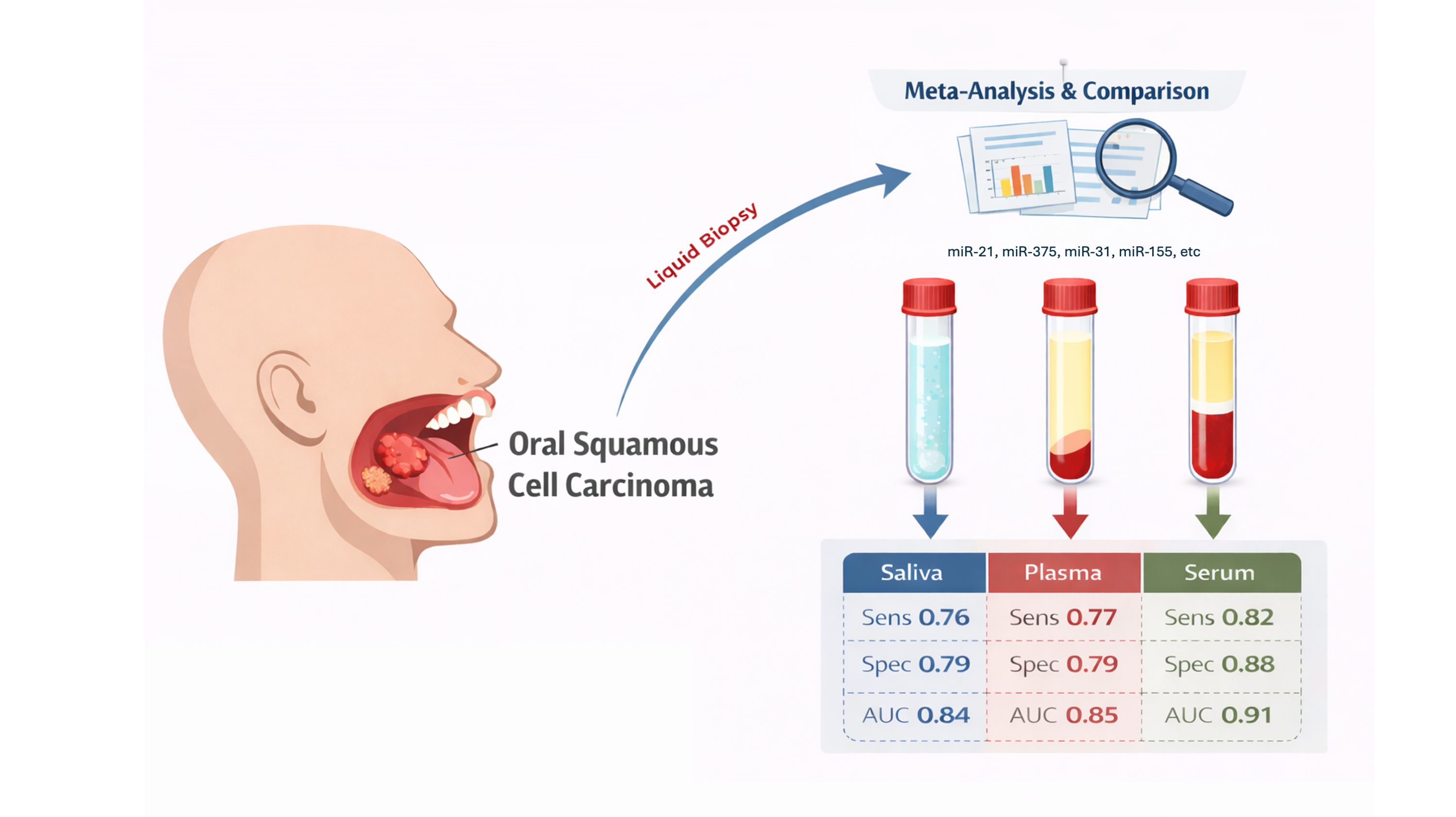


Comparative Meta-Analysis: Salivary, Plasma, and Serum miRNA Profiles for Oral Squamous Cell Carcinoma Detection

 , , , , ,
Abstract
1. Introduction
2. Materials and Methods
2.1. Study Protocol
2.2. Search Strategy
2.3. Eligibility Criteria (PICOS Framework)
2.4. Data Extraction
2.5. Quality Assessment
2.6. Statistical Analysis
3. Results
3.1. Study Characteristics
3.2. Data Analysis
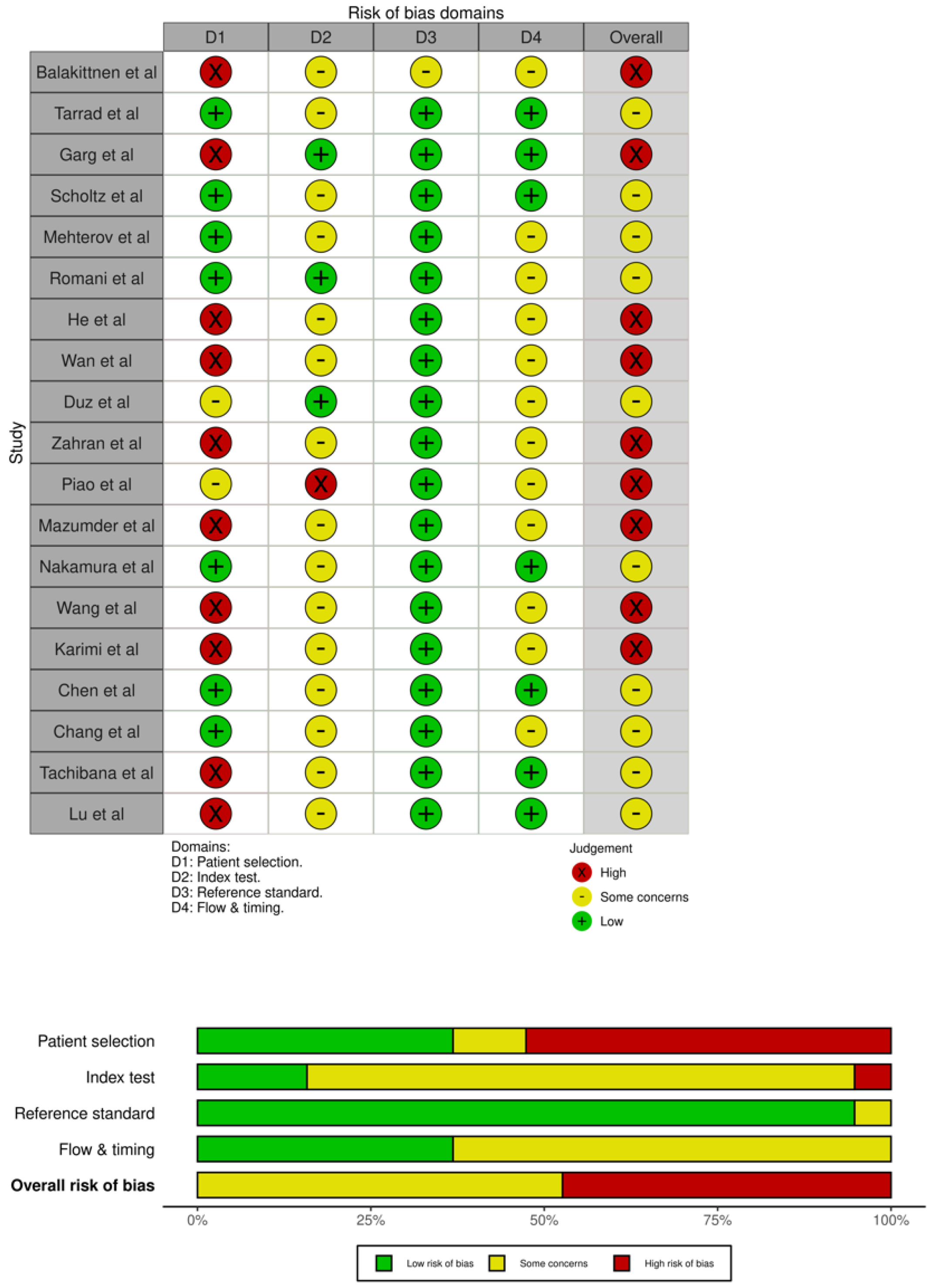
3.3. Result of Quality Assessment
4. Discussion
5. Conclusions
Supplementary Materials
Author Contributions
Funding
Institutional Review Board Statement
Informed Consent Statement
Data Availability Statement
Conflicts of Interest
Abbreviations
| OSCC | Oral Squamous Cell Carcinoma |
| NGS | Next Generation Sequencing |
| RT-qPCR | Real-Time Quantitative Polymerase Chain Reaction |
| TP | True positive |
| FP | False positive |
| FN | False negative |
| TN | True negative |
| PPV | Positive Predictive Value |
| NPV | Negative Predictive Value |
| lnDOR | log Diagnostic Odds Ratios |
| CI | Confidence Interval |
| miR | miRNAs/microRNAs |
| PRISMA | Preferred Reporting Items for Systematic Reviews and Meta-Analyses |
| QUADAS-2 | Quality Assessment of Diagnostic Accuracy Studies-2 |
| HSROC | Hierarchical Summary Receiver Operating Characteristic |
References
- Thavarool, S.B.; Muttath, G.; Nayanar, S.; Duraisamy, K.; Bhat, P.; Shringarpure, K.; Priyakanta, N.; Jaya, P.T.; Alfonso, T.; Sairu, P.; et al. Improved survival among oral cancer patients: Findings from a retrospective study at a tertiary care cancer centre in rural Kerala, India. World J. Surg. Oncol. 2019, 17, 15. [Google Scholar] [CrossRef]
- Bray, F.; Ferlay, J.; Soerjomataram, I.; Siegel, R.L.; Torre, L.A.; Jemal, A. Global cancer statistics 2018: GLOBOCAN estimates of incidence and mortality worldwide for 36 cancers in 185 countries. CA Cancer J. Clin. 2018, 68, 394–424. [Google Scholar] [CrossRef]
- Tandon, P.; Dadhich, A.; Saluja, H.; Bawane, S.; Sachdeva, S. The prevalence of squamous cell carcinoma in different sites of oral cavity at our Rural Health Care Centre in Loni, Maharashtra–a retrospective 10-year study. Współczesna Onkol. 2017, 2, 178–183. [Google Scholar]
- Su, Y.F.; Chen, Y.J.; Tsai, F.T.; Li, W.C.; Hsu, M.L.; Wang, D.H.; Yang, C.C. Current insights into oral cancer diagnostics. Diagnostics 2021, 11, 1287. [Google Scholar] [CrossRef] [PubMed]
- Jain, A.; Kotimoole, C.N.; Ghoshal, S.; Bakshi, J.; Chatterjee, A.; Prasad, T.S.K.; Pal, A. Identification of potential salivary biomarker panels for oral squamous cell carcinoma. Sci. Rep. 2021, 11, 3365. [Google Scholar] [CrossRef] [PubMed]
- Bouaoud, J.; Bossi, P.; Elkabets, M.; Schmitz, S.; van Kempen, L.C.; Martinez, P.; Saintigny, P. Unmet Needs and Perspectives in Oral Cancer Prevention. Cancers 2022, 14, 1815. [Google Scholar] [CrossRef]
- Balakittnen, J.; Weeramange, C.E.; Wallace, D.F.; Duijf, P.H.G.; Cristino, A.S.; Kenny, L.; Punyadeera, C. Noncoding RNAs in oral cancer. Wiley Interdiscip. Rev. RNA 2023, 14, e1754. [Google Scholar] [CrossRef]
- Ortiz-Quintero, B. Extracellular micrornas as intercellular mediators and noninvasive biomarkers of cancer. Cancers 2020, 12, 3455. [Google Scholar] [CrossRef]
- Khan, S.; Zhang, D.Y.; Zhang, J.Y.; Hayat, M.K.; Ren, J.; Nasir, S.; Bai, Q. The Key Role of microRNAs in Initiation and Progression of Hepatocellular Carcinoma. Front. Oncol. 2022, 12, 950374. [Google Scholar] [CrossRef]
- Pekarek, L.; Torres-Carranza, D.; Fraile-Martinez, O.; García-Montero, C.; Pekarek, T.; Saez, M.A.; Ortega, M.A. An Overview of the Role of MicroRNAs on Carcinogenesis: A Focus on Cell Cycle, Angiogenesis and Metastasis. Int. J. Mol. Sci. 2023, 24, 7268. [Google Scholar] [CrossRef]
- Higashi, Y.; Nakamura, K.; Takaoka, R.; Tani, M.; Noma, Y.; Mori, K.; Sugiura, T. Identification of Neck Lymph Node Metastasis-Specific microRNA—Implication for Use in Monitoring or Prediction of Neck Lymph Node Metastasis. Cancers 2023, 15, 3769. [Google Scholar] [CrossRef] [PubMed]
- Sempere, L.F.; Azmi, A.S.; Moore, A. microRNA-based diagnostic and therapeutic applications in cancer medicine. Wiley Interdiscip. Rev. RNA 2021, 12, e1662. [Google Scholar] [CrossRef] [PubMed]
- Sanz-Rubio, D.; Martin-Burriel, I.; Gil, A.; Cubero, P.; Forner, M.; Khalyfa, A.; Marin, J.M. Stability of Circulating Exosomal miRNAs in Healthy Subjects article. Sci. Rep. 2018, 8, 10306. [Google Scholar] [CrossRef] [PubMed]
- Quirico, L.; Orso, F. The power of microRNAs as diagnostic and prognostic biomarkers in liquid biopsies. Cancer Drug Resist. 2020, 3, 117–139. [Google Scholar] [CrossRef]
- Sandau, U.S.; Wiedrick, J.T.; McFarland, T.J.; Galasko, D.R.; Fanning, Z.; Quinn, J.F.; Saugstad, J.A. Analysis of the longitudinal stability of human plasma miRNAs and implications for disease biomarkers. Sci. Rep. 2024, 14, 2148. [Google Scholar] [CrossRef]
- Katayama, E.S.; Hue, J.J.; Loftus, A.W.; Ali, S.A.; Graor, H.J.; Rothermel, L.D.; Winter, J.M. Stability of microRNAs in serum and plasma reveal promise as a circulating biomarker. Noncoding RNA Res. 2025, 15, 132–141. [Google Scholar] [CrossRef]
- Kupec, T.; Bleilevens, A.; Iborra, S.; Najjari, L.; Wittenborn, J.; Maurer, J.; Stickeler, E. Stability of circulating microRNAs in serum. PLoS ONE 2022, 17, e0268958. [Google Scholar] [CrossRef]
- Liu, D.; Xin, Z.; Guo, S.; Li, S.; Cheng, J.; Jiang, H. Blood and Salivary MicroRNAs for Diagnosis of Oral Squamous Cell Carcinoma: A Systematic Review and Meta-Analysis. J. Oral Maxillofac. Surg. 2021, 79, e1082–1082.e13. [Google Scholar] [CrossRef]
- Balakittnen, J.; Ekanayake Weeramange, C.; Wallace, D.F.; Duijf, P.H.G.; Cristino, A.S.; Hartel, G.; Punyadeera, C. A novel saliva-based miRNA profile to diagnose and predict oral cancer. Int. J. Oral. Sci. 2024, 16, 14. [Google Scholar] [CrossRef]
- Tarrad, N.A.F.; Hassan, S.; Shaker, O.G.; AbdelKawy, M. “Salivary LINC00657 and miRNA-106a as diagnostic biomarkers for oral squamous cell carcinoma, an observational diagnostic study”. BMC Oral Health 2023, 23, 994. [Google Scholar] [CrossRef]
- Garg, A.; Urs, A.B.; Koner, B.C.; Augustine, J.; Guru, S.A. Evaluation of Diagnostic Significance of Salivary miRNA-184 and miRNA-21 in Oral Squamous Cell Carcinoma and Oral Potentially Malignant Disorders. Head. Neck Pathol. 2023, 17, 961–968. [Google Scholar] [CrossRef]
- Scholtz, B.; Horváth, J.; Tar, I.; Kiss, C.; Márton, I.J. Salivary miR-31-5p, miR-345-3p, and miR-424-3p Are Reliable Biomarkers in Patients with Oral Squamous Cell Carcinoma. Pathogens 2022, 11, 229. [Google Scholar] [CrossRef] [PubMed]
- Mehterov, N.; Sacconi, A.; Pulito, C.; Vladimirov, B.; Haralanov, G.; Pazardjikliev, D.; Sarafian, V. A novel panel of clinically relevant miRNAs signature accurately differentiates oral cancer from normal mucosa. Front. Oncol. 2022, 12, 1072579. [Google Scholar] [CrossRef] [PubMed]
- Romani, C.; Salviato, E.; Paderno, A.; Zanotti, L.; Ravaggi, A.; Deganello, A.; Bignotti, E. Genome-wide study of salivary miRNAs identifies miR-423-5p as promising diagnostic and prognostic biomarker in oral squamous cell carcinoma. Theranostics 2021, 11, 2987–2999. [Google Scholar] [CrossRef] [PubMed]
- He, L.; Ping, F.; Fan, Z.; Zhang, C.; Deng, M.; Cheng, B.; Xia, J. Salivary exosomal miR-24-3p serves as a potential detective biomarker for oral squamous cell carcinoma screening. Biomed. Pharmacother. 2020, 121, 109553. [Google Scholar] [CrossRef] [PubMed]
- Wan, Y.; Vagenas, D.; Salazar, C.; Kenny, L.; Perry, C.; Calvopiña, D.; Punyadeera, C. Salivary miRNA panel to detect HPV-positive and HPV-negative head and neck cancer patients. Oncotarget 2017, 8, 99990. [Google Scholar] [CrossRef] [PubMed]
- Duz, M.B.; Karatas, O.F.; Guzel, E.; Turgut, N.F.; Yilmaz, M.; Creighton, C.J.; Ozen, M. Identification of miR-139-5p as a saliva biomarker for tongue squamous cell carcinoma: A pilot study. Cell. Oncol. 2016, 39, 187–193. [Google Scholar] [CrossRef] [PubMed]
- Zahran, F.; Ghalwash, D.; Shaker, O.; Al-Johani, K.; Scully, C. Salivary microRNAs in oral cancer. Oral. Dis. 2015, 21, 739–747. [Google Scholar] [CrossRef]
- Piao, Y.; Jung, S.N.; Lim, M.A.; Oh, C.; Jin, Y.L.; Kim, H.J.; Koo, B.S. A circulating microRNA panel as a novel dynamic monitor for oral squamous cell carcinoma. Sci. Rep. 2023, 13, 2000. [Google Scholar] [CrossRef]
- Mazumder, S.; Basu, B.; Ray, J.G.; Chatterjee, R. MiRNAs as non-invasive biomarkers in the serum of Oral Squamous Cell Carcinoma (OSCC) and Oral Potentially Malignant Disorder (OPMD) patients. Arch Oral Biol 2023, 147, 105627. [Google Scholar] [CrossRef]
- Nakamura, K.; Hiyake, N.; Hamada, T.; Yokoyama, S.; Mori, K.; Yamashiro, K.; Sugiura, T. Circulating microRNA panel as a potential novel biomarker for oral squamous cell carcinoma diagnosis. Cancers 2021, 13, 449. [Google Scholar] [CrossRef]
- Wang, L.; Song, H.; Yang, S. MicroRNA-206 has a bright application prospect in the diagnosis of cases with oral cancer. J. Cell. Mol. Med. 2021, 25, 8169–8173. [Google Scholar] [CrossRef]
- Karimi, A.; Bahrami, N.; Sayedyahossein, A.; Derakhshan, S. Evaluation of circulating serum 3 types of microRNA as biomarkers of oral squamous cell carcinoma; A pilot study. J. Oral Pathol. Med. 2020, 49, 43–48. [Google Scholar] [CrossRef] [PubMed]
- Chen, L.; Hu, J.; Pan, L.; Yin, X.; Wang, Q.; Chen, H. Diagnostic and prognostic value of serum miR-99a expression in oral squamous cell carcinoma. Cancer Biomark. 2018, 23, 333–339. [Google Scholar] [CrossRef] [PubMed]
- Chang, Y.A.; Weng, S.L.; Yang, S.F.; Chou, C.H.; Huang, W.C.; Tu, S.J.; Huang, H.D. A three–MicroRNA signature as a potential biomarker for the early detection of oral cancer. Int. J. Mol. Sci. 2018, 19, 758. [Google Scholar] [CrossRef]
- Tachibana, H.; Sho, R.; Takeda, Y.; Zhang, X.; Yoshida, Y.; Narimatsu, H.; Iino, M. Circulating miR-223 in oral cancer: Its potential as a novel diagnostic biomarker and therapeutic target. PLoS ONE 2016, 11, e0159693. [Google Scholar] [CrossRef] [PubMed]
- Lu, Y.C.; Chang, J.T.C.; Huang, Y.C.; Huang, C.C.; Chen, W.H.; Lee, L.Y.; Cheng, A.J. Combined determination of circulating miR-196a and miR-196b levels produces high sensitivity and specificity for early detection of oral cancer. Clin. Biochem. 2015, 48, 115–121. [Google Scholar] [CrossRef]
- Sung, H.; Ferlay, J.; Siegel, R.L.; Laversanne, M.; Soerjomataram, I.; Jemal, A.; Bray, F. Global Cancer Statistics 2020: GLOBOCAN Estimates of Incidence and Mortality Worldwide for 36 Cancers in 185 Countries. CA Cancer J. Clin. 2021, 71, 209–249. [Google Scholar] [CrossRef]
- Tan, Y.; Wang, Z.; Xu, M.; Li, B.; Huang, Z.; Qin, S.; Huang, C. Oral squamous cell carcinomas: State of the field and emerging directions. Int. J. Oral Sci. 2023, 15, 44. [Google Scholar] [CrossRef]
- Siravegna, G.; Marsoni, S.; Siena, S.; Bardelli, A. Integrating liquid biopsies into management of cancer. Nat. Rev. Clin. Oncol. 2017, 14, 531–548. [Google Scholar] [CrossRef]
- Wang, J.; Chang, S.; Li, G.; Sun, Y. Application of liquid biopsy in precision medicine: Opportunities and challanges. Front. Med. 2017, 11, 522–527. [Google Scholar] [CrossRef]
- Prasad, M.; Hamsa, D.; Fareed, M.; Karobari, M.I. An update on the molecular mechanisms underlying the progression of miR-21 in oral cancer. World J. Surg. Oncol. 2025, 23, 73. [Google Scholar] [CrossRef]
- Peng, Q.; Zhang, X.; Min, M.; Zou, L.; Shen, P.; Zhu, Y. The clinical role of microRNA-21 as a promising biomarker in the diagnosis and prognosis of colorectal cancer: A systematic review and meta-analysis. Oncotarget 2017, 8, 44893201. [Google Scholar] [CrossRef]
- Padroni, L.; De Marco, L.; Dansero, L.; Fiano, V.; Milani, L.; Vasapolli, P.; Sacerdote, C. An Epidemiological Systematic Review with Meta-Analysis on Biomarker Role of Circulating MicroRNAs in Breast Cancer Incidence. Int. J. Mol. Sci. 2023, 24, 3910. [Google Scholar] [CrossRef] [PubMed]
- Ruiz-Pozo, V.A.; Cadena-Ullauri, S.; Guevara-Ramírez, P.; Paz-Cruz, E.; Tamayo-Trujillo, R.; Zambrano, A.K. Differential microRNA expression for diagnosis and prognosis of papillary thyroid cancer. Front. Med. 2023, 10, 1139362. [Google Scholar] [CrossRef] [PubMed]
- Motshwari, D.D.; George, C.; Matshazi, D.M.; Weale, C.J.; Davids, S.F.G.; Zemlin, A.E.; Matsha, T.E. Expression of whole blood miR-126-3p, -30a-5p, -1299, -182-5p and -30e-3p in chronic kidney disease in a South African community-based sample. Sci. Rep. 2022, 12, 4107. [Google Scholar] [CrossRef] [PubMed]
- Wakabayashi, I.; Marumo, M.; Ekawa, K.; Daimon, T. Differences in serum and plasma levels of microRNAs and their time-course changes after blood collection. Pract. Lab. Med. 2024, 39, e00376. [Google Scholar] [CrossRef]
- Ramadan, Y.N.; Kamel, A.M.; Medhat, M.A.; Hetta, H.F. MicroRNA signatures in the pathogenesis and therapy of inflammatory bowel disease. Clin. Exp. Med. 2024, 24, 217. [Google Scholar] [CrossRef]
- Li, Y.B.; Fu, Q.; Guo, M.; Du, Y.; Chen, Y.; Cheng, Y. MicroRNAs: Pioneering regulators in Alzheimer’s disease pathogenesis, diagnosis, and therapy. Transl. Psychiatry 2024, 14, 367. [Google Scholar] [CrossRef]
- Noor Eddin, A.; Hamsho, K.; Adi, G.; Al-Rimawi, M.; Alfuwais, M.; Abdul Rab, S.; Yaqinuddin, A. Cerebrospinal fluid microRNAs as potential biomarkers in Alzheimer’s disease. Front. Aging Neurosci. 2023, 15, 1210191. [Google Scholar] [CrossRef]
- Nelson, M.C.; O’Connell, R.M. MicroRNAs: At the Interface of Metabolic Pathways and Inflammatory Responses by Macrophages. Front. Immunol. 2020, 11, 1797. [Google Scholar] [CrossRef]



| Population (P) | Patients with histopathologically confirmed oral squamous cell carcinoma (OSCC) |
| Index Test (I) | Detection and quantification of miRNAs in non-invasive biofluids (saliva, plasma, or serum) |
| Comparison (C) | Healthy controls (no disease) |
| Outcomes (O) | Measures of diagnostic accuracy: sensitivity, specificity, area under the ROC curve (AUC), positive predictive value (PPV), negative predictive value (NPV), true positives (TP), false positives (FP), true negatives (TN), false negatives (FN) |
| Study Design (S) | Observational diagnostic accuracy studies (case–control, cohort) |
| First Author | Year | Country | Sample Size | Sample Type | miRNAs Evaluated | Expression Direction | miRNAs Type (Single/Panel) | Normalization/Internal Control | Detection Platform | |||
|---|---|---|---|---|---|---|---|---|---|---|---|---|
| OSCC | Control | Total | Discovery/ Profiling | Validation | ||||||||
| Balakittnen et al. [19] | 2024 | Australia | 50 | 60 | 110 | Saliva | miR-7-5p, miR-10b-5p, miR-182-5p, miR-215-5p, miR-431-5p, miR-486-3p, miR-3614-5p, and miR-4707-3p | Up and Down | Panel | miR-191-5p, miR-484, and SNORD96A | NGS | RT-qpCR |
| Tarrad et al. [20] | 2023 | Egypt | 12 | 12 | 24 | Saliva | miRNA-106a | Down | Single | SNORD-68 | _ | RT-qPCR |
| Garg et al. [21] | 2023 | India | 30 | 30 | 60 | Saliva | miRNA-21 | Up | Single | U6 snRNA | _ | RT-qPCR |
| miRNA-184 | Down | Single | _ | RT-qPCR | ||||||||
| Scholtz et al. [22] | 2022 | Hungary | 43 | 44 | 87 | Saliva | miR-31-5p, miR-345-3p, and miR-424-3p | Up and Down | Panel | SNORD60 | _ | RT-qPCR |
| Mehterov et al. [23] | 2022 | Bulgaria | 34 | 12 | 45 | Saliva | miR-30c-5p | Down | Single | RNU6 and SNORD72 | _ | RT-qPCR |
| Romani et al. [24] | 2021 | Italy | 50 | 42 | 92 | Saliva | miR-16-5p, miR-484, and miR-191-5p | Up and Down | Panel | Arithmetic mean of three reference miRNAs: miR-16-5p, miR-484, and miR-191-5p | _ | RT-qPCR |
| He et al. [25] | 2020 | China | 49 | 14 | 63 | Saliva | miR-24-3p | Up | Single | cel-miR-39 | Microarray | RT-qpCR |
| Wan et al. [26] | 2017 | Australia | 47 | 113 | 163 | Saliva | miR-9, miR-127, miR-134, miR-191, miR-222, and miR-455 | Up | Panel | SNORD96A | _ | RT-qpCR |
| Duz et al. [27] | 2016 | Turkey | 24 | 25 | 49 | Saliva | miR-139-5p | Down | Single | RNU6B | Microarray | RT-qpCR |
| Zahran et al. [28] | 2015 | Saudi Arabia | 20 | 20 | 40 | Saliva | miR-21 | Up | Single | SNORD68 | _ | RT-qpCR |
| miR-145 | Up | Single | ||||||||||
| miR-184 | Up | Single | ||||||||||
| Piao et al. [29] | 2023 | Korea | 27 | 21 | 48 | Serum | miR-92a-3p, miR-92b-3p, miR-320c, and miR-629-5p | Up | Panel | Combination of miR-16 and miR-423-5p | NGS | RT-qpCR |
| Mazumder et al. [30] | 2023 | India | 47 | 42 | 89 | Serum | miR-315p, miR-483-5p, let-7b-5p, miR-486-5p | Up | Panel | miR-16 | _ | RT-qPCR |
| Nakamura et al. [31] | 2021 | Japan | 40 | 40 | 80 | Serum | miR-24, miR-20a, miR-122, miR-150, miR-4419a, and miR-5100 | Up and Down | Panel | miR-16 | Microarray | RT-qPCR |
| Wang et al. [32] | 2021 | China | 132 | 85 | 217 | Serum | miR-206 | Down | Single | U6 snRNA | _ | RT-qPCR |
| Karimi et al. [33] | 2020 | Iran | 20 | 20 | 40 | Serum | miR-21 | Up | Single | miR-191 | _ | RT-qpCR |
| miR-24 | Up | Single | ||||||||||
| miR-29a | Down | Single | ||||||||||
| Chen et al. [34] | 2018 | China | 121 | 55 | 176 | Serum | miR-99a | Down | Single | cel-miR-39 | _ | RT-qPCR |
| Chang et al. [35] | 2018 | China | 144 | 70 | 214 | Plasma | miR-150-5p | Up | Single | Combination of miR-130b-3p and miR-221-3p | NGS | RT-qpCR |
| miR-423-5p | Up | Single | ||||||||||
| miR-150-5p and miR-423-5p | Up | Panel | ||||||||||
| Tachibana et al. [36] | 2016 | Japan | 31 | 31 | 62 | Plasma | miR-223 | Up | Single | let-7a and RNU6B (U6) | Ultra-sensitive genome-wide miRNA array | RT-qPCR |
| Lu et al. [37] | 2015 | Taiwan | 90 | 53 | 143 | Plasma | miR-196a miR-196b | Up | Panel | NR | _ | RT-qPCR |
| miR-196a | Up | Single | ||||||||||
| miR-196b | Up | Single | ||||||||||
| First Author | Age | Gender | Smoking Habit | Systemic Disease Excluded | Control Definition | Matching Reported | |||||||
|---|---|---|---|---|---|---|---|---|---|---|---|---|---|
| OSCC (Mean ± SD or Median [IQR]) | Healthy Control (Mean) | OSCC | Control | OSCC | Control | ||||||||
| Male (n, %) | Female (n, %) | Male (n, %) | Female (n, %) | Yes | No | Yes | No | ||||||
| Balakittnen et al. [19] | 64.8 (47–87) | 67.4 (43–89) | 38 (76) | 12 (24) | 38 (63.3) | 22 (36.7) | 7 (14) | 31 (62) | 34 (56.7) | 26 (43.3) | NR | Clinically healthy individuals without OSCC or OPMD | NR |
| Tarrad et al. [20] | 53.1 ± 8.0 | 38.7 ± 6.6 | 6 (50) | 6 (50) | 5 (41.7) | 7 (58.3) | - | - | - | - | Yes | Systemically free individuals with no oral mucosal lesions, no systemic disease, no pregnancy/lactation, no current medication, and no clinical oral mucosal lesions on examination | Age, systemic disease |
| Garg et al. [21] | 51.1 ± 12.75 | 38.5 ± 4.9 | 23 (76) | 7 (24) | 23 (76) | 7 (24) | - | - | - | - | Yes | Age and gender-matched healthy control individuals who had no smoking habit and had no significant oral or systemic disease | Age, sex, smoking habit |
| Scholtz et al. [22] | 57.9 | 57.6 | 28 (65) | 15 (35) | 16 (36) | 28 (64) | 24 (56) | 12 (28) | 6 (14) | 21 (70) | NR | Individuals without diagnosis of OSCC | - |
| Mehterov et al. [23] | 60.9 (48–72) | - | 30 (88.2) | 4 (11.98) | - | - | 32 (94.1) | 2 (5.9) | - | - | NR | Individuals with no oral mucosal lesions | NR |
| Romani et al. [24] | 66.7 (30–90) * 64.75 (24–91) ** | 50.72 (22–92) * 75.57 (71–91) ** | 43 (70) * 19 (68) ** | 18 (30) * 9 (32) ** | 28 (64) * 10 (71) ** | 16 (36) * 4 (29) ** | 36 (59) * 13 (46) ** | 25 (41) * 14 (50) ** | 21 (48) * 5 (35) ** | 23 (52) * 4 (30) ** | NR | Individuals with no oral lesions | Smoking habit |
| He et al. [25] | - | - | 30 (61.2) | 19 (38.8) | 8 (57.1) | 6 (42.9) | 20 (40.8) | 29 (59.2) | 5 (35.7) | 9 (64.3) | Yes | Individuals with no oral mucosal lesions and no other malignant tumors or severe systemic diseases | Age, sex, smoking habit, systemic disease |
| Wan et al. [26] | 61.9 ± 11.1 | 44.7 ± 11.4 | 83 (82.2) | 19 (17.8) | 59 (52.2) | 54 (47.8) | 84 (83.2) | 17 (16.8) | 42 (37.3) | 71 (63.7) | NR | Individuals with no previous history of any malignancies in the head and neck areas | NR |
| Duz et al. [27] | 54.08 ± 2.38 | 46.88 ± 3.63 | 19 (76) | 6 (24) | 21 (84) | 4 (16) | - | - | - | - | Yes | Age and gender-matched individuals without OSCC, without oral lesions and negative for hepatitis and HIV | Age, sex |
| Zahran et al. [28] | 58 ± 9.2 | 51.1 ± 9.3 | 8 (40) | 12 (60) | 9 (45) | 11 (55) | 6 (30) | 14 (70) | - | - | Yes | Individuals with no significant oral or systemic disease, and without periodontal disease | NR |
| Piao et al. [29] | 65 ± 14.2 | - | 19 (70.4) | 8 (29.6) | - | - | - | - | - | - | NR | Age and sex-matched healthy individuals with no diagnosis of OSCC | Age, sex |
| Mazumder et al. [30] | 54.02 (30–79) | 50.61 (20–64) | 32 (68) | 15 (31.9) | 28 (66.7) | 14 (33.3) | 34 (72.3) | 13 (27.7) | - | - | Yes | Individuals with no OPMD or OSCC, no specific systemic diseases reported | Age, sex, systemic disease |
| Nakamura et al. [31] | 67.3 | 63.7 | 21 (52.5) | 19 (47.5) | 20 (50) | 20 (50) | - | - | - | - | Yes | Individuals undergoing routine health screening with no pathognomonic signs and no diagnosis of OSCC | Age, sex |
| Wang et al. [32] | 57.39 ± 19.28 | - | 87 (65.9) | 45 (34) | - | - | 81 (61.3) | 51 (38.6) | - | - | NR | Individuals without oral cancer or other specified oral diseases | NR |
| Karimi et al. [33] | 46.60 ± 10.69 | 47.10 ± 17.66 | 14 (70) | 6 (30) | 14 (70) | 6 (30) | 10 (50) | 10 (50) | 6 (30) | 14 (70) | Yes | Individuals without history of malignancies, prior head and neck radio-/chemotherapy, immunodeficiency, and immune/autoimmune diseases | Age, sex, smoking habit |
| Chen et al. [34] | - | - | 73 (60.3) | 48 (39.7) | - | - | 53 (43.8) | 68 (56.2) | - | - | NR | Individuals with no diagnosis of OSCC | NR |
| Chang et al. [35] | 52.20 ± 9.03 * 53.79 ± 11.25 ** | 52.05 ± 12.78 * 52.86 ± 14.06 ** | 31 (96.8) * 80 (97.5) ** | 1 (3.2) * 2 (2.5) ** | 20 (100) * 48 (96.0) ** | 0 (0) * 2 (4.0) ** | 31 (96.8) * 75 (91.5) ** | 1 (3.2) * 7 (8.5) ** | 13 (80) * 48 (96) ** | 4 (20) * 2 (4.0) ** | NR | Individuals without clinical OL or OSCC (no oral potentially malignant disorder or carcinoma) | NR |
| Tachibana et al. [36] | 75.74 ± 8.96 | - | 20 (64.5) | 11 (35.4) | 31 (100) | - | NR | Age and sex-matched individuals without oral cancer, recruited from the same hospitals | Age, sex | ||||
| Lu et al. [37] | 54.0 ± 11.7 | 47.2 ± 11.8 | 82 (91) | 8 (9) | 37 (70) | 16 (30) | 55 (61) | - | - | - | NR | Individuals without oral cancer or pre-cancer lesions | NR |
| First Author | TP | FP | TN | FN | Sensitivity (%) | Specificity (%) | PPV (%) | NPV (%) | AUC |
|---|---|---|---|---|---|---|---|---|---|
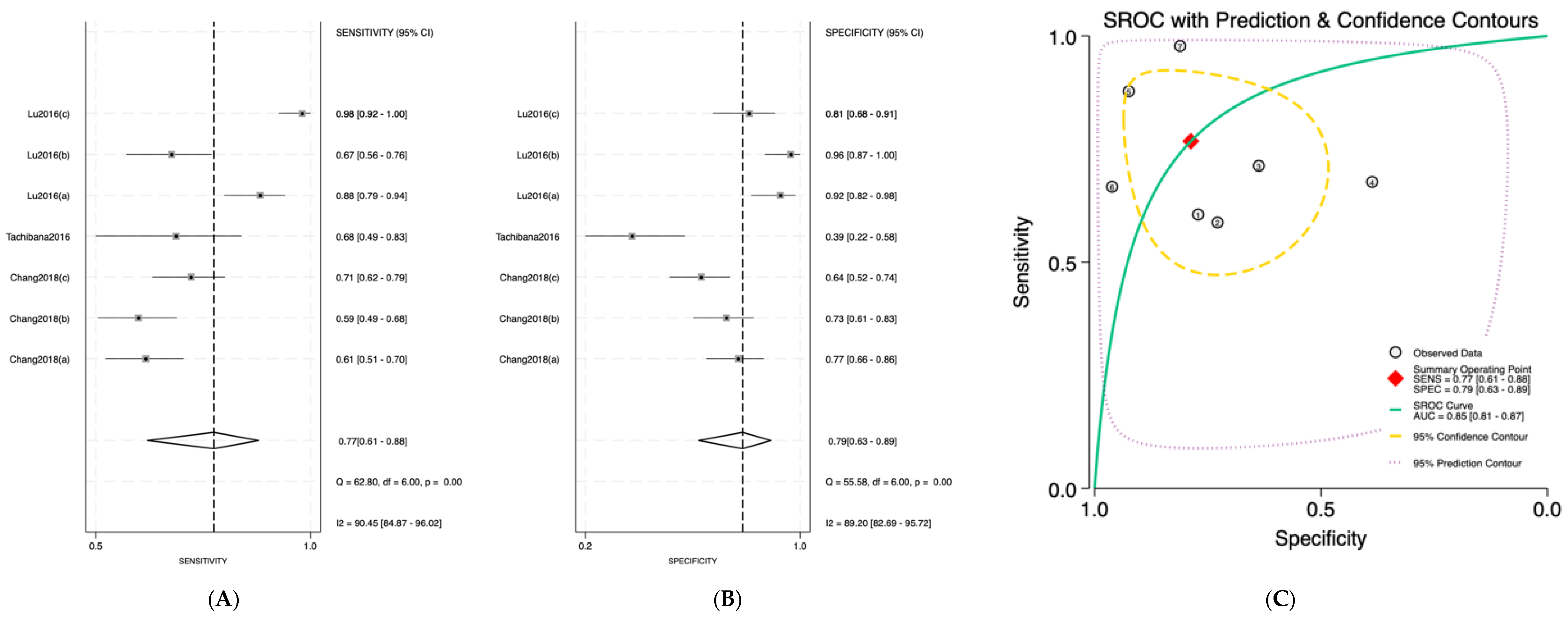
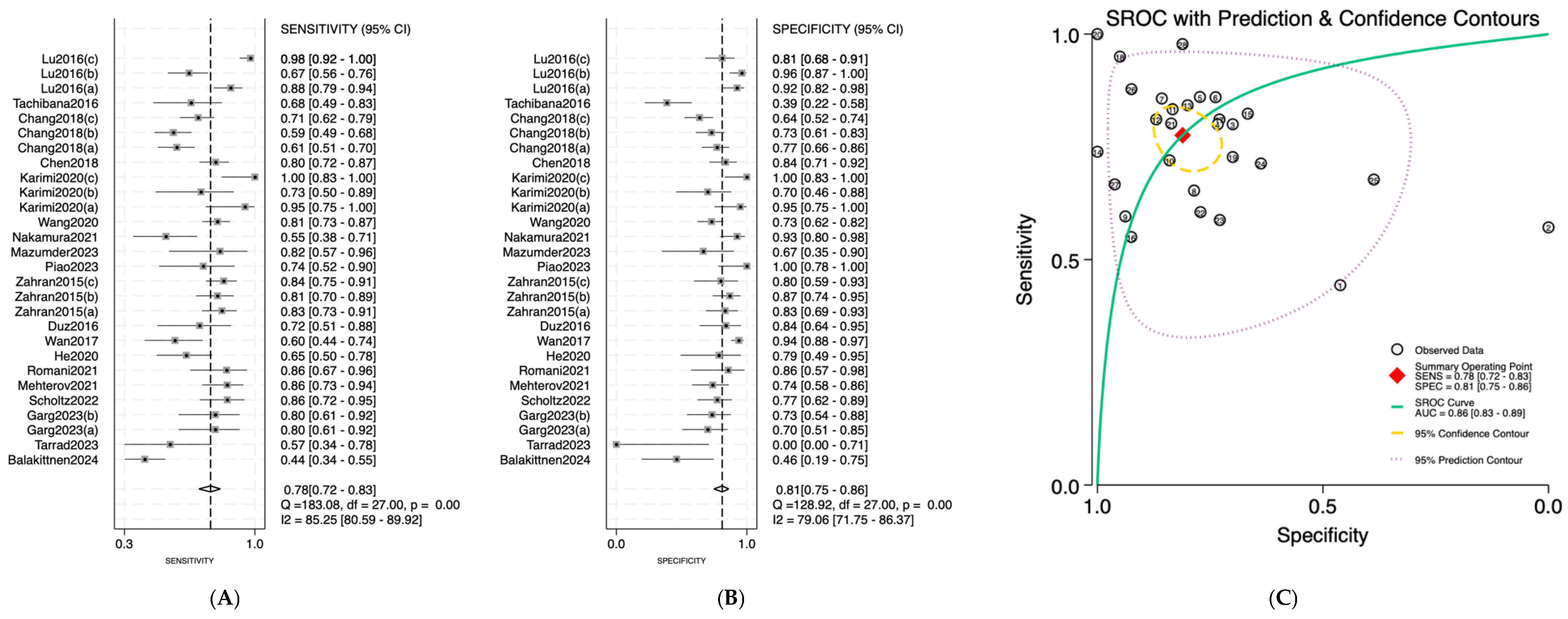
| Balakittnen et al. [19] | 43 | 7 | 6 | 54 | 86 | 90 | 87.8 | 88.5 | 0.95 |
| Tarrad et al. [20] | 12 | 3 | 0 | 9 | 100 | 70.8 | 63.2 | 100 | 0.90 |
| Garg et al. [21] | 24 | 9 | 21 | 6 | 80 | 70 | 72 | 79 | 0.89 |
| Garg et al. [21] | 24 | 8 | 22 | 6 | 80 | 74 | 75 | 79 | 0.87 |
| Scholtz et al. [22] | 37 | 10 | 34 | 6 | 86 | 77 | 78.7 | 85 | 0.87 |
| Mehterov et al. [23] | 43 | 11 | 31 | 7 | 86 | 74 | 79.6 | 81.6 | 0.82 |
| Romani et al. [24] | 24 | 2 | 12 | 4 | 85.4 | 85.1 | 92.3 | 75 | 0.92 |
| He et al. [25] | 32 | 3 | 11 | 17 | 64.4 | 80 | 91 | 39 | 0.74 |
| Wan et al. [26] | 28 | 7 | 106 | 19 | 60 | 94 | 80 | 85 | 0.82 |
| Duz et al. [27] | 18 | 4 | 21 | 7 | 75 | 84 | 82 | 75 | 0.81 |
| Zahran et al. (a) [28] | 65 | 7 | 35 | 13 | 65 | 65 | 90 | 73 | 0.73 |
| Zahran et al. (b) [28] | 60 | 6 | 40 | 14 | 60 | 70 | 91 | 74 | 0.68 |
| Zahran et al. (c) [28] | 80 | 5 | 20 | 15 | 80 | 75 | 94 | 57 | 0.86 |
| Piao et al. [29] | 17 | 0 | 15 | 6 | 97.8 | 73.9 | 100 | 71 | 0.90 |
| Mazumder et al. [30] | 14 | 4 | 8 | 3 | 80 | 64.3 | 77.8 | 72.7 | 0.72 |
| Nakamura et al. [31] | 22 | 3 | 37 | 18 | 55 | 92.5 | 88 | 67.3 | 0.84 |
| Wang et al. [32] | 107 | 23 | 62 | 25 | 81.2 | 72.7 | 82.3 | 71.3 | 0.85 |
| Karimi et al. (a) [33] | 19 | 1 | 19 | 1 | 95 | 95 | 95 | 95 | 0.95 |
| Karimi et al. (b) [33] | 16 | 6 | 14 | 6 | 80 | 70 | 73 | 70 | 0.75 |
| Karimi et al. (c) [33] | 20 | 0 | 20 | 0 | 100 | 100 | 100 | 100 | 1.00 |
| Chen et al. [34] | 97 | 9 | 46 | 24 | 80.2 | 83.6 | 92 | 66 | 0.91 |
| Chang et al. (a) [35] | 69 | 16 | 54 | 45 | 61 | 77 | 81 | 55 | 0.7 |
| Chang et al. (b) [35] | 67 | 19 | 51 | 47 | 59 | 73 | 70 | 61 | 0.68 |
| Chang et al. (c) [35] | 82 | 29 | 51 | 33 | 71 | 73 | 74 | 61 | 0.75 |
| Tachibana et al. [36] | 21 | 19 | 12 | 10 | 67.7 | 61.3 | 64 | 66 | 0.70 |
| Lu et al. (a) [37] | 79 | 4 | 49 | 11 | 87.8 | 92.5 | 95 | 92.5 | 0.96 |
| Lu et al. (b) [37] | 60 | 2 | 50 | 30 | 67 | 96 | 97 | 63 | 0.85 |
| Lu et al. (c) [37] | 88 | 10 | 43 | 2 | 98 | 81 | 90 | 96 | 0.96 |
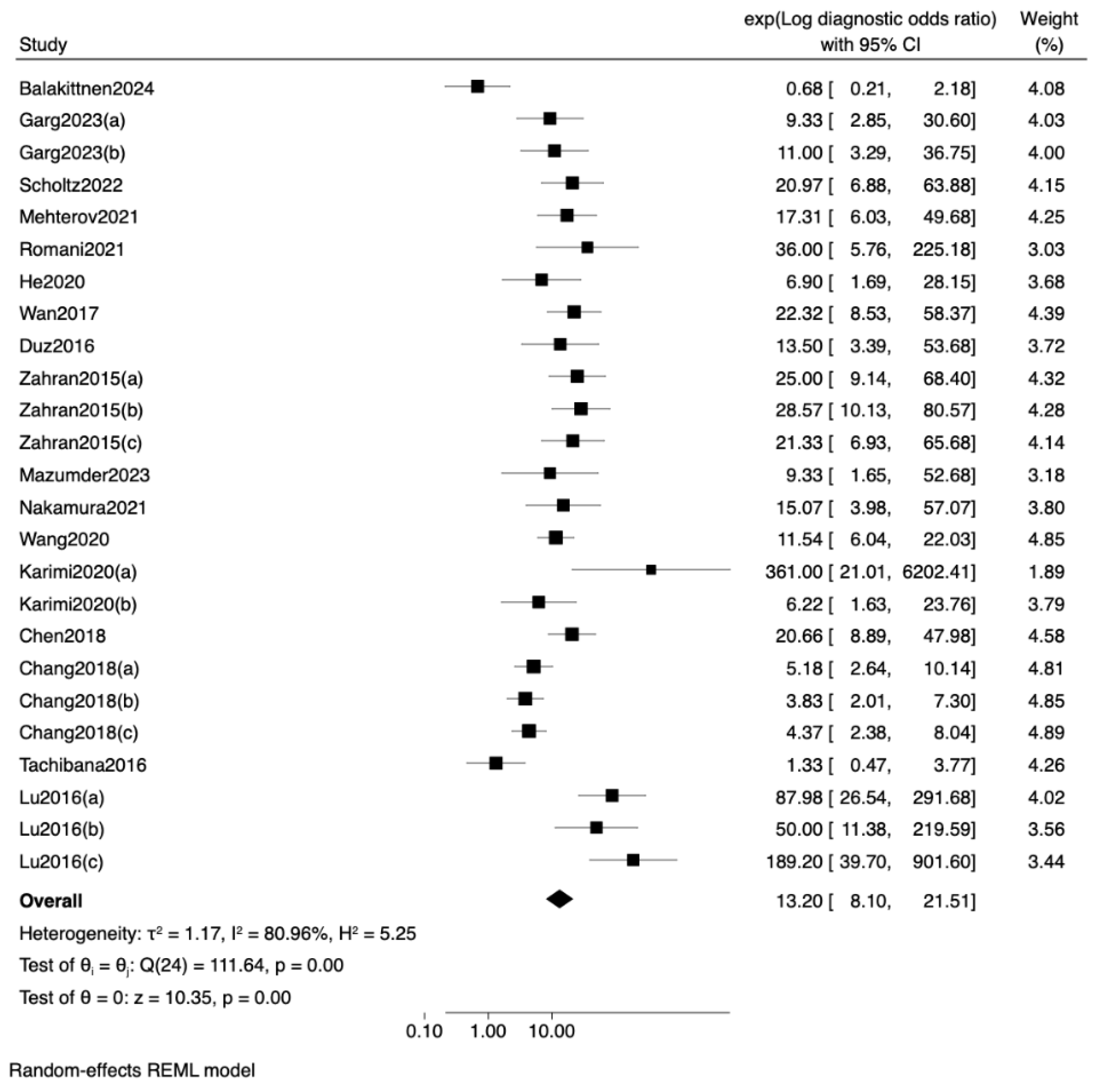
| Biofluid | Coefficient (lnDOR) | Exp(b) (DOR Ratio) | 95% CI (exp) | p-Value | Interpretation |
|---|---|---|---|---|---|
| Saliva (reference) | – | – | – | – | Baseline category |
| Serum | 0.3277 | 1.38 | 0.33–5.80 | 0.653 | No significant difference vs saliva |
| Plasma | 0.1256 | 1.13 | 0.35–3.72 | 0.836 | No significant difference vs saliva |
| Intercept (_cons) | 2.4538 | 11.63 | 4.57–29.64 | <0.001 | Pooled DOR (saliva reference) |
Disclaimer/Publisher’s Note: The statements, opinions and data contained in all publications are solely those of the individual author(s) and contributor(s) and not of MDPI and/or the editor(s). MDPI and/or the editor(s) disclaim responsibility for any injury to people or property resulting from any ideas, methods, instructions or products referred to in the content. |
© 2026 by the authors. Licensee MDPI, Basel, Switzerland. This article is an open access article distributed under the terms and conditions of the Creative Commons Attribution (CC BY) license.
Share and Cite
Wijaya, A.; Julia, V.; Soedarsono, N.; Fath, T.; Brahma, B.; Soeratman, A.R.; Purwanto, D.J.; Higashi, Y.; Miyakoshi, M.; Sugiura, T. Comparative Meta-Analysis: Salivary, Plasma, and Serum miRNA Profiles for Oral Squamous Cell Carcinoma Detection. J. Pers. Med. 2026, 16, 52. https://doi.org/10.3390/jpm16010052
Wijaya A, Julia V, Soedarsono N, Fath T, Brahma B, Soeratman AR, Purwanto DJ, Higashi Y, Miyakoshi M, Sugiura T. Comparative Meta-Analysis: Salivary, Plasma, and Serum miRNA Profiles for Oral Squamous Cell Carcinoma Detection. Journal of Personalized Medicine. 2026; 16(1):52. https://doi.org/10.3390/jpm16010052
Chicago/Turabian StyleWijaya, Arbi, Vera Julia, Nurtami Soedarsono, Turmidzi Fath, Bayu Brahma, Alif Rizqy Soeratman, Denni Joko Purwanto, Yutaro Higashi, Masaaki Miyakoshi, and Tsuyoshi Sugiura. 2026. "Comparative Meta-Analysis: Salivary, Plasma, and Serum miRNA Profiles for Oral Squamous Cell Carcinoma Detection" Journal of Personalized Medicine 16, no. 1: 52. https://doi.org/10.3390/jpm16010052
APA StyleWijaya, A., Julia, V., Soedarsono, N., Fath, T., Brahma, B., Soeratman, A. R., Purwanto, D. J., Higashi, Y., Miyakoshi, M., & Sugiura, T. (2026). Comparative Meta-Analysis: Salivary, Plasma, and Serum miRNA Profiles for Oral Squamous Cell Carcinoma Detection. Journal of Personalized Medicine, 16(1), 52. https://doi.org/10.3390/jpm16010052