This is an early access version, the complete PDF, HTML, and XML versions will be available soon.
Review

Beyond Oral Health: Personalized Strategies for Managing Oral Infections in Neutropenic Patients


by
Anca Elena Duduveche
1,*,
Luminita Ocroteala
2 and
Adina Andreea Mirea
3
1
Department of Infectious Diseases, University of Medicine and Pharmacy of Craiova, 200349 Craiova, Romania
2
Department of Hematology, Municipal Clinical Hospital Filantropia Craiova, 200143 Craiova, Romania
3
Department of Oro-Dental Prevention, University of Medicine and Pharmacy of Craiova, 200349 Craiova, Romania
*
Author to whom correspondence should be addressed.
J. Pers. Med. 2026, 16(1), 53; https://doi.org/10.3390/jpm16010053
Submission received: 16 October 2025 / Revised: 12 December 2025 / Accepted: 8 January 2026 / Published: 16 January 2026
(This article belongs to the Special Issue Advances in Oral Health: Innovative and Personalized Approaches)

Abstract

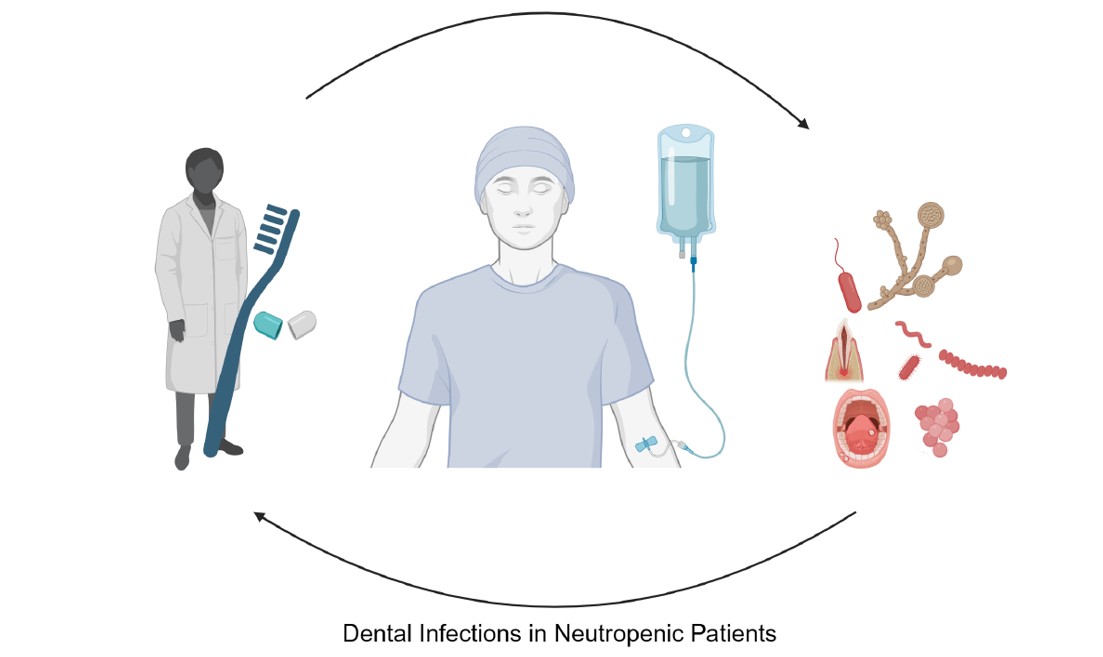
Oral infections in neutropenic patients are an underestimated but likely fatal cause of infectious complications, with clinical manifestations often diminished or absent due to immune deficiency. The evaluation and management of these infections requires a personalized multidisciplinary strategy, including prevention through pre-therapy dental assessment, individualized oral hygiene protocols, and rapid treatment of dental lesions. Antimicrobial strategies should be adapted not only to the local resistance profile and individual risk, with a priority on antibiotic stewardship and rapid de-escalation when possible, but also to individual patterns of colonization and comorbidities. Dental procedures can be performed without risk in neutropenic patients with a low complication rate, but further studies are key to stratifying risk. Future research directions include the application of artificial intelligence for infectious risk stratification, the use of salivary or microbiome biomarkers for early detection, and the development of innovative technologies for targeted antimicrobial delivery. This narrative review aims to provide an overview of the common clinical manifestations in neutropenic patients and also the potential progression of dental infections into sepsis in this category of patients.
Keywords: neutropenic; oral infections; procedures; antibiotic stewardship; personalized medicine; risk stratification neutropenic; oral infections; procedures; antibiotic stewardship; personalized medicine; risk stratification
Graphical Abstract